Feeds:
Posts
Comments

Archive for the ‘Humor’ Category

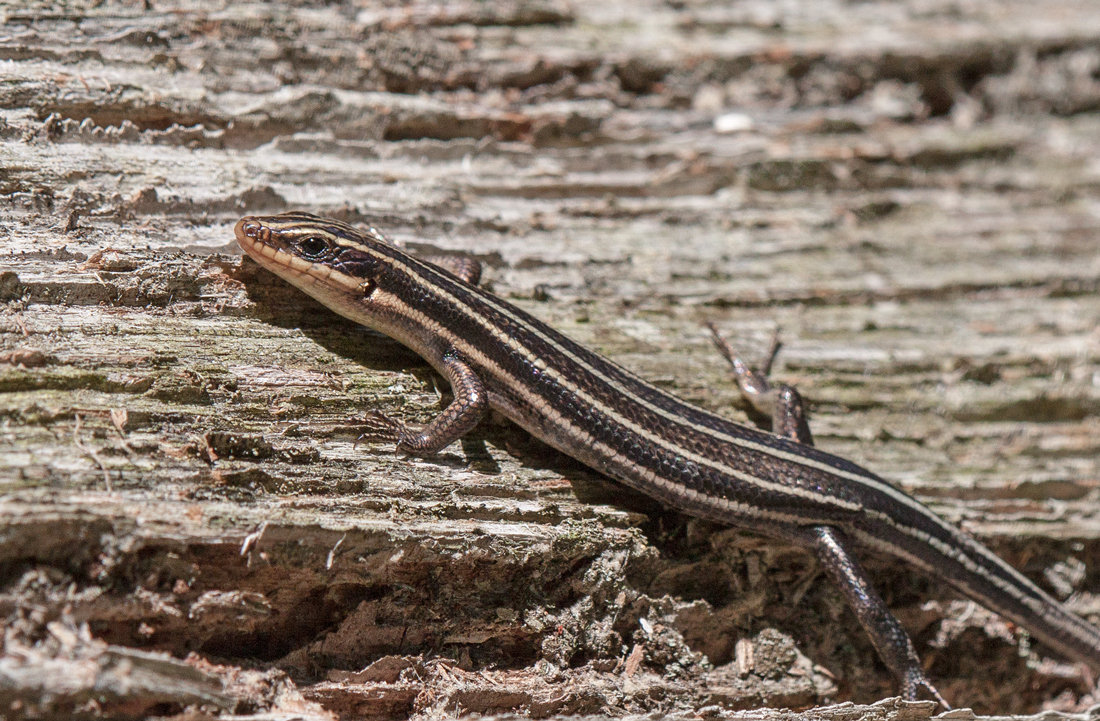
Is it just me, or does the word “skink” sound funny to you? Certain words simply sound odd to me and for some reason “skink” is one of them—I can’t help but smile whenever I say the word out loud.

Recently I took this shot of a Common Five-lined Skink (Plestiodon fasciatus, formerly Eumeces fasciatus) at my local marshland park. It was sunning itself on a rotten log and didn’t detect my presence immediately and run away, which is what usually happens when I spot a skink. It seems to have its head cocked a little and has a smile on its face, as though daydreaming, as I do when sunbathing.
skink1_blog


I wonder if you could use “skink” as a verb to describe the crawling-type behavior typical of a skink, as in, “I saw my friend skinking about.” If “skink” were a verb, would it follow the model of “drink,” with verbal forms that included “skank” and “skunk?”  That might induce a bit of confusion, I suppose, since “skank” suggests a different kind of behavior, as does “skunk.” English can be a strange language.

I’ll just continue smiling.

© Michael Q. Powell. All rights reserved.

Read Full Post »

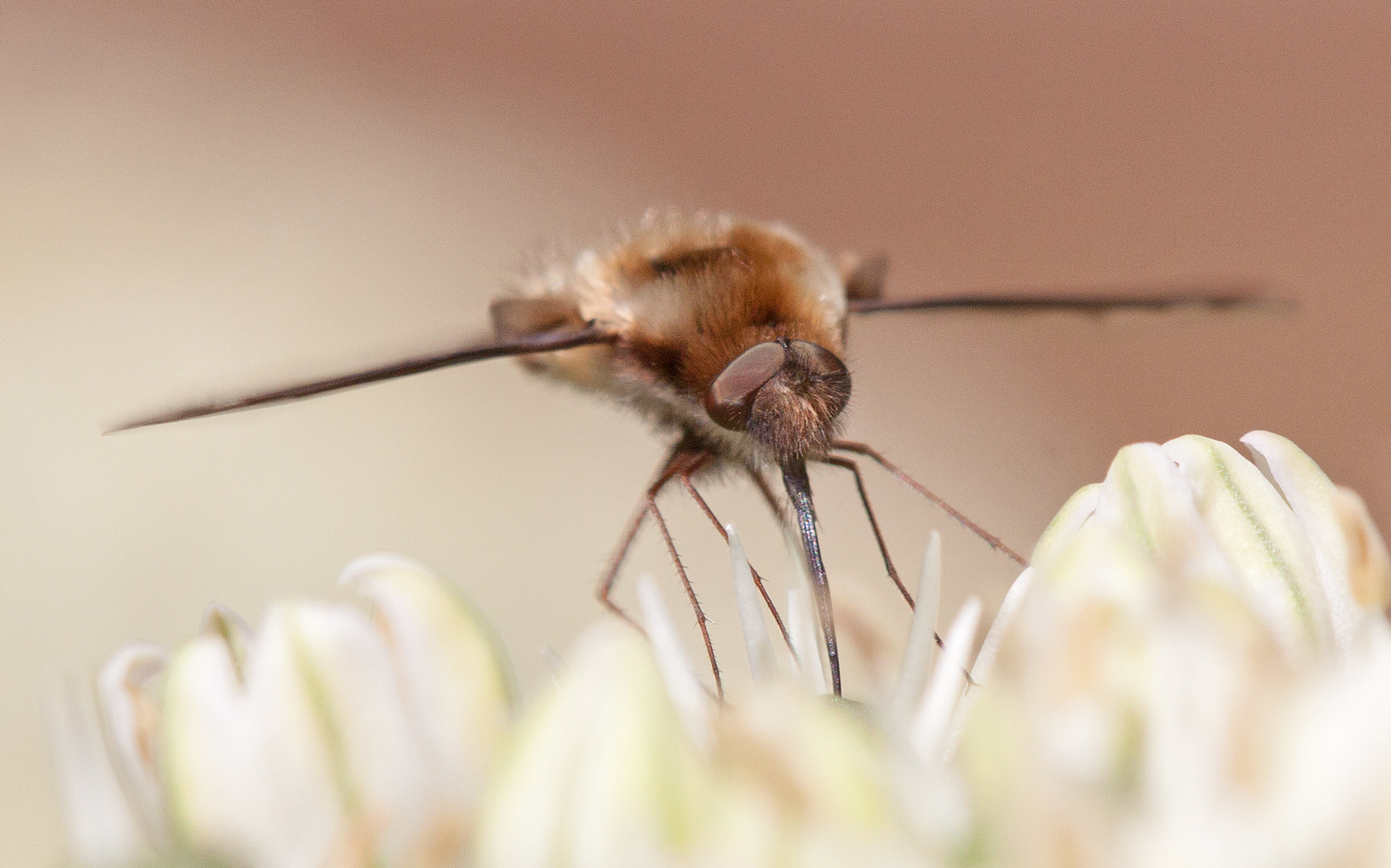
Is it a bee? Is it a fly? It’s a Greater Bee Fly (Bombylius major). What?

This bee fly has to be one of the strangest insects that I have ever seen—it looks like Doctor Frankenstein pieced together an insect from the parts of other insects. Its fuzzy body looks like that of a bee and it has a similar proboscis, though the bee fly’s proboscis seems to be outrageously long. Its long, spindly legs, however, are not bee-like and remind me of certain types of flies. The patterned wings and the way that it hovers are reminiscent of a hummingbird moth, though the bee fly is considerably smaller.

The bee fly is considered to be a bee mimic. Like a bee, it helps pollinate plants when gathering nectar.

I encountered this strange insect when I was examining the little flowers of some allium plants in the garden of my neighbor and fellow photographer and blogger Cindy Dyer. She always has interesting flowers to photograph and I have found an amazing assortment of insects in the garden too.

Greater Bee Fly on allium plant

Greater Bee Fly on allium plant


Head-on look at a bee fly

Head-on look at a bee fly

Bee Fly on allium with trellis in background

Bee Fly on allium with trellis in background

© Michael Q. Powell. All rights reserved.
 

Read Full Post »

Although I wake up to the sound of birds loudly chirping at this time of the year, it is getting increasingly difficult to see most of them as the trees regain their thick covering of leaves. The male Red-winged Blackbird (Agelaius phoeniceus) is a notable exception, because he does not hide behind the foliage. Instead, he seems to choose the highest point in the open from which to boldly make his loud calls—there is not timidity or shyness in this bird.

The blackbird puts so much energy into his “singing” that at times his perch becomes precarious. I captured this blackbird in one such moment, when his position seems so awkward and distorted that looks like a cartoon to me.

blackbird_cartoon_blog

© Michael Q. Powell. All rights reserved.

Read Full Post »

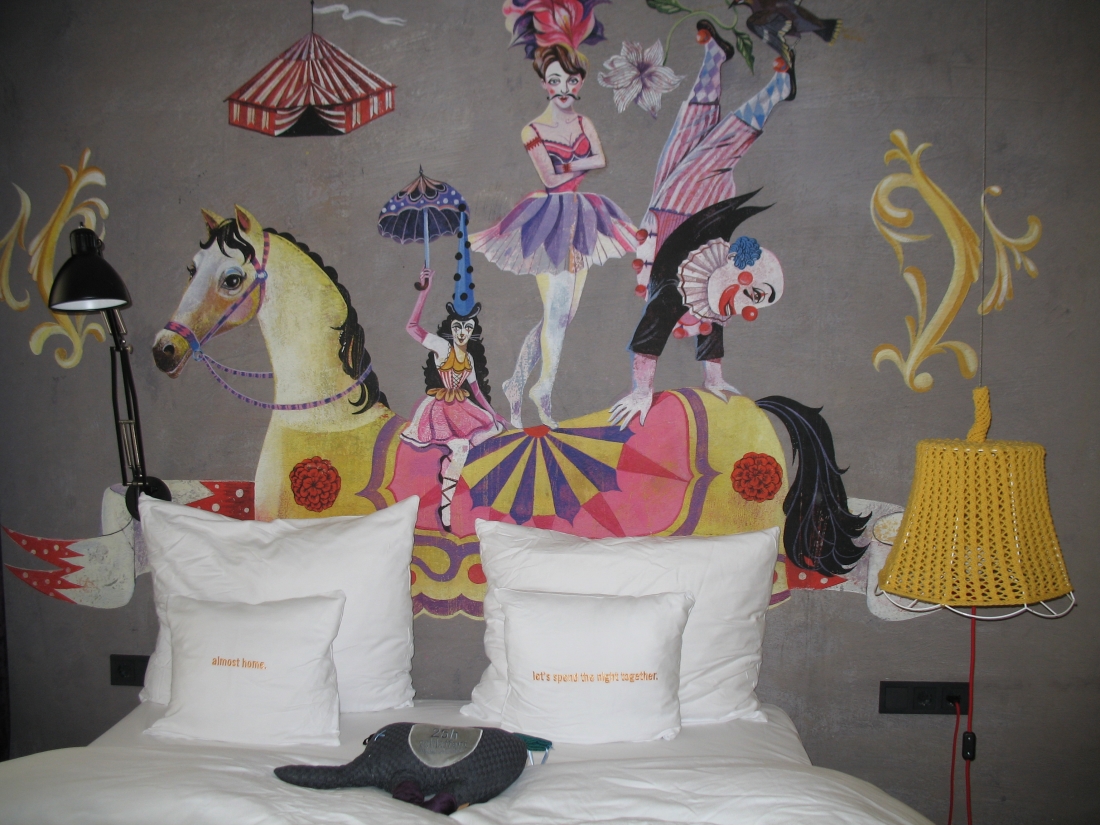
It would be somewhat of an understatement to say that my hotel in Vienna is quirky. The individual rooms are decorated with a circus motif; just above the entrance is a sign that boldly proclaims, “We are all mad here;” and the rooftop sign for the hotel announces that you should “come as you are.”

The 25 Hour Hotel in Vienna is obviously designed for a younger, more hip crowd, but I really enjoy the vibe of the hotel, even if I am outside the target demographic. Moreover, it is really conveniently located for the work I need to get done.

It’s hard to capture the feel of the hotel in a few photos, but I hope these images give you a sense of the experience that the 25 Hour Hotel provides—it’s a welcome change from the sense of faded glory that characterizes some of the older, more traditional Vienna hotels.


Headboard mural in my room

Headboard mural in my room

Large sign over hotel entrance

Large sign over hotel entrance

Hotel entrance

Hotel entrance

Rooftop hotel sign, "Come as you are."

Rooftop hotel sign, “Come as you are.”

© Michael Q. Powell. All rights reserved

Read Full Post »

Hoping to capture a shot of an osprey  (Pandion haliaetus) snagging a fish earlier this month, I started firing my camera each time the osprey dove toward the surface of the water with talons extended, but, unlike the bird, I came up empty-handed. The osprey, it turns out, was not fishing for food—it was gathering building materials for its nest. It was impressive nonetheless to watch an osprey fly up into the sky with a pretty large branch in its grasp.

Click on the photos if you want to see a higher resolution view of the images. (I am always amazed by the osprey’s yellow eyes.)

osprey_fishing1_blogosprey_fishing2_blog

© Michael Q. Powell. All rights reserved

Read Full Post »

It’s springtime and love is in the air. Two tree swallows (Tachycineta bicolor) seemed intent on getting to know each other better, but kept getting buzzed by a third swallow. A couple of times, one of the swallows, which I suspect was the male, took off and chased away the potential rival.

swalow_couple2_blogswallow_couple1_blogswallow_couple3_blog

© Michael Q. Powell. All rights reserved

Read Full Post »

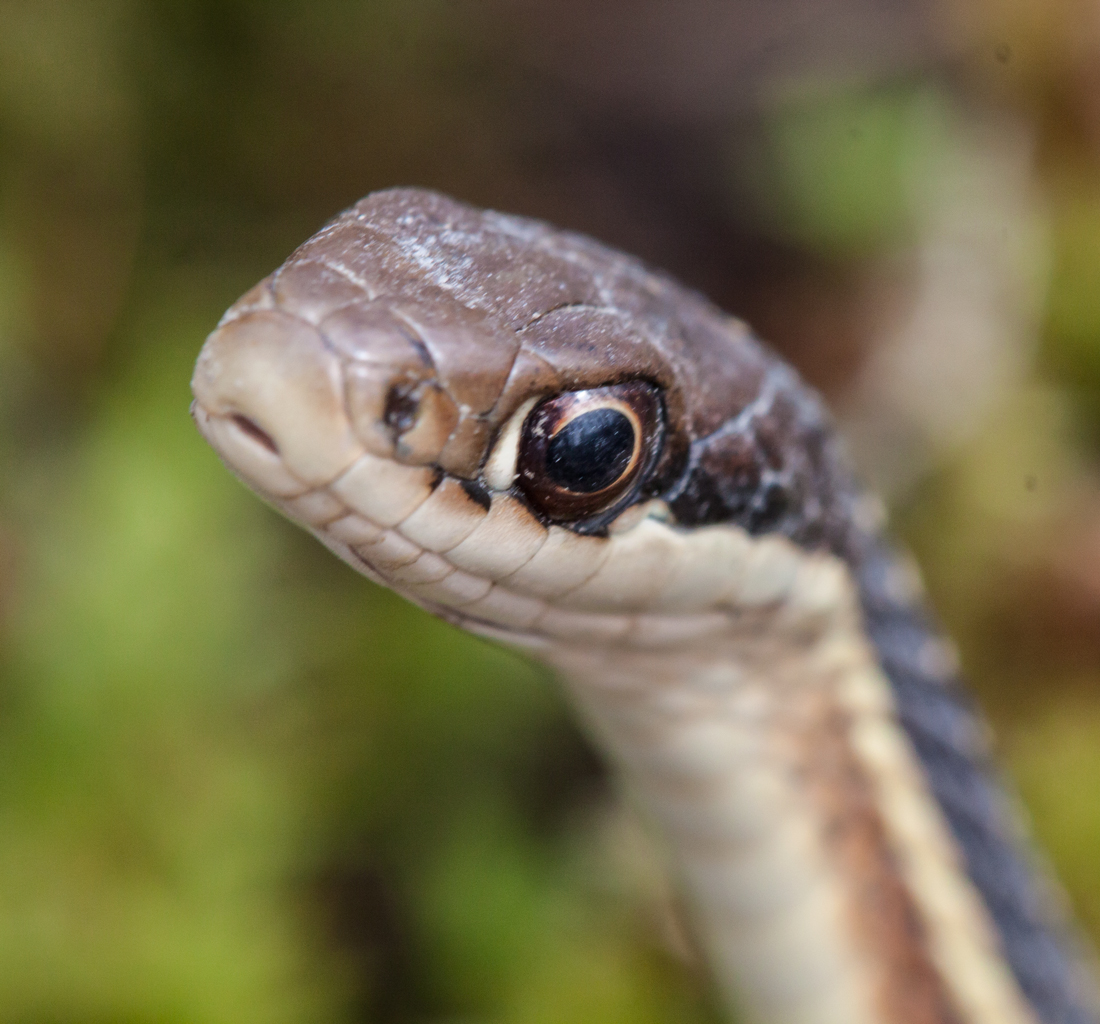
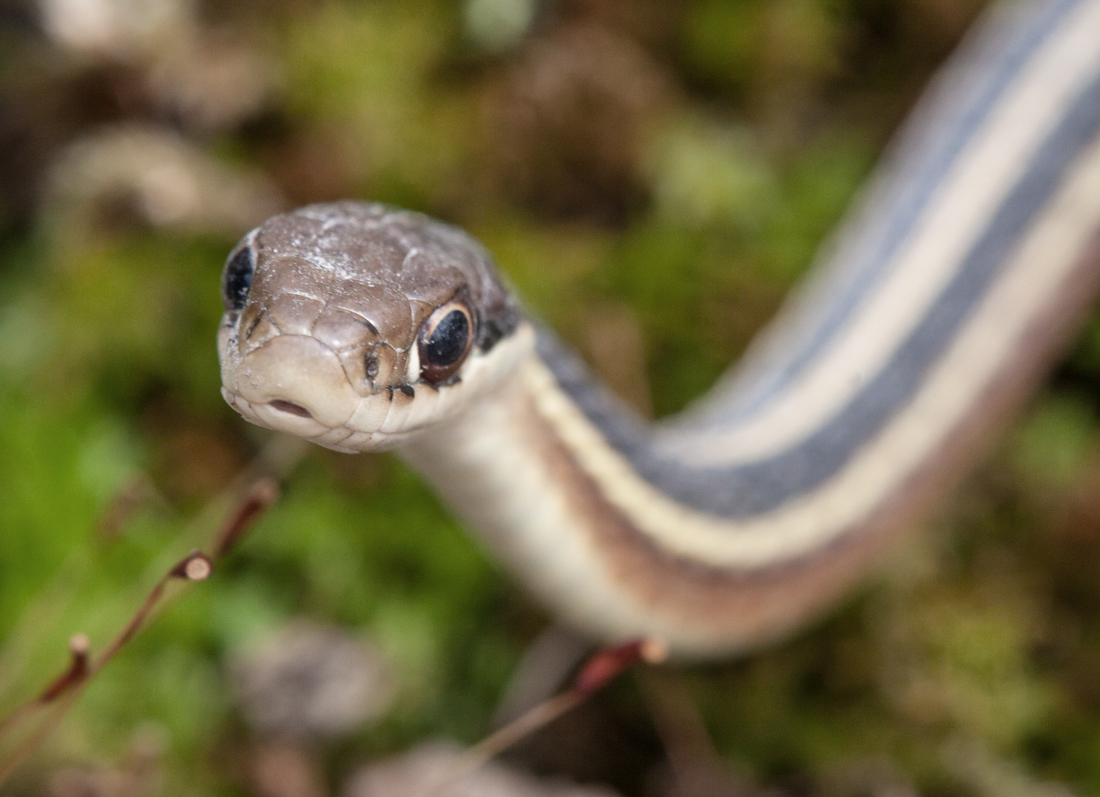
Can snakes whistle? It sure looks like this Common Ribbonsnake (Thamnophis sauritus) is trying hard to whistle as he purses his lips and seems to be blowing air in this series of shots. Who knew that snakes had lips? This snake has lips that rival those of Mick Jagger and look a bit like they were enhanced with collagen.

When you shoot subjects, how close do you get to them? My general rule for wildlife subjects is to shoot them from a distance (so I can be sure of getting a shot) and then move slowly closer and closer. I was amazed at how close this snake let me approach—this first shot was not cropped very much at all.

I like the head-and-shoulders look of the first image (taking into account the fact that snakes don’t really have shoulders), which draws attention to the snake’s eye. At times, though, I prefer the shots that show more of the snake’s body and my favorite of this group is probably the third shot. I really like the curve of the snake’s body and the tilt of its head. It’s hard to see in this reduced-size image, but two little tips of the snake’s forked tongue are visible in its partially open mouth.

snake3_march_blogsnake2a_march_blogsnake4_march_blog

© Michael Q. Powell. All rights reserved

Read Full Post »

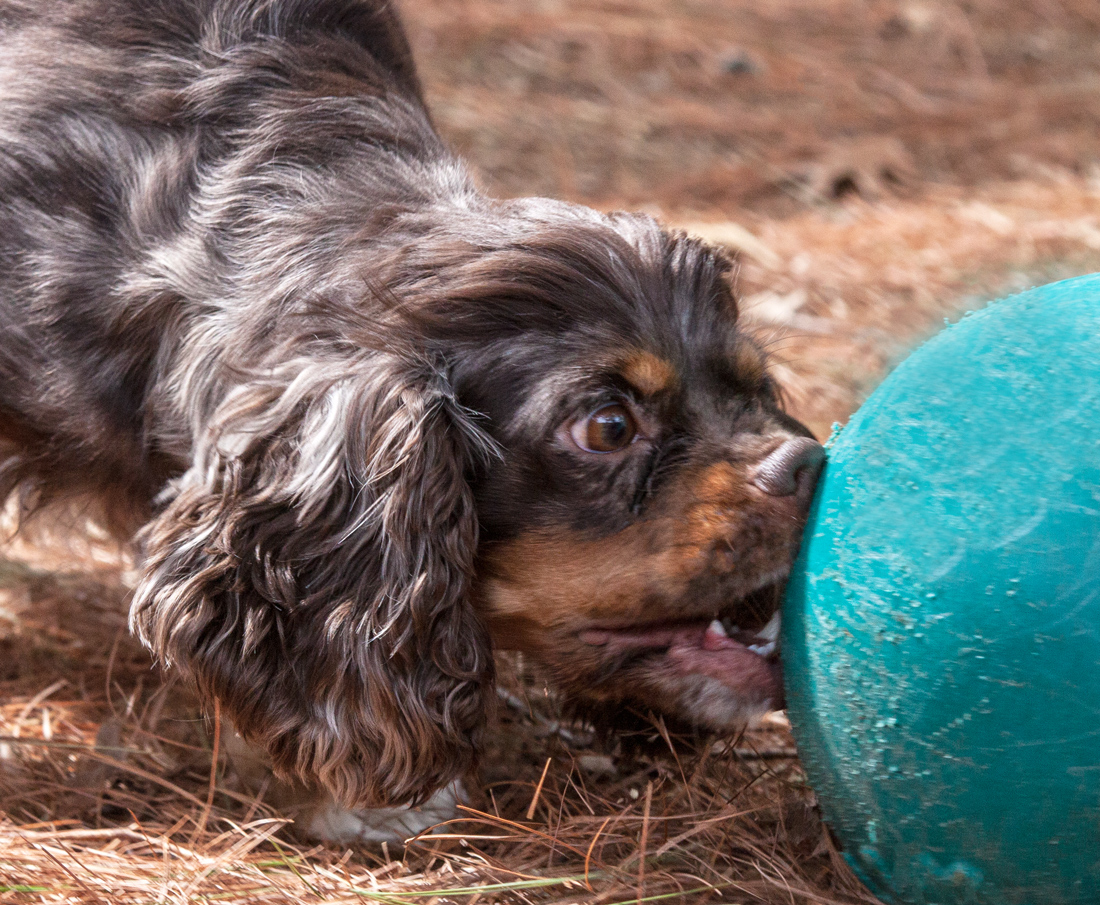
Anyone who had ever played sports has undoubtedly been told, “You have to keep your eye on the ball.” Apparently that is true for dogs too.

I took this shot of Freckles, a friend’s year-old Cocker Spaniel, as she chased a large ball in my back yard yesterday. I love the intensity of her focus, as reflected in her eyes and the expression on her entire face.

freckles_ball_blog

© Michael Q. Powell. All rights reserved

Read Full Post »

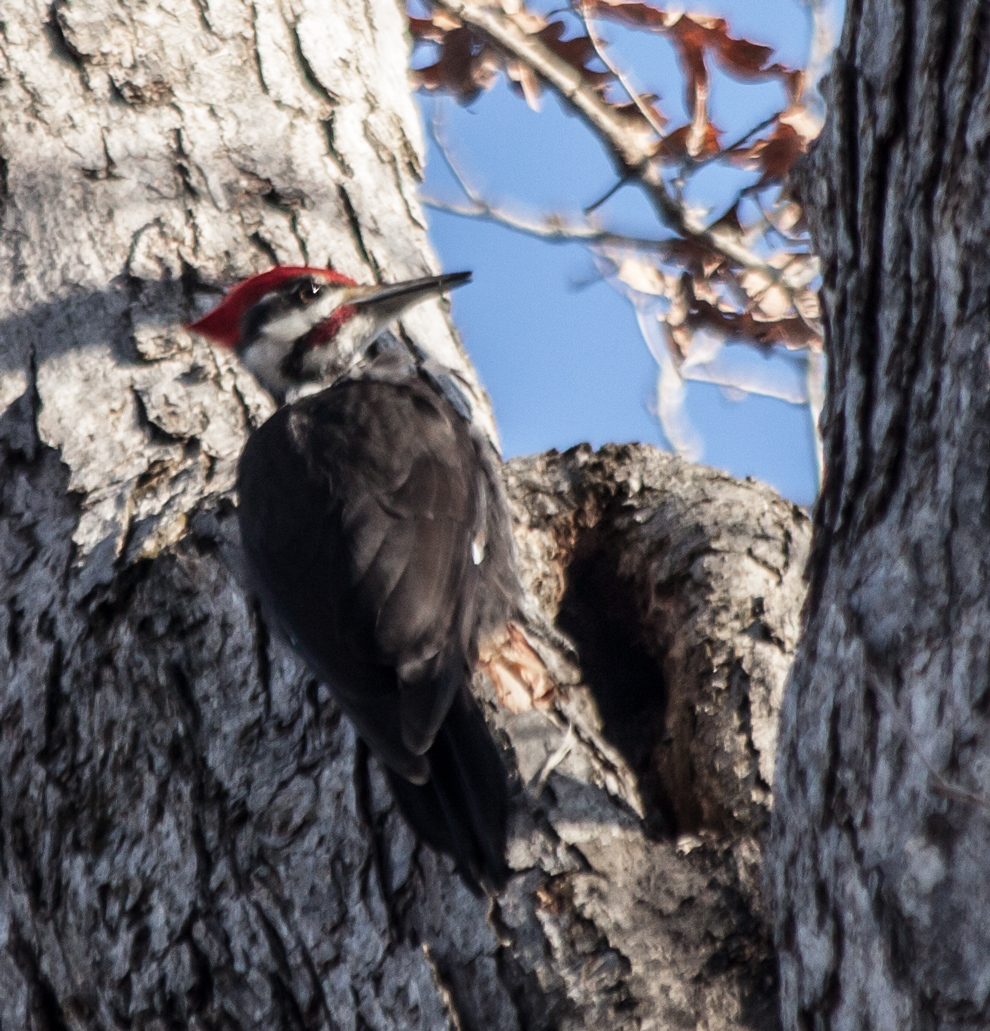
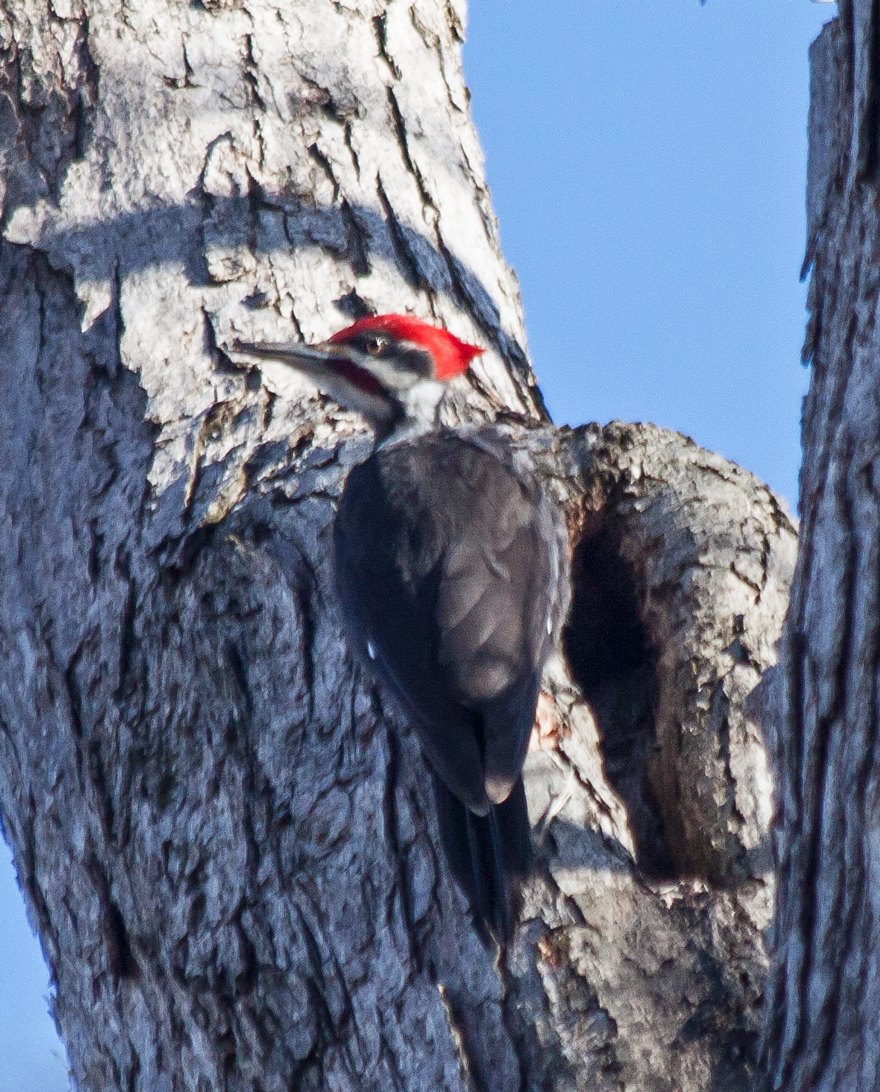
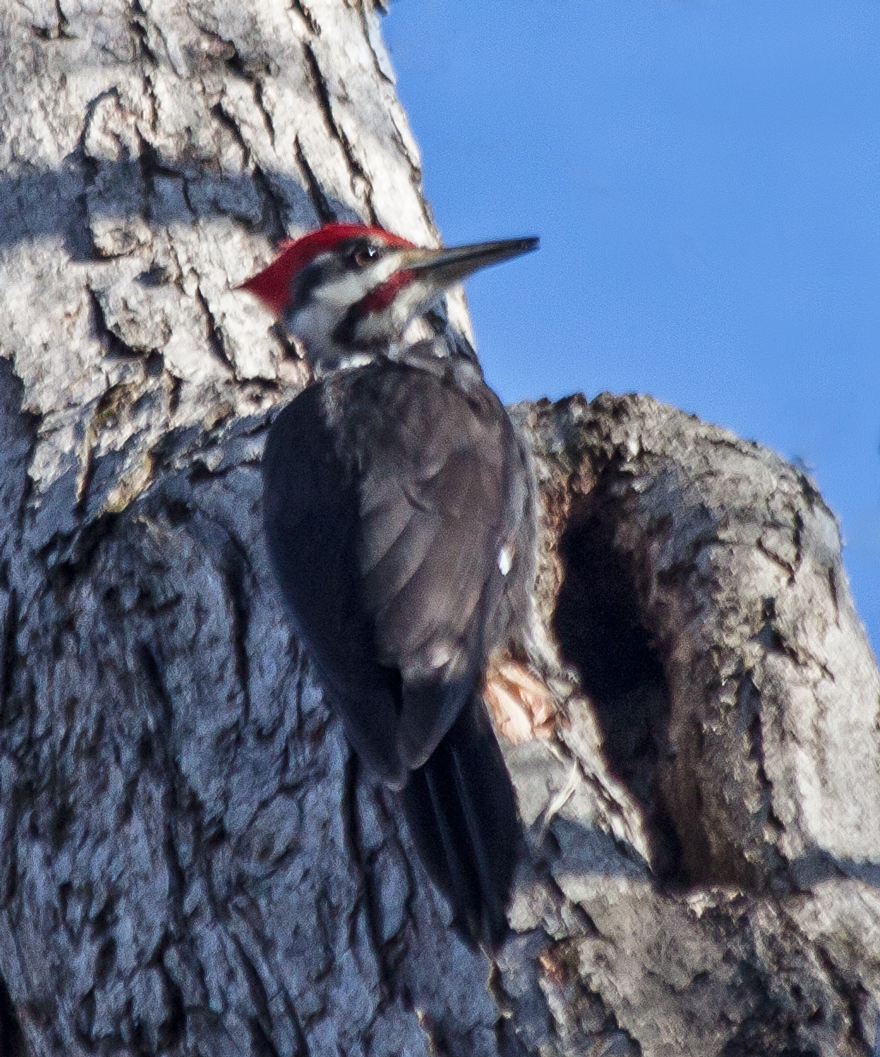
Do woodpeckers smile?

Earlier this month, I spent some time observing a Pileated Woodpecker (Dryocopus pileatus) at work, high in a tree at my local marshland park. The woodpecker would peck away for a while and then stop for a break.  As the big bird turned his head to one side or to the other, it seemed to me that its face would light up in a self-satisfied smile.

What do you think, is the woodpecker smiling or is it just my imagination, running away with me? (Sorry, I just couldn’t resist the temptations to throw in a line from a song.)

pileated4_march_blogpileated1_march_blogpileated2_march_blogpileated3_march_blog

© Michael Q. Powell. All rights reserved

Read Full Post »

Earlier this month, when the ponds were almost completely frozen over at my local marsh, I watched as some Canada Geese (Branta canadensis) zoomed across the ice at a very low altitude. It looked like they were racing each other. In the background you can see some potential spectators, but they didn’t seem to want to get caught up in a wild goose chase.

wild_goose_chase_blog

© Michael Q. Powell. All rights reserved

Read Full Post »

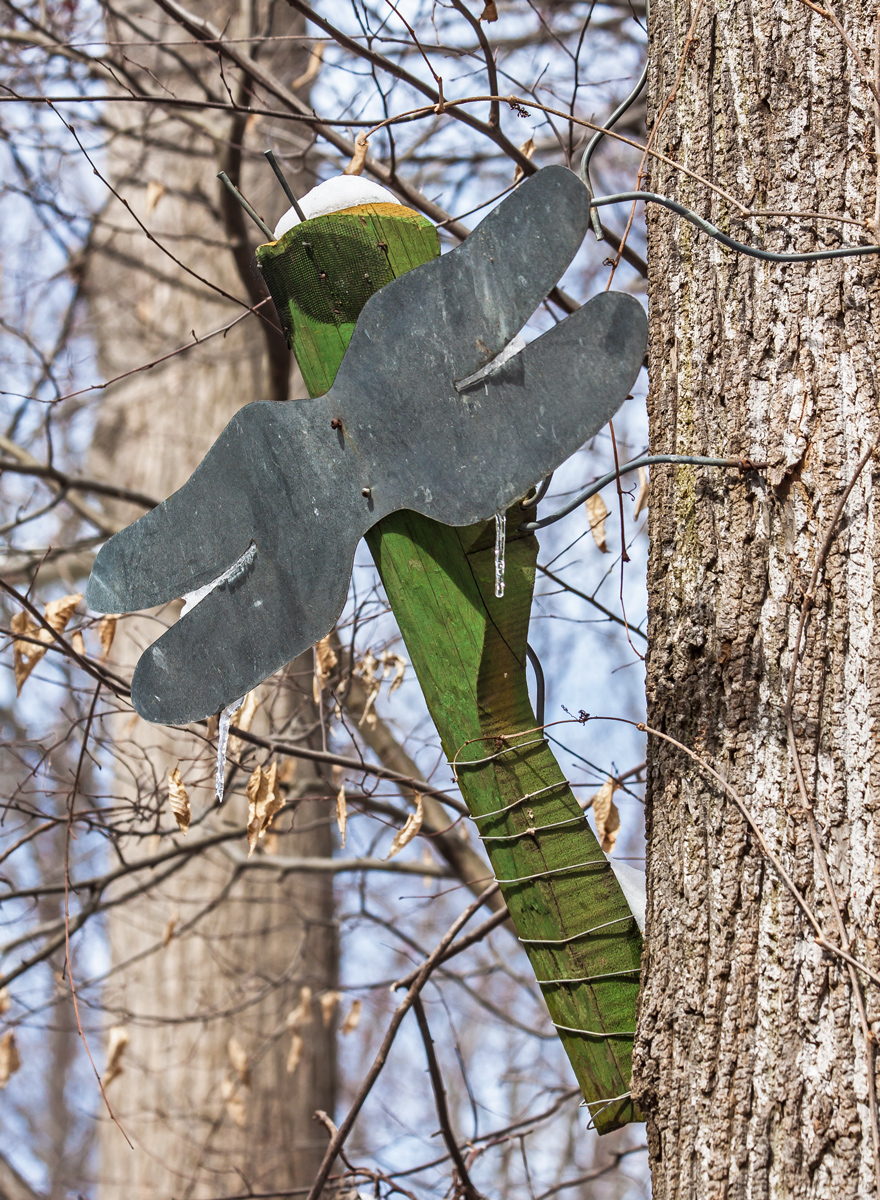
I never expected to encounter a dragonfly when I went walking in the snow in my neighborhood yesterday.

My eyes were scanning the trees for birds,  when right it front of me I detected the unmistakable shape of a dragonfly, a giant green dragonfly perched on a tree. I approached it quietly and was able to get this shot, my first shot of a dragonfly in a long time.

With snow still covering the ground and the temperatures below freezing, it’s hard to imagine that the real dragonflies will be appearing in a few short months.

dragonfly_winter_blog

© Michael Q. Powell. All rights reserved

Read Full Post »

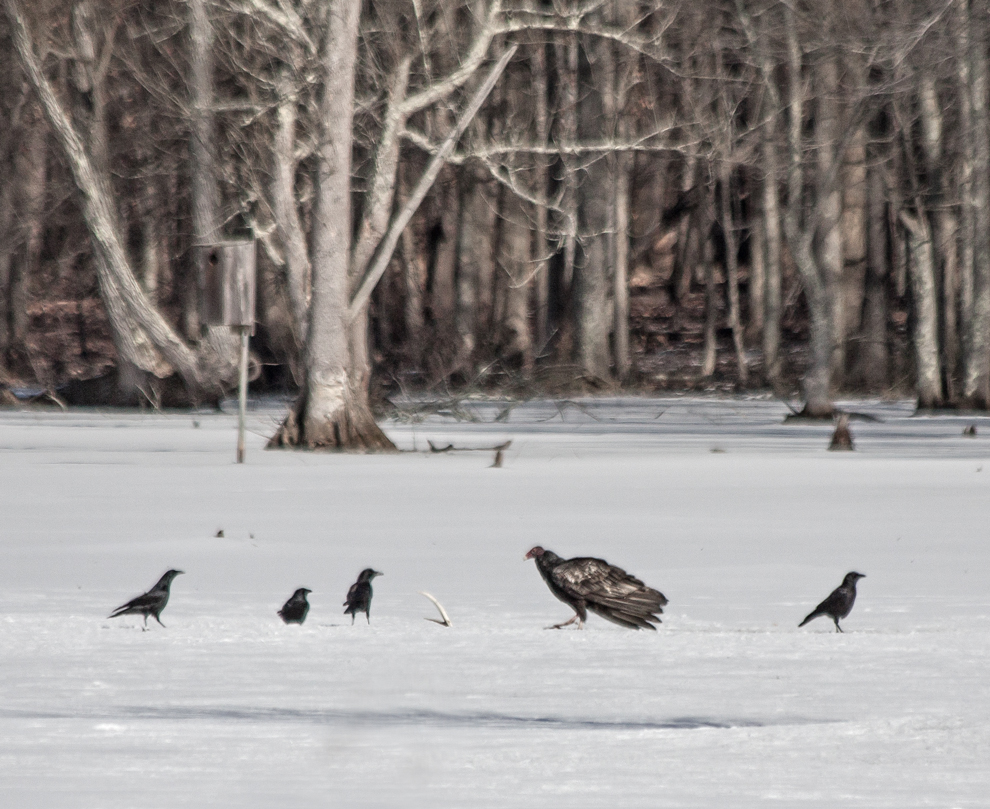
Trying to avoid an all-out turf war, the leaders of the Crows and Vultures agreed to meet, but the negotiations quickly started to break down.  What happened?vulture_crow4_blog

The leaders had agreed to meet alone in the middle of a snow-covered field.

vulture_crow2_blog

However, the Crow leader had brought reinforcements with him and the Vulture found himself outnumbered.

vulture_crow1_blog

Not wanting to show any fear, the Vulture leader decided to flex his muscles and extended his mighty wings. The Crows were not impressed and would not agree to any compromises.vulture_crow3_blogThe Vulture leader started to feel a little uncomfortable as he felt someone creeping up behind him and turned quickly to face the potential Crow assassin.

vulture_crow5_blog

Clearly, these negotiations were not going anywhere and the Vulture leader headed back to announce to his subordinates that a full-scale turf war with the Crows was about to begin.vulture_crow7_blog

© Michael Q. Powell. All rights reserved

Read Full Post »

As I was observing some mallard ducks paddling around the shallow waters of a former beaver pond yesterday, I noticed one much smaller duck in their midst that looked out of place—it was a male Green-winged Teal (Anas crecca). The little duck was acting just like the mallards, foraging for food in the water and occasionally on land as well. Had the Green-winged Teal been adopted by this group of mallards or was he merely lost and separated from his own group?

I couldn’t help but notice that most of the mallards were paired off, but the Green-winged Teal seemed to be all alone. He’s going to have to act quickly if he wants to find a sweetheart before Valentine’s Day later this week.

green-winged1_feb_blog

green-winged2_feb_blog

© Michael Q. Powell. All rights reserved

Read Full Post »

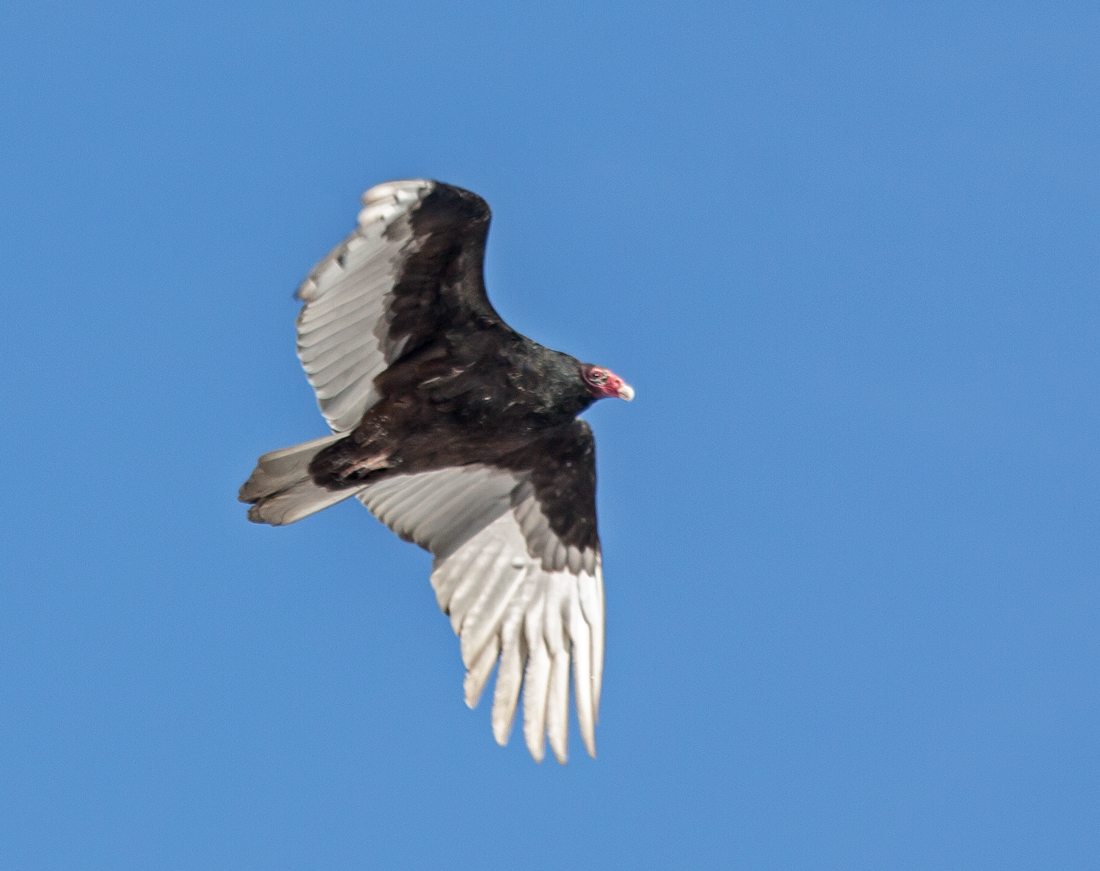
A Turkey Vulture (Cathartes aura) will never look as fierce as a hawk or an eagle and I am pretty sure that “Eye of the Vulture” won’t ever be a featured song in a Rocky movie, but there is still something disconcerting when a vulture circles close overhead, staring down in your direction.

In most of my previous shots of a Turkey Vulture, the eyes have not been visible, but on a recent sunny day, the light was good enough and the vulture came close enough for me to see the eyes, which look a little creepy. Click on the photo to see a higher resolution view of this big bird, with an impressive wingspan.

vulture_look_blog

© Michael Q. Powell. All rights reserved

Read Full Post »

When I was a college student in the 1970’s a cheap sparkling wine known as “Cold Duck” was really popular (along with Zapple, Annie Greensprings, and Boone’s Farm). Do they still produce those wines?

The title of this posting, however, refers to a bird that I observed on the ice this past weekend, not to a retro beverage.

I was struck by the contrast between the vivid colors of the male mallard duck (Anas platyrhynchos) and the drab gray and white of the frozen pond. The duck seemed to be getting into a yoga-like pose, with one foot flat on the ice and the pointed toe of the other foot providing additional stability. Wait a minute, do ducks have toes?

I also couldn’t help but notice that ducks look a lot more graceful when swimming or flying—walking looks like it would be awkward for a duck. I suspect that no composer will every produce a ballet entitled “Duck Pond,” which would scarcely provide any competition for “Swan Lake.”

In the first few days of February, our temperatures have soared over the freezing mark, but there has been little melting on the surface of the pond and I did not detect any quacks in the ice.

duck_walk_crop_blog

© Michael Q. Powell. All rights reserved

Read Full Post »

When you see a white, rounded object in a bird’s nest, your minds tends to assume that it is an egg. Of course, when it is the middle of the winter and the temperature is well below the freezing point, you know that it can’t be an egg (unless it’s from a snowbird, but I think they have already migrated south to the beaches of Florida).

I came across this little nest as I was making my way through the thorny vines at the edge of one of the ponds at my local marshland park. I still have trouble identifying many birds and I haven’t the slightest clue about what kind of bird would use a nest like this.

Still, this nest caught my eye as a kind of visual reminder that spring will arrive in just a few months, full of the promise of new life.

nest_blog

© Michael Q. Powell. All rights reserved

Read Full Post »

Words exist in a cultural context and here in Brussels, perhaps nobody smiles when they pass this sign for the “Bimbo Fashion Store.” As an American male, though, my imagination goes into overdrive as I imagine the type of clothing that would be deemed suitable fashion for a bimbo. Tight jeans and a tube top? Plunging necklines?

bimbo_blog

© Michael Q. Powell. All rights reserved

Read Full Post »

What kind of music can they possibly play in a place that advertises itself as an Irish pub disco bar?

I did a double-take when I saw this sign as I was walking around in the center of Brussels and suffered a moment of cognitive dissonance—there is little room for overlap in my preconceived notions of the clientele of an Irish pub and that of a disco bar and the main activities seem different too.

I wonder if the pub has a big mirrored ball hanging from the ceiling.

pub_blog

© Michael Q. Powell. All rights reserved

Read Full Post »

This past weekend I caught a glimpse of a fox in motion at Huntley Meadows Park—I’m pretty sure it was doing the foxtrot. I was staring across a mostly frozen beaver pond, when suddenly this red fox (Vulpes vulpes) burst into my field of view. It was running slowly around one edge of the pond, heading in the direction of a wooded area.

I didn’t have much time to react, so I had to make do with the existing camera settings. The exposure was dialed in about right and the shutter speed was fast enough. What I didn’t realize at that moment, though, was that I was in servo mode, because I had been shooting some geese in flight, so I was happy that I somehow managed to lock the focus on the moving fox pretty well. I was a little chagrined after the fact to realize that my zoom lens had not been fully extended—the images were shot at about 200mm on a 70-300mm lens.

I did get some action shots of the fox, but the first image is my favorite. The fox had paused for a split second and was looking back in the direction from which it had come and there is a lot of facial detail.

It’s especially fascinating for me to see the position of the bushy tail when the fox was moving. Often it seems like the tail is parallel to the ground. It’s cool too that I was able to catch the fox in mid-jump, with its feet almost entirely in the air. The snow is mostly gone from the ground today, so I am particularly thankful that I was able to capture some images of this brief encounter with the fox in a wintery scene.

fox_looking_back_blog fox_trot1_blogfox_trot2_blog

fox_trot3_blog© Michael Q. Powell. All rights reserved

Read Full Post »

The weathermen thought the snowstorm that is now dumping a lot of snow on the Northeast would skirt around us, but they were wrong—I ended up shoveling a couple of inches of the white stuff yesterday evening and this morning. So, I decided to post this photo of a male Northern Shoveler (Anas clypeata) that I took on New Year’s Day, in honor of all of the shovelers in the north that will be busy today.

I remember well the first time I saw a Northern Shoveler last winter. At first I thought it was a Mallard, but then I got a look at the elongated bill, which still seems cartoonish to me. In this image, I really like the way that you can see the shape of the duck’s bill in the reflection in the water.

Our storm started out with rain and then turned to snow and everything is now frozen solid. With strong gusts of wind and a current temperature of 18 degrees (about minus 8 C), I may stick close to home today, but hope to get some shots of the snow.

shoveler1_blog

© Michael Q. Powell. All rights reserved

Read Full Post »

The title for this visual pun immediately came to mind when I first saw the photo—I can’t help myself when it comes to puns.

For the record, the colorful duck in the foreground is a male Northern Shoveler (Anas clypeata) and the two in the background are male Green-Winged Teals (Anas carolinensis).

As the new year begins, should I be getting my ducks in a row?

ducks_row_blog

© Michael Q. Powell. All rights reserved

Read Full Post »

Have you ever seen a bird that looked like it was wearing a costume? When I caught sight of  this female Red-winged Blackbird (Agelaius phoeniceus) in the cattails last week, it looked to me like she had donned a large head scarf and an additional coat of feathers as protection from the cold.

blackbird_feathers_blog

© Michael Q. Powell. All rights reserved

Read Full Post »

Peering through my telephoto lens at this tiny bird, I couldn’t help but smile—its energetic personality, round body, and tiny wings and tail were cartoon-like.  It looked like a wren, but it certainly didn’t resemble the Carolina Wrens that I am used to seeing.

I did a little research and have concluded that this is probably a Winter Wren (Troglodytes hiemalis). According to the Cornell Lab of Ornithology, these little birds are “incomparably energetic in voice” and per unit weight deliver their songs with ten times more power than a crowing rooster. I can only imagine groups of scientists with tiny scales and microphones conducting the research to back up that statement.

I noted on the statistics page of my blog that this will be posting number 1,000. I never imagined how much I would come to enjoy the process of blogging when I started this blog on July 7, 2012 with a photo of a Blue Dasher dragonfly. The support and encouragement from innumerable readers has helped to sustain me on my journey into photography. Thanks to all of you.

The journey continues.

winter_wren2_blogwinter_wren1_blog

© Michael Q. Powell. All rights reserved.

Read Full Post »

I don’t know what it was about Autumn Meadowhawk dragonflies, but they really seemed to like to perch on me during several sessions when I was stalking them with fellow photographer and blogger Walter Sanford, who was able to capture shots of them (including mating pairs) on various parts of my clothing and body. His shots are wonderful and provide some great views of these colorful dragonflies, which seem to have disappeared with the arrival of frigid weather in our area.

waltersanford's avatarwalter sanford's photoblog

Autumn Meadowhawk dragonflies (Sympetrum vicinum) like Mike! Mike Powell, that is, a.k.a. “Meadowhawk Mike.” The following photos were taken at Huntley Meadows Park on 15 November 2013. Each set of images, or individual image, features a different dragonfly (or dragonflies) perching on Mike at various times during the day. Disclaimer: No dragonflies were either injured or killed in the making of these photos.

Now you see it; now you don’t! A male dragonfly perching on Mike’s shoulder, that is. Or was.


A time-series of images showing a mating pair in tandem. Mating pairs are usually more skittish than this male and female.


Sometimes the same dragonfly — or more than one dragonfly — perched in different places.


Another male, testing a couple of perching places.


A male on Mike’s arm.


This isn’t an optical illusion — a male dragonfly actually is…

View original post 133 more words

Read Full Post »

Could this be the mascot for a new line of clothing or shoes? Dragonfly photographer extraordinaire Walter Sanford took these shots of a beautiful female Autumn Meadowhawk perched on my hand as I tried to move it closer to the messenger bag in which I carry my camera gear.

waltersanford's avatarwalter sanford's photoblog

The preceding gallery shows a female Autumn Meadowhawk dragonfly (Sympetrum vicinum), spotted at Huntley Meadows Park on 15 November 2013. She is perching on the hand of Mike Powell, fellow wildlife photographer and blogger. This individual is not the female featured in my last post, “Champion dragonfly.”

Copyright © 2013 Walter Sanford. All rights reserved.

View original post

Read Full Post »

Fellow photographer and blogger, Walter Sanford, has an incredible talent for capturing photos of dragonflies, in this case one that was perched on the sleeve of my sweatshirt.

waltersanford's avatarwalter sanford's photoblog

The following gallery features photos of the undisputed champion dragonfly!

This individual is a female Autumn Meadowhawk dragonfly (Sympetrum vicinum), spotted at Huntley Meadows Park on 15 November 2013. She is perching on the sleeve of Mike Powell’sChampion USA sweatshirt.

Hey Champion, how ’bout a little something, you know, for the product placement in my photos?

Copyright © 2013 Walter Sanford. All rights reserved.

View original post

Read Full Post »

Blue Jays are usually very loud and obnoxious, but this one flew by me without a sound.  When I looked at the photos, it was pretty clear why I had heard only the sounds of silence—the Blue Jay (Cyanocitta cristata) had apparently discovered an all-you-can-eat buffet and decided to stuff its mouth.  I suspect that the Blue Jay was going to cache the food, which seems to include acorns, and go back for more.

bluejay_mouthful_blogbluejay2_mouthful_blog

© Michael Q. Powell. All rights reserved.
Read Full Post »

No matter how bad the weather is, sparrows seem to be omnipresent at this time of the year. I can hear them as they move about in search of food, but they often choose to bury themselves deep in the bushes and undergrowth.

This White-throated Sparrow (Zonotrichia albicollis) was snacking on some kind of berries and I managed to catch him mid-bite when he lifted his head slightly. The branches and leaves give you an idea of the challenge involved in getting an unobstructed  shot. I am happy that I was able to get the head (and eye) in focus and the pose is an interesting one, because it caught the sparrow as it was doing something—static portraits are nice, but for me it’s even nicer to capture motion and activity.

berry_blog

© Michael Q. Powell. All rights reserved.

Read Full Post »

Orchestral conductors tend to be flamboyant characters and that is exactly what came to mind when I first say this image  of a female Mallard Duck (Anas platyrhynchos) with fully outstretched wings. She seems to be conducting an unseen duck orchestra creating what some might call music and other would characterize as a quackonophy.

dancing_duck_blog

© Michael Q. Powell. All rights reserved.

Read Full Post »

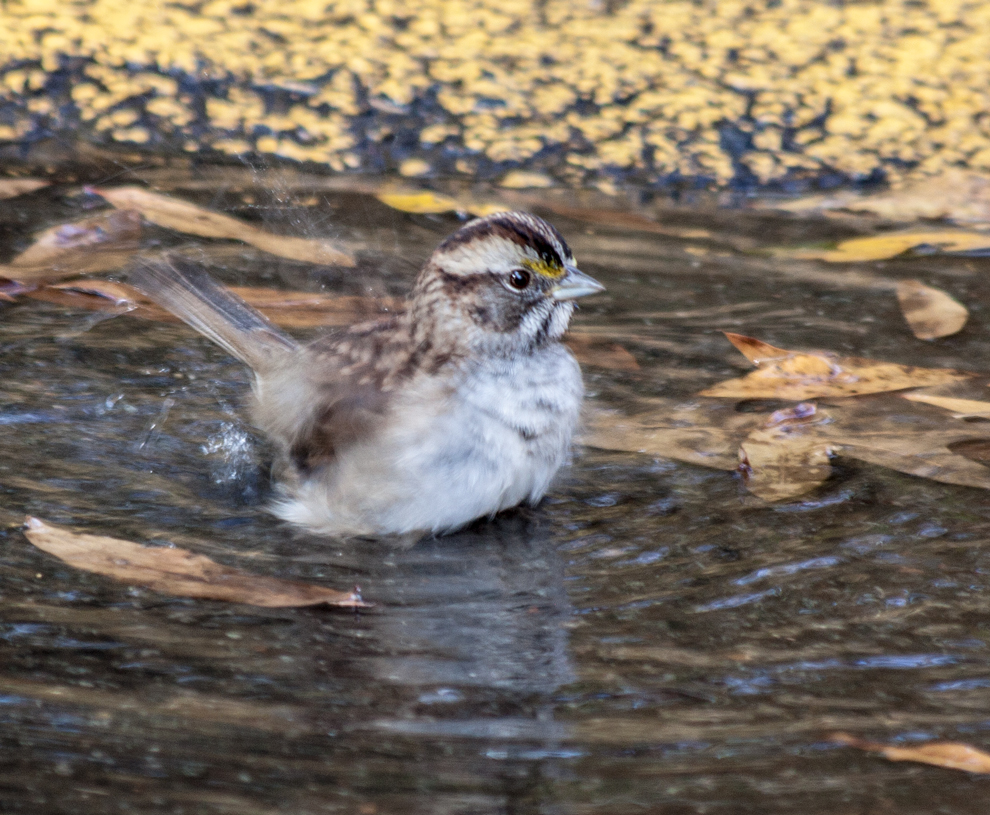
Did you enjoy playing in puddles when you were a child? I remember a childhood of rubber boots and yellow slickers and days when my pant legs would be drenched from walking through puddles. Even now, I’ll occasionally kick my feet through a puddle of water and then glance quickly all around, hoping that nobody has seen me give in to my child-like impulses.

When I spotted this White-throated sparrow (Zonotrichia albicollis) in a shallow puddle, I thought he was merely getting a drink of water. However, he stuck his head in the water, splashed around, and seemed to be having a good time. Perhaps he was taking a bath, or maybe he was simply enjoying himself in the cool waters. (In case you are curious about the background, the puddle had formed in a low area adjacent to a speed bump at the entrance to the parking area of my local marsh park—the yellow you can see is the safety paint of the speed bump itself.)

Initially, I was unsure that this sparrow was a White-throated, because the white patch was not really obvious and the eye stripes were not as well defined as in previous photos that I have posted of this species. The yellow coloration above the lore (the area between the eye and the bill) makes it pretty likely that this is a White-throated sparrow, though it may be the brown and tan striped variant, rather than the black and white one that I featured in a posting earlier this week.

I don’t know about you, but I feel inspired to find a puddle to play in today. Have a wonderful Friday.

Sparrow_puddle_cropped_blog

© Michael Q. Powell. All rights reserved.

Read Full Post »

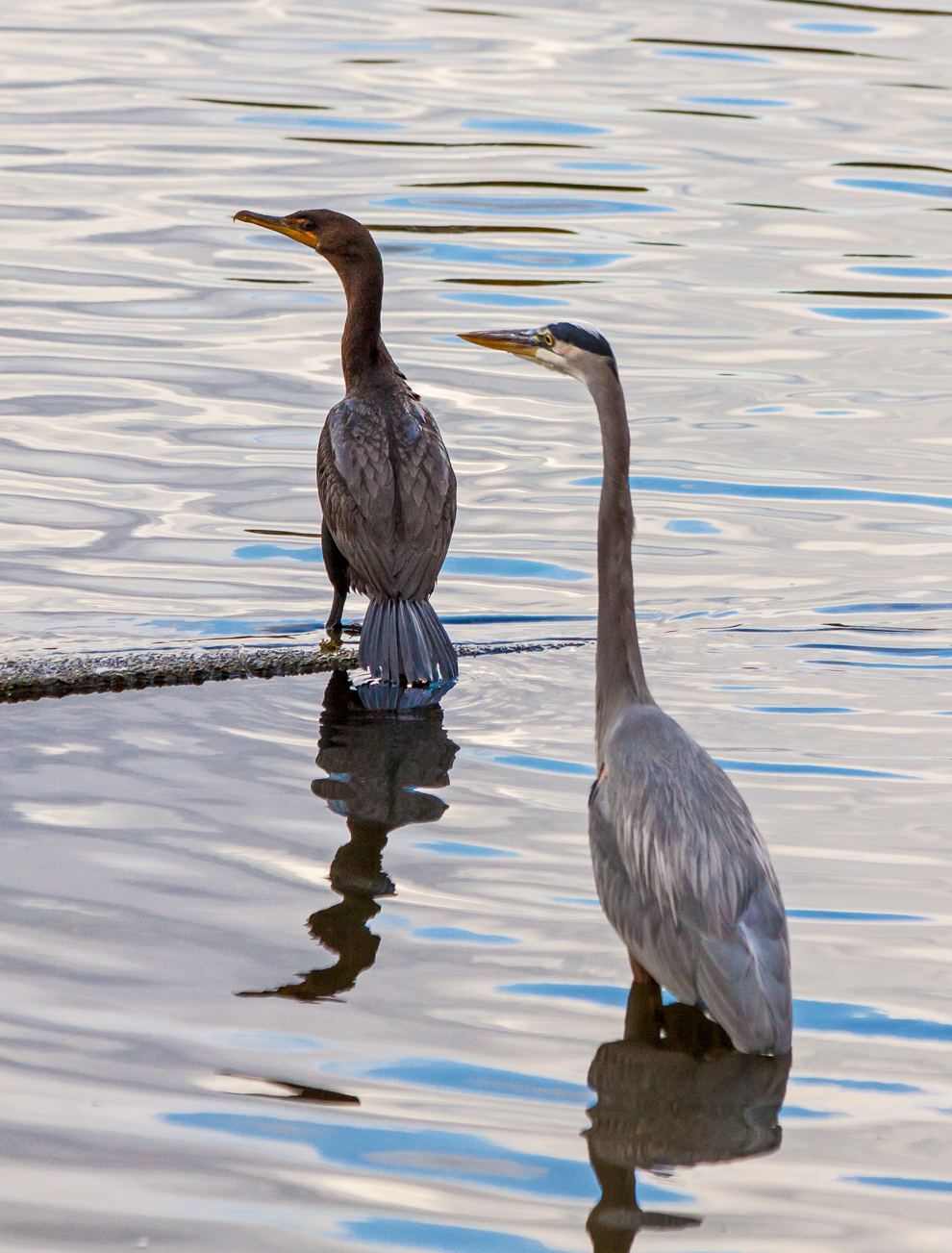
Who knew that the man-made pond in a nearby suburban neighborhood would be a favorite spot for juvenile birds to hang out together?  That’s what it looked like when I spotted an immature Double-crested Cormorant (Phalacrocorax auritus) and an immature Great Blue Heron (Ardea herodias) together, both with their heads turned in profile, probably checking out some cute little female goose.

Actually, I couldn’t immediately identify the cormorant, though it was obvious that it was neither a duck or a goose. The way that it swam with its long neck extended and its bill pointed in the air, however, was distinctive enough to make it easy to find in my identification guide.

I like the way that these two birds posed for me, with the cormorant perched on a narrow concrete slab to compensate for the heron’s greater height and the synchronized head positions. I have seen this young heron hanging around the pond before (it’s the same heron that I featured in the Crouching heron posting this morning), but I don’t think that I have seen a cormorant there before. Usually there are only geese and occasionally some ducks, like the small flock of Ring-necked ducks that are there right now.

cormorant_heron_blog

© Michael Q. Powell. All rights reserved.

Read Full Post »

« Newer Posts - Older Posts »