Feeds:
Posts
Comments

Archive for the ‘Flowers’ Category

We won’t see them for a few months in Northern Virginia, but I got a sneak preview of daffodils in bloom here in Brussels, Belgium near a small pond at the botanical gardens yesterday morning.

daffodil

© Michael Q. Powell. All rights reserved.


Read Full Post »

The pastor at the Christmas service today reminded us of the theological implications of saying “Merry Christmas.” Every time that we utter those words, he said, we are telling another person that God loves them, that the true message of Christmas is God Incarnate, God taking on a human form to dwell among us.

Earlier this morning I was thinking about what kind of a photo I would post today. I considered selecting a recent wildlife photo, but not of them spoke to me. As I walked the dog while it was still dark, I thought about taking a photo of some of the colorful lights and decorations in my neighborhood, but somehow they didn’t represent Christmas to me at that moment.

I finally went out to my front yard and took this modest photo of one of the bushes there. I think it is called Heavenly Bamboo (Nandina domestica) and its simple form and traditional colors seemed an accurate reflection of my inner thoughts and feelings about Christmas this year. Christ came into the world in a humble way and meets us today where we are, no matter what our circumstances may be.

With the angel chorus and the heavenly host, I think about these words of the traditional Christmas story that I learned so long ago in the King James version: Glory to God in the highest, and on earth peace, good will toward men.

Merry Christmas to you all.

Heavenly Bamboo

© Michael Q. Powell. All rights reserved.

Read Full Post »

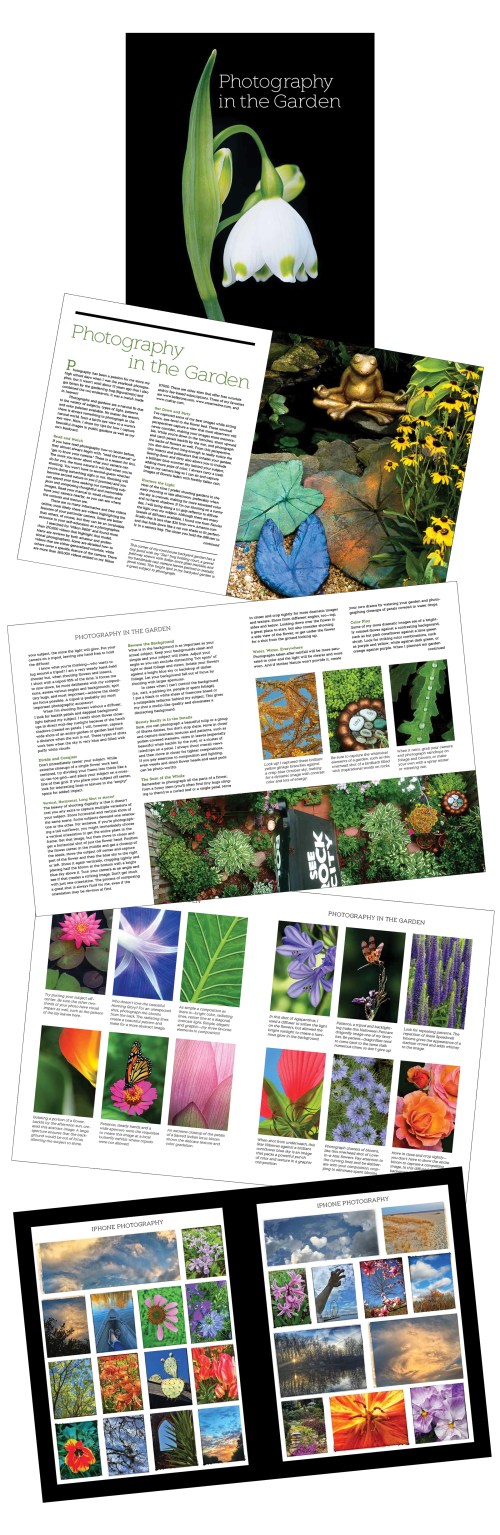
My dear friend and photography mentor Cindy Dyer just created a free mini-magazine on Photography in the Garden. Cindy is the one who helped me get more serious with photography six years ago. Her beautiful work has been featured on US postage stamps and in Nikon publications and exhibitions. In addition to her DSLR work, she has added a selection of amazing images that she shot with her iPhone.

Cindy is a constant source of inspiration for me and I encourage you all to check out her work—this mini-magazine is a great start.

cindydyer's avatarCindy Dyer's Blog

In this 20-page mini-magazine, I share my tips and tricks for photographing your garden in its best light, whether you’re shooting with a DSLR, point-n-shoot, or smartphone. You’ll learn about composition, harnessing the light, photographic resources, and what’s in my bag. Photographing gardens and the natural world has been enormously rewarding for me. Below are some sample pages from the mini-magazine.

Read your manual, shoot regularly, learn how to process your digital images and above all else, always stay curious!

Click here: Cindy Dyer Garden Photography

© Cindy Dyer. All rights reserved.

GP Sample Display

View original post

Read Full Post »

I love to photograph bees and realize that I have not featured one for quite some time. I captured this image of one as it perched on some pickerelweed this past weekend at Ben Brenman Park in Alexandria, VA.

In many ways, this image is as much about the flowering plant as it is about the bee. It speaks to me of the interaction between those two main subjects.

For me, photographing nature is about balancing the depiction of the small details, as I often do, with the “bigger” picture—the framing of this shot helps to give the viewer a better sense of the environment than if I had done an extreme close-up shot of the bee itself.

bee and pickerelweed

© Michael Q. Powell. All rights reserved.

Read Full Post »

I suspect that all of the Monarch butterflies (Danaus plexippus) will soon be leaving our area for warmer places, so I am really trying to enjoy each and every encounter with one. I spotted this beauty feeding on some kind of thistle plant thispast weekend at Occoquan Bay National Wildlife Refuge.

monarch butterfly

© Michael Q. Powell. All rights reserved.

Read Full Post »

Sometimes I don’t have to venture far to capture images. I took this shot recently of a flower growing out of one of the hosta plants in my front yard as the rain was falling.

Simple colors and shapes and the sparkle of raindrops—photography doesn’t always have to be complicated. The challenge is to slow down, to really see the world around us, and to recognize its inherent beauty.

hosta in the rain

© Michael Q. Powell. All rights reserved

Read Full Post »

There were only a few water lilies in bloom at the small pond at a local garden that I visited this past weekend. Surprisingly, they were all pink in color and not the white ones that I am more used to seeing—perhaps it is late in the season for the white ones. Not surprisingly, there were quite a few dragonflies buzzing about and I decided that I wanted to get a shot of one of them perched on one of the water lilies.

So I waited and hoped and waited some more. My patience was eventually rewarded when a tiny male Eastern Amberwing dragonfly (Perithemis tenera) landed on a partially open water lily bud and perched momentarily.

I really like the image that I managed to capture because of the way it conveys a sense of the mood of the moment, a calm, almost zen-like feeling of tranquility. The colors are subdued and the composition is minimalist—there is a real beauty in simplicity.

Dragonfly and water lily

© Michael Q. Powell. All rights reserved.


Read Full Post »

There were lots of flowers in bloom yesterday at Green Spring Gardens, a historic county-run garden not far from where I live. One of my favorites was the Zowie Zinnia and a Monarch butterfly (Danaus plexippus) seemed to like it a lot too.

I was at the garden with my dear friend and photography mentor, Cindy Dyer, and her husband. We were all taking a break at one point and I told Cindy that I was going to return to a patch of Zowie Zinnias to see if I could get a shot of a butterfly landing on one. We both recalled a photo that she took in 2010 (check out her blog posting) when an Easter Tiger Swallowtail butterfly appeared out of nowhere and landed on one of the two Zowie Zinnias that she was focusing on with her camera on a tripod.

Imagine her surprise when a couple of minutes later I returned with this photo. She grabbed her camera and went to the patch of zinnia, but, alas, the butterflies were not as cooperative for her as they had been for me.

Monarch butterfly and Zowie Zinnia

© Michael Q. Powell. All rights reserved.

Read Full Post »

Many of us are old enough to remember when wall phones had long coiled cords that usually ended up stretched out and elongated. That’s exactly what I was thinking of when I spotted these coiled tendrils of some kind of flower yesterday when I was exploring Occoquan Bay National Wildlife Refuge.

I wasn’t sure how to capture them in an image and tried a couple of different approaches. The image below was my favorite. It is kind of a natural abstract image, but I included the flower in the corner of it to give the image a sense of context.

Those who read my postings regularly know that this is not the usual kind of photo that I post—sometimes it is fun to venture outside of my normal box.

coil

© Michael Q. Powell. All rights reserved.

Read Full Post »

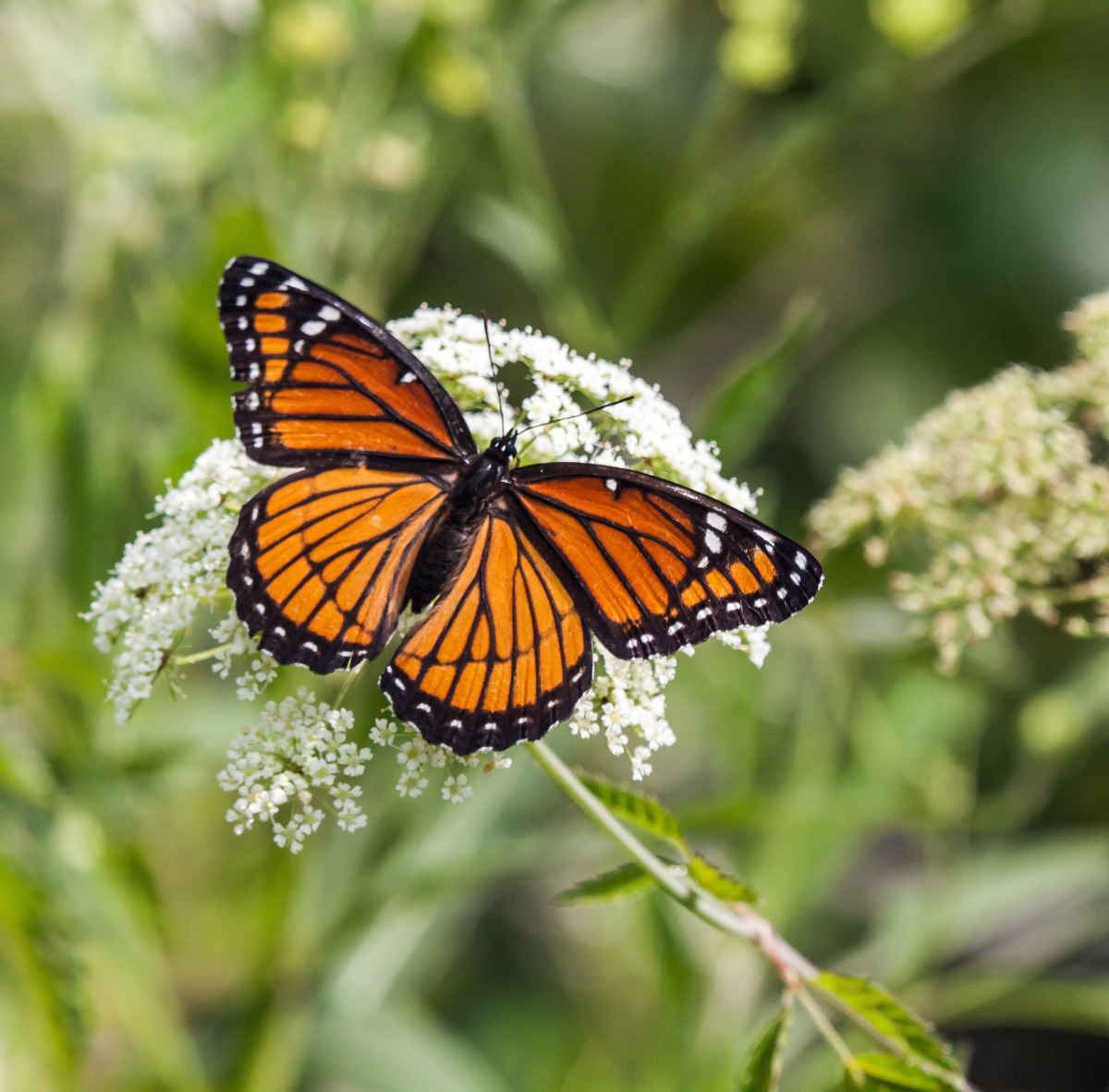
I suppose that I should call this a royal posting for it features both a viceroy and a queen. Of course, here in the USA we don’t have a monarchy, but that doesn’t keep us from having Viceroy butterflies (Limenitis archippus) and Queen Anne’s Lace (Daucus carota). I spotted this royal pair on Monday at Occoquan Bay National Wildlife Refuge where the Viceroy repeated probed the clusters of Queen Anne’s Lace.

You probably have noticed that the coloration of the Viceroy butterfly matches that of the Monarch butterfly. One of the easiest ways to tell them apart is the black line across the hind wings which is present with Viceroys but not with Monarchs.

Viceroy butterfly

Viceroy butterfly

© Michael Q. Powell. All rights reserved.

Read Full Post »

I can’t identify this flower and I am not certain what kind of skipper butterfly this is, but the two of them sure did combine well in this image that I captured this past weekend at Meadowlark Botanical Gardens. (I’m leaning towards this being a Peck’s Skipper (Polites peckius), but there are so many different kinds of skippers that it’s hard to be sure.)

In many ways this is the kind of image that I aspire to capture. The subject is active, engaged in probing the flower with its extended proboscis, rather than in a static pose. Of equal importance, the image has an artistic feel, a kind of beauty in its composition and colors. There are so many uncontrollable elements in nature that there is no way to guarantee results like this, but it is sure is nice when it happens.

UPDATE: Helpful folks on Facebook and readers of this blog have helped to identify the butterfly as a Zabulon Skipper (Poanes zabulon) and the flower as an Obedient Plant (Physostegia virginiana). Thanks, Drew and Molly.

skipper and flower

© Michael Q. Powell. All rights reserved.


Read Full Post »
Normally I aim for extreme realism when taking photos. Sometimes, however, I like to try an “artsy” approach, like in this image of a flower (a zinnia, I believe) from this past weekend at Meadlowlark Botanical Gardens.

In this case, I deliberately tried to distort perceptions and make it look like the grass and the sky had switched places. In reality, the blue is not from the sky, but is a gravel path.

I like to try to vary the angle at which I am shooting and the results can often be fun and different. I never know when I will find myself sprawled on the ground or standing in the mud, so I tend to wear clothes that are rugged and often ragged.

zinnia

© Michael Q. Powell. All rights reserved.

Read Full Post »

This past week we have had an amazing amount of rain. It has not been a single, prolonged storm, but instead has been a series of bands of heavy rain.

The rain slowed down a little yesterday morning, so I popped over to the garden of my neighbor and fellow photographer Cindy Dyer to see what was in bloom. My eye was immediately drawn to a gorgeous pinkish lily in her side garden and to some pear-shaped tomatoes on her front landing. The raindrops still glistening on both of the subjects seemed to add to their beauty and interest.

Thanks, Cindy for planting such photogenic species.

pink lily

tomatoes

© Michael Q. Powell. All rights reserved.


Read Full Post »

While they have been out of town, I have been watering the flowers in my neighbors’ garden and watching (and feeding) their three cats. The garden was planted by my photography mentor, Cindy Dyer, who always selects particularly photogenic species. She asked me document some of the flowers as they bloomed in case she does not return in time to see them herself.

Yesterday I was particularly struck by the beauty of the different lilies that are now blooming. Some of them probably qualify as day lilies, but there is another cool variety that has blooms that face downward. The big star of the show, though, is undoubtedly an enormous cream-colored lily that just opened and is the one that is featured in the first photo.

Many of you know that I am generally in ceaseless pursuit of animate subjects, but it is good to periodically stop and take the time to smell the lilies.

lily

lily

lily

© Michael Q. Powell. All rights reserved.


Read Full Post »

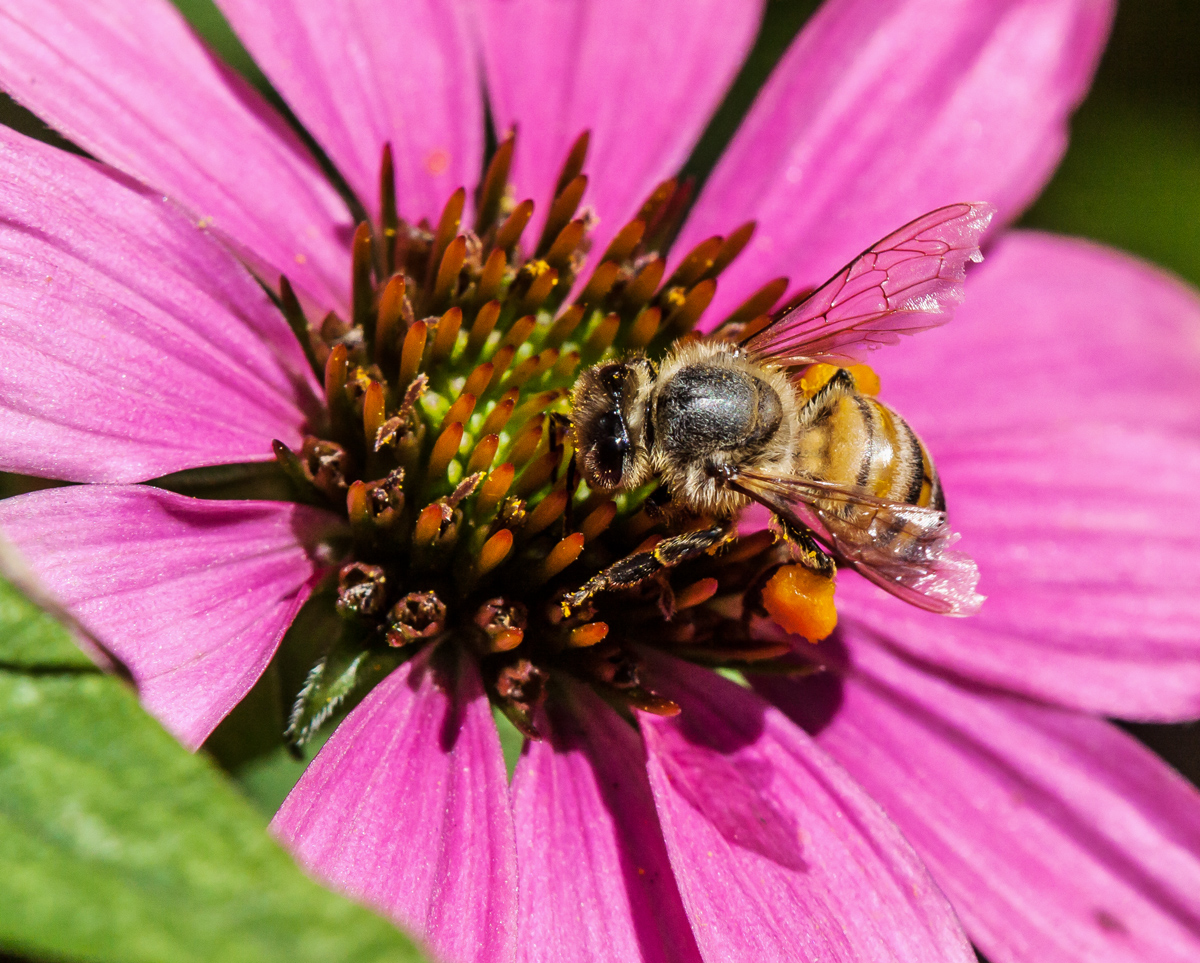
I love to watch bees as they gather pollen—they seem so industrious and focused as they systematically work their way through a group of flowers. This honey bee had both of its pollen sacs almost completely filled when I spotted it yesterday on a cone flower in the garden of one of my neighbors, fellow photographer Cindy Dyer.

One of the joys of shooting with a macro lens is that it lets you capture so many fine details, like the pollen grains on the legs of this bee and the slight damage on the trailing edges of the bee’s wings. Bees are also a great subject to practice macro techniques, because they often let you get really close without being spooked and flying away.

honey bee

© Michael Q. Powell. All rights reserved.

Read Full Post »

Water lilies are now blooming at Occoquan Bay National Wildlife Refuge, which recently has become my favorite place to explore with my camera.  Yesterday I could see lots of them in a distant pond that was not accessible. I was happy, though, to be able to capture this image of one that was just within range of my zoom lens.

Water lilies are so exquisite that a single bloom is sufficient to fill me with a sense of beauty and tranquility. Is it any wonder that water lilies were the main focus of Monet’s artistic production during the last thirty years of his life?

water lily

© Michael Q. Powell. All rights reserved.

Read Full Post »

Insect identification is really tough for me. When I saw this insect crawling about on the top of what I believe is a Shasta daisy, I was pretty sure that it was a beetle. Beyond that, I really had no idea what it was. A quick search on the internet made me conclude that it was a kind of scarab beetle.

I posted a photo on the website bugguide.net and asked for help. Responders provided a couple of possibilities and it looks most likely that this is an Oriental Beetle (Exomala orientalis) or (Anomala orientalis). In some ways it’s not that important to identify my subject, but it is something that I strive to do as much as I can and I usually end up learning a lot in the process of figuring out what I have shot.

I took quite a few shots of this beetle and especially like this one, because the beetle raised its head momentarily and I was able to get a look at its cool forked antennae. I also like the way I was able to capture some of the drops of water on the petals of the daisy.

In case any viewer is worried that I have given up on dragonflies, I can reassure you that I still have shots of lots of beautiful dragonflies to be posted and am always seeking more. I just figured that I would mix things up a little and provide a little glimpse at the world through my macro lens.

Oriental Beetle

© Michael Q. Powell. All rights reserved.

Read Full Post »

A macro lens helps to open up a whole new tiny world that is often beautiful and occasionally a little scary. I think that a tiny insect that fellow photographer Cindy Dyer pointed out to me in her garden yesterday fits into the latter category. The insect in question was moving about on an orange cone flower and at first we thought it might be a spider. When we counted the legs and looked a little closer, we realized it was probably a bug, a bug with massive spiked front legs and additional spikes on its body. It was a bit chilling to learn that this was the nymph of an assassin bug, a Spiny Assassin bug in the genus Sinea.

As I was taking this photo, I was reminded once again now much I enjoy macro photography. It has its own set of challenges, but it is rewarding to be able to get shots like this. In this image I particularly like the way that the spikes in the center of the cone flower mirror those of the fearsome little insect, which would be a real monster if it were larger.

Spiny Assassin Bug nymph

© Michael Q. Powell. All rights reserved.


Read Full Post »

We have been having so much rain this month that I have taken to carrying an umbrella with me much of the time, including when I am going out with my camera. It’s a challenge to take photos in the rain, because of the juggling required to hold a camera steady while holding an umbrella and also because there are fewer subjects to photograph—most creatures have the common sense to seek shelter when it is raining.

Here are a few photos from a walk I took this past Friday at Occoquan Bay National Wildlife Refuge. They are a different style than most of the photos that I post on this blog, but I really like the way they turned out.

In the first image an Eastern Box Turtle (Terrapene carolina) had a different way for handling the rain than the umbrella I was carrying—it simply pulled its legs and head inside of its shell. In the second image a Tree Swallow (Tachycineta bicolor) decided to brave the rain to get a breath of fresh air while perched atop a nesting box. The final photo shows a hummingbird view of a trumpet vine flower, one of its favorites. Alas, no hummingbirds were flying in the rain.

Eastern Box Turtle

Tree Swallow

trumpet vine

© Michael Q. Powell. All rights reserved.

Read Full Post »
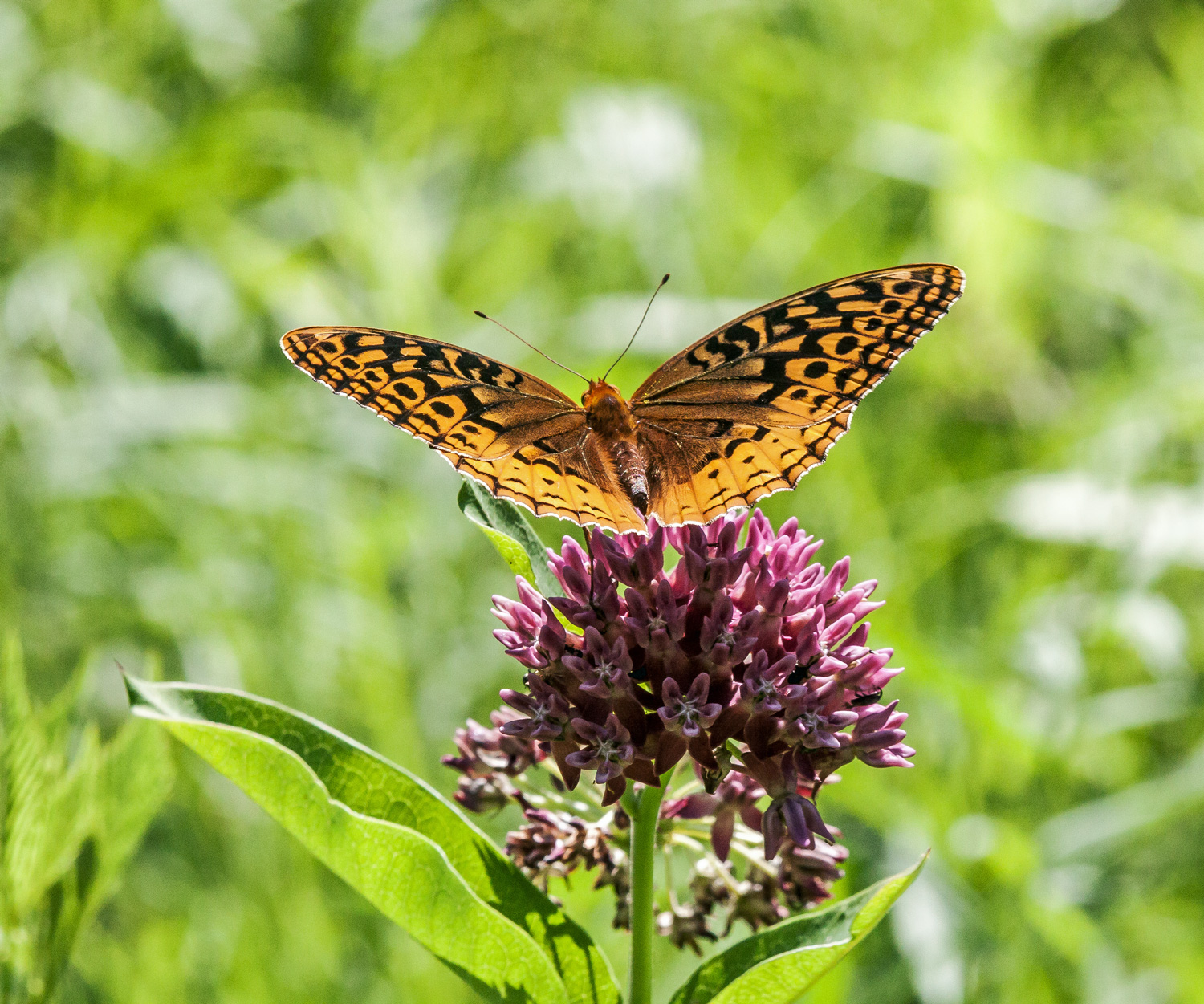
It is a gray and gloomy Friday morning and rain is forecast for most of the day. Somehow I feel the need for a boost of bright colors. So here is a shot of a Great Spangled Fritillary butterfly (Speyeria cybele) on a clump of what I believe is Purple Milkweed (Asclepias purpurascens) from this past weekend at Huntley Meadows Park.

As I worked on this image, there was a real temptation to crank up the saturation level of the colors, which made the shot look unnatural. I tried to show a little restraint and render the colors as I remember them, bright, but not in neon-like tones.

Great Spangled Fritillary

© Michael Q. Powell. All rights reserved.

Read Full Post »

Sometimes in my photos I try to capture a feeling and this recent image of an elusive Ruby-crowned Kinglet (Regulus calendula) at Occoquan Bay National Wildlife Refuge speaks to me of the beauty and fragility of spring.

Ruby-crowned Kinglet

© Michael Q. Powell. All rights reserved.

Read Full Post »

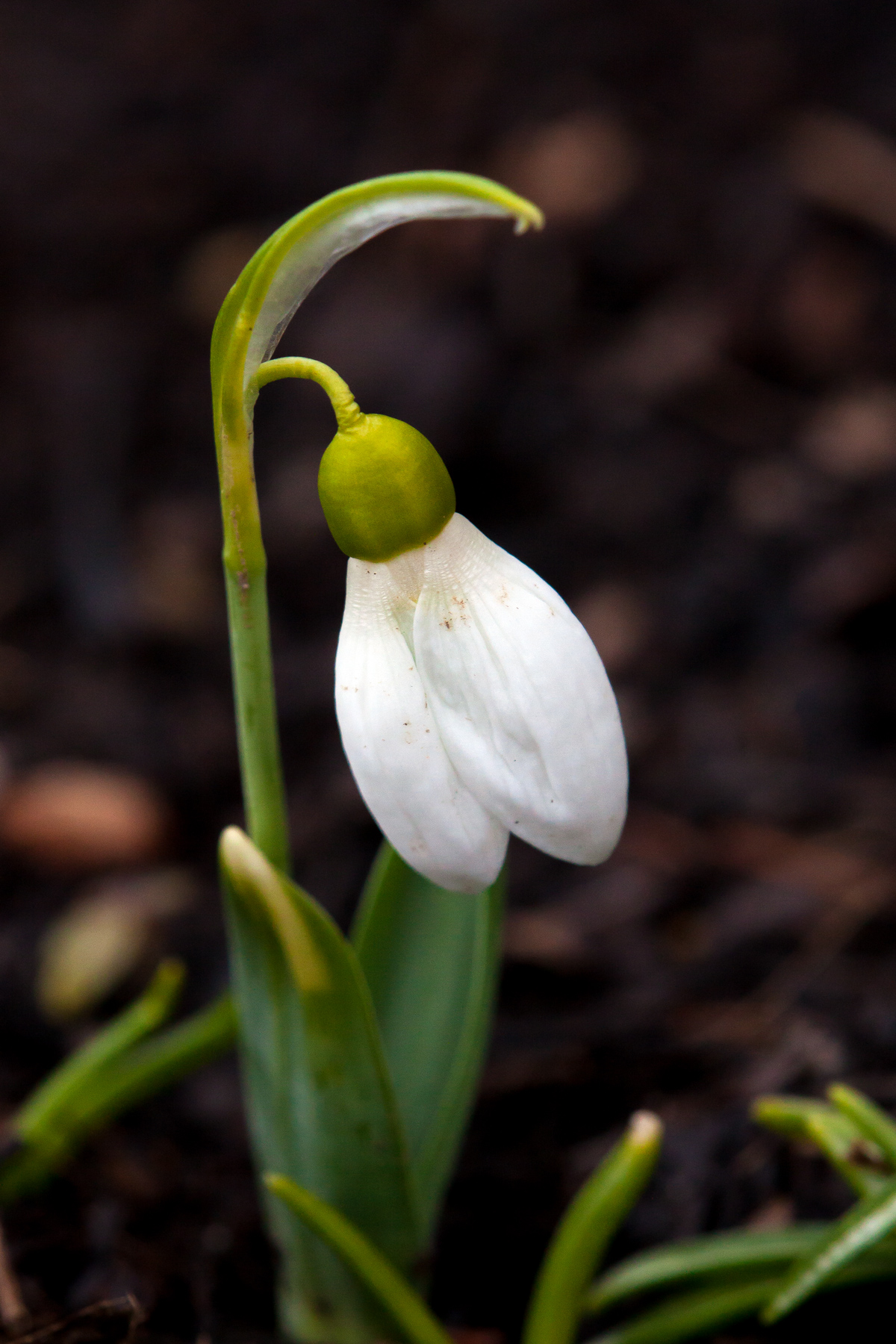
There were clumps of snowdrops scattered throughout Green Spring Gardens on Monday. I just love this simple little flower that is with us through much of the winter.

It won’t be long before the snowdrops are replaced by the more complex, more colorful flowers of the spring. At times I am impatient for the arrival of spring, but at other times I am simply content to enjoy the beauty of the modest snowdrop.

snowdrop

snowdrop

© Michael Q. Powell. All rights reserved.


Read Full Post »

Yesterday I took a break from bird photography and visited Green Spring Gardens, a county-run historic garden, with a macro lens on my camera rather than my long telephoto zoom lens. It is still a bit early for most flowers, so I was happy to spot these little purple flowers that had pushed their way to the surface. I think they may be crocuses, though I really don’t know flowers very well.

I got really low to get an interesting background and almost got stepped on by a runner—maybe it’s best not to wear a camouflage jacket when lying on the ground.

purple buds

© Michael Q. Powell. All rights reserved.

Read Full Post »

Whenever I see bees buzzing around flowers, I keep an eye out for hummingbird moths. For some unknown reason, I have seen more of these colorful moths this summer than in past years.

Although you could argue about whether or not thistles are flowers, my vigilance was rewarded when I spotted this beautiful Hummingbird Clearwing Moth (Hemaris thysbe) feeding on this thistle bloom on Monday at Occoquan Bay National Wildlife Refuge.

Hummingbird Clearwing Moth

Hummingbird Clearwing Moth

© Michael Q. Powell. All rights reserved

Read Full Post »

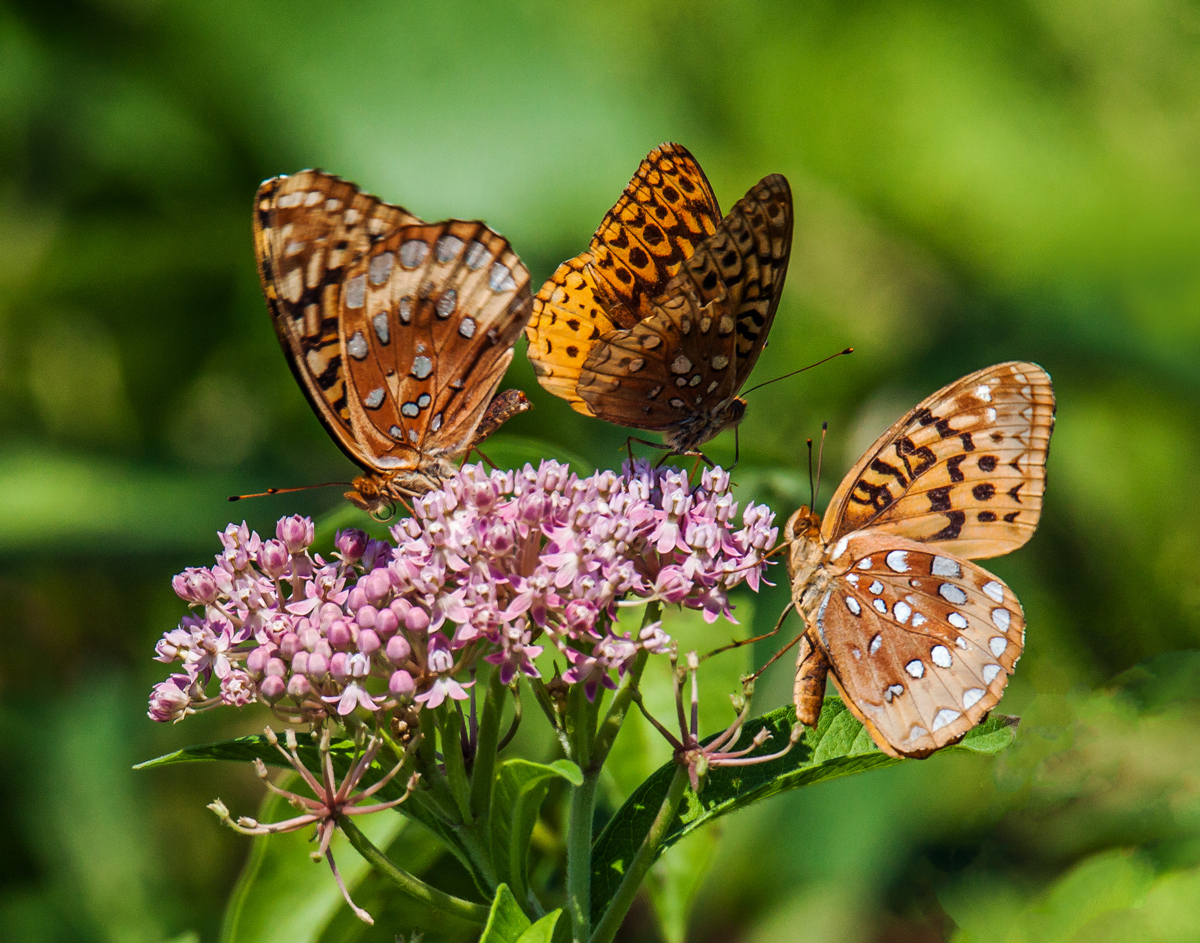
A clump of what I think is Swamp Milkweed (Asclepias incarnataseemed irresistible to a trio of Great Spangled Fritillary butterflies (Speyeria cybele) on Monday at Huntley Meadows Park. For a brief moment they coexisted peacefully, until one of them encroached into the territory of another and they all began to jostle each other for the prime spots.

I quickly snapped off a series of photos before the butterflies flew away. As is the case with almost any group, it was almost impossible to capture an image in which all of the subjects were more or less facing the camera and had interesting poses. It was roughly equivalent to trying to photograph a group of wiggly little children—single subjects seem easy by comparison.

Great Spangled Fritillary

© Michael Q. Powell. All rights reserved

Read Full Post »
Although I tend to associate Monarch butterflies (Danaus plexippus) with milkweed, this Monarch was hungrily feeding on Queen Anne’s lace (Daucus carota) this past weekend at Huntley Meadows Park. I am not sure why, but I have seen significantly more Monarch butterflies this summer than in the past few years.

Monarch butterfly

© Michael Q. Powell. All rights reserved

Read Full Post »

Several years ago, when I first started getting serious about photography, I probably would have called the insect in the photo a bee. My choices back then were simple—a black and yellow insect was either a bee or a yellowjacket. Now that I know a whole lot more about insects, I can readily identify the insect as a hoverfly (also referred to as flower fly) from the Syrphidae family.

When I spotted the hoverfly yesterday, I was struck by the way that its colors matched almost perfect those of the black-eyed Susans (Rudbeckia hirta) that were growing in abundance at Jackson Miles Abbott Wetland Refuge.

hover fly

© Michael Q. Powell. All rights reserved

Read Full Post »

How much pollen can a bee transport at one time? As it circled the inside of a sunflower, this bee filled the pollen baskets on its hind legs with so much bright yellow pollen that I was afraid it would not be able to lift off and fly away. In addition to the very full pollen baskets, which looked like cotton candy to me, the bee was virtually covered with grains of pollen. My fears proved to be unfounded, and the overladen bee was able to carry away its golden treasure.

I think this bee is a bumblebee, though I am no expert on the subject of bees. According to Wikipedia, certain species of bees, including bumblebees and honeybees, have pollen baskets (also known as corbiculae) that are used to harvest pollen. Other bee species have scopae (Latin for “brooms”), which are usually just a mass of hair on the hind legs that are used to transport pollen.

bee pollen

© Michael Q. Powell. All rights reserved

Read Full Post »

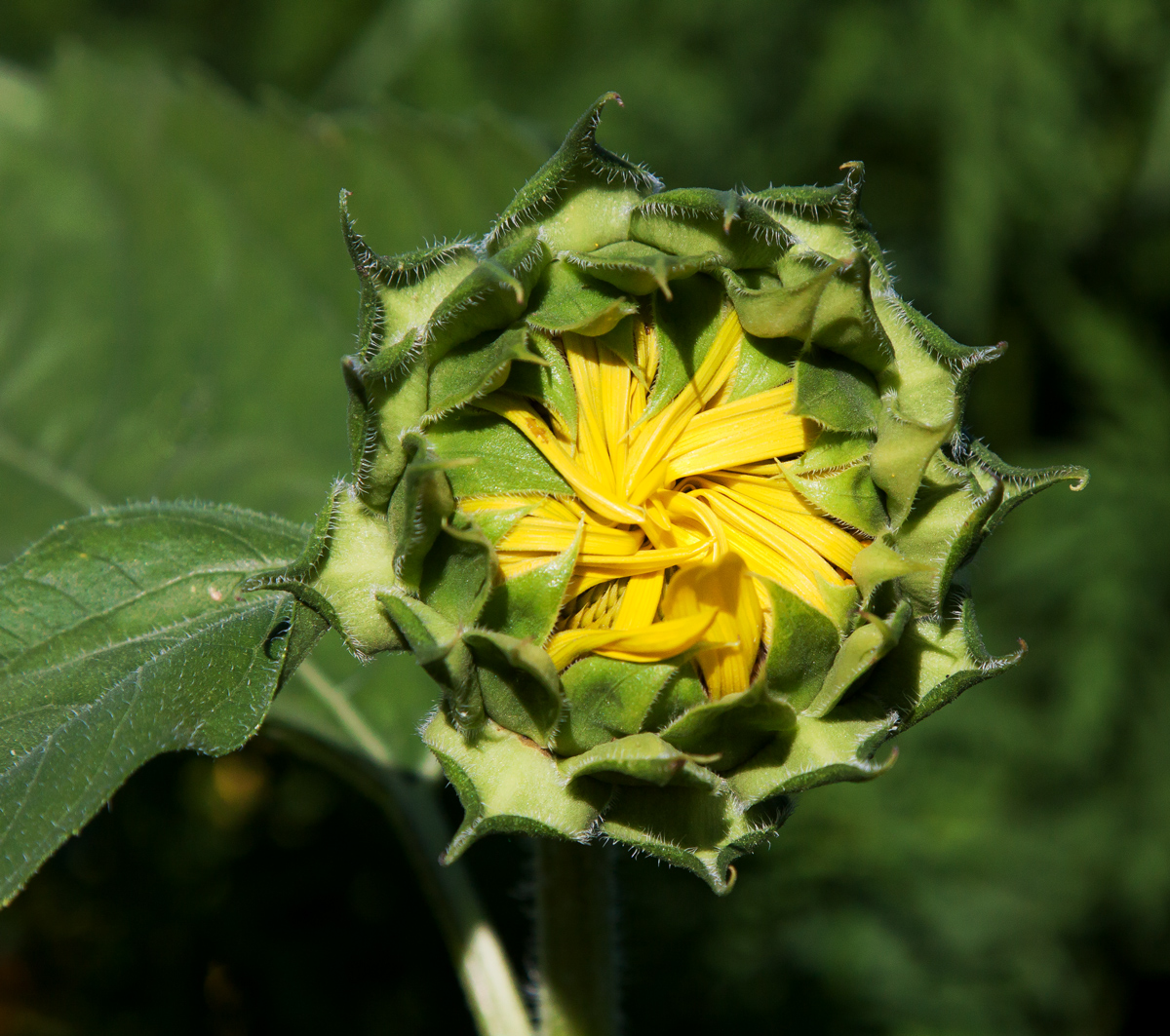
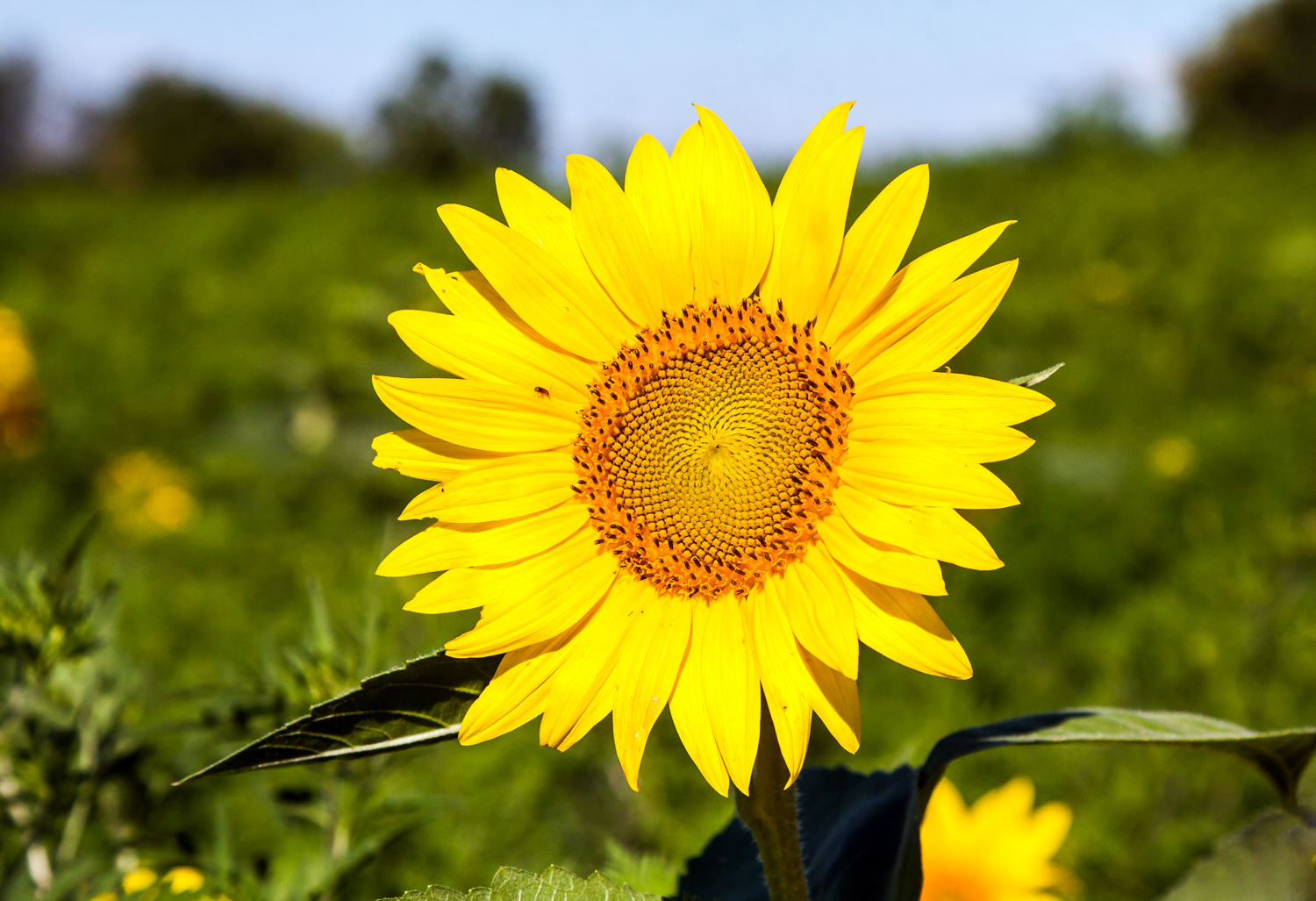
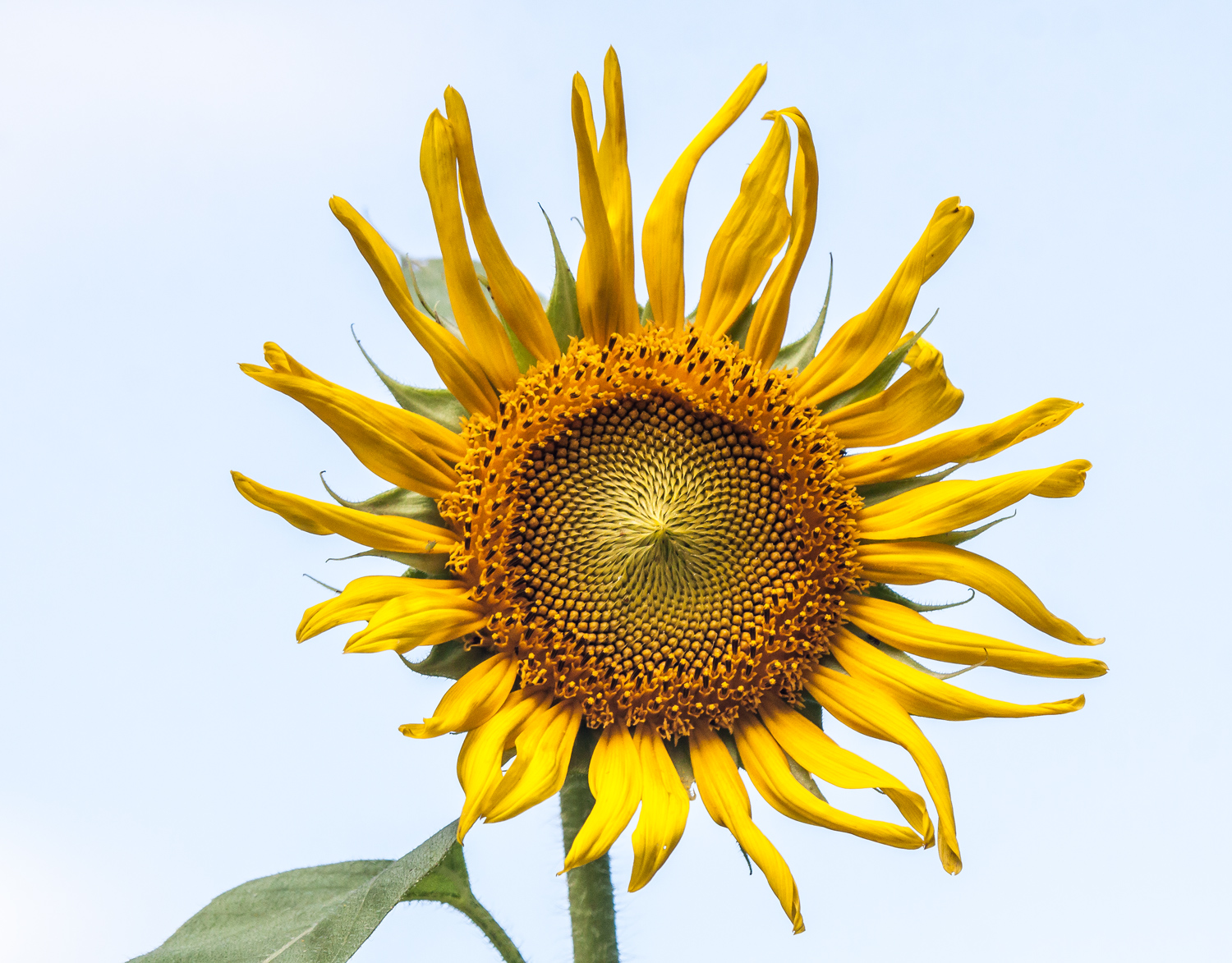
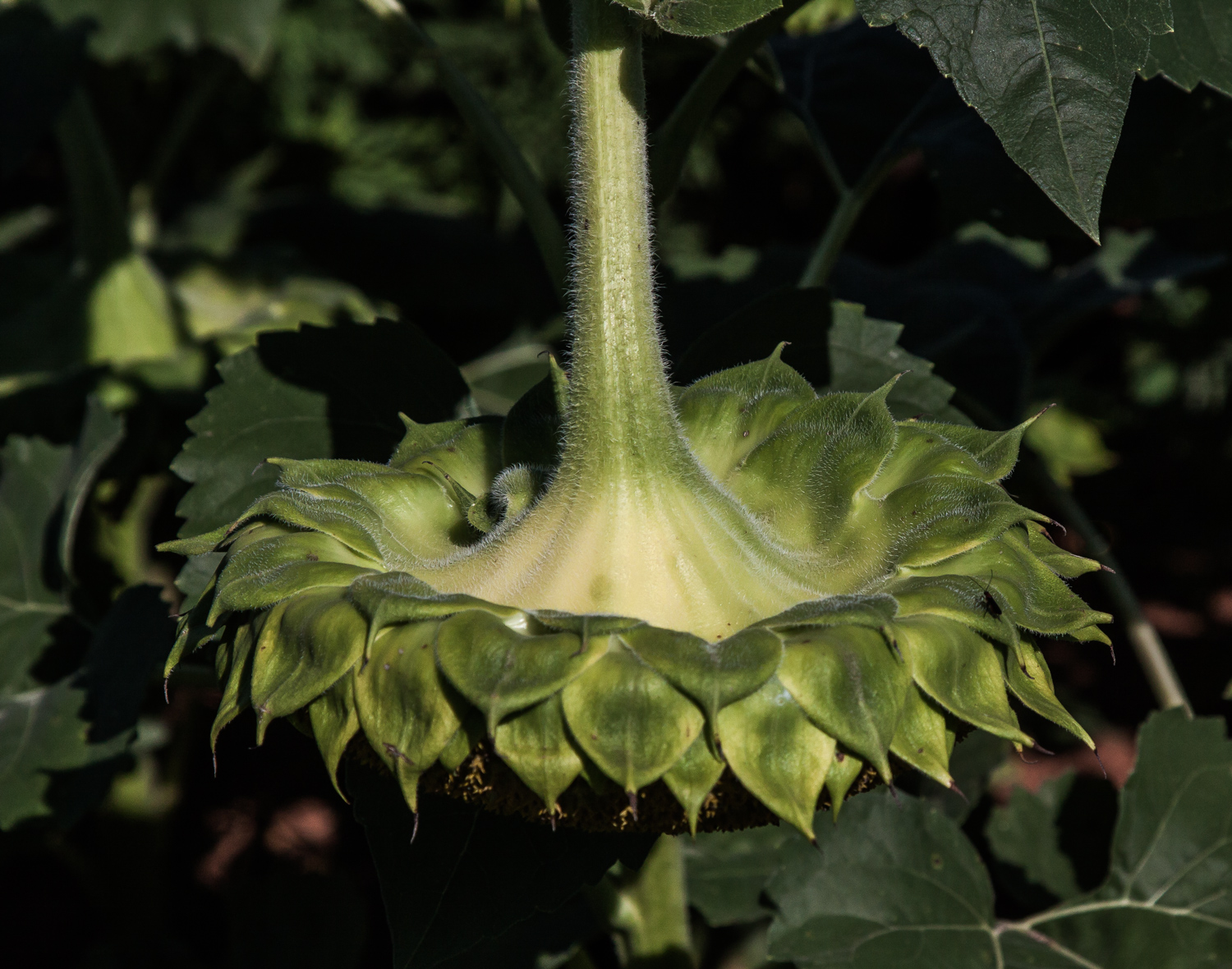
When you are confronted with a field of sunflowers, what’s the best way to photograph them? That was my challenge this past weekend at McKee-Beshers Wildlife Management Area in Poolesville, Maryland. Before I arrived, I though I would get a wide-angle view, filled with the bright yellows of the tall sunflowers. The reality was a little underwhelming, because the sunflowers had not grown very tall this year and many of them were past their prime.

So instead of going wide, I decided to move in closer and try to capture some of the details of the sunflowers. Here are a few images of single sunflowers in different stages of development. Some of the images are a little abstract and hopefully challenge readers to think beyond the normal shapes and colors that they associate with sunflowers.


sunflower

sunflower

sunflower

sunflower

© Michael Q. Powell. All rights reserved

Read Full Post »

Cardinal flowers (Lobelia cardinalis) are now in bloom at Huntley Meadows Park. In addition to being beautiful, these vivid red flowers attract butterflies, like this Spicebush Swallowtail butterfly (Papilio troilus) that I spotted this past weekend at the park.

Spicebush Swallowtail

© Michael Q. Powell. All rights reserved

Read Full Post »

Cabbage White butterflies (Pieris rapae) are small and skittish and you probably don’t pay much attention to them—you might even think that they are merely moths. If you look closely, though, you’ll discover that they have beautiful, speckled green eyes.

I love the way that a macro lens reveals amazing details that are there, but that we never see or simply take for granted. I took these photos yesterday during a brief trip to Green Spring Gardens, a wonderful, county-run historic garden not far from where I live.

Cabbage White


Cabbage White

© Michael Q. Powell. All rights reserved

Read Full Post »

« Newer Posts - Older Posts »