Feeds:
Posts
Comments

Archive for the ‘dragonfly’ Category

Do you remember the first blog post that you ever wrote? In my first blog posting on July 7, 2012, I featured a photo of a Blue Dasher dragonfly (Pachydiplax longipennis). Every year since then whenever I see my first Blue Dashers of the season, I recall my excitement I experienced in being able to photograph that first dragonfly. I did not realize at that time how “addicted” I would get to photographing these beautiful little creatures.

I spotted this handsome male Blue Dasher this past Tuesday at the edge of a small pond at Jackson Miles Abbott Wetland Refuge.

Blue Dasher

© Michael Q. Powell. All rights reserved.


Read Full Post »

Are you so used to the common beauty that surrounds you every day that you no longer see it? What does it take for you to stop and take notice and maybe even pull out a camera to photograph a subject?

Almost six years ago I read a blog posting by fellow photographer Lyle Krahn that talked of a concept called “stopping power” and that posting has stuck with me to this day. Here’s a portion of that posting that describes the concept, “I think every beautiful scene has stopping power. That’s my term for the ability of a scene to make a person stop hiking or driving in order to pull out a camera and make images. Did you ever wonder what makes you stop? Do you ever hear the music?”

I try to pay attention to even the most common subjects and when it comes to dragonflies, that means the aptly named Common Whitetail (Plathemis lydia). Common Whitetails are among the first dragonflies to appear in the spring and among the last to disappear in the autumn. You can find lots of Common Whitetails almost everywhere it seems.

On Tuesday at Occoquan Bay Regional Park I stopped and photographed some Common Whitetail dragonflies as I was searching for some more exotic dragonfly species. This early in the season the Common Whitetails seem to be hanging out at a distance from the water—later in the summer I tend to find them buzzing around ponds and swamps.

The first two shots below are of male Common Whitetails. Although mature males are white, when they are young they have brown bodies similar to those of females. However, males have different patterns on their wings and the second and third images show those differences and may help you to distinguish immature males from females.

So, what has “stopping power” for you? I encourage you to think about that question, to make an effort to lower your threshold, and to look for the uncommon beauty in common subjects.

Common Whitetail

Common Whitetail

Common Whitetail

© Michael Q. Powell. All rights reserved.

Read Full Post »

Yesterday I spotted this male Lancet Clubtail dragonfly (Gomphus exilis) while exploring Jackson Miles Abbott Wetland Refuge, a relatively small park not far from where I live. The dragonfly was perched on some leafy vegetation overhanging the water and I almost fell into the pond while trying to frame the shot. Fortunately I achieved my desired result by hanging over the edge of the steep bank.

If you look at the end of the “tail,” which technically is called the “abdomen,” you can see the enlarged section that gives rise to the term “clubtail.” Compared to the family of skimmers, which include most of the dragonflies that you probably see, like Blue Dashers and Common Whitetails, clubtails are relatively uncommon and it is always exciting for me to spot one.

I was particularly struck by this dragonfly’s brilliant blue eyes. For some reason I find blue eyes to be especially beautiful, irrespective of the species.

Lancet Clubtail

© Michael Q. Powell. All rights reserved.


Read Full Post »

During my church retreat in Orkney Springs, Virginia this past weekend, I played hide-and-seek with a Common Green Darner dragonfly (Anax junius). It repeatedly flew teasingly close to me, trying to entice me to chase it.  I took the bait and pursued the big dragonfly for quite some time as it flew in and out of the reeds.

It tried to hide by hanging from some vegetation by the tips of its tiny toes—the second photo shows my initial view of the hidden dragonfly. By moving to the side and crouching low, I was able to peer through the vegetation and eventually spot the dragonfly. Realizing that it was found, the dragonfly tilted its head toward me and smiled, as you can see in the first image shown below.

Common Green Darner

Common Green Darner

© Michael Q. Powell. All rights reserved.


Read Full Post »

I try to do a blog posting almost every day, but I spent this weekend unplugged from the internet at a church retreat in the mountains of Virginia, so I missed a couple of days. When I first started blogging, I was a bit compulsive about it and worried that I would lose all of my followers if I did not post every single day. Now I have a more balanced approach and realize that it is not the end of the world if the clock strikes midnight and I have not posted something new.

Today I am featuring some Brown Spiketail dragonflies (Cordulegaster bilineata) that I spotted last week while exploring Occoquan Regional Park with my fellow dragonfly enthusiast and blogger Walter Sanford. He and I returned to a location where we had spotted this species last year and were delighted to see that members of this species had emerged on schedule. Like many other species that emerge in the early spring, Brown Spiketails have a limited flight period and are found in small numbers at a limited number of locations.

Walter and I discovered that it is helpful to search for these dragonflies together. Often one of us will flush the dragonfly and the other person can observe the direction and the spot to which the dragonfly has relocated. This is really important because, as you can see from the photos, Brown Spiketails perch at an angle or hang vertically from vegetation that is often low to the ground, which makes it difficult to spot them when they are stationary.

Be sure to check out Walter’s posting today of our encounter with the Brown Spiketails. Although he and I were shooting together, we use different camera gear and approaches and our respective images give you different perspective on the same subjects. We also craft our blog postings independently and the style and content of our individual postings tends to reflect our personalities and backgrounds—I have a liberal arts background and Walter has a background in science.

Brown Spiketail

Brown Spiketail

Brown Spiketail

© Michael Q. Powell. All rights reserved.

Read Full Post »

Natural camouflage in the coloration of birds and insects enhances their survivability, but it really makes them hard to find and photograph. Last week I made trips on two consecutive days to Patuxent Research Refuge in Laurel, Maryland to search for dragonflies. I have already posted photos of a Common Green Darner and a Swamp Darner that I saw during those trips—both of those dragonflies are large and colorful and relatively easy to spot.

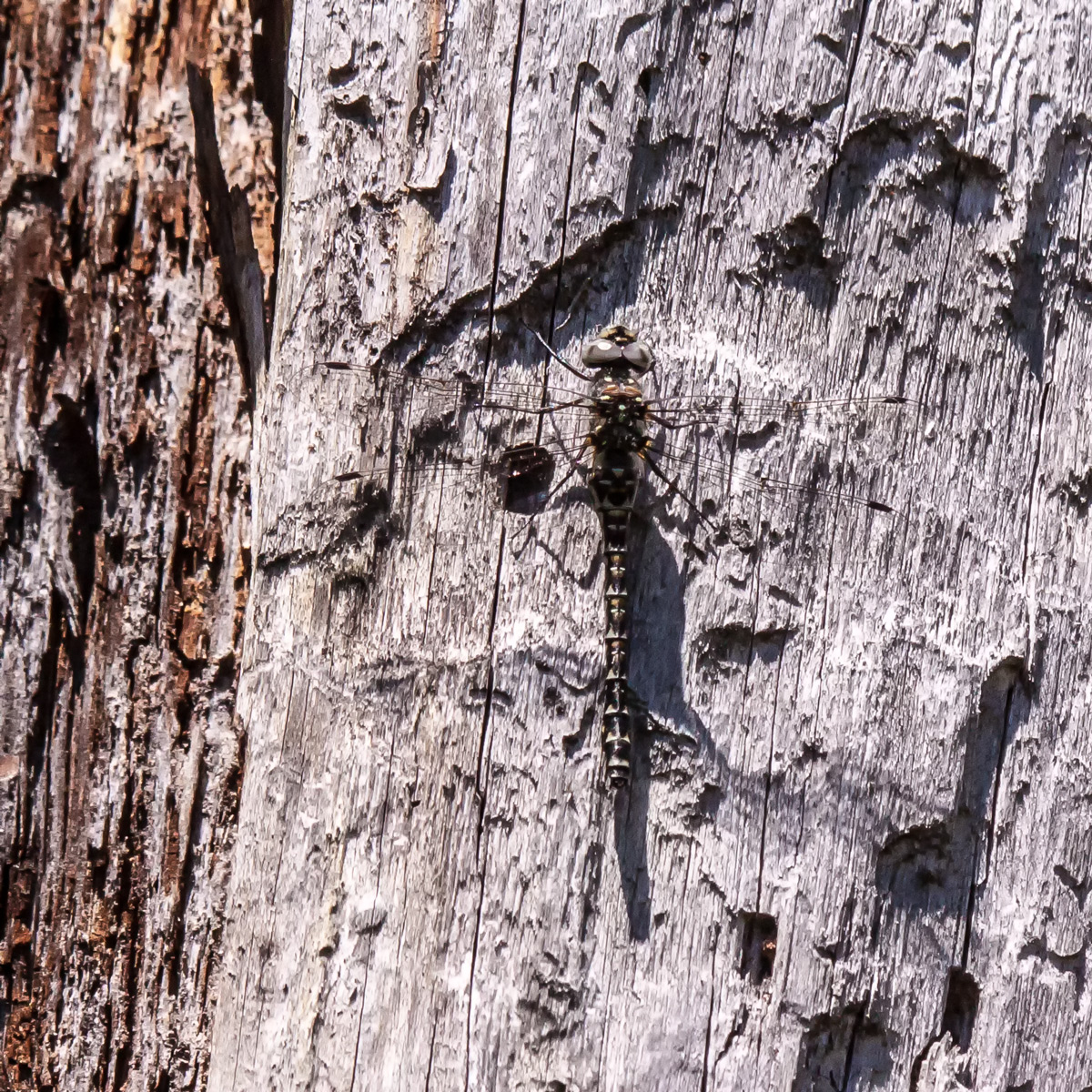
One of the main purposes of the trip, though, was to look for a Harlequin Darner (Gomphaeschna furcillata), a species that is rare in our area and hard to spot in the field. Why? The Harlequin Darner is small for a darner, about 2.2 inches (56 mm) in length, and is in a sub-group know as pygmy darners. Its subdued coloration of gray and brown provide excellent camouflage, particularly because it often perches on tree trunks. The Harlequin Darner requires a specific type of habitat and has a flight season of only a few weeks in early spring.

On my first trip, I traveled with fellow dragonfly enthusiast and blogger Walter Sanford. We searched in vain for several hours, sometimes side-by-side and sometimes separated. As luck would have it, Walter located a Harlequin Darner at a moment when I was pretty far away. Alas, the dragonfly flew away shortly after I arrived at his location. Fortunately, Walter captured some excellent shots which you can see (along with some additional information) on his blog posting from last week. As it turned out, that was the only Harlequin Darner that either of us saw all day.

The following day I decided to return alone, hoping that I too might spot a Harlequin Darner. I saw a good number of dragonflies, including the Common Baskettail that I captured in flight, but as the day progressed, I began to wonder if I would ever find a Harlequin Darner. I kept searching and finally I saw a dragonfly perch vertically on the trunk of a tree. The lighting was harsh and the shadows distorted the proportions of the dragonfly, so I wasn’t sure what kind it was. At this point, though, I was focused on getting a shot and would worry later about identifying the dragonfly. The dragonfly remained in place for about 30 seconds and then flew away.

Well, it turns out this is a female Harlequin Darner. Every time that I see a new species for the first time, I am thrilled to get any kind of recognizable images. In the future I will try to get better shots, but for now I am content that once again my persistence paid off.

It’s great to celebrate small victories.

Harlequin Darner

Harlequin Darner

© Michael Q. Powell. All rights reserved.


Read Full Post »

It is a little unusual for me to post photos of the same species twice within a few days, but I could not help myself when I captured this image of a female Swamp Darner (Epiaeschna heros) that provides such a wonderful view of her remarkable eyes.

Dragonfly eyes are always amazing, with their multiple lens that give the dragonfly almost 360 degree vision and the ability to see parts of the color spectrum that are invisible to the human eye. What is particularly striking about this Swamp Darner’s eyes are its varied colors and patterns. Wow!

The second image shows the same female Swamp Darner as she rested in a tree prior to beginning the task of depositing her eggs, which is what you see her doing in the first shot. I captured these images this past Tuesday during a visit to Patuxent Research Refuge in Laurel, Maryland.


Swamp Darner

Swamp Darner

© Michael Q. Powell. All rights reserved.


Read Full Post »

Do you like a fun photo challenge? Try taking a photo of a dragonfly as it zooms on by you.

Here’s an image I captured on Tuesday of a Common Baskettail dragonfly (Epitheca cynosura) in flight at Patuxent Research Refuge in Laurel, Maryland. In case you are curious, Common Baskettails are about 1.6 inches in length (41 mm).

So how would you go about getting a shot like this? I would say that the key requirements are patience and persistence. The first thing that I usually do is observe the dragonfly’s flight path and try to determine if there are particular places where it tends to hover or turn around. This particular dragonfly was flying low and not too far from the shore of a small pond.

Focusing is the biggest problem. Some photographers like to pre-focus on an area and wait for the dragonfly to fly into that area. Others will rely on the auto-focus capabilities of their cameras. I have had almost no success with those techniques. What I usually do is put my camera’s focus into manual mode and literally change focus on the fly as I attempt to track the dragonfly in the air.

I like to use my Tamron 180 mm macro lens, because it gives me a decent amount of reach and frees me from worrying about zooming in and out. I have found that simultaneously zooming and focusing manually while tracking the dragonfly is like patting your head and rubbing your stomach at the same time—it is theoretically possible but tough to accomplish in real life.

If you click on the image and view it in a larger size, you will see that I was fortunate to get my focus just about right for the middle of the dragonfly’s body. The shutter speed of 1/1000 of a second was fast enough to freeze most of the movement of the wings.

Needless to say, I took a lot of shots and my success rate was very low. Perhaps this is not your idea of a “fun” challenge. In that case, I would encourage you to find some area of your life and challenge yourself to do something that is difficult. Even if you are not successful, I think even the effort will help you to grow, especially in self-knowledge and self-awareness.

Common Baskettail

© Michael Q. Powell. All rights reserved.

Read Full Post »

Odonata is an order of insects that includes dragonflies and damselflies. In general, dragonflies tend to be larger and perch with their wings held out to the sides, while damselflies are smaller, have more slender bodies, and most  hold their wings over the body at rest. I try to pay attention to members of both damselflies and dragonflies, but often spend more time with the latter group, because they are easier to find and photograph.

In the interest of equality, I decided to devote today’s post to some of the female Fragile Forktail damselflies (Ischnura posita) that I have observed this past week. The three images show female Fragile Forktails in three of their main activities—perching, eating, and ovipositing (laying eggs). I have no recent shots of the mating that precedes the ovipositing, so I will leave that to your imagination for now.

As you probably noted, the coloration of these lady damselflies varies. The damselfly in the first image with the distinctive markings is an immature female. As the females age, they acquire a bluish coating that is sometimes referred to as pruinescence, which you can especially see in the second image. The third image shows a damselfly arching her long abdomen as she deposits eggs in the debris floating on the surface of a small pond.

Fragile Forktail

Fragile Forktail

Fragile Forktail

© Michael Q. Powell. All rights reserved.

Read Full Post »

Sometimes I can identify a dragonfly by the way that it perches. Some dragonflies like to perch high on the tip of vegetation and some perch low to the ground or even on the ground itself. Some will hang vertically or perch horizontally or at an angle somewhere in between.

On the rare occasions in the past when I have seen a Common Green Darner (Anax junius) perch (usually I see them in the air), it has usually been in vegetation relatively low to the ground. I was therefore surprised to see one spreadeagled on the side of a tree on Monday at Patuxent Research Refuge in Laurel, Maryland. Of course, the bright green color and the bull’s-eye pattern on the face made it easy to identify this dragonfly, despite her unconventional perching pattern.

I have learned from experience that the wildlife subjects that I love to photograph often do not look or act the way in the ways described in books. They are may also be found in different habitats or at different times than the range maps indicate. That is what makes this type of photography so challenging and so rewarding and it means I have to be constantly alert and vigilant when out in the field.

Common Green Darner

Common Green Darner

© Michael Q. Powell. All rights reserved.

Read Full Post »

On Monday I traveled to Patuxent Research Refuge in Laurel, Maryland with fellow dragonfly enthusiast and blogger Walter Sanford to search for dragonflies. One of the highlights of the visit for me was spotting this female Swamp Darner dragonfly (Epiaeschna heros) as she was laying her eggs. As you can see from these two photos Swamp Darners lay their eggs directly into wet wood with their blade-like ovipositor, unlike many other dragonflies that lay their eggs onto the water.

Swamp Darners are among the largest dragonflies in our area, about 3.4 inches in length (86 mm) and it was impressive to watch this one flying about over a swampy area of the refuge.

Swamp Darner

Swamp Darner

© Michael Q. Powell. All rights reserved.

Read Full Post »

Yesterday was a wonderful day for searching for dragonflies at Occoquan Regional Park and among my finds was this beautiful female Painted Skimmer (Libellula semifasciata). This is the first one of the season for this species, which is relatively common compared to most of the early spring species. The patterns on the wing make this species stand out and definitely help in identifying.

I love the way that the different colors on this dragonfly work so well together and give this dragonfly a refined and rather sophisticated look. It is an additional bonus that those colors are mirrored by the background colors in this image.

Painted Skimmer

© Michael Q. Powell. All rights reserved.

Read Full Post »

I sometimes complain about the names given to species and how little they correspond to what I actually see in the field. That certainly was not the case yesterday when I spotted a Twin-spotted Spiketail dragonfly (Cordulegaster maculata) along a creek in Northern Virginia. If you look closely at the image, ideally by double-clicking it, you will see the double row of spots on the dragonfly’s abdomen (the “tail”) and the long pointed ovipositor extending well beyond the end of the abdomen, the “spiketail.”

As I post photos of dragonflies, I realize that it is hard for readers to get a feel of the relative size of these beautiful creatures. The Uhler’s Sundragons that I have featured recently are about 1.7 inches in length (44 mm). A Twin-spotted Spiketail, by contrast, is much larger, about 2.8 inches in length (69 mm).

Both of these species are uncommon to rare in our area, primarily because of their specific habitat requirements—they require clean forest streams, which are not common in the Washington D.C. metropolitan area and they have an early and short flight season of only a few weeks.

Twin-spotted Spiketail

© Michael Q. Powell. All rights reserved.


Read Full Post »

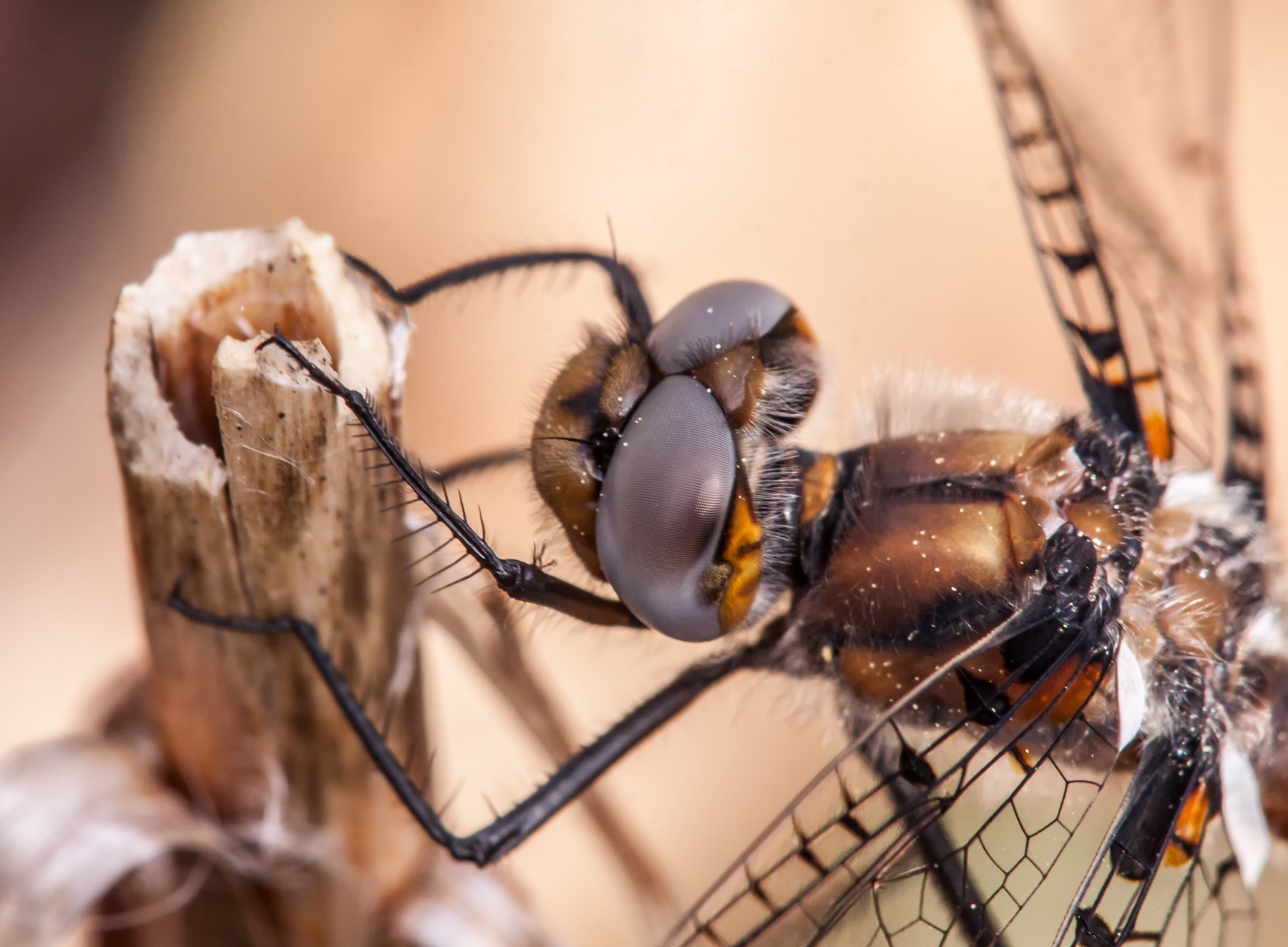
You know you are pretty close to a dragonfly when you can see individual grains of pollen on its head and body. I photographed this Uhler’s Sundragon dragonfly (Helocordulia uhleri) on 12 April alongside a creek in Northern Virginia. Ideally it would be best to stabilize macro shots taken at this close a range by placing the camera on a tripod, but in a field situation with a live subject, that is rarely possible.

If you click on the individual images, you will see some wonderful details, like the ommatidia, the individual optical units that make up the amazing compound eyes of these dragonflies.

Uhler's Sundragon

uhler's sundragon

© Michael Q. Powell. All rights reserved.


Read Full Post »

On Wednesday I finally photographed my first dragonflies of the season, some Uhler’s Sundragons (Helocordulia uhleri) that I spotted while exploring a creek in Northern Virginia. This was my first time seeing this species and I was particularly excited, because it is considered to be rare in my area. According to the Dragonflies of Northern Virginia website, this species is a “scarce and seldom seen member of the emerald family” and is a “habitat specialist with a brief and early flight period.”

Initially I took some medium distance shots with my 180mm macro lens and them moved in closer to get the first shot. In order for me to get such a close-up shot, the dragonfly has to be cooperative and this female Uhler’s Sundragon was quite accommodating.

As you probably notice in the first photo, only a limited amount of details are in focus when shooting a subject this close.  One of the biggest challenges is to ensure that the most important features are the sharpest. Following the usual rule for photographing live subjects, I attempted to focus on the eyes.

For me, dragonfly season is now open and I anticipate that I will be featuring different species of these beautiful aerial acrobats quite regularly in the upcoming months.

Uhler's Sundragon

Uhler's Sundragon

Uhler's Sundragon

© Michael Q. Powell. All rights reserved.

Read Full Post »

It will be a few more months until dragonflies reappear in our area, so for now I have to content myself with this one in my front yard that I photographed yesterday as the snow was gently falling. This metal dragonfly is part of a raised sprinkler that stands about three feet tall (about a meter).

I really like the way that the dragonfly has weathered and acquired various colors. I suppose I could talk of rust and tarnish, but I prefer to think of it as “patina.”

dragonfly

© Michael Q. Powell. All rights reserved.

Read Full Post »

Many of you know that I love dragonflies. I actively search for them not only in Northern Virginia, where I live, but also on work trips to Belgium and Austria. Liz, a fellow blogger from New Zealand, knows that I suffer from dragonfly withdrawal during the winter and posted this image to help me deal with my symptoms. Be sure to check out the other cool postings on her blog, Exploring Colour and also The Wandering Moa, a blog on hiking in New Zealand that was the source of this image of a really cool dragonfly.

Ms. Liz's avatarExploring Colour

dsc03279Click on the photo to enlarge (you may need to click again for full-size). Photo used with permission from The Wandering Moa

Apparently spelt “humongous” for Americans. I admit I’ve got some particular readers in mind as I post this: Mike Powell who photographs dragonflies in Virginia USA and young Benjamin who follows Mike’s blog and with the help of his Gram enthusiastically inspects all the detail of Mike’s photos.

Just two days ago I found a New Zealand blog newly started in early January – The Wandering Moa. Lili published a post about her first alpine tramp (serious hike) and her story included the encounter with this fabulous dragonfly as she was walking through an area of native beech forest. She kindly granted me permission to share the photo. The orange triangle is the standard plastic symbol used to mark walking tracks here. This is one massive dragonfly!

View original post 132 more words

Read Full Post »

As another year in my journey through photography comes to a close, I decided to share a few of my favorite photos of the past year. I initially planned to choose one image for each month and that was doable for the first few months of the year. Once I moved into the prime seasons for shooting, though, there were so many good photos I couldn’t select a single one, so I chose multiples for those months and ended up with these thirty photos.

If you want to see the images in a larger size, all you need to do is click on one of them and they will then be displayed in a slide show format.

Thanks so much to all of you who have followed my blog postings and supported and encouraged me in so many ways. It has been a wonderful year and I look forward to more photos and new adventures in the upcoming new year.

Happy New Year to you all and best wishes for a blessed 2019.


© Michael Q. Powell. All rights reserved.

Read Full Post »

Yesterday we were blessed with a sunny, warm day. The temperatures rose to over 60 degrees (16 degrees C) and my hopes that I might see some dragonflies increased correspondingly.

This autumn season we have already had some sub-freezing temperatures and even a couple of inches of snow. However, my past experience has shown that Autumn Meadowhawk dragonflies (Sympetrum vicinum) are unusually hardy.

Autumn Meadowhawks are small, about 1.3 inches (33 mm) in length and tend to perch on the ground, which is now covered with fallen leaves and other debris. As a result, it is pretty hard to spot these little dragonflies, despite their bright red coloration.

I searched and searched and eventually found a few of them at Occoquan Bay National Wildlife Refuge. I was able to capture a number of images and decided to feature this one, because it gives you a good look at the dragonfly’s beautiful two-toned eyes.

Today we are back to cooler temperatures and there is snow in the forecast for this weekend. Will this be my last dragonfly of the season? I will continue to search for dragonflies for another month or so, though I know that my chances of finding one of these beautiful aerial acrobats will continue to drop.

Autumn Meadowhawk

© Michael Q. Powell. All rights reserved.


Read Full Post »

It’s fun to remember the carefree days earlier this year that I spent hunting for dragonflies. Fellow dragonfly enthusiast Walter Sanford recently did a posting about a location where I photographed a Sable Clubtail dragonfly, one of the rarest species in our area, a place that he christened “Powell’s Place” after he too visited it and found a Sable Clubtail.

Be sure to check out his posting and I encourage you also to explore his blog for some amazing photos and information about dragonflies and other wild creatures.

waltersanford's avatarwalter sanford's photoblog

A single Sable Clubtail dragonfly (Stenogomphurus rogersi) was spotted perched alongside a small stream located in Fairfax County, Virginia USA.

I nicknamed a segment of the stream “Powell’s Place” in honor of Mike Powell, my good friend and photowalking buddy, who spotted the first Sable observed at this part of the stream. “Powell’s Place” is located downstream from Hotspot No. 1, where the stream re-emerges from an underground concrete pipe.

This individual is a male, as indicated by his indented hind wings and terminal appendages. Some dragonflies tend to be creatures of habit, returning to the same spot day-after-day. Perhaps this is the same individual spotted by Mike. Who knows?

I like the juxtaposition of complementary colors in the first photo.

12 JUN 2018 | Fairfax County, VA | Sable Clubtail (male)

The next photo shows the dragonfly perched deep within a shaded hidey-hole.

View original post 74 more words

Read Full Post »

I never got around to posting a shot of my final Halloween Pennant dragonfly (Celithemis eponina) of the 2018 season, so today seems an appropriate time to do so. I spotted this tattered beauty on 29 September at Ben Brenman Park, a small suburban park not far from where I live in Alexandria, Virginia.

Happy Halloween!

Halloween Pennant

© Michael Q. Powell. All rights reserved.

Read Full Post »

There are not a great number of dragonflies still around in my area, and those that are present can sometimes be really hard to spot. That was definitely the case with this beautiful female Autumn Meadowhawk dragonfly (Sympetrum vicinum) that blended in almost perfectly with the fallen leaves and other debris on the ground at Occoquan Bay National Wildlife Refuge this past week.

I initially spotted this dragonfly as she was flying and watched her land, but I couldn’t see her at first. Once I saw where she was, I had to back off, because I was shooting with my 150-600mm zoom lens that has a minimum focusing distance of almost 9 feet (270 cm).

Autumn Meadowhawks are only 1.2 to 1.4 inches in length (30 to 35mm) and spotting the tiny dragonfly from 9 feet away was a challenge to me and to the focusing system on my camera. I think that I was pretty much at the extreme end of the resolving power of the lens when I took this shot, i.e. it is tough to capture a subject with any detail that is much smaller than this.

I have already had to scrape frost from my windshield a couple of times this autumn, so the number of insects will inevitably continue to decrease. Past experience has shown me, however, that Autumn Meadowhawk dragonflies are hardy survivors and I expect to continue to see them for another month or so.

Autumn Meadowhawk

© Michael Q. Powell. All rights reserved.

Read Full Post »

Although we are well into October, some of my beloved dragonflies are still hanging on at Occoquan Bay National Wildlife Refuge. Here are some dragonfly shots from the past 10 days of (1) a male Blue-faced Meadowhawk (Sympetrum ambiguum); (2) a female Eastern Pondhawk (Erythemis simplicicollis) with a hoverfly in her mouth; and (3) a female Autumn Meadowhawk (Sympetrum vicinum).

I hadn’t really noticed before I aggregated this shots that all three of the dragonflies were perching on leaves. During the summer months, a significant number of the dragonflies that I photograph are perched higher on stalks of vegetation or on branches. In addition to these smaller dragonflies,

I have also recently spotted Common Green Darners, Wandering Gliders, and Black Saddlebags patrolling over the fields. Unfortunately, none of them paused long enough for me to get shots of them. All three of those species are migratory species and they may have been fueling up for a long journey ahead.

Blue-faced Meadowhawk

Eastern Pondhawk

Autumn Meadowhawk

© Michael Q. Powell. All rights reserved.

Read Full Post »

Each fall I look forward to the reappearance of the Blue-faced Meadhowhawk dragonflies (Sympetrum ambiguum). No matter how many times I see them, I never fail to be amazed at the wonderful combination of bright colors on these little beauties.

Quite often Blue-faced Meadowhawks perch in the crowded undergrowth, where the background is cluttered.  I was quite happy recently to capture a few images in which the dragonfly perched a little higher, which allowed me to isolate it from the background and ensure that the viewer’s attention is focused on the primary subject.

Blue-faced Meadowhawk

Blue-faced Meadowhawk

© Michael Q. Powell. All rights reserved.

Read Full Post »

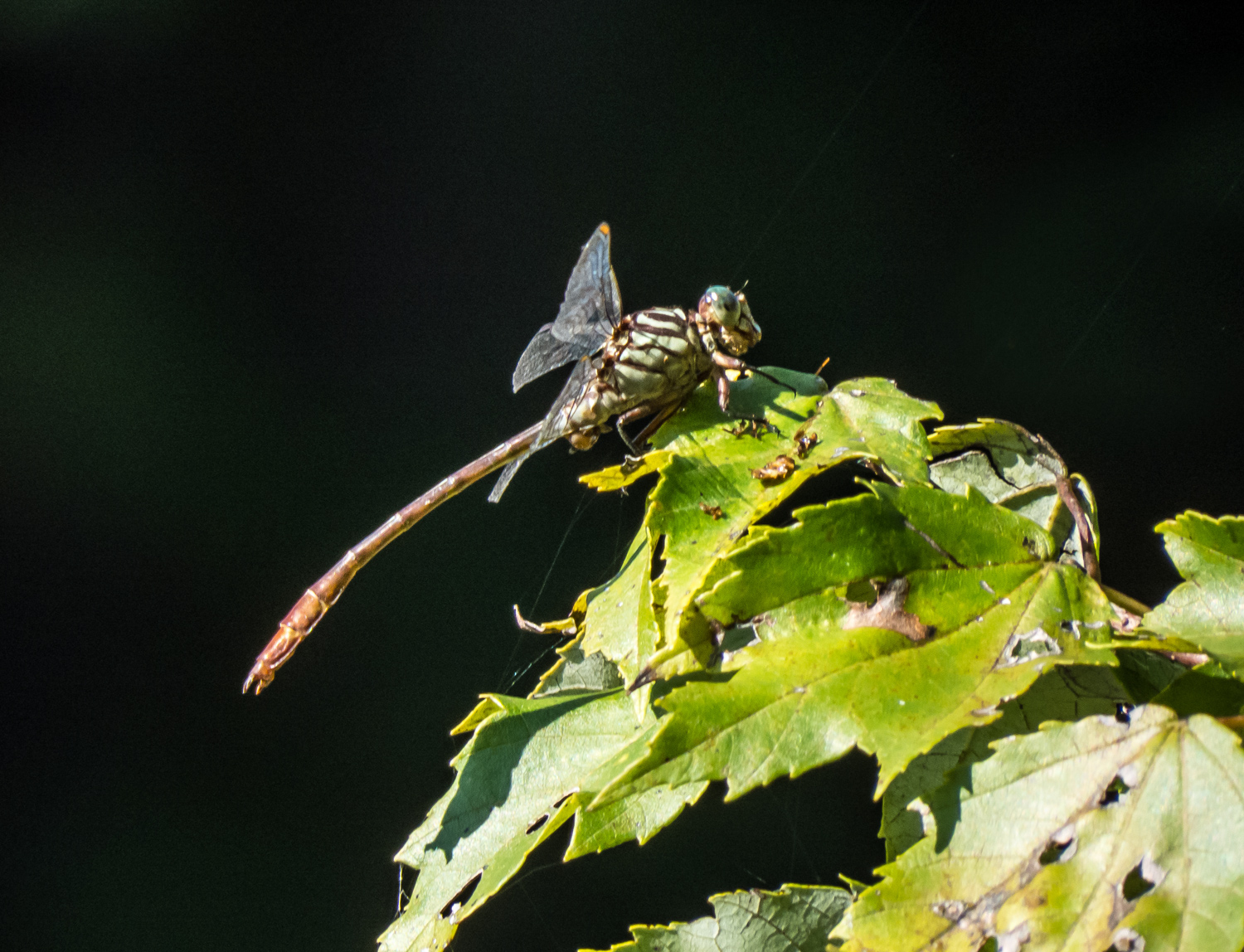
Although we are well into autumn, there are still dragonflies around, including some stunning Russet-tipped Clubtail dragonflies (Stylurus plagiatus) that I spotted earlier this week at Jackson Miles Abbott Wetland Refuge. As you can see from the photos Russet-tipped Clubtails like to perch on somewhat exposed leaves, which makes them a bit easier to spot than some species of dragonflies, though they are not common in my experience

I was able to capture images of Russet-tipped Clubtails (there were at least two individuals that I saw, both males) on several leafy perches in a tree overhanging a pond. My angle of view and the direction of the light gave each of these images a very different feel, primarily because of the way that the background was captured.

Depended on my mood, any one of these three images can be my favorite. Is there one that particularly appeals to you?

Russet-tipped Clubtail

Russet-tipped Clubtail

Russet-tipped Clubtail

© Michael Q. Powell. All rights reserved.

Read Full Post »

Autumn is a prime season for migration. It is almost impossible to ignore the sounds of the Canada Geese as they pass overhead and thousands of other birds pass by unheard, heading south to warmer locations.

Some dragonflies migrate too and at this time of the year it is not unusual to see some of them patrolling high in the air. A good number of dragonflies spend a lot of time perching, and they tend to be easiest to photograph. Other dragonflies, like the species that migrate, spend most of their time in flight. Their stamina is amazing and your patience has to be equally amazing if you try to wait for them to land to photograph them. The alternative is to try to photograph them in flight.

Yesterday I spotted a couple of Wandering Gliders (Pantala flavescens) flying patrols over a small pond at Occoquan Bay National Wildlife Refuge. Wandering Gliders are the most widespread dragonflies on the planet and have an almost worldwide distribution.

I watched the Wandering Gliders for a while to see if I could figure out the patterns that they were flying. Gradually I realized that they often would pass by a certain part of the shore  and hover a little and that became my target zone. With my Canon SX50 superzoom camera in hand, I visually tracked the dragonflies in the air and attempted to photograph them. Mostly I was unsuccessful, but I did get a few decent shots.

In the first shot below, the sharpest that I was able to manage, the Wandering Glider was flying above eye level, so the beautiful blue sky served as a backdrop. In the second image, the dragonfly was flying below eye level and the ripples in the water create a beautiful pattern in the background. When I consider the two images, I am torn between two competing impulses—technically the first shot is superior, but artistically the second shot appeals to me more. Fortunately, I don’t have to choose one over the other and can post both of them.

Wandering Glider

Wandering Glider

© Michael Q. Powell. All rights reserved.

Read Full Post »

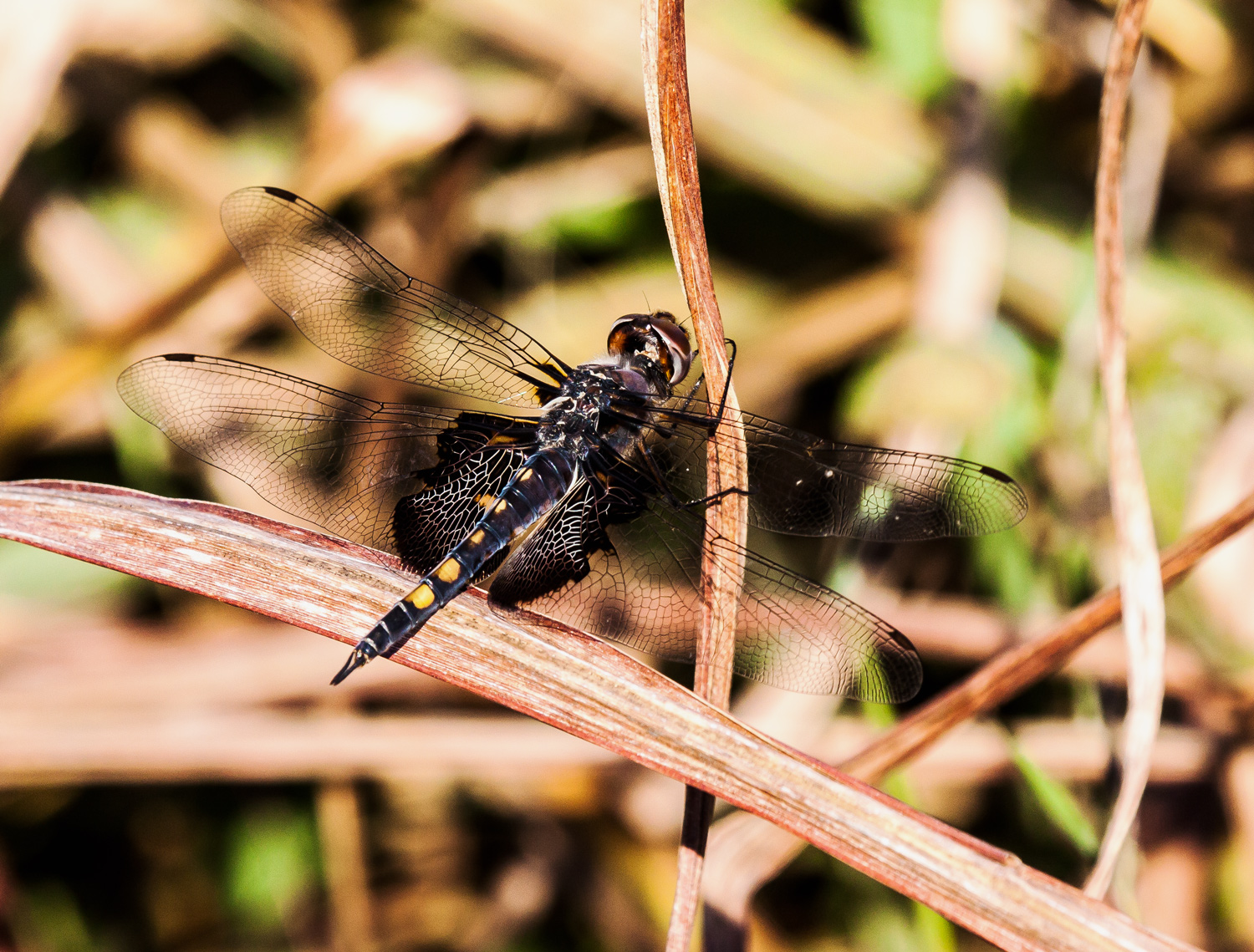
I don’t know if this is a local dragonfly or was merely stopping by while migrating south, but I was happy when this Black Saddlebags dragonfly (Tramea lacerata) stopped circling a field and perched for a moment earlier this week at Occoquan Bay National Wildlife Refuge.

This species of dragonfly is one of several migratory species and in the early autumn I tend to see more Black Saddlebags dragonflies than at any other time of the year. As you might have guessed, the dark blotches on the wings caused some scientist to imagine that they looked like saddlebags. In some cases, I scratch my head when I learn the name of a species, but in this case the name seems to fit and doesn’t require too big a stretch of the the imagination.

Black Saddlebags

© Michael Q. Powell. All rights reserved.


Read Full Post »

Despite seeing several Fine-lined Emerald dragonflies (Somatochlora filosa) last Friday at Occoquan Bay National Wildlife Refuge, only this one was cooperative enough to land for a moment and allow me to get some shots.

Previously I posted some photos I took of Fine-lined Emeralds in flight. I had chased and chased these elusive dragonflies, but they never seemed to stop flying. I was beginning to think that I would not get a shot of one perched when suddenly one that I was tracking dropped down into the vegetation. I approached very cautiously and spotted it clinging vertically to a narrow stem.

My heart was racing as I switched to manual focusing—the profile of the perched dragonfly was so slim that I didn’t think my auto-focus would lock on my subject. I took a couple of shots and then inched forward a little. This is part of an eternal struggle for a wildlife photographer, deciding how close you can get to a subject without disturbing it.

I was pretty happy with this image, because I was able to capture a lot of details of this cool-looking species. I recommend clicking on the image to see a higher resolution view of the dragonfly’s spectacular emerald eyes, beautiful body markings, and wonderful wings.

Fine-lined Emerald

© Michael Q. Powell. All rights reserved.

Read Full Post »

Orange is one of the colors that I tend to associate with autumn. Some leaves are already turning orange and pumpkin decorations and displays have started to appear on my neighbors’ doorsteps.

As I was exploring Occoquan Bay National Wildlife Refuge yesterday morning, my eyes detected some motion in the nearby grass. I leaned forward and was delighted to see this tiny damselfly decked out in the colors of Halloween—orange and black. I had no idea what species it was, but fortunately I have a really good guide for damselflies and was able to identify it as an immature female Eastern Forktail damselfly (Ischnura verticalis).

Although there are already lots of symbols for autumn, I think this tiny damselfly could be added to the list.

Eastern Forktail

© Michael Q. Powell. All rights reserved.

Read Full Post »

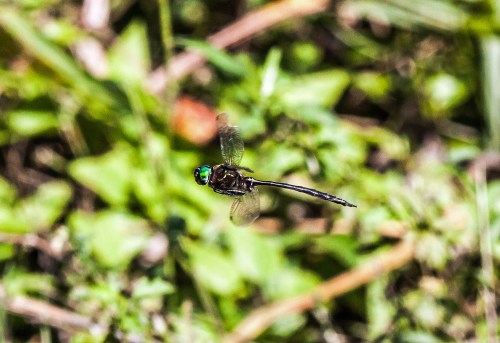
I was thrilled yesterday to see that there are still Fine-lined Emerald dragonflies (Somatochlora filosa) at Occoquan Bay National Wildlife Refuge. I was afraid that all of the recent rain had washed them away.

This particular dragonfly species is pretty uncommon, but the wildlife refuge that has become my go-to place for photography is one of the few local spots where they can be found. I think its peak period in our area is September-October, judging from my experience last year, so I was anxious to see them some more before they disappeared for the year.

It is easy to see a Fine-lined Emerald dragonfly when it is patrolling, because it often flies at knee to shoulder height. It is a whole different problem, though, to get a shot of one, because they spend most of their time in the air rather than perching. I spent quite a bit of time yesterday chasing after these dragonflies, hoping in vain to be able to catch the moment when one decided to take a break.

Finally I decided to change my approach and see if I could capture a shot of one as it flew by me. I know that it can be done, because last year I captured an in-flight image using my 150-600mm zoom lens. The lens that I had on my camera, however, was my 180mm macro lens, which meant that I had to get pretty close to the dragonfly rather than zooming in. That particular lens is slow to focus, so I decided to focus manually, which can be tricky with a moving subject. One of the downsides of the lens is it has no built-in image stabilization, so I decided to keep the camera affixed to my monopod for the sake of stability.

It took some time, but eventually I was able to capture a few shots of flying Fine-lined Emeralds that were relatively in focus, aided by the fact that these dragonflies hover a little from time to time.

I particularly like the first image because it shows both the emerald eyes and the fine lines near the tip of the abdomen that are responsible for the name of the species. It was also cool that the angle of view was unusual, given that I was looking down at the dragonfly as I took the shot. I also like the touch of brownish-orange from the out-of-focus leaves that gives the image an autumn feel.

The second shot gives a more “normal” view of a Fine-lined Emerald dragonfly as it flew by.  I was happy to be able to separate it somewhat from the leafy backdrop by carefully focusing on the dragonfly. This is one of those situations when the auto-focusing system of the camera would have been challenged—the subject was pretty small in the viewfinder and the auto-focus probably would have tried to lock on the background.

fine-lined emerald

fine-lined emerald

© Michael Q. Powell. All rights reserved.

Read Full Post »

Now that fall has officially arrived, I look forward to seeing more Autumn Meadowhawk dragonflies (Sympetrum vicinum), like this stunning female that I spotted last Friday at Occoquan Bay National Wildlife Refuge. Adult males of this dragonfly species are bright red in color, but females can be either tan or red. The “spike” near the end of the abdomen makes it easy. though, to identify this one as a female.

In Northern Virginia, where I live, the Autumn Meadowhawk tends to be the latest surviving dragonflies—I have spotted them in mid-December and others have seen them in early January.

Autumn Meadowhawk

© Michael Q. Powell. All rights reserved

Read Full Post »

« Newer Posts - Older Posts »