Feeds:
Posts
Comments

Archive for the ‘Dragonflies’ Category

Continuing my quixotic quest to photograph dragonflies in flight, I went boldly out into the wild, armed with my trusty 100mm macro lens, and managed to capture this cool image of a dragonfly as it hovered over the water.

In previous attempts, I used longer telephoto zoom lenses, which increased the number of potential subjects but gave only mixed results. Using a shorter, fixed focal-length lens, I had to change my strategy a little and try to get closer to the subject.

I noticed this dragonfly hovering about the water to the side of the boardwalk on which I was walking. I crept as close as I could and tried to shoot as close to straight down as I could (the boardwalk was at least a foot (30 cm) above the level of the water and it looked like the dragonfly was hovering almost level with the boards of the boardwalk). I was really sensitive to my shadow, because I have learned that nothing scares away an insect faster than casting a shadow on it.

I used autofocus and was a little surprised to see that my dragonfly is in pretty clear focus, although the shutter speed was not fast enough to stop the action of  the wings. I shot this handheld and really tried to pay attention to my technique, because my macro lens does not have any built-in image stabilization. As I thought about it afterwards, I realized that the auto focusing on the macro lens (using what Canon calls an ultrasonic motor) is much faster and better than the focusing on my Canon 55-250 or my Sigma 135-400mm zoom lens.

I have been having some difficulties identifying this dragonfly. The coloration of the tail looks a little like a female Blue Dasher, but the beautiful blue eyes do not seem right for the female. The tip of the tail should be a help, but I can’t seem to find one that matches it.

Although I can’t identify the dragonfly, it’s my best shot to date of a dragonfly in flight and I’m pretty content with it today, though my quixotic quest is likely to continue this weekend.

hover1_blog

Michael Q. Powell. All rights reserved

Read Full Post »

When an unfamiliar dragonfly zoomed by me, one of my fellow photographers told me it was a unicorn, at least that is what I thought he said.

Sometimes when I am concentrating on a shot, I shut out my surroundings and I had had to ask him to explain his comment. It turns out that he said that it was a Unicorn Clubtail dragonfly (Arigomphus villosipes), a type that he had rarely seen in our local marsh.

I extended my 135-400mm zoom to almost maximum range and it still was tough to get a clear shot. The dragonfly flew off and returned to his perch a couple of times, but the log on which he posed was so far away that my shot doesn’t permit me to say with great certainty that it is a Unicorn Clubtail. It is clear, though, that it not a Common Whitetail or Blue Dasher, the two types of dragonflies that I see most often.

Overall, I like the effect of the triple view of the dragonfly—the dragonfly, its shadow on the log, and its reflection in the water, which, for me, helps to compensate for the softness of the focus.

unicorn_blog

Michael Q. Powell. All rights reserved

Read Full Post »

Although I usually try to get close-up shots of dragonflies, there is something really peaceful about this longer distance shot of a male Common Whitetail dragonfly (Plathemis lydia) from this past weekend. I really like the arc of the branch and the reflection of both the branch and the dragonfly in the still water of the marsh. If you click on the image, you’ll see that there is a pretty good amount of detail in the dragonfly—I chose not to highlight those details in this posting.

Click the photo to see a higher resolution view.

Click on the photo to see a higher resolution view.

Michael Q. Powell. All rights reserved
Read Full Post »

Who hasn’t wished for an extra set of hands to get more done in this multi-tasking world?

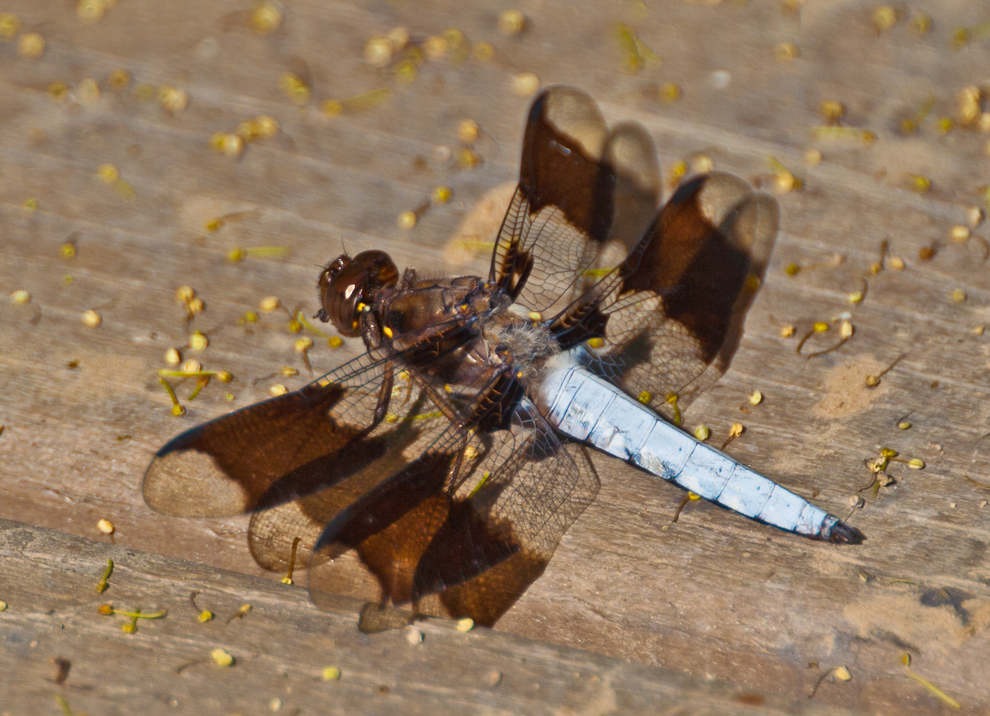
When I first looked at this photo that I took of a male Common Whitetail dragonfly (Plathemis lydia), it looked like he had grown two extra sets of wings. Had a genie granted one of his wishes? Could he now fly faster than his friends (he is a male, after all)? Will this impress the ladies?

A close look at the image, however, reveals that the extra wings are merely illusions, shadowy reflections of a more ordinary reality.

That doesn’t mean, though, that he has ceased to dream and to wish from time to time for those extra wings.

wings_blog

Michael Q. Powell. All rights reserved
Read Full Post »

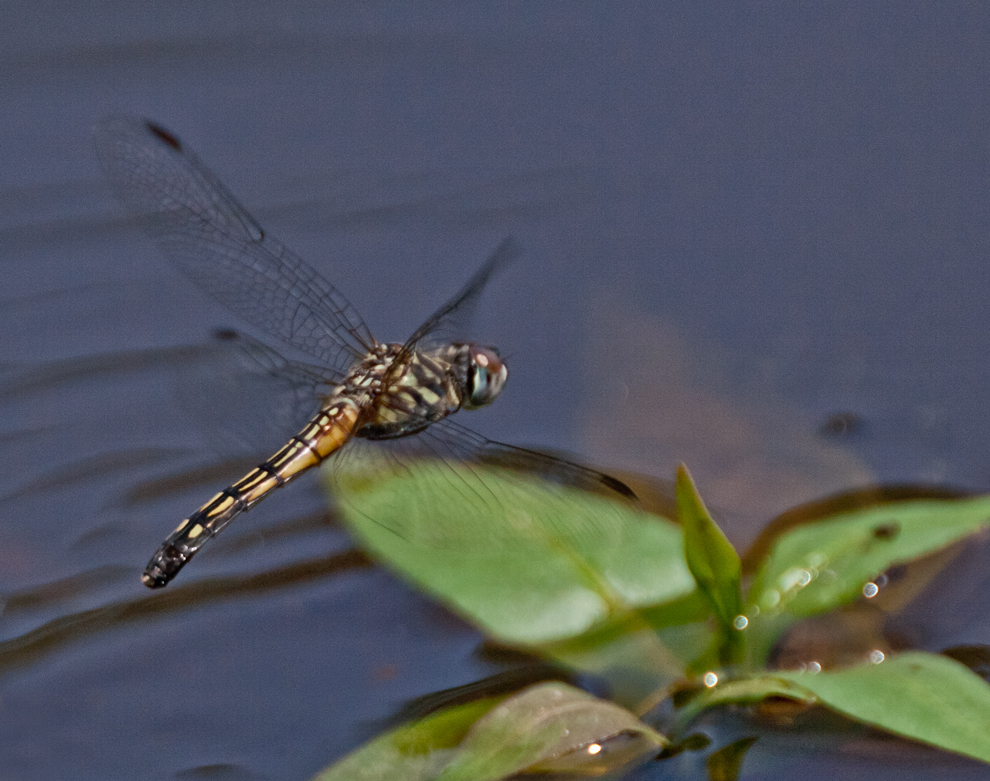
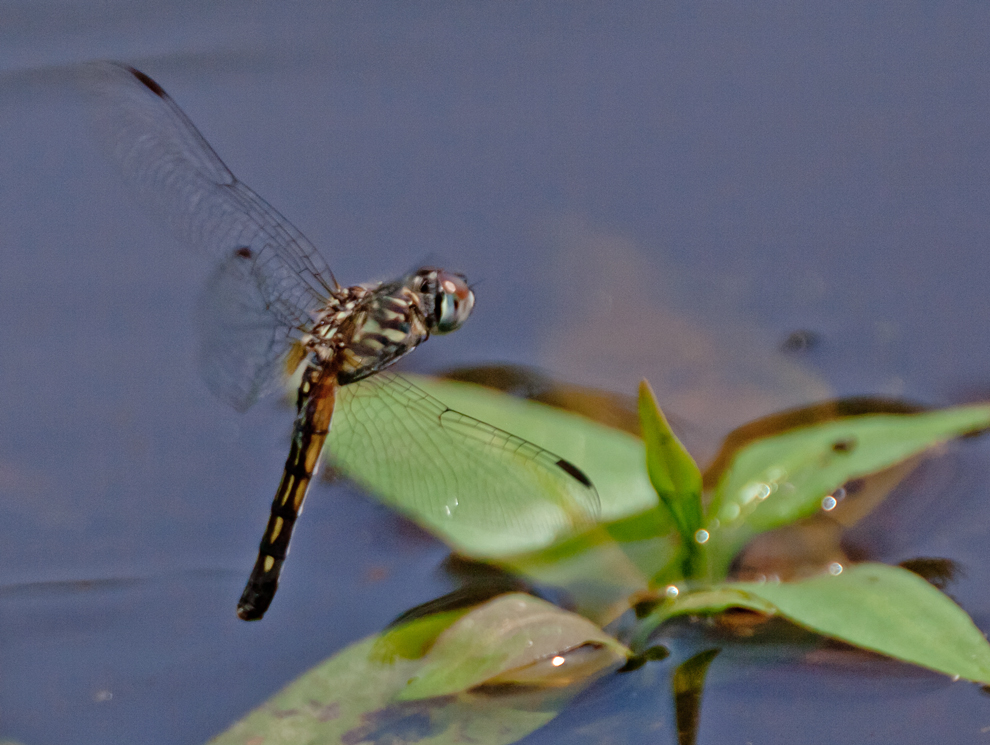
How can you photographing a dragonfly while it is flying? As we have moved into dragonfly season, I have been thinking a lot about that question and earlier this week, I had some success in getting images of a female Blue Dasher dragonfly that I believe was ovipositing.

female_dasher2_blog

Last year, I was content to photograph perched dragonflies (and still love to do so) and occasionally would capture one as it was leaving a perch. This year I am challenging myself and am actively seeking out opportunities to follow dragonflies with my lens and, if possible, to catch them in motion. They are so agile in flight, that the challenge is somewhat daunting. I have experimented with auto focusing and manual focusing. I have tried pre-focusing on an area and waiting and hoping a dragonfly would fly into it. I have had my best luck so far when I can catch the dragonfly as it is hovering.

This female Blue Dasher dragonfly (Pachydiplax longipennis) approached this little clump of vegetation several times and would begin to hover. Then she would bend her tail forward and move it rapidly back-and-forth for a few seconds, which I think meant that she was laying eggs.

female_dasher1_blog

I am definitely not an expert on dragonfly behavior and may be totally wrong about what she was doing. However, from a purely photographic point of view, this offered my best chance of getting some shots of this dragonfly in flight. As I recall, I got my best shots when focusing manually and snapping as many shots as I could when it looked like things were coming into focus.

female_dasher3_blog

The Blue Dasher female (and you’ve probably noticed that the females of this species are not blue, despite their name) flew away and returned several times, but eventually was done with her business. I am continuing to observe the different species of dragonflies and hope to identify the types of behavior they exhibit that will maximize the chance of me getting some more shots like these ones.

Michael Q. Powell. All rights reserved
Read Full Post »

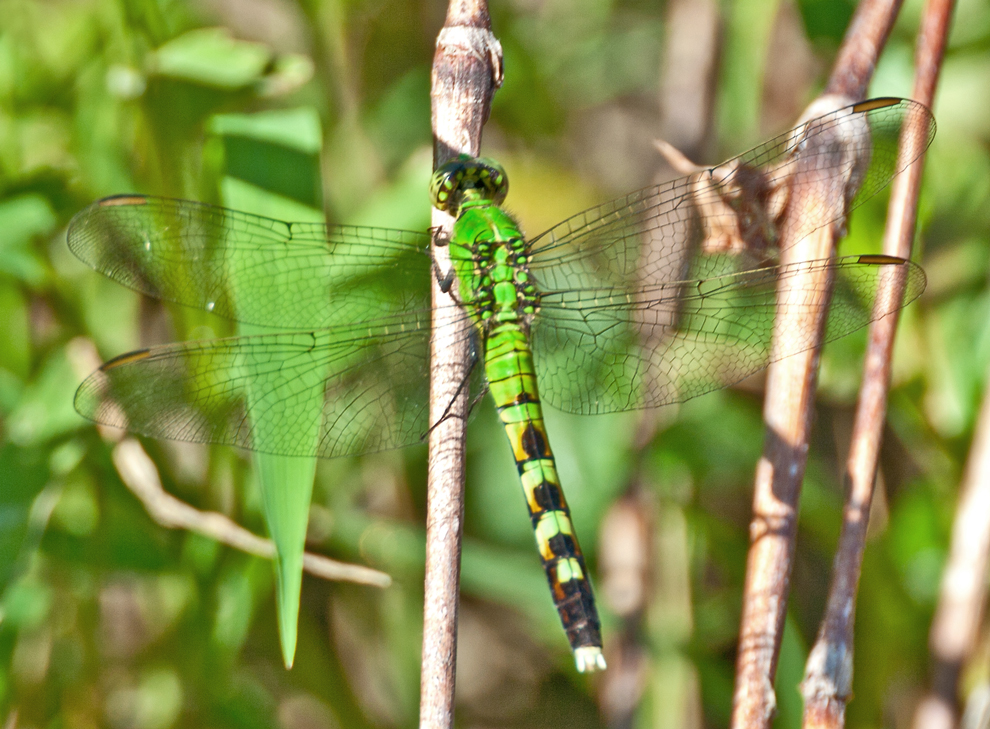
Normally, I try to have an uncluttered background for my dragonfly shots, but the brilliant green body of this female Eastern Pondhawk (Erythemis simplicicollis) really helps it to stand out (and this was the first pondhawk that I saw this spring).

Most of the dragonflies that I observe at my local marsh are either Blue Dashers or Common Whitetails, so I was really excited when a flash of emerald green caught my eye—the color is distinctive enough that I knew immediately what it was. Without paying too much attention to my surroundings, I moved forward to try to get a better angle on the dragonfly.  The next thing I knew, I was ankle-deep in marsh mud, but did manage to get some shots.

I haven’t yet seen any male Eastern Pondhawks, which are mostly blue, but I am keeping my eyes open and hope that it is only a matter of time until I photograph one this spring.

pondhawk1_blog

pondhawk2_blog

Michael Q. Powell. All rights reserved

Read Full Post »

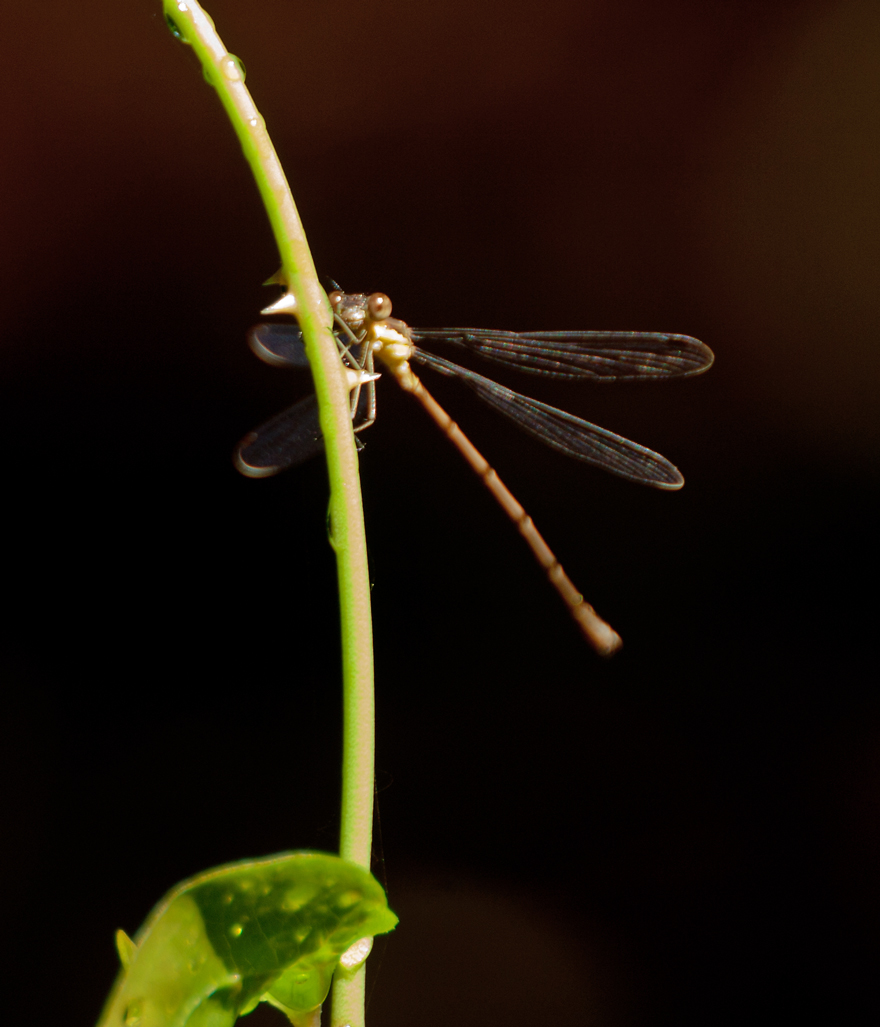
Walking through the woods today at my local marshland park, I managed to photograph my first damselfly of the spring, what appears to be some type of spreadwing damselfly, possibly a Slender Spreadwing (Lestes rectangularis).

My camera was already on my tripod, with my 135-400mm zoom lens attached, when the damselfly flew by and perched on a thorny vine right in front of me. I decided to try to get a shot and the first thing that I had to do was to back up, because the minimum focusing distance of the lens at full extension is 7.2 feet (2.2 meters). Secondly I had to switch to manual focus—the damselfly is so slender that my camera refused to autofocus on it. Finally, I had to adjust the aperture manually, when I realized that there was a lot of direct light falling on the vine and on the damselfly.

The two shots that I am posting may look like they were taken using flash, with an almost black background, but the damselfly was in a little pocket of light and the rest of the area was pretty heavily shaded.

damselfly_blog

damselfly2_blog

Michael Q. Powell. All rights reserved

Read Full Post »

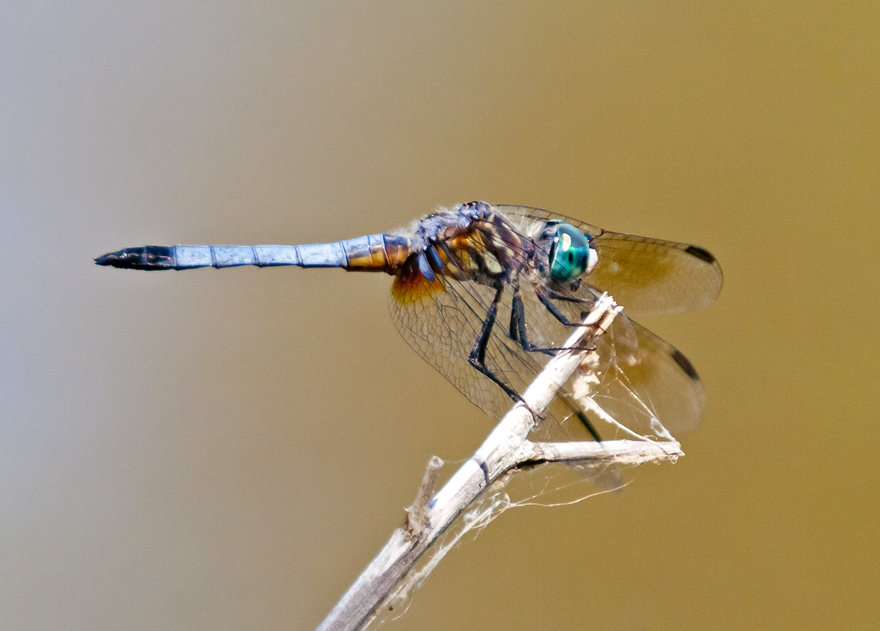
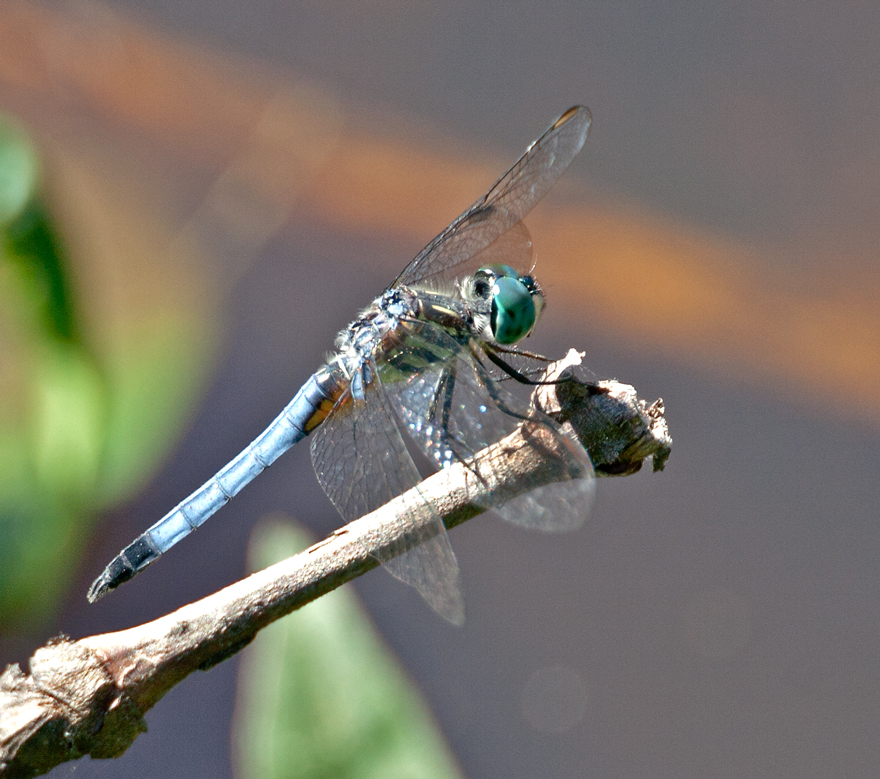
Last summer, my favorite photographic subject was the Blue Dasher dragonfly (Pachydiplax longipennis) and I was really excited on Friday to see that they are once again present at my local marshland park.

It continues to be a challenge to get close enough to capture the wonderful details of the dragonfly and to manage the background so that it is not too cluttered. I am happy to have gotten a few good images of male Blue Dashers to start the season, with the promise of more shots to come.

dasher1_blogdasher2_blog

Michael Q. Powell. All rights reserved
Read Full Post »

« Newer Posts