Feeds:
Posts
Comments

Archive for the ‘Dragonflies’ Category

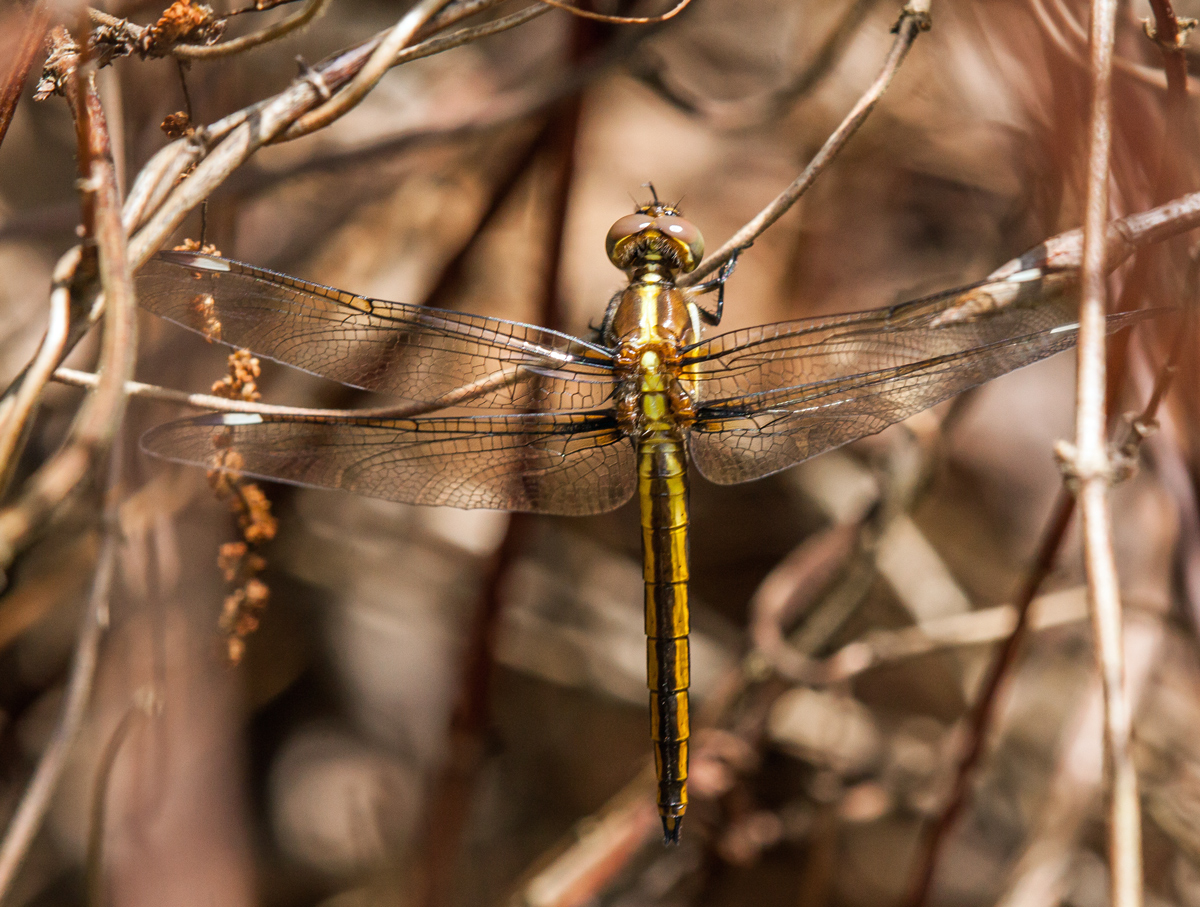
It’s dragonfly season and this past Friday fellow dragonfly enthusiast and photographer Walter Sanford guided me to a new spot to search for the elusive beauties. Accotink Bay Wildlife Refuge is a nature preserve located on Fort Belvoir, a nearby military base in Fairfax County, Virginia.

We are in a lull period of sorts for dragonflies—some of the early dragonflies are gone and others have not yet appeared. As we were making one final swing through likely locations, having come up almost empty-handed in our search, Walter spotted a dragonfly. The wings were so clear and shiny that it was obviously a teneral dragonfly, one that had only recently emerged.

Identification (and photography) was a bit of a challenge, because the young dragonfly was perched inside of a tangled mass of vegetation, making it almost impossible to get an unobstructed view. Eventually we were able to find a visual tunnel and I was able to get the first shot below. It gives a pretty good view of the dragonfly, which after the fact I could clearly see is a Spangled Skimmer (Libellula cyanea), but I really wasn’t satisfied with it.

Eventually I managed to get a second shot. It doesn’t show the dragonfly’s entire body and many element are out of focus, but it has an artistic sense that I find really appealing. I’m not sure if it’s because of the more vibrant colors or the unusual angle—I just know I like that image a whole lot more than the first one.
Spangled Skimmer

Spangled Skimmer

© Michael Q. Powell. All rights reserved.


Read Full Post »

As I turned to photograph a tiny damselfly perched on an overhanging branch, it flew down to the water. Initially I was disappointed, but then I looked more closely through my camera’s viewfinder. The male Fragile Forktail (Ischnura posita) had landed on a floating leaf and had assumed a pose that made it look like he was riding a surfboard. As a bonus, I was able to capture a fascinating area of bubbles in the algae in the foreground of the image.

Fragile Forktail

© Michael Q. Powell. All rights reserved.

Read Full Post »

Most dragonflies like sunshine, so it’s been tough this month to find very many of them, given the almost constant cloud cover and frequent rain showers. Here are a few shots nevertheless of female Common Whitetail dragonflies (Plathemis lydia) from earlier in May. All of them appear to be young ones, in particular the one in the final shot, whose wings have not yet acquired their final coloration, indicating that it has only recently emerged.

Common Whitetail

Common Whitetail

Common Whitetail

© Michael Q. Powell. All rights reserved.

Read Full Post »

Unlike many species with “common” in their names, Common Whitetail dragonflies (Plathemis lydia) actually are abundant and frequently seen during their peak season of June through September. In mid-April, however, they are much more rare and I was thrilled to spot this newly-emerged female this past Saturday at Huntley Meadows Park.

Members of this dragonfly species often perch on the ground, making them a bit difficult to photograph when they are in in area of heavy vegetation. This individual made it a easier for me to get some shots by perching almost vertically. My 180mm macro lens let me get some close-up shots without having to move too close.  I really enjoy trying to get somewhat “artsy” macro shots of dragonflies.

Mature female Common Whitetail dragonflies have distinctive dark patches on their wings. This dragonfly’s wings are mostly clear, which is why I judge that she is a teneral, i.e. she only recently underwent the transformation from living in the water as a nymph and emerged as an air-breathing acrobatic dragonfly. For comparison purposes I have included a photo from May 2014 of a fully-developed female Common Whitetail in which you can see the wing patches.

Common Whitetails are one of the first dragonflies to appear in the spring and they are around until late in the fall. I find them to be beautiful, especially this early in the season when they do not have to share the stage with very many other dragonflies.

Common Whitetail dragonfly

Common Whitetail dragonfly

Common Whitetail dragonfly

Common Whitetail dragonfly May 2014

© Michael Q. Powell. All rights reserved.


Read Full Post »

I have captured images of many beautiful dragonflies in the past, but I am not sure that any of them can quite match the spectacular colors and pattern of this female Springtime Darner dragonfly (Basiaeschna janata) that I photographed this past Friday at Huntley Meadows Park in Alexandria, Virginia.

Springtime Darners appear to be be pretty uncommon at our park—they are few in number and are active for only a very limited period of time early in the spring. Last year, fellow photographer Walter Sanford and I spotted the first known Springtime Darner at Huntley Meadows Park, but it was only a brief encounter and we never again spotted one.

Walter and I were determined that we would do better this year. Already this spring, he and I have separately explored likely locations for hours on end without success. On Friday, we decided to work together as a team. Our experience has shown that having an extra set of eyes really helps in spotting and tracking our elusive flying subjects.

After several hours of searching, we finally caught sight of a dragonfly in flight. It flew about a bit and then it finally perched—our moment had arrived for indeed it was a Springtime Darner. Springtime Darners will generally perch vertically on vegetation low to the ground. My view of the dragonfly was obscured, but fortunately Walter could see it and began to compose some shots.

I stood still for what seemed like an eternity, fearful of spooking the dragonfly, but finally was able to move forward to a spot with a somewhat clearer view of the dragonfly. The only problem was that I couldn’t pick out the dragonfly amidst all of the vegetation. I was shooting with my 180mm macro lens, which meant that I couldn’t simply zoom in to get a better view. Walter patiently described for me the specific location and I took some initial shots without actually seeing the dragonfly.

Eventually I was able to see what I thought was the dragonfly and captured a few shots before it flew away, though I never had a really clear view of it. Although we searched and searched, we were not able to relocate the dragonfly, nor did we see another Springtime Darner.

I was not very hopeful when I downloaded my images from my memory card to my computer and was surprised when I saw that somehow I had captured some of the beautiful colors and patterns of the Springtime Darner. Normally I like to try to isolate my subjects from the background and the background in these two images was unavoidably really cluttered, but I’m really happy with them.

I am happy with the images, but not quite satisfied—I’ll be out again soon to search for more Springtime Darners, hopefully including a male, as well as other dragonflies and damselflies. My dragonfly season has only just begun.

Springtime Darner

Springtime Darner

© Michael Q. Powell. All rights reserved.


Read Full Post »

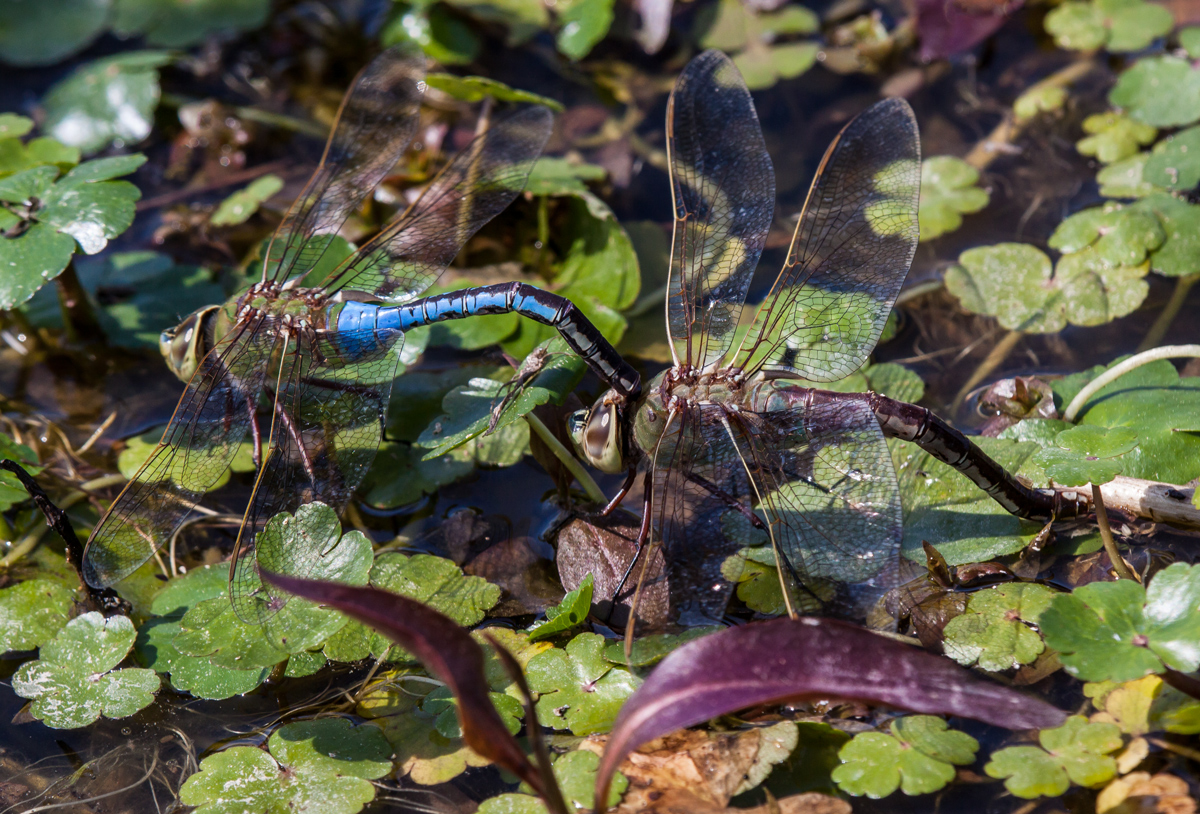
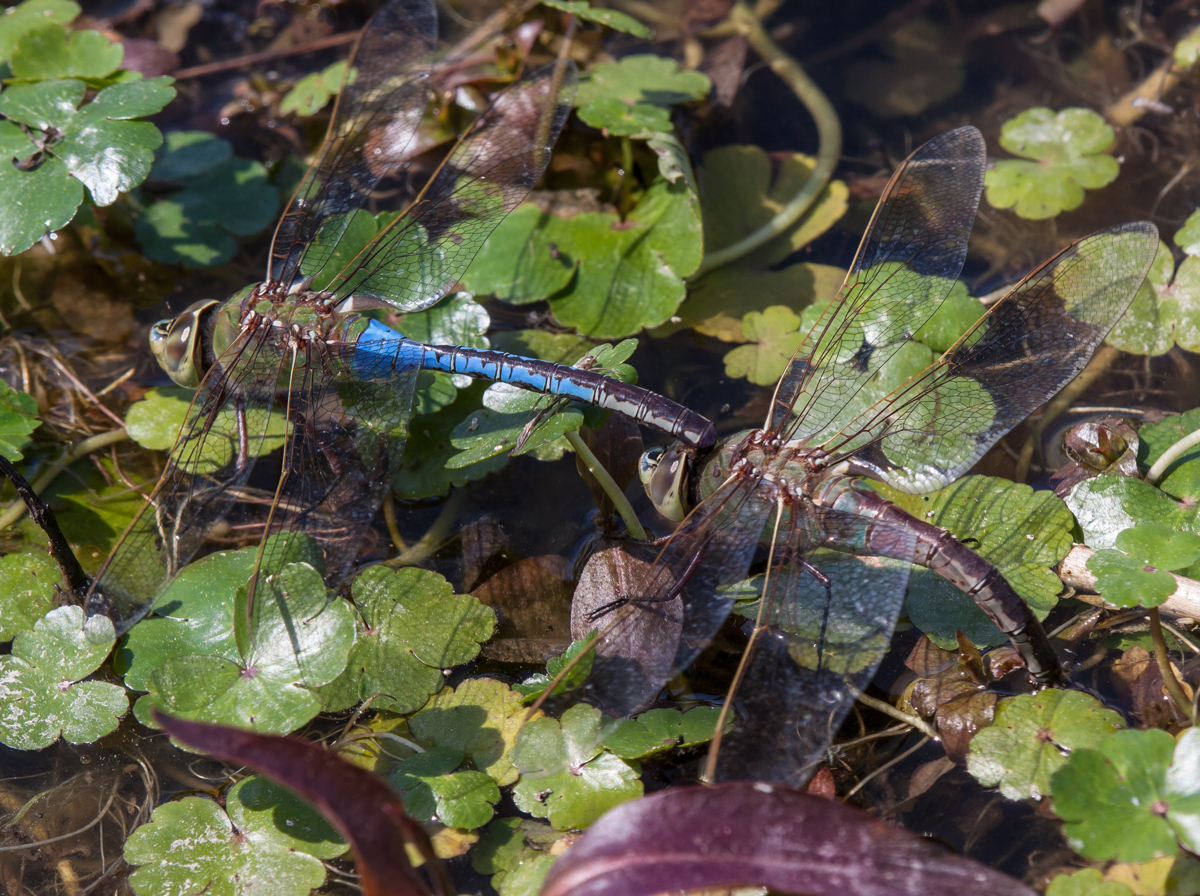
Now that the weather is warming up, I am searching in earnest for dragonflies, one of my favorite subjects to photograph. I am still having difficulties locating native-born species, but fortunately there are some migratory species in the area. Yesterday I spotted this Common Green Darner (Anax junius) dragonfly couple in tandem, with the male holding on as the female deposited her eggs in the floating vegetation.

In some dragonfly species the male will hover above the female as she oviposits, but in others, like the Common Green Darner, the male remains attached. I suspect that this method is one way of ensuring that the eggs that the male has fertilized are deposited before the female hooks up with another male.

Common Green Darner

Common Green Darner

© Michael Q. Powell. All rights reserved.

Read Full Post »

On Monday, I finally captured my first dragonfly shots of the season at Huntley Meadows Park, a recently emerged Common Basketttail dragonfly (Epitheca cynosura). For a couple of weeks I’ve been periodically seeing migrating Common Green Darners, but this is the first “native-born” dragonfly I have spotted.

The dragonfly is in a juvenile stage known as “teneral,” which initially confused me when I was trying to identify it. I looked through a lot of photos on the internet and they didn’t quite match up with some of the markings of “my” dragonfly.

Fortunately an expert came to the rescue when I posted the photos on the Northeast Odonata Facebook page and asked for help. Ed Lam, who literally wrote the book on odonata in the Northeast, replied that, “It’s a Common. It’s teneral so the stigmas and the hind wing patch will darken as it matures.” You can check out Ed’s book, Damselflies of the Northeast: A Guide to the Species of Eastern Canada and the Northeastern United States, on Amazon.

From my perspective, the dragonfly season has now officially opened. It is still really challenging, however, to find them this early, given that most species won’t emerge until much later in the spring and in early summer.

Common Baskettail dragonfly

Common Baskettail dragonfly

Common Baskettail dragonfly

© Michael Q. Powell. All rights reserved.


Read Full Post »

As I was preparing to leave work yesterday, one of my co-workers reminded me to wear something green today to celebrate St. Patrick’s Day. Some people go a little crazy on this day, drinking green beer and consuming food that has been dyed to an unnaturally bright shade of green.

To celebrate the day, I thought I’d reprise a few photos of some of my favorite green creatures, including the Common Green Darner (Anax junius), the Green Heron (Butorides virescens), a green metallic bee, and little green frogs. If you are viewing the images in the blog itself (and not the Reader), click on any one of the photos to see a larger image in slide-show mode.

For those of you also celebrating St. Patrick’s Day, be safe and have fun.

© Michael Q. Powell. All rights reserved.

Read Full Post »

Fellow dragonfly enthusiast Walter Sanford managed to spot a dragonfly in January in Northern Virginia. Wow!

Be sure to check out his blog for more facts and photos about dragonflies, damselflies, and other little creatures.

waltersanford's avatarwalter sanford's photoblog

A single Autumn Meadowhawk dragonfly (Sympetrum vicinum), jokingly referred to as a “Winter Meadowhawk dragonfly” in a recent post, was observed on 03 January 2016 near the terminus of the Hike-Bike Trail at Huntley Meadows Park. This sighting sets a new late-date for this species for both Huntley Meadows Park (formerly 27 December) and the Commonwealth of Virginia (formerly 01 January).

An Autumn Meadowhawk dragonfly (Sympetrum vicinum) spotted at Huntley Meadows Park, Fairfax County, Virginia USA. This individual is a female. 03 JAN 2016 | Huntley Meadows Park | Autumn Meadowhawk (female)

This individual is a female, as indicated by her coloration, shape of the abdomen, and terminal appendages.

An Autumn Meadowhawk dragonfly (Sympetrum vicinum) spotted at Huntley Meadows Park, Fairfax County, Virginia USA. This individual is a female. 03 JAN 2016 | Huntley Meadows Park | Autumn Meadowhawk (female)

The following graphic image shows the current air temperature in the central wetland area around the time when I spotted the record-setting dragonfly. 51°F is nearly 20 degrees less than 70°F, widely believed to be the minimum body temperature necessary for dragonfly flight!

HMP_wx-station 03 JAN 2016…

View original post 280 more words

Read Full Post »

As many of you know, I recently entered some photos in a local photo competition and was fortunate to be awarded second place for one of them. I was a little surprised by the one that was selected, because, quite frankly, it was not my favorite one of the group.

The more that I though about it, the more I realized how difficult it must be to be a judge, especially in an area like photography in which there is both a technical and an artistic component.

Why do we like what we like?

I’ve never used a poll in a posting before, but thought that in this case it might be interesting to learn which one of my four entries is your favorite. I am not really asking you to judge which one is “best,” but am looking more for a sense of which one you like most. You can use whatever criteria you like and I would be thrilled if you gave a few words about your choice.

As you can see, I chose a diverse set of subjects to appeal to a variety of tastes. There are two birds—a Bald Eagle (Haliaeetus leucocephalus) and an Eastern Bluebird (Sialia sialis); one insect—a Blue-faced Meadowhawk dragonfly (Sympetrum ambiguum); and one mammal—a Red Fox (Vulpes vulpes).

If I have set this up correctly, you can click on any image and scroll through each of them in full size. After viewing them all, select your favorite and register your vote. As I mentioned earlier, I’d be really happy if you left a few words about your choice. (I think the poll might let you vote multiple times if you have trouble choosing, but am not 100 percent certain, given that I am not familiar with the polling component.) NOTE: If you open the posting in Reader, you may need to click on the Title to get to the actual posting and to the poll.

Thanks. Merry Christmas in advance for those celebrating Christmas and best wishes as we move toward the start of a new year.

© Michael Q. Powell. All rights reserved.

Read Full Post »

Autumn Meadowhawk dragonflies, the sole survivors at this time of the year, are very friendly and it’s not unusual for them to perch on you. It took some contortions, but I managed to get these shots recently of an Autumn Meadowhawk (Sympetrum vicinum) perched on my arm and my leg.

The first shot, in which the dragonfly was perched on my arm between my elbow and my wrist,  was particularly challenging, because I had to shoot it one-handed. My Canon 50D and Tamron 180mm macro lens together weigh close to 4 pounds (1800 grams), so it was a little tough to hold steady. Additionally, the lens has a minimum focusing distance of 18 inches (470 mm), so I had to slowly stretch out the arm to gain the needed distance for the shot. By comparison, the second shot, in which the dragonfly was on my leg, was easier to shoot and I was able to capture the dragonfly’s entire body.

With a little luck, I’ll continue to see these pretty little dragonflies for a few more weeks, and then I’ll turn my attention to birds (and hopefully the occasional mammal).

Autumn Meadowhawk

Autumn Meadowhawk

© Michael Q. Powell. All rights reserved.
Read Full Post »

Some folks might be surprised to learn that I continue to spot dragonflies, despite the cooler weather of late November. Autumn Meadowhawks (Sympetrum vicinum) are a particularly hardy species and in past years I have observed these tiny red beauties into December.

One of the challenges for the Autumn Meadowhawks is to warm up and I have noticed that they sometimes like to perch on one particular sign at Huntley Meadows Park, the county-run marshland park where I take many of my photos. The sign is angled to make it easier for viewers to read, making it perfect for a basking dragonfly.

In this image I was able to capture a favorite portion of the text on that sign and a cooperative Autumn Meadowhawk added a useful accent to the message. The last sentence sums up pretty well my view of nature and my aspiration during my visits to walk lightly.

walk lightly

© Michael Q. Powell. All rights reserved.
Read Full Post »

I am not particularly fond of mosquitoes and flies landing on me, but I love it when a colorful dragonfly chooses to do so. Autumn Meadowhawks are especially friendly in this regard and my friend Walter Sanford captured some fun images of these little red beauties that had landed on different parts of his body (and even included a few photos I took of him with his little friends). Check out his posting!

waltersanford's avatarwalter sanford's photoblog

The Autumn Meadowhawk dragonflies (Sympetrum vicinum) were especially “friendly” during a recent visit to Huntley Meadows Park, landing on me frequently as Michael Powell and I were searching for Great Spreadwing damselflies (Archilestes grandis).

My Photos

The following individual is a male, perching on the leg of my Columbia convertible pants. Regular readers of my photoblog know I’m especially fond of head-tilts in which the dragonfly seems to display some of its personality. Like this guy, who I imagine is thinking “What are you looking at? That’s right pal, I’m perching on your pants!”

An Autumn Meadowhawk dragonfly (Sympetrum vicinum) spotted at Huntley Meadows Park, Fairfax County, Virginia USA. This individual is a male, perching on my leg (Columbia pants). 11 NOV 2015 | Huntley Meadows Park | Autumn Meadowhawk (male)

The next photo shows two individuals perching on my pants, both females, as indicated by their coloration and terminal appendages.

Two Autumn Meadowhawk dragonflies (Sympetrum vicinum) spotted at Huntley Meadows Park, Fairfax County, Virginia USA. These individuals are females, perching on my leg (Columbia pants). 11 NOV 2015 | Huntley Meadows Park | Autumn Meadowhawk (male)

The last individual is another female. I shot this photo…

View original post 279 more words

Read Full Post »

Over the last month I have developed an unhealthy obsession with the Great Spreadwing damselfly (Archilestes grandis)—I think that I have turned into a stalker.

Normally I am a walker, not a stalker. I like to keep in motion, opportunistically scanning for new and different subjects to photograph. Increasingly, however, I have been spending endless hours at the same location, waiting and hoping that I will get yet another glimpse of a Great Spreadwing damselfly.

My friend and fellow fanatic Walter Sanford and I have been closely monitoring this one location, documenting in our photos the continued presence of these beautiful creatures and establishing new records for the latest date that they have been spotted in our area. It’s become harder and harder to find one of them and their population has shrunk to the point that there may be only one damselfly remaining.

That certainly seemed to be the case on 11 November (Veterans Day/Armistice Day), when for the first time this season, Walter and I hunted together for a Great Spreadwing. We have a friendly rivalry and push each other, but on this day it was complete cooperation as we searched for hours, uncertain if there were any survivors. Check out Walter’s blog posting today for an engaging narrative and wonderful photos of our adventures that day, which ultimately turned out to be successful in spotting a Great Spreadwing damselfly.

I too managed to get a few photos, although it was tough to frame a shot, because the  damselfly perched in the almost knee-high vegetation and I couldn’t move much from my crouching position for fear of scaring it away. I was shooting with my 180mm macro lens, so zooming from a greater distance was not an option.

Is this the final fall farewell? Are my days as a stalker coming to an end? When is it time to call it quits on a relationship?

The weather has turned cooler again and conditions continue to grow increasingly inhospitable. These may well be the last shots I get of a Great Spreadwing damselfly this season.

However, I’m heading out to the park in a short while and suspect that I will be drawn back inexorably to the damselfly’s habitat.

It’s so hard to say goodbye.

Great Spreadwing

Great Spreadwing

© Michael Q. Powell. All rights reserved.


Read Full Post »

Check out today’s posting by my good friend and fellow photographer Walter Sanford for a compelling narrative and wonderful photos of our newest adventures searching for the Great Spreadwing damselfly.

waltersanford's avatarwalter sanford's photoblog

It was my honor to spend Veterans Day with my good friend and photowalking buddy Major Michael Powell, U.S. Army, Retired. We were men on a mission: Searching for Great Spreadwing damselflies (Archilestes grandis), in the hope of extending the “official” late-date for this species in Virginia. Mission accomplished, but it wasn’t easy — the operation was unsuccessful until we called in an “air strike!”

Since 06 October 2015, Mike and I have been frequently monitoring the Great Spreadwing damselflies that inhabit a small permanent pond and surrounding fields at a remote location in Huntley Meadows Park.

On 11 November, Mike and I spent several hours intensively searching for our quarry; no luck. A little after 1:00 p.m., we were standing near the pond watching a lone Shadow Darner dragonfly (Aeshna umbrosa) aggressively hawking smaller odonates perching around the perimeter of the pond: the darner dipped into…

View original post 199 more words

Read Full Post »

Do you keep returning to the same places over and over again to take photos of the same subjects? For the last month or so, I have been going back repeatedly to a small pool of water in a secluded part of my favorite park, hoping to get another glimpse of a spectacular Great Spreadwing damselfly (Archilestis grandis).

Their numbers seem to have dwindled and it is possible that there is only a single damselfly of this species remaining. Yesterday, I watched and waited for quite some time before I was finally able to spot a male Great Spreadwing and it took several mini-encounters before I was able to get a decent photograph of the damselfly.

All of the female damselflies of this species seem to have disappeared several weeks ago, so it seems that any hopes he harbors for mating may be in vain. Indeed, the clock is definitely ticking for him—this species has never before been documented in Virginia this late in November.

I am cheering for this survivor and will try to find him again later this weekend. Despite my hopeful attitude, however, I can’t help but remember that yesterday I observed a large Shadow Darner dragonfly (Aeshna umbrosa) patrolling the pool and periodically chasing the damselfly, hoping to turn him into the main course of his lunch.

I’ve included two very different images of yesterday’s damselfly. The first shot is one that I framed very carefully, trying to get as parallel as I could with the damselfly and focusing manually. I like the way that it shows so many of beautiful details of the damselfly’s body. When I took the second shot, I was facing almost directly into the sun and I hurriedly played with camera settings to try to ensure that I did not get a mere silhouette. I really liked the way the sunlight was coming through the outstretched wings and used my camera’s pop-up flash to add a little light to the damselfly’s underside.

Great Spreadwing

Great Spreadwing

© Michael Q. Powell. All rights reserved.

Read Full Post »

Growing up in the 1960’s, I remember well The Byrds folk-rock version of the song Turn! Turn! Turn! (To Everything There is a Season), a Pete Seeger song with lyrics adapted almost word-for-word from Chapter 3 of the Biblical Book of Ecclesiastes. (If you have never heard The Byrds version of this song, here’s a link to a YouTube video of a performance.)

“To everything there is a season, and a time to every purpose under the heaven…”

According to statistical records, the season of the boldly-patterned Twelve-spotted Skimmer dragonfly (Libellula pulchella) in my area ended in early to mid-October. I was therefore shocked last Friday, 30 October, when I spotted a beautiful male Twelve-spotted Skimmer flying about in a field at Huntley Meadows Park.

I sometimes have trouble identifying species, but the wing patterns of this species are so distinctive that I knew exactly what it was, so I chased it around for a little while until I was able to get some shots of it. When I posted this photo on the Facebook page of Northeast Odonata, several members of the group commented on the “fresh” and undamaged condition of the dragonfly.

Statistics only get you so far, especially when looking at individuals. This dragonfly beat the odds and is a survivor—his personal “season” is off of the charts.

Like this dragonfly, we all have personal “seasons.” The dragonfly’s unexpected appearance brought to mind the words of a pastor at a funeral I attended earlier this year, who poignantly remarked that “we all come with expiration dates.” That reminder continues to challenge me as I think about how I should live my life.

“To everything there is a season, and a time to every purpose under the heaven…”


Twelve-spotted Skimmer

© Michael Q. Powell. All rights reserved.


Read Full Post »

A bittersweet feeling at times envelops me at this time of the year as I photograph some summer species, never knowing for sure if it will be the last time I see them until next year.

This past Friday I spotted a tiny female Familiar Bluet damselfly (Enallagma civile), a species that I haven’t seen in months. I had almost forgotten how small these damselflies are, about 1.1 to 1.5 inches (29-39mm) in total length. Despite their diminutive size, they have wonderful colors and markings and I was thrilled to be able to be able to capture some of that beauty with my macro lens.

Will I see another Familiar Bluet? I will keep looking in familiar places, hoping for yet another rendezvous, for one more chance for a final farewell.

Familiar Bluet

© Michael Q. Powell. All rights reserved.

Read Full Post »

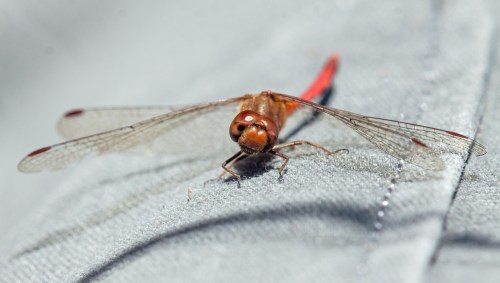
What do you do when a dragonfly lands on you? My first reaction, of course, was to take a photo when this Autumn Meadowhawk (Sympetrum vicinum) landed on my leg on Friday.

The good news was that I had a macro lens on my camera, so I knew that I would be able to focus on the dragonfly. The bad news was that it was a 180mm  macro lens, so I had to go through acrobatic contortions to try to achieve enough distance to fit the entire dragonfly into the frame. I also had to move like a ninja to keep from scaring away my subject.

In the end, I managed to get a decent shot of the dragonfly by standing as tall as I could and shooting straight downward, although my gray sweatshirt billowed out a bit and obscured the view of the dragonfly’s feet. For those of you who are not familiar with Autumn Meadowhawks, they are small dragonflies with bodies about an inch or so in length (25mm).

Autumn Meadowhawk

© Michael Q. Powell. All rights reserved.


Read Full Post »

Some of the damselfly species that I pursue are present in such limited numbers and in so well-defined areas that it is sometimes possible after time to recognize individual damselflies by their distinctive physical characteristics.

Earlier this month I was really excited when I spotted some Great Spreadwing damselflies (Archilestes grandis) after a tip from fellow dragonfly enthusiast Walter Sanford. I visited the location where he had seen them a few times and was able to get some good photos, which I included in several blog postings.

My efforts, though, pale in comparison with Walter’s—he virtually staked out that location and came to know some of  the damselflies there so well that he gave them nicknames. In messages to me, Walter noted he had named two of his favorites “Mr. Magoo” and “Bendy Straw.”  Check out Walter’s blog posting today for some wonderful images of these two damselfly celebrities.

As I reviewed my images of Great Spreadwings, I noticed that one of them had a peculiar bend near the end of his abdomen. Could this possibly be “Bendy Straw?” Walter and I were never at that location at the same time, so it seemed unlikely that I had seen one of “his” damselflies. After I sent him a copy of the image, he confirmed that I had in fact photographed “Bendy Straw.”

Great Spreadwing damselfly

As I continued examining my images, another damselfly stood out, because he had only five legs. It looked like one of his back legs had been completely severed, leaving a small stump. How could something like this have happened? I am used to seeing dragonflies with tattered wings, but an injury like this seems to be of a completely different nature.

Great Spreadwing damselfly

I usually try to identify the species of my subjects, but both of these damselflies help to remind me that I am not photographing species—I am photographing individuals. Each of those individuals has distinctive characteristics and has its own life story.

Somehow that seems to be a useful reminder and gives me a sense of perspective about what I am doing as a nature photographer.

© Michael Q. Powell. All rights reserved.

Read Full Post »

Although it is October, my good friend and fellow photographer Walter Sanford continues to discover new species of damselflies in my favorite marshland park. Check out his posting (and his site) for some awesome images of his newest find.

waltersanford's avatarwalter sanford's photoblog

I’m fairly certain I discovered a new species of damselfly at Huntley Meadows Park (HMP): Sweetflag Spreadwing damselfly (Lestes forcipatus).

A Sweetflag Spreadwing damselfly (Lestes forcipatus) spotted at Huntley Meadows Park, Fairfax County, Virginia USA. This individual is a male. 15 OCT 2015 | HMP | Sweetflag Spreadwing (male)

This individual is a male, as indicated by its hamules and terminal appendages.

A Sweetflag Spreadwing damselfly (Lestes forcipatus) spotted at Huntley Meadows Park, Fairfax County, Virginia USA. This individual is a male. 15 OCT 2015 | HMP | Sweetflag Spreadwing (male)

(See a full-size version of the preceding photo, without annotation.)

The hamules are key field markers for differentiating some species of similar-looking damselflies, such as Southern Spreadwing (Lestes australis) and Sweetflag Spreadwing (Lestes forcipatus).

All male damselflies have four terminal appendages, collectively called “claspers.” Male damselfly terminal appendages don’t look exactly the same for all species of damselflies, but their function is identical.

A Sweetflag Spreadwing damselfly (Lestes forcipatus) spotted at Huntley Meadows Park, Fairfax County, Virginia USA. This individual is a male. 15 OCT 2015 | HMP | Sweetflag Spreadwing (male)

(See a full-size version of the preceding photo, without annotation.)

Claspers are used to grab and hold female damselflies…

View original post 352 more words

Read Full Post »

How do you feel when confronted with a graphic image of mating damselflies? Are you shocked, offended, fascinated, or intrigued? Is it art or is it pornography?

I couldn’t help but feel a little bit like a voyeur as I crept closer and closer on Monday to the mating Great Spreadwing damselflies (Archilestes grandis) with my macro lens. As I prepared the photos for this posting, it seemed like I had extracted a couple of pages from the Damselfly Kama Sutra. What exactly were they doing as they assumed more and more acrobatic positions? It was like watching an R-rated (or maybe X-rated) Cirque du Soleil performance.

Art or pornography? Sometime in the distant past I remember studying a Supreme Court case in which attempts were made to define obscenity. With the help of Wikipedia, I refreshed my memory. It was a 1964 case and Justice Potter Stewart wrote some words that have become a guideline for assessing a given piece of work:

“I shall not today attempt further to define the kinds of material I understand to be embraced within that shorthand description [“hard-core pornography”], and perhaps I could never succeed in intelligibly doing so. But I know it when I see it…”

So that’s it, “I know it when I see it.”

I’ll boldly contend that my photos are art. I am glad, however, that I am not a parent who has to respond to a young child’s curious question about what these damselflies are doing. The birds and the bees are simple to explain by comparison. With damselflies, I think the Facebook expression fits—”it’s complicated.”

Great Spreadwing damselflies

Great Spreadwing damselflies

© Michael Q. Powell. All rights reserved.

Read Full Post »

I just love the beautiful blue eyes and distinctive markings of the male Great Spreadwing damselfly (Archilestes grandis) and I was thrilled when I spotted one on Saturday at Huntley Meadows Park in Alexandria, Virginia.

I wonder if it damages this little guy’s self-esteem to be called a “damsel?” Perhaps he looks with envy at his odonate brethren with the more macho-sounding “dragon” in their names. Do we need a more gender-neutral name for damselflies?

Great Spreadwing damselfly

© Michael Q. Powell. All rights reserved.

Read Full Post »

What’s the largest damselfly in North American? According to Dennis Paulson, in his wonderful book, Dragonflies and Damselflies of the East, that title goes to the Great Spreadwing damselfly (Archilestes grandis), which is more than two inches (5 cm) in length, i.e. bigger than many of the dragonflies that I so frequently chase.

My good friend and local dragonfly expert Walter Sanford spotted a male Great Spreadwing this past week and posted a photo of it and yesterday I felt inspired to try to find one myself. He had provided me the general location at Huntley Meadows Park, my favorite local place for nature photography, and I patiently searched near the water, in the tall vegetation, and under the trees for almost two hours.

As my patience was starting to wear thin, I finally spotted one. The Great Spreadwing damselflies have a yellow racing stripe on their thorax and are quite distinctive, in addition to their size. I took some initial shots with my big zoom lens and then switched quickly to my 180mm macro lens.

The first Great Spreadwing I spotted was a male, but eventually I spotted a female and a pair of them in the tandem position. I am still going through my shots, but wanted to post a couple initially. I will probably post some more images in another posting or two.

The first shot shows a female Great Spreadwing damselfly—you can tell from her coloration and her terminal appendages. She let me take quite a few photos and returned to nearby vegetation a couple of times when she was spooked. The second image is a close-up that shows her beautiful eyes and her blue upper lips, which I think technically are called labrum.

Perhaps blue lips are the new fashion craze for the autumn. I’ll look around and see if any of the young ladies in the Washington D.C. area are sporting this look.

Great Spreadwing damselfly

spread2_female_blog

© Michael Q. Powell. All rights reserved.

Read Full Post »

I have been seeing Common Green Darner dragonflies (Anax junius) hunting high over the fields the last couple of weeks as they prepare for migration, but have not been able to get any shots of them. In theory, they are easier to photograph when they land, but these dragonflies like to hang vertically low to the ground, often in areas with heavy vegetation. I have been repeated frustrated by spotting them only after they have taken to the air as I got close to them.

This past Friday, though, I saw one land nearby when I was already in a field of waist-high vegetation. Judging from the blue abdomen, it’s a male Common Green Darner. I was struck by the relatively dark color of much of the abdomen of this particular individual. When doing a little research at my favorite website for local dragonflies, dragonfliesnva.com, I learned that Common Green Darners deal with the problem of cool weather “by having dark-colored platelets in their blood that rise to the surface when it’s cold, darkening their abdomen color, therefore attracting more sun. On bright, hot days, those dark platelets sink, and the abdomen turns bright bluagain, now reflecting light.”

The dragonfly was surrounded by dried vegetation and there was no way that I could get an uncluttered background for my shots. Fortunately, however, the the colors of the vegetation are so muted that the gorgeous blue and green of the dragonfly really stand out. In the first shot, I zoomed all the way to try to capture the maximum amount of detail, while in the second shot I pulled back a little on the zoom to capture the dragonfly’s entire wingspan.

Common Green Darner

Common Green Darner

© Michael Q. Powell. All rights reserved.

Read Full Post »

We usually think of springtime as the season of love, but apparently autumn is also a good season if you are a damselfly. I don’t know what was so special about this one plant sticking out of the water, but mating damselfly couples seemed to be competing for a spot to land and deposit their eggs on it this past Monday at Huntley Meadows Park in Alexandria, Virginia.

I’m no expert when it comes to identifying damselflies, in part because so many different species have similar patterns of black and blue, but I think these couples, all in the tandem position, may be Big Bluets (Enallagma durum). I’d welcome any corrections or confirmation of my initial identification.

UPDATE:  My local odonate expert, Walter Sanford, weighed in with a correction to my identification—these damselflies are Familiar Bluets (Enallagma civile), not Great Bluets. When it comes to my initial identification, you might say that I blew it.

For those who might be curious about the technical aspects of the photo, I took this with my Canon 50D at 600mm on my Tamron 150-600mm lens, which is the equivalent of 960mm when you take into account the crop sensor of my camera. I continue to be pleased with the amount of detail that I can capture with the relatively affordable long lens, even when it’s extended to its maximum length. If you click on the image, you can see even more of those wonderful details.

mating damselflies

© Michael Q. Powell. All rights reserved.

Read Full Post »

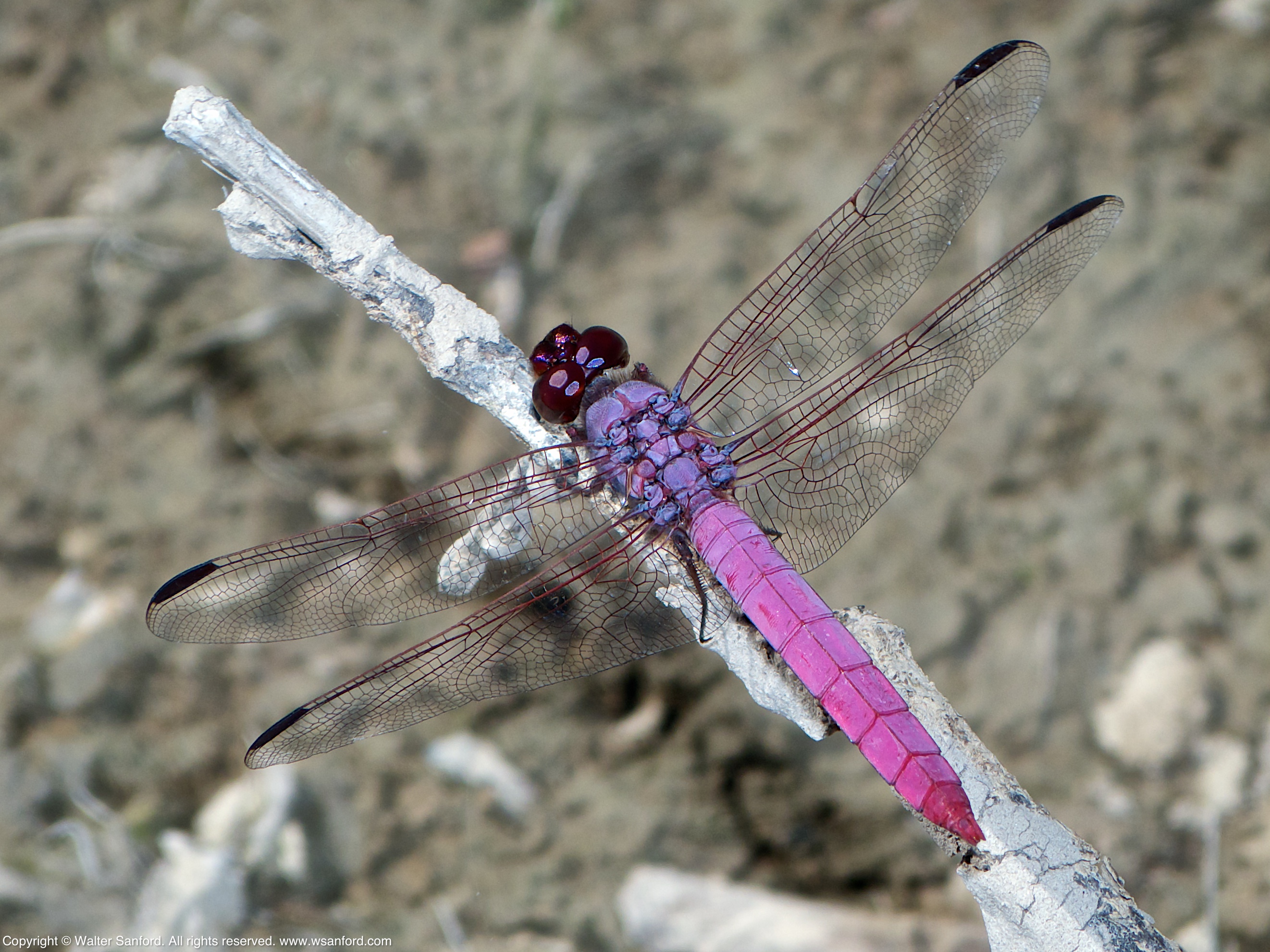
A pink dragonfly? Fellow photographer and good friend Walter Sanford was not hallucinating when he recently spotted this Roseate Skimmer dragonfly at Huntley Meadows Park, one of only a small handful of sightings ever of this species in Virginia.

He spotted one last year too, but this year managed to capture a wonderful series of images of this beauty. Be sure to check out his original posting as well as other spectacular images on his blog.

waltersanford's avatarwalter sanford's photoblog

Breaking news: I discovered a new species of dragonfly at Huntley Meadows Park — a Roseate Skimmer dragonfly (Orthemis ferruginea). This is the first official record of Orthemis ferruginea in Fairfax County, Virginia.

Actually, I discovered this species last year but was unable to shoot a photo to prove I wasn’t hallucinating pink dragonflies! On 10 September 2014, I spotted a male Roseate Skimmer that made one patrol around a pool near an old beaver lodge (one that overlapped the boardwalk that goes through the central wetland area), landed for one second (no kidding) and flew upstream along Barnyard Run; I never saw it again. This year, I have photographic proof.

This individual is a male, as indicated by its coloration and terminal appendages.

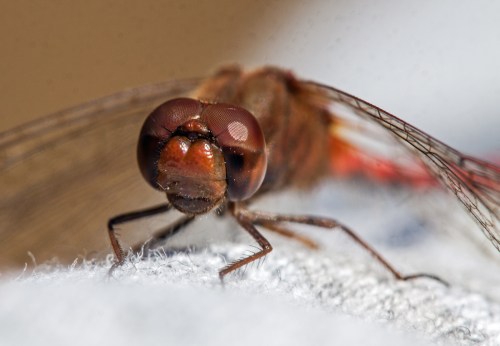
A Roseate Skimmer dragonfly (Orthemis ferruginea) spotted at Huntley Meadows Park, Fairfax County, Virginia USA. This individual is a male. 23 SEP 2015 | Huntley Meadows Park | Roseate Skimmer (male)

Dig that crazy metallic purple face!

A Roseate Skimmer dragonfly (Orthemis ferruginea) spotted at Huntley Meadows Park, Fairfax County, Virginia USA. This individual is a male. 23 SEP 2015 | Huntley Meadows Park | Roseate…

View original post 272 more words

Read Full Post »

The autumnal equinox arrived yesterday, marking another change of seasons. I love the autumn, but there is something a little wistful about it, as so many of the bright summer colors begin to fade and the leaves dry out and fall off of the trees. Somehow for me it is a reminder of the inexorable passage of time and of the fragility of life.

Earlier this week I saw a faded male Twelve-spotted Skimmer dragonfly (Libellula pulchella) that put me in a pensive mood, remembering how this boldly-patterned species really stood out in the spring. Now he has has almost become a part of the background, less notable, less distinctive, less likely to attract attention.

How many of us are like that? Our society worships youthful beauty and older people are often pushed out of the spotlight in favor of unblemished youths. It’s nice to have memories of the way we were, remembering our youthful beauty and capabilities, but I think it’s important to celebrate who we are and who we are becoming.

So here’s a look at that male Twelve-spotted Skimmer and a female Twelve-Spotted Skimmer that I observed last week. Wouldn’t you agree that they are still beautiful despite (or perhaps because of) their senior citizen status.

Twelve-spotted Skimmer

Twelve-spotted Skimmer

© Michael Q. Powell. All rights reserved.

Read Full Post »

What’s your most challenging subject as a photographer? Do you chase the perfect lighting for your landscape photos or pursue the decisive moment in your street shots or wait endlessly for an elusive creature to appear?

At least several times a year, I will attempt to photograph dragonflies in flight. Dragonflies are small, fast, and agile. Some of them seem utterly unpredictable and almost impossible to track or fly high in the air, out of range of even long telephoto lenses.

What’s an ideal scenario? In the best of all worlds, I would like to find a dragonfly that flies a repeated route, such as patrolling a portion of a stream, and periodically hovers at my eye level or below.

Yesterday I spotted a dragonfly as I was following a stream in a remote part of my favorite marshland park. The dragonfly would hover for a while and then move a short distance away and hover again.

I was pretty excited as I put my camera to my eye and tried to find the dragonfly in the viewfinder. With my zoom lens extended to 600mm, it’s a little like looking through a straw—there is a pretty limited field of view. I set my focus to manual mode, having learned in the past that it is almost impossible for me to gain and hold focus on small moving subjects in auto mode. One of the challenges of the Tamron 150-600mm lens is that the focus ring is at the back of the lens near the lens mount, which means that it is tough to hold the lens steady and focus manually.

The dragonfly was cooperative and gave me a number of chances before it flew away. When the magical moments ended, I looked at a few of my images on the back of my camera and couldn’t immediately identify the dragonfly. Initially I thought it was a Mocha Emerald, like the one that I seen near that same location earlier in September, but the coloration and body shape was all wrong. Once I got home, I did a little research and figured out that I had photographed a Shadow Darner (Aeshna umbrosa), a call confirmed by local dragonfly expert Walter Sanford.

I am pretty happy with these shots. I know that I was lucky to see this dragonfly, but I also know that the hours and hours that I have spent shooting with this camera and lens helped me to take advantage of the situation. A combination of luck, patience, and a bit of skill—it sounds like a good recipe for handling your most challenging subjects as a photographer.

Shadow Darner

Shadow Darner

© Michael Q. Powell. All rights reserved.

Read Full Post »

How was your summer? Did you take a vacation and relax or at least take some time off from work?

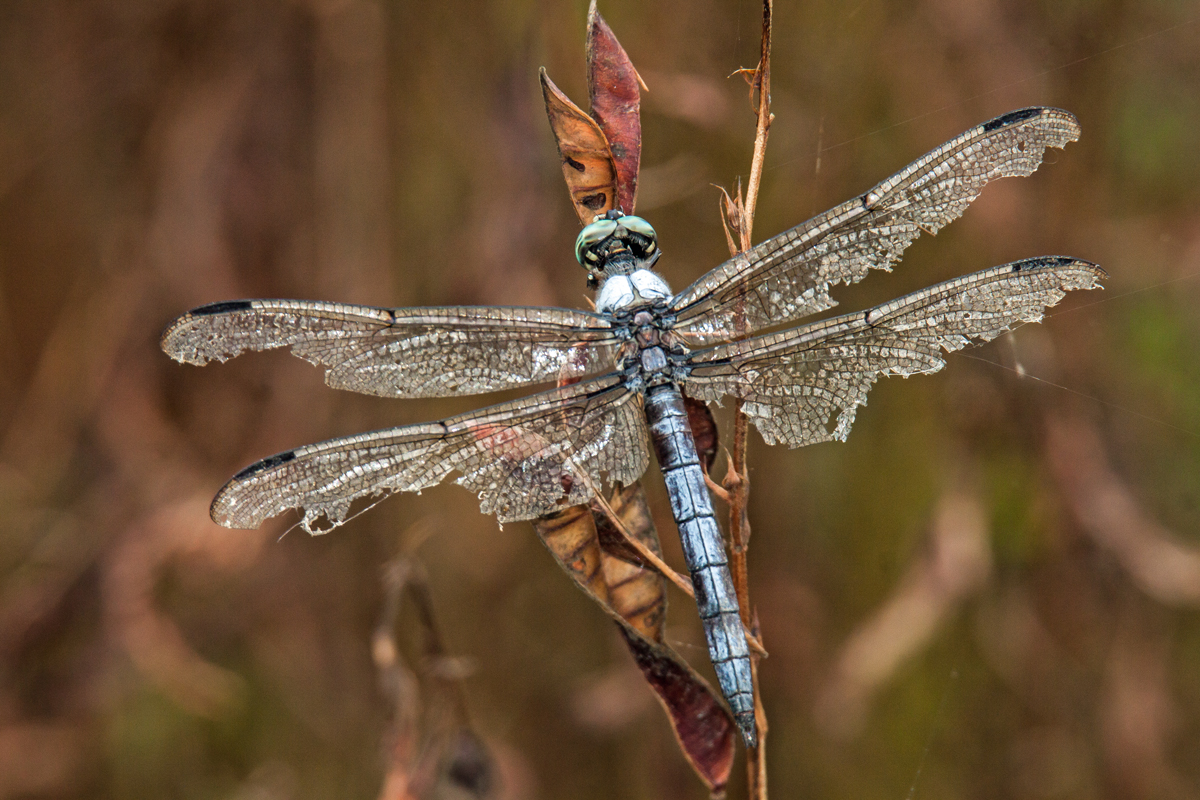
There are no vacations for dragonflies. It looks like this has been a long, hard summer for the male Great Blue Skimmer (Libellula vibrans) that I spotted earlier this month, judging from the almost shredded condition of his wings. Yet somehow, he is still able to fly and continues to survive

Autumn is almost upon us and the number of dragonflies that I observe is dropping. Before long, only a few hardy species will remain. For now, I take joy in seeing the tattered survivors, whose beauty is undiminished in my eyes.

Great Blue Skimmer

© Michael Q. Powell. All rights reserved.

Read Full Post »

Yesterday I spotted this male Mocha Emerald dragonfly (Somatochlora linearis) while exploring one of the streams at Huntley Meadows Park and was struck again by the way this species perches vertically, rather than horizontally like so many of the other dragonflies that I see.

The words of the old Supremes song come to mind, “You keep me hangin’ on…” and now that song is stuck in my head. On the off chance that one of my readers has never heard that song (and I can’t believe that is possible), here’s a link to a really old video of the Supremes performing the song.

Mocha Emerald dragonfly

© Michael Q. Powell. All rights reserved.

Read Full Post »

« Newer Posts - Older Posts »