Feeds:
Posts
Comments

Archive for the ‘Dragonflies’ Category

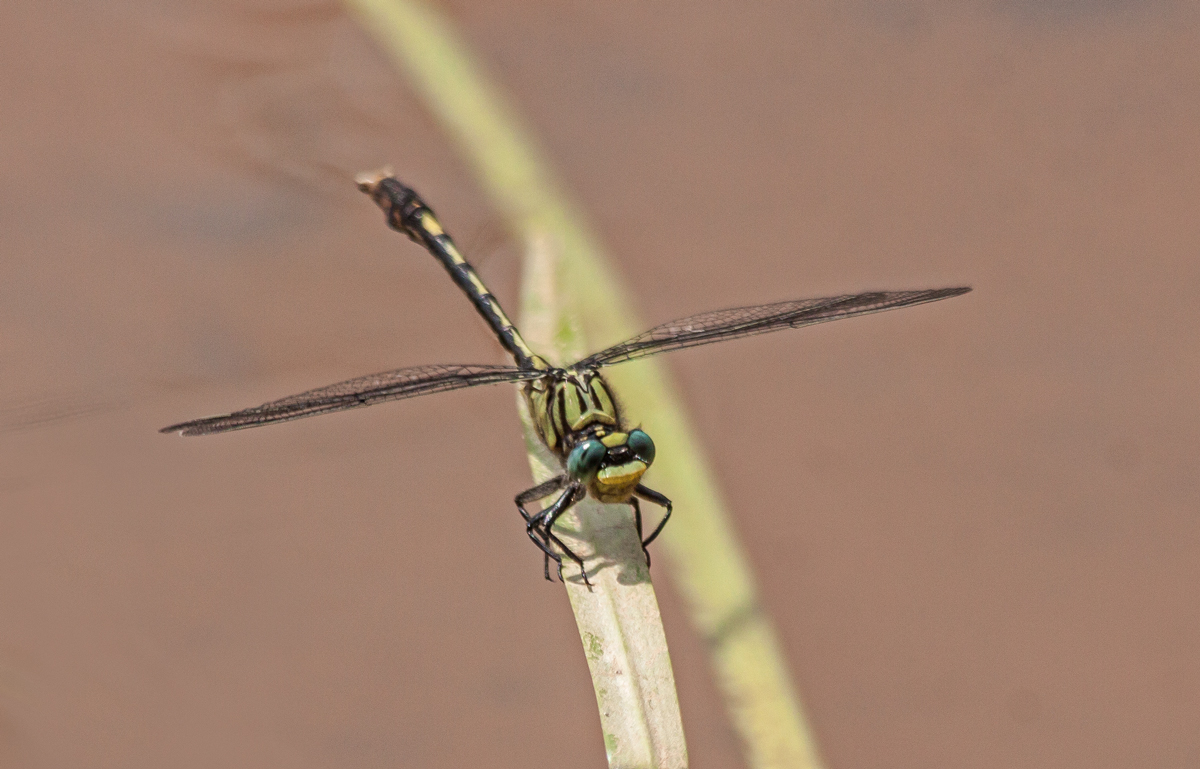
I love the colorful patterns on the wings of a Halloween Pennant dragonfly (Celithemis eponina), but rarely have the chance to see one. Therefore, I was pretty excited when I spotted one from a distance last week at Huntley Meadows Park, my favorite marshland location for nature photography.

I moved a little closer to get some initial shots with my Tamron 150-600mm lens fully extended. Generally I use my long zoom for birds more often than for dragonflies.  In this case, however, the lens turned out to be a better choice than my macro lens, because the dragonfly flew away when I took a couple of steps toward it and I never saw it again.

Most of the Halloween Pennant dragonflies that I have observed in the past have had wings that were more amber-colored than those of this individual, but the wing pattern is so distinctive that I am pretty sure about my identification. In addition to the wonderful wings, I was really struck by the length and two-toned color of this dragonfly’s legs.

Halloween Pennant

© Michael Q. Powell. All rights reserved.

Read Full Post »

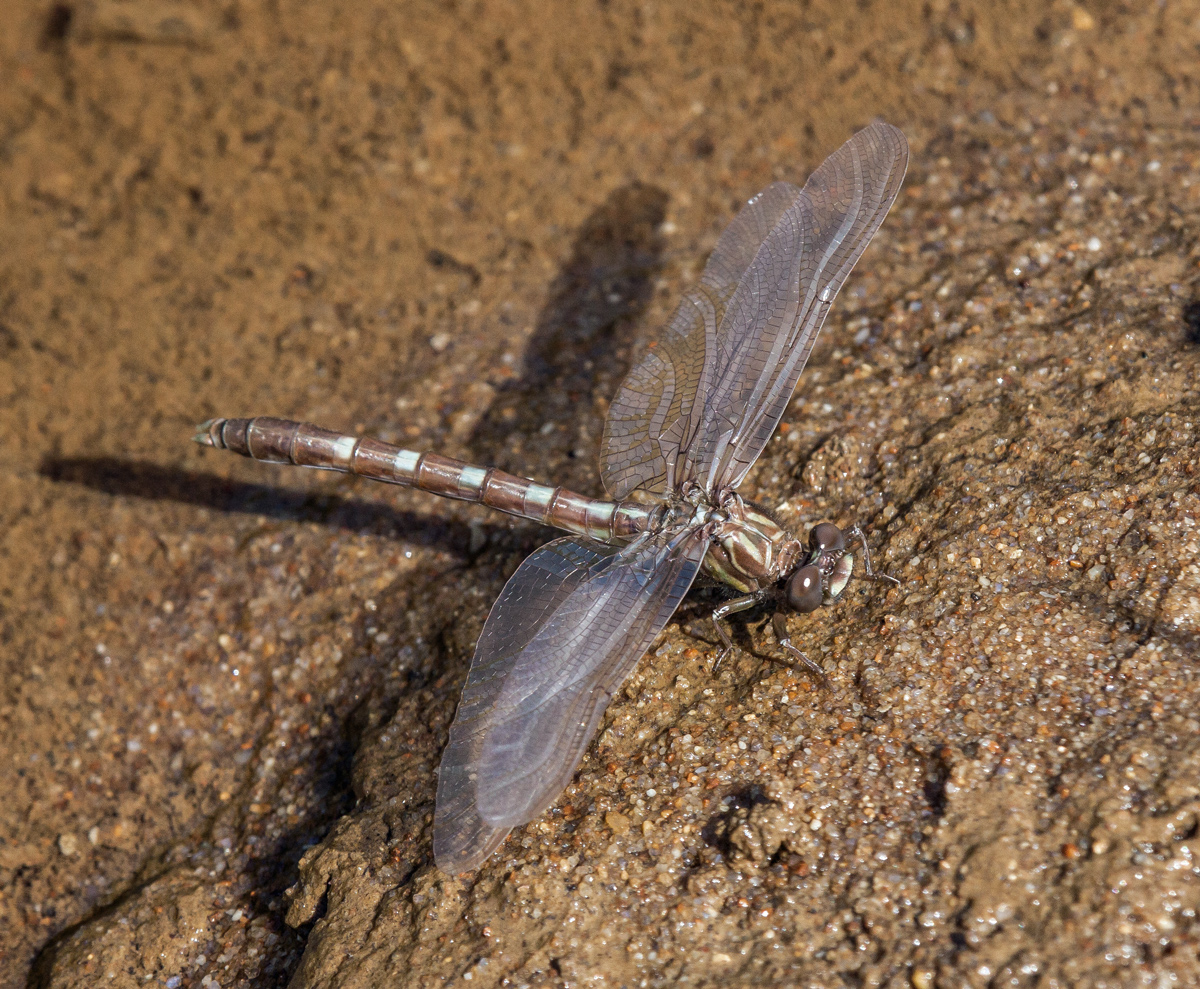
Ebony Jewelwing damselflies (Calopteryx maculata) like to hide in the shadows, but they really do sparkle like jewels when the light hits them right.

I spotted the beautiful female damselfly in the first photo this past weekend at Huntley Meadows Park—only females have white spots on their wings. I really like the way that the tones of the background complement the colors of the damselfly.

Ebony Jewelwing

I captured this shot of a male Ebony Jewelwing damselfly only a few minutes later. The lighting was brighter and the stance seems almost confrontational, which gives this image a totally different feel from that of the female.

Ebony Jewelwing

I’ll leave it to others to make broader inferences about the mysteries of the fairer gender versus the in-your-face directness of the average male.

© Michael Q. Powell. All rights reserved.

Read Full Post »

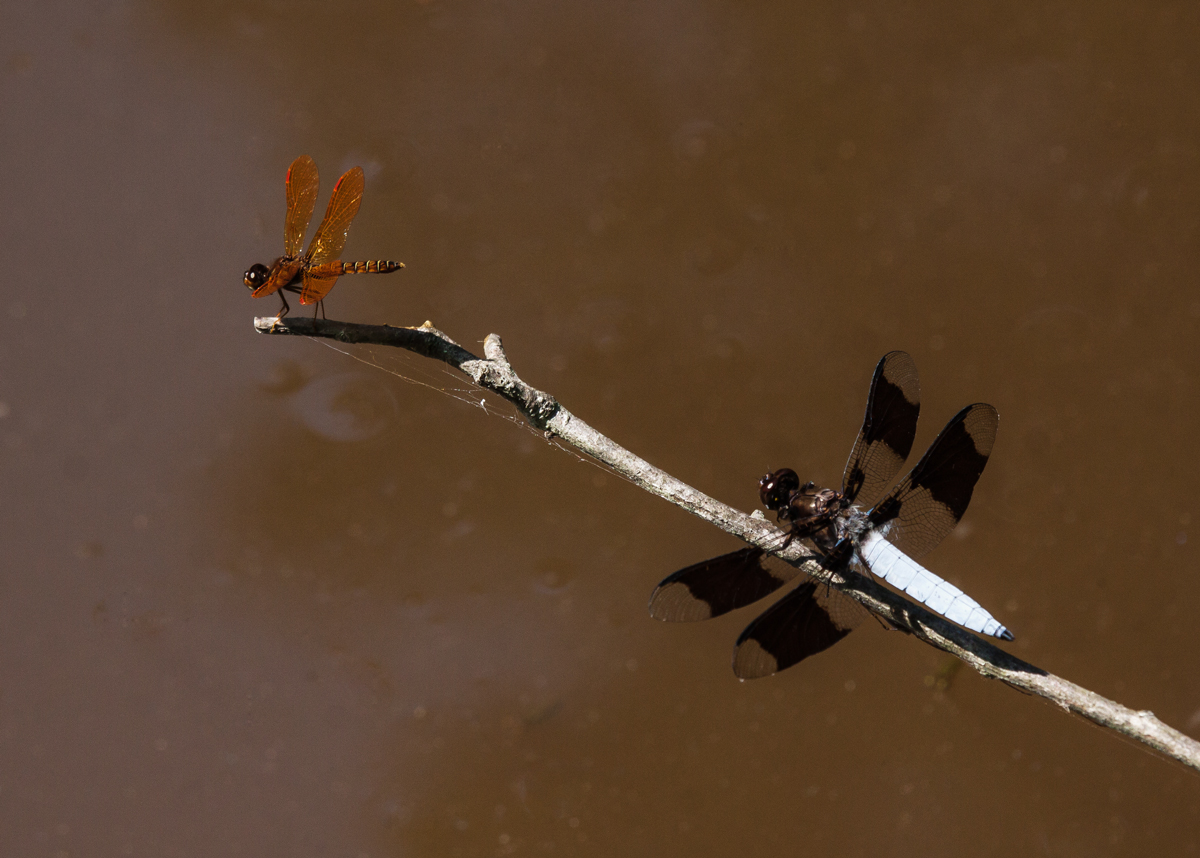
Despite their differences in size and appearance, the Eastern Amberwing (Perithemis tenera) and the Common Whitetail (Plathemis lydia) dragonflies were able to co-exist peacefully and both were able to enjoy the same perch this morning at Huntley Meadows Park.

Why is it so hard for us to do the same?

coexist1_8Jul_blog

© Michael Q. Powell. All rights reserved.

Read Full Post »

I should probably be able to remember my own anniversary, but I am a guy. Therefore I was caught a bit by surprise yesterday evening when WordPress notified me that it was the fourth anniversary of the start of my blog. Where has the time gone?

Blogging has become part of my daily life since I first started. I never suspected that I would get such joy and satisfaction from exploring my creativity in words and in photos and from sharing that journey with the wonderful folks that I have encountered through the blog. Thanks to all of you for your support, encouragement, and helpful tips. I sometimes like to say that I write this blog primarily for me, but I know that is not entirely true—I write it for all of you too. My photography mentor, Cindy Dyer, deserves special thanks. She helped me to start the blog and has been a continuous source of inspiration for me.

WordPress statistics indicate that I have made 2030 postings (which includes a dozen or more repostings of  posts written by friends) and have had 110749 views from well over 100 countries. Statistics are only a relative measure of success and I know that my best postings and my best photos are not necessarily the ones that have had the most views.

Over the past four years my skill and my confidence with my camera have grown. I now consider myself a photographer, albeit not a professional. My interests have expanded and my winters are now spent chasing birds, something I never imagined that I would find interesting. My fascination with dragonflies has remained constant and I have learned a lot about them. I think it is altogether appropriate to reprise today the short text and photo from my first posting

Text of my first posting in WordPress on July 7, 2012:

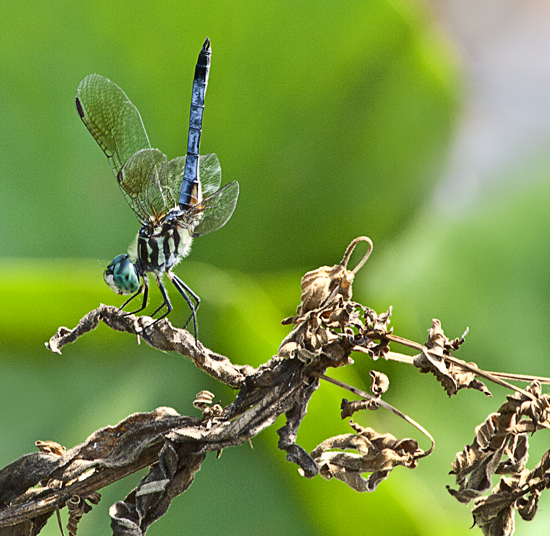
I photographed this Blue Dasher dragonfly (Pachydiplax longipennis) at Kenilworth Aquatic Gardens this morning.

© Michael Q. Powell. All rights reserved.


Blue Dasher

Read Full Post »

Although I was still here in Northern Virginia, the colors and desolate character of the landscape surrounding this Variable Dancer damselfly (Argia fumipennis violacea) reminded me of the desert Southwestern portion of the United States. It looked almost like the damselfly was posing for a photo while perched at the edge of the Grand Canyon.

The reality was a little less exciting. I spotted this Variable Dancer during the 4th of July weekend while I was exploring Pohick Creek in Springfield, Virginia, only a few miles from where I live.

Variable Dancer

© Michael Q. Powell. All rights reserved.

Read Full Post »

How quickly can you change gears when a new subject unexpectedly presents itself? Can you make the necessary physical and mental adjustments to take advantage of a fleeting moment?

This past weekend I made another trip to Jackson Miles Abbott Wetlands Refuge at nearby Fort Belvoir, Virginia to search for dragonflies and damselflies. I didn’t see all that many dragonflies, but there seemed to be a lot of damselflies. I focused my attention and my camera on these tiny beauties, attempting to get close enough to fill as much of the frame as I could with them.

As I was getting close-up shots of what I believe is a Variable Dancer damselfly (Argia fumipennis violacea), I caught sight of some motion out of the corner of my eye and turned my head to see what it was. Here’s the subject on which I was concentration before I turned my head.

Variable Dancer

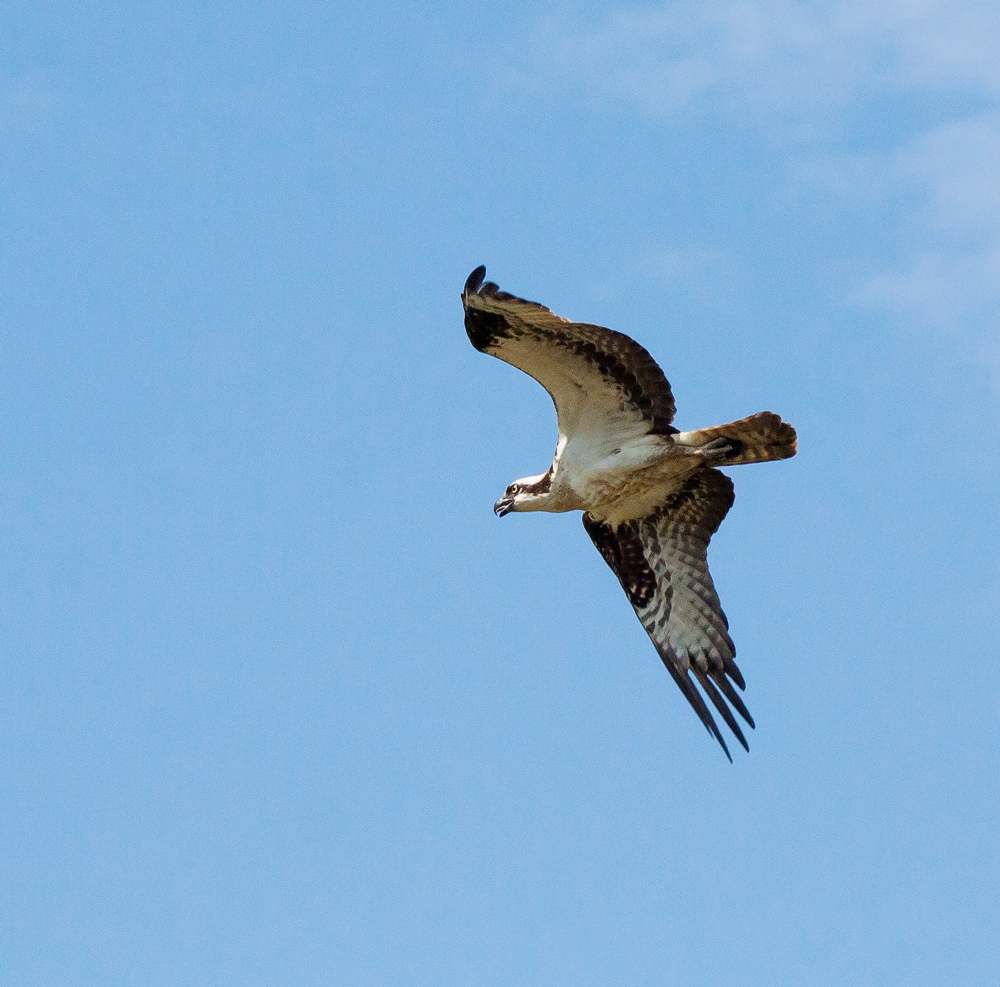
Looking up into the sky, I noticed a large bird approaching. At first I thought it might only be a seagull, but decided that I should take some shots in case it turned out to be a raptor. Obviously I was not going to have time to change lenses, so I quickly checked my camera settings and pointed my macro lens up into the sky and managed to get some shots of an osprey (Pandion haliaetus) as it slowly flew over the pond.

osprey

osprey

It’s amazing for me to look at these three photos and realize they were all taken at the same location within minutes of each other with the same lens and similar settings. The osprey images were cropped quite a bit more, but the details of the bird held up pretty well.

I tend to think of myself as an opportunistic shooter and this was definitely a case when I tested my ability to react quickly to a new subject. My trusty Tamron 180mm macro lens proved to be pretty capable too. The lens can sometimes be a bit noisy and slow when focusing and it has no built-in image stabilization, but as the osprey images show, it can capture some pretty nice in-flight shots under the right conditions.


© Michael Q. Powell. All rights reserved.

Read Full Post »

There is a whole family of damselflies called bluets that all look similar and the pattern of the males is generally some combination of black and blue (though there is one family member called an Orange Blue, which sure sounds like an oxymoron to me). On Saturday as I was exploring Pohick Creek in Springfield, Virginia, I came across two damselflies in tandem position that looked to be bluets. I suspect that they had just mated and were getting ready to deposit the eggs.

I managed to get a decent angle for a shot that allowed most of their bodies to be in focus and figured that identification would be simple. I was wrong. I went back and forth over a series of images and drawings in two guidebooks before deciding that they were probably Stream Bluets (Enallagma exsulans). The habitat was right and the markings seemed to be almost right, but I waffled for a long time.

Am I correct in my identification? I’m still not really confident, but so far one person has agreed with me in a Facebook group in which I posted the photo. The creative side of me, though, is really happy with the image, irrespective of the correctness of my identification.

Stream Bluet

© Michael Q. Powell. All rights reserved.

Read Full Post »

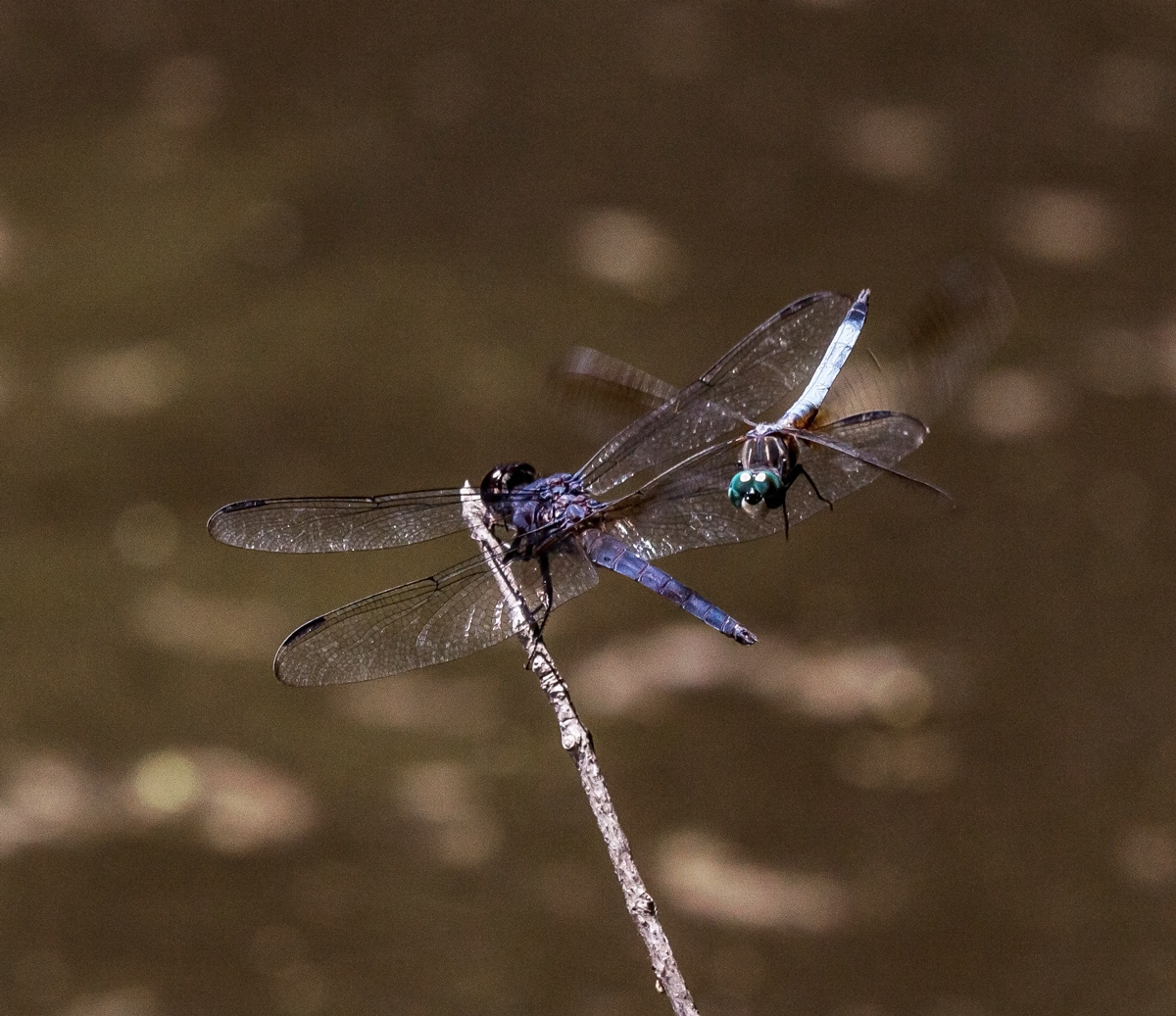
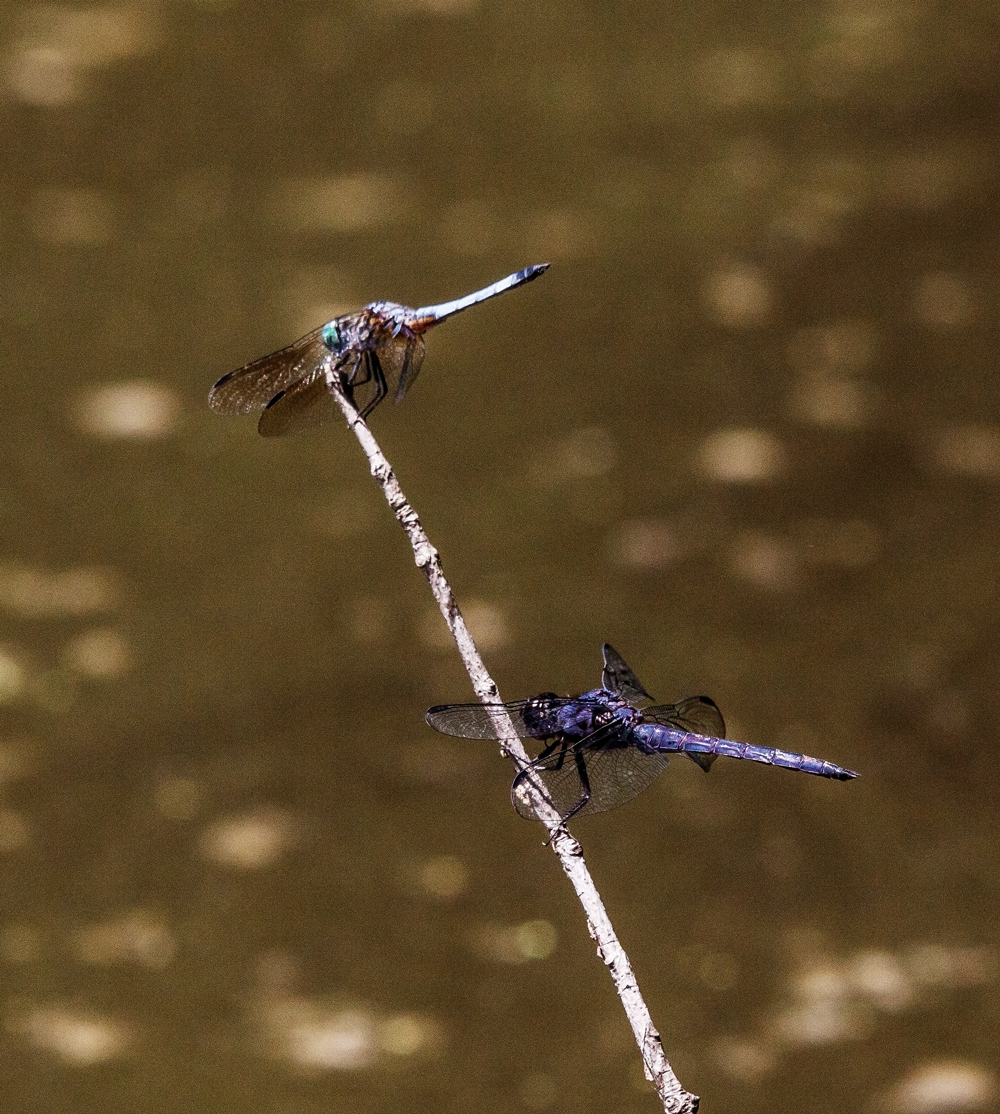
A Blue Dasher dragonfly (Pachydiplax longipennis) seemed to covet a prime perching position yesterday at Hidden Pond Nature Center in Springfield, Virginia and took action to try to dislodge the Slaty Skimmer dragonfly (Libellula incesta) that was occupying the perch.

The Blue Dasher was successful and occupied the top position for a little while, but eventually the larger Slaty Skimmer resumed the position at the top and the Blue Dasher was relegated to a lower spot on the plant.

Coming in for the attack

Coming in for the attack

The attack

The attack

Temporarily on top

Temporarily on top

battle4_blog

Relegated to the bottom

© Michael Q. Powell. All rights reserved.


Read Full Post »

This female damselfly blended in almost perfectly with her surroundings yesterday as she deposited eggs in the shallow water at the edge of Mulligan Pond at Jackson Miles Abbott Wetlands Refuge at Fort Belvoir. I love the way that the shadows changed as she dipped the tip of her abdomen into the water.

I have real difficulties in identifying female damselflies, but in this case I am not too concerned.  I was so caught up with the colors, shapes, and lighting in this image that identification seemed of secondary importance.

damselfly ovipositing


damselfly ovipositing

damselfly ovipositing

© Michael Q. Powell. All rights reserved.

Read Full Post »

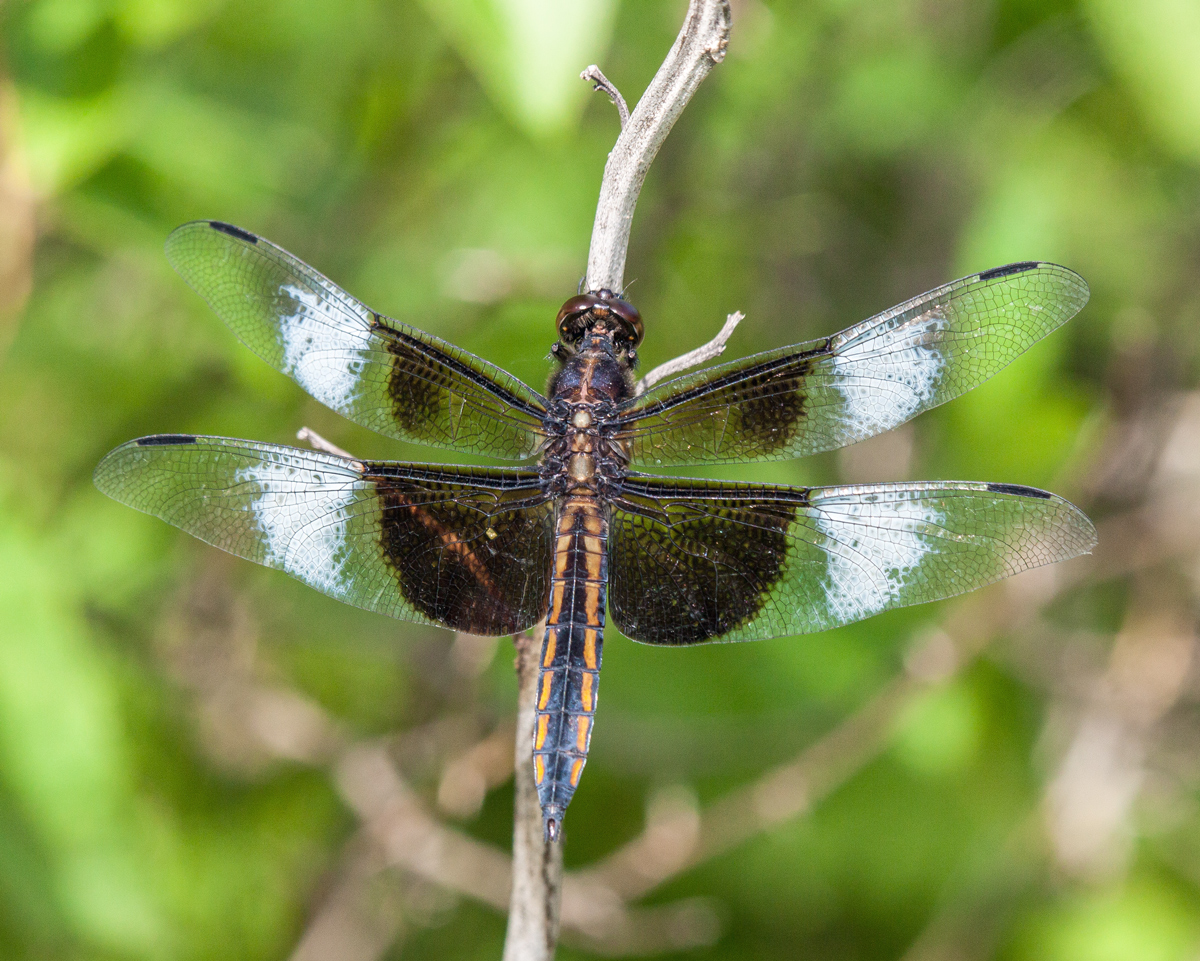
When I was first getting serious about my photography, I remember being told how important it was to isolate my subject in order to prompt the viewer to focus on what I thought was important. At this time of the year I take a lot of photos of insects and it is often a real challenge to isolate them from their backgrounds. As I was going through some images from this past weekend, I noted that I tried a couple of different approaches when photographing male Widow Skimmer dragonflies (Libellula luctuosa) at Jackson Miles Abbott Wetlands Refuge.

In one case, I tried to isolate the dragonfly by shooting at an upwards angle, thereby eliminating the clutter of the vegetation. Of course, it helped that the dragonfly cooperated by perching at the tip of the stem. I really like the way that the colors and shapes of the background almost match those of the dragonfly.

Widow Skimmer

In a second case, the dragonfly was perched in the midst of the vegetation. I moved to a position so that my camera’s sensor was on a parallel plane to the dragonfly’s open wings and opened the aperture pretty wide. Normally I try to keep the aperture stopped down in an effort to get more parts of the dragonfly in focus. This time, however, the dragonfly was relatively flat and I was able to throw the background a bit out of focus without losing the details of the dragonfly. The contrast of the background colors with those of the dragonfly helps it to stand out, while retaining a sense of the environmental setting.

Widow Skimmer

There are lots of other ways to isolate subjects. Sometimes we have the luxury of being able to think about them, but often we are forced to make rapid decisions about shooting angles and camera settings that will have a huge impact on our final images.


© Michael Q. Powell. All rights reserved.


Read Full Post »

Summer is definitely here. In the Washington D.C. area where I live, summer means endless stretches of hot, humid weather. Even the insects seem to move more slowly, like this Eastern Amberwing dragonfly (Perithemis tenera) that I recently photographed as it languidly buzzed around the vegetation at Brookside Gardens in Wheaton, Maryland.

Eastern Amberwing

© Michael Q. Powell. All rights reserved.

Read Full Post »

I love the juxtaposition of natural and man-made elements in this shot of a Slaty Skimmer dragonfly (Libellula incesta) perched recently on a piece of rebar sticking out of the water at Mulligan Pond at Jackson Miles Abbott Wetlands Refuge.

The colors and shape enhance the visual contrast between the two primary elements in this very graphic and simple composition. Photography doesn’t always have to be complicated to be effective—I need that reminder from time to time.

Slaty Skimmer

© Michael Q. Powell. All rights reserved.

Read Full Post »

Yesterday I spotted my first Banded Pennant dragonfly (Celithemis fasciata) of the season at Jackson Miles Abbott Wetlands Refuge at Fort Belvoir, Virginia. I love the beautiful blue color of its body and its boldly patterned wings. The males of this species seem to like to show off a bit by perching on the very tip of vegetation, which is both a blessing and a curse. It is a blessing because the dragonflies are easier to spot than those that perch low in the vegetation. It is a curse, however, because the slightest breeze causes the dragonflies to oscillate madly, making it tougher to get sharp shots of them.

Banded Pennant


Banded Pennant

© Michael Q. Powell. All rights reserved.

Read Full Post »

Yesterday I spotted a very cool-looking, but unfamiliar dragonfly. I ended up posting an image in several Facebook groups in an effort to get an identification from some of the experts and was a little shocked to learn that it is a male Swift Setwing dragonfly (Dythemis velox), a primarily southern species that may never before have been spotted in Fairfax County, the county where I live.

It looks like this species is spreading northward. According to a posting on an Ohio natural history blog, this dragonfly species was spotted for the first time in Ohio in 2014 and a photo was posted today of a teneral female Swift Setwing in Champaign County, Ohio.

Why are these dragonflies called “setwings?” According to the blog posting cited above, setwings “spend a lot of time perched, typically on the tip of branches and frequently with their wings angled down and forward and their abdomen slightly raised…(the) English name of “setwings” (came) from this posture, which reminded them of a sprinter at a track meet on the blocks in the “ready, set, go” position.”

Swift Setwing

Swift Setwing

Swift Setwing


© Michael Q. Powell. All rights reserved.

Read Full Post »

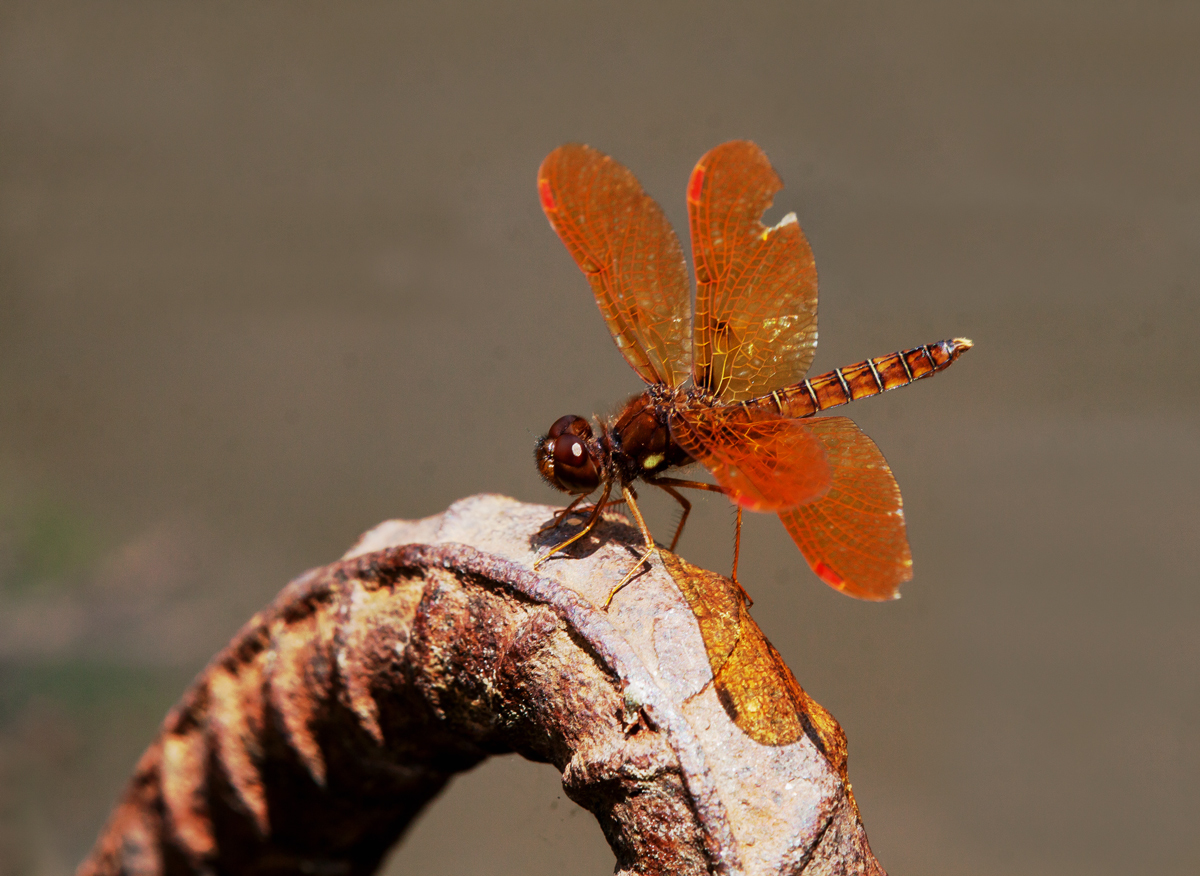
Normally I like to photograph dragonflies in their natural environment, but when an Eastern Amberwing dragonfly (Perithemis tenera) chose to perch on a curved piece of rebar recently, the juxtaposition of the natural and man-made elements seemed to create a sense of harmony rather than one of dissonance.

I took this photo at a small man-made pond at Green Spring Gardens in Alexandria, Virginia. Later in the summer I hope to see water lilies and lotus blossoms at the pond, but it is mostly devoid of vegetation right now, which many be why the dragonfly chose this unusual perch.

I have no idea why this piece of reinforcing steel is sticking out of the water, but its reddish-brown color and curved shape made it a good match for this tiny dragonfly.

Eastern Amberwing

© Michael Q. Powell. All rights reserved.

Read Full Post »

When the mating is done, damselflies have to decide where to deposit the eggs. Who decides? In many damselfly species, the male remains attached to the female as she deposits the eggs in vegetation or in the water, so I would assume that it is a joint decision of sorts.

When I observed this pair of dragonflies flying around together this past weekend at Jackson Miles Abbott Wetlands Refuge, I decided to try to track them and see where they chose to land. Would they choose a solitary spot where they could be alone or would they choose to join their friends in a post-mating frenzy at a popular hangout? They chose the former, perhaps because the hangout had reached its maximum capacity.

These may be Slender Bluet damselflies (Enallagma traviatum), although I must confess that I don’t have great confidence in my identification of bluets, which all look pretty much the same to my untrained eye.

damselflies

damselflies

damselflies

© Michael Q. Powell. All rights reserved.

Read Full Post »

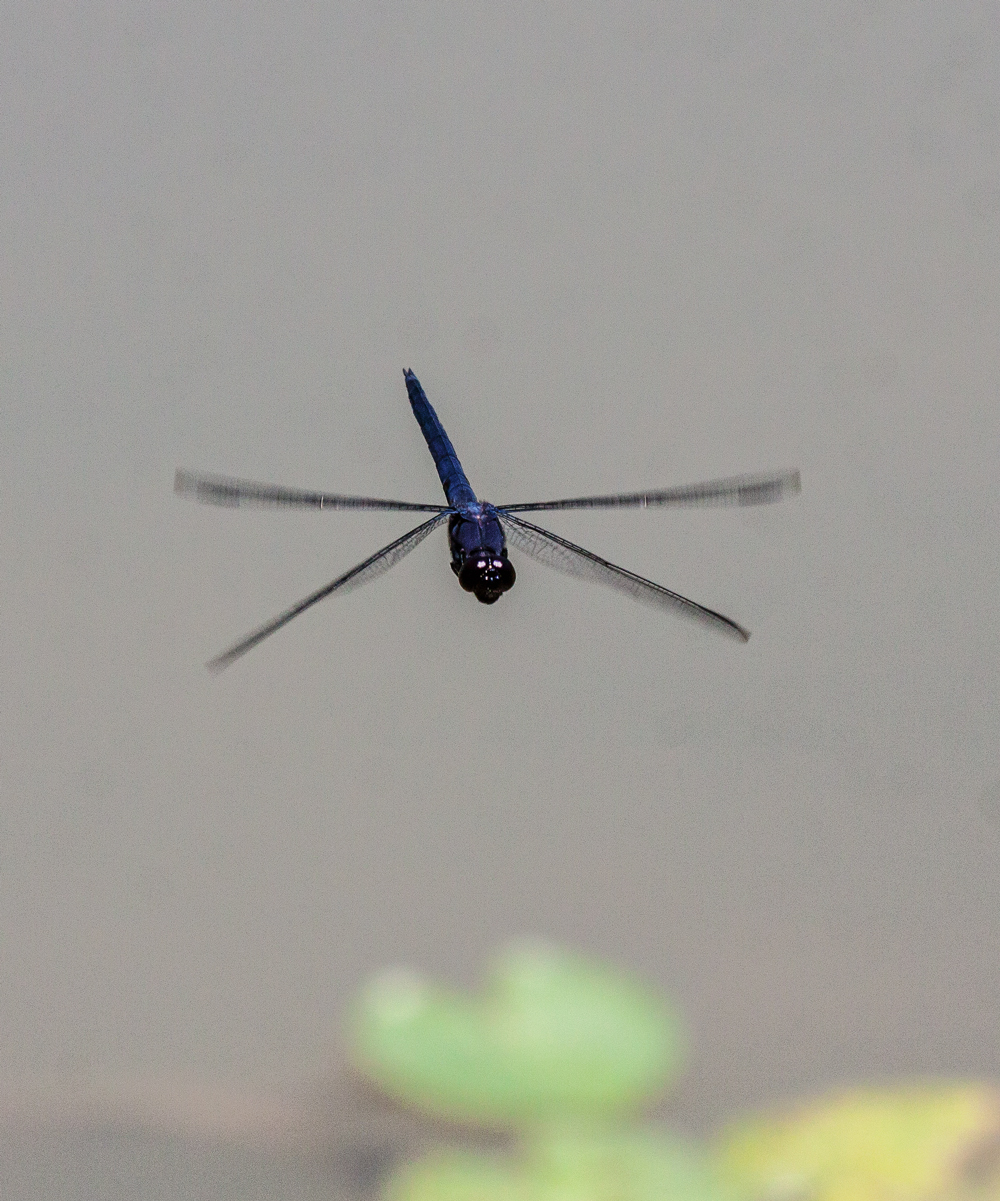
Are you attracted to dark-eyed beauties? If so, you would have loved this Slaty Skimmer dragonfly (Libellula incesta) that flew directly toward me and hovered in mid-air while appearing to check me out this past weekend at Jackson Miles Abbott Wetlands Refuge.

On his Dragonflies of Northern Virginia website, dragonfly expert Kevin Munroe offered two explanations for this kind of behavior by Slaty Skimmer dragonflies. It is possible that these dragonflies are exceptionally curious, if not actually friendly. However, he suggested, it is more likely that this dragonfly was exhibiting territorial aggression toward a perceived intruder.

After a few seconds of staring at me, the dragonfly turned and flew away, ready to fight off other intruders and search for a potential mate.

Slaty Skimmer

Slaty Skimmer


Slaty Skimmer

© Michael Q. Powell. All rights reserved.

Read Full Post »

If you want a really lesson in patience, trying photographing dragonflies in flight. Yesterday I spent several hours trying to capture images of Prince Baskettail dragonflies (Epitheca princeps) as they conducted long, low patrols over a small pond at Jackson Miles Abbott Wetlands Refuge in Fort Belvoir, Virginia.

The Prince Baskettails didn’t always follow the same flight paths and their changes in flight direction often were unpredictable, but they kept coming back, giving me lots of chances to attempt to get shots. With some species you can wait for the flying dragonflies to take a break and perch for a moment or two, but Prince Baskettails have amazing stamina—I have never seen one stationary.

There are a number of different approaches to capturing in-flight images. Some folks like to pre-focus on a zone and wait until the dragonfly comes into that area. I like to acquire my target with my naked eye as it approaches and then track it through the camera’s viewfinder for as long as I can. The biggest problem is acquiring focus.  My preferred lens for shooting dragonflies is my trusty Tamron 180mm macro lens. Its focal length lets me use it as both a telephoto and a macro lens, but it is somewhat slow in focusing, so I ended up with lots of blurry shots.

However, I was able to capture some shots that were in focus, including this image that shows the amazing eyes and beautiful markings of this spectacular dragonfly. It’s probably my imagination, but the dragonfly in the photo almost seemed to be glancing in my direction as it flew by and giving me a little smile.

Prince Baskettail

© Michael Q. Powell. All rights reserved.


Read Full Post »

What is a Widow Skimmer? It sounds like a con artist who preys on rich older women, but it actually is a beautifully patterned dragonfly, like this juvenile male that I spotted recently at Huntley Meadows Park.
Why is it called a “widow?” According to bugguide.net, the species name of the Widow Skimmer (Libellula luctuosa) “means sorrowful or mournful, perhaps because the wings of both male and female seem to be draped in mourning crepe.” Only the male has white patches on its wings, so it’spretty easy to identify the dragonfly in the image as a male. Adult males have blue bodies and juvenile males and females have yellow and brown bodies.
Sometimes I wish that the identification of dragonfly species were this easy all of the time, but real life is generally much more complicated.
Widow Skimmer
© Michael Q. Powell. All rights reserved.

Read Full Post »

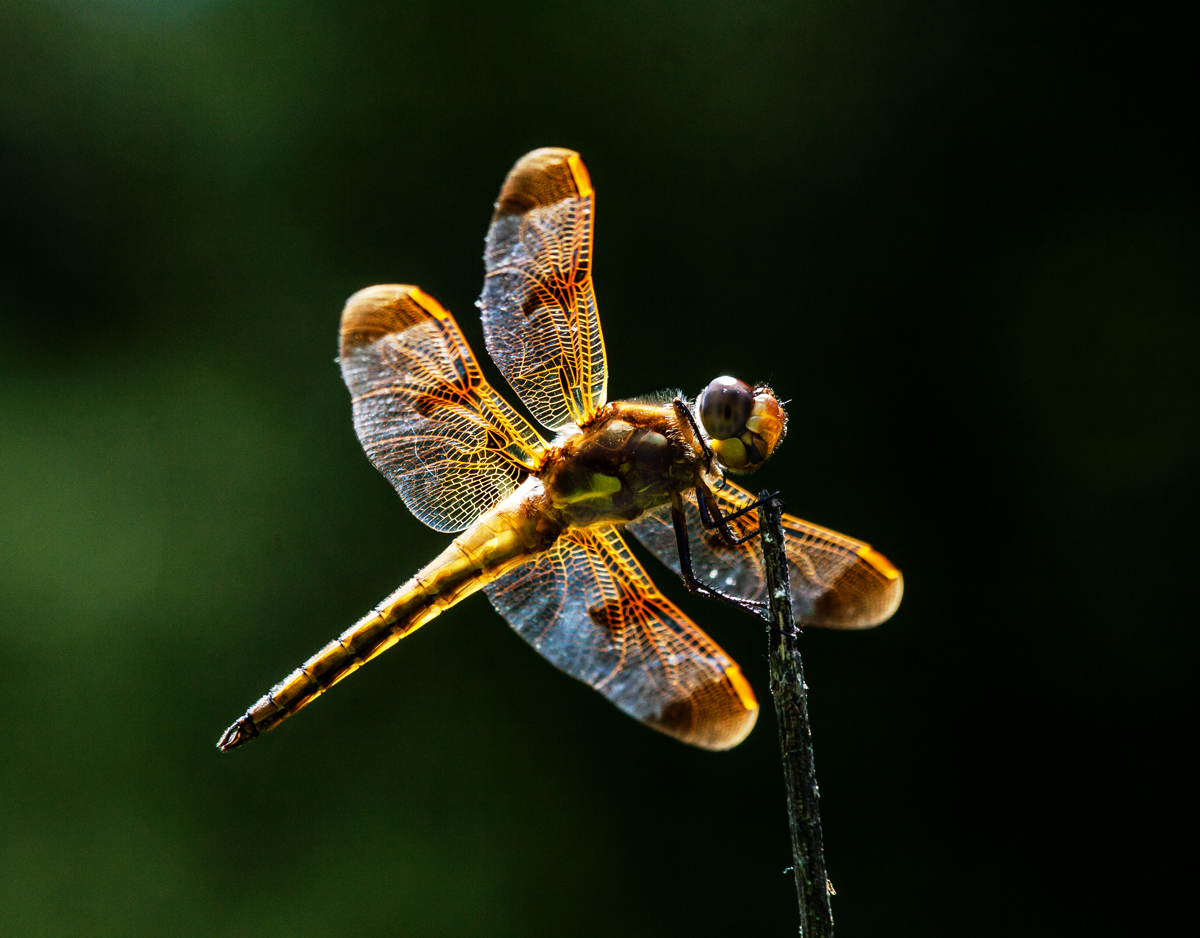
The sunlight shining through from behind helped to highlight the beautiful colors and patterns of this Painted Skimmer dragonfly (Libellula semifasciata) at Huntley Meadows Park this past Monday. Although I usually try to get more even lighting in my shots, I really like the way that this directional lighting has created areas of brightness and shadow, which seems to add a bit of drama to the image.

Painted Skimmer
© Michael Q. Powell. All rights reserved.

Read Full Post »

Females are a real mystery to me, especially when it comes to dragonflies. At this time of the year I see a lot of different dragonflies and I have featured a number of the colorful males over the past few weeks. They are relatively easy to identify when they are mature—immature males, however, often have the same coloration as females.

The challenge with females, particularly a number of the members of the Skimmer family, is that they all look pretty much the same.  This past Friday I photographed this beautiful female dragonfly and I love the two-toned coloration of her eyes. After consulting with my local dragonfly expert Walter Sanford, I have concluded that she is probably a Great Blue Skimmer (Libellula vibrans), though she doesn’t have a spot of blue on her

Great Blue Skimmer

© Michael Q. Powell. All rights reserved.

Read Full Post »

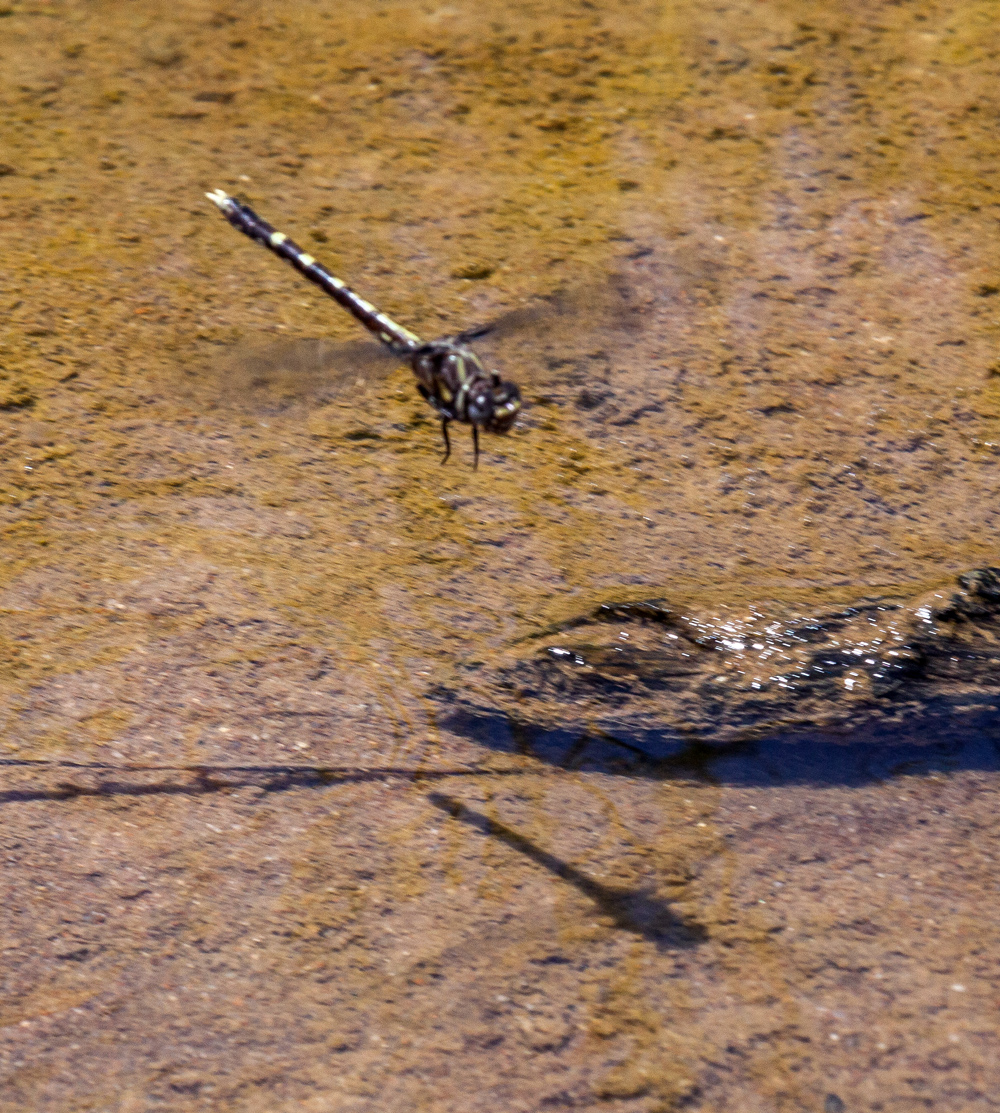
If you want a real photography challenge, try to get shots of dragonflies while they are in flight. Dragonflies are so small and generally move so quickly that it’s tough for the camera’s focusing system to lock onto them. On some occasions, dragonflies will hover for a few second or will follow the same route repeatedly and it’s slightly easier in those situations to capture images of the dragonfly.

Yesterday I spotted a dragonfly flying low over a slow-moving stream with its legs dangling. I have previously seen Common Sanddragons (Progomphus obscurus) on the sandy banks of this stream, but I had never seen a sanddragon act this way before. Most of the times that I have managed to get shots of dragonflies in flight, they have their legs tucked in, presumably to make themselves more aerodynamic. Initially I thought the dragonfly was coming in for a landing, but it flew around for a little while with the dangling legs.

What was this dragonfly doing? I don’t know for sure, but I wonder if perhaps this is a female dragonfly who was looking for a place in the water to deposit her eggs. Some dragonfly species deposit their eggs in vegetation and others will do so in the water.

I took these shots with my 180mm macro lens using auto focus.  I am happy that they are more or less in focus and show some of the details of the dragonfly. I like too the way that I was able to capture the dragonfly’s shadow as it was cast onto the water.

Common Sanddragon

Common Sanddragon

© Michael Q. Powell. All rights reserved.

Read Full Post »

I love the speckled blue eyes of the male Great Blue Skimmer dragonfly (Libellula vibrans), like this spectacular specimen I spotted Monday at Huntley Meadows Park in Alexandria, Virginia.

Great Blue Skimmer

Great Blue Skimmer

© Michael Q. Powell. All rights reserved.

Read Full Post »

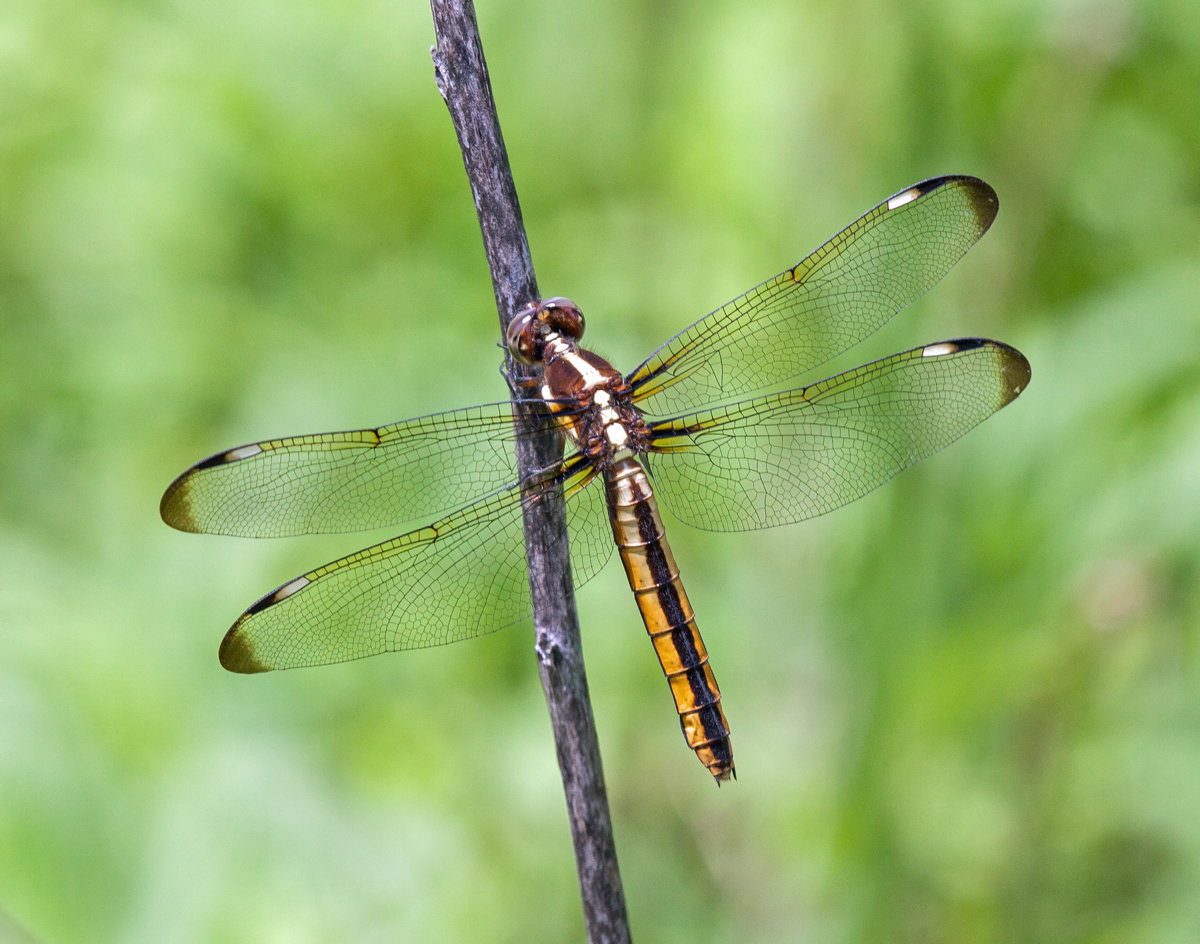
I love it when there are unique characteristics that help in identifying species. In the case of dragonflies, the Spangled Skimmer (Libellula cyanea) is the only dragonfly in our area that has both black and white stigma on the leading edge of its wings. It was therefore relatively easy to identify this beautiful female dragonfly when I spotted it this past Monday at Huntley Meadows Park and she cooperated by perching for a moment so that I could capture this image.

Spangled Skimmer

© Michael Q. Powell. All rights reserved.

Read Full Post »

When I noted in a recent posting called Transformation, that I had not yet witnessed the remarkable metamorphosis of a dragonfly, I never suspected that only a few day later I would somehow manage to observe such a transformation of a Common Sanddragon dragonfly (Progomphus obscurus) from start to finish at relatively close range.

Nymphs of this species of dragonfly crawl out of the water onto a sandy beach to begin the process and I knew of the bank of a stream where this had been taking place over the past week or so, having observed there newly emerged teneral dragonflies and the discarded exoskeletons known as exuviae. However, what were the chances that I would be able to be at the right location at precisely the right time? I figured the odds were about the same as winning the lottery.

Last Friday around noon I spotted several exuviae in the sand as I was walking along that section of the stream. I bent down, picked them up, and placed them in the palm of my hand in order to get a good look at them. Having spotted Unicorn Clubtails in this location along with Common Sanddragons, I wondered if these was a way to tell which species of dragonfly had emerged from a given exuvia. As I continued to walk, I suddenly became aware that something was crawling around in my hand—one of my presumed exuviae was in fact a live nymph.

I experienced an initial moment of shock, but realized pretty quickly that I needed to get the nymph back onto the sand. If I had been thinking a little more clearly, I might have chosen a spot that optimized my chances for capturing good images, but instead I selected a location where I could see another exuvia and gently placed the nymph there.

I placed my eye to the viewfinder of my camera and began to wait and to watch. Within a very short period of time I began to see signs of movement in the thorax area of the nymph, just behind the eyes, and before long the head of the dragonfly appeared as it began to pull its body out of the soon-to-be-discarded shell. It took about eight minutes for the body to be entirely free of the exoskeleton.

The dragonfly changed positions so that it could extend its abdomen and begin the process of extending its wings, which at this stage were merely nubs. Over the next twenty minutes or so, the wings and the abdomen grew larger and larger. My original shooting position was no longer optimal, so I ended up standing in the stream to get a view of what was happening. The water was about six to eight inches deep (15 to 20 cm) and my non-waterproof boots were quickly soaked. As I crouched to get as close as I could to the eye level of the dragonfly, I suddenly realized that the seat of my pants was getting wetter.

Twenty seven minutes after the process had started, the wings of the newly emerged dragonfly snapped open to the familiar position of dragonfly wings. At this moment they were very clear and obviously very fragile and I experienced a moment of concern for the vulnerable dragonfly when a slight wind kicked up. Fortunately, though, I had chosen a somewhat sheltered position and the dragonfly was safe. The wings continued to harden and six minutes later the dragonfly flew off to some nearby vegetation to begin its new life.

I took a lot of photos of the process of metamorphosis and it was hard to choose which ones to post. In the caption area of each of them,I have indicated the time at which the photo was taken. The transformation began at 12:19 and the dragonfly flew away at 12:52.

Fellow dragonfly enthusiast and photographer Walter Sanford witnessed the emergence of a Common Sanddragon at a nearby, but different location on 1 June and did a blog posting on it today. Be sure to check out his posting for some great photos and a detailed explanation of what is happening within the dragonfly’s body as it undergoes this dramatic metamorphosis.
Common Sanddragon

12:19 indications of first movement

Common Sanddragon

12:21 head starts to become visible


Common Sanddragon

12:22 dragonfly starts to pull out of shell

Common Sanddragon

12:22 body of dragonfly starts to be visible

Common Sanddragon

12:23 body significantly out of shell

Common Sanddragon

12:24 side view of dragonfly pulling body out of shell
Common Sanddragon

12:25 struggling to get abdomen out of shell

Common Sanddragon

12:27 body completely freed

Common Sanddragon

12:27 straightening the abdomen

Common Sanddragon

12:28 starting to extend wings

Common Sanddragon

12:29 continuing to extend wings

Common Sanddragon

12:31 wings extended

Common Sanddragon

12:40 wings reach final length

Common Sanddragon

12:48 wings fully opened

Common Sanddragon

12:52 close-up of newly emerged dragonfly

© Michael Q. Powell. All rights reserved.


Read Full Post »

Where do you go to find sanddragons? Although it sounds like a trick question, the correct response is the obvious one—you generally find Common Sanddragon dragonflies (Progomphus obscurus) perched on the sandy bank of a stream. Sometimes Common Sanddragons will perch almost flat on the sand, but often they will raise their abdomens up, sometimes assuming the obelisk position, in which the tip of the abdomen is pointing almost straight up. Why do they do this? The most frequent explanation for this behavior that I have seen is that it is a method of thermoregulation. The dragonfly keeps from overheating by reducing the amount of its body that is directly exposed to the sun.

Common Sanddragon

Common Sanddragon

© Michael Q. Powell. All rights reserved.

Read Full Post »

Do you have a favorite dragonfly? One of my favorites is the Unicorn Clubtail (Arigomphus villosipes)—I love both its appearance and its name. Earlier this week, on the last day of May, I spent some time chasing an elusive unicorn at Huntley Meadows Park and captured a few photos of it. The second shot gives you a glimpse of the “horn” between the dragonfly’s eyes that is responsible for the first part of its name.

Unicorn Clubtail

Unicorn Clubtail

© Michael Q. Powell. All rights reserved.

Read Full Post »

Dragonflies spend most of their lives as nymphs in the water.  When the time is right, they crawl out of the water, break out of their exoskeletons, and turn into the colorful aerial acrobats that I love to watch and to photograph.

Although I have seen photos and videos of this amazing transformation, I have not yet witnessed the entire process in person. However, this past weekend I did spot some newly emerged Common Sanddragon dragonflies (Progomphus obscurus) at Huntley Meadows Park. Nymphs of many dragonfly species attach themselves to vegetation as they undergo their metamorphosis, but Common Sanddragon nymphs merely crawl out of the water onto a sandy area at the edge of a stream.

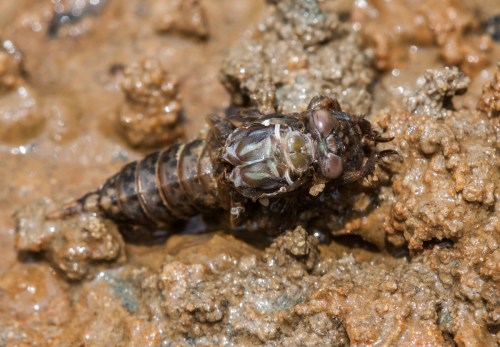
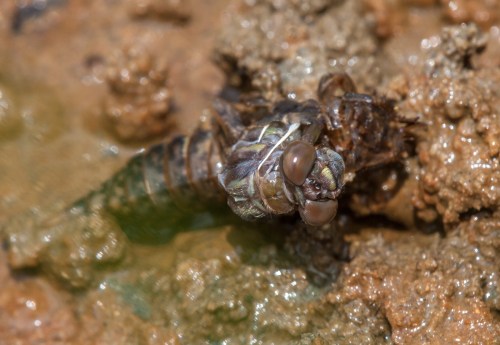
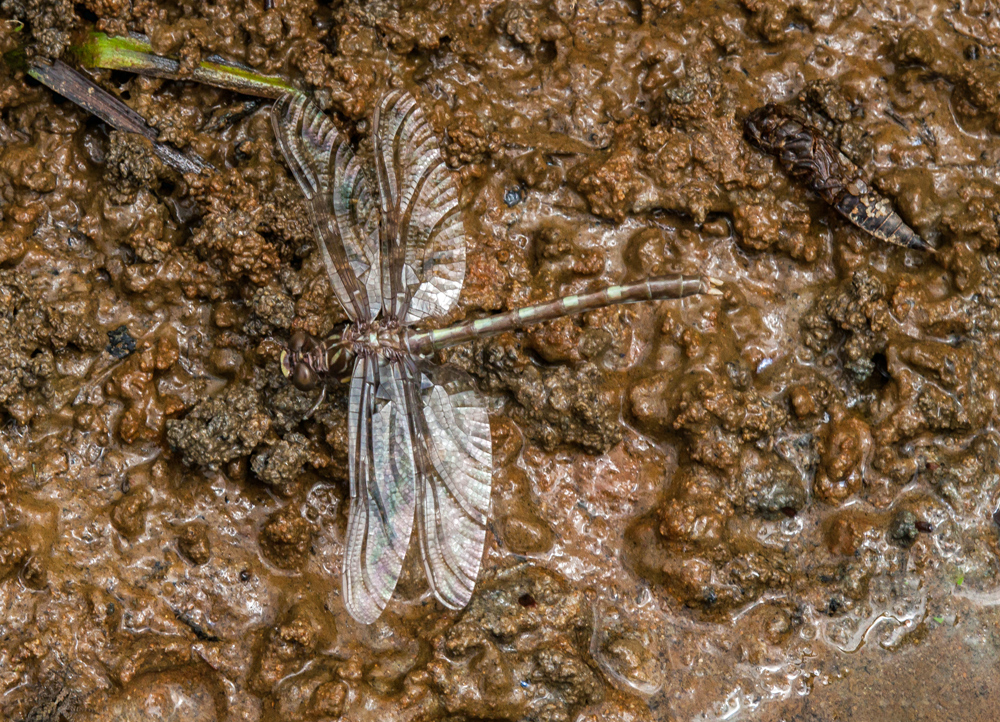
After I had spotted the dragonflies, I scoured the sandy stream bank and managed to find some cast-off skins (exuviae). Looking at the exuvia in the photo, you can see how the nymph has broken through the shell just behind the eyes and crawled out. The stringy white things on the top of the exuvia are breathing tubes used by the nymphs.

My last image is a visual reminder of how complicated and delicate this transformation can be be. The dragonfly obviously had some kind of a problem in expanding its wings and it is doubtful that it was able to survive for very long.

Common Sanddragon

Common Sanddragon

Common Sanddragon

Common Sanddragon exuvia

Common Sanddragon

© Michael Q. Powell. All rights reserved.


Read Full Post »
Many damselfly species look so much alike that they are visually indistinguishable for me. I never have that problem, however, with the Ebony Jewelwing (Calopteryx maculata)—its dark wings and emerald body set it apart from all other damselflies in my area.

I spotted this distinctive little beauty yesterday, the last day of May, at Huntley Meadows Park in Alexandria, Virginia alongside one of the creeks in a remote area of the park. As I went through my photos I was drawn to this one, because of the wing positions.

When I showed a similar shot to my local dragonfly expert Walter Sanford, he immediately noticed the curve in the abdomen, something that I hadn’t even seen. I initially dismissed it as some kind of flexing by the damselfly, but when I noted the same curve in all of my images, I realized that it may be a deformity, as Walter initially suggested. Fortunately, the damselfly appeared to be able to fly normally despite the curved abdomen.

Ebony Jewelwing

© Michael Q. Powell. All rights reserved.


Read Full Post »
The coloration of this female Eastern Pondhawk dragonfly (Erythemis simplicicollis) helped it to blend in almost perfectly with the lush green vegetation this past Friday at Huntley Meadows Park. This species of dragonfly is not only beautiful, but it is also deadly. I was reminded of this latter fact when I realized why the dragonfly had stopped and perched—it was consuming a small moth that it had just caught.

Eastern Pondhawk

© Michael Q. Powell. All rights reserved.

Read Full Post »

Occasionally I complain that some species with names that include “common” are rare, but Common Whitetail dragonflies (Plathemis lydia) are in fact quite common. They are among the first dragonflies to appear in the spring and among the last to disappear in the autumn.

Even though I see them all of the time, I’ll frequently photograph Common Whitetails, with the hope of capturing a new or different view of the dragonfly. Yesterday was sunny and I knew that I would have trouble photographing male Common Whitetails, because their bodies are so white. Usually they end up overexposed with the highlights blown out.

To try to compensate for that problem, I set the metering mode on my camera for spot metering and I was able to capture this shot. The dragonfly is a male, but has not yet acquired the bright white of an adult male, which made things a little easier. I managed to get a proper exposure for the body and the rest of the image is a bit underexposed. The result was a kind of dramatic lighting effect that helps me to highlight the uncommon beauty of this common species.

Common Whitetail

© Michael Q. Powell. All rights reserved.


Read Full Post »

« Newer Posts - Older Posts »