Birders, I’m finding out, are an excitable breed. Sometimes they travel in flocks and sometimes alone. You can often identify them by their binoculars and spotting scopes and sometimes their cameras with enormous camouflaged lenses. They have special apps on their smartphones and frequently can be observed with their heads buried in one of the numerous identification guides they may be carrying.
I encountered a very excited member of this species as I passed by the bird feeders at my local marshland park this past weekend. He had his camera—with a large lens and flash—set up on a tripod pointed at the feeder. Crouching in the shadows with a remote release in his hand, he was obviously waiting for something.
Before I could pose the obvious question, he asked me in a whisper if I also was there to photograph the Wilson’s Warbler. He must have mistaken me for one of his own kind, probably because I had a camera with a telephoto lens around my neck. I got the impression that this bird was rarely seen here and that word had circulated in birding circles of this find. Suddenly he snapped a few photos and went rushing off into the underbrush, saying that a fellow birders had alerted him that the bird had also been seen near one of the benches in the park. His closing words to me were that the warbler had been timed as coming back to the feeder every four to five minutes.
Caught up in the excitement, I waited near the feeder with my camera. The only problem was that I did not have a clue what a Wilson’s Warbler looked like. How was I going to photograph it if I couldn’t identify it? An assortment of Downy Woodpeckers and nuthatches arrived and departed at the feeder and I was beginning to despair that I would see this elusive bird, when all of the sudden I saw a flash of bright yellow. It was a small yellow bird, a welcome sight on a gray late December day, and over the course of the next fifteen minutes or so I attempted to take his picture.
When I arrived home, looked at my photographs on my computer, and did a little research, I realized that I had photographed a Wilson’s Warbler (Wilsonia pusilla or Cardellina pusilla). Judging from the range maps on the Cornell Lab of Ornithology website, Virginia is on the migratory path for these birds, which breed in the northern and western parts of North American and winter in the tropics.
I am not used to photographing birds at a feeder, but managed to get a few interesting shots of the Wilson’s Warbler. To avoid scaring off the bird, I was at a pretty good distance from the feeder, so I had to crop the images quite a bit. I am quite content, though, that I have managed to capture some of the essence of this happy little bird.
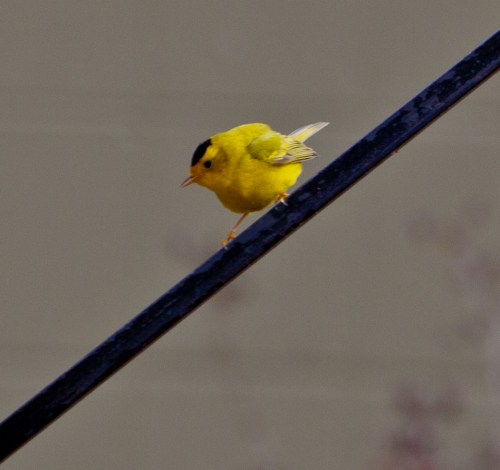
Wilson’s Warbler Walking

Wilson’s Warbler Hovering
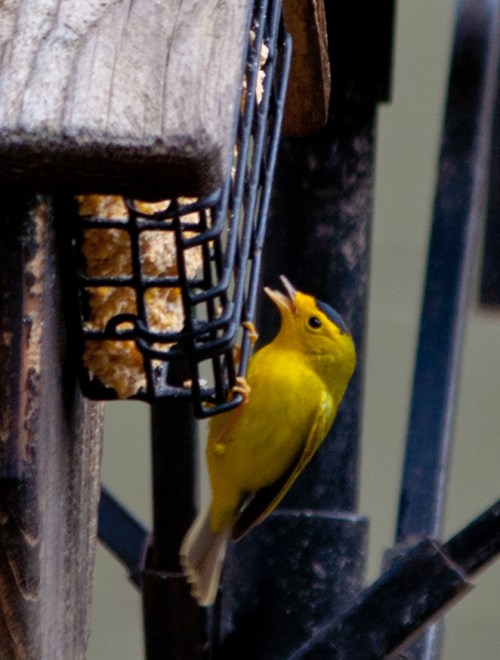
Wilson’s Warbler Feeding
© Michael Q. Powell. All rights reserved
Read Full Post »



 Mike Powell
Warbler in December
Posted in Birds, commentary, Humor, Nature, Photography, Portraits, Winter, tagged Canon 55-250mm zoom lens, Canon Rebel XT, Cardellina pusilla, December, Huntley Meadows Park, warbler, Wilson's Warbler, Wilsonia pusilla on January 3, 2013| 15 Comments »
Birders, I’m finding out, are an excitable breed. Sometimes they travel in flocks and sometimes alone. You can often identify them by their binoculars and spotting scopes and sometimes their cameras with enormous camouflaged lenses. They have special apps on their smartphones and frequently can be observed with their heads buried in one of the numerous identification guides they may be carrying.
I encountered a very excited member of this species as I passed by the bird feeders at my local marshland park this past weekend. He had his camera—with a large lens and flash—set up on a tripod pointed at the feeder. Crouching in the shadows with a remote release in his hand, he was obviously waiting for something.
Before I could pose the obvious question, he asked me in a whisper if I also was there to photograph the Wilson’s Warbler. He must have mistaken me for one of his own kind, probably because I had a camera with a telephoto lens around my neck. I got the impression that this bird was rarely seen here and that word had circulated in birding circles of this find. Suddenly he snapped a few photos and went rushing off into the underbrush, saying that a fellow birders had alerted him that the bird had also been seen near one of the benches in the park. His closing words to me were that the warbler had been timed as coming back to the feeder every four to five minutes.
Caught up in the excitement, I waited near the feeder with my camera. The only problem was that I did not have a clue what a Wilson’s Warbler looked like. How was I going to photograph it if I couldn’t identify it? An assortment of Downy Woodpeckers and nuthatches arrived and departed at the feeder and I was beginning to despair that I would see this elusive bird, when all of the sudden I saw a flash of bright yellow. It was a small yellow bird, a welcome sight on a gray late December day, and over the course of the next fifteen minutes or so I attempted to take his picture.
When I arrived home, looked at my photographs on my computer, and did a little research, I realized that I had photographed a Wilson’s Warbler (Wilsonia pusilla or Cardellina pusilla). Judging from the range maps on the Cornell Lab of Ornithology website, Virginia is on the migratory path for these birds, which breed in the northern and western parts of North American and winter in the tropics.
I am not used to photographing birds at a feeder, but managed to get a few interesting shots of the Wilson’s Warbler. To avoid scaring off the bird, I was at a pretty good distance from the feeder, so I had to crop the images quite a bit. I am quite content, though, that I have managed to capture some of the essence of this happy little bird.
Wilson’s Warbler Walking
Wilson’s Warbler Hovering
Wilson’s Warbler Feeding
© Michael Q. Powell. All rights reserved
Share this:
Read Full Post »