Feeds:
Posts
Comments

Archive for the ‘Birds’ Category

The water level in the area of the marsh where I photographed herons and egrets earlier this summer is so low that it is now just a big puddle. Therefore, I was surprised early one morning this past weekend to see a Great Blue Heron (Ardea herodias) wading in the water. The light was not very bright, but the surface of the water had a really beautiful reflection of the orange of the fall foliage. The heron was a pretty good distance away and I was on a boardwalk, so my options were limited for framing my shots. Here are a couple of my favorite shots of the heron, surrounded by the reflection of the fall colors.

Great Blue Heron in the fall at Huntley Meadows Park

Fall reflection of a Great Blue Heron

© Michael Q. Powell. All rights reserved.

Read Full Post »

In the autumn, rural areas in New England are often invaded by hordes of city dwellers anxious to see the spectacular fall foliage. Locals frequently refer (often derisively) to these outsiders as “leaf peepers.” Still, it’s hard to ignore the beauty of the changing leaves, and the Northern Cardinal in this photo appears to have paused for a moment to admire the scenery. Apparently birds can be leaf peepers too.

Northern Cardinal checks out the fall foliage

© Michael Q. Powell. All rights reserved.

Read Full Post »

I am going through a bird phase, it seems, as I continue on my journey into photography. Perhaps it’s a seasonal thing, as flowers and insects seem to be in shorter and shorter supply, or perhaps it’s a kind of evolution in an unknown direction. Whatever the case, I find my lenses pointed more and more frequently at birds.

Here are a few shorts of an American Goldfinch that I took in the early morning, when the dew was still clinging to the strands of spider web silk on the plants. The sunlight was not yet strong and was coming from the side.

When I pulled up the RAW files to make a few adjustments, I was faced with the dilemma of the yellow coloration of the bird. In I changed some settings, the yellow became “dirtier,” but you can see more details. That’s what I did in the first photo. I can’t decide if the contrast is too much, but it seemed to me that the bird’s more severe facial expression lent itself to this treatment. On the other hand, if I changed settings differently, the yellow became a little brighter, but the image got a little softer. That’s what I did in the second and third photos. Again, I was guided a bit by the bird’s expressions.

Do you think that one of the two approaches worked better? I’ve come to realize that there is no magical recipe, no secret formula that will guarantee me great shots. That’s why it’s fun for me to try out different approaches and see what happens.

© Michael Q. Powell. All rights reserved.

Read Full Post »

As I have worked to improve my skills in photographing birds, I have had the most success with red-winged blackbirds (Agelaius phoeniceus). Why? First of all, the red-winged blackbird is a lot bigger than most of the birds that I try to photograph. Secondly, the blackbirds like to perch on cattails, which are closer than the trees in the areas in which I shoot. Finally, the blackbirds seem a bit more tolerant of my relative proximity (unlike some other birds that fly away at the slightest movement long before I get in camera range).

Here are three shots of male red-winged blackbirds from yesterday that I like. The first one shows some details of the feathers, which for this bird are not solid black. This may be a not-quite-nature male blackbird (immature males have wings with buff or orange edges and have yellow on their shoulders, according to the Cornell Lab of Ornithology).

Red-winged blackbird with feather details

The next two photos show the same bird in slightly different positions. The first one looks almost like the bird was posing for me for a profile shot. The last one gives us a peek inside a blackbird’s mouth as he begins to call out—it seems that male blackbirds always need to get in the last word.

Red-winged blackbird profile

Red-winged blackbird with open mouth

© Michael Q. Powell. All rights reserved.

Read Full Post »

I was out with my camera early this morning, when the ground fog still hung over the cattails in the marsh. The red-winged blackbirds were active and I managed to get this shot. It’s almost a silhouette, yet it retains some surface detail. I love the bird’s open mouth as he utters a loud cry. The elements all seem to work together to create an atmosphere of early morning mystery.

Early morning blackbird

© Michael Q. Powell. All rights reserved.

Read Full Post »

I think that just about everybody can correctly identify this bird as a male Northern Cardinal (Cardinalis cardinalis), the mascot of the St. Louis Cardinals. His flashy red color makes him very easy to spot, even when he is in heavy vegetation. The background and foreground of this image are pretty cluttered, but I love the way that it captures the cardinal as he is feeding, with seeds visible on his beak.

Northern Cardinal feeding on seeds

© Michael Q. Powell. All rights reserved.

Read Full Post »

The tree is ablaze with vibrant fall colors and in the middle of it sits a dull black bird, a Common Grackle (Quiscalus quiscula), whose only touch of color is his yellow eyes. The juxtaposition of the contrasting elements, I believe, makes the image more interesting than either of them would have been separately.

Common Grackle in a tree

© Michael Q. Powell. All rights reserved.

Read Full Post »

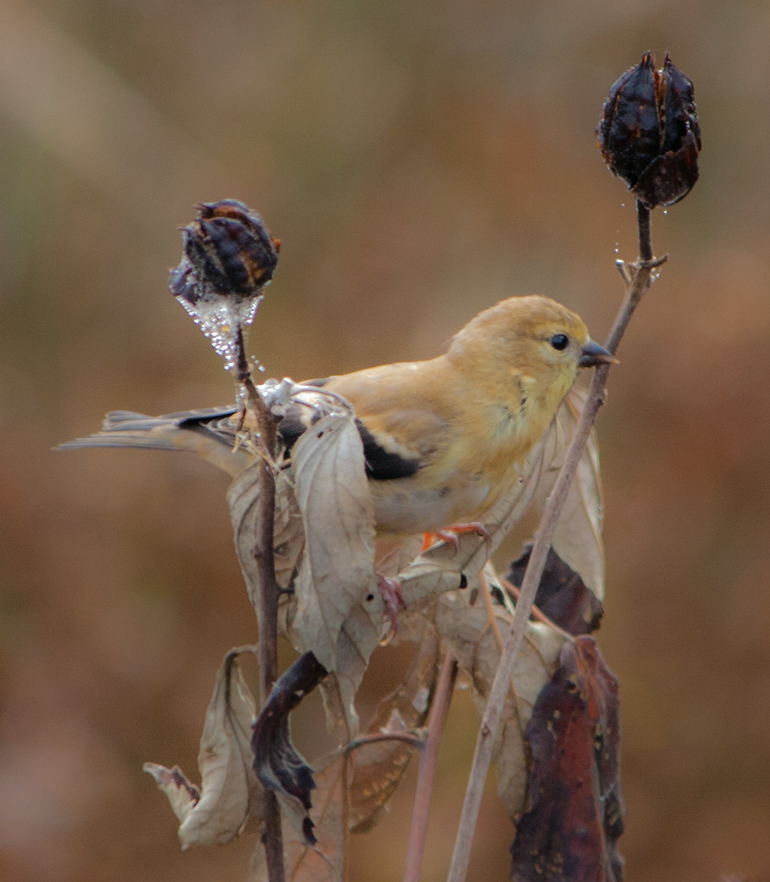
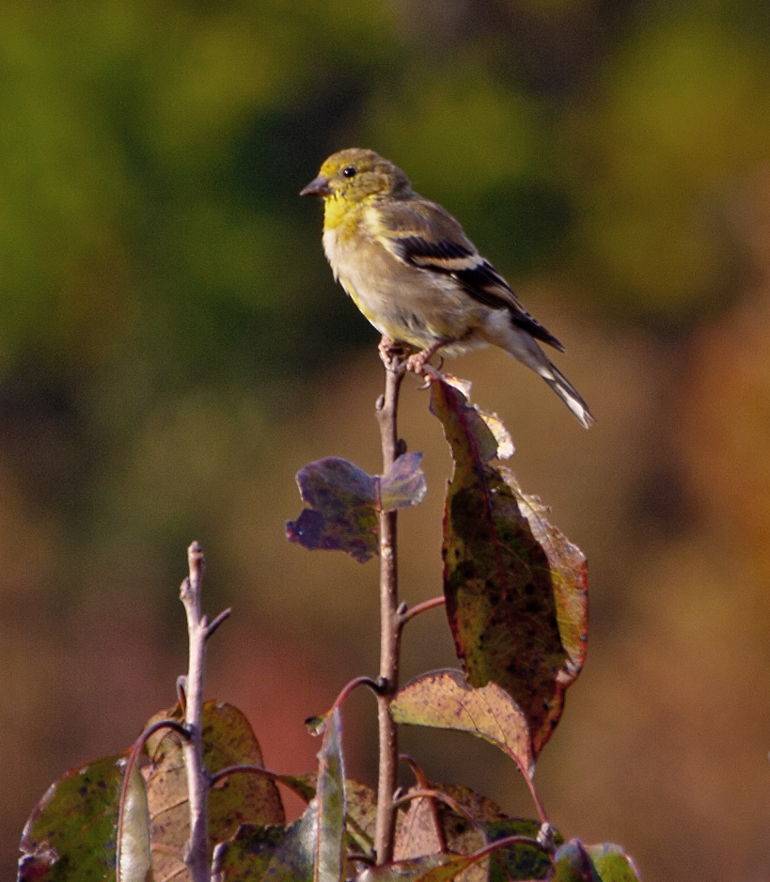
I am getting a little better at bird identification and can identify the birds in these photos as probably American Goldfinches (Spinus tristis). However, just went I thought I could differentiate between a male and a female, I found out that non-breeding males look a lot like females. Wow! This is getting more complicated. Here’s some of my favorite goldfinch shots from this past weekend, when there seemed to be quite a few goldfinchs feeding on the bushes at Huntley Meadows Park in Alexandria, Virginia.

American Goldfinch looking back at me

American Goldfinch in a tree

American Goldfinch perched at the top

American Goldfinch feeding

© Michael Q. Powell. All rights reserved.

Read Full Post »

This weekend I learned some new things about woodpeckers. I always thought that woodpeckers were found exclusively in the trees. Isn’t it logical that woodpeckers need wood to peck? (It reminds me of the response attributed to Willie Sutton on why he robbed banks—”Because that’s where the money is.”) Well, I saw a woodpecker pecking at the stalks of cattails and other similar vegetation that clearly were not made of solid wood.

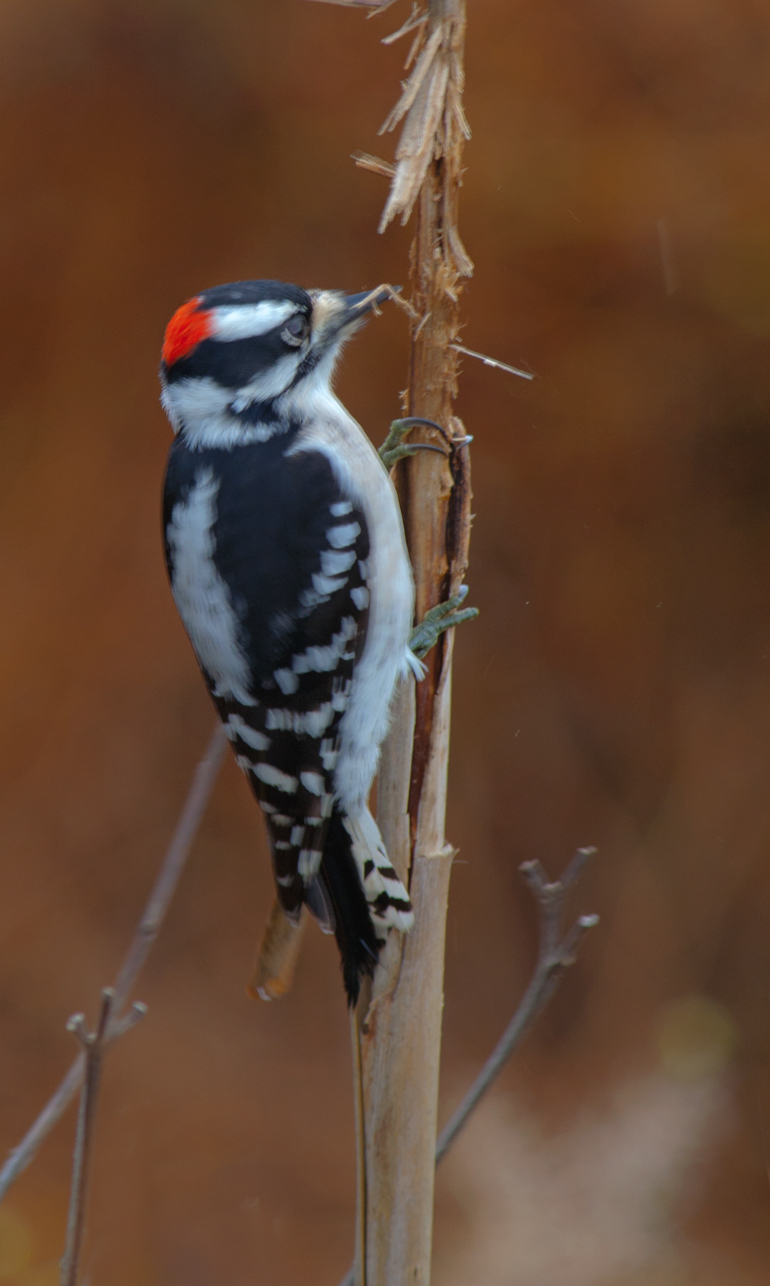
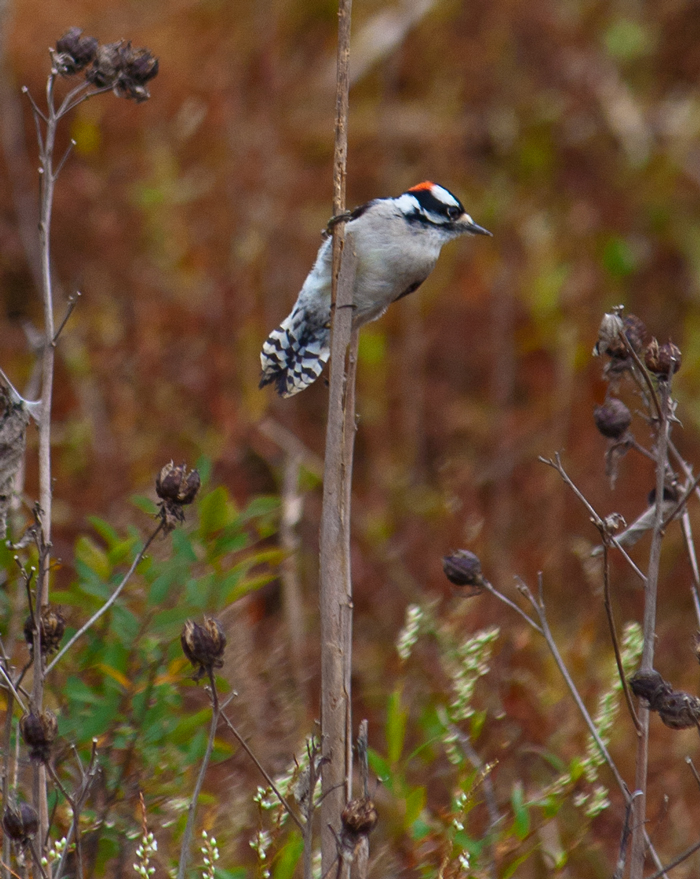
Secondly I learned that the woodpecker that had a big red spot on the back of his head was not a Red-Headed Woodpecker. Fortunately, it was not too hard to determine that the little woodpecker that I saw and photographed was a male Downy Woodpecker (Picoides pubescens). He was very active climbing up and down the stalks of a whole series of plants in the middle of a marsh and was a lot of fun to watch.

Here are a couple of photos of that beautiful bird. I am not sure that I did full justice to the blazing red color on his head that initially attracted my attention or to the wonderful black and white pattern of his feathers. I hope that I have another chance soon to see more woodpeckers and learn even more new things about them.

Male Downy Woodpecker in the field

Downy Woodpecker looks to the side

© Michael Q. Powell. All rights reserved.

Read Full Post »

There was a lot of bird activity early yesterday morning as I walked through the cattail-filled marshy area of Huntley Meadows Park in Alexandria, Virginia. Many of the birds were in groups, it seemed, including large flocks of noisy black birds that several  of my fellow bloggers have helped me identify as grackles.

Most of the birds seemed to be be passing through and perched high in trees or landed too far away for me to capture them individually with my modest telephoto zoom. (Another photographer I saw had a massive 600mm telephoto lens with a 1.4x teleconverter attached and seemed to have greater success.)

However, I was able to take this photo of bird on a cattail stalk and amazingly I can identify it—it’s a male Red-winged Blackbird (Agelaius phoeniceus).  I realize that the Red-winged Blackbird is probably one of the easiest birds to identify (along with the robin, bluejay, and cardinal), but I have had so many problems recently identifying the birds in my photos that it is satisfying to be able get one right.

There were flocks of birders present too, equipped with telescopes and binoculars, and some of them were almost as loud as the grackles. I heard lots of interesting debates, like whether a large bird soaring in the distance was a red-shouldered hawk or a redtail hawk (and I had no idea previously that there was a bird called a Coopers hawk). Most of the bird people were so intense that I didn’t dare to attempt to engage them in conversation.  One gentlemen, however, talked with me at length, periodically referring to a tattered guide that he had with him (it was a Peterson’s guide to birds east of the Rockies and he recommended it for a beginner like me). I think that I may have to break down and buy a little guide like that to start to learn more about birds.

For now, I’m happy that I can identify a Red-winged Blackbird most of the time, especially a male one!

Red-winged Blackbird on a cattail

© Michael Q. Powell. All rights reserved.

Read Full Post »

As I was walking through the marsh land early this morning, a flock of very loud black birds flew overhead. I was surprised at how many there were and how noisy they were. I think they may be some kind of blackbird and that they are in the process of migrating. I managed to snap a few photos of some of the birds as they were flying. It is fun to look at all of the different body positions of the individual birds when I took the shots.

I especially like this first photo. It looks to me like the bird who is lagging behind is calling out to the other birds, requesting that they slow the pace a bit so that he does not fall behind. The birds look almost cartoonish and the photo just makes me smile.

“Please slow down.”

The second photo shows an even greater number of different positions. You may want to click on the photo for a higher resolution view so that you can appreciate the uniqueness of the individual birds.

Unsynchronized flying

© Michael Q. Powell. All rights reserved.

Read Full Post »

A little over a week ago I posted a photo of a brown pelican at the National Zoo in Washington, D.C. that was full of vivid colors in the pelican and in the reflections of light on the water. Today, I want to show the same pelican in a different way. I changed the angle of the camera and captured a background that was more somber and simple.  In post-processing I desaturated the colors a bit to place the emphasis on the textures of the feathers, the branch on which the pelican is perched, and the rock in the right hand corner. I toyed with the idea of going completely to black and white, but decided I liked the hint of a color in the beak and part of the pelican’s head, as well as on the branches. The overall look is more somber and perhaps a bit more formal.

I haven’t made my mind up yet whether I like this presentation of the brown pelican more than the previous one, but it certainly was fun experimenting with various settings in Photoshop Elements with the intent of making the colors less bright (usually I am moving in the opposite direction).

Somber brown pelican at the National Zoo

© Michael Q. Powell. All rights reserved.

Read Full Post »

When it comes to photographing birds, it doesn’t take much to make me happy. If I can get a clear shot of a bird with a relatively uncluttered background, that constitutes a good photograph for me.  By that low standard, this image that I took a week ago is a successful one. My bird identification skills are still so weak that I won’t even hazard a guess at what kind of bird it is, but I like this modest image of this little bird.

Little bird feeding in the wild

© Michael Q. Powell. All rights reserved.

Read Full Post »

It was early in the morning and I was walking almost directly east along a stream. The sun had already risen and was in my eyes, but I spotted a Great Blue Heron in the water. I was able to get a shot that I knew would turn out as a silhouette, but the heron was standing in such a way that I was pretty confident that his silhouette would be immediately recognizable. The glare caused the color to wash out almost entirely and there are all kinds of artifacts from the light, but I like the overall effect.

Great Blue Heron Silhouette

© Michael Q. Powell. All rights reserved.

Read Full Post »

This is another shot of the Great Blue Heron (Ardea herodias) who was so cooperative today in permitting me to get close to him. In this shot, his eyes are fixed intently on the water, which unfortunately was covered with some combination of algae and duckweed. There was virtually no way for him to spot any potential prey below the surface of the water. His body seems coiled, ready to strike at a moment’s notice. He remained in this position for quite some time, but eventually he relaxed and gave up the hunt. Later, he moved to the other small pond and was equally unsuccessful there.

Focused blue heron (click for a higher resolution view)

© Michael Q. Powell. All rights reserved.

Read Full Post »

I was lucky today. Normally when I have tried to photograph Great Blue Herons (Ardea herodias), I have had to do so at the maximum range of my telephoto zoom lens and even then would have to crop the image significantly. The result has been that my photos have not been as sharp or detailed as I would have liked.

Today was different. I was walking around the little ponds at Green Spring Gardens, a county-run historical park where I had previously taken photos of a green heron, when I startled a Great Blue Heron who had been perched in a tree. He flew off high into a tree across the pond and remained there as I followed him and tried to take some photos. I have not yet looked at those photos, but suspect that they are a little distorted, given that I was shooting almost straight up.

It started to drizzle a bit. When all of the other visitors left, the heron flew down from the tree and landed no more than 30 feet from me. He wandered along the water’s edge, periodically entering the water and staring intently at its surface, probably searching for something to eat. I cautiously approached him and he let me get with fifteen feet or so of him and I even circled around him trying to get a decent angle and background for a shot. How close was I? At times I could not use the full range of my 55-250mm lens if I wanted to capture his whole body.

Here is one of my initial favorite shots. I shot it with the lens extended to 194mm with settings of f9.0, 1/200 sec, ISO 400, and an exposure compensation of -.67. Other than a little sharpening and a little cropping, this is the way the image came out of the camera.

Indeed, I was lucky today to encounter an unusually cooperative Great Blue Heron.

Cooperative Great Blue Heron

© Michael Q. Powell. All rights reserved.

Read Full Post »

I became engrossed watching some little shorebirds (or wading birds) this past weekend as I was attempting to photograph herons and egrets at Cameron Run, a stream tributary of the Potomac River. These small birds (there was a little group of them) would zigzag through the shallow water and periodically bob down to peck at some tasty morsel of food. They seemed to be aware of my presence and would move away whenever I tried to approach them, although they would not fly completely away.

I was unable to get any clear close-up photos of these unidentified birds, but I did manage to produce this image that I really like. There is a kind of graphic quality to the photo and the light and the reflections are nice, even though it is obviously no technical masterpiece.

Wading bird at Cameron Run

© Michael Q. Powell. All rights reserved.

Read Full Post »

Great Blue Herons (Ardea herodias) look graceful when they are flying or when they are wading, but they sure look awkward and gawky when on dry land. This heron seemed to be taking a break in the shade on a sunny, fall day. I took this photograph yesterday at Cameron Run, a tributary stream of the Potomac River, where I often see both egrets and heron. I do not know if they will remain here through the winter, but I hope that they do.

Great Blue Heron in the underbrush

© Michael Q. Powell. All rights reserved.

Read Full Post »

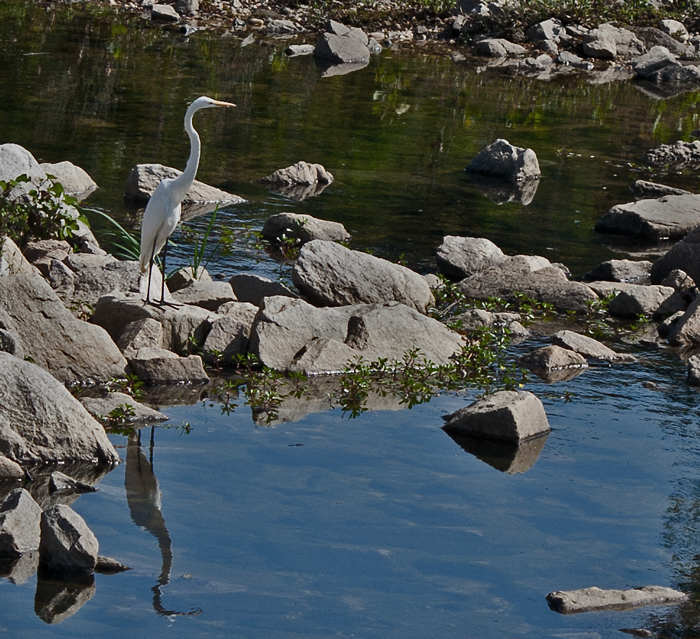
As many of you know, periodically I try to take photographs of the Great Egrets (Ardea alba) that are often present in the waters or the trees of Cameron Run, a tributary stream of the Potomac River. Usually I am frustrated, because the bright white bodies of the egrets caused my images to be overexposed and the highlights are almost always blown out.

Today, the light was a little more forgiving and I was able to capture an image of an egret with the light coming from the side. There is a dramatic glow surrounding part of its body and a nice reflection in the water. It is certainly not a perfect photo, but I like the way that it turned out.

Egret with dramatic lighting

© Michael Q. Powell. All rights reserved.

Read Full Post »

A month ago the National Zoo in Washington, D.C. opened up a newly renovated, $42 million exhibit called the American Trail that highlights species of North American wildlife. The zoo’s website (which contains lots of information about the animals and great photos) notes that the majority of the American Trail species have rebounded after facing serious threats, thanks to the conservation efforts of many organizations, including the National Zoo.

This brown pelican is part of the American Trail exhibit. I don’t think that I had ever seen one live, and certainly not so close up. I love the beautiful colors of this bird and its wonderful pose, and it seemed willing to cooperate when I was taking the photographs.

Brown pelican at National Zoo

Unlike my photos of the red panda and cheetahs, I was not shooting without obstructions—here was a fence between me and the pelican. Following instructions that I read somewhere recently, I got as close to the fence as I could and opened up the aperture (to F5.6 in this case) and the fence seems to have disappeared.

Now that I have taken a few photographs at the zoo and had some success, I think that I will probably add it to my list of local places where I can find interesting subjects to photograph.

© Michael Q. Powell. All rights reserved.

Read Full Post »

Walking along Rock Creek in Washington, D.C. on my way to the National Zoo yesterday, I came upon some ducks in a area of the creek where the water was still. I knew that they were ducks, but when I zoomed in on them I was surprised. One of them was the most unusually colored duck that I have ever seen, with a strangely shaped head, brightly colored feathers, and red eyes.

Male wood duck in Rock Creek

I did some research and discovered that this is a male wood duck. If you had asked me yesterday about wood ducks, I would have thought you were talking about those hand-painted decoys.

I managed to get a shot of the male wood duck swimming along with a female wood duck. The photo is not quite as clear as the first one, but it shows the difference in coloration between the male and the female. The female is more delicately beautiful than the male, who is really ostentatious in appearance.

Female and male wood ducks in Rock Creek

I seem to have a knack in discovering brightly colored creatures, whether they be grasshoppers or duck. I hope my good fortune continues.

© Michael Q. Powell. All rights reserved.

Read Full Post »

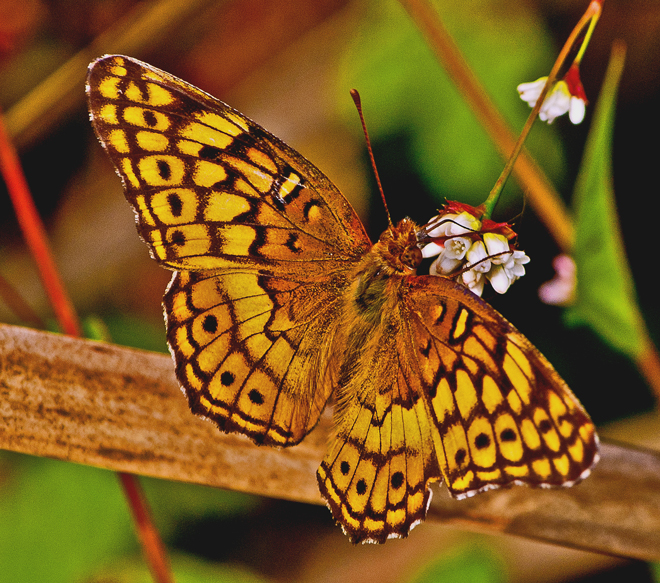
As we move deeper into autumn, I expect to find the colors orange and yellow only in the fall foliage or an occasional sunset. Yesterday, I was surprised to see this orange-and-yellow butterfly flitting from flower to flower, seemingly oblivious to the changing seasons. Doesn’t he know it’s almost October? Is it eternally spring for a butterfly?

Butterfly in late September

© Michael Q. Powell. All rights reserved.

Read Full Post »

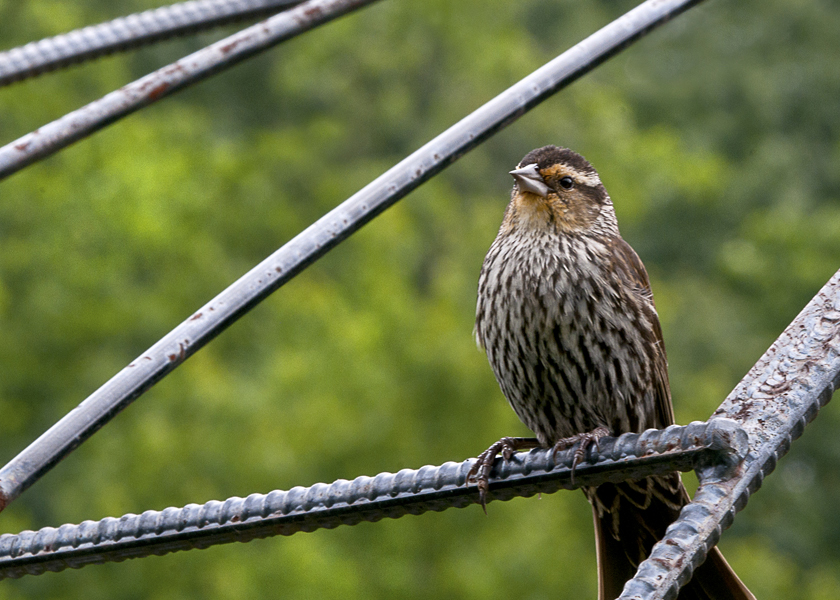
I have recently been making a lot of attempts to photograph birds, but none of the photos comes close to matching the visual impact of this female red-winged blackbird that I photographed in early June at Brookside Gardens in Wheaton, MD.

Normally you are not supposed to photograph a bird from the front, but in this case it seems to heighten the intensity of the bird’s stare. The sky was almost white that day and it disappeared when tweaks were made, but that seemed to fit with the industrial look provided by the rebar that was used to form a trellis.

Intense female red-winged blackbird

Here is another shot of the blackbird on the trellis, with some greenery in the background. You can see some of the details of the trellis, and it looks like the rusted metal is almost a perfect color match for some parts of the bird.

Bird on a wire

My blog is still less than three months old, so I have a number of my pre-blog favorites that you have not yet seen. I will occasionally share some of them when I don’t have any new material or don’t have time to prepare the new photos.

© Michael Q. Powell. All rights reserved.

Read Full Post »

This shot has some great elements—a Great White Egret and a Great Blue Heron,  practicing together in the trees for their audition for “Dancing With the Stars.” They look to be almost perfectly synchronized, though the heron may need to work on his neck position. From a technical perspective, alas, the shot is far from great, but it was interesting enough that I decided to share it.

I frequently see egrets roosting in the trees along Cameron Run, a stream in Alexandria, Virginia that feeds into the Potomac River, but this is the first time that I had seen a blue heron fly into the trees. I was shooting from a running path that parallels one side of the stream.  Shooting across a considerable amount of growth as well as the stream itself, I find it difficult to get a close-up shot. In this photo, I had startled the heron and he took off into the trees, startling the egret, who was already perched there.

Dancing in the trees

I continue to have difficulties getting good shost of the egret, because there is often glare and it is hard to keep the highlights from blowing out. Here is a shot of an egret in partial shade that has some detail, but I can’t seem to keep the detail without imparting a grayish tinge to what is a really white bird. I will definitely keep trying, though, because I find the egrets and herons to be fascinating to watch in their almost geeky gawkiness.

Egret in a tree along Cameron Run

© Michael Q. Powell. All rights reserved.

Read Full Post »

Yesterday I went out to a local garden with the monster Mamiya 500mm telephoto lens mated to a Nikon D300 to see if I could get some reasonably focused shots. A few days ago I did a posting outlining my initial difficulties in mastering the requirements of shooting in a totally manual mode and I wanted to see if things would be a little easier for me.

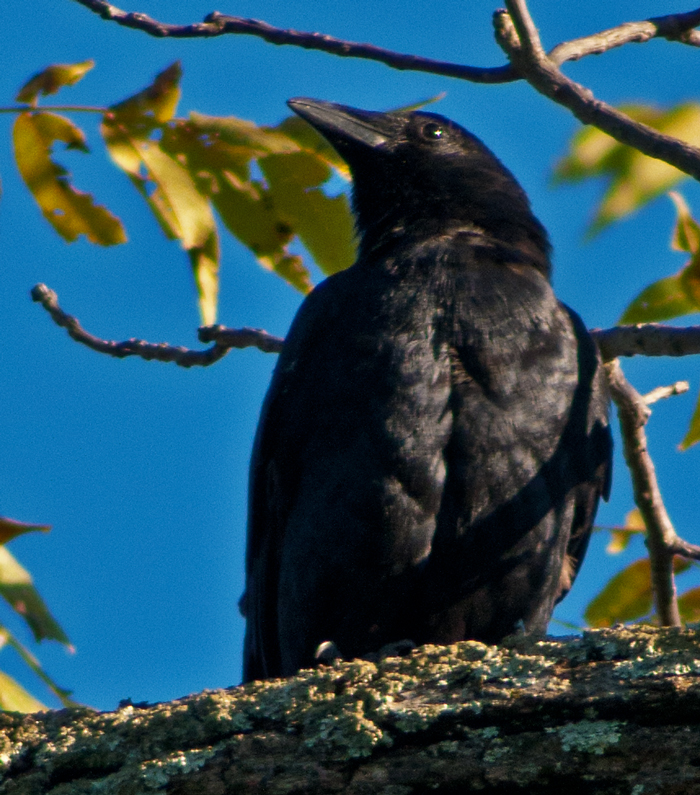
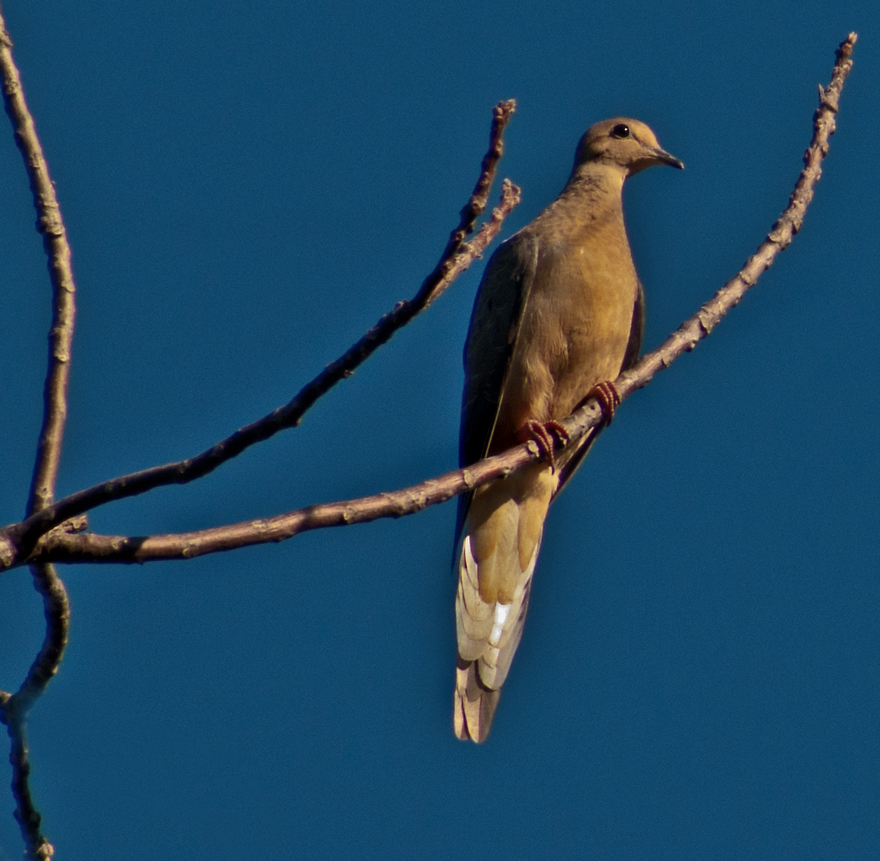
It was once again a lot of fun experimenting and I tried taking shots of a wide variety of subjects, including soccer-playing kids, flowers (yes, flowers with a 500mm lens), and a rabbit. Other than the rabbit, I had only limited success. The real test for me, though, was whether I could capture some shots of birds. I noticed a couple of birds perched high up in a tree in a relatively open area and I was able to set up my tripod on the grass and began to make a few exposures. The birds were far enough away that they were not distracted by the sound of the shutter and they stayed in place as I made adjustments. Here are some of my best shots of a crow (I cropped him so you can see the details, including the catch light in his eye) and a mourning dove. I am also including a shot of a bird that almost got away. He flew away just as I tripped the shutter and ended up in the lower left hand corner of the image in an unusual position. I decided also to post a shot of a rabbit that seems to have some personality. In this garden setting, it was the wildest animal to be found.

I have satisfied myself that it is possible to get some good images with this setup, although it requires both patiience and persistence. Is it worth the additional aggravation? My friend, Cindy Dyer, for whom I am testing this configuration will have to make that call for herself.

Close-up of a crow

Mourning dove

The one that almost got away

Rabbit on the grass

© Michael Q. Powell. All rights reserved.

Read Full Post »

It’s been at least a few weeks since I last photographed the Great White Egrets that inhabit the Cameron Run area of Alexandria, VA.  It was immediately obvious to me this past weekend that the dry summer has affected this tributary of the Potomac River and the water was really low in many places.

I was happy to stumble upon an egret standing out of the water on some rocks. The sky was a brilliant blue and it was reflected beautifully into the water, as was the egret itself. Behind the egret, the water was in the shadows and was a deep shade of green, contrasting nicely with the blue and white of the sky and the clouds. The rocks reflected the light and their highlights were a little blown out, but not outrageously so.

As we move into the fall, I am not sure if the Great Blue Herons and Great White Egrets will remain in the area. I hope that I will have the chance to photographs these wonderful birds later in the year.

Great White Egret in Cameron Run, Alexandria VA

© Michael Q. Powell. All rights reserved.

Read Full Post »

Yesterday I spent several hours completely out of my comfort zone photographically as I used unfamiliar equipment in a way that stretched my skills and knowledge. This image is one of the few that I produced that I liked. I am pretty sure that this is a grackle, probably a Common Grackle (Quiscalus quiscula).  It was taken at the bird feeder at a local wildlife park—not exactly a natural habitat.

Common Grackle

I was shooting with a friend’s Nikon D300 camera rather than my Canon Rebel XT. The size, weight, and feel of the camera was different and the buttons and dials were a mystery to me. It was like trying to speak in an unfamiliar foreign language. I kept having to ask my photography mentor Cindy Dyer to translate my Canon language into Nikon language as I sought to change the ISO or use exposure compensation.

More significantly, though, I was using a large, heavy 500mm Mamiya telephoto lens. Yes, I was using a lens designed for a medium format camera with an adapter for the Nikon.

The lens was really cool, so much so that it is featured (at least temporarily) in the long skinny banner of my blog.  However, it was hard to use effectively because everything was manual and took a lot of time to set up. My eyes have been so attuned to looking at subjects close up that it was hard to adjust to the new reality of a minimum focusing distance of 30 feet. It was equally startling to see a lens marking for 500 feet, which preceded the marking for infinity. Focusing was manual and I longed for the split prism viewfinder of my old SLR as I tried to figure out if things were in focus. I had to guess at aperture settings and make adjustments as I went along, checking and rechecking my images. As I stopped down the lens, the viewfinder got progressively darker, meaning I had to focus with a wide open aperture and then manually switch to the desired aperture setting. Interestingly enough, the lens had aperture settings beyond F22 up to F45.

We were testing the lens because one of Cindy’s friends is trying to sell it to her. When she asked me what I thought at the end of our little shoot, I responded that I needed at least one more session before I could come to a conclusion. We started out late in the morning and there were few birds visible in the sun and the heat. I think that I need to be able to try to capture some images of birds to determine in this lens would be of any use at all. With a little more practice, estimating exposures and getting clear images would probably get easier for me. In addition, it may be possible to input information on the lens into her D300 and enable metering and focus confirmation, if I read correctly the information in the user’s manual (yes, I am one of those guys who actually reads instruction manuals). If the camera displayed the correct aperture, it would make things a lot easier and I would be able to focus on focusing. I also learned that her Nikon has Live View, a feature that I am not sure she has used. That might also help with my difficulty in focusing.

So, stay tuned and perhaps you will see me do battle once again with a heavyweight Mamiya lens.

© Michael Q. Powell. All rights reserved.

Read Full Post »

Blue Dasher dragonflies seem to have disappeared from my local marshland, but I was happy today to see that the Common Whitetail dragonflies (Plathemis lydia) are still around. They are not as elegant and colorful as some other dragonflies and are somewhat stubby and drab (and, in fact, are called “common”). My portrait below shows, however, that they possess their own special beauty.

Common Whitetail dragonfly in mid-September

© Michael Q. Powell. All rights reserved.

Read Full Post »

I was at a local garden when I happened to hear this bird singing. My bird identification skills are so weak at this point that I won’t even hazard a guess about what kind of bird he is (I seem to be wrong more than I am right, with the exception of really common birds like robins and cardinals). His song was pleasant, however, and his brown eyes were captivating. He was perched up high enough that the sky provided a clear background and the green leaves and bright red berries added some interest and color in the foreground, although they partially hide his body. I like the way the shot turned out and it required only a minimum amount of cropping.

I finally managed to get a decent bird image in relatively good focus. What happened? I’m learning that I need plenty of light with the camera and lenses that I have to get an optimal image and I need to avoid the extreme end of my telephoto zoom and aperture range too.  Most of all, I need to be really lucky.

© Michael Q. Powell. All rights reserved.

Read Full Post »

Birds were out this past Monday and once again I went through the mostly frustrating process of trying to get some shots. I managed to get this unintentionally soft-focused image that I like. The angle of the shot is strange and the bird seems almost distorted, possibly because of the way in which he is sticking out his neck, but I love the blue markings on the wings. The blue color, in fact, helped me to identify the bird as most likely a Cerulean Warbler (Setophaga cerulea) for it turns out that there are not that many blue-colored birds.

UPDATE: Joel Eagle has corrected my false identification. It’s a Nuthatch, not a Cerulean Warbler. The name may not be as cool-sounding, but the bird is still as beautiful. Check out Joel’s blog “Pops & Mojo Photos” for some wonderful insect photos (and birds too).

Nuthatch

© Michael Q. Powell. All rights reserved.

Read Full Post »

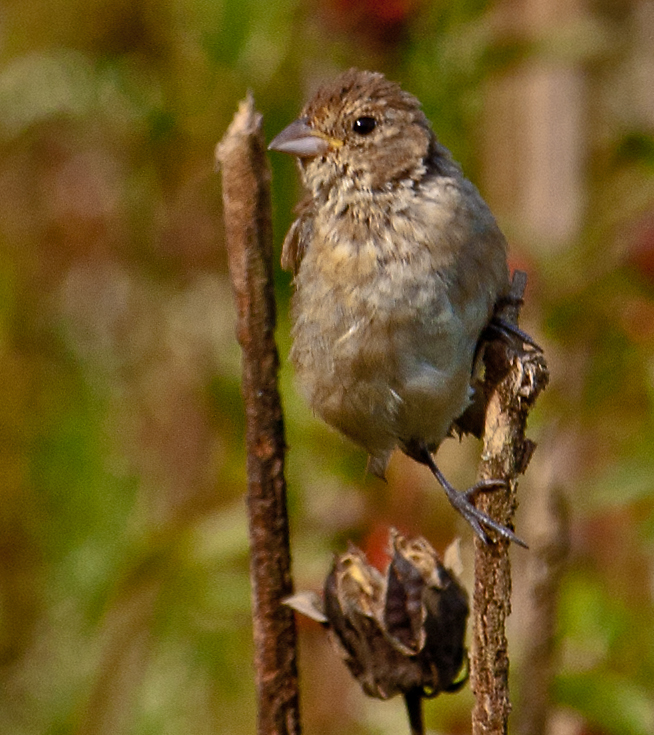
Do you ever take a photo and like the way the background turns out so much that the primary subject becomes of secondary importance?

I mentioned in an earlier post the difficulty I have in photographing birds. This was a shot from the same day I photographed the cardinal. I’m not really sure what kind of bird this is, but I like the fact that I got a relatively clear shot of the bird. More than that, though, I like the impressionist look of the background.

Can anyone identify this bird?

Unidentified bird

© Michael Q. Powell. All rights reserved.

Read Full Post »

« Newer Posts - Older Posts »