Feeds:
Posts
Comments

Archive for the ‘Birds’ Category

The Bald Eagles (Haliaeetus leucocephalus) at a prominent nesting site at Occoquan Bay National Wildlife Refuge were late this year in nesting and I feared that they might not have any babies. I was therefore thrilled yesterday to discover that there is now an eaglet in the nest when I returned to that part of the refuge for the first time in a couple of months.

Authorities at the refuge set up barriers to keep the nesting eagles from being disturbed, so I had to observe the nest from a long way off. When I first arrived at the barrier yesterday, I could not tell if there were any eaglets. However, I noted that one of the parent eagles was perched on a limb above and to the right of the nest. In the past, I learned that when eaglets start to grow, there is no longer any room for a parent in the nest, so having one parent keeping guard near the nest was a positive sign.

I waited and waited and eventually the other parent eagle flew in and perched on a limb above and to the left of the nest. I was peering though my fully-extended telephoto zoom lens and noticed a dark shape pop up in the middle of the nest shortly after the second parent arrived. When I looked at my shots afterwards, I confirmed that there was an eaglet in the nest.

In the first shot, it looks like the eaglet was calling to its parent, although I did not hear a sound, or maybe was indicating it was hungry. I pulled back my zoom lens to its widest setting for the second shot, in which you can see both eagle parents and the eaglet in the nest in the center (you may want to click on the image to see more details).

I think that there is only one eaglet this year, though I can’t be absolutely certain. In past years there have been either one of two eaglets in this nest. Now that I know that there is a new little eaglet, I will probably try to return to the site to monitor its progress over the upcoming weeks and months.

Bald Eagle

Bald Eagle

© Michael Q. Powell. All rights reserved.

Read Full Post »

I am not sure what kind of insect this male Eastern Bluebird (Sialia sialis) had caught, but he seemed pretty proud of himself yesterday at Occoquan Bay National Wildlife Refuge. When I first spotted him, the bluebird was perched on the roof of a nesting box. I suspect that there may be a female and possibly babies inside the nesting box and the male was serving as a deliveryman. 

As I moved slightly to try to get a better angle, the bluebird flew to a nearby tree, still holding the worm/caterpillar in its mouth. I quickly realized that he did not like me being around , so I took a quick shot of him in the tree and left him in peace to complete his delivery.

Eastern Bluebird

Eastern Bluebird

© Michael Q. Powell. All rights reserved.

Read Full Post »

When I first got interested in photographing birds, Great Blue Herons (Ardea herodias) were one of my favorites. They were large, easy to find, and cooperative subjects. Rather than fly away when they sensed my presence, they would often remain in place. That tendency, I learned, was both a blessing and a curse. It is easier to photograph a bird when it is stationary, but eventually I wanted to capture action and Great Blue Herons, I learned, have endless patience—they can stay motionless for a really long time before they strike, often longer than I was willing to wait.

I still love to see Great Blue Herons and spotted this one earlier this month during a trip to Occoquan Bay National Wildlife Refuge. The heron seemed restless and was slowly slogging its way through the vegetation. Perhaps it was hunting or maybe it was just relocating to another spot. In any case, it was wonderful to see and photograph one of my old familiar favorites.

Great Blue Heron

Great Blue Heron

© Michael Q. Powell. All rights reserved.

Read Full Post »

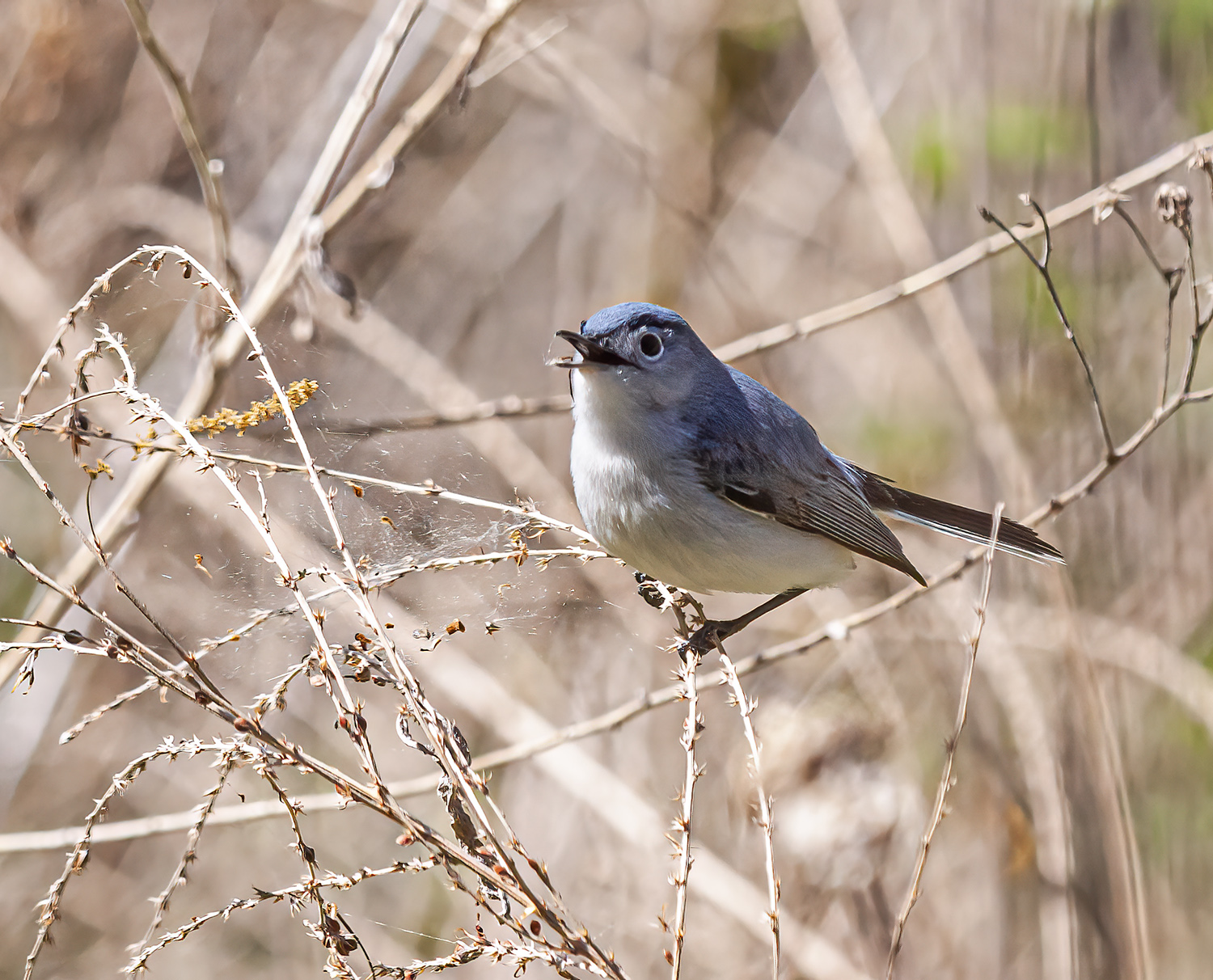
As I was searching in a small field of eye-height vegetation for dragonflies last Wednesday at Jackson Miles Abbott Wetland Refuge, my eyes detected a flash of blue and white and I realized that a bird had joined me in the field. I was shocked to see that it was a male Blue-gray Gnatcatcher (Polioptila caerulea). During my previous encounters with a Blue-gray Gnatcatcher, the bird has always been moving about in the foliage high in a tree.

I sprung into action and managed to get some decent shots of this tiny bird, despite the fact that I was shooting with my 180mm macro lens, the one that I generally use for the macro shots of insects that you see on this blog. The coolest image, I think, is the first one and it was mostly a matter of luck. I had just taken the second shot below when the gnatcatcher took off and I instinctively pressed the shutter release and captured a fun action shot.

So what was the gnatcatcher doing at ground level? As I was was processing my images I noticed that there were old spider webs in most of them. It is most obvious in the final photo, but if you click on the other images, you will see webs to the left of the bird in the penultimate shot (and in its mouth, I think), and also to the right of the bird and a little lower in the second shot (and possibly in the corner of its mouth).

Why would they be messing with spider webs? According to the Cornell Lab of Ornithology website, Blue-gray Gnatcatcher pairs use spiderwebs and lichens to build small, neat nests on top of tree branches and may build up to seven nests in a breeding season.  The website also notes that breeding males have a black V above their foreheads extending above their eyes, which you can see quite clearly in the second shot. I wonder if breeding season is begining

I have not spotted any gnatcatcher nests yet this year, but two years ago in late May I took some shots of a nest at the same refuge that show the amazing construction abilities of these little birds. Check out the posting called Baby gnatcatchers? by clicking on the title of the posting or clicking here. The nests are fascinating to examine.

Blue-gray Gnatcatcher

Blue-gray Gnatcatcher

Blue-gray Gnatcatcher

Blue-gray Gnatcatcher

© Michael Q. Powell. All rights reserved.

Read Full Post »

At this time of the year I often hear the distinctive singing of Blue-gray Gnatcatchers (Polioptila caerulea), but I rarely get a clear view of these tiny birds. I like the way the Cornell Lab of Ornithology website describes these birds, “The nasal, wheezy, rambling song and insistent, squeaky calls are great first clues to finding them, particularly as these tiny birds can get lost in the generally taller habitats used in the eastern part of their range.” If you are interested in hearing samples of the different calls and songs of Blue-gray Gnatcatchers, click this link to another part of the same website.

Once I have heard the singing, I begin to scan the foliage near the top of top of a tree and if I am lucky I will detect some motion. Blue-gray Gnatcatchers like to flick their tails from side to side to scare up insects and then the gnatcatchers chase after them. Strangely, though, gnats do not form a significant part of their diet. So, in addition to being small (about 4 inches (10 cm) in length), they are almost always moving—that makes it quite a challenge to photograph one.

I was therefore quite thrilled to capture this image last Friday of a Blue-gray Gnatcatcher at Occoquan Bay National Wildlife Refuge. I had been tracking this bird for a while as it moved about from one patch of leaves to another and was more or less ready when it popped out of the foliage onto this small branch.

Blue-gray Gnatcatcher

© Michael Q. Powell. All rights reserved.

Read Full Post »

I never fail to be entranced by the striking blue eyes of a Double-crested Cormorant (Phalacrocorax auritus), like this one that I spotted last week at Occoquan Bay National Wildlife Refuge. Most of the time when I spot cormorants, they are in the deep waters and their eyes are too far away to be seen. Even when they are a bit closer, the eyes are often hidden by shadows.

On this occasion, however, the cormorant was in a small pond, so I was able to track it easily after I spotted it. On one of its dives the cormorant popped up within range of my camera and turned into the light for a moment before it submerged itself again, allowing me to get this shot with a clear view of its sparkling blue eyes.

Double-crested Cormorant

© Michael Q. Powell. All rights reserved.

Read Full Post »

It has been almost a month since I last checked in on the Ospreys (Pandion haliaetus) at Occoquan Bay National Wildlife Refuge. Last month they were busy collecting materials to build or repair their nests. Last Friday I spotted several nests that had grown considerably in size and the ospreys in the nests appeared to be sitting on their eggs.

I captured this image when one of the sitting ospreys had lifted her head to the sky, looking with hopeful expectation for her mate to return. Maybe he would be bringing her a fresh fish or perhaps he would be spelling her a bit from her maternal duties or could it be that she simply longer for his presence.

osprey

© Michael Q. Powell. All rights reserved.


Read Full Post »

On Friday morning, the temperature was only 38 degrees F (3 degrees C), so I abandoned my macro lens, assuming that insects would not be active, and switched back to my telephoto zoom lens. I returned to my favorite location, Occoquan Bay National Wildlife Refuge (OBNWR), to look for birds. This location is relatively remote and has few amenities, which means that it is rarely crowded—there have been times in the past when my car was the only one in the parking lot. Unlike many parks in our area, OBNWR remains open and it has become my place of refuge.

It has been almost a month or so since my last visit, so I was not sure which birds would be active. As you may have seen in yesterday’s posting, some warblers are now passing through our area. While it is nice to welcome these colorful visitors, I was perhaps even happier to spot some of my favorite year-round residents, the Bald Eagles (Haliaeetus leucocephalus). There are at least two active eagle nests in the refuge and one of the volunteers there told me that there is already an eaglet in one of the nests.

I captured these two images not far from the nest with the eaglet, so it is quite possible that at least one of these eagles is a parent. The early morning sunshine was quite beautiful and I love the way that it illuminated the side of the eagle’s face in the first image. The second image gives you an idea of the amount of leaves now on the trees, which makes it difficult to spot birds, especially the smaller ones. Fortunately the white coloration of the bald eagles and ospreys and their large size makes it hard for them to hide completely.

It is reassuring to see that the cycle of life is continuing normally in nature even when our lives have been completely disrupted and most of us are confined and/or in isolation.

Bald Eagle

Bald Eagle

© Michael Q. Powell. All rights reserved.

Read Full Post »

It is warbler season now where I live. This can be a frustrating time of the year for me, because the arrival of these colorful migrating birds coincides with the re-leafing of the trees. I can hear the warblers and occasionally get a glimpse of their bright colors through the leaves, but it is rare for me to get a clear shot of one.

Yesterday, I was thrilled to capture this image of a Yellow-rumped Warbler (Setophaga coronata) at Occoquan Bay National Wildlife Refuge. I started to track this bird as it was moving about in the foliage and was fortunate to be ready when it paused for a split second in the open. I did not plan this particular composition, but it worked out really nicely with the shapes of the branches on the right side of the image and the mostly out of focus leaves on the left.

This image speaks of spring to me. Happy Spring to those in the Northern Hemisphere and hopefully those experiencing autumn in the Southern Hemisphere will also enjoy the bright springtime colors.


Yellow-rumped Warbler

© Michael Q. Powell. All rights reserved.

Read Full Post »

Sometimes Ospreys (Pandion haliaetus) will renovate preexisting nests, but often they have to build one from scratch. This osprey couple that I spotted recently at Occoquan Bay National Wildlife Refuge was trying to build one in what seemed to be a rather precarious location.

I learned about the location of the nest only when I spotted an osprey flying by me with a stick in its talons. In my zeal to track the osprey, I neglected to pull back on my zoom lens, so I ended up cutting off its wing tips in the first image in which the osprey is delivering the stick. In the second image, you can see the nest-to-be as the osprey attempts to arrange the sticks. The final shot shows the osprey arriving at the nesting site with another stick. I like the way that the osprey almost hovered in order to land softly with its delivery.

I don’t know it the osprey couple will manage to jam enough sticks in the crook of the tree to be able to form a stable nest, but I will be sure to check their progress in future visits, as long as the wildlife refuge continues to stay open.

Osprey

Osprey

Osprey

© Michael Q. Powell. All rights reserved.

Read Full Post »

“Oh what a beautiful morning, oh what a beautiful day, I’ve got a beautiful feeling everything’s going my way.” I started my Thursday morning at Occoquan Bay National Wildlife Refuge with this handsome Great Blue Heron (Ardea herodias) who seemed to be serenading me.

If you have ever heard the squawk of a Great Blue Heron, you know why it is best that there is no soundtrack. Instead, I recommend that you click on this link to a YouTube video of the song that I cited in my opening sentence from the classic 1955 movie “Oklahoma”—it is guaranteed to brighten your day.

Great Blue Heron

© Michael Q. Powell. All rights reserved.

Read Full Post »

Land prices are so high here in Northern Virginia that you have to be creative. Yesterday I spotted this Osprey (Pandion haliaetus) couple building their tiny house on one of the boundary channel markers off of Occoquan Bay National Wildlife Refuge.

The osprey perched in the back, which I believe is the female, remained in place while the other osprey flew off to forage for building materials. Sometimes they were only small twigs, but occasional the male osprey would return with a fairly long branch, as in the second photo. In the third shot, the male osprey has successfully landed with the long branch, but has not yet let go of it.

Multiple osprey couples are busily constructing nests all of “my” wildlife refuge and I hope to be able to share some images of their constructions sites.


Osprey

Osprey

Osprey

© Michael Q. Powell. All rights reserved.

Read Full Post »

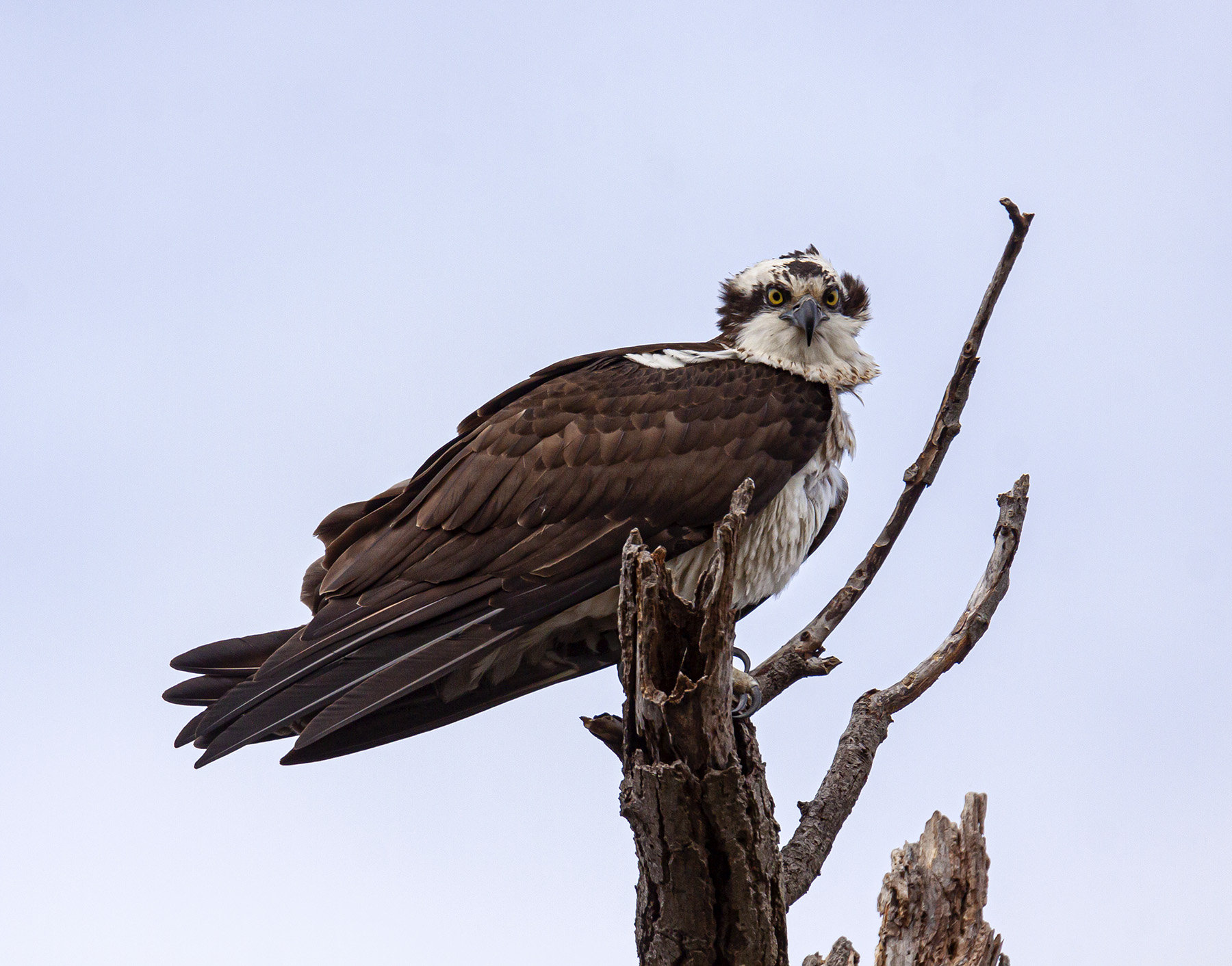
Even though we were at more than an acceptable social distance, this Osprey (Pandion haliaetus) seemed to be communicating a message to me with its direct eye contact on Saturday at Occoquan Bay National Wildlife Refuge—something like, “Please leave so I can continue working on my nest.”

Most of the time I will try to avoid photographing a bird head-on, because it has the potential to distort its features a lot. With this osprey, though, I think it worked out pretty well, perhaps because of the size and shape of its head.

osprey

© Michael Q. Powell. All rights reserved.

Read Full Post »

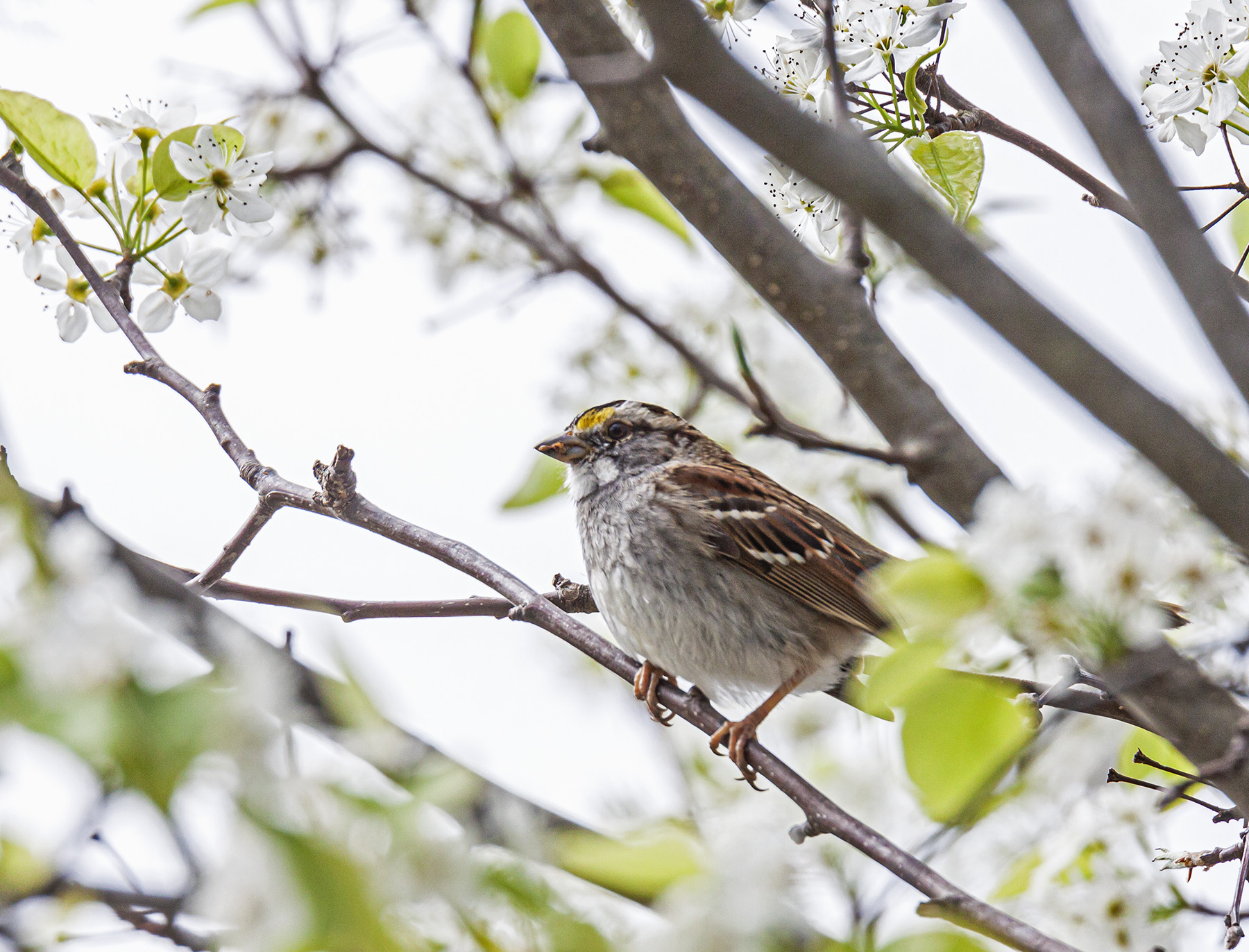
Each spring I try to get shots of birds perching in blossoming trees, but the birds rarely cooperate with me—they all seem more interested in foraging for food than in posing for me. On Saturday, though, a White-throated Sparrow (Zonotrichia albicollis) at Occoquan Bay National Wildlife Refuge paused for a moment and I was able to capture this image.

I chose not to crop this image any closer in order to give you a better view of the delicate white blossoms of a tree that I am not able to immediately identify.

White-throated Sparrow

© Michael Q. Powell. All rights reserved.

Read Full Post »

I am more of a liberal arts guy than a scientist, so the details of bird identification often escape me. Sue of the Back Yard Biology blog, on the other hand, is a self-avowed “geeky science nerd.” She decided to do some work to find out how to tell the age of a wild turkey. I suspect that many of you will find her posting as fascinating as I did, so be sure to click on the View Original Post in order to see her entire posting.

Be sure also to check out other postings on her wonderful blog. Sue is one of my most faithful followers and was one of the first to comment on my earliest postings more than seven years ago.

Sue's avatarBack Yard Biology

It’s that time again, when tom Turkeys begin to strut their stuff in the backyard.  The other day, a FB friend/fellow wildlife photographer posted a shot of a tom turkey (https://michaelqpowell.com/2020/03/22/panic-or-calm/) that looked quite a bit different than the one I have been seeing in my backyard.  I thought it looked younger, but I wondered how one can tell the age of male wild Turkey.  So, I googled that thought, and it turns out it’s not a hard thing to do (assuming you can judge lengths somewhat accurately).

The key things to look for are the length of the beard (the hair-like structures — which are modified feathers) hanging down from its breast), the color of the tip of the beard, and the length of the spurs on the back of the lower-most part of its leg next to the foot (the tarsometatarsus to be exact).

It’s still early in…

View original post 399 more words

Read Full Post »

Wild Turkeys (Meleagris gallopavo) reacted in different ways yesterday at Occoquan Bay National Wildlife Refuge when they detected my presence. One turkey seemed to panic, put down its head, and sprinted to the other side, while the other calmly strode across the trail. Both reached the other side safely. Was this the turkey version of social distancing?

How do you react in the face of a perceived threat? These days, this question is not merely an academic one—it is part of our daily lives. I think we all experience moments of panic, but we can choose not to let those feelings overwhelm us. Stay safe and healthy within the limits imposed on you by the current crisis and be sure to take care of yourselves.

Wild Turkey

Wild Turkey

© Michael Q. Powell. All rights reserved.


Read Full Post »

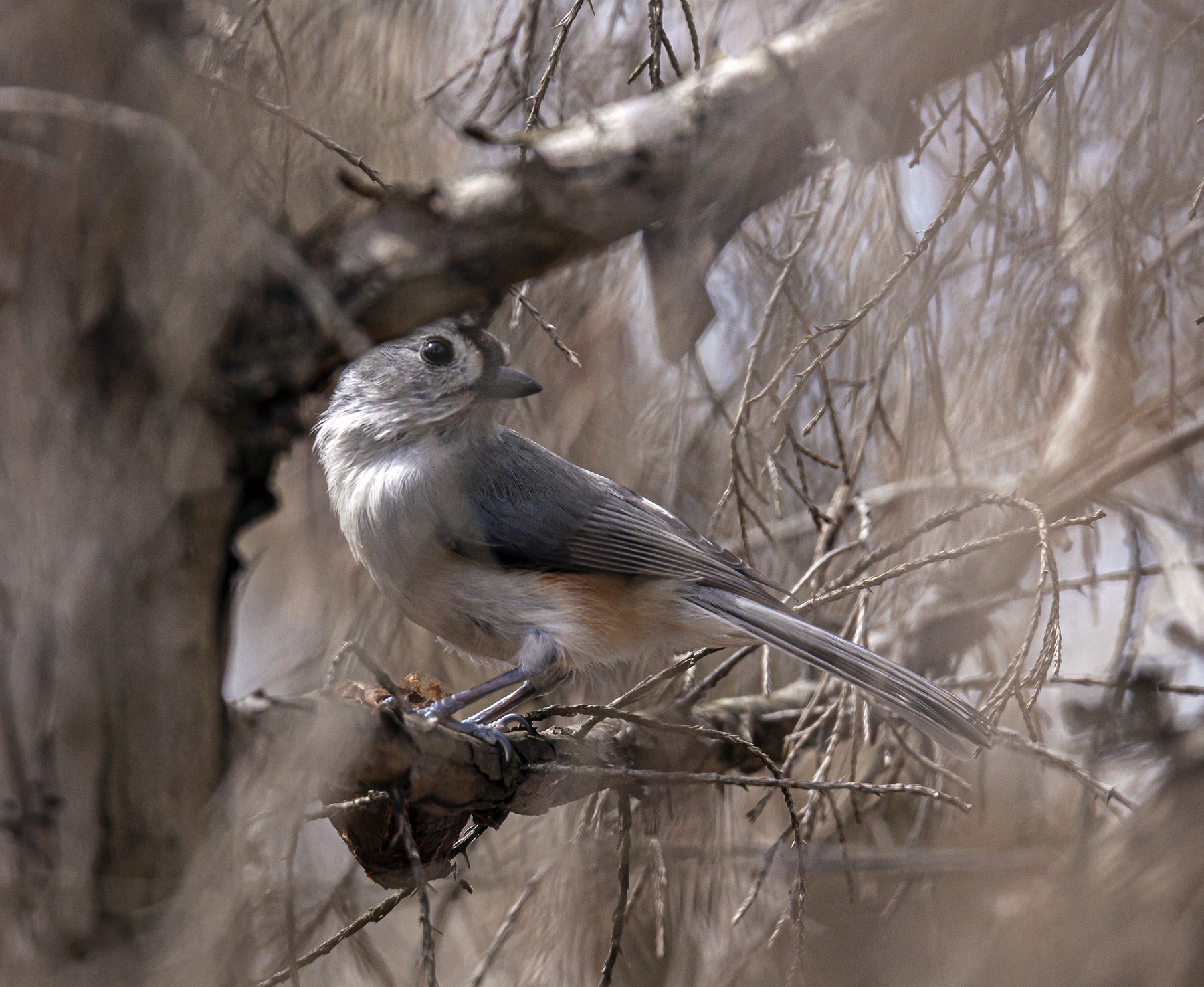
The early bird gets the worm, they say, but this mid-morning Tufted Titmouse (Baeolophus bicolor) was eating something different when I spotted it through the trees last Friday at Occoquan Bay National Wildlife Refuge.

It is always a challenge to get shots of birds as small as this one (approximately 5.5-6.3 inches (14-16 cm) in length), but I have found that my chances of success increase when a subject stops to eat. I could see the little titmouse clearly, but there was a lot of vegetation between us.  As a result, I had to move from side to side, trying to find a clear visual tunnel. I am happy with what I was able to get, even if the bird’s distinctive pointed crest did end up being blocked from view by a tree.

Tufted Titmouse

Tufted Titmouse

© Michael Q. Powell. All rights reserved.

Read Full Post »

On Tuesday I could hear a pair of screaming hawks overhead at Accotink Bay Wildlife Refuge and eventually I saw one of them land on a broken-off tree. As I focused on that hawk, which I think is a Red-shouldered Hawk (Buteo lineatus), the other hawk zoomed into the frame and continued the fight.

In the first image, the perched hawk appeared to sense the approach of the “enemy” and was preparing itself for battle. I didn’t realize that the other hawk was approaching I saw it through the viewfinder of my camera as you can see in the second shot. At that moment, the stationary hawk was preparing to take off. In the final shot, the flying hawk had closed the gap and the two raptors were engaged in what looked to be a fierce struggle.

Why were they fighting? My guess is that it was some kind of territorial dispute, but there is no way for me to be sure. When I first saw the two hawks chasing each other, I thought it might be love, but the final frame suggests that was not the reason.

Red-shouldered Hawk

Red-shouldered Hawk

Red-shouldered Hawk

© Michael Q. Powell. All rights reserved.

Read Full Post »

No matter how many times it happens, it is always exciting to see a Bald Eagle (Haliaeetus leucocephalus). Last week I spotted this one at Occoquan Bay National Wildlife Refuge and I was happy when it presented me with a chance to take this profile shot.

I had watched as the eagle flew to this tree and stealthily approached it. I was able to get relatively close, because the eagle was looking away from me and could not see me moving closer. However, the butt-first pose that it presented to me is not the most flattering for any creature, so I waited and hoped that the eagle would change its position. After what seemed like an eternity, the eagle moved its head to the side and I was finally able to get a few shots in which the eye was visible. Patience paid off one more time.


Bald Eagle

© Michael Q. Powell. All rights reserved.

Read Full Post »

The world seems to have gone crazy recently, so I look for any signs of happiness and positivity that I can find, like this beautiful Eastern Bluebird (Sialia sialis) that I spotted on Monday at Occoquan Bay National Wildlife Refuge. The relatively subdued coloration of this bird suggests to me that this is a female bluebird.

Bluebirds are traditionally associated with happiness. It is my hope and prayer that somehow amidst the chaos of cancelled plans and possible quarantines, you will be able to pause and find a few moments to be thankful for what you do have.

Eastern Bluebird

© Michael Q. Powell. All rights reserved.

Read Full Post »
Yesterday morning I was excited to spot this handsome Red-shouldered Hawk (Buteo lineatus) perched rather low in a tree at Occoquan Bay National Wildlife Refuge. Rather than flying away immediately, as is usually the case, the hawk remained in place long enough for me to maneuver around to a good position to capture its portrait.

Red-shouldered Hawk

Red-shouldered Hawk

© Michael Q. Powell. All rights reserved.

Read Full Post »

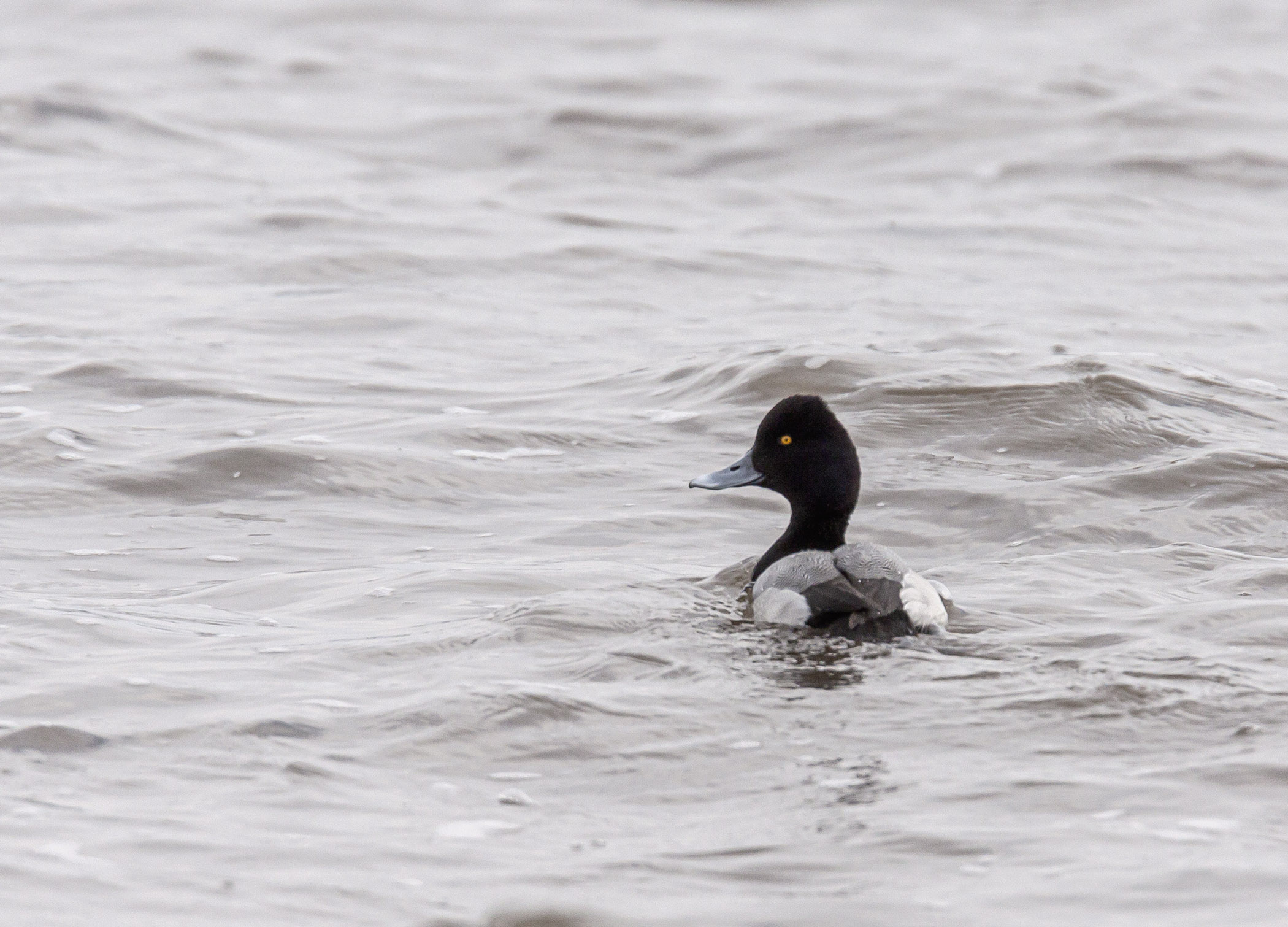
The wind was blowing strongly on Monday morning, kicking up lots of waves in the waters off of Occoquan Bay National Wildlife Refuge. In the deeper water I could see a small group of scaups bobbing up and down among the waves. Were they Greater Scaups (Aythya marila) or Lesser Scaups (Aythya affinis)?

I confess that I can’t tell the difference between the two species. I was content to get shots of both genders, especially the female with the distinctive white markings at the base of her bill.

scaup


scaup

© Michael Q. Powell. All rights reserved.


Read Full Post »

Yesterday morning I was delighted to spot this immature Bald Eagle (Haliaeetus leucocephalus) at Occoquan Bay National Wildlife Refuge. It takes approximately five years for a Bald Eagle to gets its classic white head and I estimate this one to be about three years old, judging from its coloration.

Initially I spotted the eagle when it flew into the midst of a group of trees. I moved around only a little, fearful of spooking the bird, and captured the second shot below when the eagle leaned forward a little and exposed its head. Moving as stealthily as I could, I maneuvered to a position from which I had a somewhat clearer shot and captured the third shot below. I noted that the eagle was crouching, which is often a prelude to taking off, but the eagle remained in place.

Eventually I reached a little opening and was able to capture the first image, which I think is the best of the group. The tree in which the eagle is perched is, I believe, a sycamore. Unlike the sweet gum trees with spiky seed balls that have appeared in many of my perched eagle shots, the seed balls of this tree appear to be much smoother.

If you are interested in the developmental stages of a Bald Eagle and how its appearance changes over time, I recommend that you check out a posting from onthewingphotography.com entitled “Bald Eagles – Age Progression from one to five years old” that features wonderful photographs of each stage.

Bald Eagle

Bald Eagle

Bald Eagle

© Michael Q. Powell. All rights reserved.


Read Full Post »

There are at least two Bald Eagle nests (Haliaeetus leucocephalus) at Occoquan Bay National Wildlife Refuge, the location where I take many of my wildlife photos. One of them is located adjacent to a popular trail and most years the authorities close nearby trails during eagle nesting season. There has been a lot of construction at the refuge over the past few months and, although I saw an eagle couple at that nesting site on several occasions, it looks like they may not have occupied that nest this year (and the trails have not been closed).

The second nest, pictured below, is in a more remote location—it is visible through the trees from one of the trails, but is surrounded by dense vegetation, so the eagles are more insulated from human activity. On a recent visit to the refuge, I was pleased to spot both members of an eagle couple in the nest. I am pretty sure that the eagle on the left is the male, because male eagles tend to be considerably smaller than their female counterparts.

With a bit of luck I hope to be able to spot some eaglets here in the upcoming months, although I noted last year that it is a real challenge to do so, because the wall of this large nest appear to be quite high and effectively hide the eagles from view.

Bald Eagle

© Michael Q. Powell. All rights reserved.


Read Full Post »

Although the old proverb asserts that “birds of a feather flock together,” I have learned the value of examining groups of floating birds, because they often include multiple species. I was examining one such group last week in the waters off of Occoquan Bay National Wildlife Refuge when I spotted an obvious outlier, a duck that was larger and more brightly colored than the rest. I am pretty sure that this is a male Canvasback duck (Aythya valisineria), a species that I do not see very often and still have not seen at close range.

Canvasback duck

© Michael Q. Powell. All rights reserved.

Read Full Post »

A strong wind was blowing last Thursday as I was exploring Occoquan Bay National Wildlife Refuge. Most of the birds that I usually observe were absent from view, probably using common sense to take shelter from the blustery wind. As I was returning almost empty-handed to my car, I spotted several Eastern Bluebirds (Sialia sialis) perched low on the roof of a covered picnic area.

Generally I try to avoid including manmade structures in my wildlife photos, but sometimes you just have to take what you can get. I really like the way that I was able to capture some of the feather details of this male Eastern Bluebird. If you look closely, you can see the bird’s windblown feathers, a look that is cultivated by some stylish humans, who often rely on “product” to achieve the effect rather than on the actual wind.

Eastern Bluebird

© Michael Q. Powell. All rights reserved.

Read Full Post »

I do not know much about fashion, but I am pretty sure that I could not pull off wearing an outfit that combined stripes and dots. Somehow, though, the combination works well for this male Northern Flicker (Colaptes auratus) that I spotted yesterday morning at Occoquan Bay National Wildlife Refuge.  This Northern Flicker goes even further by adding a bright red crescent across the back of his head.

Unlike most other woodpeckers that are content to wear black and white and maybe a little bit of red, this Northern Flicker comes across as a bold, colorful, and stylish. I wonder why we don’t have similarly-colored penguins.


Northern Flicker

© Michael Q. Powell. All rights reserved.

Read Full Post »

I feel lucky when I am able to capture an unobstructed shot of a Ruby-crowned Kinglet (Regulus calendula). I feel doubly fortunate when I manage to get a shot of the tiny red “crown” that is responsible for the bird’s name. Last week I spotted this Ruby-crowned Kinglet at Occoquan Bay National Wildlife Refuge.

According to the Cornell Lab of Ornithology, “the male’s brilliant ruby crown patch usually stays hidden—your best chance to see it is to find an excited male singing in spring or summer.” I have seen some photos of Ruby-crowned Kinglets with their red feathers standing on end like a Mohawk hairstyle, but I have not yet seen that phenomenon in person. Spring is almost here, though, and I will keep my eyes open to see if I can spot an excited male singing kinglet. (I recommend that you repeat the words “singing kinglet” several times and you will almost certainly end up with a smile on your face.)

Ruby-crowned Kinglet

© Michael Q. Powell. All rights reserved.

Read Full Post »

Where I live in Northern Virginia, American Robins (Turdus migratorius) stay with us throughout most of the year, but I am always happy to see them because they evoke memories of my childhood, when robins were viewed as a harbinger of spring. This robin was part of a small flock that I spotted last week at Occoquan Bay National Wildlife Refuge.

Robins also bring a smile to my face, because they invariably bring to mind the song “When the Red, Red Robin (Comes Bob, Bob, Bobbin’ Along)” that includes these catchy lyrics (as found on lyrics.com):

“When the Red, Red Robin Comes Bob-Bob Bobbin’ Along
When the red, red robin comes bob, bob, bobbin’ along, along
There’ll be no more sobbin’ when he starts throbbin’ his old sweet song
Wake up, wake up you sleepy head
Get up, get out of your bed
Cheer up, cheer up the sun is red
Live, love, laugh and be happy
What if I were blue,
Now I’m walking through
Fields of flowers
Rain may glisten but still I listen for hours and hours
I’m just a kid again doing what I did again, singing a song
When the red, red robin comes bob, bob, bobbin’ along.”
If you are unfamiliar with this song, check out this link to Youtube to hear a wonderful version by Bing Crosby.

Readers from the United States may have noted that I initially called this bird an American Robin, rather than simply a Robin. Thanks to my occasional trips to Europe, I have been introduced to the European Robin (Erithacus rubecula), an equally beautiful but completely different bird. Here’s a link to a posting about a European Robin that I spotted in Paris last November.


American Robin

© Michael Q. Powell. All rights reserved.


Read Full Post »

Getting an unobstructed shot of small birds is frequently impossible, so I often have to twist, turn, and bend in order to get a clear shot of at least the bird’s head. That certainly was the case with this focused male Downy Woodpecker (Picoides pubescens) last week at Occoquan Bay National Wildlife Refuge.

If you look closely at the web of branches that surround and frame this woodpecker, you may notice that they are at varying degrees of sharpness, with some of them closer to the bird and some closer to me. My task was to find a visual tunnel through the branches that would somehow make them as undistracting as possible, even when they run right across the body of the main subject. Of course, the challenge is even greater with a subject like a Down Woodpecker that is hyperactive and in almost constant motion.

Downy Woodpecker

© Michael Q. Powell. All rights reserved.


Read Full Post »

The wind was blowing strongly last Friday morning at Occoquan Bay National Wildlife Refuge, giving this Bald Eagle (Haliaeetus leucocephalus) a bad case of “bed head.” I think that the wind may also have distracted the eagle a little, which allowed me to move closer to the eagle that I might otherwise have been able to do.

bald eagle

© Michael Q. Powell. All rights reserved.

Read Full Post »

« Newer Posts - Older Posts »