Feeds:
Posts
Comments

Archive for the ‘Birds’ Category

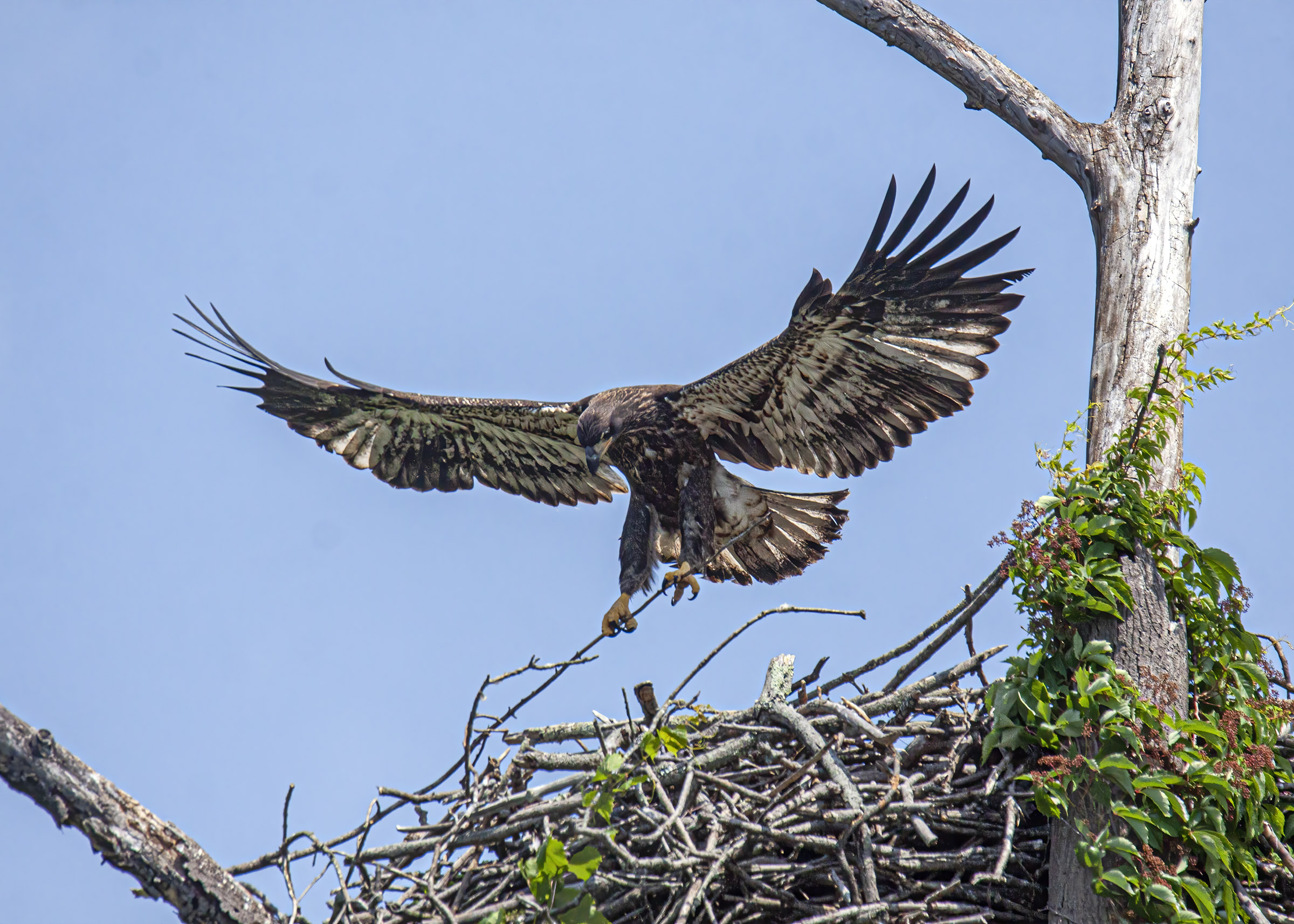
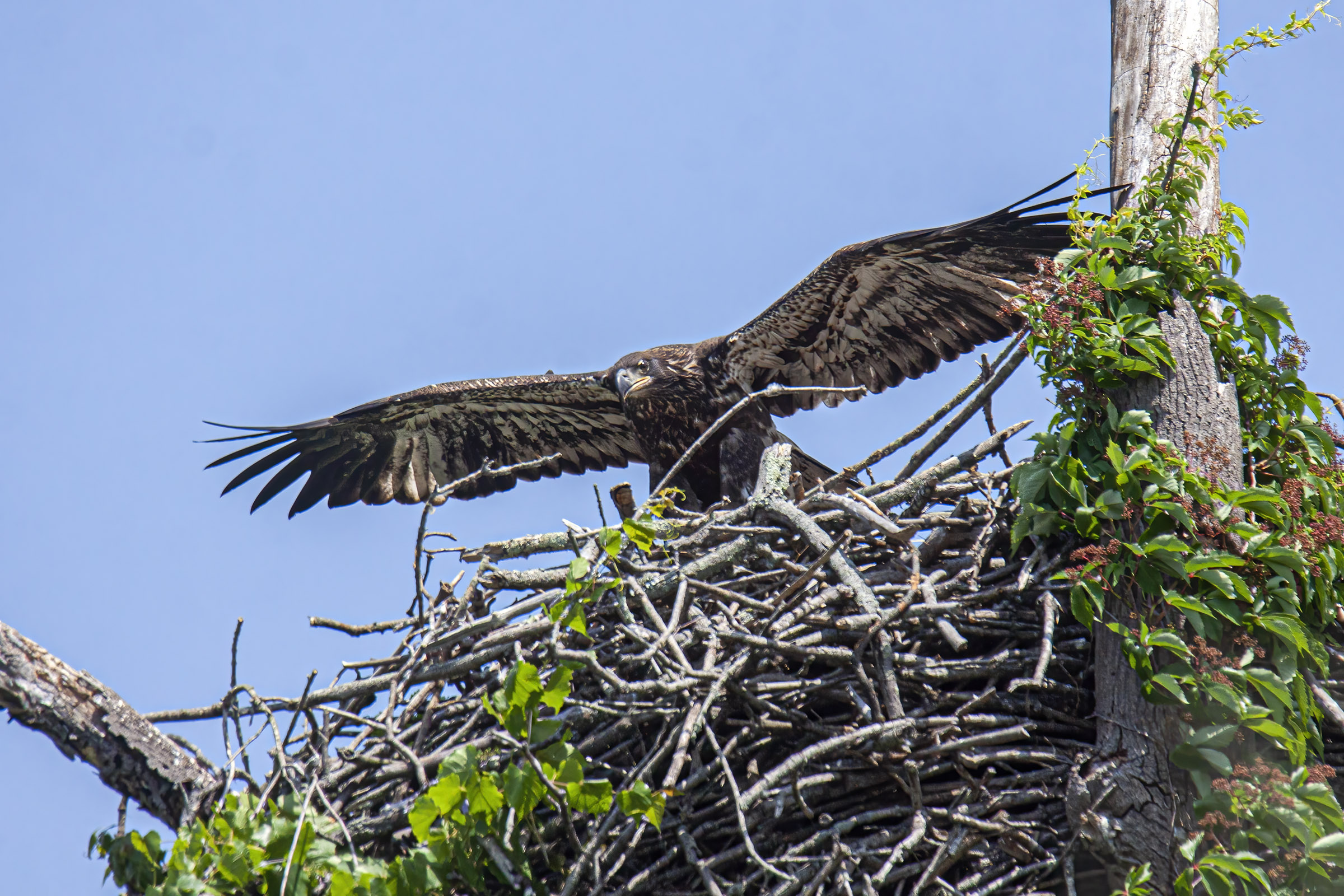
Earlier this month I did a posting called  Looking out of the nest that featured a young Bald Eagle (Haliaeetus leucocephalus) sitting up in a large nest at Occoquan Bay National Wildlife Refuge and wondered when it would be able to fly. Last Friday I returned to the refuge and was delighted to see the eaglet flapping its wings and testing them out—I think it is almost ready to fly..

The eaglet repeatedly extended its wings, but seemed a bit uncoordinated, like a gawky teenager who has experienced a growth spurt. Several times it was able to rise up into the air, but looked uncertain about what to do next. The photos below show some of the action, which lasted only for a few minutes. The eaglet then disappeared into the deep nest, possibly to rest after its exertion.

I watched for a while longer and eventually the eaglet reappeared, but it simply sat up, looking out of the nest. A fellow photographer told me that he spotted the eaglet the following day perched in the tree that you can see in the right side of the image. I suspect, though, that the eaglet will need some quite a bit more practice before it will be capable of venturing out on its own and, of course, it will have to learn how to fish.

I will probably make a trip to the refuge this week to check on the eaglet. So many of the nearby trees are covered with leaves that I may have trouble spotting the eagle, particularly because its dark, and mottled plumage help it to blend in well with the foliage. Adult Bald Eagles tend to stick out a bit more because of the bright white feathers on their heads.

Bald Eagle

Bald Eagle

Bald Eagle

© Michael Q. Powell. All rights reserved.
Read Full Post »

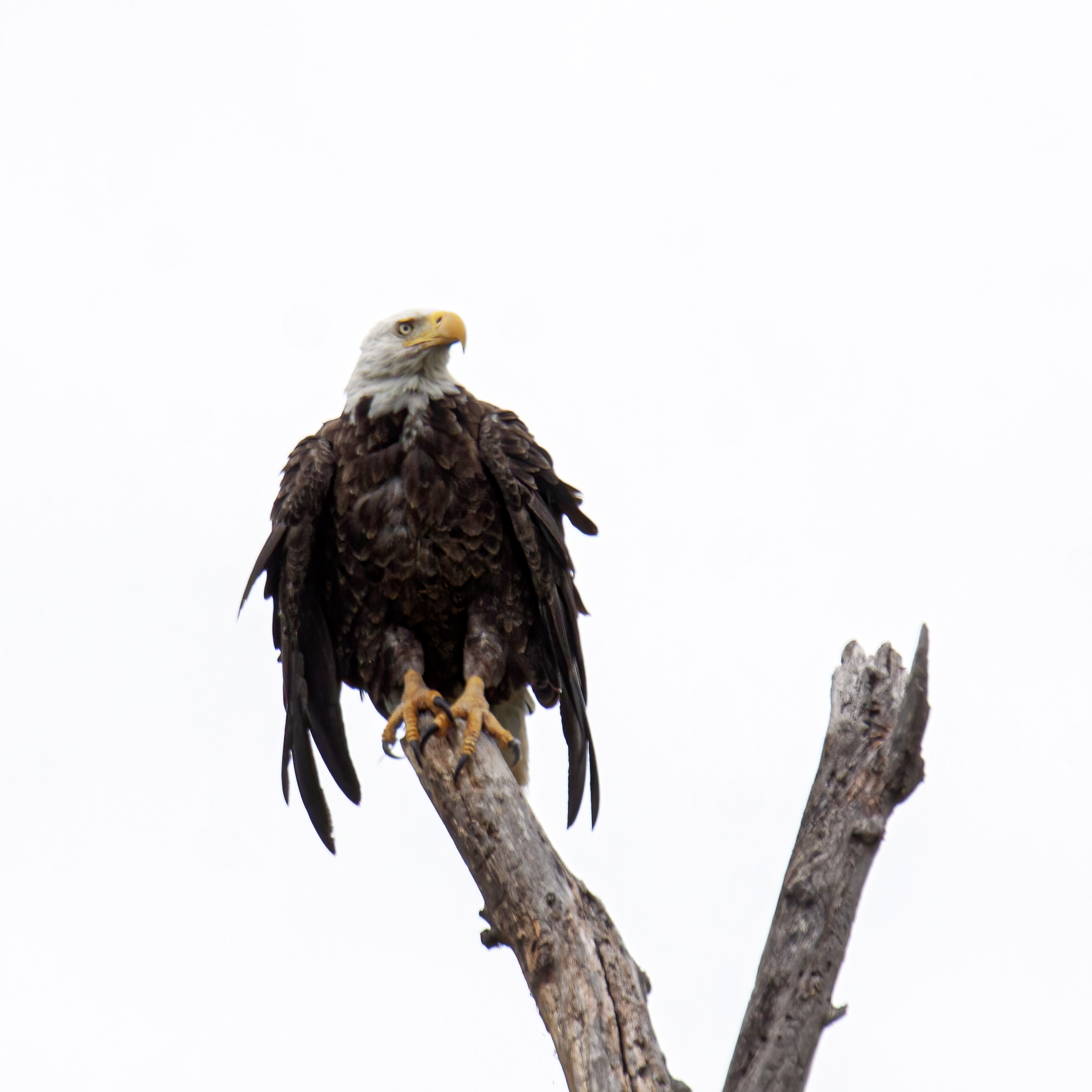
This Bald Eagle (Haliaeetus leucocephalus) looked a bit bedraggled when I spotted it on Tuesday at Occoquan Bay National Wildlife Refuge, where it was perched just above the large eagle nest in which a young eagle was visible. Harried parent? Check out yesterday’s posting “Looking out of the nest” if you missed the photos of the inquisitive juvenile eagle.

The sky was totally overcast on the day when I took these photos and the sky was almost pure white. The resulting effect makes these shots look almost like high key portraits taken in a studio setting, although personally I would have liked a little more directed light to make the photos look less flat. Still, any day is a good day when I get to see a bald eagle.

bald eagle

Bald Eagle

Bald Eagle

© Michael Q. Powell. All rights reserved.

Read Full Post »

It was really cool on Tuesday to be able to capture these images of a young Bald Eagle (Haliaeetus leucocephalus) looking out from the large eagle nest at Occoquan Bay National Wildlife Refuge. The growing eaglet appeared to be quite alert and was sitting up quite high near the edge of the nest. I love how you can see the mottled plumage, dark eyes, and multi-colored beak of this eaglet in these photos.

The nest is high in the trees and there is now a lot of vegetation growing, so it was quite a challenge to get a clear angle of view. I am pretty happy with the results that I was able to achieve. The eaglet looks to be big enough to be flying, but I am not sure if that is the case. One of its parents was perched on some branches just above the nest, so I am pretty sure that it is not yet ready to go out on its own—eagles normally take about 12 weeks to fledge and then may hang around with their parents for another month or two.

Bald Eagle

Bald Eagle

© Michael Q. Powell. All rights reserved.
Read Full Post »

I have seen an Indigo Bunting (Passerina cyanea) only a few times in my life, so I was thrilled last week when I spotted one last week at Occoquan Bay National Wildlife Refuge, my second sighting of this species this year. Once again I was struck by the brilliant blue coloration of its feathers—even from a distance the bird’s amazing blue color really stood out.

As I was doing a little research, I was surprised to learn that Indigo Buntings, along with other buntings and grosbeaks, are part of the Cardinalidae family, which I tend to associate with the bright red Northern Cardinals. When I look at the first photo, though, I must admit that the raised crest on the head of the bunting does remind me a bit of a cardinal.

I did not notice it when I took the first photo, but as I was processing the first image I spotted what appears to be a band on the bird’s right leg—I encourage you to click on the image to get a closer look at that leg. There is a bird banding station at this wildlife refuge and several years ago I visited it and watched the fascinating process of bird banding (see my 2018 posting entitled Visit to a banding station). I recall being amazed at the range of sizes of the bands, which allow for the banding of birds even smaller than the Indigo Bunting, which is about 5 inches (13 cm) in length.

I believe that Indigo Buntings remain with us all summer, so I will be keeping my eyes open for them during future visits. However, I couldn’t help but notice how the trees are now covered with leaves and the vegetation is lush, which makes it really hard for me to see small birds, even when I am able to hear them.

Indigo Bunting

Indigo Bunting

© Michael Q. Powell. All rights reserved.


Read Full Post »

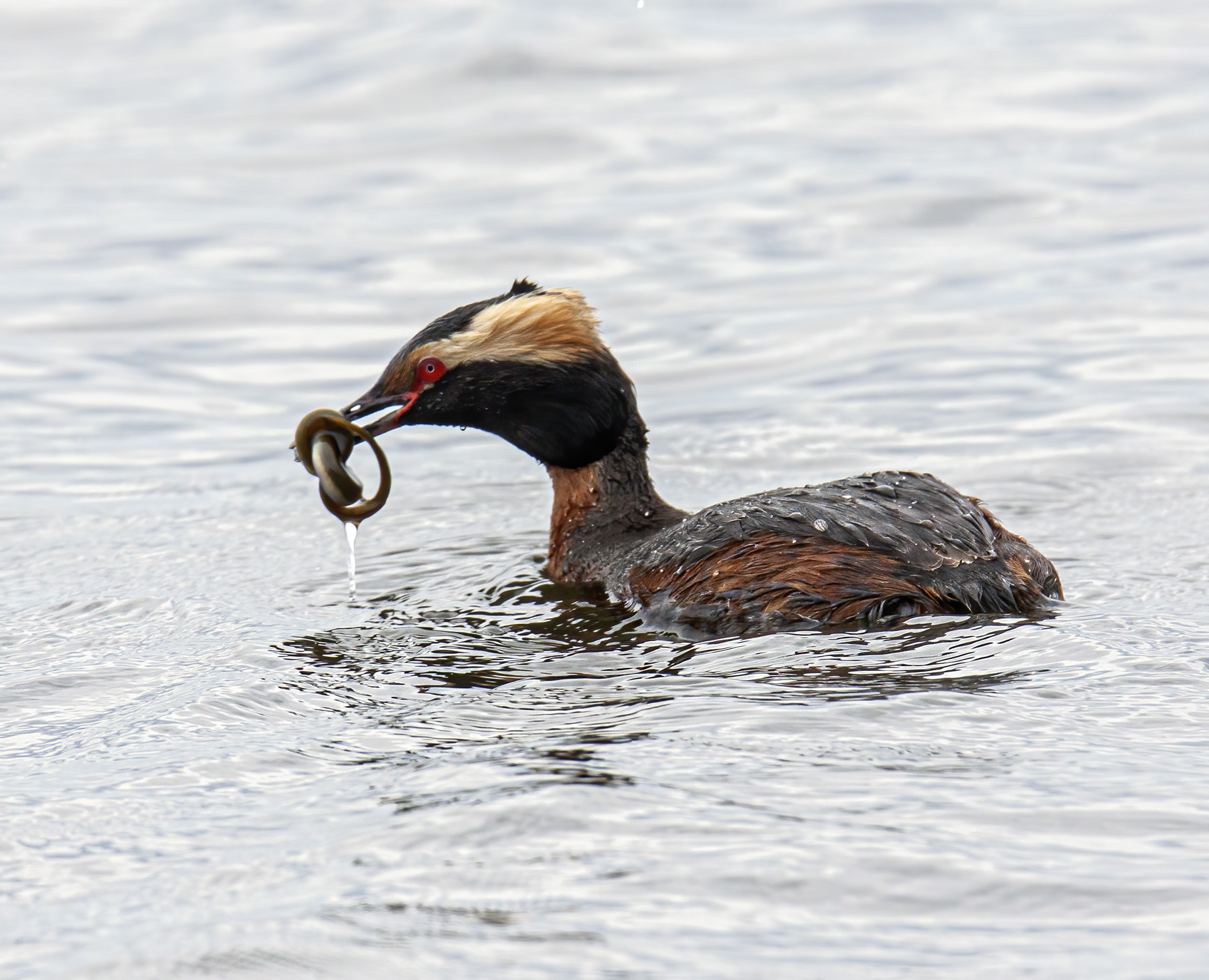
When the Horned Grebe (Podiceps auritus) emerged from the water on Monday at Occoquan Bay National Wildlife Refuge, I initially thought that he had snagged some underwater vegetation. However, it quickly became apparent that the prey was wriggling and squirming and was in fact alive. It looked a bit like a small snake or maybe some kind of marine worm, but several Facebook viewers later informed me that it was probably an American Eel (Anguilla rostrata).

The eel put up quite a struggle, but I believe that the grebe eventually subdued it and swallowed it. Unfortunately the grebe turned his back to me during the process, so I was not able to document the final phases of his efforts with my camera.

Horned Grebe

Horned Grebe

© Michael Q. Powell. All rights reserved.
Read Full Post »

I spotted this Spotted Sandpiper (Actitis macularius) on Monday at Occoquan Bay National Wildlife Refuge. There are a lot of sandpipers that are similar in appearance, so I was not sure what kind it was when I took these shots. As I looked through my bird identification guide, however, I realized that the spots on the bird’s chest and the orange bill made it quite easy to identify, because these traits are distinctive for breeding Spotted Sandpipers.

I was intrigued to learn on the Cornell Lab of Ornithology website that the female Spotted Sandpiper is the one who establishes and defends the territory—she arrives at the breeding grounds earlier than the male, unlike in other species of migratory birds, where the male establishes the territory and arrives earlier. More amazingly, the male of this species takes the primary role in parental care, incubating the eggs and taking care of the young. Wow!

Spotted Sandpiper

Spotted Sandpiper

© Michael Q. Powell. All rights reserved.


Read Full Post »

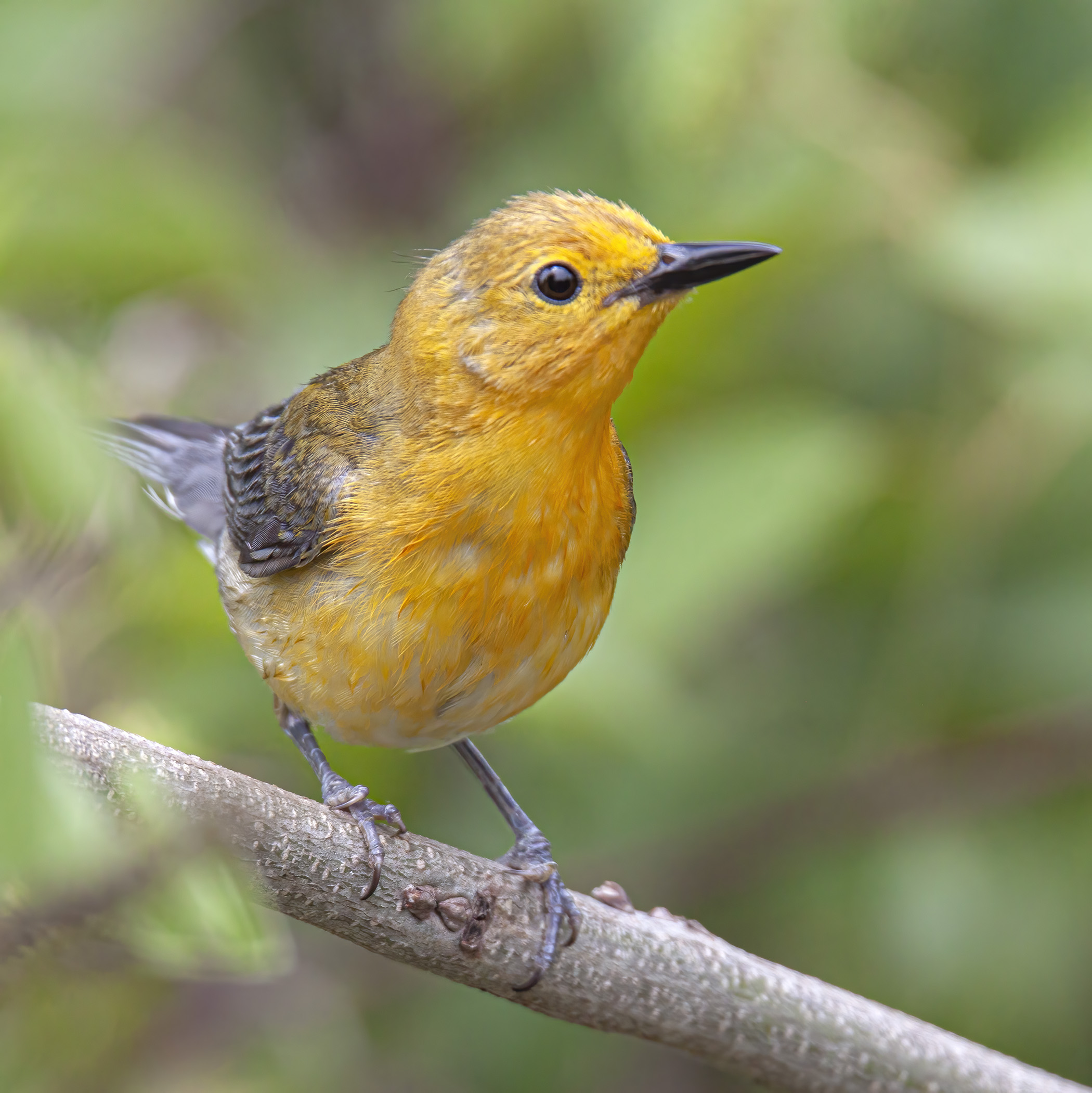
I was tracking the movement of this colorful Prothonotary Warbler on Monday (Protonotaria citrea) at Occoquan Bay National Wildlife Refuge as it hopped about in the dense green foliage, when suddenly it popped into the open and I was able to capture these images.

I absolutely love the bright yellow coloration of this warbler that never fails to put a smile on my face—years ago I used to drive a Toyota Matrix that was Solar Yellow and was visible from a long distance away. It was cool during this encounter that the bird was close enough to me that I managed to capture the reflection of the sky and the landscape in its eye.

Prothonotary Warbler

Prothonotary Warbler

© Michael Q. Powell. All rights reserved.
 

Read Full Post »

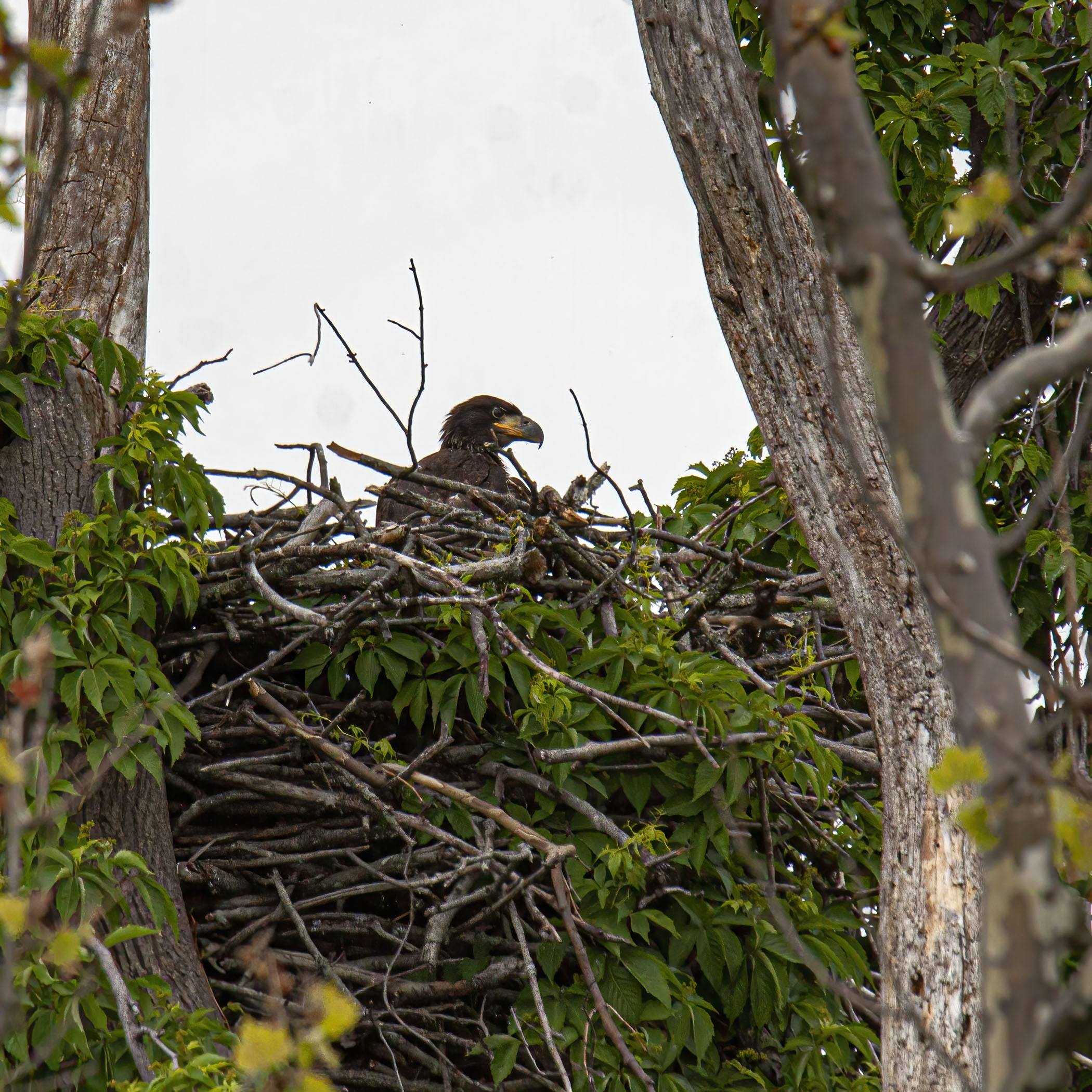
I was excited to spot this juvenile Bald Eagle (Haliaeetus leucocephalus) sitting up in the big nest at Occoquan Bay National Wildlife Refuge on Monday. I assume that this eaglet was born this spring, based on its coloration and markings.

Earlier this spring I had noted eagle activity around this nest and thought that the nesting process had already begun long ago. However, this nest is very large and so high up that it is impossible to tell when the eagles began to sit on the egg or eggs. I checked my blog postings from the past and saw that I posted a shot of eaglets at this same nest on 19 May last year (see the posting Eagle nest update in May), so things seem to be following the same approximate schedule.

I saw only a single eaglet this time, but will continue to monitor the nest for more eaglet activity, including indications that there is more than one eaglet. Earlier on the same day I spotted an adult eagle perched in a tulip tree—you can actually see some of the “tulips”— adjacent to the nest and suspect that this is one of the parents keeping an eye on the eaglet(s). I included a shot below of the presumed proud parent as a final photo.

Bald Eagle

Bald Eagle

© Michael Q. Powell. All rights reserved.


Read Full Post »

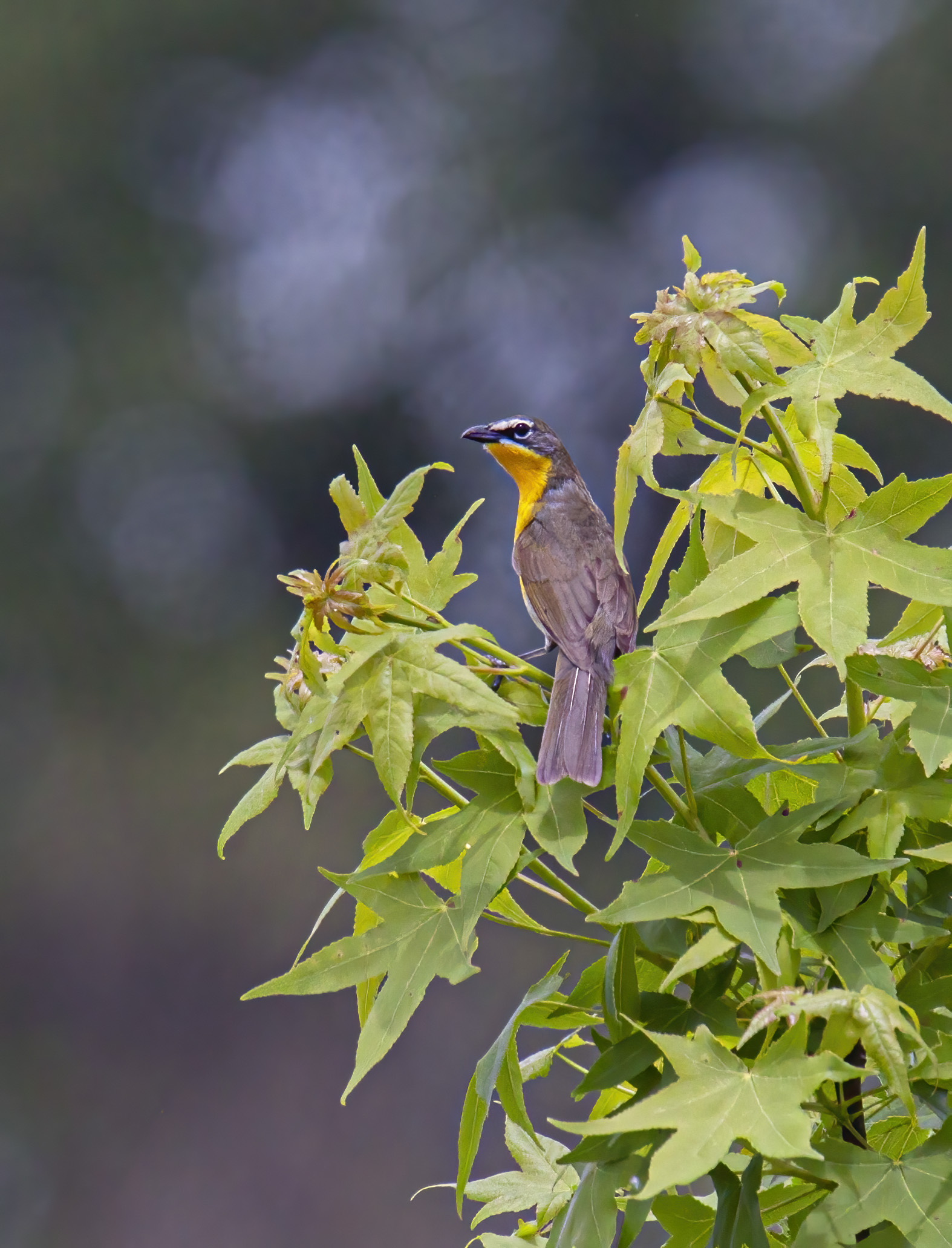
This bird was in the middle of a field on Tuesday at Occoquan Bay National Wildlife Refuge when its movement caught my eye. When it hopped to the top of the vegetation, its brilliant yellow chest made it really hard to miss, even though it was far away. I am pretty sure that it is a Yellow-breasted Chat (Icteria virens), my first sighting ever of this cool bird species.

Many of the migrating warblers that are passing through my area have various yellow markings, so I assumed that this was simply another warbler that I had never seen before. The reality, however, is hardly simple. According to Wikipedia, “The Yellow-breasted Chat (Icteria virens) is a large songbird found in North America, and is the only member of the family Icteriidae. It was once a member of the New World warbler family, but in 2017, the American Ornithological Society moved it to its own family. Its placement is not definitely resolved.”

Compared with most other warblers, the Yellow-breasted Chat seems much larger and bulkier and it has a relatively long tail and a rather robust beak. I love the bright yellow color on its breast and the distinctive eye-markings that make it look like the bird is wearing spectacles.

I think that we are nearing the end of the period of bird migration, but I will definitely keep my eyes open for possible new finds like this gorgeous Yellow-breasted Chat.

Yellow-breasted Chat

yellow-breasted chat

© Michael Q. Powell. All rights reserved.

Read Full Post »

Although I have photographed a Horned Grebe (Podiceps auritus) several times in the past, I had never seen one in colorful breeding plumage until yesterday. According to the range maps on the Cornell Lab of Ornithology website, Horned Grebes do not breed in my area, so this one, who was swimming by himself, may just be passing through as he migrates northward.

The colors and patterns on this bird are amazing. The gold circles in the grebe’s red eyes really grab a viewer’s attention, though I must admit that I find them to be a little bit creepy—it is definitely worthwhile to click on the photos to get a closer look at those eyes. The bird’s distinctive “horns” appear to be tufts of long golden feathers behind each eye in a pattern that is reminiscent of the haircut of a medieval monk, particularly in the middle photo. My favorite photo may well be the final one that captures some of the grebe’s spunky personality.

Like most other grebes, Horned Grebes have compact bodies, relatively short necks, blocky heads and straight, narrow bill that is very different from a duck’s bill. I observed the grebe as it repeatedly made short dives in search of food yesterday in the waters off of Occoquan Bay National Wildlife Refuge. According to the Cornell Lab of Ornithology, during the breeding period Horned Grebes also feed heavily on insects and larvae, some caught in the air, others in or on the water.

Horned Grebe

Horned Grebe

Horned Grebe

© Michael Q. Powell. All rights reserved.

Read Full Post »

I kept hearing loud singing coming from the top of the trees on Monday at Occoquan Bay National Wildlife Refuge, but had trouble locating the source of the singing. Leaves are now covering the trees, complicating my efforts to spot small songbirds. Eventually I managed to locate the birds and they turned out to be Indigo Buntings (Passerina cyanea).

Once again I was amazed by the deep blue coloration of the male Indigo Buntings—its intensity never fails to startle me. The bold color of the Indigo Buntings, sometimes nicknamed “blue canaries,” was matched by the cheerfulness of their songs. According to the Cornell Lab of Ornithology, “Male Indigo Buntings whistle a bright, lively song of sharp, clear, high-pitched notes that lasts about 2 seconds. They are voluble, singing as many as 200 songs per hour at dawn and keeping up a pace of about one per minute for the rest of the day.” Check out this link to hear samples of some of the songs of Indigo Buntings.

I was amazed to discover about how Indigo Buntings learn to sing. According the Cornell Lab of Ornithology, “Indigo Buntings learn their songs as youngsters, from nearby males but not from their fathers. Buntings a few hundred yards apart generally sing different songs, while those in the same “song neighborhood” share nearly identical songs. A local song may persist up to 20 years, gradually changing as new singers add novel variations.” Wow!

I believe that Indigo Buntings will be with us all summer and I hope to get some shots at closer range. I have fond memories of the first time I photographed a male Indigo Bunting in August 2017 as he perched on the drooping head of a sunflower—check out the posting entitled Indigo Bunting and Monarch.

Indigo Bunting

Indigo Bunting

Indigo Bunting

© Michael Q. Powell. All rights reserved.

Read Full Post »

On Monday I spotted my first Green Heron (Butorides virescens) of the season at Occoquan Bay National Wildlife Refuge. Unlike Great Blue Herons that remain with us all winter, Green Herons migrate to warmer places in the fall and return to our area in the spring and spend the summers with us.

When I first spotted the heron, it was perched in a tree, as shown in the final photo. I passed by the heron, stopped a short distance away, and waited. Eventually the heron grew comfortable with my presence (or chose to ignore me) and hopped down out of the tree. Recent heavy rains had caused a pond to overflow onto a road and I was happy to be able to get some shots as the heron poked about in the shallow waters at the edge of the road.

I crouched as low as I could and waited for the heron to move into one of the patches of light. The little moved slowly and deliberately, gradually Green moving into the dense undergrowth where I had trouble tracking it. It was a cool encounter with one of my favorite birds—in my experience Green Herons show a lot of personality than other herons.

Green Herons are also one of the world’s few tool-using bird species. According to the Cornell Lab of Ornithology, Green Herons “often create fishing lures with bread crusts, insects, and feathers, dropping them on the surface of the water to entice small fish.” I have not yet seen this kind of behavior, but try to be particularly alert whenever I spot a Green Heron. It would be easier for me to recognize the behavior if the Green Heron used something more distinctive, like a little fishing pole.

Green Heron

Green Heron

Green Heron

© Michael Q. Powell. All rights reserved.

Read Full Post »

A speedy little Barn Swallow (Hirundo rustica) was perched on a paved path at Meadowlark Botanical Gardens last Saturday and I captured this first image as it was taking off. The shot is a little blurry, but I love the the really cool shadow that the swallow was casting onto the ground. The second image shows the same swallow just before it took off and give you a better view of the coloration and markings of a Barn Swallow.

When I first spotted the birds in the final photo, I thought they might also be Barn Swallows, but when I took a closer look and did a little research, I determined that the bird on the outside of the nest was a male Purple Martin (Progne subis) and the one with her head poking out was a female Purple Martin. As far as I can recall, this is the first time that I have photographed this bird species, which is the largest swallow in our area.

Barn Swallow

Barn Swallow

Purple Martin

© Michael Q. Powell. All rights reserved.


Read Full Post »

Most warblers forage in the forest canopy and I have to strain my neck to search for them. Palm Warblers (Setophaga palmarum), however, mainly forage on open ground or in low vegetation.  When I saw a flash of yellow in some low bushes last week at Occoquan Bay National Wildlife Refuge, I therefore suspected that it might be a Palm Warbler.

I watched and waited and eventually the bird hopped up onto a branch and I managed to get a clear shot of it. I wasn’t one hundred percent sure that it was a Palm Warbler, but the color and markings looked about right and I could see the rust-colored cap on its head, another identification feature for a Pine Warbler. Some experts in a Facebook forum confirmed that “my” bird is indeed  a Palm Warbler.

The warblers are with us for only a limited period of time in the spring before they continue their migration northward, so I don’t know how many more times I will have a chance to photograph them. At this time of the year, though, colorful flowers are popping up and insects are reappearing, so I won’t suffer from a lack of subjects when the wablers depart.

Palm Warbler

© Michael Q. Powell. All rights reserved.
Read Full Post »

I spotted this colorful Prairie Warbler (Setophaga discolor) as it was singing high in a tree on Thursday at Occoquan Bay National Wildlife Refuge. Most of the time I spot birds like this when they fly to a new perch, but this warbler stubbornly refused to move. I stared and stared at the tree, desperately trying to locate the source of the song that the bird was singing over and over again.

I finally located the warbler in the crook of a branch. I was looking upward at such an acute angle that I mostly got a view of the underside of the bird, but eventually I captured the first image in which the warbler was singing. Prairie Warblers have an unusual rising song that the Cornell Lab of Ornithology described in these words, “The Prairie Warbler sings a distinctive, rising and accelerating song with a buzzy quality, zee-zee-zee-zee-zee-zeeeee.” If you click on this link, you can listen to several sound samples of the songs of the Prairie Warbler.

I do not know how much longer the migratory warblers will be in my area, but I hope to have another chance to see some of these joyous little birds. I am still not confident in my identification skills for warblers, so there is a chance that I am wrong about this being a Prairie Warbler, but its beauty is undeniable.

Prairie Warbler

Prairie Warbler

Prairie Warbler

© Michael Q. Powell. All rights reserved.

Read Full Post »

I could hear a bird singing in a tree on Wednesday at Occoquan Bay National Wildlife Refuge, but I had trouble finding it. Eventually I spotted some movement and was able to track the bird, but it remained mostly hidden. I saw some flashes of yellow and assumed that it was some sort of warbler. I finally managed to get decent shot of it and was anxious to check out my birding guide to see what it was.

When I looked through the warbler section of the book, none of the images seemed to match “my bird.” What else could it be? Suddenly I remembered that a couple of other local photographers had mentioned seeing vireo at this refuge. Could this be a vireo?

The overall coloration and the stunning eye convinced me that this is almost certainly a White-eyed Vireo (Vireo griseus), a new species for me. This is definitely one of the coolest looking birds that I have seen in a long time. I love the wash of pale yellow on its breast and the darker yellow around its bill. If you click on the image and look carefully at the bill, you will see that it is slightly hooked, which is not the case with warblers.

I went to the Cornell Lab of Ornithology website to learn a bit more about the behavior of this species—”White-eyed Vireos hop among branches and make short flights between shrubs, making sure to stay well hidden in the process. Males sing from the edges of understory vegetation all day long, even during the heat of the day.” I still have trouble geolocating a bird on the basis of sound, but can use all the help I can get.

I am currently alternating between looking for birds and looking for dragonflies. At this time of the year, they are found in vastly different habitats, so I have to make a decision when I set out in my car. I am absolutely thrilled that I have already had some success with both birds and dragonflies this spring and look forward to new discoveries.

White-eyed Vireo

© Michael Q. Powell. All rights reserved.

Read Full Post »

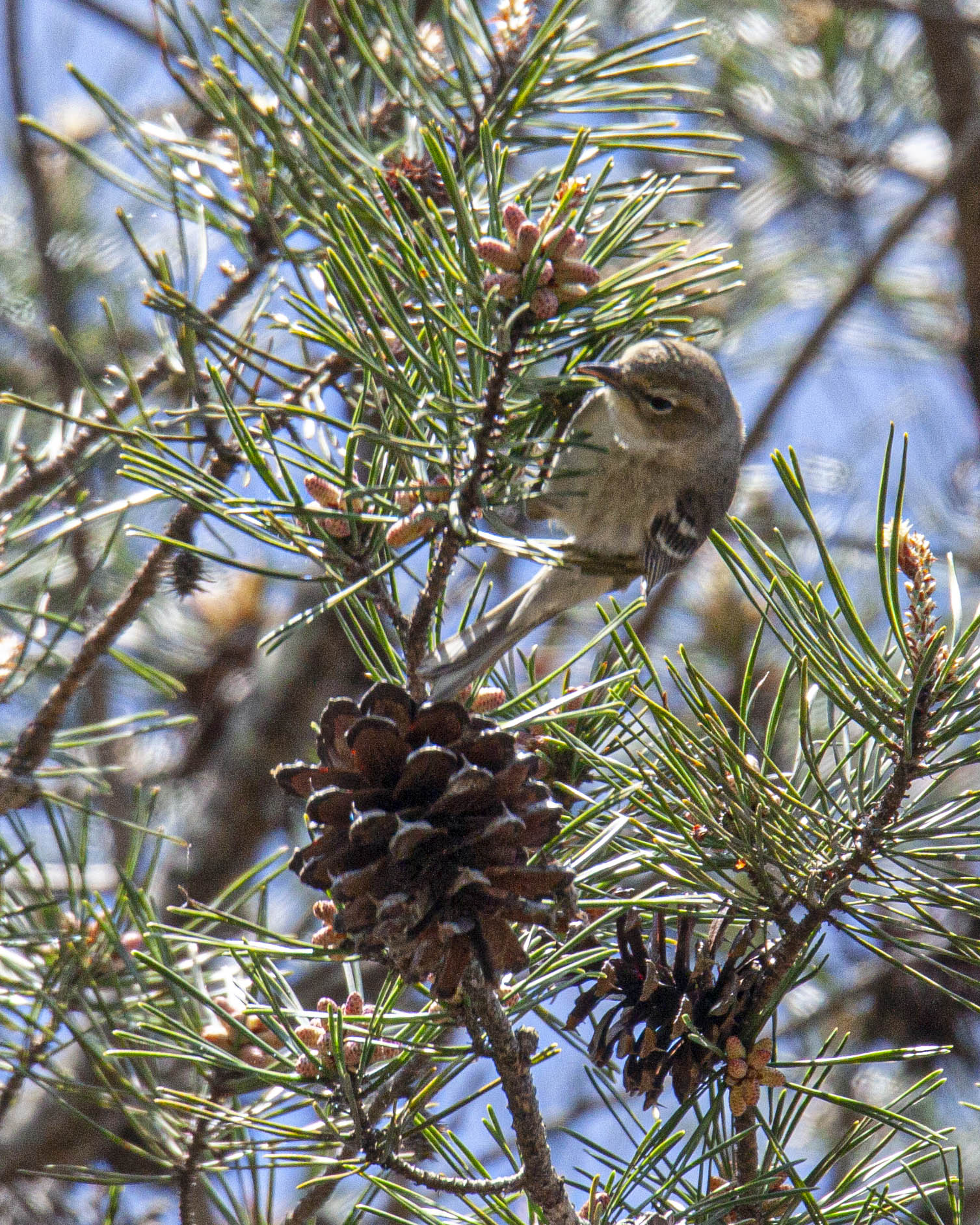
Yesterday I featured a warbler that was so brightly colored that it was impossible to miss. Today’s warbler is the complete opposite—it was so nondescript and so well hidden that it was almost impossible to see and initially I could not even identify it from my photos.

My eyes detected some motion high in a pine tree on Wednesday at Occoquan Bay National Wildlife Refuge and I stopped. I had set my long lens on a monopod, so my arms did not get tired as I strained to make out the bird that was moving about among the pine needles and the pine cones, though my neck quickly became sore. It looked like the bird was feeding on little seeds, so it would stop momentarily from time to time, giving me a change to find it in my viewfinder and acquire focus.

None of my shots was spectacular, but I was able to capture enough details of the bird’s body that some experts in a Facebook birding group identified it as a Pine Warbler (Setophaga pinus). Not only were they able to identify the species of the bird, they determined that it was a first year female on the basis of its markings and coloration. I am always amazed when confronted with that level of expertise.

Pine Warbler

Pine Warbler

Pine Warbler

© Michael Q. Powell. All rights reserved.
Read Full Post »

Yesterday I set aside my macro lens and put my telephoto zoom lens back on my camera.  Over the past week, I have seen some amazing photos by local photographers of a variety of colorful warblers that migrate through our area in the spring and the fall and I felt compelled to try to photograph them. I must confess, though, that I have never had much success photographing warblers. I can often hear these little birds, but have trouble locating them in the tops of the trees—they seem to be teasing me as they flit about and sing their songs.

I walked around a lot and eventually had several encounters with Prothonotary Warblers (Protonotaria citrea) at Occoquan Bay National Wildlife Refuge. Some warblers have markings and colors that allow them to be camouflaged in the foliage, but the plumage of a Prothonotary Warbler is such a bright yellow that it is impossible for one to hide.

These warblers never seem to sit still for very long and they move quickly from branch to branch. I was happy that I was able to track them reasonably well, considering that I had my zoom lens extended to its maximum length. It takes some practice to be able to see something with your eye and then be able to point the lens in the proper direction.

I exceeded my expectations in getting these shots and also managed to photograph several other bird species that I will probably be featuring in future postings. Today I will probably switch back to my macro lens and focus again on insects. The transitional seasons definitely keep me busy as I try to keep an eye on close-in subjects and those that are farther away.

Prothonotary Warbler

Prothonotary Warbler

Prothonotary Warbler

© Michael Q. Powell. All rights reserved.

Read Full Post »

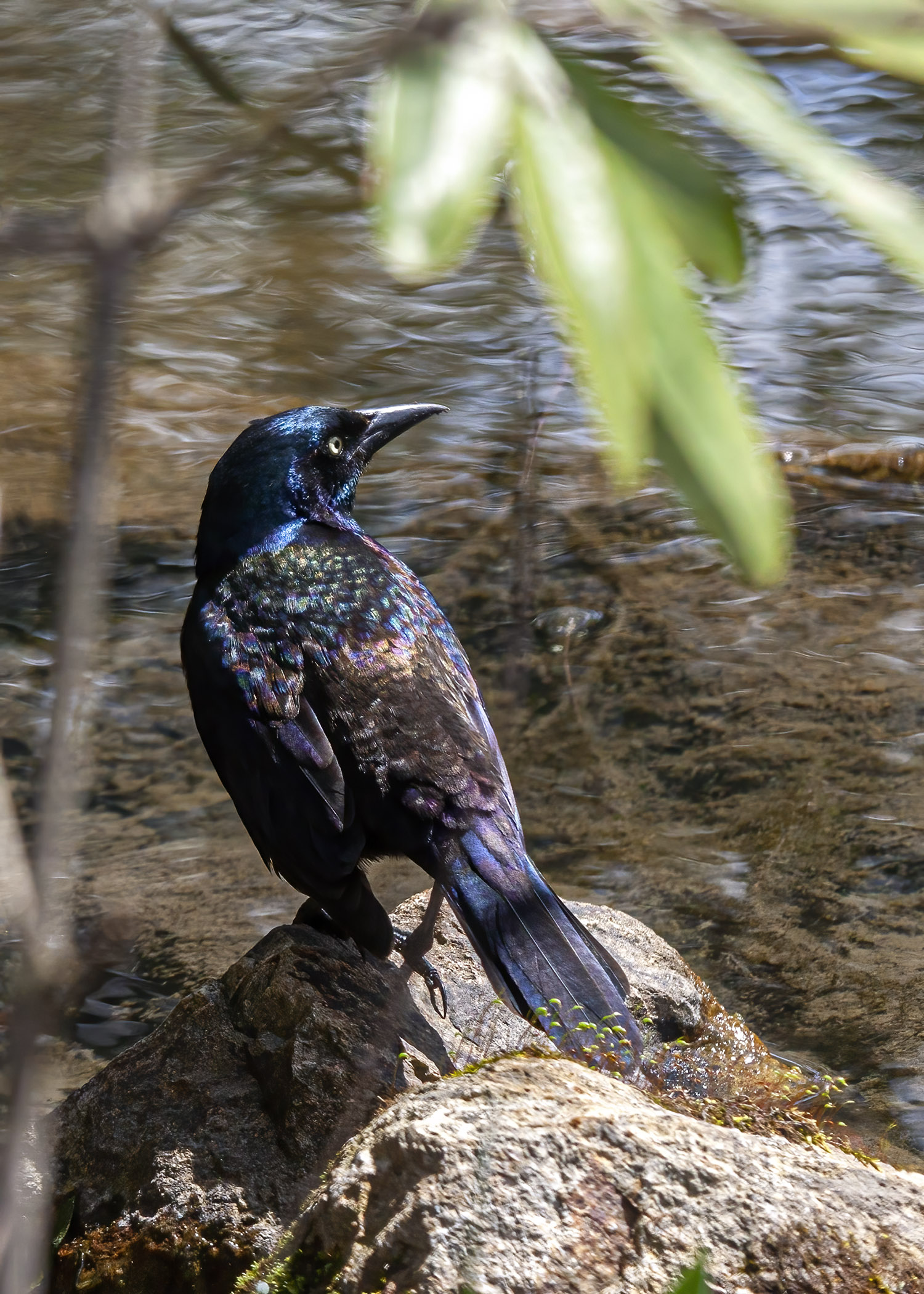
From a distance Common Grackles (Quiscalus quiscula) often appear to be black, but often you can spot their distinctive yellow eyes. When you get closer, especially when the lighting is good, you discover that the grackles are covered with an array of multi-colored iridescent feathers.

On Friday I spotted this grackle while I was exploring Lewis Ginter Botanical Garden in Richmond, Virginia with fellow photographer Cindy Dyer. The grackle was poking around at the edge of the water of a small pond and moving about a lot. I had to maneuver around to get a clear shot of the bird, which was a bit of challenge, because overhanging vegetation partially obstructed my view.

Eventually I was able to capture this image. I had my macro lens on my camera at the time, but fortunately its focal length of 180mm means that it also works as a short telephoto lens. I often tell people that it is best to take a photo with whatever camera gear you have in your hand when a situation arises, even if it does not appear to be the ideal option. If I had stopped to change lenses—I had a longer lens in my backpack—I am pretty sure I would missed this fun little shot of the grackle.

Grackle

© Michael Q. Powell. All rights reserved.
Read Full Post »

Ospreys (Pandion haliaetus) were really vocal and active last week at Occoquan Bay National Wildlife Refuge.  Most often, though, the ospreys were flying out of range of my lenses, so getting shots of them was a bit of a challenge.

Eventually I manage to get a shot of some  perched ospreys. In the first and third photos, the osprey appeared to have a fish that it kept hidden from me. Perhaps it had had a recent experience with an eagle trying to steal its catch and consequently was hyper-possessive now. I think that attitude also explains why the bird was in a defensive, crouched position and would look around before taking a bite of the unseen fish.

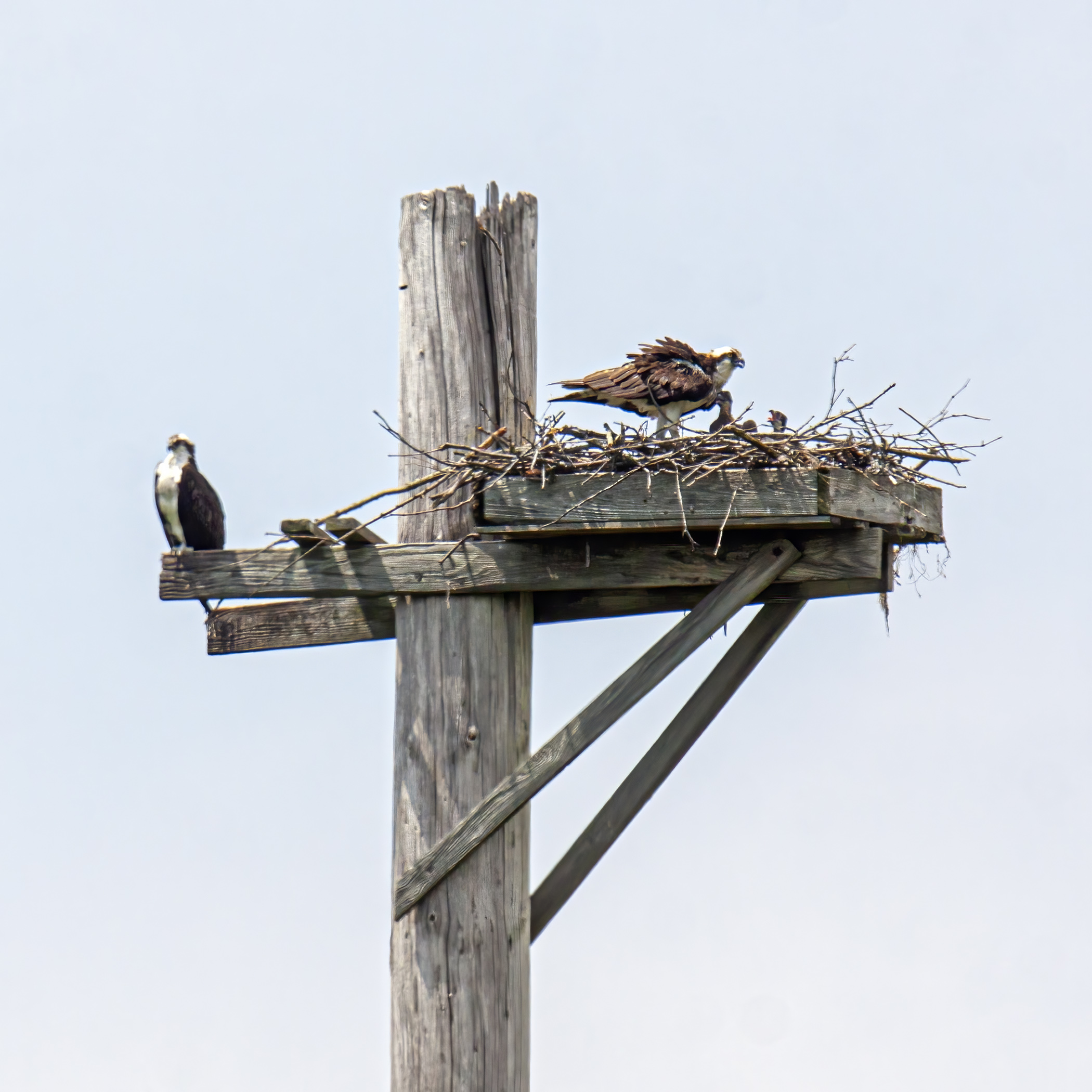
The middle photo shows an osprey on a nest that is being constructed on a channel marker in the waters off of the wildlife refuge. In the past,I have photographed much larger nests on this same buoy—check out my blog posting entitle Defying gravity from last year to see a photo of a previous iteration of a nest at this spot.

In the last few days some local photographers have posted photos of warblers at this wildlife refuge, so I will be looking for small birds as well as the larger, more visible ones like these ospreys. Insect activity is beginning to pick up too, so it looks like April will be a busy time for me and my camera.

osprey

Osprey

osprey

© Michael Q. Powell. All rights reserved.


Read Full Post »

I love seeing the differences between juvenile and adult Bald Eagles—the coloration and markings of the eagles change dramatically over time. Earlier this week I did a posting called Two eagles that showed two juvenile eagles perched in a tree. One of them was quite young and the other was almost an adult. It was really easy to see the differences between the two stages of development, with only the older one showing the distinctive white head feathers.

Today I am featuring in-flight photos of two eagles that I spotted last Monday while exploring Occoquan Bay National Wildlife Refuge. The first photo shows a juvenile Bald Eagle that looks to be about two to three years old. The head appears to be dark and the there is a mottled mixture of white and brown feathers. The second image shows a mature Bald Eagle with a white head and uniformly dark feathers.

It is an awesome experience for me when eagles fly almost directly over me and I love trying to get shots of them. I never fail to be impressed by their amazing wingspans, which can reach more than seven feet (213 cm).

Bald Eagle

Bald Eagle

© Michael Q. Powell. All rights reserved.

Read Full Post »

Most of the times when I photograph an Osprey (Pandion haliaetus), the bird appears to be long and lanky. The angle at which I photographed this osprey, however, distorted its proportions, making it seem more short and squat than normal. The spherical head and the osprey’s exaggerated expression of curiosity and surprise help to make this image feel comical and cartoonish—I can’t help but smile every time that I look at the photo.

There are quite a few ospreys now at Occoquan Bay National Wildlife Refuge and quite soon they will be working on their nests. I hope to be able to capture some shots of that activity. Now that we have moved into April, I will start to switch some of my focus to searching for dragonflies. With a bit of luck, I will see my first dragonflies of the year with a week or two.

Osprey

© Michael Q. Powell. All rights reserved.
Read Full Post »

When it comes to aerial skills, Tree Swallows (Tachycineta bicolor) are some of the most agile fliers that I have ever observed. On Monday I watched in awe and amazement as a small group of tree swallows swooped and zoomed over the waters off of Occoquan Bay National Wildlife Refuge. The flight of these tiny birds was graceful and mesmerizing, full of acrobatic twists and turns.

It was a real challenge, though, to take photos of birds that are so small and so fast. I was especially happy when I managed to capture the first image that shows a pair of swallows with their wings fully extended. The second shot shows a swallow gliding low over the water—the shape of the bird reminds me of a stealth aircraft skimming low over the earth to avoid being detected by radar.

I did not realize that Tree Swallows had returned to our area. There are several nesting boxes at this wildlife refuge that Tree Swallows regularly use, so I will have to check them out soon.  Sometimes there is a competition between Tree Swallows and Eastern Bluebirds for the nesting boxes. I am not sure how they decide who will get to use the boxes, but somehow they figure it out. Tree Swallows

tree swallow

© Michael Q. Powell. All rights reserved.


Read Full Post »

I was excited to spot quite a few Bald Eagles (Haliaeetus leucocephalus) on Monday at Occoquan Bay National Wildlife Refuge. It was especially cool because the eagles that I observed were at different stages of development. Bald Eagles are mostly brown in color when they are born and it takes almost five years for them to mature and develop the white feathers on their head that we associate with Bald Eagles.

The eagle on the left in both of the photos is a really young one. I initially thought it might be a fledging that was born this year, but it seems too early for one to have already reached this stage of development. Perhaps this eagle is a year old, judging from its coloration and markings.

I thought that the other eagle was the same one in both photos, but the markings in the first photo show some dark feather on the head and some mottled coloration on the body that seems to me missing on the adult bald eagle in the second photo. I would guess that the “other” eagle in the first photo is about four years old.


Bald Eagles

Bald Eagles

© Michael Q. Powell. All rights reserved.

Read Full Post »

I don’t see Ring-necked Ducks (Aythya collaris) very often, so I was happy to spot this little group of them last week at Occoquan Bay National Wildlife Refuge. Although this looks like a ménage à trois situation with a male duck in the middle of two females, there actually was another male who was out of the frame when I took this photo. Ring-necked Ducks are a migratory species that overwinters with us and I suspect that these ducks will soon be leaving our area for more northern locations.

Ring-necked Duck

© Michael Q. Powell. All rights reserved.

Read Full Post »

Sometimes I feel compelled to throw back my head and sing at the top of my lungs, as this Bald Eagle (Haliaeetus leucocephalus) was doing when I spotted it last week at Occoquan Bay National Wildlife Refuge. It might be somewhat of an exaggeration to call it “singing”—the eagle was calling out to its mate, I believe, in a somewhat unmelodious way, but it was a cool experience nonetheless.

The Cornell Lab of Ornithology had the following description of a bald eagle’s calls, “For such a powerful bird, the Bald Eagle emits surprisingly weak-sounding calls—usually a series of high-pitched whistling or piping notes.” Check out this link to a Cornell Lab webpage that has several sound samples of an eagle’s call. According to a National Public Radio report, Hollywood movies often dub over an eagle’s call with a Red-tailed Hawk’s cry, which is much more majestic, so you may be surprised to hear what a bald eagle actually sounds like.

bald eagle

bald eagle

bald eagle

© Michael Q. Powell. All rights reserved.

Read Full Post »

There was a lot of activity on Tuesday at the large Bald Eagle (Haliaeetus leucocephalus) nest at Occoquan Bay National Wildlife Refuge. I still cannot determine if any eaglets have hatched, but several times I observed an eagle fly into the nest or fly out of it. The nest is so deep that an eagle is often hidden from view when sitting on an egg—the only way to know for sure that an eagle is present is when one of them arrives or departs.

The eagle in the first photo was arriving and had spread its wings to slow down its speed and forward momentum. In the second photo, an eagle that was in nest had popped its head up and was looking towards a nearby tree where its mate was perched. After the eagle had reassured itself that everything was ready, the two eagles executed a changing of the guard ceremony—the eagle in the nest flew away and the perched eagle took its place. I captured the third image just as the eagle was taking off from its perch to take its turn watching over the nest.

Bald Eagle

Bald Eagle

bald eagle


© Michael Q. Powell. All rights reserved.

Read Full Post »

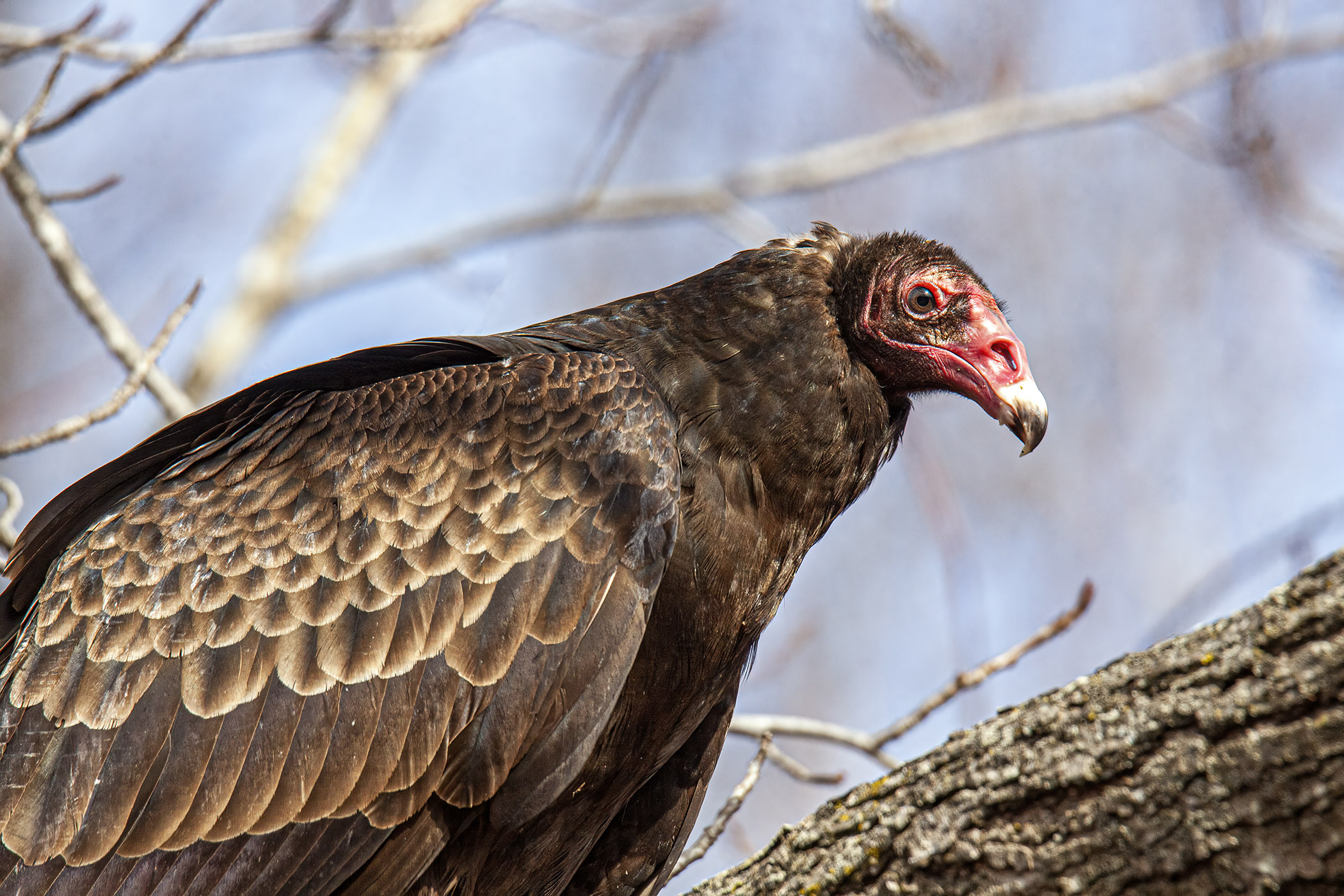
I would not necessarily call this Turkey Vulture (Cathartes aura) handsome, but I am happy with the way that I was able to capture a bit of the bird’s personality in this close-up portrait shot. I spotted this vulture last week as it perched low in a tree just off the edge of a trail that I was following at Occoquan Bay National Wildlife Refuge.

Some people are freaked out by the fact that vultures eat carrion, but most people acknowledge that these scavengers play a valuable role in our ecosystems. I am ok with a turkey vulture’s dietary choices, though I would probably refuse to join a turkey vulture in a meal if one of them made such an offer.

Turkey Vulture

© Michael Q. Powell. All rights reserved.

Read Full Post »

Some of the Ospreys (Pandion haliaetus) that I spotted last week at Occoquan Bay National Wildlife Refuge seemed to be making early claims on the existing nests from last year, while others were simply perched on trees throughout the refuge. Mostly they kept their distance, though, so I had to be content with relatively distant shots of these recently returned raptors.

osprey

Osprey

© Michael Q. Powell. All rights reserved.

Read Full Post »

Quite a few ospreys (Pandion haliaetus) have returned to Occoquan Bay National Wildlife Refuge and I spent a lot of time last Thursday trying to photograph them. Most of my efforts were focused on trying to capture images of them in flight.

Ospreys will fly in circles over the water and occasionally will hover and glide a little as they search for prey, which makes it somewhat easier to focus on them than on many other birds. However, it’s still a pretty formidable challenge to get shots in which the eyes are visible and in focus and in which the wing positions are good.

For the first image, I did not react quickly enough to zoom out when the osprey flew overhead, so I clipped its wings in the photo. I think that it is nonetheless a cool shot that provides a good look at the feather details of the osprey and at its eye and beak.

In the second shot, I captured the osprey at a moment when it had its wings fully extended. I like the way that the osprey’s yellow eye really stands out in the image.

I am sure that I will get lots of chances to photograph ospreys in the upcoming months, but it is always exciting me to them again for the first time each year—another sign that the seasons are changing.

osprey

osprey

© Michael Q. Powell. All rights reserved.

Read Full Post »

A juvenile Bald Eagle (Haliaeetus leucocephalus) tried to steal a fish from an Osprey (Pandion haliaetus) on Thursday at Occoquan Bay National Wildlife Refuge and chased it across the sky. It was quite an aerial dogfight. In the end, I think that the osprey dropped the fish and both birds ended up “empty-handed.”

Ospreys migrate away from my area for the winter and I was delighted to see that they had returned. I spotted at least a half-dozen or more ospreys and they were both active and vocal. Ospreys have high-pitched, distinctive voices that the Cornell Lab of Ornithology described in these words, ” Their calls can be given as a slow succession of chirps during flight or as an alarm call—or strung together into a series that rises in intensity and then falls away, similar to the sound of a whistling kettle taken rapidly off a stove.” Here is a link to a Cornell Lab webpage where you can listen to recordings of various osprey calls.

These three photos give you a general sense of the chase. In the first shot, you can definitely see the “prize,” the fish that the osprey had caught. In the second shot, the eagle has closed the distance separating it from the osprey. In the third shot, the osprey is doing its best to maneuver away from the eagle, but the eagle was able to match the osprey turn by turn. All of this took place over the water and eventually the two birds flew out of range.

eagle osprey chase

eagle osprey chase

eagle osprey chase

© Michael Q. Powell. All rights reserved.

Read Full Post »

« Newer Posts - Older Posts »