Feeds:
Posts
Comments

Archive for the ‘Autumn’ Category

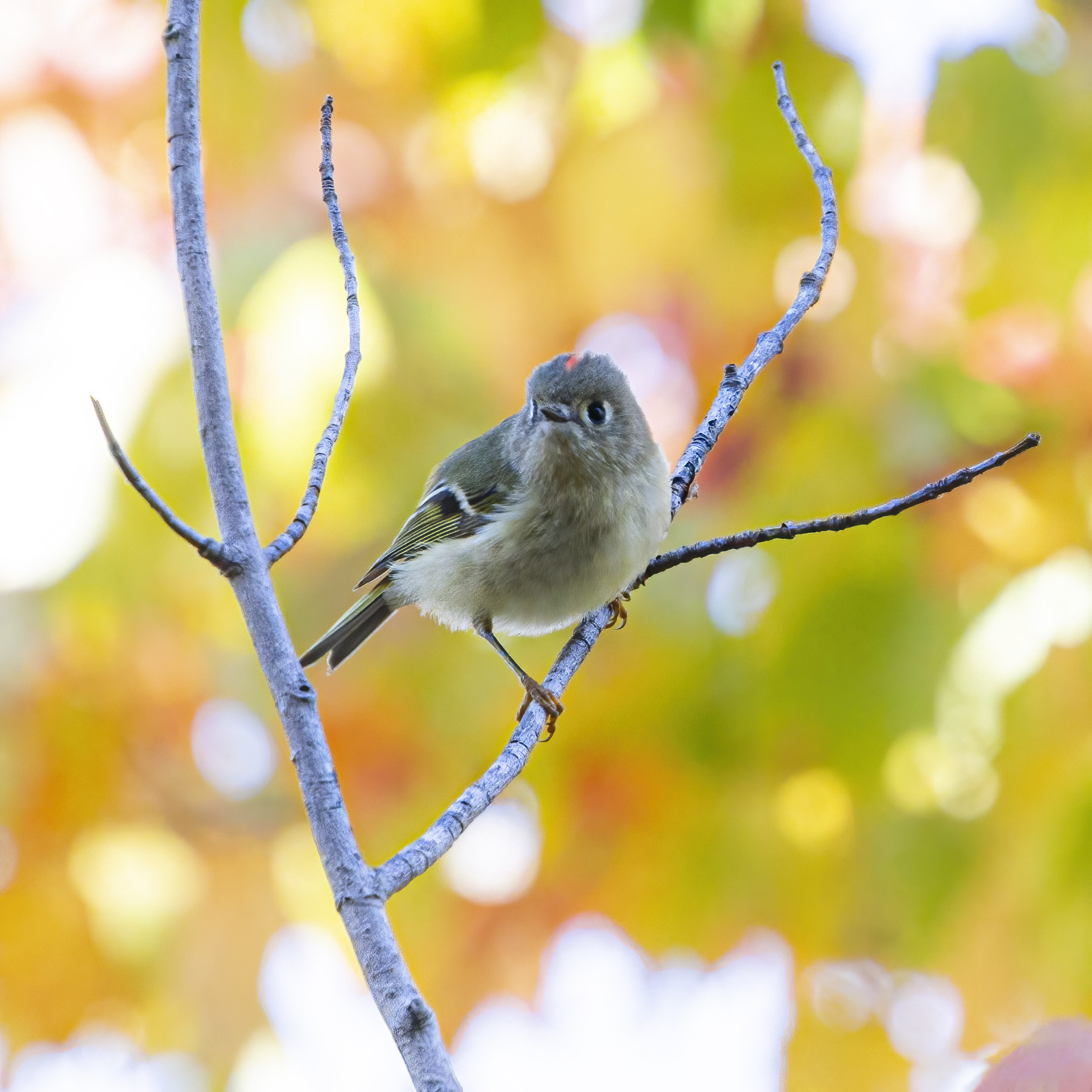
This tiny Ruby-crowned Kinglet (Corthylio calendula) glared down at me as I photographed it on Wednesday in a tree overhanging a stormwater retention pond in Kingstowne, a suburban community only a mile or so from where I live. The autumn foliage surrounding the pond had several patches of  impressively colorful leaves and I was delighted to be able capture some of the beautiful autumn color in the background of these two images.

In the first photo, you can see a portion of the kinglet’s “ruby crown,” a feature of the males that is often hidden from sight. The second image gives you a better overall view of the little kinglet, which only about four inches (10 cm) in length and weighs about .3 ounces (9 grams).

Ruby-crowned Kinglets are generally hyperactive, so it was unusual when this one paused for a moment in its foraging efforts and “posed” for me in the open.
Ruby-crowned Kinglet

Ruby-crowned Kinglet

© Michael Q. Powell. All rights reserved
 

Read Full Post »

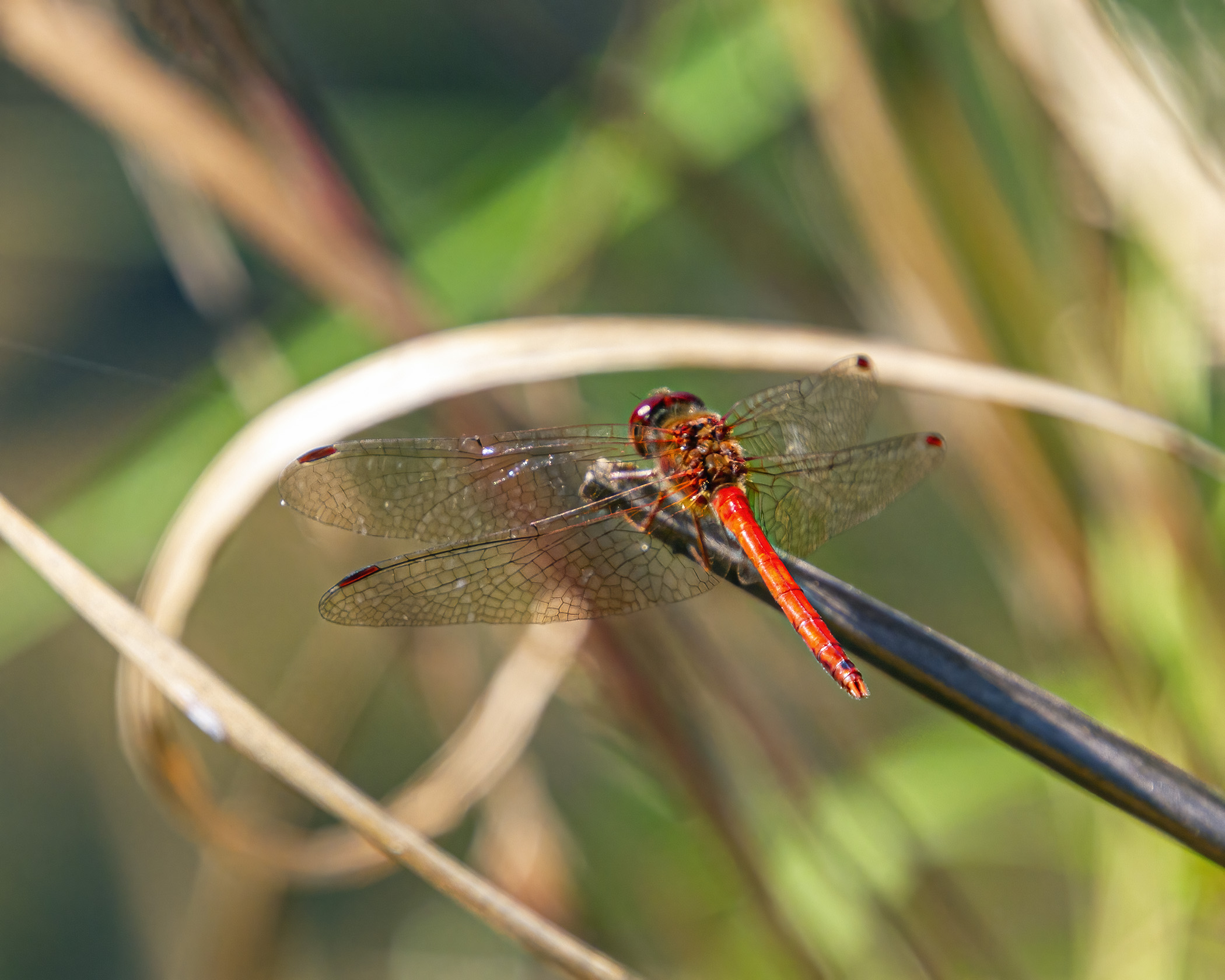
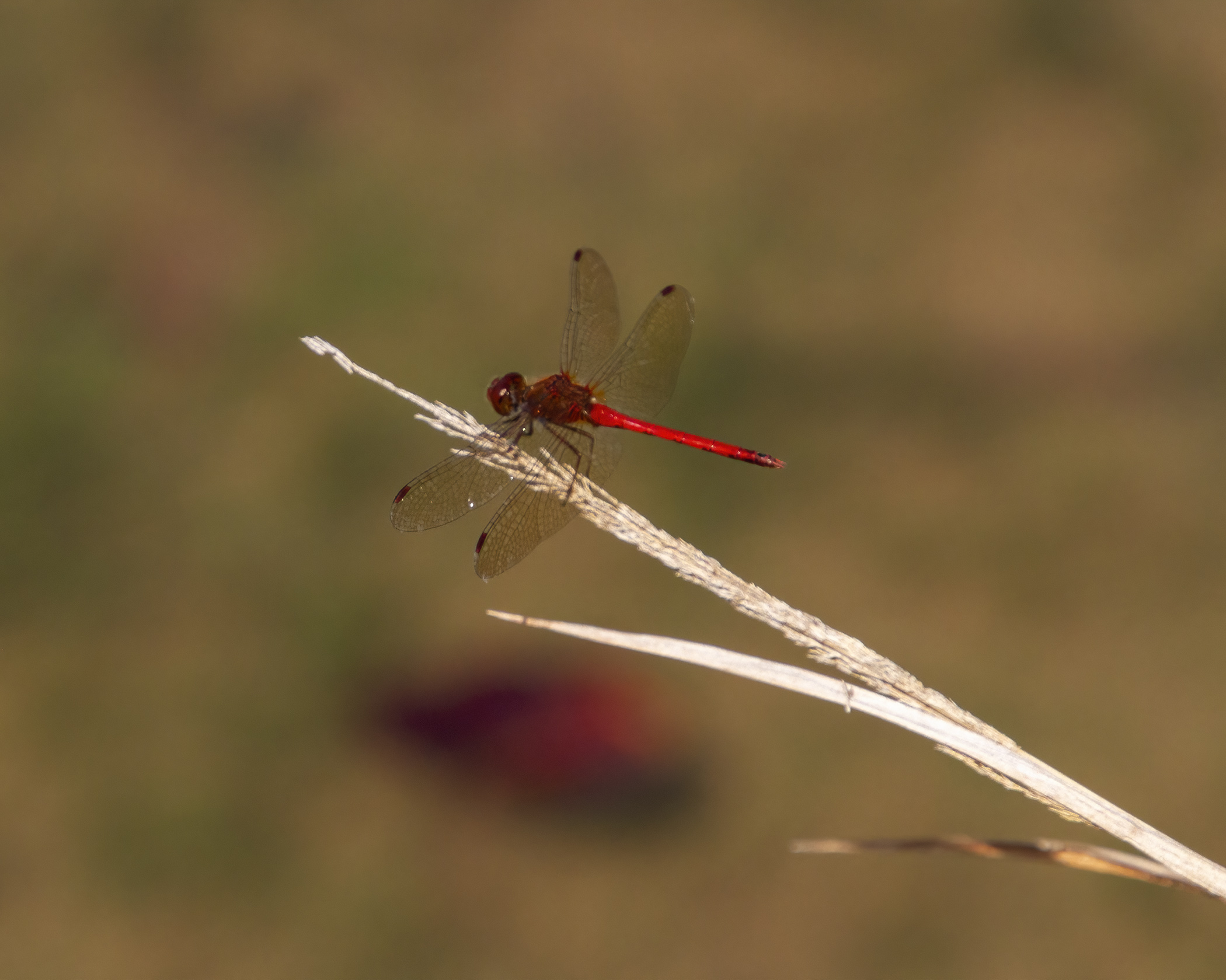
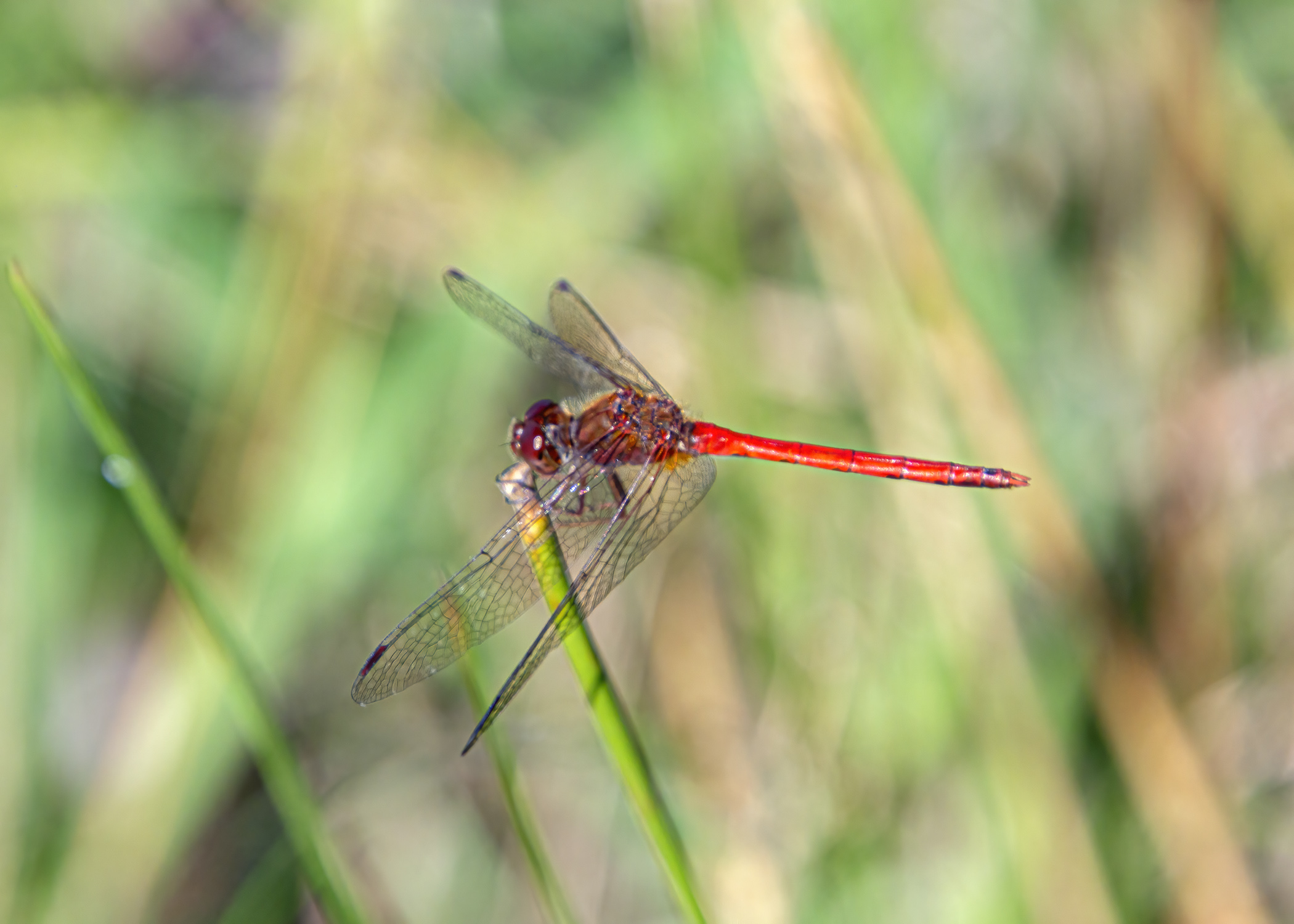
Now that Autumn Meadowhawk dragonflies (Sympetrum vicinum) have become the only dragonflies that I see regularly, I have been paying a great deal of attention to their perches when I am photographing them—when there are a limited number of subjects available, I try to make each encounter count. During a recent trip to Huntley Meadows Park, a county-run marshland park only a few miles from where I live, I managed to capture images of these colorful little dragonflies perching on a variety of different types of vegetation.

Often I have to choose between zooming in close to show the details of my subjects or pulling way back to show the environment in which I found them. In the case of these Autumn Meadowhawks, though, the images balance those competing priorities quite well, in part, I believe, because the dragonflies were so immersed in their environment, i.e. they do not choose high perches that produce “dragonfly on a stick” photos that isolate the subject too much from its surroundings.

Autumn Meadowhawk

Autumn Meadowhawk

Autumn Meadowhawk

© Michael Q. Powell. All rights reserved

Read Full Post »

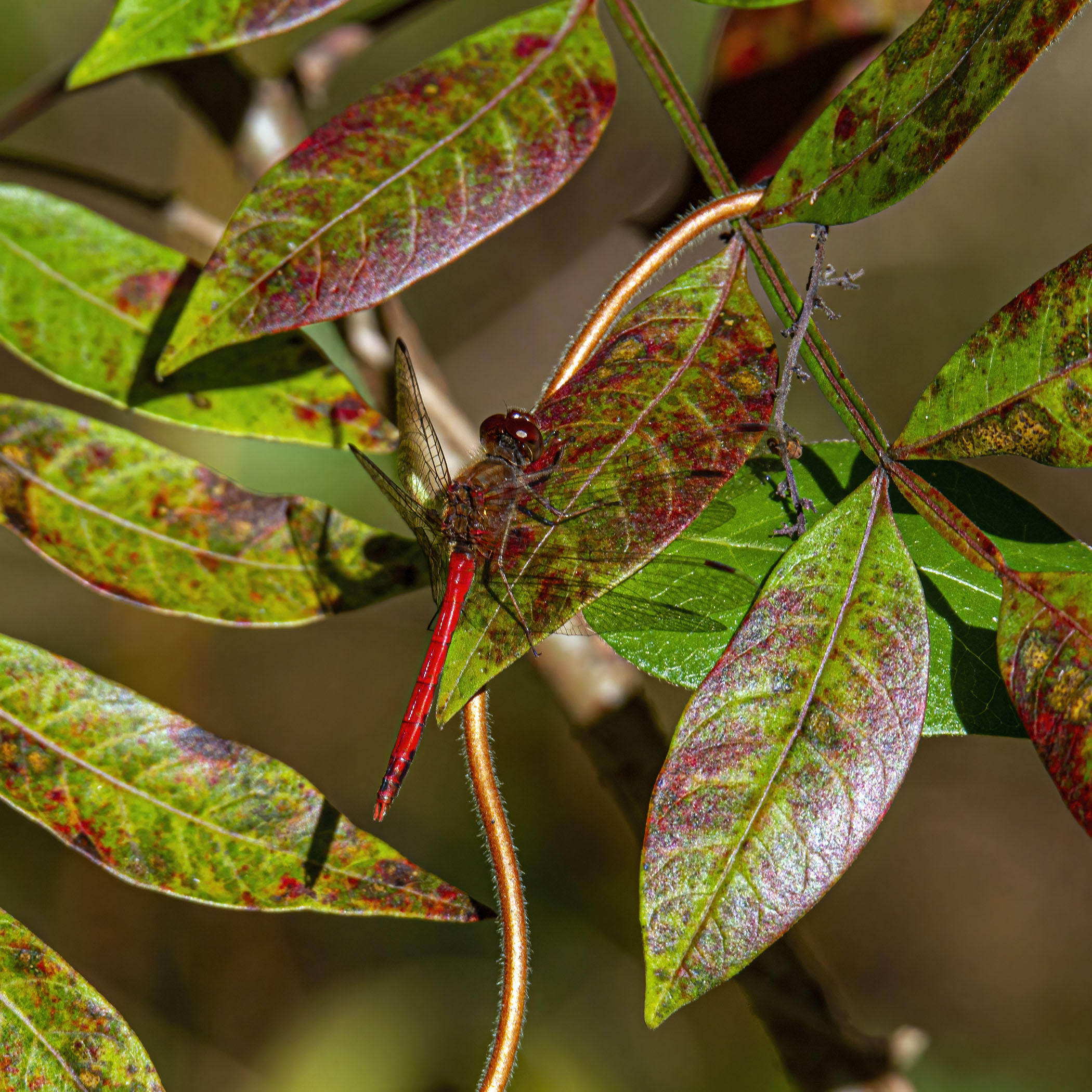
The red bodies of male Autumn Meadowhawk dragonflies (Sympetrum vicinum) make them relatively easy to spot.  However, when they choose to perch on foliage that matches their coloration, they can sometimes be well camouflaged.

The first photo shows an Autumn Meadowhawk perched on some kind of red vegetation (Virginia Creeper ?) at Huntley Meadows Park last Thursday. The red leaves really help to give the image a feel of autumn.

In the second image, the dragonfly stands out a bit more, but the dying leaves provide an artistically pleasing backdrop for the beautiful little dragonfly—I love this composition a lot.

Autumn Meadowhawk

Autumn Meadowhawk

© Michael Q. Powell. All rights reserved.


Read Full Post »

Lots of wildflowers still in bloom as we move deeper into autumn here in Northern Virginia. Last night we had our first frost warning of the season, but I don’t think there was any frost this morning in my neighborhood—a hard frost may speed the demise of many of the remaining butterflies and dragonflies. I was therefore delighted last Thursday to spot this Clouded Sulphur butterfly (Colias philodice) feeding on the flowers of what I believe is a White Heath Aster (Symphyotrichum ericoides) plant at Huntley Meadows Park.

Although part of the butterfly is obscured by the stem and the leaves in the foreground of this image, I like the way that I was able to capture the details of the butterfly’s green eyes and its extended proboscis.

Clouded Sulphur

© Michael Q. Powell. All rights reserved.

Read Full Post »

I will often strive to photograph my wildlife subjects from as many different angles as I can in order to take advantage of the lighting or to highlight the details of their bodies. When I spot a subject, though, I initially try to capture whatever shot I can before I work to get a better shot—any of my subjects are skittish and there is always the chance that my initial shot will be my only one.

I spotted this perched male Belted Kingfisher (Megaceryle alcyon) last Thursday at Huntley Meadows Park in Alexandria, Virginia and one of my initial shots was the third one below. The perch was sticking out of a pond that was surrounded by a marshy wetland, so there was really no chance for me to get closer to the kingfisher—there was no way to work the angles in my usual way.

So what did I do? In the background I noticed there were some patches of colorful fall foliage, so I decided to see if I could include some of those colors in my images to give them an autumn vibe. By bending, twisting, crouching, and kneeling I was able to vary my shooting angle, while remaining more or less in the same spot, and eventually managed to get some photos that included portions of that autumn foliage. The kingfisher remained in place, but cooperated by changing his head position from time to time.

Belted Kingfisher

Belted Kingfisher

Belted Kingfisher

© Michael Q. Powell. All rights reserved.

Read Full Post »

I was thrilled yesterday on Thursday at Huntley Meadows Park, a local marshland park, when I finally spotted some Blue-faced Meadowhawk dragonflies (Sympetrum ambiguum), a stunning species that is one of my favorites, after searching in vain for them at other locations for over a month. The Blue-faced Meadowhawk is a late-season dragonfly that is somewhat similar in appearance to the more common Autumn Meadowhawk—males of both species have bright red bodies, but the Autumn Meadowhawks have brown eyes.

The females of both species are more muted in their coloration than their male counterparts, as is often the case with many dragonflies and birds, so they have more natural camouflage and are frequently more difficult to find. The second image shows a female Blue-faced Meadowhawk that I managed to spot in the same general area as the male in the first photo. I love the way that the female dragonfly appeared to be singing a song as she basked in the sunlight on some dried-out vegetation.

Blue-faced Meadowhawk

Blue-faced Meadowhawk

© Michael Q. Powell. All rights reserved.


Read Full Post »

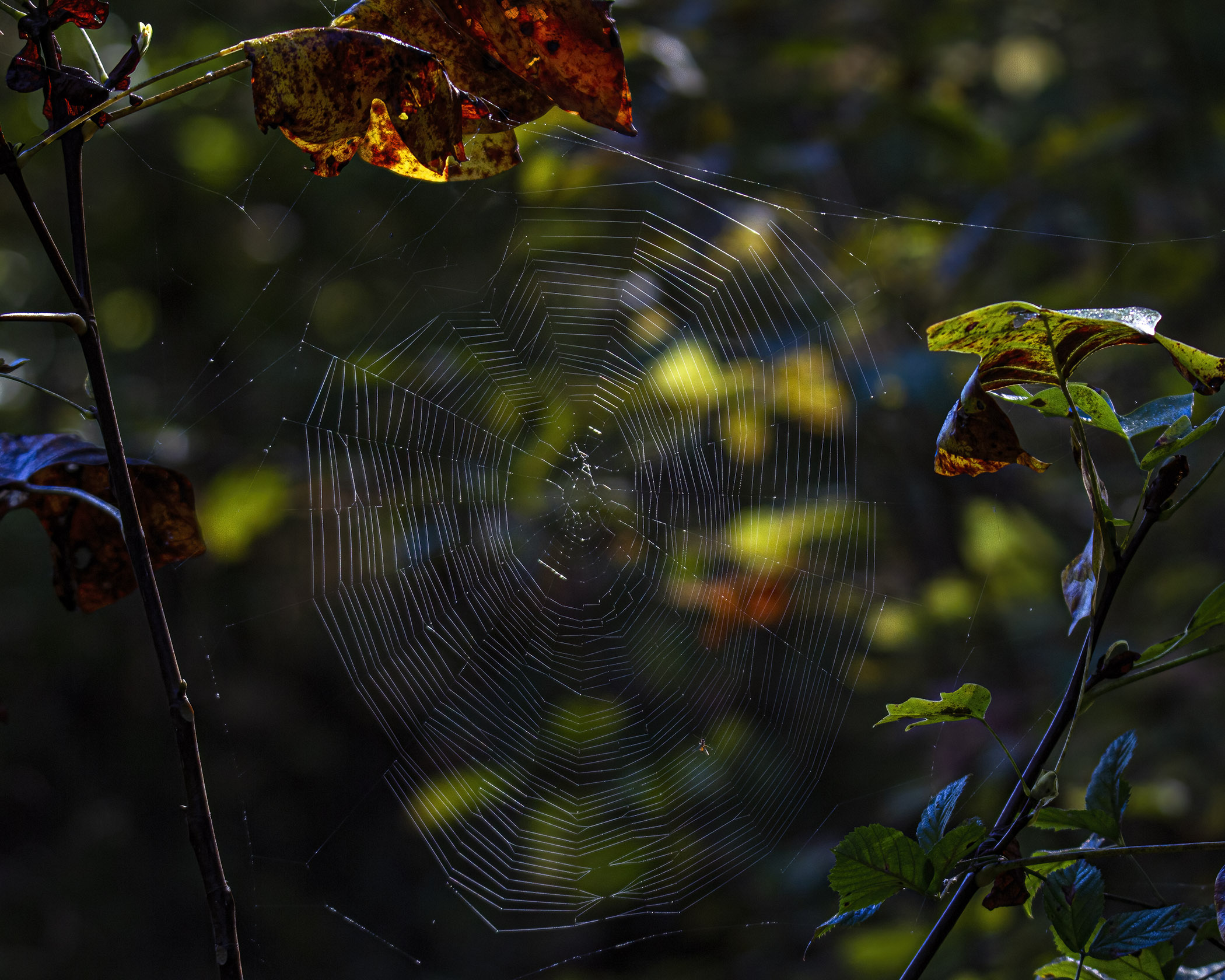
I have always admired the beauty and artistry of spider webs. It is so amazing to me that they can create such intricate patterns out of bodily secretions. I stumbled upon this beautiful little web on Thursday at Huntley Meadows Park and was thrilled that I was able to capture an image of it. I encourage you to click on the image for a closer view of the web design.

In order to make sure that the web did not disappear into the background completely, I deliberately underexposed the image, and focused manually on the web—there was no way that my camera’s autofocus would focus on the web.

spider web

© Michael Q. Powell. All rights reserved.

Read Full Post »

This late in the season, most of the large butterflies seem to be gone, but I continue to see some of the smaller ones, like this beautiful Variegated Fritillary butterfly (Euptoieta claudia) that I spotted on Thursday during a visit to Huntley Meadows Park, a county-run marshland park not far from where I live. Earlier in the year I encountered some Great Spangled Fritillaries, but I think this may well be my first sighting of a Variegated Fritillary in 2023.

The butterfly appeared to be basking in the sun as it perched with its wings wide open on some dried-out vegetation. I was using my Tamron 150-600mm telephoto zoom lens, which has a minimum focusing distance of almost nine feet (270 cm), so I was pretty far from the butterfly when I captured this image. I have read reviews that state that this lens is soft when fully extended to 600mm, but I have found that I can get acceptably sharp images if I pay a lot of attention to my focusing and shooting techniques, including remaining steady—in this case I was using a monopod.

Variegated Fritillary

© Michael Q. Powell. All rights reserved.


Read Full Post »

I walked about for a couple of hours on Wednesday at Occoquan Bay National Wildlife Refuge and visited some of my favorite dragonfly sites, but managed to spot only three dragonflies. Of those three, the only one that I managed to photograph was this pretty little Autumn Meadowhawk (Sympetrum vicinum).

Autumn Meadowhawks are quite small, about 1.3 inches (33 mm) in length, so they are not easy to spot, despite their bright red color. They tend to stay close to the ground, making short flights most of the time, so you have to be looking down to see them. At this time of the year, I focus a good amount attention on birds, so I end up alternating between looking up for birds and down for insects.

I really like the color and texture of the rocks on which the dragonfly chose to perch. Their cool muted tones contrast nicely with the red and brown colors of the dragonfly.

Autumn Meadowhawk

© Michael Q. Powell. All rights reserved.

Read Full Post »

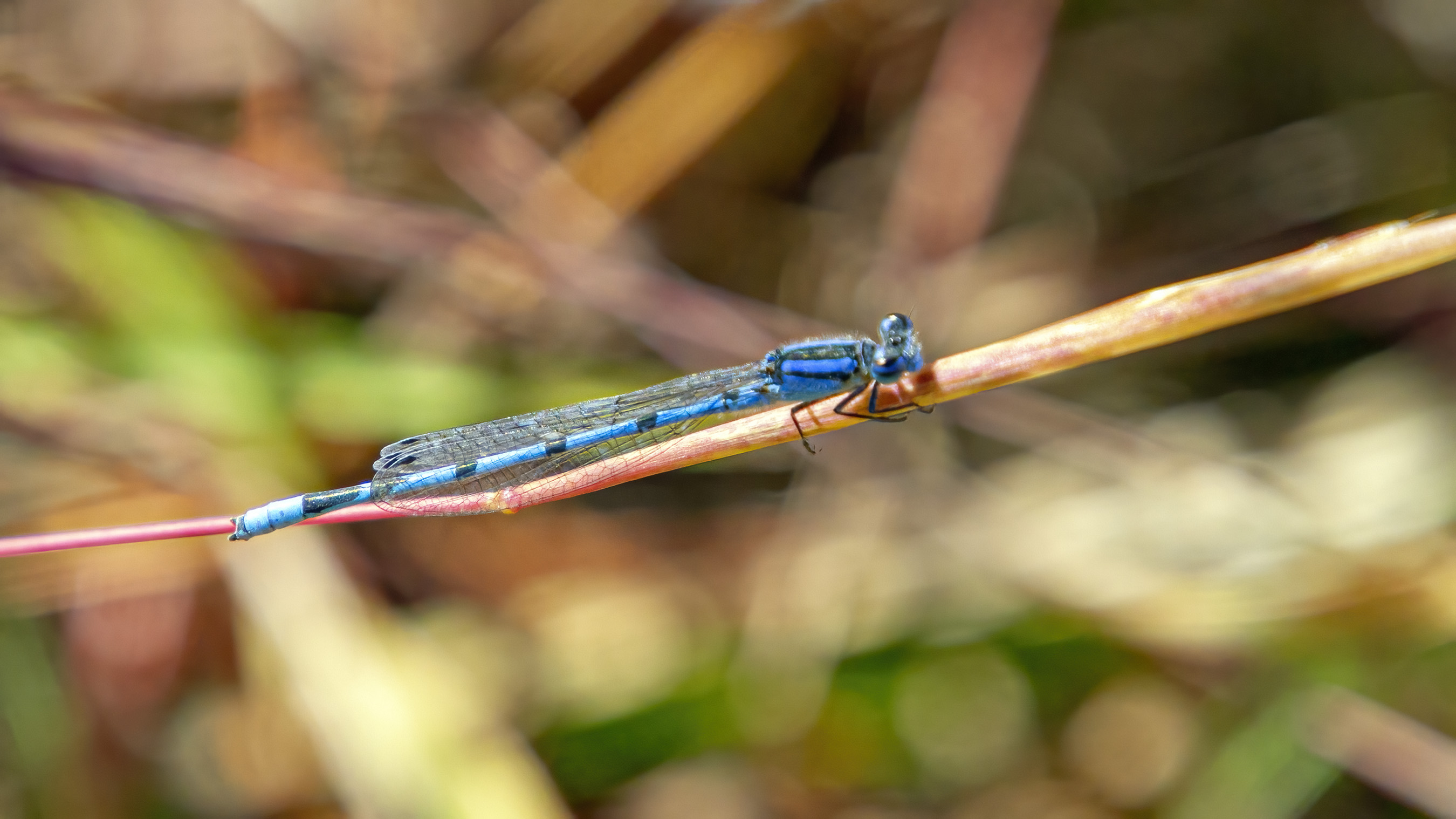
Like dragonflies, their larger “cousins,” damselflies have been rapidly decreasing in numbers this month. During recent visits to Occoquan Bay National Wildlife Refuge, I have seen only a few remaining damselflies. Therefore I was especially happy to spot this handsome male Familiar Bluet damselfly (Enallagma civile) last Tuesday.

The little damselfly seemed to be giving me a sideward glance as I carefully focused on him and I see a hint of what might be a smile. I really like the way that the background turned out in this image too—the colors and bokeh balls add additional visual interest without detracting from the primary subject.

Familiar Bluet

© Michael Q. Powell. All rights reserved.


Read Full Post »

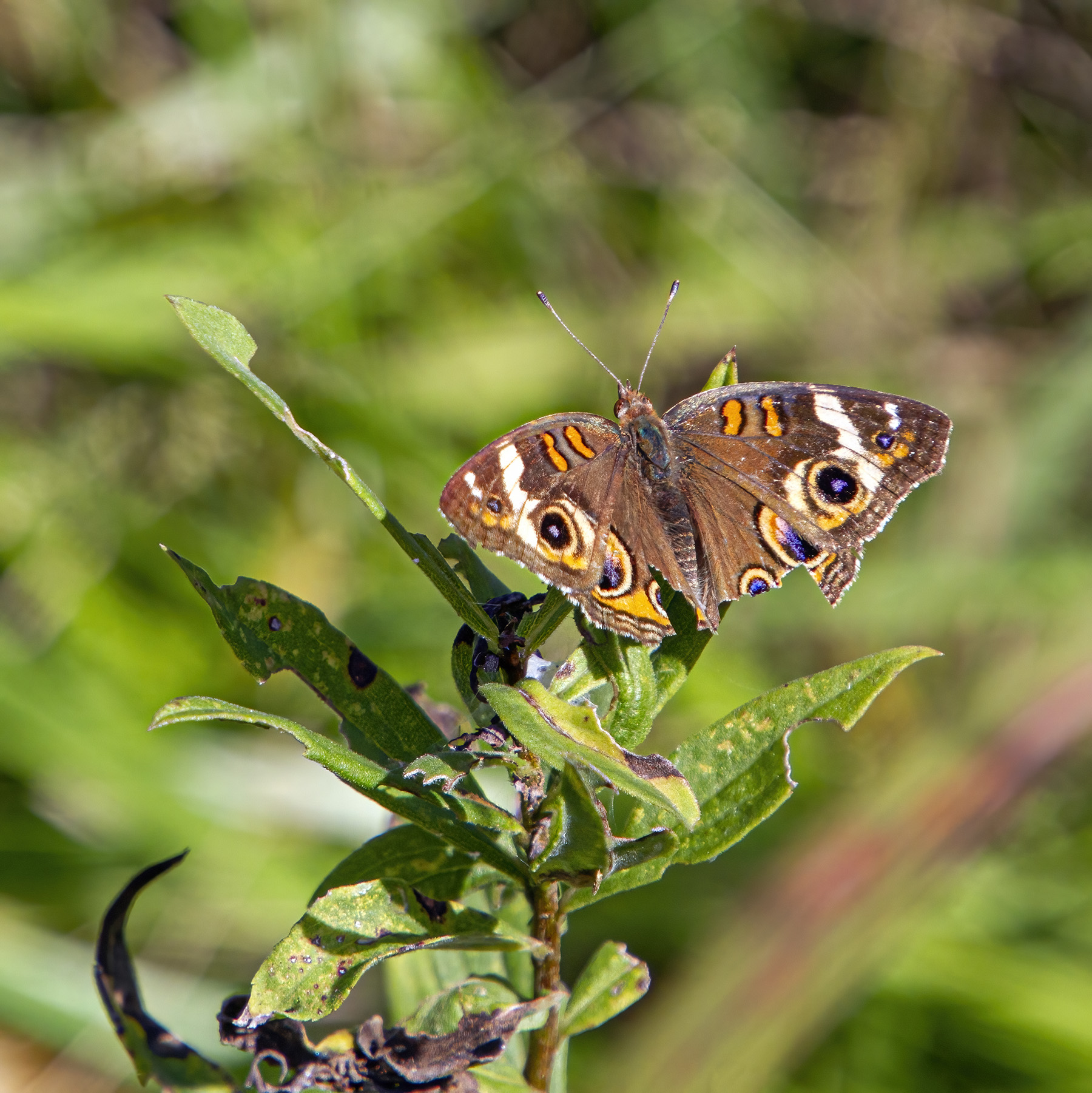
Many of the insects and plants that I now see show signs of the ravages of summer, like this damaged Common Buckeye butterfly (Junonia coenia) that I spotted atop an equally damaged plant during a recent visit to Occoquan Bay National Wildlife Refuge. Nonetheless the beauty of the butterfly shines through and it appears to be fully functional.

Autumn is a time for harvest celebrations as we rejoice in the bounty of the growth that has taken place, but there is also a tinge of melancholy as we experience a sense of loss and the feeling that our lives our changing. Change, of course, is a constant in our lives, but most of us—and I definitely fit into this group—become creatures of habit and have trouble dealing with changes at times. Yet we eventually adapt and may even learn to appreciate the results of the change, even if the process of change is a bit uncomfortable.

Common Buckeye

© Michael Q. Powell. All rights reserved.

Read Full Post »

I endlessly tried to track several Wandering Glider dragonflies (Pantala flavescens) as they flew back and forth over a field at Occoquan Bay National Wildlife Refuge last Thursday and was thrilled when one of them finally landed some nearby vegetation, allowing me to capture this image.

Wandering Gliders, also known as Globe Skimmers or Globe Wanderers, are considered to be the most widespread dragonfly species on the earth, with a good population on every continent except Antartica, although they rare in Europe. According to Wikipedia, Wandering Gliders “make an annual multigenerational journey of some 11,200 miles (18,000 km); to complete the migration, individual Wandering Gliders fly more than 3,730 miles (6,000 km)—one of the farthest known migrations of all insect species.”

This modest image was technically quite challenging to capture. The vegetation in this field was dense and the autofocus on my camera kept getting confused by the stalks of vegetation, so I had to resort to manual focusing. I was reluctant to move about very much for fear of rippling the vegetation and disturbing the dragonfly and therefore had to crouch in an awkward position close to the ground. It is certainly not an award-worthy photo, but I am thrilled whenever I manage to get a decent shot of a dragonfly species that rarely perches.

Wandering Glider

© Michael Q. Powell. All rights reserved.


Read Full Post »

This Great Blue Heron (Ardea herodias) was so well hidden that I could not tell if it was perched on a small raised portion of the ground or in a tree when I caught a glimpse of it during a recent visit to Occoquan Bay National Wildlife Refuge. My view of the heron initially was mostly obscured by the thick vegetation, but I managed to get a somewhat clear shot of it by climbing on top of a conveniently placed park bench.

Great Blue Heron

© Michael Q. Powell. All rights reserved.


Read Full Post »

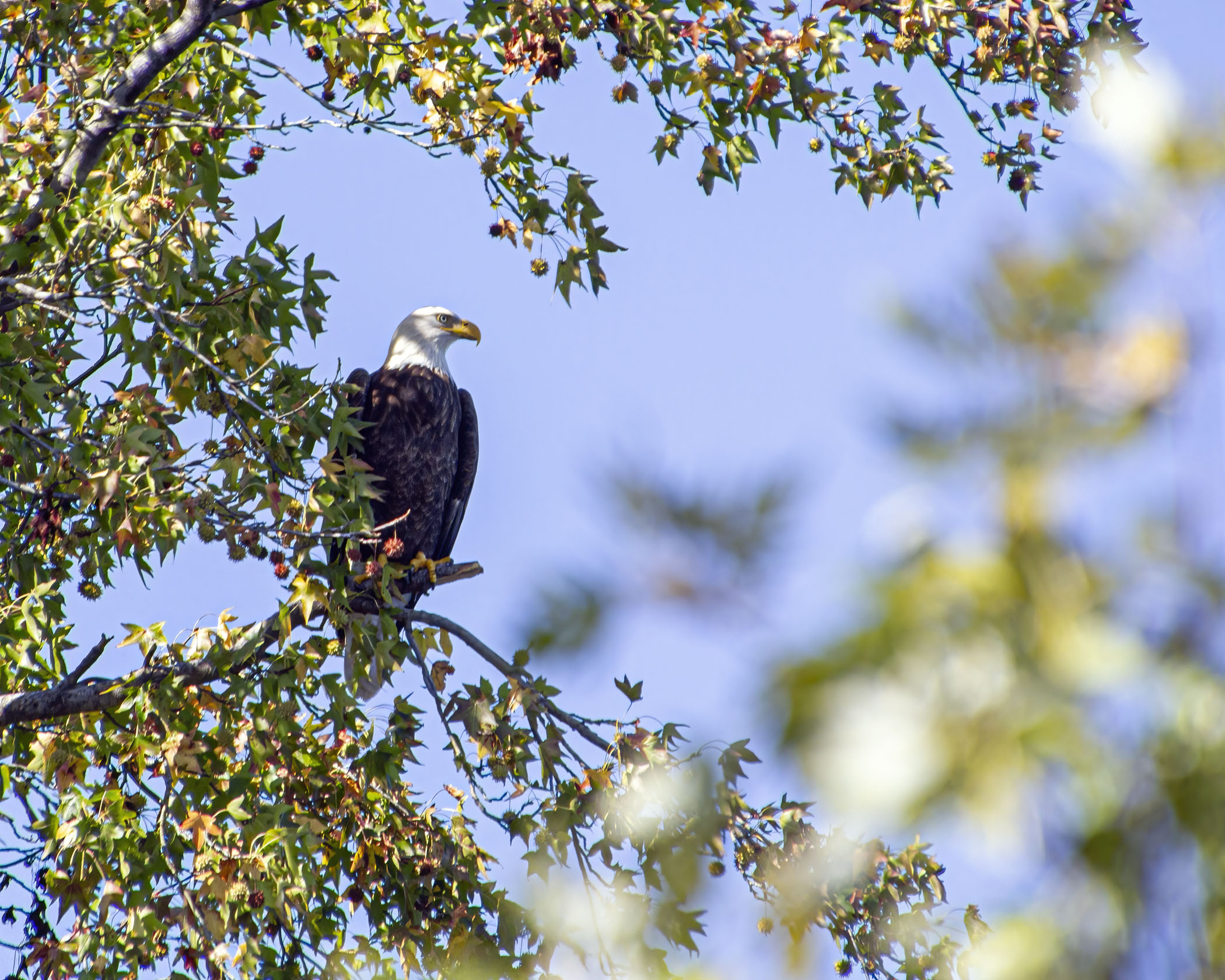
This Bald Eagle was almost hidden in the foliage of a sweet gum tree when I spotted it on Thursday at Occoquan Bay National Wildlife Refuge. Normally I depend on the brightness of a bald eagle’s head to give away the presence of an eagle, but in this case the eagle’s head was in partial shade, making it stand out quite a bit less than it usually does.

The second shot shows a view of the eagle from a different angle. Even though this shot does not show as much detail as the first shot, which was actually taken after the second one, I like the way that it shows how the eagle was nestled on its perch amidst all of the branches.

In the upcoming months, many of the leaves will fall from the trees and it will become marginally easier for me to spot an eagle from a longer distance away. Of course, that will also make it easier for the eagles to spot me and my vision and reflexes are rarely a match for those of the eagles. Often my first indication of an eagle’s presence is when it takes to the air and flies away from me.

Bald Eagle

Bald Eagle

© Michael Q. Powell. All rights reserved.


Read Full Post »

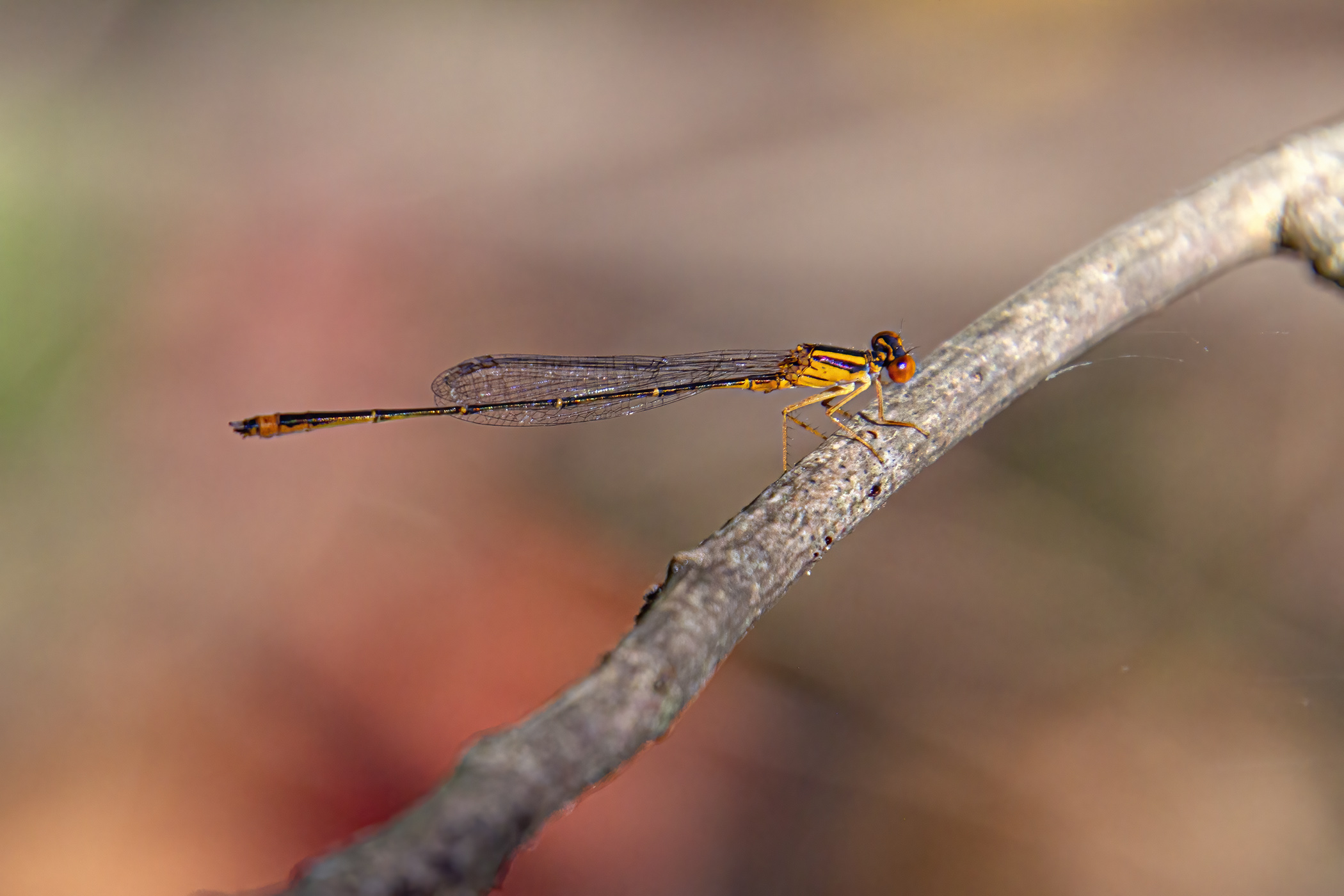
Although the name of this Orange Bluet damselfly (Enallagma signatum) sounds like an oxymoron, its colors are a perfect match for this autumn season. As the name suggest, most damselflies in the bluet family are blue, but they do come in other colors.

I photographed this handsome male Orange Bluet on 10 October at Occoquan Bay National Wildlife Refuge and was thrilled to be able to capture a little autumn color in the background of the image.

Orange Bluet

© Michael Q. Powell. All rights reserved.

Read Full Post »

There were several Common Green Darner dragonflies (Anax junius) flying overhead on 10 October at Occoquan Bay National Wildlife Refuge. One of them landed and perched momentarily low in the vegetation and I was able to capture this image.

I have been seeing fewer and fewer dragonflies on the ground as we move deeper and deeper into October, but in the air I have been seeing quite a few Common Green Darners, Black Saddlebags, and Wandering Gliders, the dragonfly species that migrate through our area. Many of the members of the surviving summer species appear to be faded and tattered, but the migrants appear to be bright and pristine.

The tangled grasses and vegetation where the dragonfly was perched were dried out and mostly void of color, which helps the green of the dragonfly’s thorax to really stand out in the photo. I also like the way that I was able to capture the transparency and details of the dragonfly’s wings.

Common Green Darner

© Michael Q. Powell. All rights reserved.

Read Full Post »

I spotted this Bald Eagle (Haliaeetus leucocephalus) in a distant tree on Tuesday at Occoquan Bay National Wildlife Refuge at about the same time that it spotted me. I reacted quickly and managed to capture this first image as it prepared to take off. As you can see, there is already a bit of color in our autumn foliage, but the colors are relatively muted here in Northern Virginia, compared to what I would see when I was growing up in New England.

The second photo shows the eagle a few seconds after its takeoff as it rose above the trees. At that moment its feet were still dangling, but it raised its “landing gear” shortly after I captured the image.

It has been a while since I last posted eagle photos and it was wonderful to have a couple of sightings of these majestic birds on a beautiful fall day.

Bald Eagle

Bald Eagle

© Michael Q. Powell. All rights reserved.

Read Full Post »

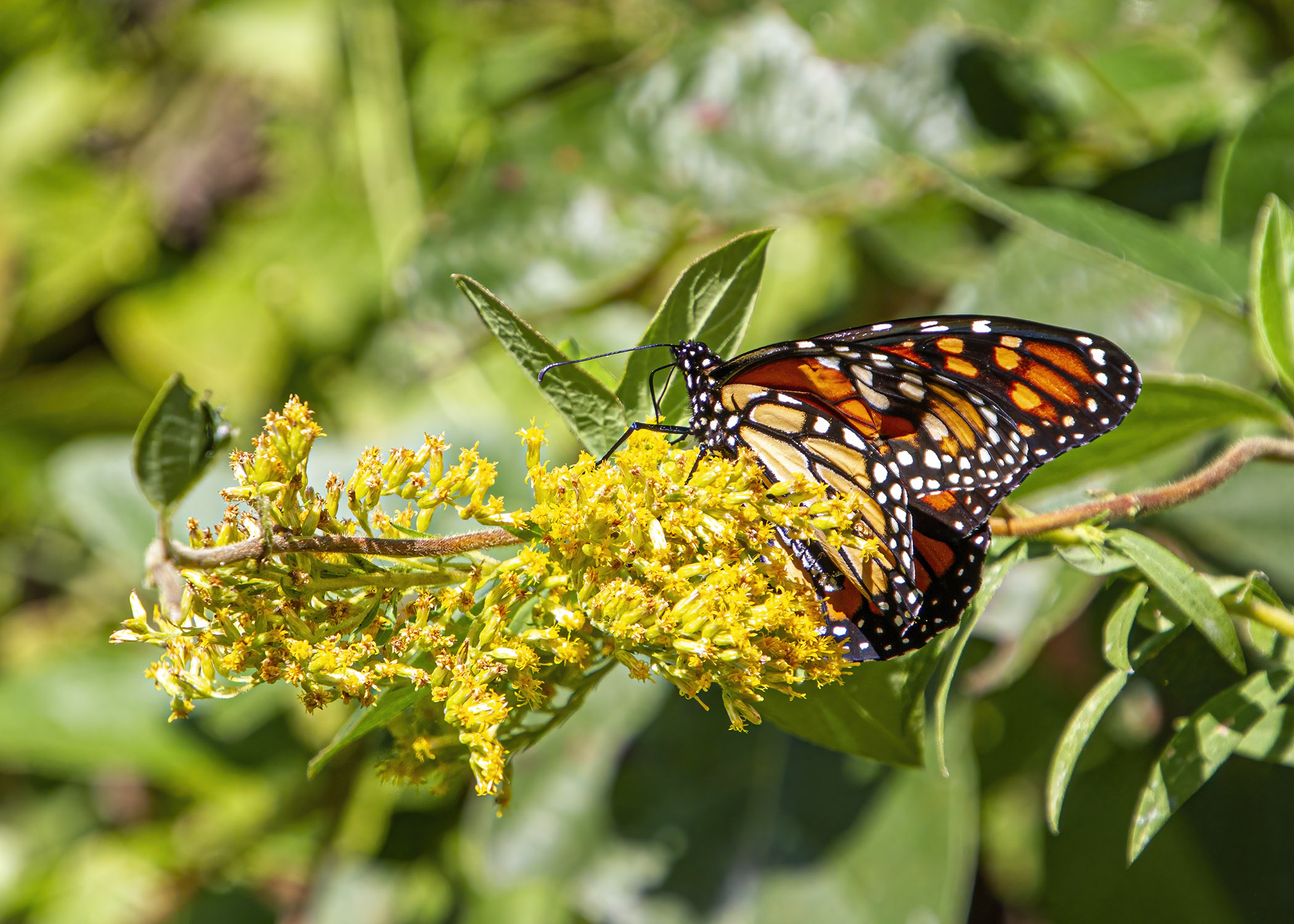
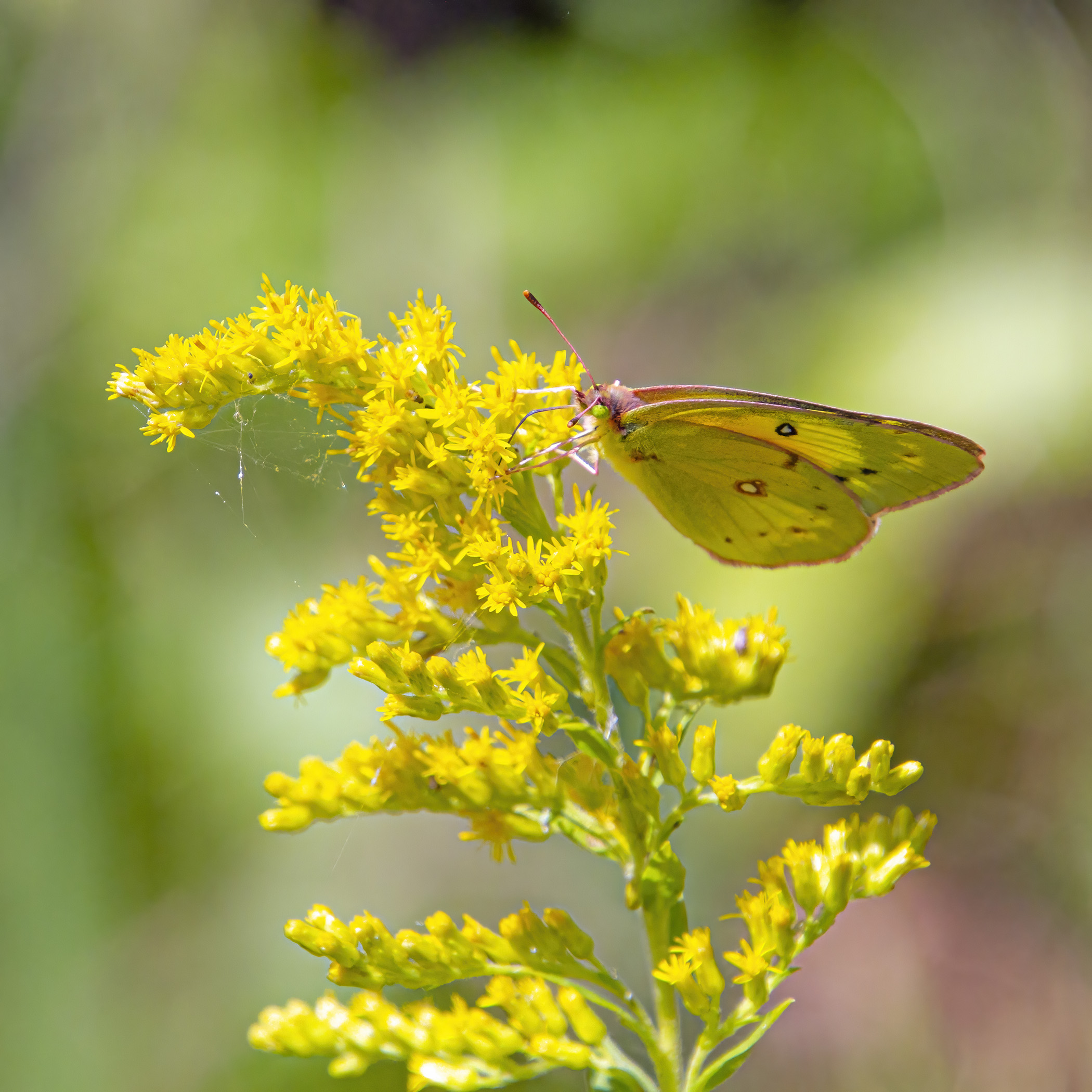
I love bright colors and instinctively smile when I see the large patches of goldenrod that are still in bloom at Occoquan Bay National Wildlife Refuge. The insects seem to love these flowers too and last Tuesday I spotted a large Monarch Butterfly (Danaus plexippus) and smaller Clouded Sulphur butterfly (Colias philodice) feeding on goldenrod.

Monarch

Clouded Sulphur

© Michael Q. Powell. All rights reserved.


Read Full Post »

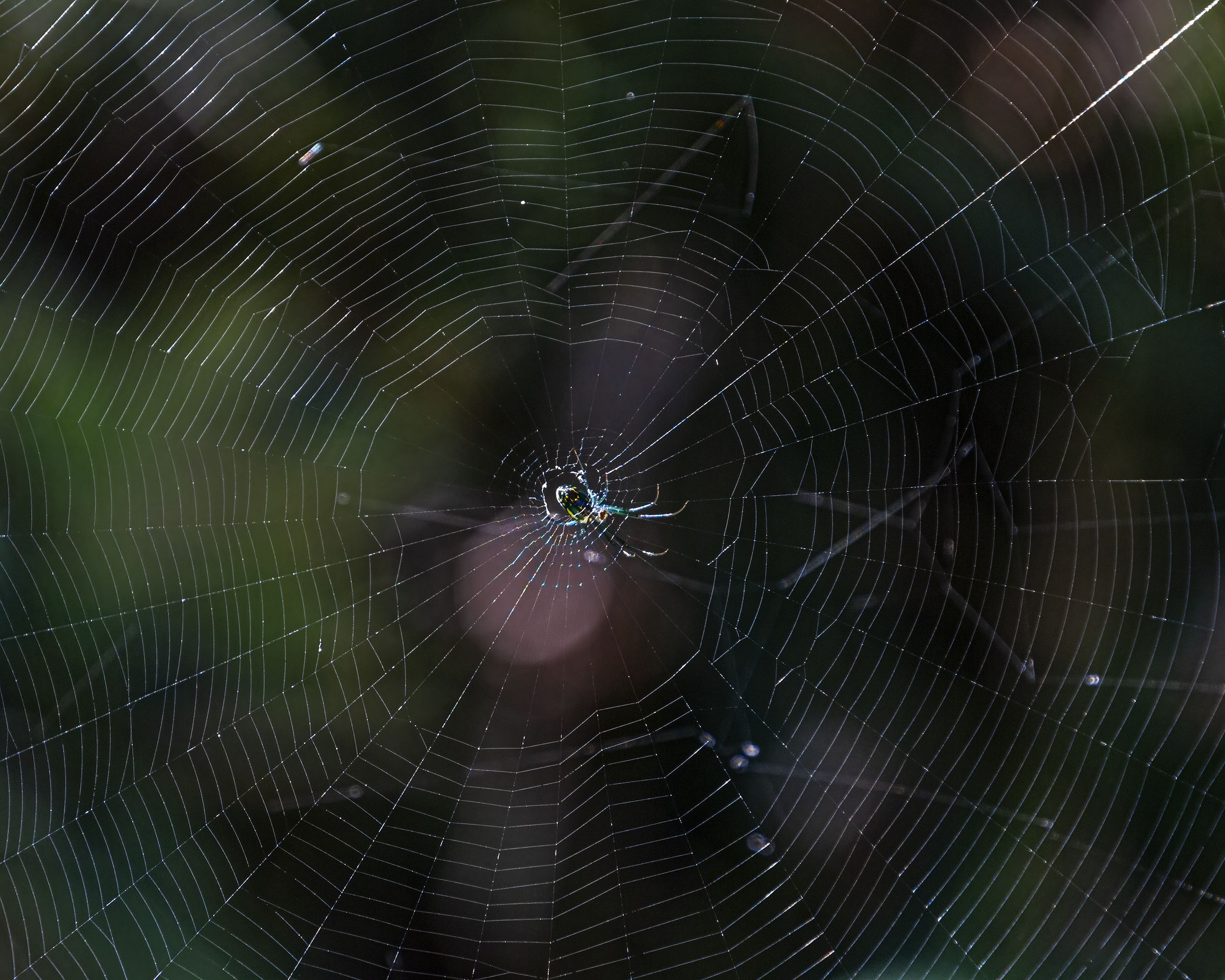
I am always amazed by the skill and artistry of spiders that construct elaborate webs, like this little Orchard Orbweaver spider (Leucauge venusta) that I photographed last Tuesday at Occoquan Bay National Wildlife Refuge. It is a bit of a challenge to capture an image of a web like this, especially in full daylight, but I managed to do so by focusing very carefully and deliberately underexposing the image so that the background appeared a bit darker than it was in real life.

Orchard Orbweaver

© Michael Q. Powell. All rights reserved.

Read Full Post »

When the calendar turns over to October, I never know which dragonflies I will encounter. Many of them have disappeared, but some hardy survivors are still around. The weather was warm last week, with several days in the 80’s (27 degrees C), but this week, high temperatures are predicted to be in the low to mid 60’s (17 degrees C) with nighttime temperatures dipping to the upper 40’s (9 degrees C)—this cool weather is less than optimal for most dragonflies.

I was thrilled last Tuesday to spot this Twelve-spotted Skimmer dragonfly (Libellula pulchella) at the edge of a small pond at Occoquan Bay National Wildlife Refuge. I was especially pleased to be able to capture the beautiful patterns on this dragonfly’s wings as it perched in the reeds.

Twelve-spotted Skimmer

© Michael Q. Powell. All rights reserved.

Read Full Post »

What is going on in this photo? It is really cool to photograph the interaction between two species, but it is often difficult to interpret the nature of their exchange. Is it mere curiosity or are there more deadly and sinister intentions on the part of one of the actors? If so, which one is the predator and which one is the potential prey?

I captured this image this past Monday at Occoquan Bay National Wildlife Refuge. I could not identify either of these insects, so I posted the photo and requested identification assistance on bugguide.net, a wonderful resource for insect identification.  It did not take long before I received a response that the insects were an Orange Assassin Bug (Pselliopus barberi) on the left and a Milkweed Leaf Beetle (Labidomera clivicollis) on the right.
I may be giving too much weight to the “assassin” part of the name of one of these insects, but, judging from their individual postures, it seems to me that the orange bug is preparing to attack the black-and-red beetle. Who know? It is such a cool and creepy photo that perhaps I should have waited until Halloween to post it.

Orange Assassin Bug Milkweed Leaf Beetle

© Michael Q. Powell. All rights reserved.

Read Full Post »

What signals the arrival of autumn for you? Perhaps it is the changes in the foliage, the cooling of the temperatures, or the shortening of the daylight hours. In recent years Autumn Meadowhawk dragonflies (Sympetrum vicinum) have become the harbingers of autumn, visible signs that the end of the dragonfly season is inexorably drawing near.

I spotted my first Autumn Meadowhawks this year on 2 October at Occoquan Bay National Wildlife Refuge. This species usually appears in late September and most years is the last dragonfly species to disappear—I have seen Autumn Meadowhawks as late as December some years and there have been some reports of them in early January.

A number of other dragonflies are still active, but by early November most of them will be gone. I will still be looking to photograph those hardy survivors in the upcoming months, but, as recent postings suggest, I will eventually be shifting a lot of my focus from insects to birds.

Autumn Meadowhawk

Autumn Meadowhawk

Autumn Meadowhawk

© Michael Q. Powell. All rights reserved.


Read Full Post »

I spotted this pretty little sparrow on Wednesday at Occoquan Bay National Wildlife Refuge. When I looked through my bird identification guide, I thought that it looked a little bit like a Chipping Sparrow. When I posted the photo below in a birding group on Facebook, however, some experienced birders identified this bird for me as a young White-crowned Sparrow (Zonotrichia leucophrys), a new species for me.

Sparrows can often be hard for me to identify, but the distinctive bill on this one helped me to narrow down the pool of potential species. A mature male White-crowned Sparrow has a black and white head and is easy to identify, but immature males and females of different species are often similar in appearance.

White-crowned Sparrow

© Michael Q. Powell. All rights reserved.


Read Full Post »

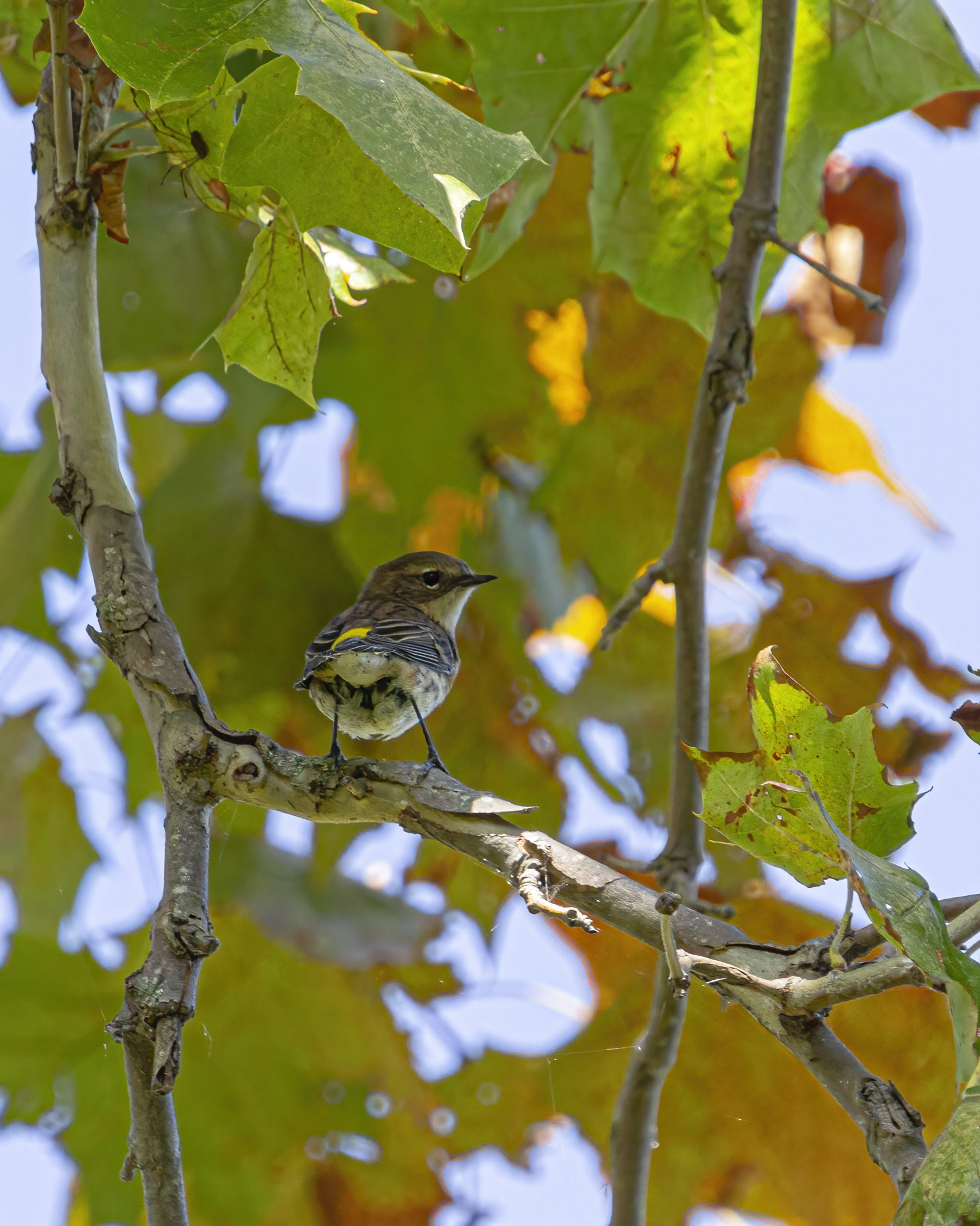
Each fall I face the same dilemma—I see the photos of other photographers indicating that migrating warblers are present in our area, but I have trouble spotting these elusive little birds. Part of the problem is that leaves are still mostly on the trees and I can often hear birds that remain invisible in the foliage. The other main problem is that many birds are now sporting their duller fall plumage, so they do not stand out as much as during the spring migration, when their  breeding plumage is much brighter.

Given my normal experience, I was thrilled to spot several Palm Warblers (Setophaga palmarum) and Yellow-rumped Warblers (Setophaga coronata) during visits to Occoquan Bay National Wildlife Refuge earlier this week. The birds in the first two photos, I believe, are Palm Warblers, a relatively common warbler species that likes to poke around a lot on the ground.

The final two photos show Yellow-rumped Warblers, which are the most common warbler species in my area. In both of the photos you can see the yellow patch of feathers on the “rump” of the bird.

In a month or so I may switch over to my longest lens, a Tamron 150-600mm zoom lens, which will allow me to zoom in a little more on these tiny birds, but for now I am sticking with my Tamron 18-400mm lens, a more versatile lens that lets me get photos of butterflies and dragonflies as well as of birds. (The problem with the longer lens is that it has a minimum focusing distance of almost 9 feet (2.7 meters) and it is sometimes hard to focus on small subjects from that far away.)


Palm Warbler

Palm Warbler

Yellow-rumped Warbler

Yellow-rumped Warbler

© Michael Q. Powell. All rights reserved.

Read Full Post »

I was thrilled to spot this handsome Russet-tipped Clubtail dragonfly (Stylurus plagiatus) last Wednesday at Jackson Miles Abbott Wetland Refuge. I love the way that the dragonfly was clinging to the leaf, looking almost like it was peeping over the edge.

Russet-tipped Clubtails are a late season species and are seen most often in August and September in my area. Unlike many of the dragonflies that I see regularly that prefer pole-like perches or perch flat on the ground, Russet-tipped Clubtails like to hang from the leaves of vegetation at an angle or almost vertically—members of the genus Stylurus are sometimes called “Hanging Clubtails.”

Russet-tipped Clubtail

© Michael Q. Powell. All rights reserved.

Read Full Post »

As I prepared to take a step closer to a pond last Friday at Occoquan Bay National Wildlife Refuge, I suddenly saw that there was a large snake in the vegetation right where my foot was about to land. My mind quickly processed the information and came to the conclusion that it was probably “only” a Northern Water Snake (Nerodia sipedon), a non-poisonous snake that is quite common where I live.

Not wanting to disturb the snake, I backed off a little and captured this shot of the snake that was pretty well hidden in the vegetation. My mission completed, I continued on down the trail and the snake was able to resume its basking in the warmth of the autumn sunlight.

Northern Water Snake

© Michael Q. Powell. All rights reserved.

Read Full Post »

As I was exploring Occoquan Bay National Wildlife Refuge this past Friday, I spotted some colorful red and black bugs. I had no idea what they were, but I happened to be walking with a fellow dragonfly enthusiast and he told me that they were Florida Predatory Stink Bugs (Euthyrynchus floridanus).

Unlike most other stink bugs that feed on plants, Florida Predatory Stink Bugs feed on insects that attack plants and are therefore considered to be beneficial. According to the North Carolina Extension website, “Immature Euthyrhynchus have a strong tendency to aggregate, and they even attack larger prey in concert. Apparently, aggregation behavior allows them to successfully attack prey too large to be subdued by a single nymph. Sometimes adults aggregate with nymphs, although when times get hard, these bugs sometimes feed on smaller relatives! When the bugs jab their proboscis into a less fortunate insect, they inject a toxin that slowly immobilizes the prey. The predigested insides are then sucked out.”

When they are developing, these stink bugs go through five stages, known as instars. The two largest bugs in the photo below are adults, while the two in the middle are in some what earlier stages of development. I don’t know for sure what this group of bugs was doing, but wonder if there is some kind of prey beneath them that they are immobilizing together.

Florida Predatory Stink Bug

© Michael Q. Powell. All rights reserved.

Read Full Post »

As I was leaving Occoquan Bay National Wildlife Refuge on Friday, I spotted this small band of Wild Turkeys (Meleagris gallopavo) foraging on the side of a small hill. I captured this image while I was seated in the driver’s seat of my car. I was stopped with my blinkers on and fortunately there was no other traffic. I like the way that the turkeys had spaced themselves out in a military-style patrolling formation.

Wild Turkeys

© Michael Q. Powell. All rights reserved.


Read Full Post »

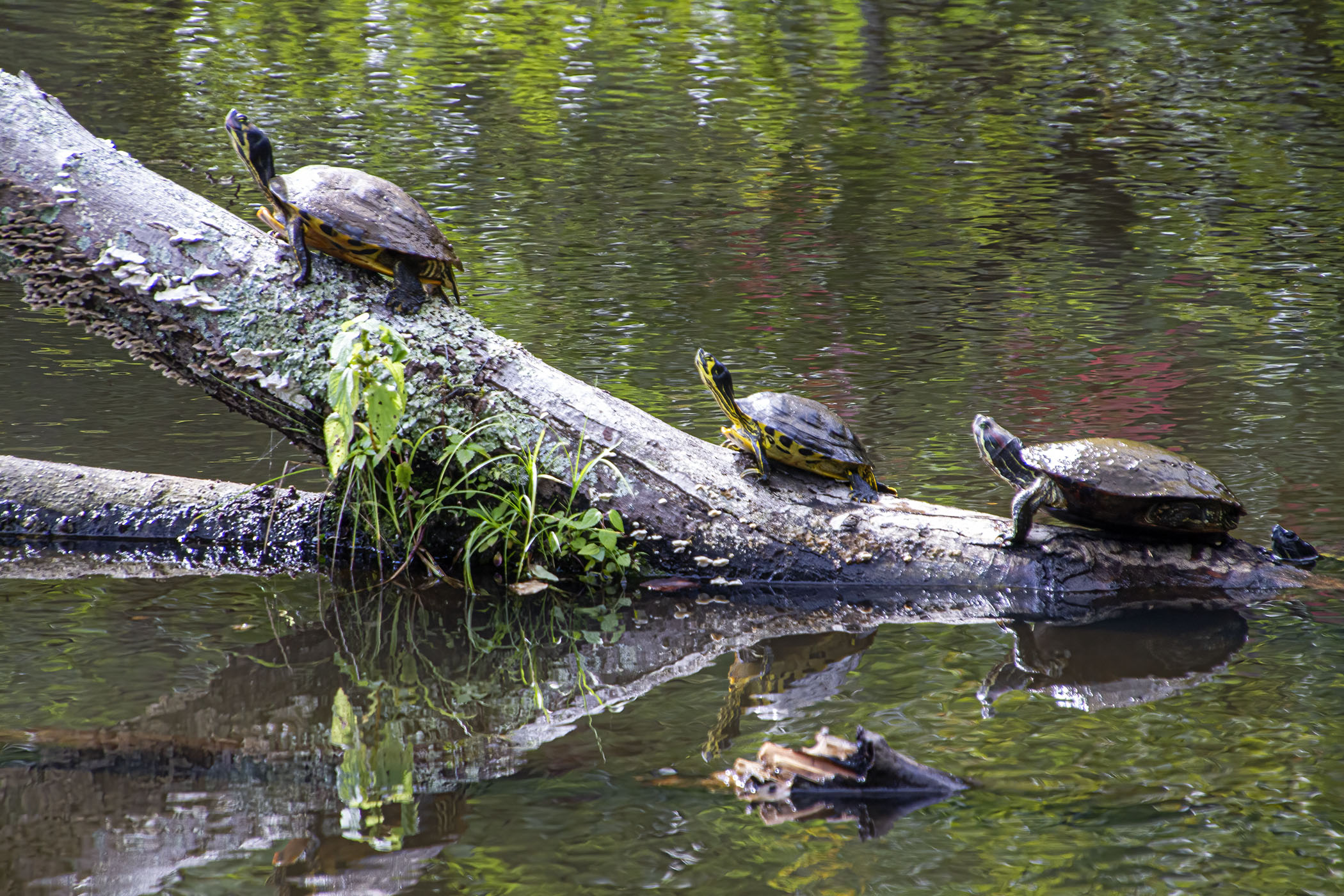
The weather is cooling off, but whenever there is the slightest amount of sunshine, I can count on seeing turtles basking in the warmth of the sun. This past Wednesday, I spotted these three turtles on a partially submerged tree branch in the small pond at Jackson Miles Abbott Wetland Refuge. I am pretty sure that the turtle on the right is a Red-eared Slider (Trachemys scripta elegans) and the other two may be Yellow-bellied Sliders (Trachemys scripta scripta).

I am always a fan of reflections and I love the way that we can see reflections of the turtles on the rippled surface of the water. It was an added bonus to have some patches of red, a sign of the changing season.

turtles

© Michael Q. Powell. All rights reserved.

Read Full Post »

On Wednesday at Jackson Miles Abbott Wetland Refuge I was thrilled to spot this rainbow-colored Handsome Meadow Katydid (Orchelimum pulchellum), which is probably my favorite insect. In addition to its multiple colors, I love its striking blue eyes and long antennae.

My title is a little misleading, because technically there are some differences between grasshoppers and katydids. One of the most visible differences is the length of the antennae—a katydid’s antennae are longer than the length of its body, while a grasshopper’s tend to be shorter. In the first photo, I cut off one of the antennae a bit when I cropped the photo, but if you look closely you can see that the antenna runs all the way to the left edge of the photo.

Shortly after I took the first photo, the katydid became aware of my presence and tried to hide from me. She stretched out her legs, which really elongated her body, and she was almost successful in concealing herself behind the stalk of grass.

How do I know that the katydid is a female? If you look closely at the tail end of the katydid in the first photo, you can see a red scimitar-shaped appendage. That is the ovipositor that the katydid uses to make a slit in vegetation in which to deposit her eggs.

Handsome Meadow Katydid

Handsome Meadow Katydid

© Michael Q. Powell. All rights reserved.


Read Full Post »

At this time of the year, many of the butterflies that I see are showing the ravages of a long summer season. That, however, was not the case with several Monarch butterflies (Danaus plexippus) that I spotted last week at Occoquan Bay National Wildlife Refuge that appeared to be in perfect condition.

Perhaps these are newly emerged Monarchs that are now preparing for a long migration flight to warmer locations.

Monarch

Monarch

© Michael Q. Powell. All rights reserved.

Read Full Post »

« Newer Posts - Older Posts »