Feeds:
Posts
Comments

Archive for the ‘Autumn’ Category

I am blessed to live in an area in which Bald Eagles (Haliaeetus leucocephalus) are present throughout most of the year. During the summer, however, my encounters have been pretty infrequent, so I was excited to spot this one on Monday while visiting Occoquan Bay National Wildlife Refuge. I was looking for dragonflies that day and had a macro lens on my DSLR camera and I realized the eagle was too far away for me to capture a decent image.

It was precisely for situations like this that I also carry my Canon SX50 super-zoom camera. The resolution of this camera is not as good as that of my “big” camera, but it gives me a lot of reach. After I had zoomed in to take the first shot, I zoomed out and realized that there was a second bald eagle perched above the one I had just photographed. The second shot shows the relative positions of the two eagles.

I was hoping for better head positions for the two eagles, but they flew away shortly after I took the second shot. I have discovered that it is usually best to get a shot as early as possible in such encounters and then work to get a better shot. If I had waited for the “perfect” moment, I almost certainly would have come up empty-handed.

Bald Eagle

Bald Eagles

© Michael Q. Powell. All rights reserved.

Read Full Post »

For those of us in the Northern Hemisphere, today is the first day of autumn. In my area, today’s high temperature is forecast to reach 90 degrees (32 degrees C), so it does not really feel like autumn yet. However, it is beginning to look like autumn, with browns and orange tones starting to appear in the landscape.

Fortunately there are still lots of butterflies around, like this Viceroy Butterfly (Limenitis archippus) that I spotted last Wednesday at Occoquan Bay National Wildlife Refuge. The color palette of this shot really speaks to me of this new season.

Given that seasons are determined differently in different places by using meteorological or astrological calendars, I probably should try to be scrupulously inclusive and wish everyone a Happy September Equinox Day rather than Happy Autumn.

UPDATE: I took this shot while photowalking with fellow photographer and blogger, Walter Sanford. We did not talk about when we/if we might post an image of this butterfly, but it turns out he also posted one today. Checking out his posting if you like to read another take on our adventure and see a slightly different approach to photographing this butterfly. Walter and I have different backgrounds that affect the way we express ourselves in our words and in our images. Our complementary posts help to remind me that “reality” is as much subjective as it is objective.

Viceroy

© Michael Q. Powell. All rights reserved.

Read Full Post »

On Monday I spotted this freshly emerged female Common Green Darner dragonfly (Anax junius) at Occoquan Bay National Wildlife Refuge.  It won’t be long before it will be time for her to migrate southward. Yes, some dragonflies actually migrate.

When I first started getting into dragonflies, it never struck me that dragonflies could travel long distances. I figured that they lived and died in a relatively confined geographic area. Although that may be true for some dragonfly species, that is not the case for the Common Green Darner. One of my favorite websites, Dragonflies of Northern Virginia, describes the amazing saga of this species in these words:

“They emerge in the Southeast and fly north, arriving here late March thru May. After their long flight, they mate, lay eggs and die. Their young emerge in July and August. Congregating in large swarms, this 2nd generation begins flying south in September. They lay eggs that fall, after arriving in their southern destinations, and die. When their young hatch in March, they fly back to Northern Virginia and it starts again – a two generation migration.”

Many of us have gotten used to using Global Positioning System (GPS) devices to help us navigate or use Google Maps. How do these dragonflies know where to go? How do they find a destination that they have never visited before? It boggles my mind and fills me with awe and wonder when I contemplate questions like these.

Common Green Darner

Common Green Darner

© Michael Q. Powell. All rights reserved.


Read Full Post »

Over the past few months I have repeatedly heard the screaming of hawks in the distance, but it has been rare for me to actually catch sight of one. I was thrilled therefore when I spotted this Red-tailed Hawk (Buteo jamaicensis) last week at Occoquan Bay National Wildlife Refuge. The hawk soared almost directly over me, providing me with a wonderful view of its fully extended wings and red tail.

This was one of the few cases when it was not an advantage to have my camera attached to a monopod. I ended up taking this shot with the camera held at a high angle with monopod sticking straight out, almost parallel to the ground.

Red-tailed Hawk

© Michael Q. Powell. All rights reserved.

Read Full Post »

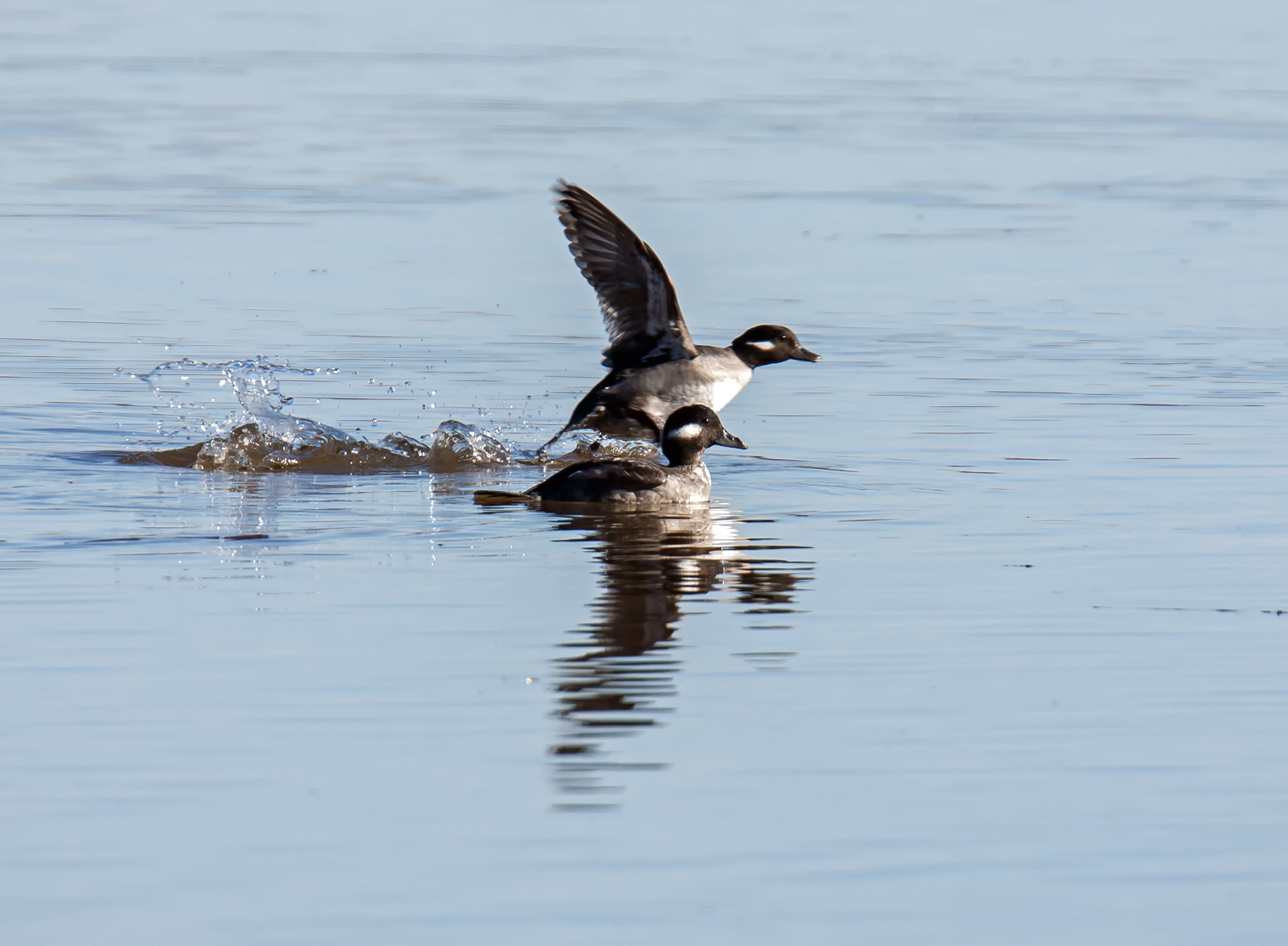
When I am watching water birds, it is hard for me to predict when they will decide to take to the air. Often they give no visible warning. Some species, though, need to dance across the water to gain momentum before they can lift off, like this pair of female Buffleheads (Bucephala albeola) that I observed last week at Occoquan Bay National Wildlife Refuge.

The one in the back had already started its takeoff maneuvers when I captured this image and a second later the second bufflehead was also skipping across the water.

bufflehead

© Michael Q. Powell. All rights reserved.
Read Full Post »

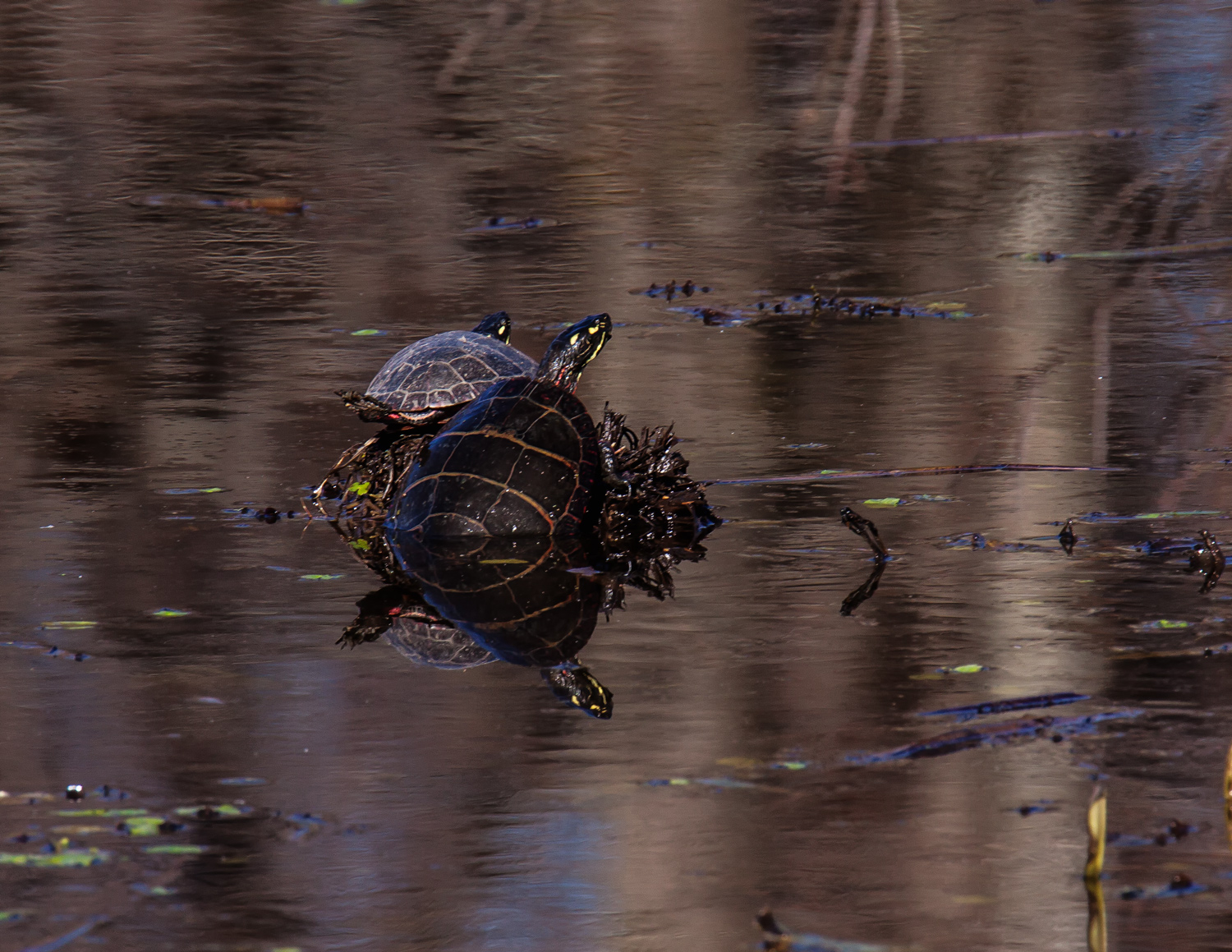
The temperature today feels so frigid—right about the freezing level—that it is hard to remember that only this past Monday it was sunny and 60 degrees (16 degrees C). While I was enjoying the unseasonably warm weather and exploring Occoquan Bay National Wildlife Refuge, I photographed these sunning turtles, a relatively rare sight in December.

I did not get a good enough view of the turtles to be able to identify them with any confidence, but I think they may be Eastern Painted Turtles (Chrysemys picta picta) or possibly Red-eared Sliders (Trachemys scripta elegans).

Turtles in December

© Michael Q. Powell. All rights reserved.
 

Read Full Post »

Recently I served as the assistant for a fellow photographer Cindy Dyer as she shot some portraits in her studio. I had never before participated in that kind of a venture and I was a little shocked by the amount of coaching that the subject needed to ensure a proper head position, body position, and expression. Apparently most of us do not know how to act “naturally” in a way that will yield a goof portrait.

Fortunately many birds do not require these instructions. On Monday of this week, this Cedar Waxwing (Bombycilla cedrorum) took a break from its foraging and seemed to be posing for me.  The bird decided that a profile shot would be good to show of its distinctive eye mask and that any hint of a double chin could be eliminated by slightly elongating its neck. Although the Cedar Waxwing tried to maintain a serious expression, I think I detect the beginning of a tiny smile.

Cedar Waxwing

© Michael Q. Powell. All rights reserved.

Read Full Post »

Despite his diminutive size, this male Golden-crowned Kinglet (Regulus satrapa) seemed to have plenty of attitude when I spotted him on Monday at Occoquan Bay National Wildlife Refuge.

Size is relative, of course, but by almost any standard Golden-crowned Kinglets are tiny. The are about 3-4 inches (8 to 10 cm) in length and weigh only 0.1 to 0.3 ounces (4 to 8 gm). Their small size and hyperactivity make them a fun challenge to photograph.

I particularly like this bird’s combative stance and the way that it provides us with such a good view of its bright yellow “crown.” It is one of the rare occasions when I got an unobstructed shot of a kinglet—normally there are branches blocking at least part of the view.

Golden-crowned Kinglet

© Michael Q. Powell. All rights reserved.

Read Full Post »

I was quite excited on Monday at Occoquan Bay National Wildife Refuge when this Brown Creeper (Certhia americana) finally let me get a relatively unobstructed shot of it. I had spent quite a while trying to track it as it climbed up and around several trees in a kind of corkscrew pattern.

In the past I have seen this elusive little bird several times, but as far as I know, this is the first time that I have ever gotten a shot of one. The Brown Creeper moves in a pattern that is not at all like any other bird that I have observed. The Cornell Lab of Ornithology website provides the following description of this behavior:

“The Brown Creeper spends most of its time spiraling up tree trunks in search of insects. It holds its short legs on either side of its body, with the long, curved claws hooking into the bark, and braces itself with its long, stiff tail. Both feet hop at the same time, making the bird’s head duck after each hop. Because of its specialized anatomy, the Brown Creeper rarely climbs downward: once high in a tree, it flies down to begin a new ascent at the base of a nearby tree.”

I am happy with this shot, though I must confess that I get a little dizzy if I look at it too long.

Brown Creeper

© Michael Q. Powell. All rights reserved.


Read Full Post »

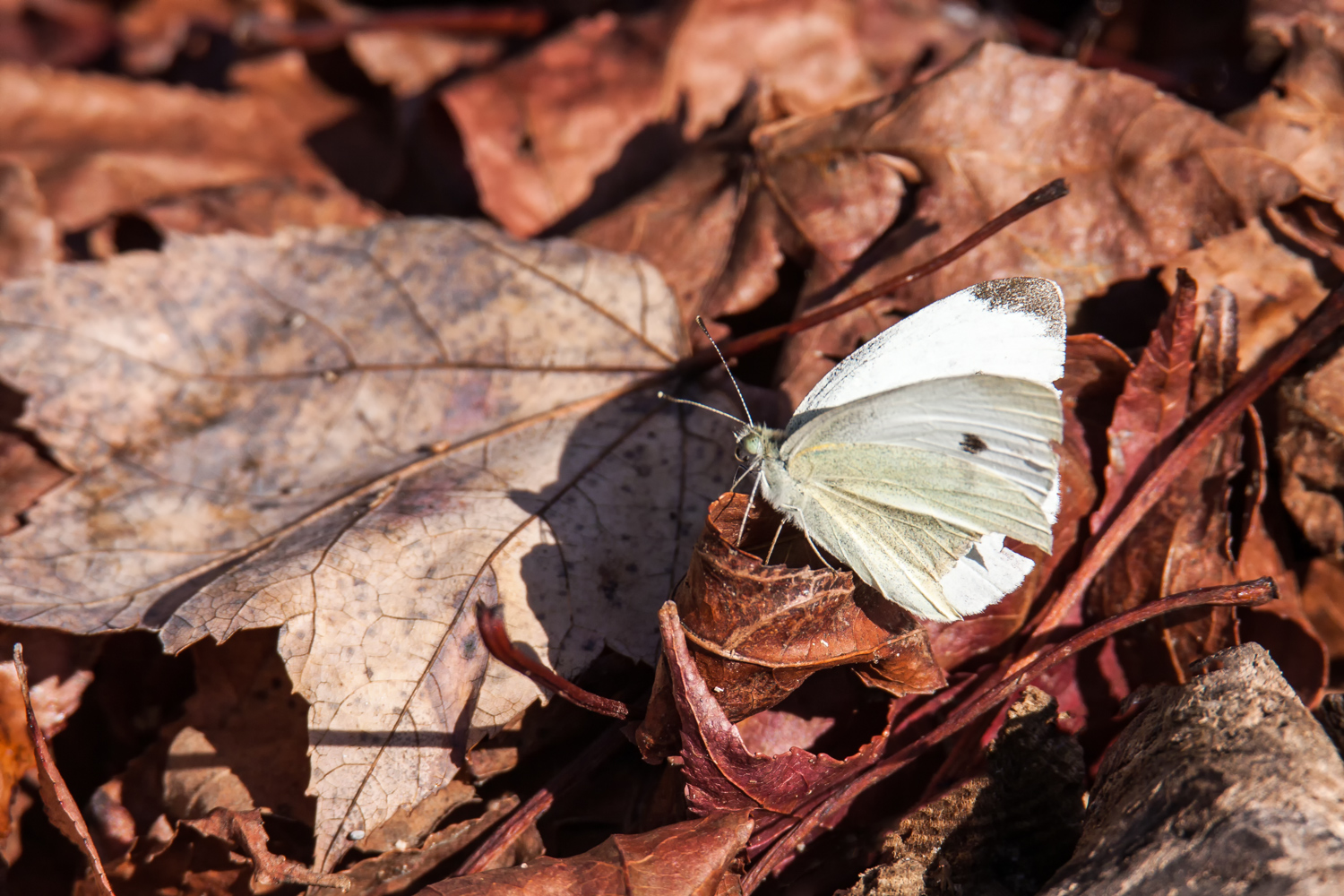
A butterfly in December? I was shocked and thrilled to see this tattered Cabbage White butterfly (Pieris rapae) flying around yesterday at Occoquan Bay National Wildlife Refuge.

I photographed this little butterfly with my telephoto zoom lens fully extended to 600mm. I contemplated cropping the image, but decided that I really like the look and feel of all of the fallen leaves and left it uncropped. I also like the way that the veining in the leaves seems to mirror the veining in the butterfly’s white wings.

Cabbage White

© Michael Q. Powell. All rights reserved.
Read Full Post »

Yesterday we were blessed with a sunny, warm day. The temperatures rose to over 60 degrees (16 degrees C) and my hopes that I might see some dragonflies increased correspondingly.

This autumn season we have already had some sub-freezing temperatures and even a couple of inches of snow. However, my past experience has shown that Autumn Meadowhawk dragonflies (Sympetrum vicinum) are unusually hardy.

Autumn Meadowhawks are small, about 1.3 inches (33 mm) in length and tend to perch on the ground, which is now covered with fallen leaves and other debris. As a result, it is pretty hard to spot these little dragonflies, despite their bright red coloration.

I searched and searched and eventually found a few of them at Occoquan Bay National Wildlife Refuge. I was able to capture a number of images and decided to feature this one, because it gives you a good look at the dragonfly’s beautiful two-toned eyes.

Today we are back to cooler temperatures and there is snow in the forecast for this weekend. Will this be my last dragonfly of the season? I will continue to search for dragonflies for another month or so, though I know that my chances of finding one of these beautiful aerial acrobats will continue to drop.

Autumn Meadowhawk

© Michael Q. Powell. All rights reserved.


Read Full Post »

The gentle paddling of this Pied-billed Grebe (Podilymbus podiceps) produced such wonderful patterns in the water that it was easy to fight the temptation to crop this image more closely. This is another one of the waterbirds that appeared recently at a pond in a nearby suburban neighborhood.

Virtually all of the visiting birds are skittish enough that they will swim away toward the center of the pond as I approach. Fortunately for me they swim a lot more slowly than they fly, so I generally have a chance to track them as they swim, hoping they will turn their heads periodically to the side.

Pied-billed Grebe

© Michael Q. Powell. All rights reserved.

Read Full Post »

This male Ruddy Duck (Oxyura jamaicensis) and I spotted each other at almost the same time and we both immediately sprung into action. As I was bringing my camera up to my eye, the duck was swimming away. I thought that I had lost the photo opportunity when suddenly the duck turned his head to the side and I was able to capture this image.

This Ruddy Duck, like the Hooded Merganser duck that I featured yesterday, has taken up residence in a small pond in a suburban neighborhood not far from where I live. I am thrilled, because it gives me a place where I can experience wildlife without having to travel too far. Things can get busy sometimes, especially at this time of the year, and I cannot always spend hours on end in the wild with my camera as I prefer to do.

Ruddy Duck

© Michael Q. Powell. All rights reserved.

Read Full Post »

I have occasionally been described as a bit of an “odd duck,” which Wiktionary defines as “an unusual person, especially an individual with an idiosyncratic personality or peculiar behavioral characteristics.” That definition certainly fits me (and most other wildlife photographers too, I suspect).

In a more literal sense, “odd duck” is a great way to describe the unusual-looking Hooded Merganser duck (Lophodytes cucullatus). There are no other ducks in my area that look anything like these ducks, so identification is never a problem. Getting good photographs of one, though, can be a problem, because Hooded Mergansers are small and often skittish.

I spotted this handsome male Hooded Merganser yesterday at a suburban pond not far from where I live in Northern Virginia. He was part of a group of about a dozen or so Hooded Mergansers. Most of the members of the group were out in the middle of the pond, but this one hanging out nearer the shore and I was able to get off a few shots before he swam away to link up with the rest of his group.

hooded merganser

© Michael Q. Powell. All rights reserved.

Read Full Post »

When I am out in the wild with my camera, my eyes are almost always in constant motion, scanning the skies and the ground, the trees and the fields, searching for subjects to photograph. Sometimes, though, I’ll stop, overwhelmed by the natural beauty of my surroundings, and may remain stationary for an extended period of time.

I had such an experience earlier this week when I was checking out a small pond at Occoquan Bay National Wildlife Refuge. The early morning light was just beginning to illuminate the tops of the trees. Although most of the leaves on the trees have turned brown, the sunlight caused them to glow a little, restoring them for a few precious moments to their former glory.

It may not be traditional to shoot a landscape photo with a telephoto lens, but that is what I had on my camera that moment. I zoomed out my 150-600mm lens to its widest position and tried to compose an image that captured the feeling of the moment.

I don’t shoot landscape images very often and probably violated some of the normal guidelines, but I am pretty happy with this image. Although generally I crop an image to focus a viewer’s attention on my primary subject, that did not seem necessary in this case.


morning light

© Michael Q. Powell. All rights reserved.

Read Full Post »

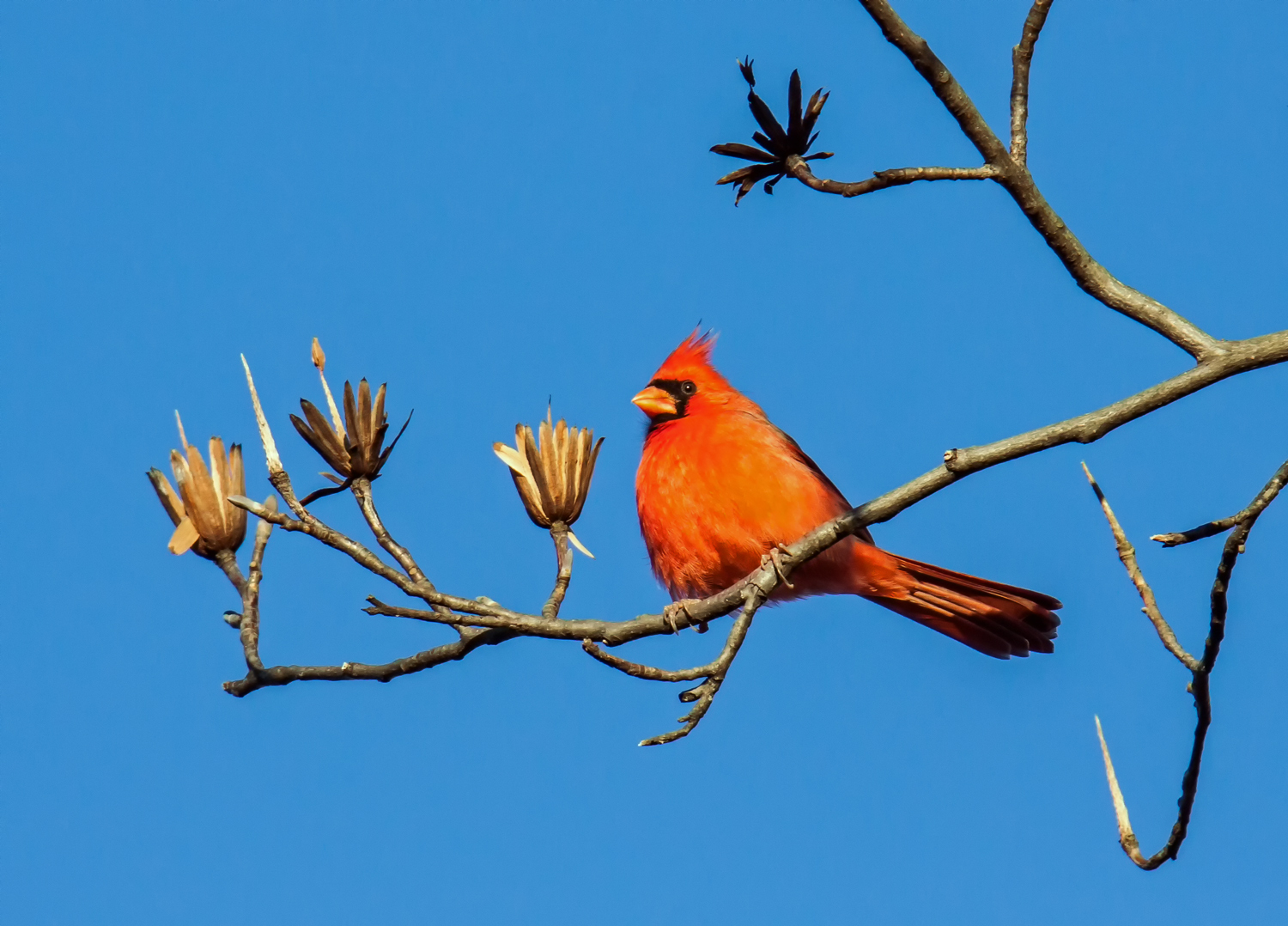
Sunshine and bright colors have been in short supply during the month of November. We have already broken the all-time record for rainfall in November in our area and will break the record for rainfall in a year if we have one more inch (25mm) of rain by 31 December.

I was therefore absolutely thrilled when I spotted this bright red male Northern Cardinal (Cardinalis cardinalis) high in a tree at Occoquan Bay National Wildlife Refuge earlier this week. Unlike so many other birds that try to blend in with their surroundings, the cardinal seems bold and self-assured—it is not at all hard to spot them, though they often bury themselves in the middle of bushes, so getting an unobstructed shot can be quite a challenge.

Comparatively speaking, this cardinal was cooperative and posed for a short while before finally taking off. His head was in constant motion, but eventually I was able to capture an image with the head in a decent position. Even with human subjects, I find it tough to shoot a portrait in which the head and eyes are in a natural and pleasing pose.

Northern Cardinal

© Michael Q. Powell. All rights reserved.
Read Full Post »

Most of the time that I see a Great Blue Heron (Ardea herodias), it is standing stationary in the water or is flying away from me. Yesterday, however, I saw herons in slightly more unusual places. One was crouching slightly as it perched on a low branch overhanging a path at Occoquan Bay National Wildlife Refuge and the other was huddled in a field adjacent to a small pond, half-hidden from view.

The first image is an obvious one to feature in a posting, but I also really like the way that I captured the heron’s surroundings in the second image and the heron’s yellow eye that seems to be peering out at me though the reeds.

Great Blue Heron

Great Blue Heron

© Michael Q. Powell. All rights reserved.

Read Full Post »

Whenever I walk the trails parallel to the water at Occoquan Bay National Wildlife Refuge I try to stay alert, because I never know when a Bald Eagle (Haliaeetus leucocephalus) will come zooming by, as this one did last week.

I had my camera already set to relatively appropriate settings and my biggest challenge was to acquire the eagle in my viewfinder before it flew out of sight. I was fortunate that the eagle was flying on a level plane, so I did not have to worry about having to zoom the lens in or out. I took a burst of shots and the image below was the one that I liked the best, primarily because of the wing position and the catch light in the eye.

Each opportunity to photograph a bird in flight is unique. I never know when circumstances will work together to permit me to capture a good in-flight image, but it feels almost magical when somehow I do.


Bald Eagle

© Michael Q. Powell. All rights reserved.

Read Full Post »

What does it mean to have your ducks in a row? For most of us, it means being well-prepared and organized in advance. Personally, I am a little scatter-brained and disorganized, so it is not a term that I would apply to myself very often.

As is the case with many such expressions, it is sometimes fun to apply them literally. Last week I spotted some Ruddy Ducks (Oxyura jamaicensis) in the waters off of Occoquan Bay National Wildlife Refuge. The wind was blowing pretty hard and the ducks seemed to be struggling to stay together. From my perspective, they seemed to be ducks in a row, though from their perspective, they probably felt like they were ducks in a column. It’s all a matter of perspective.

Most of the time that I see Ruddy Ducks, they are in groups like the one in the first photo, usually in the deeper waters. For more than a month, though, I have been seeing a solitary male Ruddy Duck in the more placid waters of a small pond at the wildlife refuge. I captured him in the second image below on the same day as the first shot. In both of the photos, you can see the stiff tail that is one of the distinguishing characteristics of this species.

I often wonder about the origins of expressions like “ducks in a row.” I assumed that it had to do with a mother duck and her ducklings, but decided to search the internet to see if that was the case. I came across a wonderful posting by The Word Detective that addresses speculation that the expression comes from the game of pool. It is a fun read, particularly the comments from readers suggesting that the expression is related to ship or aircraft construction or to duck hunting.

Ruddy Duck

Ruddy Duck

© Michael Q. Powell. All rights reserved.


Read Full Post »

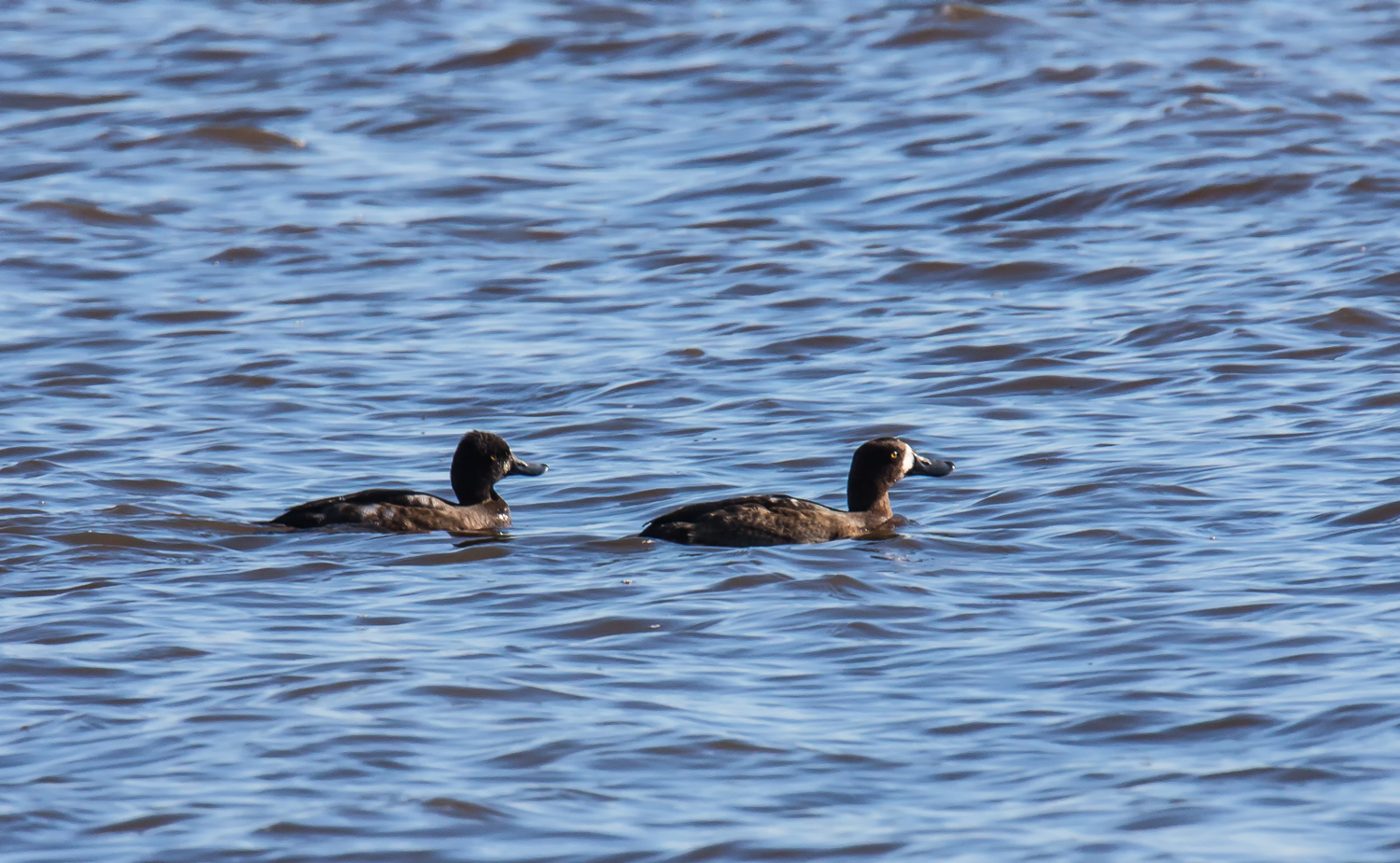
I have been seeing increasing numbers of scaups off of Occoquan Bay National Wildlife Refuge, but they stayed in the deep water, so I never managed to get a close look at them.

I think they are Greater Scaups (Aythya marila), but there is also a chance that they are the similar-looking Lesser Scaups (Aythya affinis). The differences between the two species are subtle enough that I do not feel at all confident in distinguishing between the two. The white stripe behind the bill indicates that the one in the first image is a a female. I think the one on the left in the second photo may be an immature female and the one on the right is almost certainly a female.

Greater Scaup

Greater Scaups

© Michael Q. Powell. All rights reserved.


Read Full Post »

Recently I have been seeing flocks of American Robins (Turdus migratorius) throughout Occoquan Bay National Wildlife Refuge. Growing up, I used to think of the appearance of robins primarily as a harbinger of spring. Where I live now, however, I see robins during most of the year.

Earlier this week during a period of the morning when the light was exceptionally beautiful I was searching desperately for a subject to photograph when I spotted this handsome robin in a bare tree. The branches of the tree were fascinating in their shapes and they became an important compositional element in the three images that I included in this posting.

American Robin

American Robin

American Robin

© Michael Q. Powell. All rights reserved.

Read Full Post »

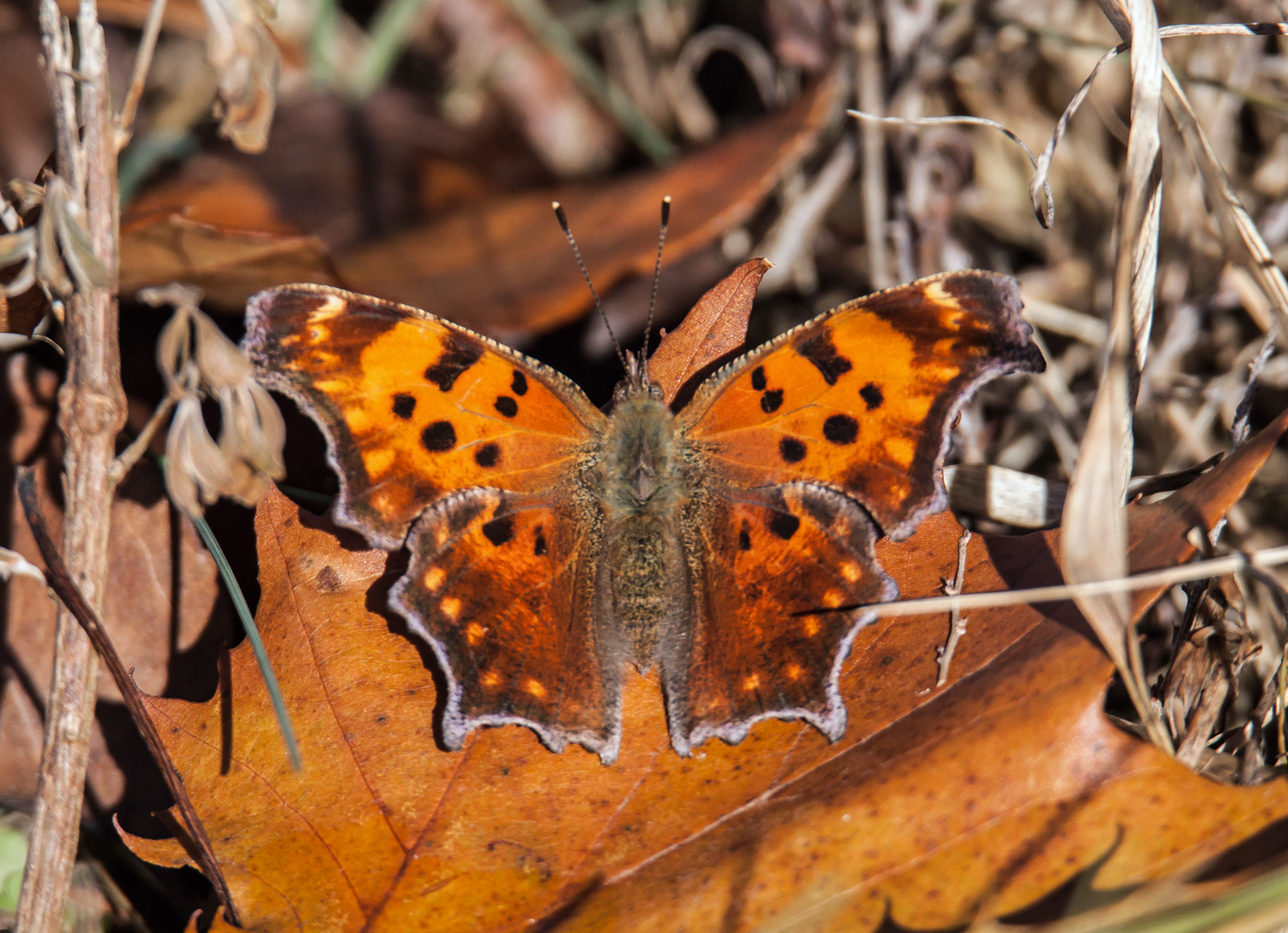
Because of our recent snow and cold weather, I was a little shocked on Wednesday to spot an Eastern Comma butterfly (Polygonia comma) at Occoquan Bay National Wildlife Refuge. This butterfly is a real beauty, but I fear that is may well be my last butterfly of the season.

Earlier in the autumn, this butterflies were a perfect match for the foliage.  Now, however, most of the leaves have fallen and are dried up, which makes this butterfly’s muted tones stand out as bright and vibrant.

Eastern Comma butterfly

© Michael Q. Powell. All rights reserved.


Read Full Post »

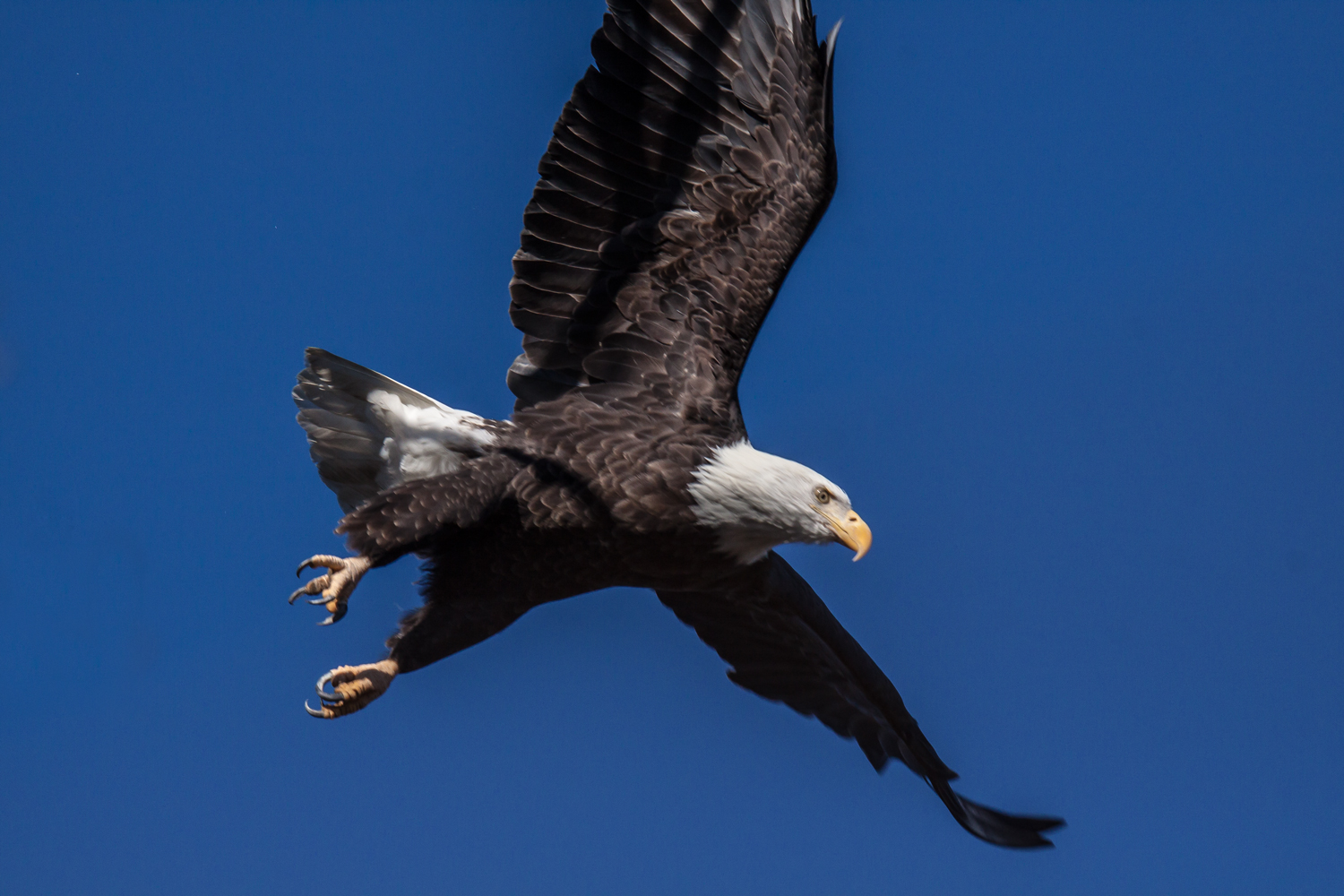
As I was observing a Bald Eagle (Haliaeetus leucocephalus) earlier this week at Occoquan Bay National Wildlife Refuge, something seemed to catch its eye and without warning the eagle took off into the air.

I was a little slow in reacting, but managed to capture an in-flight shot. The image you see is framed just as I took it. I was already partially zoomed out at 375mm on my 150-600mm, but that was not wide enough to capture the full wingspan of the eagle. When the action happens so quickly, it is hard to simultaneously track the moving subject and use the zoom—it is a bit like trying to rub your stomach and pat your head at the same time.

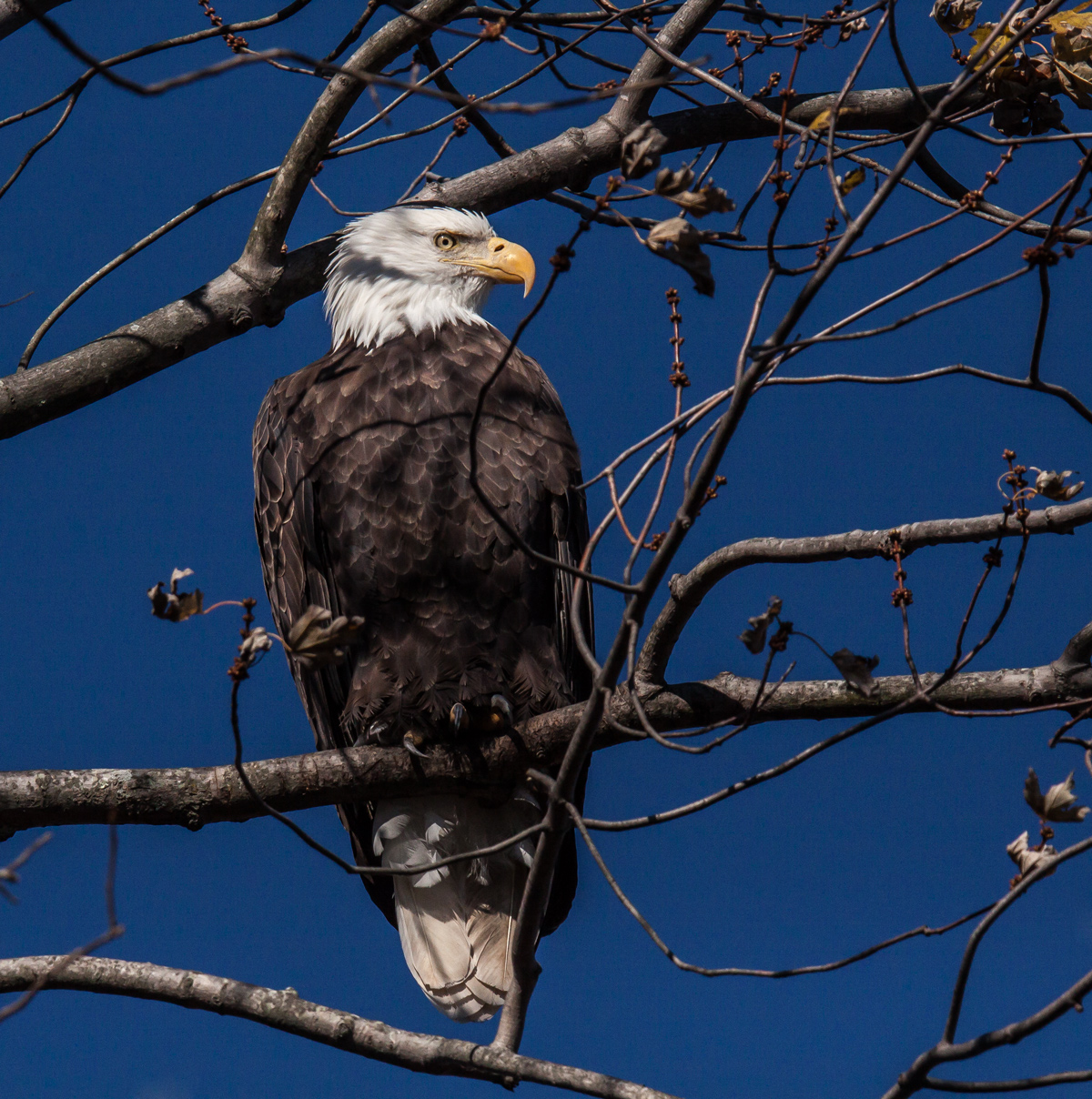
The second shot shows the eagle just before the takeoff. I like the tension of its body position and and the intense focus of the eagle’s eyes.

The final shot was taken before the other two and gives you an idea of how the eagle was perched as I approached it. There were a lot of branches surrounding the eagle and I tried to move slowly and cautiously to get a mostly unobstructed shot.

For those of you in the United States celebrating today, I wish you a very happy Thanksgiving Day. It is good to pause and reflect on all the blessings in our lives, not just on the one day each year that is set aside for doing so. I thank all of you for your continuous support and encouragement for me as I share my photography and my life in this blog. Over the last six years it has become part of my daily life and I consider many of you to be a part of my extended family.

“In everything give thanks.”

Bald Eagle

Bald Eagle

Bald Eagle

© Michael Q. Powell. All rights reserved.
Read Full Post »

I love the tranquility of the early morning, especially when I am alone with nature. It fills me with a sense of inner peace and helps me to slow down and appreciate better the world around me.

It is difficult to convey that inner feeling in a single photo, but this image of an Eastern Bluebird (Sialia sialis) from last week at Occoquan Bay National Wildlife Refuge comes pretty close. The bluebird was perched on some reeds in the middle of a marshy field. There was no way that I was going to be able to move closer, but I was ok with that. I focused on capturing a sense of the bird and its autumn environment and I am pretty happy with the way that the shot turned out.

Eastern Bluebird

© Michael Q. Powell. All rights reserved.


Read Full Post »

The colorful fall foliage has mostly disappeared and the natural world seems increasingly drab. At this time of the year, even tiny touches of bright colors are welcome, like the patches of yellow feathers on this Yellow-rumped Warbler (Setophaga coronata) that I spotted recently at Occoquan Bay National Wildlife Refuge.

On many of the Yellow-rumped Warblers that I see, the yellow markings seem pale and faded. I was really struck, though, by the intensity and saturation of the yellow on this particular bird. Yellow is one of those colors that never fails to lift my spirits, even when delivered in tiny doses.

Yellow-rumped Warblers

© Michael Q. Powell. All rights reserved.

Read Full Post »

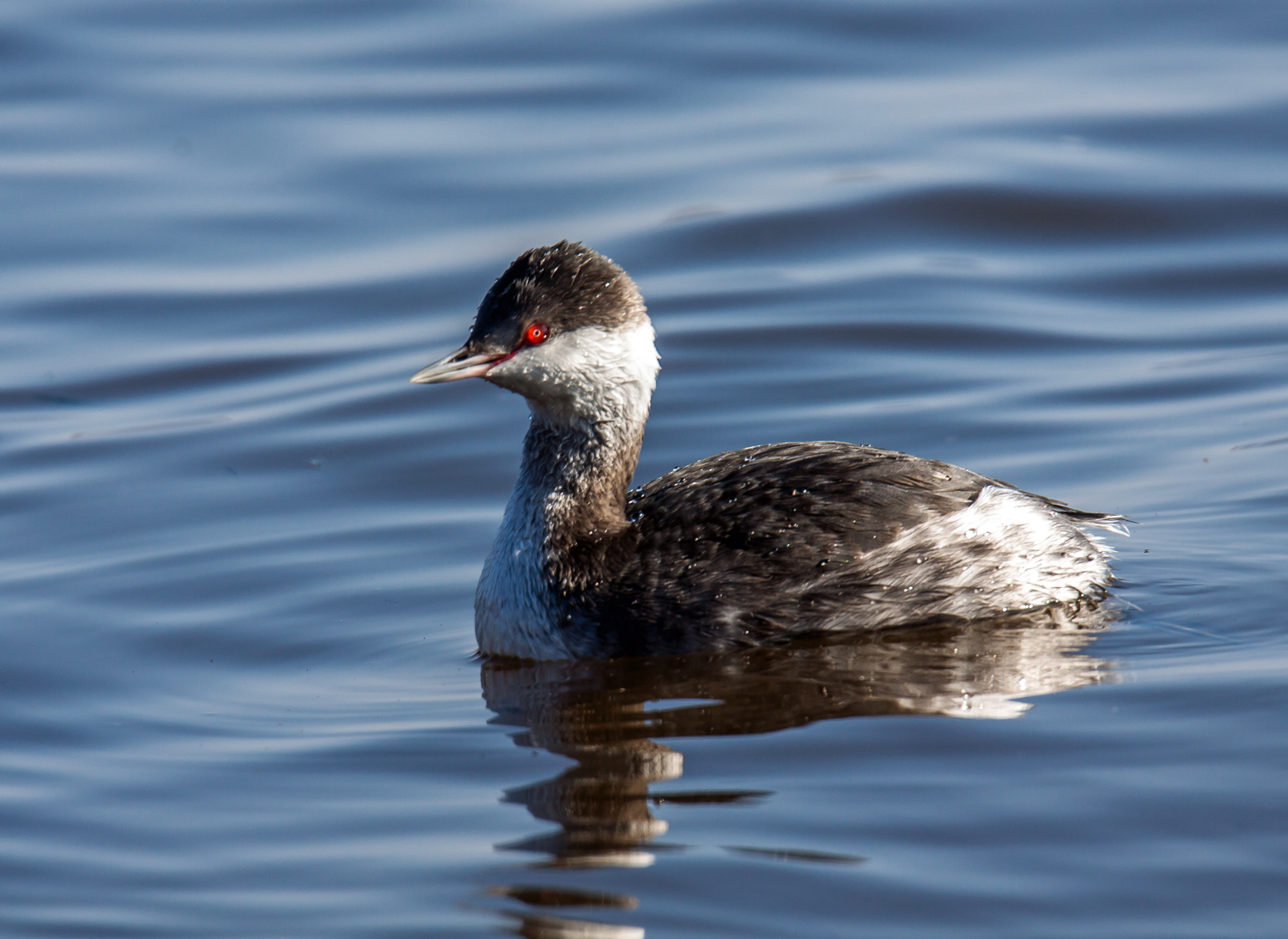
This past weekend I spotted a Horned Grebe (Podiceps auritus) while exploring Occoquan Bay National Wildlife Refuge. I tend to see this little diving waterbird only a few times a year and often it is so far from the shore that I am not able to capture a decent shot.

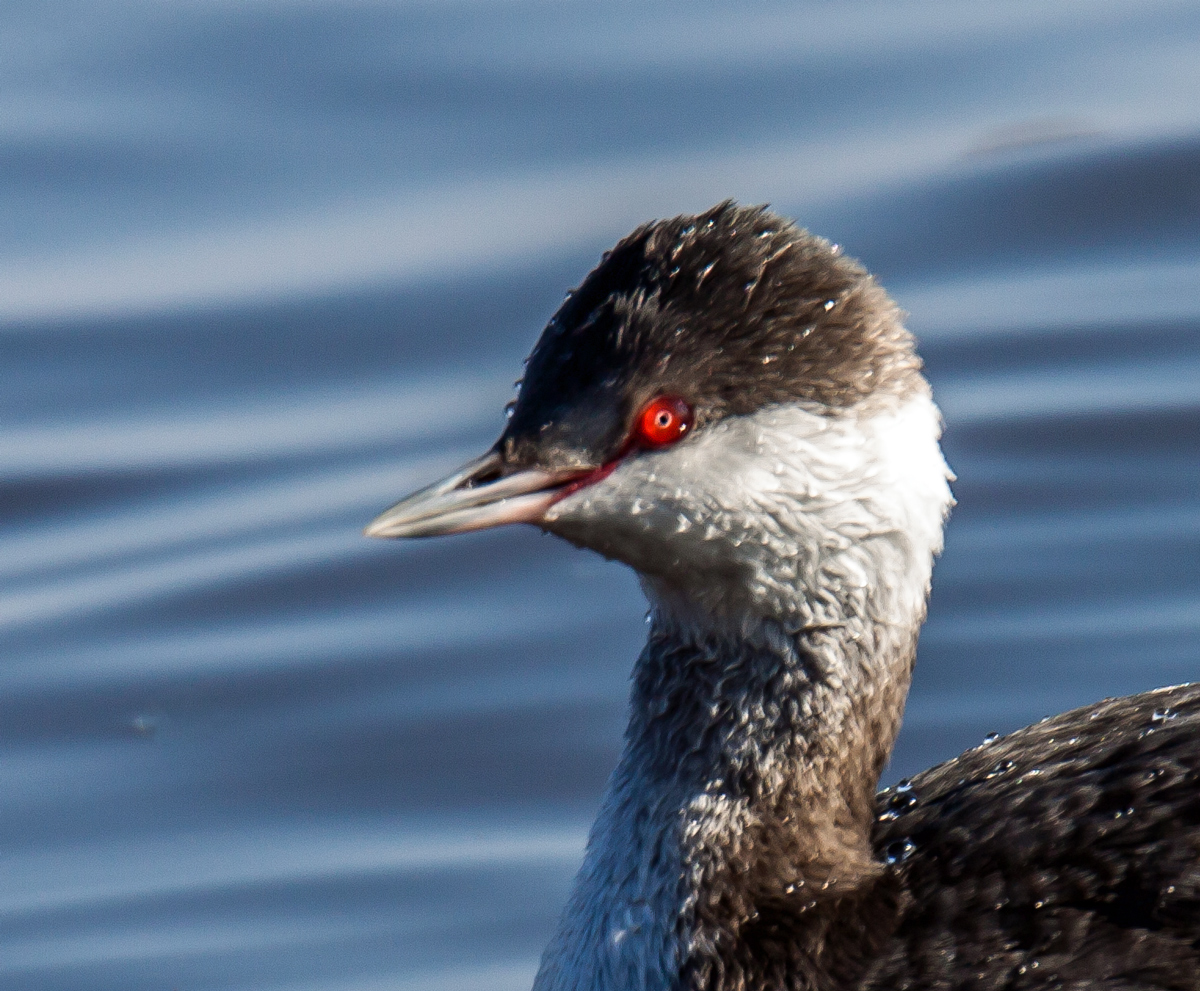
This grebe was within range and I watched it dive and resurface multiple times, hoping it would turn toward the sun so I could see its amazing looking red eyes trimmed with gold. Eventually my patience was rewarded and it turned in the proper direction.

The second image is merely a closer crop of the first one that gives you a closer look at those fantastic red eyes. Wow!

Horned Grebe

Horned Grebe

© Michael Q. Powell. All rights reserved.

Read Full Post »

Yesterday at Occoquan Bay National Wildlife Refuge I spotted this bright yellow warbler. Amazingly, it is actually called a Yellow Warbler (Setophaga petechia). There is sometimes a mismatch between the appearance of a bird and its official name, so I have learned that common sense does not always help in identifying a subject.

I was quite shocked when I first caught a glimpse of this little bird. The bright yellow on its body really stood out among the more muted tones of the fall foliage. I don’t know the normal dates for this warbler to be present, but I suspect that this is really late in the season for it to be around still.

We had several inches of snow this week and nighttime temperatures have dropped below the freezing levels. Most migratory birds, I suspect, have already passed through our area on the way to warmer spots.


Yellow Warbler

© Michael Q. Powell. All rights reserved.
Read Full Post »

When I spotted a small bird hanging from a branch, I zoomed in with my telephoto lens and discovered that it was a Yellow-rumped Warbler (Setophaga coronata). I could also see that there were numerous clusters of poison ivy berries on the branch, so I waited to see if I could capture an image of the warbler grabbing a berry.

The warbler turned its head away from me when it pulled the berry from the cluster, but fortunately turned back in my direction with the berry still visible in its mouth. I was really happy to get the shot and the warbler seemed to be berry contented.

Yellow-rumped Warbler

yellow-rumped warbler

© Michael Q. Powell. All rights reserved.
Read Full Post »

I am not sure what is so special about the small pond in Kingstowne, a suburban development not far from where I live, but every year about this time a group of Ring-necked ducks (Aythya collaris) shows up and generally spends the winter there. There are not too many other local places where I find this particular duck species.

I know that Ring-necked ducks are diving ducks rather then dabbling ducks like Mallards and I wonder if the depth of the water in the pond is the determining factor in their decision. I am always happy each year to see the golden eyes, striped bills, and odd-shaped heads of these Ring-necked ducks.

Ring-necked Duck

Ring-necked Duck

Ring-necked Ducks

© Michael Q. Powell. All rights reserved.


Read Full Post »

Northern Flickers (Colaptes auratus), the most colorful woodpeckers in our area, prefer to eat ants and other insects. Now that the weather had gotten colder and insects are scarcer, they have switched their diet to include more berries and seeds.

Earlier this week I spotted this male Northern Flicker (males have moustaches and females do not) foraging among the clumps of poison ivy berries in a tree at Occoquan Bay National Wildlife Refuge. The photos give you a sense of the wonderful colors and patterns on the body of this incredible bird.

I didn’t get to see the insides of the wings of this particular flicker, but Northern Flickers on the East Coast have beautiful yellow-shafted feathers on the underside of their wings and tails. On the West Coast, Northern Flickers have red moustaches and red shafts on the underside of their wings and tails.

Northern Flicker

Northern Flicker

© Michael Q. Powell. All rights reserved.
 

Read Full Post »

Leaves are now falling from the trees, making my walks though the woods increasingly crunchy. I feel like I am announcing my presence to all of the birds as I approach them. This little Yellow-rumped Warbler (Setophaga coronata) lifted its head for a moment to check me out, then returned to its foraging among the fallen leaves, probably having decided that I did not represent a threat.

Yellow-rumped Warbler

© Michael Q. Powell. All rights reserved.

Read Full Post »

« Newer Posts - Older Posts »