Feeds:
Posts
Comments

Archive for the ‘Art’ Category

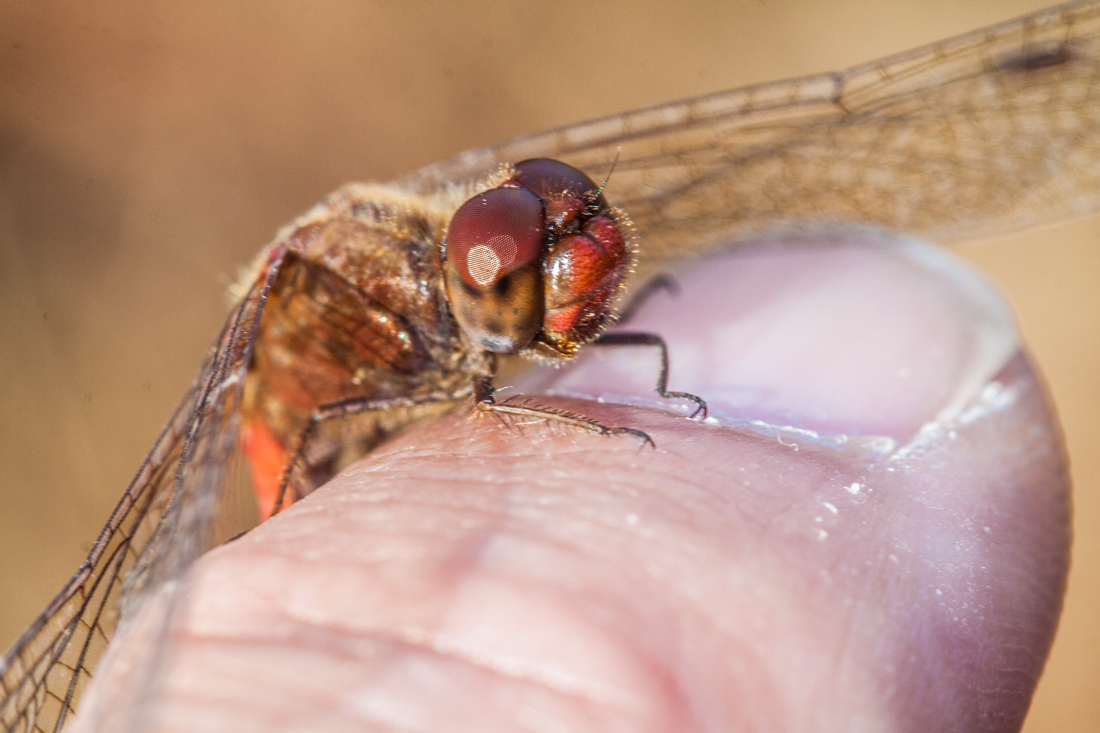
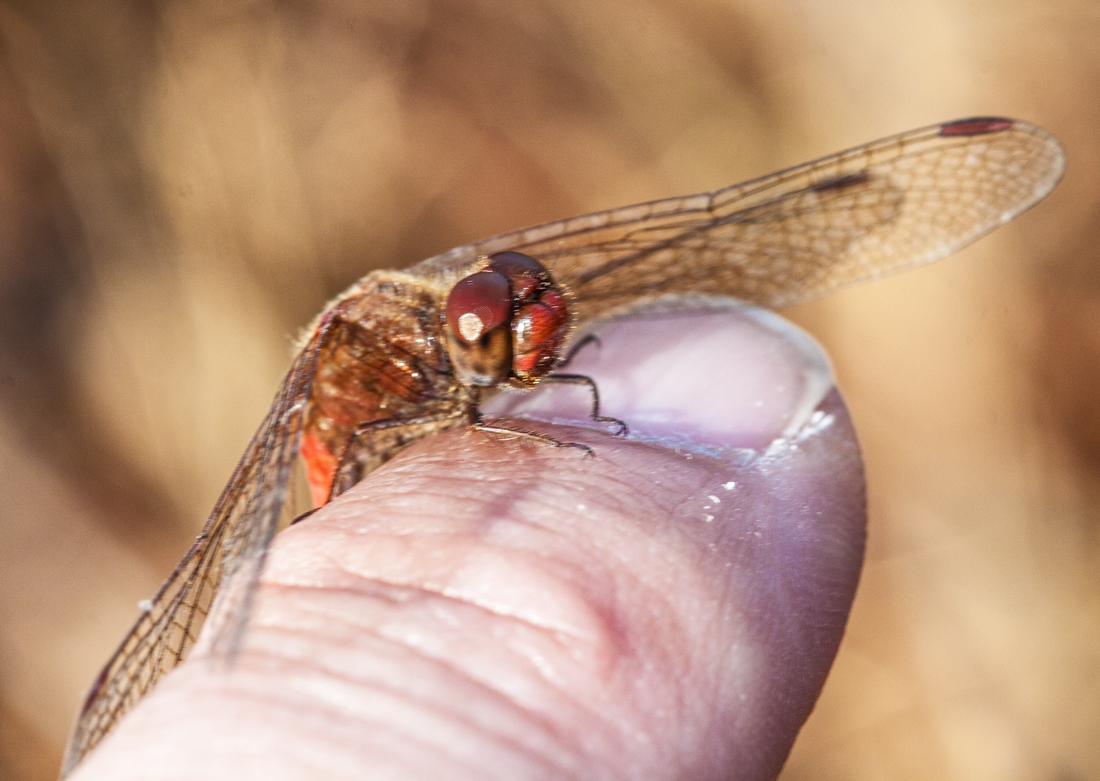
It may be mid-November, but one hardy dragonfly species is still around here in Northern Virginia—the Autumn Meadowhawk (Sympetrum vicinum).

The dragonflies were unusually friendly today, perching on my sweatshirt and jeans numerous times, though they spent most of the time trying to warm themselves in the sun on the boardwalk. Here is a close-up shot of a male Autumn Meadowawk that I coaxed onto my fingertip yesterday at Huntley Meadows Park. All I had to do was slowly move my finger forward and several times a dragonfly accommodated by crawling onto the finger.

Needless to say, it was an interesting challenge trying to hold one finger out as far as I could and then focus and shoot my DSLR with the other hand. Fortunately I had switched to my macro lens—my arms would not have been long enough to get within the minimum focusing distance of the telephoto zoom lens that I had been using earlier in the day. Click on the photos to get a higher-resolution look at the details of the dragonfly’s compound eyes.
dragonfly_finger2_blogdragonfly_finger1_blog

© Michael Q. Powell. All rights reserved.
Read Full Post »

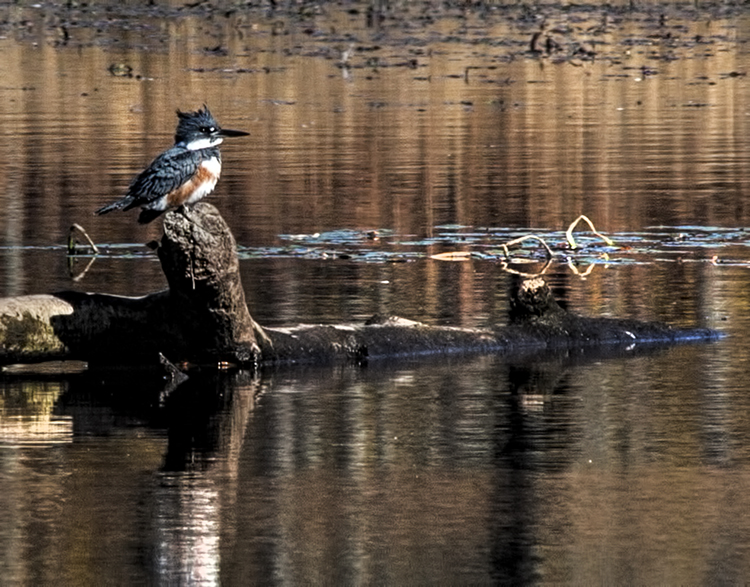
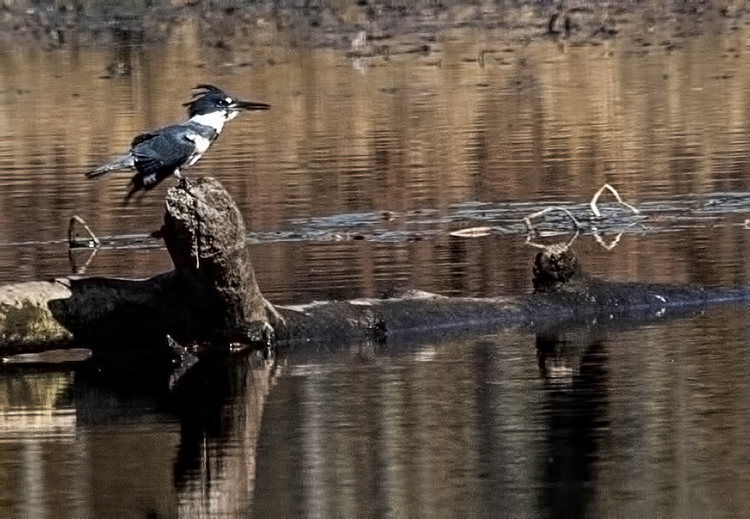
I was looking across the water of a small pond at my local marsh, enjoying the beautiful early morning reflections, when a bright white flash zoomed across my field of view and stopped in the middle of the water.

Initially I had no clue about what it might be, but when I looked through my telephoto lens, I could see that it was a female Belted Kingfisher (Megaceryle alcyon). I had never before seen a kingfisher perched so low to the water and it was pretty obvious that she was not fishing. As I watched from a distance, she went through what I assume is her morning routine, as she twisted and turned and fluffed up her feathers.

Before long, the kingfisher flew off to a higher perch in a more distant tree, where I suspect she busied herself with the task of catching some fish for her breakfast.

IMG_2587 crop webIMG_2519 Cropped web

© Michael Q. Powell. All rights reserved.
Read Full Post »

Sometimes you don’t have to make a choice between two options—you can have them both.

In this morning’s blog posting, I posed the question, “When it comes to images of birds in flight, do you prefer the sky as the background or some element of the earth?” and I received quite a few responses, with a greater number having a preference, in general, for background or contextual elements rather than a plain blue sky.

Sometimes I manage to get an image that incorporates the best of both worlds. This image, for example, has one Canada Goose against a leafy background, one against the sky, and one in between.

Who says you have to choose? (In the interest of full disclosure, I intentionally set up the question as a false dichotomy in order to stimulate thinking. For me, the best answer to the question I posed, which called on you to make a sweeping overgeneralization, was the person who responded quite simply with the words, “It depends.”)

geese_flying_cropped_blog

© Michael Q. Powell. All rights reserved.

Read Full Post »

When it comes to images of birds in flight, do you prefer the sky as the background or some element of the earth? Here are two photographs of Canada Geese (Branta canadensis) that I took this past Monday that illustrate my question.

Canada Geese are some of my favorite subjects as I try to improve my skills in photographing flying birds—they are relatively big, flight slowly (especially when taking off and landing), and, perhaps most importantly, there are a lot of them.

In some ways, it’s a little easier to track a bird in the sky, since there is nothing else to grab the camera’s focus (if you can lock in the focus quickly enough). However, the light is a lot more variable, particularly when a bird is circling, so proper exposure is a challenge and shadows are a sad reality. I was happy that I was able to time the second shot so that the light illuminated most of the underside of the goose. Some photographers, though, seem to look down at photos of birds in the sky and prefer more environmental shots.

I had to act quickly to get the shot of the goose with the trees in the background, when some geese took off and flew by me at almost eye level. The trees were far enough away that they blurred out and the head of the goose is mostly in focus. Depth of field is always an issue for me in shots like this—you can actually see the depth of field in the amount of the extended wings that is in focus.

So there you have it, two different shots of a goose in flight. Does the background play a role in your assessment of which one you prefer?

goose_flying_11Nov_blog

goose_flying2_11Nov_blog

© Michael Q. Powell. All rights reserved.

Read Full Post »

As I was going through some of my bird photos, I realized that a majority of them feature the male of the species. The males tend to be more loud and flashy, so I guess it’s not surprising that they draw my attention much of the time. The female often has a more delicate beauty and coloration, as is the case with this female Ring-necked duck (Aythya collaris) that I photographed recently.

I added an image of a male Ring-necked duck that I photographed the same day to allow you to make your own comparison and judgments. It may be a cliché, but it is nonetheless true that beauty is in the eye of the beholder.

ring-necked_female_blogring-necked_male_blog

© Michael Q. Powell. All rights reserved.

Read Full Post »

Do you still look at the clouds and see shapes as you did when you were a child? Sometimes the shadows and light and my imagination combine and cause me to see new things, like the leaves in this ginkgo tree that remind me of a flock of bright yellow butterflies.

Ginkgo trees are endlessly fascinating for me. Check out my earlier posting to see additional photos of my journey to a ginkgo grove a few weeks ago, including some close-up shots of ginkgo leaves and the fleshy seeds produced by the female ginkgo trees.

ginkgo_butterflies_blog

© Michael Q. Powell. All rights reserved.

Read Full Post »

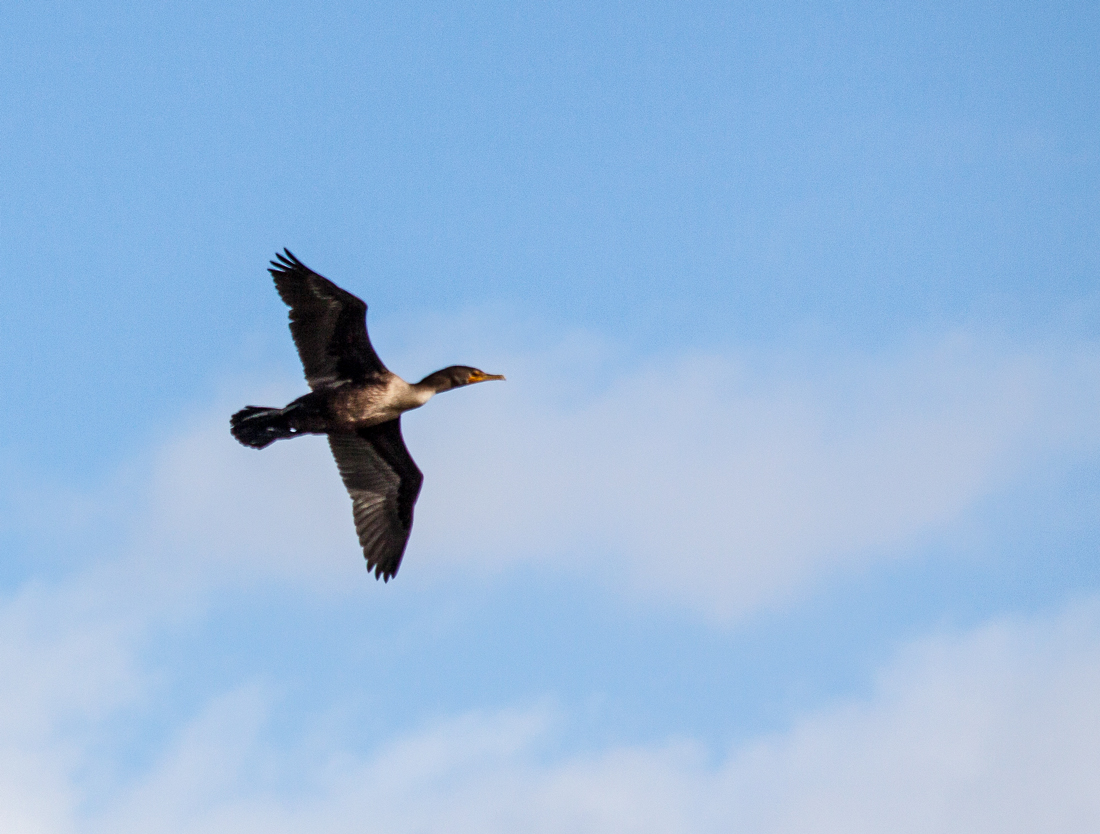
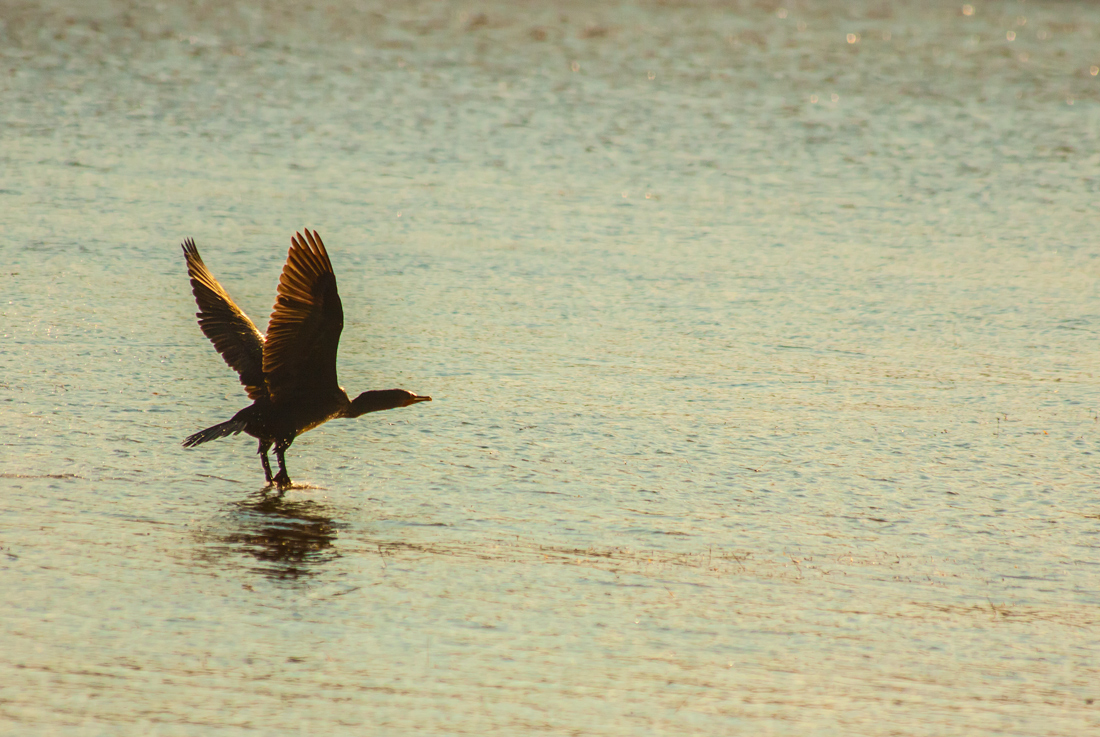
Two weeks ago I didn’t even realize that we had Double-crested Cormorants (Phalacrocorax auritus) in this area and now I can find quite a number of them on the Potomac River. It’s a little difficult to tell from the range maps in my bird guide if the cormorants are migrating through this area of if they may choose to winter here.

The more I observe these birds, the stranger they appear. The Cornell Lab of Ornithology described them this way—”The gangly Double-crested Cormorant is a prehistoric-looking, matte-black fishing bird with yellow-orange facial skin. Though they look like a combination of a goose and a loon, they are relatives of frigatebirds and boobies and are a common sight around fresh and salt water across North America.”

I am still working on getting some shots of the cormorants in the water, but as a start, here are a couple of images of a cormorant in the air. I took the first one before I knew that it was a cormorant—I have a habit of trying to capture anything in flight that is remotely in range. The second one shows a cormorant as he is taking off from the water after some bounding steps across the surface as he gained speed. The location of the light caused much of the cormorant’s body to be in the shadows, but did illuminate the details of some of its feathers.

cormorant_flying1_blogcormorant_liftoff_blog

© Michael Q. Powell. All rights reserved.

Read Full Post »

The wind was kicking up yesterday on the Potomac River, making it difficult for the ducks there, like this Ruddy Duck (Oxyura jamaicensis). I watched as the small ducks got drenched repeatedly as they sought to ride the waves.

At least it wasn’t raining and the temperatures have not yet dropped below the freezing levels, even at night.

ruddy_waves_blog

© Michael Q. Powell. All rights reserved.

Read Full Post »

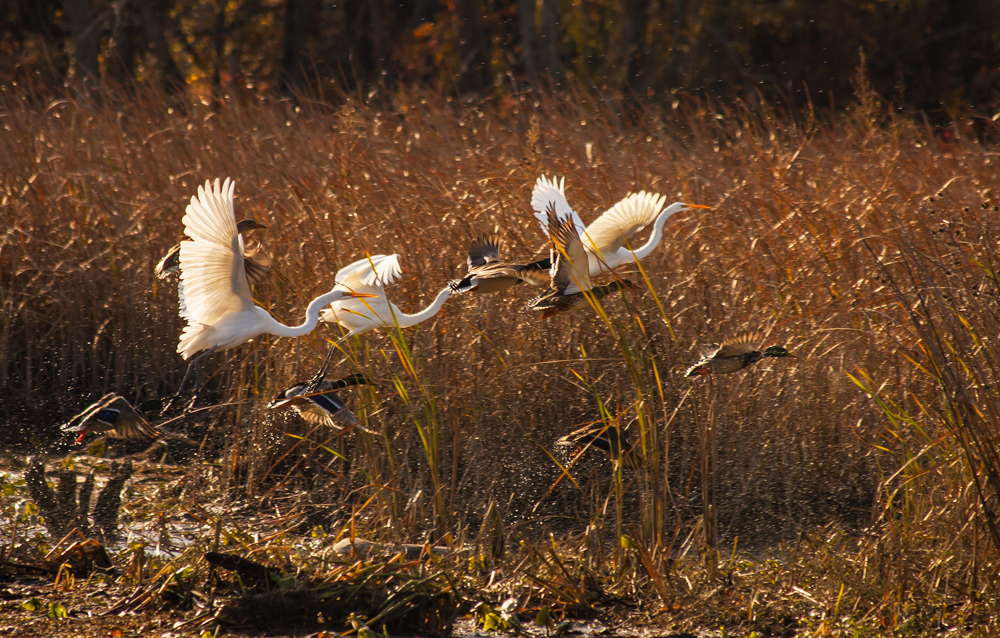
I was watching some Great White Egrets (Ardea alba) yesterday at Dyke Marsh Wildlife Preserve, a freshwater tidal wetland on the Potomac River, when something startled the birds.

The egrets and some mallard ducks took off from the water en masse in a great explosion of water. I captured some of that noise and confusion in the second photo. The photo I chose to feature shows the birds a short after the take off as they start to lift off a little and fly over a meadow-like area with tall golden grass. The light was especially beautiful on the wings of the egrets, which happily I managed to capture without blowing out the highlights as sometimes I do with these very white birds.

Click on the photos to see some of the beautiful details of the birds in greater resolution.

takeoff_group1_blog takeoff_group2_blog

© Michael Q. Powell. All rights reserved.
Read Full Post »

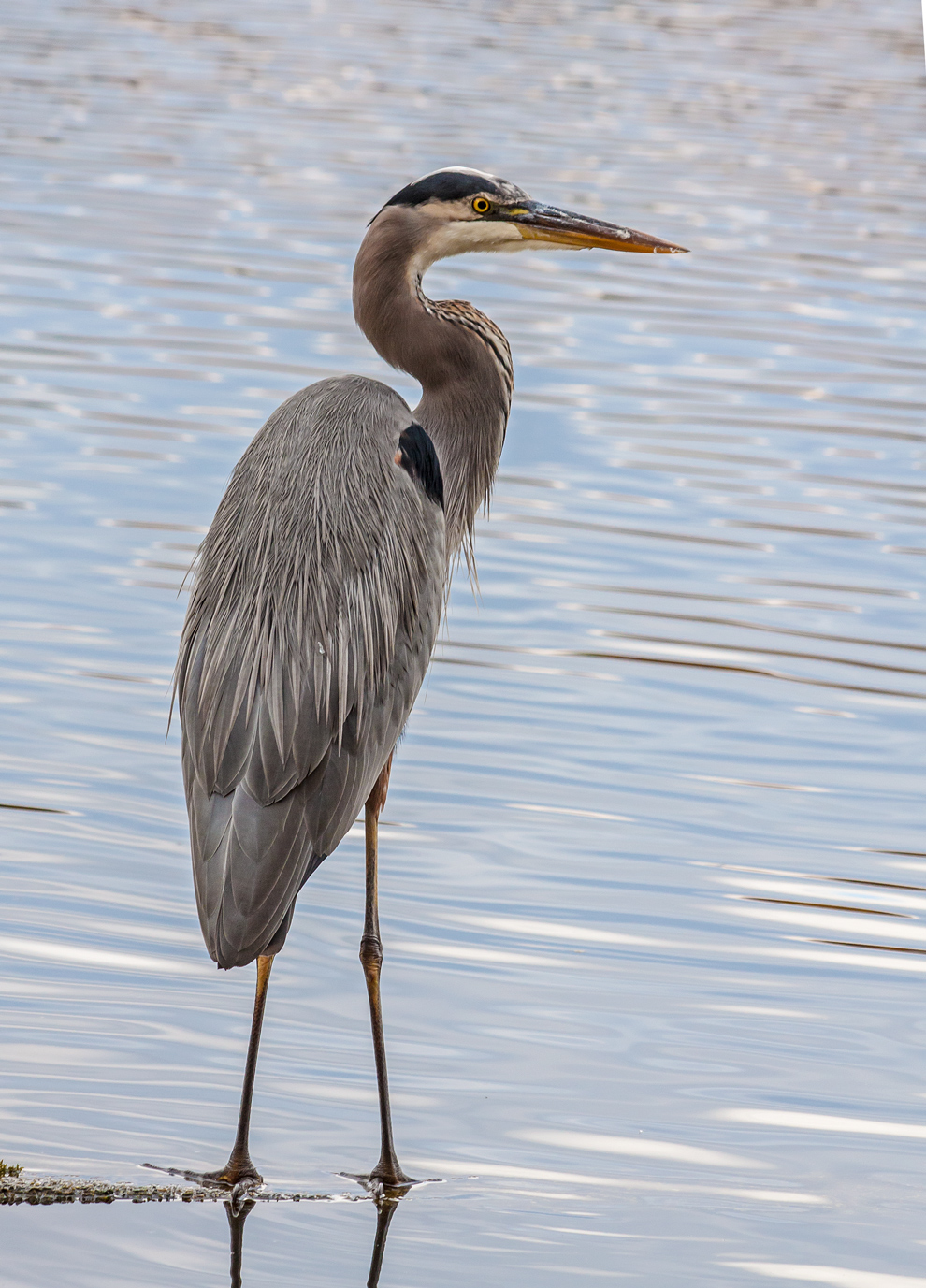
I felt like this Great Blue Heron (Ardea herodias) was modeling for me when it climbed out of the water onto a narrow slab of concrete and struck a pose. It was unusual for me to see a stationary heron out of the water—usually when I see them out of the water, they are flying. The blue waters make it look like I shot this in some exotic, tropical location, but I took this photo only a mile or so from where I live, at a small suburban pond surrounded by townhouses on one side and a well-travelled road on the other side.

heron_out_of_waterblog

© Michael Q. Powell. All rights reserved.
Read Full Post »

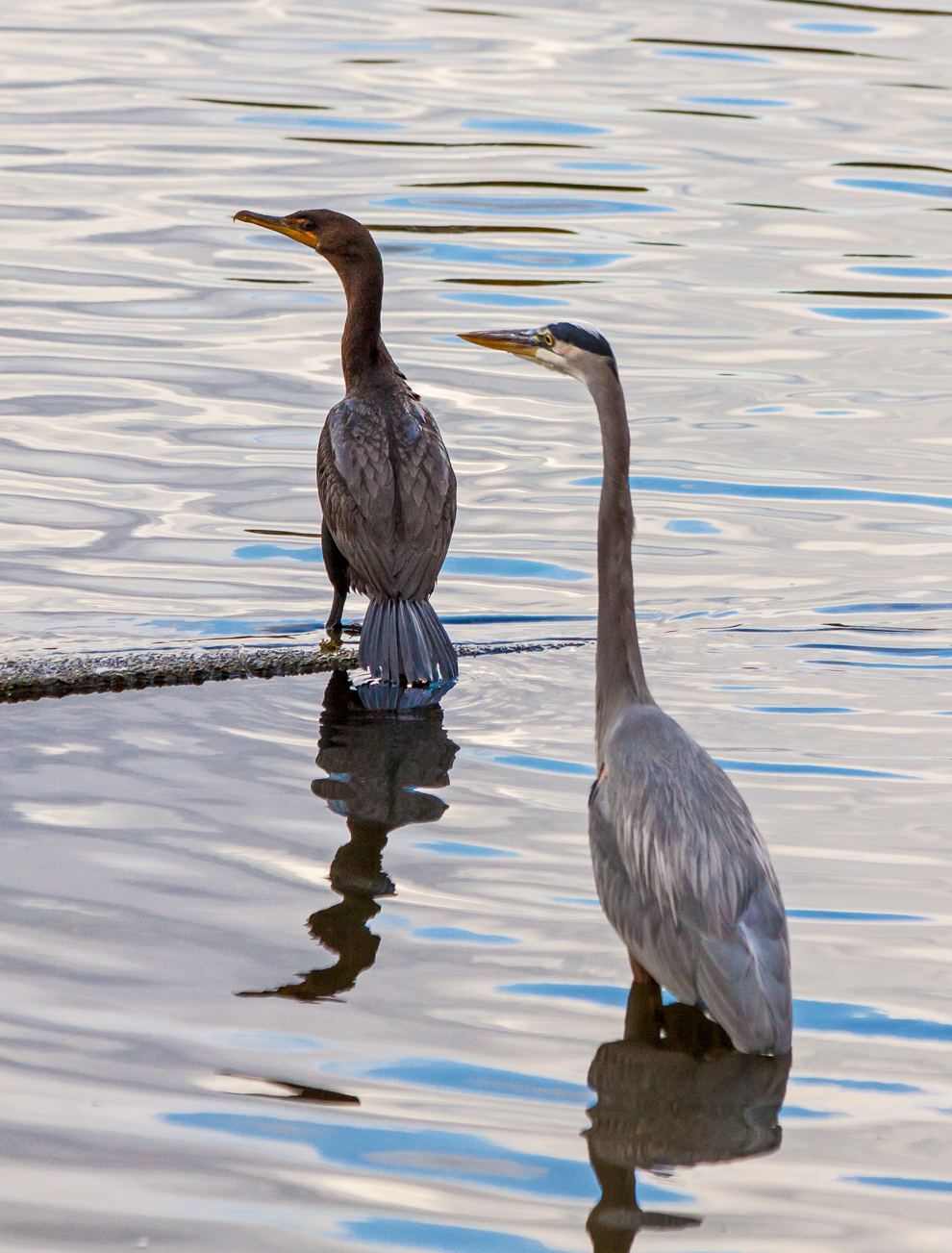
Who knew that the man-made pond in a nearby suburban neighborhood would be a favorite spot for juvenile birds to hang out together?  That’s what it looked like when I spotted an immature Double-crested Cormorant (Phalacrocorax auritus) and an immature Great Blue Heron (Ardea herodias) together, both with their heads turned in profile, probably checking out some cute little female goose.

Actually, I couldn’t immediately identify the cormorant, though it was obvious that it was neither a duck or a goose. The way that it swam with its long neck extended and its bill pointed in the air, however, was distinctive enough to make it easy to find in my identification guide.

I like the way that these two birds posed for me, with the cormorant perched on a narrow concrete slab to compensate for the heron’s greater height and the synchronized head positions. I have seen this young heron hanging around the pond before (it’s the same heron that I featured in the Crouching heron posting this morning), but I don’t think that I have seen a cormorant there before. Usually there are only geese and occasionally some ducks, like the small flock of Ring-necked ducks that are there right now.

cormorant_heron_blog

© Michael Q. Powell. All rights reserved.

Read Full Post »

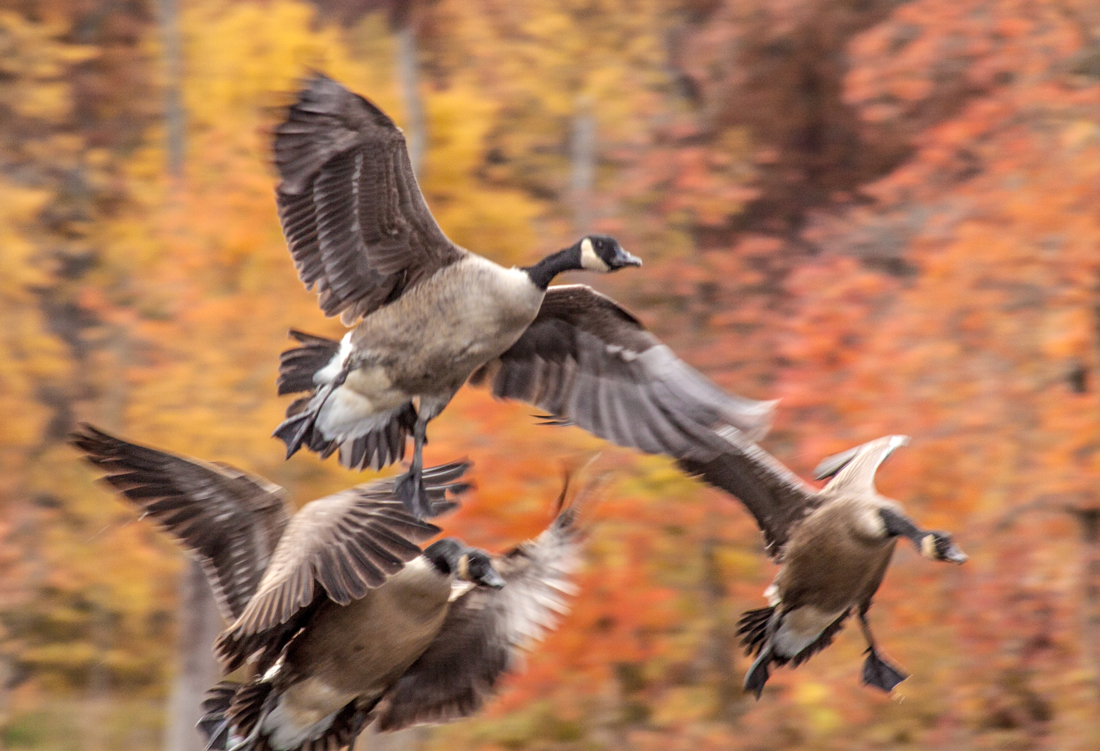
Standing at the end of a small pond, I heard the sounds of an approaching flock of Canada Geese (Branta canadensis). I looked all around as I prepared to track them and couldn’t help noticing areas of beautiful autumn foliage.

Wouldn’t it be cool  if I could capture the geese landing with the colorful leaves as a background? I put that idea in the back of my mind, remembering that it was going to be tough enough to capture decent shots of the geese without worrying about the background.

It’s a noisy crazy couple of moments when the geese come in for a landing—they come in waves and there is so much activity that it’s hard to figure out what to focus on. Usually, as I did here, I will try to concentrate on a single bird as it approaches and to keep it in focus.

I captured this image at the moment when the geese were slowing down just prior to entry into the water. My main subject is in a pretty good focus and the other geese are in interesting positions. I was surprised that I was able to get the orange background—it had been a hope, but certainly not an expectation. The result is an image that I really like, an image that combines two of the iconic elements of the autumn.

geese_landing_fall_blog

© Michael Q. Powell. All rights reserved.
Read Full Post »

Some spiders can be creepy, but others are quite beautiful, like this one that I photographed earlier this month at my local marshland park. I am catching up a bit on posting photos from this month that I really liked and thought it might be good to post a spider image on Halloween night. I have not yet been able to identify this spider, but noted that it did not have a web and seemed to be lying in wait for prey on the long leaf of this plant. I’d welcome assistance in identifying the species of spider,

spider_halloween_blog

© Michael Q. Powell. All rights reserved.

Read Full Post »

On Halloween night, it somehow feels appropriate to post this photograph of a spider web that I took earlier this month. Some people find spider webs (and spiders) to be creepy, but I find them to be fascinating.  I look at spider webs as a form of beautiful natural art, filled with wonderful geometric shapes and designs and always marvel at the ability of spiders to weave them.

web_halloween_blog

© Michael Q. Powell. All rights reserved.
Read Full Post »

Turnabout is fair play. In one of my earlier posts entitled “Dragonflies mating on a calf” I featured Walter Sanford, a fellow photographer and blogger. Today, in a posting called “The natives are friendly.” he featured my arm and finger as I tried to charm a couple of different dragonflies to perch on my index finger.

waltersanford's avatarwalter sanford's photoblog

Most dragonflies are skittish. Some dragonflies are “friendly,” such as Blue Corporal dragonflies (Ladona deplanata). Autumn Meadowhawk dragonflies (Sympetrum vicinum) are friendly; sometimes very friendly!

Mike Powell and I visited Huntley Meadows Park recently. We stopped to “charm” dragonflies a couple of times during our photowalk. The following gallery shows two different male Autumn Meadowhawk dragonflies perching on Mike: Photos 1-2 show Mike coaxing a dragonfly onto his finger; Photos 3-4 show another dragonfly perching on Mike’s arm.

Tech Tip: Either mouse-over or tap photos to see captions.

Copyright © 2013 Walter Sanford. All rights reserved.

View original post

Read Full Post »

The first time I saw a bird that looked like this, I thought it was a sparrow of some sort. When I saw this one, last week, I knew immediately that it was a female Red-winged Blackbird (Agelaius phoeniceus).

I have learned a lot about birds and photography this past year.  Along the way I also have learned more about myself as I seek to express myself in my words and in my images.

red-winged_female_blog

© Michael Q. Powell. All rights reserved.
Read Full Post »

I haven’t seen many migrating ducks yet at my local marsh, so I traveled to the Potomac River this weekend, because I had heard from a birder that there were numerous ducks there. There were lots of Mallards, some Northern Shovelers (I think), and this cool-looking duck with a distinctive white patch on its cheek that I could not identify initially. After I returned home, it didn’t take long to figure out that this as a Ruddy Duck (Oxyura jamaicensis), a species that I had never seen before.

ruddy_duck1_blog

© Michael Q. Powell. All rights reserved.
Read Full Post »

My eyes caught a flash of bright blue yesterday as I was walking through Huntley Meadows Park, my local marsh, and I pointed my telephoto lens at the tree in the distance.

As I composed this shot, I was initially a little confused by what I saw. The reddish-brown color of the breast and the fact that there were some blue feathers made me think that it was an Eastern Bluebird (Sialia sialis), but the bird’s body didn’t seem blue enough. After doing a little research when I got home, I realized that most of the bluebirds that I had seen previously must have been adult males—as is the case with many other birds, the female Eastern Bluebird is more subdued in color than the male.

I didn’t have a lot of time to frame this shot, so I was happy that I managed to center the bird on the dark spot in the background and to surround it with some colorful fall foliage. All of the orange color in the image really helps the blue on the wing to pop, which is not too surprising since, if I remember color theory correctly, orange and blue are complementary colors.

bluebird_autumn_blog

© Michael Q. Powell. All rights reserved.

Read Full Post »

This past weekend I traveled with some friends to photograph a large grove of ginkgo trees at the Blandy Experimental Farm of the State Arboretum of Virginia in Boyce, VA. It was a beautiful day, with bright blue skies, and I took some shots that I will probably include in a more extended post, but I wanted to give you a sneak preview of the really-cooling looking leaves of the ginkgo (Ginkgo biloba) tree, a tree that dates back at least 270 million years, judging from ginkgo leaf fossils that have been uncovered.

GInkgo Vertical blog

© Michael Q. Powell. All rights reserved.

Read Full Post »

Despite the frost that we’ve had the last few mornings, the gorgeous Morning Glory flowers of my neighbors continue to flourish. I photographed one of the flowers yesterday afternoon—does that make it an afternoon glory?

When you look at the photo it looks like I used flash, which caused the background to go black. However, if you look carefully at the way the light falls, with some of it coming from the back, you realize I would have had to use an elaborate multi-light setup to get this kind of lighting. I took this shot in the early afternoon, with the light mostly coming from the side and back of the flower.

My fellow photographer and blogger CIndy Dyer says that the shadow in the bottom area of the white part of the flower looks like a photographer (possibly with a bald head) with a camera and long telephoto lens and she initially thought I had somehow managed to get a reflection of myself onto the flower. We may have spent too many hours yesterday out in the sun with our cameras!

Glory Photographer blog

© Michael Q. Powell. All rights reserved.

Read Full Post »

The bright fall colors of the trees at the pond’s edge were reflected beautifully in the water and I waited until the Great Blue Heron (Ardea herodias) moved into those reflections to capture this shot.

The effects of the light on the water remind me a little of some of the paintings of Monet, one of my favorite artists. Normally when I am photographing birds, I do my best to fill the frame with them, but in this case the context was actually more important to me than the apparent subject.

heron_fall_light_blog

© Michael Q. Powell. All rights reserved.

Read Full Post »

Migrating birds are starting to arrive in my area, including a few Ring-necked ducks (Aythya collaris) that I observed last week in a man-made pond in a nearby suburban housing area. The water in my local marsh tends to be too shallow for these diving ducks, but this pond seems to suit them pretty well.

The ducks tend to stay near the center of the pond, which makes them a little challenging to photograph. These shots were taken from a distance, but they let you see some of the beautiful details of the male Ring-necked duck, including the pattern on his bill and his beautiful golden eyes.

If I have the good luck that I had last year, I look forward to seeing and photographing another half-dozen species of ducks in the coming months.

ring-necked_duck2_blog

ring-necked_duck1_blog

© Michael Q. Powell. All rights reserved.

Read Full Post »

Although I have been seeing a lot of cardinals recently, most of them seem very skittish and fly off as I approach. This Northern Cardinal (Cardinalis cardinalis) flew away a short distance and observed me from a tree where he was almost surrounded by the foliage.

With that bright red coloration, though, it’s a little hard to conceal yourself entirely.

cardinal_foliage_blog

© Michael Q. Powell. All rights reserved.

Read Full Post »

I am not really sure what these spiders were doing, but it looked to me like they were engaged in a game that I played as a child called “King of the Hill.” The objective of the game was to climb to the top first and then to repel the efforts of the others trying to unseat you and take your place.

The two spiders seemed to be racing to the top of this plant’s stalk in the first photo and the second image shows that the one on the left was the winner. Somehow that second image reminds me of the iconic shot of King Kong on the Empire State Building, clutching the spire of the building.

It was a challenge trying to track moving subjects like this with a macro lens and my need for a higher shutter speed caused me to sacrifice some depth of field. I do like the simple, uncluttered composition that I was able to achieve and the fact that I was able to capture these little spiders in action.

spider_games2aspider_games1a© Michael Q. Powell. All rights reserved.

Read Full Post »

Have you ever watched a coot swim? When I first spotted this American Coot (Fulica americana) earlier this week at my local marsh, I thought it might be a duck. Once it started swimming, I could tell immediately that it was a coot.

Coots have a really clumsy way of swimming. They thrust their necks forward and then back, as if to generate momentum to propel themselves forward. The two photos show two different positions that the coot assumes while swimming. The Cornell Lab of Ornithology that coots, unlike ducks, don’t have webbed feet, but instead each one of the coot’s long toes has broad lobes of skin that help it kick through the water. In fact, they are closer relatives to Sandhill Cranes than to Mallards.

This coot was by itself and may be migrating through this area or may become a resident here for the winter. I was happy that I saw the coot in a relatively open area of the marsh. A short time later, the coot swam into the cattails and disappeared from sight.

Given the popular use of the term “coot,” I wonder if I am old enough to qualify as an American coot too.

coot_swimming2_blogcoot_swimming1_blog

© Michael Q. Powell. All rights reserved.

Read Full Post »

Like most people who live in the the Washington, D.C. area, I don’t visit monuments much unless there are visitors. One of my fellow photographers invited me to photograph the Capitol on Friday evening to satisfy the wishes of a visiting photographer.

We were quite a sight as we set up umbrellas and tripods in the rain which fell progressively harder and harder. My favorite shot is the first one, which shows the reflection of the Capitol in one of the wet, slippery stairs leading up to it.  I tried a number of long exposures, varying from about 15 to 30 seconds to get this look.

The second one is a more traditional view, but I think that the lighting was pretty cool at that time of the evening.

capitol2_blogcapitol1_blog

© Michael Q. Powell. All rights reserved

Read Full Post »

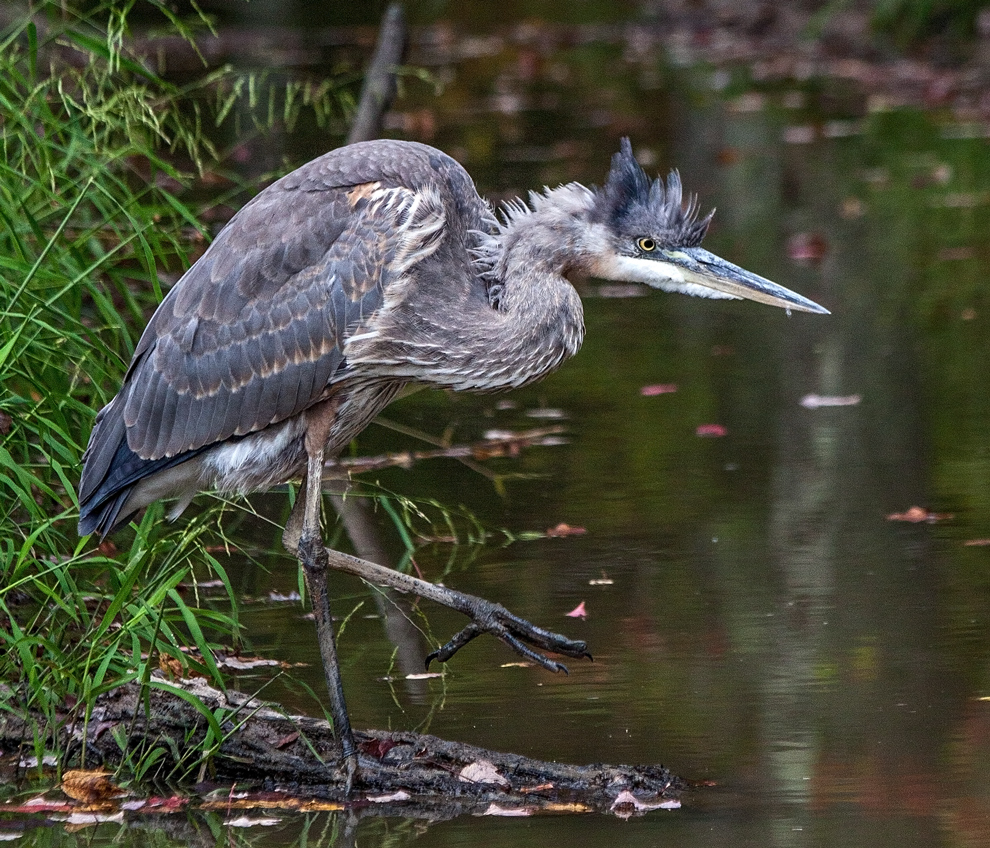
A blue heron with attitude? The pose, facial expression, and hair style of this Great Blue Heron (Ardea herodias) at Huntley Meadows Park, my local marsh, remind me of a punk rocker. Do you think he has tattoos and body piercings too?

heron_punkrocker_blog

© Michael Q. Powell. All rights reserved

Read Full Post »

This week we are caught in a weather system with constant gray skies and rain, so I need a splash of color to lift my spirits, like this immature male Common Yellowthroat (Geothlypis trichas) that was hiding in the lower levels of the cattails last week.

The little yellow bird was in almost constant motion and was often obscured by the stems of the underbrush, but I did manage to get a few relatively unobstructed shots when the bird poked its head into an open area. As is often the case, I also managed to get a shot as the bird flew away. Normally that means that the bird is partially out of the frame, but this time the bird flew almost straight down and I got a fun little final image.

yellow_brush_blogyellow_brush2_blogyellow_brush3_blog

© Michael Q. Powell. All rights reserved

Read Full Post »

Sometimes I don’t want to freeze motion entirely in the way that I did in a photo of a Canada Goose landing in the water that I posted earlier today.

Here is another shot of a Canada Goose in which I panned the camera, helping to blur the background, and the slower shutter speed left a certain amount of motion blur in the wings, helping to enhance the impression of speed. My camera was in aperture-priority mode and the shutter speed dropped when the goose that I was tracking flew against the darker background of the trees.

I really like the overall feel of the image, the sense that the goose is straining to slow down as it prepares for landing, but is still moving forward at a fast speed. Is the image “tack sharp?” No, it’s not, but I am happy that it is not—it’s a creative choice. Check out a recent posting entitled “Chasing the tack sharp mirage” by Lyle Krahn, one of my favorite photographers, for a provocative  discussion about this topic.

goose_flying_blog

© Michael Q. Powell. All rights reserved

Read Full Post »

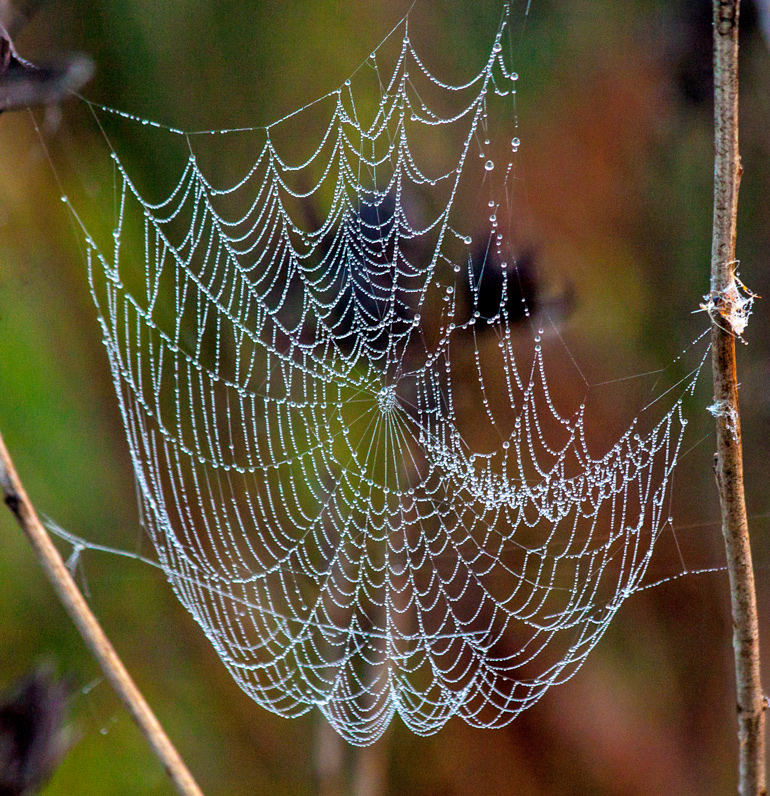
I haven’t seen many big spiders this fall, but I did come across this spiderless web early one morning recently. The morning was damp and foggy and the droplets of water on the web made it easier to spot in the cattails of the marsh. Using manual focusing, which is still a challenge for me with my DSLR, I was able to capture this image of the web. If you click on the image, you can see the beads of water that look like tiny strands of transparent pearls.

web_fall_blog

© Michael Q. Powell. All rights reserved

Read Full Post »

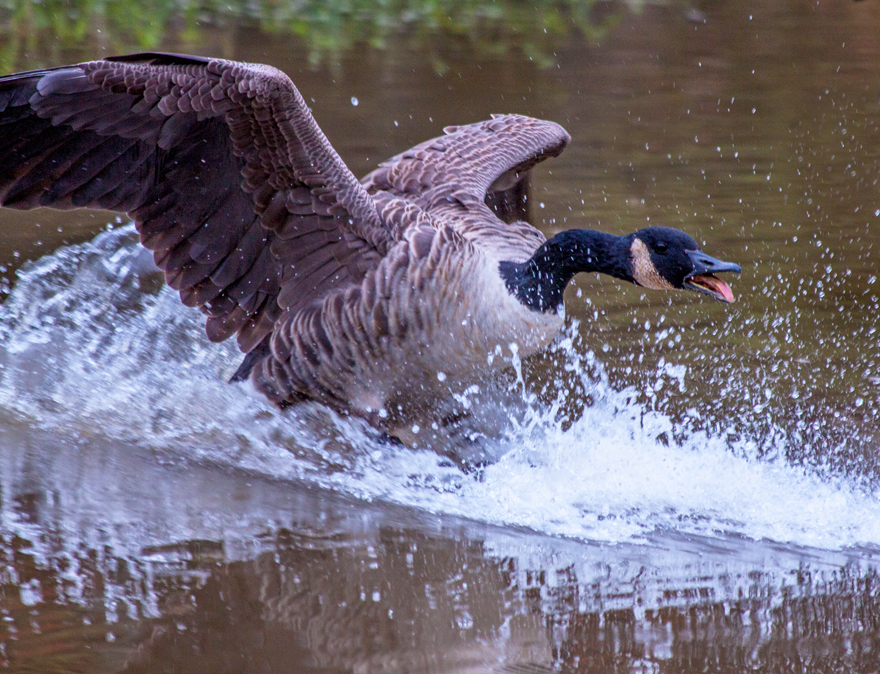
One of the first waves of migrating Canada geese (Branta canadensis) loudly announced its arrival and landed right in front of me in the beaver pond of my local marsh yesterday.

Last year we seemed to have geese arriving and departing so frequently that I felt like I was at a major geese transit airport. I kept expecting to hear departure announcements on a loudspeaker.

Several areas of the marsh had dried up in the last few months, because of a lack of rain, and I had been fearful that the migrating birds would not stop over. The rain storms this week have partially filled those areas, so my concerns have been partially assuaged.

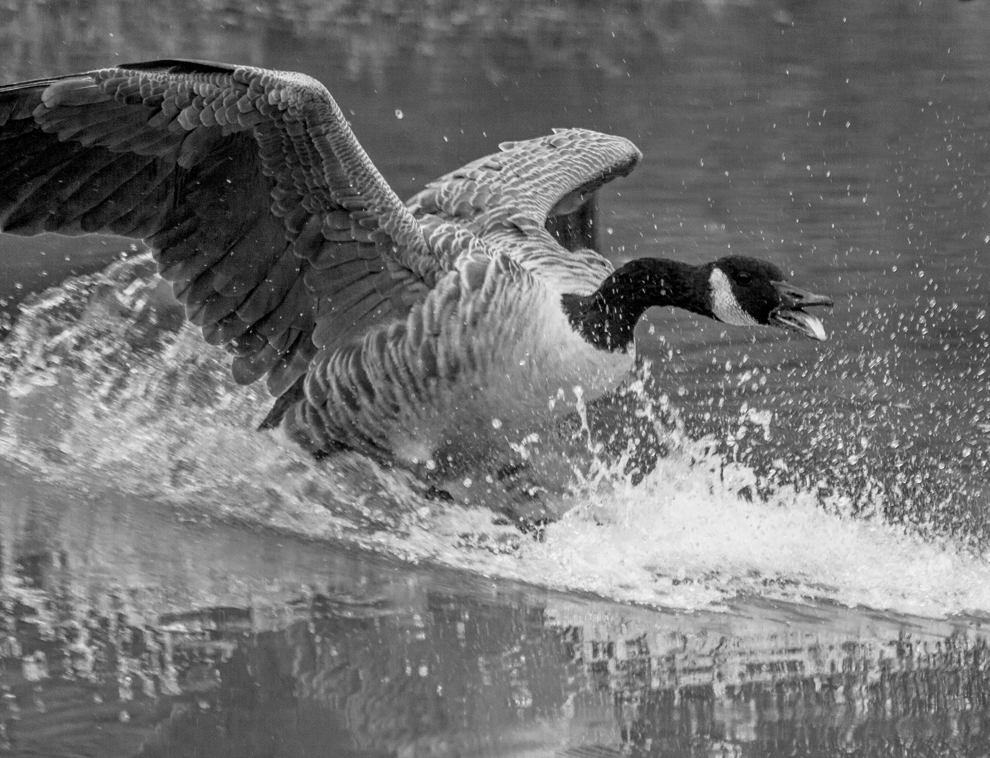
When I looked at this photo, it seemed like it was mostly black and white already (except for the pink tongue), so I played around a little and converted it to black-and-white. For me, the second version really draws my eye to the texture of the feathers, but I can’t decide whether I like it more than the color version.

What do you think about the black-and-white version?

goose_arrrival1_bloggoose_arrrival1a_blog

© Michael Q. Powell. All rights reserved

Read Full Post »

« Newer Posts - Older Posts »