Feeds:
Posts
Comments

Archive for November, 2023

Bluebirds have lots of acrobatic moves they can use to snag berries. On Monday I returned to a spot at Occoquan Bay National Wildlife Refuge where I had seen some Eastern Bluebirds (Sialia sialis) the previous week. I was delighted to see several bluebirds zooming in and out of a cluster of trees that had dark blue berries hanging high in them. I don’t think that the unidentified berries were part of the tree, but instead seemed to be growing on vines attached to the trees.

The dilemma for the bluebirds was that the berries were out of reach when they remained perched on tree branches, even when they stretched and reached as much as they could. The bluebirds therefore had to launch themselves into the air and attempt to snag a berry as they zoomed by the little hanging fruits. Yikes!

Needless to say, the degree of difficulty of this maneuver is quite high. It would be nice if bluebirds could hover like hummingbirds and pluck multiple berries while in mid-air, but I don’t think that they can.

The second photo shows an Olympic-level acrobatic move in which the bluebird launched itself into the air from a branch and swiveled its head a full 180 degrees. Wow! When I first looked at the photo, it took me a moment to realize that the bluebird’s body was facing me, but its head was facing in the opposite direction. I was fortunate to capture the moment when the bluebird had extended its wings fully to arrest its forward movement and give it an extra split second to grab a berry. The colorful foliage in the background was a nice bonus.

Eastern Bluebird

Eastern Bluebird

© Michael Q. Powell. All rights reserved.

Read Full Post »

As I was observing some birds on Monday at Occoquan Bay National Wildlife Refuge, a burst of bright yellow flashed across my camera’s viewfinder. I was not sure what kind of bird it was, but I definitely wanted to find out. I panned my long telephoto lens and eventually tracked the bird when it landed high in a distant tree.

I was delighted to see that it was a beautiful little American Goldfinch (Spinus tristis). Goldfinches are with us all year, but I am most used to seeing them during the summer months as they feed on sunflowers and other flowers. There is still a bit of warmth in the sun and some color in the trees, but we are moving inexorably towards the cold gray days of winter when bright colors will be in short supply.

Celebrate the color!

American Goldfinch

© Michael Q. Powell. All rights reserved.

Read Full Post »

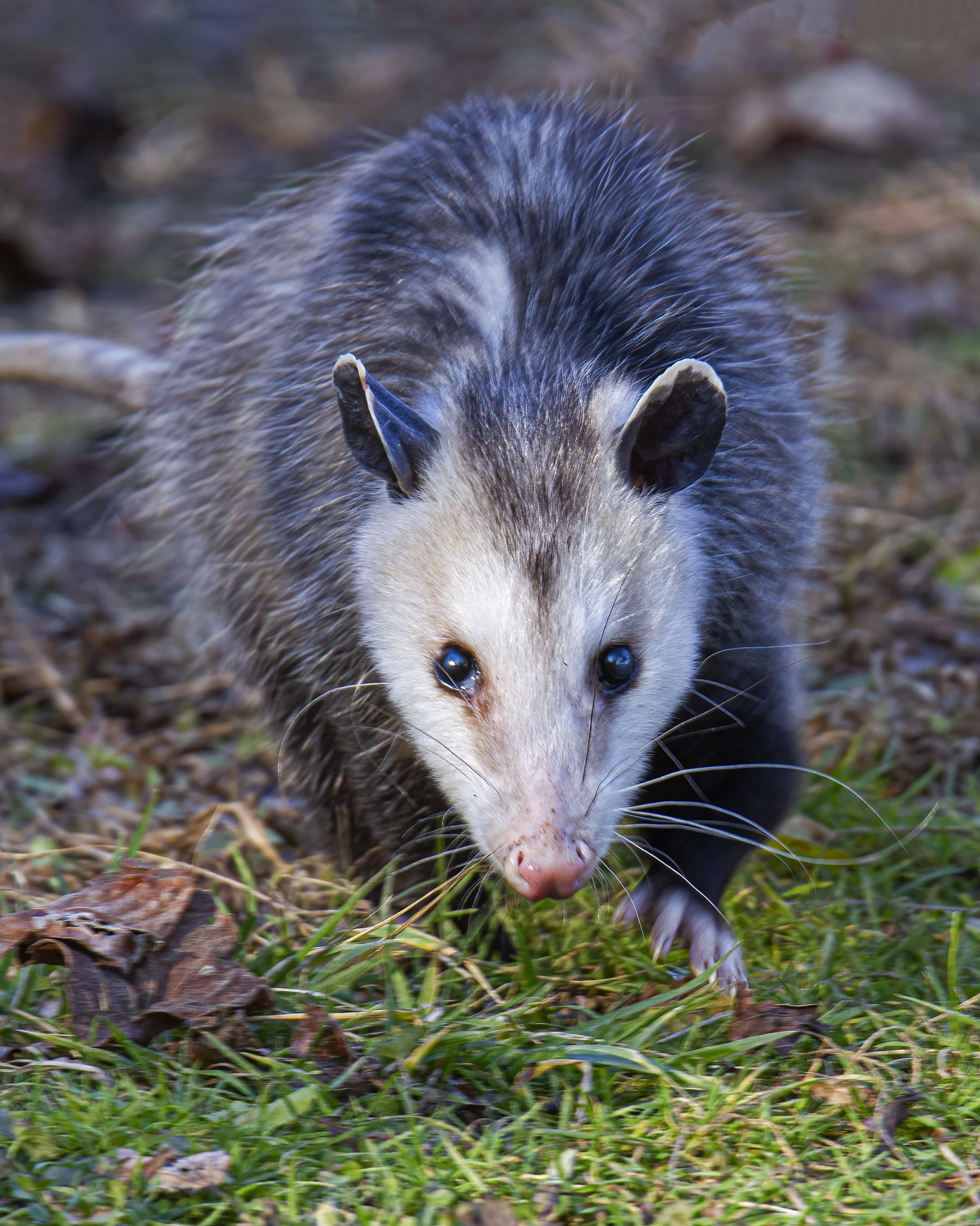
Yesterday I encountered a cool-looking Virginia Opossum (Didelphis virginiana) at Occoquan Bay National Wildlife Refuge. It was walking down the middle of a trail straight towards me and did not seem aware of my presence. Opossums are mostly nocturnal, so I do not see them very often—apparently they do not seem me very often either. An opossum’s eyesight is much better in the dark than it is in daylight, so the opossum may not have initially seen me, even though it was looking right at me in a number of these photos.

Virginia Opossums, also known as North American Opossums, are the northernmost marsupial in the world, and the only one living north of Mexico, according to Wikipedia. Like other marsupials such as a kangaroos, kolas, and wombats, opossums give birth to incompletely developed babies that develop further in a pouch—he word “marsupial” comes from the Latin word “marsupium”, which means pouch.

The gestational period lasts only 11-13 days, according to Wikipedia, and the average litter size is 8–9 infants, although over 20 infants may be born. “Newborns are the size of a honeybee. Once delivered through the central birth canal, newborn opossums climb up into the female opossum’s pouch and latch onto one of her 13 teats. The young remain latched for two months and in the pouch for 2+12 months. The young then climb onto the mother’s back, where she carries them for the remainder of their time together. It is during this time that the young learn survival skills. They leave their mother after about four or five months.”

If you want to learn more about opossums, check out an article called “50 Opossum Facts That Are Too Awesome to Miss” at the website facts.net. For example, I was shocked to learn that the word “opossum” originated in Virginia, where I live. Between 1607 and 1611, colonists John Smith and William Strachey first recorded the usage of opassom and aposoum at the early British colony in Jamestown, Virginia.

The opossum seemed curious, cute, and almost cuddly, but I kept my distance and tried not to disturb. From certain angles, such as in the second image, though, the opossum seemed focused and a little menacing.

I encourage you to click on the photos to get a closer look at some of the details of the opossum, like its prehensile tail and the little claws on its feet. You can’t see it very well, but opossums have opposable clawless thumbs on their hind feet that lets them grip onto tree branches.

Virginia Opossum

Virginia Opossum

Virginia Opossum

Virginia Opossum

© Michael Q. Powell. All rights reserved.
Read Full Post »

The Eastern Bluebirds (Sialia sialis) that I spotted last Wednesday at Occoquan Bay National Wildlife Refuge were quite far from me, but I was thrilled to catch a glimpse of their brilliant blue plumage as they foraged in some evergreen trees.

I really love bluebirds and though it is a bit of a cliché to speak of “bluebirds of happiness,” these bright little birds invariably bring a smile to my face.

Happy Monday!

Eastern Bluebird

Eastern Bluebird

© Michael Q. Powell. All rights reserved.

Read Full Post »

Although it was sunny last Wednesday at Occoquan Bay National Wildlife Refuge, the wind was kicking up quite a bit, repeatedly ruffling the feathers of this perched Bald Eagle (Haliaeetus leucocephalus). It has been a long time since I had hair that was long enough to sport that kind of windblown look.

When I was a child, I had a cowlick in the back of my head that refused to stay in place, despite my lineral use of Brylcreem or a similar product called Groom and Clean. My father, like many men of his generation had a comb over hair style that he somehow fixed in place. When I started going bald, I rejected that style and opted to keep  my hair cut short. Of course, during the 20 years that I spent in the US Army, it was a mandated “choice,” much like the mandatory “fun” that surrounded official social functions.

Bald Eagle

© Michael Q. Powell. All rights reserved.


Read Full Post »

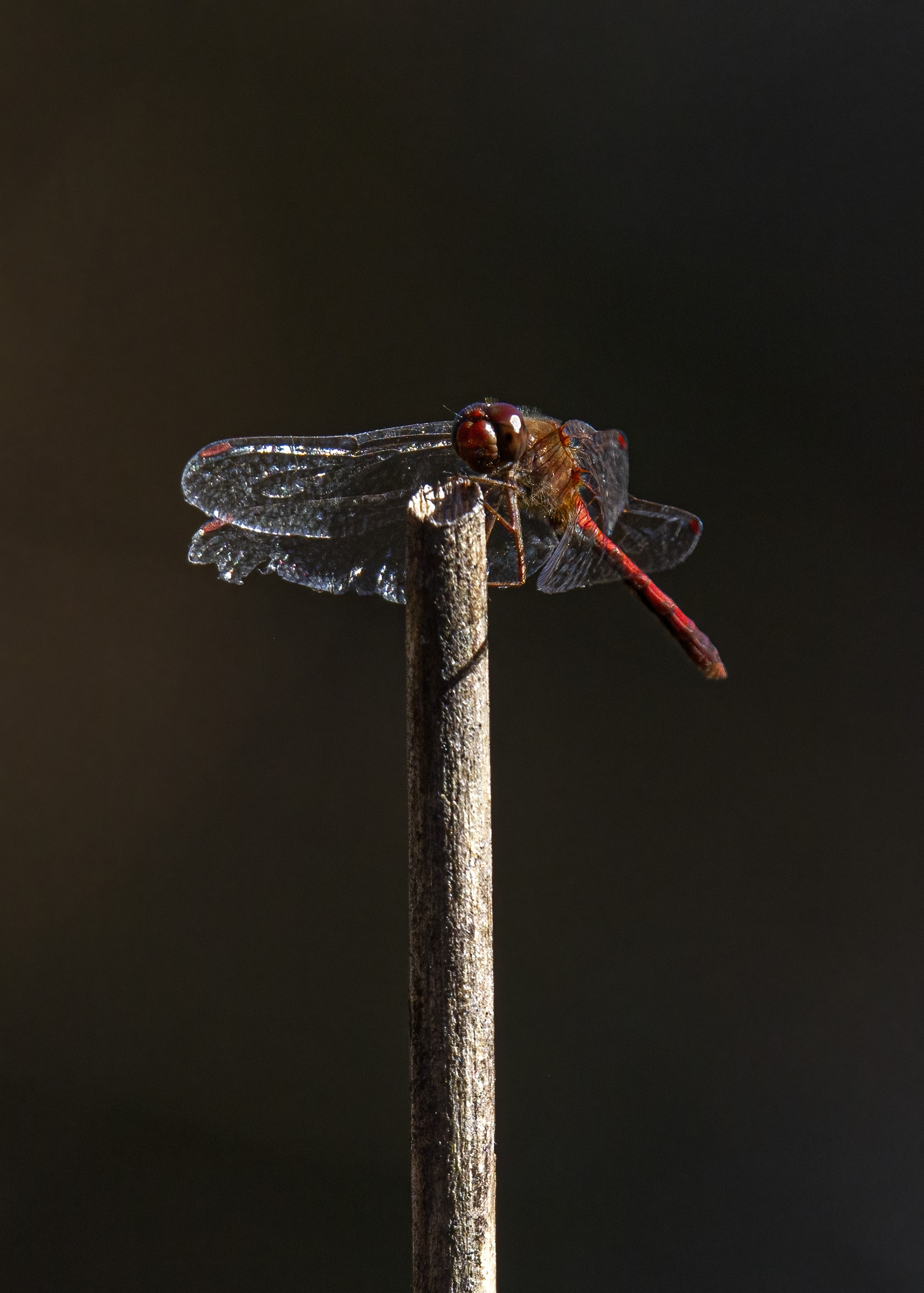
Autumn Meadowhawk dragonflies (Sympetrum vicinum) are still hanging in there as we approach the end of November. At other times of the year their bright red bodies would stand out, but there are lots of red and brown leaves on the ground now that help to camouflage them when they land. If the dragonflies remain still while on these perches, they are almost undetectable.

I photographed these little beauties on Wednesday at Occoquan Bay National Wildlife Refuge. Amazingly, I used the same telephoto zoom lens for these images that I used to capture shots of a Bald Eagle that same day—check out yesterday’s posting called What’s for dinner? that featured shots of an eagle with a duck that it had captured. The Tamron 150-600mm lens is a really versatile lens that, if I am careful, can capture a wide range of subjects ranging from an eagle in flight to a tiny perched dragonfly.

Autumn Meadowhawk

Autumn Meadowhawk

© Michael Q. Powell. All rights reserved.


Read Full Post »

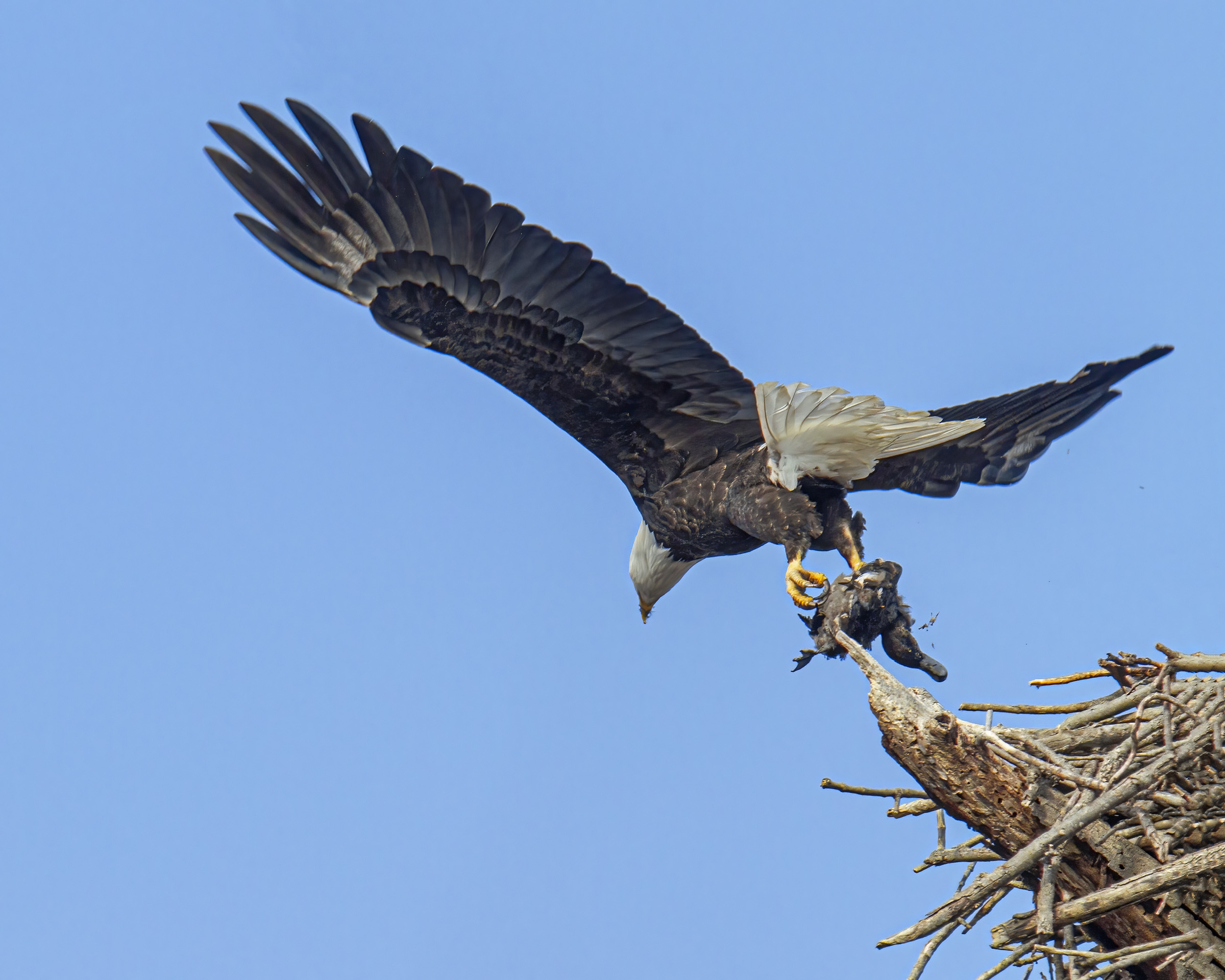
This Bald Eagle (Haliaeetus leucocephalus) must have decided that it wanted to celebrate Thanksgiving with poultry rather than fish. A Wild Turkey would have been too big, so it looks like the eagle settled for a duck.

As I approached the large eagle nest at Occoquan Bay National Wildlife Refuge, I was shocked to see that there was an eagle in the nest. As I watched, the eagle moved about a bit, bobbing its head up and down. I assumed that it was making minor repairs to the nest, but I was wrong.

It was only when the eagle flew out of the nest that I realized that the movement I had observed had been feeding behavior. I did not get a good look at the prey that was dangling from one of the eagle’s feet as it flew away, but assumed that it was a fish. Once again, I made a wrong assumption. When I looked at the images on my compute screen, I could see that the prey was some kind of duck, though I did not get a good enough shot of the duck to identify its species.

I don’t know how often eagles prey on water birds, but this is not the first time that I have seen it happen. Check out my March 2023 blog posting called “Eagle grabs coot” in which I featured some photos of an eagle encounter with an American Coot.

When I looked out on the waters of Occoquan Bay, I noticed that several rafts of ducks were present. They were pretty far away, but I did managed to identify numerous Ruddy Ducks and Buffleheads in addition to a few Pied-billed Grebes. The size of these groupings of birds varies throughout the colder months, but I can usually count on seeing them during late fall and winter months. If the eagles feel lazy or want a change in diet, I suspect that it is much easier for them to grab a duck that a fish.

Bald Eagle

Bald Eagle

Bald Eagle

Bald Eagle

© Michael Q. Powell. All rights reserved.

Read Full Post »

“Take Flight 2023” has landed. I was thrilled yesterday when the post office delivered my copy of a just-published poetry anthology that has one of my dragonfly photos on the cover.

Since 2020 I have attended almost monthly Zoom poetry readings conducted by Flight of the Dragonfly Spoken Word, a UK-based poetry group, and feel blessed to be part of this community of incredibly talented poets and writers. Pre-pandemic, the group hosted poetry readings at a pub in Brighton, but during the pandemic its readings became virtual and its reach became worldwide.

Flight of the Dragonfly inaugurated a quarterly e-journal of poetry, prose, and flash fiction called Flights and is currently working on Issue 10 of the journal. “Take Flight 2023” is a printed anthology of selected poems from Flights issues five to eight. A little over a year ago Flight of the Dragonfly Press was founded and has already published a number of poetry collections.

In case you are curious, I captured the in-flight shot of the Migrant Hawker dragonfly (Aeshna mixta) in 2018 at the Botanical Garden in Brussels, Belgium during a work trip there. If you would like more details about the circumstances surrounding the capture of the image, check out my September 2018 blog posting entitled “Migrant Hawker in flight.”

I am one of the few non-poets who regularly attends the poetry readings—thought I have been encouraged on multiple occasions to start writing poetry. I believe that it is important to support the creative people who pour themselves into creating works that touch me deeply in so many different ways. I was deeply moved by the words in the “Thanks” section of the anthology that said, ” A very special thanks to Michael Powell, who has been turning up and cheering for the last three years and who has now allowed us to use one of his fabulous dragonfly photographs as the cover for this book.” Thanks, Darren and Barbara, the co-founders of Flight of the Dragonfly, for those very kind words.

I encourage you all to support your local poets, writers, and artists. The next Zoom poetry reading of Flight of the Dragonfly Spoken Word is on 28 November—click on the link at the beginning of this sentence to get details on how to sign up for this free event. The featured poets for this reading will be Gaynor Kane and Damien B. Donnelly, two of my favorite poets. For further detail on Damien, whom I met in Paris in 2019, check out this December 2019 blog posting and for information on the dynamic duo, check out my March 2021 posting entitled “I joined a cult.” I hope to see some of you at the event.

Take Flight

© Michael Q. Powell. All rights reserved

Read Full Post »

Most of the time my photos have a well-defined subject. Some of the time, though, I am so interested in trying to capture the mood of the moment that the “subject” occupies only a small part of the frame.

Last Friday, I spotted a large bird perched on a skeletal tree at Occoquan Bay National Wildlife Refuge. I thought at first that it might be a Bald Eagle, but when I zoomed in a bit I could see that it was a Turkey Vulture. I really like the starkness of the bare trees and the way that they give an abstract feel to the landscape. As I was preparing to take a shot, a small flock of Canada Geese flew into the frame and I captured several of them in the photo below.

The resulting image is mostly monochromatic, though you can see occasional glimpses of a warmish brown on some of the broken edges of the trees. If you look really closely at the vulture’s head, you can see a touch of red.

I do not know if this image “works” in conveying the mood of that monochromatic moment, but I thought it might be interesting to share with you my thought process as I experimented in capturing an image that is quite different from my normal wildlife shots.

monochromatic

© Michael Q. Powell. All rights reserved.

Read Full Post »

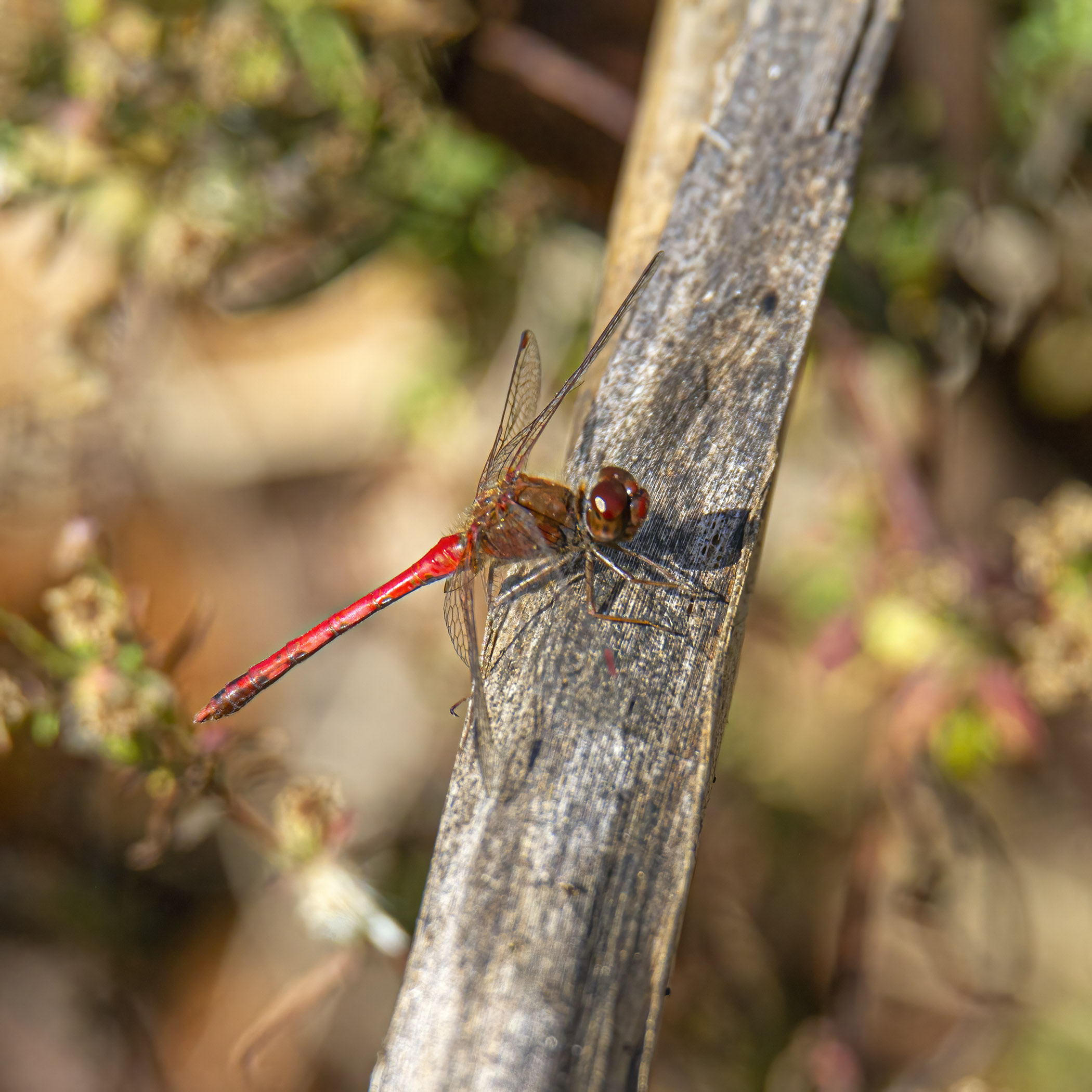
We have reached the point of the season when the only dragonflies remaining are the hardy Autumn Meadowhawks (Sympetrum vicinum). I try to photograph every one that I see, knowing that it could be the last one that I spot for the year. In past years I have sometime seen Autumn Meadowhawks in December, but their continued presence is dependent on a number of factors, including the weather.

I photographed this Autumn Meadowhawk last Friday at Occoquan Bay National Wildlife Refuge in Northern Virginia—it was one of a half-dozen or so that I spotted that day. The little dragonfly appeared to be staring right at me with a mixture of curiosity and defiance. The dragonfly was perched on a log and I was happy to capture some of the texture of the wood along with a bit of autumn color in the background.

I will continue to keep an eye out for these little red dragonflies, knowing full well that their time is rapidly coming to an end.

Autumn Meadowhawk

© Michael Q. Powell. All rights reserved.

Read Full Post »

The days are growing cooler, but when the sun is shining brightly, turtles will still come up from the bottom of the ponds to bask, like this Painted Turtle (Chrysemys picta) that I spotted last Friday on a log at Occoquan Bay National Wildlife Refuge. One of its comrades was lounging nearby with just its head stuck out of the mucky surface of the water.

Neither of these two images is incredible, but I really like the small details that I was able to capture, like the claws on the turtle’s feet in first photo and the bubbles on the water in the second shot. I think that life is often like that—there is amazing beauty in the most mundane, everyday moments if we can manage to look closely enough.

Painted Turtle

Painted Turtle

© Michael Q. Powell. All rights reserved.


Read Full Post »

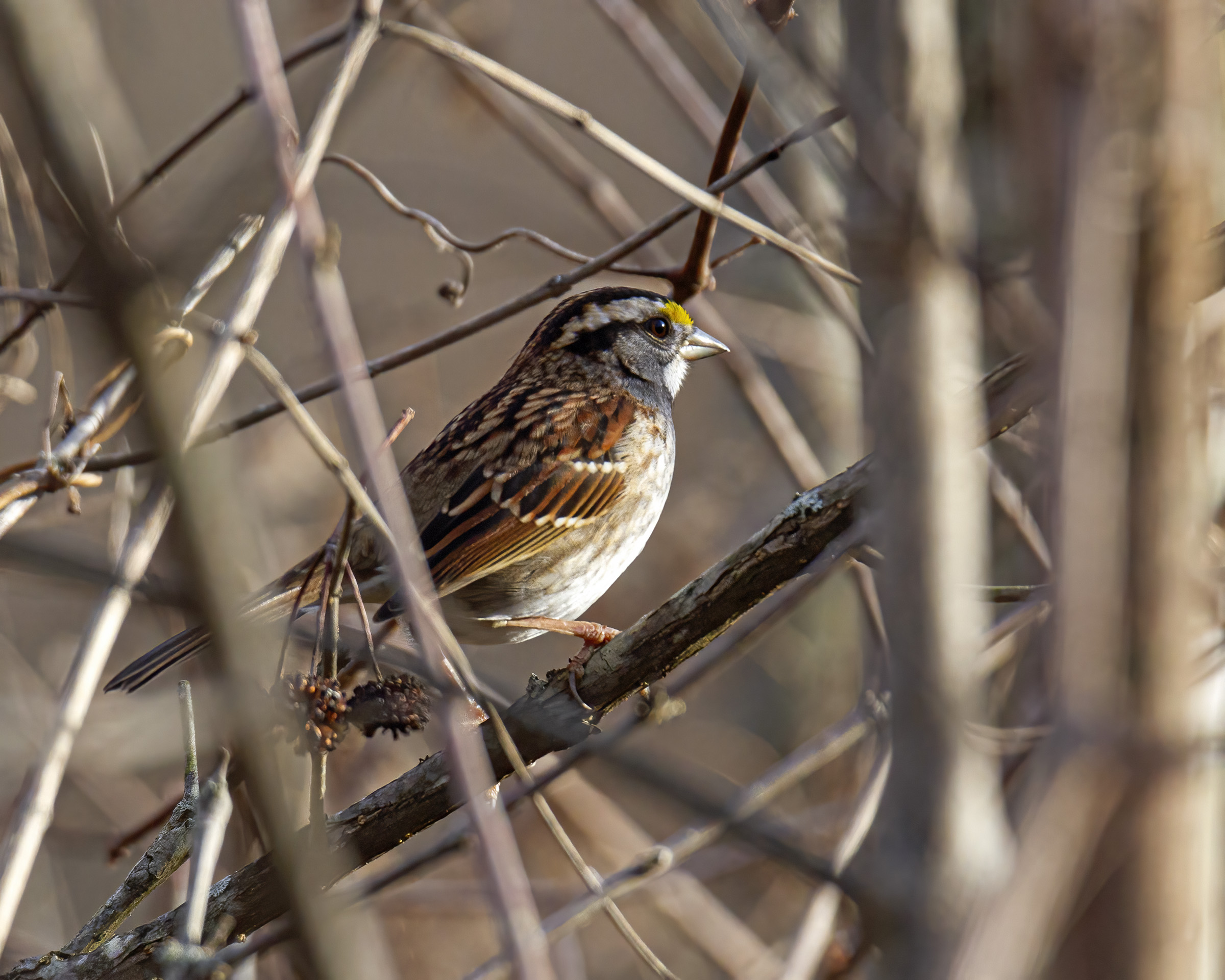
White-throated Sparrows (Zonotrichia albicollis) are one of my favorite winter birds. During autumn they migrate into my area in great numbers and spend the winter with us.

Sometimes I complain that I have trouble identifying sparrows, but this is a species that I can reliably identify, thanks to the bright yellow lores (i.e. the area between the eyes and bills) and the white throat patch that always makes me think of Santa Claus.

Like many other sparrows, White-throated Sparrows like to forage deep in the bushes and the underbrush, so it is tough to get an unobstructed shot of one. As you can see in both of these photos, my view of the sparrow was partially blocked, but I was able to find a visual tunnel that let me get a good shot the head and most of the body of this beautiful little bird.

White-throated Sparrow

White-throated Sparrow

© Michael Q. Powell. All rights reserved.

Read Full Post »

It has been quite a while since I have seen any dragonflies other than Autumn Meadowhawks, so I was thrilled yesterday (17 November) when I spotted this Wandering Glider (Pantala flavescens) patrolling over a field at Occoquan Bay National Wildlife Refuge. I watched and waited for a long time and the dragonfly finally landed for a moment.

I captured the image below with my Tamron 150-600mm telephoto zoom lens extended all the way to 600mm on my Canon 7D DSLR. The dragonfly was perched only a few inches above the ground, so I had to crouch down quite low to get this shot. Although I had my camera on a monopod, it was tough to get into a steady shooting position and I had to focus manually, because my camera’s autofocus kept locking onto the vegetation. I took lots of photos and happily a few of them were in focus and were relatively sharp.

Wandering Gliders are a migratory species and are considered to be the most widespread dragonfly on the planet, with good population on every continent except Antarctica. According to Wikipedia, Wandering Gliders, also known as Globe Skimmers, “make an annual multigenerational journey of some 18,000 km (about 11,200 miles); to complete the migration, individual globe skimmers fly more than 6,000 km (3,730 miles)—one of the farthest known migrations of all insect species.” Wow!

Wandering Glider

© Michael Q. Powell. All rights reserved.

Read Full Post »

When I was growing up in New England, American Robins (Turdus migratorius) were always viewed as a harbinger of spring. I don’t know if American Robins migrated out of our area and returned in the spring, but I do recall that seeing one of them foraging on a lawn meant that spring was on the way.

Here in Northern Virginia where I have lived for thirty years now, I have grown accustomed to seeing American Robins throughout almost the entire year. It gets cold enough here that the ground freezes most years, so I suspect that the robins have to adapt their diets to other food sources—I have a mental picture of robins pulling worms out of the ground and that would not be possible during the winter.

I spotted this American Robin last Thursday almost hidden in the vegetation at Huntley Meadows Park. I suspect that it is either a female or an immature male, given the rather pale coloration and the white patches of feathers on the belly.

American Robin

© Michael Q. Powell. All rights reserved.

Read Full Post »

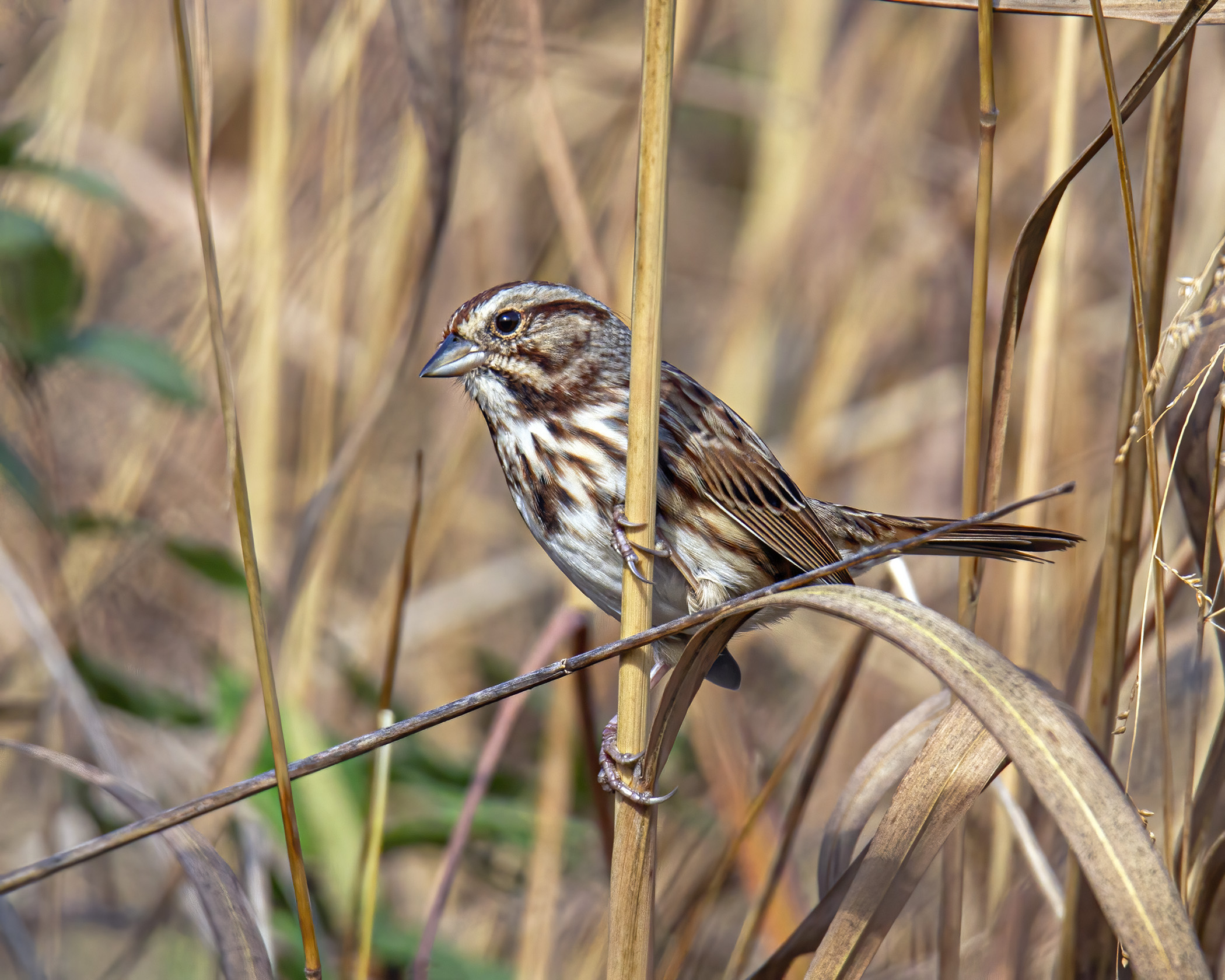
Some days it seems like most of the birds are hiding from me, but I can usually count on seeing at least a few sparrows. Last Thursday I spotted this little sparrow, which I am pretty sure is a Song Sparrow (Melospiza melodia), perched in the reeds at Occoquan Bay National Wildlife Refuge.

I still have a bit of trouble with identifying some sparrow species, but I am getting better at looking closely at the facial markings and other identifying features that help me to distinguish one species from another. Some experienced birders can identify birds by their calls, but with a few notable exceptions I am not at that level.

Song Sparrow

© Michael Q. Powell. All rights reserved.
 

Read Full Post »

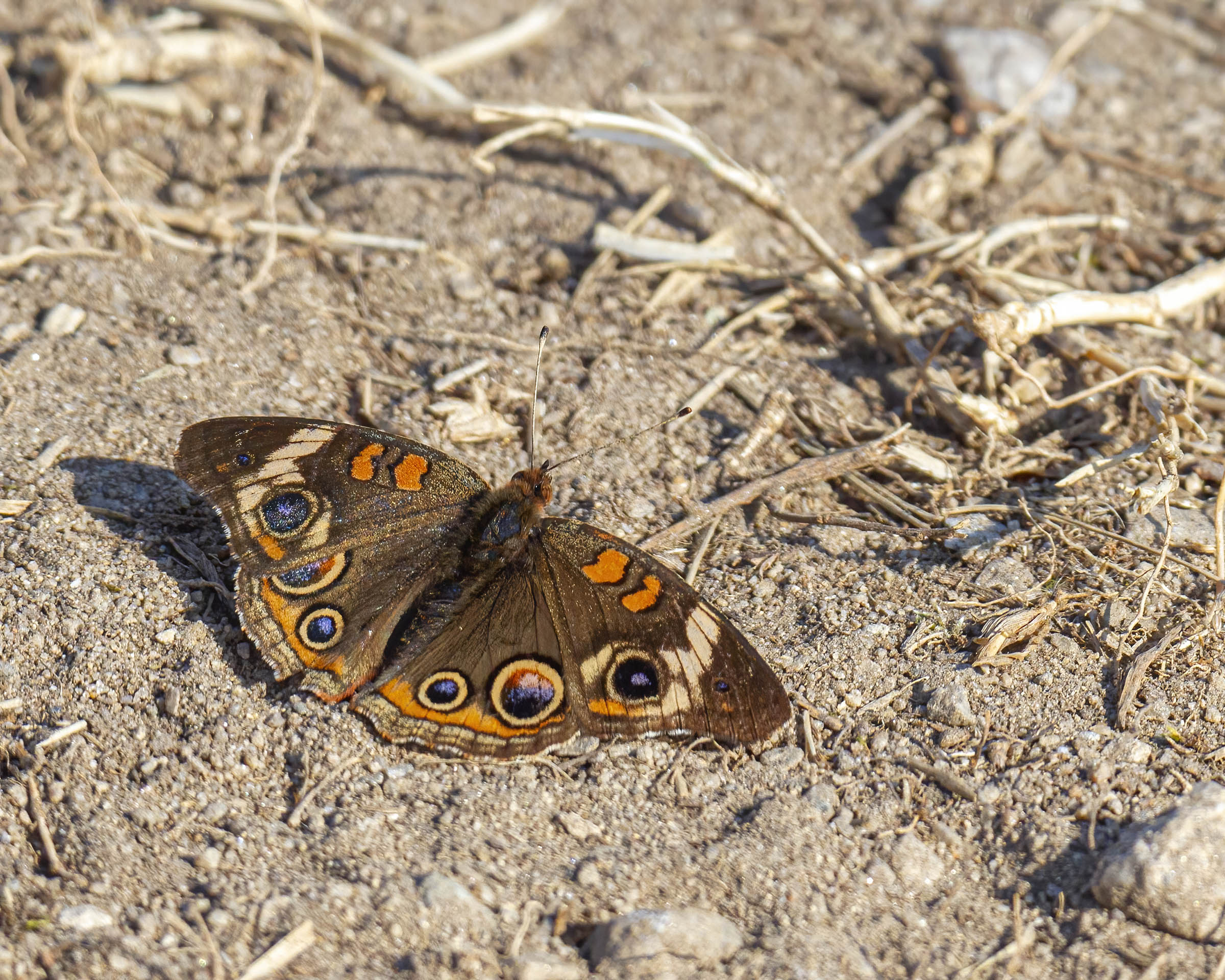
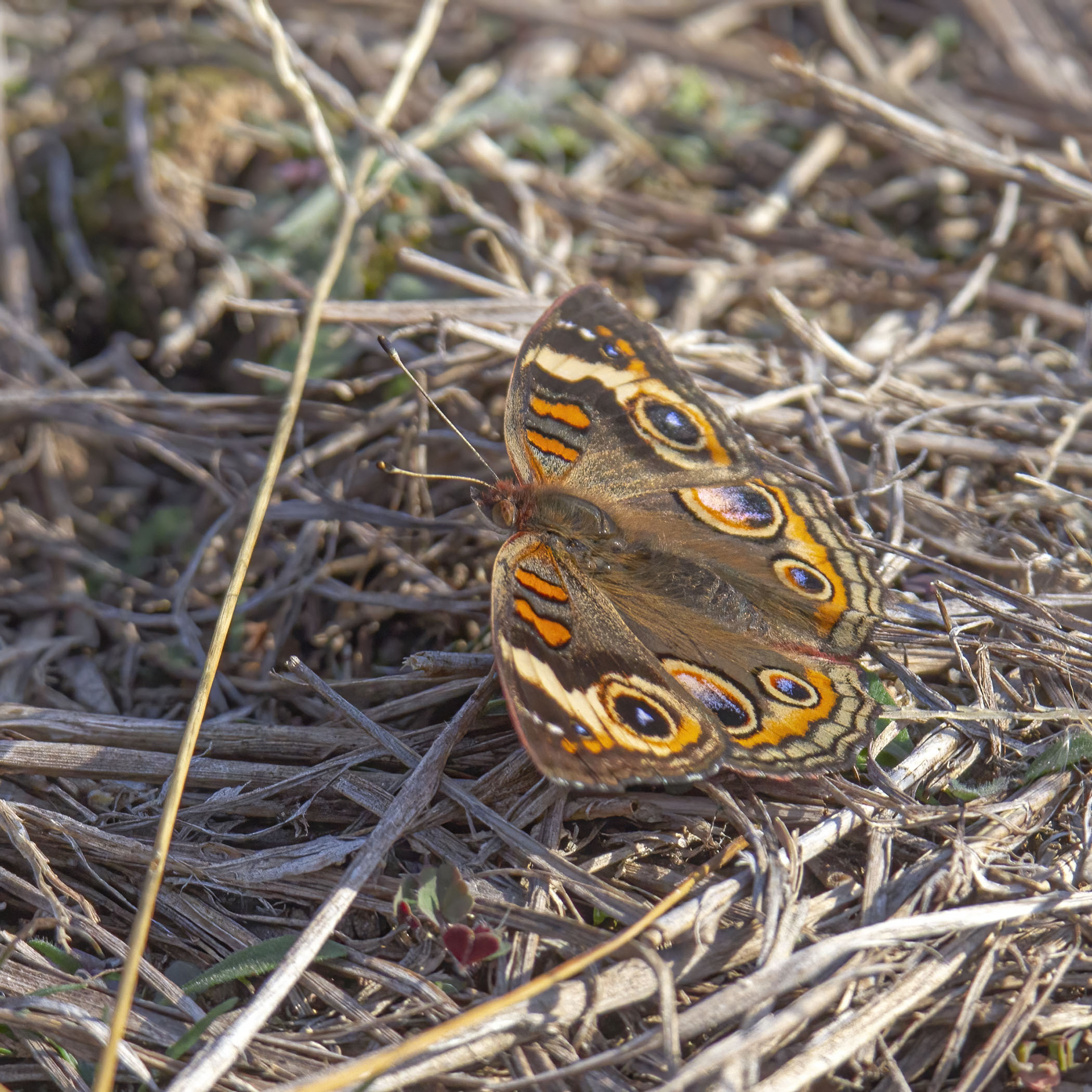
There were few insects flying last Thursday at Occoquan Bay National Wildlife Refuge, so I was a bit surprised to encounter several Common Buckeye (Junonia coenia) butterflies. The body color of this butterfly is pretty drab, but its markings are stunning in their beauty—I especially love its multi-colored eyespots. Wow!

I do not think that Common Buckeye butterflies overwinter in my area as adults, so I wonder if the butterflies that I observed are in the process of migrating southward. If not, then they are appearing on the scene quite late in the season, when we have already had several frosty nights. Perhaps they will hang around for a little while longer—I will keep an eye out for them on my next trips to my favorite local wildlife refuge.

Common Buckeye


Common Buckeye

© Michael Q. Powell. All rights reserved.


Read Full Post »

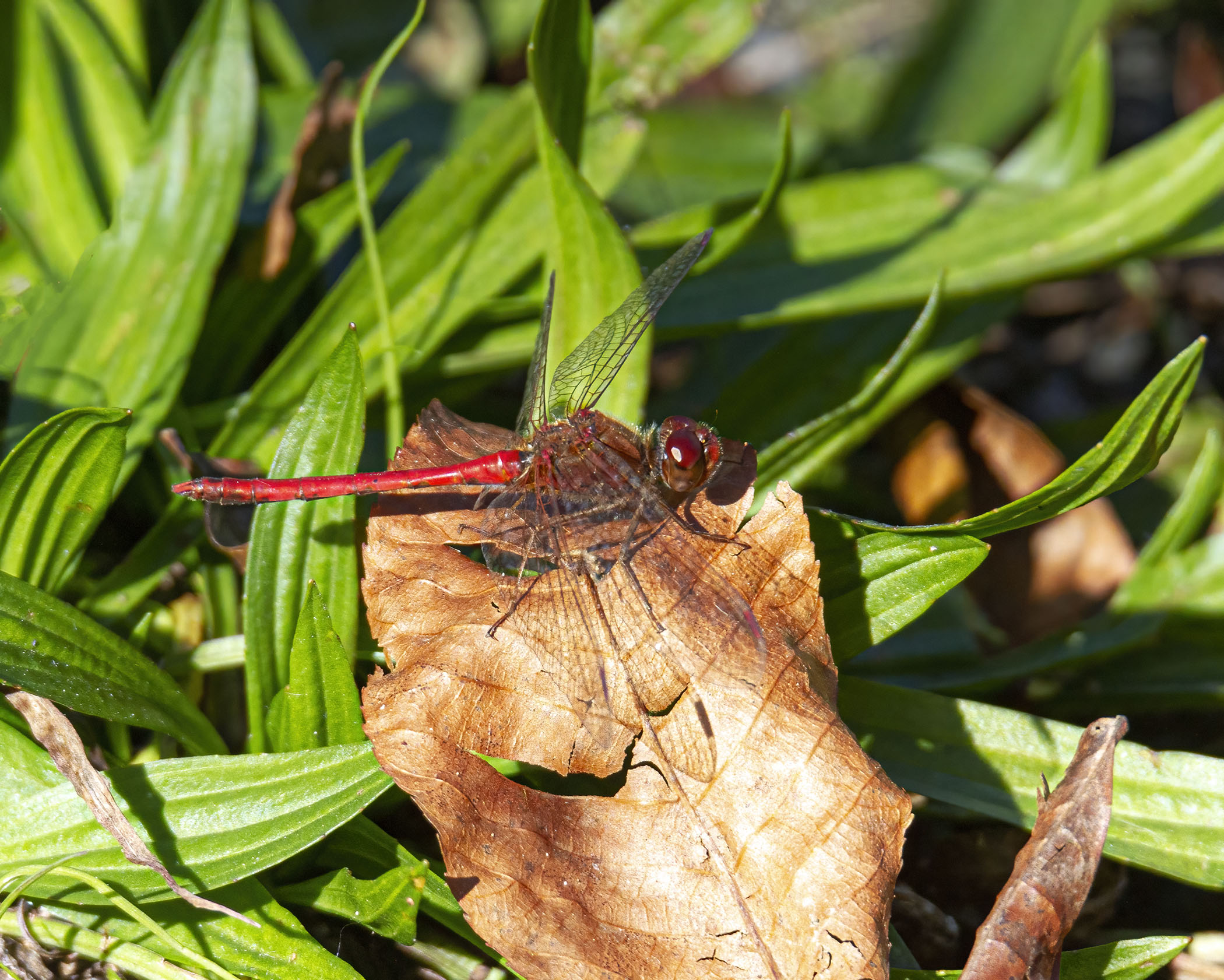
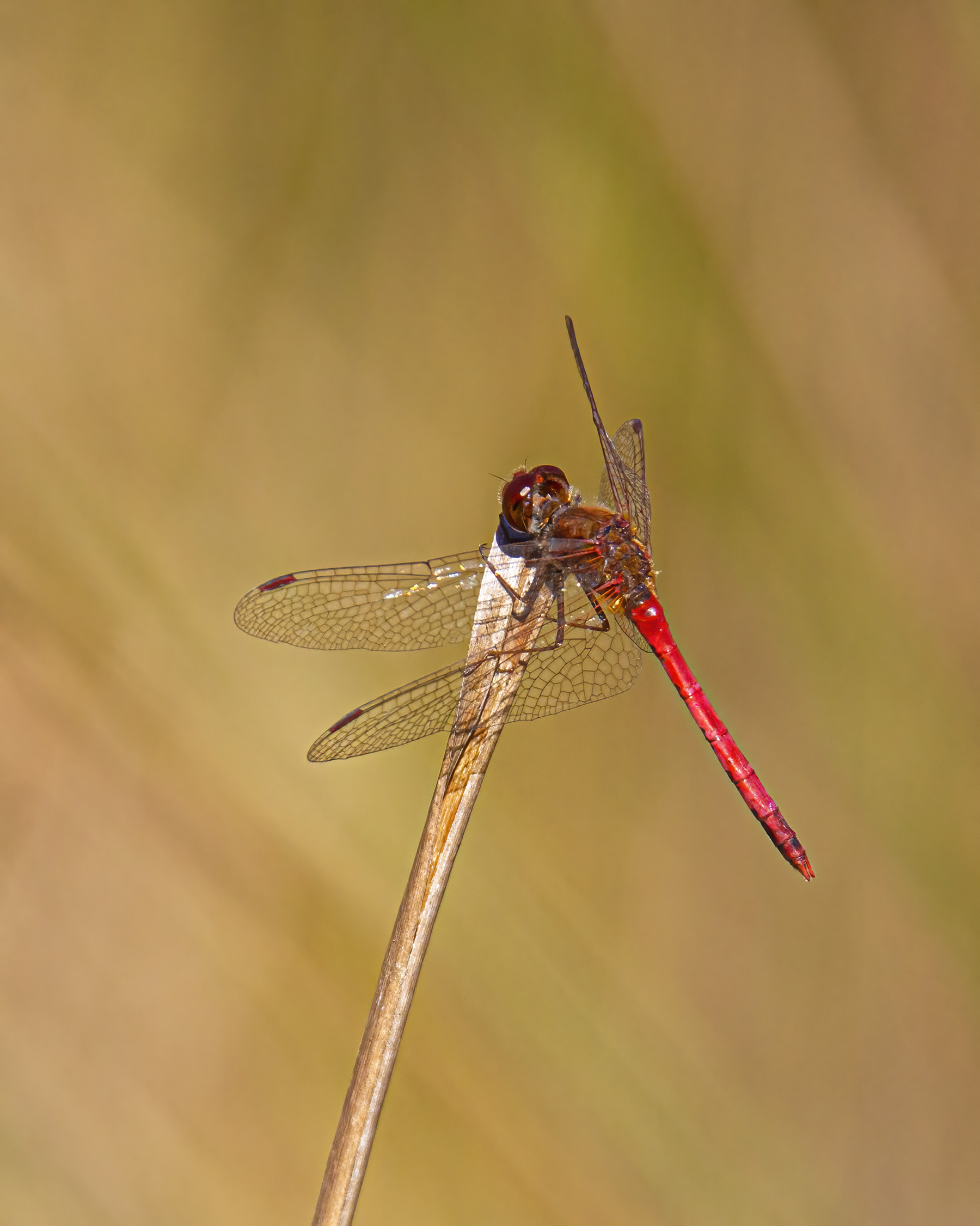
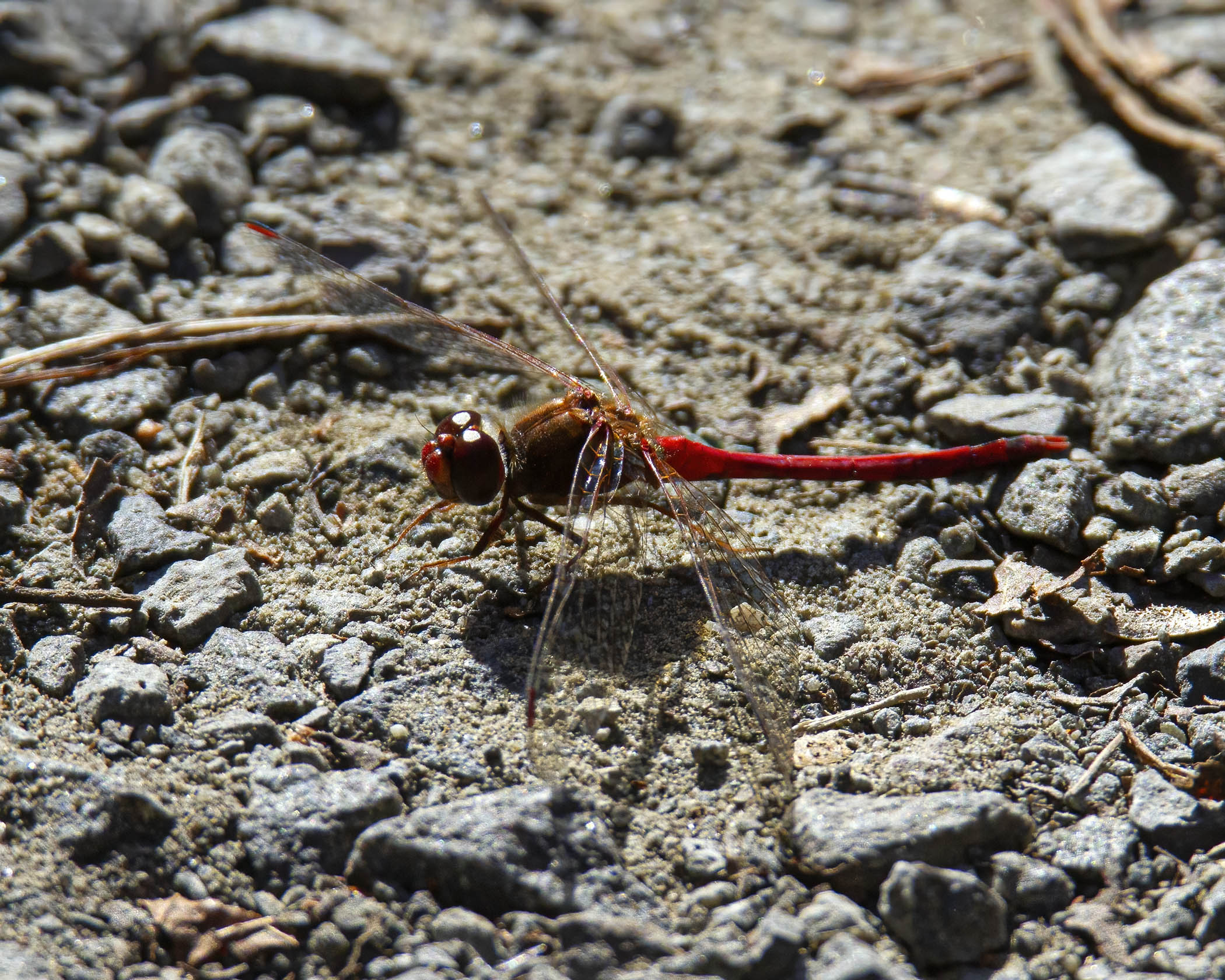
I can’t totally exclude the possibility that I may see a hardy survivor of another species, but it is beginning to look like Autumn Meadowhawks (Sympetrum vicinum) are the sole remaining dragonfly species. Last week I spotted quite a few of them during a visit to Huntley Meadows Park, a county-owned marshland not far from where I live.

I tried to capture images of these bright red beauties in as many different environments as I could. Autumn Meadowhawks often perch on the ground, which does not provide a very interesting background, as you can see in the final photo. It is much more interesting if they perch on fallen leaves, or even better if they choose a more elevated perch.

The photos below give you an idea of how I try to “work” a subject. I try to shooting from different angles and distances.  When possible, I try to selectively include or exclude background elements by choosing the appropriate camera settings, as you can see in the fourth photo, where I caused the background to be totally out of focus. Paying attention to the direction of the light really helps too, as you can see particularly in the second image in which the light is so directional that it almost looks like a studio portrait.

Autumn Meadowhawks will probably be around for another few weeks or maybe a month or so, depending in part on the severity of the local weather. At that point, I will rekuctantly turn my focus to birds, landscapes, and other non-insect subjects. I also hope to devote a bit more attention to learning more about creating videos—I have a modest YouTube channel that I have allowed to languish this past year.

Autumn Meadowhawk

Autumn Meadowhawk

Autumn Meadowhawk

Autumn Meadowhawk

Autumn Meadowhawk

© Michael Q. Powell. All rights reserved.

Read Full Post »

Most of the insects are gone by now, so I was a bit shocked to spot this Sleepy Orange butterfly (Eurema nicippe) last Thursday at Occoquan Bay National Wildlife Refuge. When I first saw it, I assumed that it was a Clouded Sulphur butterfly, a species that I photographed a few weeks ago. Upon examining my shot on my computer screen, I realized that it was an unfamiliar species, and a friend of mine who is more of an expert on butterflies helped to identify the butterfly for me.

I really like the way that the bright color of the inside of the butterfly contrasts with the brown tones of the dried leaves on which the butterfly was perched.

Sleepy Orange

© Michael Q. Powell. All rights reserved.

Read Full Post »

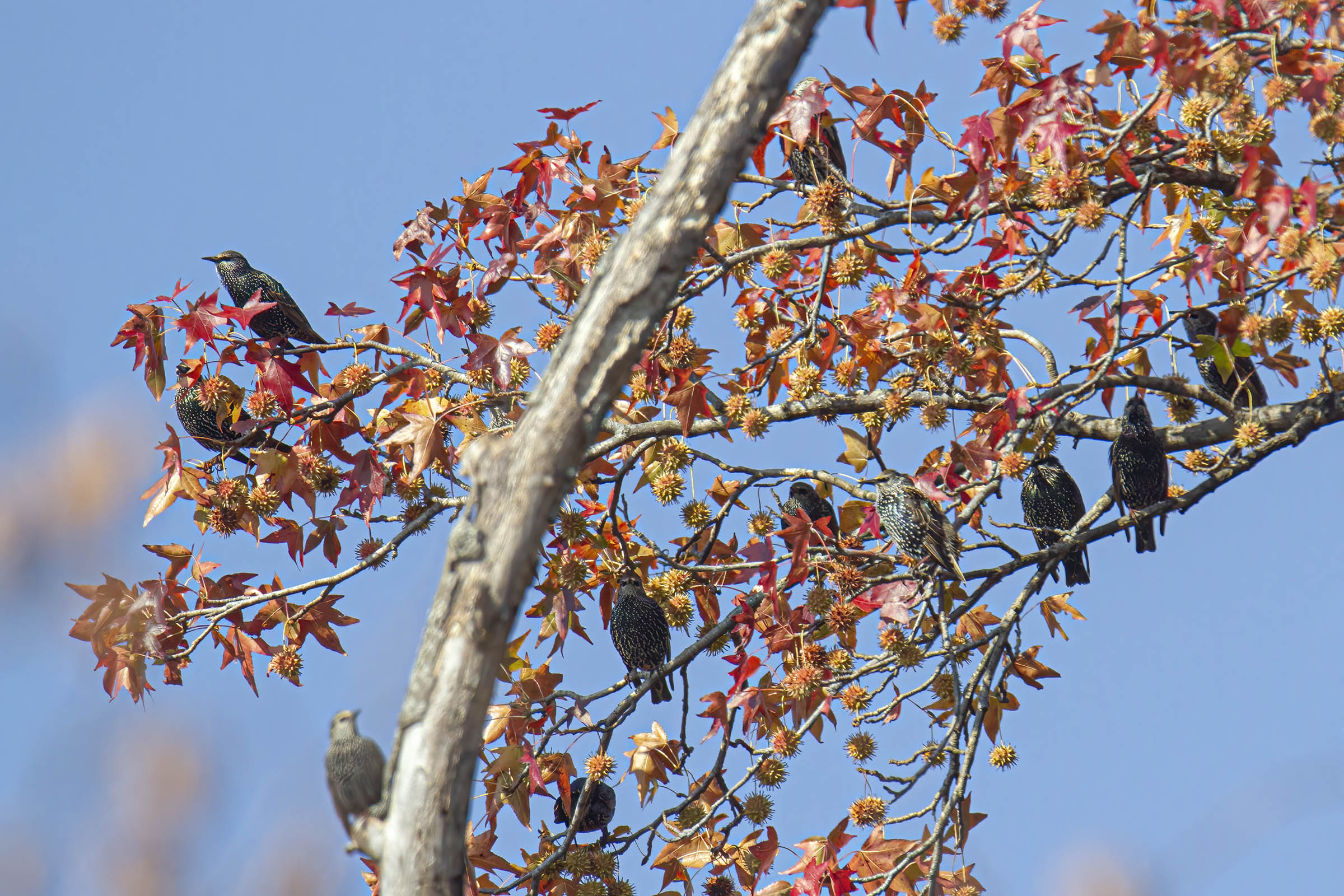
How do you photograph a flock of birds? This past Thursday I visited Occoquan Bay National Wildlife Refuge and observed (and heard) that a sizable flock of European Starlings (Sturnus vulgaris) was moving about in a large expanse of trees. I attempted to photograph clusters of starlings, but as you can see in the final photograph, many of the birds were hidden or shaded by the foliage or were looking away from me.

I decided that a better approach was to concentrate my efforts on getting shots of individual starlings. The first image is one of my favorites from my session with the starlings. The texture of the photogenic snag adds to the visual interest of the image and the starling cooperated by giving me a nice view of its profile. The colorful foliage gives you a sense of the season and of the environment and the two blurry starlings in the background help to balance the image.

The composition of the second image is much simpler—it’s just the bird and its perch. What makes this image interesting for me is the intensity of the starling as it calls out with its mouth wide open, which adds a touch of dynamism to what would otherwise be a static portrait.

European Starling

European Starling

European Starling

© Michael Q. Powell. All rights reserved.


Read Full Post »

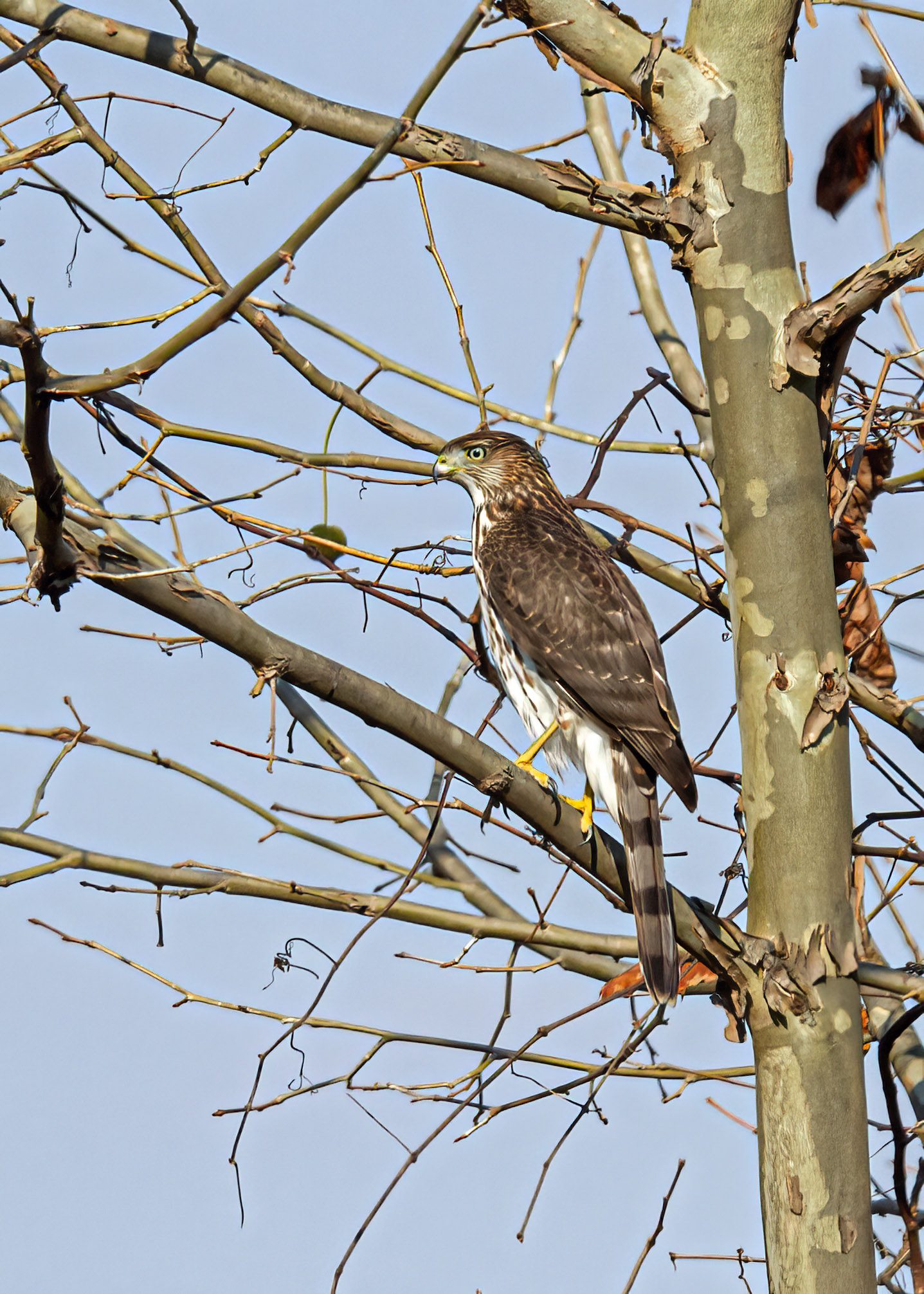
As I looked up a trail on Thursday at Occoquan Bay National Wildlife Refuge, I noted the shape of a bird perched on a shaded gate. When I zoomed in, I realized it was a hawk, which flew to a distant tree as I was capturing the first shot. I shared the images with a Facebook birding group, and the general consensus is that the bird is a juvenile Cooper’s Hawk (Accipiter cooperii).

Most of the hawks that I regularly see are Red-shouldered Hawks and occasionally I spot Red-tailed Hawks. At first I thought that this one might be a Red-shouldered Hawk, but when I looked at my photos on my computer, I was really struck by the length of the hawk’s tail and by the elongated shape of the hawk’s body that are not characteristic of a Red-shouldered Hawk.

One of the folks on Facebook who responded to my posting noted, “Juvenile Cooper’s hawk. Beautiful youngster. You caught the neat teardrop shaped breast streaking, and the short wings against the long and widely banded tail.”

As many of you know, I am an opportunistic wildlife photographer—I enjoy walking around a lot and try to capture photos of my wonderful encounters with nature, like this one.


Cooper's Hawk

Cooper's Hawk

Cooper's Hawk

© Michael Q. Powell. All rights reserved.

Read Full Post »

Woodpeckers are amazingly industrious. They repeatedly hammer their heads against trees, with seemingly a low success rate. Yesterday, though, this male Downy Woodpecker (Picoides pubescens) was successful in capturing an insect at Occoquan Bay National Wildlife Refuge and paused for a moment to show it to me.

Downy Woodpeckers are the smallest woodpeckers in my area and are the species that I see most often. In addition to pecking away at trees, I have also seen them search for insects in cattails and in other vegetation. It is easy to distinguish a male Downy Woodpecker from a female, because males have a bright red patch on the back of their heads, a feature that you can just see in this photo.

Downy Woodpeckers are usually very energetic. I spotted this woodpecker as he was spiraling his way up the tree. I prepared myself when he disappeared behind the trunk and was able to anticipate where he would reappear. I really like the angle of view of this shot that allows us to see the bird’s sharp claws and intense eyes. Downy Woodpeckers always seem to be intensely focused on what they are doing and it was wonderful to see this one’s efforts rewarded with a nice little treat.

Downy Woodpecker

© Michael Q. Powell. All rights reserved.
Read Full Post »

While I was composing a shot of this turtle at a small pond in Kingstowne, a suburban area only a mile or so from where I live, another turtle popped its head out of the water to photobomb its friend. I am pretty sure that the basking turtle is a Red-eared Slider (Trachemys scripta elegans), though I must admit that turtles are definitely not my speciality when it comes to identifying species.

We are in a transitional time of the year—we have already had some days with frost, but some other days have been warm and sunny. Today, for example, we may be flirting with record high temperatures up to 76 degrees (24 degrees C). Tomorrow, on the other hand, the high temperature is forecasted to reach only 52 degrees (11 degrees C).

turtle

© Michael Q. Powell. All rights reserved.


Read Full Post »

It is fun to watch the acrobatics of tiny Ruby-crowned Kinglets (Corthylio calendula) as they forage for food, like this one that I photographed last Thursday at Occoquan Bay National Wildlife Refuge. I love the twisting, spiral shape of the little branchlet on which the kinglet is perched so much that I might well have photographed it even if the kinglet were not there. The yellow colors in the background are a huge plus in creating an autumnal feeling in this image.

© Michael Q. Powell. All rights reserved.

Read Full Post »

I wouldn’t recommend adding poison ivy berries to your diet, but this Yellow-rumped Warbler (Setophaga coronata) seemed to be really enjoying them last Thursday at Occoquan Bay National Wildlife Refuge. Amazingly, poison ivy is a great source of nutrition to a variety of wildlife species. According to the Georgia Department of Natural Resources, a wide variety of “birds are especially fond of poison ivy berries. The plant’s waxy, white berries are loaded with vitamins and other nutrients. If that isn’t enough, they are available to south-bound migrants in mid-summer as well in winter when food is at a premium.”

It is incredible to me that such tiny birds can survive during the winter and finding nutrition like these little white poison ivy berries is one of the keys to their survival. Yellow-rumped Warblers eat mainly insects in the summer, according to the Cornell Lab of Ornithology, but during the winter they switch to a diet of mostly seeds and berries. Can you imagine being a carnivore for six months of the year and a vegan for the other six months?

Yellow-rumped Warbler


Yellow-rumped Warbler

Yellow-rumped Warbler

© Michael Q. Powell. All rights reserved.

Read Full Post »

As I was preparing to lock the front door of my townhouse in Northern Virginia one day last week, I glanced over at a bush about 10 feet (3 meters) away where a bird was perched. I pivoted my body, turned on the camera, and focused on the little bird, which I noted was a Carolina Wren (Thryothorus ludovicianus)—I going out out on a photo adventure, so my camera was slung over my shoulder.

Fearing that I might scare off the wren, I snapped off a few shots without paying too much attention to my camera settings. It felt a little strange to photograph a bird at such close range. In most cases I photograph birds with my 150-600mm lens zoomed out to 600mm, but in this instance I took the shot at 309mm and probably should have zoomed back a bit more.

When I was reviewing the images on my computer,  I checked the camera settings I had used and found out my camera was set at ISO 800, f/6.3, and 1/100. I am a little shocked that I was able to get a relatively sharp shot at such a low shutter setting, but the lens does have some built-in image stabilization and I am used to holding the lens pretty steady.

Some photographers travel great distances to capture wildlife images. This shot is definitely award worthy, but it does show that you may not have to travel far from home to see and photograph nature and wildlife. Beauty is everywhere.

Carolina Wren

© Michael Q. Powell. All rights reserved.
Read Full Post »

Most warblers pass briefly through my area when they are migrating in the spring and in the fall, but Yellow-rumped Warblers (Setophaga coronata) stay with us for a good part of the colder season. This past Thursday I spotted quite a large number of Yellow-rumped Warblers as I wandered the trails at Occoquan Bay National Wildlife Refuge.

In the first photo, you can see a portion of the yellow patch that is responsible for the name of this species. Most of the time I see only the smaller yellow patches on their sides, because they tend to perch high above me and I am often shooting at an upwards angle.

I am amazed by the light weight of Yellow-rumped Warblers and their ability to perch on incredibly slender branches, as you can see in the second image. According to the Cornell Lab of Ornithology, these little birds weigh only 0.4-0.5 ounces (12-13 g).

In the final photo, the warbler is poised to move on to its next perch. Yellow-rumped Warblers are not quite as hyperactive as some other species that I see at this time of the year, like Ruby-crowned and Golden-crowned Kinglets, but they move around a lot as they forage for food.

Yellow-rumped Warbler

Yellow-rumped Warbler

Yellow-rumped Warbler

© Michael Q. Powell. All rights reserved.
Read Full Post »

And then there was one…

Now that the calendar has turned over to November, we have reached the point in the dragonfly season when there is essentially only one remaining species, the Autumn Meadowhawk (Sympetrum vicinum). There is a chance that I will encounter a hardy survivor from some of the summer species or a migratory dragonfly species passing through our area, but in all likelihood, the only dragonflies that I am likely to see this month are the tiny red Autumn Meadowhawks.

This past Thursday I visited Occoquan Bay National Wildlife Refuge and spotted a total of about ten Autumn Meadowhawks at various points throughout the refuge. Unlike some species that require specific habitats, Autumn Meadowhawks seem to be pretty adaptable and I have found them in a variety of different environments.

The dragonfly in the first photo is a female Autumn Meadowhawk—you can tell it is female by looking at her terminal appendages, i.e. the tip of her “tail.” She was perching more or less in the open, so I managed to capture an obstructed shot of her.

Most of the time, though, Autumn Meadhawks perch low to the ground on fallen leaves and dried-up vegetation, as you can see in the final two shots. Both photos show male Autumn Meadowhawks. I love the lighting in the penultimate shot, although the cluttered background makes the dragonfly a little hard to see. In the final photo, I really like the way that the dragonfly appeared to be looking up at me with a sense of curiosity.

Autumn Meadowhawk

Autumn Meadowhawk

Autumn Meadowhawk

© Michael Q. Powell. All rights reserved.
 

Read Full Post »

I encountered this Woodland Box Turtle (Terrapene carolina carolina) last Friday on a paved road at Occoquan Bay National Wildlife Refuge. The brown color of the eyes suggests that this is a female—males generally have red eyes. However, according to the Virginia Herpetological Society, “The color of the iris is sometimes considered indicative of a turtle’s sex, but it is not always reliable.”

The turtle was quite small, about the size of the palm of my hand. I normally try not to disturb wildlife, but I worried that this turtle might be hit by a car, so I picked it up and moved it off of the surface of the road. I was concerned that its claws might scratch me, but the turtle drew in all of its legs and its head as soon as I lifted it.

Hopefully this turtle will live to a ripe old age, but it definitely needs to stay out of traffic, according to the Virginia Herpetological Society, “Box turtles are notorious for living as long, or longer, than humans. An adult male with the date 1874 carved in its plastron was found in Rockingham County in August 1985 (Daily News Record, Harrisonburg), indicating an age of >111 years. It is difficult to confirm such sightings, however.” Yikes!

Woodland Box Turtle

© Michael Q. Powell. All rights reserved.
 

Read Full Post »

The sunlight coming from the back and side of this Clouded Sulphur butterfly (Colias philodice) produced a really dramatic effect in this image that I captured last Friday at Occoquan Bay National Wildlife Refuge. It looks almost like I had the butterfly posing for me in a photography studio, where I would have had full control over the power and direction of the light.

In situations like this, the settings on the camera are really important, because there is so much light that it threatens to blow out the highlights of the light-colored subjects. As a result, I deliberately underexposed the photo, which is why the background appears to be so dark, but I did retain a lot of the details in the butterfly and the asters.

For those of you who enjoy the geeky, technical aspects of photography, I was shooting with a Canon 7D DSLR and a Tamron 150mm-600mm telephoto zoom lens at 600m—I was using a monopod for additional stability. My camera was set to f/8.0, 1/1600 sec, and ISO 400 with negative 1.33 stops of exposure compensation.

Clouded Sulphur

© Michael Q. Powell. All rights reserved.
Read Full Post »

Sometimes when you have an itch, you just have to stop what you are doing and scratch it. I have certainly had that experience and that seemed to be the case with this Great Blue Heron (Ardea herodias) that I spotted last week at the edge of the water at Occoquan Bay National Wildlife Refuge.

If you zoom in on the photo, you can see that the heron has quite long claws on its toes that it was using along the length of its neck. I love the way that the feathers were all awry as the heron focused on scratching its itch.

Great Blue Heron

© Michael Q. Powell. All rights reserved


Read Full Post »