Feeds:
Posts
Comments

Archive for June, 2020

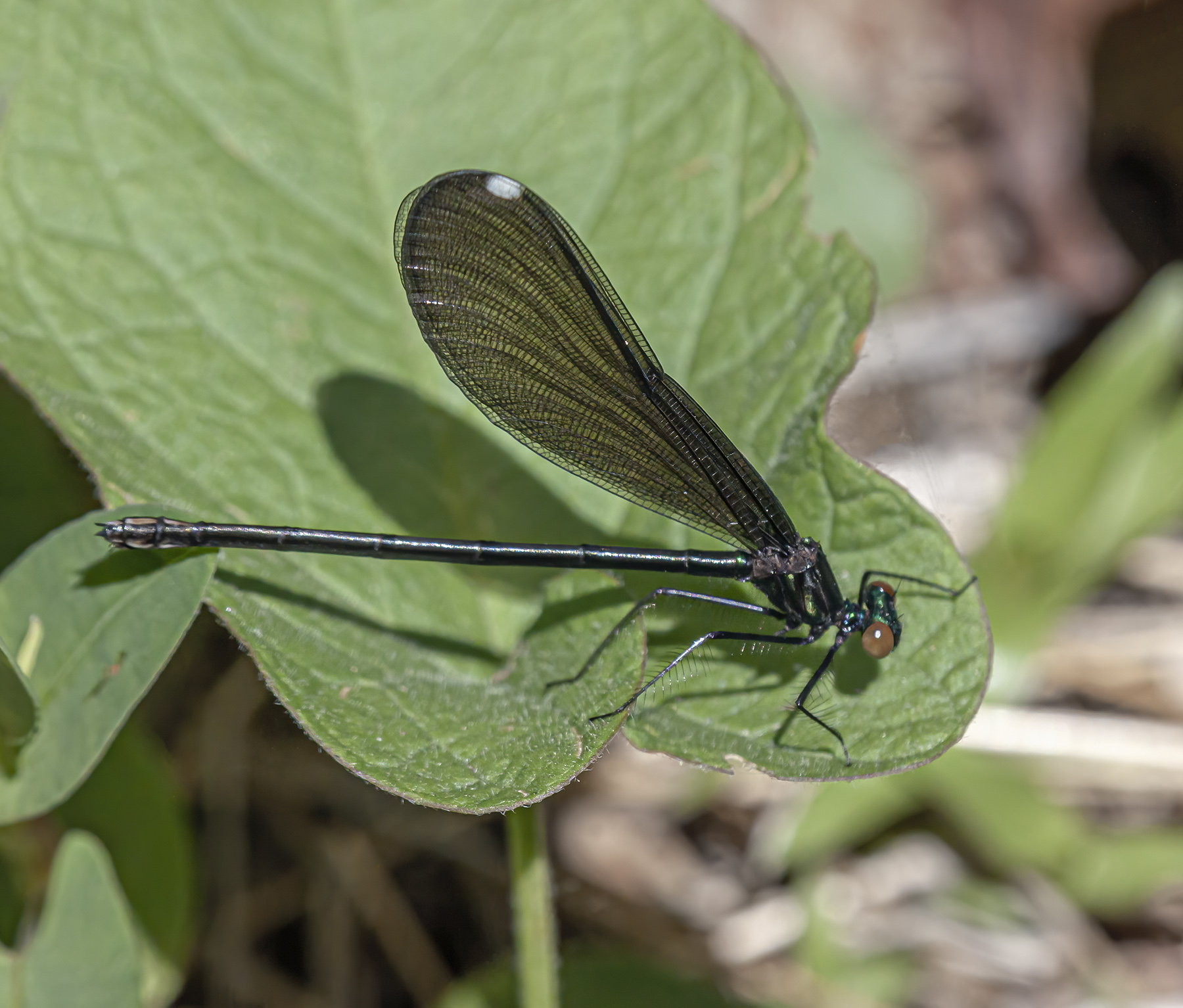
Yesterday I posted images of Eastern Amberwings, one of the most easily identified dragonfly species in my area. Today I am going to continue the mini-trend of going easy on my identification skills by presenting our most easily identified damselfly species, the Ebony Jewelwing damselfly (Calopteryx maculata).

I spotted this beautiful female Ebony Jewelwing last week as I was exploring in Occoquan Regional Park. Ebony Jewelwings are found most often along wooded slow-moving streams and frequently perch on low shrubbery in sun-lit openings in the forest canopy, which pretty well describes the circumstances of my encounter with this little beauty.

How do I know that it is an Ebony Jewelwing? There is no other damselfly in our area that has completely dark wings like the Ebony Jewelwing. How can I be sure that it is a female? Females have a conspicuous little white patch on their wings, technically known as a “pseudostigma,” that is pretty obvious in the photo below.

Some recent postings have noted the difficulties in making a correct identification of the dragonflies and damselflies that I photograph. I enjoy a mystery from time to time, but there is something reassuring about spotting a familiar species and being able to identify it immediately.
 

Ebony Jewelwing

© Michael Q. Powell. All rights reserved.

Read Full Post »

Last week I spotted my first Eastern Amberwing dragonflies (Perithemis tenera) of the season at Jackson Miles Abbott Wetland Refuge. These distinctively colored dragonflies are a frequent sight throughout the summer as they buzz about over the waters of ponds. Eastern Amberwings are small, even by dragonfly standards, with a total length of less than an inch (25 mm) and are considered to be a wasp mimic. According to Wikipedia, “The Eastern Amberwing dragonfly is one of the only types of dragonfly that actively mimics a wasp. The yellow and brown stripes on its abdomen encourage predators to stay away. When perched, they will wiggle their abdomen and wings in a wasp-like fashion to deter other animals from eating it.”

My second and third shots are portraits of perched male Eastern Amberwing dragonflies that were carefully composed and sharp, but my favorite image of the day is the dynamic shot of two dragonflies in flight. It may not be obvious what is going on in the photo, so let me explain. After mating, the female in the upper left corner is getting ready to deposit her eggs in the water, while the male in the lower right corner hovers in the air, ready to keep any rivals from interfering with the process.

Eastern Amberwing

Eastern Amberwing

Eastern Amberwing

© Michael Q. Powell. All rights reserved.

Read Full Post »

Dragonflies have been around for a long time, with fossils showing dragonfly-like creatures that date back to the Jurassic period, more than 150 million years ago. It is generally believed that dragonflies of the Petaluridae family, including the Gray Petaltail (Tachopteryx thoreyi) most closely resemble those ancient species.

I was thrilled to find several Gray Petaltails this past Monday at Occoquan Regional Park, about 20 miles (32 km) from where I live. Most of the time Gray Petaltails perch vertically, flat against tree trunks at eye level or higher. The first photo is a little deceptive, because it makes it look like it is easy to spot these rather large dragonflies (three inches (76 mm) in length). However, in my experience it is rare to see a Gray Petaltail on a smooth-barked tree. When they perch on trees with coarser bark, these dragonflies almost melt into the trees. You get a hint of how this camouflage works in the second image below.

The final image shows a more typical scenario. From a distance, I saw a Gray Petaltail land on a tree. When I snapped the photo, though, I could not see the dragonfly, even though I knew exactly where it was. Can you see the Gray Petaltail in the final photo? I think that my post processing may have made it a little easier to spot, but the dull color and pattern of the dragonfly help it to blend in with the light and shadows on the tree trunk.

Gray Petaltail

Gray Petaltail

Gray Petaltail

© Michael Q. Powell. All rights reserved.

Read Full Post »

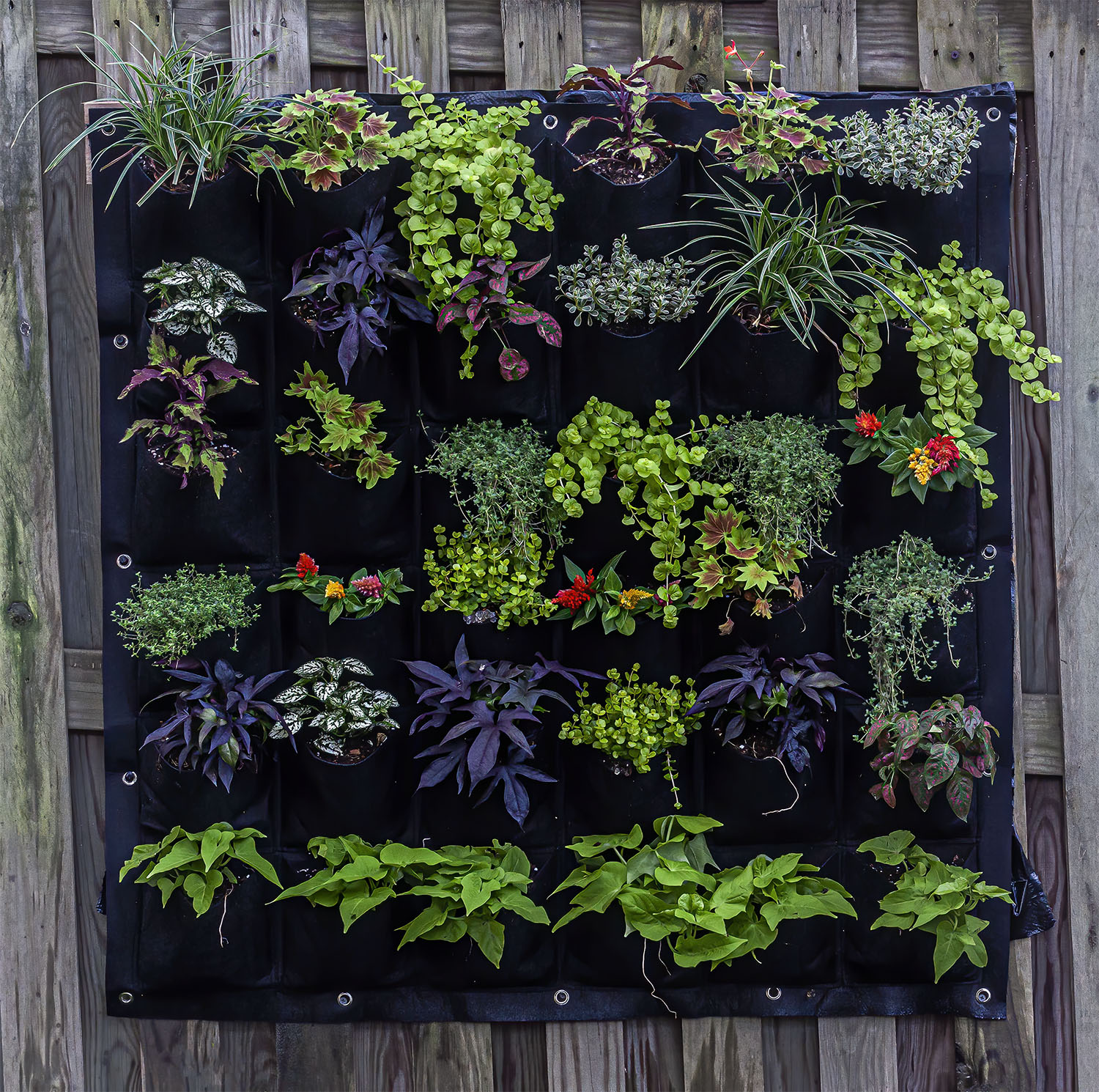
How do you grow a lot of plants in a small space? My amazingly creative friend, neighbor, and photography mentor Cindy Dyer decided to take advantage of vertical space and created this incredible wall of flowers and plants on the interior portion of the fence that encloses her back yard. Wow!

I do not know all of the details about how she set it up, but I think that the material, which Cindy describes as “felt-like,” has sewn-in pouches into which she inserted all of the plants and flowers. She mentioned to me that she had mixed some water-storing crystals in with the potting soil to reduce water stress and plans to water the wall regularly.

flower wall

© Michael Q. Powell. All rights reserved.

Read Full Post »

I was thrilled on Monday to see lots of butterflies as I was exploring Occoquan Regional Park. Many of them were small skippers that skittishly flew away whenever I approached them. Only a few were large and colorful, like the Red-spotted Purple butterfly (Limenitis arthemis) in the first photo. When it first landed on the plant, its wings were closed, but I waited and eventually the butterfly opened its wings. The damage to one of those wings this early in the season really emphasizes the fragility of these beautiful little creatures.

I also saw some brown woodland butterflies and I chased after several of them. I was out of breath but finally managed to catch up to one. Identification of this type of butterfly is always problematic, because there are quite a few similarly-colored species that vary only in the number and placement of the the eyespots. I think that the butterfly in the second shot is a Little Wood Satyr butterfly (Megisto cymela). I contemplated cropping closer, but decided I liked the little plant on the right side of the image and kept it. With this framing, I am able to create the illusion that the butterfly is staring at the plant.

Red-spotted Purple

Little Wood Satyr

© Michael Q. Powell. All rights reserved.

Read Full Post »

Most of you know that I love to photograph dragonflies. In a recent posting, I thought I was featuring photos of a Cobra Clubtail dragonfly, but it turns out that it was a Splendid Clubtail dragonfly. Here is Walter Sanford’s behind the scenes account of the initial misidentification of the dragonfly, with photos showing the differences between the two species, and how experts determined that we had made an error. His posting provides some fascinating insights into the complications sometimes associated with making an identification of a species (and why it is important to photograph subjects from multiple angles, if possible).

Be sure to click on the “View original post link” if you are using the WordPress Reader to read Walter’s complete posting on his blog or go directly to his posting by using this link.

waltersanford's avatarwalter sanford's photoblog

A Splendid Clubtail dragonfly (Gomphurus lineatifrons) was spotted during a photowalk with Michael Powell at an undisclosed location in Fairfax County, Virginia USA. Easy for me to say now. As it turns out, my initial identification was incorrect.

The first photo I took of the dragonfly — the record shot — is shown below. Notice the pattern of yellow lateral marks/spots on its abdomen. Also notice the yellow blotch on the side of abdominal segment eight (S8) extends onto the club flange, as shown in the full-size version of the image. (Thanks to Michael Boatwright, founder and administrator of the Virginia Odonata Facebook group, for sharing these key field marks for Splendid.)

26 MAY 2020 | Fairfax County, VA | Splendid Clubtail (female)

In contrast, the pattern of yellow lateral marks/spots on the abdomen of a female Cobra Clubtail (Gomphurus vastus), shown below, looks…

View original post 449 more words

Read Full Post »

On Tuesday I spotted this handsome male Spangled Skimmer dragonfly (Libellula cyanea) at Occoquan Regional Park. This species is fairly easy to identify because of the “spangles,” the little white patches on the leading edges of the wings, often referred to as stigmata or pterostigmata. Most other species have darker colored stigmata or none at all.

If you use the meteorological calendar, summer started on the first of June. For most of us, though, who use the astronomical calendar, we have a few weeks to wait until the summer begins on the 20th of June. No matter how you calculate summer, I have noticed a lot more of the summer dragonfly species during my most recent outings. If things work out well, June could be a great month for dragonfly hunting, with the possibility of seeing some of the remaining spring species, plus the new summer ones.

spangled skimmer

© Michael Q. Powell. All rights reserved.


Read Full Post »

Last Tuesday I spotted this cute little toad—I think it may be a Fowler’s Toad (Anaxyrus fowleri)—while exploring the wilds of Fairfax County. The toad was just chilling (or more accurately may have been warming itself) on a rock ledge with a bumpy texture and mottled coloration that matched those of the toad pretty well.

It is hard to know what the frog was thinking, but it appeared to be in deep contemplation. “I think, therefore I am.”

Fowler's Toad

© Michael Q. Powell. All rights reserved.
 

Read Full Post »

We have started a new month and new flowers are blooming in the garden of my friend and photography mentor Cindy Dyer. Iris season has almost ended, but more lilies are opening each day. Today’s featured star is the bold, fragrant oriental hybrid known as the Stargazer Lily (Lilium ‘Stargazer’). Wow—there is nothing subtle about this flower that overwhelms both the eyes and the nose.

The words “star gazer” bring to mind some words from one of my favorite songs, The Rainbow Connection as sung by Kermit the Frog. “What’s so amazing that keeps us stargazing and what do we think we might see? Someday we’ll find it, that rainbow connection, the lover, the dreamer, and me.” Now more than ever, we all need hope.

I want to share with you the concluding portion of a prayer distributed to us by our local Episcopal bishop yesterday, a National Day of Mourning and Lament for those who have died of COVID-19. “God of all hope, God of all goodness, we are a people hurting, lost and divided. Our world seems a strange and foreign land, our days a blur of separation and isolation. Gather us to your very heart as we pray for our nation, receive all who have died into the fulness of your heaven, guide the hands of all who serve others. Bless our efforts to love all people in concrete action and, in your powerful ways and in your perfect time, make us whole for the sake of a world so desperately in need of You. Amen.”

Stargazer Lily

Stargazer Lily

© Michael Q. Powell. All rights reserved.


Read Full Post »

Names can sometimes be misleading. There is a genus of damselflies, consisting of 35 species, called American bluets. As the common name “bluet” suggests, most members of the genus are primarily blue in color. One notable exception is the adult male Orange Bluet (Enallagma signatum) that often does not appear to have even a speck of blue on its body.

I spotted this little guy last Friday at Jackson Miles Abbott Wetland Refuge and was a bit shocked by his bright red eyes when I looked through the viewfinder of the camera. The male Orange Bluet was perched at the extreme end of some vegetation overhanging a pond.

I would have liked to have gotten a shot in which more of its body was in focus, but I did not want to risk falling in the water, which looked to be pretty deep at that spot. As I look at the photo now, I realize that the soft focus of the body may actually be a good thing, because it draws a viewer’s attention even more to the eyes of the handsome little damselfly.

orange bluet

© Michael Q. Powell. All rights reserved.

Read Full Post »

« Newer Posts