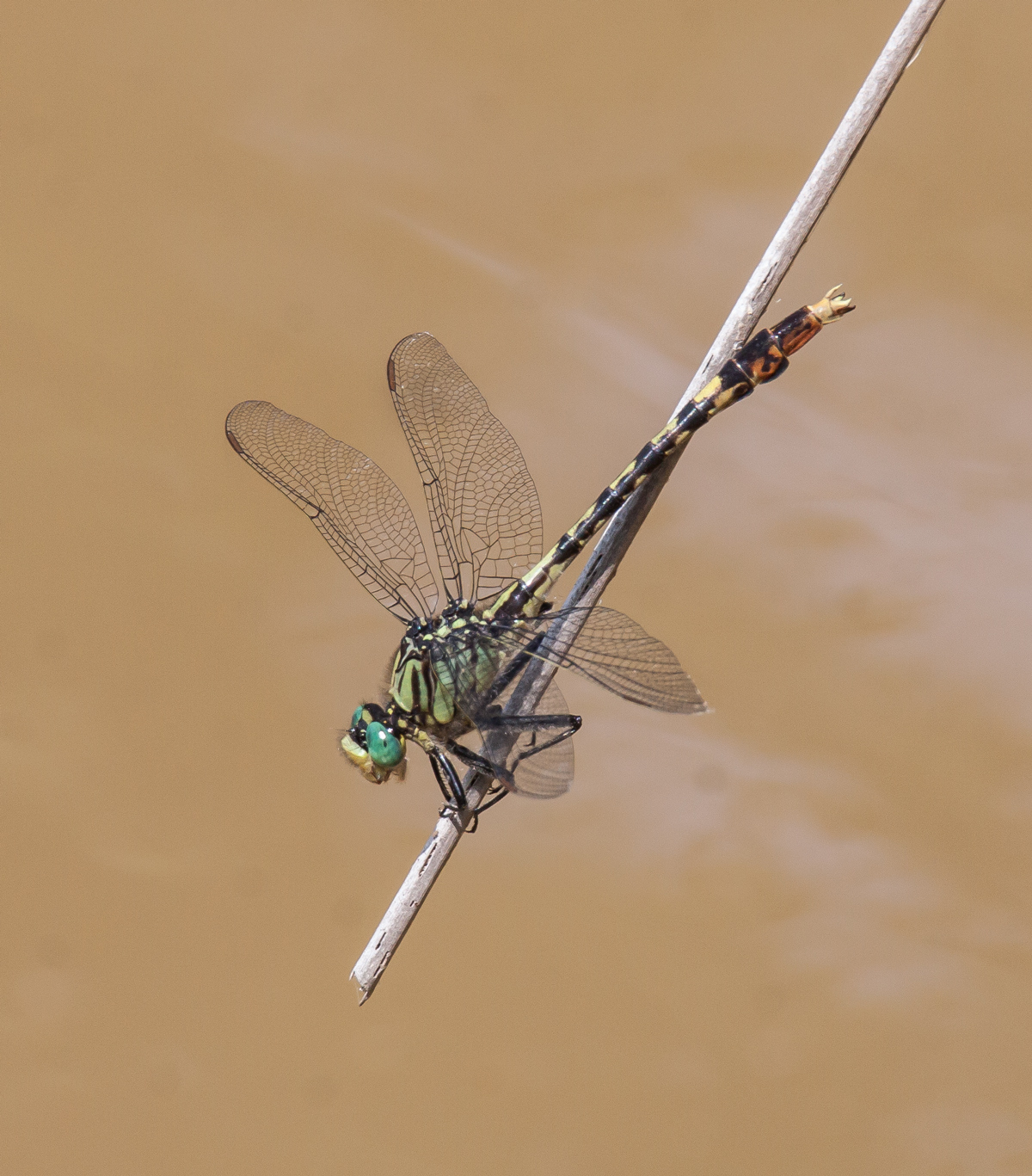
Do you believe in unicorns? I spent part of yesterday chasing a flying unicorn, although in this case it was the Unicorn Clubtail dragonfly (Arigomphus villosipes), not the one that looks like a horse.

The Unicorn Clubtail is not a mythical creature, but I rarely see one—I am lucky if I manage to see a couple during an entire season of dragonfly watching. The u-shaped terminal appendage in the male Unicorn Clubtail is pretty distinctive and as soon as I saw this image on my computer screen, I knew that I had captured a unicorn.
When I first spotted this dragonfly, it was perched on a sandy area of the bank of a small stream. I mistakenly assumed that it was a Common Sanddragon, a somewhat similar species which is also part of the clubtail family (the members of this family have slim abdomens that end in an enlarged tip, i.e. the “clubtail”). When the dragonfly flew up into some vegetation that hung over the pond, I snapped off some photos as quickly as I could, because it is rare to get shots of these dragonflies with an unobstructed background.
One of my friends, Walter Sanford, a fellow photographer and blogger suggested to me earlier this spring that I use my Tamron 150-600mm lens, one that I use primarily for birds, to photograph dragonflies. I protested a bit, suggesting that I would not be able to capture the fine details of the dragonflies with the lens, which is reported to be a little soft at the long end.
There are some challenges, including the minimum focusing distance of 107.3 inches (2.7 m), which means I have to be a pretty good distance from my subject. However, shots like this one make me realize his advice was good—the extra reach helps me get shots that I might not be able to get otherwise, especially if I tried to move closer to take a shot with a shorter telephoto lens and risked spooking the dragonfly.
© Michael Q. Powell. All rights reserved.
Read Full Post »


 Mike Powell