Feeds:
Posts
Comments

Posts Tagged ‘wren’

Carolina Wrens (Thryothorus ludovicianus) are quite common in Northern Virginia, where I live. Most often, though, I get a only a glimpse of one when I hear it loudly singing. Carolina Wrens often seem to bury themselves in the low vegetation and it is hard to get an unobstructed view of one.

Last week at Occoquan Bay National Wildlife Refuge, I spotted a Carolina Wren as it was moving about and manage to track it. I attempted to take a lot of shots of the little bird, but most of them were blurry or had the head hidden by branches. There are a lot of branches (and shadows) in this photo too, but I was fortunate enough to be able to focus on the wren’s eye.

I really love the warmth of the colors on the wren’s body and how well it blended into its surrounds. The color palette is minimal, with mostly varying shade of brown, but the little green bits add some visual interest and give rises to hope that the bleak days of winter will eventually be replaced by the new growth of spring.

Carolina Wren

© Michael Q. Powell. All rights reserved.

Read Full Post »

Throughout this winter, I have been trying to capture an image of Winter Wren (Troglodytes hiemalis), a tiny bird that spends the cold season in my area. As described by the Cornell Lab of Ornithology, “Winter Wrens hop and scamper through the understory moving more like a mouse than a bird as they investigate upturned roots and decaying logs for food. These energetic birds often bob their entire bodies as if doing squats while they nervously look around in the forest understory.”

I have occasionally caught glimpses of Winter Wrens, but they have invariably moved away before I could get a shot. These wrens are really elusive as they scurry about among the tangled branches and leaves and my camera has struggled to focus on them, choosing instead to focus on the surrounding vegetation.

On Monday, I finally managed to get a shot of a Winter Wren, after tracking it through the brush for almost 15 minutes. It is definitely not a prize-winner, but I am pretty confident that I achieved my goal. Parts of the bird are hidden by branches, but I think helps viewers to better understand the environment in which this little birds are found.

Now I have a new challenge—to get a better shot of a Winter Wren. That’s part of the cycle of being a wildlife photographer, celebrating small achievements, but always believing that I can do better. That’s why I return again and again to the same places, always watching, always waiting, wildly optimistic that new opportunities will present themselves.

Winter Wren

© Michael Q. Powell. All rights reserved.


Read Full Post »

As I was preparing to lock the front door of my townhouse in Northern Virginia one day last week, I glanced over at a bush about 10 feet (3 meters) away where a bird was perched. I pivoted my body, turned on the camera, and focused on the little bird, which I noted was a Carolina Wren (Thryothorus ludovicianus)—I going out out on a photo adventure, so my camera was slung over my shoulder.

Fearing that I might scare off the wren, I snapped off a few shots without paying too much attention to my camera settings. It felt a little strange to photograph a bird at such close range. In most cases I photograph birds with my 150-600mm lens zoomed out to 600mm, but in this instance I took the shot at 309mm and probably should have zoomed back a bit more.

When I was reviewing the images on my computer,  I checked the camera settings I had used and found out my camera was set at ISO 800, f/6.3, and 1/100. I am a little shocked that I was able to get a relatively sharp shot at such a low shutter setting, but the lens does have some built-in image stabilization and I am used to holding the lens pretty steady.

Some photographers travel great distances to capture wildlife images. This shot is definitely award worthy, but it does show that you may not have to travel far from home to see and photograph nature and wildlife. Beauty is everywhere.

Carolina Wren

© Michael Q. Powell. All rights reserved.
Read Full Post »

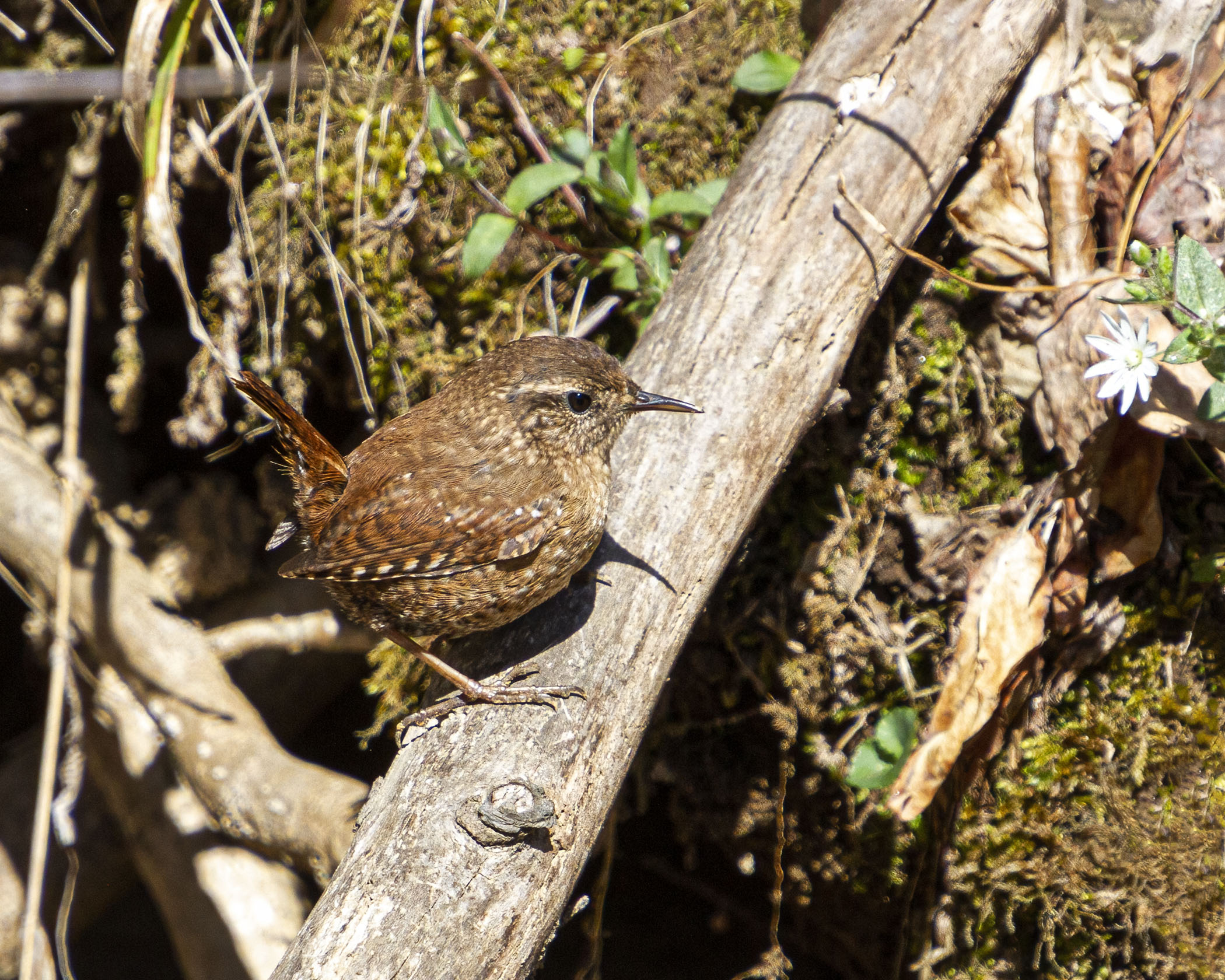
Throughout the winter I searched in vain for a Winter Wren (Troglodytes hiemalis), but finally managed to spot one last Thursday as I was exploring a stream in Prince William County, Virginia on a sunny spring day. According to the Audubon Field Guide, the Winter Wren is “A secretive little bird of dense woods. It often creeps about among fallen logs and dense tangles, behaving more like a mouse than a bird, remaining out of sight but giving an occasional kimp-kimp callnote.”

When I took these photos, I was standing in a dried-up stream bed, so I was almost at eye-level with this tiny bird. This angle of view allowed me to get much better shots that I would have gotten if I had been shooting downwards at the subject. I recommend that you click on the images to get a closer look at the beautiful details on this wren, including its speckled feathers, upturned tail, large feet, and sharp bill.

Winter Wren

Winter Wren

© Michael Q. Powell. All rights reserved.

Read Full Post »

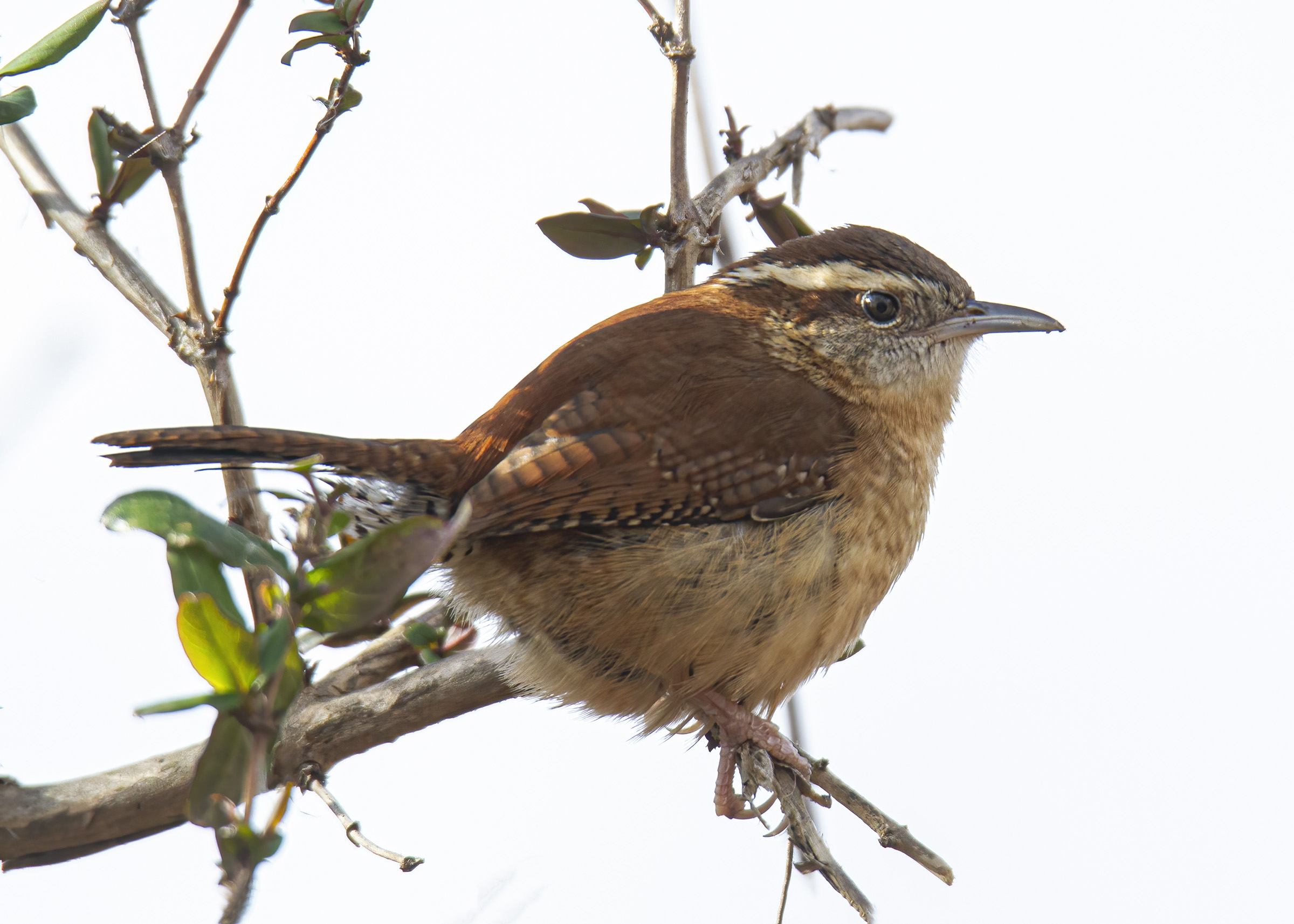
Carolina Wrens (Thryothorus ludovicianus) are one of the birds that I hear a lot more often than I see. Most of the time these little birds are flitting about in the vegetation and leaf litter near the ground and and I am lucky to get a glimpse of one of them.

On Thursday at Occoquan Bay National Wildlife Refuge, a handsome Carolina Wren hopped up on a branch right in front of me and perched for a moment. I was thrilled to capture this little portrait of the wren that shows the beautiful markings on its wings and its distinctive white eye stripe.

Carolina Wren

© Michael Q. Powell. All rights reserved.
Read Full Post »

Carolina Wrens (Thryothorus ludovicianus) are incredibly hard to see, because they spend a lot of their time moving through the underbrush in areas with heavy vegetation. However, it is not hard to know that one of them is around, because Carolina Wrens delivers an amazing number of decibels for their size.

These spunky little birds sing loudly and often—according to the Cornell Lab of Ornithology, one captive male Carolina Wren sang nearly 3,000 times in a single day. The Cornell Lab noted further that, “Only male Carolina Wrens sing—a series of several quick, whistled notes, repeated a few times. The entire song usually lasts less than 2 seconds and the notes are usually described as three-parted, as in a repeated teakettle or germany. Each male has a repertoire of up to several dozen different song variations. He’ll sing one of these about 15 times before changing his tune.” Check out this link to hear recordings of some of those sounds.

This past Thursday, I while I was at Occoquan Bay National Wildlife Refuge, I spotted some movement in the brush and heard the singing of a Carolina Wren. The bird was mostly hidden, but I managed to find a small visual tunnel through the vegetation that allowed me to get this shot of the wren when it hopped up onto a broken-off branch.

I was thrilled to be able to capture this image mid-song—it helps to show the personality of the wren. I also really like limited color palette—mostly various shades of brown—that give the image a really pleasant color harmony.

Carolina Wren

© Michael Q. Powell. All rights reserved.

Read Full Post »

For almost a year now we have been taking defensive measures to minimize our risks—we now must cautiously consider our actions before we take them. “Spontaneity” has almost disappeared from our active vocabulary. Were we ever completely carefree?

When I first looked at this photograph of a Carolina Wren (Thryothorus ludovicianus) that I spotted on Monday at Occoquan Bay National Wildlife Refuge, I immediately saw it as a kind of visual metaphor for my life. Surrounded by thorns in an almost monochromatic world, this serious-looking little bird cautiously contemplates its surroundings. Is it safe yet?

No, it is not yet safe, but there are signs of hope that things are improving. Vaccinations have started and here in the Northern Hemisphere, there are already small indications that spring is on the way. The birds are preparing their nests and buds are appearing on the trees.

Our celebrations may still be muted, but even now there is joy to be found. Don’t forget to stop and look for it in today—joy in the midst of caution.

Carolina Wren

© Michael Q. Powell. All rights reserved.

Read Full Post »

I could hear rustling in the fallen leaves along one of the trails yesterday at Occoquan Bay National Wildlife Refuge, but had trouble determining what was making the noise. Most of the time, sparrows fly away in similar situations, but this little creature seemed to be crawling about, moving in one direction undeterred by my presence. When I finally got a partial glimpse of it, I realized that it was a Winter Wren (Troglodytes hiemalis).

The Cornell Lab of Ornithology describes the appearance and behavior of the Winter Wren in these words, “It sports a palette of browns with dark barring on the wings, tail, and belly. It habitually holds its tiny tail straight up and bounces up and down. This rather weak flier hops and scampers among fallen logs mouselike, inspecting upturned roots and vegetation for insects.” Wow. I don’t recall any other instance of the term “mouselike” being used to describe a bird, but it fits pretty well.

The little Winter Wren was a ball of energy, moving all the time in and out of the vegetation, making it hard to track and even harder to photograph. Eventually it hopped up onto a perch for a few seconds and I was able to capture the first two images. Most of the time, though, it was hidden in the undergrowth, even when it was mostly exposed as in the final image, which gives you a good idea of its habitat.

I really encourage you to click on the images to get a closer view of the different shades of brown and detailed patterns on this beautiful little Winter Wren.


Winter Wren

Winter Wren

Winter Wren

© Michael Q. Powell. All rights reserved.

Read Full Post »

When I am walking about with my camera at Occoquan Bay National Wildlife Refuge, my favorite local spot for wildlife photography, my eyes are in constant motion. I don’t want to miss the eagles perched high in trees or soaring overhead, but I also don’t want to miss the small birds that I can hear poking about in the underbrush.

I am amazed at how much noise these little birds can make as they pick their way over, under, and through the carpets of fallen leaves. This past Wednesday I was really happy when this Carolina Wren (Thryothorus ludovicianus) perched momentarily on a fallen branch. I love this wren’s beautiful brown coloration and the wonderful accents provided by the eye stripe and detailed pattern on its long tail. After its brief pause, the wren resumed its energetic pursuits and disappeared from sight.

Carolina Wren

© Michael Q. Powell. All rights reserved.

Read Full Post »

I love to sing, but it would be hard for me to compete with a Carolina Wren (Thryothorus ludovicianus). Carolina Wrens are quite small, but their songs and calls are amazingly loud and frequent. According to the Cornell Lab of Ornithology, one captive male Carolina Wren sang nearly 3,000 times in a single day. Yikes! Click on this link if you would like to hear the sounds that a Carolina Wren can make.

I spotted this Carolina Wren on Thursday at Occoquan Bay National Wildlife Refuge and followed it around as it went about its normal activities. In the first image, the wren was singing and in the other two shots it was foraging for food.

It is interesting to see how the bird’s body shape seemed to change as the angle of view changed. In the first photo, the wren looks round and chubby, but in the second photo it looks longer and thinner. I took the third shot from a strange angle, but I like the way that it shows the patterns of the bird’s feathers, a pattern that is almost matched by the grain of the wood of the log on which it is perched.

Carolina Wren

Carolina Wren

Carolina Wren

© Michael Q. Powell. All rights reserved.

Read Full Post »

Carolina Wrens (Thryothorus ludovicianus) are usually active very close to the ground in the undergrowth. I was therefore quite surprised when one recently flew into a tree at almost eye level as I sought to track a different bird. The minimum focusing distance for my telephoto lens is almost 9 feet (270 cm) and although this little bird seemed to be really close, it was apparently a little beyond that distance.

I managed to quickly focus on the wren and capture this shot before it flew away. It is always cool when I am able to be at eye level with a bird, because I think that it tends to show the personality of a bird more than a shot from a lower or higher angle.


Carolina Wren

© Michael Q. Powell. All rights reserved.

Read Full Post »

Most of the time when I see or hear Carolina Wrens (Thryothorus ludovicianus), they are hidden in the undergrowth. I was thrilled therefore last Monday to be able to capture an image of this one in the open at Occoquan Bay National Wildlife Refuge.

I generally think of Carolina Wrens as cheerful, energetic little birds and I like the way that this simple shot captures a bit of that personality.


Carolina Wren

© Michael Q. Powell. All rights reserved.

Read Full Post »

I love the sweet sounds of a Carolina Wren (Thryothorus ludovicianus), like this little beauty that I spotted on Wednesday at Occoquan Bay National Wildlife Refuge.  Most of the times when I see a Carolina Wren, it is hopping about in the underbrush, but sometimes when they are going to sing, they choose a higher, more visible perch.

Carolina Wren

© Michael Q. Powell. All rights reserved.

Read Full Post »

Carolina Wrens (Thryothorus ludovicianus) are small birds that often remain hidden, but their loud songs let you know when they are near. I caught a glimpse of this one from an unusual angle last week at Occoquan Bay National Wildlife Refuge.

Carolina Wren

© Michael Q. Powell. All rights reserved.

Read Full Post »

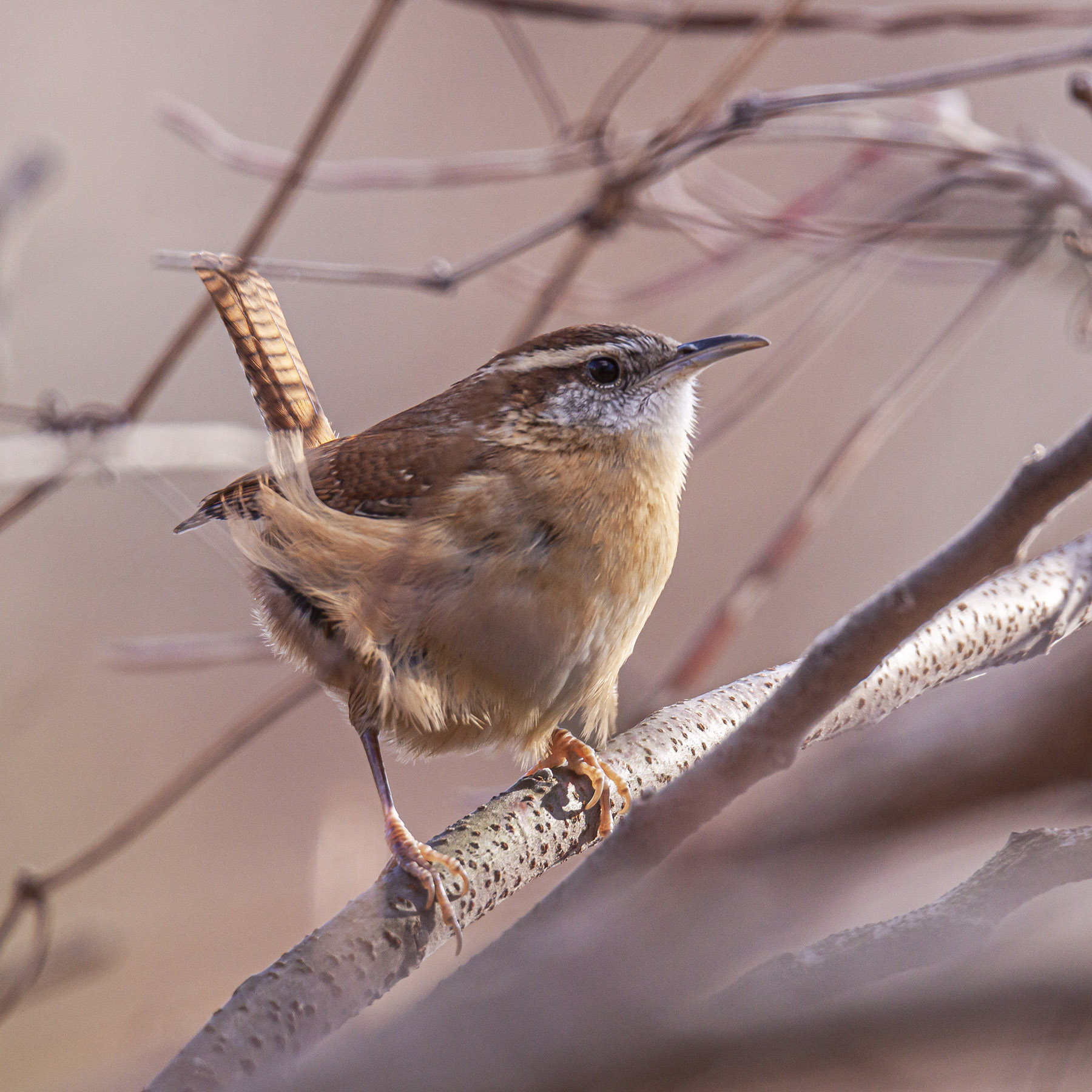
Sometimes when a bird fluffs up its feathers, its appearance changes enough that identification becomes more difficult than usual. That was certainly the case with this little Carolina Wren (Thryothorus ludovicianus) that I spotted on New Year’s Day at Occoquan Bay National Wildlife Refuge. The head and the tail looked normal for a Carolina Wren, but I had never before seen spots on the back of one.

Once again, experts in a Facebook forum came to my rescue and reassured me that this was normal behavior for a Carolina Wren. When they fluff up their feathers to roost at night, the spots are visible too, although in this case I suspect that the wren was merely trying to retain body heat in the bitter cold weather that we have been experiencing the last couple of weeks.

Carolina Wren

© Michael Q. Powell. All rights reserved.
Read Full Post »

This bird was tiny and elusive, but I finally managed to get a shot of what I confirmed is a Winter Wren (Troglodytes hiemalis) today at Huntley Meadows Park. The Winter Wren is smaller—about 3-4 inches (8-11 mm) in length—and has darker markings on its belly than the Carolina Wrens that I am more accustomed to seeing.

The description of this bird found on the website of the Cornell Lab of Ornithology matches perfectly the behavior I observed today. “It habitually holds its tiny tail straight up and bounces up and down. This rather weak flier hops and scampers among fallen logs mouselike, inspecting upturned roots and vegetation for insects.”

Winter Wren

© Michael Q. Powell. All rights reserved.


Read Full Post »

I had hopes of capturing lots of images of birds perched on snow-flocked branches at Huntley Meadows Park  yesterday morning, but this happy little Carolina Wren (Thryothorus ludovicianus) was the only bird that cooperated. About an inch of light fluffy snow had fallen overnight and covered the trees and cars, but the streets were totally clear—it was what some local meteorologists like to call “conversation snow.” Traffic snarls easily in Northern Virginia, but fortunately this dusting of snow did not seem to create any serious problems on the road.

So far this winter, snow has been uncommon here, but I am sure we will be blasted before long and, conditions permitting, I’ll be out again trying to capture the snowy images that I have in my mind.

Carolina Wren


© Michael Q. Powell. All rights reserved.

Read Full Post »

Peering through my telephoto lens at this tiny bird, I couldn’t help but smile—its energetic personality, round body, and tiny wings and tail were cartoon-like.  It looked like a wren, but it certainly didn’t resemble the Carolina Wrens that I am used to seeing.

I did a little research and have concluded that this is probably a Winter Wren (Troglodytes hiemalis). According to the Cornell Lab of Ornithology, these little birds are “incomparably energetic in voice” and per unit weight deliver their songs with ten times more power than a crowing rooster. I can only imagine groups of scientists with tiny scales and microphones conducting the research to back up that statement.

I noted on the statistics page of my blog that this will be posting number 1,000. I never imagined how much I would come to enjoy the process of blogging when I started this blog on July 7, 2012 with a photo of a Blue Dasher dragonfly. The support and encouragement from innumerable readers has helped to sustain me on my journey into photography. Thanks to all of you.

The journey continues.

winter_wren2_blogwinter_wren1_blog

© Michael Q. Powell. All rights reserved.

Read Full Post »

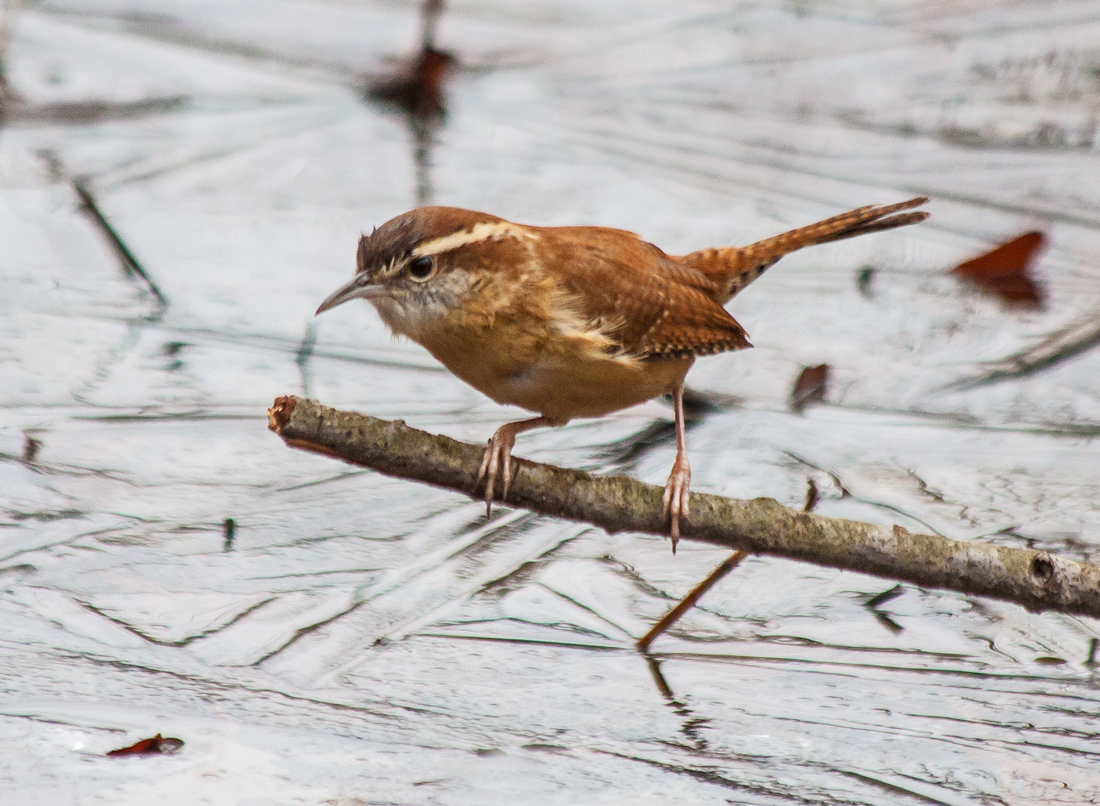
Back home from a week overseas in Vienna, I felt the need to reconnect with nature and headed off to the marsh at Huntley Meadows Park early this morning. The weather was cold and gray, but I was able to get some shots of birds, like this Carolina Wren (Thryothorus ludovicianus), surveying the frozen pond from an overhanging branch.

It’s nice to be home.

wren_dec_blog

© Michael Q. Powell. All rights reserved.

Read Full Post »

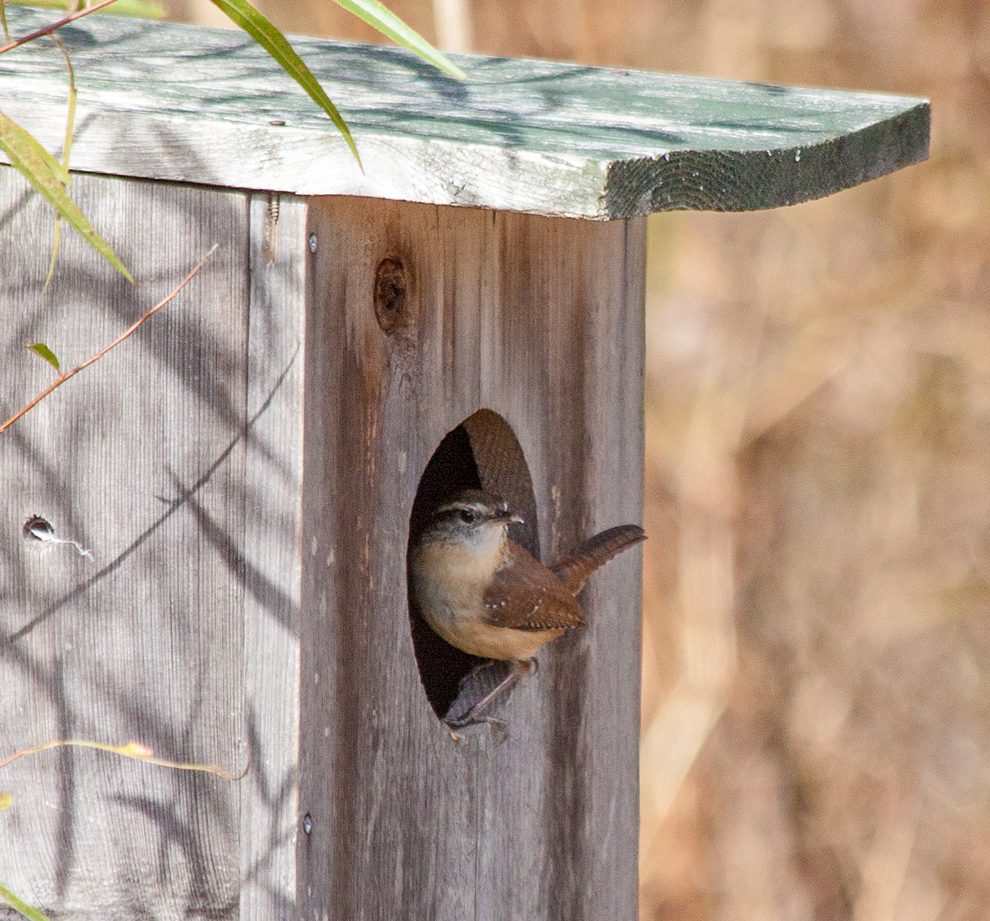
Why was this wren perching on the nesting box just prior to entering it? It’s not nesting season, is it? Was it seeking shelter on a cool, windy day? Were there insects inside to eat?

As I noted yesterday, bird activity was low on Monday—we didn’t even have any Canada geese or ducks passing through. I initially noticed this small bird, which I think is a Carolina Wren (Thryothorus ludovicianus), when it was checking out the underside of this nesting box. The box itself is pretty big and was placed there, I believe, for ducks to use. Eventually the wren perched on the edge of the entrance and peered inside and then looked all around before going inside.

wren_box_blog

© Michael Q. Powell. All rights reserved.

Read Full Post »

Nowadays when I see a little brown bird, my first thought is that it’s probably some kind of sparrow. In this case, however, the beak seemed to be too long to be a sparrow, so I had to so some research. I’m pretty sure this pretty little bird is a Carolina Wren (Thryothorus ludovicianus). In addition to the beak, I was able to use the white eye stripe and uplifted tail as identification features.

In addition to the internet, I now have my first hardcopy identification guide, Peterson Field Guide to Birds of North America, a thank-you gift from friends for catsitting. I suspect that this may turn out to be the first of a series of guides that I’ll end up acquiring.

Carolina Wren

Carolina Wren

© Michael Q. Powell. All rights reserved

Read Full Post »