Feeds:
Posts
Comments

Posts Tagged ‘woodpecker’

I love to watch energetic little Downy Woodpeckers (Picoides pubescens) at work, like this one that I observed last week in my own neighborhood.

Most of the time these little powerhouses are in constant motion or are obscured by branches, so it’s difficult to get a clear shot of them. This one, however, was in a location where I could get an unobstructed photograph and the woodpecker even cooperated by lifting its head for a moment (though it did appear to be a little irritated at the interruption).

As soon as I was done with the brief photo shoot, the woodpecker went back to work, pounding away at the wood in search of some tasty morsels of food.

downy_neighbor_blog

© Michael Q. Powell. All rights reserved

Read Full Post »

It’s nice to be back home from my recent overseas trip and to have the chance to go out in the wild for some photos. Urban shooting is ok, but somehow I feel more comfortable chasing after wildlife.

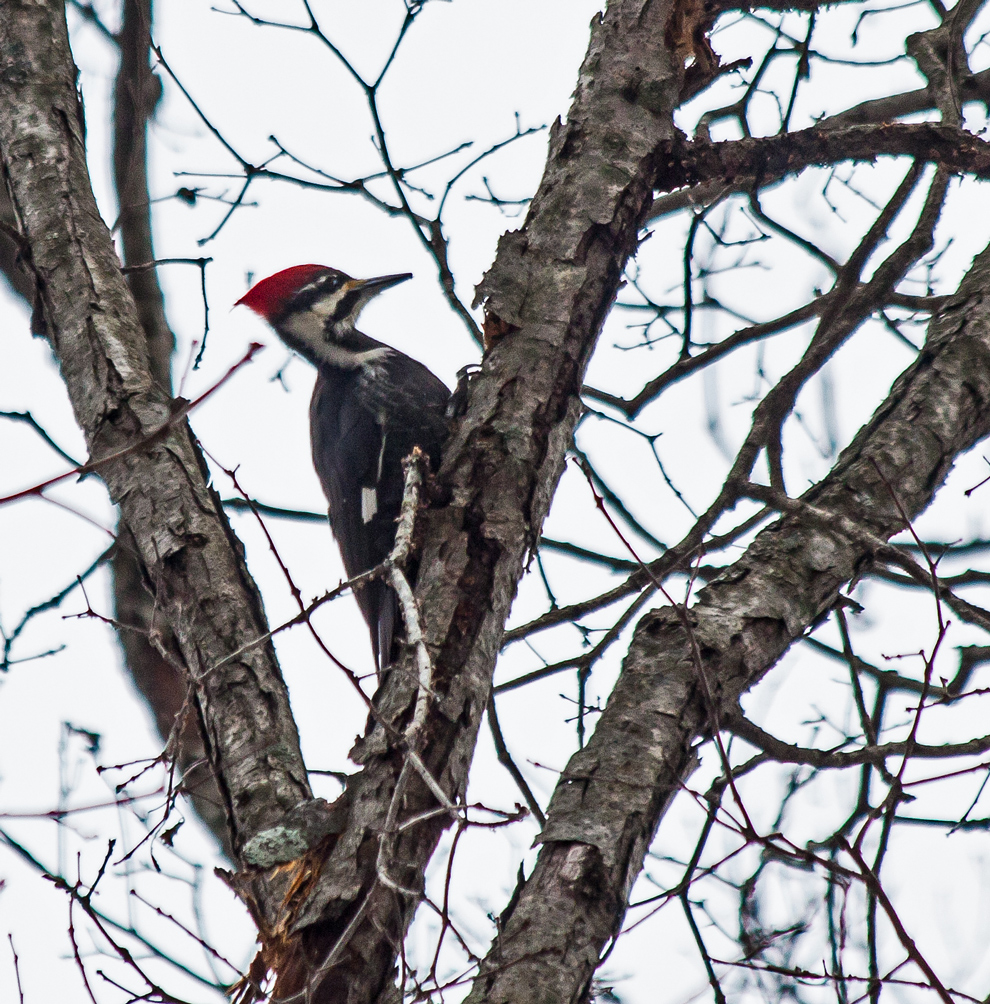
Yesterday I spotted this Pileated Woodpecker (Dryocopus pileatus) high in the trees at Huntley Meadows Park, the local marsh that is my favorite spot for wildlife shooting. I’ve been trying for quite a while to get some good shots of this spectacular woodpecker and they are getting better, though they are not quite there yet.

These two shots are part of a series that I took as the woodpecker moved its head from side to side as well as up and down, chiseling out a hole in the tree. I was amazed to see how far back the woodpecker pulled its head before each stroke and the powerful force with which it struck—it was enough to give me a headache.

I’m still hoping that I will find a Pileated Woodpecker a bit lower in a tree (or working on a fallen log) in a location that will permit me to get some better shots, but I am content that I was able to get these shots when I caught sight of this woodpecker yesterday.

pileated2_jan_blogpileated1_jan_blog

© Michael Q. Powell. All rights reserved

Read Full Post »

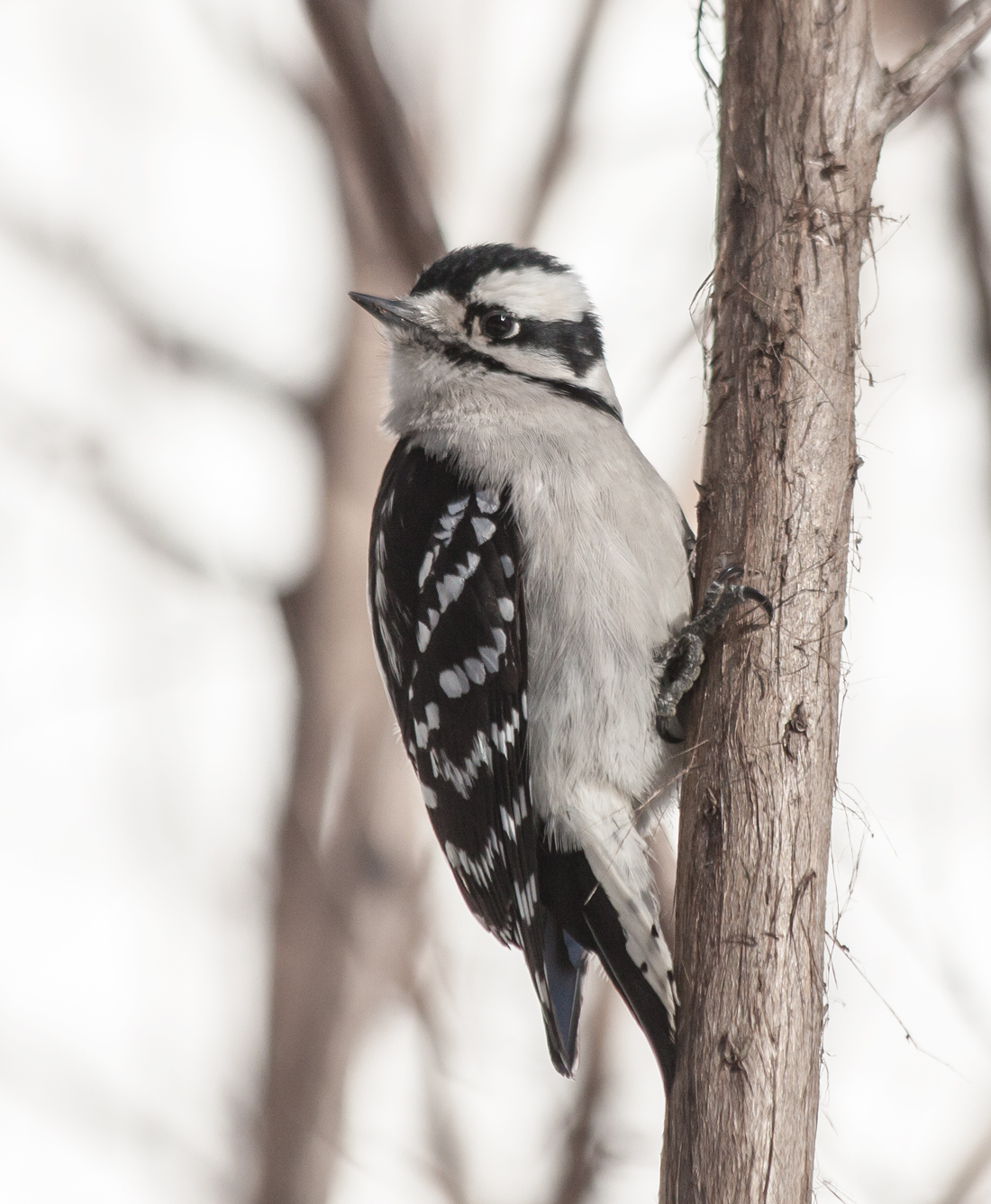
Like most Downy Woodpeckers, this little male woodpecker started spiraling his way up the tree as soon as he landed on it. Then to my surprise, he worked his way back down the tree and stopped at eye level, where he stayed long enough for me to take a number of shots and even make a few adjustments in between the shots.

I really like Downy Woodpeckers (Picoides pubescens). Their high energy and acrobatic activities are a constant source of interest for me as I watch them at work in the trees and in the cattails. I’ve usually had a tough time, though,  getting an uncluttered shot of a Downy Woodpecker.

I took this shot in an area where there were mostly young trees, which made it easier for me to isolate the woodpecker as he moved about and to slowly move closer and fill the frame with the little bird. The area was shaded, so I ended up using my pop-up flash to add a little fill light. I opened up the aperture as wide as I could, which had the effect of blurring out the background.

I ended up with a portrait-like shot of the Downy Woodpecker that I really like. Click on the image to see it in higher resolution.

downy_Jan1_blog

© Michael Q. Powell. All rights reserved

Read Full Post »

Do you have a list of subjects that you really want to photograph? I do and ever since I caught sight of a Pileated Woodpecker (Dryocopus pileatus) through the window of the visitor center of my local marshland park, I have been possessed with an overwhelming desire to photograph one. That first time, the woodpecker was hanging from a suet feeder usually used by nuthatches and Downy Woodpeckers and I was impressed by its size and its beauty.

Last month, a year after the initial sighting, I finally got a photo of one and featured it in a posting My First Pileated. The photo was a little blurry and the bird was partially obscured by branches, but it was clearly a Pileated Woodpecker. This past Saturday, I came upon another one as I was walking through the woods. Not surprisingly, I heard the woodpecker before I caught sight of it high in the trees, barely visible.

The dry leaves crackled loudly as I tried to get closer to the woodpecker and it flew to other trees several times during this protracted process. I had heard from others that Pileated Woodpeckers sometimes work on fallen logs, but this one never left the higher reaches of the trees. Eventually it flew out of sight.

I ended up with a slightly better photograph of a Pileated Woodpecker, but am confident that I can do much better this winter as I continue to stalk “big game,” which for me includes this woodpecker, hawks, and maybe even an owl.

pileated_dec_blog

© Michael Q. Powell. All rights reserved.

Read Full Post »
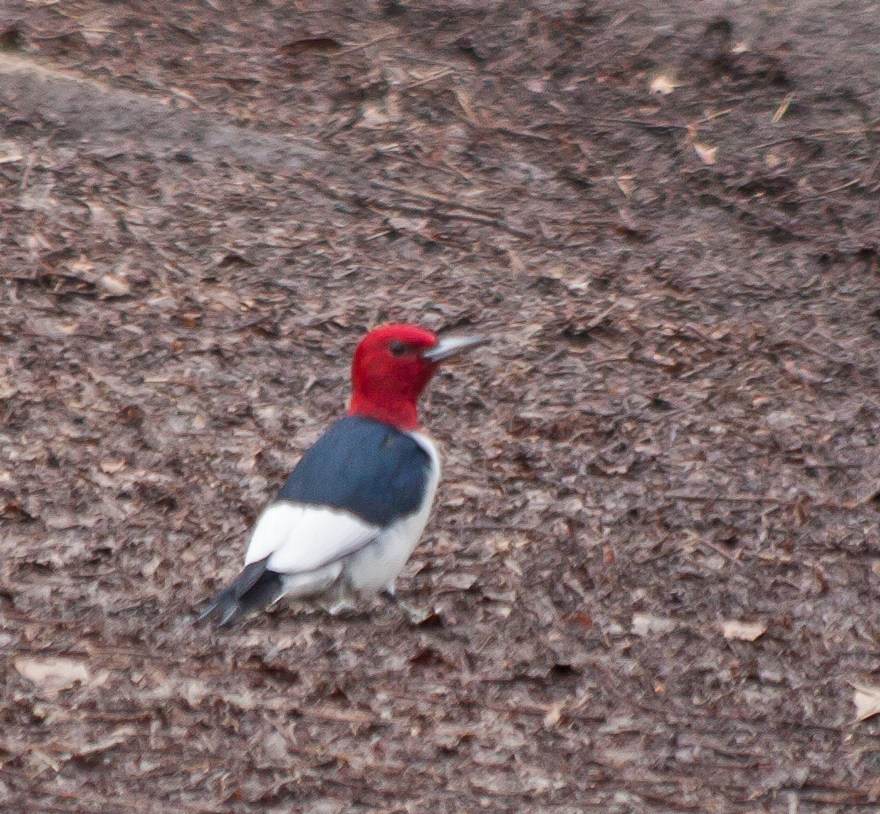
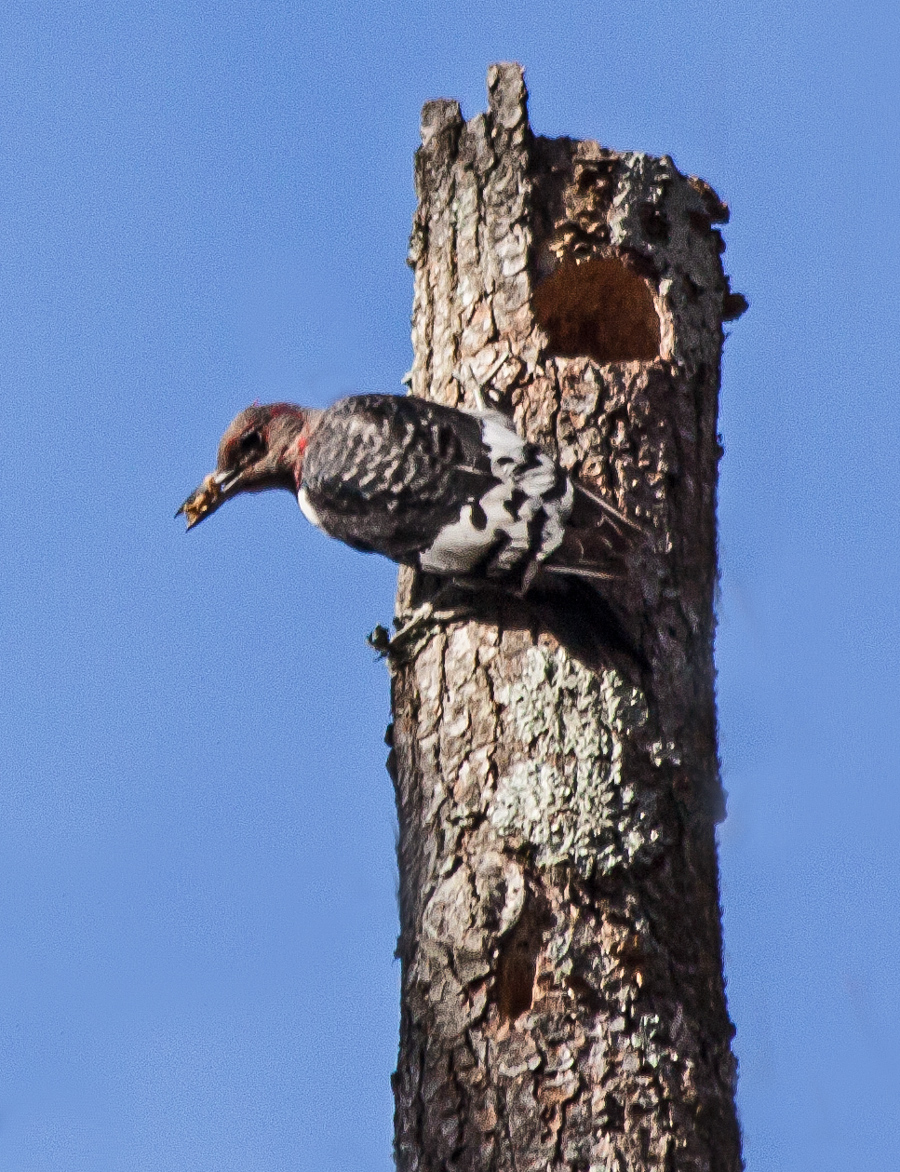
I suspect that I may qualify as a stalker, because I spent over thirty minutes on Friday sitting on a fallen tree, observing every movement of a juvenile Red-headed Woodpecker (Melanerpes erythrocephalus) high in the oak trees.

The small branches and the shadows made it almost impossible to get a clear shot of the little bird, but they did not keep me from trying. I was really fortunate to get this shot of the woodpecker as it took off from one of its perches with an acorn in its mouth and gave me a glimpse of its beautifully-patterned wings. As I understand it, when the Red-Headed Woodpecker becomes an adult, its wings will be pure black and white, so I am glad that I was able to get the shot of the black dots.

After I posted this photo, I noticed that there is a least one acorn jammed into a crack in the bark just above the top edge of the bird’s tail, mostly likely a snack that it has cached for future consumption.

woodpecker_flying_blog

© Michael Q. Powell. All rights reserved.

Read Full Post »

Why was this Red-bellied Woodpecker (Melanerpes carolinus) pecking so feverishly at the top of this broken tree? It certainly did not look like a good spot to find insects.

A few seconds later, I got an answer to my unspoken question, when the woodpecker pulled an acorn out with its beak (at least that’s what I think it is). After a bit of research on the internet, I learned that these woodpeckers eat plant materials, like acorns, as well as insects and that they sometimes use cracks in trees to store food for use at a later time.

red_bellied1-blogred_bellied2_blog

© Michael Q. Powell. All rights reserved.

Read Full Post »
Wouldn’t you know it, I finally see a Red-headed Woodpecker (Melanerpes erythrocephalus) and its head is not red. It’s a juvenile one and if you look closely you can see a few traces of the spectacular red that it will eventually sport on its entire head.

One of the serious birders at my local marshland park identified the area in which two juvenile Red-headed Woodpeckers had been seen regularly and I was fortunate to spot one of them this past Monday. The woodpecker seemed to be carving out a cavity in the tree and actually climbed into the hole as it chiseled away the bits of wood. Earlier, I saw one of them in the distance at a nearby tree with two large cavities (see the third photo). The bird stuck its head inside one of the cavities and I couldn’t tell if it was checking out the hole or was storing food there.

The Cornell Lab of Ornithology notes that the Red-headed Woodpecker is one of only four North American woodpeckers known to store food, and it is the only one known to cover the stored food with wood or bark. These woodpeckers have a varied diet and will eat both insects, which they sometimes catch in the air, and a a number of plant materials, especially acorns.

I don’t know how long it will take for this bird’s head to turn red, but I will certainly be keeping an eye out for it, now that I have an approximate idea of its territory.

redheaded2_blogredheaded1_blogwoodpecker_cavity_blog

© Michael Q. Powell. All rights reserved.

Read Full Post »

He was partially hidden by the branches, but I was happy—I had finally gotten a clear view and a recognizable photograph of a Pileated Woodpecker (Dryocopus pileatus).

I have long hoped to spot a Pileated Woodpecker. I have seen evidence of their handiwork (or is it more appropriately “beakwork”) several time and heard the loud sound of these large woodpeckers at work, but I had not been able to find one. This past Monday, while I was attempting to photograph dragonflies, I heard the sound of a woodpecker in a nearby patch of woods and went to investigate. I was surprised to see a Pileated Woodpecker, because the soft tap-tap was not what I expected from this species.

My shot is really just a record shot, but the first time that I see a new bird, insect, or animal, I am invariably content to get any kind of shot. I know I can do a lot better, if I can just find a cooperative Pileated Woodpecker.

pileated_blog

© Michael Q. Powell. All rights reserved.

Read Full Post »

Last year it seemed like I saw Downy Woodpeckers everywhere, but this year I have sighted only a few of them. I took this shot of a female Downy Woodpecker (Picoides pubescens) in mid-October during a visit to Theodore Roosevelt Island, a nature preserve in the Potomac River opposite the District of Columbia.

woodpecker_downy_blog

© Michael Q. Powell. All rights reserved.

Read Full Post »

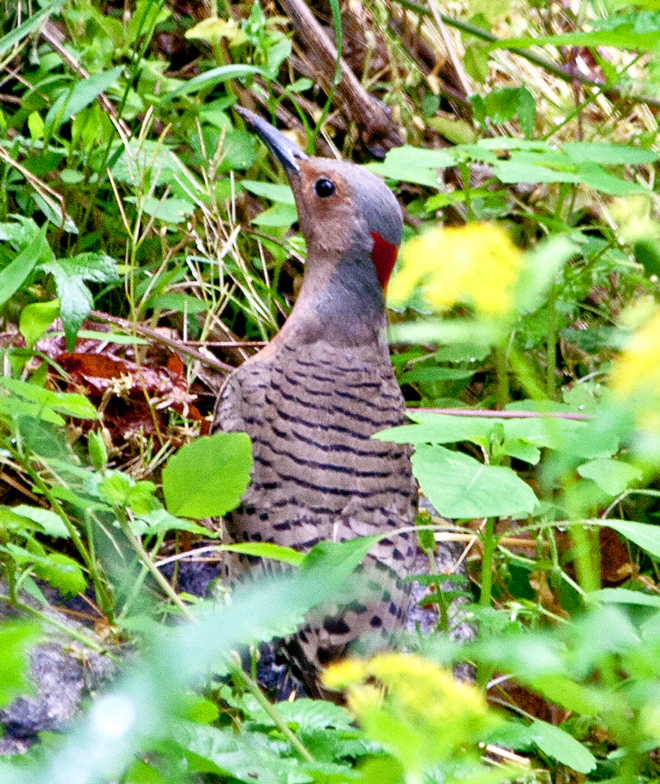
I observed this female Northern Flicker (Colaptes auratus) for quite some time yesterday, but had a difficult time getting a clear shot as she dug about in the undergrowth.

The Cornell Laboratory of Ornithology notes that this type of woodpecker is unusual in that it spends a lot of its time on the ground, digging in the dirt for ants and beetles. I love the coloration of the Northern Flicker and you can tell that this one is a female, because she is lacking the mustache stripe under her eye.

I didn’t manage to capture her entire body in the shot, but I like the way that she seems to emerge from the colorful underbrush.

flicker_blog

Michael Q. Powell. All rights reserved

Read Full Post »

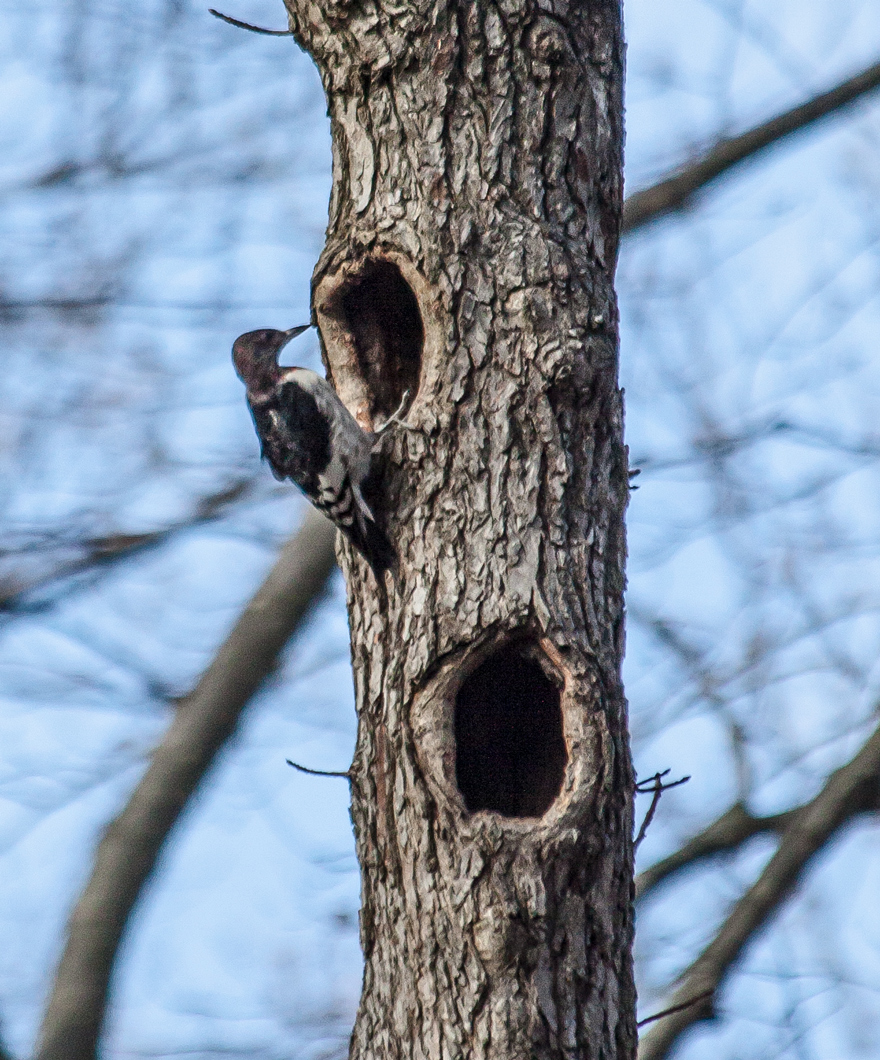
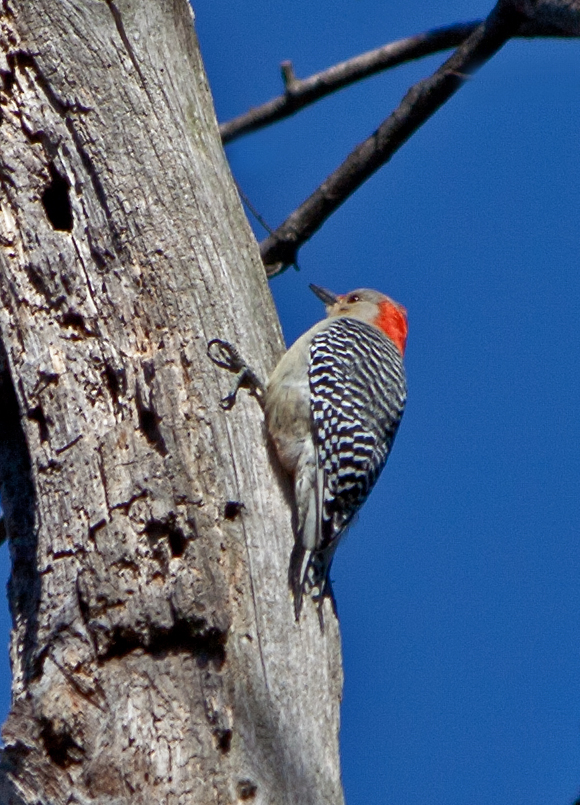
Most often I see small woodpeckers high up in the trees, pecking at the smaller branches there, but this male Red-bellied Woodpecker (Melanerpes carolinus) seemed determined to take on the challenge of the trunk of this substantial-sized tree. I really like his pose, as he appears to be contemplating how best to tackle this problem.

Does he dream of great things, like excavating holes in trees like those in the second and third photos? Maybe he was an orphan and was raised by a family of Pileated Woodpeckers and doesn’t recognize any limitations in his size.

I am still trying to get photos of the larger woodpeckers that made the impressive series of holes. I hear a jackhammer-like sound when they are working, but they manage to elude me each time.

For now, I am content with my photo of the smaller woodpecker, attempting to punch above his weight class.

woodpecker1_blogtree1_blogtree2_blog

Michael Q. Powell. All rights reserved

Read Full Post »

Walking through the woods on Monday, I heard the sound of a woodpecker and was pleasantly surprised to see that it was a Red-bellied Woodpecker (Melanerpes carolinus).

Most of the woodpeckers that I see are Downy Woodpeckers, which are cute in their own way, but I had been longing to see some of the bigger woodpeckers. Although the woodpecker was fairly high in the tree, I was happy that I managed to get some recognizable shots in different poses.

red_bellied4_blogred_bellied3_blogred_bellied2_blog

I stopped in the visitor center as I was leaving the park and happened to glance through the window at the bird feeders. The birds at the feeders tend to be fairly small, including nuthatches, chickadees and tufted titmice. Imagine my surprise when a big woodpecker showed up at the suet feeder—it was another Red-Bellied Woodpecker.

Although I was indoors, I decided to take a few shots of the woodpecker.  I think I ended up with a pretty cool image, in which the shadow of the wire cage imparted a striped pattern to the bird’s bill. When you first look at the image, you may not even realize that the stripes are added.

Now that I have photographed a medium-sized woodpecker, I will be in search of a Pileated Woodpecker—the superstar of woodpeckers.

red_bellied1_blog© Michael Q. Powell. All rights reserved

Read Full Post »

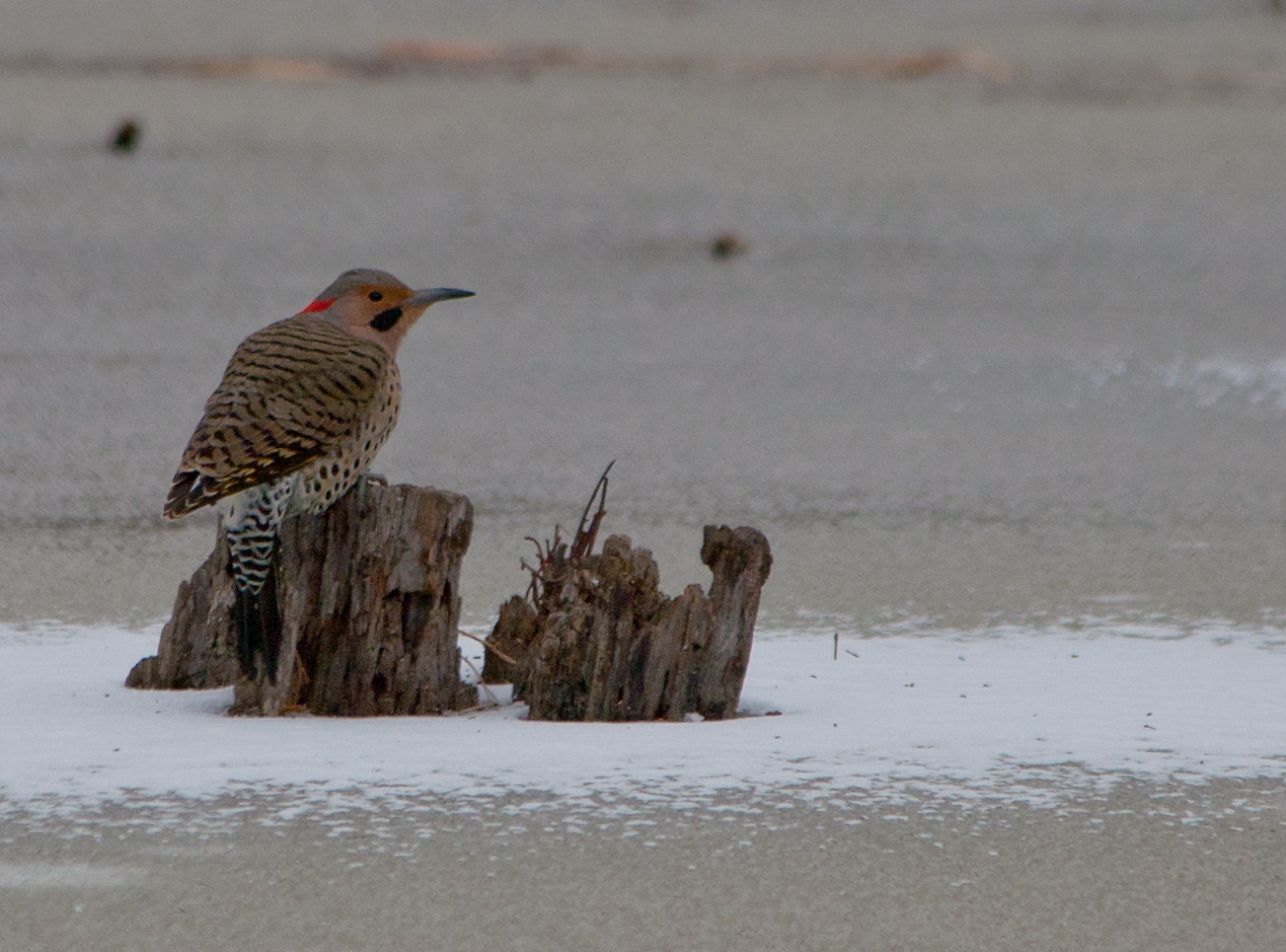
Against the backdrop of a frozen pond with a dusting of snow, the colors of this male Northern Flicker (Colaptes auratus) stood out even more brightly than usual yesterday morning. The flicker is perched on a rotted stump that is poking out of the beaver pond at my local marshland park.

I love the colors and the markings on this beautiful bird, who seems to be making a fashion statement by mixing stripes and polka dots and accenting the ensemble with touches of bright colors.

flicker1_blog

© Michael Q. Powell. All rights reserved

Read Full Post »

I really enjoy watching woodpeckers at work—they are so determined and industrious. I find their simple black and white coloration (sometimes accented with a bit of red) to be tasteful and elegant. Usually I end up watching them from a distance or with my neck at an uncomfortable angle as I look high up into the trees or low near the ground.

This weekend, though, I observed a woodpecker—I think he was a Downy Woodpecker—at relatively close range and at eye level. He was hanging upside down on a branch and was systematically pecking away at it. I really like the lighting in this shot and the way it is reflected in his eye. My favorite element, however, is the feathers on the breast area. The texture is simply amazing and looks like almost like a loosely woven fabric. It is a nice contrast to the black-and-white feathers on his back that look like they are stacked from this angle.

I never tire of photographing the same subjects, whether they be birds, insects, or flowers. Familiar subjects somehow seem different when viewed from new angles or in different light.

Downy feather texture

Downy feather texture

© Michael Q. Powell. All rights reserved

Read Full Post »

Do your find yourself shooting the same subjects over and over, hoping that you will find the perfect combination of lighting, pose, and background? That is certainly the case for me when it comes to photographing birds. It is both frustrating and challenging to realize that the only variables over which I have any control are me and my trusty camera. I can try to creep closer to birds or adjust the exposure and composition, but luck and perseverance are the overwhelmingly dominant factors in achieving success, however you choose to definite it.

Walking along a path at my local marshland park this past Friday, I heard the now-familiar tap-tap of a woodpecker. I looked up and saw a male Downy Woodpecker (Picoides pubescens) at work in the upper branches of a tree. Instantly I knew I had a chance for a pretty good shot, because the lighting was good, the view was uncluttered,  and the sky was blue in the background. The woodpecker was persistent as he moved along the branch and so was I, snapping away with my head bent back at an uncomfortable angle.

Downy Woodpecker portrait

How did I do? Well, you can judge for yourself, but I think that this is about as close to perfection as I can achieve with my current skills and equipment. The elements fell into place and I managed to take an image with which I am pretty happy, a nice portrait of a Downy Woodpecker.

© Michael Q. Powell. All rights reserved

Read Full Post »

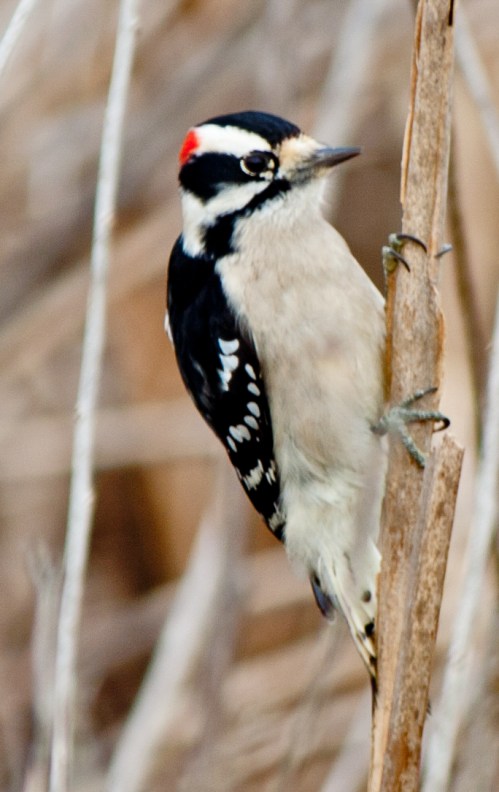
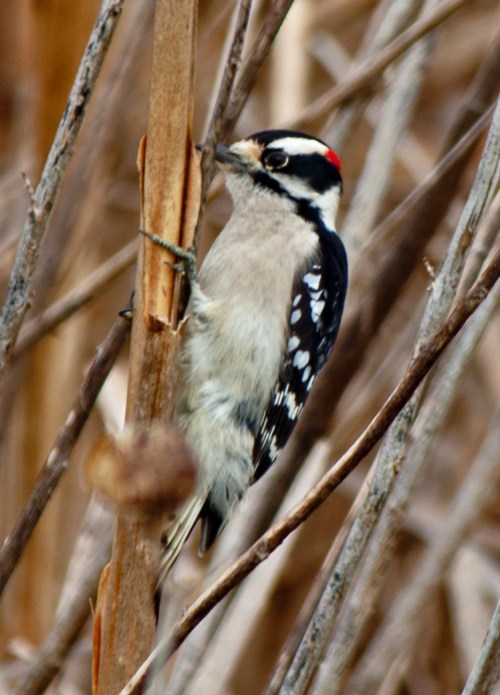
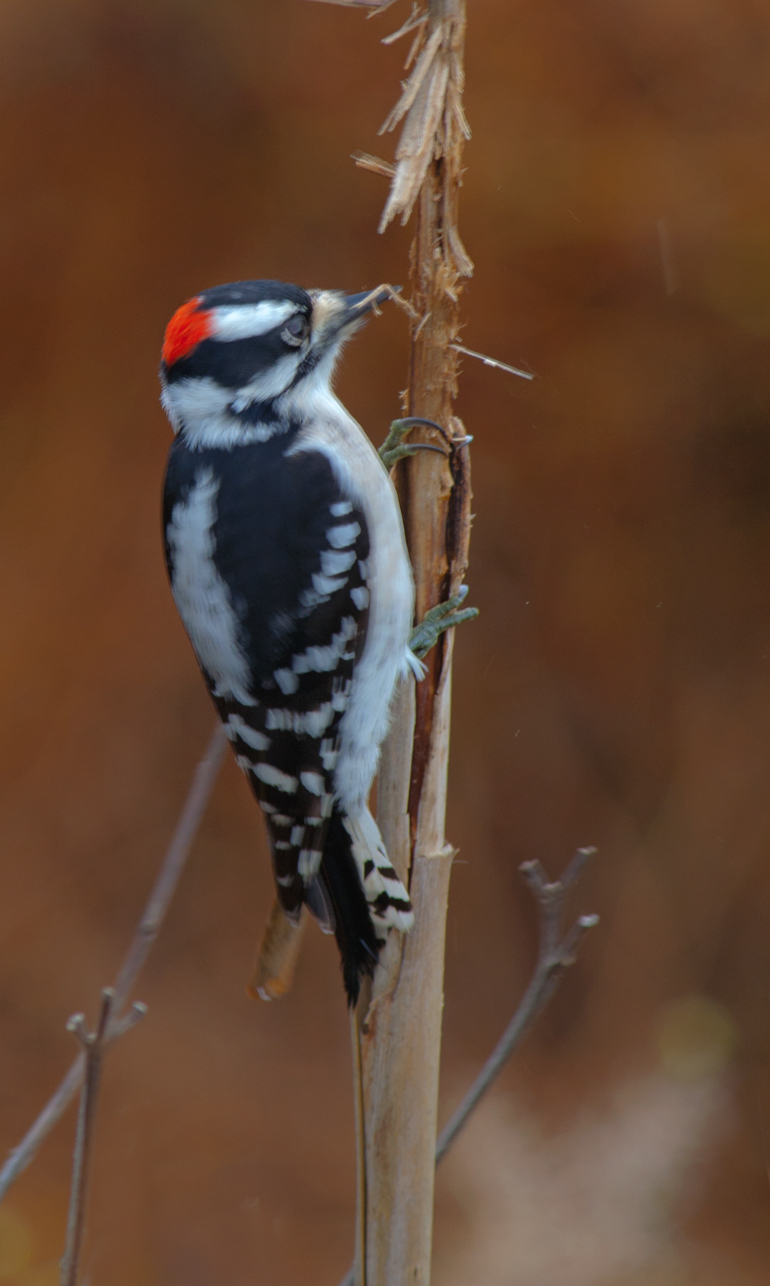
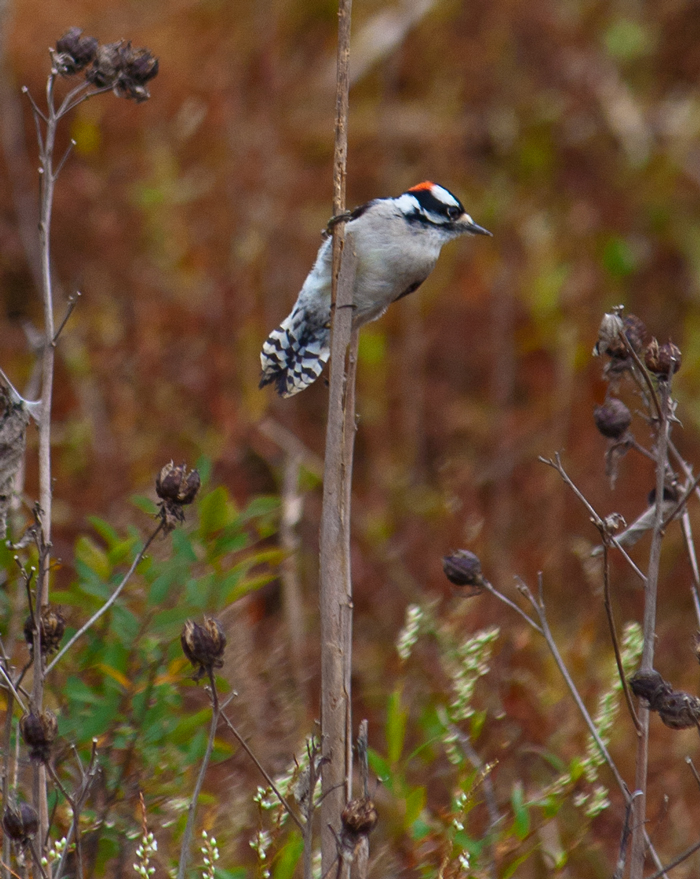
Never seeming to tire, a very active Downy Woodpecker (Picoides pubescens) yesterday was moving back and forth and up and down the stalks of cattails and other vegetation. I got tired just watching him as he performed some amazing acrobatic feats. The woodpecker would start at the bottom of each stalk and would gradually work his way up, grabbing whatever insects might be hidden inside. Many of the stalks seemed to thin to support the weight of a bird, but Downy Woodpeckers are not only small, about 5.5-6.7 inches long (14-17 cm), they are also really light at 0.7-1 oz (21-28 g), according to the Cornell Lab of Ornithology website.

I managed to get a few good shots of a male Downy Woodpecker showing some details of the bird. The first one includes a good view of his claws and the second one shows his beak, which is still partially imbedded in a piece of a stalk that had broken free.

downy2_blog

downy_blog

© Michael Q. Powell. All rights reserved.

Read Full Post »
Downy Woodpeckers (Picoides pubescens) are so small and light that they can perch almost anywhere. I was little surprised, however, when I looked down into the water of the marsh and saw a Downy Woodpecker on a very small piece of wood that was jutting out just a little above the surface of the water. I had never before seen a woodpecker that close to water level.

Downy Woodpecker just above the marsh water

The branch was small, just big enough for him to relax, but the woodpecker was not there to rest—he was there to work. There doesn’t seem like there is much room for him to maneuver, but somehow he got into position and was soon hammering away at that little piece of wood. I was concerned that the vibration might loosen the branch and cause him to tumble into the water, but that didn’t happen.

No piece of wood is too small

I guess that if you are a small woodpecker, almost any piece of wood is fair game—size does not matter.

© Michael Q. Powell. All rights reserved.

Read Full Post »

Some birds seem to enjoy relaxing and posing and showing off their beauty, embodying a carefree approach to life. Woodpeckers, on the other hand, seem to be serious and focused, with a look of sheer determination in their eyes. It’s the same look that I see in so many of the people here in the Washington D.C. area, so driven in their professional lives that they are in danger of losing their identities apart from work.

Today, I photographed this Downy Woodpecker (Picoides pubescens) as he was preparing himself for work. Look deeply into his eye and what to you see? (Click on the photo to see more details.) The dead tree seems huge in comparison to this tiny bird. Yet he seems determined, determined to beat his head repeatedly against that wood, determined to find the food that he hopes and believes may be hidden inside.

Determined Downy Woodpecker


Do you ever feel like this woodpecker?

© Michael Q. Powell. All rights reserved.

Read Full Post »

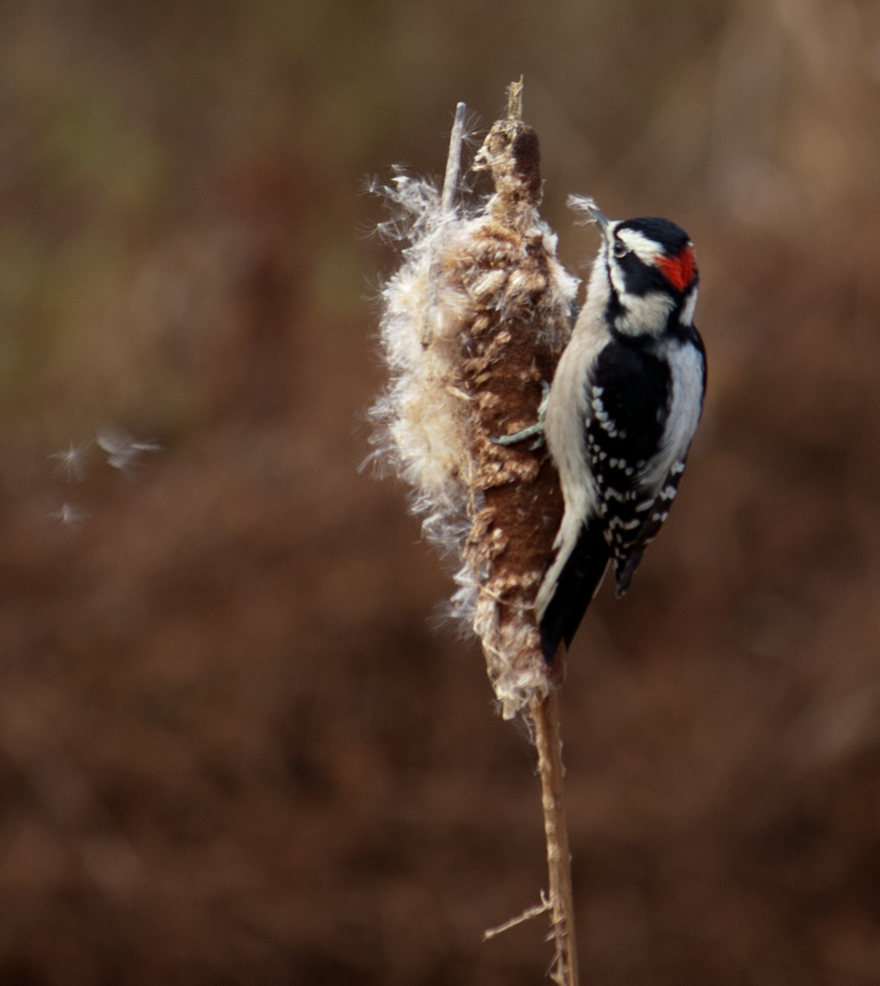
If I were a woodpecker, I would want to be a male Downy woodpecker (Picoides pubescens) and slam my head into something soft as a pillow—like this cattail—and not always into solid wood. Of course, you can end up with a mouthful of cattail fibers, and not just a tasty bug.

Downy woodpecker with mouthful of cattail

Downy woodpecker on cattail

More seriously, scientists are doing research to figure out why woodpeckers don’t end up with concussions, given that they can slam their heads into wood with the force of 1,000 times that of gravity, according to an article on livescience.com. By comparison, humans can survive a force of up to G’s, according to Air Force research, though there are reports of race car drivers surviving a force of over 100 G’s. According to the article, Chinese researchers are studying the microscopic structure of the bones surrounding the brain and also the beak to try to understand how the woodpecker’s brain is protected. If you are interested in the research, an article on a website called Inkfish explains in layman’s terms the research methodology and some of the preliminary conclusions.

© Michael Q. Powell. All rights reserved.

Read Full Post »

This weekend I learned some new things about woodpeckers. I always thought that woodpeckers were found exclusively in the trees. Isn’t it logical that woodpeckers need wood to peck? (It reminds me of the response attributed to Willie Sutton on why he robbed banks—”Because that’s where the money is.”) Well, I saw a woodpecker pecking at the stalks of cattails and other similar vegetation that clearly were not made of solid wood.

Secondly I learned that the woodpecker that had a big red spot on the back of his head was not a Red-Headed Woodpecker. Fortunately, it was not too hard to determine that the little woodpecker that I saw and photographed was a male Downy Woodpecker (Picoides pubescens). He was very active climbing up and down the stalks of a whole series of plants in the middle of a marsh and was a lot of fun to watch.

Here are a couple of photos of that beautiful bird. I am not sure that I did full justice to the blazing red color on his head that initially attracted my attention or to the wonderful black and white pattern of his feathers. I hope that I have another chance soon to see more woodpeckers and learn even more new things about them.

Male Downy Woodpecker in the field

Downy Woodpecker looks to the side

© Michael Q. Powell. All rights reserved.

Read Full Post »

« Newer Posts