Feeds:
Posts
Comments

Posts Tagged ‘Widow Skimmer’

There were lots of dragonflies, mostly Common Whitetails and Needham’s Skimmers, flying about on Monday when I visited Occoquan Bay National Wildlife Refuge along with an abundance of pesky flies and mosquitoes. The temperatures were marginally cooler than in recent days, but the high humidity made it feel like I was slicing my way through the water-laden air.

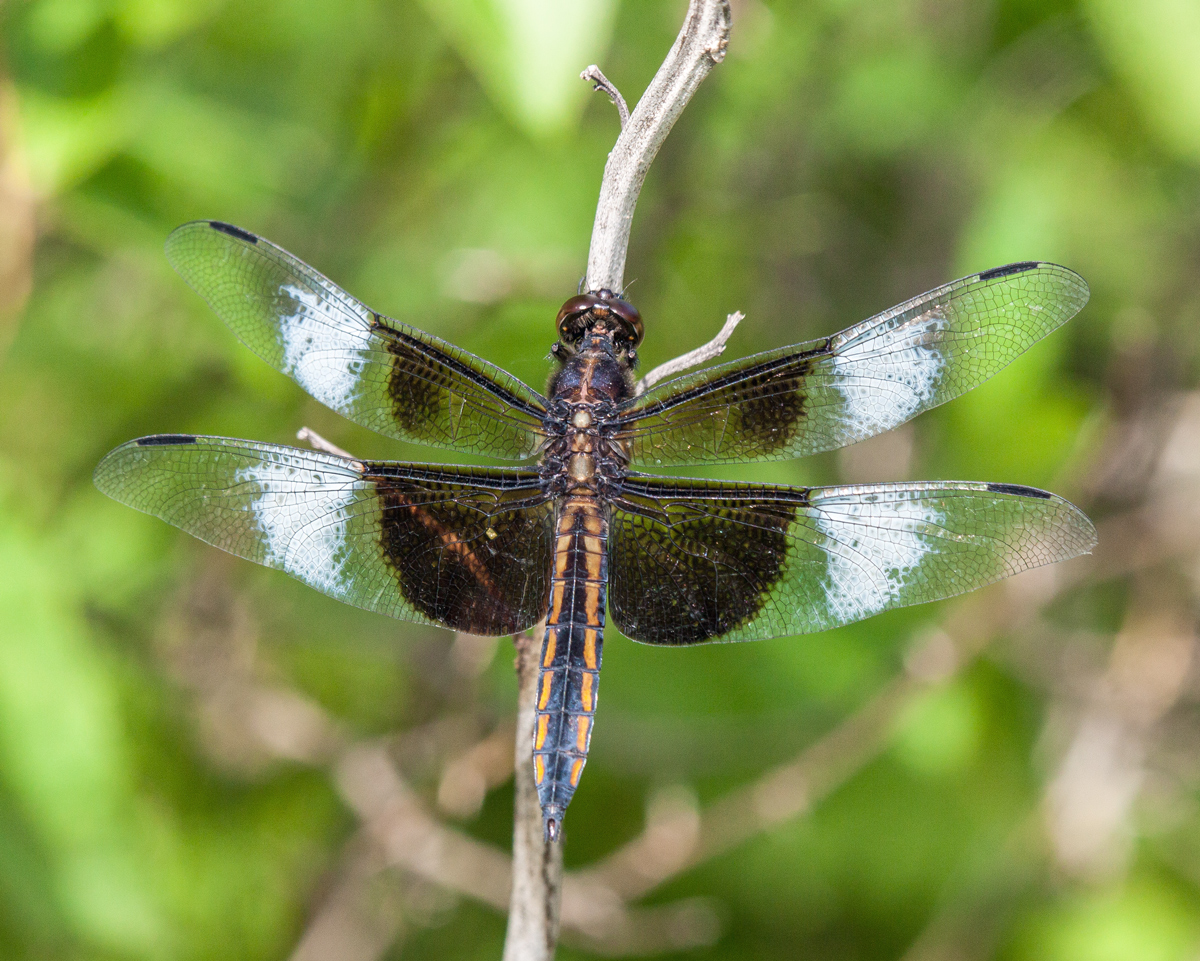
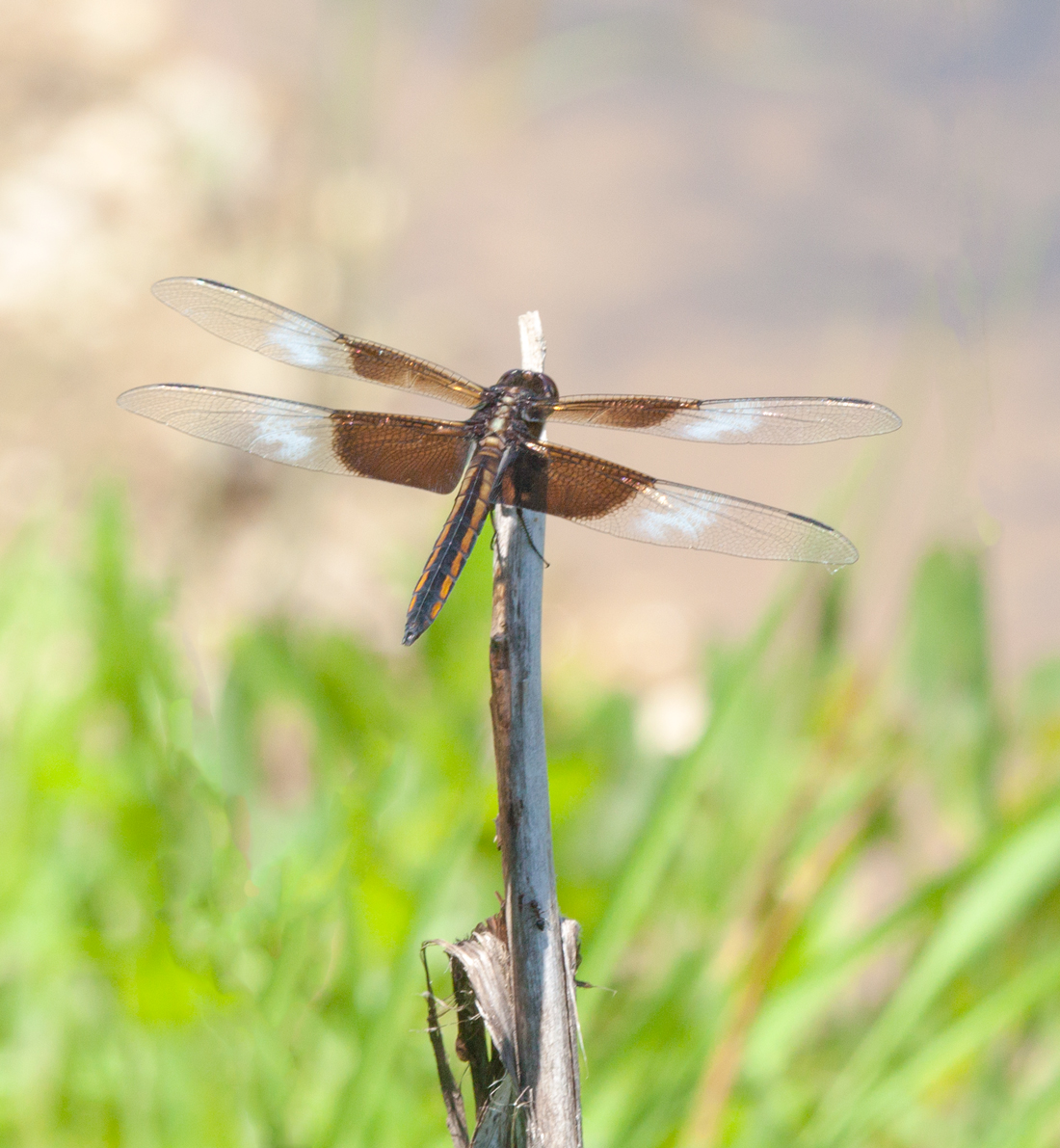
I was delighted to spot this male Widow Skimmer dragonfly (Libellula luctuosa), a species that I do not often at this location, perched in the vegetation adjacent to a small pond. Like female Widow Skimmers, male have dark patches on their wings, but they also have a white patch on each wing, which makes them easy to identify. These patches are visible when male Widow Skimmers are flying, causing them to look a bit like fluttering butterflies.

When I was processing this image, I was surprised to see what appears to be an ant attached to the tip of one of the back legs of this dragonfly—you may need to click on the image to see this detail. I am not sure if the ant had hitched a ride on the dragonfly from its previous perch or, more likely, was merely exploring this unexpected intruder that had landed on this stalk of vegetation.

Widow Skimmer

© Michael Q. Powell. All rights reserved.


Read Full Post »

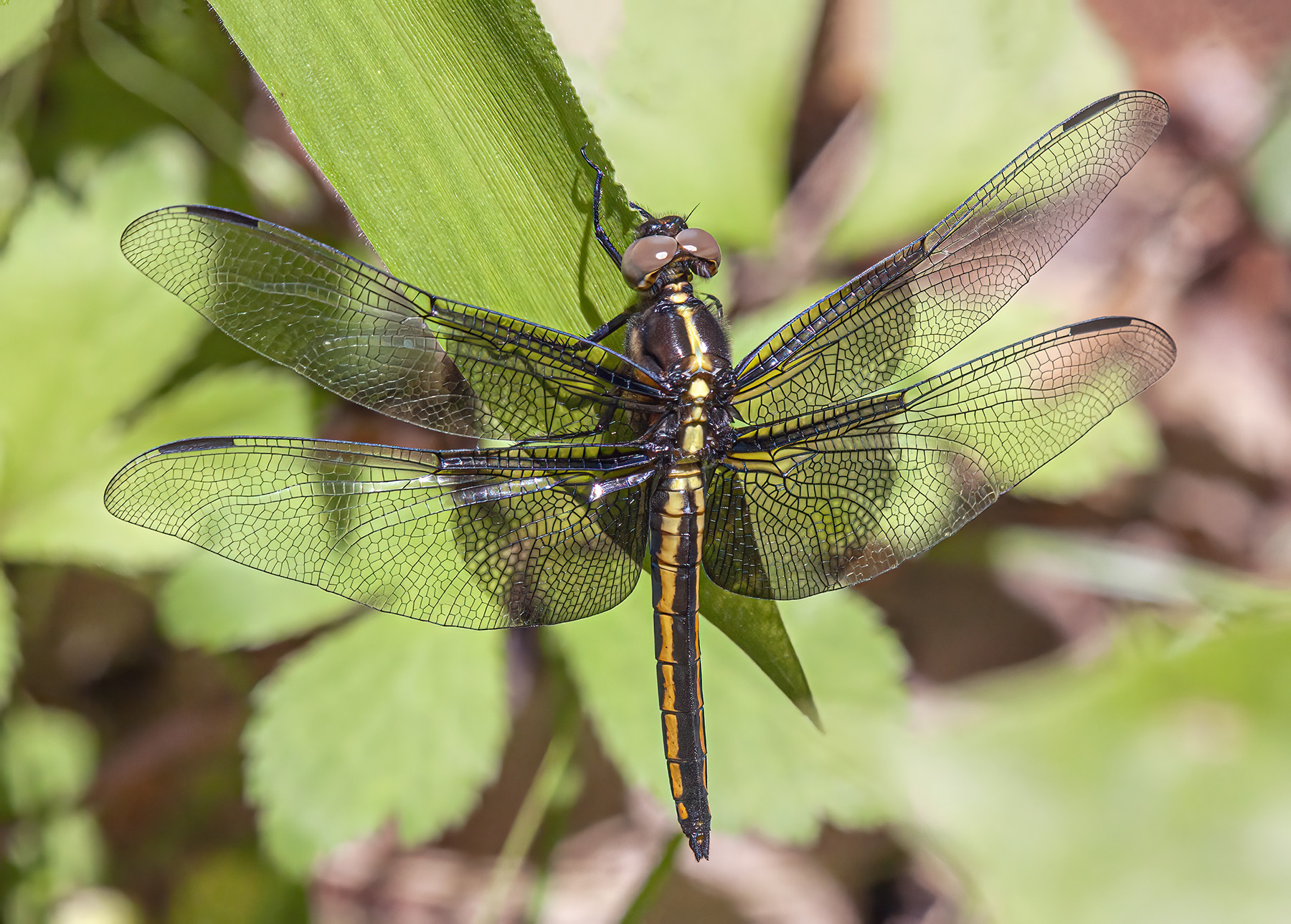
On Monday I spotted this female Widow Skimmer dragonfly (Libellula luctuosa), my first one of 2025, during a visit to Occoquan Bay National Wildlife Refuge. Widow Skimmers have very distinctive dark patches on their wings that reminded the scientist who named them of the dark mourning crepe worn by Victorian-era widows during their initial stages of mourning and even their Latin name “luctuosa” means “sorrowful.”

The weather in my area has warmed considerably this week and already it feels like summer. Gradually the summer dragonflies, like this Widow Skimmer, are starting to appear. The hot days of summer are a bit uncomfortable for me, but seem to be preferred by many dragonfly species.


Widow Skimmer

© Michael Q. Powell. All rights reserved.


Read Full Post »

The end of the season is drawing near for many of the common dragonflies in my area. A month from now, some species will be gone entirely, with only a few hardy stragglers hanging on for a bit longer. Children return to school this coming week, which seems outrageously early to me—when I was growing up, school did not begin until after Labor Day.

I am starting to pay greater attention to the dragonflies that I encounter, never knowing for sure if I will see them again this season. Summer is not over yet, of course, but there are already signs that the seasons are changing.

I spotted this male Widow Skimmer (Libellula luctuosa) on Monday at Occoquan Bay National Wildlife Refuge. Many of the dragonflies that I see are showing signs of wear, with tattered wings increasing common, but this individual was beautifully intact.

I suspect that dragonflies live in the moment, focused solely on the present for as long as they live. I recently read an article that noted how much of life many people miss, because they are focused too much on the future, which, of course, is never guaranteed. Yes, it is good to plan for the future, but be sure to enjoy your present life too.

Widow Skimmer

© Michael Q. Powell. All rights reserved.


Read Full Post »

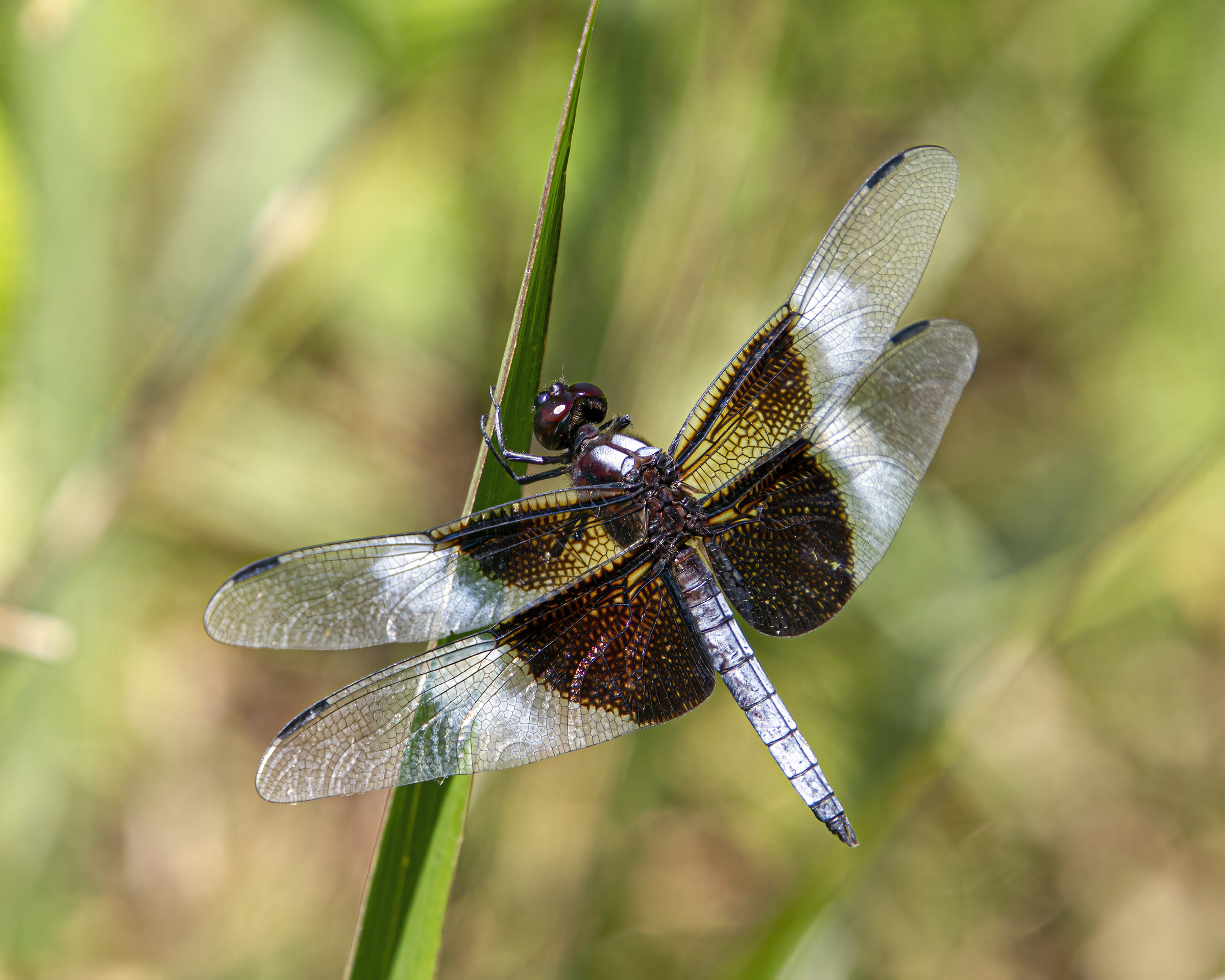
I love to look closely at dragonfly wings. I have a mental picture of the cells of a dragonfly wing as being made up of regularly-shaped squares, like those on a page of graph paper. When I examine them in real life, though, I am always delighted to see all of the different shapes and sizes of these tiny cells in intricate patterns that rival those of massive stained-glass windows.

I photographed this male Widow Skimmer dragonfly (Libellula luctuosa) last Thursday at Occoquan Bay National Wildlife Refuge. I love to see dragonflies with patterned wings and the males of this species have the added bonus of having both brown and white patterns on each wing.

This dragonfly was relatively cooperative and did not fly away as I moved slowly into a position that gave me a good view of the wings. I had to bend and crouch a little to get this shot that emphasizes the impressive wingspan of this handsome little dragonfly.

Widow Skimmer

© Michael Q. Powell. All rights reserved.

Read Full Post »

On occasion I have noticed a dragonfly that seemed to be smiling a little at me. Last week, though, I encountered a female Widow Skimmer (Libellula luctuosa) at Occoquan Bay National Wildlife Refuge that seemed to have an exceptionally toothy grin—she seemed delighted to pose for me. I love the way that the background blurred out, allowing viewers to focus on the details of this smiling dragonfly and hopefully producing smiles on their faces in response.

Widow Skimmer

© Michael Q. Powell. All rights reserved.

Read Full Post »

I photographed this male Widow Skimmer (Libellula luctuosa) on Tuesday at Occoquan Regional Park. As I was working on the image, I noted that the dragonfly had an infestation of what look to be red water mites on at least two of its wings. You may need to click on the images to zoom in and you should be able to see some small red spherical objects that I am pretty sure are water mites.

According to Wikipedia, these water mites, likely from the genus Arrenurus, “establish an association for the purpose of transportation and nutrients, and attach to the host during the host’s transition from larva to adult.” Although these mites do not kill the dragonfly hosts, studies “show that parasitism by the mites affect the host’s longevity and fecundity by draining its tissue fluids, hampering copulation and interfering with sperm transfer.” Yikes!


Widow Skimmer

Widow Skimmer

© Michael Q. Powell. All rights reserved.


Read Full Post »

Many dragonflies have transparent wings that seem to disappear when they are flying, making them look even smaller and hard to detect. Male Widow Skimmer dragonflies (Libellula luctuosa), however, have such large bi-colored patches on their wings that they look almost like butterflies when in flight, an impression heightened by the fluttering way that they fly.

I was thrilled when I spotted this male Widow Skimmer—the females of this species do not have the white wing patches—on Monday at Occoquan Regional Park. The dragonfly flew by me numerous times and I watched and waiting, hoping that it would land.  My patience eventually paid off and I was able to capture this shot that shows off its wings beautifully. This may not be the most artistic image that I have ever captured, but it is a good one to use for the purpose of identification.

One of the coolest things about photography is that it can be both scientific and artistic, allowing me to be as geeky as I want in either domain.

Widow Skimmer

© Michael Q. Powell. All rights reserved.

Read Full Post »

On Monday I photographed this female Widow Skimmer dragonfly (Libellula luctuosa) at Occoquan Regional Park, my first sighting of this species in 2024. Why is it called a “Widow Skimmer?” Someone apparently thought the dark patches on the wings of this species looked like the mourning crepe that historically widows wore and even a portion of its Latin name “luctuosa” means “sorrowful.”

The dark wing patches are quite distinctive and may it relatively easy to identify this species. The males of the species, which I did not see at all that day, have patches of white in addition to the same dark wing patches of the female and their bodies are blue in color when they are mature. Click on this link to see some photos of a male Widow Skimmer from a few years ago.

Widow Skimmer

© Michael Q. Powell. All rights reserved.

Read Full Post »

I spotted this handsome male Widow Skimmer dragonfly (Libellula luctuosa) this past Saturday at Occoquan Bay National Wildlife Refuge. Only the males of this species have white patches on their wings—the females have only the dark patches.

The Latin name for this species includes the word “luctuosa,” which means “sorrowful” or “mournful.” Apparently someone thought that the dark patches on the wings of dragonflies of this species looked like the kind of mourning crepe veils that traditionally widows were supposed to wear up to four years to show their grief.

I think that I have been reading too many warnings about people taking advantage of older people, because the name “Widow Skimmer” initially conjured up visions of young gigolos chasing after rich old ladies in Florida who have lost their husbands.

Widow Skimmer

© Michael Q. Powell. All rights reserved.
Read Full Post »

Here’s a shot of a handsome male Widow Skimmer dragonfly (Libellula luctuosa) that I spotted this past Monday at Jackson Miles Abbott Wetland Refuge. The Widow Skimmer is one of only a few dragonfly species that I have encountered that has both white and brown markings on its wings. (the male Twelve-spotted Skimmer dragonfly is the only other one that immediately comes to mind and you can see what one looks like in my 31 May 2021 posting entitled Twelve-spotted Skimmer.

Backgrounds are always tricky when photographing insects perched in highly vegetated areas. I think the stalks of vegetation are blurred enough in the first image that they do not draw attention away from the main subject. I think, in fact, the the green and tan lines add some visual interest to the image that would be lacking if the entire background were a solid color. The background in the second image is a bit busier, but you get a much better view of the dragonfly’s wing patterns—wildlife photography is often a matter of compromise in which “perfection” is often unachievable.

Widow Skimmer

Widow Skimmer

© Michael Q. Powell. All rights reserved.


Read Full Post »

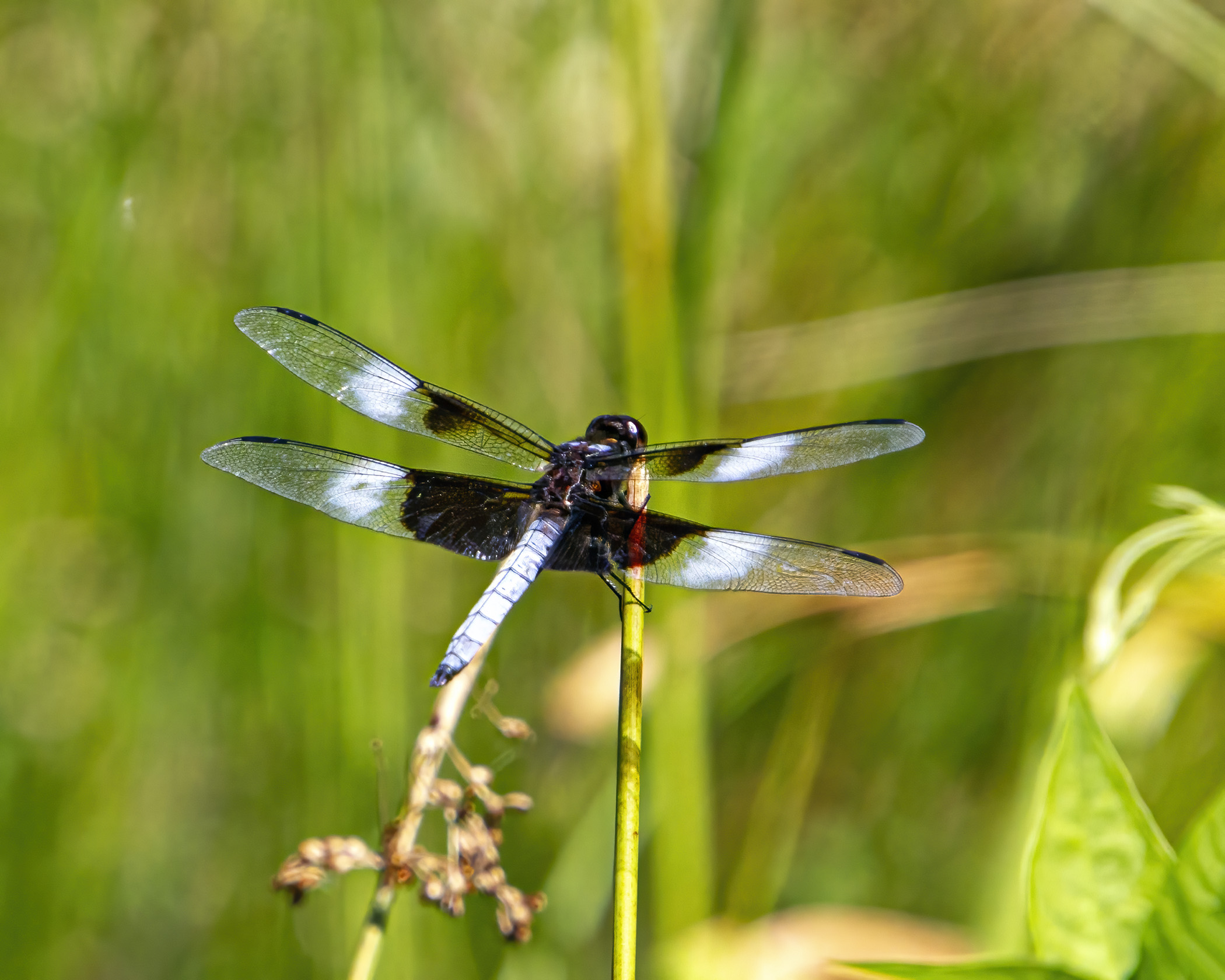
I love the distinctive wing markings on male Widow Skimmer dragonflies, one of only a few dragonfly species that I have encountered with both light and dark patches on their wings. I spotted this handsome male Widow Skimmer last week during a brief visit to Occoquan Regional Park in Lorton, Virginia.

One of the cool things about this dragonfly is that it looks almost like a butterfly when it is flying. With most dragonflies, the transparent wings seem to almost disappear when they are flying, but with the male Widow Skimmer, the wings are much more visible when the dragonfly is in motion.

Widow Skimmer

© Michael Q. Powell. All rights reserved.
Read Full Post »

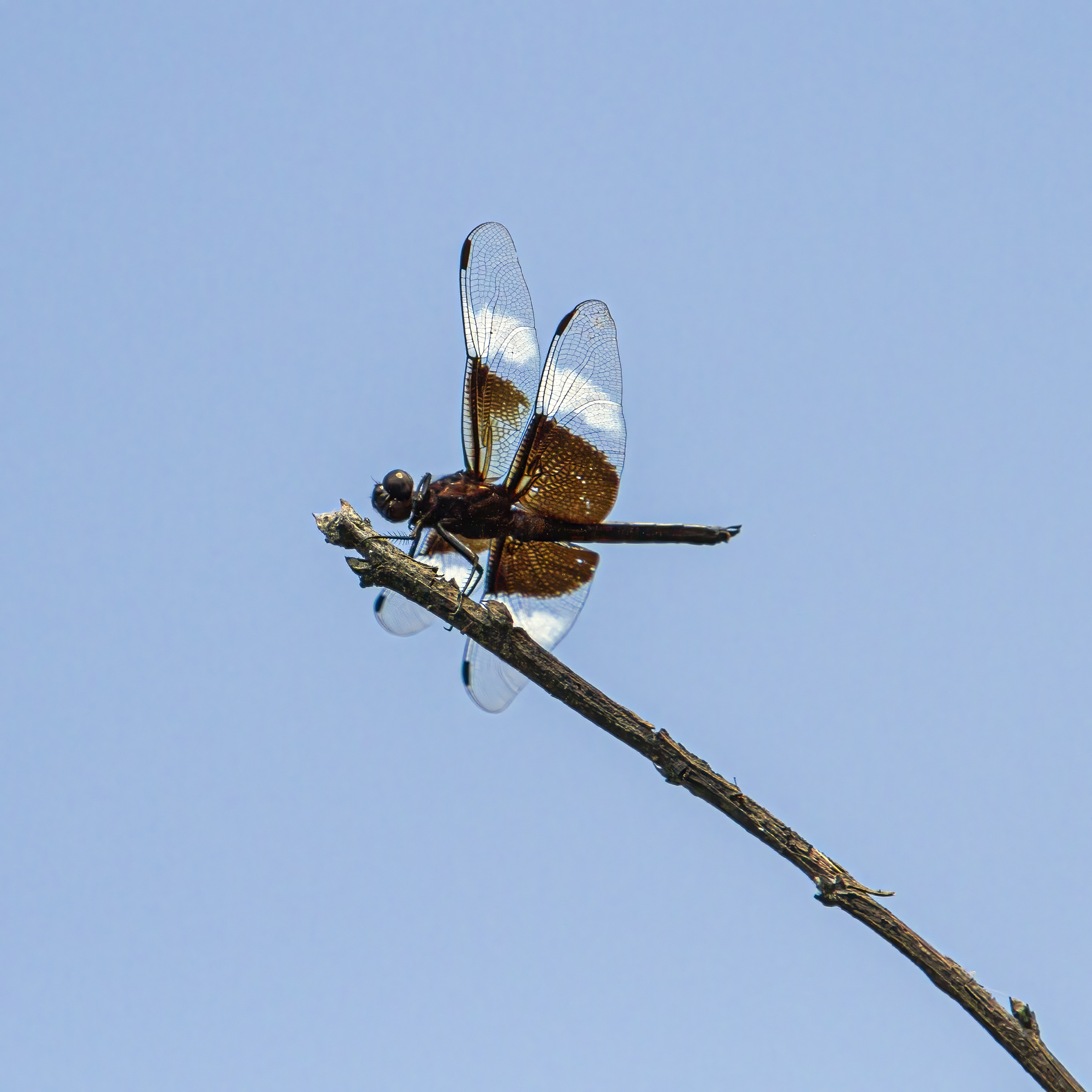
Many summer dragonfly species are now emerging on the scene, like this immature male Widow Skimmer dragonfly (Libellula luctuosa) that I spotted last Tuesday at Occoquan Regional Park in Lorton, Virginia.

Anecdotally, someone thought that these dragonflies appeared to be draped in mourning crepe and that is the source of the “widow” in the name of the species. The Loudon Wildlife Conservancy website states that “This dragonfly got the “widow” name because, unlike most other dragonfly species where the male stays near the female after she lays the eggs, the male in this pair leaves her after the eggs have been laid.” Either explanation is plausible, though I have seen more references to the first explanation than the second one.

I was quite fortunate that the dragonfly chose a high perch that allowed me to separate it from the rest of the background. Quite a few of the dragonflies that I have photographed recently have perched on the ground or in dense vegetation and the backgrounds in those photos have been quite cluttered.

Widow Skimmer

Widow Skimmer

© Michael Q. Powell. All rights reserved

Read Full Post »

We are at a time of the summer, when it is unlikely that I will see any new dragonflies for the season. Several species will emerge towards the end of the summer, but for now I see the same familiar faces over and over again.

I really am content, though, with photographing the beauty of these wonderful aerial acrobats and never grow tired of photographing the same ones over and over. Each outing with my camera is an opportunity to capture images in a different way, in different environments, and in situations with different lighting.

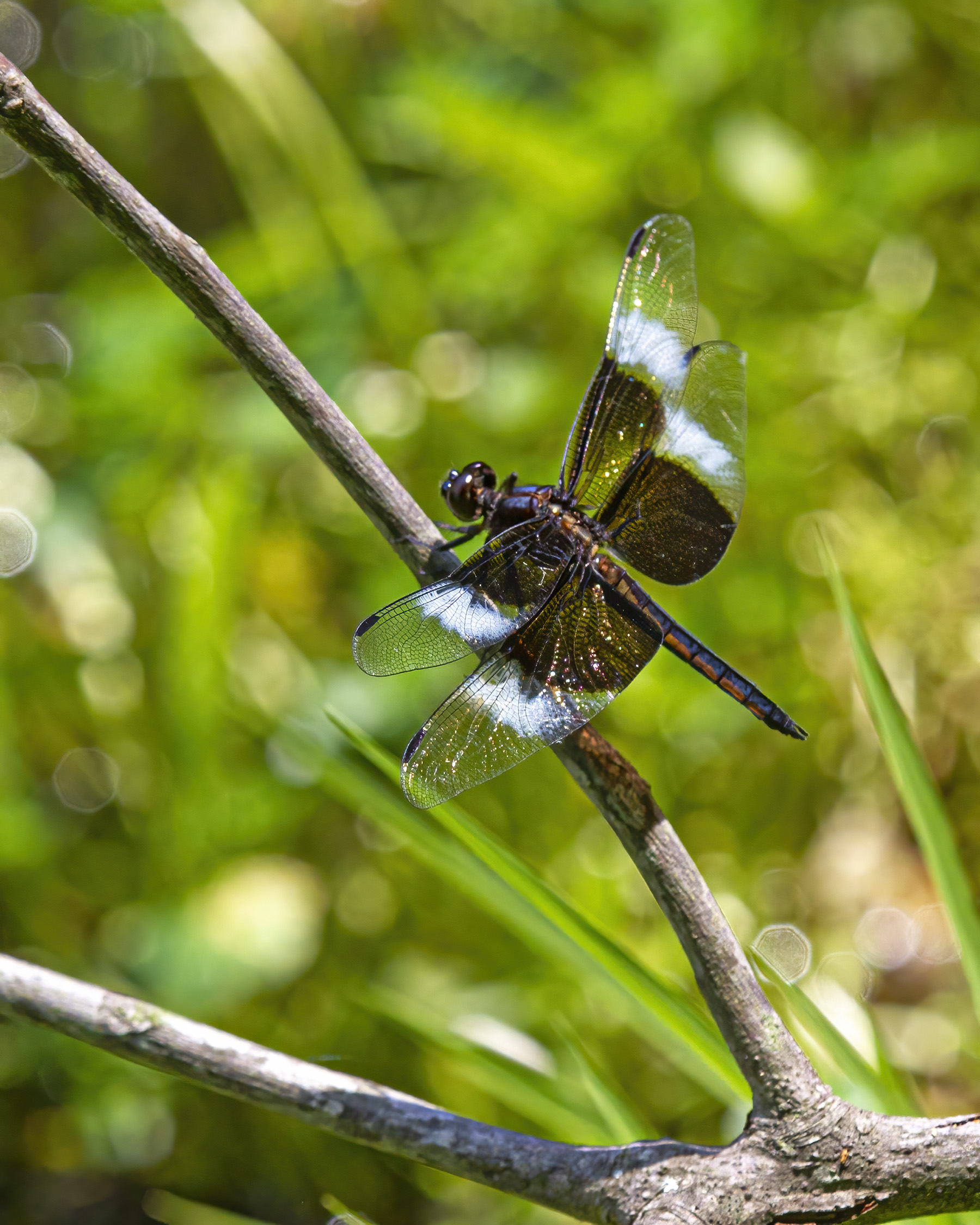
Last  week I was delighted to capture these images of male Widow Skimmer dragonflies (Libellula luctuosa) during a visit to Occoquan Bay National Wildlife Refuge. I just love the brown and white patches on the wings of these dragonflies that make them really stand out from all other dragonflies in our area.

These shots also illustrate the fact that the shapes of the front wings of most dragonflies are different from the rear wings. I suspect that the different shapes play a role in enabling the amazing flight capabilities of dragonflies, although I confess that I do not understand very well the aerodynamics of dragonfly flight—their flight seems almost magical to me.

Widow Skimmer

Widow Skimmer

Widow Skimmer

© Michael Q. Powell. All rights reserved.
Read Full Post »

I love dragonflies with patterned wings and one of the coolest ones in our area is the male Widow Skimmer (Libellula luctuosa), which has a distinctive combination of one dark and one white blotch per wing. Eventually the immature male in the first photo will turn bluish in color, but for now he has the brown and yellow colors that he shares with the females. The females have only a single large blotch on each wing, so usually I can tell the genders apart.

When the male first emerges, however, the white blotches may be hard to see, so I have to look more closely at other aspects of the dragonfly’s body. I am pretty confident that the dragonfly in the second photo is a very young male Widow Skimmer.

It was really easy to track a male Widow Skimmer dragonfly in the air, because its colorful wings made it look almost like a butterfly. However, the dragonfly in the first photo was remarkably skittish and would perch only momentarily in between its patrols over the waters of the small pond that I visited on Monday. Eventually my patience paid off and I was able to get a shot, albeit from a relatively long distance away.

Widow Skimmer

Widow Skimmer

© Michael Q. Powell. All rights reserved.


Read Full Post »

How do I find all of the different dragonflies that I feature on my blogs? I like to visit a variety of habitats starting early in the spring and going later into the autumn. When I am out in the wild with my camera, I try to move relatively slowly as my eyes scan the ground, the vegetation, and the air for indications of dragonflies. Most of the time I need movement for me to detect a dragonfly and track a dragonfly, but sometimes I am able to spot a perched dragonfly.

During a recent visit to Occoquan Bay National Wildlife Refuge, I photographed two dragonflies that help to illustrate the importance of looking up as well as down when hunting for dragonflies. The male Widow Skimmer (Libellula luctuosa) in the first photo was perched low in some vegetation at the edge of a small pond. I watched the dragonfly fly to that perch, but my view was blocked by vegetation until I found a small visual tunnel that gave me a relatively clear view as I pointed my camera down at the dragonfly.

The male Great Blue Skimmer (Libellula vibrans) in the second photo, on the other hand, was perched high in the air in a field. Visually I had no trouble getting this shot as I pointed my camera toward the sky, but the ground was uneven and mucky and thorns were pricking my ankles as I composed the shot.

Down? Up? Straight ahead? My eyes are constantly moving when I am in target acquisition mode—that is one of the “secrets” of my dragonfly photography.

Widow Skimmer

Great Blue Skimmer

© Michael Q. Powell. All rights reserved.

Read Full Post »

Most of the Widow Skimmer dragonflies (Libellula luctuosa) that I have seen this season have been immature males, like the one in the second photo below that I spotted on Wednesday at Occoquan Regional Park. When they are that young, their colors and wing markings match those of their female siblings.

As they mature, however, the males develop the additional white patches on their wings that are simply spectacular, like those of the mature male Widow Skimmer in the first photo that I spotted later that same day. Their bodies also turn blue and with varying degrees of pruinosity, the dusty looking coating on their abdomens that gives them a frosted look. (According to the Educalingo website, the word pruinose comes “from Latin pruīnōsus frost-covered, from pruīna hoarfrost.”)

We have moved into the lazy days of the summer, when dragonflies are now a frequent sight at most of the ponds in our area. Hopefully you are seeing them too. Most of those dragonflies are probably from the skimmer family, a large group of dragonflies in which many species tend to be habitat generalists. I will certainly be photographing lots of skimmers, but will also be keeping an eye out for more uncommon species, like the Cyrano Darner that I featured yesterday.

Widow Skimmer

Widow Skimmer

© Michael Q. Powell. All rights reserved.


Read Full Post »

Things are not always as they seem. When I spotted this Widow Skimmer dragonfly (Libellula luctuosa) last Friday at the edge of a pond in Fairfax County, I thought for a moment that it might be a female. After all, females have yellow and brown bodies and have one large dark blotch per wing, while males have blue bodies and have one dark and one light blotch per wing.

However, immature male Widow Skimmers look a lot like females, as is the case with many dragonfly species. The colors of “fresh” dragonflies tend to be pale and wing patterns may not have developed fully yet, so you cannot rely exclusively on those markings for identification.

The first photo below provides a pretty clear view of the “claspers” at the tip of the abdomen, which indicates that this is a male—the terminal appendages are often the most important indication of the gender of a dragonfly. For comparison purposes I have included a photo of a mature male Widow Skimmer at this same location from a 2019 posting entitled Male Widow Skimmer dragonfly. It may be a little hard to envision, but the dragonfly in the first photo will eventually grow to look like the one in the second image.

You may wonder why this species is called a “Widow Skimmer.” Someone apparently thought the dark patches on the wings looked like the mourning crepe that historically widows wore. Even the Latin name “luctuosa” means “sorrowful.”

I used to hesitate a bit when I used the the words male and widow together, wondering if perhaps I should call a male of this species a Widower Skimmer. Over time I have gotten used to this seeming incongruity and now I even happily speak about male damselflies. I wonder how those guys feel about being called damsels.

Widow Skimmer

Widow Skimmer

© Michael Q. Powell. All rights reserved.

Read Full Post »

Most dragonflies have clear wings, so I am happy when I see one with dark patches on its wings. It is even more exciting to see one with both brown and white patches, like this male Widow Skimmer dragonfly (Libellula luctuosa) that I spotted on Saturday at Occoquan Regional Park in nearby Lorton, Virginia.

When it comes to identifying dragonfly species, I have learned to focus not only on the colors of the wing patterns, but also on the number of such patches and their shapes. In the case of the Widow Skimmer, for example, both the males and females have the brown patches on the portion of the wings nearest the body.

Why are they called “Widow Skimmers?” Someone apparently thought the dark patches looked like the mourning crepe that historically widows wore. Even the Latin name “luctuosa” means “sorrowful.”

I used to be confused by the use of a female-associated word like “widow” with males, but I have gotten used to it. In fact, I no longer give a second thought to the idea of male damselflies, though I don’t have a clue about how that label affects their self-image.

Widow Skimmer

Widow Skimmer

© Michael Q. Powell. All rights reserved.


Read Full Post »

You never know for sure when a dragonfly will let you get close. Although some species tend to be less skittish than others, each individual dragonfly seems to have its own sense of “personal space.” Some will let you get really close and may even perch on you, but others will take flight or keep their distance as soon as they detect your presence.

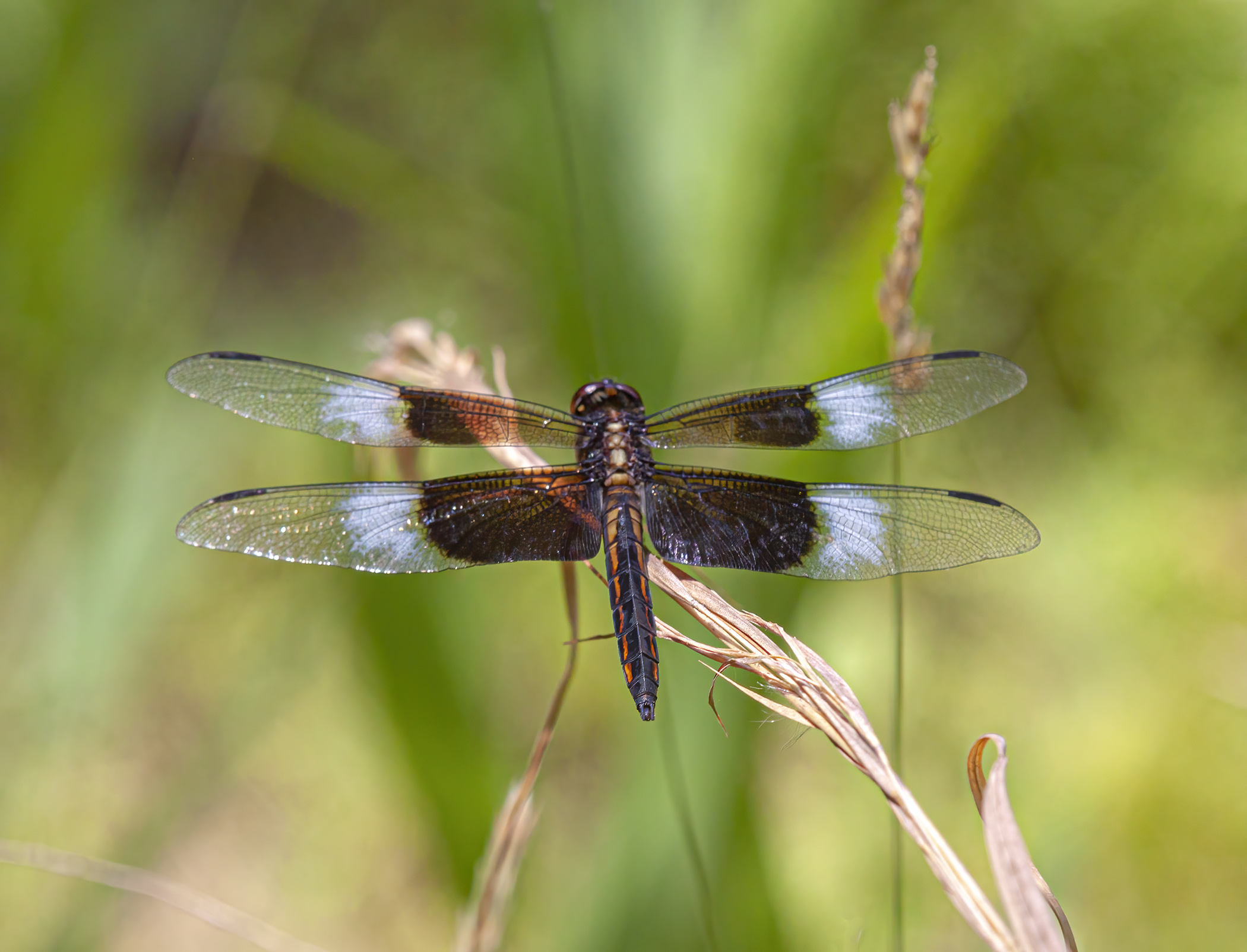
On a recent trip to Occoquan Bay National Wildlife Refuge I was able to see eye to eye with this handsome male Widow Skimmer (Libellula luctuosa). I love the wonderful symmetry of looking straight into the multi-faceted eyes of a dragonfly, as in the first photo below, though I will admit that it really limits the depth of field in the image and does not let you see much of its body. For the second photo, I moved a little and shot if from a slight angle.

I tend to prefer the first image. What do you think?

Widow Skimmer

Widow Skimmer

© Michael Q. Powell. All rights reserved.
Read Full Post »

What’s a Widow Skimmer? The name may bring to mind a gigolo chasing after rich old ladies, but it is actually a strikingly beautiful dragonfly. I spotted this handsome male Widow Skimmer (Libellula luctuosa) on Monday at Jackson Miles Abbott Wetland Refuge in at Fort Belvoir, Virginia.

When I took this shot, I was facing toward the sun. As a result, the body of the dragonfly is almost a silhouette. What was more important to me was the detail of the wings and I am happy I was able to capture some of the detail that was revealed as the light streamed through the almost transparent wings.

widow skimmer

© Michael Q. Powell. All rights reserved

Read Full Post »

When I was first getting serious about my photography, I remember being told how important it was to isolate my subject in order to prompt the viewer to focus on what I thought was important. At this time of the year I take a lot of photos of insects and it is often a real challenge to isolate them from their backgrounds. As I was going through some images from this past weekend, I noted that I tried a couple of different approaches when photographing male Widow Skimmer dragonflies (Libellula luctuosa) at Jackson Miles Abbott Wetlands Refuge.

In one case, I tried to isolate the dragonfly by shooting at an upwards angle, thereby eliminating the clutter of the vegetation. Of course, it helped that the dragonfly cooperated by perching at the tip of the stem. I really like the way that the colors and shapes of the background almost match those of the dragonfly.

Widow Skimmer

In a second case, the dragonfly was perched in the midst of the vegetation. I moved to a position so that my camera’s sensor was on a parallel plane to the dragonfly’s open wings and opened the aperture pretty wide. Normally I try to keep the aperture stopped down in an effort to get more parts of the dragonfly in focus. This time, however, the dragonfly was relatively flat and I was able to throw the background a bit out of focus without losing the details of the dragonfly. The contrast of the background colors with those of the dragonfly helps it to stand out, while retaining a sense of the environmental setting.

Widow Skimmer

There are lots of other ways to isolate subjects. Sometimes we have the luxury of being able to think about them, but often we are forced to make rapid decisions about shooting angles and camera settings that will have a huge impact on our final images.


© Michael Q. Powell. All rights reserved.


Read Full Post »

What is a Widow Skimmer? It sounds like a con artist who preys on rich older women, but it actually is a beautifully patterned dragonfly, like this juvenile male that I spotted recently at Huntley Meadows Park.
Why is it called a “widow?” According to bugguide.net, the species name of the Widow Skimmer (Libellula luctuosa) “means sorrowful or mournful, perhaps because the wings of both male and female seem to be draped in mourning crepe.” Only the male has white patches on its wings, so it’spretty easy to identify the dragonfly in the image as a male. Adult males have blue bodies and juvenile males and females have yellow and brown bodies.
Sometimes I wish that the identification of dragonfly species were this easy all of the time, but real life is generally much more complicated.
Widow Skimmer
© Michael Q. Powell. All rights reserved.

Read Full Post »

I love the dramatic lighting, the graphic quality, and the simple composition of this shot of a male Widow Skimmer dragonfly (Libellula luctuosa) that I took earlier this month at Jackson Miles Abbot Wetlands at Fort Belvoir, a nearby military installation here in Virginia.

There is a real beauty in simplicity.

Widow Skimmer

© Michael Q. Powell. All rights reserved.

Read Full Post »

It violates one of the basic rules of photography to have your subject in the center of an image, but for both of these shots of a male Widow Skimmer dragonfly (Libellula luctuosa), that’s precisely what I did.

In the first image, the blade of grass that bisects the image helps to emphasize the symmetric patterns on the wings of the Widow Skimmer.

Widow Skimmer

In the second image, I was so fascinated by the geometric lines of the grass and their varying degrees of sharpness that I did not want to crop them at all, so I left the Widow Skimmer more or less in the center.

Widow Skimmer

When it comes to my photography, I tend to look at “rules” as general guidelines that apply in many—but not all—situations. That approach helps me to remain centered and flexible.

© Michael Q. Powell. All rights reserved.

Read Full Post »

Flying slowly and weakly with its patterned wings, a male Widow Skimmer dragonfly (Libellula luctuosa) looks amazingly like a butterfly as it flutters by. Fortunately this one stopped to perch on some vegetation at the edge of a small stream and I was able to get this shot.

Widow Skimmer

This was the second time that I have seen a male Widow Skimmer this spring. It’s easy to tell that this is a male, because the females do not have the white spots on their wings. When I saw one last month, though, it was a little tougher to make the call. Immature male Widow Skimmers look a lot like females, as is the case with many dragonfly species. The colors of “fresh” dragonflies tends to be pale and wing patterns may not have developed fully yet. The photo below provides a pretty clear view of the “claspers” at the tip of the abdomen, which indicates that this is a male. Eventually he will grow up and begin to look more like the mature Widow Skimmer in the first photo.

Widow Skimmer

Michael Q. Powell. All rights reserved.


Read Full Post »

Although I usually try to get close up for my dragonfly photos, I am unusually pleased with this image I took yesterday of an immature male Widow Skimmer dragonfly (Libellula luctuosa), which has an artistic quality that is not always found in my close-ups.

For those who might be curious about the identification, the white on the wings indicates that it is a male (females have only dark blotches) and the yellow and black body indicates that it is immature,because adult males have bluish-colored bodies.

widow1_blog

© Michael Q. Powell. All rights reserved

Read Full Post »

It was exciting for me to spot a new dragonfly this weekend, a male Widow Skimmer dragonfly (Libellula luctuosa).

I really like the brown and white pattern on the wings, which was distinctive enough that it also helped me in identifying it. According to Bugguide, the species name means sorrowful or mournful, perhaps because the wings of both male and female seem to be draped in mourning crepe.

The weather has turned hot and humid, which is typical for the Washington D.C. area, which seems to be great for the dragonflies, so I’ll be out as often as I can tolerate the heat, searching for new dragonflies to photograph.

brown_white1_blogbrown_white2_blog

© Michael Q. Powell. All rights reserved

Read Full Post »