Feeds:
Posts
Comments

Posts Tagged ‘Washington D.C.’

I should probably be able to remember my own anniversary, but I am a guy. Therefore I was caught a bit by surprise yesterday evening when WordPress notified me that it was the fourth anniversary of the start of my blog. Where has the time gone?

Blogging has become part of my daily life since I first started. I never suspected that I would get such joy and satisfaction from exploring my creativity in words and in photos and from sharing that journey with the wonderful folks that I have encountered through the blog. Thanks to all of you for your support, encouragement, and helpful tips. I sometimes like to say that I write this blog primarily for me, but I know that is not entirely true—I write it for all of you too. My photography mentor, Cindy Dyer, deserves special thanks. She helped me to start the blog and has been a continuous source of inspiration for me.

WordPress statistics indicate that I have made 2030 postings (which includes a dozen or more repostings of  posts written by friends) and have had 110749 views from well over 100 countries. Statistics are only a relative measure of success and I know that my best postings and my best photos are not necessarily the ones that have had the most views.

Over the past four years my skill and my confidence with my camera have grown. I now consider myself a photographer, albeit not a professional. My interests have expanded and my winters are now spent chasing birds, something I never imagined that I would find interesting. My fascination with dragonflies has remained constant and I have learned a lot about them. I think it is altogether appropriate to reprise today the short text and photo from my first posting

Text of my first posting in WordPress on July 7, 2012:

I photographed this Blue Dasher dragonfly (Pachydiplax longipennis) at Kenilworth Aquatic Gardens this morning.

© Michael Q. Powell. All rights reserved.
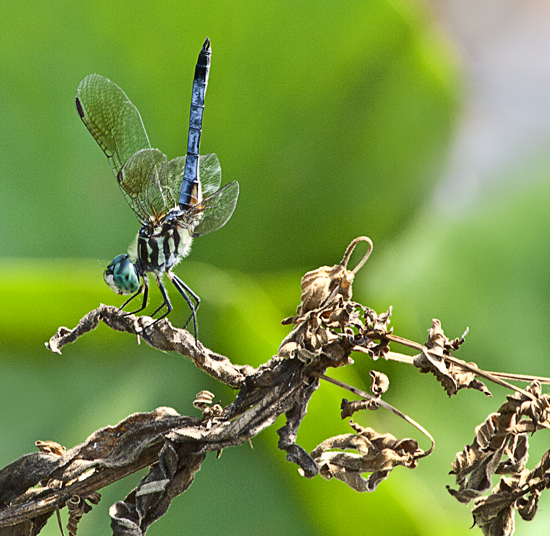
 

Blue Dasher

Read Full Post »

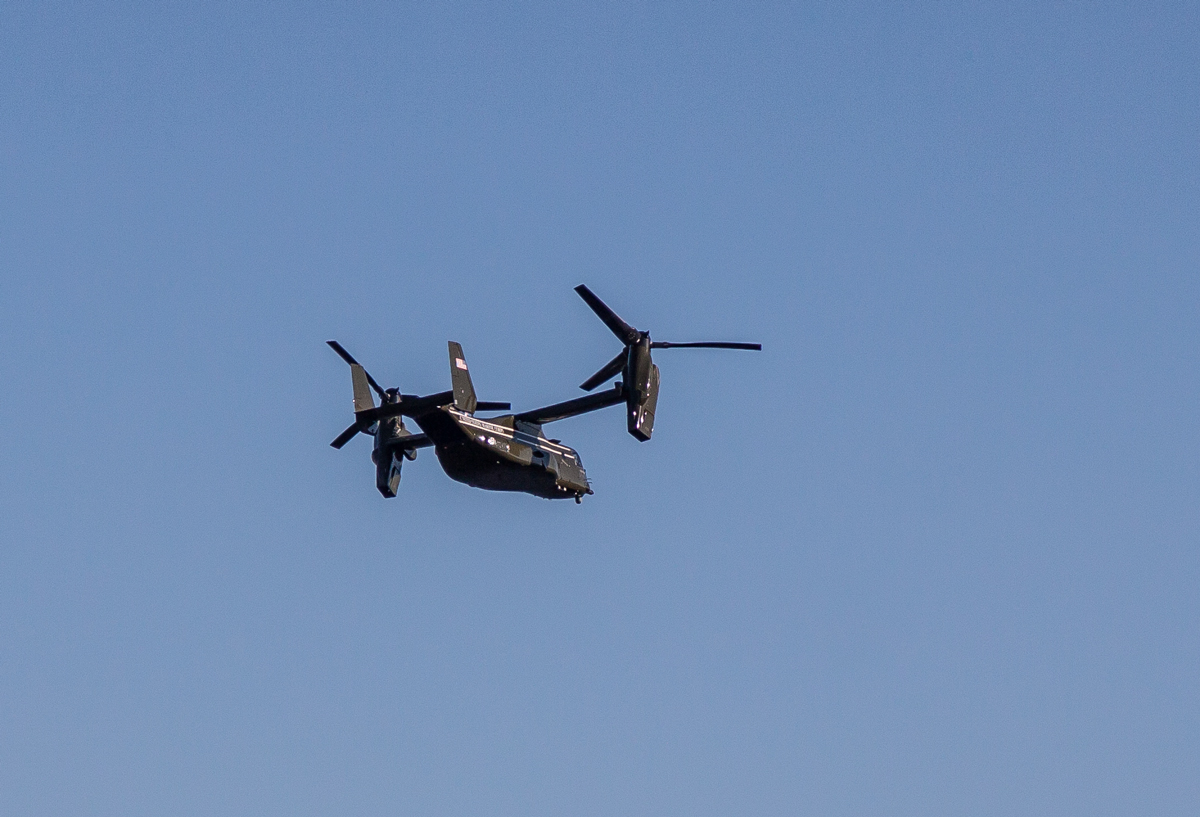
As I stood at the waterfront in Georgetown last Friday, I heard a rumble approaching. Was it an aircraft? Was it a helicopter? Suddenly a loud, slow aircraft appeared low in the sky above the Potomac River. It was probably the strangest looking aircraft that I had ever seen.

I had read about the MV-22 Osprey, but had never seen one. The Osprey combines the functionality of a helicopter with that of an aircraft and has tilt rotors that allow it to perform vertical takeoffs and landings.

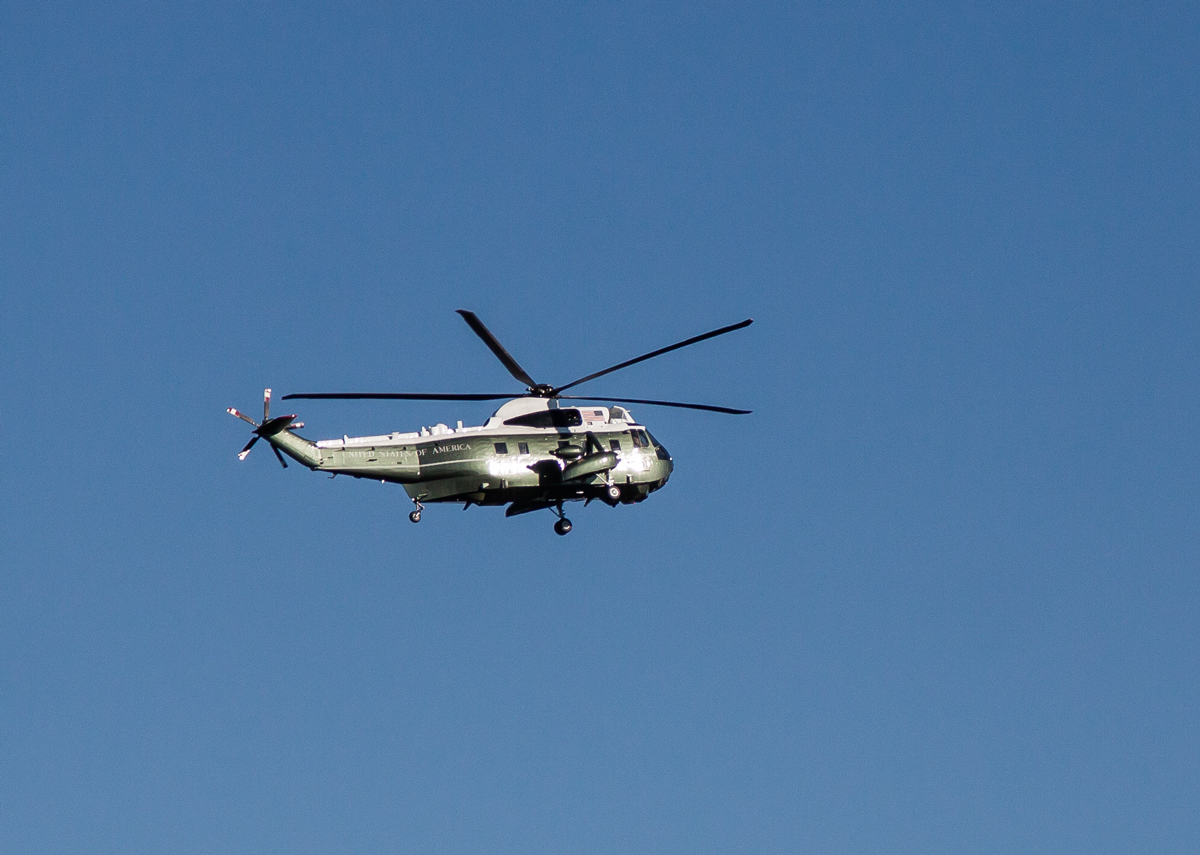
This Marine Corps aircraft was at the tail end of a small flight of helicopters that was heading toward the White House. Perhaps it was providing additional security, given that it was September 11 when I took the photos, or may have merely been transporting part of the President’s entourage.

The first two photos show the Osprey in flight. I was pleased to be able to get these shots despite the fact that I had only a 24-105mm lens on my camera at the time. The third shot is of one of the other helicopters in the group. The “white top” helicopters are usually associated with the Marine Corps detachment that supports the President. The final shot shows a couple of the presidential helicopters as they fly toward the White House.

I thought about cloning out the small jet in the first photo, but decided that I like the way that it almost looks like the Osprey is stalking the jet.

MV-22 Osprey

MV-22 Osprey

presidential helicopter

presidential helicopters

© Michael Q. Powell. All rights reserved.

Read Full Post »

When taking photos, do you ever just point and shoot? Now I realize that there is an entire class of consumer cameras with mostly automatic settings that are referred to as “point and shoot cameras,” but that’s not what I am talking about here. What I am asking is whether you ever just point your camera in the general direction of a subject and engage the shutter without actually framing the shot with the viewfinder or even the LCD on the back of the camera.

Why would you do that? I have a fascination with street photography. Conceptually I like the idea of taking photos of strangers, often at close range, in interesting urban settings. However, I have not been able to overcome my inhibitions and fears about capturing these kinds of images.

As I was returning by Metro back to my Northern Virginia suburb from a trip to the District of Columbia, I noticed  a guy with a bicycle standing in front of me. He had a racing-style bike and was carrying what appeared to be a fully inflated spare tube in his hand. It was an intriguing scene and I decided to try to capture it. With my camera balanced on my camera bag on my lap, I pointed the camera in his direction and took a number of shoots, zooming in and out with my 24-105mm lens. A few times, I peeked at my results and adjusted the angle and direction of my camera. I slightly adjusted the angle of a couple of the shots you see below, but kept the one that was really skewed just like it came out of the camera—I just like the different look that it has.

I felt safe and secure in taking these shots, because the sounds of the moving train more than covered any noise coming from my shutter. I even felt emboldened to take some shots of a young lady sitting across the aisle from me. She had assumed what I consider to be the classic Metro pose. She had headphones on and was sitting upright, absorbed in her own world. There seems to be an unwritten Metro code that strangers do not interact with each other, and usually go to pains not to look each other in the eye.

I think I will try my experiment again to try to get used to the idea of taking photos of strangers, albeit surreptitiously. I am not ready to become the next Cartier-Bresson, but it’s a start.

rider3_blog

rider1_blog

rider4_blog

rider2_blog

© Michael Q. Powell. All rights reserved.

Read Full Post »

What kind of subjects lend themselves to black and white film? Can you decide beforehand and try to see the world in black and white, as I started out trying to do, or do you decide afterwards, as most people do when converting digital images to black and white?

This is the continuing story of my experimentation with a totally mechanical Nikon F SLR loaded with Ilford HP 5 Plus black and white film. I wandered through the streets of Washington D.C. looking for subjects and came upon this bust of noted Soviet human rights activist Andrei Sakharov outside of the Russia House restaurant on Connecticut Avenue.

I worked hard on this one to try to compose it and shoot it in an interesting way and I like the way that it turned out. It turned out that focusing manually is tougher than I thought, even with the visual assists in the viewfinder of a film camera, like the micro prism. I was definitely out of practice and I worried that all of my images would be soft and out of focus. This image reassured me that if I am careful, I can get relatively sharp images and capture details like the texture that you can see on the hands and the head of the statue.

Andrei Sakharov

Eventually I made my way to the National Zoo and last week I posted some digital shots of some of the animals that I encountered there. The zoo posed a big problem for me in getting a proper exposure, because there was a mixture of harsh midday sunshine and shadows. As I looked over my negatives, I realized that I need to meter more often—I took a series of shots of lions that were sometimes in the sunshine and sometimes in the shade and overexposed many of the shots.

However, one of my favorite images of the roll of film was this one of a female lion that was properly exposed and captured a good amount of detail. At this point in the day, I had switched to a Tokina 80-200mm lens to give myself a bit of additional reach.

lion

So could I take the kind of wildlife/nature shots that I normally feature with a film camera? It would be tough to do so, but this shot of a Monarch butterfly suggests that it would not be impossible. The pattern of the Monarch is so well-known, that most of us can imagine its orange and black coloration without actually seeing the colors. This is the only one of my black and white images on which I did a significant crop, and you can see how the background has become a bit grainy.

Monarch butterfly

For folks who are interested in the process, I developed the film with Ilfosol 3 developer, a general purpose developer. I exposed the film as though it were ISO 200, instead of the box speed of ISO 400, and learned that pulling the film like this is likely to lead to lower contrast (while shooting it at higher speeds will tend to give more contrast). I scanned the negatives with a Canoscan 8400f scanner as TIFF files and did a few adjustments in Photoshop Elements 11.

So what did I learn? I learned to slow down and be more deliberate as I contemplate my shots; I learned to look past some of the colors of the world and search for shapes and lines and contrast; and I leaned the value in producing my images in a manual, hands-on way, leading to a greater sense of ownership of those images.

I learned a lot, though clearly I have a lot more to learn as I continue to explore this new/old area of photography.

© Michael Q. Powell. All rights reserved.

Read Full Post »

Do you ever feel a desire to step outside of your comfort zone in your photography, to capture some images in a completely different way, to return to the basics of our craft? For the last month, I have felt an irresistible urge to shoot some black and white film, something that I haven’t done in over thirty years.

When I told some folks at work that I was planning to shoot some film during a week of vacation, one of them responded by asking if I was making a movie. I patiently explained that I would be putting some black and white film into a non-digital camera. He stared back at me with a look of incredulity and asked if I couldn’t simply convert some of my digital images into black and white.

I still have some analog cameras, but most of them have some electronic assists—I wanted a truly mechanical camera. I found a Nikon F SLR with a 50mm f/1.4 lens on my local Craigslist. The Nikon F introduced in 1959, was Nikon’s first SLR, although this particular camera was produced in 1971, judging from its serial number. The camera is so basic that it requires no battery. When was the last time you took photos with a camera without a battery? The camera has no meter and I ended up using my DSLR as the meter.

Nikon F

What about film? I went to one of the last remaining camera stores in our area and bought a couple of rolls of Ilford HP5+ film, a black and white film with a “box speed” of ISO 400. I ended up shooting it at ISO 200, because it was very sunny and bright the day that I went shooting. (Using the “sunny 16” guidelines, I would have been shooting all day at 1/500 sec and f/16.)

What should I shoot? I decided that an urban environment would be more suitable for my film project than my normal wildlife environment, so I got on the metro and headed into Washington D.C. with my Nikon SLR and my Canon DSLR in tow.

I got off on the elevated outdoor metro platform at Reagan National Airport and my first shot was of the airport’s control tower. I wanted to try to find subjects with shapes and lines that would show up in black and white. (I am including some digital shots of the same subjects at the end of the post. I didn’t try to exactly match the shots, but they give you an idea of the differences in how the cameras rendered the subjects.)

Reagan National Airport

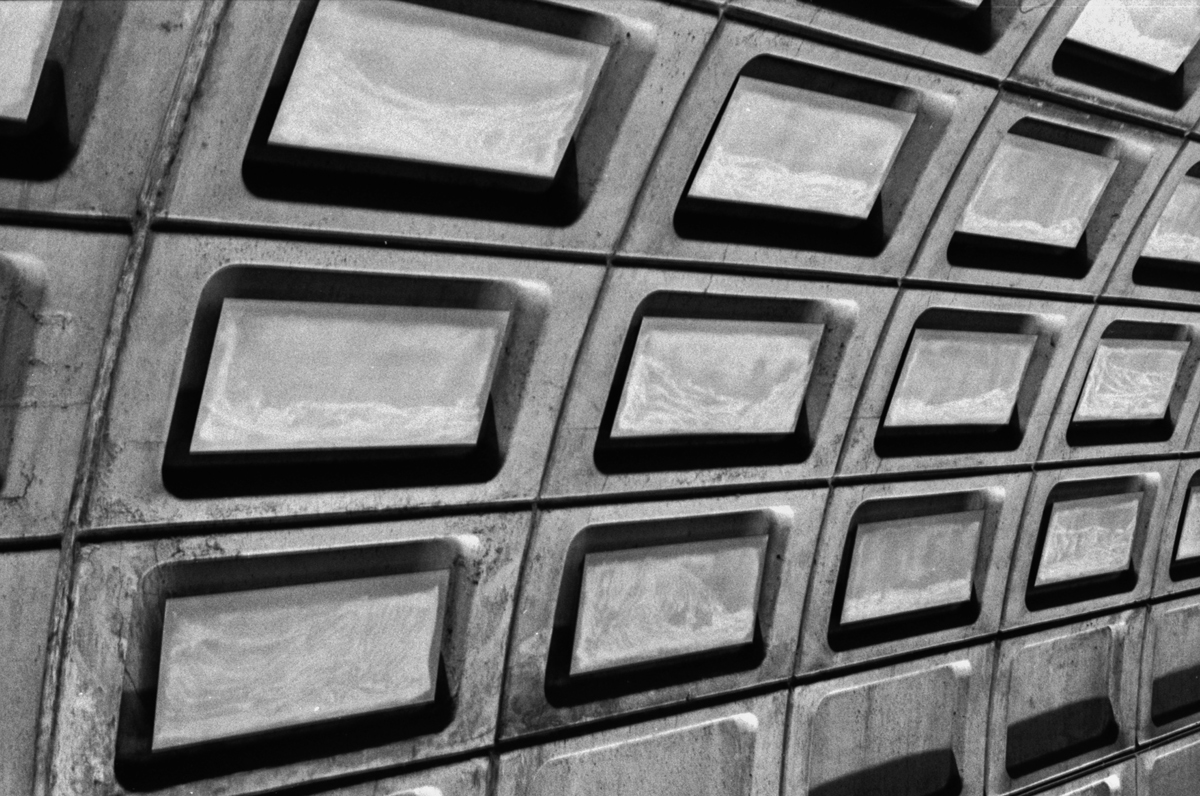
The next shot was of the Metro’s ceiling at the underground station in Rosslyn, Virginia. (You may have already seen a similar shot that I took with my digital camera and posted last week.)

metro

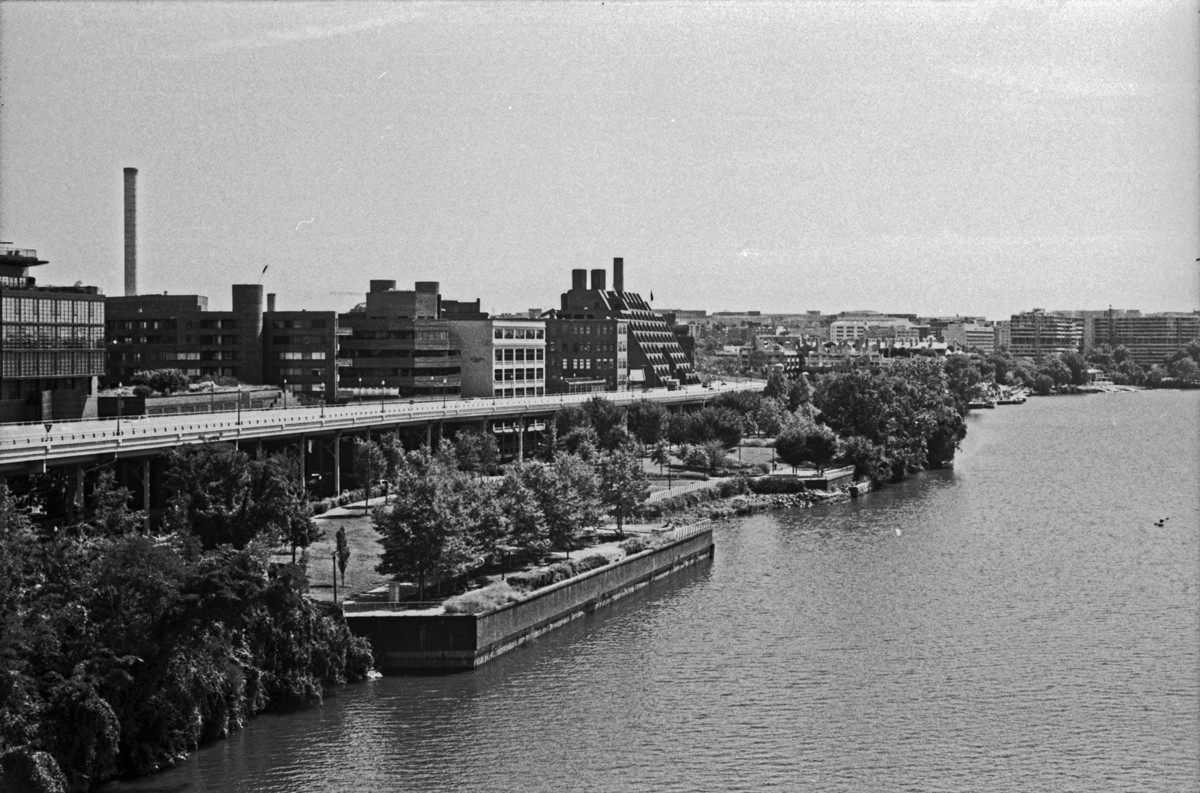
I exited the Metro in Rosslyn and walked across the Key Bridge into Georgetown. From the bridge, I took this shot of part of the waterfront in Georgetown. I like the old time feel of this shot.

Georgetown waterfront

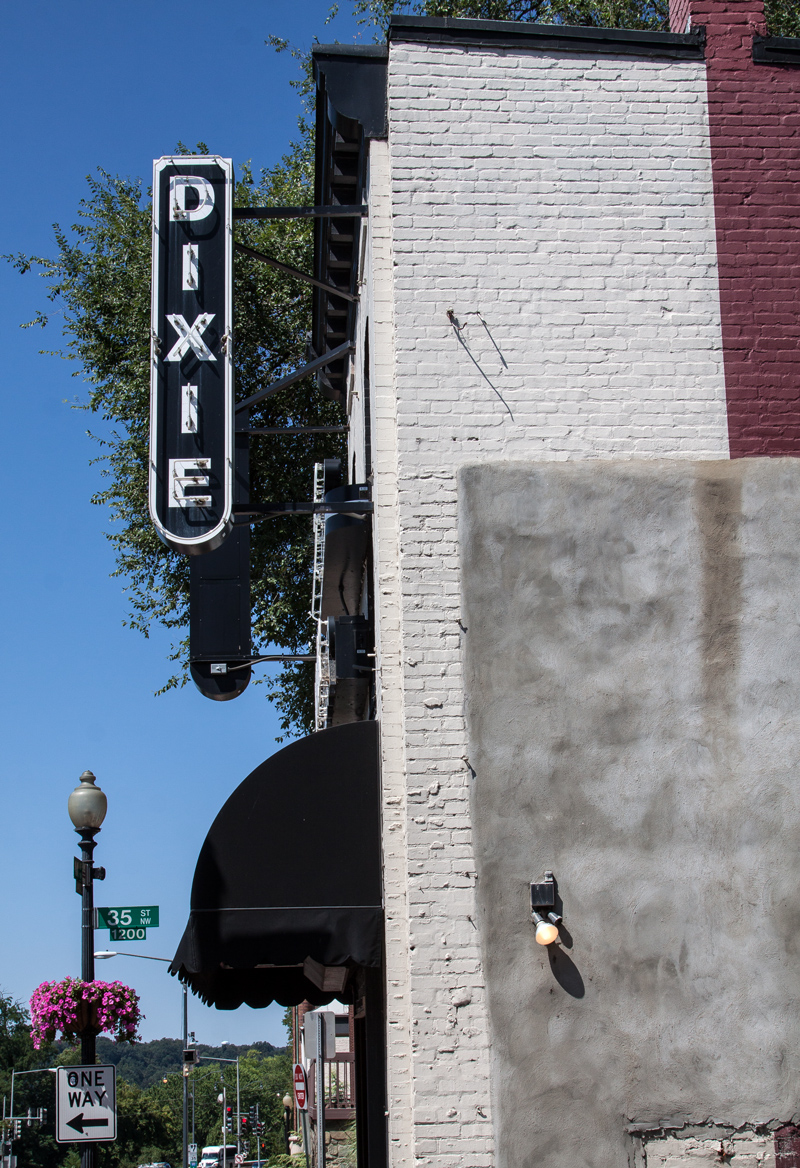
One of the first things that you see when you cross the bridge is Dixie Liquors, an old-fashioned liquor store with a really cool sign that I have always liked.

Dixie Liquors

That was the start of my adventure with film. As I had hoped, I was looking at the world with different eyes and was forced to slow down, knowing I had to input manually the shutter speed and aperture and very conscious of the fact that I had no auto focus to help me. I was also shooting with a fixed focal length lens, so I did not have the luxury of zooming in and out. Most of all, though, I was filled with uncertainty, not knowing for sure if any of my shots would come out, worrying that my old camera might have a light leak or that I would mess up the development of the film.

I’ll continue my saga in another posting or two in the upcoming weeks. As promised, here are some digital shots that I took as I used my Canon DSLR as a meter for my manual Nikon.

control tower Reagan National Airport

metro ceiling

Georgetown waterfront

Dixie Liquors

© Michael Q. Powell. All rights reserved.

Read Full Post »

In its simplest form, photography is about light and darkness, about lines and shapes. That was what I was seeking to capture when I took some shots in a Metro station in Rosslyn, Virginia earlier this week.

I took this week off from work and have spent a considerable amount of time thinking about photography, watching lots of videos, and shooting different subjects in different ways. I have even shot and developed some black and white film—I’ll do a separate posting on that soon.

This first shot highlights the distinctive ceilings that are present in many of the stations in the D.C. Metrorail system. I love the geometric patterns and the interplay of light and shadows in this image. I took this 1/3 second exposure by leaning my camera on a railing.

metro ceiling

The Rosslyn station is at a point in the Metro system where the trains pass under the Potomac River. Consequently, the escalators are extremely long. As I rode the escalator up, I was fascinated by the different lights and captured this image when I was approximately at the mid-point between the level of the tracks and the above-ground station.

It was midday on a weekday, which is why you don’t see more people in this shot. Things get really crowded during rush hour and woe to those who do not follow the Metro etiquette of staying to the right on the escalator steps unless passing.

metro escalator

© Michael Q. Powell. All rights reserved.

Read Full Post »

Walking in Washington D.C. along the National Mall, I couldn’t help but notice that humans were not the only ones taking advantage of the water fountains along the periphery. Several different kinds of birds were bathing and drinking in the water of backed-up fountains.

In the first shot, a bird, which may be a Common Grackle (Quiscalus quiscula), seemed to be testing the water in the fountain—a few seconds later, it was happily splashing about.

urban bird

I love the defiant stance of the larger bird in the second shot, looking like he is the leader of an urban gang, prepared to defend his turf against outsiders like me.

urban bird

© Michael Q. Powell. All rights reserved.

Read Full Post »

On a trip to the National Zoo earlier this week, I was walking around in heat of the summer sun, unlike most of the animals, who were relaxing in the shade or finding other ways to cool off.

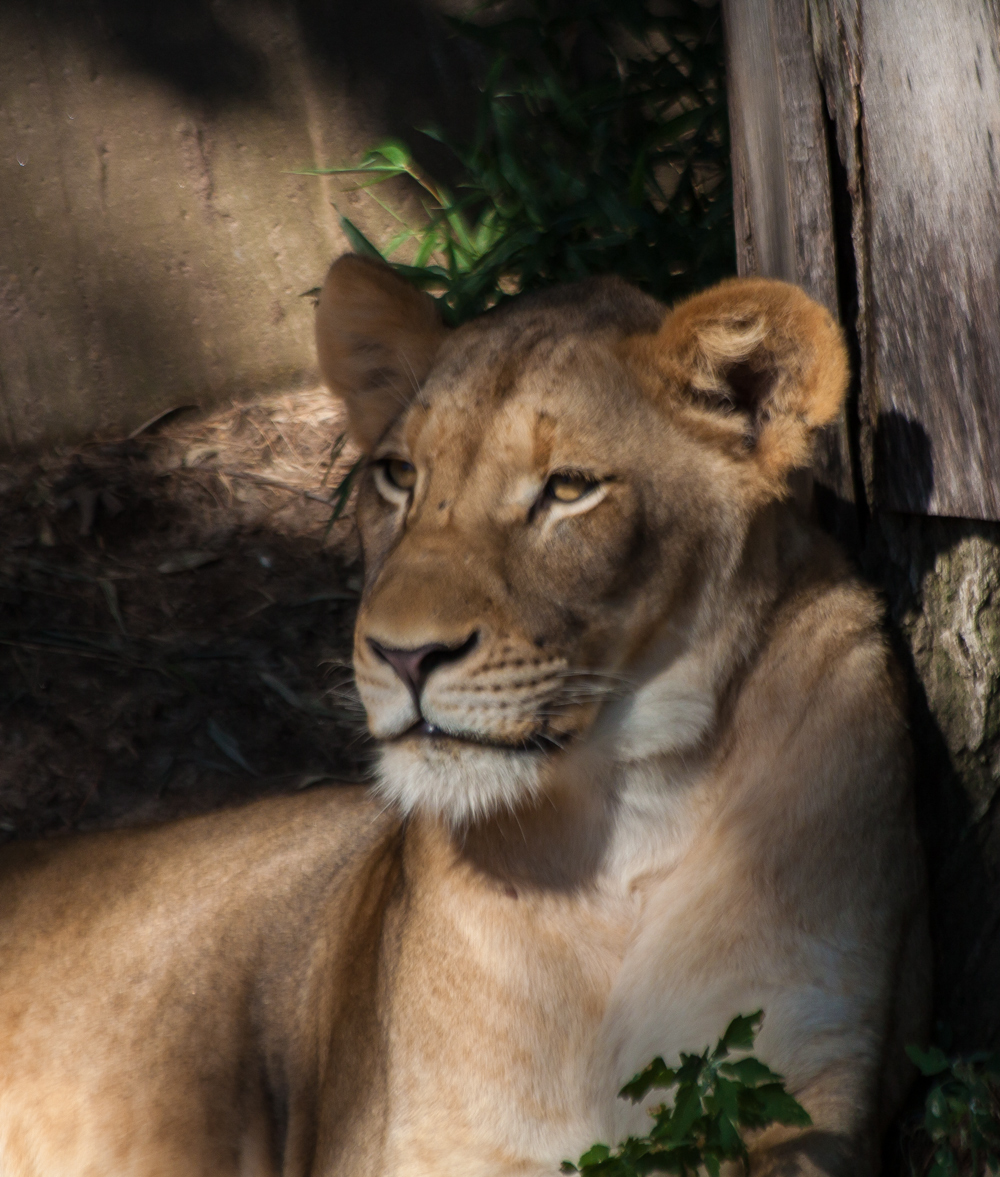
This female lion was dozing in the shade and would periodically raise her head and look in our direction with sleepy eyes.

lion

This tiger decided to swim a bit in the water of the moat at the front edge of its enclosure. I couldn’t tell how deep the water was—at times it looked like the tiger was merely walking in the water and not actually swimming.

tiger

This cheetah seemed a little agitated and was not relaxing. It was walking back and forth along the fence line that separated its enclosure from the adjacent cheetah enclosure.

cheetah

I’ll probably never go on a safari and see these beautiful creatures in the wild, but my trip to the National Zoo in Washington D.C. afforded me a glimpse of their power and their majesty. I am happy that the National Zoo is active in efforts to ensure the preservation of endangered species, in particular the cheetah. Check out this article for more information about those efforts.

© Michael Q. Powell. All rights reserved.

Read Full Post »

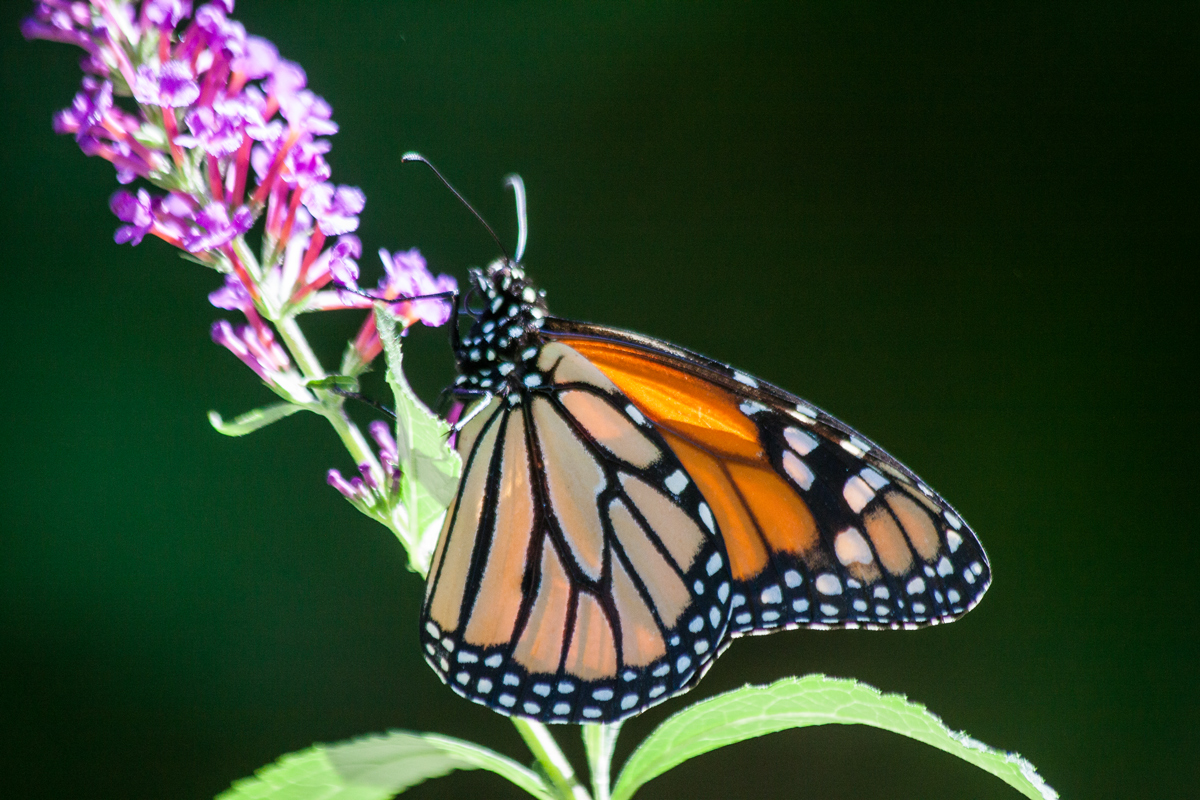
I haven’t seen very many Monarch Butterflies (Danaus plexippus) the last few years, so I was thrilled when I spotted this one yesterday at the outdoor butterfly garden at the National Zoo.

I chased after it as it flew from plant to plant, hoping that it would come to rest withing range of my camera. Once the Monarch had landed I circled around until I was on the same plane as the butterfly and got this shot. Fortunately I was close enough that I was able to fill the frame with the beautiful Monarch and a small amount of the flower on which it was feeding—this is an uncropped image.

It was midday and the lighting was a little harsh, but it did help illuminate the wing from an angle and showcase the butterfly’s spectacular colors.

I did take some photos of some of the animals at the National Zoo, which I will present in another posting, but thought I’d start with the Monarch Butterfly, an unexpected bonus of my brief visit to the zoo.

Monarch butterfly

© Michael Q. Powell. All rights reserved.

Read Full Post »

Safe inside the confines of an enormous lily pad, this little frog calmly watched the crowds of people last weekend in Washington D.C. at the Lotus and Water Lily Festival at Kenilworth Park and Aquatic Gardens.

frog on a lily pad

You can’t help but noticed that this is not your average lily pad. I believe that it is a tropical variety that comes from the Amazon River basin of the genus Victoria, possibly Amazonica victoria. According to Wikipedia, the leaves of this species can grow as large as 10 feet in diameter (3 meters), although this one was probably less than three feet (one meter) in size. Clearly it had no problem supporting the weight of the little frog.

Readers who follow my photography know that I love to try to get in close to my subjects, irrespective of whether I am shooting with a telephoto lens or a macro lens, and this was no exception. There was a waist-high wire fence around the cement pond in which the water lilies were growing, so I had some limitations in framing my shots, but did manage to get this shot of the frog looking over the edge of lily pad.

frog on a lily pad

© Michael Q. Powell. All rights reserved


Read Full Post »

Lotuses are gorgeous flowers when they are in bloom, but the lotus that really drew my attention was this bud that is just starting to open, full of hope and promise, clothed in a sense of mystery and expectation.

lotus bud

© Michael Q. Powell. All rights reserved

Read Full Post »

While I was at Kenilworth Park and Aquatic Gardens in Washington D.C. on Monday, it was easy to understand Monet’s endless fascination with water lilies. My opening image of a small wooden bridge brings to mind several of Monet’s paintings of the Japanese Bridge in his water garden at Giverny.

bridge at Kenilworth

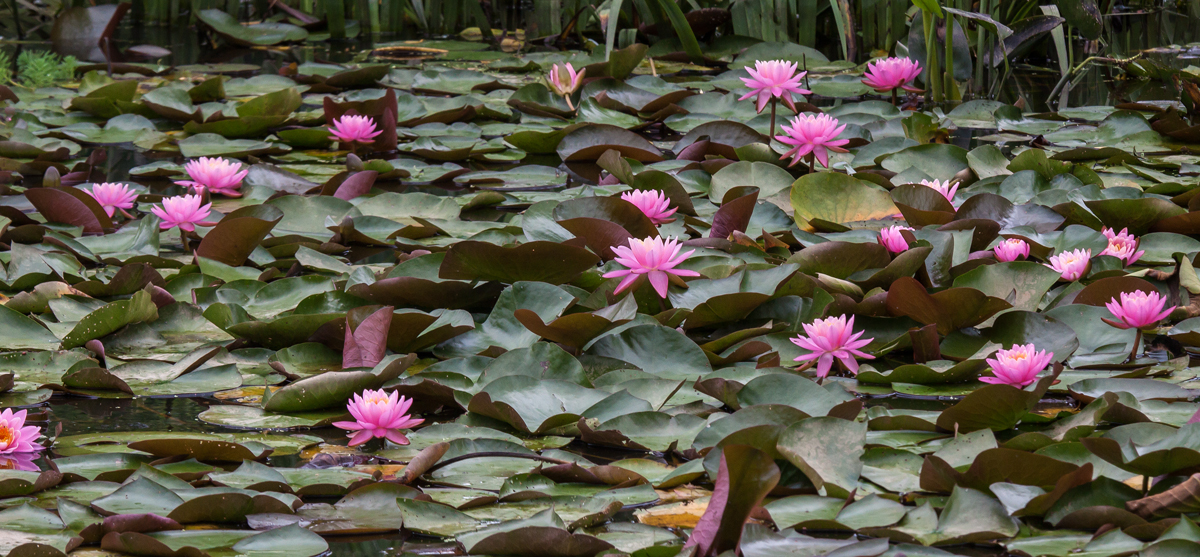
Water lilies seem to draw me in and surround me with an overwhelming sense of beauty and tranquility. How can I possibly capture that feeling in a photo? Here are a few images to show you some of the different approaches that I used in attempting to show the irresistible attraction of water lilies.

water lily at Kenilworth

water lilies at Kenilworth

pink water lilies at Kenilworth

© Michael Q. Powell. All rights reserved

Read Full Post »

Dragonflies are colorful and flowers are colorful too, but it’s rare that I get to see the two of them together. I was thus thrilled when fellow photographer Cindy Dyer spotted a colorful Blue Dasher dragonfly (Pachydiplax longipennis) perching on a beautiful purple water lily during our recent trip to Kenilworth Park and Aquatic Gardens in the District of Columbia.

I took some initial shots with the 180mm macro lens that I had on my camera at that moment, but wasn’t really able to fill the frame with my subject and the background was a little distracting. (The second photo below was one of those first shots and it does a pretty good job of highlighting the water lily, but the dragonfly is merely an added bonus.) I couldn’t physically move any closer, because the water lilies were in a cement pond, surrounded by a three foot high wire fence.

I decided to change to a longer lens, though I sincerely doubted that the dragonfly would stay in place. Almost all of the times that I have done a rapid lens change in the field, the subject has departed before I was ready to shot. In this case, however, I got lucky and the Blue Dasher held his perch long enough for me to get a few shots with my 70-300mm lens.

I simply love the color combination of the different shades of blue of the dragonfly and the purple and yellow of the water lily.

Blue Dasher

Blue Dasher

© Michael Q. Powell. All rights reserved


Read Full Post »

Yesterday morning I made a quick trip to Kenilworth Park and Aquatic Gardens in Washington D.C. with fellow photographer Cindy Dyer to check out the water lilies and lotuses. Many of the pathways in the park are flooded or muddy, thanks to a significant amount of recent rain. Wet feet, however, were a small price to pay to see so many beautiful flowers, including the two spectacular pink water lilies that I am featuring today.

Stay tuned for more water lily and lotus images later this week.

pink water lily

pink water lily


© Michael Q. Powell. All rights reserved

Read Full Post »

All orchids are beautiful, but I am particularly fascinated by Lady’s Slipper orchids, which are characterized by a slipper-shaped pouch. The pouch traps insects that help to fertilize the flower as they climb up and out of the pouch. According to Wikipedia, the Lady’s Slipper orchids are in the orchid subfamily Cypripedioideae, though some apparently consider them to be their own family separate from the other orchids.

I took this shot last week in Washington D.C. at the US Botanic Garden. There were several rooms full of orchids of all kinds, including multiple species of Lady’s Slipper orchids—it was almost like being in heaven.

Lady's Slipper orchid

© Michael Q. Powell. All rights reserved.

Read Full Post »


The weather has not been very cooperative and outdoors there are not yet many flowers blooming. Yesterday I went to the US Botanic Garden in Washington D.C. to get my “fix” of flowers in a more temperate setting. Among the many beautiful flowers that I observed was this Madeira Cranesbill geranium (Geranium maderense).

Madeira Cranesbill geranium

© Michael Q. Powell. All rights reserved.

Read Full Post »

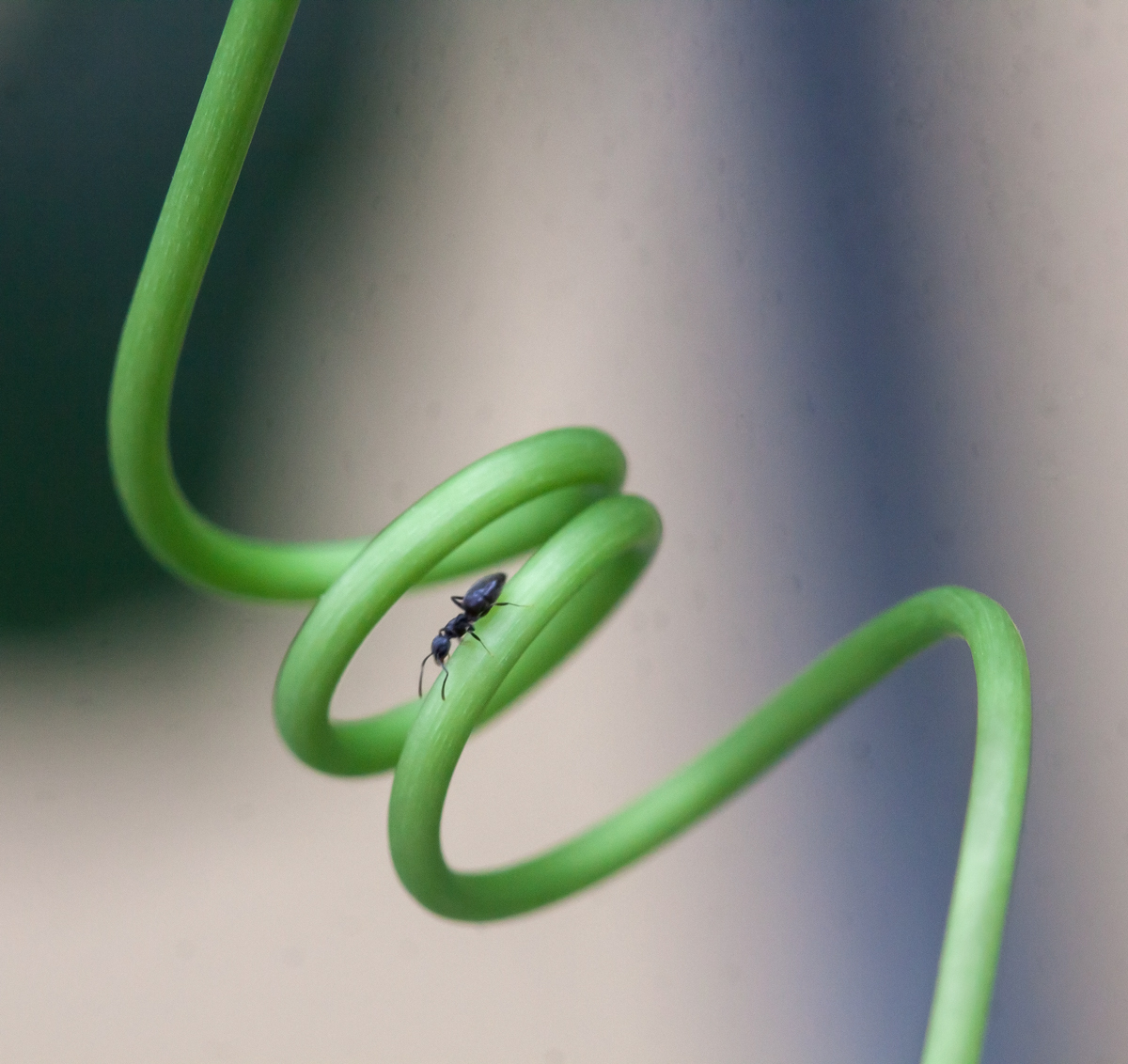
I’m so desperate for the weather to warm up more and for insects to emerge that I got really excited when one of my fellow photographers spotted a small ant on one of the tendrils of a passion flower vine yesterday at the US Botanic Garden in Washington DC.

The ant seemed determined to follow the long and winding road.

winding1_blog

© Michael Q. Powell. All rights reserved.

Read Full Post »

Shortly after spotting the Great Egret that I featured yesterday, I caught sight of this Great Blue Heron (Ardea herodias), almost hidden in the trees. From his perch on a fallen tree, he had a view of the grass field that opened into the marsh and seemed to be keeping watch over it.

The heron’s upright posture somehow reminded me of the sentinels at the Tomb of the Unknowns at Arlington National Cemetery, just a few miles away from Theodore Roosevelt Island, where I took this photo. At the Tomb, elite soldiers of The Old Guard, a US Army unit, are on duty twenty-four hours a day, keeping watch over the monument dedicated to American service members who have died without their remains being identified.

It is important that we never forget the military, police, and other dedicated people who are conducting the often solitary duty of keeping us safe and free, while we are awake and while we are sleeping. During this Christmas season especially, be sure to keep in your hearts and prayers the men and women who will be on duty in distant lands, separated from their family and loved one.

Great Blue Heron

© Michael Q. Powell. All rights reserved.


Read Full Post »

I thought that all of the Great Egrets (Ardea alba) had left this area for warmer locations and haven’t seen one at my local marsh in weeks. However, I encountered one this past weekend on Theodore Roosevelt Island, a small island in the Potomac River opposite part of the District of Columbia.

Great Egret

The egret was initially foraging in a field of high grass in a marshy area of the park, as shown in image below. I tried to be as stealthy as I could as I crept bit closer to the egret, but it eventually sensed my presence and took to the air.

Great Egret

The bird circled around a little, but returned to its initial location after a very short period of time in the air.

Great Egret

I had some trouble getting in-flight shots of the egret. The changing light as the bird circled, combined with the bright white color of its body, made it tough to get a proper exposure. I liked the unusual body position of the flying egret in several of the shots well enough that I included them in this post, though I think the image of the egret on the ground is probably the one in sharpest focus.

During this transitional season, it’s fascinating to see which summer birds are still with us, which birds stop by as they migrate to more distant locations, and which ones arrive to overwinter here.

© Michael Q. Powell. All rights reserved.

Read Full Post »

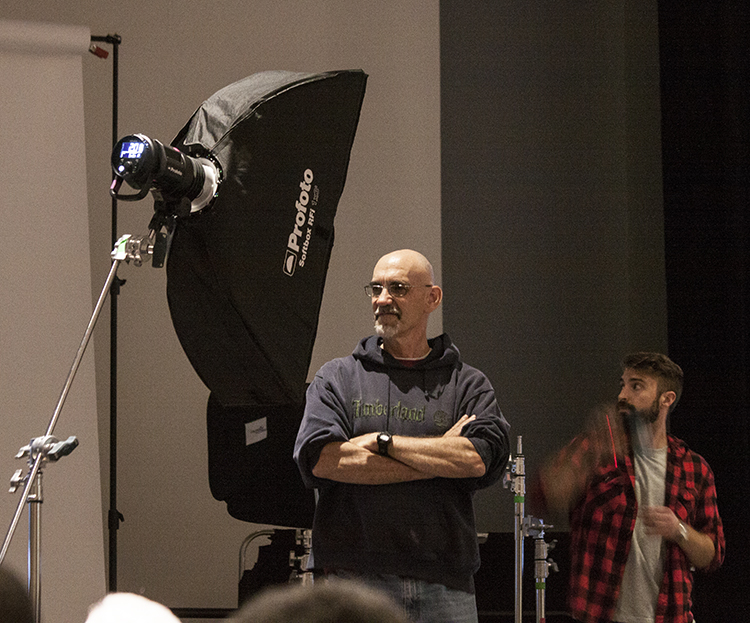
Like most photographers, I feel more comfortable when I am behind the camera, but last Thursday I found myself on stage in front of five hundred other photographers with the lens pointed in my direction.

I was at the Washington D.C. Convention Center with my dear friend and photography mentor Cindy Dyer for a daylong seminar on lighting using flash, taught by Joe McNally, an internationally-known photographer and a great motivational instructor.

During one class segment, Joe pulled me out of the crowd to serve as the model for a mini-shoot. I was more than a little shocked when he pointed in my direction and asked me to come forward. I was a little self-conscious about the fact that I was wearing a hooded sweatshirt and jeans, but at least I didn’t have to worry about how my hair looked.

While I was up on the stage, Cindy decided that she needed to capture the moment and initially took some shots with her iPhone. She was unsatisfied with the results, but didn’t have her camera with her.  Suddenly she remembered that my camera was in my camera bag underneath my chair. Although she is a dedicated Nikon shooter, she grabbed my Canon and got these shots of both the setup and the resulting images from one of the large video projections screens.

In an interesting side note, this is actually the second time that I have been photographed by Joe McNally. In March 2012, when Photoshop World was held in Washington D.C., I was observing one of Joe’s lighting demonstrations at a vendor’s booth. He had just demonstrated beauty lighting with a very photogenic couple and said he needed a subject to demonstrate character lighting—and pointed to me.

IMG_5822 DONE lorezIMG_5831 DONE lorez IMG_5835 DONE lorez IMG_5836 DONE lorez

© Michael Q. Powell. All rights reserved.

Read Full Post »

Readers may have noticed that I rarely take photos of people and never photograph sporting events, but yesterday I found myself supporting one of my friends at the Capital Sprints Regatta in Washington D.C. on the Anacostia River. This was her first competition as a member of the DC Strokes Rowing Club and it was great to get some shots of her in action to commemorate the event.

I had never before been to a regatta and I took a lot of photos in an effort to capture the feeling of the experience. I selected a few of my favorites for this posting, including some close-up portraits as well as some action shots.

row4a_blog


© Michael Q. Powell. All rights reserved


Read Full Post »

Two years ago today, my photography mentor and dear friend Cindy Dyer sat me down at her computer and told me that I was going to start a blog. We had just returned from a photo shoot at Kenilworth Aquatic Gardens in Washington D.C. and had taken lots of shots of waterlilies, lotus flowers, and dragonflies.

Cindy is a professional photographer and web designer and I had previously looked at her blog (which currently has had over 560,000 views), but I had never really thought about starting a blog myself. Inside I had all kinds of concerns about my inadequacies as a photographer and about not being ready to share my images with an audience broader than, but Cindy was undeterred and helped me choose a theme and a banner and set up my basic page.

My first posting was short, only 14 words and included a shot of a Blue Dasher dragonfly. I have reposted it below for your convenience or you can use the link in the first sentence of this paragraph.

Today’s posting is posting number 1,224. I never imagined that I would enjoy this blog as much as I have or that I would continue so faithfully to document my journey into photography. Thanks to so many of you readers who have encouraged and supported me along the way.

I may take a pause this week to reflect on that journey and possibly re-post some of my favorites from the last two years. Don’t worry, though, I be back to posting new images before long.

My first WordPress posting on 7 July 2012:

I photographed this Blue Dasher dragonfly (Pachydiplax longipennis) at Kenilworth Aquatic Gardens this morning.

© Michael Q. Powell. All rights reserved.

Read Full Post »

Last night I made a trip into Washington D.C. with some friends to see the National Christmas Tree. Despite the fact that I have lived in this area for more than 20 years, this was the first time that I had seen it live—I have seen the tree-lighting ceremony on the news many times.

The large Christmas tree, which is a live tree, is surrounded by 56 smaller decorated live trees, representing the 50 states, the District of Columbia, and the unincorporated territories of the United States. Underneath the tree was an elaborate set-up of model trains, reminding me of my childhood.

It’s the day before Christmas and most of us are in high gear for the coming holy day. Best wishes to all of you for a joyous Christmas and a wonderful and blessed New Year.

National_Christmas_Tree_blog

© Michael Q. Powell. All rights reserved

Read Full Post »

I love all water lilies, but somehow the pink ones had a special attraction for me this past weekend, when I visited Kenilworth Aquatic Gardens, a wonderful treasure in the District of Columbia administered by the National Park Service. The surrounding lily pads and the duckweed in the foreground really help to showcase the delicate beauty of this flower.

pink_lily_crop_blog

© Michael Q. Powell. All rights reserved

Read Full Post »

In the orange glow of the sky, the trees cast their reflections on the black granite surface of the Vietnam Veterans Memorial wall.

It was a moment to reflect on the names of more than 58,000 men and women whose names are inscribed on the wall. I am old enough to remember the conflicted mood of the country at the time of that war.  In the late 1970’s I enlisted in the U.S. Army and served on active duty for twenty years. With that experience, I can’t help but be humbled by the memorial to the sacrifice of so many Americans for the common good.

Monuments_blog

From certain angles, I could see reflections of the Washington Monument in the wall. It proved to be very difficult, however, to capture that reflection in a photograph. I used my tripod and a long exposure, but never quite captured the feeling of the moment. I am posting one of those efforts as a kind of aspirational shot, one that I hope to shoot better in the future.

WashMonuWords

© Michael Q. Powell. All rights reserved

Read Full Post »

When most people think of the Vietnam Veterans Memorial, they think only of the black granite wall with all of the names, but the Three Servicemen Statue is also part of the memorial.

Frederick Hart, the sculptor of these statues, described his work in these words (according to the Vietnam Veterans Memorial Fund):

“The portrayal of the figures is consistent with history. They wear the uniform and carry the equipment of war; they are young. The contrast between the innocence of their youth and the weapons of war underscores the poignancy of their sacrifice. There is about them the physical contact and sense of unity that bespeaks the bonds of love and sacrifice that is the nature of men at war. And yet they are each alone. Their strength and their vulnerability are both evident. Their true heroism lies in these bonds of loyalty in the face of their aloneness and their vulnerability.”

I visited the memorial one evening this past weekend and took these photos of the statue. The first photo shows the torsos of the grouping (the statues themselves are full body, but I wanted to show the details of the upper bodies) and the others show the faces of each of the three soldiers.

Vietnam_trio_blogmachinegun_blogStatue 2Black_soldier_blog

© Michael Q. Powell. All rights reserved

Read Full Post »

Fog, low-hanging clouds, and reflected light gave the skies of Washington D.C. an orange-colored glow last night, which made for dramatic shots of the Washington Monument.

I don’t really understand the scientific basis for the phenomenon (perhaps air pollution contributed to it), but tried to capture it with my camera. I took these shots at about nine o’clock in the evening using my tripod and a long exposure, even thought they look like they might have been shot at sunset.

A friend convinced me to go with him to Washington D.C. with the goal of getting some photographs of the Washington Monument shrouded in heavy fog, which turned out not to be the case. Instead, we got something totally unexpected that turned out to be even better than that for which we had hoped.

Monument & TreesWashMonumentOrangeSky

© Michael Q. Powell. All rights reserved

Read Full Post »

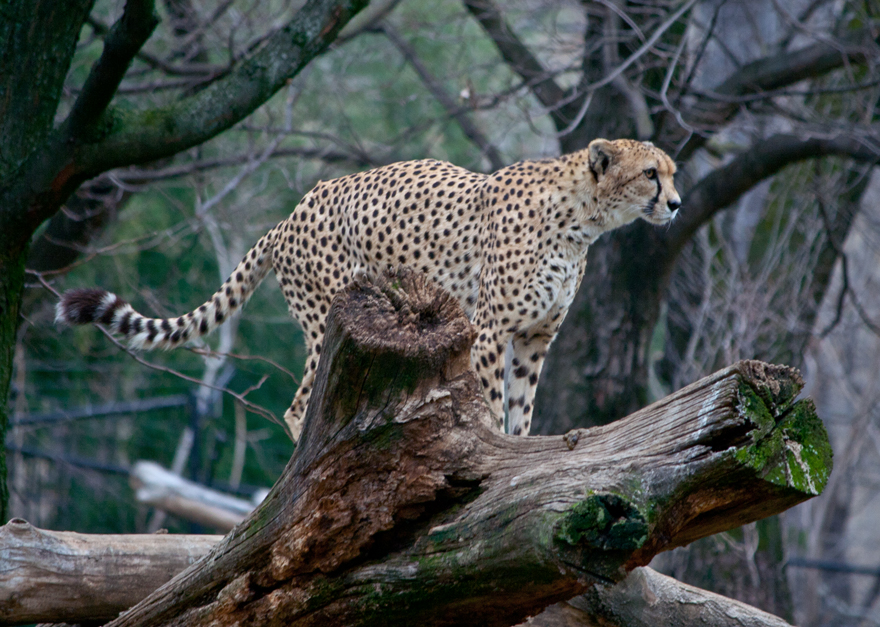
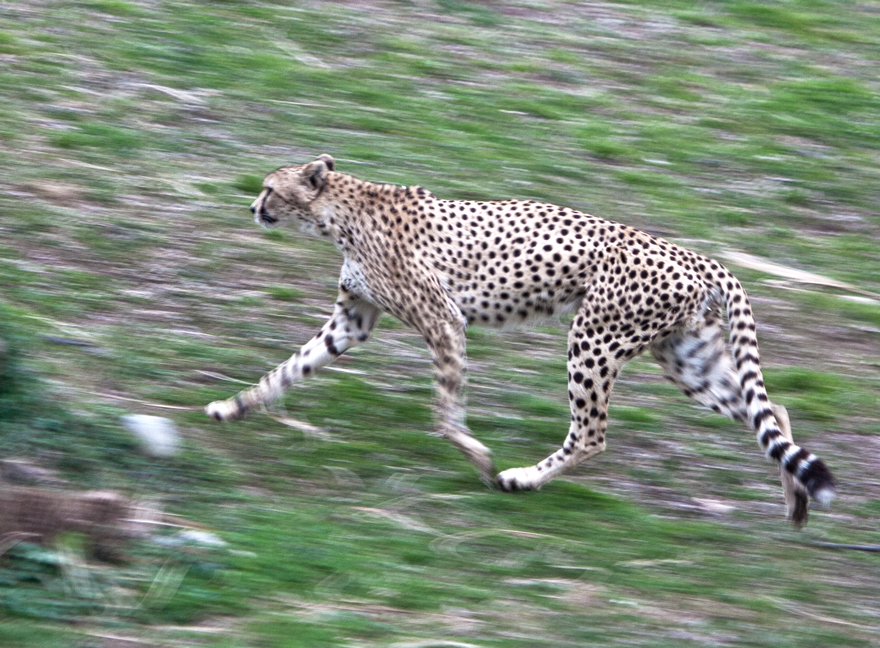
I don’t manage to go the zoo very often, but when I do, I tend to spent a lot of time with the cheetahs. There is something about cheetahs that I find irresistible, their combination of beauty and power, of strength and speed. In the largest enclosure in the cheetah exhibit area, there are normally three or four male cheetahs and they are the ones that I usually observe.
Last September I did a posting about the cheetahs at the National Zoo and this is an update of sorts. This past weekend I tried to concentrate on taking shots of the cheetahs in action. This was a challenge for a few reasons. It was late afternoon and the light was starting to fade and there were limited angles for the shots and some of the backgrounds were very undesirable.

I did finally manage to get some shots that I like, although I have trouble deciding which one is my favorite—I like each of them for slightly different reasons.

I’ll let you decide for yourself which one you like most.

cheetah3_blogcheetah1_blogcheetah4_blogcheetah5_blog

© Michael Q. Powell. All rights reserved

Read Full Post »

The American Trail is one of the newest and coolest exhibit areas at the National Zoo, highlighting North American wildlife, including the North American Beaver (Castor canadensis), that I featured in an earlier post, and the North American River Otter (Lontra canadensis), pictured here.

When I arrived, the zookeepers were spreading food all throughout the area inhabited by two otters. It was a lot of fun to watch the otters scurrying about, searching for the food. They were incredibly energetic and curious (and difficult to capture in a photo).

This is my favorite shot, because I think that it does a good job of expressing some of the otter’s essential traits.

otter1_blog

© Michael Q. Powell. All rights reserved

Read Full Post »

I don’t know where the male lions were this weekend when I visited the National Zoo, but there were three or four female lions and it was fun to watch them play together.

I tried to get a group photo, but they were about as cooperative as kids, with one of them turning her back and another sticking out her tongue.

lioness3_blog

After a while they seemed to get bored with me and I caught one of them in a big yawn.

lioness2_blogI wanted very much to get an action photo, but the lions seemed content to lounge around together. This is the closest thing I got to an action photo. I like it a lot, even though it is not super sharp, primarily because of the body position and the angle of the shot.

lioness1_blog

© Michael Q. Powell. All rights reserved

Read Full Post »

To supplement their diets, the beavers at the National Zoo in Washington D.C. get crunchy vegetables like carrots and corn.

I had the chance to watch them eat this past weekend and took some fun photos of one of the beavers munching away on part of an ear of corn. This beaver, a female named Willow, was able to manipulate the corn really easily with her front paws and seemed to enjoy each bite as she slowly consumed the entire piece of corn.

I watched some videos on photographing animals at a zoo before this shoot and followed some of the tips, like shooting close-ups and paying attention to backgrounds. I did not, however, switch to shutter-priority mode, as suggested, but kept the camera in aperture-priority mode. I may have lost a few shots, because the shutter speed was too slow, but I was able to get decent results by using a more familiar approach.

beaver_corn_blogbeaver_corn2_blog© Michael Q. Powell. All rights reserved

Read Full Post »

« Newer Posts - Older Posts »