Feeds:
Posts
Comments

Posts Tagged ‘Vienna VA’

The simple shape and spare palette of spiderwort plants (g. Tradescantia) really appeal to me and I found myself taking innumerable photos of them during a visit with fellow photographer Cindy Dyer to Meadowlark Botanical Gardens in Vienna, Virginia this past weekend. Be sure to check out Cindy’s blog for some awesome colorful images of many of the other flowers that we observed.

My friends all know that I have a warped sense of humor, so it would come as no surprise to them when I confess that I can’t help but think of an abnormal growth on an arachnid every time that I use the word “spiderwort.” As the weather continues to warm up, I’m pretty confident that I will soon be featuring images of spiders, warts and all.

spiderwort

© Michael Q. Powell. All rights reserved

Read Full Post »

Most of us have probably tried to frame a shot by using an archway, foliage, or other natural or man-made object to draw the attention of our viewers to our main subject. Yesterday I decided to try something a little more elaborate  during a visit to Meadowlark Botanical Gardens in Vienna, Virginia.

The Korean Bell Pavilion at Meadowlark Botanical Gardens in Vienna,VA is an amazing structure. It was made by hand using traditional methods and houses an enormous bell. How could I highlight its beauty? I started off by taking some conventional shots of the structure and they were ok, but probably the same as hundreds of other visitors have taken.

Korean Bell Pavilion

As I was exploring some of the other buildings in the Korean Bell Garden, I noticed some beautiful carved wooden openings that faced the bell pavilion. By half-kneeling and half-standing, I realized that I could frame a view of the pavilion through the opening.

Korean Bell Pavilion

I liked the shots that I was getting, but the “frame” seemed to be a bit too dark, so I decided to see what would happen if I used my pop-up flash. As I expected, the flash helped to reveal some of the beautiful grain and color of the wood without affecting the rest of the image.

Korean Bell Pavilion

As I stood up, I saw another wooden opening and tried a similar approach, resulting is a panoramic-style shot.

Korean Bell Pavilion

Of course, it is always possible to add a frame to a shot after it has been taken, but for me it’s a lot more fun to try to frame the image while I am taking it. At a minimum, it’s worth the extra effort to try to find new angles and perspectives for a shot.

© Michael Q. Powell. All rights reserved


Read Full Post »

Do you find yourself shooting the same subjects with the same lens all of the time? Sometimes it’s fun to try to try to photograph a subject with the “wrong” lens.

Conventional wisdom tells me to use a telephoto lens to photo birds, a macro lens to photograph insects, and a wide-angle lens to photograph landscapes. Following that wisdom, I had my macro lens on my camera this past weekend when I traveled with some friends to Meadowlark Botanical Gardens in Vienna, Virginia, where I anticipated that I would be shooting flowers and insects.

As I was walking around a small pond, hoping in vain to spot some dragonflies, I suddenly came upon a Great Blue Heron (Ardea herodias). From a distance, vegetation at the water’s edge had blocked the heron from view. With the heron right in front of me, I had two choices—I could try to change to the 70-300mm lens that I had in my camera bag to gain some additional reach or I could make do with my macro lens. I chose the latter option.

My macro lens is a 180mm Tamron lens. It is slow and noisy when focusing at close distances, but when I pay attention to my technique, I have taken some pretty good macro shots with it. How would it do with a bird? I have gotten used to photographing birds with a 150-600mm Tamron lens that has a built-in image stabilization system and, obviously, lets me zoom in and out. My macro lens lacks both of these capabilities, so I really did not know how well it would fare, particularly when I tried to capture some in-flight shots of the heron—I was pretty sure the heron would be spooked by my presence and I proved to be right.

Well, I ended up following the heron around for quite a while and captured images of it at several locations, including in the air. It worked out remarkably well. In some ways, it was even more enjoyable shooting with a prime lens than with a zoom lens, because I could concentrate better on tracking and framing the subject—my decision process was simplified when I had to zoom with my feet.

I particularly like the first photo below. The lighting at that moment was very unusual and the colors are so vivid that a friend asked me if I had used some kind of art filter. With the exception of a few minor tweaks in post-processing, however, the image looks like it did when I first looked at it on the back of my camera.

So what did I learn? I have a greater appreciation of the capabilities of my macro lens and realize that I can use it for more than just macro shots. I think that I also appreciate better the experience of shooting with a prime lens—I think my zoom lenses sometimes make me a bit lazy and sloppy.

I look forward to trying to shoot some more little experiments like this of thinking outside of the box and shooting more subjects with the “wrong” lens.
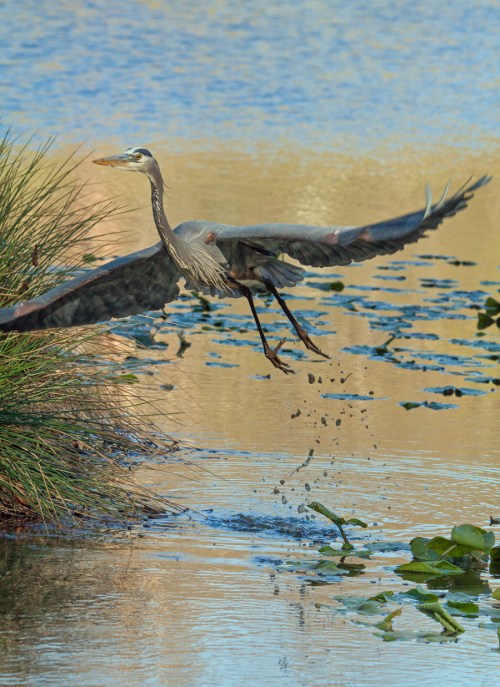
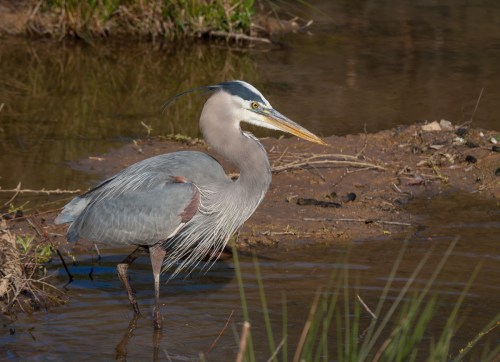
Great Blue Heron

Great Blue Heron

Great Blue Heron

Great Blue Heron

© Michael Q. Powell. All rights reserved.

Read Full Post »

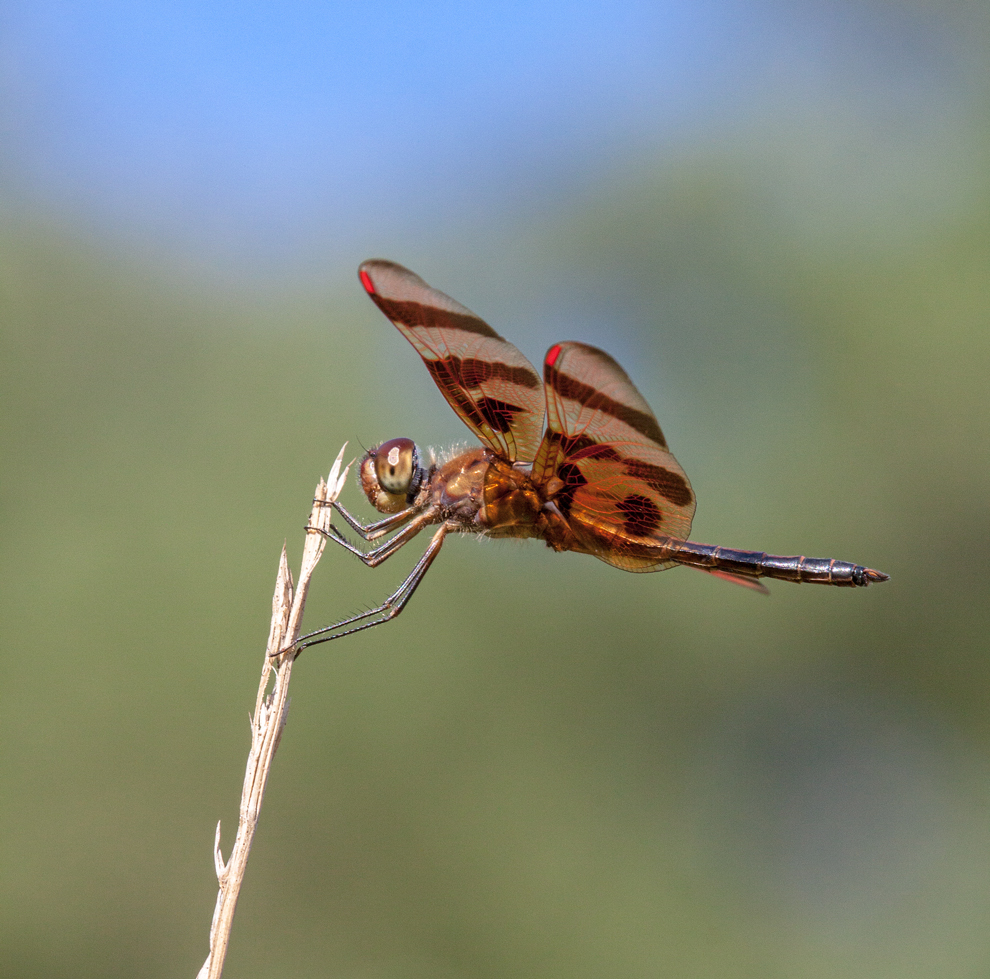
Yesterday when a Great Blue Heron at Meadowlark Botanical Gardens in Vienna, Virginia turned and intently stared at me, its look conveyed a definite sense of stern disapproval.
I went to the gardens with some friends with the intent of photographing flowers, but my attention was hijacked by this very photogenic Great Blue Heron (Ardea herodias). Despite the fact that I was shooting with my macro lens, I managed to get some wonderful shots of the heron, including some in-flight shots, that I will post later. I loved the look in the heron’s eyes and its pose so much that I decided to post this image immediately.
Great Blue Heron

© Michael Q. Powell. All rights reserved.


Read Full Post »

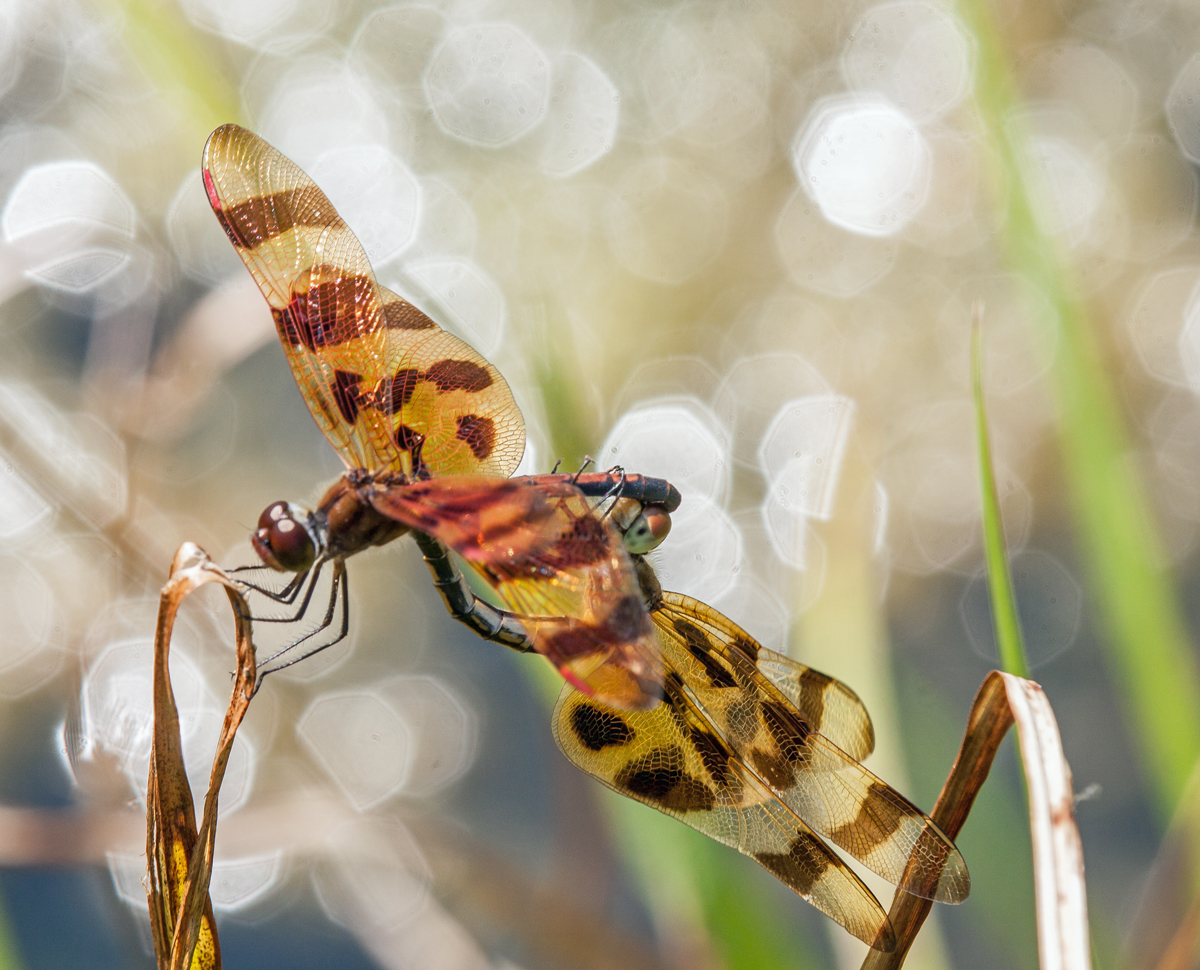
Summer days are drifting away and the biological clocks are almost certainly ticking loudly for some dragonflies. This past weekend at Meadowlark Botanical Gardens in Vienna Virginia, I spotted these two Halloween Pennant dragonflies (Celithemis eponina) engaged in a little summer loving.

It’s hard not to feel a little bit like a voyeur as I move in closer to photograph the acrobatic intertwining of the tiny dragonfly bodies. Summer loving happens so fast and soon my colorful little friends will be gone for the season,

Halloween Pennant

Halloween Pennant

© Michael Q. Powell. All rights reserved.

Read Full Post »

One of the highlights for me of a short visit yesterday to Meadowlark Botanical Gardens in Vienna, Virginia was spotting this spectacular dragonfly, which I think is a female Banded Pennant (Celithemis fasciata).

Earlier this summer, I spotted a male Banded Pennant, whose body was blue, but the coloration of this one suggests to me that it is a female. The dragonfly was perched on the highest branches of a small tree, which allowed me to isolate it against the beautiful blue sky. You may notice that the branches are different in the two photos—the dragonfly flew away a few times, but returned to the same tree a short time later.

CORRECTION: My initial identification was incorrect. My local dragonfly expert, Walter Sanford, with whom I neglected to consult in advance, provided a correct identification. This is a female Halloween Pennant (Celithemis eponina), not a Banded Pennant.


Banded Pennant

Banded Pennant

© Michael Q. Powell. All rights reserved.

Read Full Post »

When a Northern Watersnake (Nerodia sipedon) sensed my presence at the edge of a pond this weekend at Meadowlark Botanical Gardens, it began to swim right at me. As the snake grew larger and larger in my viewfinder, I assumed it would veer off. I was wrong. The snake actually came out of the water and I captured this first shot of the triumphant snake who forced me to back away.

Northern Watersnake

Initially the snake was swimming lazily in the shallow water of the pond, seemingly basking in the warm of the midday sun.

Northern Watersnake

Suddenly the snake turned its head and looked straight at me. It did not look amused.

Northern Watersnake

The snake started to flick its forked tongue and began to swim rapidly through the vegetation that separated us.

Northern Watersnake

A part of my brain certainly understood that the snake was not as close as it looked in my telephoto zoom lens, but a more instinctive, primordial part of the brain kicked in when the snake started to fill the viewfinder. I know that this kind of snake is not poisonous and that I had nothing to fear, those rational thoughts were crowded out by the emotional responses that screamed at me that I needed to back away.

I honestly did not expect the snake to come out of the water and it happened so fast that I am not sure how it did it. The snake seemed to propel itself out of the water in a jump. Once it was on terra firma, the snake assumed the confrontational pose that you see in the first photo.

This round goes to the snake.

© Michael Q. Powell. All rights reserved.


Read Full Post »

The intricate shape and delicate colors of this beautiful little flower simply captivated me yesterday at Meadowlark Botanical Gardens in Vienna, Virginia. (I think it is a kind of columbine flower.)

columbine

© Michael Q. Powell. All rights reserved.

Read Full Post »

Sometimes, simple compositions of familiar subjects result in the best images, like this recent shot of an Eastern Carpenter Bee (Xylocopa virginica) on a purple coneflower (Echinacea purpurea).

It came out just as I imagined when I was looking through the viewfinder of my camera and required a minimum amount of tweaking and no cropping.

At times, it’s not complicated.

bee_cone_blog

© Michael Q. Powell. All rights reserved.

Read Full Post »
Last week I turned 60, but I am happy to confess that I still chase butterflies with much of the exuberance (if not quite the energy) of a child. There is something really special about the delicate beauty of butterflies that draws me in and the idea of their metamorphosis inspires me.

During a recent trip to Meadowlark Botanical Gardens in Vienna, Virginia, I was thrilled to spot this female Eastern Tiger Swallowtail butterfly (Papilio glaucus). She was feeding on an identified plant that must have been tasty, because she kept moving from spot to spot on the plant, offering me multiple opportunities to get some shots.

I especially like the fact that I was able to get the sky into some of the images, reinforcing for me the idea of butterflies flying freely and lightly through the open air. Now that’s the way to live a life.

swallowtail1_blogswallowtail2_blogswallowtail3_blogswallowtail4_blog

© Michael Q. Powell. All rights reserved.

Read Full Post »

Watching insects is sometimes like watching a Cirque du Soleil production, very colorful and incredibly acrobatic, like these mating damselflies that I photographed recently at Meadowlark Botanical Gardens in Vienna, VA.

damsel1_mating_blog damsel2_mating_blog

© Michael Q. Powell. All rights reserved.

Read Full Post »

One of my fellow photographers pointed out this cool little crab spider on some Queen Anne’s Lace (Daucus carota) during a photo jaunt to Meadowlark Botanical Gardens in nearby Vienna, Virginia this past Saturday.

In this first shot, my favorite, the spider seemed to be expressing frustration that his prey had escaped his grasp (or simply wanted to show me his awesome biceps pose). Who knew that spiders have biceps?

crab spider

Initially I tried to photograph the spider looking down at it, but I had trouble maintaining a steady pose and my shots were blurry. I decided to kneel down and get at eye level with the spider, looking across the plane of the flower, and that seemed to work a bit better. These shots look like they were done with flash, but the EXIF data shows a shutter speed of 1/320, which is higher than the synch speed of my flash, so these were actually done with natural light, with some exposure compensation dialed in.

The second shot, which preceded the first one in time, shows the spider trying to capture a small insect (I think).

crab2_blog

The little insect starts to run away.

crab3_web

In vain, the spider crawled after the small insect, but it was too late. When I left the spider, it was at the edge of the flower, looking off into the distance, pondering perhaps what might have been, thinking about the one that got away.

crab4_blog

© Michael Q. Powell. All rights reserved

Read Full Post »

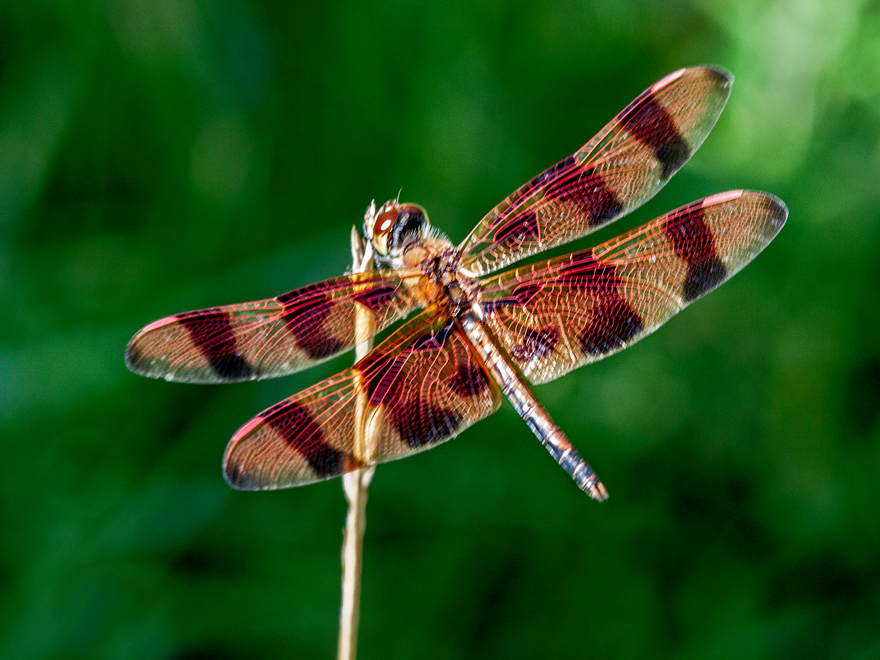
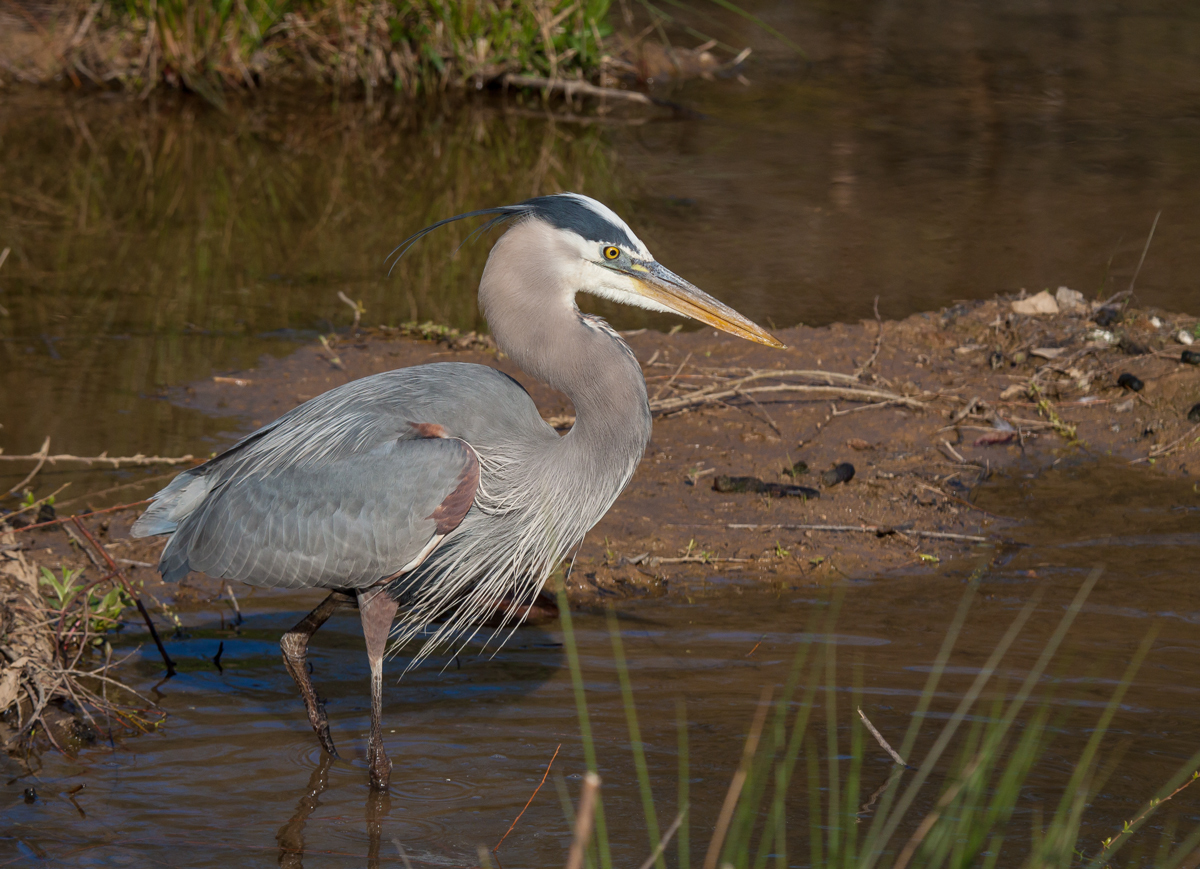
It’s not hard to see where this dragonfly gets its name—the Halloween Pennant (Celithemis eponina)—when it is perched on the very tip of a stalk of grass and is blown about by even the slightest wind.

I took this shot from a very low angle to try to show the sky and I am pretty happy with the way in which I was able to separate the dragonfly from the background.

blowing_blog

© Michael Q. Powell. All rights reserved

Read Full Post »

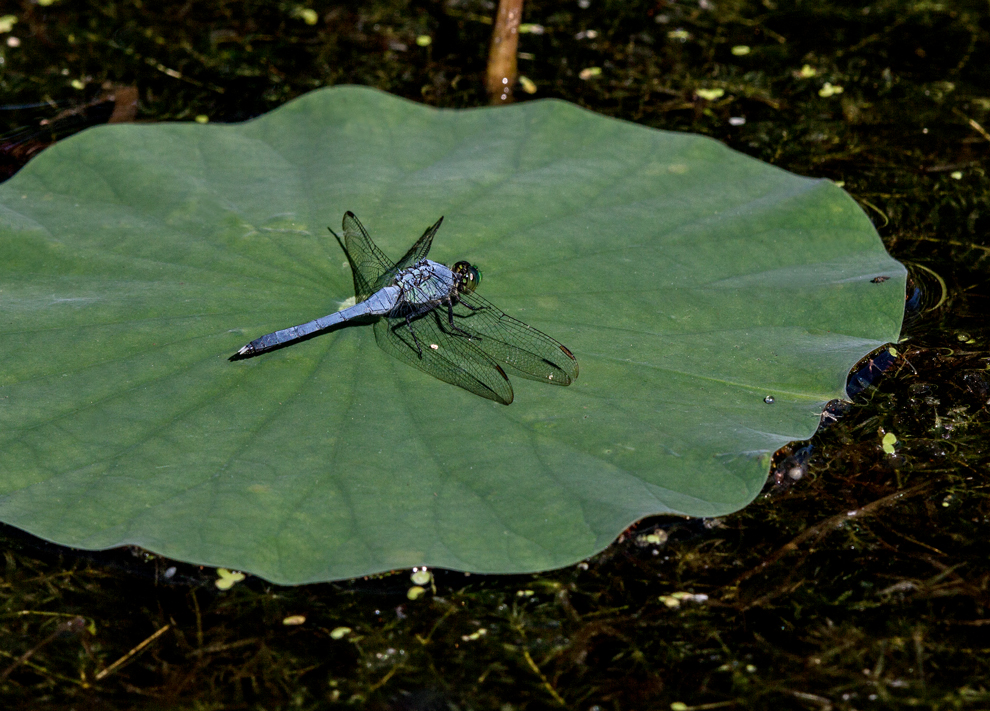
In most of my dragonfly shots the dragonfly is perched on an upright object, so, for variety, I decided to post this shot of a male Eastern Pondhawk dragonfly (Erythemis simplicicollis) in a different position—posing on a lily pad.

The dragonfly made multiple touch-and-go landings on this lily pad, sometimes landing near the edge, as in the first image, and sometimes in the middle, as in the second image. I couldn’t tell if he was using the lily pad as a platform for hunting insects or was merely resting. (It seems to me that it would be more advantageous for hunting to be higher up, unless you are hunting aquatic insects, which didn’t seem to be the case here.)

pad2_blogpad1_blog

© Michael Q. Powell. All rights reserved

Read Full Post »

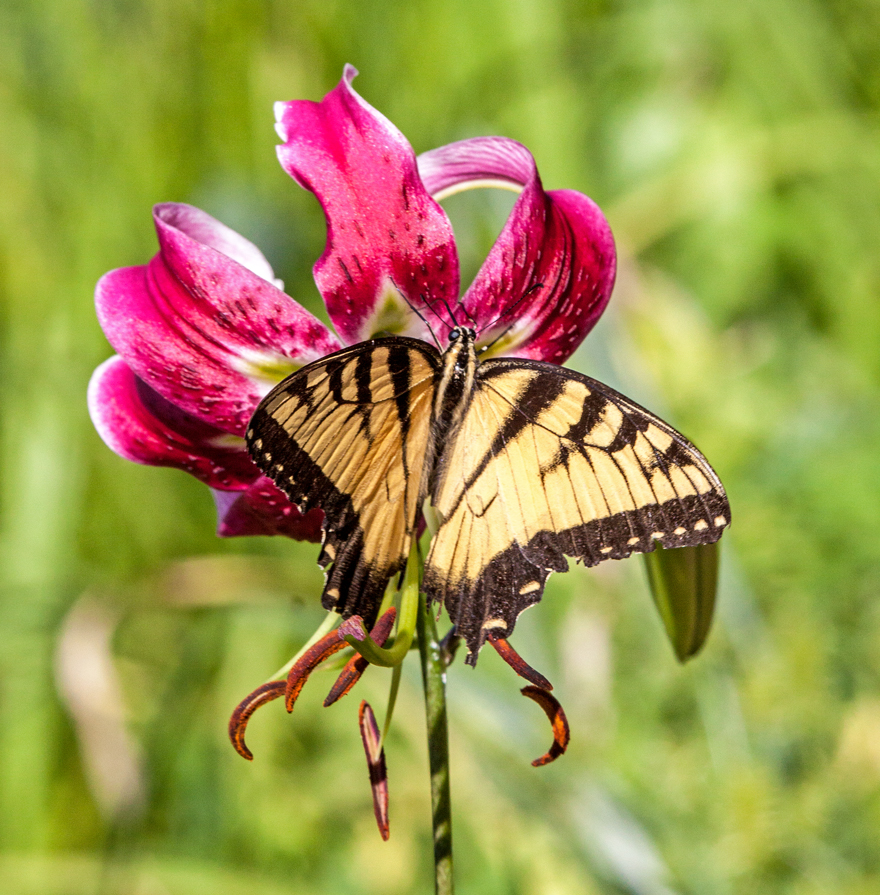
I don’t know my flowers very well, but I think that this Eastern Tiger Swallowtail (Papilio glaucus) is feeding on some kind of tiger lily (Lilium columbianum). Tiger on tiger—I like the way that sounds. Whatever the case, I love the gorgeous colors of the flowers, providing a gorgeous contrast to those of the butterfly.

tiger_blog

© Michael Q. Powell. All rights reserved

Read Full Post »

The weather this week has been mostly gray and dreary and I felt the need for a burst of bright colors, so I am posting this image from last week of a two Eastern Tiger Swallowtail butterflies (Papilio glaucus) feeding on an unidentified flower against the backdrop of a brilliant blue sky. The butterflies were even cooperative enough to place themselves at different angles to add  visual interest to the shot.

swallowtails_blog

© Michael Q. Powell. All rights reserved

Read Full Post »

The wasp looked huge, even from a distance, but I could get a clear shot of it against a beautiful blue sky, so I stepped out of my comfort zone and got close enough to it to get these images.

Fortunately I was shooting with a 180mm macro lens, so I was not exactly on top of the wasp, but even so, it was a little disconcerting to try to get a shot of a moving insect that looked so enormous and a bit threatening in the viewfinder.

After I took these shots, the wasp flew away and I breathed a sigh of relief—another sting avoided.

wasp2_blog

wasp1_blog

© Michael Q. Powell. All rights reserved

Read Full Post »

Yesterday I was happy to get some shots of my favorite dragonfly, the Halloween Pennant dragonfly (Celithemis eponina), at Meadowlark Botanical Gardens in Vienna, Virginia.

I don’t see this dragonfly at all at most of the usual places where I take photographs, so I was really excited when I caught sight of a couple of them yesterday. I chased them around for well over an hour and attempted to take a couple of hundred shots using a wide range of camera settings.

Why did I take so many photos? The dragonfly gets the “pennant”  part of its name because it likes to perch on the very tip of a weed stalk and waves in the breeze like a pennant. Yesterday, in fact, was breezy and it was quite an adventure trying to keep the dragonfly in focus, particularly because I was trying to fill the frame with the dragonfly.

The dragonflies that I photographed were reasonably cooperative and I was able to attempt shots from the side, from above, and even from below (fortunately the insects in the grass did not bite very often).

I have not been able to go through the shot to pick the best ones, but thought it would be nice to post one now, especially for those readers who may not be familiar with this beautiful dragonfly. I suspect that I will eventually post at least a couple more images in future postings.

Halloween1_blog

© Michael Q. Powell. All rights reserved

Read Full Post »

Tiny butterflies seem to be constantly in motion and their size and speed normally make them difficult to photograph.

However, this butterfly, which I think may be a Summer Azure butterfly (Celastrina neglecta), stayed perched on a Black-eyed Susan (Rudbeckia hirta) long enough to allow me and my fellow photographer, Cindy Dyer, to take multiple shots, including some with flash. There is a whole family of small Azure butterflies, which have a wingspan of about one inch (25mm) and look pretty similar, so please correct me if I have misidentified this insect.

We encountered this little butterfly on a recent trip to Meadowlark Botanical Gardens in Vienna, Virginia. (You can check out Cindy’s image of this butterfly, along with her amazing photographs of other flowers and insects on her blog.)

I love large, colorful butterflies, like the Eastern Tiger Swallowtails that were virtually omnipresent in the garden that day, but there is something really special too about the delicate beauty and simple colors of this tiny butterfly. In this image, I like the way in which the muted tones of the butterfly provide a nice visual counterbalance to the bold colors of the flower.

azure1_blog

© Michael Q. Powell. All rights reserved

Read Full Post »

As the beautiful afternoon light illuminated the wings of this Eastern Tiger Swallowtail butterfly (Papilio glaucus) from behind, I couldn’t help but think of a stained glass window. I love backlighting and these subjects seemed perfect to showcase the effect—I didn’t even have to worry about using fill flash to avoid shadows, because of the translucency of the wings.

I took this image yesterday at Meadowlark Botanical Gardens in Vienna, Virginia, yet another wonderful local spot for photographing flowers and insects.

stained_glass_butterfly_blog

© Michael Q. Powell. All rights reserved

Read Full Post »
I didn’t go to a lot of trouble to set up a really cool backdrop, but did manage to get a shot yesterday evening of the supermoon. It was amazing to see how much light it put off and I had no trouble handholding my camera to take a shot, even with my 135-400mm zoom lens. I decided to add a little visual interest to the shot by shooting the moon with the shadowy outline of an electrical tower of some kind in the foreground.

moon1_blog

© Michael Q. Powell. All rights reserved

Read Full Post »

« Newer Posts