Feeds:
Posts
Comments

Posts Tagged ‘Tamron 180mm’

Quite often the simplest of subjects can be incredibly beautiful, like these little white butterflies that I photographed last week. Many folks might dismiss these nondescript creatures as moths or simply ignore them. It really is worthwhile to slow down and look at them closely.

The butterfly in the first photo is a Cabbage White (Pieris rapae) that was feeding on a patch of what I believe is purple dead nettle. Although it looks like a macro shot, I captured the image at the 600mm end of my telephoto zoom lens.

I took the next two pictures with an actual macro lens, my trusty Tamron 180mm lens. The tiny Eastern Tailed-Blue butterfly (Cupido comyntas) has a wingspan of about an inch (25 mm) and I was thrilled to capture so much detail of its beauty, including the little “tails.”

Beauty is everywhere.

Cabbage White

Eastern Tailed-blue

Eastern Tailed-blue

© Michael Q. Powell. All rights reserved.

Read Full Post »

As I was wandering about on Friday in Prince William County, a dragonfly zoomed by me and perched on some nearby vegetation. At the time I took the shots, I had no idea what it was because of the poor lighting. I was able to capture a few images and when I opened them on my computer I was delighted to discover that I had photographed a beautiful female Stream Cruiser dragonfly (Didymops transversa).

This was the first live Stream Cruiser dragonfly that I have photographed this spring. A week earlier I stumbled upon a Stream Cruiser that had had some unspecified problem in emerging and was dead, as shown in the second photo. Dragonflies are extremely vulnerable when they are emerging and unfavorable weather conditions and predators  almost certainly lower their survival rate. Given the magnitude of their remarkable metamorphosis, it seems remarkable to me that any of them can survive.

My experience with the Stream Cruiser in the first photo reminds me of the importance of being constantly vigilant. I was walking down a hill, headed towards a stream, when I glanced to the side and saw the flying dragonfly. I made a quick 180 degree turn and tracked the dragonfly as it landed. I took two steps forward and and had time to snap off only a few photos and that was it.

Fortunately I had my camera settings were somewhat appropriate and I was able to react quickly. As is often the case with wildlife photography, those two factors were key to capturing a shot. If the circumstances had been different, I might have been able to get a better image, but I am pretty happy with the image I captured. Needless to say, success is not guaranteed—I have plenty of stories from that day of the ones that got away.

Stream Cruiser

Stream Cruiser

© Michael Q. Powell. All rights reserved.

Read Full Post »

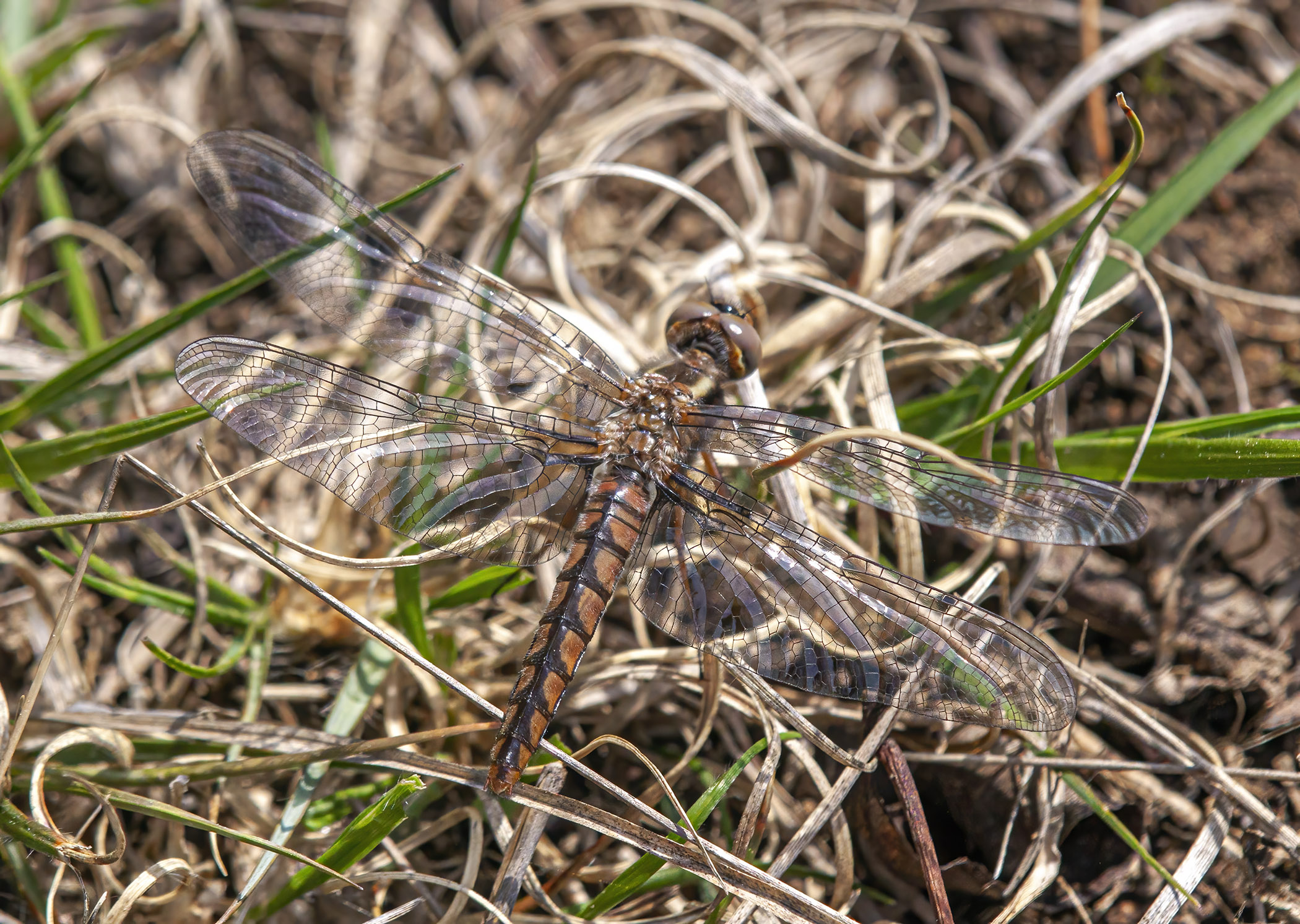
Ashy Clubtail dragonflies (Phanogomphus lividus) like to perch on the ground, which makes them really difficult to spot. Fortunately I saw these two dragonflies land last Friday during separate encounters in Prince William County and was able to get close enough and low enough to photograph them. If I had not seen them move, I probably would not have been able to detect them.

Both dragonflies had really shiny wings, an indication that they had emerged fairly recently. Initially the wings are fragile when a dragonfly emerges and they are folded above its head. The dragonfly gradually pumps fluid through the veins of the wings and they progressively harden and pop open into the normal outstretched resting position. Sometimes, as you can see in the final photo, a dragonfly will temporarily hold its wings closed over its head in their former position.

Dragonfly metamorphosis is a fascinating phenomenon, a remarkable transformation of a water-dwelling larva into an incredible aerial acrobat. Several years ago I managed to witness the entire process with a Common Sanddragon dragonfly and documented the thirty-minute process in a blog posting entitled Metamorphosis of a dragonfly. Be sure to check out that posting to see photos of the different stages of the amazing transformation.

Ashy Clubtail

Ashy Clubtail

Ashy Clubtail

© Michael Q. Powell. All rights reserved.

Read Full Post »

Recently I did a posting that featured Eastern Tiger Swallowtail butterflies (Papilio glaucus)—see Swallowtails in the forest.  None of those butterflies seemed to be involved in searching for nectar and seemed content to take in minerals and water.

Last Friday I returned to that same location in Prince William County, Virginia and discovered that the butterflies were taking advantage of the few small flowers that were blooming. In the first photo, an Eastern Tiger Swallowtail was nectaring on the small bluets (Houstonia caerulea) that are sometimes referred to as Quaker Ladies. The butterfly was so low to the ground that it looked like it was dragging its “tails.”

The butterfly in the second image is a dark morph Eastern Tiger Swallowtail female. Females of this species are dimorphic—there is a yellow variant that looks like the one in the first photo and a dark variant that looks like the one in the second image. The dark morph female was almost flat on the ground as she gathered nectar from a very short dandelion.

As more flowers begin to bloom, I am sure these butterflies will have a better selection of sources of nourishment, but the early arrivers have to make do with a really limited menu of choices.

Eastern Tiger Swallowtail

Eastern Tiger Swallowtail

© Michael Q. Powell. All rights reserved.

Read Full Post »

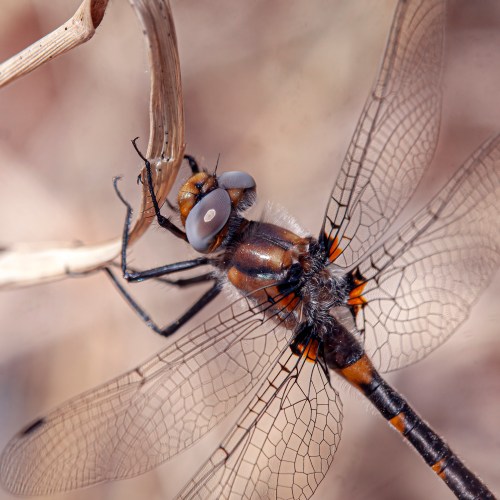
Have you ever taken a close-up look at a dragonfly’s amazing compound eyes? Dragonflies have the largest compound eyes of any insect; each containing up to 30,000 facets, and the eyes cover most of the insect’s head, resembling a motorcycle helmet. According to a wonderful article by GrrlScientist, “each facet within the compound eye points in a slightly different direction and perceives light emanating from only one particular direction in space, creating a mosaic of partially overlapping images.”

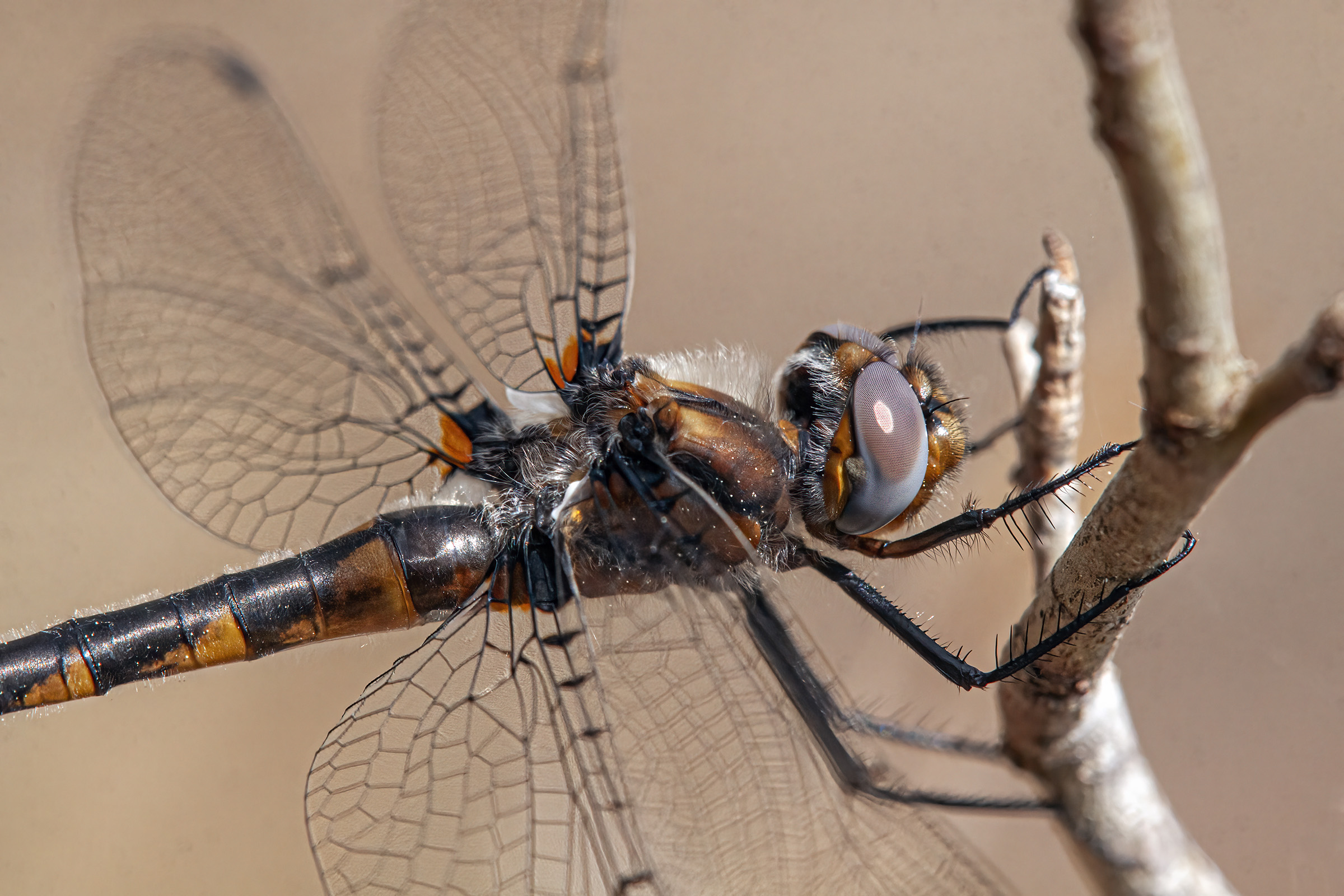
How exactly does that work? Scientists are still not sure how this visual mosaic is integrated in the dragonfly’s brain. If you can get close enough for a shot, you can actually see the individual facets, technically known as ommatidia. The first image below is a cropped image of an unusually cooperative Uhler’s Sundragon (Helocordulia uhleri) that I encountered last Friday while exploring a stream in Prince William County. If you click on the image, you can see the pattern of facets in the eyes.

The second image is an uncropped version of the first photo. I like the way that I as able to capture so many details of the dragonfly as it perched, like the spiky hairs on its legs and the stubble on its face as well as the pollen on its body.

The dragonfly in the third shot is another Uhler’s Sundragon that I spotted later in the day. From this angle, you can see the dragonfly’s tiny feet as it grasps the dried stalk of vegetation.

I love close-up images and will often try to capture them after I have taken some initial shots. When I am at close range, the angle of view is particularly important, because the depth of field is so shallow—some legs of the dragonfly, for example, will inevitably be out of focus, so I have to choose carefully what I want to be in focus.

Hand-holding and breathing techniques are also really important, because any movement will cause the fine details to be blurred. This is a bit of a challenge with the 180mm macro lens that I use because it does not have any built-in image stabilization.

Uhler's Sundragon

Uhler's Sundragon

Uhler's Sundragon

© Michael Q. Powell. All rights reserved.

Read Full Post »

Happy Easter. My childhood memories of Easter are full of flowers, with the interiors of churches filled with lilies and tulips. Today, I decided to post images of some of the orchids that I photographed during a recent visit to Lewis Ginter Botanical Garden. This garden has a wonderful glass-domed conservatory that houses all kinds of exotic plants—it was a fun challenge to try to capture a sense of the beauty of these flowers in such a confined, warm, and humid space.

Not everyone, of course, is celebrating Easter and for Orthodox Christians Easter will come next Sunday. Still, I think that today is a good moment for us all to pause and reflect on what is important to us. My simple prayer is that all of our lives will be filled with peace, love, and with renewed hope, irrespective of whether you are observing this holy day today.

Alleluia! Christ is Risen! The Lord is risen indeed! Alleluia!

Orchid

orchid

orchid

© Michael Q. Powell. All rights reserved.

Read Full Post »

I was happy to spot several Blue Corporal dragonflies (Ladona deplanata) on Wednesday at Occoquan Bay National Wildlife Refuge, my first dragonflies of the year at that location. Blue Corporals almost always perch low to the ground, which makes them a challenge to photograph, as you can see in these photos.

In our area, Blue Corporals are found most often in the coastal plain region, unlike the Uhler’s Sundragon that I featured in an earlier posting (First dragonfly of 2022) that is found at rocky forest streams. Most of the early spring dragonflies are found in specific and limited habitats, while many of the summer species can thrive in a variety of habitats.

You may have noticed that none of these Blue Corporals are blue. Adult males are bluish in color and both the male and the female have two white stripes on their thoraxes in an area that you might think of as their shoulders. In the military of the United States, the rank insignia for corporals is two stripes, which accounts for that portion of the common name for the species.

When males first emerge, however, they share the same tan coloration as the females and as they mature they turn blue. (Here’s a link to a 2018 posting called A Bluer Corporal that shows a mature male.) The dragonfly in the final photo looks to be an immature and the one in the middle photo is a female—the angle of the first photo makes it hard for me to determine its gender.

It is still really early in the dragonfly season, so I am excited every single time that I spot one. Actually my enthusiasm for dragonflies barely wanes as we get deeper into the season and the early dragonflies give way to new species.

Blue Corporal

Blue Corporal

Blue Corporal

© Michael Q. Powell. All rights reserved.

Read Full Post »

On Monday I saw a surprisingly large number of Eastern Tiger Swallowtail butterflies (Papilio glaucus) as I explored a stream in Prince William County, Virginia. I used to associate these butterflies with gardens, because that is where I had previously seen them most of the time. Over the past years, though, as I have searched for early spring dragonflies, I have gotten used to seeing these colorful butterflies alongside the streams, often congregating in groups to drink and extract minerals from puddles (see my blog post from last year called A kaleidoscope of butterflies for more information and a photo of this phenomenon).

These swallowtails seemed content to fly about continuously, searching and exploring, but rarely perching. When they did come to the ground, they often landed in patches of fallen leaves, as you can see in the second and third images. I was happy when one of the butterflies opted to perch on a fern, which made it a little easier for me to photograph it.

Eastern Tiger Swallowtail

Eastern Tiger Swallowtail

Eastern Tiger Swallowtail

© Michael Q. Powell. All rights reserved.

Read Full Post »

There are not very many insects that could be mistaken for a dragonfly, but the color and pattern on the abdomen of this crane fly made me do a double take when I spotted it from a distance on Monday in Prince William County. At that time I had not yet seen my first dragonfly of the year and was anxious to see one. An expert in a Facebook group identified this as a Crane Fly (Tipula noveboracensis).

The first image is a cropped version of the photo that allows you to focus on the wonderful patterns on the wings and the body. If you click on the image, you can see that the crane fly has antennae. The second shot is much less cropped and gives you an idea of the length of the extremely long legs of this insect.

When I am out in the winter looking for birds, I sometimes end up taking photos of odd branches or clumps of leaves, because their shapes make me think that they might be birds. I have the same “problem” with dragonflies—I am likely to photograph anything that remotely resembles a dragonfly, knowing that later I will be able to sort the images and remove the oddball results. Sometimes, as was the case here, my strange results are worth posting.

Crane Fly

Crane Fly

© Michael Q. Powell. All rights reserved.


Read Full Post »

I was delighted to spot some Virginia Bluebells (Mertensia virginica) during a trip last week to Lewis Ginter Botanical Garden. This spring ephemeral plant has beautiful bell-shaped sky-blue flowers and is native to eastern North America. The bees seemed to be equally excited to see these flowers. My photos suggest that the bees, which appear to be Carpenter Bees, were getting to the nectar through the tube of the flowers rather than through the bell.

I really like the varied shades of blues and pinks in the bluebells in different shades of development. The colors work well together, sometimes even combining to produce a lovely shade of violet.

Virginia Bluebells

Virginia Bluebells

Virginia Bluebells

© Michael Q. Powell. All rights reserved.

Read Full Post »

I finally found my first dragonfly of the season yesterday—a female Uhler’s Sundragon—while I was exploring a stream in Prince William County. Uhler’s Sundragons (Helocordulia uhleri) are considered to be rare in our area. This species requires a very specific type of habitat and has an early and very brief flight period.

So where would you find one? According to the wonderful Dragonflies of Northern Virginia website, “Uhler’s need clean, small to medium, rocky forest streams with gravelly and/or sandy substrate, and a decent flow. They can be found in sunny clearings and forest edges near their streams.”

Fortunately I have found this species at a particular stream the last several years, so that is where I headed yesterday. I searched the spots where I had found Uhler’s Sundragons in the past, but came up empty-handed. I walked along extended lengths of the stream and eventually found the one in the photograph below—it was the only dragonfly that I spotted all day.

My hike yesterday lasted 4 hours and 42 minutes and covered 7.18 miles (11.55 km), according to my GPS app. My pace was pretty slow, partly because I was scanning for dragonflies, but also because the terrain was full of ups and downs. I pasted in a chart from the GPS readout to give you an idea of the type of terrain that I covered. According to my iPhone, I walked up the equivalent of 21 floors, which explains why my legs are a little sore this morning.

As many of you know, dragonflies are my favorite subjects during the warm months—there is something almost magical about these beautiful aerial acrobats. I am therefore super excited that the 2022 dragonfly season has officially started for me.

Uhler's Sundragon

Hike 11 April 2022

© Michael Q. Powell. All rights reserved.

Read Full Post »

Some people speak figuratively about a “snake in the grass,” but that is literally what I encountered last Friday at Lewis Ginter Botanical Garden in Richmond, Virginia. The Northern Water Snake (Nerodia sipedon) was moving about in a grass patch at the edge of a small stream when I first spotted it.

When the snake raised its head to look around, I got down low and moved closer. How close was I? I was using a relatively long macro lens, which makes it look like I was closer than I actually was, but I was close enough that you can see my reflection in the snake’s eye. The second image image is merely a cropped version of the first image that lets you focus more closely on the eye.

Photographically, though, I prefer the first image. I like the way that I was able to capture blurry grass in both the foreground and the background. The rocky area at the bottom of the image helps to ground the snake and provides a sense of the environment.

I recognize that some people find snakes to be creepy, but I am fascinated by them. It was interesting to note that as I was moving closer to the snake when I saw it, others were moving farther away from it.

Northern Water Snake

Northern Water Snake

© Michael Q. Powell. All rights reserved.

Read Full Post »

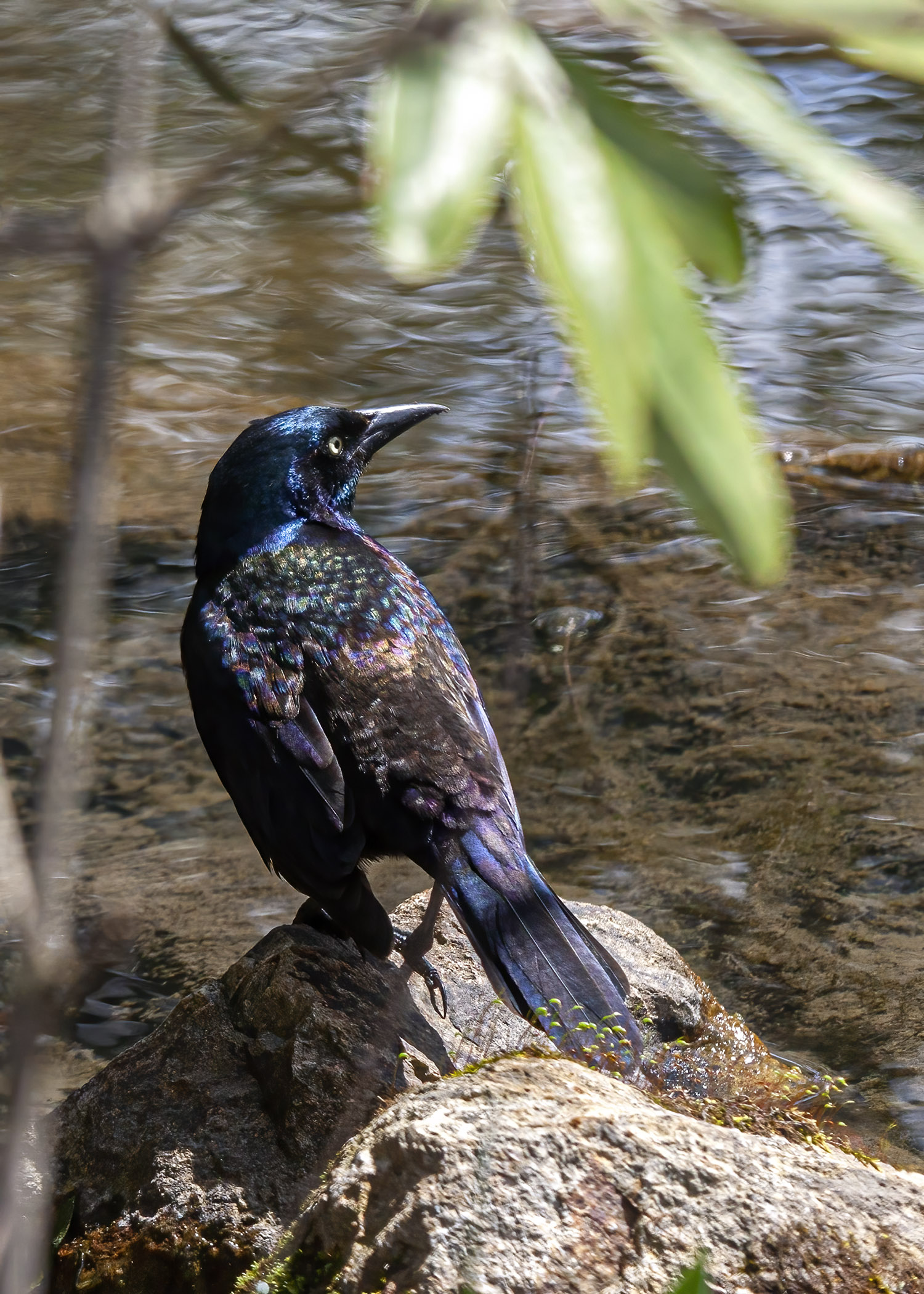
From a distance Common Grackles (Quiscalus quiscula) often appear to be black, but often you can spot their distinctive yellow eyes. When you get closer, especially when the lighting is good, you discover that the grackles are covered with an array of multi-colored iridescent feathers.

On Friday I spotted this grackle while I was exploring Lewis Ginter Botanical Garden in Richmond, Virginia with fellow photographer Cindy Dyer. The grackle was poking around at the edge of the water of a small pond and moving about a lot. I had to maneuver around to get a clear shot of the bird, which was a bit of challenge, because overhanging vegetation partially obstructed my view.

Eventually I was able to capture this image. I had my macro lens on my camera at the time, but fortunately its focal length of 180mm means that it also works as a short telephoto lens. I often tell people that it is best to take a photo with whatever camera gear you have in your hand when a situation arises, even if it does not appear to be the ideal option. If I had stopped to change lenses—I had a longer lens in my backpack—I am pretty sure I would missed this fun little shot of the grackle.

Grackle

© Michael Q. Powell. All rights reserved.

Read Full Post »

Yesterday I travelled with fellow photographer Cindy Dyer to Lewis Ginter Botanical Garden in Richmond, Virginia. While Cindy focused on the numerous tulips and other spring flowers that were in bloom, I immediately headed for the ponds in search of frogs, turtles, snakes, and dragonflies.

On one of my trips around a small pond I finally encounter my first damselfly of the season—a male Fragile Forktail damselfly (Ischnura posita). Most damselflies are hard to identify, but Fragile Forktails of both sexes are pretty easy to identify because both sexes have interrupted pale should stripes that look like exclamation points.

Eventually I spotted several other Fragile Forktails and was able to get some decent shots of them, despite their small size—they are a very small species with a body length of only 0.8 to 1.1 inches (21-29 mm). I was hoping to get some shots of the damselflies perched on vegetation, but in all of the photos I managed to get the damselflies were perched on rocks.

I was happy later in the to spot a Common Green Darner dragonfly in flight, but was not able to get a shot of it. From my perspective, my first dragonfly of the season does not “count” unless I am able to capture a photo of it. So this week I will be out in the wild again, seeking to capture my first dragonfly shot of the season.

Fragile Forktail

Fragile Forktail

Fragile Forktail

© Michael Q. Powell. All rights reserved.

Read Full Post »

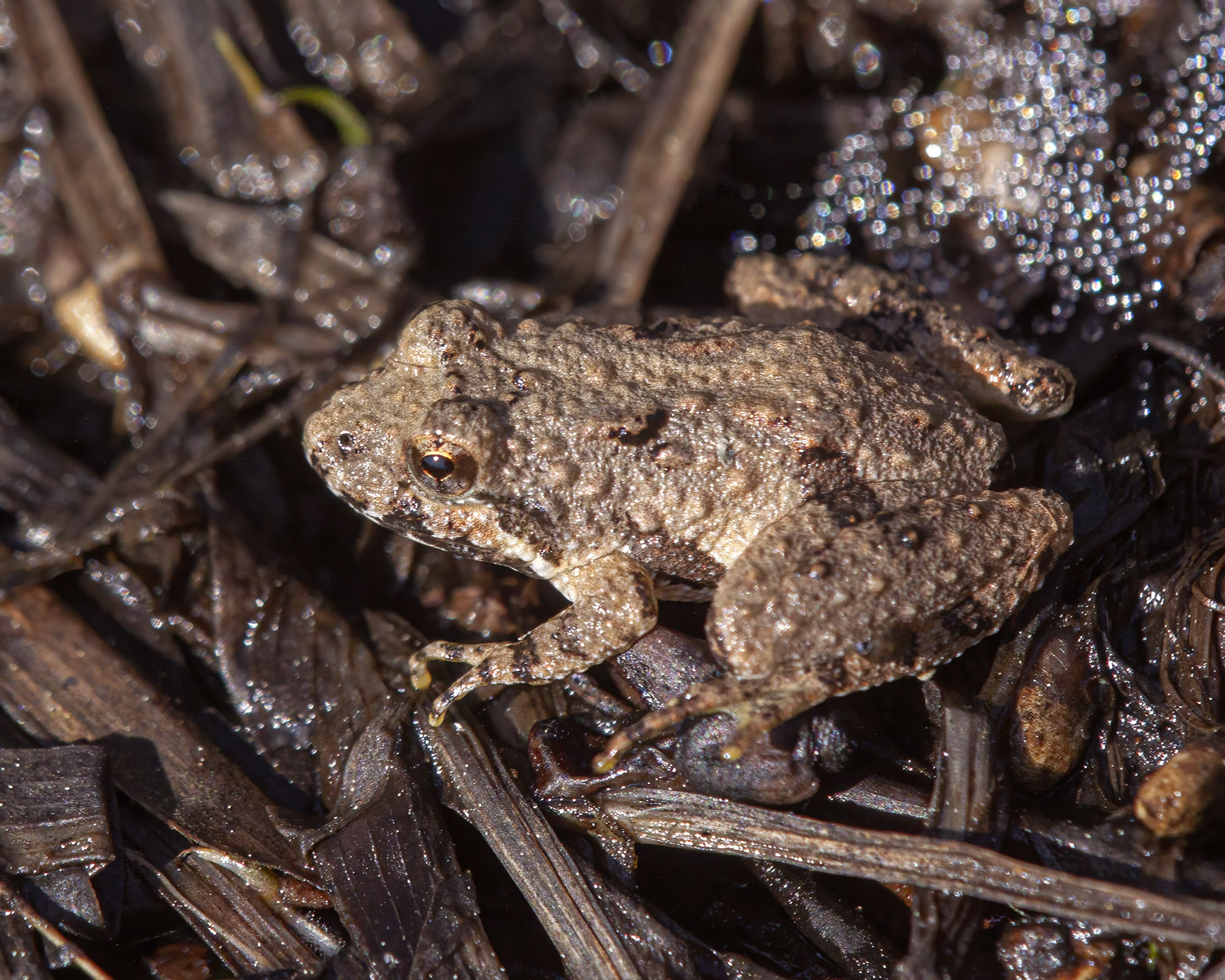
Following the lead of fellow photographer Steve Gingold, I decided that today is a Frog Friday. I spotted these Eastern Cricket Frog (Acris crepitans), one of the smallest frogs in Virginia, on Monday as I was exploring in Prince William County. I really like frogs and was happy to capture some of the cool details of these frogs in these shots, like their tiny toes.

Be sure to check out Steve’s blog posting for today entitled Frog Friday—before and after. While you are there, I encourage you to poke about on his site—Steve has an amazing array of nature photos that he has taken, primarily in the western part of Massachusetts.

Cricket Frog

Cricket Frog

Cricket Frog

© Michael Q. Powell. All rights reserved.

Read Full Post »

The ground in the forest is covered with fallen leaves at this time of the year, making it really easy to spot a Six-spotted Tiger Beetle (Cicindela sexguttata). The metallic green of their bodies shines so brightly that it is almost impossible to miss them as they scurry in and out of the underbrush.

I spotted this little beauty on Monday as I searched for dragonflies in Prince William County, Virginia. After months of photographing birds, often at a great distance, my eyes are gradually readjusting to searching for small subjects at close range. In the springtime I switch to using a macro lens most of the time rather than the long telephoto zoom lens that has been my constant companion throughout the cold, dark days of winter.

I also tend to slow down my pace as I search for tiny insects, scanning for changes in colors and patterns and, most importantly, for movement. In this style of photography, I cannot afford to be in a hurry and often my patience are persistence are rewarded.

Six-spotted Tiger Beetle


Six-spotted Tiger Beetle

© Michael Q. Powell. All rights reserved.

Read Full Post »
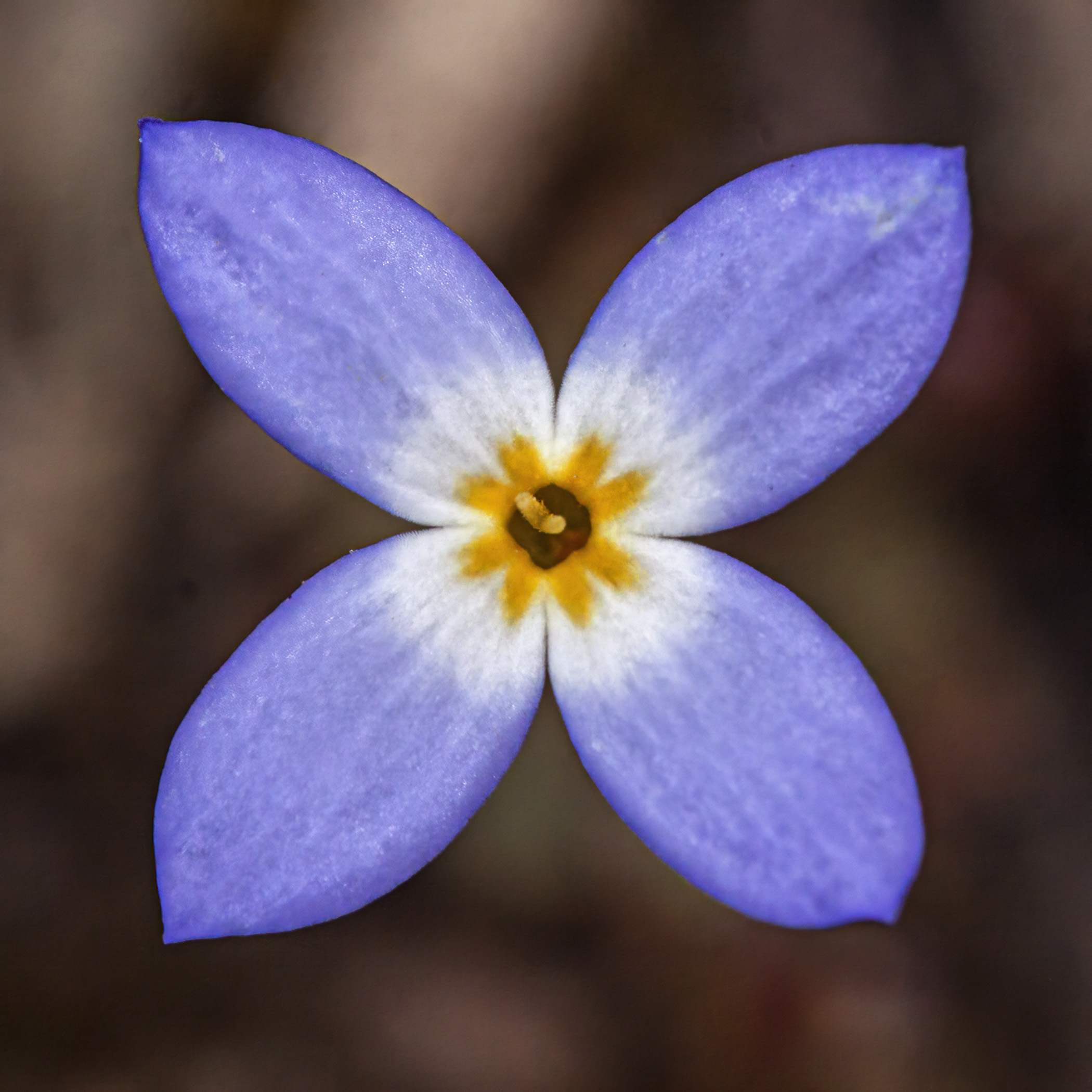
For a brief period each spring, tiny wildflowers spring up from the forest floor, giving the forest a magical feel. Some are colorful and some are pure white, but the wildflowers are all beautiful.

I spotted these little flowers on Monday as I was searching for dragonflies in Prince William County, Virginia. I came up empty-handed that day and am still searching for my first dragonfly of the season. However, I had an enjoyable day, covering almost six miles (9.6 km) on hilly trails through the forest.

The first photo shows a bluet (Houstonia caerulea), a species that is sometimes referred to as a “Quaker Lady,” because its shape is reportedly similar to that of the hats once worn regularly by women of the Quaker faith. The flower in the second shot is a Star Chickweed (Stellaria pubera), I believe. The flower in the final photo is probably a wild violet (Viola sororia).

As you can readily see, I got really close to the flowers and used a macro lens. I love the detailed views of their shapes, patterns, and colors and encourage you to click on each image to immerse yourself more deeply in their beauty. In these troubled times, nature continues to serve as a balm to my soul.

bluet

star chickweed

wild violet

© Michael Q. Powell. All rights reserved.

Read Full Post »

I love water lilies and one of my favorite places to see them is Kenilworth Park and Aquatic Gardens, a National Park Service site located in the northeastern corner of Washington, D.C. My photography mentor Cindy Dyer photographed water lilies there that were featured in 2015 on US Postal Service stamps and I helped her during a presentation she did at the special dedication ceremony for the postage stamps—check out Cindy’s blog posting entitled Special dedication ceremony for Water Lilies Forever Stamps for additional information.

Yesterday I traveled with Cindy to Kenilworth Gardens to drop off some matted prints for the gift store and it was fascinating to see the aquatic gardens in the off-season. It is much too early for water lilies to be blooming, but I could see lots of lily pads floating on the surface of the small ponds.

The lily pads were mostly colored in shades of rust and orange and I was able to capture some “artsy” shots of them. Obviously there photos are different from my more typical wildlife shots, but I like mixing it up and challenging myself to photograph different subjects. It forces me to stretch myself creatively outside of my comfort zone, which I believe is a good thing.

lily pad

lily pad

lily pad

© Michael Q. Powell. All rights reserved.

Read Full Post »

Now that it is spring, it is time for the crawling critters to reappear, like this little spider that I spotted last week while exploring in Prince William County. Some spiders overwinter as adults, so this spider may have just awoken from a long winter’s sleep. If so, the spider may have decided to go back to bed, because temperatures have dropped the last couple of days and it is currently about 25 degrees outside (minus 4 C)—it was 70 degrees (21 degrees C) when I photographed the spider last week.

UPDATE:  Initial indications from an expert at bugguide.net suggest that this is a wolf spider.

spider

© Michael Q. Powell. All rights reserved.

Read Full Post »

I note the transition to spring in small ways, quite often in the reappearance of familiar species of plants, insects, and other living creatures. I was delighted on Monday to discover that tiny Virginia Spring Beauty wildflowers (Claytonia virginica) have already started to push their way up from the forest floor in Prince William County. According to Wikipedia, the individual flowers bloom for three days, although the five stamens on each flower are only active for a single day.

On the same day, I spotted an Eastern Comma butterfly (Polygonia comma), the first full-sized butterfly that I have been able to photograph this year. I was not able to get very close to the butterfly, but you can see the beautiful orange pattern of its inner wings in the middle shot below.

The final image shows a Spotted Turtle (Clemmys guttata) that I spotted last week. This species seems to be found only in shallow marshy areas and I rarely encounter one, so it was exciting to be able to photograph it.

We all celebrate different signs of spring at this time of the year (or of autumn if you live in the Southern Hemisphere). What indications do you look for that signal the change of the season?

Spring Beauty

Eastern Comma

spotted turtle

© Michael Q. Powell. All rights reserved.


Read Full Post »

I was happy on Monday to photograph my first butterfly of the year, which appears to be the appropriately named Spring Azure butterfly (Celastrina ladon). Earlier this season I have spotted several Mourning Cloak butterflies, but was not able to get a shot of any of them.

The Spring Azure butterfly is only about an inch (25 mm) in size, but has some wonderful details that I was able to capture. It is fairly nondescript in color until it opens its wings and reveals a beautiful shade of blue—you get a small glimpse of that wonderful blue in the second image.

I had to pursue this butterfly for quite a while before it finally landed. An outside observer might have have wondered what it the world I was doing, but chasing butterflies always makes me feel like a child again.

It won’t be long before I see much bigger and more colorful butterflies, but this one is special to me as the first butterfly of the spring that I was able to photograph.

Spring Azure

Spring Azure

Spring Azure

© Michael Q. Powell. All rights reserved.


Read Full Post »

It was sunny and warm on Monday, so I went off in search of dragonflies. There has already been at least one sighting of a dragonfly this month in Virginia, but it realistically is still a bit early for any to appear in the northern part of the state where I live. I searched diligently at a pond and at several small streams in Prince William County, but did not find any dragonflies or damselflies.

I was happy, however, to spot several Eastern Cricket Frogs (Acris crepitans crepitans). These frogs are tiny, with a length of about 5/8 to 1-3/8 inches (16-35 mm). One of the most distinctive things about this species is the male mating call that resembles the sound of two stones being hit together or perhaps is similar to the sound of a cricket.

According to the Virginia Herpetological Society, “This species prefers grassy margins of ponds, ditches and wetlands. Permanent bodies of water with emergent or shoreline vegetation and exposure to the sun are preferred habitat,” a perfect description of the locations where I spotted these frogs.

Each year I am confused when researching this species, because I see references to Eastern Cricket Frogs and Northern Cricket Frogs used almost interchangeably. If I understand it correctly Northern Cricket Frog (Acris crepitans) is the species name and Eastern Cricket Frog (Acris crepitans crepitans) is one of the subspecies.

As you can see from these images, cricket frogs blend in really well with their surroundings. If I had not seen these frogs jump to their new locations, I am pretty sure that I would not have seen them. I walked around all day with my 180mm macro lens attached to my camera and it served me well to capture some of the details on the bodies of the little frogs. I attempted to get as low as I could and to shoot from the side in order to get as much of the frog in focus as I could, so muddy knees were inevitably one of the “benefits” of getting these shots.

cricket frog

cricket frog

© Michael Q. Powell. All rights reserved.


Read Full Post »
Turtles were out in force on Wednesday at Jackson Miles Abbott Wetland Refuge, including these three that appeared to be practicing social distancing. They looked to me to be different species—a Red-eared Slider, maybe a Northern Red-bellied Cooter, and one that I’m really not sure about.

I must confess that I am not very good at identifying different types of turtles, especially when they are covered in dried mud. The middle turtle was shockingly clean and had especially beautiful and colorful markings. Be sure to click on the image to get a better look at the turtles. If you know a lot about turtles, I would welcome your assistance in identifying the species of these three turtle that were basking in the sunlight on an unusually warm March day.

turtles

© Michael Q. Powell. All rights reserved.

Read Full Post »

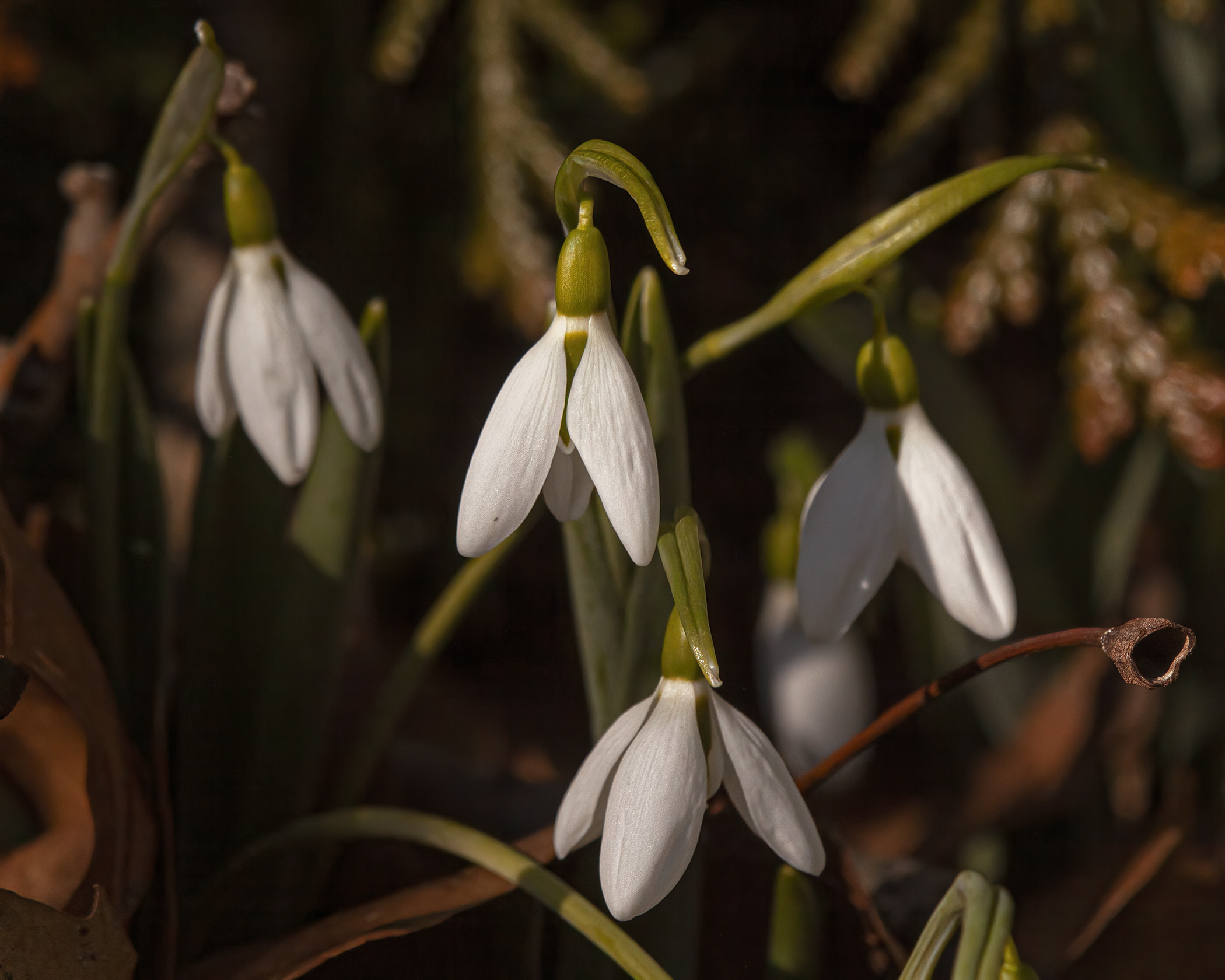
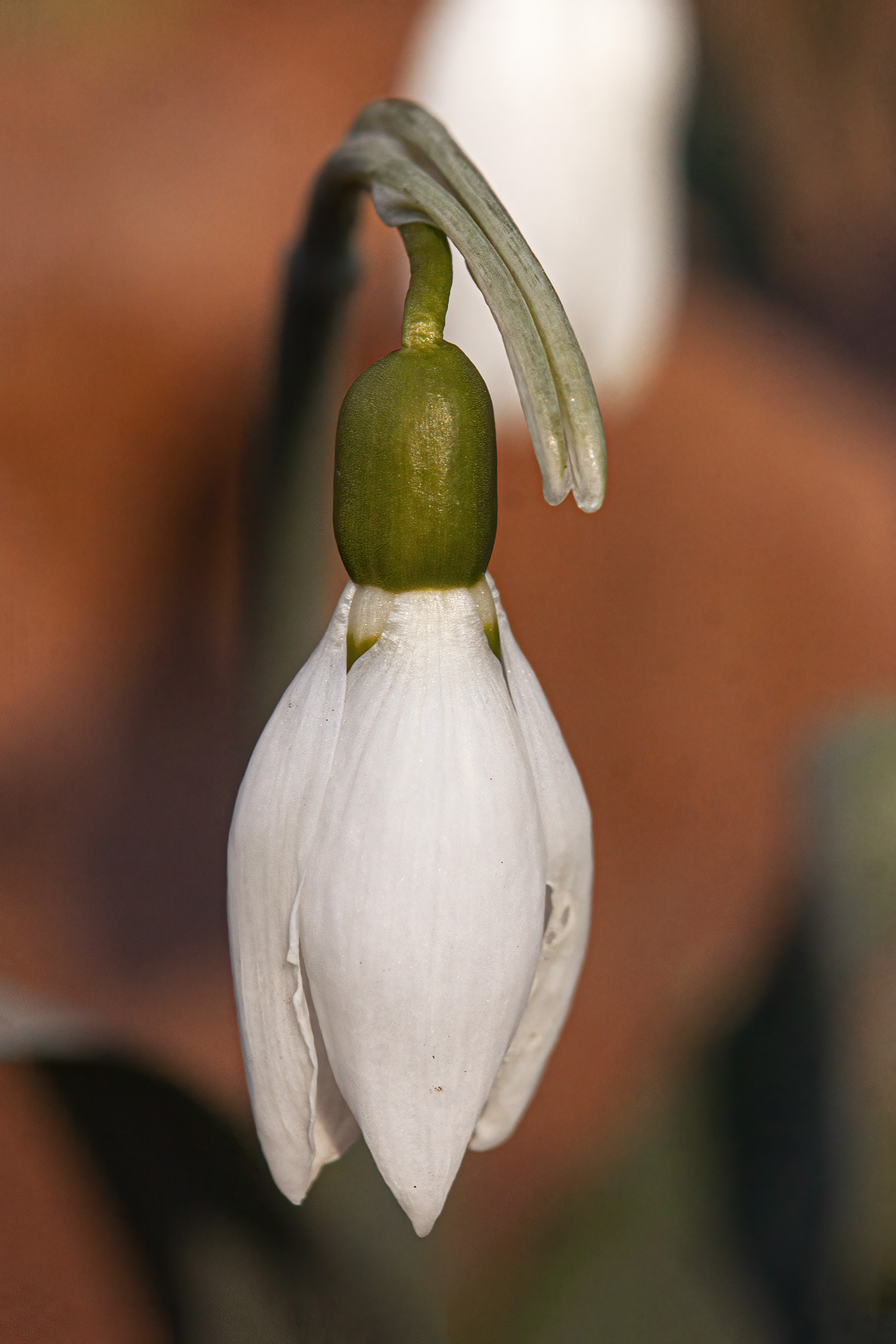
In the deepest darkest days of winter, there is still new growth, like these snowdrop flowers (g. Galanthus) that I spotted yesterday at Green Spring Gardens, a county-run historic garden not far from where I live.

I decided to mix things up a bit and put my macro lens on my camera for the first time in months, hoping that I might find flowers in bloom. What can I possibly find that would be flowering in late January? We have had over a foot (30 cm) of snow already this month and some frigid temperatures, a harsher winter than in recent years. I knew from past experience, though, that there was a good chance that some snowdrop flowers would be in bloom—my challenge was to find them.

I searched in vain in flowerbed after flowerbed, until finally I found several small patches of these pretty white flowers. The words to the song Edelweiss from The Sound of Music, one of my favorite musicals, came to mind. Although edelweiss is a completely different flower, the words of the song seemed to fit my snowdrops so well.

“Every morning you greet me
Small and white, clean and bright
You look happy to meet me
Blossom of snow, may you bloom and grow
Bloom and grow forever.”

snowdrops

snowdrop

snowdrop

© Michael Q. Powell. All rights reserved.

Read Full Post »

My dragonfly season is slowing winding down. During the month of November, I have seen only two species of dragonflies—Wandering Gliders (Pantala flavescens) and Autumn Meadowhawks (Sympetrum vicinum), but I have had multiple encounters with each species. Autumn Meadowhawks are usually the last dragonflies standing each year and there is a chance that I will see one in December.

Wandering Gliders, on the other hand, may disappear from the scene at any moment, so I am especially delighted whenever I spot one flying about, patrolling back and forth over a field. If I am lucky, I will see it perch on some vegetation when it comes down to earth for a rest and I will have a chance to get a shot. I took the first shot this past Tuesday, 9 November, at Occoquan Bay National Wildlife Refuge at a moment when I had my macro lens on my camera. I really like the way that I was able to capture the intricate patterns on the dragonfly’s body.

The two final photos are of a Wandering Glider that I spotted on the 1st of November. It is probably hard for you to tell, but I took these shots with my long telephoto zoom lens, which still managed to capture an amazing amount of detail, especially in the wings in the last image. I encourage you to click on the images to get a better look at those details.

It is raining today and the ground is littered with fallen leaves. As the trees are laid bare, I will have a better chance to spot some of the birds that I have been hearing recently, but have not seen.

For now, though, I am enjoying the waning moments of the season with my magical little dragonfly friends. Their time is not over until it is over.

Wandering Glider

Wandering Glider

Wandering Glider

© Michael Q. Powell. All rights reserved.

Read Full Post »

I love milkweed plants—their shape and texture fascinate me at all stages of of their development. I photographed this milkweed plant last Thursday at Occoquan Bay National Wildlife Refuge, a plant that most might describe as past its prime—I would call it beautiful.

If you look carefully at the photo, you will see several red Large Milkweed Bugs (Oncopeltus fasciatus) crawling about on the plant. It is always worthwhile to examine milkweed plants carefully, because a fascinating variety of insects feed on milkweed or use it as part of their habitat.

milkweed

© Michael Q. Powell. All rights reserved.

Read Full Post »

I really do not expect to find any damselflies this late in the season, so I was both surprised and delighted to spot several Familiar Bluets (Enallagma civile) last Thursday at Occoquan Bay National Wildlife Refuge. As many of you may recall, damselflies are the smaller “cousins” of dragonflies—together they make up the order of insects known as odonata. Damselflies have eyes farther apart than dragonflies and generally perch with their wings held closed above them, unlike dragonflies that extend their wings when perching.

The damselfly in the first photo is a female Familiar Bluet. The brown, nondescript color is fairly typical for female damselflies, which tend to be less colorful than their male counterparts. In order to determine the species, I have to look at the pattern of stripes on the thorax (the “shoulders”) and the abdomen (the “tail”) and the color and size of the eye spots.

The damselfly in the second photo is a male Familiar Bluet. Like most other male bluets, this damselfly’s body is covered in patterns of black and blue. I often have trouble distinguishing between the different species of bluets, but once again the eye spots, shoulder stripes, and the specific color pattern are key factors that I look for in trying to come up with an identification.

I am not sure if these damselflies are unusually late or if I simply was not looking for them as hard in previous years. At this time of the year I spend a lot of time looking up at the distant trees for indications of bird activity and I may not have been paying as much attention to the vegetation at my feet.

Temperatures have dropped close to the freezing mark the last couple of nights and I fear that the frosty weather may hasten the demise of these beautiful little creatures. If so, these may well be the last damselflies that I will see until next spring. Au revoir, mes petits amis.

Familiar Bluet

Familiar Bluet

© Michael Q. Powell. All rights reserved.


Read Full Post »

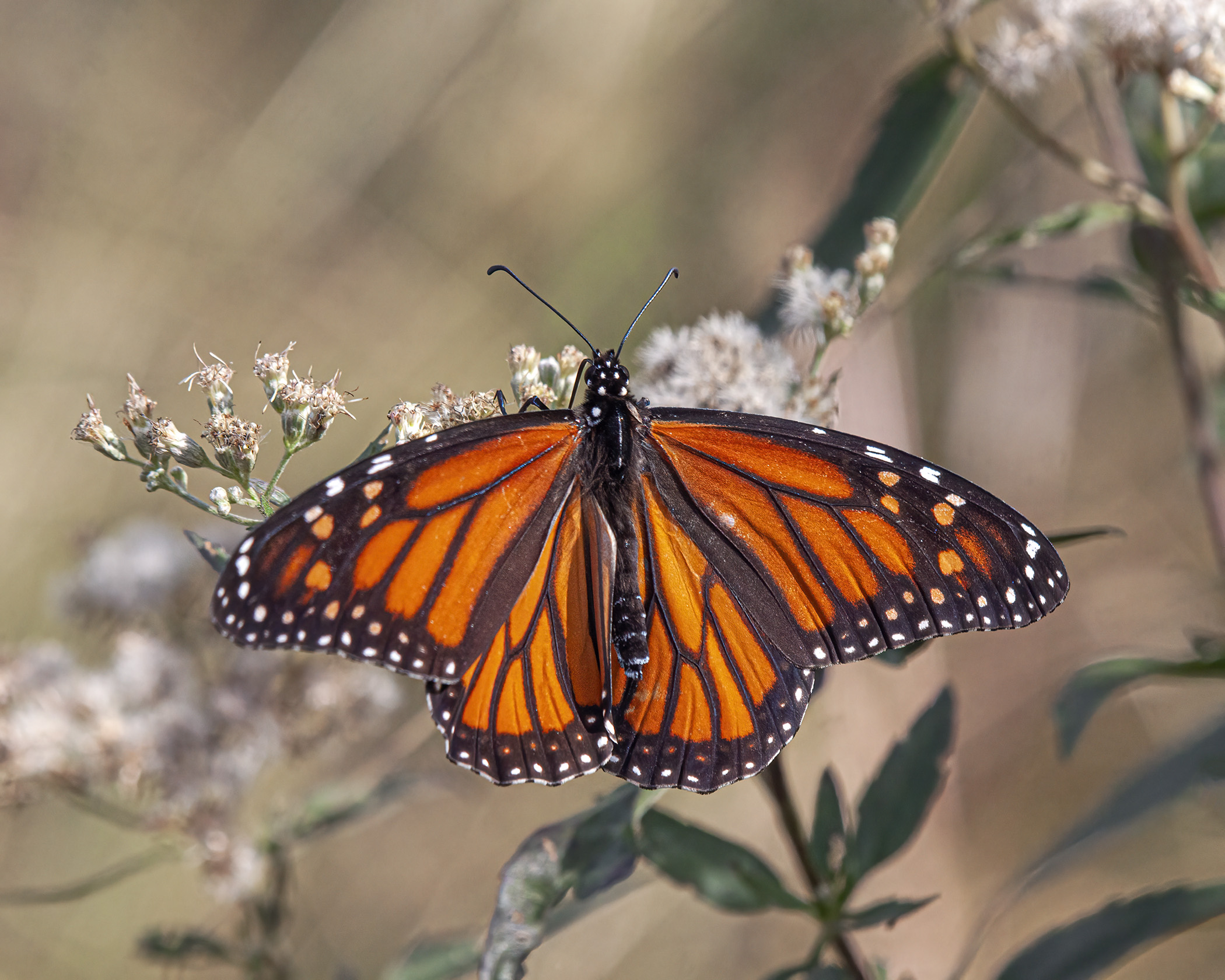
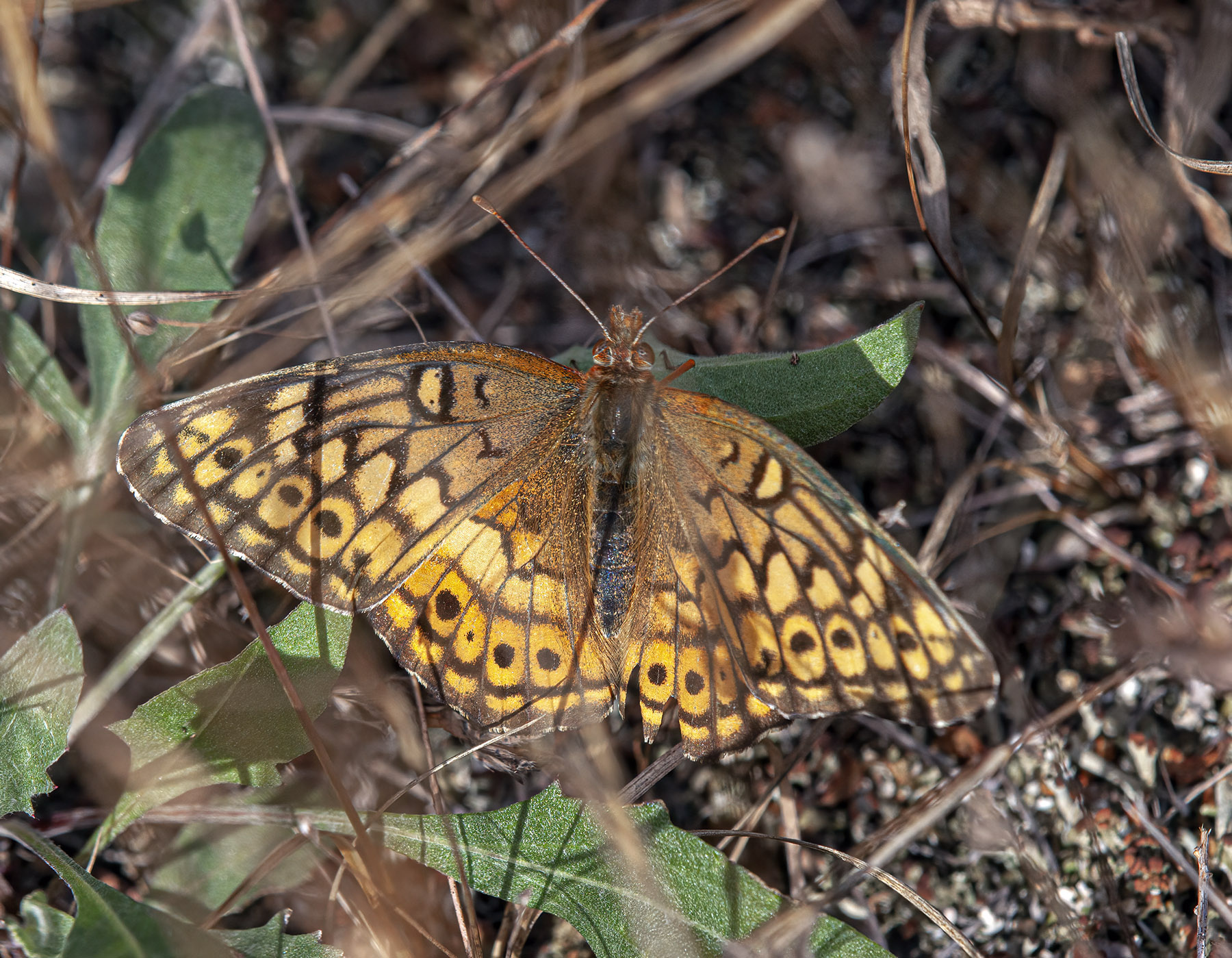
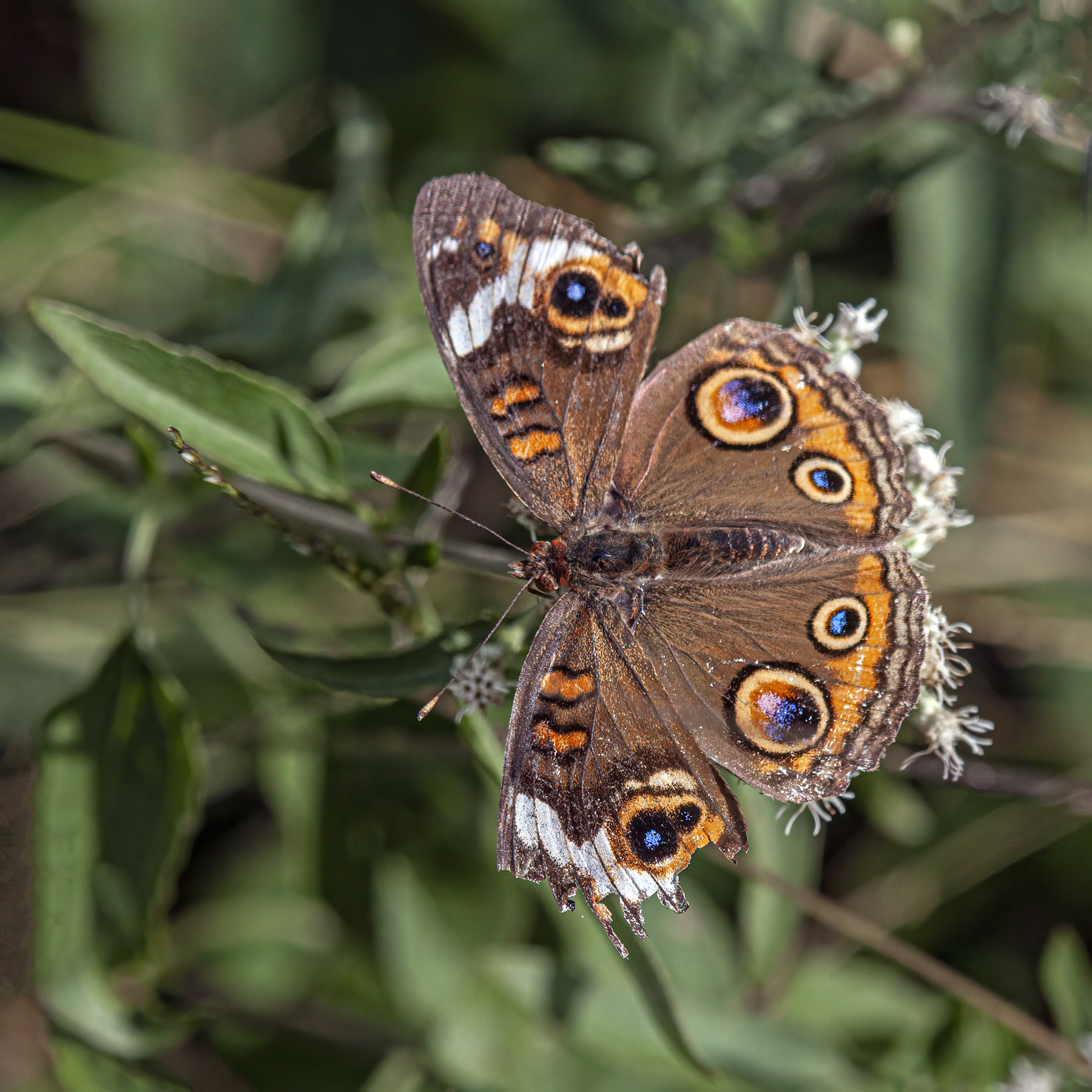
I am shocked and delighted by the number of butterflies that I continue to see at the end of October, despite the cooling temperatures and decreasing number of hours of daylight. Last Thursday, 28 October, I spotted a Monarch butterfly (Danaus plexippus) and multiple Variegated Fritillaries (Euptoieta claudia) and Common Buckeyes (Junonia coenia).

The dominant browns and oranges in the color palette of these butterflies seems to be a perfect reflection of the autumn season, when the colors in nature seem more muted than they were during the spring and the summer. For me, though, there is an inner warmth and comfort in these colors, like the feel of a well-worn flannel shirt or the taste of an autumn soup.

Monarch

Variegated Fritillary

Common Buckeye

© Michael Q. Powell. All rights reserved.


Read Full Post »

Here’s a couple of looks at an enormous praying mantis that I photographed on Thursday at Occoquan Bay National Wildlife Refuge. I was walking towards the parking lot at the end of a day of shooting when I passed a couple of fellow photographers who asked me if I wanted to photograph a praying mantis. I think that praying mantises are pretty cool, so of course I was quite happy to have them show me where it was.

I had never seen such a large praying mantis—I estimate that this one was about 5 inches (127 mm) in length. It was a challenge to find a shooting angle that allowed me to get most of this insect’s long angular body in focus. However, the mantis was cooperative and stayed in place until I was able to get some shots that I liked.

I am pretty sure that this is a Chinese Praying Mantis (Tenodera sinensis), a non-native species that is much larger and more aggressive than the native species. I did a little research about mantises in the United States and apparently there are a variety of views about the degree to which the non-native species are “invasive,” i.e. that cause environmental harm.

When I posted a photograph on Facebook, several readers commented that it looked like “my” mantis was about ready to lay her eggs. I had not initially considered that possibility, but it certainly does look like the mantis has a swollen abdomen. Female mantises generally lay their eggs in the fall in a protective sac structure called a “ootheca” and then she dies. The nymphs hatch in the spring when the weather warms up again.

Nature is amazing!

Chinese Praying Mantis

Chinese Praying Mantis

© Michael Q. Powell. All rights reserved.

Read Full Post »

When I went out with my camera on Tuesday, I made sure to carry both my 150-600mm telephoto zoom lens, my preferred lens in the cold months, and my 180mm macro lens, my lens of choice during the warm months. As you may have noticed, I have started photographing more birds during the month of October than in previous months, so I really need the additional reach afforded by the long lens. However, I also know that there is a good chance that I will see some dragonflies, and the macro lens helps me get certain photos that are just not possible with other lenses.

I spent most of my time that day trying to photograph little birds, like sparrows and goldfinches. In the early afternoon, though, I changed lenses when I spotted some Autumn Meadowhawk dragonflies (Sympetrum vicinum) basking in the sun on the wooden rails of a split-rail fence. I have learned in the past that Autumn Meadowhawks are often willing to let me move in close for shots and sometimes they will even perch on me—the perfect scenario for me to use my beloved macro lens.

In the first photo, I was so close to the dragonfly that I was balancing the lens hood on the edge of the rail on which the dragonfly was perched. As you can see, the depth of field was pretty shallow and most of the body is blurry. I am ok with that, because the eyes are in relatively sharp focus—I encourage you to click on the image to see some of the amazing details that I was able to capture, include the hairy “stubble” on the dragonfly’s face.

The second shot gives you a better overall view of the body of a male Autumn Meadowhawk. The bright red color of of its body really stands out again the backdrop of the brown fallen leaves and the gray gravel.

We will soon be moving forward to a new month. I am hopeful that November will include additional encounters with these colorful little Autumn Meadowhawk dragonflies.

Autumn Meadowhawk

Autumn Meadowhawk

© Michael Q. Powell. All rights reserved.

Read Full Post »

Common Whitetails (Plathemis lydia) are among the first dragonflies to appear in the spring and one of the last to disappear in the autumn. I spotted this handsome male Common Whitetail last week at Occoquan Bay National Wildlife Refuge.

I love taking photos of everyday species, ones that may be ignored by many others. I like what Kevin Munroe wrote about Common Whitetails on his wonderful website Dragonflies of Northern Virginia:

“Dragonfly geeks like myself tend to turn our noses up at the ubiquitous and ever-present whitetail – but thank goodness for them! Often seen in large numbers, almost swarm-like, they’re essential members of the urban and suburban food chain. There they are, eating mosquitos (both as larvae and adults) in our urban parks where few other dragonflies can help us out. And literally everything eats them: praying mantids, birds, frogs, raccoons, fish, spiders.”

You may not be as much of a dragonfly enthusiast as I am, but I am sure that you can find equally beautiful and fascinating things in your immediate surroundings, if you take the time to seek and savor them—beauty is everywhere.

Common Whitetail

© Michael Q. Powell. All rights reserved.

Read Full Post »

« Newer Posts - Older Posts »