Feeds:
Posts
Comments

Posts Tagged ‘Tamron 180mm’

There has been a recent explosion of dragonflies in my area. Yesterday was a hot, humid day and I encountered hundreds of dragonflies as I walked along the trails of one of my favorite wildlife park. They were almost all relatively common species, including Common Whitetails, Needham’s Skimmers, Eastern Pondhawks, and Great Blue Skimmers. These dragonflies thrive in a variety of habitats, are numerous, and are easy to see.

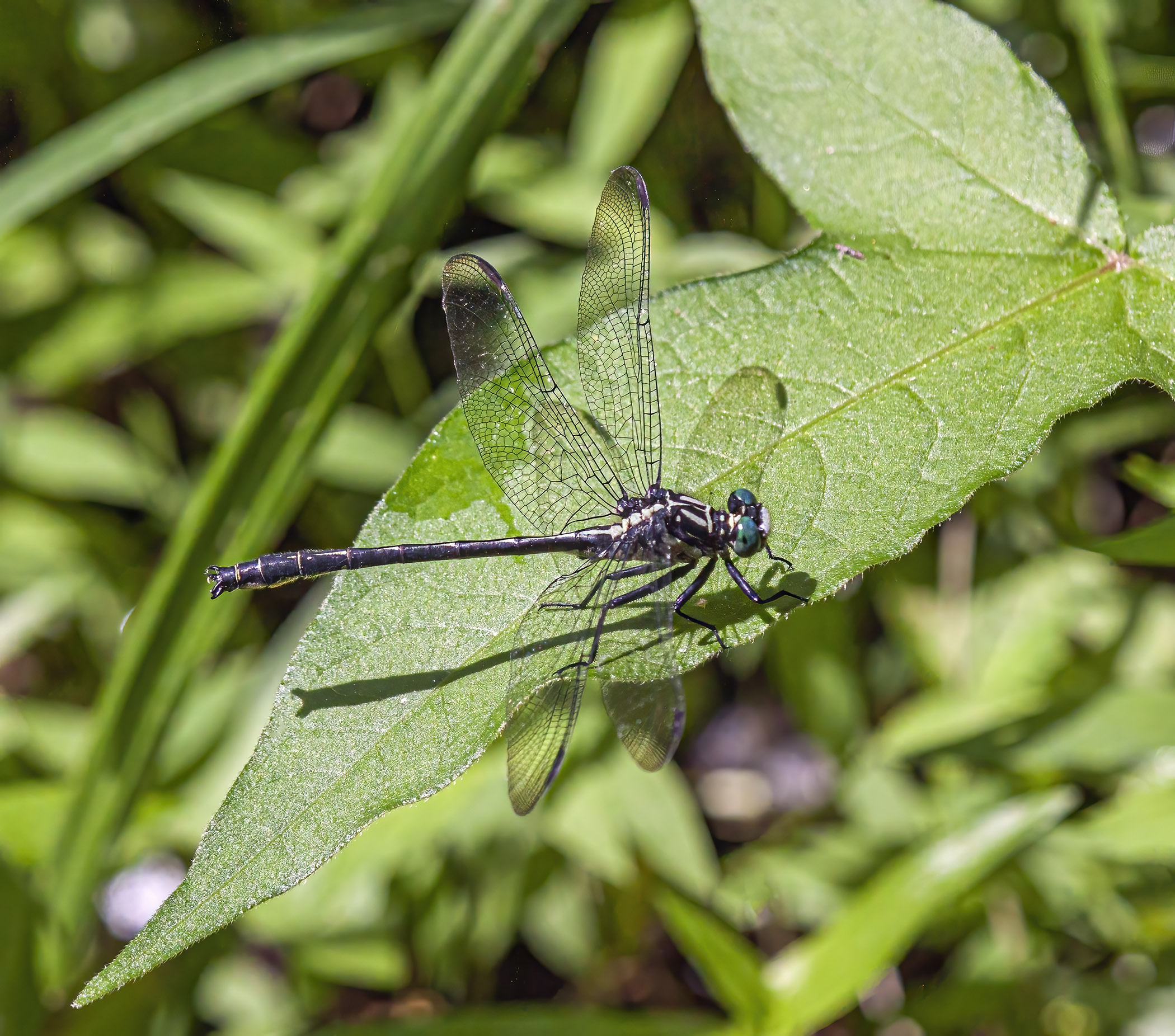
Some of the rarest dragonflies in our area, however, are quite muted in their appearance, like these male Sable Clubtail dragonflies (Stenogomphurus rogersi). Sable Clubtails are generally found only in very small numbers, have a short flight period, and require very specific habitats,—this species prefers small, clean forest streams. This past two weeks I have spent hours exploring a stream in Fairfax County in Virginia, the county in which I live, and spotted a grand total of two Sable Clubtails.

As you can see from the first photo, my most recent sighting, Sable Clubtails like to perch flat on leafy vegetation, just above the level of the stream. They are often in shadowy areas and are incredibly skittish, so it is tough to get a good shot of a Sable Clubtail.

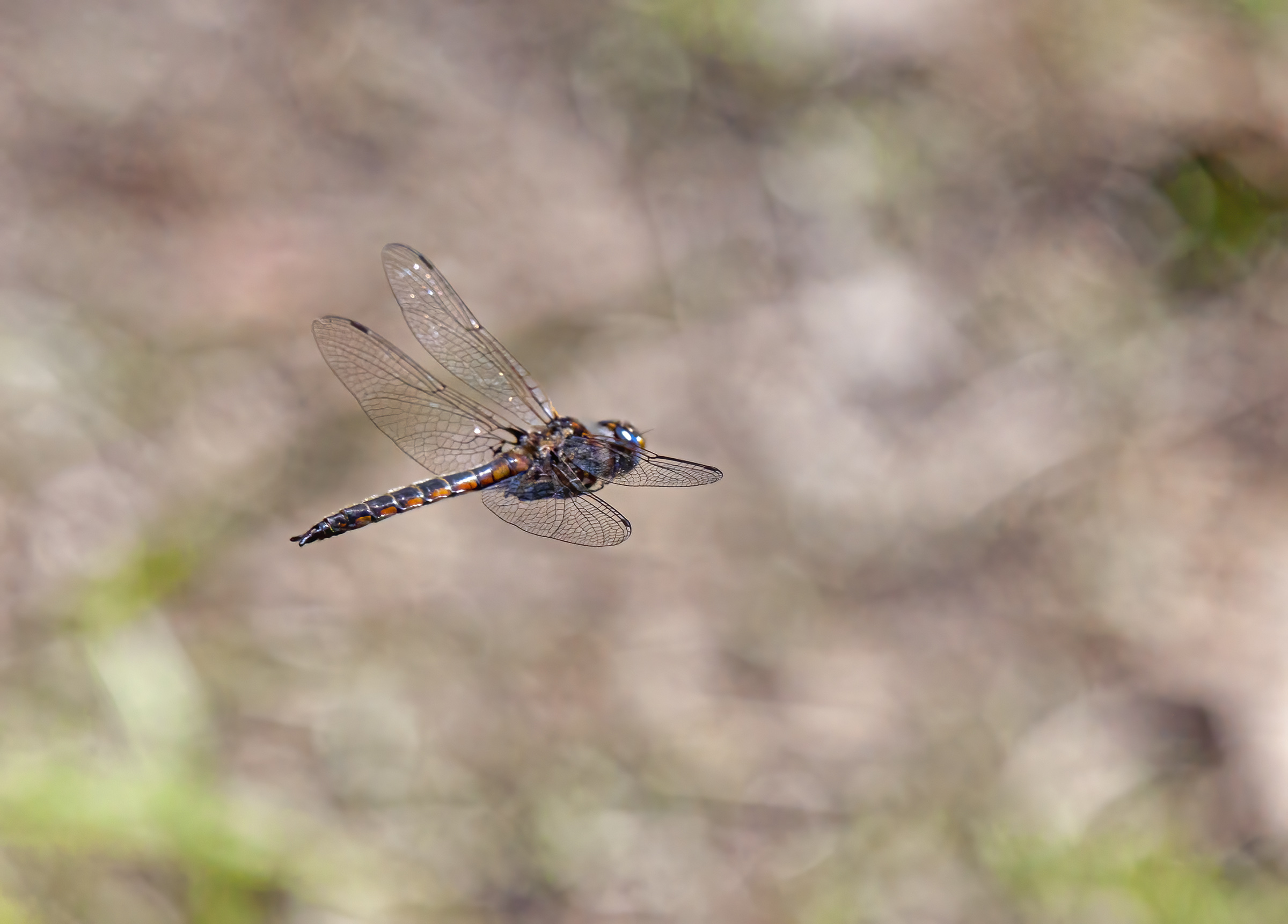
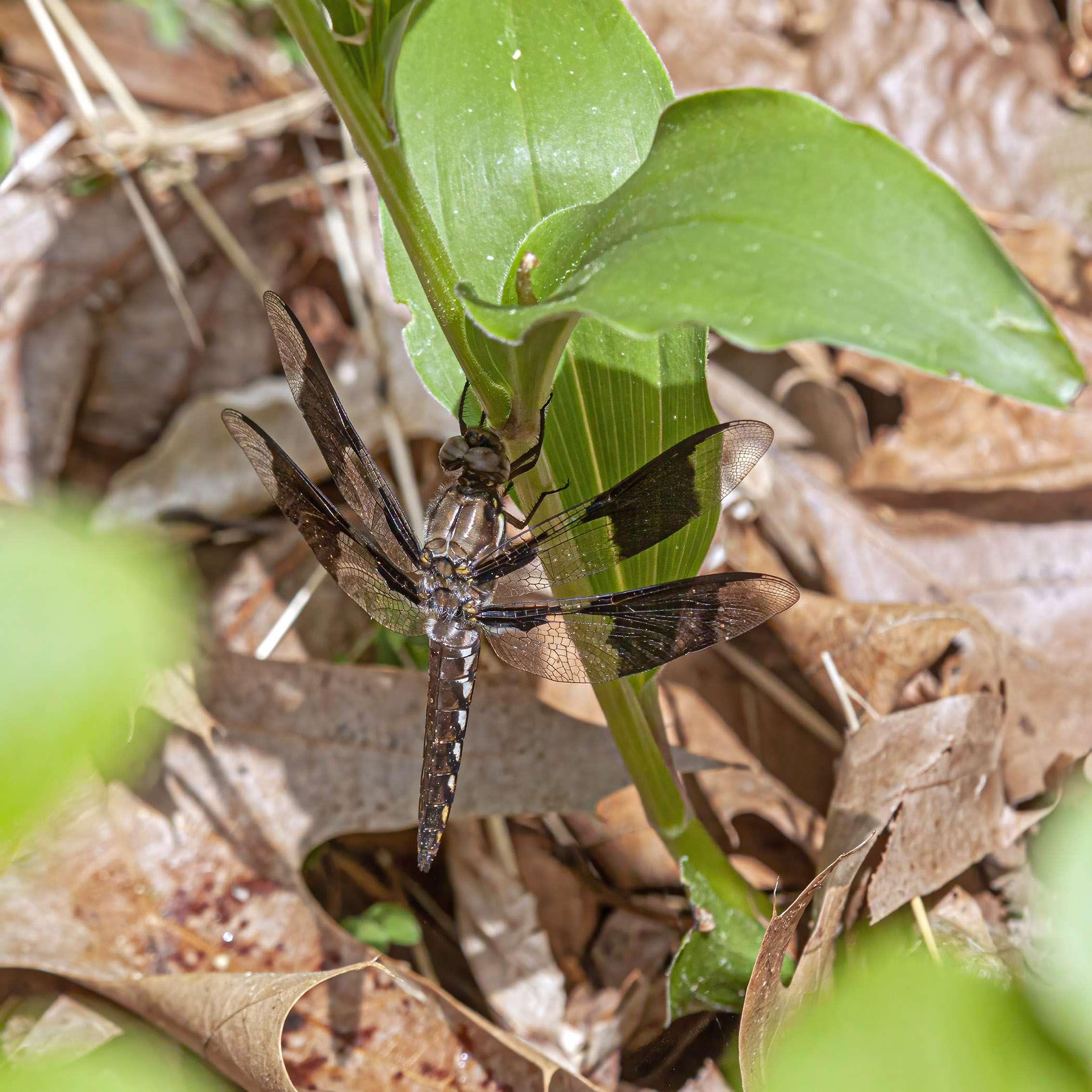
The dragonfly in the second and third photo was initially spotted by a fellow dragonfly enthusiast a little over a week ago. I was upstream from him (and had not noticed that he was there) when he called out to me and informed me that he had spotted a Sable Clubtail. I hurried over in the direction of his voice and photographed the dragonfly in the middle photo. I was able to capture the markings of the Sable Clubtail by shooting almost directly downwards, but the sunlight produced harsh specular highlights.

As I crouched to get a better angle, I spooked the dragonfly.  Fortunately it flew only a few feet away and perched higher on a leaf in a slightly shaded area, which let me capture the third shot before it flew away.

I don’t know if I will see another Sable Clubtail this season, but it was gratifying to be able to have two encounters with this uncommon species. Habitats are fragile and changeable, so I never know from year to year if one of these low-density species will reappear or not. At this location, I have been blessed to photograph a Sable Clubtail for three of the last four years. I’ll probably check it out at least another couple of times before I call it quits for this species for the season.

Sable Clubtail

Sable Clubtail

Sable Clubtail

© Michael Q. Powell. All rights reserved.


Read Full Post »

I was thrilled to spot this cool-looking Six-spotted Fishing Spider (Dolomedes triton) yesterday at Green Spring Gardens, a county-run historic garden in Alexandria, Virginia, not far from where I live. These spiders usually keep several of their legs on the surface of the water and detect the vibrations of potential prey and them scamper across the water to capture their targets.

Initially the spider had its legs anchored on the edge of a colorful lily pad a short distance from the edge of a small pond, as shown in the first photo. When I got a little too close, the spider moved a short distance away, as shown in the second photo, but eventually it returned to its original spot.

Fishing spiders like this one are quite large—a female can grow to be about 2.4 inches (60 mm) in length, including her legs, while the male is somewhat smaller. According to Wikipedia, Six-spotted Fishing Spiders hunt during the day and can wait can wait patiently for hours until stimulated by prey. Potential prey include both aquatic insects and terrestrial insects that have fallen into the water, tadpoles, frogs, and small fish. Amazingly, these spiders are capable of capturing fish up to five times their body size, using venom to immobilize and kill the prey.

Six-spotted Fishing Spider

Six-spotted Fishing Spider

© Michael Q. Powell. All rights reserved.

Read Full Post »

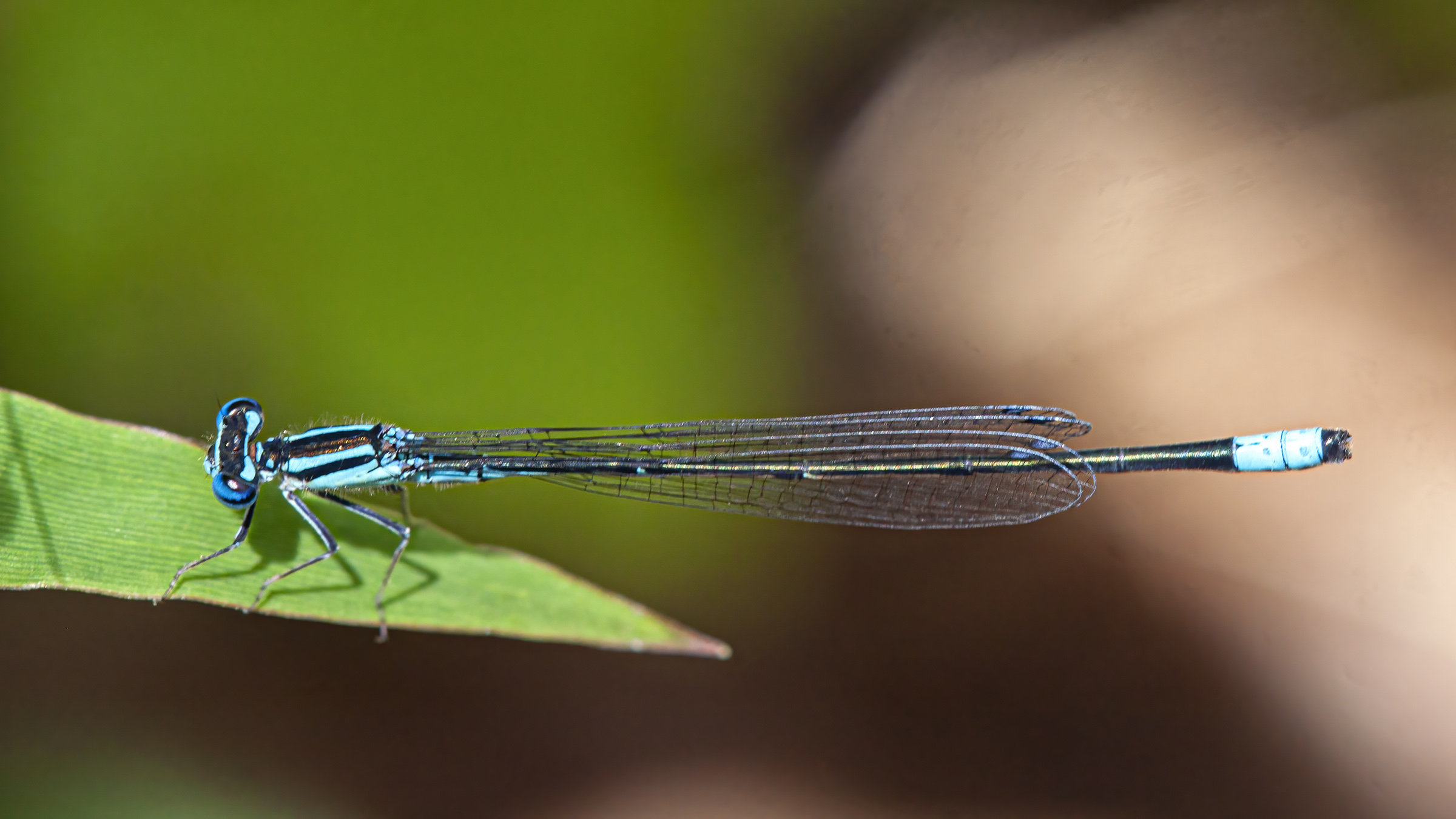
Last week I was excited to capture this image of a beautiful Turquoise Bluet damselfly (Enallagma divagans) as I explored the edge of a small pond in Prince William County, Virginia. The damselfly was conducting short patrols over the water and then would perch on the vegetation sticking out of the water.

I got low to the ground and squatted as close to the water’s edge as I dared, doing my best to avoid falling into the water as I leaned forward. I managed to stay dry as I waited patiently. Eventually the Turquoise Bluet perched within range of my lens and I was able to capture a pretty detailed image of the little bluet, which was about 1.4 inches (35 mm) in length.

Turquoise Bluet

© Michael Q. Powell. All rights reserved.
Read Full Post »

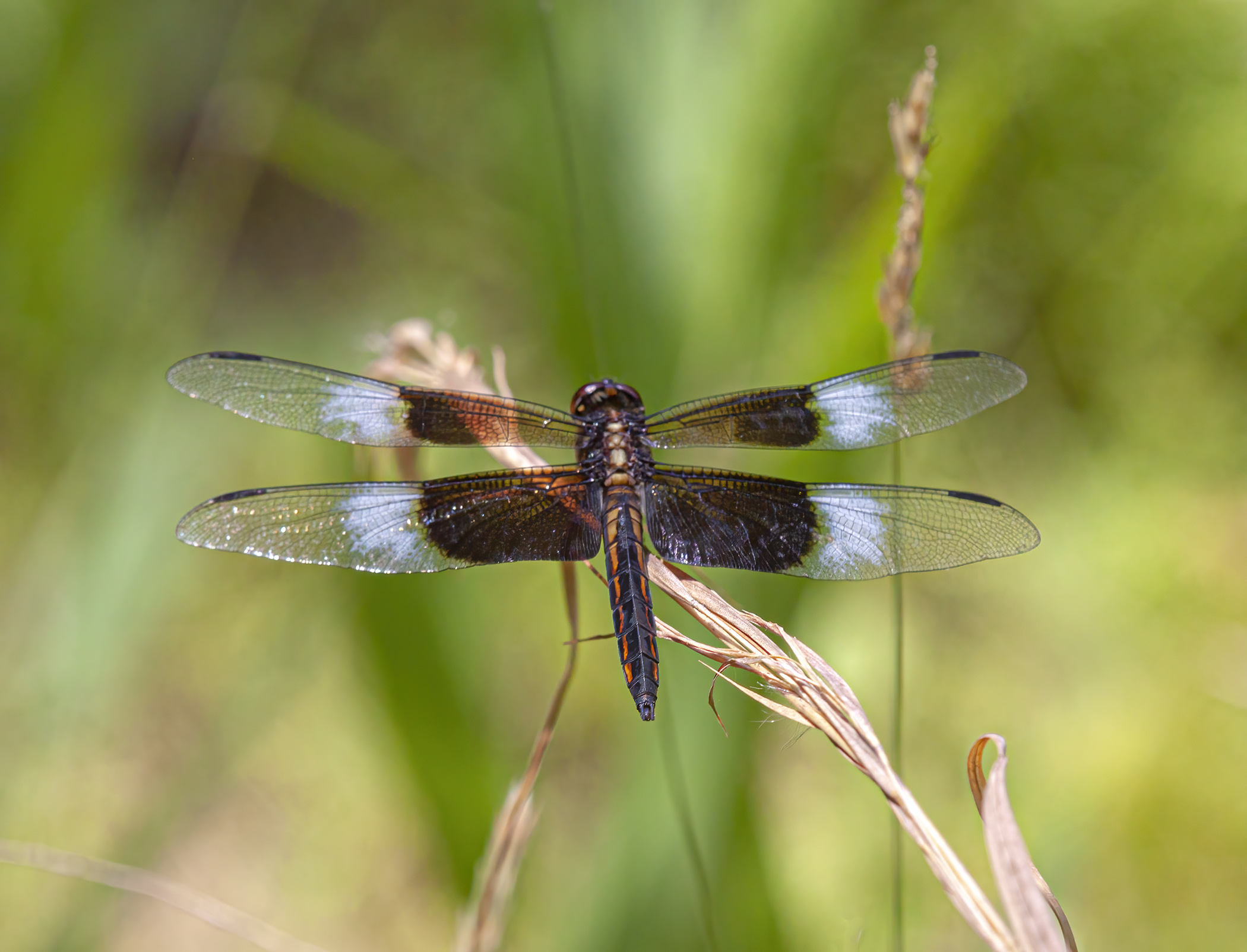
I love dragonflies with patterned wings and one of the coolest ones in our area is the male Widow Skimmer (Libellula luctuosa), which has a distinctive combination of one dark and one white blotch per wing. Eventually the immature male in the first photo will turn bluish in color, but for now he has the brown and yellow colors that he shares with the females. The females have only a single large blotch on each wing, so usually I can tell the genders apart.

When the male first emerges, however, the white blotches may be hard to see, so I have to look more closely at other aspects of the dragonfly’s body. I am pretty confident that the dragonfly in the second photo is a very young male Widow Skimmer.

It was really easy to track a male Widow Skimmer dragonfly in the air, because its colorful wings made it look almost like a butterfly. However, the dragonfly in the first photo was remarkably skittish and would perch only momentarily in between its patrols over the waters of the small pond that I visited on Monday. Eventually my patience paid off and I was able to get a shot, albeit from a relatively long distance away.

Widow Skimmer

Widow Skimmer

© Michael Q. Powell. All rights reserved.
 

Read Full Post »

When damselflies mate, it is often a very conspicuous event, easily recognized by the heart-shaped “wheel” formation of the mating couple. The male clasps the female by the back of her head and she curls her abdomen to pick up sperm from secondary genitalia at the base of the male’s abdomen. That’s about as graphic as I dare go in describing the process.

Yesterday I spotted a pair of mating Ebony Jewelwing damselflies (Calopteryx maculata) as I was exploring a stream in Fairfax County, Virginia, the county in which I live. Ebony Jewelwings are immediately identifiable, because they are the only damselflies in our area with dark wings. They can be found at a wide variety of running waters, especially at shaded forest streams, like the one where I found this couple.

Male Ebony Jewelwings have wings that are all black, while females have dark brown wings with conspicuous white pseudostigmas—the male is on the right in this photos. The body of the males is a metallic green with copper highlights—in certain lights, their bodies may look distinctly blue. Females seem to have a bit more color variation, though it is hard to tell their true color because of the reflected light from their shiny bodies.

Ebony Jewelwing

© Michael Q. Powell. All rights reserved.

Read Full Post »

One of the coolest, most colorful damselflies in our area is the violet subspecies of the Variable Dancer (Argia fumipennis) that is often called the Violet Dancer (Argia fumipennis violacea). I spotted these handsome male damselflies last Thursday in Prince William County and love the way I was able to capture some of the texture of their environment, especially in the first photo.

Some of you may have noticed that I have had a photo of a Violet Dancer as the banner for this blog for quite a number of years. This coloration of this damselfly is so strikingly different from the various shades of blue of most damselflies that it made an immediate impression on me the first time that I photographed one.

I need to update many aspects of my blog page format, including the information in the “About Me” section, but I am still pretty comfortable with having a Violet Dancer being the first image that viewers see when they access my page.

Variable Dancer

Variable Dancer

© Michael Q. Powell. All rights reserved.

Read Full Post »

I was delighted to spot this female Lancet Clubtail dragonfly (Phanogomphus exilis) on Thursday in Prince William County, the first member of this species that I have seen this season. She seemed to be glancing upwards at me as she smiled and posed for me.

When I was doing some research on this species, I got a little confused, because sometimes the Latin name for the species was given as Phanogomphus exilis and sometimes as Gomphus exilis. As far as I can understand it, the Lancet Clubtail used to be included in Gomphus genus. However, according to Wikipedia, “As a result of phylogenetic studies, Gomphus subgenera Gomphurus, Hylogomphus, Phanogomphus, and Stenogomphus were elevated in rank to genus in 2017. With the removal of their member species, Gomphus ended up with 11 of its previous 54 species, none of which are found in the Western Hemisphere.” Yikes!

Lancet Clubtail

Lancet Clubtail

© Michael Q. Powell. All rights reserved.

Read Full Post »

Last Tuesday I spotted several beautiful Bar-winged Skimmer dragonflies (Libellula axilena) while I was exploring a small pond in Prince William County, Virginia. The dragonflies kept choosing beautiful, but flimsy perches, so I did not have much time snag shots of them before they flew away.

According to the Dragonflies of Northern Virginia website, Bar-winged Skimmers have relatively specific habitat needs and consequently are one of the less common skimmers in our area. “It prefers very shallow marshy pools in the full sun. If there’s enough water for fish, it’s too deep for Bar-winged Skimmers. And of course shallow pools in the full sun tend to quickly evaporate and dry up, so stable populations in Northern Virginia are few and far between.”

I really like the backgrounds that I was able to capture in these shots—they are colorful, but not at all distracting. If you look closely at the leading edges of the wings, you can see the black spots and stripes that give rise to the name of this species.

Bar-winged Skimmer

Bar-winged Skimmer

Bar-winged Skimmer

© Michael Q. Powell. All rights reserved.

Read Full Post »

I love the triangular shape of Spiderwort plants (genus Tradescantia). I tend to think of spiderworts as being a bluish-purple in color, but was delighted to discover them blooming in a variety of colors during a recent visit to Green Spring Gardens, a county-run historical garden near where I live. I think my favorite color combination may be the one in the middle photo, with the white flowers and the purple “fuzz” in the center.

Spiderwort

Spidewort

spiderwort

© Michael Q. Powell. All rights reserved.

Read Full Post »

Although “treehugger” is a term that is sometimes used for environmentalists, it is even more applicable to Gray Petaltail dragonflies (Tachopteryx thoreyi), like these ones that I spotted last Tuesday in Prince William County. Gray Petaltails love to perch on the trunks of trees, where they blend in almost perfectly with the bark, as you can see especially well (or almost not see) in the second photo.

I have been told that Gray Petaltails especially like the color gray and a number of times one has perched on me when I was deliberately wearing a gray shirt. Fellow dragonfly enthusiast Walter Sanford capture that phenomenon in 2019 in one of his blog postings that he called “You look like a tree to me!

I drove up to Massachusetts this past weekend for the celebration of my 50th high school reunion at Northfield Mount Heron School, the private college preparatory boarding school that I attended for three years. I disconnected from the internet during that time there, which is why I have not posted in several days—my apologies to those of you who may be used to a daily “fix.”

It was fascinating to reconnect with high school friends, often for the first time in 50 years, and to meet some classmates for the first time. Northfield was founded as a girls school in 1879 by evangelist Dwight L. Moody and two years he established Mount Hermon as a boy school. In 1971 the two schools formally merged and those of us in the class of 1972, my class, were the first to graduate from Northfield Mount Hermon School. At that time there were close to 1300 students divided between the two campuses, which made it difficult to know everyone—in recent years the school consolidated onto the Mount Hermon campus and it currently has a student body of about 700 students.

Gray Petaltail

Gray Petaltail

© Michael Q. Powell. All rights reserved.


Read Full Post »

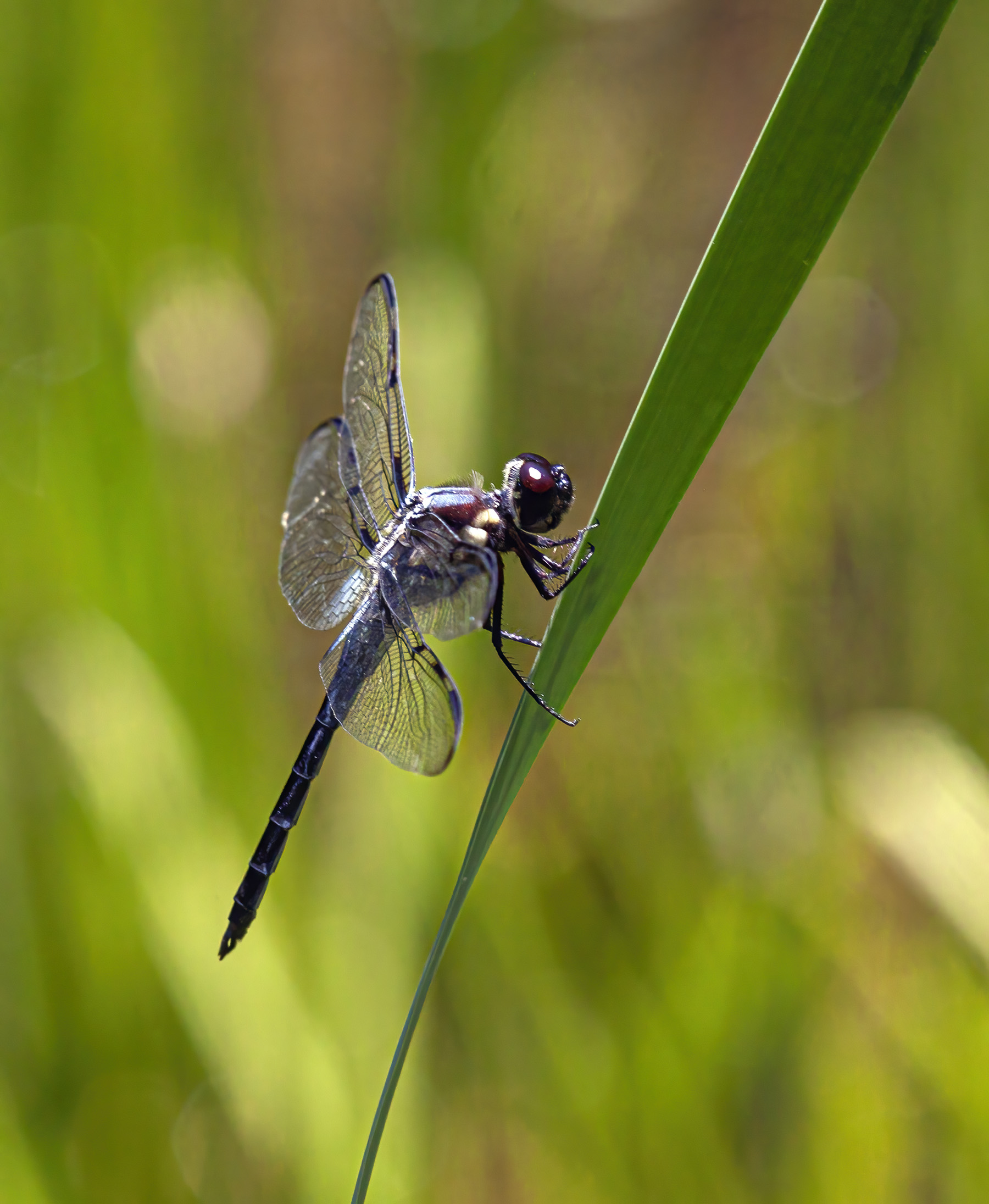
On Tuesday I was thrilled to spot this male Brown Spiketail dragonfly (Cordulegaster bilineata) while I was exploring a marshy area in Prince William County, Virginia. Spiketail dragonflies are quite rare in our area and this was the first one that I have spotted this year.

Brown Spiketails are found only in a specific type of habitat. According to the Dragonflies of Northern Virginia website, Brown Spiketails prefer “clean, small, sunlit, forest streams and seepages” and “perch often and low on grasses and shrubs in clearings, meadow edges and sunny forest edges.” As you can see from the background in these two images, the location where I found this dragonfly was full of ferns.

In case you are curious, spiketail dragonflies are so named because the long ovipositor of the female extends beyond the tip of the abdomen. The females lay their eggs by hovering over shallow water and driving the long ovipositor vertically into the shoreline mud or stream bottom in a fashion reminiscent of a sewing machine. Since these photos show a male, there is no “spike” to see for this spiketail.

I love the striking eyes of this dragonfly and the colorful markings his entire body and was happy to be able to capture such a detailed look at his beauty.


Brown Spiketail

Brown Spiketail

© Michael Q. Powell. All rights reserved.
Read Full Post »

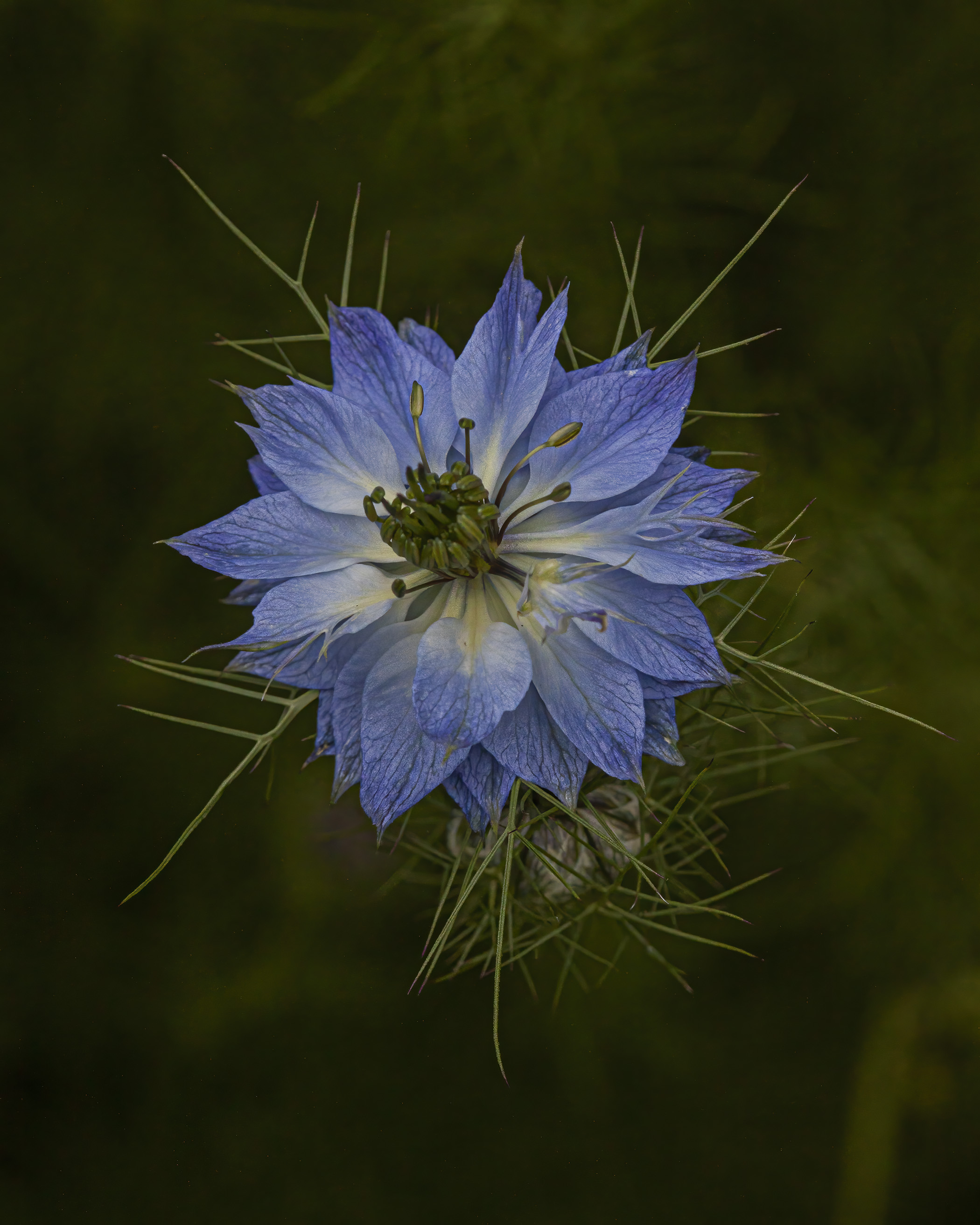
During a recent trip to Green Spring Gardens, a county-run historic garden near where I live, I was delighted to see that Love-in-a-mist (Nigella damascena) was in bloom. Love-in-a-mist  is a flower that looks like it came from outer space, with wild tendrils shooting out of its middle and green spiky vegetation surrounding it. Like many forms of love, the flower simultaneously looks to be both inviting and threatening.

I find this flower to be incredibly beautiful and exotic and it is one of my favorites. Typically Love-in-a-mist is blue, but it also comes in shades of white, pink, and lavender. Many flowers lose our interest after they have bloomed, but I find the seedpods of Love-in-a-mist to at least as intriguing as the flower itself, as you can see in the final photo.

When I did a little research I learned that the striped, balloon-shaped object that I call a seedpod, is actually an inflated capsule composed of five fused true seedpods, according to an article by Wisconsin Horticulture. I also discovered that the thorny-looking spikes that make up the “mist,” which are not sharp, despite their appearance, are technically bracts, a specialized kind of leaves.

I smile whenever I use the name of this flower—we can always use more Love, whether it comes in a mist, in the sunshine, or even in a downpour.


Love-in-a-mist

Love-in-a-mist

Love-in-a-mist

© Michael Q. Powell. All rights reserved.

Read Full Post »

When the weather turns warm and sunny, it is not uncommon for me to spot Common Five-lined Skinks (Plestiodon fasciatus), one of the few lizards that are present in my area. Most of the time I see them on the trunks of trees or on fallen logs, but occasionally I will see one on a man-made structure that has crevices and overhangs where they can hide.

Skinks are skittish and will scamper away if they detect my presence, so I have to be super stealthy in approaching them to get a shot. In the case of these photos, I was at the edge of a small pond at Jackson Miles Abbott Wetland Refuge last week looking for dragonflies when some movement on a nearby concrete fishing platform caught my eye. The skink had just crawled out of the shadows and was surveying the area when I captured these images.

Juvenile skinks have blue tails and there appears to be some blue on the tail that is especially visible in the second photo, so I am guessing that it is almost a full-grown adult. Some scientists believe that the blue color functions as a decoy, diverting the attention of predators to this “expendable part” of the body—the tail is detachable and regrows if it is lost. Other scientists propose that the blue coloration serves to inhibit attacks by aggressive adult males, who might otherwise view the juveniles as rivals.

If you are curious and would like to see a photo of the blue tail of a juvenile skink, check out this 2021 blog posting entitled Juvenile Skink in April.


Five-lined Skink

Five-lined Skink

© Michael Q. Powell. All rights reserved.

Read Full Post »

I was busy this week, so I was not able to spend as much time out in nature as normally. The last two days, temperatures have soared well above normal to over 90 degrees (32 degrees C), so it has been really uncomfortable to spend much time outdoors. Later in the summer, my body will grow accustomed to the heat, but right now the high temperatures are unbearable.

I was able to make a short trip on Wednesday to Jackson Miles Abbott Wetland Refuge, a small nature preserve not far from where I live, and was delighted to spot this female Ashy Clubtail dragonfly (Phanogomphus lividus). Ashy Clubtails are an early spring species—they appear in April and are gone by June—and I have seen them several times already this year. Most of the ones I have spotted have been males, so it was a treat to be able to photograph a female.

Ashy Clubtails like low perches and often perch on the ground, where they often are camouflaged by the vegetation. In this case, the dragonfly perched a bit above ground level, so I was able to get a pretty good shot of her profile. It is probably my imagination, but it seems to me that she was glancing up at me and smiling a little as she posed for this portrait.

Ashy Clubtail

© Michael Q. Powell. All rights reserved.li

Read Full Post »

It is getting late in the season for Uhler’s Sundragon dragonflies (Helocordulia uhleri), so I was particularly happy when I spotted several of them last week while I was exploring a creek in Prince William County. Uhler’s Sundragons appear in early April and their flight period lasts for only a month or so, so it is always a challenge to find them and photograph them for the season.

Both of the dragonflies in the photos are males, judging by the appendages at the tips of their abdomens and their indented hind wings. I think that they are two separate individuals, but cannot be sure, since I spotted them in the same general area.

Some of you may have noticed that I did not do postings on Saturday and Sunday. I try to do a posting every day and during the past year “missed” only four days. I spent this past weekend in the mountains of Virginia at a church retreat and disconnected myself from the internet during that time. I had a wonderful time and feel uplifted emotionally and spiritually. After all of the covid-related travel limitations of the past two years, it felt good to get away and break out of my normal routine.

Uhler's Sundragon

Uhler's Sundragon

© Michael Q. Powell. All rights reserved.


Read Full Post »

Do you worry about how you look when you are taking a photograph? Most of the time I am by myself in remote locations, so I don’t feel at all self-conscious when I kneel and lean or even sprawl onto the ground in order to get a better angle for a shot. Recently, though, I was at Meadowlark Botanical Garden, a relatively crowded public space, with some friends and one of them, my photography mentor Cindy Dyer, photographed me in action.

You probably cannot help but notice my brightly colored sneakers. Since I retired, I have developed a fondness for Chuck Taylor Converse All Star sneakers and have pairs that are aqua, orange, and blue, in addition to the hightop coral ones in the photos. Did you notice that I was using a monopod for additional stability for the macro shot that I was taking? I was also leaning my elbow onto my knee to steady my shot.

What was I shooting? I was photographing a tiny spider on the side of a snowflake flower that is barely visible in the foreground of the photos. I reprised the photo of the spider that I originally included in a posting entitled Spider on snowflake to give you a sense of the distance that I was from the subject. One of the real benefits of the 180mm macro lens is that it lets me get close-up shots without having to be be on top of the subject, as would be necessary with my 60mm macro lens or even my 100mm macro lens.

In case you are curious, I tend to wear more subdued footgear when I am out in the wild. Many of my subjects are probably colorblind, so they would not be mindful of my bright shoes—I am more worried about covering them with mud and dirt, which I seem unable to avoid when I am trekking about in nature.

mike powell

Mike Powell

spider and snowflake

© Michael Q. Powell. All rights reserved.


Read Full Post »

Last Monday I was really excited to spot several male Stream Cruiser dragonflies (Didymops transversa), one of the early spring dragonflies that heretofore had eluded me this season. Stream Cruisers are habitat specialist, according to the Dragonflies of Northern Virginia website, and prefer “stable, small to medium, forest streams, with good flow and rocks. The best place to find them is hunting in sunlit meadows near their woodland waterways.”  That is am accurate description of the spot where I photographed these Stream Cruisers alongside a stream in Prince William County, Virginia.

I love the overall look of a Stream Cruiser, with its distinctive green eyes, its colorful markings, and its long, gangly legs. If you look closely at the first image, you can see that the dragonfly is holding onto both sides of the forked branch with its long legs. I marvel too at the way that the Stream Cruiser is hanging in the second and third images—the pose looks awkward and precarious, but somehow the acrobatic position worked for the dragonfly.

Stream Cruiser

Stream Cruiser

Stream Cruiser

© Michael Q. Powell. All rights reserved.


Read Full Post »

Every year I challenge myself by attempting to capture images of dragonflies in flight. Some dragonfly species help out by flying in somewhat predictable patterns or by hovering a bit, but it is still pretty tough to capture a tiny moving subject like a dragonfly.

This week I managed to photograph Common Baskettail dragonflies (Epitheca cynosura) in flight on two consecutive days at different locations using different lenses and techniques. Male Common Baskettails often patrol around the edges of small ponds in fairly limited areas. If you observe them long enough, you can get a general sense of the track that they are following.

For the first photo, I extended my Tamron 150-600mm lens to its maximum length and pre-focused on an open area that appeared to be part of the patrol route at a small pond at Occoquan Bay National Wildlife Refuge. My camera was on a monopod and when the dragonfly entered the target area, I would attempt to track it and focus the lens manually. It sounds pretty straightforward, but the hand-to-eye coordination required makes this approach quite daunting. However, as you can see in the first photo, it is possible to get a decent shot. If you click on the image, you can see lots of cool details, including the way that the dragonfly has folded up its legs under its thorax.

The next day I was exploring a small pond in Prince William County when I spotted a patrolling dragonfly—it was another male Common Baskettail. I had my Tamron 180mm macro lens on my camera and was not using a monopod. I was able to track the dragonfly a bit more freely with this lighter lens, which proved to be beneficial when the dragonfly deviated from its flight path. Once again I focused manually and was thrilled with the results I got in the second and third images below. I particularly like the way that I was able to capture some of the pond environment in the second shot, while managing to get the dragonfly in sharp focus.

Why do I use manual focus? My Canon 50D is a long in the tooth and has a relatively primitive focusing system with only nine focus points, which means that my camera can’t focus fast enough or accurately enough to shoot a dragonfly in mid-air. More modern camera have much faster and more sophisticated focusing systems and theoretically can produce better results. I saw a video recently, for example, in which a photographer was able to use animal eye focus on a moving dragonfly. Yikes! You pay a real premium, though, for that advanced technology, with camera bodies costing up to $5,000 and lenses up to $12,000.

I am not all that impressed by fancy camera gear and would rather focus on mastering the more modest gear that I have and spending as much time as I can out in the wild. In my mind, that recipe sets me up best to take advantage of the opportunities that arise as I wander about in nature.

Common Baskettail

Common Baskettail

Common Baskettail

© Michael Q. Powell. All rights reserved.


Read Full Post »

Orchids are rare and beautiful and it is amazing to find them growing in the wild. Last Thursday I went on a hike in a hilly forested area of Prince William County in Virginia. It was cool and overcast, less than idea circumstances for finding the dragonflies that I was seeking. After coming up empty-handed at my favorite dragonfly spots, I decided to switch to Plan B.

I vaguely remembered where in previous years I had seen some Pink Lady’s Slippers (Cypripedium acaule), a beautiful wild orchid that is native to North America, and decided to go off on a quest to find these treasures. I noticed that a lot of trees had fallen over the past year. Although workers at this national park had cleared the trails themselves, the limbs from the fallen trees obstructed my view in my target areas.

Orchids are pretty fragile and require specific habitats and I was worried that those habitats might have been damaged or destroyed. I walked very slowly, scanning the forest floor for hints of red or pink, wondering if I had come too early or too late. Eventually I found one small patch and then a second one a bit later (as shown in the final photo).

Pink Lady’s Slippers are sometimes called “moccasin flowers.” According to the New England Today website, “Native American folklore tells the story of a young maiden who ran barefoot in the snow in search of medicine to save her tribe, but was found collapsed on the way back from her mission with swollen, frozen feet. As a result, beautiful lady slipper flowers then grew where her feet had been as a reminder of her bravery.”

As I did a bit more research I learned more about this delightful flowers, including the specific requirements for them to grow that include a particular type of fungus. According to the U.S. Forest Service, “In order to survive and reproduce, pink lady’s slipper interacts with a fungus in the soil from the Rhizoctonia genus. Generally, orchid seeds do not have food supplies inside them like most other kinds of seeds. Pink lady’s slipper seeds require threads of the fungus to break open the seed and attach them to it. The fungus will pass on food and nutrients to the pink lady’s slipper seed. When the lady’s slipper plant is older and producing most of its own nutrients, the fungus will extract nutrients from the orchid roots. This mutually beneficial relationship between the orchid and the fungus is known as “symbiosis” and is typical of almost all orchid species.”

In a recent posting about Bleeding Hearts, I commented that I really liked heart-shaped flowers. At that time I was referring to the stylized shape that we associate with love. In the case of these Lady’s Slippers, I have always found that they look like actual human hearts, at least as I have seen them in movies that included open-heart surgery. Wow!

Depending on your angle of view, I also find that Pink Lady’s Slippers look like angels. I have tried to show you what I mean in the second photo, in which I have focused on a single flower. Do you see the hovering angel?

The final photo is one that I snapped with my iPhone. It gives you a sense of the habitat in which I found these beautiful little flowers. I feel blessed to have found them again this year and hope to see them again in future springs. According to the U.S. Forest Service article cited above, Pink’s Lady Slippers can live to be twenty years old or more.

Pink Lady's Slipper

Pink Lady's Slipper

Pink Lady's Slipper

© Michael Q. Powell. All rights reserved.

Read Full Post »

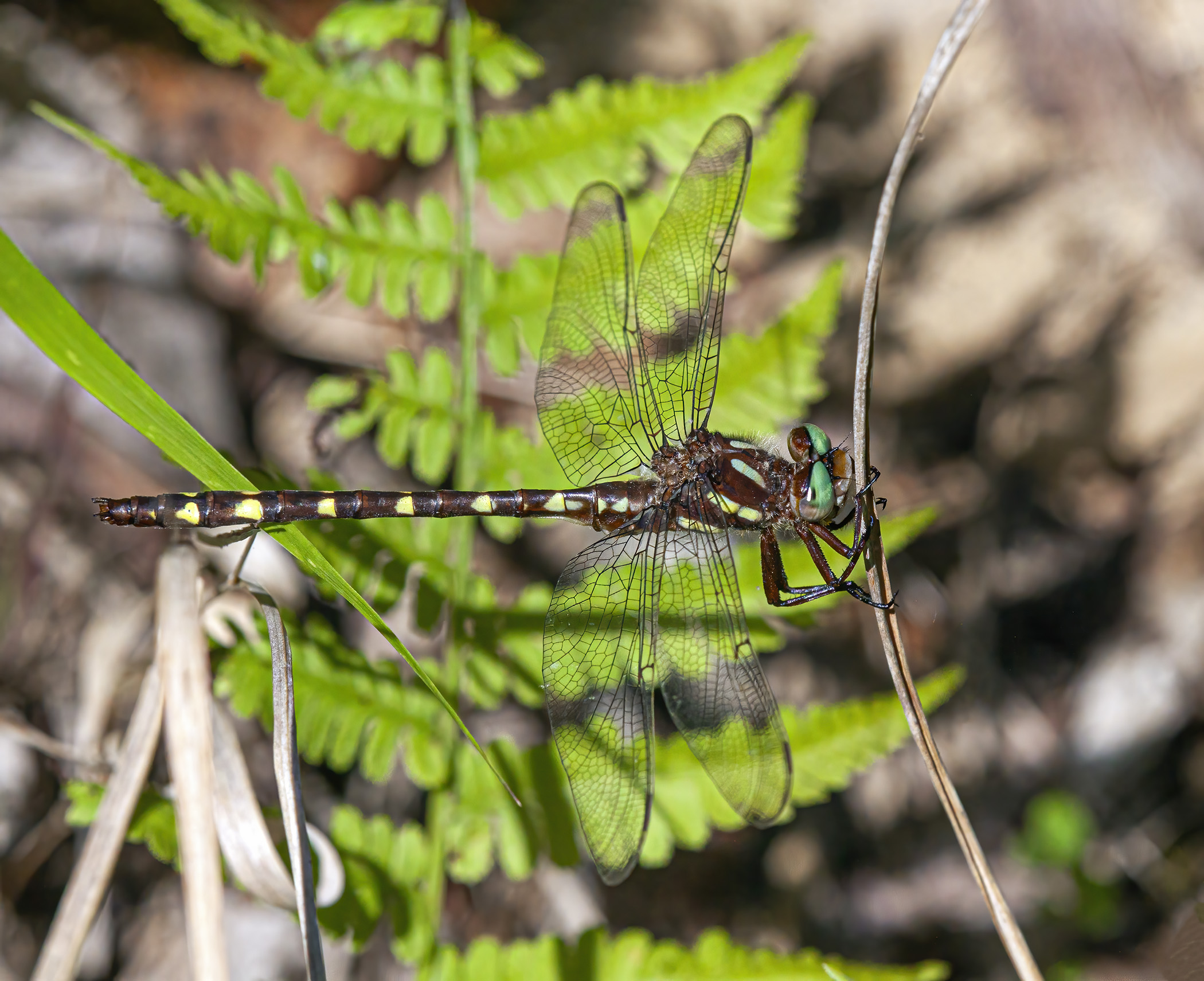
It is prime time for the bearded irises in the garden of my dear friend and fellow photographer Cindy Dyer. There are several dozen irises in bloom now in multiple colors, including these beauties, and it looks like even more flowers will be blooming soon.

Beauty is everywhere.

bearded irises

Bearded Iris

Bearded Iris

© Michael Q. Powell. All rights reserved.
Read Full Post »

It did not seem like there was much pollen inside of each little phlox flower, but bees were busily collecting it when I spotted several of them last Saturday at Meadowlark Botanical Gardens in Vienna, Virginia. I love the way that some bees, including honeybees, collect pollen in little pouches on their back legs. When the pickings are really good, I have seen those pouches, which technically are called corbiculae, so full and bulging that they seem ready to burst—that was not the case this early in the spring, when not very many flowers were in bloom.

I was pleasantly surprised when I managed to capture a bee in flight in the second photo below as it surveyed the phlox flowers and planned its next assault. My 180mm macro lens is notoriously slow to acquire focus, so I rarely try to use it to try to capture moving subjects. The lens also is so noisy when focusing that one of my friends calls it “The Grinder.” Nonetheless, my trusty Tamron lens is my constant companion during the warm months and it is the one I use most often for my insects and other macro shots.

bee and phlox

Bee and Phlox

© Michael Q. Powell. All rights reserved.


Read Full Post »

Some of the coolest looking plants that I saw last Saturday at Meadowlark Botanical Gardens were Japanese Jack-in-the-Pulpit flowers (Arisaema sikokianum). There is something so alien and exotic about this plant that it stopped me in my tracks when I first spotted it.

According to the Plant Delights Nursery, Inc. website, the dark pitcher and two five-lobed leaves of this plant emerge on a 12 inch tall (30 cm) fleshy stalk from an underground tuber in early spring. As the pitcher opens, it reveals a swollen, pure white, protruding spadix that provides a dramatic contrast to the purple of the pitcher.

The Japanese Jack-in-the-Pulpit is closely related to the Jack-in-the-pulpit (Arisaema triphyllum), which, according to Wikipedia, is common to the eastern United States. I checked the range map and the Jack-in-the-Pulpit can be found in Virginia where I live, though I have not yet spotted one. When I looked at photos of the American species, it looks fairly similar to the Japanese variant, but the spadix, the part that is the “Jack” in the name, is darker in color and the pitcher more closely matches the leaves. Check out this blog posting by Steve Gingold to see a beautiful photo of a Jack-in-the-Pulpit growing wild in his area of New England.


Japanese Jack-in-the-Pulpit

Japanese Jack-in-the-Pulpit

Japanese Jack-in-the-Pulpit

© Michael Q. Powell. All rights reserved.

Read Full Post »

I am a bit of a romantic, so my eyes are immediately drawn to the heart-shaped blooms of Bleeding Heart flowers whenever they are present in a springtime garden. Most of the time they are reddish in color, as their name suggests, but they also come in other colors. I spotted these beautiful White Bleeding Hearts (Dicentra spectabilis alba) last Saturday at Meadowlark Botanical Gardens.

I was fortunate to be able to get close enough for the first photo to be able to focus on the delicate shape of a single flower. Somehow the little wings on the hearts make me think of angels or maybe the little cherubs that we associate with Valentine’s Day. The second image gives you an idea of the way that these flowers grow in rows, suspended from tiny filaments from a stalk, twisting and turning in the wind.

Bleeding Heart

Bleeding Heart

© Michael Q. Powell. All rights reserved.
Read Full Post »

A speedy little Barn Swallow (Hirundo rustica) was perched on a paved path at Meadowlark Botanical Gardens last Saturday and I captured this first image as it was taking off. The shot is a little blurry, but I love the the really cool shadow that the swallow was casting onto the ground. The second image shows the same swallow just before it took off and give you a better view of the coloration and markings of a Barn Swallow.

When I first spotted the birds in the final photo, I thought they might also be Barn Swallows, but when I took a closer look and did a little research, I determined that the bird on the outside of the nest was a male Purple Martin (Progne subis) and the one with her head poking out was a female Purple Martin. As far as I can recall, this is the first time that I have photographed this bird species, which is the largest swallow in our area.

Barn Swallow

Barn Swallow

Purple Martin

© Michael Q. Powell. All rights reserved.


Read Full Post »

I love the shape and colors of columbine flowers that appear in many of the gardens that I visit during the spring. According to Wikipedia, the genus name for these flowers Aquilegia is derived from the Latin word for eagle (aquila), because of the shape of the flower petals that are said to resemble an eagle’s claw. The common name “columbine” comes from the Latin for “dove”, due to the resemblance of the inverted flower to five doves clustered together.

I spotted several spectacular columbines during a visit to Meadowlark Botanical Gardens in Vienna, Virginia last Saturday. The purple columbine was in the middle of a flower bed and I could not get very close to it. I was really happy though that I had to shoot from a longer distance away than normally, because I able to capture some of the shadowy shapes of the ferns in the background.

I did manage to get quite a bit closer to the pretty pink columbine. I smiled when I saw a marker that indicated that this variety is called “Strawberry Ice Cream.” I now have an overwhelming urge to buy some strawberry ice, one of the many ice cream flavors that I love.

columbine

columbine

© Michael Q. Powell. All rights reserved.


Read Full Post »

As we were photographing some Spring Snowflake flowers (Leucojum vernum) on Saturday at Meadowlark Botanical Gardens, my dear friend and photography mentor Cindy Dyer noticed what looked like a spider’s leg on the side of one of the flowers and asked me to go around to the other side of the flower to investigate.

Sharp-eyed Cindy was right—I spotted this tiny spider clinging to the side of the snowflake and was delighted that I was able to capture this image of it.

Leucojum vernum

© Michael Q. Powell. All rights reserved.

Read Full Post »

I love the rich color, velvet-like texture, and geometric shape of this beautiful little flower that I spotted yesterday at Meadowlark Botanical Gardens in Vienna, Virginia. I believe that this is a Red Trillium (Trillium erectum). According to Wikipedia, Red Trilliums are also known as wake robin, bethroot, and stinking benjamin.

I was curious about the name “stinking benjamin,” so I searched on-line and learned that Red Trilliums produce fetid or putrid odors purported to attract carrion fly and beetle pollinators. Some describe the odor as similar to that of a wet dog—I did not get close enough to verify personally the accuracy of this assertion.

Red Trillium

© Michael Q. Powell. All rights reserved.

Read Full Post »

Common Whitetail dragonflies (Plathemis lydia) are probably the most common dragonflies in my area. They are among the first species to appear in the spring and among the last to be seen in the autumn and can be found in a variety of habitats. I photographed my first Common Whitetails of the season last week at Accotink Bay National Wildlife Refuge.

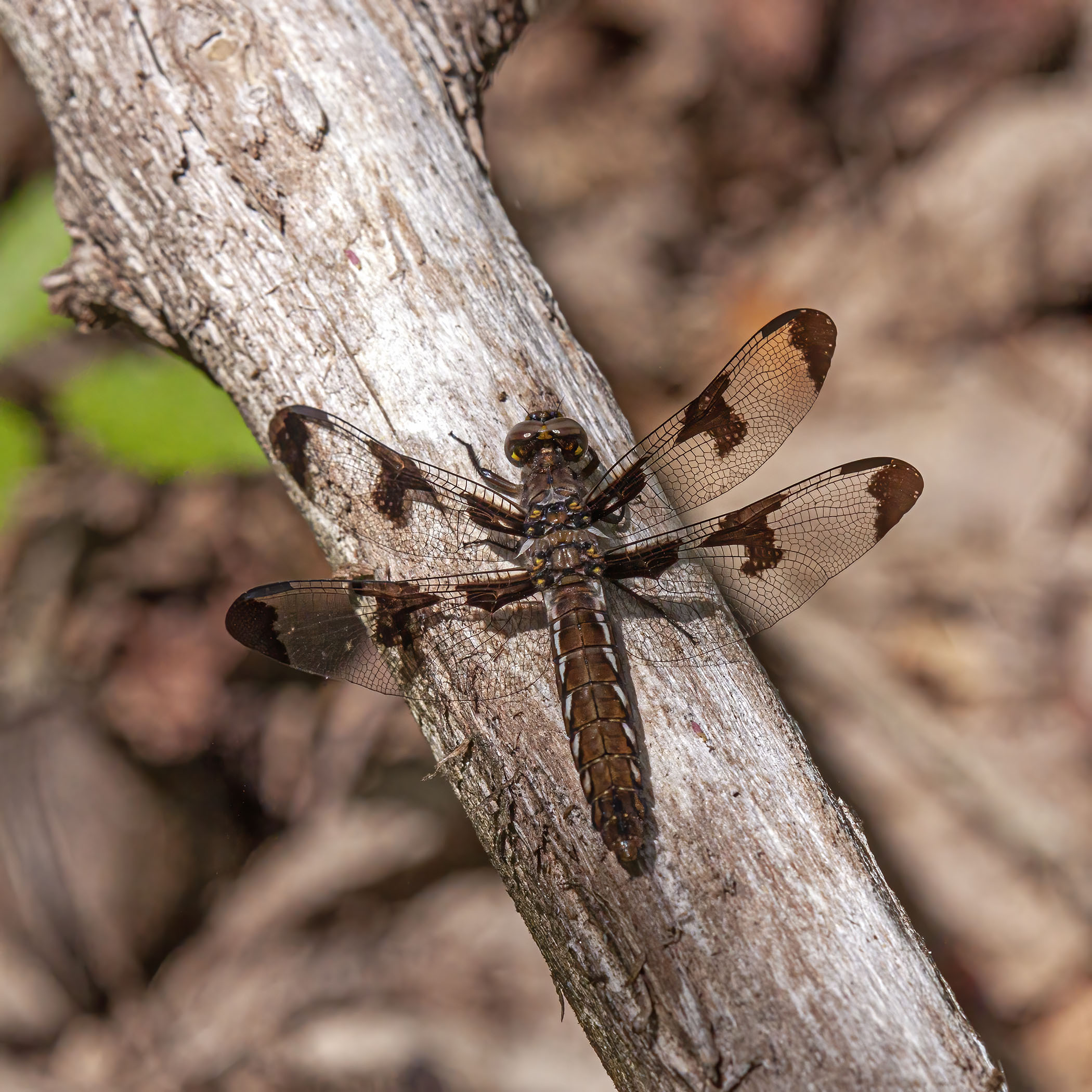
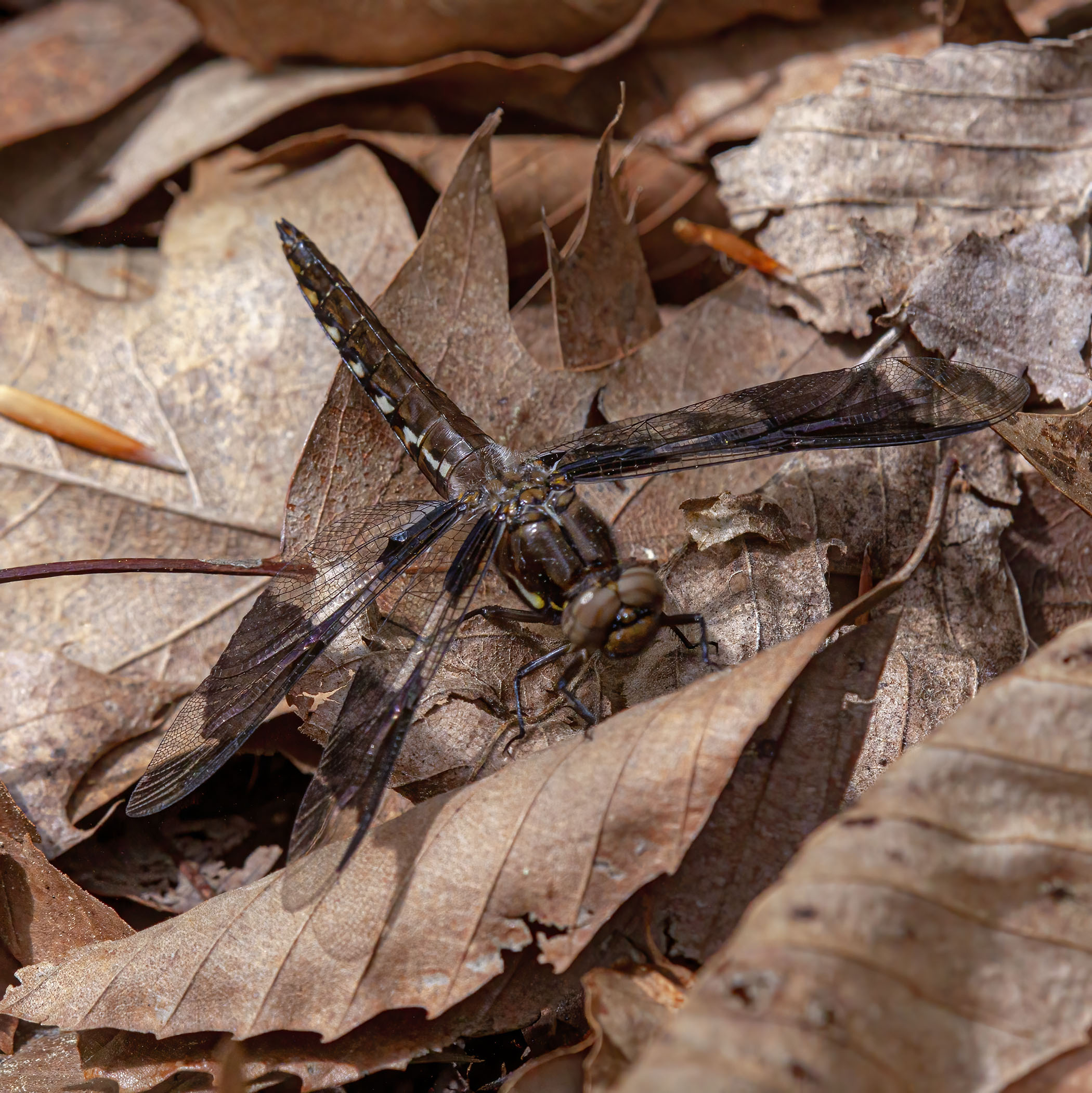
When they are adults, it is easy to distinguish the male Common Whitetails from the females—the males have white-blue abdomens and the females have brown abdomens. Immature males, however, have the same coloration as the females. If you look at the first two photos below, you can see that the coloration and markings on the two dragonflies is quite similar, but the first one is an immature male and the second one is a female.

For Common Whitetails, the first thing I do is to look at the pattern of dark patches on the clear wings. Males have two patches per wing and females have three, including one that extends to the wingtip. This is really easy to see in the first two photos, because the dragonflies were perched above the ground.

Quite often, though, Common Whitetails will perch flat on the ground in the leaf litter, as in the third photo, and it is a little tougher to see the wing markings. As long as you can see a clear wingtip, however, you can tell that it is a male.

There are, of course, other ways to tell the gender of a Common Whitetail, if you can’t see the wings. If you look really closely at the tips of the abdomen (the “tail”), for example, you can see that they are shaped differently—the male’s terminal appendages are more tapered, while the female’s are more stubby in appearance.

I don’t consider myself an expert in dragonflies and my background is not in science, but I have learned about these colorful aerial acrobats over the last ten years of photographing them. Folks sometimes ask me how I can tell the gender of a dragonfly and I think it cool to be able to explain what is going on in my mind when I am trying to figure out what I have photographed. This is especially true when I have photos that show both the male and female of a species, as was the case with these Common Whitetail dragonflies.

Common Whitetail

Common Whitetail

Common Whitetail

© Michael Q. Powell. All rights reserved.

Read Full Post »

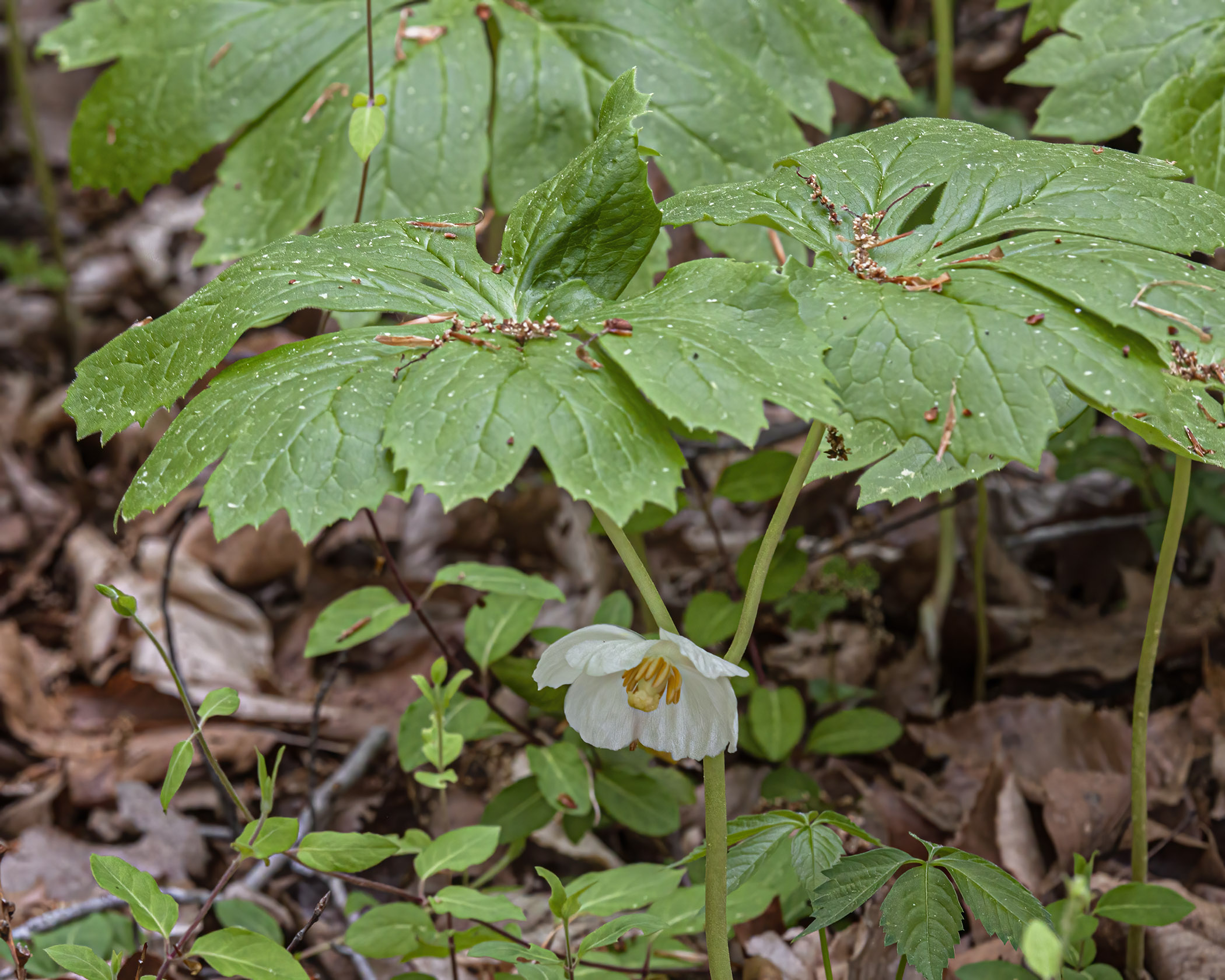
Most flowers have blooms at the end of their stems or at least in places above their leaves. Each spring, though, I encounter Mayapples (Podophyllum peltatum), a weird plant that seems to work in a totally different way. It puts out large umbrella-shaped leaves and eventually a single white blossom appears at the juncture point where the stem branches off in two directions. If you don’t know that the blooms are there, it is easy to miss them, because the large leaves hide them from view.

I saw a large number of Mayapples on Wednesday at Accotink Bay Wildlife Refuge at the edge of Fort Belvoir, a nearby Army base where I have seen Mayapples in the past, but most often before or after they had flowered. I tried to capture the unique way that this plant grows in these photos, which was a bit of a challenge, because the blooms are so close to the ground.

I came across a fascinating article on the Wisconsin Horticulture website that noted that Mayapple  “typically grows in colonies from a single root in open deciduous forests and shady fields, riverbanks and roadsides…The upright stems grow from a shallow, creeping, branched underground rhizome, composed of many thick dark or reddish-brown tubers connected by fleshy fibers and downward spreading roots at the nodes. Each terminal bud produces a shoot. The mostly unbranched 12-18 inch tall stems are topped with umbrella-like (peltate) leaves. The leaves remain furled as the stem elongates in the spring, unfolding when the stem nears its full height. Each smooth, pale green, rounded, palmate leaf has 5-9 shallowly to deeply cut lobes. There are one or two leaves per stem, each up to a foot across. Only stems with more than one leaf will flower. Mayapple often forms large, dense colonies in the wild.”

As most of you know, I focus mostly on wildlife in my photography, but my almost insatiable sense of curiosity draws me to anything weird and wonderful that attracts my attention, like these Mayapples.

mayapple

Mayapple

Mayapple

© Michael Q. Powell. All rights reserved.

Read Full Post »

I was tracking a Common Green Darner dragonfly (Anax junius) in my viewfinder yesterday at Occoquan Regional Park, when suddenly another dragonfly flew into the frame. The two dragonflies appeared to hook up in mid-air and I assumed that they were mating. When they landed in some nearby vegetation, however, I discovered that it was hunger and not lust that had brought them together. The Common Green Darner was having lunch with a Common Whitetail dragonfly (Plathemis lydia), and it was the main course.

Dragonflies feed on other live insects and they aren’t picky eaters—they will eat any insect they can catch, including other dragonflies. Midges and mosquitoes make up the bulk of their diet, but dragonflies also prey on flies, bees, beetles, moths, butterflies, and other flying insects. The larger the dragonfly, the larger the prey insect it can consume.

As you can see from the photo, Common Green Darners are quite large, with an overall length of approximately three inches (76 mm), while Common Whitetails are considerably smaller, with an overall length of approximately 1.7 inches (43 mm).

Common Green Darners are really powerful fliers too and are one of only a handful of dragonfly species that migrate. The adult Common Green Darners that I see this early in the season are likely to be migrants from locations further south. Kevin Munroe described their migration really well on the wonderful Dragonflies of Northern Virginia website:

“They emerge in the Southeast and fly north, arriving here late March thru May. After their long flight, they mate, lay eggs and die. Their young emerge in July and August. Congregating in large swarms, this second generation begins flying south in September. They lay eggs that fall, after arriving in their southern destinations, and die. When their young hatch in March, they fly back to N. VA and it starts again – a two generation migration.”

The Common Whitetail in the photo probably emerged only recently and may have been particularly vulnerable. Some may find this photo to be a little disturbing or a bit too graphic, but I think it shows the “circle of life” in nature. Yesterday the Common Green Darner was the predator, but tomorrow it could become the prey of a bird or some other creature higher up on the food chain—all creatures have to eat.


Common Green Darner

© Michael Q. Powell. All rights reserved.

Read Full Post »

When the dragonfly season first starts, I am content to get a record shot of each species, which is to say that I am looking primarily to document the species and am not all that concerned about the quality of the initial images or their artistic merits. After the first excitement dies down, I try to get better and better images and one of the things that I often try to do is to photograph males and females of each species.

How do you tell the gender of a dragonfly? In some dragonfly species, the mature males and females have different colors and are easy to tell apart. However, quite often immature males have the same coloration as the females, so color alone is rarely a reliable marker. I have found that the best way to determine the gender is to look at the tips of the abdomen (the “tail”)—I won’t go into the details of dragonfly anatomy, but suffice it to say that the males and females have different shapes in this area so they can fit together for mating.

Over the last two weeks I have had several encounters with Uhler’s Sundragon dragonflies (Helocordulia uhleri) and was able to get shots of both a male and a female. The dragonfly in the first image is a female. I can tell its gender by the shape of the “terminal appendages” and also by the curved shape of the hind wings where they join the body.

If you look closely at the second image, which is a shot of a male, you can see that the lower portion of the abdomen is slightly enlarged—the abdomen is more uniformly shaped with a female—and the shape of the tip of the abdomen is different. You might also notice that the shape of the hind wings is “indented” where they meet the body, unlike the smooth curves of the female.

With some species, you can find the males and the females in the same area, so it is not hard to get shots of both genders. However, with other species, the females hang out in separate areas and do not mingle with the males until the females decide it is time for mating, which forces me to search a much wider area to photograph males and females.

I apologize if I got a little “geeky” in this posting. I am a little obsessed with dragonflies and am endlessly fascinated by them, so it is easy for me to get a little lost in the details.

female Uhler's Sundragon

male Uhler's Sundragon

© Michael Q. Powell. All rights reserved.

Read Full Post »

« Newer Posts - Older Posts »