Feeds:
Posts
Comments

Posts Tagged ‘Tamron 18-400mm’

Our recent warm weather has brought out a whole lot of little creatures. As I was hiking about in Prince William Forest Park last week, I notice a spot of bright red moving about on a rock at the edge of a small creek. When I looked at it more closely, it had a shape that made it look like a tiny red spider.

I did some initial searches when I returned home to see if I could identify the spider. I could not find an exact match, but I think this might be a spider mite (or some kind of mite) rather than an actual spider. If I understand it right, mites and spiders belong to the same family of arachnids, though I might have this wrong.

spider mite

© Michael Q. Powell. All rights reserved.

Read Full Post »

When the weather is sunny, turtles at local ponds often bask in the sun in large groups. Sometimes the turtles are packed in so tightly that it looks like a mall parking lot at Christmas time. The turtles seem to have no concept of “personal space and often are leaning against each other.

I spotted a few turtles on Wednesday at Prince William Forest Park and was struck by the fact that all seemed to have chosen solitude over solidarity—they were perched by themselves.

The first one, a small Painted Turtle (Chrysemys picta) was perched on a small log in the shallow part of a marshy area. I really like the limited color palette of this image, made up of mostly earth tone. If you look carefully, though, you can spot a few red markings on the turtle’s neck.

The second turtle, a much larger Painted Turtle, had crawled entirely out of the water and appeared to be napping on dry land. The greenery in this image gives it a much more lively feel than the first image and the bright red markings on the turtle’s neck are much easier to see.

Like these two turtles, I tend to avoid crowds and like to be myself when I am pursuing my photography. Go with the crowd? No, I will leave that to others.

Painted Turtle

Painted Turtle

© Michael Q. Powell. All rights reserved.

Read Full Post »

For a brief period in the spring, the forest floor is carpeted with wildflowers. It is still a little early for most of the wildflowers to appear but on Wednesday I spotted a few early blooming ones during a hike in Prince William Forest Park in Northern Virginia.

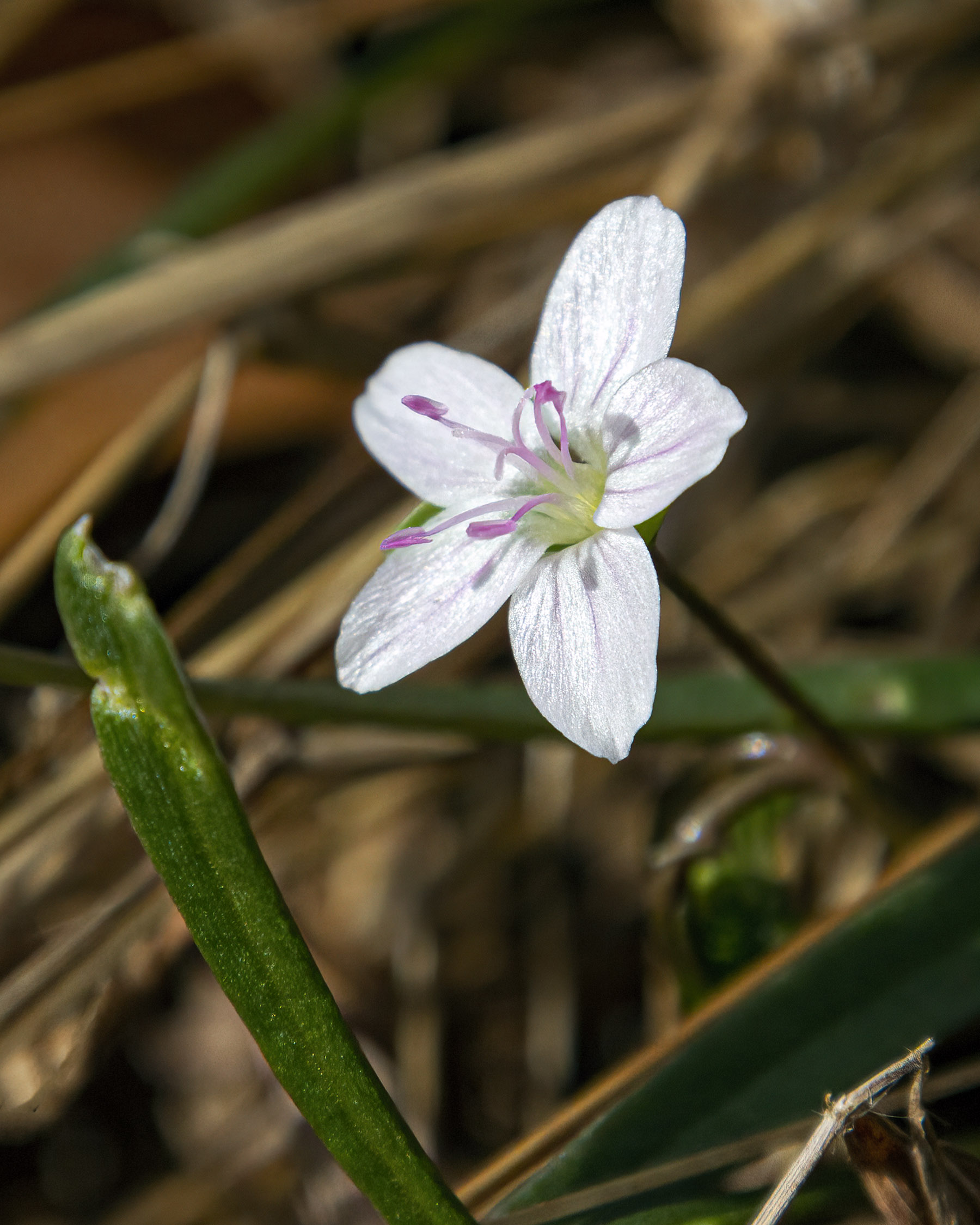
The little wild flower in the first photo is the appropriately named Virginia Spring Beauty (Claytonia virginica). I love the pops of pink in this flower, especially the stamens. According to Wikipedia, “The individual flowers bloom for three days, although the five stamens on each flower are only active for a single day.” Yikes! I guess the Spring Beauties qualify as being “ephemeral.”

The flower in the second photo is often referred to as a Quaker Lady Bluet (Houstonia caerulea)—it is also known as the Azure Bluet. Later in the spring I am certain to encounter large clusters of this cool little flower, but on this occasion there were only a few of them. I love the simple geometric pattern of the petals that someone decided resembled the traditional hats worn by Quaker ladies.

Virginia Spring Beauty

Quaker Lady Bluet

© Michael Q. Powell. All rights reserved.

Read Full Post »

Yesterday I went on a hike at Prince William Forest Park, the largest protected natural area in the Washington D.C. area at over 13,000 acres (53 square kilometers), that is located about 27 miles (43 km) from my home. Unlike the wildlife refuge that I usually visit, which is on a coastal plain, Prince William Forest Park, as its name suggests, is heavily wooded and it is quite hilly. I love to walk along the many creeks and streams that crisscross the park—the sound of the flowing water always has a therapeutic effect on me.

I was thrilled to spot this beautiful Question Mark butterfly (Polygonia interrogationis) as it perched on some leaves in a marshy area adjacent to one of the creeks. I could not tell for sure, but it looked like this butterfly was sipping water, possibly gathering nutrients from the soil. Question Mark butterflies and their punctuation “cousins,” the Eastern Commas, overwinter as adults, so they are among the earliest appearing butterflies in the spring.

Question Mark and Eastern Comma butterflies are quite similar in appearance. When the wings are fully open, as in the photo below, you can see a brown dash near the top of the upper wings that is not present on the wings of Eastern Comma butterflies.

Question Mark butterfly

© Michael Q. Powell. All rights reserved.

Read Full Post »

Most of the photos in my most recent blog postings were captured during my hike last week at Prince William Forest Park, which was a break from my usual wildlife-focused images. It is time to hit the trails again after this brief respite, but I thought I would conclude this mini-series with a final photo from the hike.

Many of you know that I love shadows and I was really struck by the tree shadows falling across the trail during the early stages of the hike. The photo gives you an idea of the size and density of the forest in which I was immersed. This trail was wide enough to serve as an emergency access route, but the majority of the trails that I traversed later in the day were significantly more narrow. The trails were pretty well defined and there were painted blazes on the trees, which were particularly useful when trails crisscrossed each other.

I grew up in New England and memorized a number of poems by Robert Frost. One of his most famous poems is entitled “The Road Not Taken.” Somehow the opening words of that poem always come to mind when I am hiking on forest trails, “Two roads diverged in a yellow wood, and sorry I could not travel both and be one traveler, long I stood and looked down one as far as I could to where it bent in the undergrowth…”

In this case, however, the pictured road is the road that was taken. That day, I stuck to a familiar path, though I am prone to wander and love to explore. Who knows what I might discover beyond the next twist of the road.

trees

© Michael Q. Powell. All rights reserved.


Read Full Post »

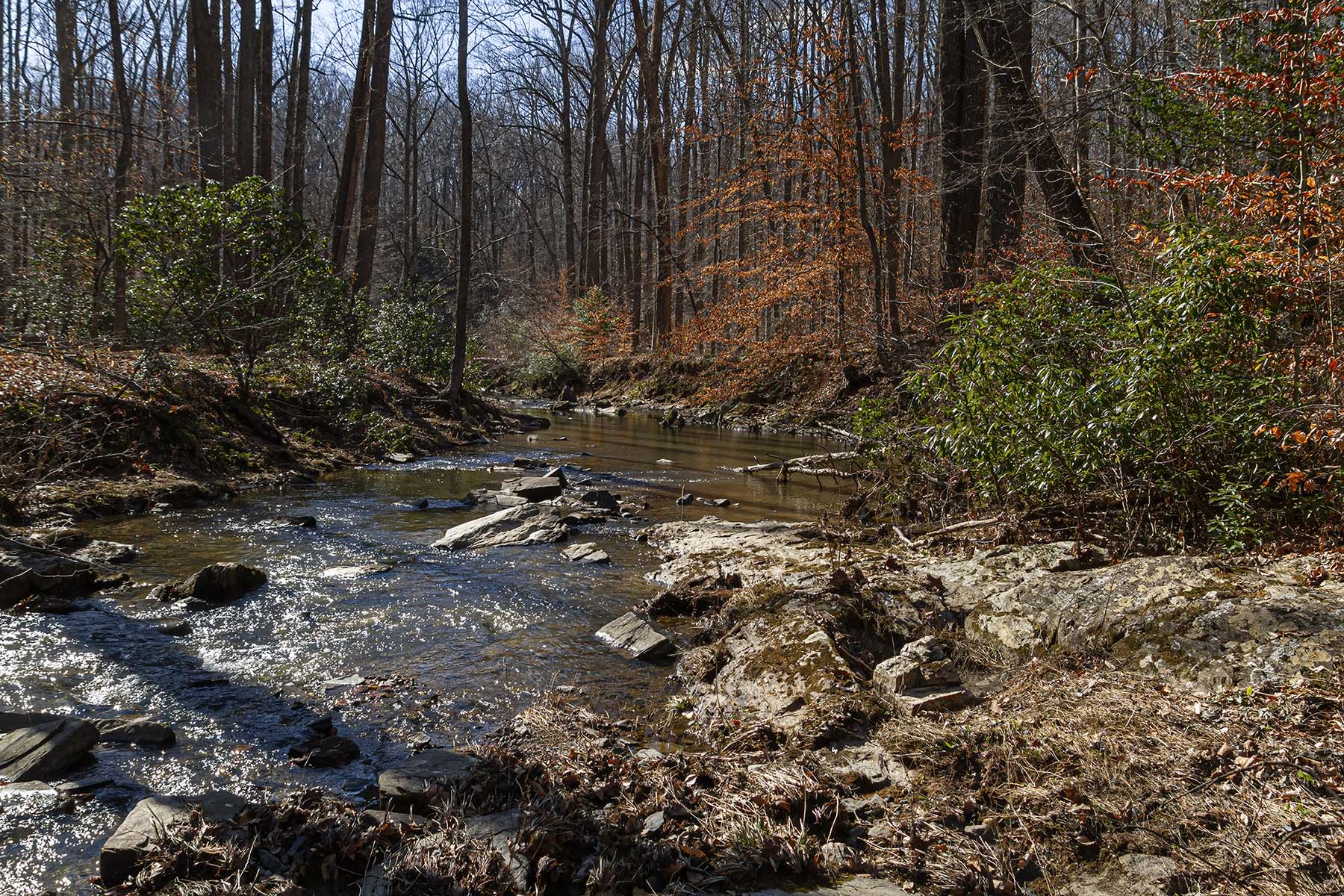
There is something special and soothing about the sound of flowing water. During my hike last week in Prince William Forest Park, I spent much of my time following  Quantico Creek and listening to the different noises that it made as it moved through the varying landscapes.

The terrain I traversed was hilly and the elevation diagram below from my GPS software shows the ups and downs of my hike. From the area where I parked my car I had a rather steep descent to the creek. The first photo was my first view of the creek and gives you an idea of its size. Although the water appears quite still, it was moving towards the dam shown in the second photo that was only a short distance downstream.

To get to the next section of the creek, I had to climb up and over a ridge before beginning a long descent to a series of small cascades, one of which is shown in the penultimate photo. I followed the creek for a while as it continued to flow downhill, gradually flattening out a bit and giving me views like the one in the final photo.

Eventually, I turned around and headed back toward my car, partially retracing my steps and then taking a more direct and steeper route. During the three hours or so that I was on the trails I did not see another person. It is a little selfish, I know, but I prefer not to share my nature experiences with others. I like to proceed at my own pace, stopping whenever I choose, immersing myself in the beauty of nature, reviving and refreshing my soul.

Quantico Creek

Quantico Creek

Quantico Creek

Quantico Creek

© Michael Q. Powell. All rights reserved.


Read Full Post »

I had low expectations for capturing images of birds when I set out for a hike this past Tuesday at Prince William Forest Park. I knew from past experience that I was unlikely to see very many birds as I walked up and down then hill at the park and alongside the streams. The birds that I was lucky enough to see or hear were likely to be hidden high in the trees, outside of the reach of the lens that I was carrying. Normally I shoot with a 150-600mm lens, but it is a bit heavy to tote around for hours on end and instead I carried my 18-400mm lens, a lighter and more flexible lens that allows me to take wide-angle and telephoto shots.

I did manage to capture a few photos that I am sharing here. The first one shows a Golden-crowned Kinglet (Regulus satrapa), an elusive species that is one of the smallest birds in our area. I tried to track this bird as it moved about and was happy to get a shot when it poked its head between some branches.

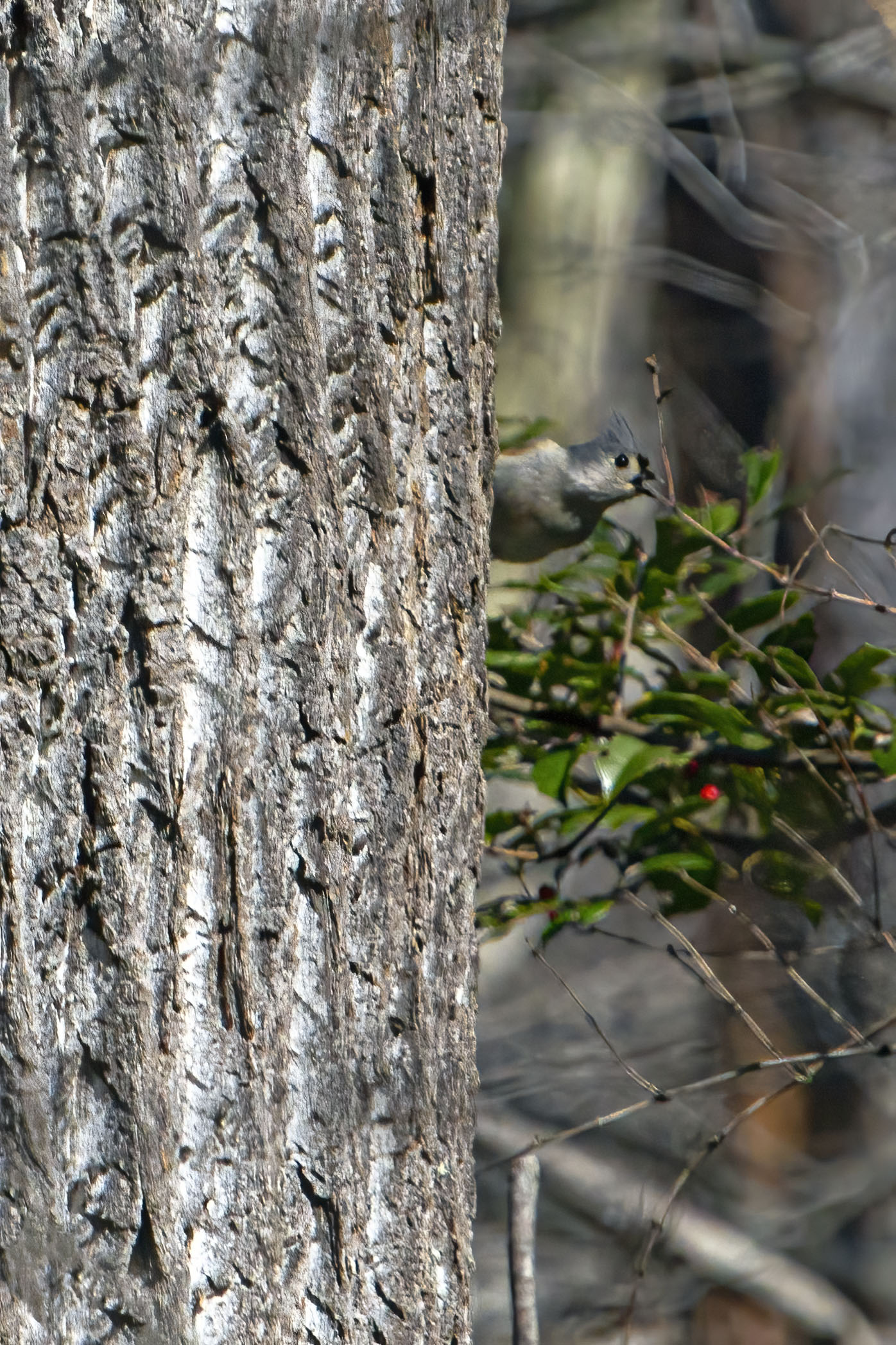
A Tufted Titmouse (Baeolophus bicolor) was also playing a combination of hide-and-seek and peekaboo with me. I captured the second photo below when the titmouse poked its head out from behind a tree trunk.

The final photo shows a Carolina Chickadee (Poecile carolinensis) that perched briefly almost directly overhead. This image has the cleanest composition of the three shots, but does not really give you a sense of the environment in which I found the little bird.

Some days it is nice just to commune with nature, to hear the sound of the rustling leaves and the babbling brooks, to observe the light and the shadows. Any photos that I do manage to capture are simply a bonus.

Golden-crowned Kinglet

Tufted Titmouse

Carolina Chickadee

© Michael Q. Powell. All rights reserved.

Read Full Post »

Prince William Forest Park is the largest protected natural area in the Washington D.C. metropolitan region  at over 13,000 acres (53 sq km). As its name suggests, it is is a heavily wooded area that is criss-crossed by numerous streams and creeks, most notably Quantico Creek.

There are over 37 miles of hiking trails in the park and this past Tuesday I walked a little over 6 miles (10 km) along some of my favorite trails. I knew that I would not see very much wildlife, but I really wanted to stretch my legs on a beautiful, sunny winter day. Occoquan Bay National Wildlife Refuge, where I most frequently go to photograph wildlife, is part of a flat, coastal plain, but Prince William Forest Park is hilly—according to my iPhone I climbed the equivalent of 19 flights of stairs that day.

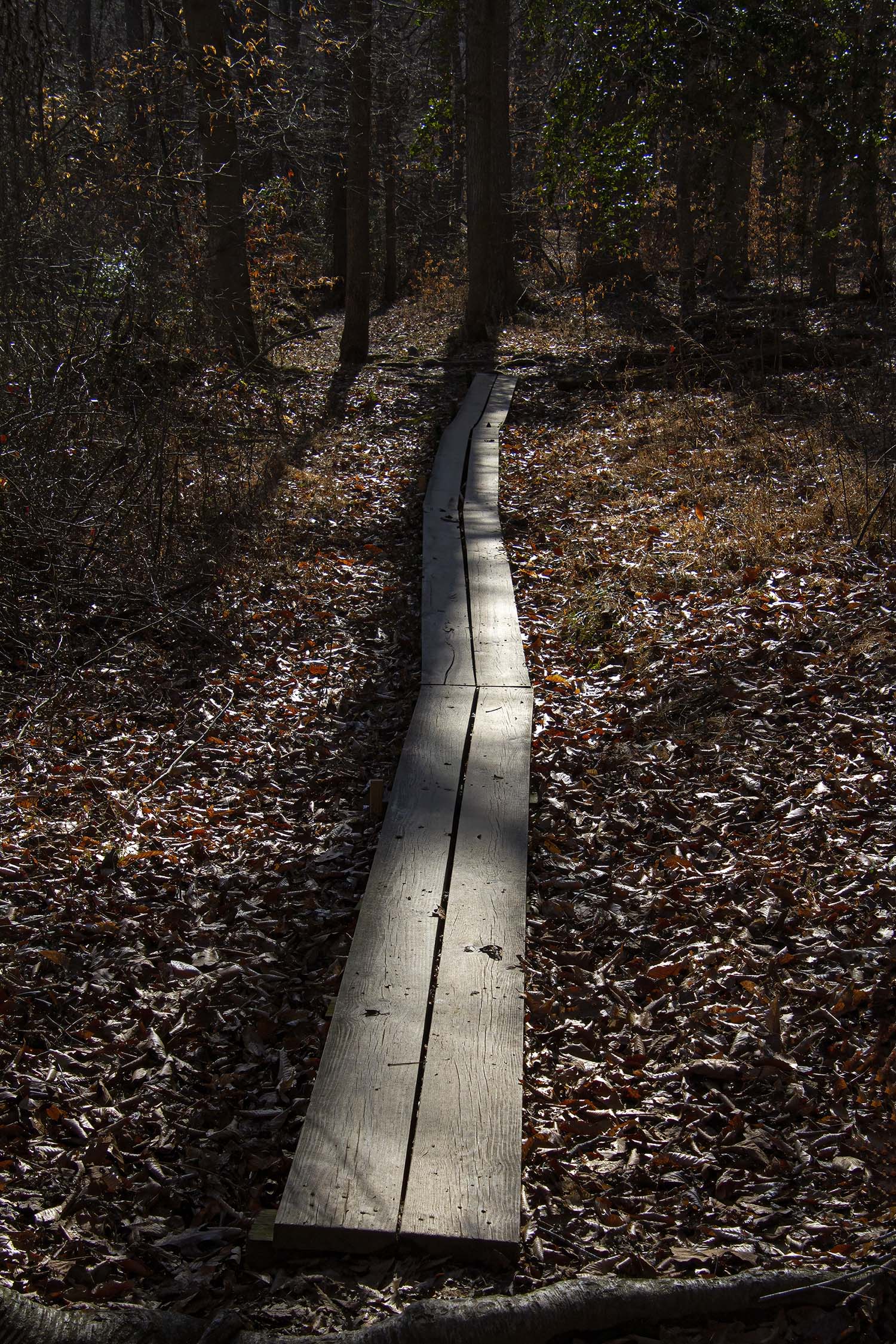
Some of the trails at Prince William Forest Park get mucky after a rain and I encountered two-board walkways like the ones in the first and last photos below at several spots while wandering about in the park on Tuesday. There were also some small bridges across streams (see second photo) and one larger bridge across Quantico Creek (see third photo). It really enjoyed checking out all of the different means that were in place to assist hikers in crossing wet areas and photographing subjects that are not my “usual” ones.

Prince William Forest Park is administered by the National Park Service and is wonderfully maintained. The trails are kept clear and are well-marked. I visit it most often in the spring, when wild flowers begin to appear on the forest floor and dragonflies start to emerge. If my memory serves me well, the earliest that I have seen dragonflies in my area was around the beginning of April, so I am waiting patiently for that time to come as we move through winter.

bridge

bridge

two-board bridge

© Michael Q. Powell. All rights reserved.

Read Full Post »

How do birds decide where they will perch? As I was reviewing my photos from a little hiking trip on Tuesday to Prince William Forest Park, I was shocked to see that a White-throated Sparrow (Zonotrichia albicollis) was perched in some prickly vegetation and was almost literally  surrounded by thorns. I had encountered similar thorns earlier in the day and can attest to the fact that they are sharp.

I could not help but notice how closely the claws on the bird’s tiny feet resembled those thorny protrusions.

White-throated Sparrow

© Michael Q. Powell. All rights reserved.

Read Full Post »

While I was composing a shot of this turtle at a small pond in Kingstowne, a suburban area only a mile or so from where I live, another turtle popped its head out of the water to photobomb its friend. I am pretty sure that the basking turtle is a Red-eared Slider (Trachemys scripta elegans), though I must admit that turtles are definitely not my speciality when it comes to identifying species.

We are in a transitional time of the year—we have already had some days with frost, but some other days have been warm and sunny. Today, for example, we may be flirting with record high temperatures up to 76 degrees (24 degrees C). Tomorrow, on the other hand, the high temperature is forecasted to reach only 52 degrees (11 degrees C).

turtle

© Michael Q. Powell. All rights reserved.


Read Full Post »

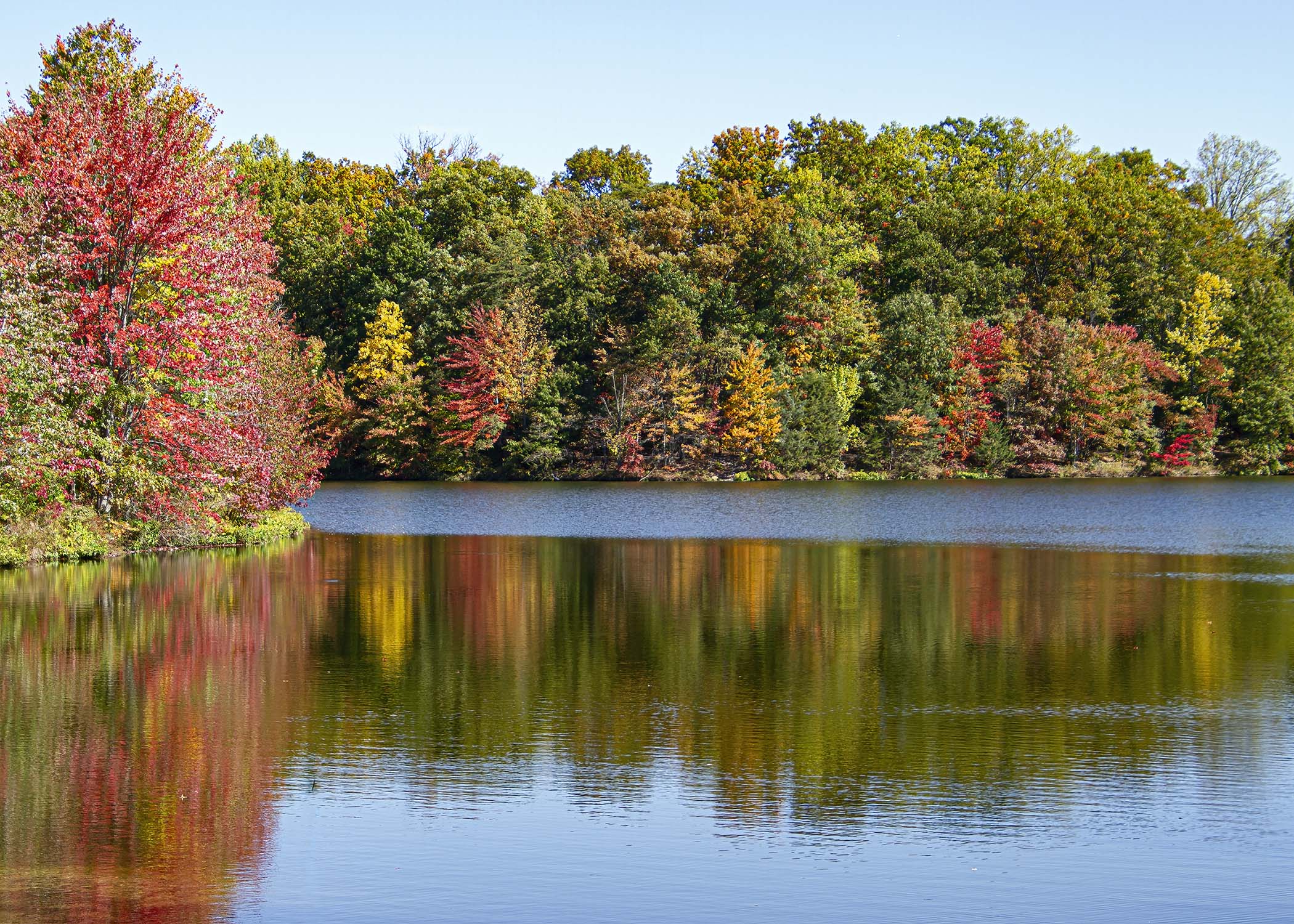
How do you capture the beauty of the fall foliage? I like to try a variety different approaches with my camera.  These three images of the water retention pond in Kingstowne, only a mile or so from my townhouse, convey some of my impressions of this colorful season.

The first image is perhaps my favorite of the three. By photography the reflections in the water I was able to remove the details of the foliage and focus on the colors and the light. It reminds me a little of some impressionist paintings by Monet and others.

For the second photo, I pointed my camera at a particularly colorful patch of leaves that were being backlit and zoomed in quite a bit. In addition to the brilliant colors, I really like the interplay of the light and the shadows.

The third image is the most “traditional” in its approach to the foliage—it is the kind of photo that you might see on a calendar. It provides the “big picture” that I sometimes forget to include in my normal photography, when I tend to concentrate on capturing the details of a subject with a macro or telephoto lens.

This season of autumn color will soon be coming to an end. When I left my house yesterday morning, I couldn’t help but notice that all of the streets and yards in my neighborhood were covered with fallen leaves. Life, it seems, is all about changes and celebrating each new moment.

autumn colors

autumn colors

autumn colors

© Michael Q. Powell. All rights reserved

Read Full Post »

I love the way these turtles were lined up on an upward-slanting log as they basked in the autumn sunlight last Tuesday at Jackson Miles Abbott Wetland Refuge. One smaller turtle looked like it was trying to merge into the traffic on the log, but the other turtles, like drivers in the Washington D.C. area where I live, were not letting him in.

The reflections in the water were a nice bonus and few floating leaves add little pops of autumn color.

turtles

© Michael Q. Powell. All rights reserved

Read Full Post »

Do you imagine a photo in your mind and then try to create it? Most of the time I am an opportunistic wildlife photographer—I react to the situations in which I find myself and try to make the best possible photo to capture the subject, the action, or the mood. Sometimes, though, I look at a spot and think, “Wouldn’t it be great if my subject moved into that light or onto that photogenic perch?”

On Wednesday I watched a lone Double-crested Cormorant (Phalacrocorax auritus) as it repeatedly dove into the water in a small suburban pond not far from my townhouse. Generally I encounter cormorants at larger bodies of water, but I know that this manmade pond is deep and is suited to birds that dive for food—some species of migratory diving ducks, for example, overwinter there.

The cormorant would spend quite a while underwater and I never knew where it would pop up next. I kept hoping it would surface in an area where the reflections of the fall foliage were especially colorful and eventually it did. The cormorant was quite far away, but I captured the kind of imagine that I had imagined, with colorful rippled patterns on the surface of the water as the cormorant swam into the frame. I encourage you to click on the imagine to see the details of the first image.

The second image was one of my earlier attempts. The cormorant surfaced closer to me than in the first shot, but the surface of the water was not as colorful as I wanted. However, the shot provides a really good look at the striking aquamarine eyes of this beautiful bird. Wow! Those eyes never fail to startle and delight me.

It is a fun challenge to try to incorporate the fall foliage into my photos and I have had an unusual amount of good luck in doing so this past week with a variety of subjects. I am starting to see more and more leaves on the ground, so I know that this period is transitory. Carpe diem!

Double-crested Cormorant

Double-crested Cormorant

© Michael Q. Powell. All rights reserved


Read Full Post »

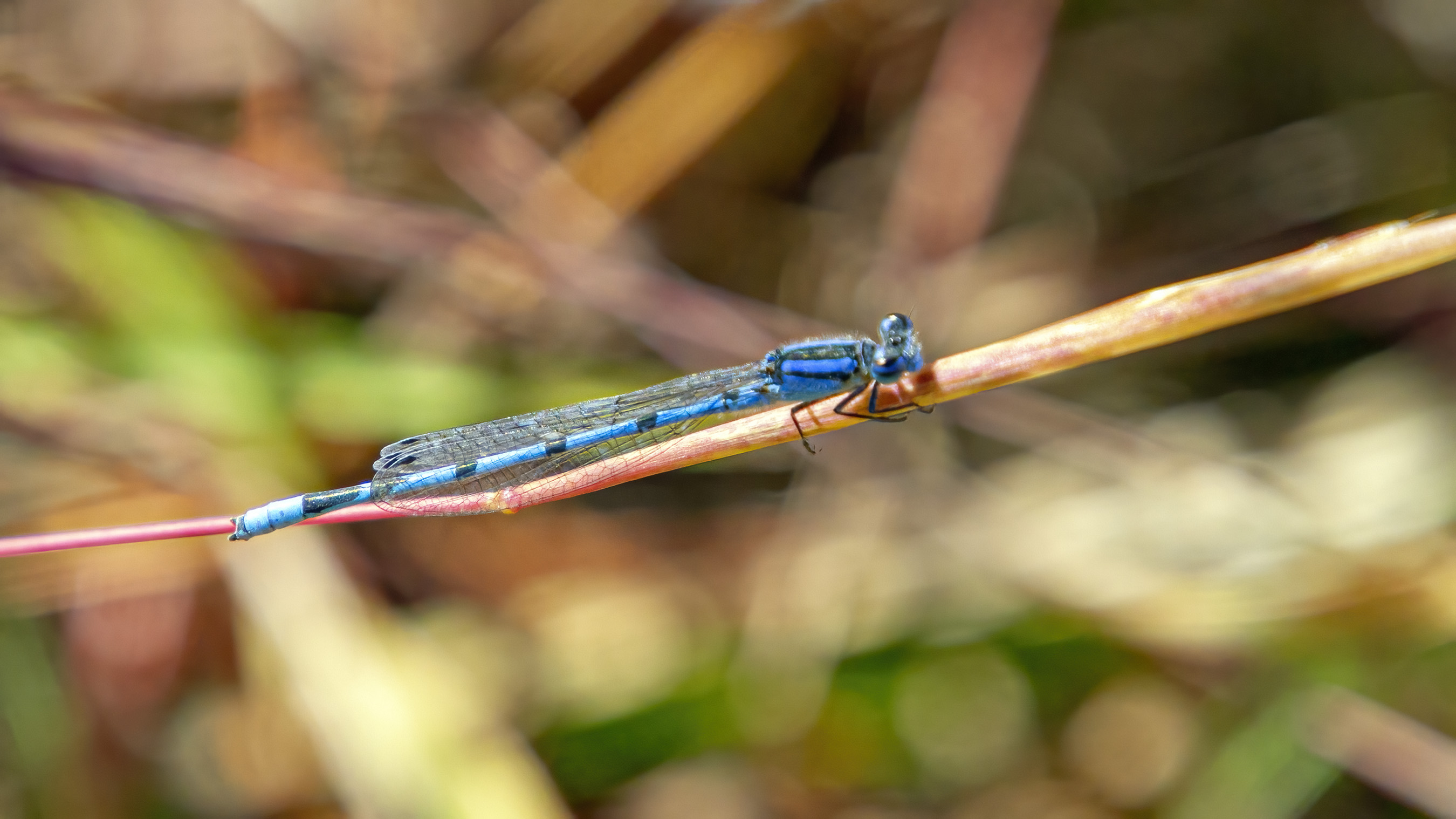
Like dragonflies, their larger “cousins,” damselflies have been rapidly decreasing in numbers this month. During recent visits to Occoquan Bay National Wildlife Refuge, I have seen only a few remaining damselflies. Therefore I was especially happy to spot this handsome male Familiar Bluet damselfly (Enallagma civile) last Tuesday.

The little damselfly seemed to be giving me a sideward glance as I carefully focused on him and I see a hint of what might be a smile. I really like the way that the background turned out in this image too—the colors and bokeh balls add additional visual interest without detracting from the primary subject.

Familiar Bluet

© Michael Q. Powell. All rights reserved.


Read Full Post »

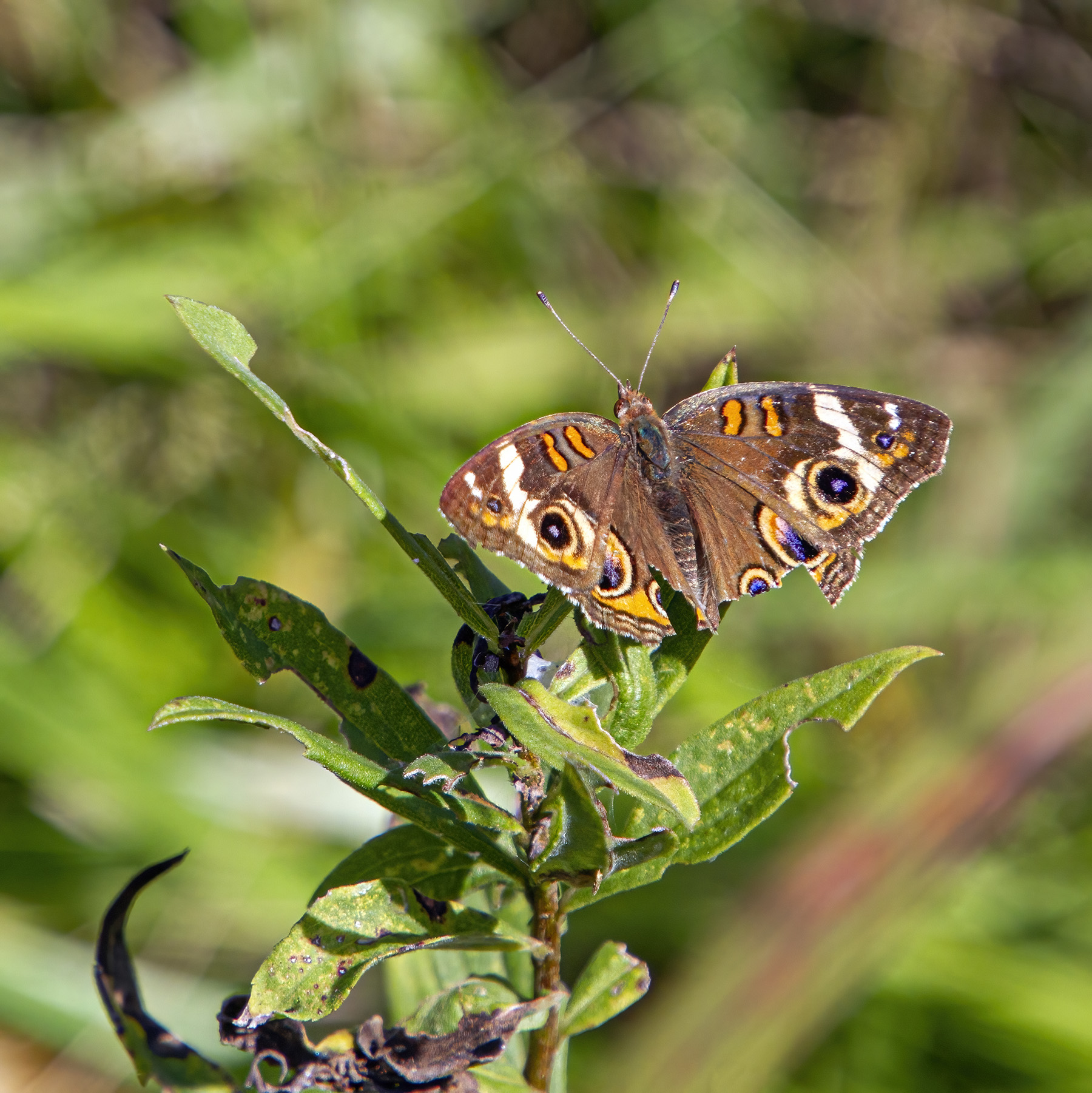
Many of the insects and plants that I now see show signs of the ravages of summer, like this damaged Common Buckeye butterfly (Junonia coenia) that I spotted atop an equally damaged plant during a recent visit to Occoquan Bay National Wildlife Refuge. Nonetheless the beauty of the butterfly shines through and it appears to be fully functional.

Autumn is a time for harvest celebrations as we rejoice in the bounty of the growth that has taken place, but there is also a tinge of melancholy as we experience a sense of loss and the feeling that our lives our changing. Change, of course, is a constant in our lives, but most of us—and I definitely fit into this group—become creatures of habit and have trouble dealing with changes at times. Yet we eventually adapt and may even learn to appreciate the results of the change, even if the process of change is a bit uncomfortable.

Common Buckeye

© Michael Q. Powell. All rights reserved.

Read Full Post »
I endlessly tried to track several Wandering Glider dragonflies (Pantala flavescens) as they flew back and forth over a field at Occoquan Bay National Wildlife Refuge last Thursday and was thrilled when one of them finally landed some nearby vegetation, allowing me to capture this image.

Wandering Gliders, also known as Globe Skimmers or Globe Wanderers, are considered to be the most widespread dragonfly species on the earth, with a good population on every continent except Antartica, although they rare in Europe. According to Wikipedia, Wandering Gliders “make an annual multigenerational journey of some 11,200 miles (18,000 km); to complete the migration, individual Wandering Gliders fly more than 3,730 miles (6,000 km)—one of the farthest known migrations of all insect species.”

This modest image was technically quite challenging to capture. The vegetation in this field was dense and the autofocus on my camera kept getting confused by the stalks of vegetation, so I had to resort to manual focusing. I was reluctant to move about very much for fear of rippling the vegetation and disturbing the dragonfly and therefore had to crouch in an awkward position close to the ground. It is certainly not an award-worthy photo, but I am thrilled whenever I manage to get a decent shot of a dragonfly species that rarely perches.

Wandering Glider

© Michael Q. Powell. All rights reserved.


Read Full Post »

This Great Blue Heron (Ardea herodias) was so well hidden that I could not tell if it was perched on a small raised portion of the ground or in a tree when I caught a glimpse of it during a recent visit to Occoquan Bay National Wildlife Refuge. My view of the heron initially was mostly obscured by the thick vegetation, but I managed to get a somewhat clear shot of it by climbing on top of a conveniently placed park bench.

Great Blue Heron

© Michael Q. Powell. All rights reserved.


Read Full Post »

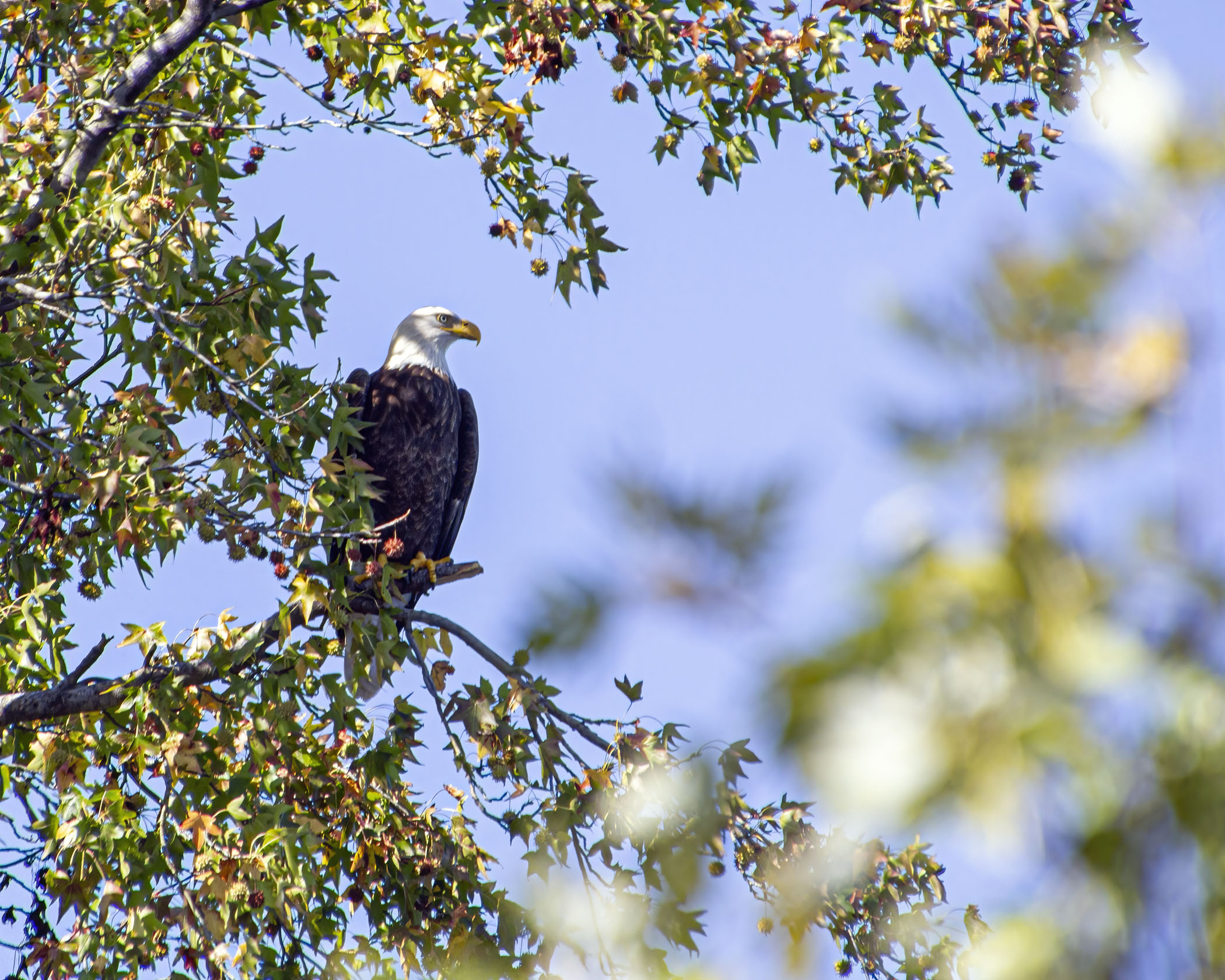
This Bald Eagle was almost hidden in the foliage of a sweet gum tree when I spotted it on Thursday at Occoquan Bay National Wildlife Refuge. Normally I depend on the brightness of a bald eagle’s head to give away the presence of an eagle, but in this case the eagle’s head was in partial shade, making it stand out quite a bit less than it usually does.

The second shot shows a view of the eagle from a different angle. Even though this shot does not show as much detail as the first shot, which was actually taken after the second one, I like the way that it shows how the eagle was nestled on its perch amidst all of the branches.

In the upcoming months, many of the leaves will fall from the trees and it will become marginally easier for me to spot an eagle from a longer distance away. Of course, that will also make it easier for the eagles to spot me and my vision and reflexes are rarely a match for those of the eagles. Often my first indication of an eagle’s presence is when it takes to the air and flies away from me.

Bald Eagle

Bald Eagle

© Michael Q. Powell. All rights reserved.


Read Full Post »

On Thursday I spotted this cool-looking Arrowhead Spider (Verrucosa arenata) , also known as a Triangle Orbweaver, at Occoquan Bay National Wildlife Refuge. This spider is one of the few known orbweavers that sits facing upwards in its web—all other species face downward.

Its distinctive triangle-shaped abdomen makes this species pretty easy to identify. If you look closely at the image, I think that you can see a couple of the spider’s large round eyes shining brightly in between several of the legs in the upper left portion of the spider’s body.

Arrowhead Spider

© Michael Q. Powell. All rights reserved.

Read Full Post »
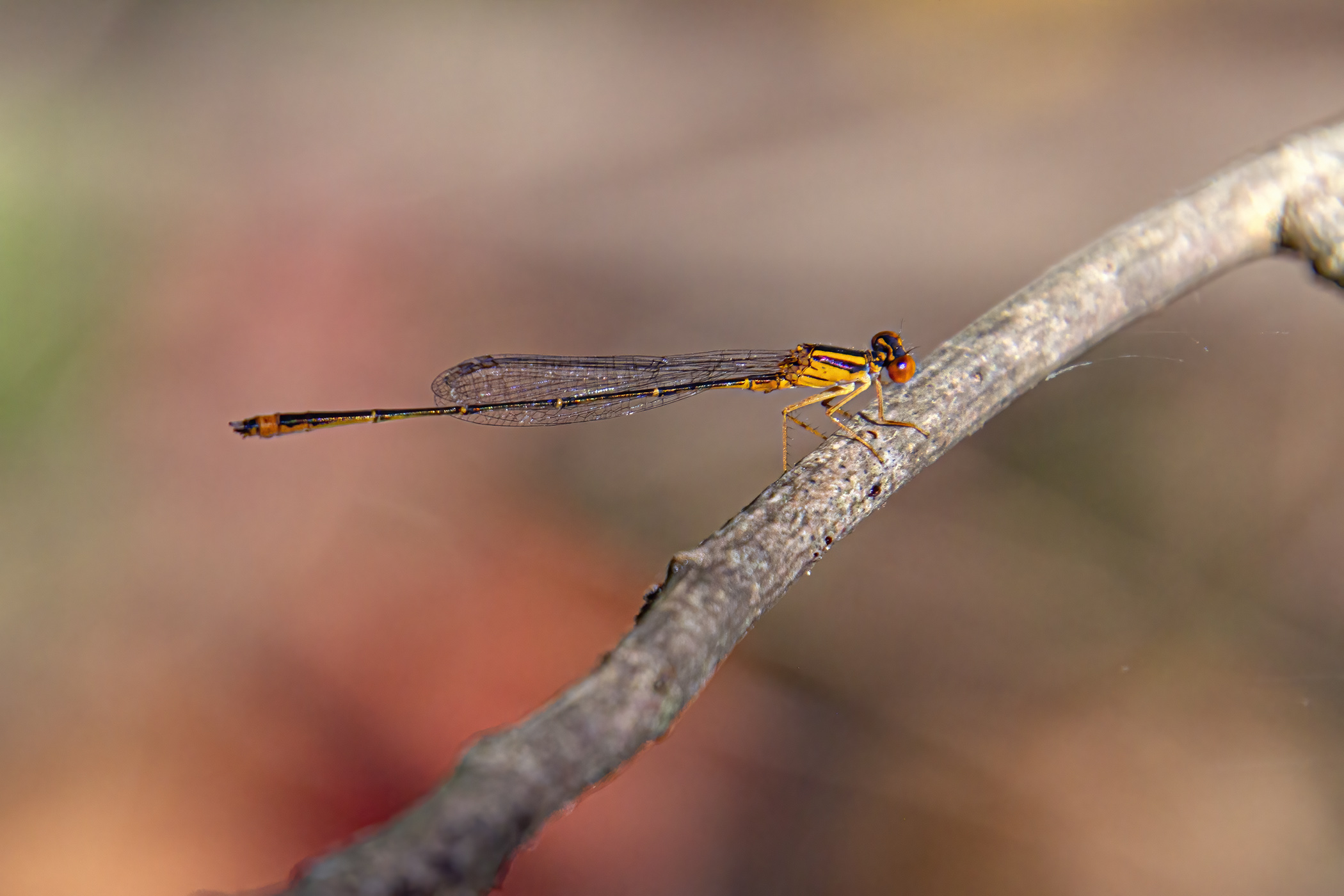
Although the name of this Orange Bluet damselfly (Enallagma signatum) sounds like an oxymoron, its colors are a perfect match for this autumn season. As the name suggest, most damselflies in the bluet family are blue, but they do come in other colors.

I photographed this handsome male Orange Bluet on 10 October at Occoquan Bay National Wildlife Refuge and was thrilled to be able to capture a little autumn color in the background of the image.

Orange Bluet

© Michael Q. Powell. All rights reserved.

Read Full Post »
There were several Common Green Darner dragonflies (Anax junius) flying overhead on 10 October at Occoquan Bay National Wildlife Refuge. One of them landed and perched momentarily low in the vegetation and I was able to capture this image.

I have been seeing fewer and fewer dragonflies on the ground as we move deeper and deeper into October, but in the air I have been seeing quite a few Common Green Darners, Black Saddlebags, and Wandering Gliders, the dragonfly species that migrate through our area. Many of the members of the surviving summer species appear to be faded and tattered, but the migrants appear to be bright and pristine.

The tangled grasses and vegetation where the dragonfly was perched were dried out and mostly void of color, which helps the green of the dragonfly’s thorax to really stand out in the photo. I also like the way that I was able to capture the transparency and details of the dragonfly’s wings.

Common Green Darner

© Michael Q. Powell. All rights reserved.

Read Full Post »

I spotted this Bald Eagle (Haliaeetus leucocephalus) in a distant tree on Tuesday at Occoquan Bay National Wildlife Refuge at about the same time that it spotted me. I reacted quickly and managed to capture this first image as it prepared to take off. As you can see, there is already a bit of color in our autumn foliage, but the colors are relatively muted here in Northern Virginia, compared to what I would see when I was growing up in New England.

The second photo shows the eagle a few seconds after its takeoff as it rose above the trees. At that moment its feet were still dangling, but it raised its “landing gear” shortly after I captured the image.

It has been a while since I last posted eagle photos and it was wonderful to have a couple of sightings of these majestic birds on a beautiful fall day.

Bald Eagle

Bald Eagle

© Michael Q. Powell. All rights reserved.

Read Full Post »

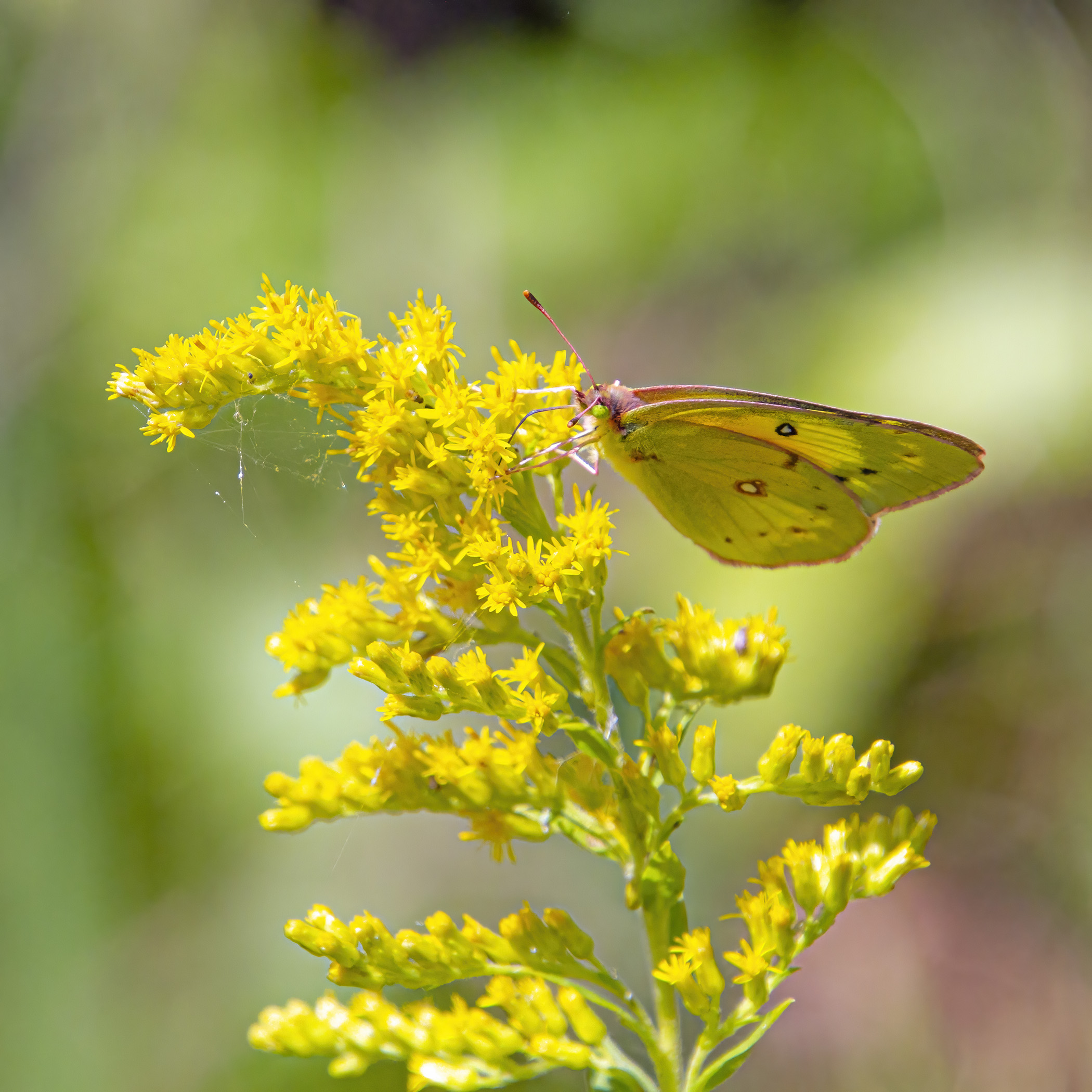
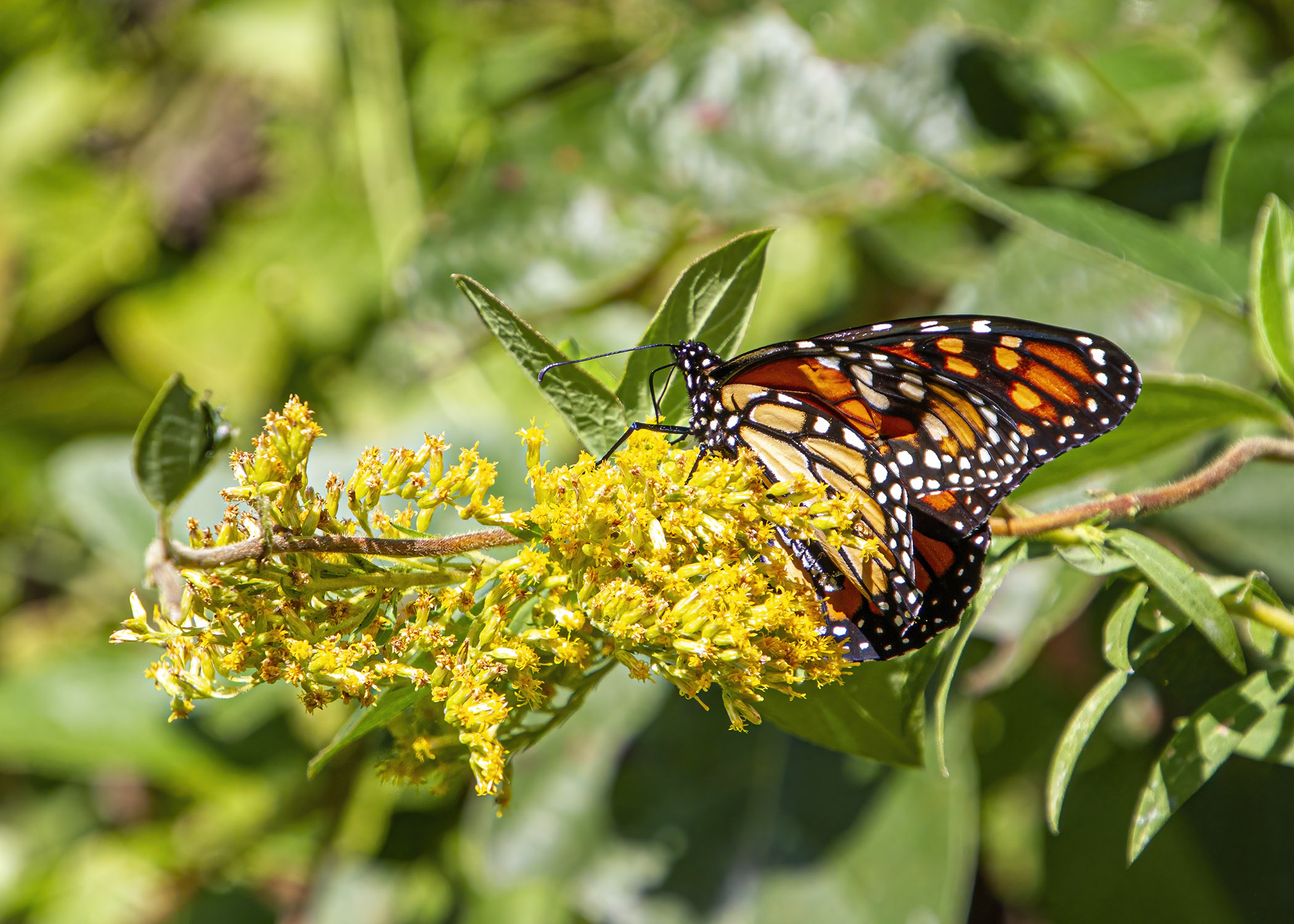
I love bright colors and instinctively smile when I see the large patches of goldenrod that are still in bloom at Occoquan Bay National Wildlife Refuge. The insects seem to love these flowers too and last Tuesday I spotted a large Monarch Butterfly (Danaus plexippus) and smaller Clouded Sulphur butterfly (Colias philodice) feeding on goldenrod.

Monarch

Clouded Sulphur

© Michael Q. Powell. All rights reserved.


Read Full Post »

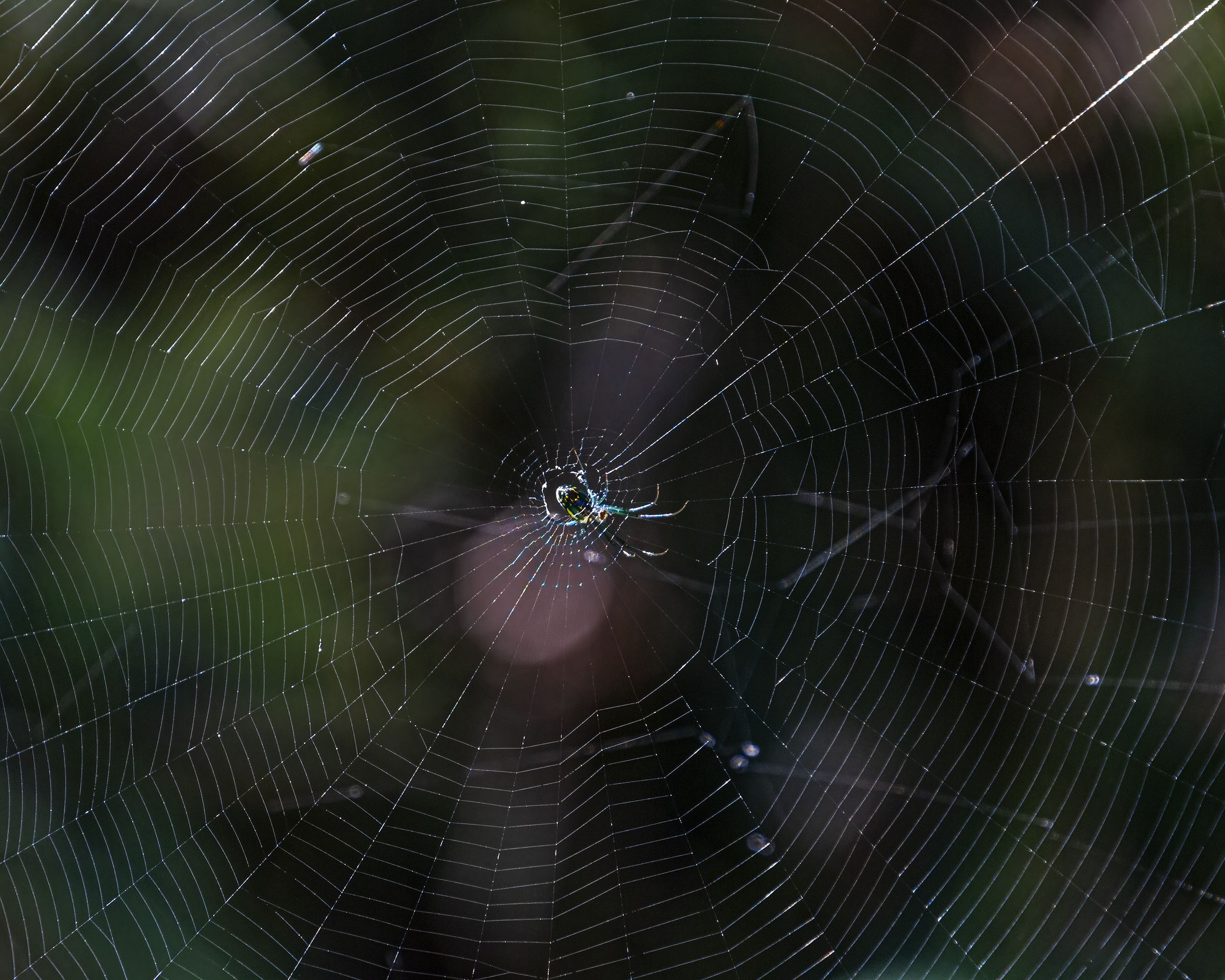
I am always amazed by the skill and artistry of spiders that construct elaborate webs, like this little Orchard Orbweaver spider (Leucauge venusta) that I photographed last Tuesday at Occoquan Bay National Wildlife Refuge. It is a bit of a challenge to capture an image of a web like this, especially in full daylight, but I managed to do so by focusing very carefully and deliberately underexposing the image so that the background appeared a bit darker than it was in real life.

Orchard Orbweaver

© Michael Q. Powell. All rights reserved.

Read Full Post »
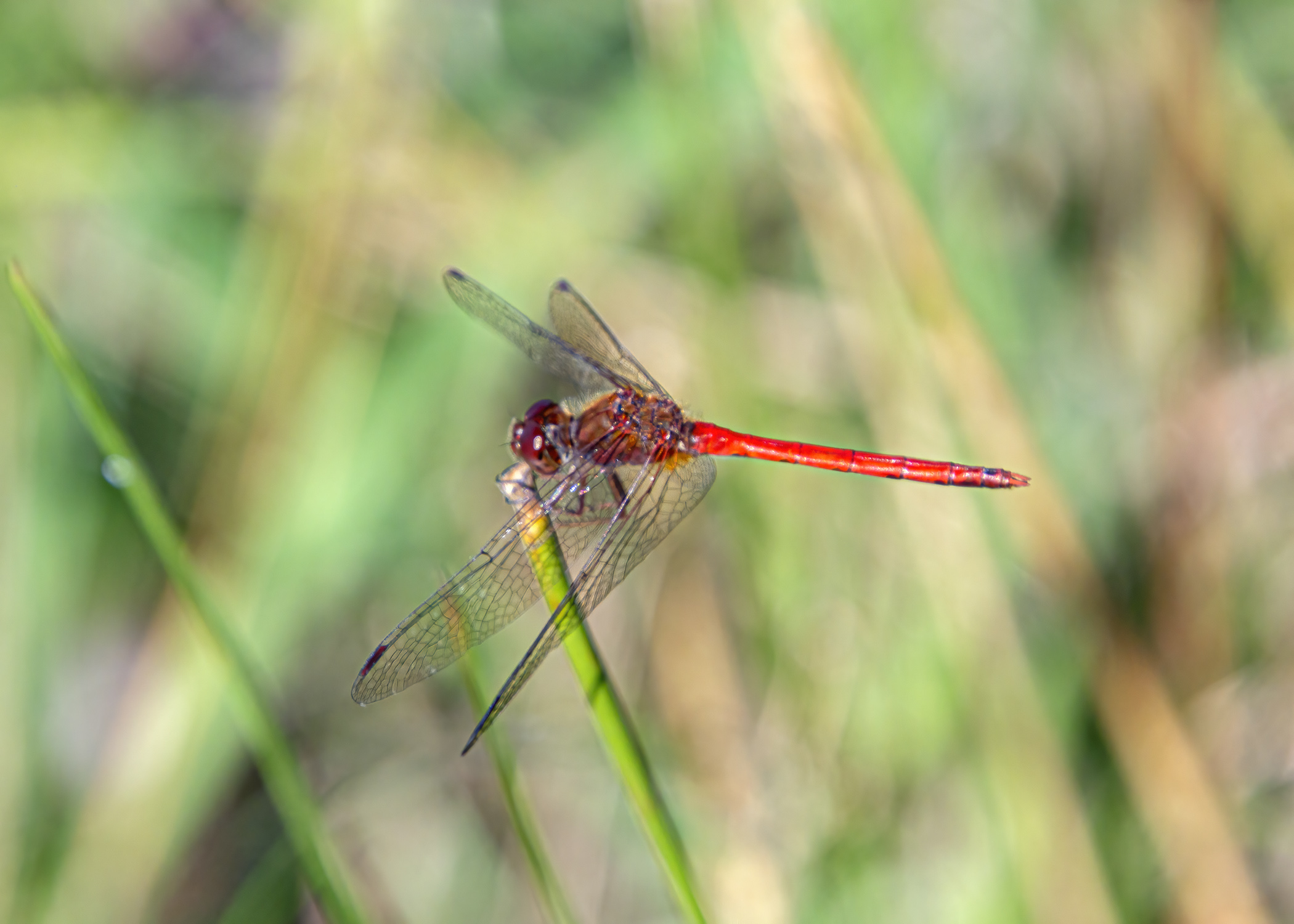
When the calendar turns over to October, I never know which dragonflies I will encounter. Many of them have disappeared, but some hardy survivors are still around. The weather was warm last week, with several days in the 80’s (27 degrees C), but this week, high temperatures are predicted to be in the low to mid 60’s (17 degrees C) with nighttime temperatures dipping to the upper 40’s (9 degrees C)—this cool weather is less than optimal for most dragonflies.

I was thrilled last Tuesday to spot this Twelve-spotted Skimmer dragonfly (Libellula pulchella) at the edge of a small pond at Occoquan Bay National Wildlife Refuge. I was especially pleased to be able to capture the beautiful patterns on this dragonfly’s wings as it perched in the reeds.

Twelve-spotted Skimmer

© Michael Q. Powell. All rights reserved.

Read Full Post »

What is going on in this photo? It is really cool to photograph the interaction between two species, but it is often difficult to interpret the nature of their exchange. Is it mere curiosity or are there more deadly and sinister intentions on the part of one of the actors? If so, which one is the predator and which one is the potential prey?

I captured this image this past Monday at Occoquan Bay National Wildlife Refuge. I could not identify either of these insects, so I posted the photo and requested identification assistance on bugguide.net, a wonderful resource for insect identification.  It did not take long before I received a response that the insects were an Orange Assassin Bug (Pselliopus barberi) on the left and a Milkweed Leaf Beetle (Labidomera clivicollis) on the right.

I may be giving too much weight to the “assassin” part of the name of one of these insects, but, judging from their individual postures, it seems to me that the orange bug is preparing to attack the black-and-red beetle. Who know? It is such a cool and creepy photo that perhaps I should have waited until Halloween to post it.

Orange Assassin Bug Milkweed Leaf Beetle

© Michael Q. Powell. All rights reserved.

Read Full Post »
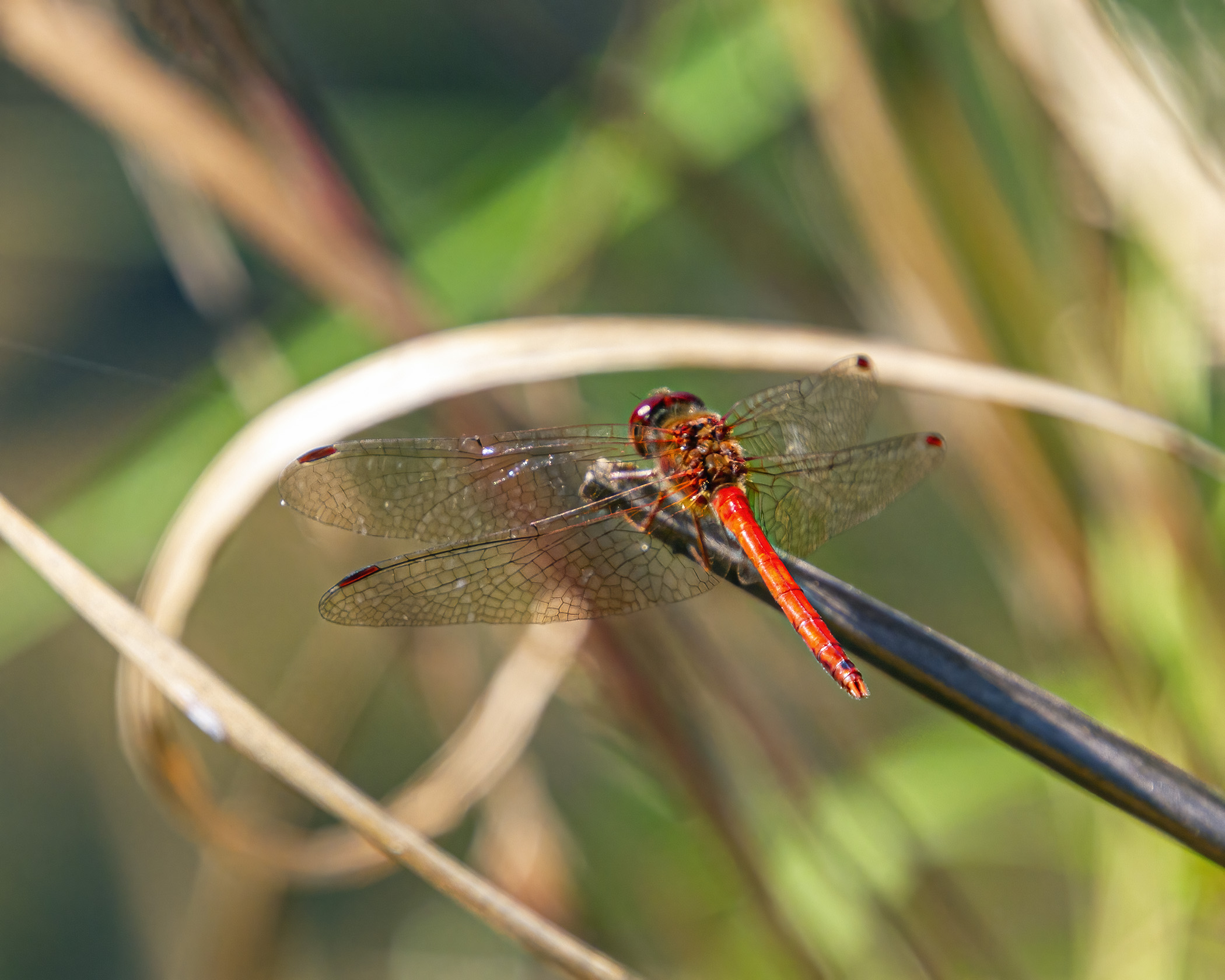
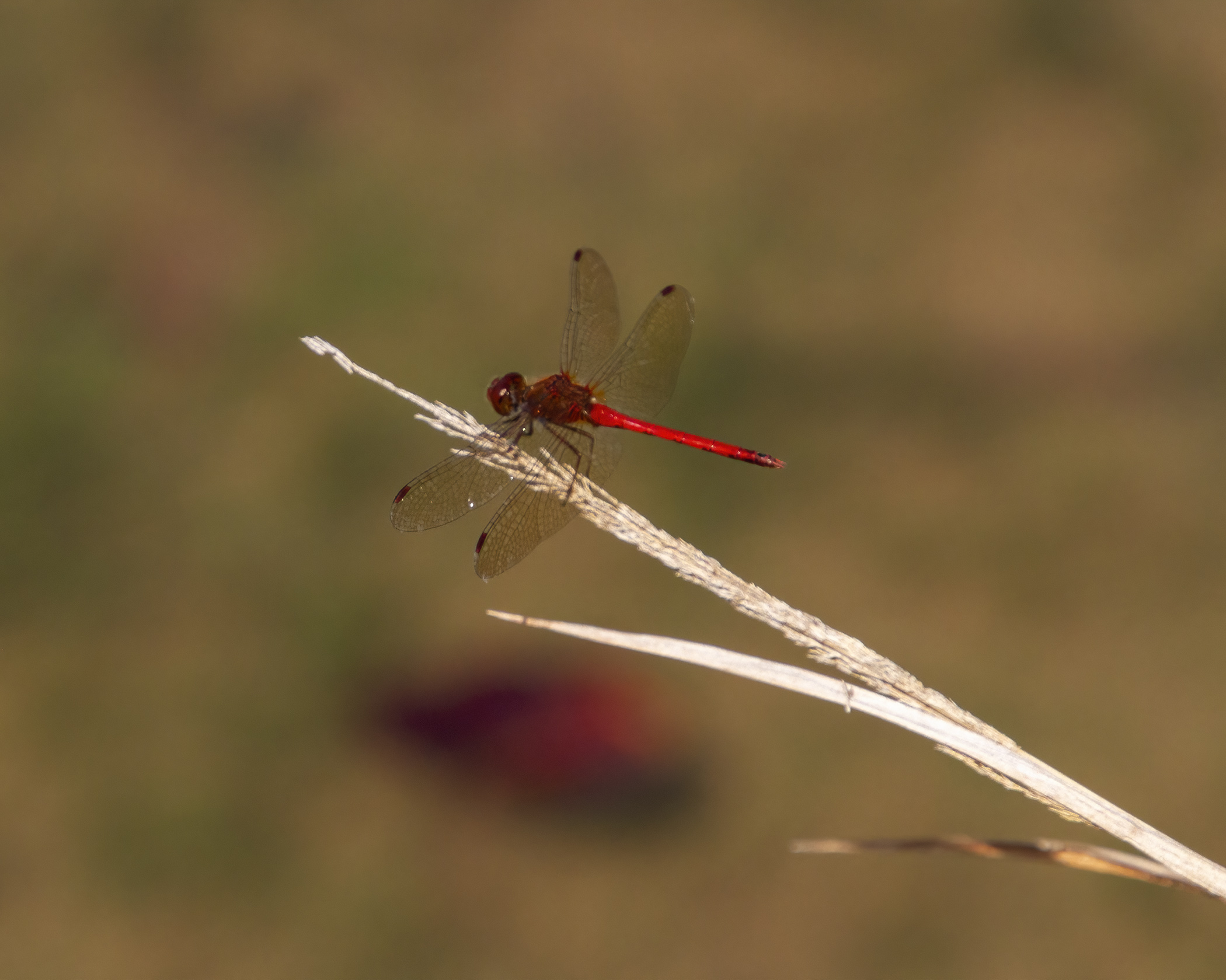
What signals the arrival of autumn for you? Perhaps it is the changes in the foliage, the cooling of the temperatures, or the shortening of the daylight hours. In recent years Autumn Meadowhawk dragonflies (Sympetrum vicinum) have become the harbingers of autumn, visible signs that the end of the dragonfly season is inexorably drawing near.

I spotted my first Autumn Meadowhawks this year on 2 October at Occoquan Bay National Wildlife Refuge. This species usually appears in late September and most years is the last dragonfly species to disappear—I have seen Autumn Meadowhawks as late as December some years and there have been some reports of them in early January.

A number of other dragonflies are still active, but by early November most of them will be gone. I will still be looking to photograph those hardy survivors in the upcoming months, but, as recent postings suggest, I will eventually be shifting a lot of my focus from insects to birds.

Autumn Meadowhawk

Autumn Meadowhawk

Autumn Meadowhawk

© Michael Q. Powell. All rights reserved.


Read Full Post »

I spotted this pretty little sparrow on Wednesday at Occoquan Bay National Wildlife Refuge. When I looked through my bird identification guide, I thought that it looked a little bit like a Chipping Sparrow. When I posted the photo below in a birding group on Facebook, however, some experienced birders identified this bird for me as a young White-crowned Sparrow (Zonotrichia leucophrys), a new species for me.

Sparrows can often be hard for me to identify, but the distinctive bill on this one helped me to narrow down the pool of potential species. A mature male White-crowned Sparrow has a black and white head and is easy to identify, but immature males and females of different species are often similar in appearance.

White-crowned Sparrow

© Michael Q. Powell. All rights reserved.


Read Full Post »

Each fall I face the same dilemma—I see the photos of other photographers indicating that migrating warblers are present in our area, but I have trouble spotting these elusive little birds. Part of the problem is that leaves are still mostly on the trees and I can often hear birds that remain invisible in the foliage. The other main problem is that many birds are now sporting their duller fall plumage, so they do not stand out as much as during the spring migration, when their  breeding plumage is much brighter.

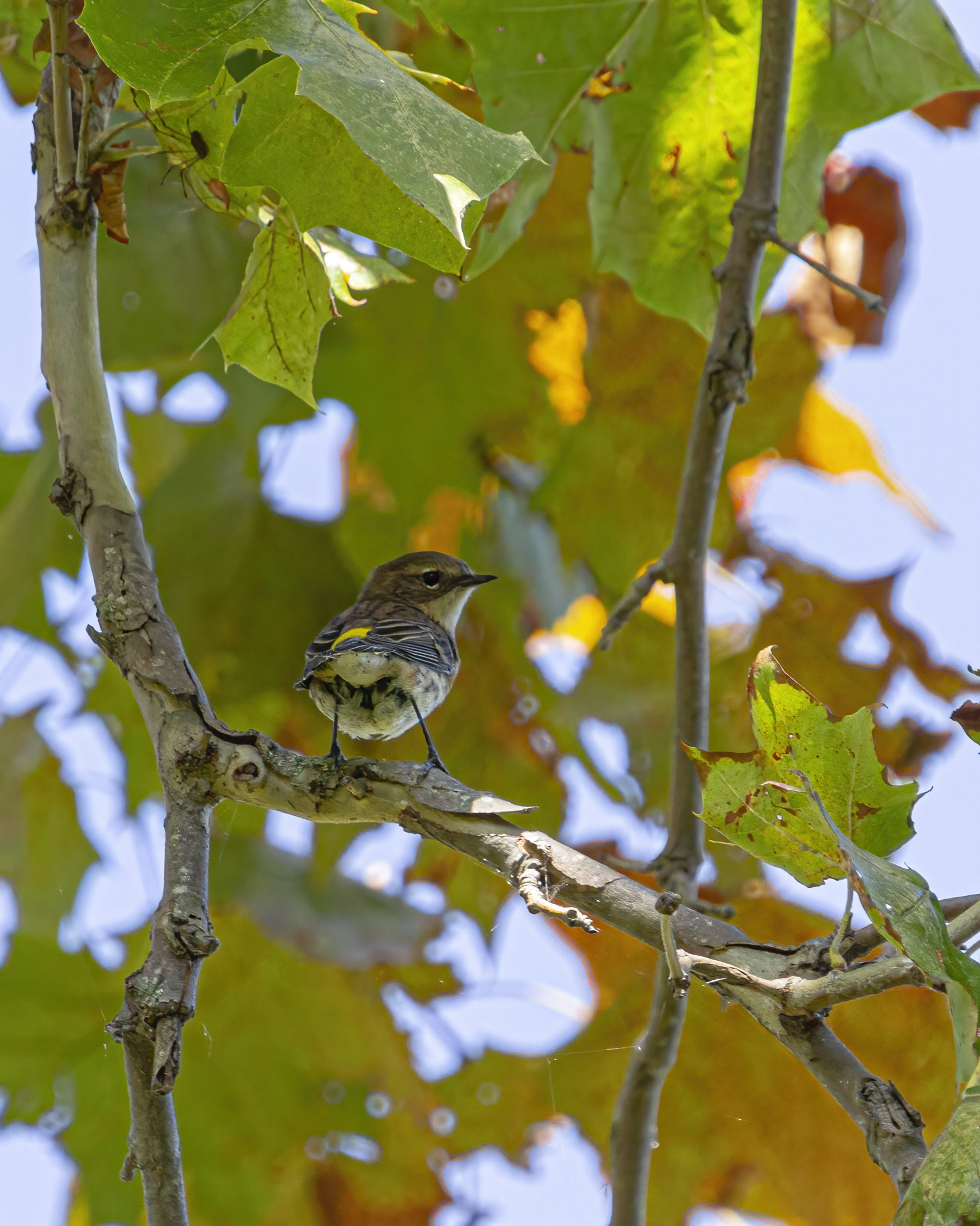
Given my normal experience, I was thrilled to spot several Palm Warblers (Setophaga palmarum) and Yellow-rumped Warblers (Setophaga coronata) during visits to Occoquan Bay National Wildlife Refuge earlier this week. The birds in the first two photos, I believe, are Palm Warblers, a relatively common warbler species that likes to poke around a lot on the ground.

The final two photos show Yellow-rumped Warblers, which are the most common warbler species in my area. In both of the photos you can see the yellow patch of feathers on the “rump” of the bird.

In a month or so I may switch over to my longest lens, a Tamron 150-600mm zoom lens, which will allow me to zoom in a little more on these tiny birds, but for now I am sticking with my Tamron 18-400mm lens, a more versatile lens that lets me get photos of butterflies and dragonflies as well as of birds. (The problem with the longer lens is that it has a minimum focusing distance of almost 9 feet (2.7 meters) and it is sometimes hard to focus on small subjects from that far away.)


Palm Warbler

Palm Warbler

Yellow-rumped Warbler

Yellow-rumped Warbler

© Michael Q. Powell. All rights reserved.

Read Full Post »

I was thrilled to spot this handsome Russet-tipped Clubtail dragonfly (Stylurus plagiatus) last Wednesday at Jackson Miles Abbott Wetland Refuge. I love the way that the dragonfly was clinging to the leaf, looking almost like it was peeping over the edge.

Russet-tipped Clubtails are a late season species and are seen most often in August and September in my area. Unlike many of the dragonflies that I see regularly that prefer pole-like perches or perch flat on the ground, Russet-tipped Clubtails like to hang from the leaves of vegetation at an angle or almost vertically—members of the genus Stylurus are sometimes called “Hanging Clubtails.”

Russet-tipped Clubtail

© Michael Q. Powell. All rights reserved.

Read Full Post »
As I was exploring Occoquan Bay National Wildlife Refuge this past Friday, I spotted some colorful red and black bugs. I had no idea what they were, but I happened to be walking with a fellow dragonfly enthusiast and he told me that they were Florida Predatory Stink Bugs (Euthyrynchus floridanus).

Unlike most other stink bugs that feed on plants, Florida Predatory Stink Bugs feed on insects that attack plants and are therefore considered to be beneficial. According to the North Carolina Extension website, “Immature Euthyrhynchus have a strong tendency to aggregate, and they even attack larger prey in concert. Apparently, aggregation behavior allows them to successfully attack prey too large to be subdued by a single nymph. Sometimes adults aggregate with nymphs, although when times get hard, these bugs sometimes feed on smaller relatives! When the bugs jab their proboscis into a less fortunate insect, they inject a toxin that slowly immobilizes the prey. The predigested insides are then sucked out.”

When they are developing, these stink bugs go through five stages, known as instars. The two largest bugs in the photo below are adults, while the two in the middle are in some what earlier stages of development. I don’t know for sure what this group of bugs was doing, but wonder if there is some kind of prey beneath them that they are immobilizing together.

Florida Predatory Stink Bug

© Michael Q. Powell. All rights reserved.

Read Full Post »

« Newer Posts - Older Posts »