© Michael Q. Powell. All rights reserved.
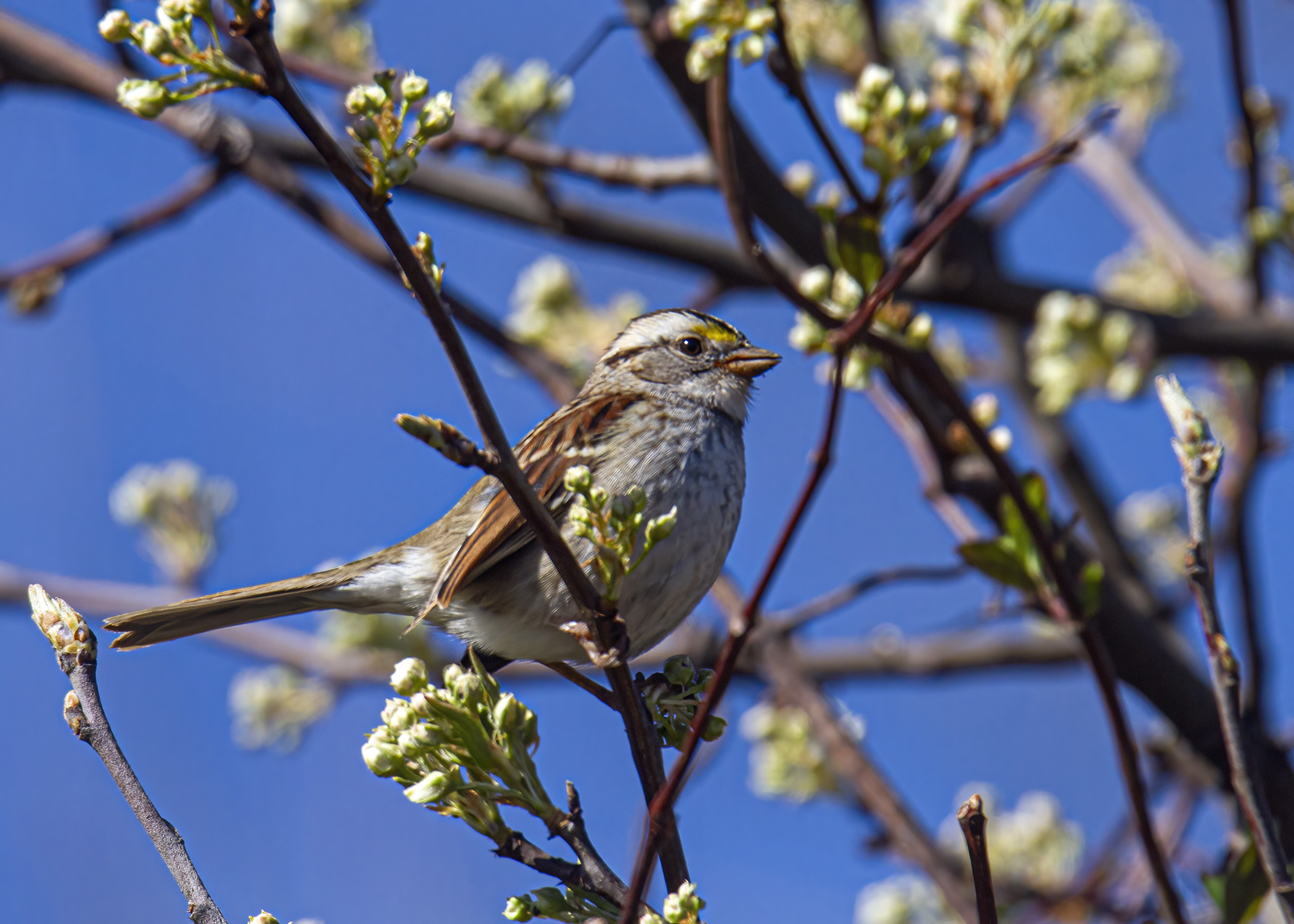
Posted in Birds, Nature, Photography, spring, wildlife, tagged Canon 7D, Occoquan Bay National Wildlife Refuge, Tamron 150-600mm, white-throated sparrow, Woodbridge VA, Zonotrichia albicollis on March 29, 2026| 2 Comments »
Posted in Birds, Nature, Photography, spring, wildlife, tagged Canon 7D, Occoquan Bay National Wildlife Refuge, Osprey, Pandion haliaetus, Tamron 150-600mm, Woodbridge VA on March 28, 2026| 7 Comments »
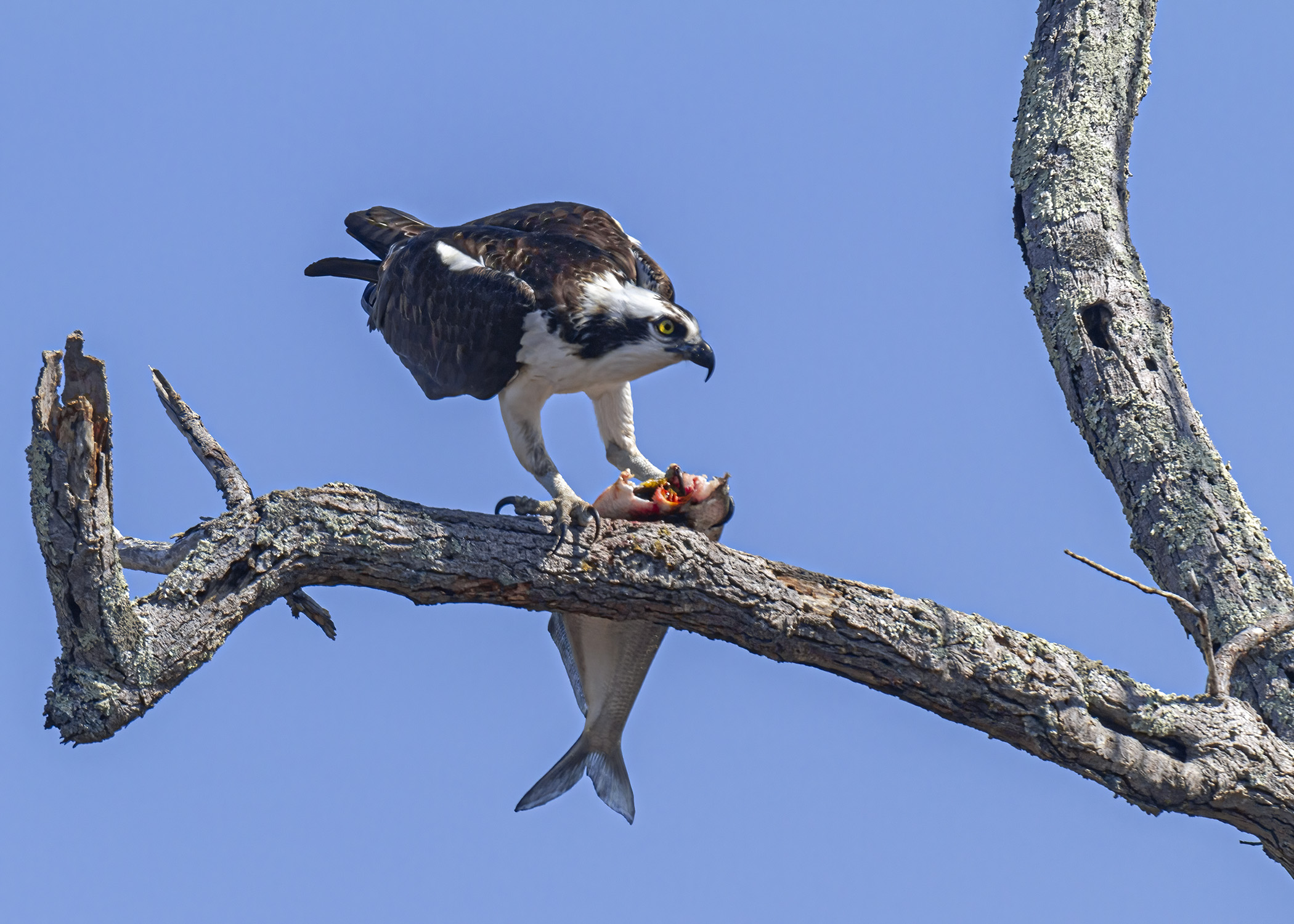
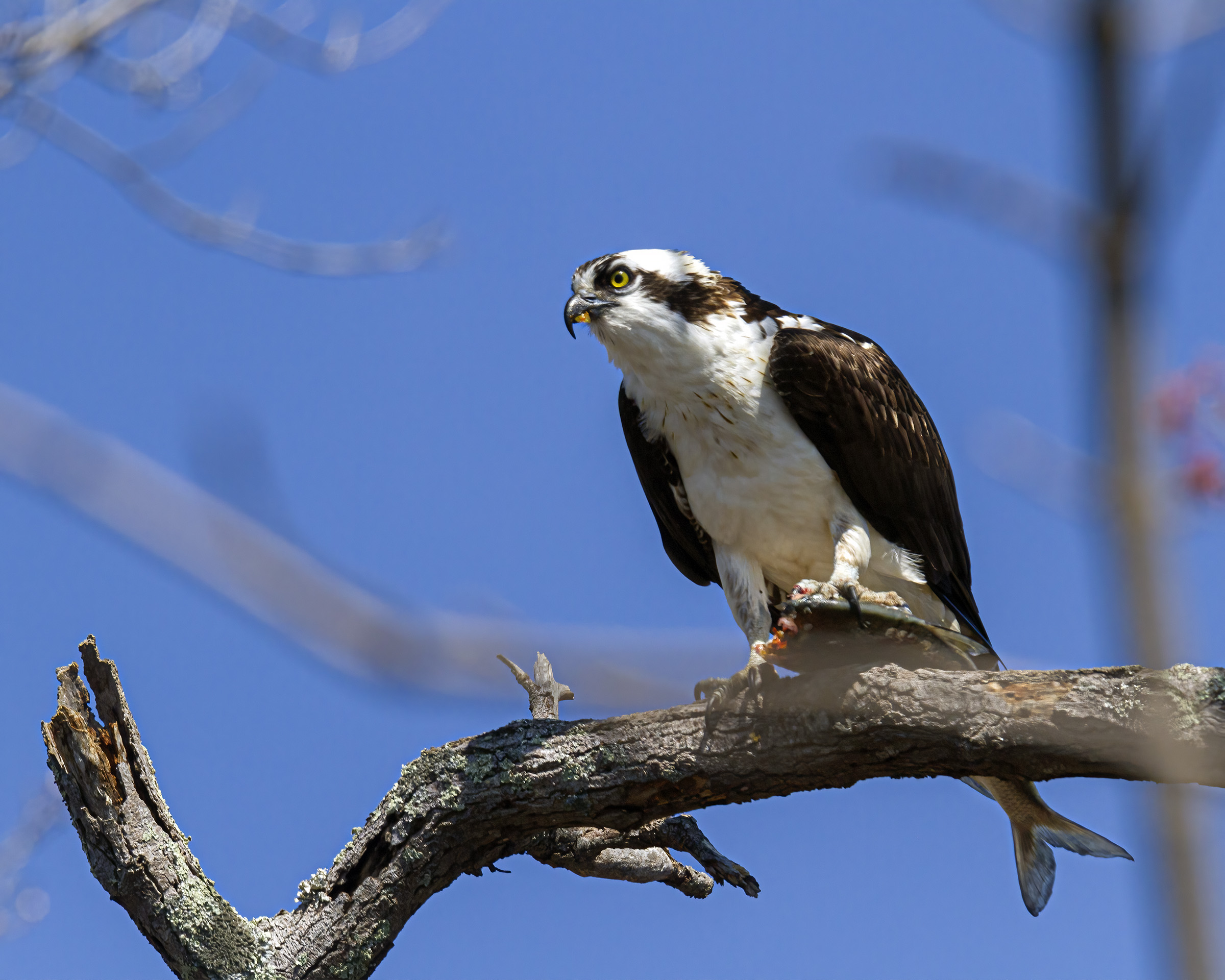
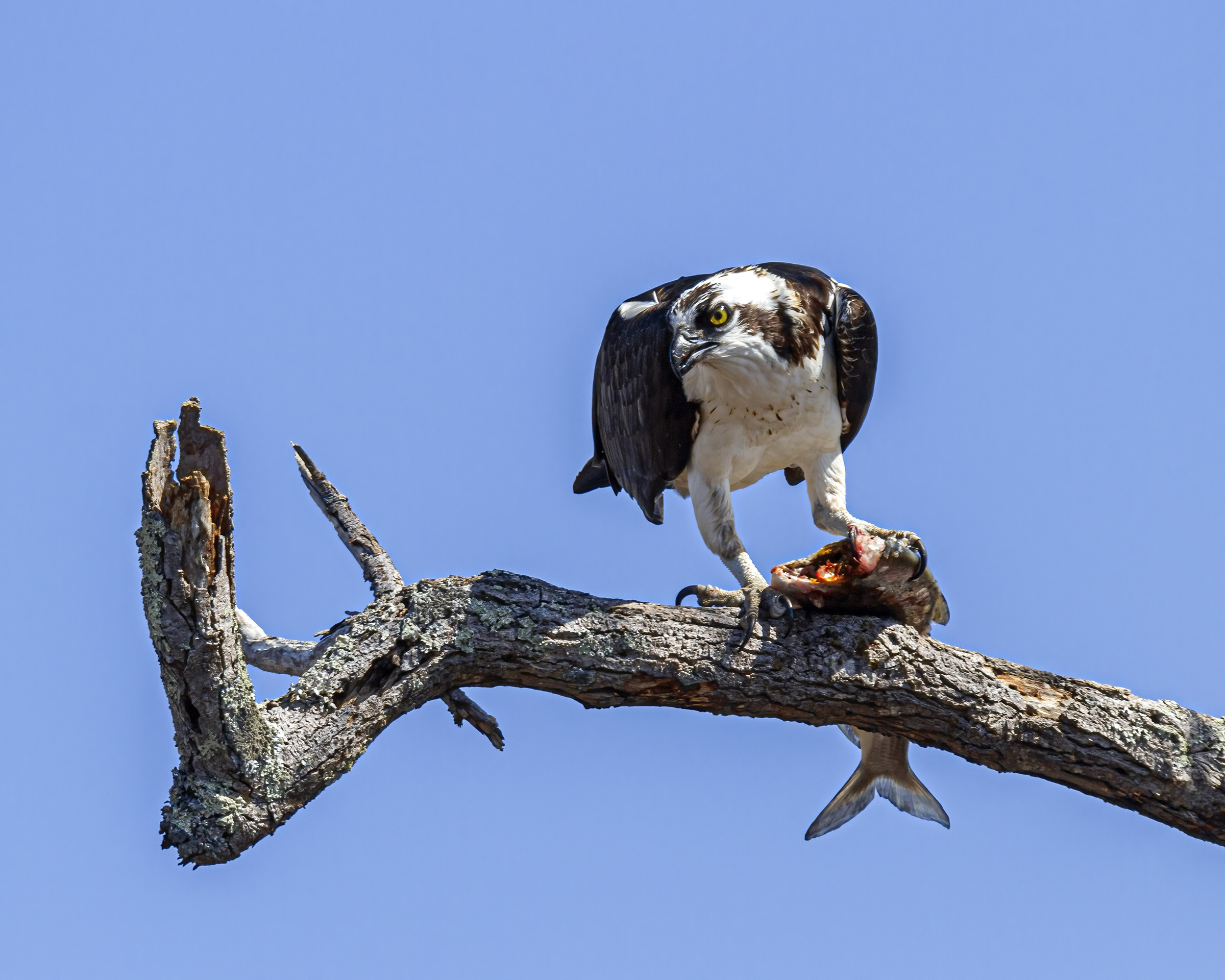
The ospreys (Pandion haliaetus) are definitely back at Occoquan Bay National Wildlife Refuge after spending the winter in warmer locations. I captured these images last week of an osprey as it was enjoying a freshly caught fish. I tried to vary the angles a bit for the individual shots, but moved slowly and carefully so that I did not disturb the osprey during its breakfast.
© Michael Q. Powell. All rights reserved.
Posted in Photography, Insects, Nature, wildlife, Butterflies, spring, tagged Tamron 150-600mm, Occoquan Bay National Wildlife Refuge, Woodbridge VA, Spring Azure, Spring Azure butterfly, Celastrina ladon, Canon7D on March 25, 2026| 3 Comments »
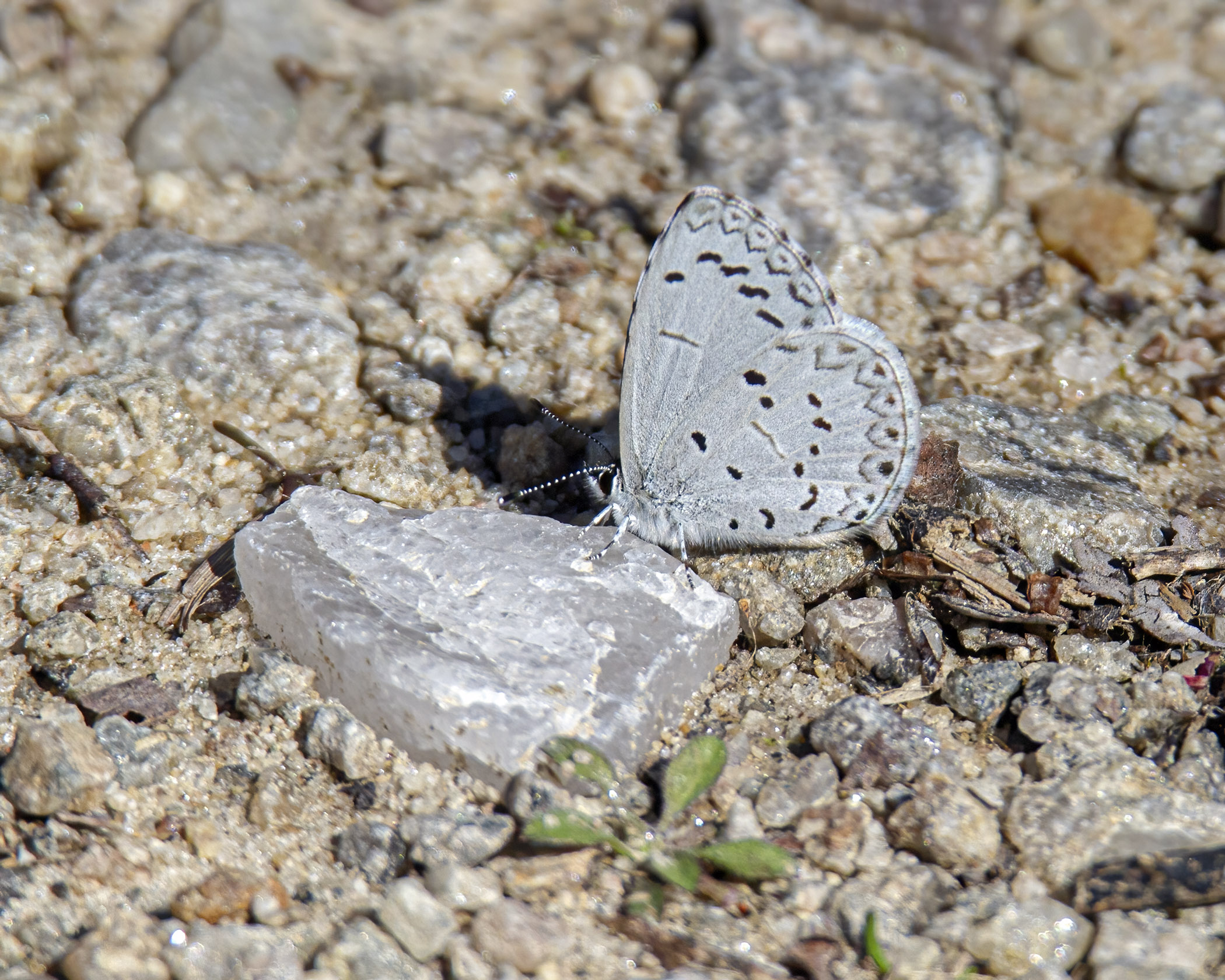
Butterflies are already starting appear at Occoquan Bay National Wildlife Refuge, including this tiny Spring Azure butterfly (Celestrina ladon) that I photographed there on 20 March. These little butterflies look pretty nondescript when their wings are close, but when they are flying, you can see the beautiful blue coloration of their inner wings.
Spring Azure butterflies are almost always the first butterflies that I see in the spring. A few other species, like Mourning Cloaks, overwinter as adults, but Spring Azure butterflies spend the winter in the pupal stage in a chrysalis and emerge as adults in the early spring.
© Michael Q. Powell. All rights reserved.
Posted in Photography, Birds, Nature, wildlife, spring, tagged Bald Eagle, Canon 7D, eagle, Haliaeetus leucocephalus, Occoquan Bay National Wildlife Refuge, staring contest, Tamron 150-600mm, Woodbridge VA on March 24, 2026| 12 Comments »
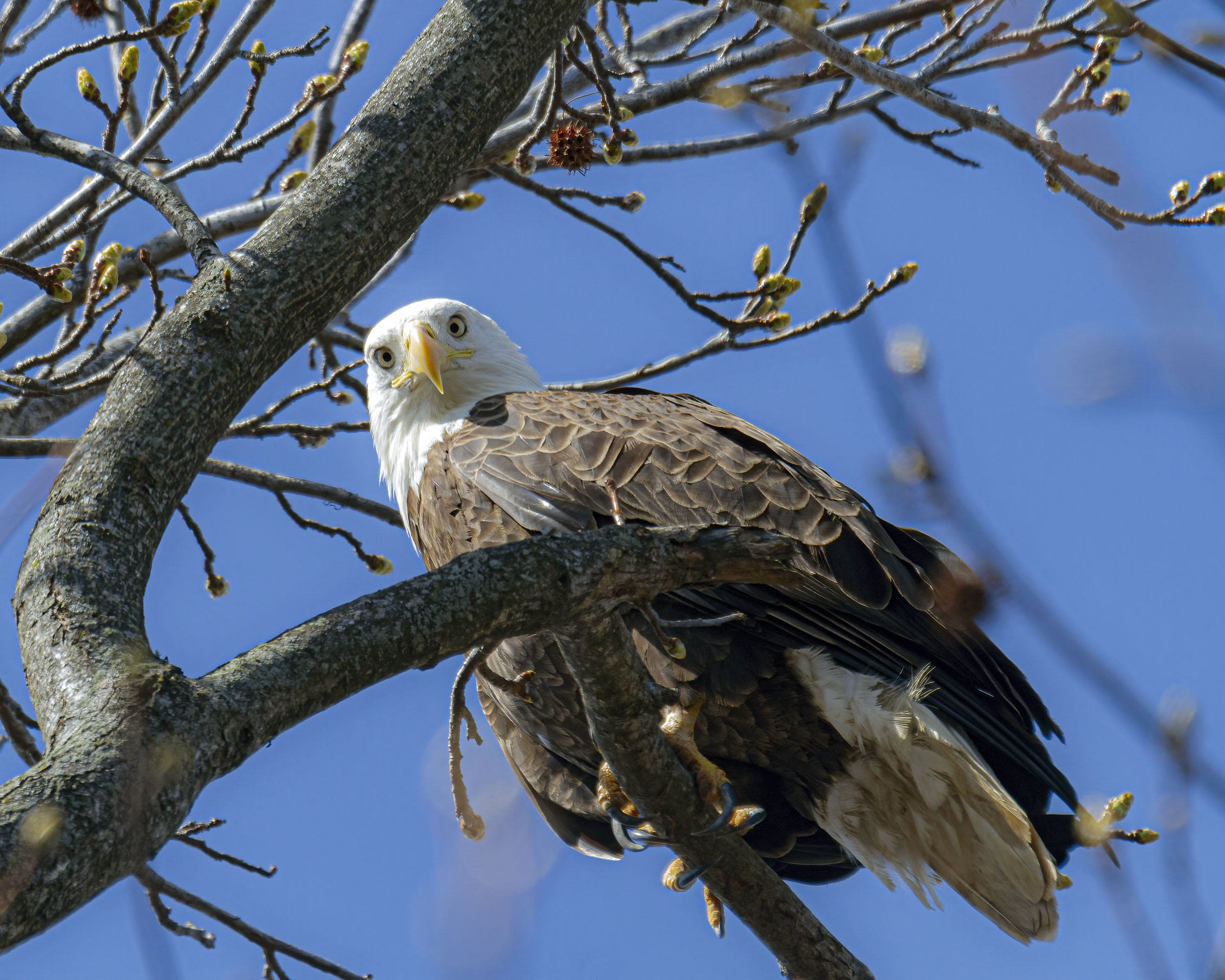
I got involved in a little staring contest with a Bald Eagle (Haliaeetus leucocephalus) last Friday at Occoquan Bay National Wildlife Refuge. I moved slowly and deliberately to get some photos and then departed silently, leaving the eagle in peace on its perch.
Most of the time my first indication that there is an eagle in the area is when it takes off in response to my presence. In this case, however, the eagle looked right at me and seemed to decide that I did not represent a threat, so it stayed in place.
I like that kind of peaceful coexistence.
© Michael Q. Powell. All rights reserved.
Posted in Birds, Nature, Photography, wildlife, tagged Blue Jay, Canon 7D, Cyanocitta cristata, Occoquan Bay National Wildlife Refuge, Tamron 150-600mm, Woodbridge VA on March 19, 2026| 4 Comments »
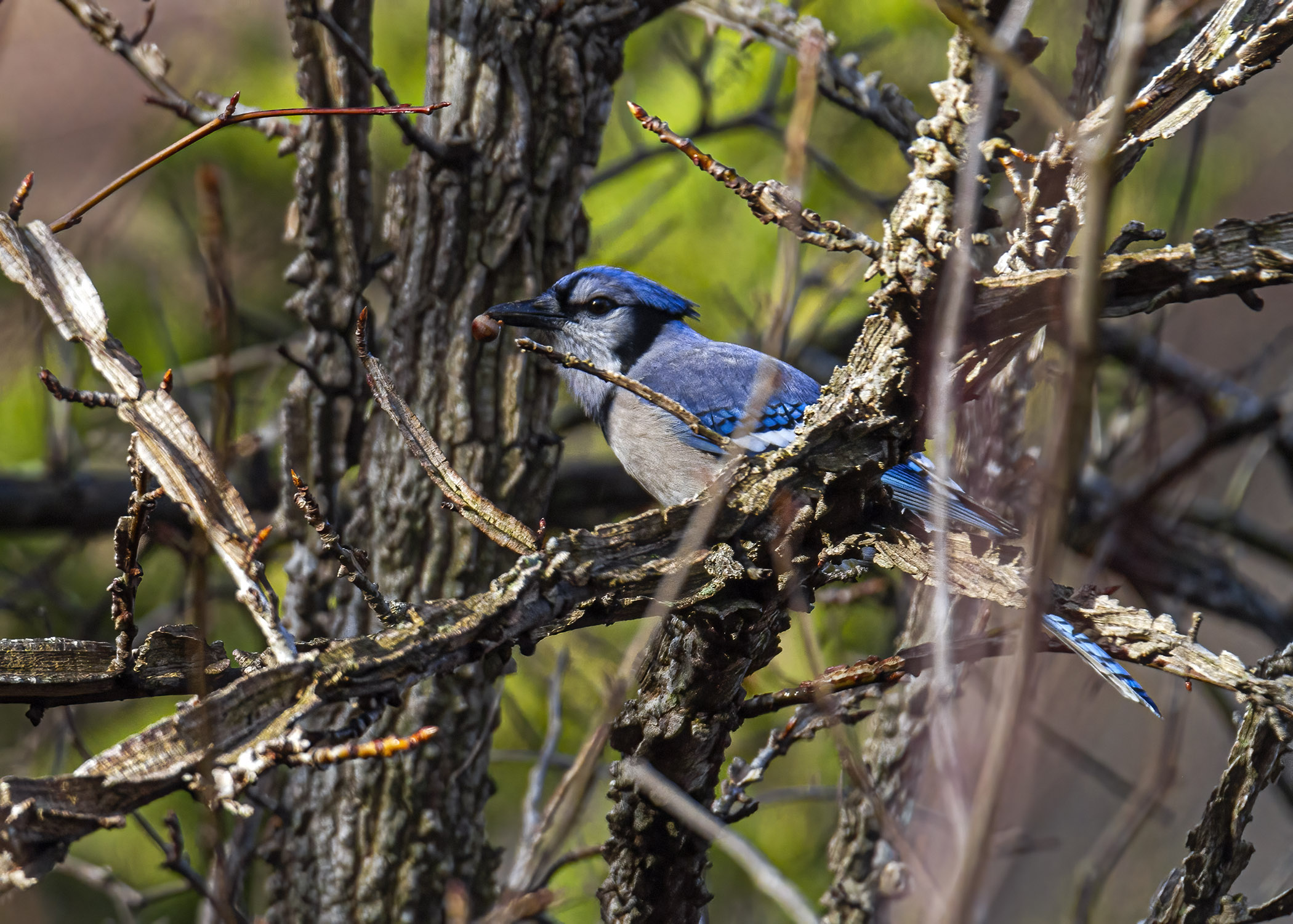
When it’s this early in the spring, I try to photograph as many of the birds that I encounter as I can. Blue Jays (Cyanocitta cristata) are pretty common where I live, but I rarely have the chance to photograph one. Earlier this month I was thrilled to hear and see this Blue Jay during a visit to Occoquan Bay National Wildlife Refuge.
The Blue Jay was busily foraging in the trees, rarely stopping in any one place for very long. I was thrilled to capture this shot of the jay when it paused momentarily with some kind of berry that it had just snagged. It is not a great photo, but I like the overall feel of the photo, with the blues and greens working well together to create a pleasant image.
© Michael Q. Powell. All rights reserved.
Posted in Birds, Nature, Photography, spring, wildlife, tagged Canon 7D, Carolina Chickadee, chickadee, Occoquan Bay National Wildlife Refuge, Poecile carolinensis, Tamron 150-600mm, Woodbridge VA on March 17, 2026| 2 Comments »
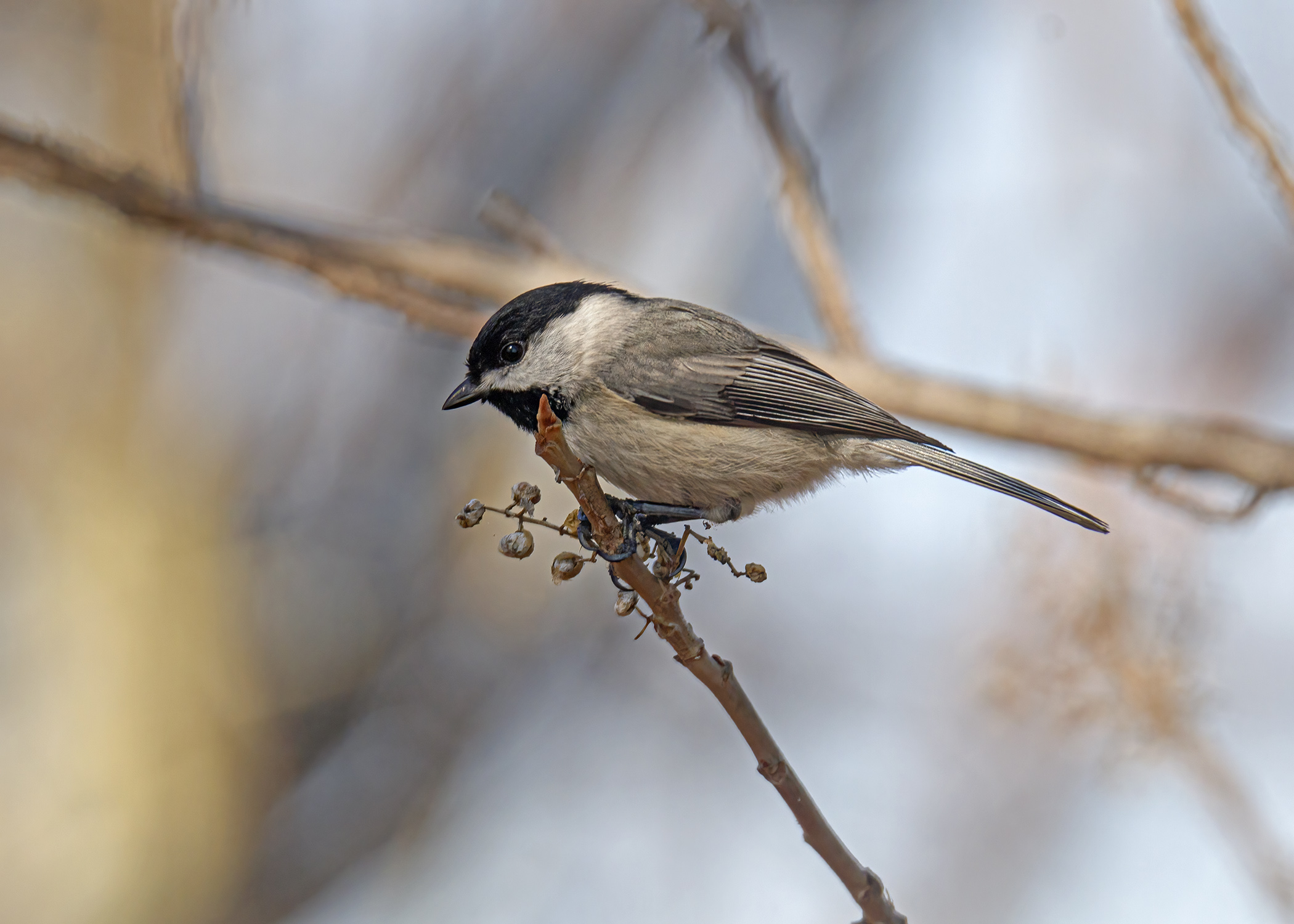
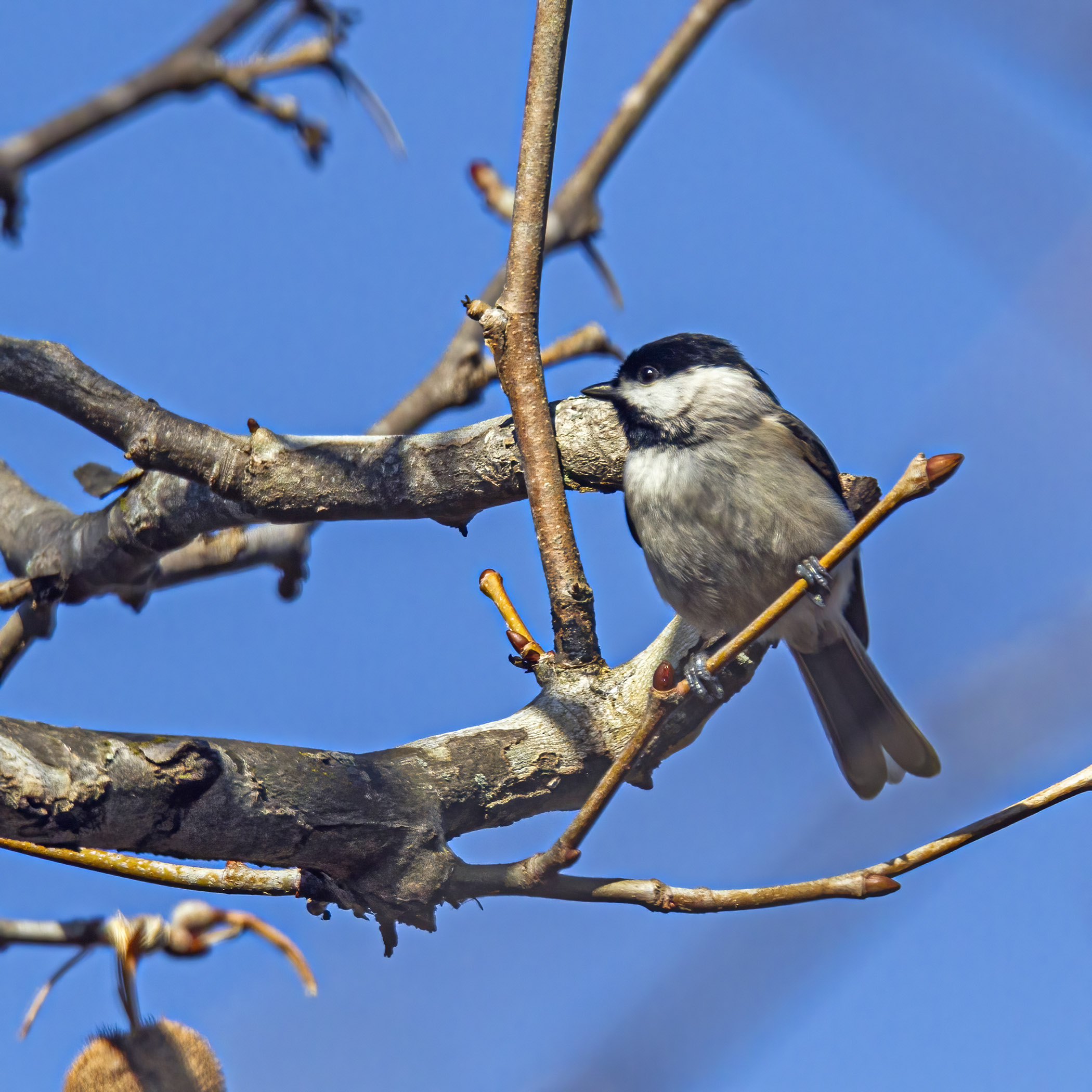
I couldn’t help but notice the sight and sounds of little birds last week at Occoquan Bay National Wildlife Refuge—they were really active. Of course, being aware of their presence did not magically result in photographs of them. As many of you know, one of the “secrets” of my wildlife photography is that I am unusually patient and persistent.
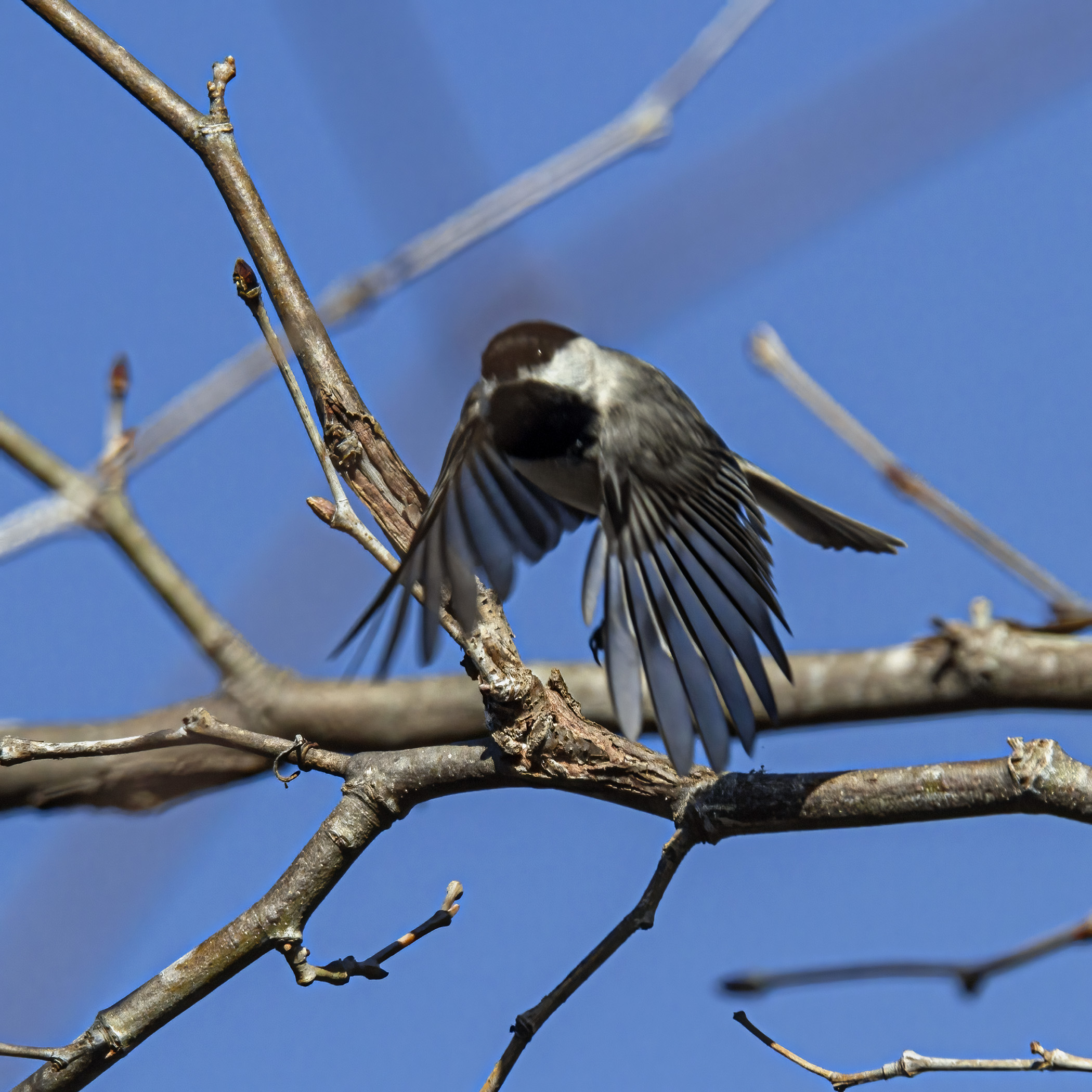
So I watched and waited and eventually managed to capture images of Carolina Chickadees (Poecile carolinensis), some of the smallest birds in our area. Here are a few of my favorites. In the first one, I managed to isolate the little bird from its cluttered background, which was a bit tricky, considering that the chickadee was perched on a small branch in the midst of a tangled group of branches.
The second photo was a little easier to take, because the bird was perched at the end of a branch in a more open area. The final photo was an unplanned one. As I was focusing on the chickadee, it took off and I instinctively pressed the shutter release. The photo is far from perfect, but I really like it.
I’m sure I’ll be taking more (and hopefully better) bird photos as we move deeper into spring and I’m looking forward to seeing a few dragonflies appearing in the next month or so.
© Michael Q. Powell. All rights reserved.
Posted in Birds, Nature, Photography, spring, wildlife, tagged brown thrasher, Canon 7D, Occoquan Bay National Wildlife Refuge, Tamron 150-600mm, thrasher, Toxostoma rufum, Woodbridge VA on March 14, 2026| 5 Comments »
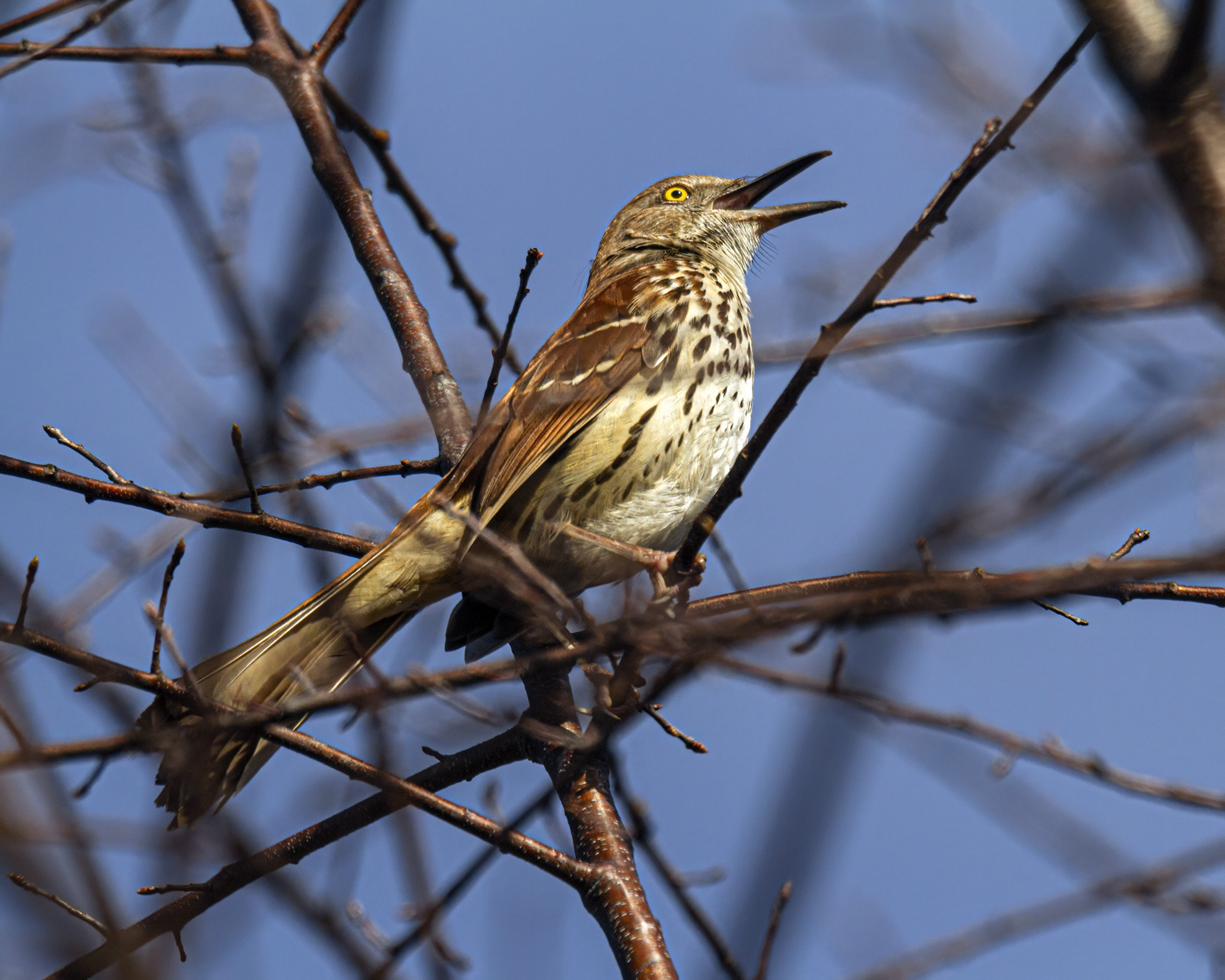
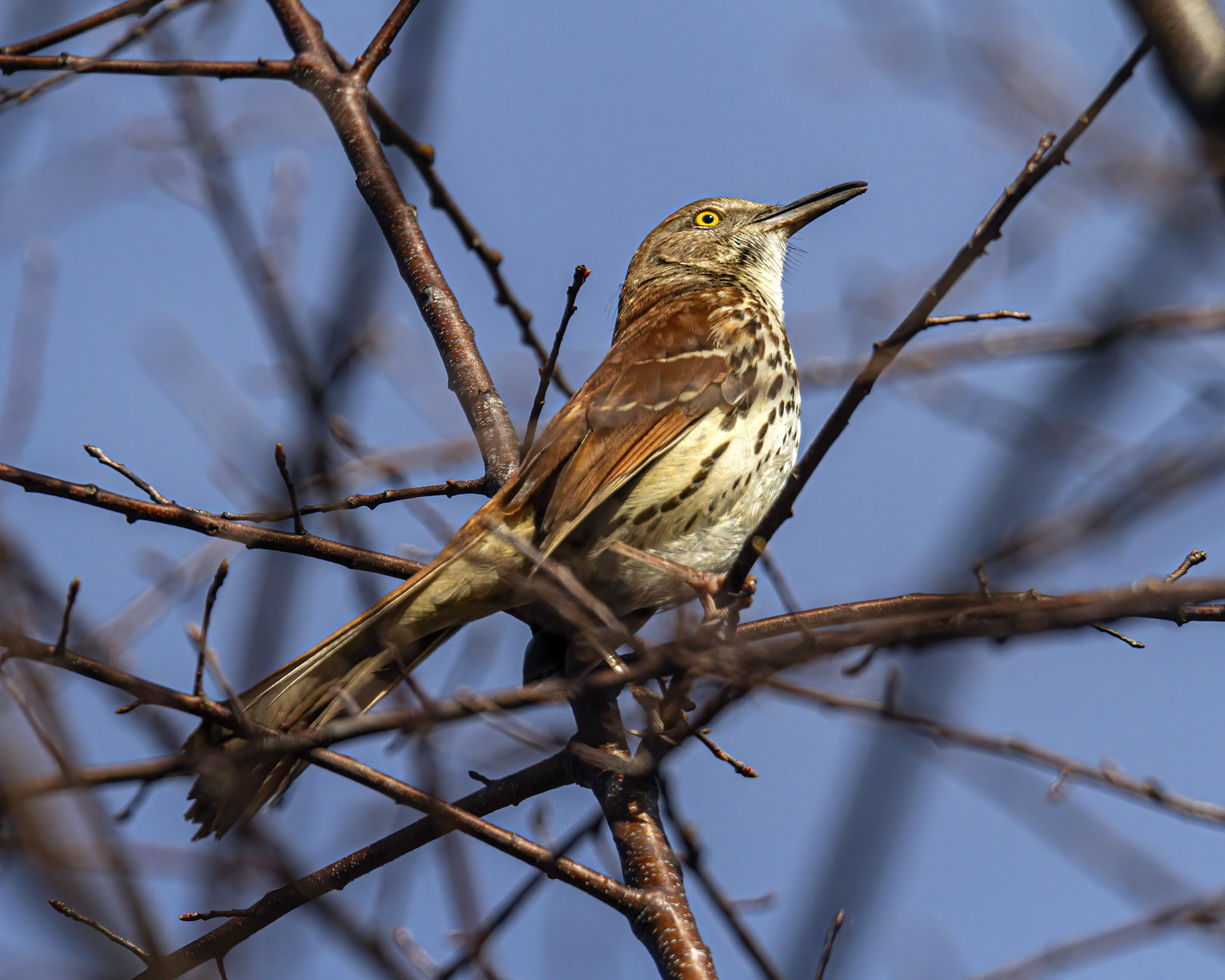
I could easily hear this Brown Thrasher (Toxostoma rufum) singing high in the trees this past Tuesday at Occoquan Bay National Wildlife Refuge, but I had a hard time getting an obstructed view of it because it was hidden in the branches. I waited and waited and eventually the Thrasher moved to a more open spot. I was delighted when I managed to capture a shot when it started singing again.
According to some naturalists cited on the Cornell Lab of Ornithology website, “It is the opinion of many ornithologists that the song (of the Brown Thrasher)… is richer, fuller, and definitely more melodious than that of polyglottis” (the Northern Mockingbird).” I was also happy that I was able to get some good shots of the striking yellow eyes of the Brown Thrasher. Wow!
© Michael Q. Powell. All rights reserved.
Posted in Birds, Nature, Photography, spring, wildlife, tagged Canon 7D, Cygnus columbianus, Occoquan Bay National Wildlife Refuge, Pelecanus erythrorhynchos, pelicans, Tamron 150-600mm, Tundra Swan, White American Pelicans, Woodbridge VA on March 13, 2026| 4 Comments »
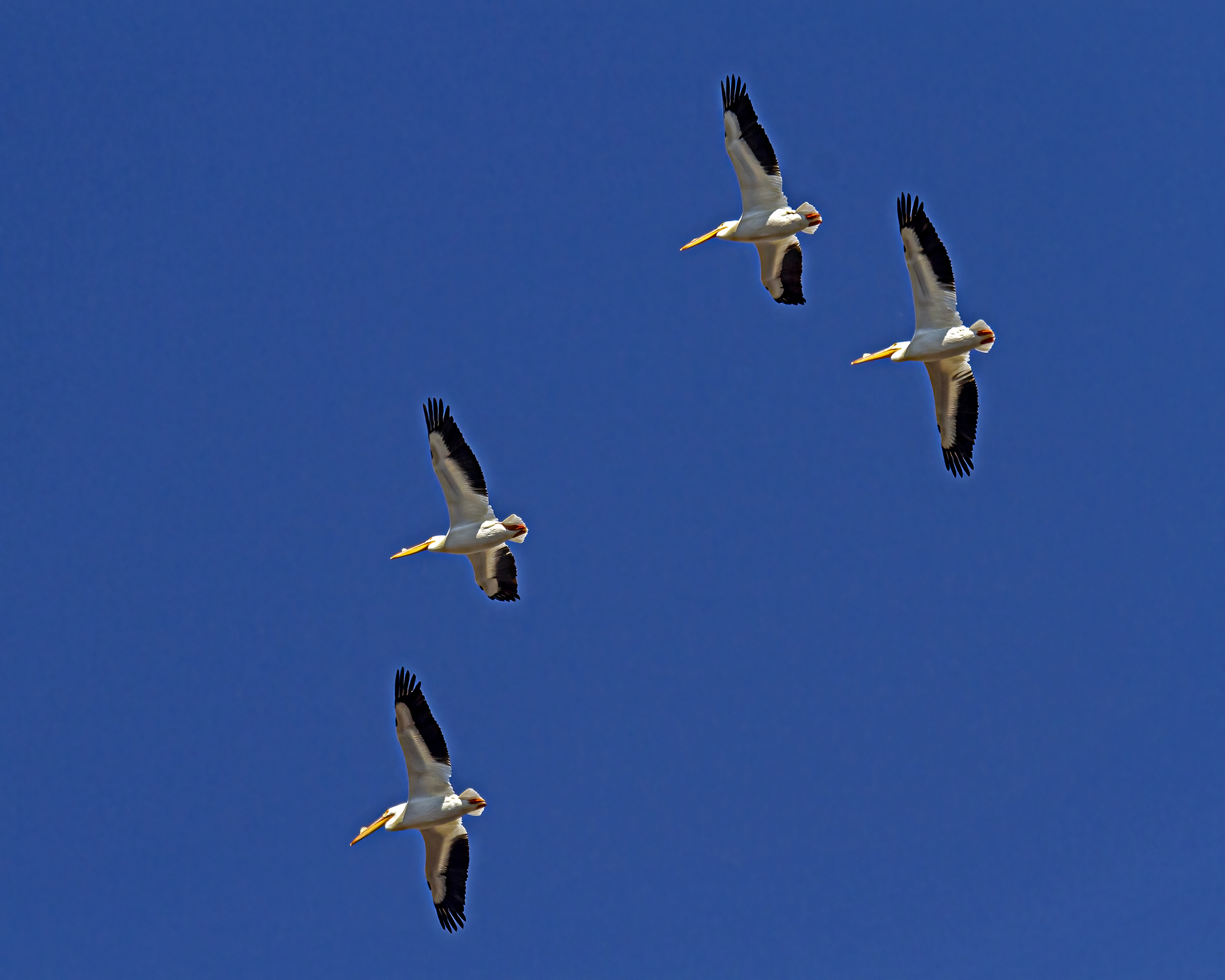
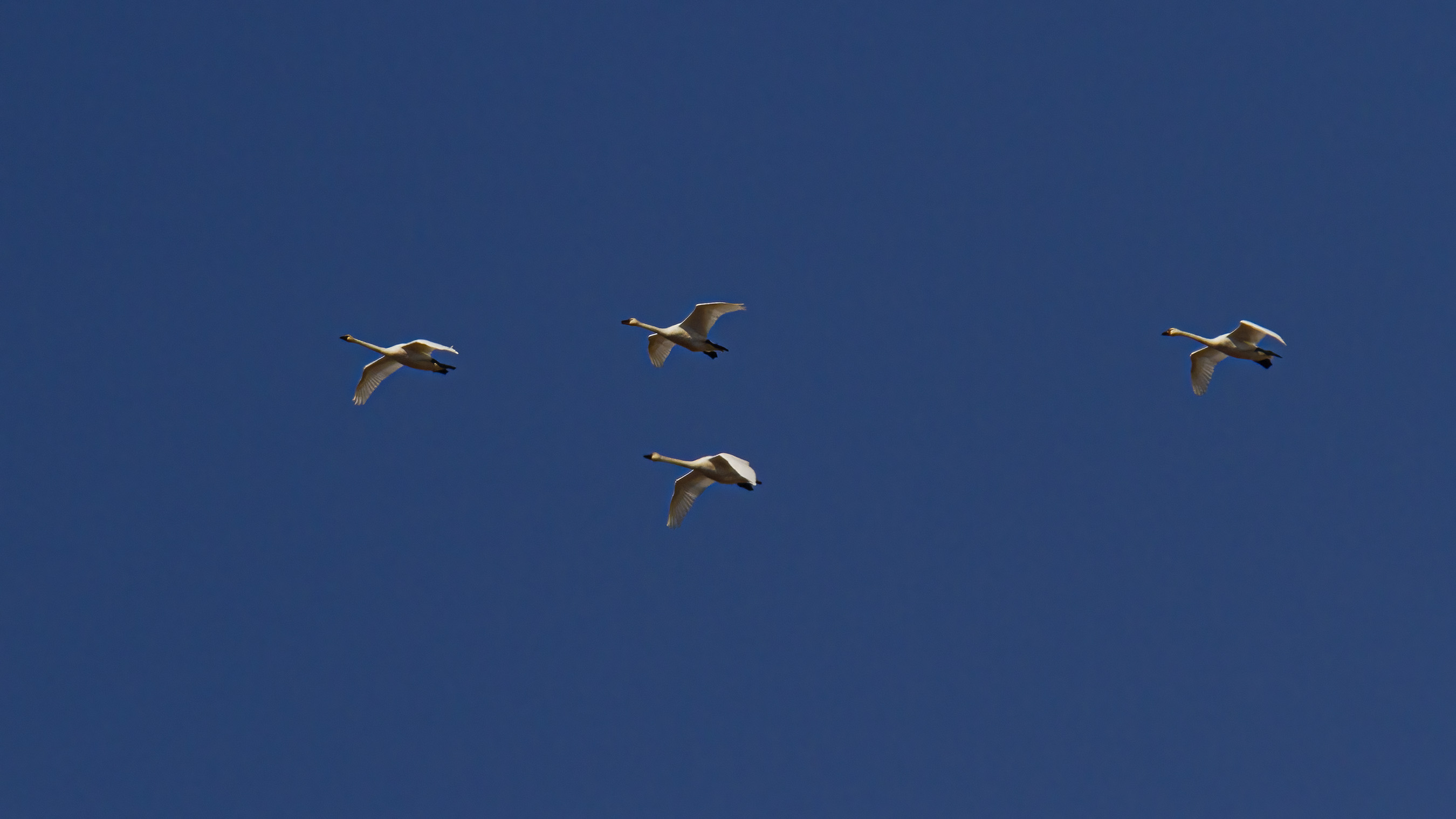
At this time of the year, the skies are often filled with migratory birds. I live in Northern Virginia, which seems to be a kind of midpoint in the journeys of birds that spend their winters in warmer places and then fly northward for breeding.
The most common birds that I see are Canada Geese, but this past Tuesday I was delighted to spot a couple of less common Species. In the first photo are some members of a large flock of American White Pelicans (Pelecanus erythrorhynchos). Although the photo makes it look like the birds were flying in a military-like formation, the grouping was often quite disorganized and was slow-moving. I couldn’t help but notice the “horn” on the upper bill of several of the pelicans that they will eventually shed after the birds mate and lay their eggs.
A short while later, I spotted a small group of Tundra Swans (Pelecanus erythrorhynchos), as shown in the second photo below. I noted that these swans fly with their necks fully extended, unlike the herons and egrets that I am more used to seeing that fly with their necks tucked in, creating an S-shape.
Tuesday was a warm, beautiful spring day and I managed to spot some additional birds in the trees and in the underbrush that I will feature in blog postings in the next few days.
© Michael Q. Powell. All rights reserved.
Posted in Birds, Nature, Photography, spring, wildlife, tagged Bucephala albeola, bufflehead, Canon 7D, Occoquan Bay National Wildlife Refuge, Tamron 150-600mm, Woodbridge VA on March 5, 2026| Leave a Comment »
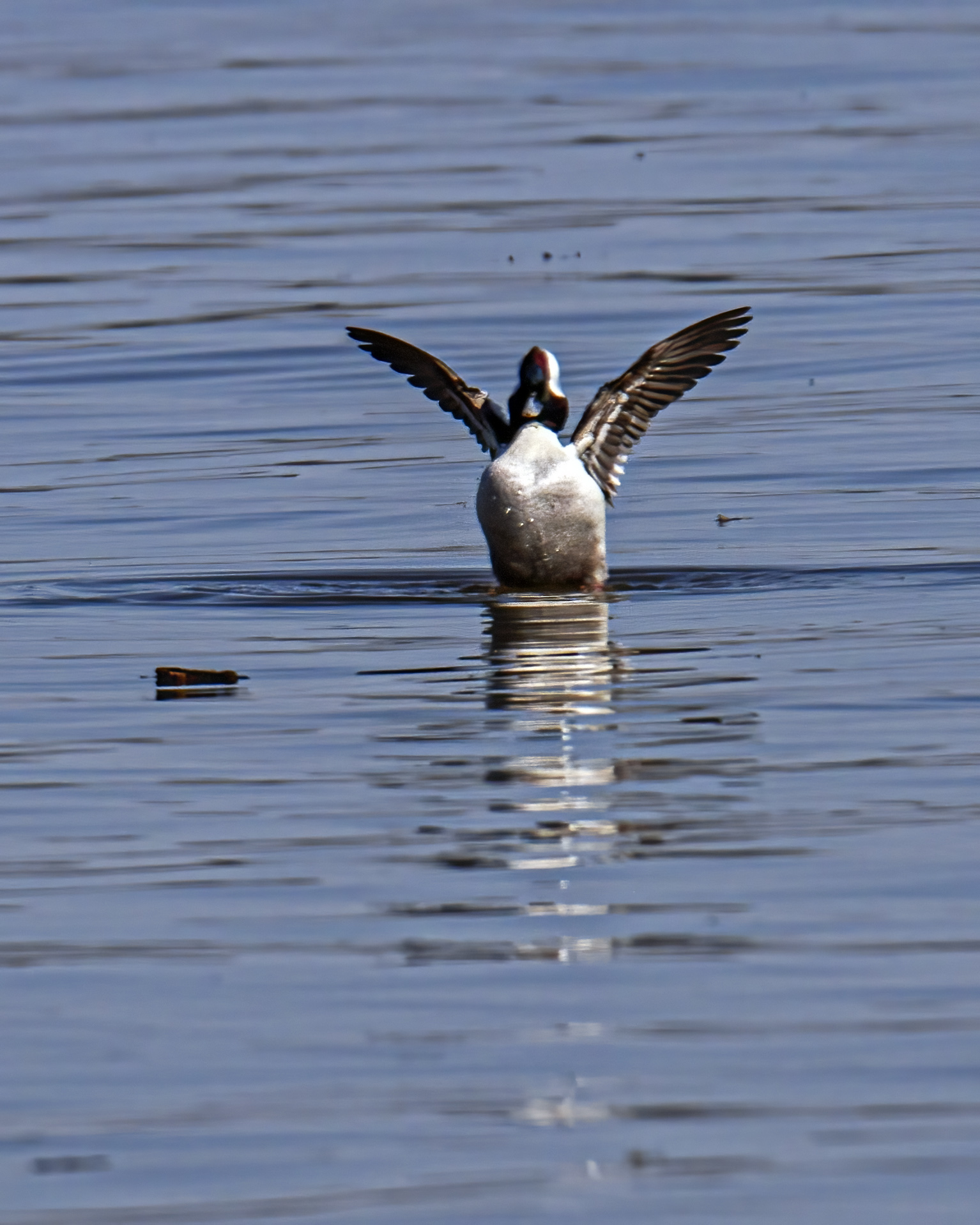
Buffleheads (Bucephala albeola) are small sea ducks that I sometimes observe during the winter in the waters off of Occoquan Bay National Wildlife Refuge. The males have a large white patch on their heads that makes them relatively easy to identify. From a distance these males often look to be black and white. When the sun is shining from the right directions, as it was last week when I captured this image, you can see that their heads are actually a glossy green and purple that really helps to set off their distinctive white patches.
In addition to being able to see the colors, the straight-on angle of this shot shows the odd shape of the head of this bufflehead’s head. It may be a bit of an optical illusion, but it looks to me like the lower portion of its head is considerably bigger than the upper part.
© Michael Q. Powell. All rights reserved.
Posted in Photography, Birds, Nature, wildlife, spring, tagged astronomical spring, Bald Eagle, Canon 7D, Haliaeetus leucocephalus, meteorological spring, Occoquan Bay National Wildlife Refuge, Tamron 150-600mm, Woodbridge VA on March 2, 2026| 4 Comments »
Yesterday, 1 March, marked the start of meteorological spring for those of us who live in the Northern Hemisphere. Meteorologists divide the seasons into three month increments for easier data tracking, although in the United States we generally use the astronomical calendar that ties the start of spring to the vernal equinox, which is on March 20 in 2026. No matter how you calculate the start of spring, there are definite signs that the seasons are changing.
After a brutally cold period of weather in most of February, we had an unusually warm day on Saturday, the last day of the month. The sun was shining brightly throughout the day and temperatures soared to over 60 degrees (15.5 degrees C). I generally don’t go out with my camera on the weekends to avoid the inevitable crowds, but I couldn’t resist the pull of the beautiful weather and headed off to Occoquan Bay National Wildlife Refuge.
There were quite a few people at the refuge and most of the wildlife that I encountered was out of camera range, but that didn’t really matter. Like the turtles that had risen up from the bottom of the ponds, I enjoyed simply basking in the warmth of the sun.
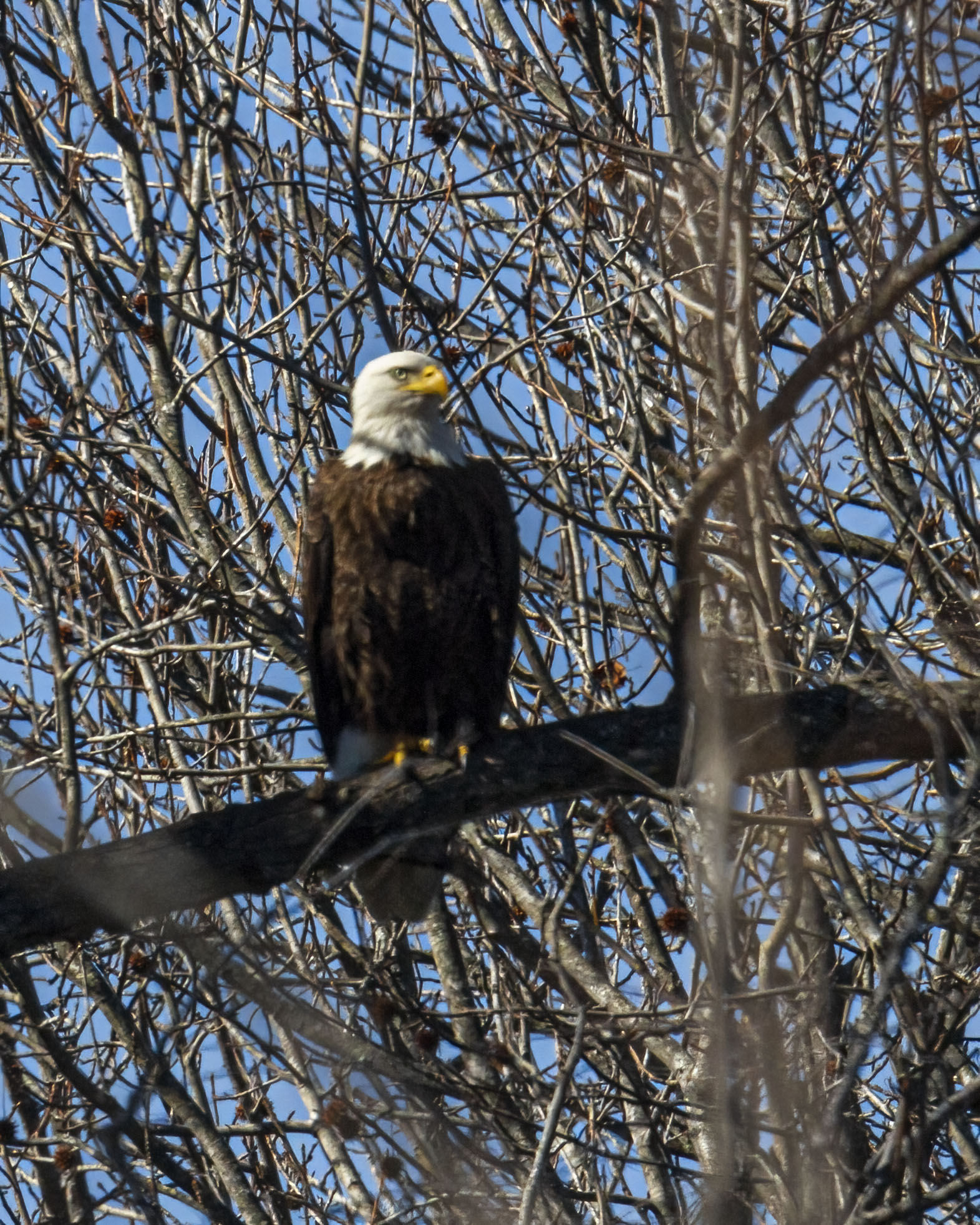
I did manage to capture a shot of a distant Bald Eagle (Haliaeetus leucocephalus). Many of you know that I rarely pass up an opportunity to photograph an eagle, even when they are far away. As you can see from the blurry branches in the foreground, I had to bend and twist my body to get a clear view of the eagle through the thicket of branches that mostly blocked my view.
It will soon be nesting season for the eagles, so I’ll be checking out several locations at the wildlife refuge this month for signs of eagle activity.
© Michael Q. Powell. All rights reserved.
Posted in Photography, Birds, Nature, wildlife, Winter, tagged Canon 7D, Occoquan Bay National Wildlife Refuge, sparrow, Tamron 150-600mm, white-throated sparrow, Woodbridge VA, Zonotrichia albicollis on February 19, 2026| 2 Comments »
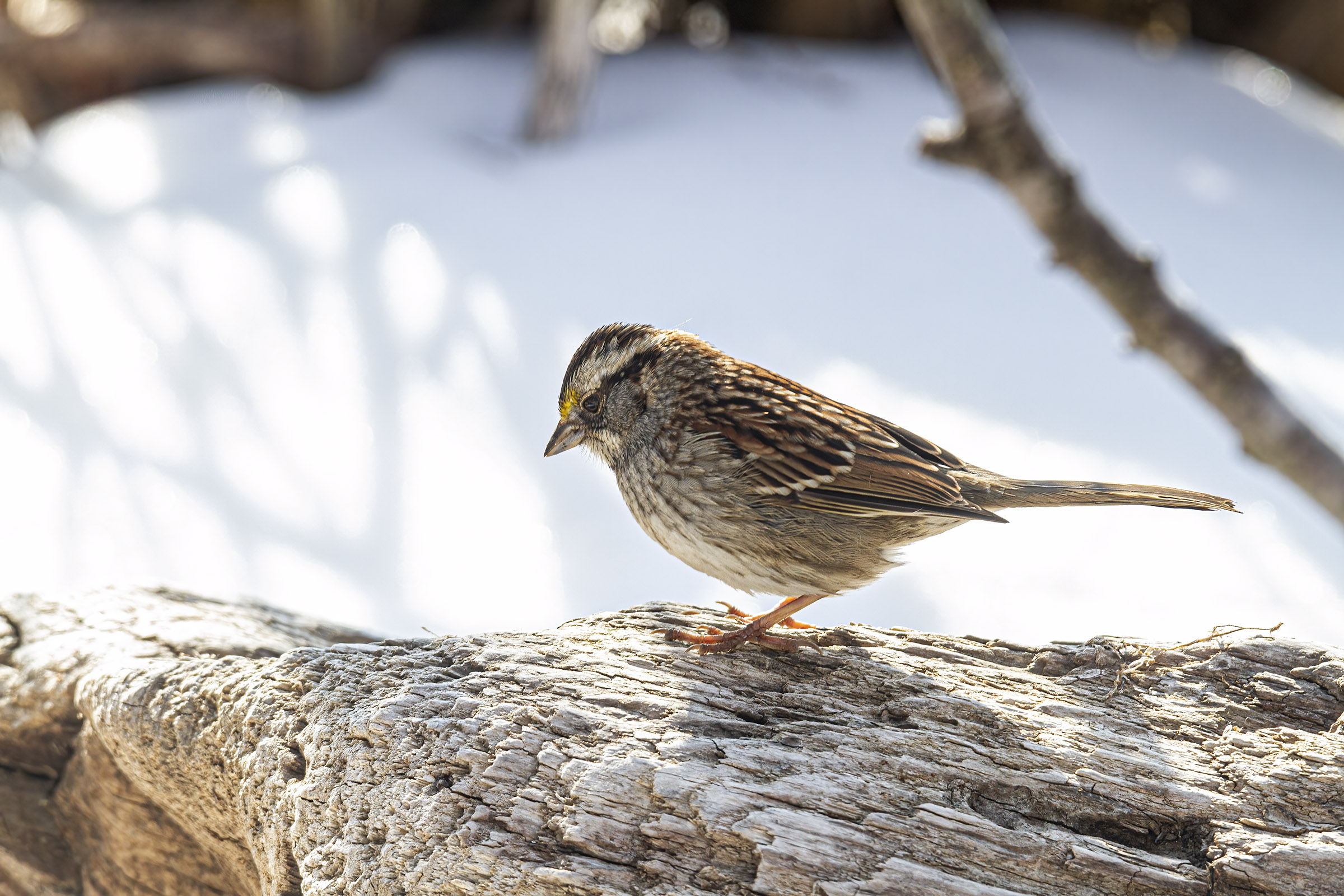
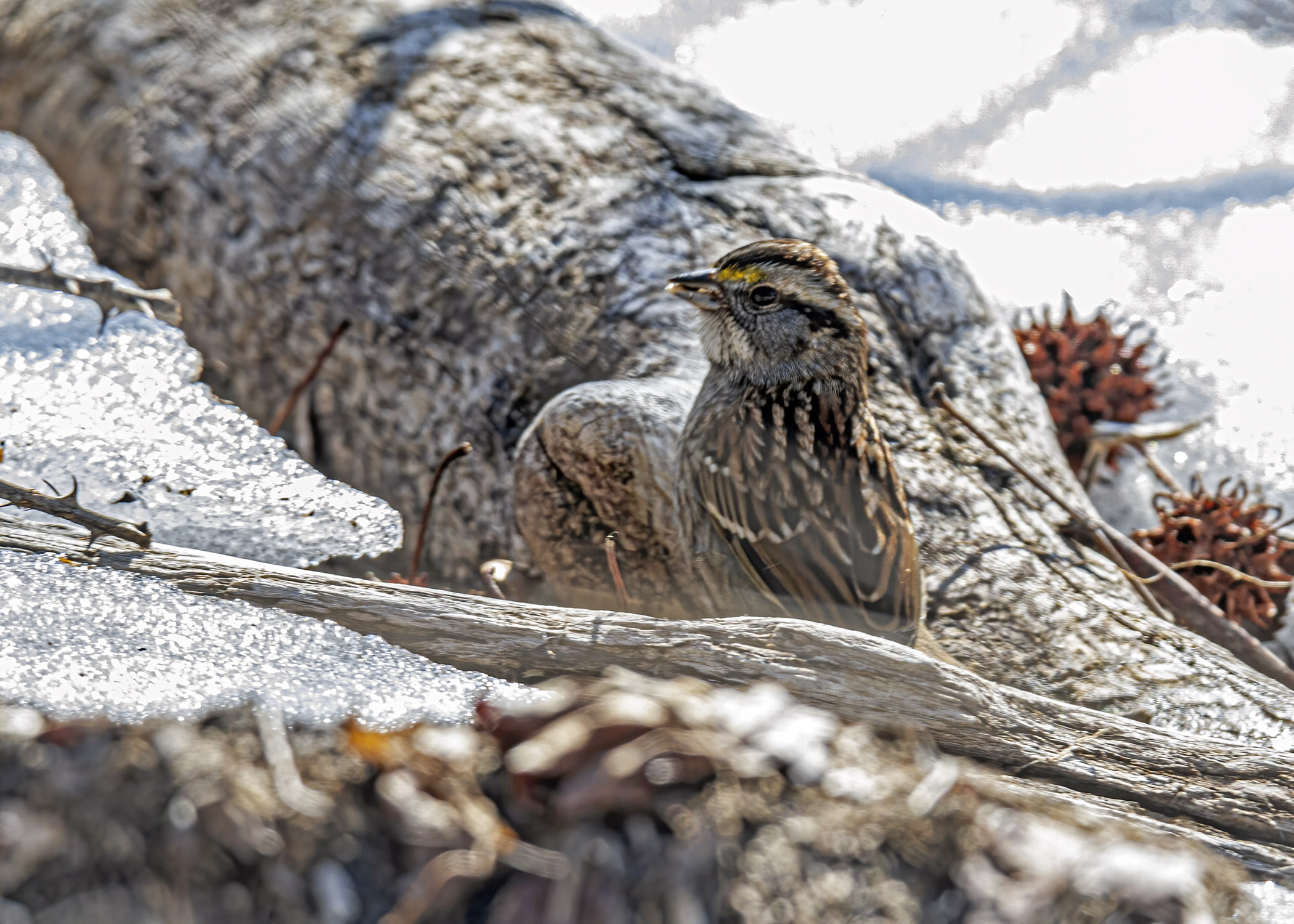
When birds are perched in the trees during the winter, you often do not have a sense of their environment when you look at photos of them. Some sparrow species, however, like to poke about on the ground and when I manage to capture some shots of them, you get much better sense of the harshness of their environment, as was the case with this White-throated Sparrow (Zonotrichia albicollis) last week at Occoquan Bay National Wildlife Refuge.
White-throated Sparrow overwinter with us, but disappear during the warmer months when they fly north to breed. One of my favorite identification features for this species is the bright yellow stripe in their lores (the area between their eyes and their bills). This particular sparrow was feverishly poking about in the snow as if foraged for food and I was particularly pleased when it hopped up onto a log and gave me a chance to capture an unobstructed shot of it.
© Michael Q. Powell. All rights reserved.
Posted in Birds, Nature, Photography, wildlife, Winter, tagged Canon 7D, Melospiza melodia, Occoquan Bay National Wildlife Refuge, song sparrow, sparrow, Tamron 150-600mm, Woodbridge VA on February 17, 2026| 3 Comments »
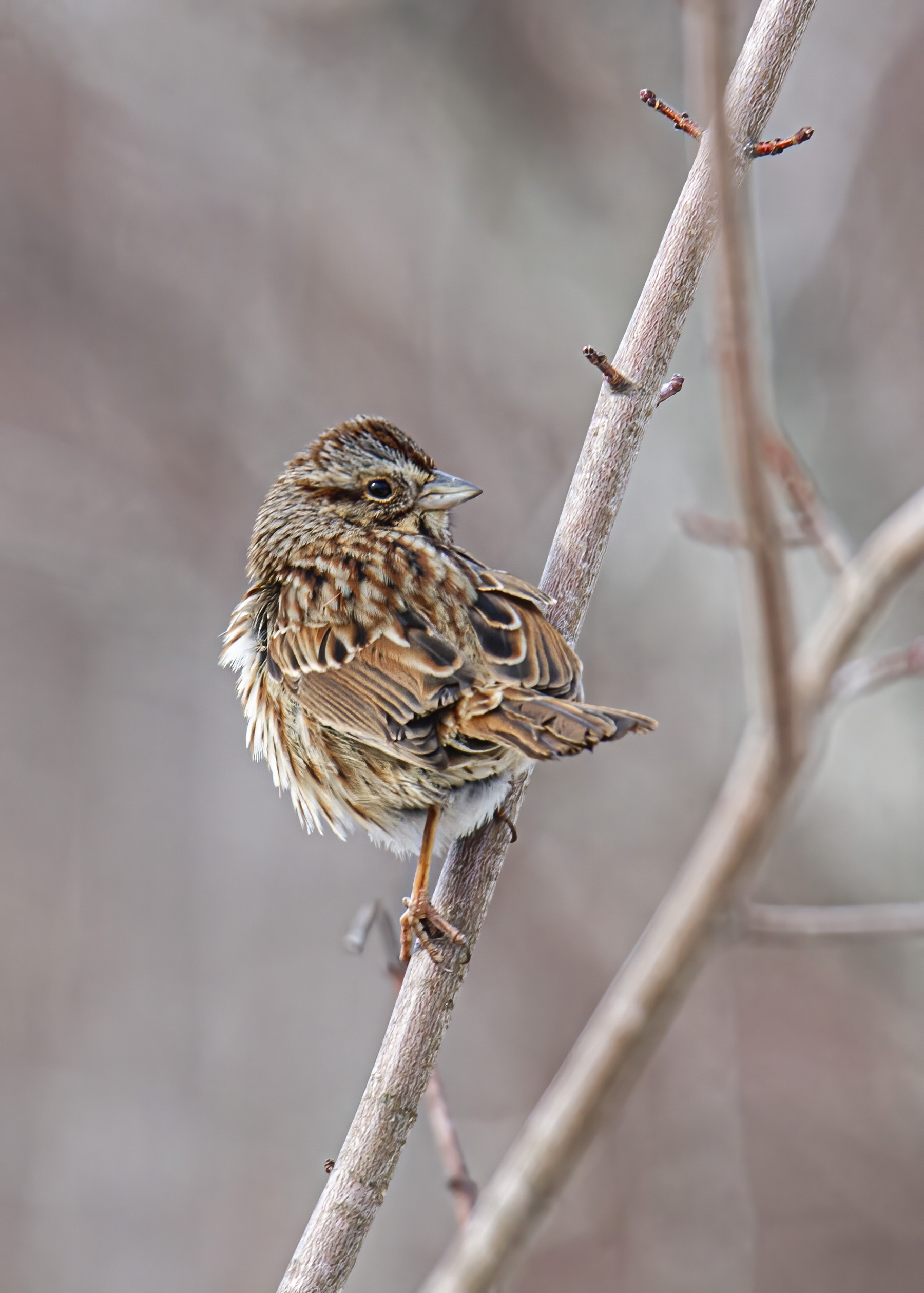
This Song Sparrow (Melospiza melodia) was facing away from me when I first spotted it last week at Occoquan Bay National Wildlife Refuge, but I waited patiently for it to move its head and was rewarded with this profile pose. Of course, my challenge was to capture the moment, and I was happy that I was able to get an unobstructed shot of the little bird.
You have to be out there to have opportunities like this and a combination of skill and luck (and quick reactions) to get the shot. As I learned long ago when I was a Boy Scout, it is important to “Be Prepared.”
© Michael Q. Powell. All rights reserved.
Posted in Birds, Nature, Photography, wildlife, Winter, tagged Ardea herodias, Canon 7D, Great Blue Heron, heron, Occoquan Bay National Wildlife Refuge, Tamron 150-600mm, Woodbridge VA on February 16, 2026| Leave a Comment »
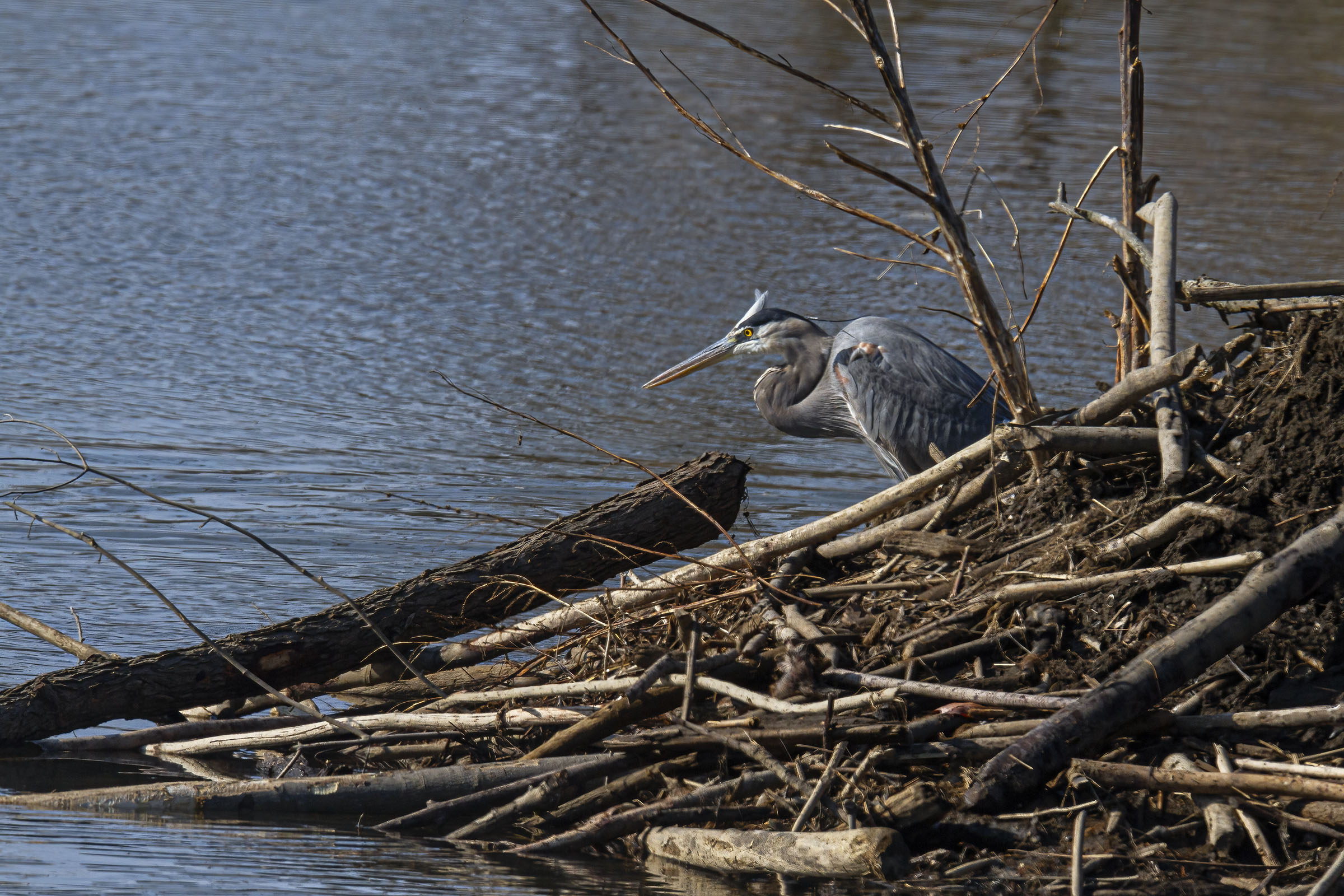
I was thrilled to spot this Great Blue Heron (Ardea herodias) last week at Occoquan Bay National Wildlife Refuge. Unlike Great Egrets (Ardea alba) that migrate out of our area in the fall, Great Blue Herons remain with us throughout the entire year. A lot of the water at the wildlife refuge was frozen, but this heron managed to find an open stretch of water and was fishing at the side of what might be a beaver den.
© Michael Q. Powell. All rights reserved.
Posted in Birds, Nature, Photography, warbler, wildlife, Winter, tagged Canon 7D, Occoquan Bay National Wildlife Refuge, Setophaga coronata, Tamron 150-600mm, warbler, Woodbridge VA, Yellow-rumped Warbler on February 13, 2026| 4 Comments »
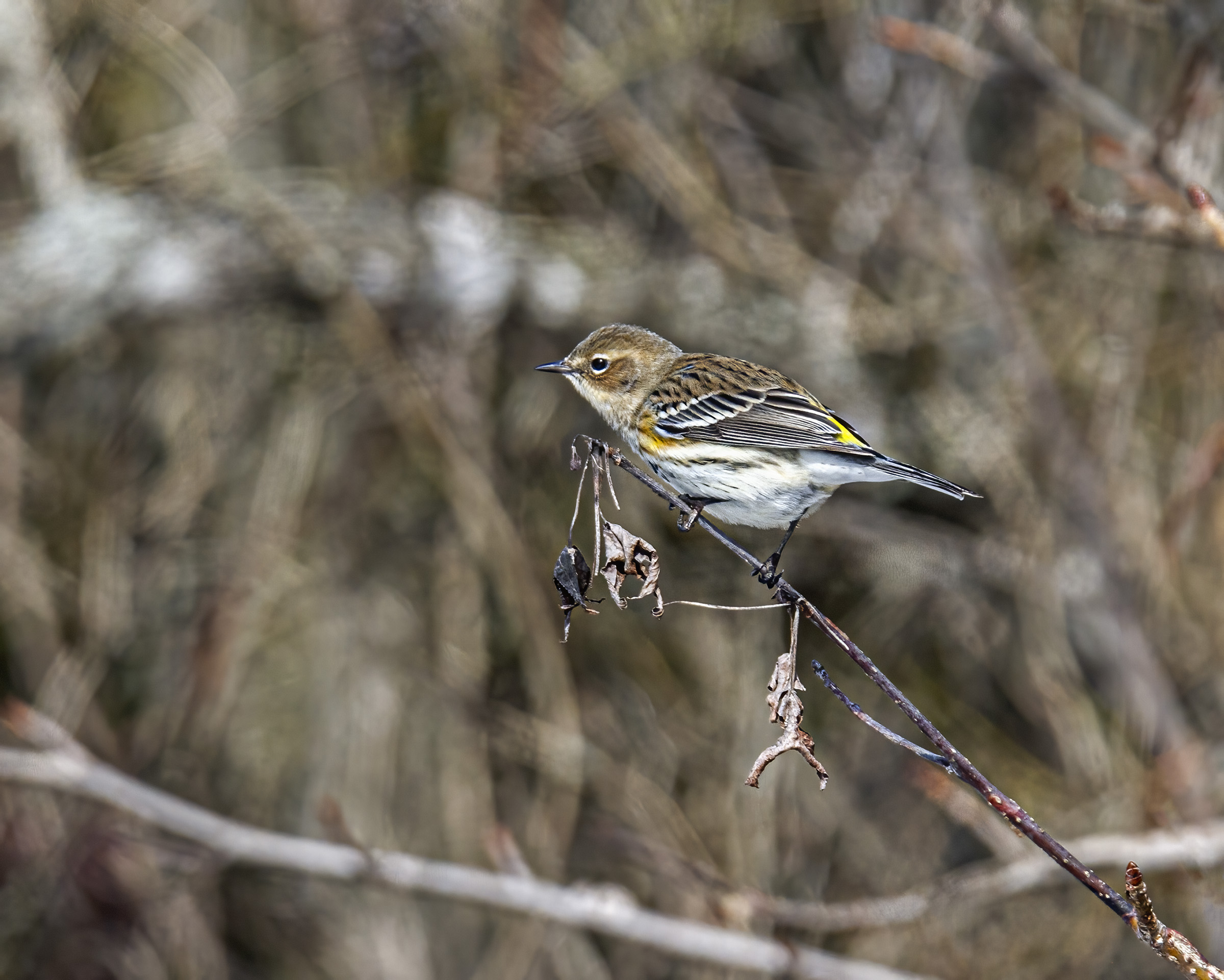
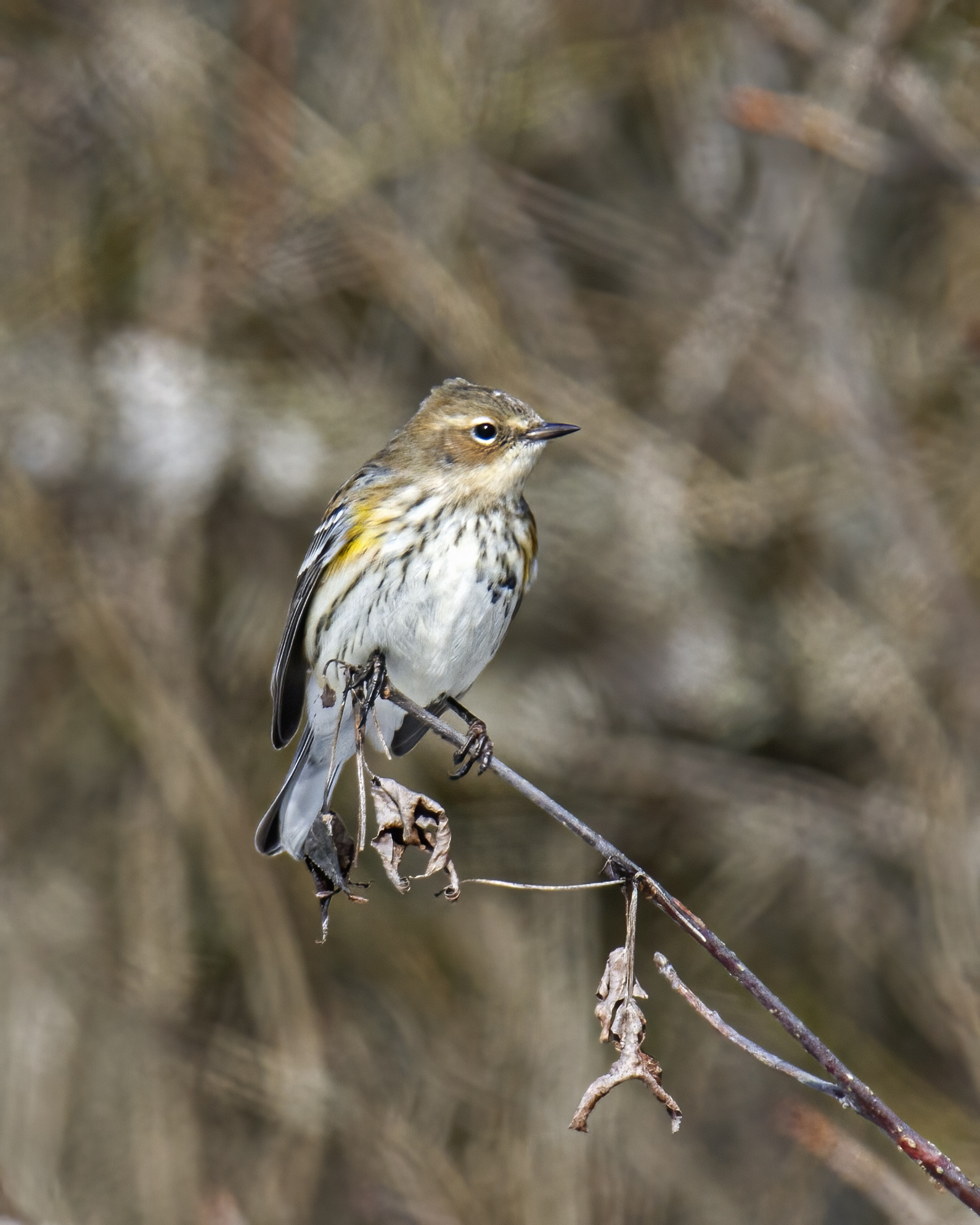
When I am lucky enough to spot warblers, it is usually in the spring and autumn, when they are migrating through Northern Virginia where I live. One exception is the Yellow-rumped Warbler (Setophaga coronata) that stays here for much of the winter.
I was delighted to get a glimpse of this Yellow-rumped Warbler on Wednesday at Occoquan Bay National Wildlife Refuge and even more thrilled that I was able to capture a couple of shots of the handsome little bird. The warbler was feverishly foraging and was rather hyperactive. The challenge for me and my camera was to acquire the subject in my viewfinder as soon as I saw it and then to accurately focus on it before it flew to a new perch.
On this day, I more or less met the challenge with this warbler, but like all other wildlife photographers, I have plenty of stories of “the one that got away.”
© Michael Q. Powell. All rights reserved.
Posted in Birds, Nature, Photography, wildlife, Winter, tagged American Coot, Canon 7D, coot, Fulica americana, Occoquan Bay National Wildlife Refuge, Tamron 150-600mm, Woodbridge VA on February 12, 2026| 1 Comment »
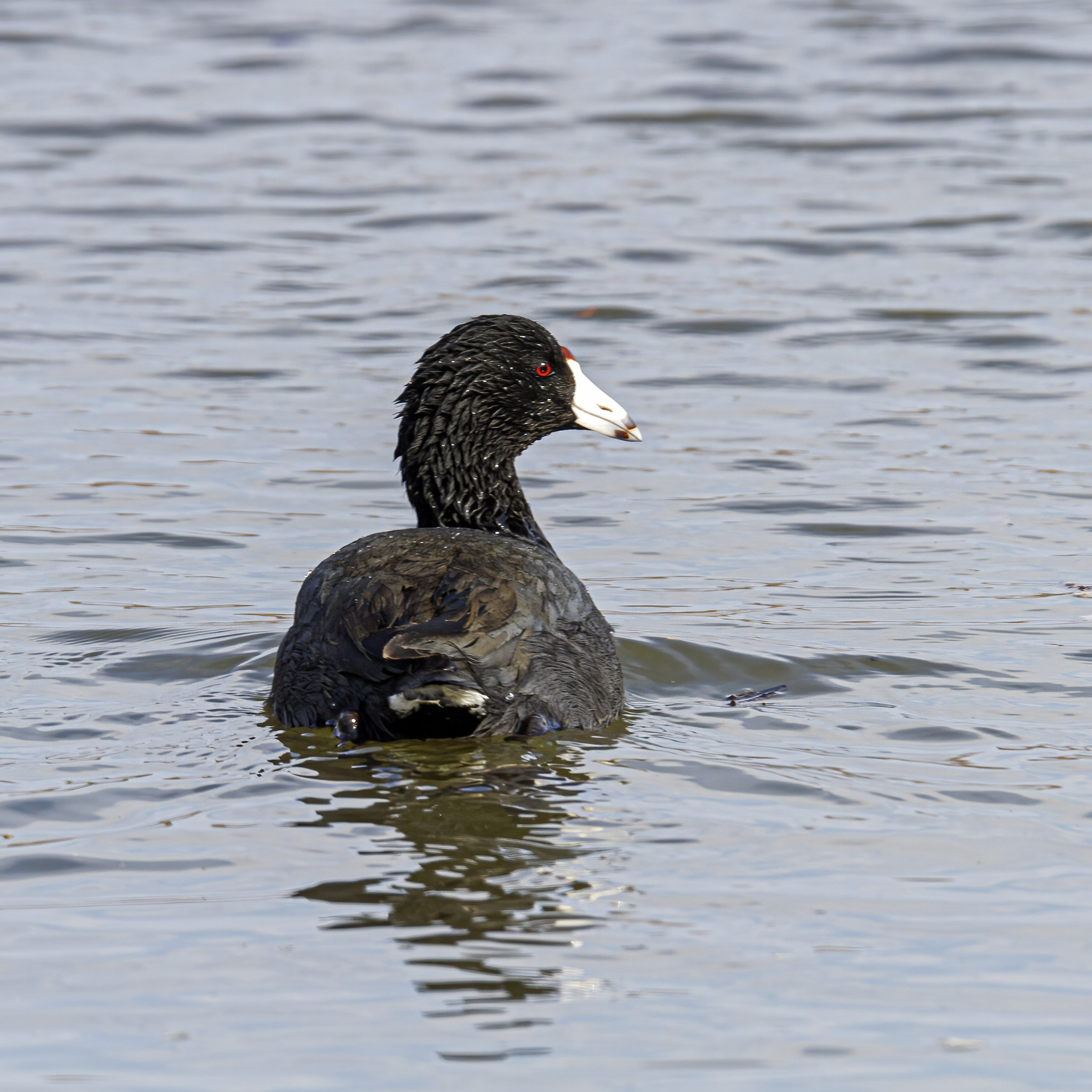
An American Coot (Fulica americana) turned its head as it swam away from me yesterday at Occoquan Bay National Wildlife Refuge, allowing the light to illuminate its stunning red eyes that often remain hidden in the shadows.
This was the first time that I have been out with my camera in several weeks. I have been mostly housebound during that time, due to the frigid temperatures and lingering snow that has made driving a challenge. Here in Northern Virginia we are not used to dealing with this much snow and the only now are we starting to warm enough for the snow to start to melt.
Yesterday was warm enough that the icy top layer of the snow had softened enough that it was no longer slippery, but it also mean that I was sinking into the snow several inches as I trudged along the still snow-covered trails at the wildlife refuge.
I was happy to have a few encounters with birds and I’ll share some more photos in the next few days, but thought I’d get back to more regular postings, now that I have something to share.
© Michael Q. Powell. All rights reserved.
Posted in Birds, Nature, Photography, wildlife, Winter, tagged Ardea herodias, Canon 7D, Great Blue Heron, Occoquan Bay National Wildlife Refuge, scratching an itch, Tamron 150-600mm, Woodbridge VA on January 20, 2026| 4 Comments »
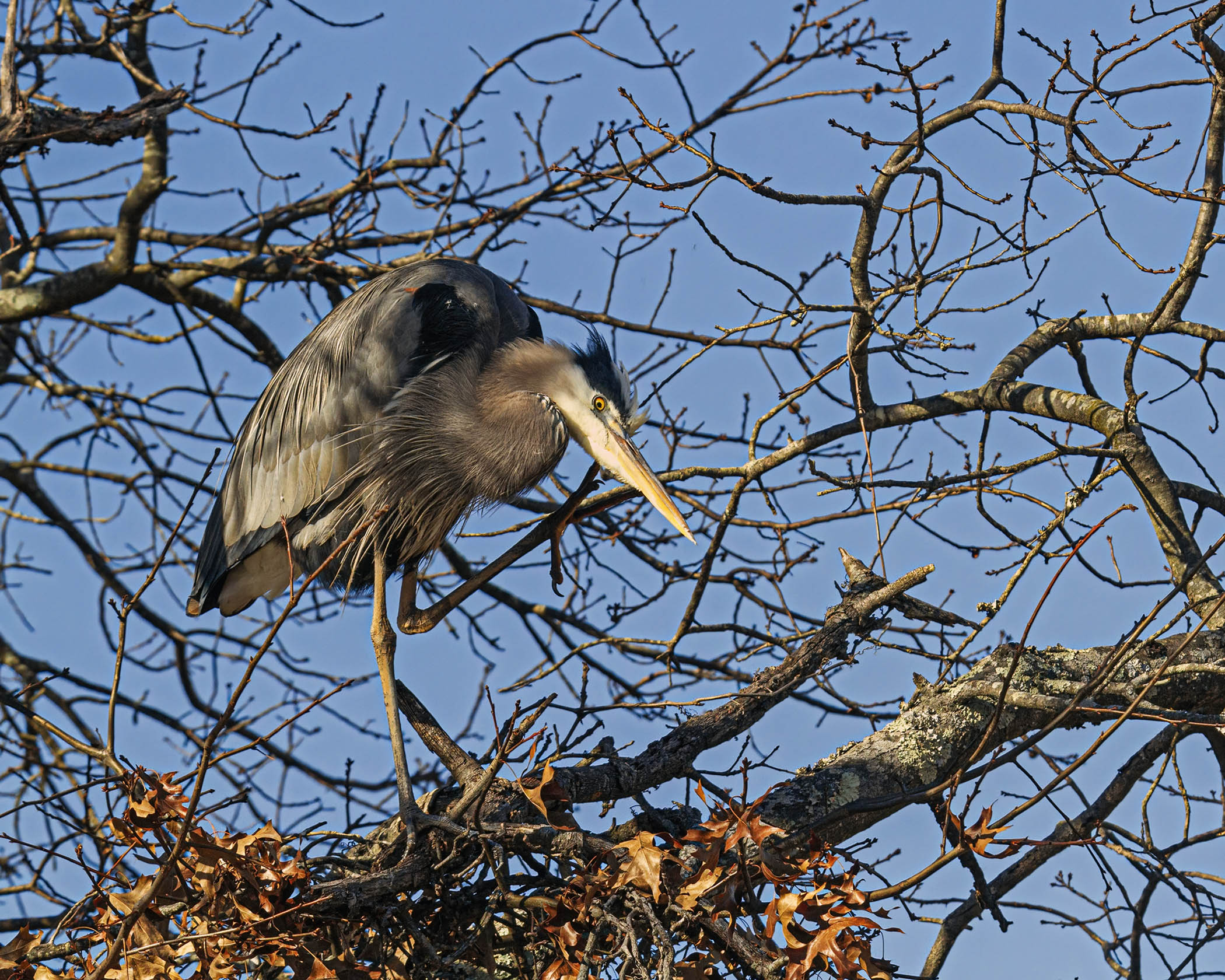
When I spotted this Great Blue Heron (Ardea herodias) last week, it was perched uprignt in a tree at Occoquan Bay National Wildlife Refuge. Suddenly it seemed to develop an itch that absolutely had to be scratched. The heron carefully balanced itself on one leg, bent its head down, and scratched away with its long nails.
Sometimes life is like that and you just have to scratch that itch immediately. Trust me, I’ve been there.
© Michael Q. Powell. All rights reserved.
Posted in Art, Landscape, Nature, Photography, Winter, tagged Canon 7D, foggy morning, misty morning, morning fog, Occoquan Bay National Wildlife Refuge, Tamron 150-600mm, Woodbridge VA on January 16, 2026| 2 Comments »
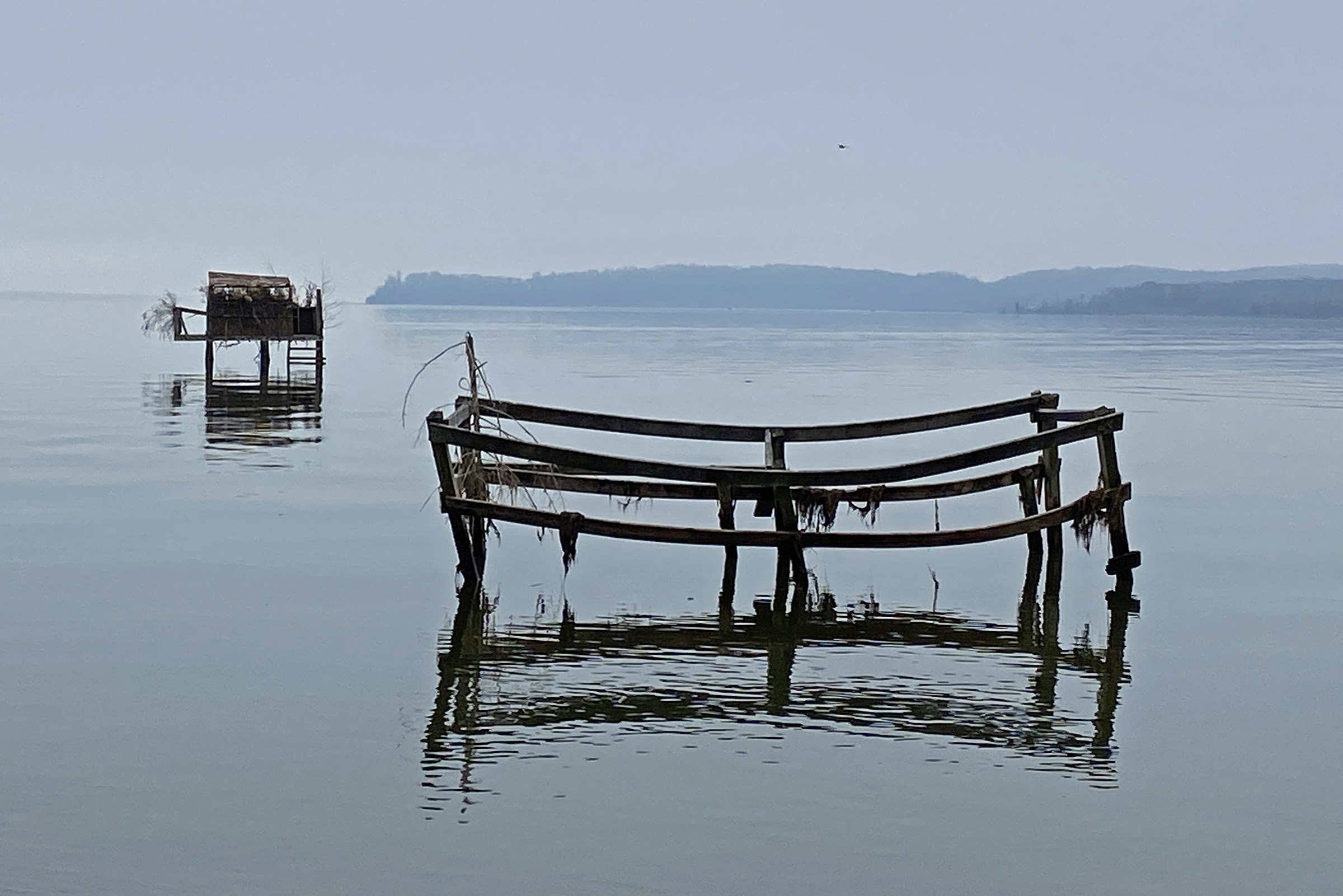
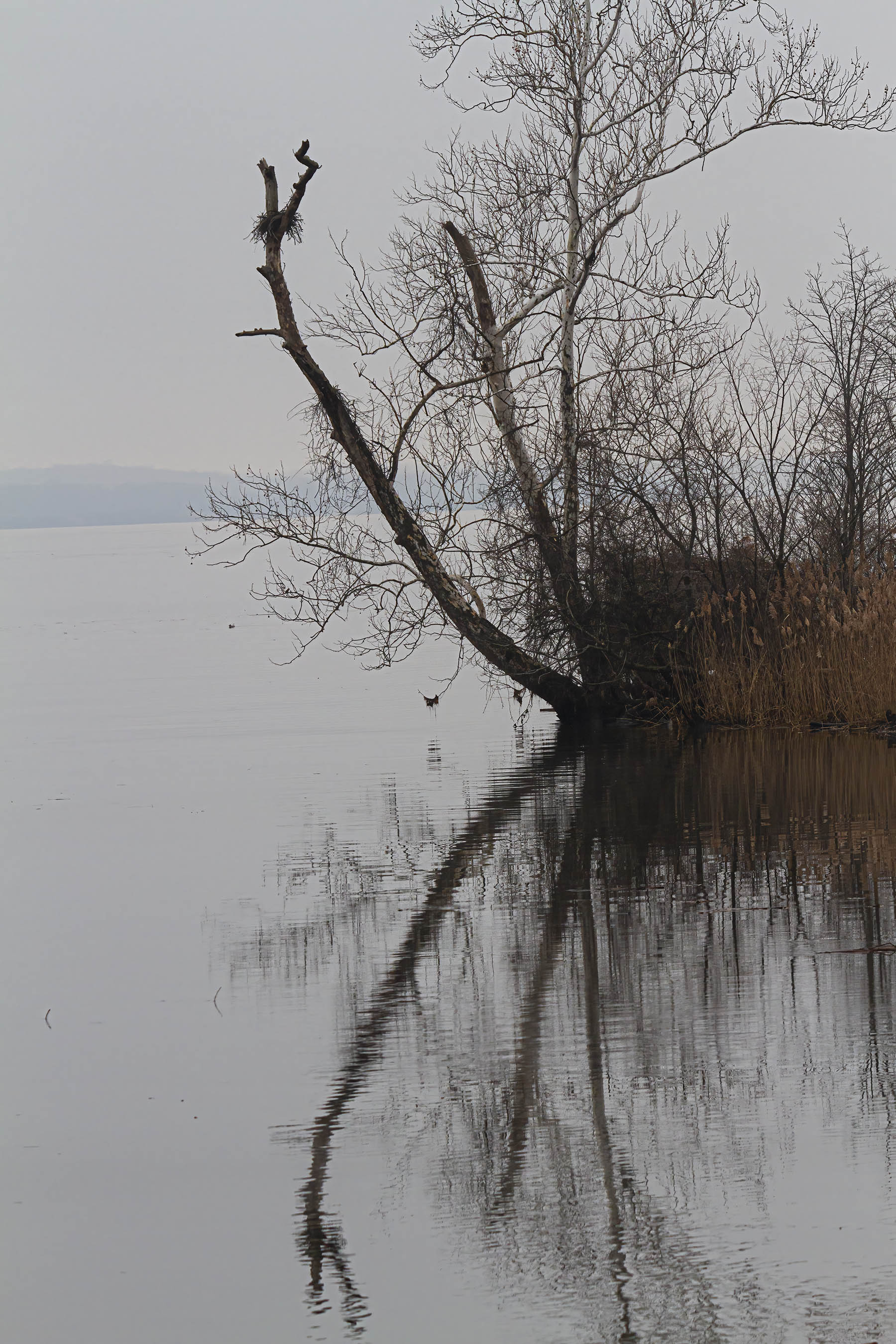
I have not been very good in forcing myself to get out early on the cold winter mornings of January so far this year. However, I did visit Occoquan Bay National Wildlife Refuge one cool, misty morning earlier this month.
The weather conditions created a moody, atmospheric vibe that prompted me to take some rather minimalist landscape shots. The two photos that I have included in this post more or less speak for themselves. You can see what the subjects are, but they are much less important than in my usual photos—I was focused more on capturing the mood rather than the theoretical subjects.
© Michael Q. Powell. All rights reserved.
Posted in Birds, Nature, Photography, wildlife, Winter, tagged Ardea herodias, Canon 7D, Great Blue Heron, heron, heron takeoff, Occoquan Bay National Wildlife Refuge, Tamron 150-600mm, Woodbridge VA on January 8, 2026| 7 Comments »
Some birds cooperate when I try to photograph them by posing, but often they fly away as soon as they detect my presence. Most often that results in a butt shot, which is not exactly the most flattering view of a bird (or a person for that matter).
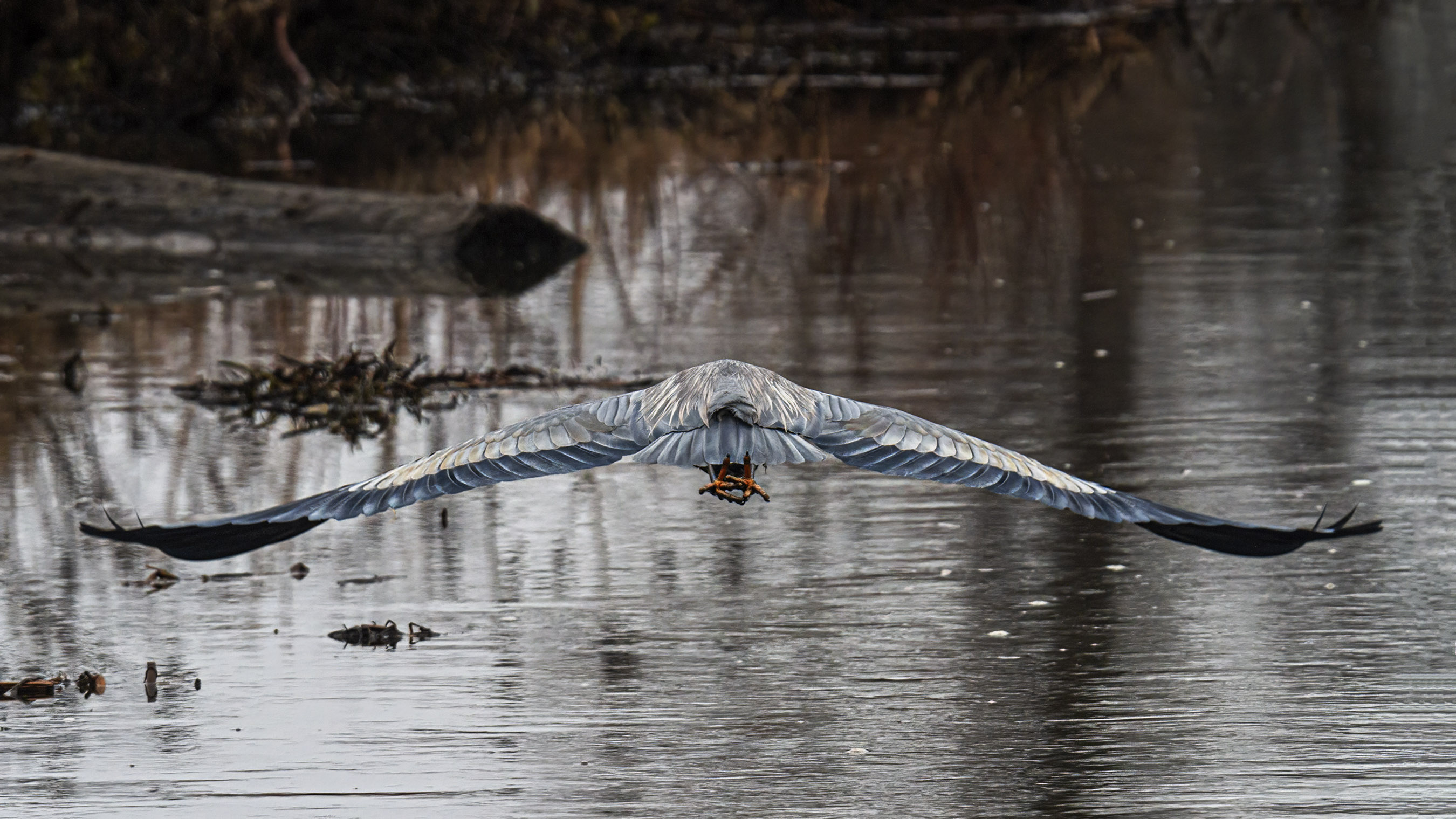
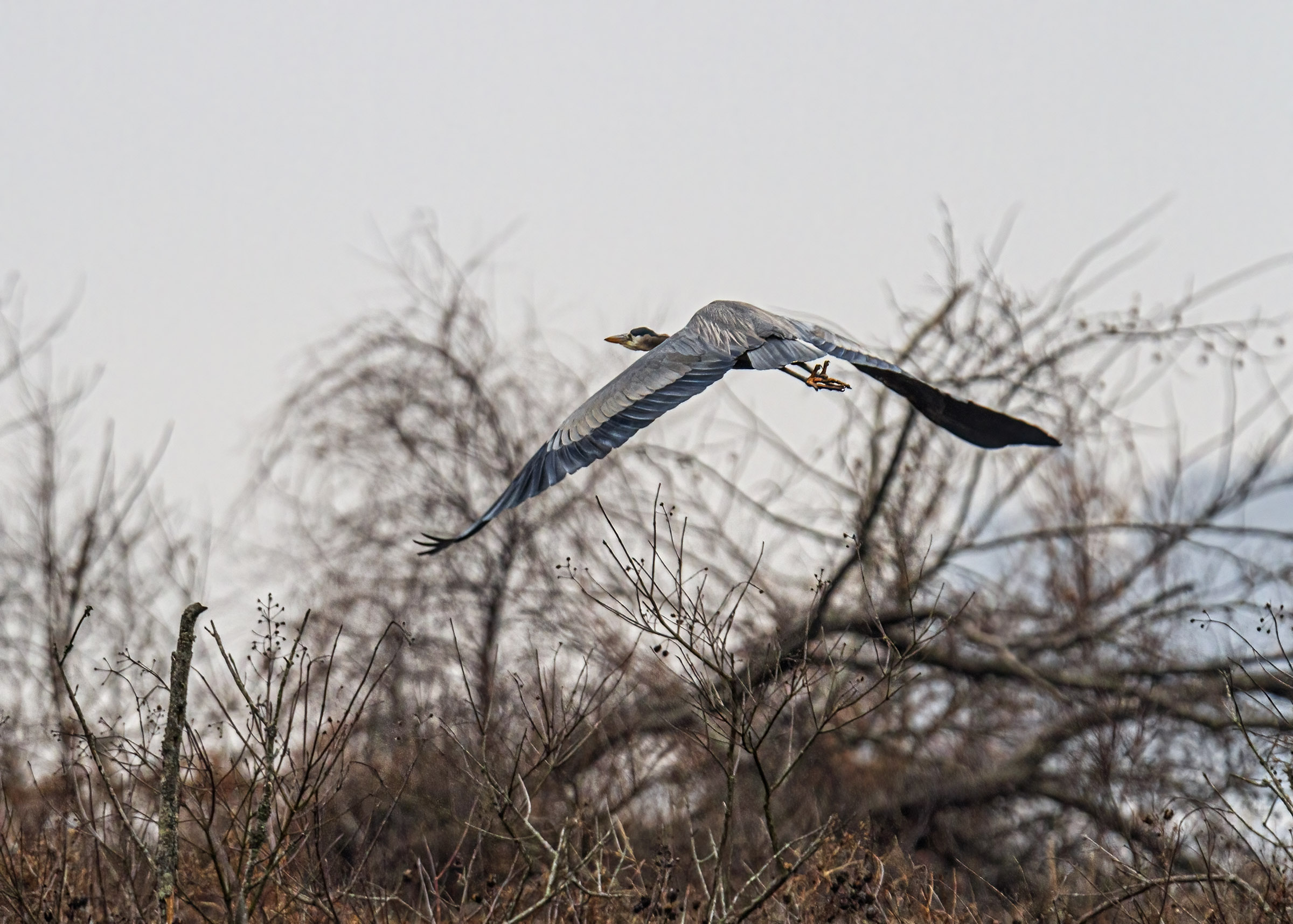
Sometimes though, I get lucky and get an interesting shot of the bird as it is moving out of view. This past Monday at Occoquan Bay National Wildlife Refuge, I captured some shots of a departing Great Blue Heron (Ardea herodias) that really showcased its impressively wide wingspan. According to the Cornell Lab of Ornithology, the wingspans of Great Blue Herons are about 5.5-6.6 feet (1.7-2.0 meters), an amazing size for a bird that weighs only about 5 pounds (2.3 kg).
I was zoomed in with my telephoto lens when the heron took off unexpectedly. As you can see in the first photo, I reacted a bit too slowly and was not quite ready when the heron extended its wings and jumped out of the water. The second shot shows the heron’s fully extended wings as it flew low over the pond before gaining some altitude (an I managed to capture the full wingspan). In the final shot, you can finally get a glimpse of the heron’s head and it has lifted its legs up against its body into more aerodynamic flight position. 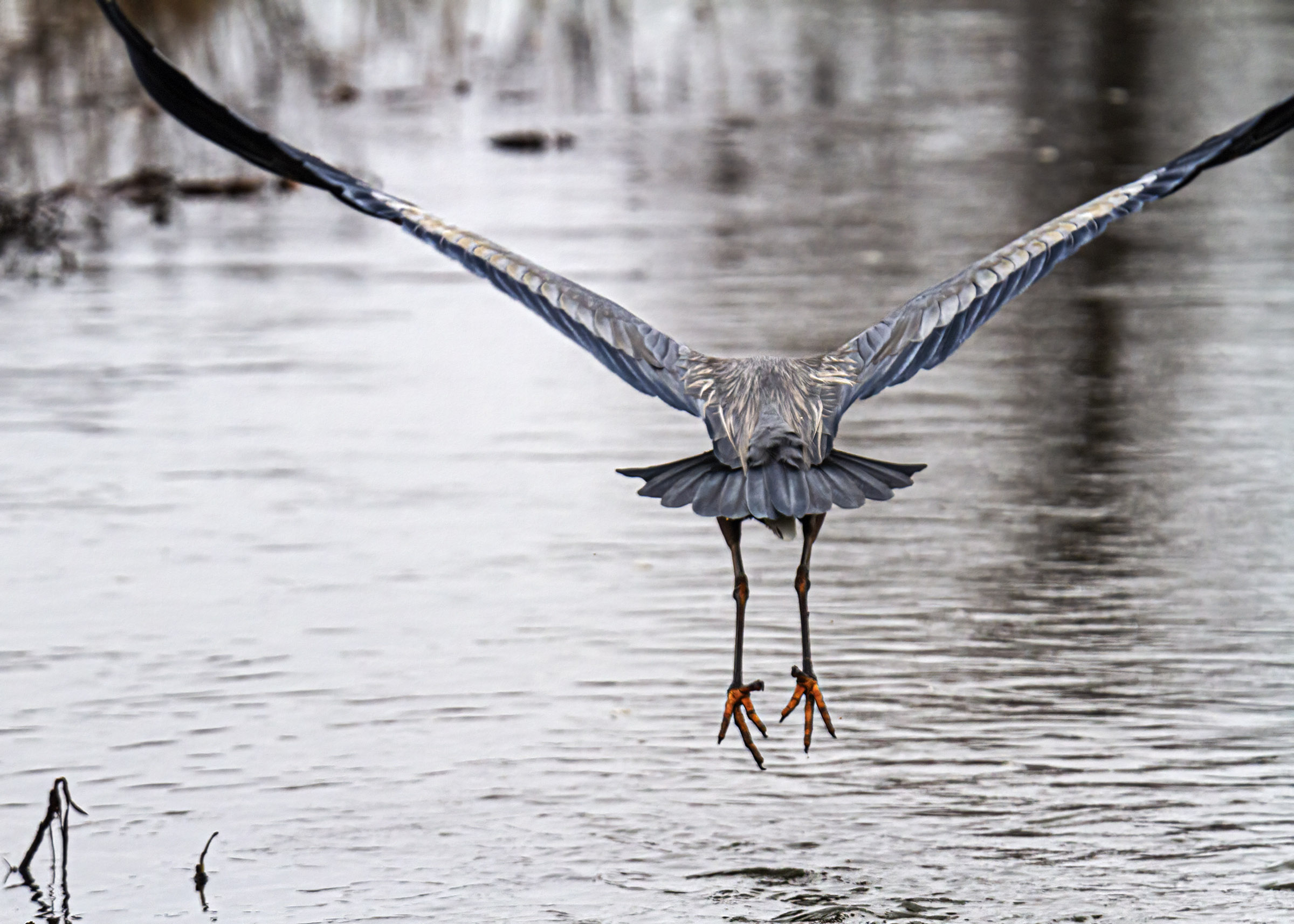
© Michael Q. Powell. All rights reserved.
Posted in Birds, Nature, Photography, wildlife, Winter, tagged Canon 7D, Carolina Wren, Melospiza melodia, Occoquan Bay National Wildlife Refuge, song sparrow, Tamron 150-600mm, Thryothorus ludovicianus, Woodbridge VA on January 7, 2026| 5 Comments »
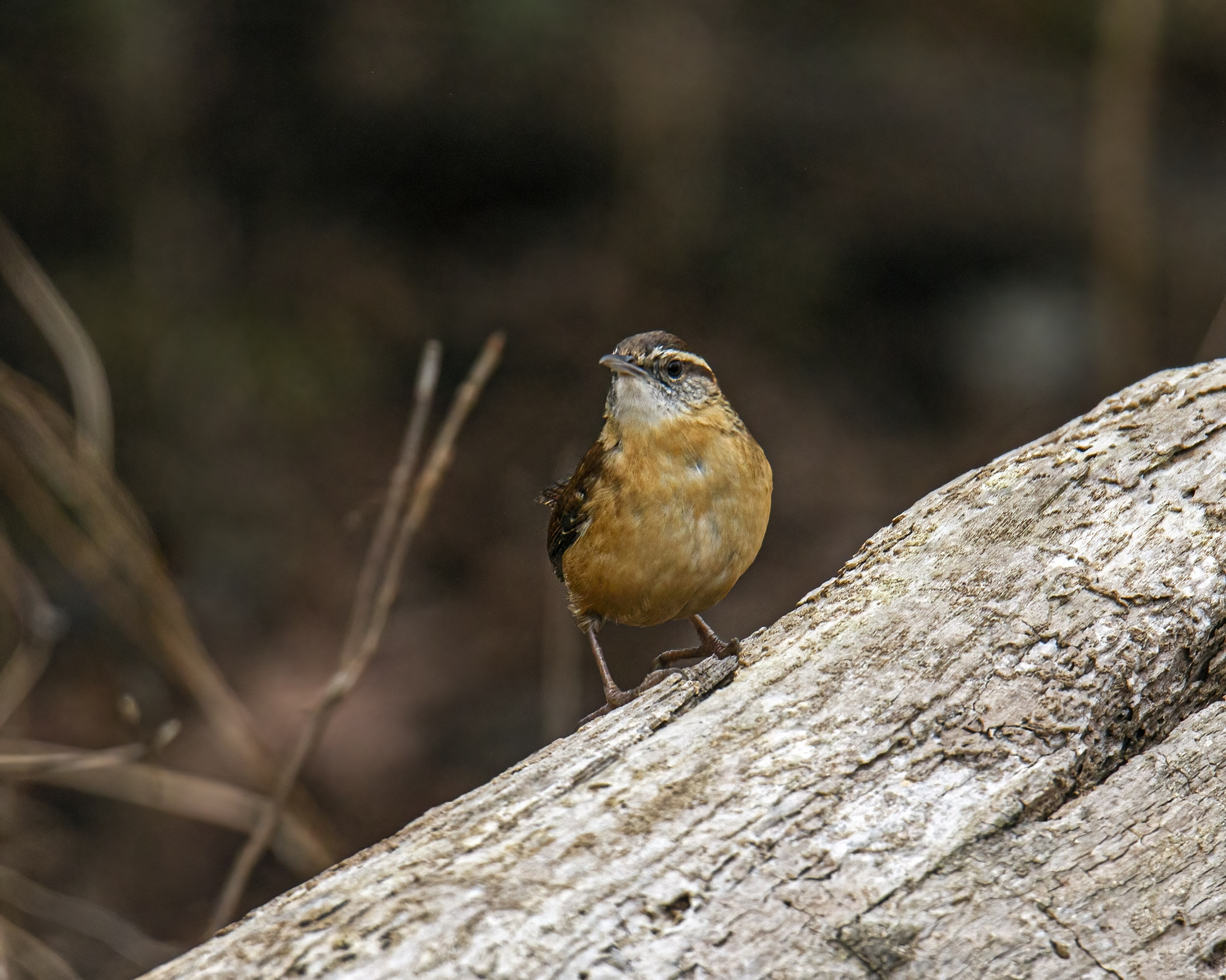
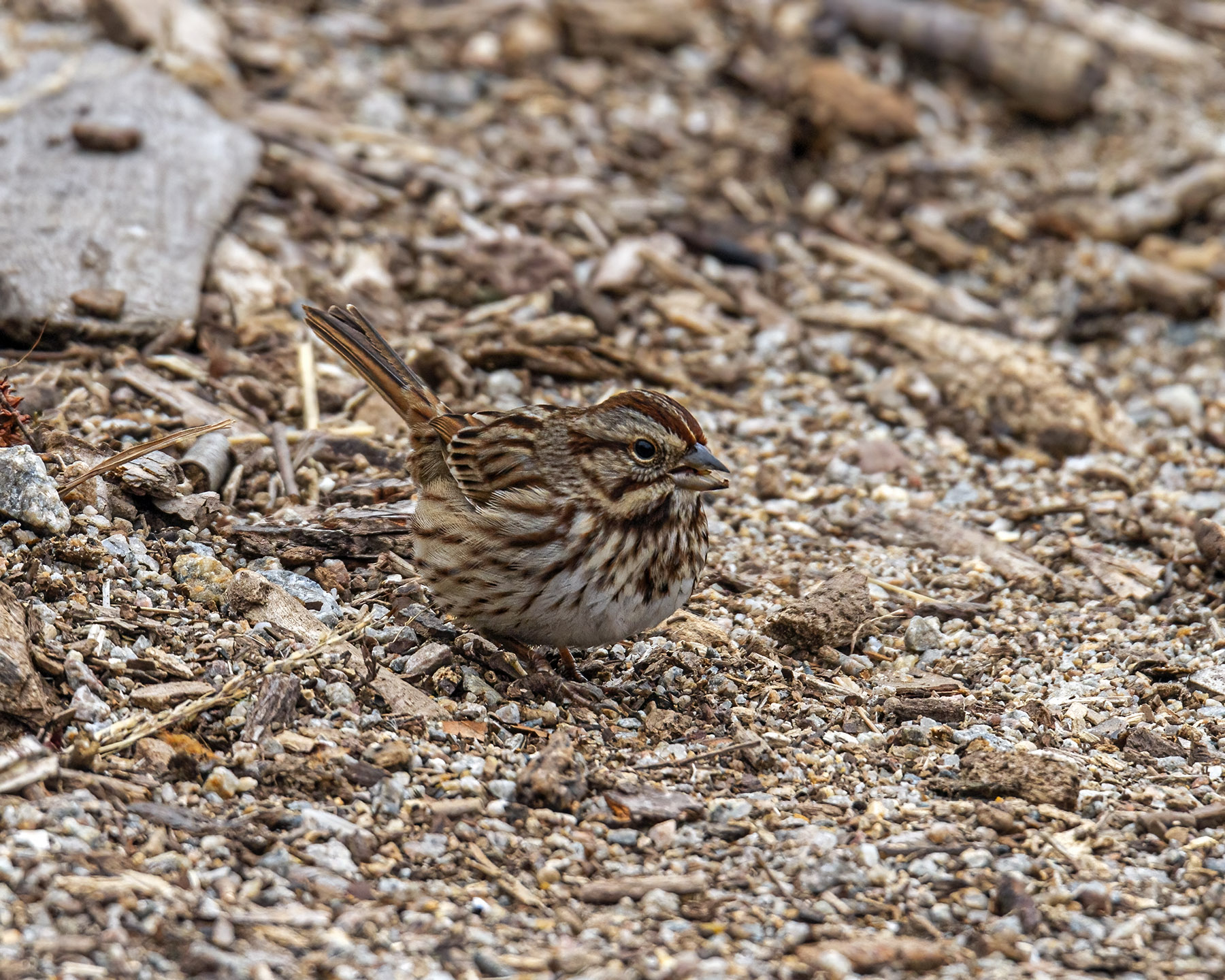
I photographed this little Carolina Wren (Thryothorus ludovicianus) and this spherical Song Sparrow (Melospiza melodia) yesterday during a lengthy trek through Occoquan Bay National Wildlife Refuge. The weather yesterday was cold and overcast, which mean that the conditions were less than ideal, but I was feeling a bit of cabin fever and was happy to be outdoors for my first photo trek of the new year.
I could hear a lot of birds singing in the trees and rustling about in the underbrush, but did not get very many clear views of them. Still, I was happy with the results that I achieved. I snapped off the first photo when the wren momentarily hopped up from the leaves in which it had been foraging and looked in my direction.
The sparrow in the second photo was a bit more in the open, but its head was most often turned away from me. I really like the way that the bird’s markings were an almost perfect match for the colors and the patterns in the background.
It felt good to be out with my camera and to experience the tranquility of nature that so often soothes my soul.
© Michael Q. Powell. All rights reserved.
Posted in Birds, cross stitch, Nature, Photography, Winter, tagged @pigeoncoopdesigns.com, Bombycilla cedrorum, Canon 7D, Cedar Waxwing, Festive Cardinal, Max Pigeon, New Year 2026, Occoquan Bay National Wildlife Refuge, Pigeon Coop Designs, Tamron 150-600mm, Woodbridge VA on January 2, 2026| 15 Comments »
It’s hard to believe that a new year has already started. Where did 2025 go? I had to really pay attention when I wrote the date on my first check of 2026 this morning—yes, I still write a few paper checks each month, though I am moving increasingly to paying most of my bills on line.
For a variety of reasons, I kind of backed off from photography a bit this past year. According to the stats portion of WordPress, I published 196 posts in 2025 for a total of over 34 thousand words. That may seem like a lot, but over the lifetime of this blog, I’ve probably averaged about 400 postings a year, with a high of 653 posts with a total of just under 100 thousand words in 2014. In case you are a stats nerd, my lifetime totals since my start in 2012 are 5502 postings with a total of 581988 views.
Strangely enough, the number of views in 2025 was an all-time high of over 89 thousand. Why? I think that the addition of an AI summary to Google searches may have brought forward a number of my posts to a broader audience and a sharp increase in the number of viewers from China (over 12 thousand views in 2025) may reflect the activity of bots or some other web tools.
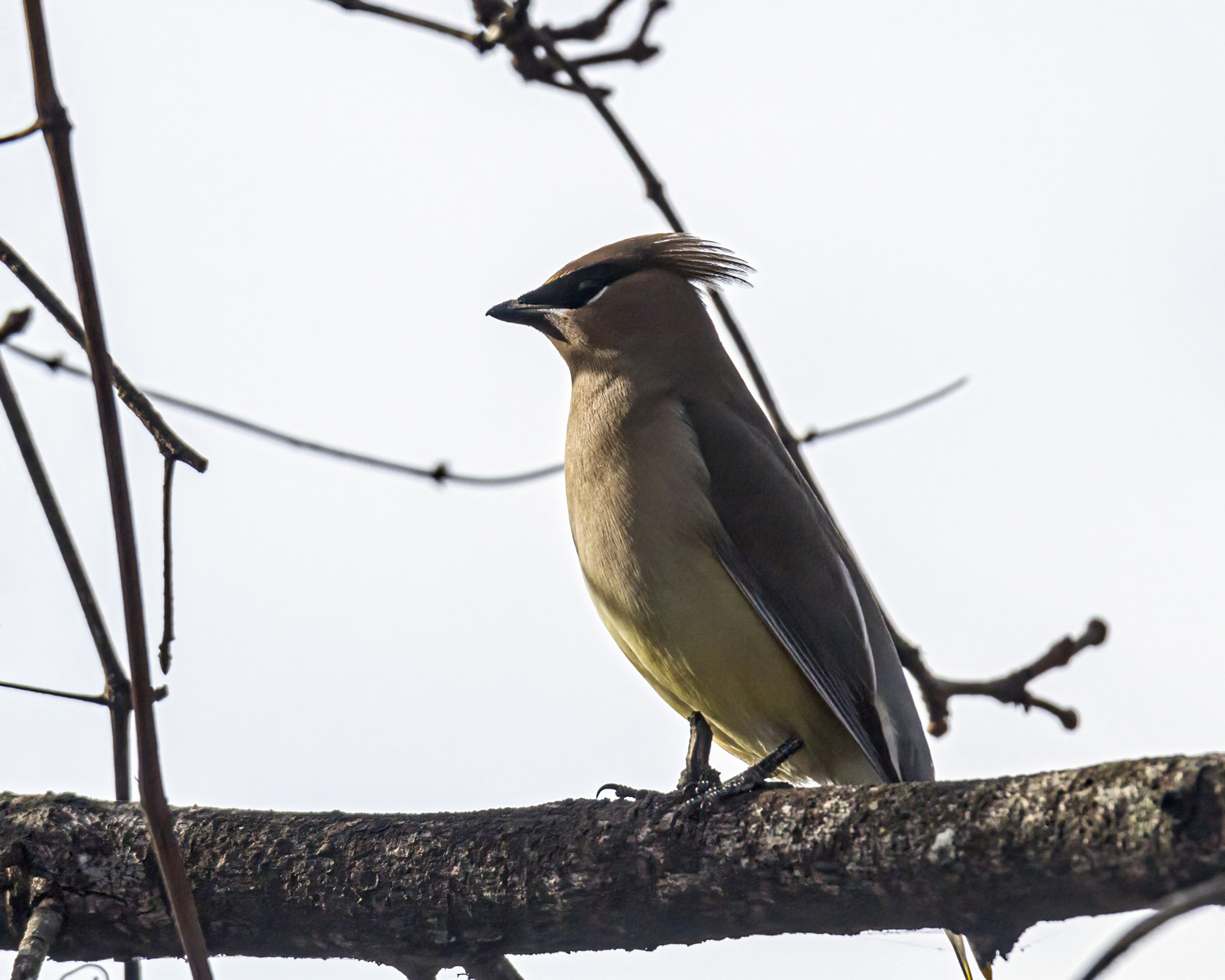
I haven’t given up on wildlife photography, but during the second half of 2025 I averaged going out with my camera only about once a week. In late December I captured this image of a Cedar Waxwing bird (Bombycilla cedrorum) that was most hidden in the shadows. I was thrilled to be able to capture the distinctive crest of this really cool bird.
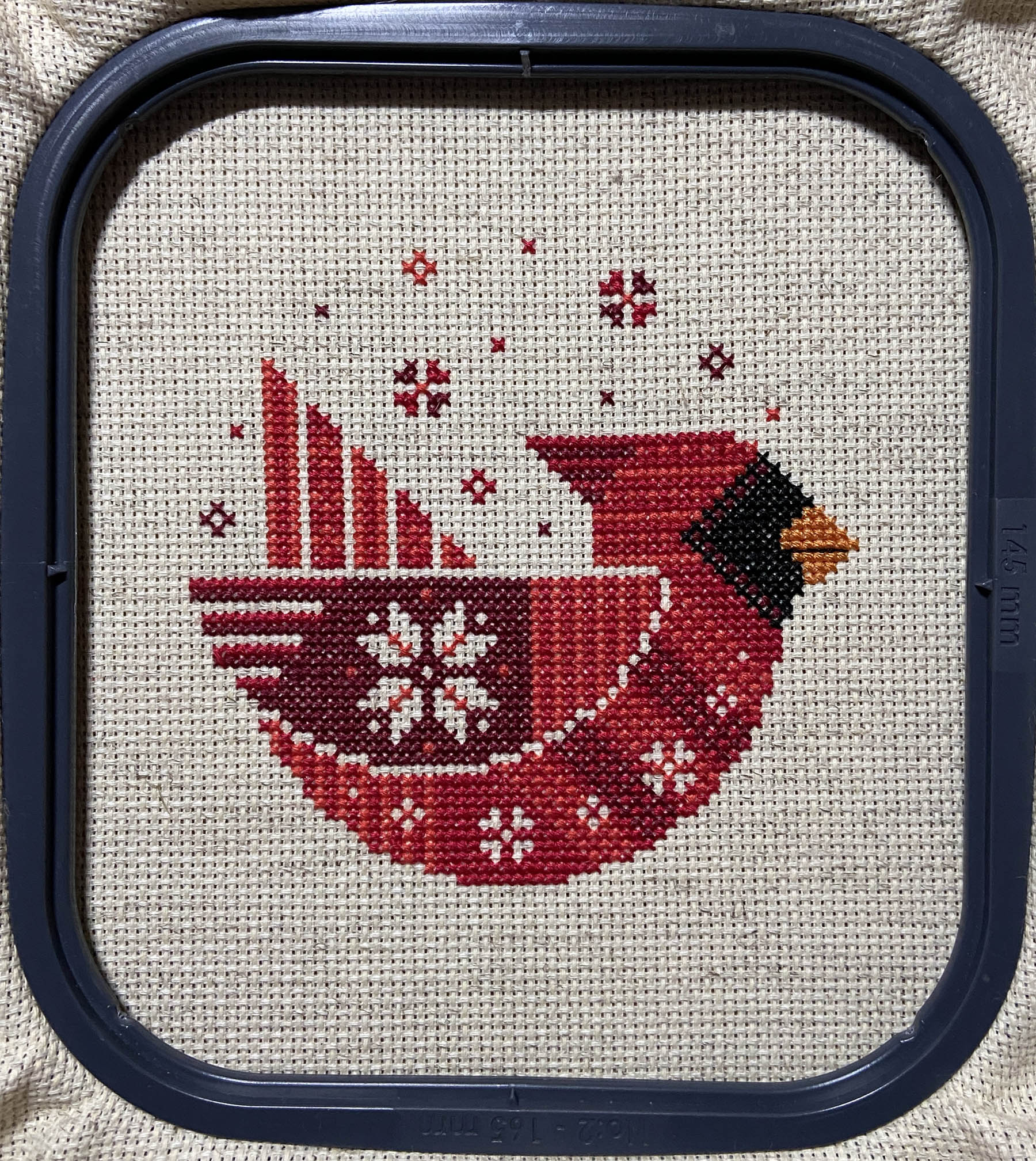
During this past year I have rediscovered my love of counted cross stitch and have devoted a substantial amount of my “extra” time to stitching. It’s a strange mix of hobbies to have one that is active and outdoors and another that is mostly sedentary. The second photo shows a recently completed project called Festive Cardinal, designed by Max Pigeon of Pigeon Coop Designs. I showed this project a while back when it was almost completed, but thought it would be fun to show it again in its finished form, because it shows the way that my photography interests and cross stitch interests overlap in terms of subject matter.
So what will 2026 hold for me? I really don’t do new year’s resolutions and am not much for planning—I came across a joke yesterday that new year’s resolutions are things that go in one year and out the other. Sorry. I’m hoping that I’ll achieve a better balance between these two primary hobbies, but I may go off on tangents with watercolor painting, knitting, or even sewing—maybe I’ll finally learn to use the sewing machine that a friend gave to me. I guess that the one thing that ties all of these interests together is a sense of wonder and curiosity and a desire to tap into a sense of creativity that was mostly suppressed during my working career.
Best wishes for a happy and healthy new year. Technically I am also wishing those of you who celebrate Christmas a Merry Christmas, because today is only the ninth day of Christmas (on which the well-known song indicates that my true love gave me nine ladies dancing).
© Michael Q. Powell. All rights reserved.
Posted in Birds, Nature, Photography, wildlife, Winter, tagged Canon 7D, Occoquan Bay National Wildlife Refuge, Setophaga coronata, Tamron 150-600mm, warbler, Woodbridge VA, Yellow-rumped Warbler on December 29, 2025| Leave a Comment »
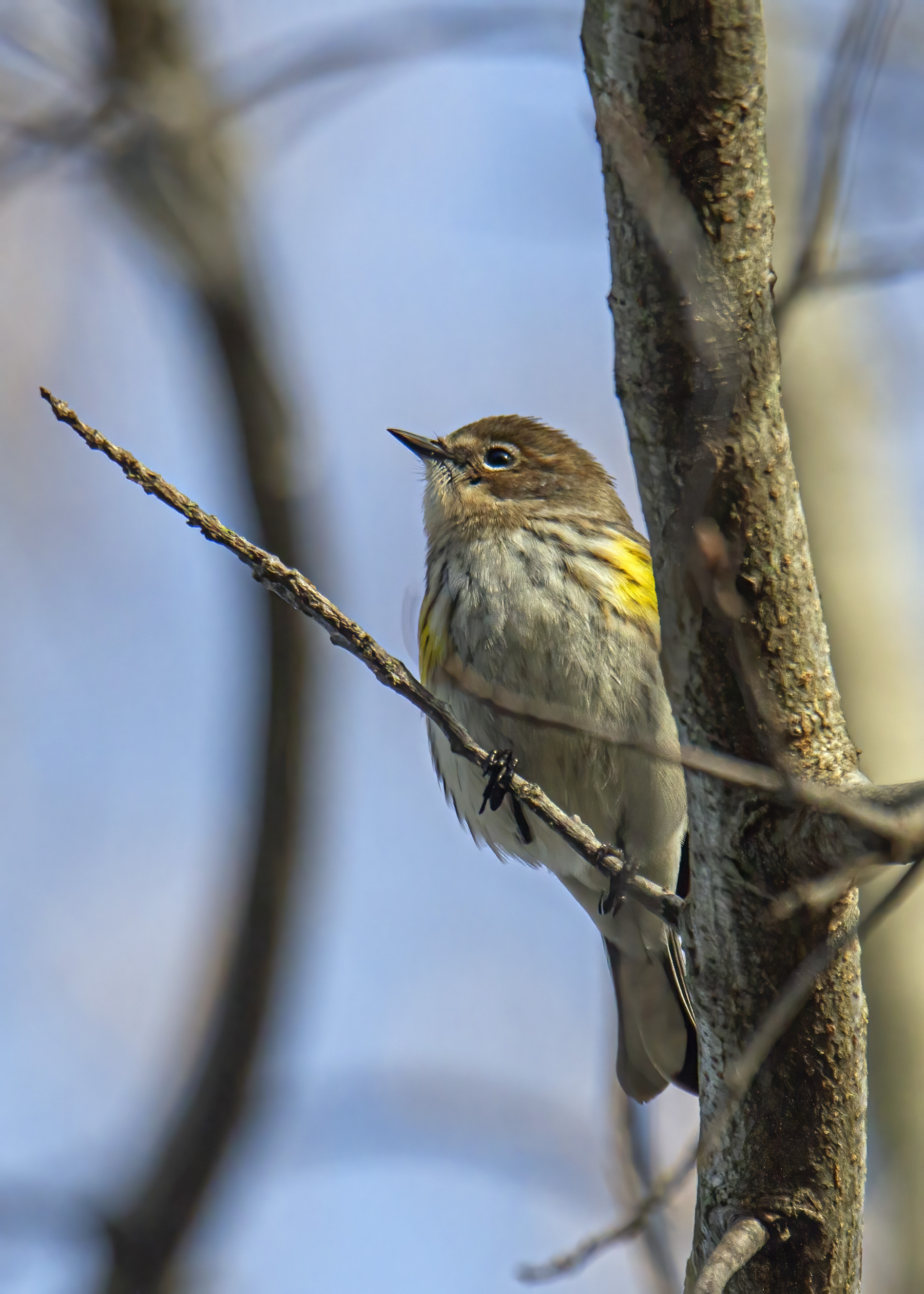
Many different warblers pass through my area during the spring and the autumn, but the Yellow-rumped Warbler (Setophaga coronata) is one of the few species that remains here for most of the winter. Their colors are pretty subdued during the winter season, but they do have small patches of bright yellow on their sides and on their rump. It is always a delight to spot their flashes of yellow as they forage in the trees.
I captured this shot of a Yellow-rumped Warbler in mid-December as it was peeking out from behind a tree at Occoquan Bay National Wildlife Refuge.
© Michael Q. Powell. All rights reserved.
Posted in Art, Birds, Nature, Photography, wildlife, Winter, tagged Canon 7D, Melanerpes carolinus, Occoquan Bay National Wildlife Refuge, Red-bellied Woodpecker, Tamron 150-600mm, Tamron 150-600mm telephoto, Woodbridge VA, woodpecker on December 27, 2025| 8 Comments »
When I am out in the wild with my camera, most of my senses are fully engaged. I am listening intently and scanning constantly, seeking audio or visual clues of the presence of potential subjects. During much of the year, sounds don’t help much, because the leaves on the trees hide the sources of the sounds. I marvel at the ability of some folks to identify birds by their calls, but I can do that with only a handful of species. So most of the time I rely on movement and to a lesser extent on color for me to acquire a target—if a bird (or insect) remains still, it often will remain invisible to me.
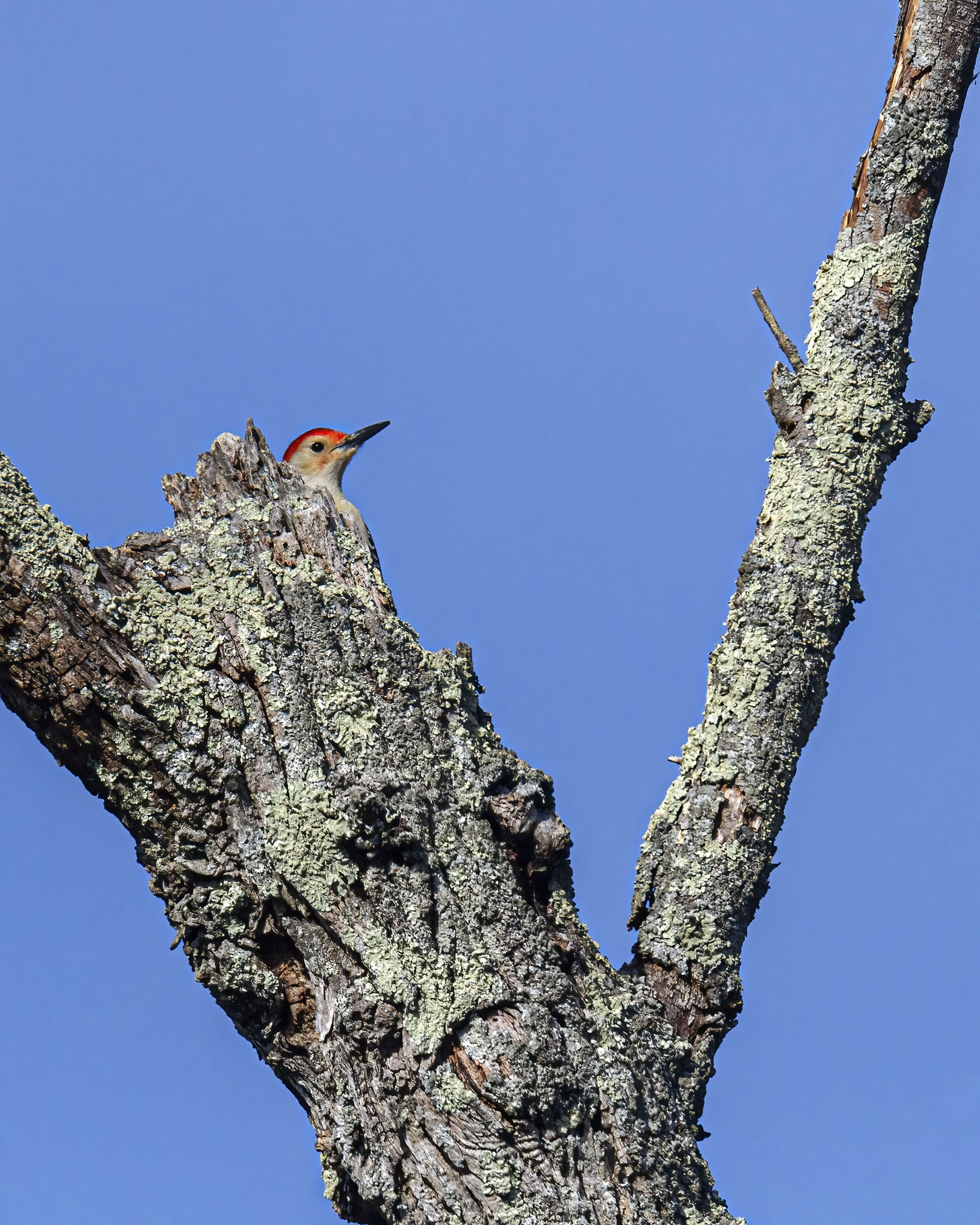
Last week when I was walking about at Occoquan Bay National Wildlife Refuge, I heard the gentle tapping sounds of a woodpecker. I looked in the general direction of the sounds and saw a distant snag, but did not see the woodpecker. Did I have the right tree identified? As I was focusing on the tree, a Red-bellied Woodpecker (Melanerpes carolinus) poked its head out from behind the tree and I quickly snapped off a couple of photos before the bird disappeared again from view.
The woodpecker was pretty far away, even for my telephoto zoom lens, so I knew that I did not get the kind of close-up detailed image that I usually like to capture. However, when I was reviewing the photos on my computer, I found myself drawn to this profile shot of the woodpecker, surrounded by the wonderful texture of the lichen-covered bark of the tree. The image has a bit of an artsy, minimalist feel that I really like.
© Michael Q. Powell. All rights reserved.
Posted in Birds, Nature, Photography, wildlife, Winter, tagged Bald Eagle, bald eagle takeoff, Canon 7D, Haliaeetus leucocephalus, Occoquan Bay National Wildlife Refuge, Tamron 150-600mm, Woodbridge VA on December 26, 2025| 4 Comments »
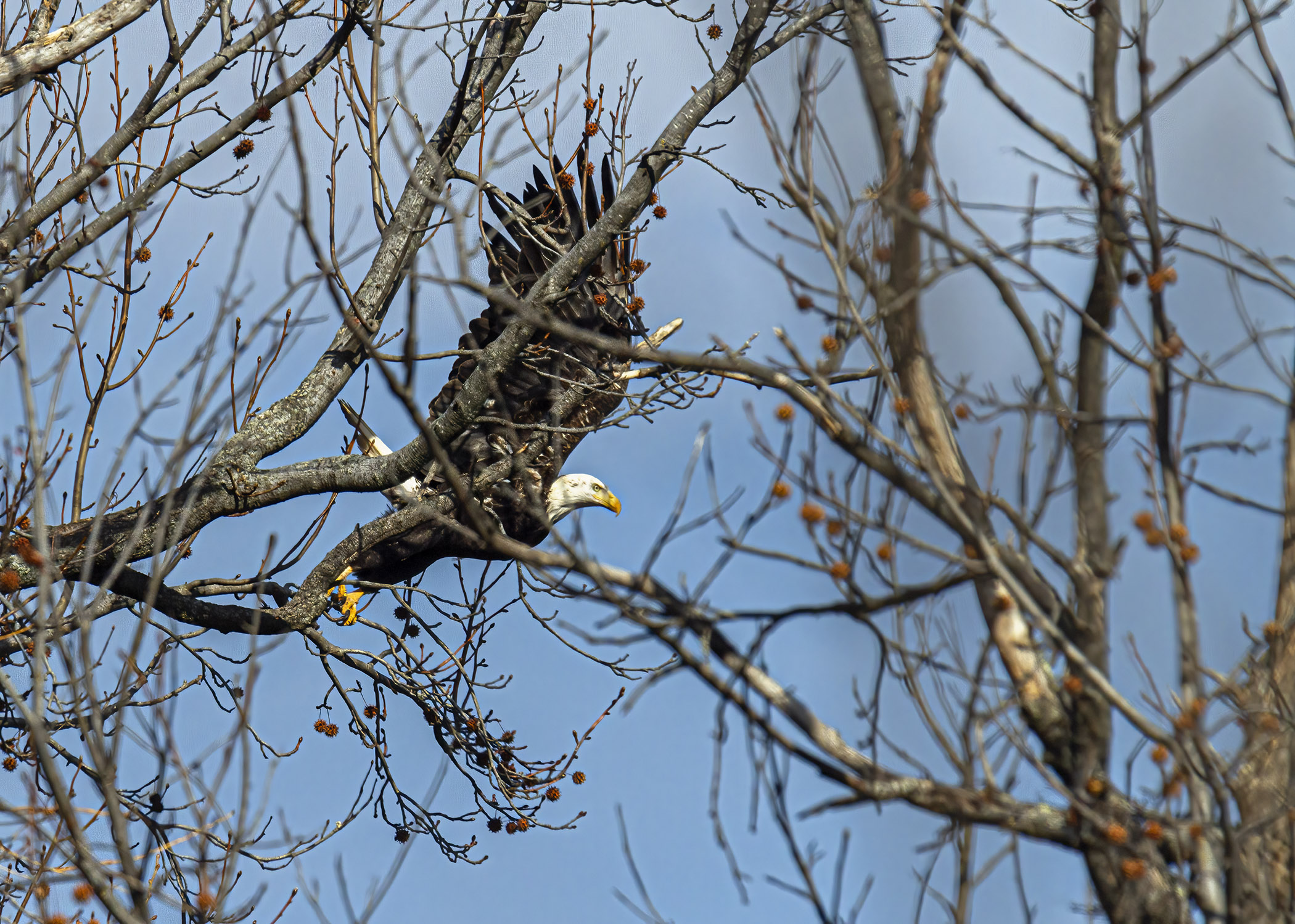
When the leaves are gone from the trees, it’s a little easier to spot perched Bald Eagles (Haliaeetus leucocephalus), like this one that I photographed last week at Occoquan Bay National Wildlife Refuge. I am blessed to live in an area where there are enough bald eagles that it is not uncommon for me to spot one. However, the eagles have much more developed senses that I do, so often my first indication of their presence is when they are flying away from me, as you can see in the first photo below.
In the case of the second photo, there was a good deal of vegetation between me and the eagle that partially hid my presence. I was able to manually focus my lens on the perched eagle through the vegetation and get a relatively clear shot of the eagle, which took off almost immediately after I had snapped a couple of photos.
I am not certain if I will be able to get out with my camera during the few remaining days of 2025, so these photos may well be my last shots of the year of these majestic birds.

© Michael Q. Powell. All rights reserved.
Posted in Birds, Nature, Photography, wildlife, Winter, tagged American robin, bathing robin, Canon 7D, Occoquan Bay National Wildlife Refuge, robin, Tamron 150-600mm, Turdus migratorius, Woodbridge VA on December 24, 2025| 3 Comments »
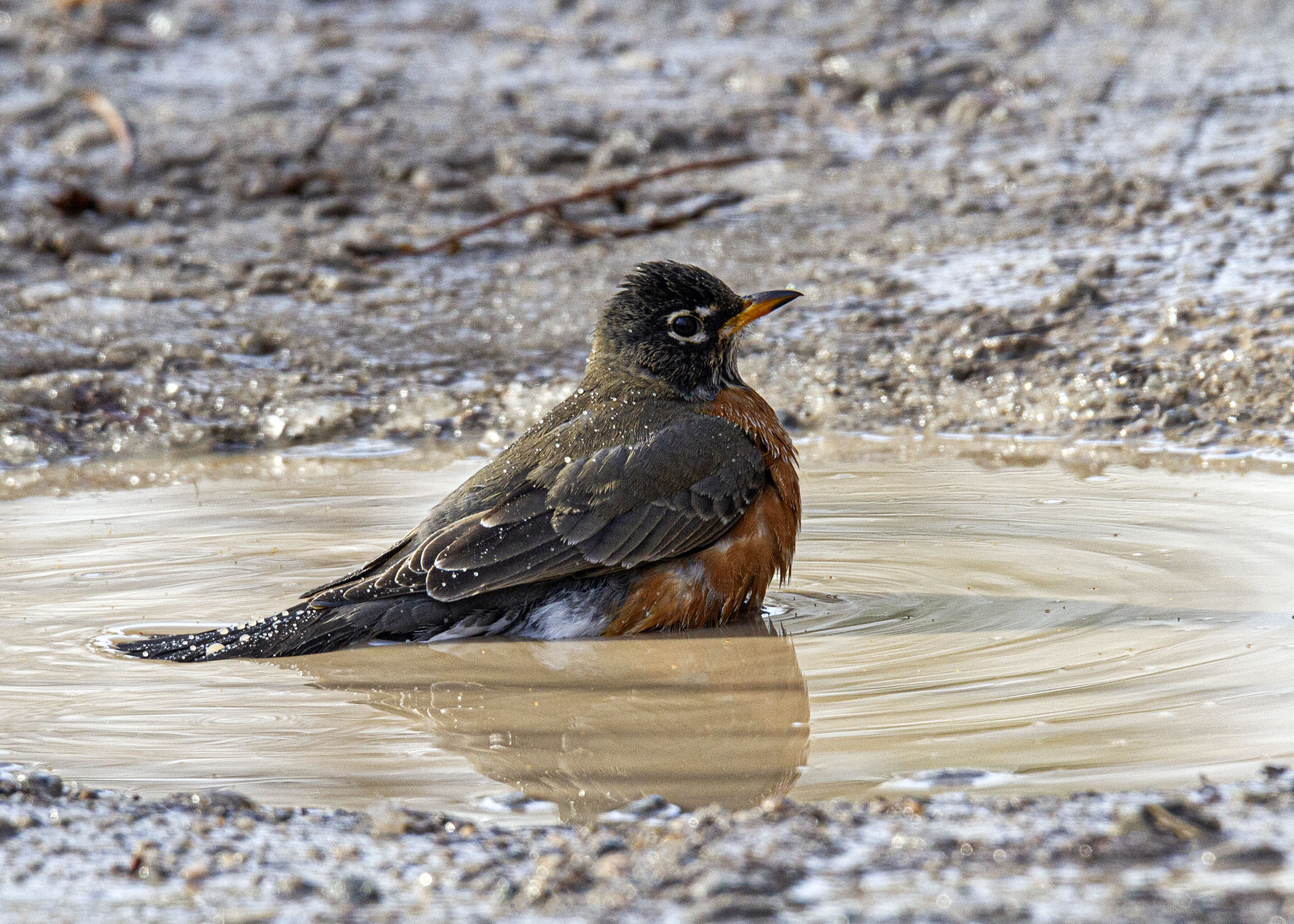
Last week at Occoquan Bay National Wildlife Refuge I spotted a small group of American Robins (Turdus migratorius) clustered around a large puddle. Some of the birds took their turns drinking from the puddle, while others took advantage of the opportunity to take a bath. Some of the birds merely flapped about a bit in the water, but the robin in the photo below seemed to enjoy soaking in the cold water.
© Michael Q. Powell. All rights reserved.
Posted in Birds, Nature, Photography, wildlife, Winter, tagged Ardea herodias, Canon 7D, Great Blue Heron, Great Blue Heron fishing, Occoquan Bay National Wildlife Refuge, Tamron 150-600mm, Woodbridge VA on December 22, 2025| 2 Comments »
Some birds, like Great Egrets and Green Herons, leave our area during the cold months to overwinter in warmer places. Great Blue Herons, however, remain with us throughout the year. I imagine that it is tough for them to find food, especially when the small ponds where I often spot them are frozen over.
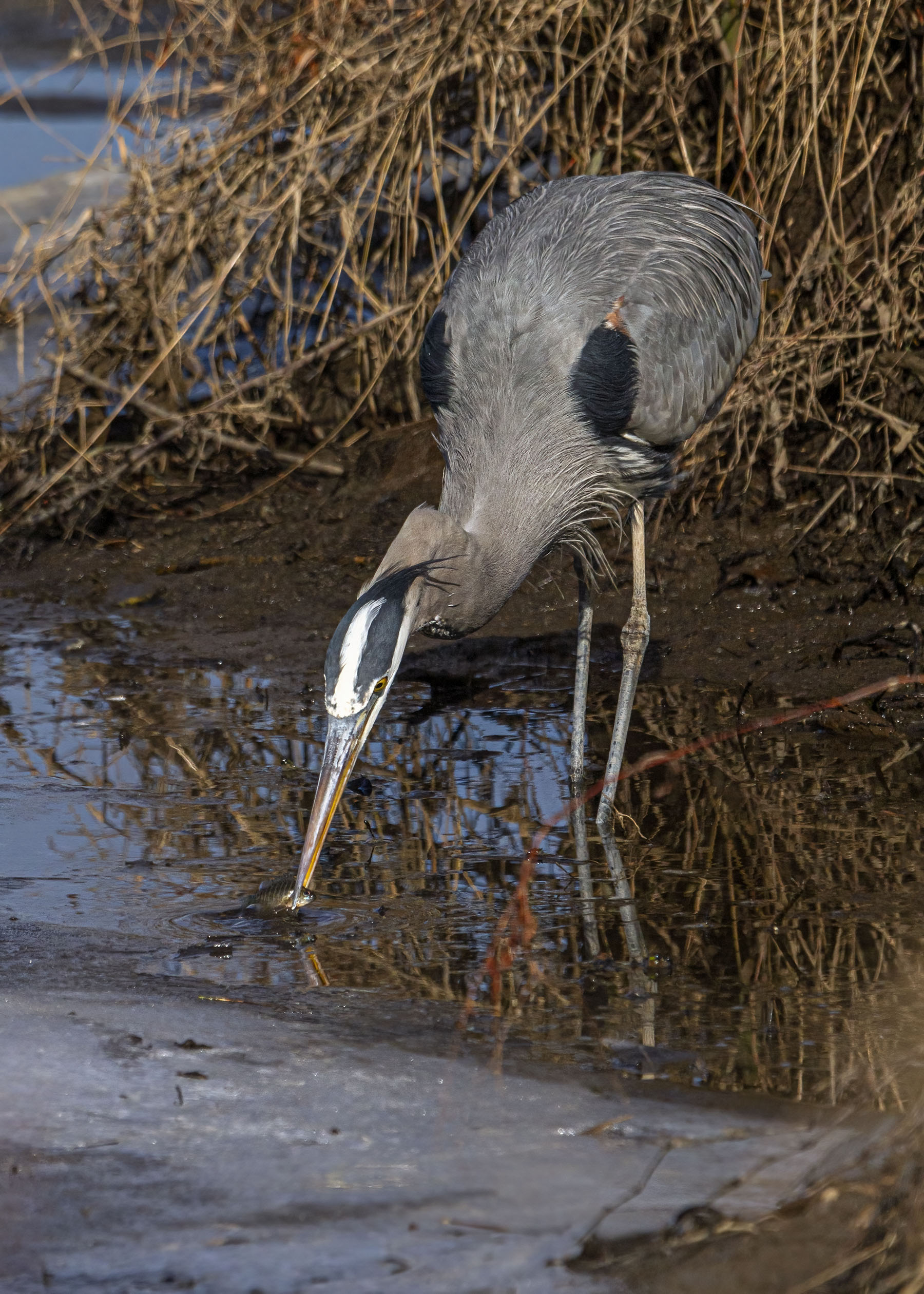
I was happy last week to spot this Great Blue Heron (Ardea herodias) at Occoquan Bay National Wildlife Refuge. There was ice on parts of the pond where the heron was standing, but there were still some open areas. I watched as the heron patiently scanned the water for potential prey and captured this shot as the heron was pulling a small fish out of the water.
It’s a really small fish and I encourage you to click on the image to enlarge it and get a better look at the fish. For the heron, the fish is probably only an appetizer, but at this time of year, food is scarce, so even tiny bits are undoubtedly welcome.
© Michael Q. Powell. All rights reserved.
Posted in Birds, Nature, Photography, wildlife, Winter, tagged Canon 7D, Field Sparrow, Occoquan Bay National Wildlife Refuge, sparrow, Spizella pusilla, Tamron 150-600mm, Woodbridge VA on December 20, 2025| 6 Comments »
I was thrilled on 18 December to capture this shot of a beautiful little Field Sparrow (Spizella pusilla) during a visit to Occoquan Bay National Wildlife Refuge. I initially heard this bird as it was foraging in the underbrush and was searching for it when it unexpectedly hopped up onto a fallen branch. The little sparrow posed momentarily for me and I was able to capture this cool little portrait of it. Even though the background is pretty cluttered, the sparrow really stands out in the shot.
When I took the photo, I was not able to identify the sparrow species. However, the rust colored crown, orange-pink bill, and white eye ring as quite distinctive, so I was able to find the Field Sparrow in my identification guide. Still I was not absolutely certain of my identification, so I posted a photo to a Facebook birding group and several experts there confirmed that it was indeed a Field Sparrow.

© Michael Q. Powell. All rights reserved.
Posted in Autumn, Birds, Nature, Photography, wildlife, Winter, tagged Canon 7D, Carolina Chickadee, chickadee, Occoquan Bay National Wildlife Refuge, Poecile carolinensis, Tamron 150-600mm, Woodbridge VA on December 9, 2025| 7 Comments »
During the wintertime, when the leaves are gone from the trees, I have a better chance of spotting tiny birds, like this Carolina Chickadee (Poecile carolinensis) that I photographed last week at Occoquan Bay National Wildlife Refuge. It was sunny but cold when I photographed the chickadee. Like most birds that I encounter during the winter months, this chickadee looked almost round, having fluffed up its feathers in order to retain its body heat. I have the same body shape when I bundle up in my cold weather clothes and increasingly even without them.

© Michael Q. Powell. All rights reserved.
Posted in Autumn, Dragonflies, dragonfly, Insects, Nature, Photography, wildlife, Winter, tagged Autumn Meadowhawk, Autumn Meadowhawk dragonfly, Canon 7D, male Autumn Meadowhawk, Occoquan Bay National Wildlife Refuge, Sympetrum vicinum, Tamron 150-600mm, Woodbridge VA on December 5, 2025| 7 Comments »
I was delighted to spot this Autumn Meadowhawk dragonfly (Sympetrum vicinum) on Wednesday, 3 December, at Occoquan Bay National Wildlife Refuge. Despite our recent cold nights, many of which have dipped below the freezing level, this hardy dragonfly managed to survive.
It is snowing out right this moment, so I am not sure how much longer I will be seeing these beautiful little creatures, but I’ll almost certainly be out with my camera next week to see what I can find.

© Michael Q. Powell. All rights reserved.
Posted in Birds, Inspiration, Nature, Photography, Thanksgiving, wildlife, tagged attitude of gratitude, Bald Eagle, Bald Eagle couple, Canon 7D, Haliaeetus leucocephalus, Occoquan Bay National Wildlife Refuge, Tamron 150-600mm, thanks, Thanksgiving 2025, Woodbridge VA on November 27, 2025| 4 Comments »
Happy Thanksgiving to all those celebrating this American holiday. Whether we are soaring high or resting at water’s edge, like this Bald Eagle couple (Haliaeetus leucocephalus), we are all blessed.
The Scriptures tell us we should “Rejoice always, pray continually, give thanks in all circumstances.” A recent sermon reminded me that we are called to give thanks “in” all circumstances, even when it may not be possible to feel thankful “for” all of them. It’s a matter of having what some have called an “attitude of gratitude.”

© Michael Q. Powell. All rights reserved.
Posted in Autumn, Dragonflies, dragonfly, Insects, Nature, Photography, wildlife, tagged Autumn 2025, Autumn Meadowhawk, Autumn Meadowhawk dragonfly, Canon 7D, Occoquan Bay National Wildlife Refuge, Sympetrum vicinum, Tamron 150-600mm, Woodbridge VA on November 25, 2025| Leave a Comment »
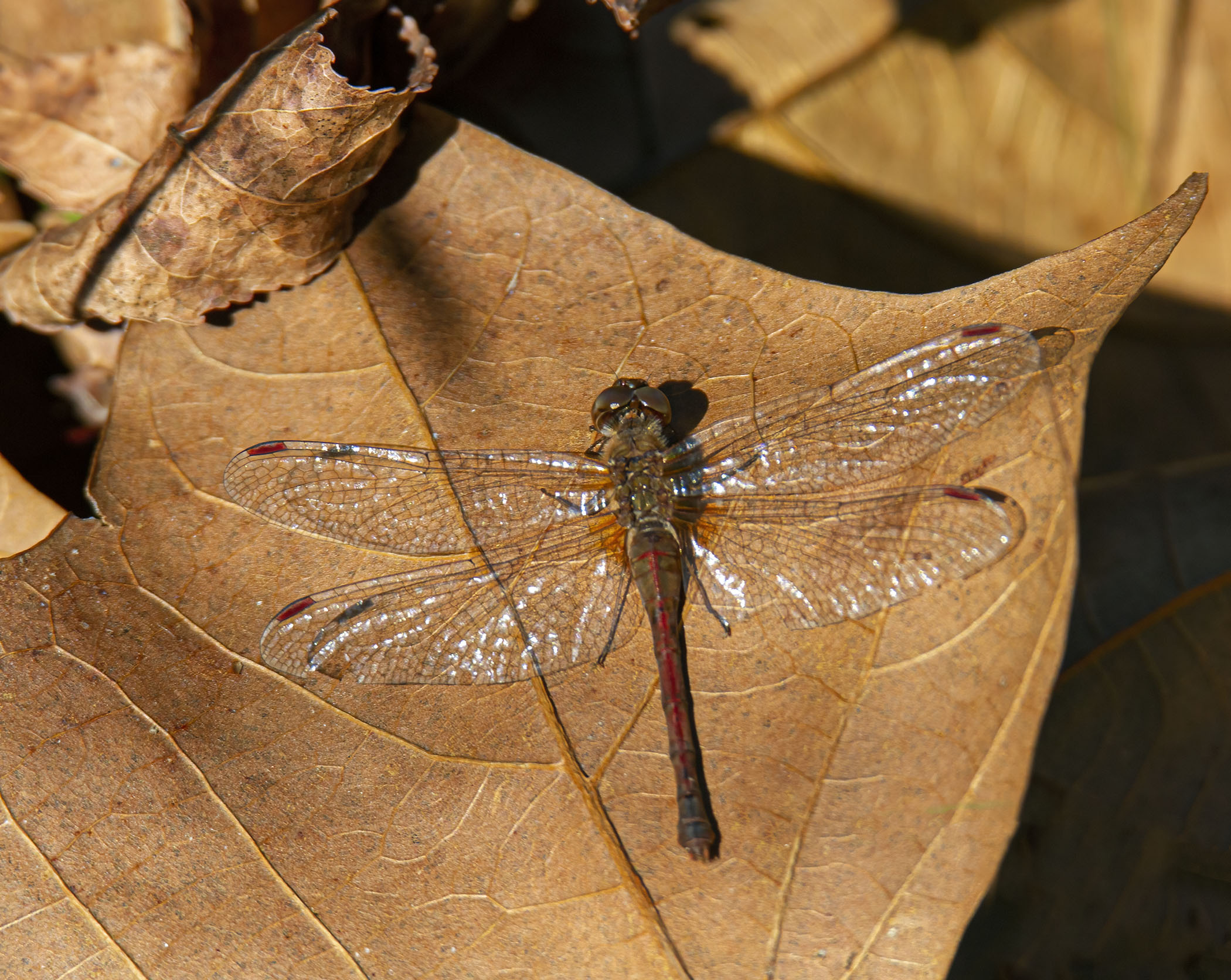
I haven’t yet checked this week, but these Autumn Meadowhawk dragonflies (Sympetrum vicinum) that I spotted on 17 November at Occoquan Bay National Wildlife Refuge are likely to be among the last dragonflies that I see this season.
Autumn Meadowhawks frequently perch flat on the ground or on dried leaves on the ground. I was delighted when a male Autumn Meadowhawk perched almost vertically on a colorful fallen leaf and I was able to capture the first image below. By contrast, the female in the second photo chose a less interesting drab leaf on which to perch.
I’ll try to go out later this week to see if I can find some late season survivors, but it is becoming clear to me that this year’s dragonfly season is nearly over.

© Michael Q. Powell. All rights reserved.
Posted in Autumn, Birds, Nature, Photography, wildlife, tagged bluebird, Canon 7D, Eastern Bluebird, Occoquan Bay National Wildlife Refuge, Sialia sialis, Tamron 150-600mm, Woodbridge VA on November 19, 2025| 5 Comments »
As I was walking along the trails at Occoquan Bay National Wildlife Refuge on Monday, I spotted a small flock of birds foraging high in the trees. When I zoomed in with my telephoto lens, I was delighted to see that they were Eastern Bluebirds (Sialia sialis). It may be a bit trite and a bit of a cliché, but I really do love bluebirds—they make me happy.
As you can see from the photos, Eastern Bluebirds have a substantial amount of orange plumage in addition to their blue feathers. Years ago, one of my youngest viewers, Benjamin, suggested that they should be known as Orange Bluebirds and I chuckle as I remember that comment every time that I spot a bluebird.
It was a bit of a challenge capturing shots of these hyperactive little birds as they moved about in the colorful foliage, but I managed to get a few relatively decent shots. Ideally I would have liked for the bluebirds to have been at eye level, but I try to do my best with the conditions that I am given. That is the typical fate of a wildlife photographer.


© Michael Q. Powell. All rights reserved.
 Mike Powell