Feeds:
Posts
Comments

Posts Tagged ‘spider’

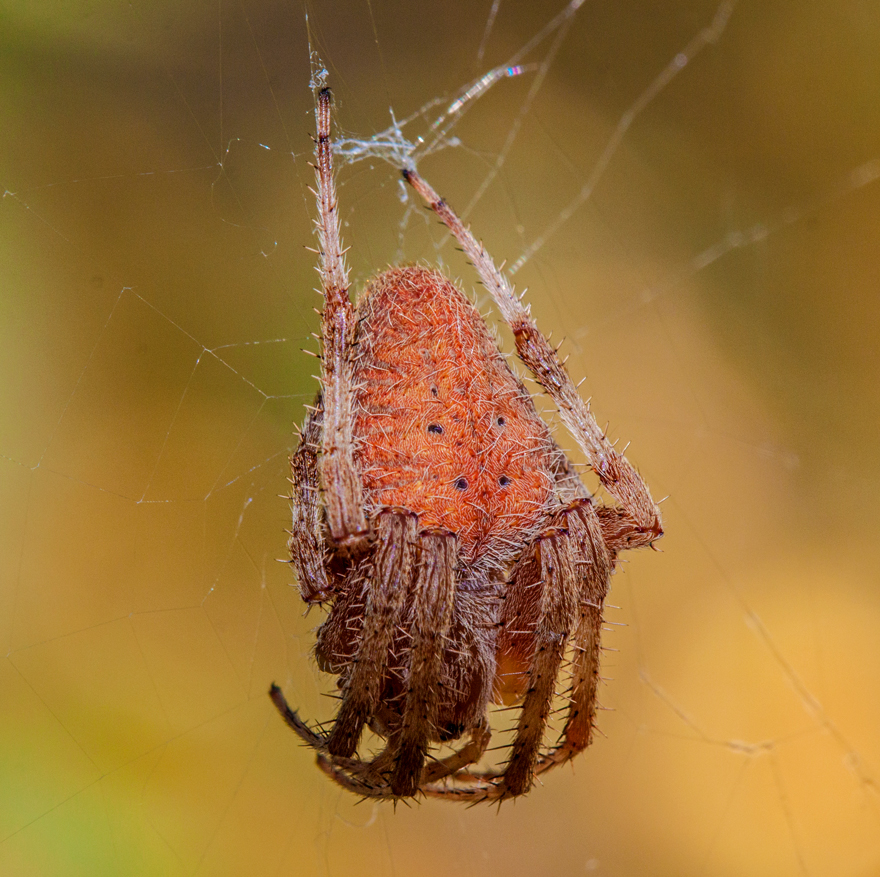
Walking along the boardwalk at my local marsh, I encountered this fairly large, hairy red spider in a web almost at eye level.

It was a little disconcerting to look a spider in the eye (eyes) at such close range, but it did allow me to get a pretty detailed shot at close range against an uncluttered background. I’ve been searching around on the internet, attempting to identify the spider but so far have not had any success. Can anyone identify this cool-looking spider?

orange_spider1_blog

© Michael Q. Powell. All rights reserved.

Read Full Post »

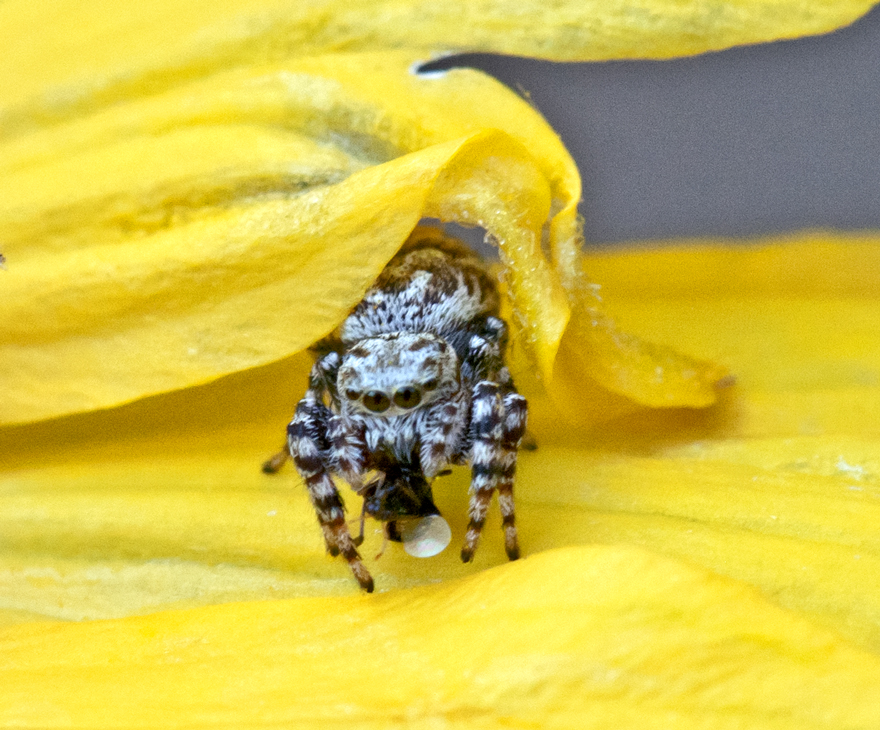
Earlier this week I came across this little Jumping spider, patiently waiting for a prey to come by.  I never fail to be amazed by those eyes that seemed to be staring right at me.

Transfixed, I can’t take my eyes off of you, tiny spider, and your eyes seem to follow me. I don’t want to seem paranoid, but when I am with you, I always feel like somebody is watching me.

Somehow I thought I heard the spider humming, “I only have eyes for you,” but it was just my imagination, running away with me.

jumping_marsh2_blog

© Michael Q. Powell. All rights reserved

Read Full Post »

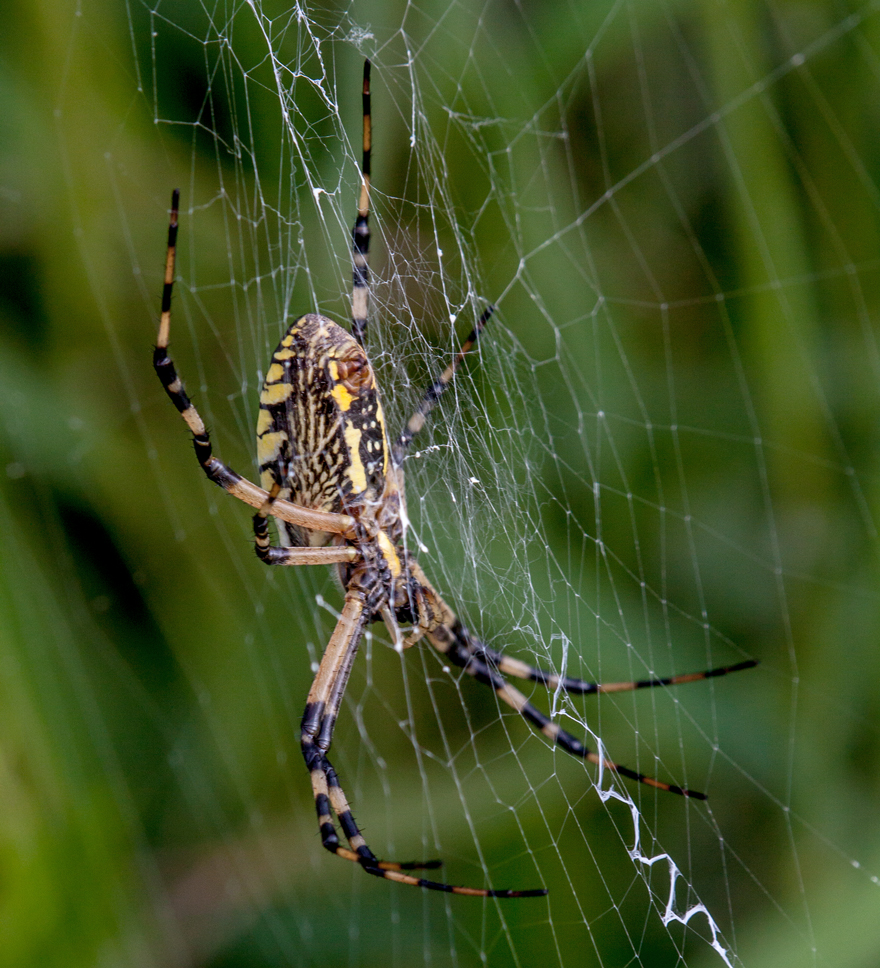
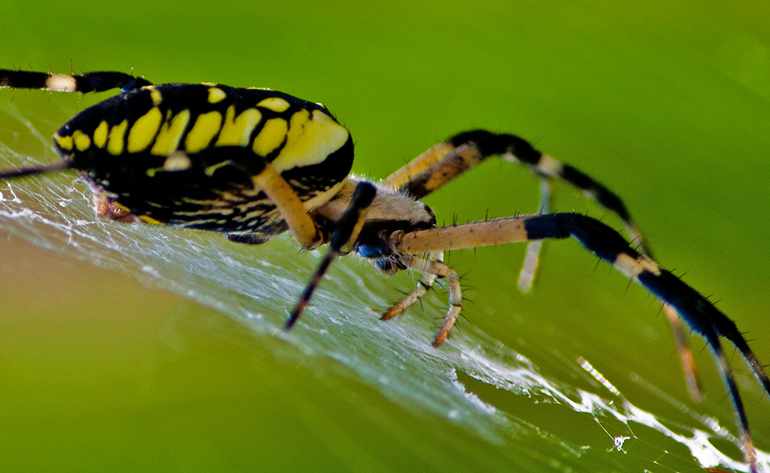
Finally I am starting to see some of the Yellow Garden Orbweaver spiders (Argiope aurantia) that fascinated me so much last summer. These spiders are big and colorful and have awesome webs with a distinctive zigzag section. I will be keeping an eye on the spiders to see if I can observe them catching prey and wrapping it up in silk.

Stay tuned for more spiders., most likely coming pretty soon to the blog—this spider is just the first fall installment.

argiope_web1_blog

© Michael Q. Powell. All rights reserved

Read Full Post »

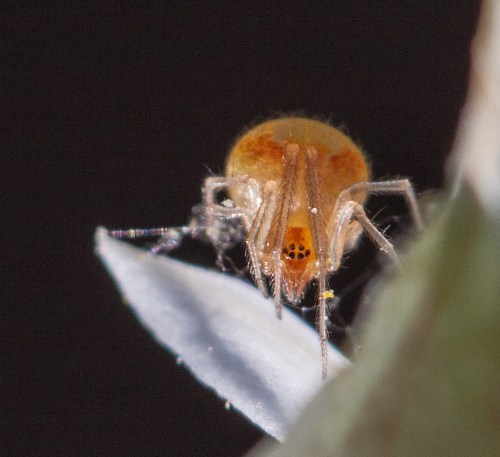
Is it just my imagination or do the eyes of this spider look like a smiley face to you too?

Eager to use my new macro lens, I went searching yesterday in my neighbors’ garden for subjects and came upon a tiny orange spider, which I have not yet been able to identify.

The spider was initially suspended in midair, but climbed up an invisible silken thread as I approached and took refuge in the shadow of white flower.

I boldly (or foolishly) tried photographing the spider handheld, but the images were blurry. Eventually I put the camera on my tripod and did my best to focus manually. For some shots, I used my pop-up flash to add a bit more light. Of course, it turned the background black, but I think that works for this shot.

In the original shot, the spider was upside down, but I decided it looked better when I rotated the image 180 degrees. I am fascinated with the multiple eyes of spiders.  There seem to a lot of different eye patterns in the different species of spider—a macro lens tends to make me look more closely at these kinds of details.

orange_spider_blog

© Michael Q. Powell. All rights reserved

Read Full Post »

Sometimes an insect or a spider is so small that it seems almost impossible to get a clear shot of it, which was the case the this morning with this tiny crab spider.It was located in a place where a tripod was not feasible and the spider kept changing its position.

I kept shooting and got this image that is kind of artsy. The spider ended up as merely one element of the composition. I especially like the limited color palette and the different shades of green and brown that are present in the image.

crab_blog

© Michael Q. Powell. All rights reserved

Read Full Post »

I have encountered some cool-looking spiders in the past, but I think that this Bold Jumping spider (Phidippus audax) just leaped to number one on my personal list.

I was checking out my neighbor’s garden (fellow blogger and photographer Cindy Dyer) this past weekend, when I saw a little movement among the flowers. The first thing that i noticed was the fuzzy body and I suspected that I had a jumping spider in front of me. It crawled all around a couple of different plants and most of the time it had its back to be. I tried to be patient as I waited for it to turn toward me, so that I could get a shot of its amazing eyes.

It is equally remarkable that the Bold (also known as Daring) Jumping spider has iridescent blue-green mouth parts that are technically known as chelicerae. At first, I thought the spider was eating something brightly colored that really made it stand out—you can’t really camouflage yourself when you have a color that distinctive.

This is the third species of jumping spider that I have now seen in this one little garden. I am not sure what attracts the spiders to it, but the garden has an equal attraction for me.

Jumping_spider_A_blogjumping_spiderB_blog

© Michael Q. Powell. All rights reserved

Read Full Post »

The last time I posed a question about using flash to photograph a spider, the majority of readers said that the spider looked much better in natural light, but the case is not so clear for this Barn Spider (Araneus cavaticus) that I spotted in the garden yesterday.

The spider was in a web that stretched across the path in the garden, about chest-high, and was in subdued light. I really wanted to shoot at an angle to give the spider some dimensionality, but it was tough to do so, because of the web, and depth of field was an issue. To make matters worse, a breeze would kick up periodically, making slow shutter speeds a bit problematic.

There was no question about whether to use a tripod or not—it was obvious that I needed it. Initially, I shot at f/10 in aperture priority, with a shutter speed of 1/13 of a second, resulting in the second image. Although parts of the spider are blurry, the head and eyes are pretty sharp. I then raised the shutter speed to 1/200 and used my pop-up flash and got the first image. The background turned almost totally black, but I was happy that it did not blow out the details in lighter areas of the spider and the eyes remain pretty sharp.

I like the image with the black background better this time and like the look of the background. Which one do you prefer? (Clink on this link to see the posting from March when I initially posed a similar question.)

spider_black_blogspider_brown_Blog

© Michael Q. Powell. All rights reserved

Read Full Post »

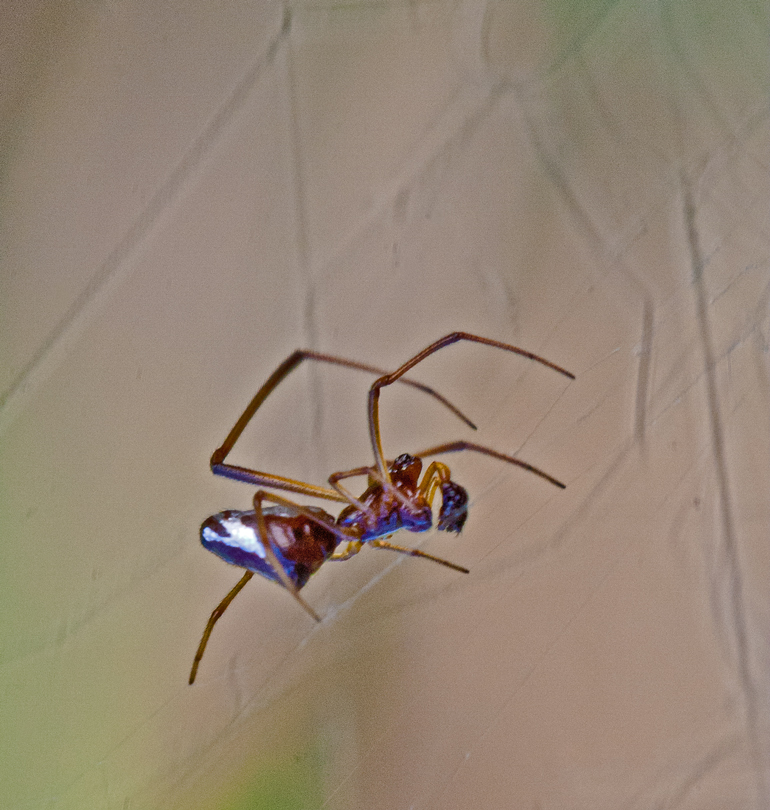
With my macro lens on my camera on Monday, I was happily scouring every plant and flower for insects to photograph when I came upon this unusual-looking spider. Instead of having a rounded body like most spiders, it had a really elongated body and what appeared to be legs of varying lengths.

I have purposely attached a clickable higher resolution image to give you a better look at the details of this strange spider. For example, I think I can see at least two rows of tiny eyes in the middle of the photo.

Last year, I photographed a similar spider and I think that it is probably a kind of Long-jawed Orbweaver, though I can’t make a more definite identification.

What mental image do you have when you think of a spider? Perhaps this photo will help you broaden your perspective about what a spider might look like.

long_spider_blog

Michael Q. Powell. All rights reserved

Read Full Post »

Looking for spiders to photograph, I came across this one, which I think may be a Lattice Orbweaver spider (Araneus thaddeus). I tried a number of different techniques to get a shot of this little spider and think that this may be one of the ones on which I used my pop-up flash.

I especially like the way in which part of the web is visible against the dark background and the way the light seems to be shining through the jelly-like front part of the spider’s body.

spider_drops_blog

Michael Q. Powell. All rights reserved

Read Full Post »

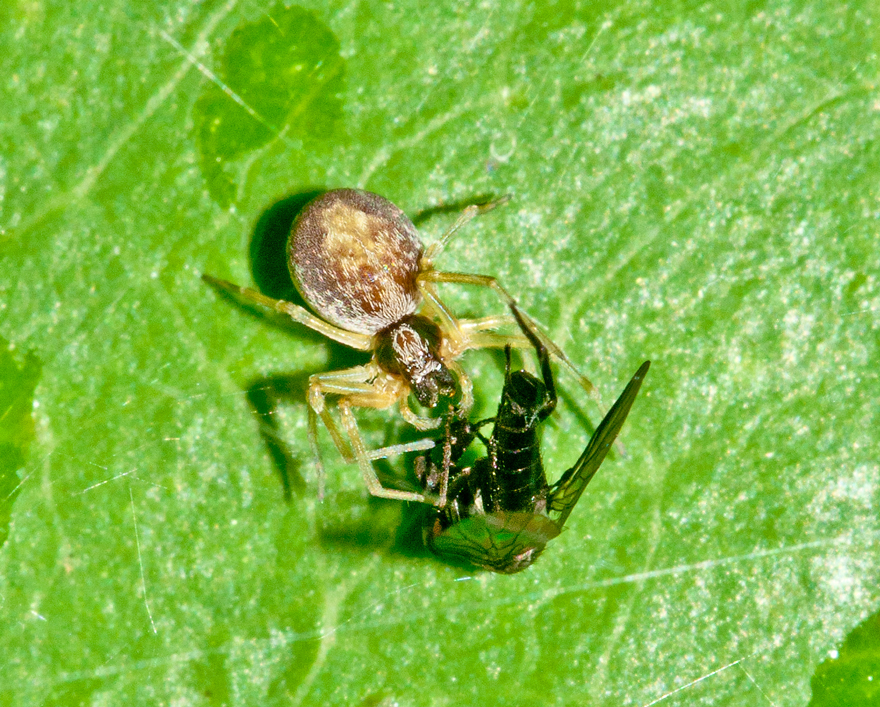
This past weekend I was off in search of spiders again and came across this little spider perched on a leaf, munching on a flying insect.

The lighting was poor, so I used the pop-up flash on my camera to provide a little extra light. Generally I don’t like it if the flash causes a shadow, but in this case it seems to add a somewhat more menacing and sinister look to the spider.

I am still trying to identify the spider and would welcome assistance. The patterns on its body, and especially the front section, are particularly cool and should assist me in finally being able to identify it.

spider_fly_blog

Michael Q. Powell. All rights reserved

Read Full Post »

As I was checking out the flowers in my neighbors’ garden yesterday afternoon, I came across this little spider, sitting on top of a flower. There was no web anywhere in the vicinity, so I suspected that I might have a jumping spider.

Last month, I encountered a tiny, fuzzy spider that turned out to me a jumping spider, so I am a little more attuned to looking for them now. This one is definitely not the same kind, though, with completely different colors and markings. You can compare the two by checking out the photos in my previous posting.you

When I first saw the spider, it had just captured some kind of insect as you can see in the second photo. It then moved under the shade of a petal of the flower to enjoy its freshly caught dinner. I showed this moment in the first and third shots. The first one was taken a little closer and shows a lot of detail, but I really like the context that the third one provides and it is probably my favorite one. The final shot gives you an overall view of the spider.

I love the color and pattern of the spider and was happy that I was able to capture some of the details. The spider was not very big and I had trouble placing my tripod on the uneven ground to get a sharp shot. I am really happy with the results, however, and will definitely keep looking for these spiders with eyes that I find to be simply irresistible.

jumping3_blog

jumping2_blogjumping1_blogjumping4_blog

Michael Q. Powell. All rights reserved

Read Full Post »

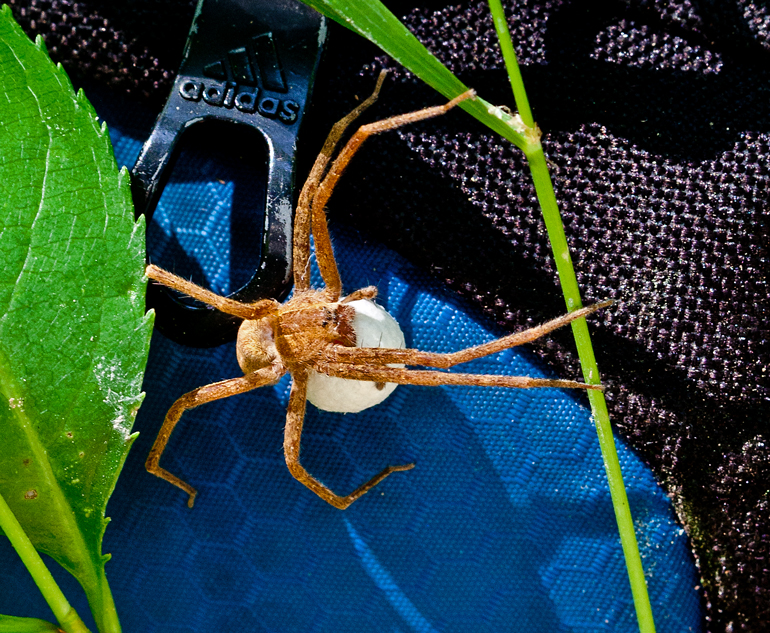
As I was reaching for my camera bag after taking a photo of a spider, I was surprised to see an unexpected visitor—a much larger spider with what looks like an egg sack.

I was in a wooded area and had placed my bag on the ground while I set up my tripod to take a photo of a small spider (shown in the second photo).  After getting the shots, I returned to my bag. I bent down to open the zipper of the bag and suddenly was eye-to-eye with the spider. The spider seemed really large at that moment, although retrospectively it does not seem that big when I compare it with the Adidas logo on the zipper pull. When I tried to adjust the bag’s position, the spider moved away, but fortunately I had the foresight to take some photos before attempting to improve the lighting situation.

I am not sure of the identification of either of these spiders, but find them both to be pretty cool in their own ways. I’d welcome some more information from more knowledgeable readers about the white ball and, in particular, if it is an egg sack.

UPDATE: I have done a little research and think that the spider in the first shot may be a Nursery Web Spider (Psaurina mira), a spider that is known for carrying its egg sack with its fangs. Some other spiders attach the egg sack to their spinnerets.

egg1_blogspider2_green_blog

Michael Q. Powell. All rights reserved

Read Full Post »

This weekend I learned how difficult it is to get good shots of a tiny spider when it is in the middle of a cluster of plants and is surrounded by an untidy mess of web material, rather than a nice web.  Auto-focus was utterly useless and the camera refused to focus on the spider—it wanted to focus either on the plants in the background or on the web material. Manual focusing was required and it was tough to tell which parts of the spider were in focus at any given moment.

I used my tripod, which helped a little, and even used the pop-up flash to give me little extra light (you can see the shadows it caused in the second photo). I especially like the way that the colors in the images turned out, giving the photos kind of an out-of-this-world, sci-fi look.

The second shot is an action shot in which the spider has captured some kind of flying insect, which I can’t really identify. I didn’t have a great angle, but find the shot to be interesting.

As I shoot more insects and spiders, I am experimenting and finding out what works for me (and admiring even more the photographers who are able to get the amazing shots that I see on other blogs and elsewhere on the internet).

spider1_blog

spider2_blog

Michael Q. Powell. All rights reserved

Read Full Post »

Six-spotted Fishing Spiders (Dolomedes triton) are a particularly fascinating kind of spiders and I was really excited to see one yesterday at my local marsh.

Fishing spiders don’t build a web, but use the surface of the water in the same way that other spiders use a web. They extend some of their legs onto the surface of the water and when they feel the vibrations of a prey, they run across the surface of the water to snatch it. According to Wikipedia, the very sensitive hairs on their legs and feet help them to interpret the vibrations they sense and determine distance and direction. Their eyes play a secondary role in hunting, particularly because they do much of their hunting at night.

This spider was a couple of feet below the level of the boardwalk and several feet away and I was able to use my tripod to help steady the shot. In fact, the spider was cooperative enough that I made attempts with my 135-400mm zoom, my 55-250mm zoom, and my 100mm macro lens. Of the images that I am posting, the first image was shot with the longer zoom and the second with the macro lens. The macro lens let me hang over the edge of the boardwalk a little, which let me get a little closer, but made it tough to brace myself.

If you want to see a few more images of these interesting spiders, check out my previous postings Fishing spider waiting for prey and Fishing in the swamp.

fishing_spider1_blogfishing_spider2_blog

Michael Q. Powell. All rights reserved

Read Full Post »

As I was looking in my neighbors’ garden for flowers to photograph, I came across this cool-looking little spider, which I have not yet been able to identify.

The spider was really small, maybe a half-inch (a little over 1 cm) in size and didn’t sit still too much, so it was quite a challenge to photograph him. I really like his eyes and his hairy legs, which look almost like they are transparent.

One of the things that I especially like about spring is that insects reappear and give me photo opportunities like this one.

spider2_blogspider3_blog

Michael Q. Powell. All rights reserved

Read Full Post »

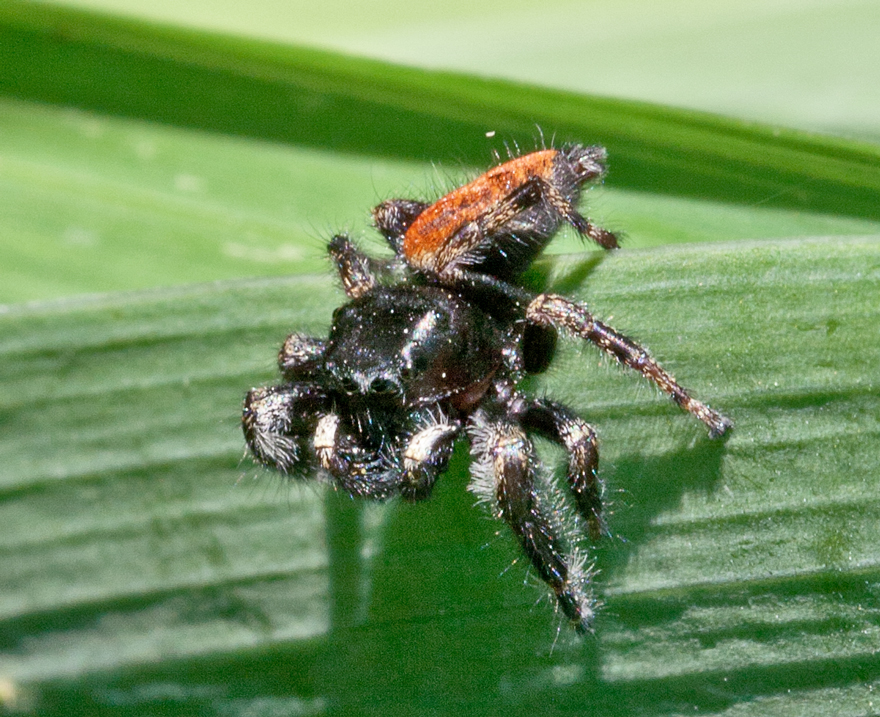
I was checking out the plants yesterday in my neighbor’s garden when I came upon this cool-looking spider, a type that I had never before encountered. From an initial check on-line, it looks like this might be a kind of jumping spider, though I really am out on a limb with the guess. In any case, I really like the combination of red and black on his body and the multiple eyes that are just visible.

With the arrival of spring, I am starting to see some familiar insects from last year and some new “friends.” It’s an exciting time for me.

spider_blog

Michael Q. Powell. All rights reserved

Read Full Post »

We had a foggy start to one of the weekend mornings and I traveled to my local marshland park with the hope (but no real expectation) of seeing some spider webs. When I arrived at the park, the ground was covered in places with funnel webs, but that was not really what I was looking for.

As I walked along, I suddenly came upon this modestly-sized web. It is not really ornate and is broken in places, but I was thrilled to find it nonetheless. I did not see any spiders, but the web is clear evidence that they are around.

It’s only a matter of time now before I post a shot of a spider!

web2_blog

Michael Q. Powell. All rights reserved

Read Full Post »

Walking along the Augusta Canal for a final time yesterday morning before returning home, I encountered this spider, hanging in the air from a concrete supports of an overpass, and took shots of him without a flash and with one. After being starved for insects over the winter (photographically speaking), I was thrilled to have a chance to photograph one.

I probably should have taken out my macro lens, which I had with me in my bag, but opted instead to shoot with the 55-250mm zoom lens that was on my camera. It was still relatively early in the morning and the the spider was mostly in the shade, so lights was an issue. I upped the ISO to 800, but still needed an exposure of 1/8 of a second at f/9. Fortunately I had my tripod with me, so I used that to get a relatively sharp shot. I shot with the zoom at 250mm and used manual focus.

The first image was with natural light and the second one was taken using the camera’s built-in flash. The light coming from behind the spider in the first shot helps to illuminate the spider’s legs, which look almost translucent. The flash in the second photo reveals some additional details of the spider, although it did add some reflections, because I did not have a diffuser for the flash.

Which one do you prefer?

spider1_blogspider2_blog

© Michael Q. Powell. All rights reserved

Read Full Post »

As I was walking on a low boardwalk yesterday at the Phinizy Swamp Nature Park in Augusta, GA, I spotted this Six-spotted Fishing spider (Dolomedes triton) at the edge of the water on a leaf. These spiders wait for prey with several of their legs in the water and capture other invertebrates, tadpoles, and sometimes even small fish, according to Wikipedia, when they feel the vibrations in the water.

It will probably be several months before I begin to see insects in Northern Virginia, but my brief trip to Georgia has given me a foretaste of things to come.

spider1_blog

© Michael Q. Powell. All rights reserved

Read Full Post »

It seems appropriate to post a photo of a spider on the evening before Halloween. I was not able to get a look at the spider’s front side when I photographed it this past weekend at Huntley Meadows Park, so I can’t identify it. I know for sure, though, that I never want to wake up in the morning and have this view of a spider. With my near-sighted vision, that would mean that it was way too close to me for my comfort. Happy Halloween!

UPDATE: Thanks to the assistance of my mentor and fellow blogger, Cindy Dyer, I am now pretty sure that the spider is the orb-weaver spider Neoscona Crucifera, sometimes known as Hentz’s orb-weaver or a barn spider (though there are other spiders known as barn spiders too).

Pre-Halloween spider enjoys a snack

© Michael Q. Powell. All rights reserved.

Read Full Post »

Yesterday when I was walking the marsh, I glanced down and saw a spider web shining a foot or so above the surface of the brown, muddy water. There was a long, skinny insect on the web and my first thought was that this was a spider’s prey, but no spider was visible. I took some photos and did some internet research and was shocked to learn that strange insect is a spider, probably a Long-jawed Orb Weaver spider of the Family Tetragnathidae. Check out Bugguide if you want to learn more about this unusual-looking spider and click on the image to see more details.

Long-jawed Orb Weaver spider

© Michael Q. Powell. All rights reserved.

Read Full Post »

A few days I posted a photo of a giant spider web (which one blogger said looked to be big enough to catch a dog) processed in a couple of different ways. I received lots of helpful comments about adjustments that I made or didn’t make. With those comments in mind, I worked on this photo of a different web that I photographed earlier in October. It’s not quite as big as the previous one, but is in better condition and the spider is still present. The web was suspended between two cattails and I had enough room to set up my tripod on the boardwalk that runs through the marsh, so hopefully my shot is pretty clear (although I confess that manual focusing is still a challenge for me). I may work on some more variations of this photo, but here is my initial effort.

So what do you think of this spider web (click on it to see a higher resolution view)?

Almost giant spider web with spider

© Michael Q. Powell. All rights reserved.

Read Full Post »

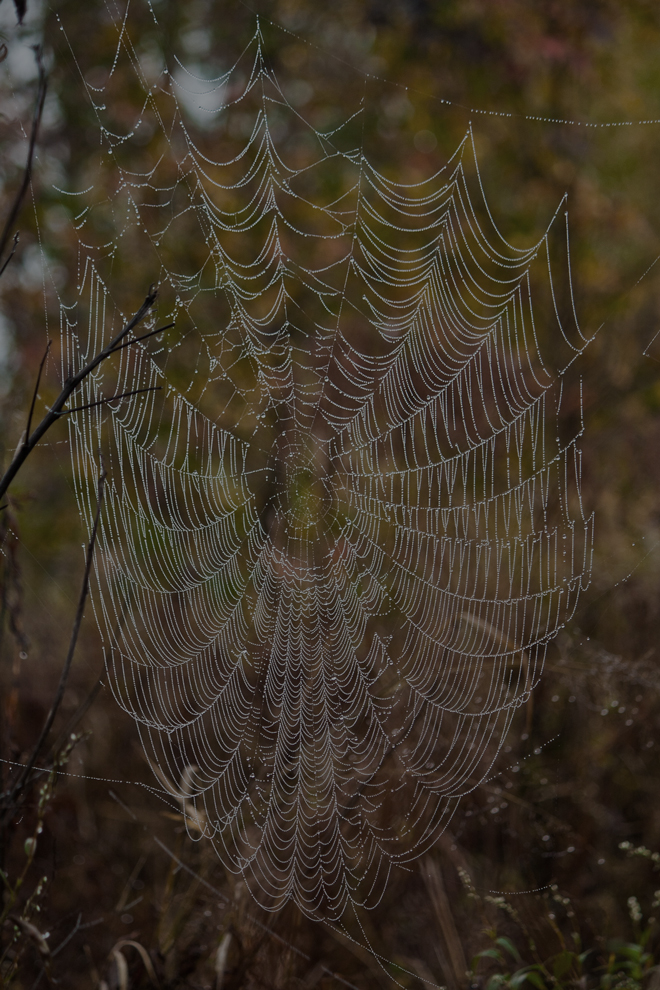
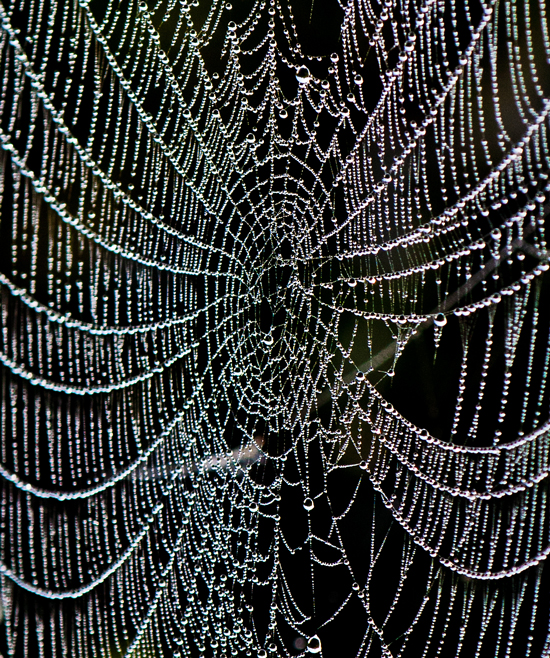
I was really happy when I came across this large dew-covered spider web early one morning this past weekend. I am not sure exactly how big it was, but I think it was probably about 18-24 inches across, with an amazing number of rows, especially at the bottom part that is fully intact.

I processed the same photo in two ways to get different looks. In the first photo, I desaturated most of the color to try to draw attention to the strands of the web (and you should click on the photo to get a somewhat higher resolution view of the web). In the second photo, I tried to punch up the colors a bit by increasing the vibrance and saturation settings.

Which one do you think works best?

Spider web (mostly desaturated)

Spider web (increased vibrance)

© Michael Q. Powell. All rights reserved.

Read Full Post »

Throughout much of the summer I posted photos Black and Yellow Garden Orbweaver spiders (Argiope aurantia). Having not spotted one in several weeks,  that they were gone until next year. I was happy to be wrong, however, and photographed one yesterday. I was even more delighted that the background colors work well for autumn and for Halloween (and nothing says Halloween more than a creepy spider).

Autumn spider

© Michael Q. Powell. All rights reserved.

Read Full Post »

Have you ever woken up on a fall morning and noticed the dewy grass and bushes littered with spider webs? I don’t mean the beautiful geometric-patterned webs of the orb-weaving spiders, but webs that appear to be nothing more than loosely woven sheets of spider silk. Normally I don’t give them a second glance, but one morning this weekend I stopped and looked at one of them more closely.

Close-up of web in the grass

I discovered a beautiful little world, filled with tiny beads of water, captured by the threads of the web. I think the spider is a grass spider of the genus Agelenopsis. Wikipedia notes that the webs of grass spiders are not sticky, but the spiders makes up for that by being able to run really quickly.

Here is a view of an entire web through a telephoto lens. I was on a walkway several feet above ground-level when I took the shots, so I was not able to get actual close-up shots. The photo is not a very good one, but it gives you an idea of how nondescript the web looked at first glance.

Web in the grass

© Michael Q. Powell. All rights reserved.

Read Full Post »

Last week I did a posting entitled “Kleptoparasitic Spider that talked of the little spiders that hang around a larger spider’s web and steal or feed on the prey captured by the other spider. Today I managed to take a much clearer shot of one such spider. I am pretty sure the little spider below is of the genus Argyrodes, which are also known as dewdrop spiders.

The spider was positioned in such a way that I was able to get close enough to use my 100mm macro lens, although there was not really enough room for me to shoot with a tripod. I was able to close down only to F10 because I was shooting handheld and wanted to have a shutter speed of 1/200 sec, so depth of field suffered a little. I have found that depth of field is a problem with spiders most of the time because of the length and positioning of their legs.

This spider was really tiny and I am happy that I was able to get this good a photo of it. The portions of the web that are visible help to add an interesting geometric pattern to the background, which I think enhances the image.

Dewdrop spider (genus Agyrodes)

© Michael Q. Powell. All rights reserved.

Read Full Post »

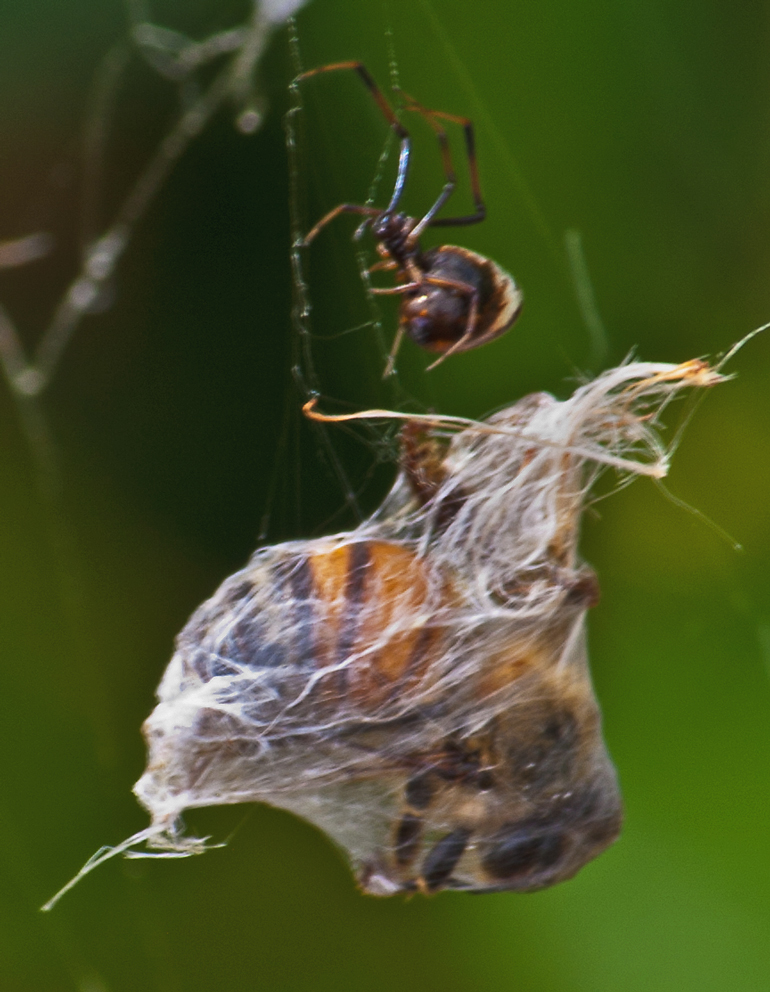
I have repeatedly observed a small spider or two hanging around the periphery of the web of the large Yellow Garden Orbweaver spiders (Argiope aurantia) that I have been photographing recently. Initially I thought it might be the male of the species, which is considerably smaller than the female, but when I finally took a clear enough photo of one of these small spiders, I realized it was a different species.

My research suggests that this is a kleptoparasitic spider. Let me explain. It may sound like I’m trying to sound like a scientist, but “kleptoparasitism” is a single word that captures the idea that this spider steals or feed on the prey captured by another spider. According to Wikipedia, kleptoparasitic spiders occur in five different families and I am pretty sure the little spider below is of the genus Argyrodes, which are also called dewdrop spiders.

Kleptoparastic spider eyes another spider’s catch

Let me set the scene for you. The much larger Yellow Garden Orbweaver spider caught what looks like a bee and returned to the center of the web, leaving the wrapped bee on the periphery. The little spider moved in and appears to be checking out this potential new food source. Compare the relative size of the spider and the bee—the spider is tiny. That made it tougher to get a clear shot of both the spider and the captured bee. My shot is far from perfect, but it does allow you to see some of the details (and you can get a higher resolution view if you click on the image).

It seems to me that the little spider plays a risky game, living with (and maybe stealing food from) a larger, more dangerous spider. Maybe he’s a thrill-seeker, an adrenaline junkie who enjoys living in a state of constant danger.

© Michael Q. Powell. All rights reserved.

Read Full Post »

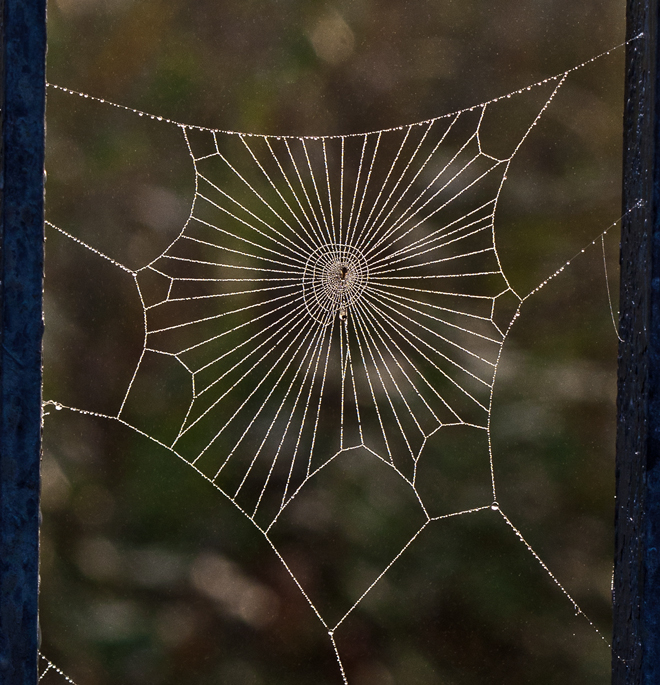
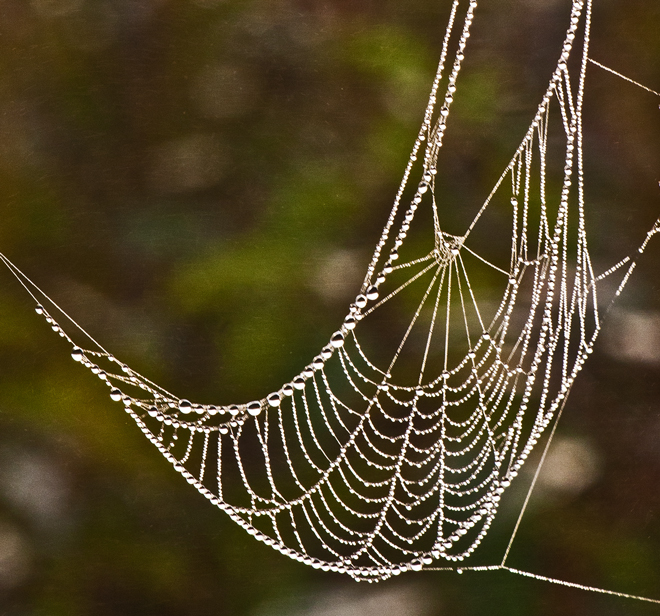
I’ve already posted some photos of spider webs from last Friday morning when I visited Huntley Meadows Park. When I looked over the photos again today, however, I realized I have some more pretty good ones. Once again I am struck by the complexity and the diversity of the webs. Some have primarily straight lines and others have mostly curves. Some are large and intricate, others are smaller and simpler.

All of them are breathtakingly beautiful to me.

A view from a jail cell (not really, but it almost looks like that)

An unusually-shaped spider web

An incomplete spider web

Scallop-curved web

© Michael Q. Powell. All rights reserved.

Read Full Post »

As I was going through some photos this morning I realized that I have a lot of photos of the Yellow Garden Orbweaver spider (Argiope aurantia). I have posted quite a few photos, but most have shown the spider with a prey. I came across an image of the spider by herself and started playing with it in Photoshop Elements. This first image is the result of my experimentation—it is cropped and rotated and focuses on only part of the subject. I think it is a little more dramatic thank the original image. (You can get a higher resolution view of all of the images if you click on them.)

Creeping spider

You can see below the original image after a minor crop. I remember when I took the shot that I had to twist my body around to get the desired angle of view of the spider in the center of her web, waiting patiently for prey. This morning I initially liked the image a lot and was going to post it, but then decided to rotate it 90 degrees to see what it looked like.

Side view of spider

After the rotation, it looked like the image below. It seems to me that by simply shifting the plane of view, the spider appears like more of a predator, like she is more aggressively stalking her prey rather than waiting for it to arrive. I keep going back and forth in trying to decided if I like this image more than the cropped image that I started with. What do you think? Which of the three images do you like most?

Creeping spider (full body)

© Michael Q. Powell. All rights reserved.

Read Full Post »

I’m amazed at the size and intricacy of the webs of the Yellow Garden Orbweaver spiders (Argiope aurantia) whenever I see them at Huntley Meadows Park here in Alexandria, VA. This past weekend I had a chance to see how effective these webs are when a bee flew into the web of a spider that I was observing.

Previously I posted some photos of these spider with prey (a grasshopper and a cicada) that had been captured earlier and wrapped up in silk, but I didn’t really understand how the spider accomplished this. In this case, as soon as the bee touched the web, the spider moved quickly from the center of the web and in a few seconds had wrapped up its newest victim. I was so fascinated by what was happening in front of my eyes that my reaction time was delayed and I missed photographing those initial actions. However, I stayed and observed (and photographed) the spider’s subsequent actions.

The first photo below shows the spider as she is wrapping up the wrapping up of the bee. It’s a little hard to believe that the long package is just a bee, but I’m pretty sure that’s all that there is inside. (With all three photos, you can click on them and get a somewhat higher resolution view.) After the bee had finished, she left the package at the periphery of the web and returned to the center of the web, where she usually resides, probably hoping for another victim.

After several minutes wait, she returned to the bee and and began to transport it to the center of the web. In the photo below, you can see how she held the wrapped-up bee with some of her legs as she crawled along the strands of the web. The zigzag portion of the web is part of the path that leads to the center.

Once she was back in the center, it looks like she was preparing to eat her newly captured meal. I really like the varied positions of her legs in this photo as she holds on to her prey.

You may have noticed the blurry contours of another, smaller spider in the upper portion of the final photo. There were two small spiders hanging around the web and they seemed to be fighting with one another. I tried to capture that dynamic and will post a photo if I find one that is clear enough. I suspect that one of them may have been the mate of the female spider. Bugguide notes that the male of this species is considerably smaller than the female. Not counting legs, the male is usually 5-6 mm in size and the female is 14-25mm. I am not sure who the “other guy” was. Maybe he’s another male competing for the affections of this “lovely” lady. Any ideas?

© Michael Q. Powell. All rights reserved.

Read Full Post »
This morning as I was walking along the boardwalk that runs through the marsh in Huntley Meadows Park, I happened to glance down into the muddy water and was surprised to see something that looked like a cross between a starfish and a spider. I always though that spiders lived in trees and on other types of vegetation, but today I learned that there are also spiders that hunt for their prey in the water.

This spider is from the Dolomedes family, probably a six-spotted fishing spider (Dolomedes triton). According to the Wikipedia article, they are often seen with their legs sprawled out by the water while they are waiting for prey (which is what this one seems to be doing). They eat other invertebrates, tadpoles and occasionally small fish (and the female may also eat male fishing spiders if she has already mated). According to fcps.edu, these spiders can walk on the surface water and can stay underwater for 30 minutes. Not surprisingly, they don’t make webs.

This has been quite the day for unusual insects, beginning with a neon-colored grasshopper and ending with a fishing spider. I can’t wait to see what’s next.

Fishing Spider Waiting for Prey (click for higher resolution)

© Michael Q. Powell. All rights reserved.

Read Full Post »

« Newer Posts - Older Posts »