Feeds:
Posts
Comments

Posts Tagged ‘Sigma 135-400mm telephoto zoom lens’

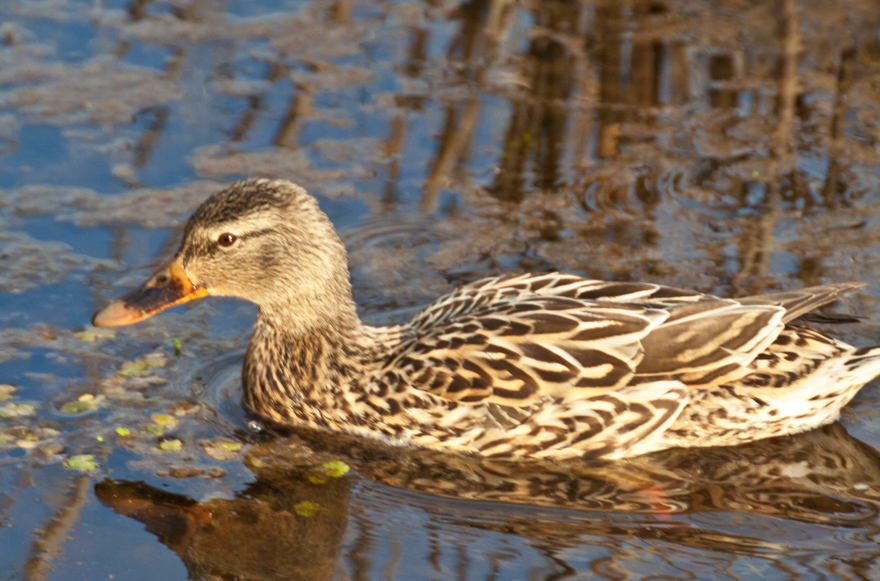
Do you ever find yourself in such beautiful light that you are almost desperate to find a suitable subject? Saturday morning, for a brief period, the rays of the sun were producing wonderful light and incredible reflections in the water of my local marsh, reminding me of some of my favorite Monet paintings.

I looked all around and finally spied this male mallard duck and his mate and they became my models. They didn’t take instructions very well and wouldn’t stay still in one place for very long, but I was able to get some shots that I like.

mallard1_blogmallard2_blog

Michael Q. Powell. All rights reserved

Read Full Post »

I am old enough to remember the 1977 Captain and Tenille hit song “Muskrat Love,” but inexperienced enough with muskrats not to know if the one that I photographed yesterday is a male or female.

I’ve had the chance to get photos of muskrats in the past, but the muskrat has always been swimming in the water or had been a long way away. Yesterday I came across this as he was eating no more than six to eight feet from where I was standing.

I had my long telephoto on my camera and had to back way down from the 400mm end of the zoom to get this frame-filling shot. I should have been able to get more good shots, but I didn’t notice at the time that my shutter speed was approximately 1/100 of a second and most of my images are blurred. It’s ironic that I had the chance for a close-up at a moment when I had replaced my image-stabilized lens for one with greater reach (but no stabilization).

Still, I got a pretty good shot that captured many of the muskrat’s details, so I am content (until the next time).

muskrat1_blog

Michael Q. Powell. All rights reserved

Read Full Post »

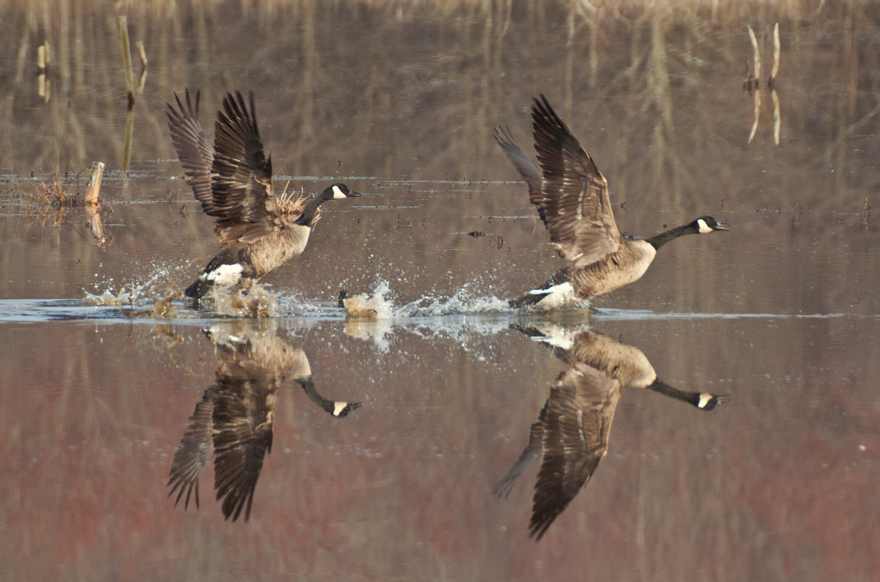
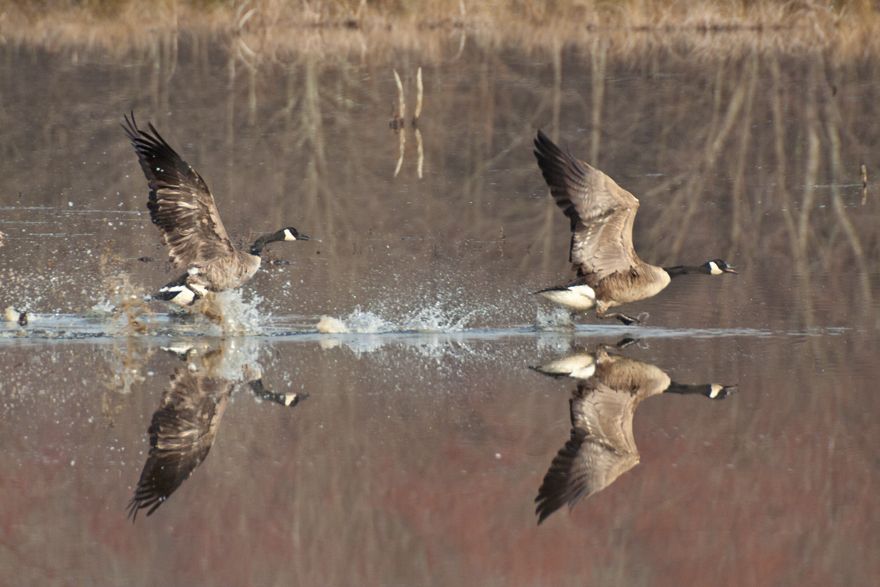
At a moment when the lighting was particularly beautiful yesterday morning, I sensed that the pair of geese was getting ready to take off from the pond. I readied myself and somehow my timing, composition, and focus clicked together with my shutter.

I ended up with some images that required almost no adjustments or cropping. I was particularly happy, because I have been experiencing difficulties capturing motion with my newest lens, a Sigma 135-400mm telephoto zoom.

Luck played a big role too, since I had no control over the way that the geese would move their wings (though I guessed correctly the direction in which they would take off).

geese_takeoff_bloggeese_takeoff2_blog

Michael Q. Powell. All rights reserved

Read Full Post »

Yesterday while walking along the banks of Cameron Run, a tributary stream of the Potomac River, I encountered this unknown insect. I have been so starved for insects (photographically-speaking, not literally) that I decided I had to try to photograph it.

The insect was pretty small and would fly (or hop) when I approached, so I decided to give it a shot with the lens that was on my camera, a 135-400mm telephoto zoom. I was pleasantly surprised with the resulting photo, which almost looks like it was shot with a macro lens.

I will try to identify this little insect, but am happy with the shot and am now convinced that spring is here if insects are reappearing.

insect_blog

Michael Q. Powell. All rights reserved

Read Full Post »

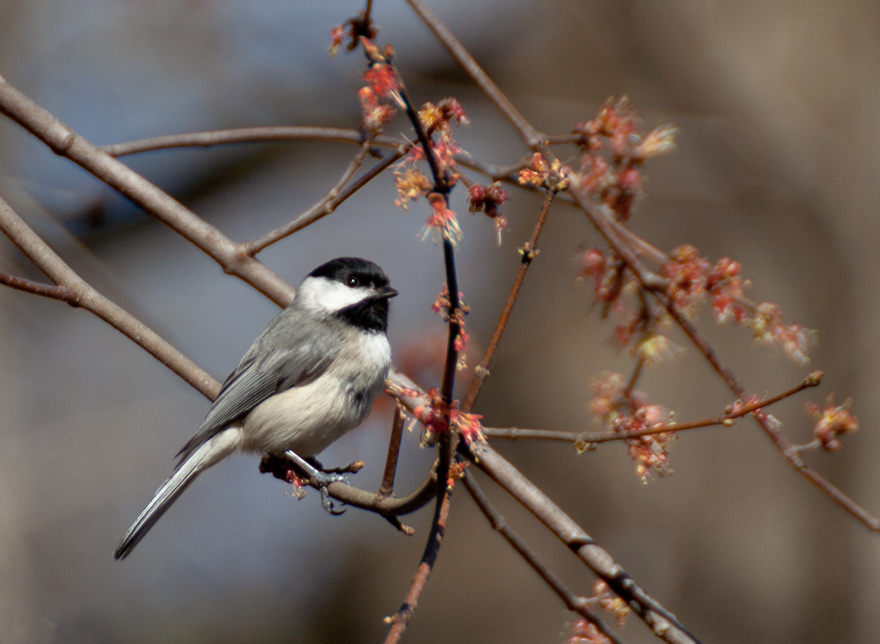
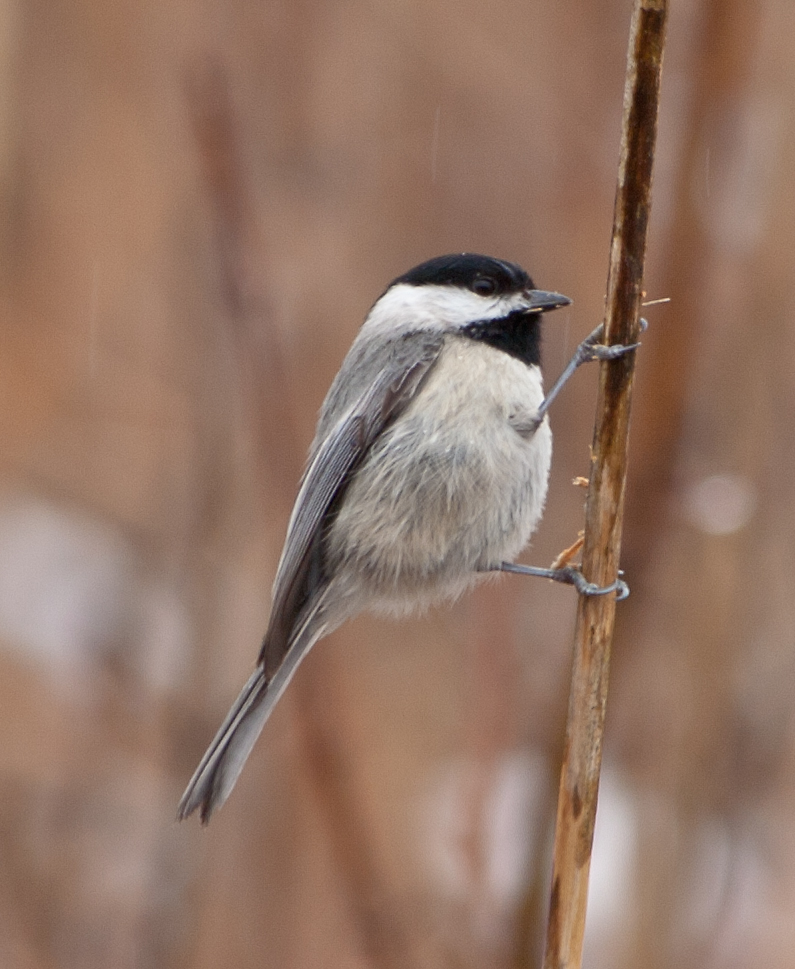
A fellow photographer informed me this past weekend that the little bird that I was preparing to photograph was not a Black-capped Chickadee—it was a Carolina Chickadee.

I am a neophyte when it comes to bird identification, but I confess to being confused. I have been trying to photograph this bird for months and have been calling it a Black-capped Chickadee (Poecile atricapillus) in my postings. To my eyes, it looked like the photographs I’ve seen others post of the Black-eyed Chickadee.

I turned to the Cornell Lab of Ornithology website, my favorite resource for bird identification, to try to resolved this conundrum. The site confirmed that the Black-capped Chickadee and the Carolina Chickadee (Poecile carolinensis) look a lot alike, but the two species probably diverged more than 250,000 years ago.

There are some differences between the two in the edging of the wings and the bib and the songs are different too, but apparently the range is one of the most critical factors, since the ranges of these two species don’t overlap much. I appear to be within the range of the Carolina Chickadee, but Virginia seems to be near the northernmost edge of the range, so I can’t exclude the possibility that I will run into a Black-capped Chickadee.

Here are a couple of my favorite chickadee photos. The first one was taken a couple of weeks ago with my recently acquired 135-400mm lens. It did a pretty good job in capturing some of the details of the chickadee in the tree. The second one was taken this past Monday with my 55-250mm lens. I managed to get a little closer to the chickadee that was clutching a stalk in the cattail field and was able to isolate the background a little.

I got started watching and photographing birds this past fall, probably after many birds had left the area. I can’t wait to see what new ones (for me) show up this spring.

chickadee_blogchickadee2_blog

Michael Q. Powell. All rights reserved

Read Full Post »

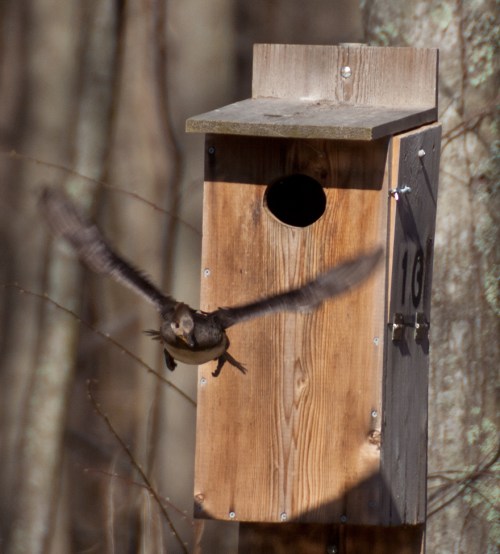
This past weekend I was fortunate enough to see a female Hooded Merganser duck (Lophodytes cucullatus) again enter a nesting box at my local marshland park. If you want to see some photos of my first such incident, check out my previous posting.

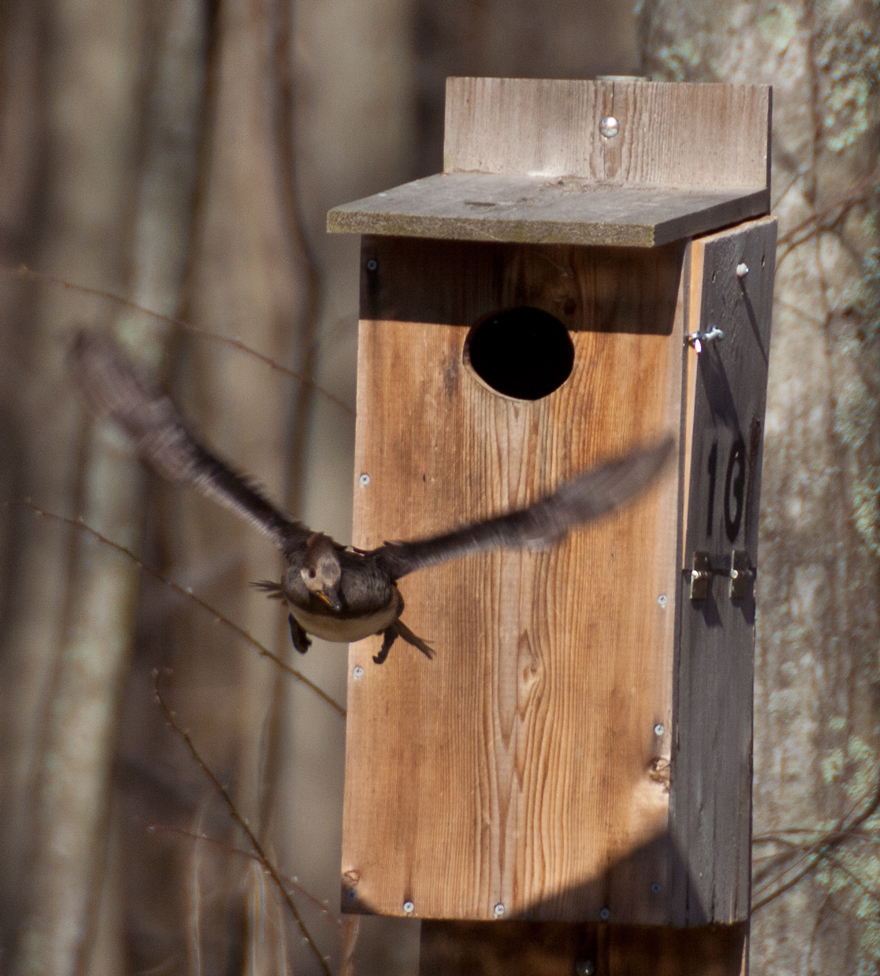
It is proving to be quite a challenge to capture this fascinating encounter in photographs, even with my camera trained on the nesting box. I think I get my best shots when the female chooses to land on the box prior to entering it. At that moment, the subject is relatively stationary and I can refocus my camera on the duck itself, and not on the box. When she flies into and out of the box, my camera and lens have trouble maintaining focus and stopping the action, even at exposures of 1/1000 and greater.

She paused a moment when exiting and I was able to get a shot with her head sticking out of the nesting box. I also got a photo of her flying out of the box, which is pretty blurry, but I thought the shadow was pretty cool.

The last two shots are aspirational shots for me—they give you an idea of what I am trying to shoot, even if I have not yet been able to do so successfully.

box2a_blogbox2b_blogbox2d_blogbox2c_blog

Michael Q. Powell. All rights reserved

Read Full Post »

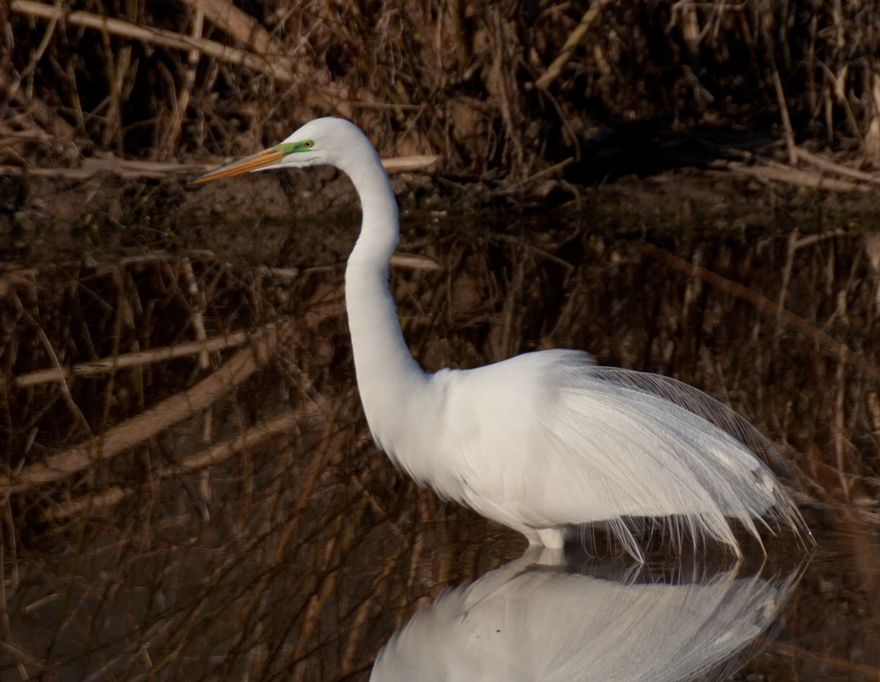
I was thrilled yesterday to see a Great Egret (Ardea alba) at my local marshland park for the first time in months. Unlike the Great Blue Herons, which stayed with us all winter, the Great Egrets flew south when the weather grew cold.

This egret was standing and fishing in a small pool of water near the boardwalk that runs through the marsh, undeterred by the crowd of photographers busily snapping away. I was a late arrival to the encounter and missed seeing the egret catch a frog, but I was happy that I was managed to get some good shots.

Egrets are always beautiful, but the wispy plumes they have at this time of year are especially spectacular. Normally I have problems with blowing out the highlights when I try to photograph egrets, but I think that the closeness of the bird helped me to get a decent exposure.

I can’t wait to see what other surprises are in store for me as we move into spring.

egret2_blogegret1_blog

Michael Q. Powell. All rights reserved

Read Full Post »

This male Hooded Merganser duck (Lophodytes cucullatus) flew away when his mate entered the nesting box (as shown in my posting yesterday), but I was able to get these shots when he was swimming around beforehand.

I am also including a shot from earlier this month when a male was displaying for a female. He would periodically throw back his head back and make the strangest sound, almost like a frog. The sound is so unusual that you may enjoy checking it out at the Cornell Lab of Ornithology site, where you should click on the button that says “Male display.”

male1_blogmale2_blog

Merganser_singing1_blog

Michael Q. Powell. All rights reserved

Read Full Post »

There is just something about this Red-winged Blackbird that makes me laugh. Perhaps it is his whimsical little half-smile or the way that he has cocked his head. Maybe it is the way that his feathers stick out like a little boy’s cowlick or the glint in his eyes or the way he is perched on the cattail. All of these features give him an almost comical look that I really enjoy.

blackbird1_blog

Michael Q. Powell. All rights reserved

Read Full Post »

I have often wondered if birds actually used the nesting boxes scattered throughout my local marshland park and yesterday I got a definitive response when I saw two female Hooded Merganser ducks separately go into one of the boxes.

As I was looking across the beaver pond, one of my favorite spots for taking photos, a Hooded Merganser (Lophodytes cucullatus) couple flew by and landed in the water. They were out of the reach of my lens at that moment, but a fellow photographer alerted me to the fact that the couple had been using a nesting box that was somewhat closer to where I was standing.

I set up my tripod and trained my 135-400 telephoto lens on the nesting box and waited.  Eventually the couple swam behind a cattail patch and came into view near the box. Without warning, the female lifted off and flew straight into the box. It happened so fast that I was not able to get off a shot. A short while later, the male took off.

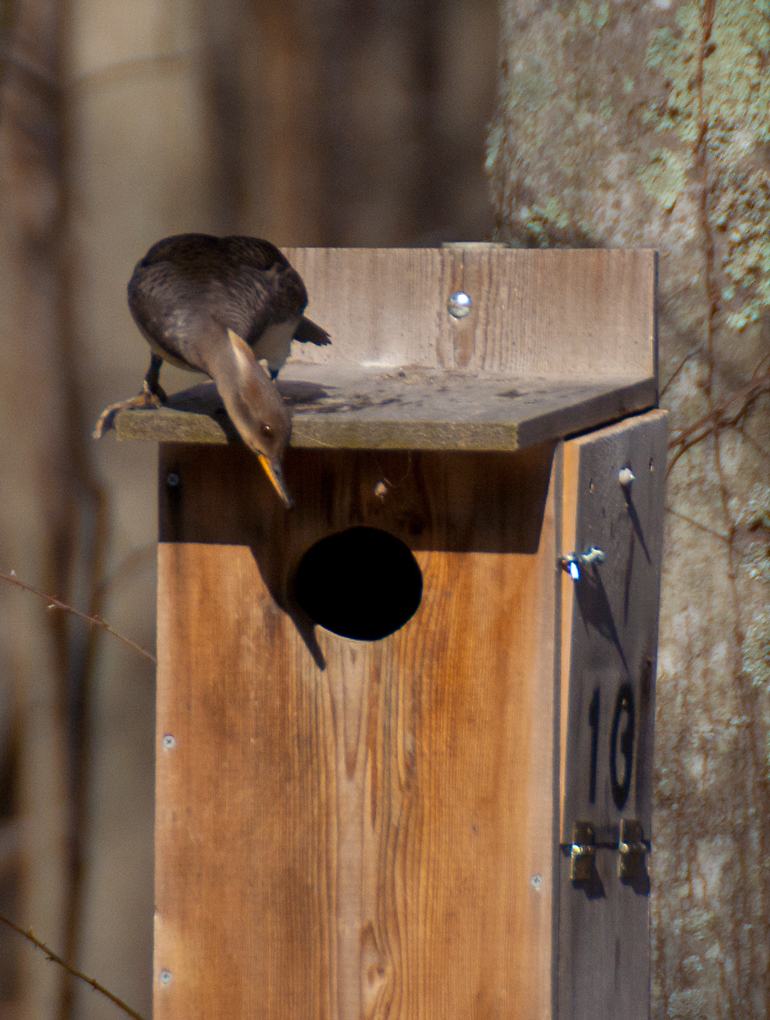
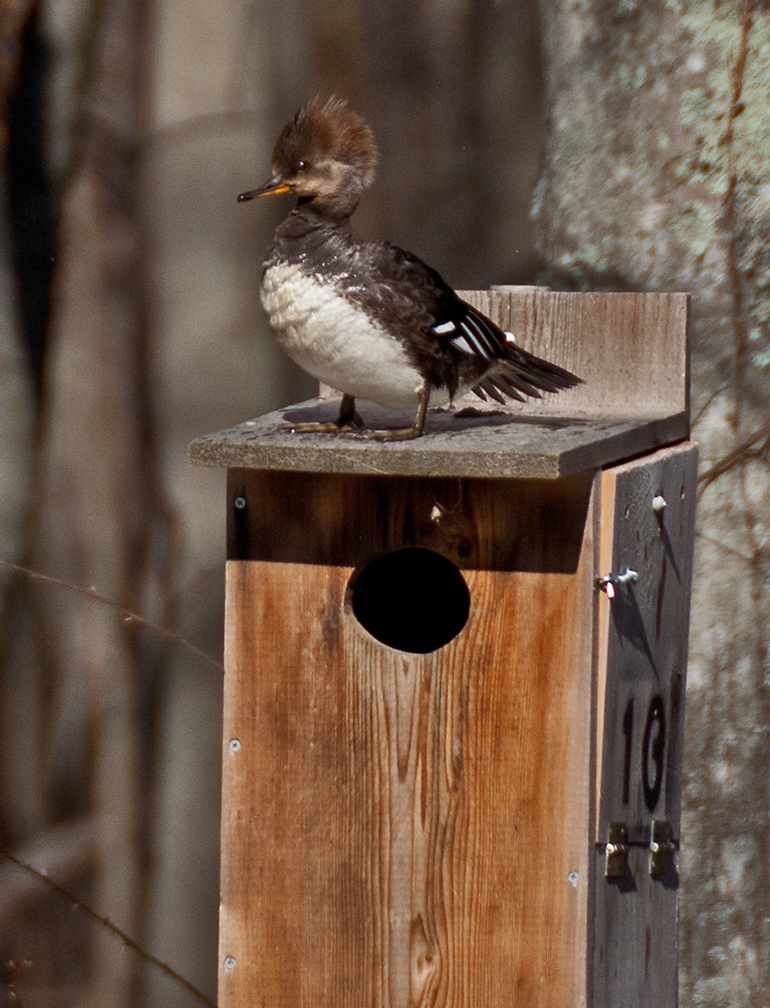
I continued to wait, confident that the female would eventually have to emerge through the hole in the nesting box. As I was watching and waiting, a bird landed on the roof of the nesting box, as you can see in the second photo. I did not immediately realize that it was another female Hooded Merganser, but I had the presence of mind to take some shots.

She seemed uncertain about whether or not she should go into the box and tried to peer into it, as you see in the first photo. Satisfying herself that everything was ok, she flew into the box, which by now was getting a little crowded. My photos of the entry were completely blurry.

I waited some more and eventually one of the females flew out and I managed to get the third shot. I was hoping that she would linger with her head sticking out of the box before she started flying, but that didn’t happen. I waited for about 45 minutes longer for the second female to exit the box and finally my patience gave out.

The incubation period for the eggs that the female presumably is laying in the box is about a month, so I will keep returning to this location, and with a little luck will be able to see some ducklings.

merganser2_blogmerganser1_blogmerganser3_blog

Michael Q. Powell. All rights reserved

Read Full Post »

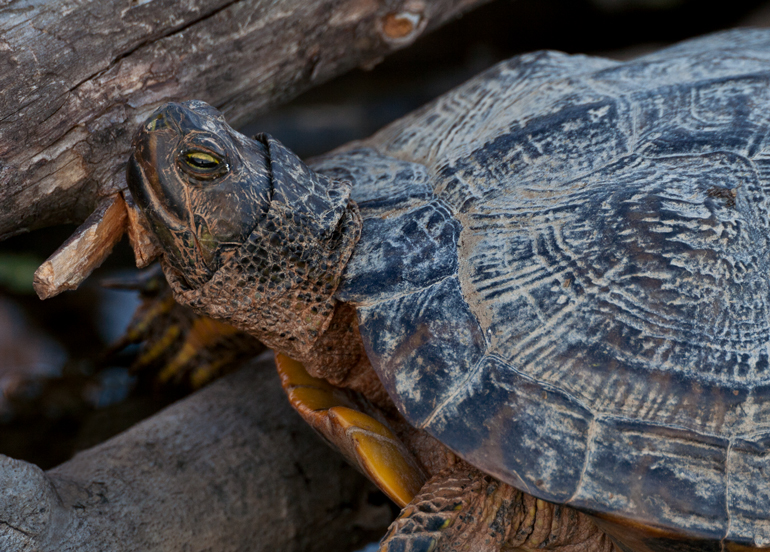
Yesterday I decided to take some close-up shots of some of the turtles sunning themselves at my local marsh.

I am pretty sure that the first one is a painted turtle, but I am not sure if the turtle in the second photo is a different species. I was intrigued by the contrast between the clean, bright colors of the first turtle and the muddy, muted colors of the second one. The turtles were pretty cooperative and let me get close enough to fill the frame of my camera.

It’s not quite warm enough for humans to be sunbathing, but now that spring is officially here, it won’t be long.

turtle1_blogturtle2_blog

Michael Q. Powell. All rights reserved

Read Full Post »
« Newer Posts