Feeds:
Posts
Comments

Posts Tagged ‘red-winged blackbird’

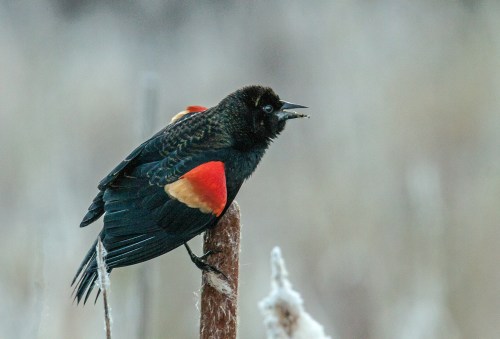
I was delighted to see some Red-winged Blackbirds (Agelaius phoeniceus) last week at Occoquan Bay National Wildlife Refuge. In the first photo, a male  Red-winged Blackbird seemed to be showing off for me as he balanced himself on a single leg, glanced in my direction, and seemed to smile. Eventually he climbed to the tip of the small branch and appeared to be complaining about something that he observed.

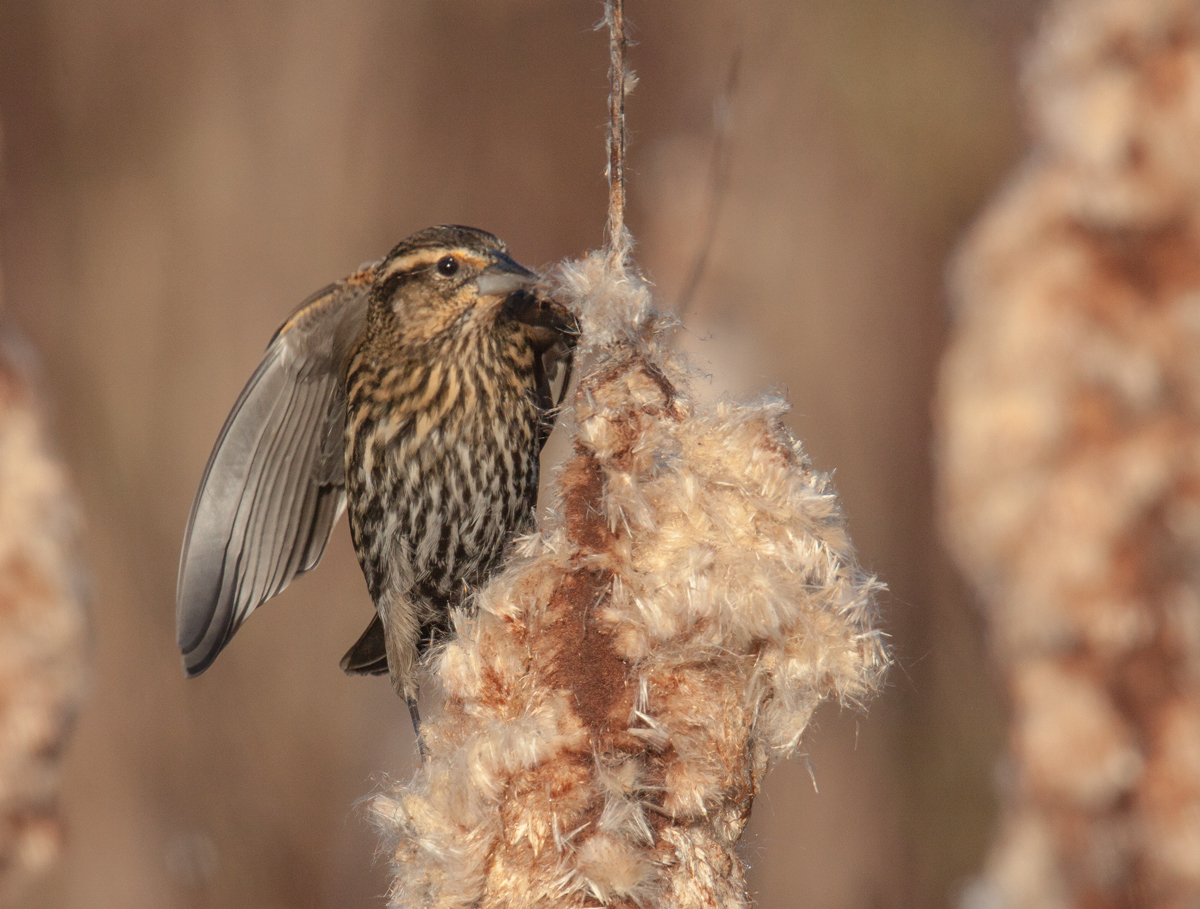
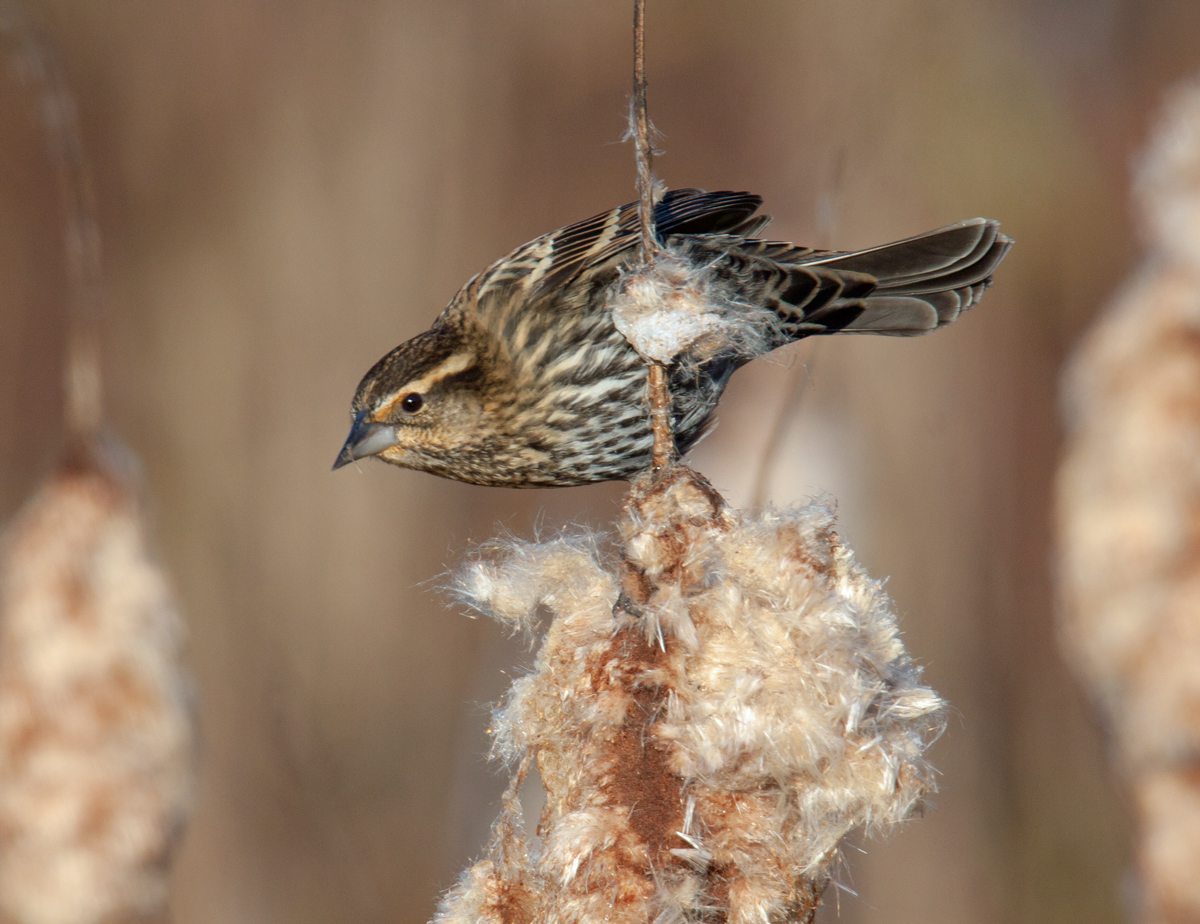
A short distance away I captured the final image of a female Red-winged Blackbird. As you can she, she is not black nor does she have any red on her wings, so it feels a little strange to call her a Red-winged Blackbird. Although I was not able to get very close to her, I really like the overall composition of the image and the moment of action that I was able to capture as she called out.

Red-winged Blackbird

Red-winged Blackbird

Red-winged Blackbird

© Michael Q. Powell. All rights reserved.


Read Full Post »

I spotted this beautiful female Red-winged Blackbird (Agelaius phoeniceus) poking about in the marshland vegetation last Thursday at Jackson Miles Abbott Wetland Refuge. As is the case with many birds, the name of the species matches the coloration and/or features of the male, but not those of the female, e.g. this Red-winged Blackbird is not black nor does it have red wings.

I had my first encounter with a female Red-winged Blackbird in June 2012, a few months before I started this blog. I remember well my initial difficulties in trying to identify the bird and my shock in learning that it was a blackbird—I assumed it was a sparrow of some sort. In September 2012, I posted some photos of that bird in a blog entry entitled “Intense bird.” I encourage you to click on that link and make your own judgment about the degree to which my photography “style” has remained consistent over the years.

In 2012 I was just starting to get serious about photography and my dear friend and photography mentor Cindy Dyer had lent me a Nikon D300 and a Tamron 180mm macro lens that day. I fell in love with that lens and quickly purchased one for my Canon, the brand that I mostly use. The Tamron 180mm macro lens remains one of my favorite lenses.

It was quite enjoyable to watch this blackbird last week exploring the vegetation protruding from the water. She would perch on some rather small stems, appearing to flare her tail to maintain her balance, as you can see in these photos, occasionally calling out to a male blackbird that I could hear, but did not see.

Red-winged Blackbird

Red-winged Blackbird

© Michael Q. Powell. All rights reserved.

Read Full Post »

A female Red-winged Blackbird (Agelaius phoeniceus) lifted her head as I approached her last week at Occoquan Bay National Wildlife Refuge, but then went back to work extracting seeds from the spiky sweetgum balls. The seedpods were so numerous that they reminded me of a well-decorated Christmas tree festooned with hanging ornaments.

Red-winged Blackbird

© Michael Q. Powell. All rights reserved.

Read Full Post »

Birds have to work really hard to find food during the cold season. This female Red-wing Blackbird (Agelaius phoeniceus) decided that it was worth her effort to try to extract some seeds from the spiky seed pods of a sweetgum tree earlier this month at Occoquan Bay National Wildlife Refuge.

Some of you may be wondering how this can possibly be a Red-winged Blackbird. After all, this bird is not at all black and her wings are not red. When I first started getting serious about my photography more than 11 years ago, I would often go out shooting with my mentor Cindy Dyer, who loved to photograph flowers and sometimes insects. She rarely photographed birds and I had no experience identifying them.

During one such outing I photographed a bird on a rebar trellis at one a botanical garden. I assumed that it was one of the many types of sparrows that I lumped together as “little brown birds.” When I posted the shots in a Facebook birding forum, I was shocked to learn that it was a female Red-winged Blackbird. (Check out my 27 September 2012 blog posting called “Intense bird” for more details on that adventure, including my first ever shots of a female Red-winged Blackbird. I also remember that 2012 encounter well because I was shooting with a Nikon D300 that Cindy had lent me along with a Tamron 180mm macro lens. I did not switch from Canon to Nikon, but immediately orders the Canon version of the lens, which continues to be one of my favorite lenses.)

I am a lot more knowledgeable about birds now and have reconciled myself to the reality that many species derive their names from the males, who tend to be more colorful in appearance. As most of you know, I love to photograph insects, particularly dragonflies, but they have now completely (or maybe almost completely) disappeared from the scene, so I will be focusing my camera and my attention mostly on birds in the upcoming cold months.

Red-winged Blackbird

© Michael Q. Powell. All rights reserved.

Read Full Post »

On Tuesday at Occoquan Bay National Wildlife Refuge I watched this Red-winged Blackbird (Agelaius phoeniceus) try to balance itself on the tip of a small, broken-off branch. The bird teetered and tottered and extended its wings for balance before it finally gave up and flew to a less precarious perch.

Somehow the little bird reminded me of my childhood, when I enjoyed tiptoeing along on sidewalk curbs, trying to maintain my balance. On rare occasions when I felt really bold, I’d try the same balancing act on low brick walls. At an early age I concluded that I was not destined for a career in the circus as a high-wire performer.


Red-winged Blackbird

© Michael Q. Powell. All rights reserved.

Read Full Post »

Eight years ago yesterday my dear friend and photography mentor Cindy Dyer sat me down and told me that I was going to start a blog. She is a professional photographer and graphic designer and already had a well-established blog. I had gone shooting with her multiple times and we had spent countless hours together reviewing my photos to improve my skills in capturing images and processing them. She had decided it was time to broaden my audience beyond that of Facebook.

Cindy showed me the basics of WordPress editing and navigation and helped me to set up my initial pages. I do not think that either of us anticipated the degree to which I would grow to love the process of blogging, a process that has allowed me daily to express myself creatively in both words and images.

WordPress data show that I have published 3628 posts, which probably includes the occasional re-blog of a post written by someone else, and have had almost 249 thousand views. Those posts have included over 580 thousand words (about 160 words per posting) and well over 4000 photos.

Although I look at the numbers from time to time, they are not that important to me. It is personally more important to me that the blog has helped me to develop relationships with a lot of different viewers, to share with so many of you my sometimes faltering  steps on my meandering journey into photography.

Thanks to all of you for helping me along the way and sharing your comments, suggestions, and recommendations. I especially owe a debt of gratitude to Cindy Dyer for motivating me throughout this entire period, for pushing me at times when I was hesitant, and for serving as my muse. Many of you probably feel that you already know Cindy, given that I have featured flowers from her garden repeatedly during this year as I have been forced to stay close to home. Thanks, Cindy.

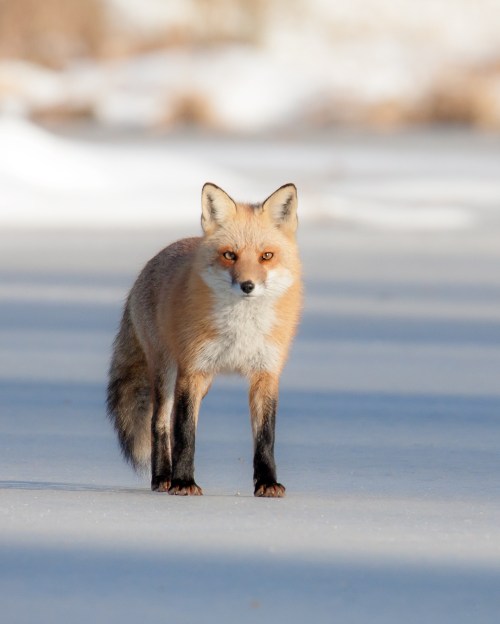
To celebrate this anniversary, I thought I would reprise two of my favorite photos. These are not necessarily my most popular images or my “best” images, but they are ones that are particularly memorable to me. I am also including links to the original postings so you can read the accompanying text and additional commentary about the circumstances under which they were captured. Links to original postings: Visible Song (8 March 2016) and Fox on a frozen pond (31 January 2016).

But wait, there’s more. As a bonus, I am including an image that I captured last week of a spectacular male Halloween Pennant dragonfly (Celithemis eponina). Most of you know that I am somewhat obsessed with dragonflies and they have been an almost constant focus of my photography during the warm months over the last eight years. In fact, my very first blog posting featured a dragonfly. So, I feel it is only appropriate to include a dragonfly as I look back at where I have been.

Thanks again for all of your support and encouragement over these past eight years. The journey continues onward. I hope to continue to walk side-by-side with so many of you as we support and encourage one another. “Therefore, as we have opportunity, let us do good to all people.” (Gal. 6:10)

Visible song

fox on frozen pond

Halloween Pennant

© Michael Q. Powell. All rights reserved.


Read Full Post »

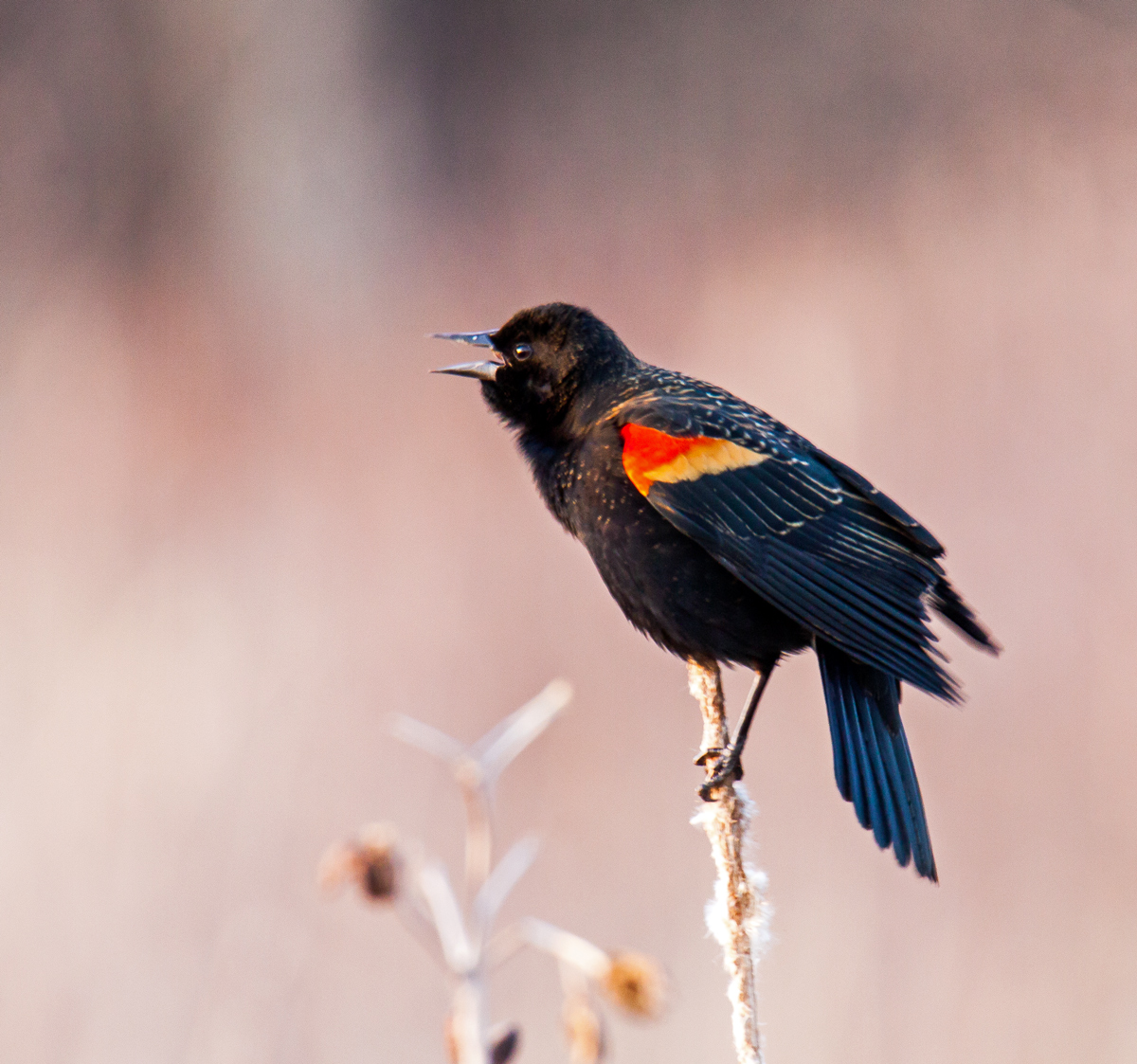
I went searching through my archives yesterday for a photo from March 2016 that I wanted to have printed. I won’t dwell on my storage practices, but suffice it to say that I am not very well organized. The image in question, one of my all-time favorite shots, shows a Red-winged Blackbird (Agelaius phoeniceus) whose breath was visible in the cold morning air. I have posted the image a few times and have had some really positive response, but somehow I had never gotten around to having it printed.

I had forgotten that I had captured multiple shots that day and as I was going through them yesterday I came across the first shot below that I have never posted. I love the way that the image shows how the blackbird puts his whole body into producing his “visible song”—I remember my choir leaders instructing us on the importance of breathing from the diaphragm for better sound projection.

The second and third shots give you a better view of the bird’s breath as it was being expelled. I was playing around with image formats and decided to do a square crop that I think works pretty well with these images. One of the photo companies has a sale today on canvas prints and I may one or more of these shots printed to see how they look. A friend has also suggested that I consider having a metal print made of one of them.

The temperature, humidity, and lighting all have be perfect to be able to see this phenomenon shown here. I have not been lucky enough to see it again since that day almost four years ago, though others have taken similar shots at the same location in recent years.

If you are curious to read my blog posting about the initial encounter, check out my 8 March 2016 blog posting entitled “Visible Song.”

Red-winged Blackbird

Red-winged Blackbird

Red-winged Blackbird

© Michael Q. Powell. All rights reserved.


Read Full Post »

This female Red-winged Blackbird (Agelaius phoeniceus) was backlit on Monday at Occoquan Bay National Wildlife Refuge, so I had to overexpose the image, which made the cloudy sky turn almost pure white. I really like the effect, which is reminiscent of a high-key portrait taken in a studio setting. One of my Facebook friends commented that the shot looked to him “like an old time copper image.”

My initial thought was to crop the image in a landscape format, as in the second image below, because I liked the graceful curve of the main branch. Upon further reflection, I decided that maybe there was literally too much white space in the image and opted for the square format in the first shot below, which gives a bit more attention to the main subject. What do you think? Do you have a preference for one version over the other?

red-winged blackbird

red-winged blackbird


© Michael Q. Powell. All rights reserved.


Read Full Post »

Thanks to a reminder from WordPress, I realized this morning that I am starting my 8th year with this blog. On July 7, 2012 I made my first posting “Blue Dasher dragonfly” and, as they say, the rest is history. According to WordPress stats, I have had 205,209 views of 3,177 posts. Some of those were re-reposts of blogs written by others, but I figure that I have written over 3,100 individual posts with well over 5,000 photos.

This morning I decided to share three of my all-time favorite photos—a singing Red-winged Blackbird (Agelaius phoeniceus); a Red Fox (Vulpes vulpes) on a frozen pond; and a close-up shot of a Blue-faced Meadowhawk dragonfly (Sympetrum ambiguum). I think that these three images taken together give you a good idea of my approach to photography.

I could not have made it this far on my journey in photography without the support and encouragements of so many of you. You have helped to make blogging part of my daily life. Thanks so much to you for enriching my life in a whole range of different ways.

I owe a special debt of gratitude to Cindy Dyer, my dear friend and photography mentor. She was the one who sat me down seven years ago and helped me with the mechanics of starting this blog. She continues to inspire me and to support me in both my personal life and in my photography. Thanks, Cindy.

What’s ahead? For the foreseeable future I plan to continue my adventures in photography. Having recently retired, I may start to venture to somewhat more distant locations, but mostly I anticipate more and more hours of walking around with my camera in hand, trying to capture all of the beauty of the natural world.

Red-winged Blackbird

Red Fox

Blue-faced Meadowhawk

© Michael Q. Powell. All rights reserved.

Read Full Post »

“Environmental bird portraits” is a fancy way of saying that I was not able to get close enough to my subjects to isolate them and fill the frame. Although that is true, I like the way that these three images give you a sense of the environment in which the birds were found. Often I try to get so close enough to my subjects with a telephoto or macro lens that I lose sight of the “big picture.” These images, all of which were taken last week at Occoquan Bay National Wildlife Refuge, give you some sense of the variety of birds and environments that I encounter when I am out with my camera.

The first image shows a pair of colorful Wood Ducks (Aix sponsa) that took off as soon as they detected my presence (and I was a long way off from them). The male is the one that is in front, with the female just behind him.

The second image shows a Sharp-shinned Hawk (Accipiter striatus), the smallest hawk in the United States. This bird was the toughest one for me to identify and I had to seek assistance from some experts in a Facebook bird forum. There was some discussion about whether this was a Sharp-shinned Hawk or a Cooper’s Hawk, another small hawk, but prevalent view was the it was the former.

The final image shows a male Red-winged Blackbird (Agelaius phoeniceus) as he sang out loudly from atop a tree. Male blackbirds are definitely not shy and the volume of their enthusiastic songs and calls is amazing, i.e. really loud.

Wood Duck

Sharp-shinned Hawk

Red-winged Blackbird

© Michael Q. Powell. All rights reserved.

Read Full Post »

Six years ago today my photography mentor Cindy Dyer sat me down and told me that I was going to start a blog. She showed me the basics of WordPress editing and navigation and helped me set up my initial pages. I don’t think that either of us anticipated the degree to which I would grow to love the process of blogging, a process that has allowed me to express myself creatively in both words and images

WordPress data show that I have published 2768 posts and have had approximately 170800 views. Those posts have included 429649 words (about 155 words per posting) and well over 3000 photos.

The importance of my blog, though, cannot be expressed merely in numbers. More significantly the blog has helped me to develop relationships with a lot of different viewers, to share with you the different steps on my meandering journey into photography. Thanks to all of you for helping me along the way and sharing your comments, suggestions, and recommendations. I especially owe a debt of gratitude to Cindy Dyer for motivating me throughout this entire period, for pushing me at times when I was hesitant, and for serving as my museThanks, Cindy.

To celebrate this anniversary, I thought I would reprise a few of my favorite photos. These are not necessarily my most popular images or my “best” images, but they are ones that are particularly memorable to me. I am also including links to the original postings so you can read the accompanying text and additional commentary about the circumstances under which they were captured.

Links to original postings: Visible Song (8 March 2016); Fox on a frozen pond (31 January 2016); and Rescue of an injured Bald Eagle (4 November 2014).

Thanks again for all of your support and encouragement over these past six years. The journey continues onward.

Visible song

fox on frozen pond

eagle resuce

© Michael Q. Powell. All rights reserved.


Read Full Post »

A large number of Red-winged Blackbirds (Agelaius phoeniceus) were in the trees and among the cattails yesterday afternoon at Huntley Meadows Park and their raucous calls resounded throughout the park. The males seemed to competing to see who could call out the loudest and longest, as if to say, “Can you hear me now?”

Red-winged Blackbird

Red-winged Blackbird

© Michael Q. Powell. All rights reserved.

Read Full Post »

When I took this shot yesterday morning at Huntley Meadows Park, I assumed it was a female Red-winged Blackbird (Agelaius phoeniceus), because of its color and the pattern of the feathers. At home, though, it became clear that it was an image an immature male who is just starting to gain some of the markings of an adult male—you can just make out the beginnings of the colorful shoulder patch.

Red-winged Blackbird

© Michael Q. Powell. All rights reserved.

Read Full Post »

The composition of these images couldn’t get much simpler, but I think that they help to highlight the beauty of this female Red-winged Blackbird (Agelaius phoeniceus) that I spotted last week at Huntley Meadows Park. Normally female blackbirds forage down low inside the vegetation, so it was a real treat to find one perched out in the open.

Female Red-winged Blackbirds are special to me because they were one of my first subjects when I started to photograph birds. I remember well my surprise when I learned that this bird was a red-winged blackbird, given that it clearly was not black nor did it have red wings. I’ve learned a lot about bird identification since that time and birds have become one of my favorite subjects.

Red-winged Blackbird

Red-winged Blackbird

© Michael Q. Powell. All rights reserved.


Read Full Post »

I love the feeling of the early morning, when the world is awash in pale colors and the birds are just starting to wake up. It’s a magical feeling for me sometimes, and the mist in the air last Monday only enhanced that effect.

How do you capture a moment like that? I don’t shoot a lot of landscape photos, but I can understand how some photographers are driven to find the right mix of compositional elements to pass on to others the emotional impact of a particular scene.

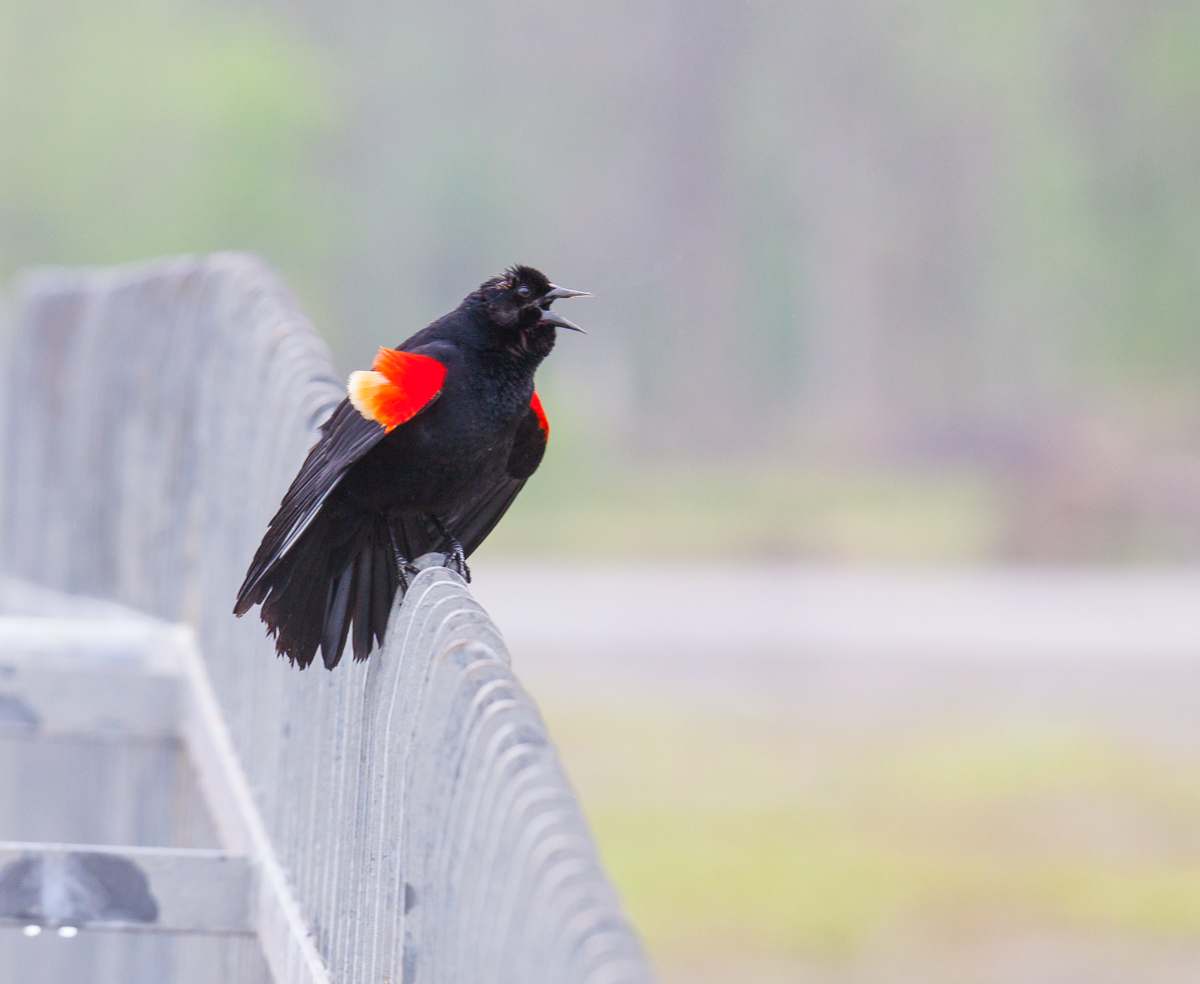
As I was walking along the boardwalk at my favorite marshland park, I was drawn to this male Red-winged Blackbird (Agelaius phoeniceus) perched on a railing leading to an observation platform. Normally I try not to include man-made elements in my wildlife shots, but in this case the railing faded out into an almost indistinct set of lines and shapes. Far in the distance, there is a suggestion of the trees and the water. With its bright shoulder patches, dark color, and sharper details, the blackbird provides an element of contrast with the rest of the scene.

Sometimes it’s fun to chase after more exotic subjects, like the owlet that I saw recently, but at other times I am content to try to capture the feeling of a moment, like this blackbird on a misty morning.

Red-winged Blackbird

© Michael Q. Powell. All rights reserved.

Read Full Post »

I am not sure why, but this male Red-winged Blackbird (Agelaius phoeniceus) was acting differently this past weekend. Rather than standing tall and singing out loudly, as is normally the case, he was instead hunched over and making a more gentle peeping sound.

Was he in pain or distress? Was this simply a different way of communication? It’s overwhelming sometimes to consider how little I know about the behavior of the subjects that I try to photograph, despite the fact that I am learning all of the time.

From a photographic perspective, I really like the geometric. almost abstract shape of the blackbird in this image.

Red-winged Blackbird

© Michael Q. Powell. All rights reserved.

Read Full Post »

In a field full of cattails, this male Red-winged Blackbird (Agelaius phoeniceus) at Huntley Meadows Park chose to perch on a man-made structure, a weather-monitoring station.

I really like the juxtaposition of the natural and industrial elements in the simple composition of this image and its limited palette of colors.

Red-winged Blackbird

© Michael Q. Powell. All rights reserved.

Read Full Post »

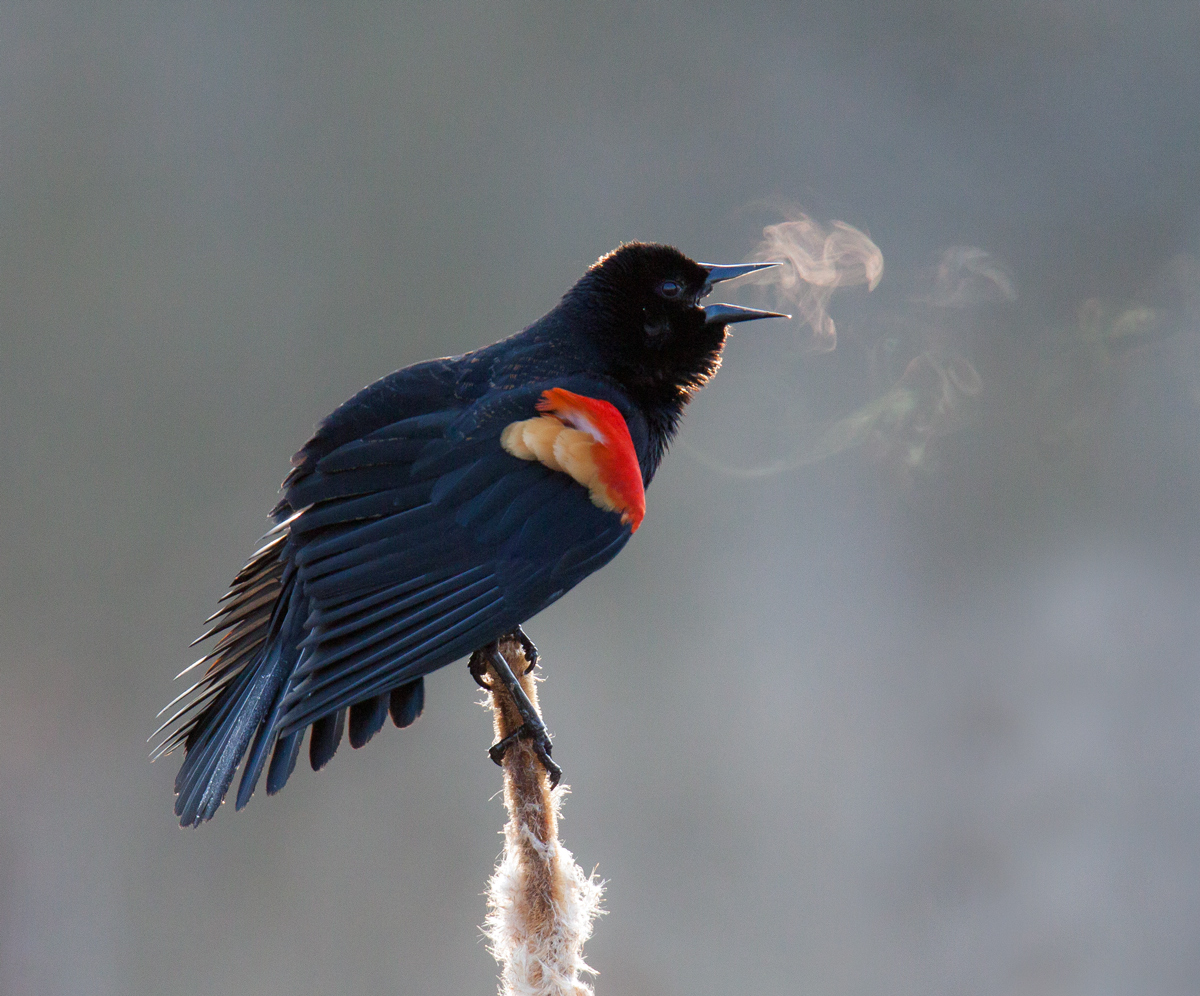
It was so cold yesterday morning at Huntley Meadows Park that the breath of a Red-winged Blackbird (Agelaius phoeniceus) was visible as he sang out from atop a cattail.

Spring is definitely in the air and potentially record high temperatures are forecast for later in the week. However, it was right about at the freezing level when I arrived at the local marshland park where I spent so much of my free time wandering with my camera in hand.

I’ve photographed Red-winged Blackbirds lots of times, but I rarely pass up an opportunity to shoot them again—I just never know when I may capture an unusual moment. The sun had risen and light was starting to reach the cattails. I turned toward the light when I heard a blackbird call out.

As I zoomed in on the bird, I was amazed to see that the blackbird’s breath was visible as he forcibly exhaled when singing. In the still morning air the visible breath swirled about and the bird looked like a smoker getting his early morning nicotine fix.

I was fascinated by the differing patterns of the condensation as the blackbird moved his head or body position and was thrilled to be able to capture several different views of the blackbird’s visible song.

As I went to bed last night, I noticed that the counter for my blog was right at a hundred thousand views. Thanks to so many of you for helping me to reach this milestone and for encouraging me and supporting me as I journey on into photography.

Red-winged Blackbird

Red-winged Blackbird

Red-winged Blackbird

© Michael Q. Powell. All rights reserved.


Read Full Post »

Some days it seems like the birds are conspiring against me. They are so skittish that they fly away long before I am within range or they hide behind a wall of branches, where I can hear them but cannot see them clearly.

In moments like that, a male Red-winged Blackbird (Agelaius phoeniceus) often comes to rescue me from my despair. These birds are so bold and defiant that they refuse to hide. Instead, they find the most prominent perch and sing out as loudly as possible, showing off for rivals and potential mates.

This past Monday was one of those days when I was having trouble finding subjects to photograph. Suddenly a blackbird appeared and flew to the highest branch of a nearby small tree. Undeterred by my presence, he looked in my direction and seemed to smile. After a moment, he burst forth in singing while continuing to look at me, as though he were saying, “This one’s for you.”

Red-winged Blackbird

bb2_22feb_blog

© Michael Q. Powell. All rights reserved.

Read Full Post »

How do you generate volume when you sing? I remember being told to breathe from the diaphragm, but this male Red-winged Blackbird (Agelaius phoeniceus) seemed to think that spreading his wings helped him to be heard yesterday morning at Huntley Meadows Park.

Red-winged Blackbird

© Michael Q. Powell. All rights reserved.

Read Full Post »

As the early morning sunlight hit the cattails yesterday at Huntley Meadows Park, this male Red-winged Blackbird (Agelaius phoeniceus) seemed to be contemplating the start of the new day.

Red-winged Blackbird

© Michael Q. Powell. All rights reserved.

Read Full Post »

Some of my favorite photos are ones with a common subject and a simple composition, like these shots I took this past weekend of a male Red-winged Blackbird (Agelaius phoeniceus) at Huntley Meadows Park. The blackbird was perched in a field of cattails and the morning light was beautiful.

Sometimes photography seems so uncomplicated—it just works.

Red-winged Blackbird

Red-winged Blackbird

© Michael Q. Powell. All rights reserved.

Read Full Post »

Several male Red-winged Blackbirds (Agelaius phoeniceus) were calling out loudly in the cattails yesterday morning at Huntley Meadows Park as I walked crunchy snow on the boardwalk. There was no way that I could sneak up on the birds for a closer shot, so I was content to photograph them from a distance.

I love the look of birds against a snowy backdrop and decided to leave a lot of literal white space around the blackbirds to give a sense of the setting in which I found them. Temperature are going to soar in the next few days, so I am going to take advantage of the snow while it is still present in our area.

Red-winged Blackbird

Red-winged Blackbird

Michael Q. Powell. All rights reserved.

Read Full Post »

A female Red-winged Blackbird (Agelaius phoeniceus) paused for a moment to pose as she foraged for food in the cattails of Huntley Meadows Park earlier this month.

Red-winged Blackbird

© Michael Q. Powell. All rights reserved.

Read Full Post »


How do you celebrate the end of the year? Do you like to go out with a bang, with a big celebration and literal or figurative fireworks, or are you more pensive and reflective? I know that I am in the latter group.

My life this past year, both personally and as a photographer, has had some high points, but mostly it has been a year in which I have tried to find beauty and meaning in ordinary things. I have visited my favorite park over and over again, photographing some of the same species repeatedly. Patience and persistence have been my hallmarks and I have been rewarded with some wonderful photographic opportunities.

Somehow it seems appropriate that I end this year with a couple of images of this beautiful female Red-winged Blackbird (Agelaius phoeniceus) that I spotted in the cattails on Monday at Huntley Meadows Park. Red-winged Blackbirds are with us most of the year. They seem to come and go, but they are often there. The females are usually buried deep in the underbrush and are not seen as often as the more flashy and loud males. As you can see from these photos, however, the females are at least as beautiful as the males.

The blackbird’s body positions serve as a visual metaphors for my approach as I look forward to 2016—hanging on and occasionally looking back, but primarily looking forward with optimism to the future.

Best wishes to all for a wonderful 2016.

Red-winged Blackbird

Red-winged Blackbird

© Michael Q. Powell. All rights reserved.

Read Full Post »

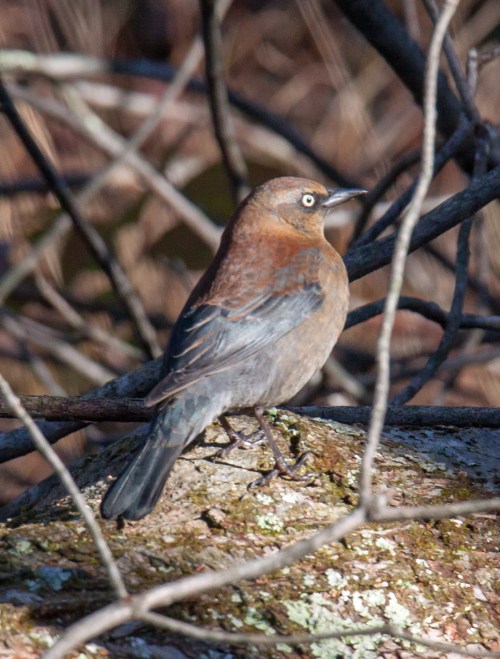
On Friday I spotted a very small flock of what I think are Rusty Blackbirds at Huntley Meadows Park. Unlike the much more common Red-winged Blackbirds (Agelaius phoeniceus), Rusty Blackbirds (Euphagus carolinus) like to forage in shallow pools of water at the edge of the woods, so they are often in the shadows

According to the Cornell Lab of Ornithology, the Rusty Blackbird is one of North America’s most rapidly declining species of birds. “The population has plunged an estimated 85-99 percent over the past forty years and scientists are completely puzzled as to what is the cause.”

At this non-breeding time of the year, the male and the female have similar coloration, with the male having a darker head and breast. I may have captured a male in the first photo and a female in the second or they may both be females, with the differences caused by changed lighting in the two images.

Rusty Blackbird

Rusty Blackbird

© Michael Q. Powell. All rights reserved.


Read Full Post »

Who needs a rooster when you have a Red-winged Blackbird?

The silence of the early morning yesterday at Huntley Meadows Park was broken by the raucous call of a male Red-winged Blackbird (Agelaius phoeniceus), announcing loudly his presence and the arrival of a new day.

On a frosty November morning, it was time to wake up.

Red-winged Blackbird

© Michael Q. Powell. All rights reserved.

Read Full Post »

The soft morning light reflected off of the colorful autumn foliage early today at Huntley Meadows Park, providing a beautiful backdrop for this male Red-winged Blackbird (Agelaius phoeniceus) as it perched in the cattails.

Red-winged Blackbird

© Michael Q. Powell. All rights reserved.

Read Full Post »

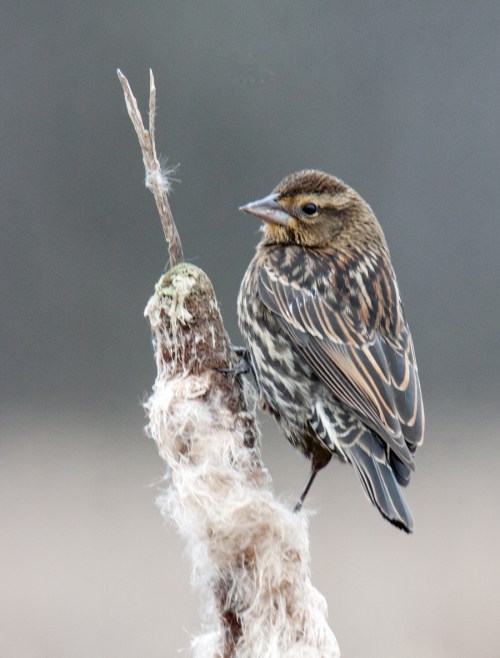
A small flock of Red-winged Blackbirds (Agelaius phoeniceus) was active in the cattails at Huntley Meadows Park on Monday morning. I was happy to be able to capture some action shots of one of the females, which, as you can readily see, are not black and don’t have red wings.

It was a real treat for me to be able to get some shots of the female blackbirds at the top of the cattails. Most of the time, the females peck about at the base of the cattails and only the male blackbirds are visible at the tops. For whatever reason, the majority of the members of this small flock appeared to be females.

I didn’t think that this female blackbird was aware of my presence as she diligently searched for insects, but the stare that I captured in the final photo seemed to be conveying a message that she did not want me there. I backed off and left a short time later.

Red-winged Blackbird

Red-winged Blackbird

Red-winged Blackbird

Red-winged Blackbird

Red-winged Blackbird

© Michael Q. Powell. All rights reserved.

Read Full Post »

I can understand how an adept female Red-winged Blackbird (Agelaius phoeniceus) can catch one dragonfly, but how in the world did this one manage to catch two at once?

I can’t tell for certain, but the dragonflies in the bird’s mouth look to be female Common Whitetails (Plathemis lydia) or possibly immature males, which look like the females. The wings seem to be very transparent, so it’s possible too that these may be newly emerged dragonflies—when they first transition from the water nymph stage into dragonflies, they are very vulnerable.

Red-winged Blackbird

© Michael Q. Powell. All rights reserved.

Read Full Post »
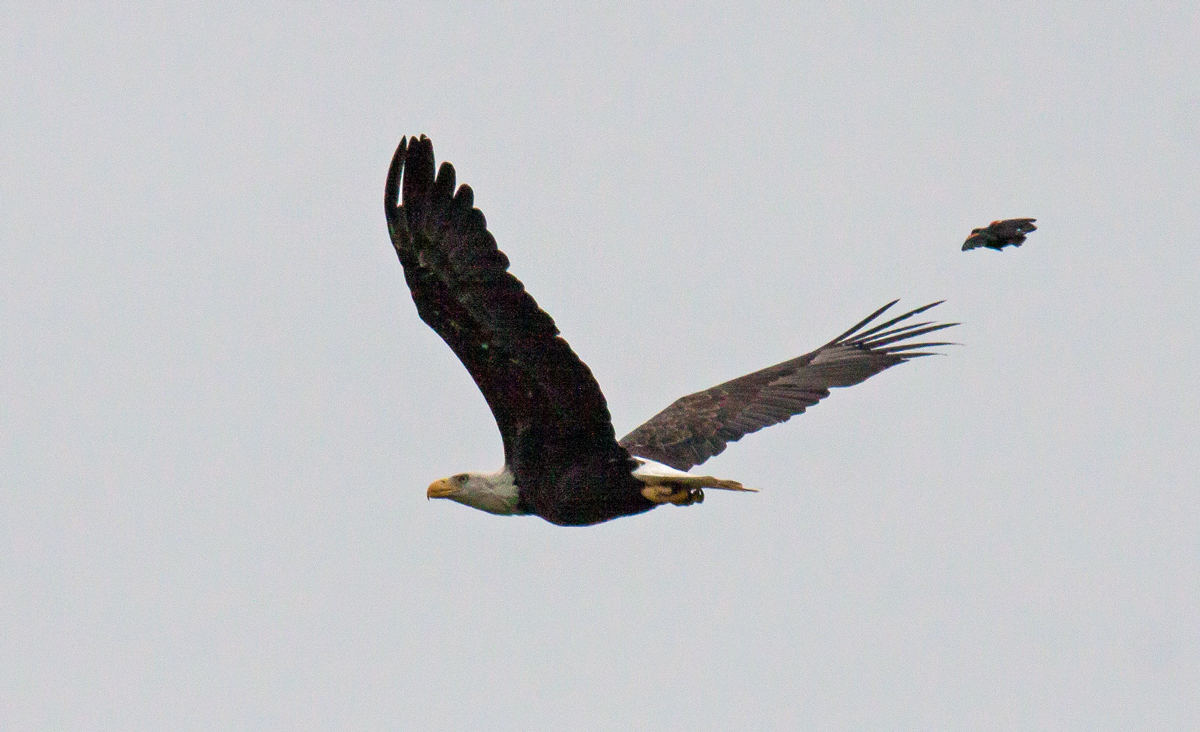
The Red-winged Blackbird (Agelaius phoeniceus) was either really brave or really foolish chasing a Bald Eagle (Haliaeetus leucocephalus) across the sky early yesterday morning at Huntley Meadows Park in Alexandria, Virginia.

Bald Eagle chase

I did manage to get a few other shots (below) in which the eagle’s wings are in more photogenic positions, but the blackbird is farther away from the eagle in each of them.

Bald Eagle chase

Bald Eagle chase

© Michael Q. Powell. All rights reserved

Read Full Post »

Older Posts »