Feeds:
Posts
Comments

Posts Tagged ‘Queen Anne’s Lace’

I suppose that I should call this a royal posting for it features both a viceroy and a queen. Of course, here in the USA we don’t have a monarchy, but that doesn’t keep us from having Viceroy butterflies (Limenitis archippus) and Queen Anne’s Lace (Daucus carota). I spotted this royal pair on Monday at Occoquan Bay National Wildlife Refuge where the Viceroy repeated probed the clusters of Queen Anne’s Lace.

You probably have noticed that the coloration of the Viceroy butterfly matches that of the Monarch butterfly. One of the easiest ways to tell them apart is the black line across the hind wings which is present with Viceroys but not with Monarchs.

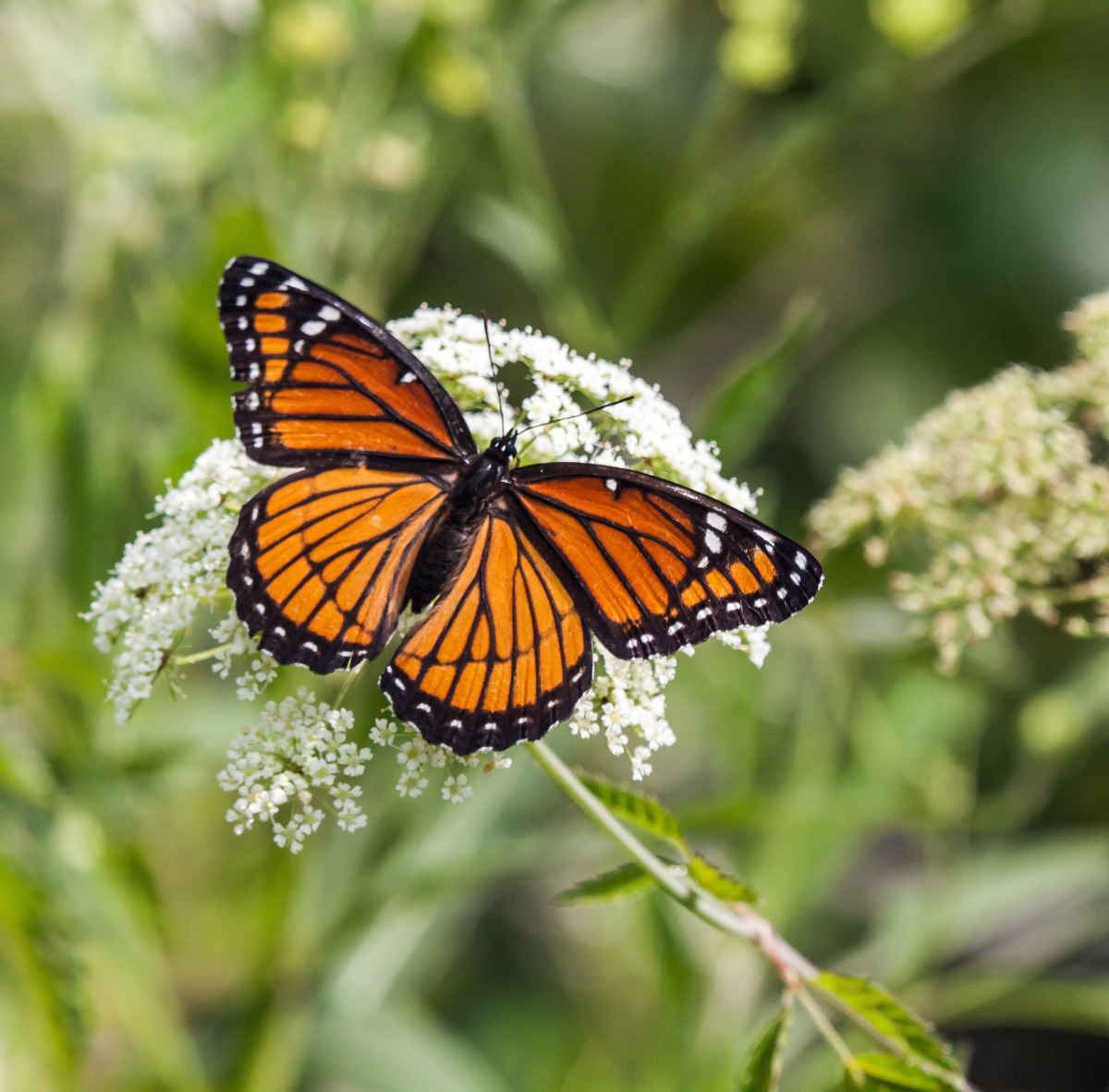
Viceroy butterfly

Viceroy butterfly

© Michael Q. Powell. All rights reserved.

Read Full Post »

Although I tend to associate Monarch butterflies (Danaus plexippus) with milkweed, this Monarch was hungrily feeding on Queen Anne’s lace (Daucus carota) this past weekend at Huntley Meadows Park. I am not sure why, but I have seen significantly more Monarch butterflies this summer than in the past few years.

Monarch butterfly

© Michael Q. Powell. All rights reserved

Read Full Post »

One of my fellow photographers pointed out this cool little crab spider on some Queen Anne’s Lace (Daucus carota) during a photo jaunt to Meadowlark Botanical Gardens in nearby Vienna, Virginia this past Saturday.

In this first shot, my favorite, the spider seemed to be expressing frustration that his prey had escaped his grasp (or simply wanted to show me his awesome biceps pose). Who knew that spiders have biceps?

crab spider

Initially I tried to photograph the spider looking down at it, but I had trouble maintaining a steady pose and my shots were blurry. I decided to kneel down and get at eye level with the spider, looking across the plane of the flower, and that seemed to work a bit better. These shots look like they were done with flash, but the EXIF data shows a shutter speed of 1/320, which is higher than the synch speed of my flash, so these were actually done with natural light, with some exposure compensation dialed in.

The second shot, which preceded the first one in time, shows the spider trying to capture a small insect (I think).

crab2_blog

The little insect starts to run away.

crab3_web

In vain, the spider crawled after the small insect, but it was too late. When I left the spider, it was at the edge of the flower, looking off into the distance, pondering perhaps what might have been, thinking about the one that got away.

crab4_blog

© Michael Q. Powell. All rights reserved

Read Full Post »