Feeds:
Posts
Comments

Posts Tagged ‘Prince William County VA’

I felt like I had hit the jackpot last Friday when I finally spotted several Uhler’s Sundragon dragonflies (Helocordulia uhleri) while exploring a stream in Prince William County, Virginia. Uhler’s Sundragons are a scarce and seldom seen dragonfly species with a brief and early flight period. There is a very active Virginia dragonfly group in Facebook that posts sightings and photos and it appears that my sightings of this species were the first in our state for 2020.

Last year I was able to do some reconnaissance of an area where this species had been spotted in previous years using information shared with me by fellow dragonfly fanatic and blogger Walter Sanford. Eventually I found and photographed some Uhler’s Sanddragons and he and I were able to spot them again several times.

This species generally is found in a specific type of habitat—”Clean, sandy or gravely forest streams with a mix of riffles and pools,” according to the excellent Dragonflies of Northern Virginia website. So Friday I scoured the locations where had spotted them last year and it was in one such location that I spotted the Ashy Clubtail and Common Green Darner that I featured recently in my posting First dragonflies of the season. I looked for Uhler’s Sundragons there but came up empty-handed.

It was at a second spot that I finally spotted one as it flew through the air and landed on a piece of vegetation. There is not much flying this early in the season and I could tell from the way that it perched that it was probably my target species. I think I was shaking a little bit and certainly my heart rate had accelerated, but I managed to get a shot of that one (the middle shot below), before it flew away. A few minutes later, I had another spotting and captured the last shot below—it might have been the same dragonfly or a different one.

Part of my long walk back took me along another stretch of the same stream and I was absolutely thrilled when I spotted yet another Uhler’s Sundragon and captured my favorite shot of the day, the first one below. It turns out that all of the Uhler’s Sundragons that I photographed were females. I am not sure if the males were all out patrolling or were simply in other locations.

Many of the locations where I might normally search for dragonflies are closed and some of the others are potentially crowded, so I am not willing to go there. As you can see from my recent postings, I am staying really close to home most of the time, with trips like this one to remote locations being a rare exception.

Uhler's Sundragon

Uhler's Sundragon

Uhler's Sundragon

© Michael Q. Powell. All rights reserved.

Read Full Post »

What do you call a group of butterflies? I have always been fascinated by the collective nouns that we use in English for groups of creatures. I was delighted to learn that one of the collective nouns used for butterflies is a kaleidoscope.

“A kaleidoscope of butterflies” seems to be the perfect descriptor for this group of beautiful Eastern Tiger Swallowtail butterflies (Papilio glaucus) that I spotted yesterday. They appeared to be engaged in a behavior known as “puddling,” during which the butterflies, most often the males, gather minerals and other nutrients from the soil or other organic material.


Eastern Tiger Swallowtails

© Michael Q. Powell. All rights reserved.

Read Full Post »

Last Friday I photographed my first dragonflies of the spring, a male Common Green Darner (Anax junius) and a female Ashy Clubtail (Phanogomphus lividus). The Common Green Darner is probably a migratory dragonfly that is just passing through as it heads north—we do have local-born members of this species, but it is too early for them to have emerged.

The Ashy Clubtail, which was actually the first dragonfly that I photographed, almost certainly emerged locally. When a dragonfly emerges, its wings are really shiny and the wings of this Ashy Clubtail were definitely sparkling in the sunlight. According to the local flight calendar, the Ashy Clubtail is one of the earliest dragonflies in our area to emerge, but I have never seen one this early before.

As you can see, I captured the images of both of these dragonflies when they were perched flat on the ground. There were dry leaves all around, which made a stealthy approach almost impossible and focusing on the dragonfly was a bit of a challenge.

Common Green Darner

Ashy Clubtail

© Michael Q. Powell. All rights reserved.

Read Full Post »

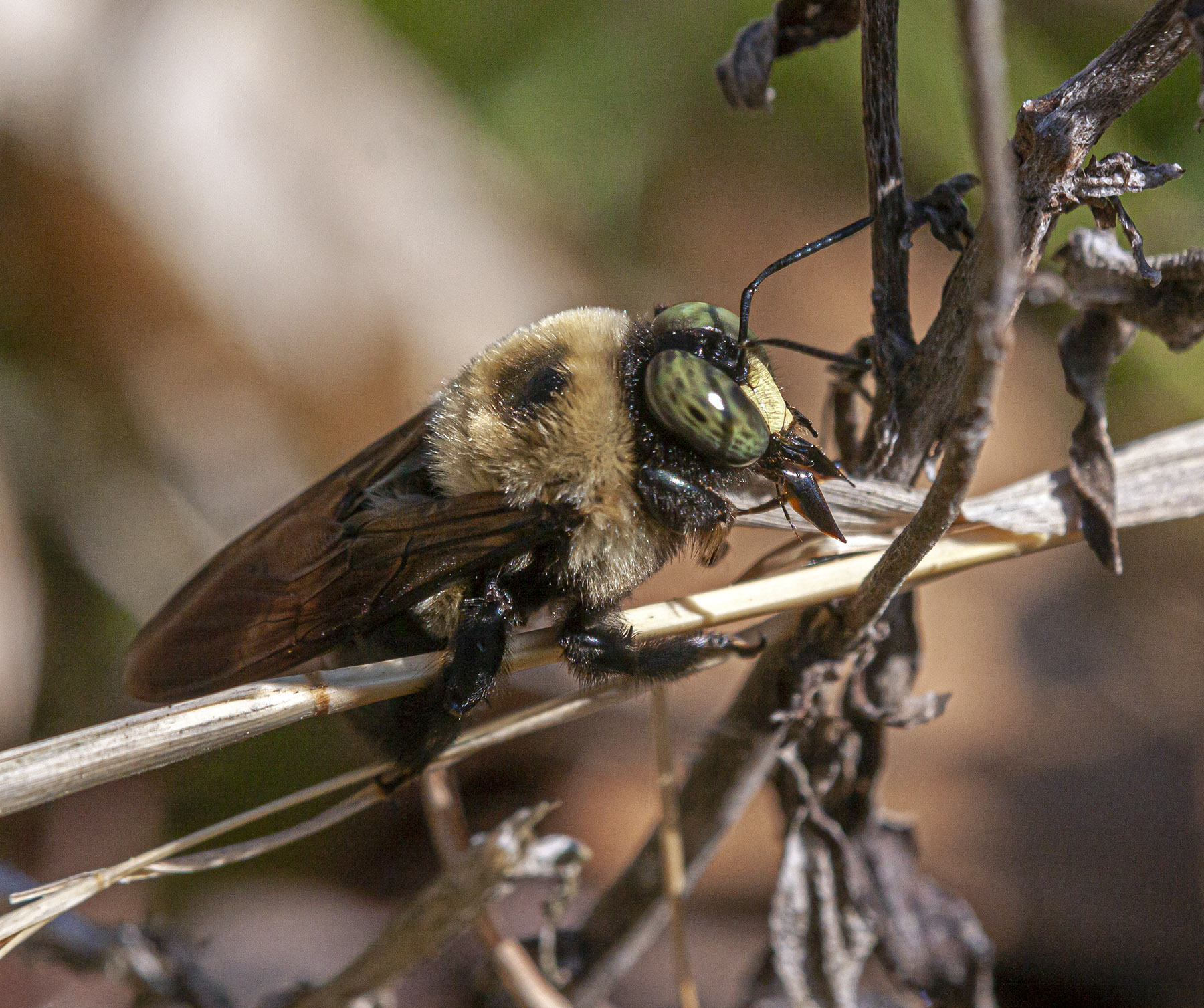
Did you know that some bees have green speckled eyes? I was really startled by the brightness of this bee’s eyes as I was taking its photo last Monday while exploring in Prince William County, Virginia. Some research on-line revealed that this is a male Eastern Carpenter Bee (Xylocopa virginica).

I was pretty sure that I had never before seen a bee like this, but I was wrong. As I was preparing this posting, I discovered that I had seen a similar bee in October 2012 and published a posting entitled “Green-eyed Eastern Carpenter bee.” Wow. It’s been a long time between sightings, so maybe I can be forgiven for having forgotten about the previous time, though at my age I can simply claim that I had a “senior moment.” Ages has its privileges.

Eastern Carpenter Bee

© Michael Q. Powell. All rights reserved.
Read Full Post »

Nature is full of wonderful shapes, like the spiral of this curled-up fern—at this stage it is know as a fiddlehead—that I spotted on Monday while exploring in Prince William County. A few days afterwards, Gary Bolstad published a photo of a fiddlehead in New Zealand in his blog krikitarts.wordpress.com. Gary is an amazing photographer and you should really check out his wonderful blog.

In replying to a comment I made about his posting, Gary explained that “The Māori name for a fiddlehead is Koru, and the spiral shape is an essential part of their culture and probably the most common shape used in the design of their carved greenstone (jade) jewelry. It can represent creation, perpetual movement, return to a point of origin, equilibrium/harmony in life, and new life.”

I think we could all use more equilibrium and harmony in our lives during these unsettling times.

fiddlehead

© Michael Q. Powell. All rights reserved.


Read Full Post »

Whenever I have my macro lens on my camera, I tend to scan small areas very carefully, looking for variations of color and patterns or signs of movement. The colorful markings permitted me to spot the tiny cricket frog that I featured in yesterday’s posting. Not far from the frog’s habitat, it was movement that allowed me to spot this cool-looking wolf spider (Tigrosa georgicola) on Monday. The spider was slowly crawling through some leaf litter and I was able to grab this shot when it paused for a second in an open area.

I believe that this is the first wolf spider that I have ever photographed. Fortunately I was able to get help in identifying it in a Facebook group devoted to spider identification. I know that some people are totally creeped out by spiders, while others are fascinated by them. I apologize to those in the former group, but hope that exposure to these spiders through my photos will help you appreciate their beauty—they truly are amazing creatures.

If you are at all interested in or curious about wolf spiders (and there are a lot of different species), you should check out Pete Hillman’s blog that just yesterday featured a photo of a wolf spider basking in the sun. Those who really like spiders will love a posting that Pete did earlier in the month entitled Not One For The Squeamish that shows a female wolf spider with a group of little spiderlings on her back—be sure to double-click on that image.


wolf spider

© Michael Q. Powell. All rights reserved.

Read Full Post »

Yesterday I captured this shot of an Eastern Cricket Frog (Acris crepitans) while exploring a seepy area in Prince William County, Virginia. The frog was tiny, only an inch or so (25 mm) in length. I was thankful for the green markings or I might otherwise have missed seeing the frog. The markings look very much like an arrow point towards the frog’s head. They also gave me something on which to focus since the rest of the frog’s body was pretty well camouflaged.

Eastern Cricket Frog

© Michael Q. Powell. All rights reserved.

Read Full Post »

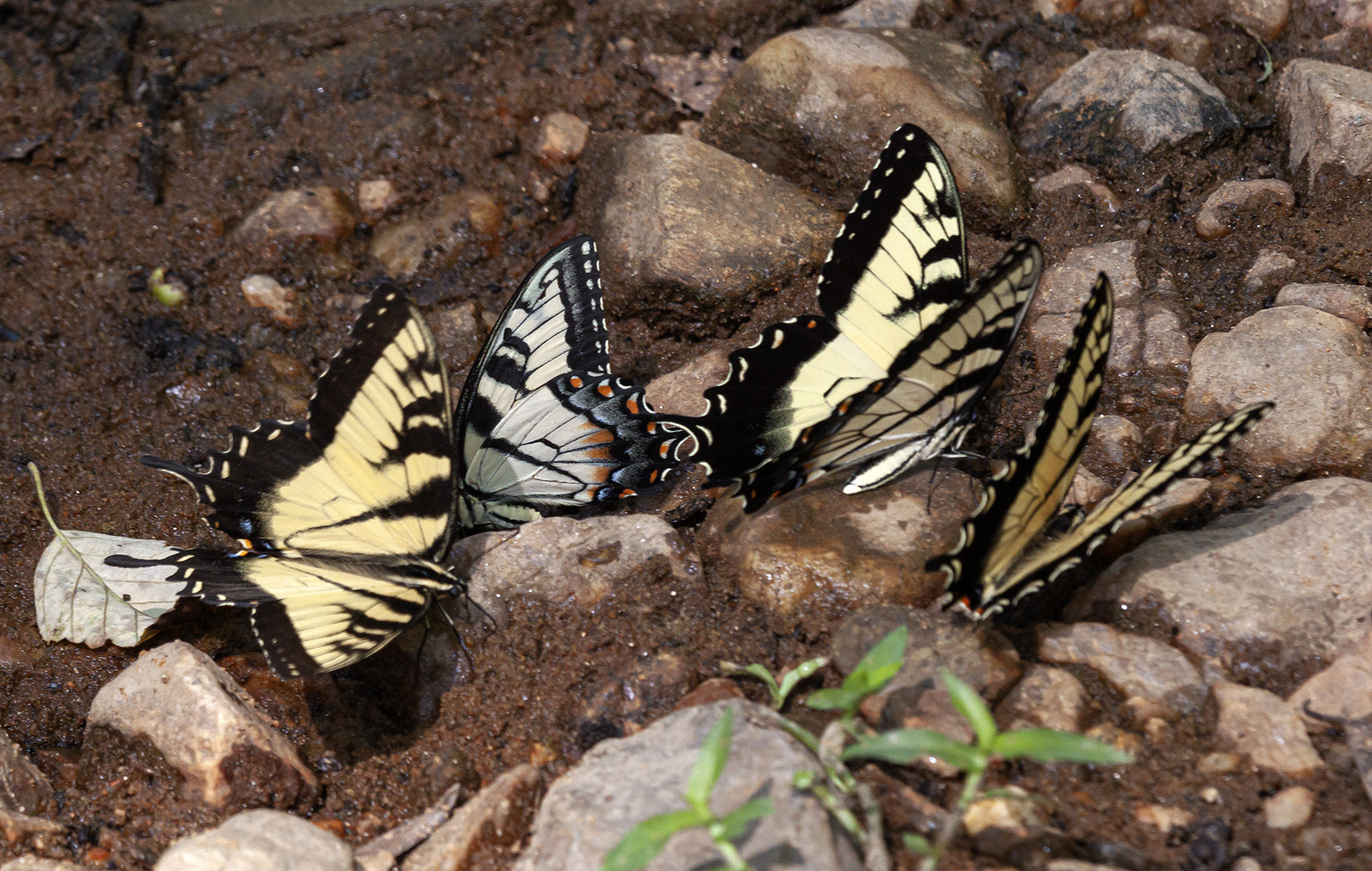
Most of us associate butterflies with flowers, but they sometimes can be found on the sandy banks of creeks, like this cluster of male Eastern Tiger Swallowtails (Papilio glaucus) that I spotted earlier this month in Prince William County, Virginia.

I went looking for information about this behavior and learned the following on the thoughtco.com website:

“Butterflies get most of their nutrition from flower nectar. Though rich in sugar, nectar lacks some important nutrients the butterflies need for reproduction. For those, butterflies visit puddles. By sipping moisture from mud puddles, butterflies take in salts and minerals from the soil. This behavior is called puddling, and is mostly seen in male butterflies. That’s because males incorporate those extra salts and minerals into their sperm. When butterflies mate, the nutrients are transferred to the female through the spermatophore. These extra salts and minerals improve the viability of the female’s eggs, increasing the couple’s chances of passing on their genes to another generation.”

Eastern Tiger Swallowtail

© Michael Q. Powell. All rights reserved.
Read Full Post »

Should I present a subject in landscape mode or portrait mode? That is a question I face frequently when I am composing photos initially and later when I am processing the images. Some subjects or scenes lend themselves naturally to one of the modes, but often it is not clear which one will be more effective. I remember reading somewhere that it is best to take shots from multiple angles, at varying distances, and using multiple modes and I try to follow that advice whenever I can.

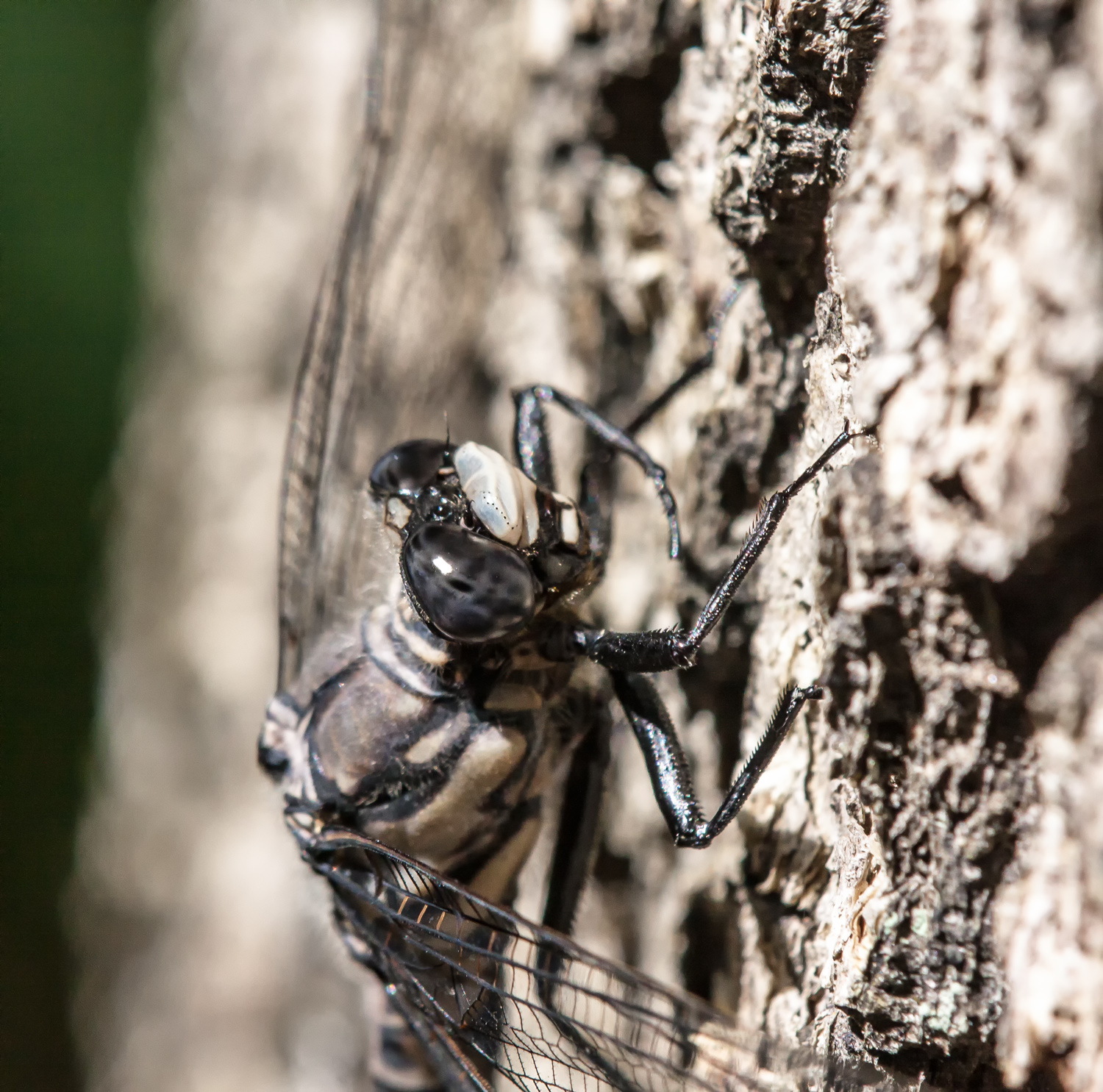
This past week I encountered a large dragonfly as I was exploring a small creek in Prince William County, Virginia. The creek was mostly in the shadows and I was unable to identify the species of the dragonfly until it perched on a sun-lit tree. Then it was easy to determine that it was a Gray Petaltail dragonfly (Tachopteryx thoreyi).

The dragonfly was pretty cooperative and I was able to take multiple shots, two of which I have included in this posting. From an artistic perspective I particularly like the first image, which gives equal weight to the dragonfly and to the environmental elements. The second image draws your attention more to the details of the dragonfly and give greater emphasis to the texture of the tree.

Are you drawn more to one of the two images? If so, why? I know how I react to my own images and am always curious to hear what you think and/or feel about them.

Gray Petaltail

Gray Petaltail

© Michael Q. Powell. All rights reserved.

Read Full Post »

A couple of weeks ago I posted a photo of a Black-shouldered Spinyleg dragonfly (Dromogomphus spinosus) that prompted one of my readers, Molly Lin Dutina of Treasures in Plain Sight, to comment, “Spinyleg —sounds like something a child would be afraid of!” That photo, alas, did not give a very good view of the spiny legs.

This week, however, as I was exploring a creek in Prince William County, Virginia, I was fortunate to capture some images of a Black-shouldered Spinyleg that show off those fearsome spines. If you click on the image below and focus your attention on the back legs, you will see the long pointed spines that help the dragonfly hold on to prey.

Ouch! 

Black-shouldered Spinyleg

© Michael Q. Powell. All rights reserved.

Read Full Post »

Yesterday as I was exploring a creek in Prince William County, Virginia I spotted this large damselfly. I marveled at its beautiful coloration and was happy to be able to capture an image that shows it off well. At the time I took the photo I was not certain of the species, but when I returned home and looked in my damselfly book, I learned that it is a male Powdered Dancer damselfly (Argia moesta).

As a Powdered Dancer male gets older, its thorax and the tip of its abdomen become covered with a powdery blue or gray substance in a process known as pruinescence. Eventually the male will look almost white, which makes it even easier to identify. So many damselflies have a lot of blue on their bodies that it is hard for me to be confident in my identification when I see a damselfly with blue coloration.

Powdered Dancer

© Michael Q. Powell. All rights reserved.

Read Full Post »

Do you suffer from recency bias? Recency bias is a type of cognitive bias that causes you to give greater weight in decision-making to things that have happened recently than to those that happened in the past, even the recent past. It is the only explanation I can come up with for not having already posted these shots of a Sable Clubtail dragonfly (Stenogomphurus rogersi) that I observed on 12 June.  Essentially, I got so caught up in excitement over newer photos that that I pushed this dragonfly out of my mind or at least off of my “To-do” list.

Sable Clubtails are rare in our area. Although I have searched for them repeatedly this season, including in a location where I saw some last year, this is the only one that I have seen in 2019. According to the website Dragonflies of Northern Virginia, “Sables appears to prefer small, relatively clean, shallow and stable forest streams, with plenty of low vegetation and a gentle flow.” That is a pretty good description of the stream in Prince William County, Virginia where I spotted this Sable Clubtail, but it also means that I am unlikely to stumble upon a member of this species at the ponds and marshes that I often visit.

In addition to being found only in a very specific type of habitat, Sable Clubtails have a very limited flight season—only a few weeks in length. That window of opportunity has almost certainly closed for the year. If you would like to see some additional photos of Sable Clubtails or read of my thoughts about chasing after rare dragonflies, check out this posting from a year ago.


Sable Clubtail

Sable Clubtail

© Michael Q. Powell. All rights reserved.

Read Full Post »

Perhaps there are dragonflies with longer names than the Black-shouldered Spinyleg dragonfly (Dromogomphus spinosus), but none of them immediately come to mind. Sometimes I will complain about the inaccurate names given to various species, but in this case the descriptors are accurate. Alas, when I spotted this dragonfly in a boggy area of Prince William County, Virginia last week, I couldn’t get close enough to capture those details very well.

The vegetation on which the dragonfly is perched is skunk cabbage, a plant that grows in the mucky confines of seeps and swamps. It is said that bruised leaves present a fragrance reminiscent of skunk, so I try to step carefully  whenever I am near any skunk cabbage.

Black-shouldered Spinyleg

© Michael Q. Powell. All rights reserved.

Read Full Post »

Although I love seeing my old familiar dragonfly friends, it is always exciting to observe new species. Last week while I was exploring in Prince William County, Virginia with fellow dragonfly enthusiast Walter Sanford, I spotted this dragonfly perched on a small tree. I really liked the pose and moved closer for some shots.

I initially thought it was a Needham’s Skimmer, a fairly common species in our area, but the more I looked at my photos afterwards on my computer screen, the more I began to note some differences in the colors and patterns on wings and the body. After consultations with some dragonfly experts on Facebook, I learned that it is a Yellow-sided Skimmer (Libellula flavida).

As far as I know, this is the first time that I have seen a Yellow-sided Skimmer. There is a possibility that I have unwittingly seen one in the past and dismissed it as “only” a common species.  I try not to do that, because this is not the first time that I have photographed something new without realizing until later that it was in fact new.


Yellow-sided Skimmer

© Michael Q. Powell. All rights reserved.


Read Full Post »

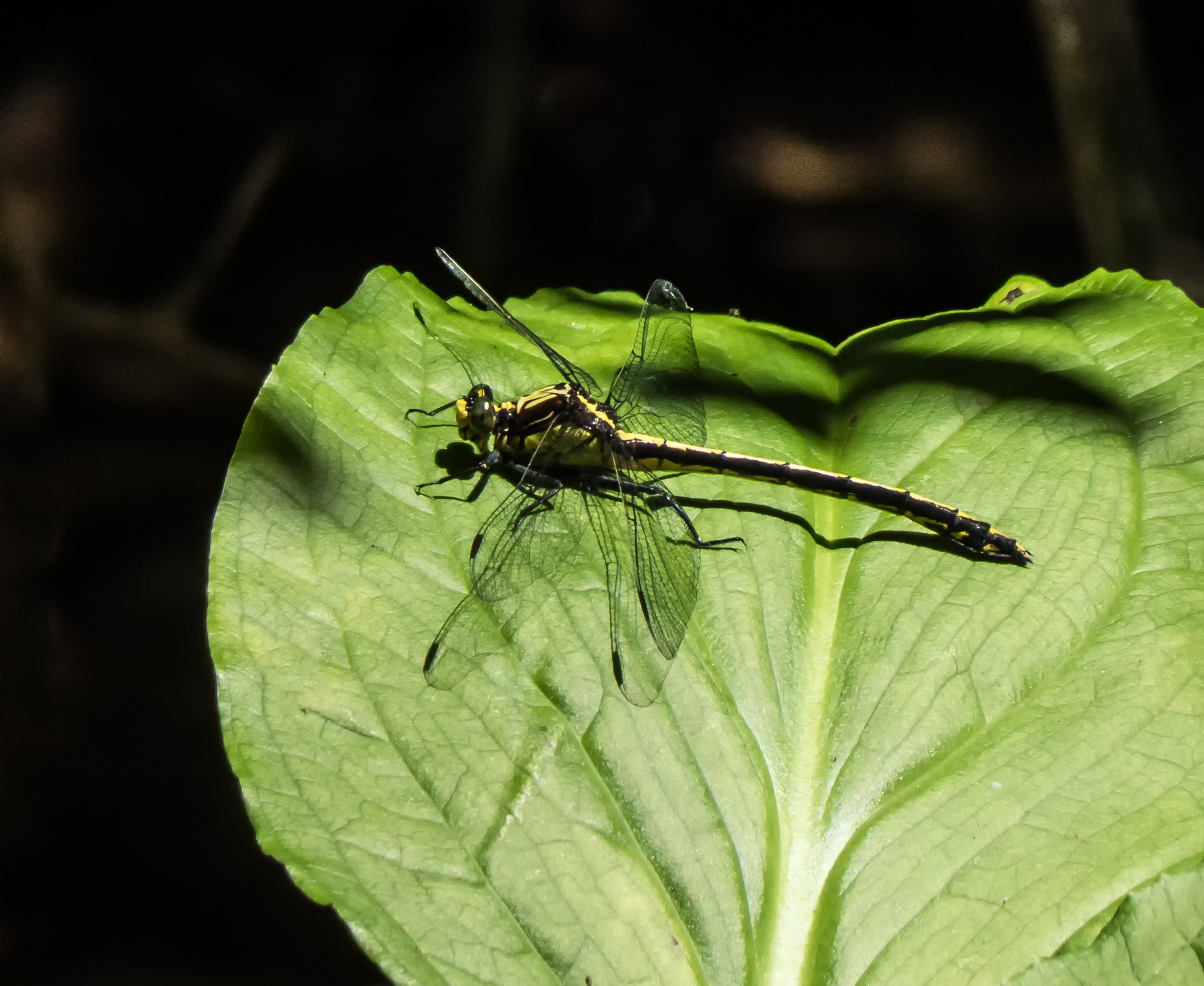
Dragonhunter dragonflies (Hagenius brevistylus) love to perch and wait for their prey to come by and then use their powerful back legs to snag that prey, which is often another dragonfly. Those legs are so long and ungainly, though, that Dragonhunters’ poses often seem awkward when they are perched—they remind me of teenage males who have undergone a recent growth spurt and haven’t gotten used to their longer limbs.

Last Friday as I was exploring a stream at Prince William Forest Park with fellow blogger and dragonfly enthusiast Walter Sanford, he spotted this female Dragonhunter perched at the edge of the water. I was walking toward him when I spotted the Dragonhunter on the rocks that I featured yesterday and was delayed in getting to see this dragonfly. Fortunately, she was relatively tolerant of our presence and remained in place long enough for me to get some shots.

All of the images that I captured show a side view of the Dragonhunter, because she was facing toward the water and I was trying not to get wet. Walter, however, wanted more of a frontal view  and waded into the water to get that shot. Check out today’s posting on his blog and you can compare the results of our different approaches.

dragonhunter

© Michael Q. Powell. All rights reserved.
 

Read Full Post »

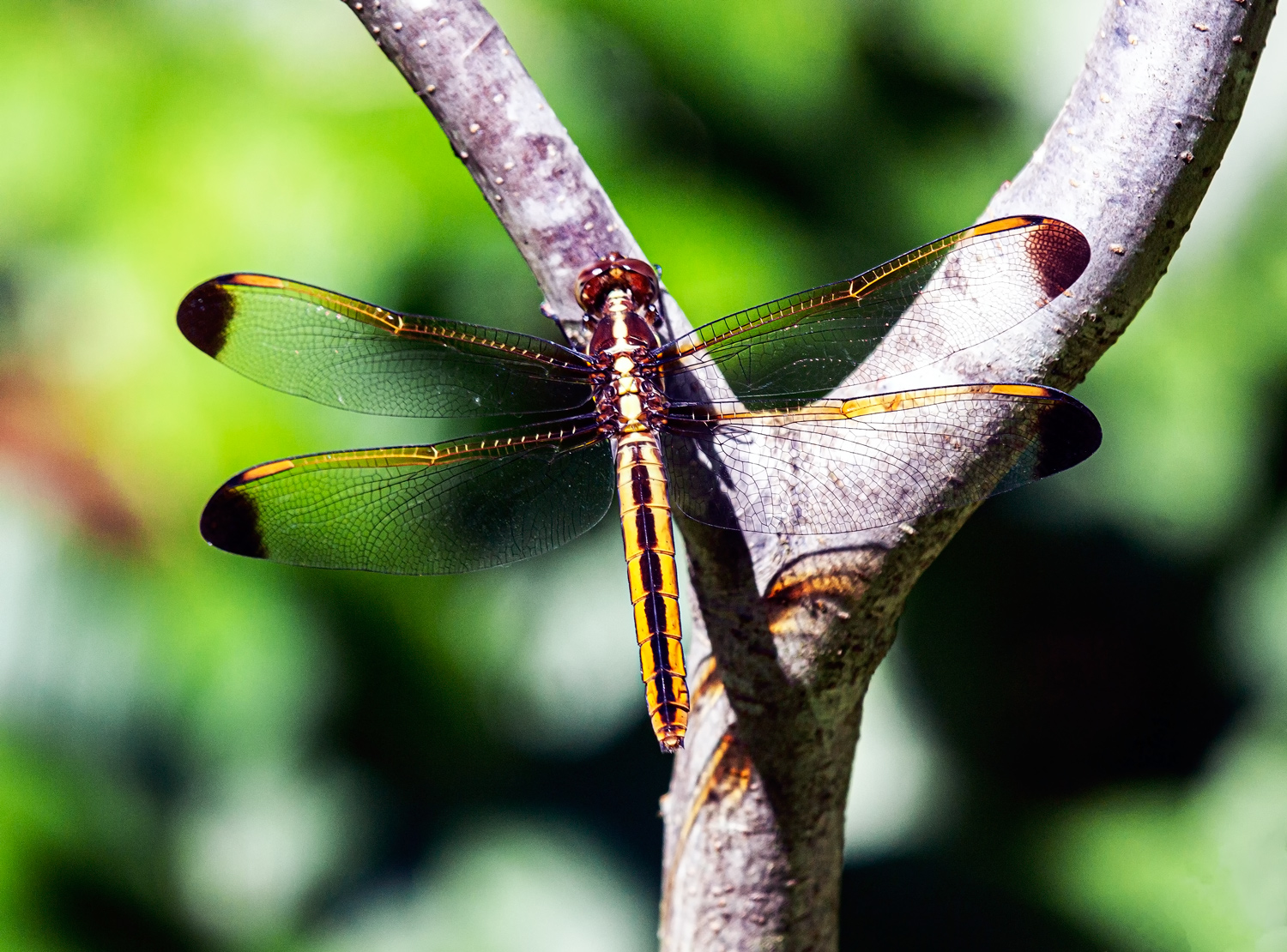
Dragonfly on the rocks? It sounds like a summertime beverage, but it accurately describes what I saw last Friday while exploring a stream in Prince William County, Virginia with fellow dragonfly enthusiast Walter Sanford. I think it is a Dragonhunter dragonfly (Hagenius brevistylus), but the unusual angle makes it tough to made a definitive determination of the species, because I am not able to see critical portions of the dragonfly’s anatomy.

In the past when I have spotted Dragonhunters, they have been perched on branches overhanging the water and that is where I expect to find them. This encounter is a good reminder for me to stay alert at all times—my subjects may not have read the identification guides about how they are supposed to behave.

dragonhunter

© Michael Q. Powell. All rights reserved.
Read Full Post »

Most of the times that I have observed a Common Sanddragon dragonfly (Progomphus obscurus) it has been perched directly on the sand, which makes sense, given its name. Last week, however, I spotted this Common Sanddragon perched in some vegetation overhanging the water of a stream in Prince William County, Virginia.

I like the way that the dragonfly almost looks like he is flying, because I managed to take the photograph from almost directly overhead, causing the perch almost to disappear. I also really like the look of rocky portion of the stream that makes up most of the background of this image.

Common Sanddragon

© Michael Q. Powell. All rights reserved.

Read Full Post »

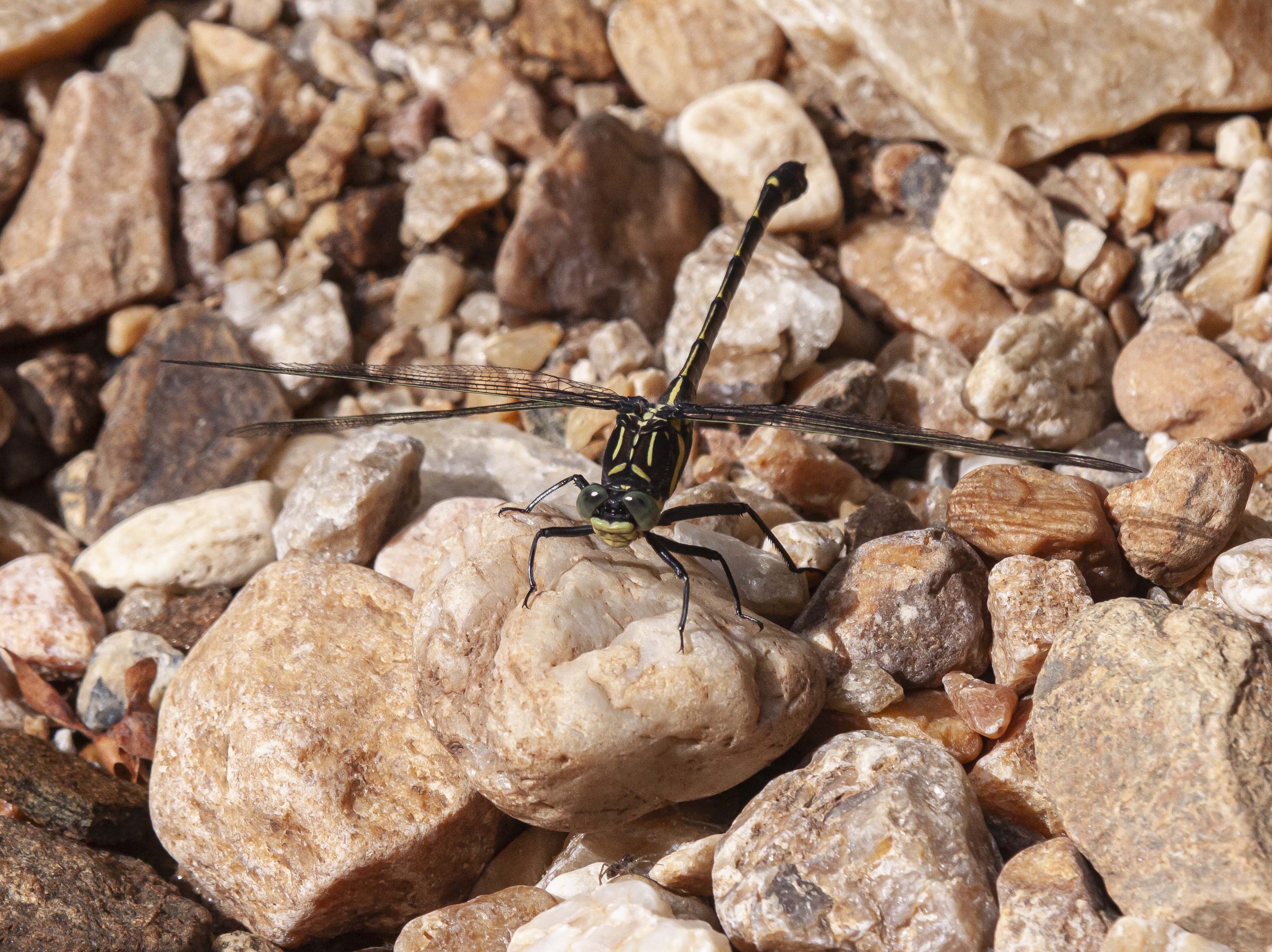
Last week as I was exploring Prince William County, I encountered this large dragonfly  perched in a tree overhanging a fairly large stream. When I captured these images, I was not sure what kind of dragonfly it was. After consultations with some experienced dragonfly experts, I learned that this is a female Dragonhunter dragonfly (Hagenius brevistylus).

Dragonhunters are among the largest dragonflies in our area. Unlike darners, another group of large dragonflies that fly almost continuously as they seek prey, dragonhunters prefer to perch and wait patiently before they strike. As their name suggests, they specialize in hunting other dragonflies, reportedly including members of their own species.

Dragonhunter

Dragonhunter

Dragonhunter

© Michael Q. Powell. All rights reserved.
 

Read Full Post »

This past Wednesday I encountered a really cooperative Gray Petaltail dragonfly (Tachopteryx thoreyi) as I explored nearby Prince William County and was able to capture this tight head shot. I simply love this dragonfly’s beautiful gray eyes, which are a perfect for the monochromatic palette of the rest of its body and give this dragonfly a more sophisticated look than many of its more gaudily-clad brethren. (The coloration also helps this dragonfly to almost disappear from view when it is perched on a tree like this one.)

Gray Petaltail

© Michael Q. Powell. All rights reserved.

Read Full Post »

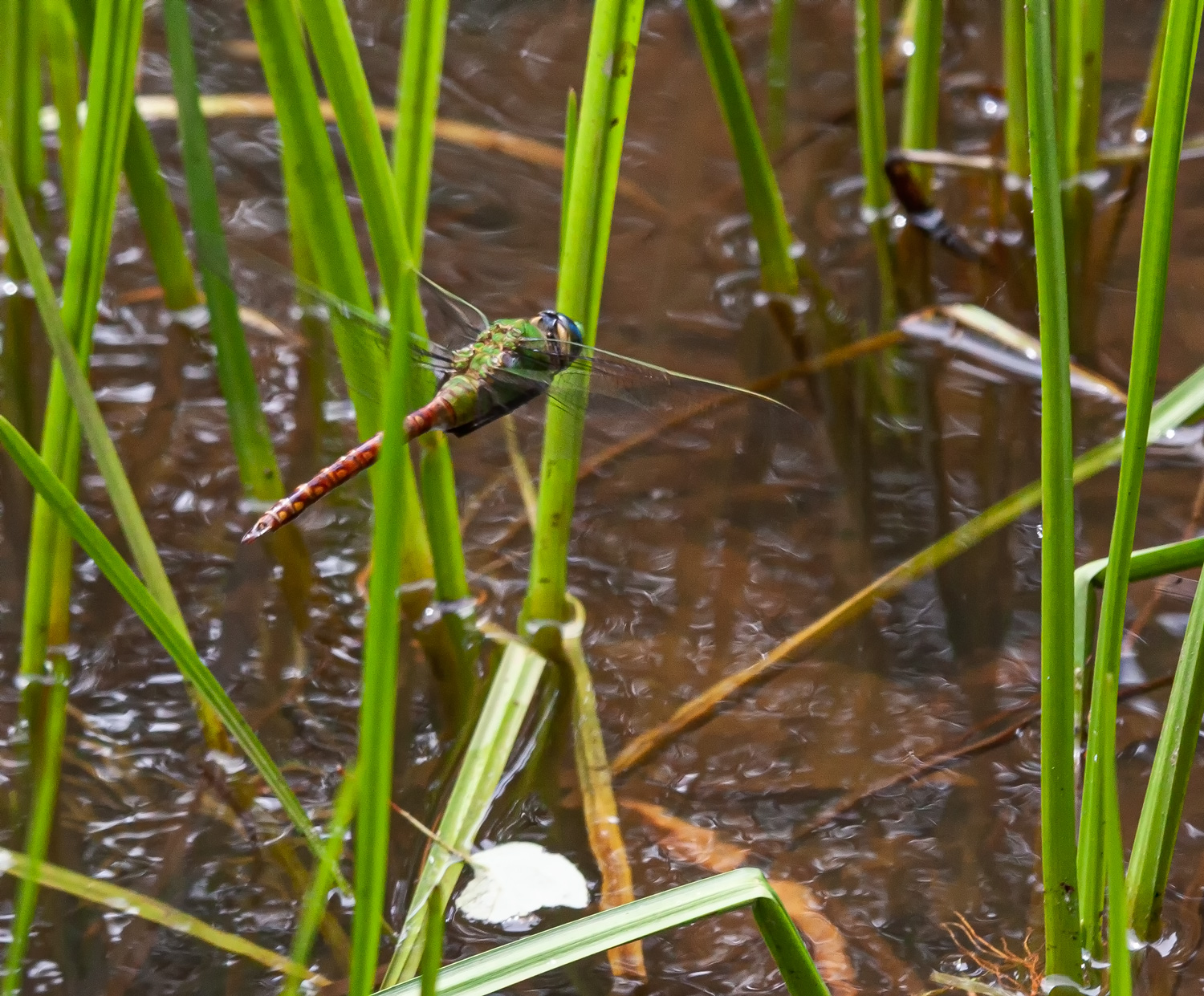
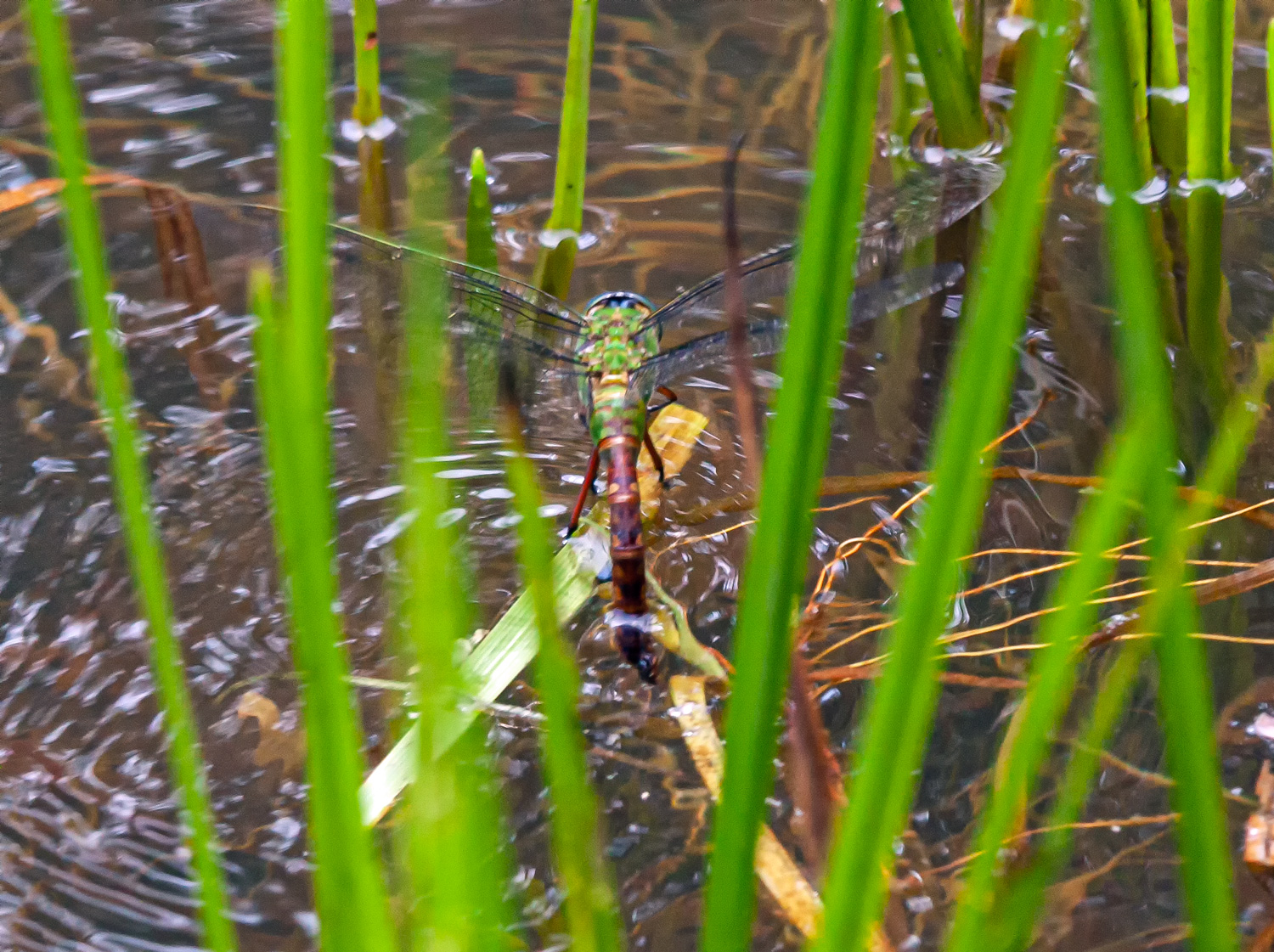
I have often thought that Comet Darner dragonflies (Anax longipes) are appropriately named for they have always been beautiful objects speeding by that I have been forced to admire from a distance. It is hard to miss a Comet Darner when they are around because they are very large and the red color on their bodies is so bright that it seems to glow. They generally patrol near the center of the ponds where I have seen them and I have never seen one stop to perch. According to the Dragonflies of Northern Virginia website, “Comets have expansive territories that may cover several miles and a network of small, shallow, forest-edged ponds. They’ll visit your pond, leave for 30 minutes to patrol other sites, then return.”

On Wednesday, I spotted a Comet Darner while I was at a small pond and started to track it in my camera’s viewfinder. Strangely this dragonfly was flying in and out of the vegetation growing in the shallow water, as you can see in the first shot. As I was trying to figure out what was going on, the Comet Darner dipped her abdomen in the water and began to deposit her eggs. If you look closely at the second image, it looks like she may actually have the tip of her abdomen submerged as she oviposited. I didn’t have a completely unobstructed view of this beautiful dragonfly, but I actually like the effect of the vegetation in the foreground—it helps to convey the sense that we are sharing a private moment.

Comet Darner

Comet Darner

© Michael Q. Powell. All rights reserved.

Read Full Post »

« Newer Posts