Feeds:
Posts
Comments

Posts Tagged ‘Perithemis tenera’

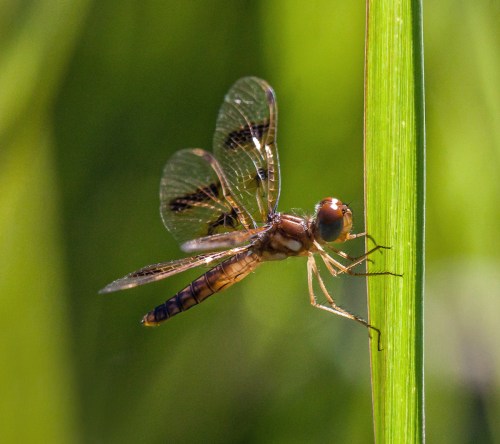
Eastern Amberwings (Perithemis tenera) are one of the smallest dragonfly species where I live—less than one inch (25 mm) in length. I often see the amber-colored males buzzing around at the ponds that I visit, but it is pretty rare for me to spot a female.

Yesterday I visited Jackson Miles Abbott Wetland Refuge and was a bit surprised to see a female Eastern Amberwing dragonfly in the vegetation near the edge of a small pond. Unlike the males, females of these species have patterned wings that are partially clear. I maneuvered around to composed a shot and managed to capture this image of the dragonfly.

According to the website Dragonflies of Northern Virginia, one of my favorite dragonfly websites, female Eastern Amberwing dragonflies are often found far from the water in meadows where they share perches with hornet and other wasps. When they are threatened, these dragonflies will rhythmically move their wings up and down while pulsing their abdomens in imitation of a wasp to scare off potential predators that believe they are about to be stung.

I don’t know if this female was checking out the males at the pond, searching for a suitable partner, or perhaps had just mated and was recovering from the experience. Whatever the case, I was delighted to spot this elusive little dragonfly.

Eastern Amberwing

© Michael Q. Powell. All rights reserved.


Read Full Post »

Sometimes my photos convey the mistaken impression that dragonflies are large and are easy to find and photograph. Using telephoto and macro lenses and a stealthy approach, I try to isolate the dragonflies, so that viewers can focus on the beautiful details of these amazing aerial acrobats.

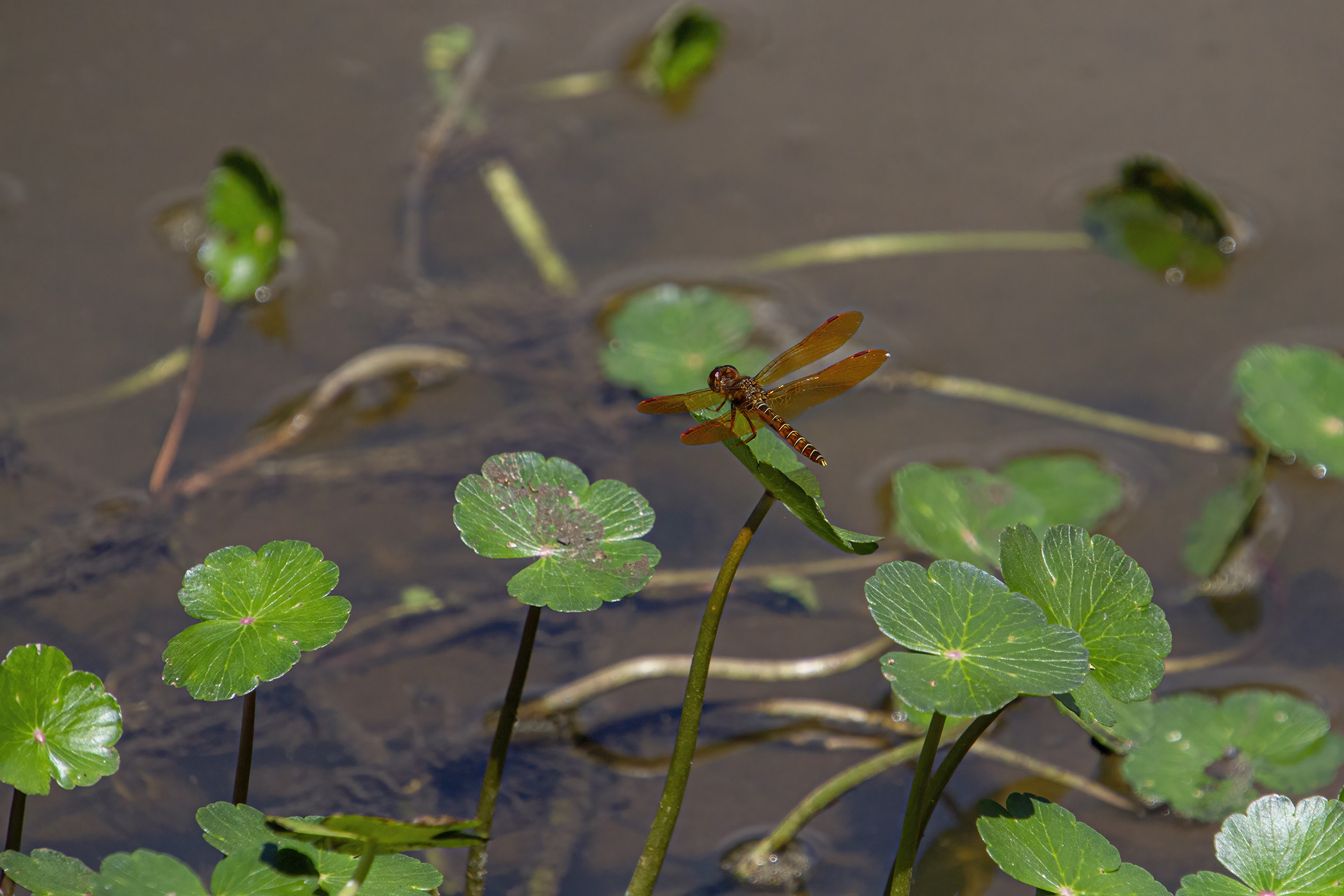
The reality though, is that most dragonflies are quite small—this male Eastern Amberwing dragonfly (Perithemis tenera) is only about one inch (25 mm) in length—and they often fly about amidst vegetation that conceals their movements.

This image gives you a sense of the vastness of the environment and some of the challenges in spotting the dragonflies. Of course, the second challenge is getting close enough to the subject without scaring it away, though in this case I was content to capture a wide-angle shot that shows this dragonfly in its preferred environment.

Eastern Amberwing

© Michael Q. Powell. All rights reserved.


Read Full Post »

Most of the time when I spot Eastern Amberwing dragonflies (Perithemis tenera) they are busily flying about over the water, but this handsome little guy decided to rest a bit in the vegetation at the water’s edge on Thursday at Jackson Miles Abbott Wetland Refuge.

Most of the summer dragonflies have now arrived on the scene, so I may not be featuring any new species for a while. However, I am content to photograph my familiar “friends,” always hoping to capture them in different perches, activities, or lighting conditions. Each moment gives me a new chance to capture something beautiful and/or unusual. Beauty is everywhere.

Eastern Amberwing

© Michael Q. Powell. All rights reserved.

Read Full Post »

Whenever I visit Jackson Miles Abbott Wetland Refuge, I never fail to check a spot near a fishing platform where there is a piece of twisted rebar sticking out of the water. In the past, I have seen dragonflies of various species perching on the rebar and it provides a wonderful photographic opportunity, assuming that the dragonfly does not immediately fly away. I generally prefer to photograph dragonflies on natural perches, not on manmade ones, but this is a case when I am more than happy to break that “rule.”

On Tuesday I was delighted to spot a male Eastern Amberwing dragonfly (Perithemis tenera) perched on the aforementioned piece of rebar. I love the contrast between the colors, patterns, and textures of the natural object, the dragonfly, and those of the man-made subject, the rebar. The floating debris on the surface of the pond helps to break up the mostly uniform background without being visually distracting.

I have taken similar shots to this one multiple times, but I don’t mind repeating myself. Each encounter is unique and subtly different. As the Greek philosopher Heraclitus of Ephesus is reported to have said, “No man ever steps in the same river twice, for it is not the same river and he is not the same man.”

Eastern Amberwing

© Michael Q. Powell. All rights reserved.

Read Full Post »

I know that summer is almost here when dragonflies like this male Eastern Amberwing (Perithemis tenera) begin to appear. I spotted this distinctive-looking dragonfly on Tuesday at a small pond at Jackson Miles Abbott Wetland Refuge.

Eastern Amberwings are really small at about one inch (25 mm) in length. According to the Dragonflies of Northern Virginia website, the Eastern Amberwing is “the smallest dragonfly in Northern Virginia, and second smallest in the U.S. (only Elfin Skimmers are smaller), Amberwings are fascinating little insects. No bigger than a horsefly or paperwasp, nature still found a way to pack a lot into this tiny package.”

These little dragonflies are considered to be wasp mimics, “Amberwings may be our only dragonfly that actively mimics a wasp. The markings and shape of their abdomens resemble a small wasp, but they take it several steps further. When threatened, they rhythmically move their wings up and down while pulsing their abdomens. All to imitate a wasp, we think, so as to scare off potential predators that believe they’re about to be stung.”

I love the stunning amber wings that are found on only the males of this species—the females have patterned wings that are mostly clear. As you can see in both photos, the male’s wings are quite transparent despite their darker color. I also really like the intricate patterns and markings on the abdomens of Eastern Amberwing dragonflies.

I look forward to seeing more and more Eastern Amberwings over the course of the next five months or so. Some summer dragonfly species have not yet appeared, but I am seeing more and more dragonflies as the temperatures rise and the hours of sunlight are extended.

Eastern Amberwing

Eastern Amberwing

© Michael Q. Powell. All rights reserved.

Read Full Post »

In many of my blog postings, I concentrate on a single species of dragonflies, but today I want to celebrate the diversity of species that I have been seeing during the month of September. Despite my warnings in some earlier postings about the decreasing numbers of dragonflies, I continue to see a variety of species—Northern Virginia, where I live, is blessed to have an abundance of different dragonflies and damselflies.

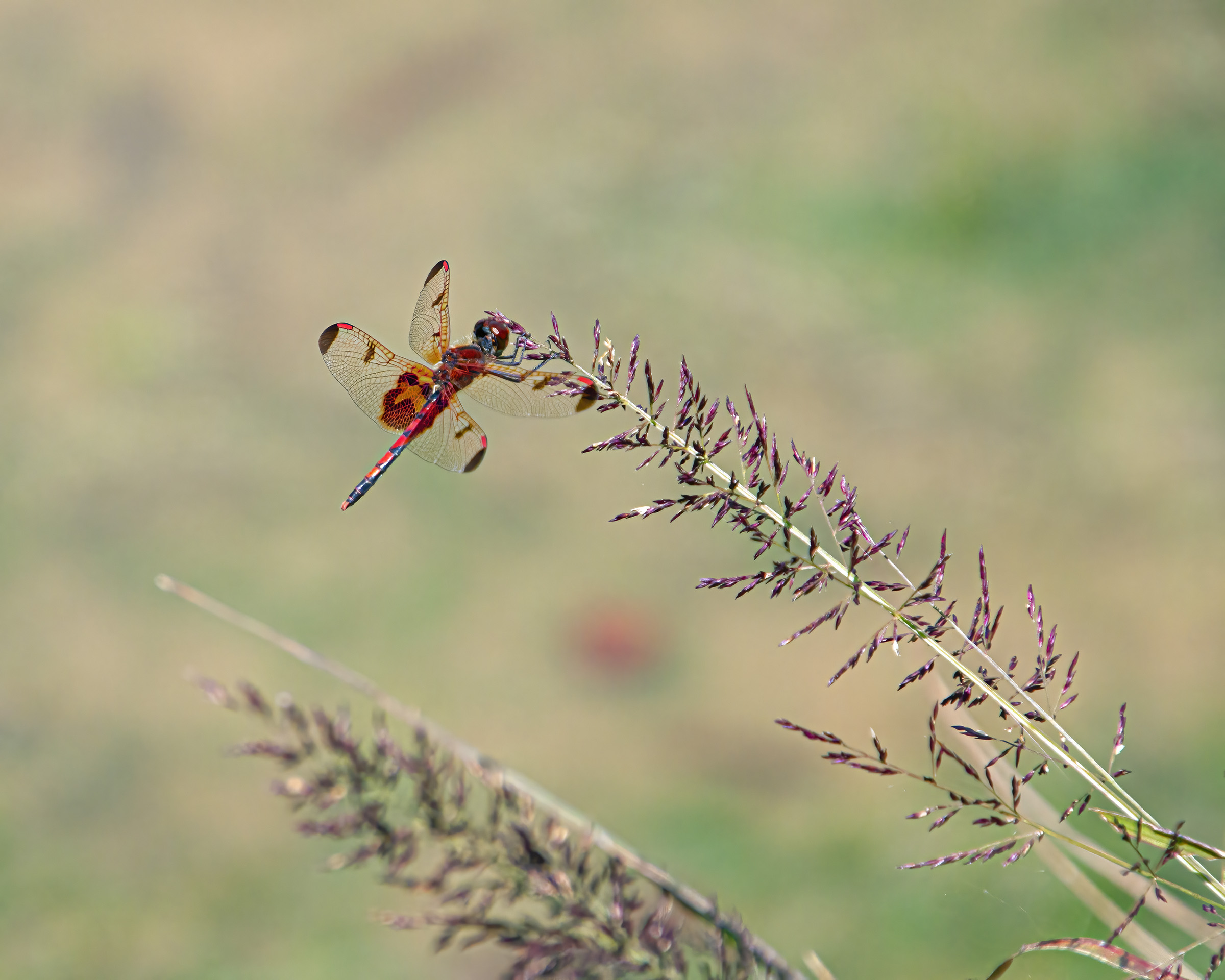
The first photo shows a female Eastern Amberwing (Perithemis tenera), the smallest dragonfly in our area.  Males of this species hang out at ponds, but the females, which do not have amber wings like the males, are usually found in vegetation some distance from the water.

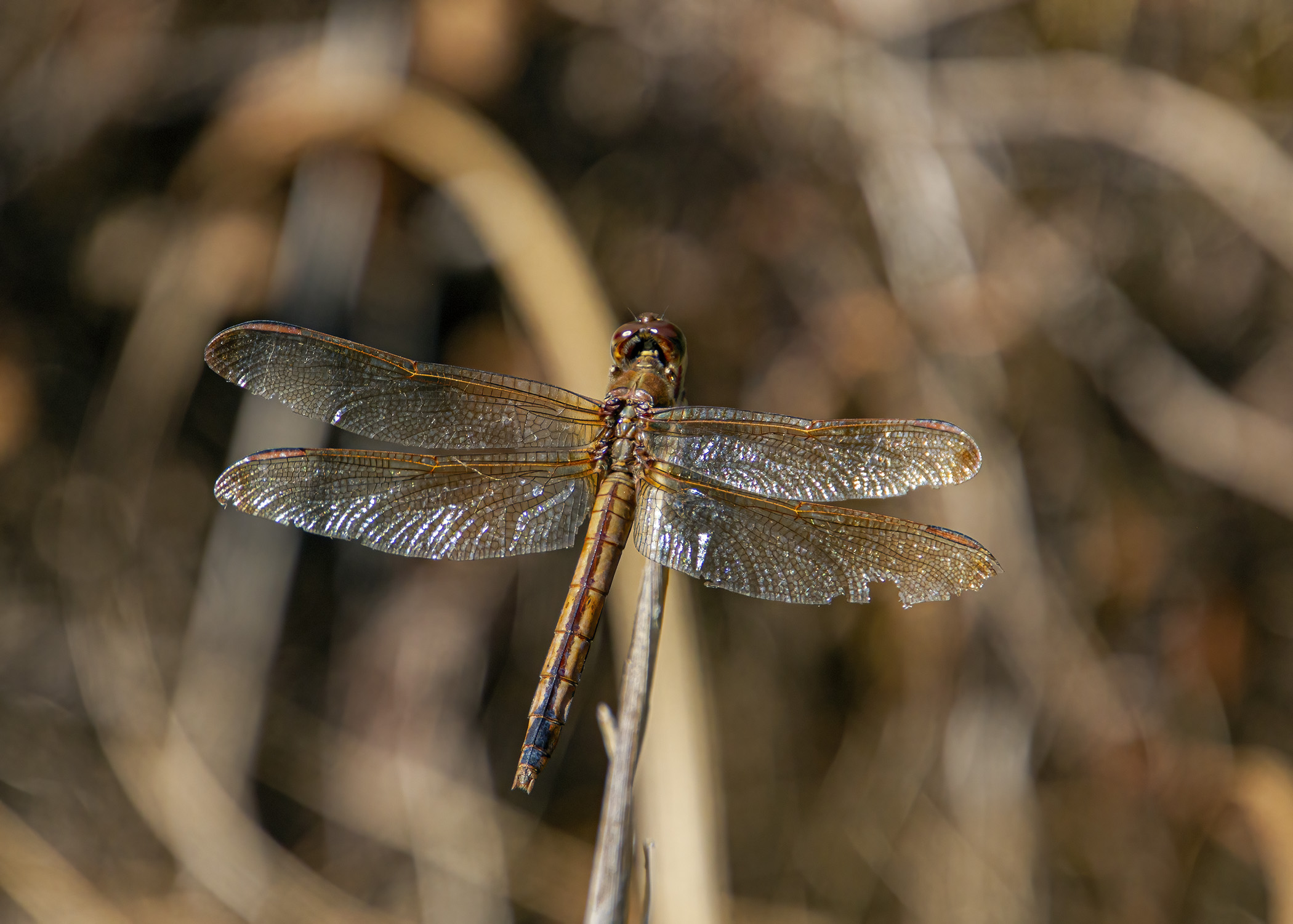
The second image shows a male Calico Pennant (Celithemis elisa), a beautifully colored dragonfly with distinctive patterns on its wings. The third image shows a mature female Needham’s Skimmer (Libellula needhami). Her wings show some damage and her color has fades, but she is still beautiful and the golden strands on the front edges of her wings were sparkling in the sunlight when I captured this image.

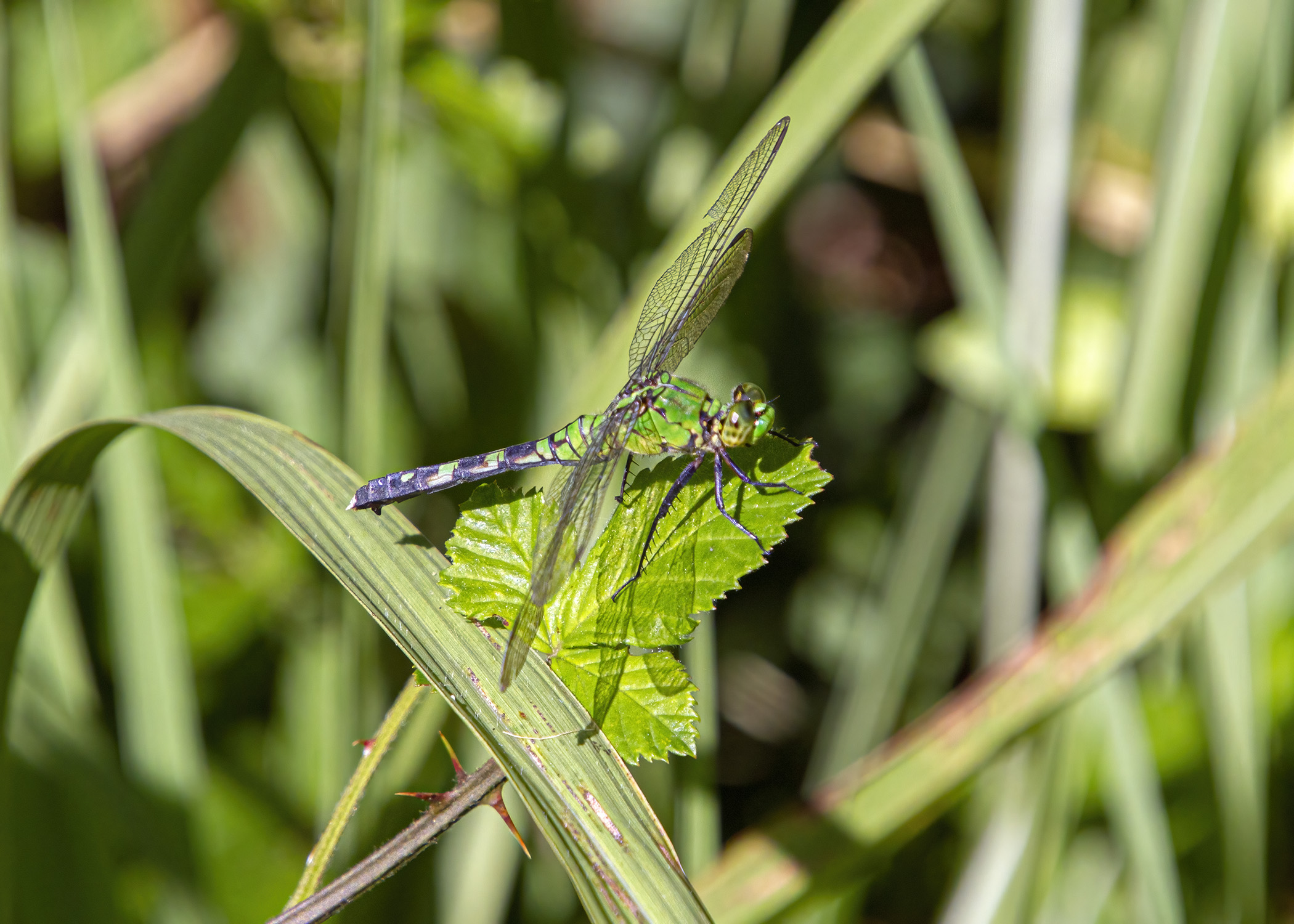
The fourth image shows a female Eastern Pondhawk (Erythemis simplicicollis), one of the most common dragonfly species in my area. I love the brilliant emerald color of the females (and immature males) of this species and the black markings on the abdomen.

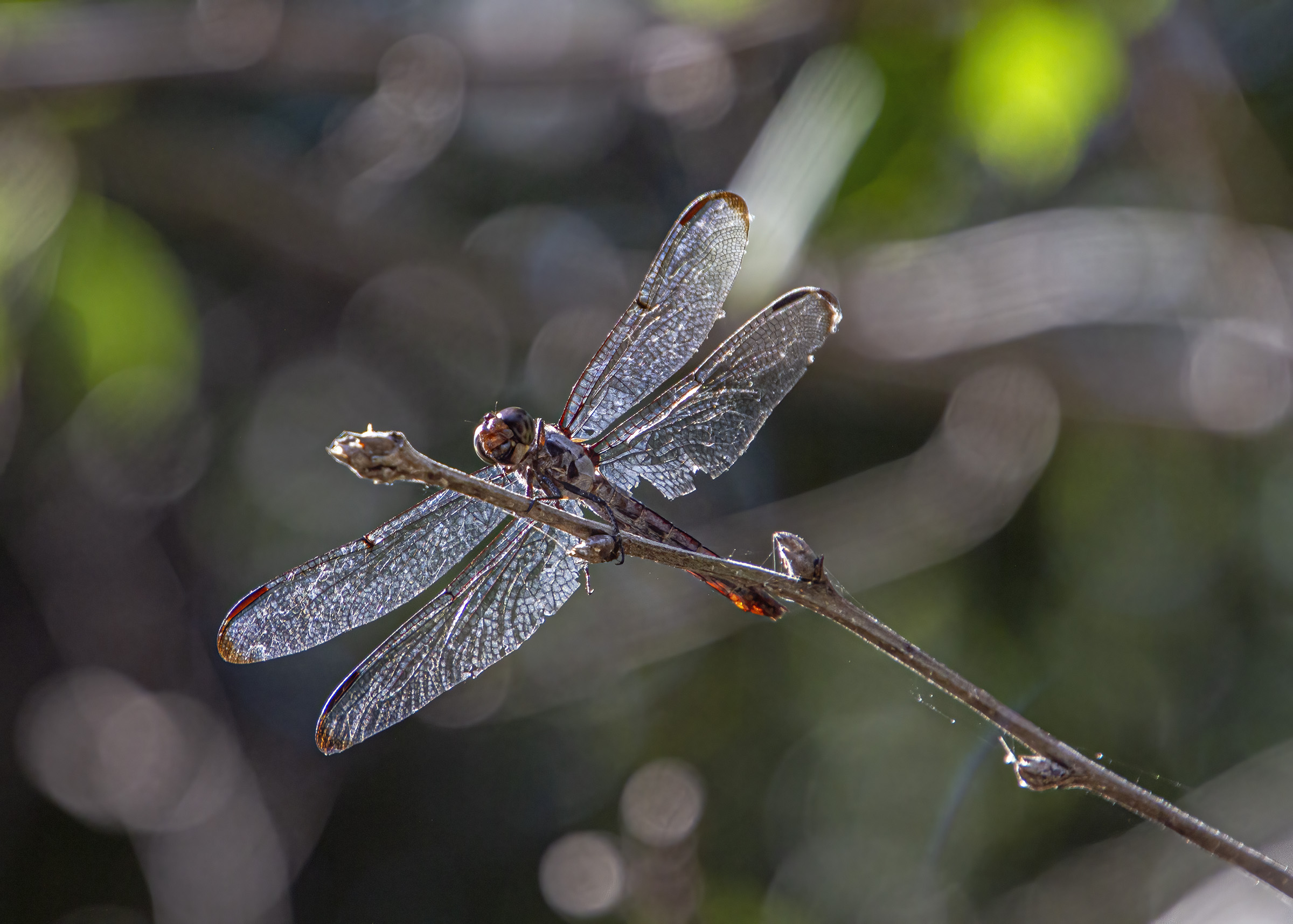
The dragonfly in the last photo was the toughest one for me to identify. It had flown up into a tree and I was looking into the sun when I captured the image. However, I am pretty sure that it is a female Great Blue Skimmer (Libellula vibrans).

All of these dragonflies belong to the Skimmer family, the largest dragonfly family that includes the species most likely to be seen by a casual dragonfly watcher. The other families, which are generally harder to find, include Clubtails, Cruisers, Darners, Emeralds, Petaltails, and Spiketails. If I remember correctly, I have managed this season to photograph at least one dragonfly in all seven of these dragonfly families.

Eastern Amberwing

Calico Pennant

Needham's Skimmer

Eastern Pondhawk

Great Blue Skimmer

© Michael Q. Powell. All rights reserved.


Read Full Post »

Eastern Amberwing (Perithemis tenera) dragonflies are the smallest dragonflies in my area at less than an inch (25 mm) in length, but are quite common. I often spot the distinctive amber wings of the males as they fly low over the waters of many ponds. Females of this species, however, do not have amber wings—they have brown patches on their wings—and I rarely see them.

According to the Dragonflies of Northern Virginia website, female Eastern Amberwings are often found far from water, in meadows among summer wildflowers. “They’re probably hunting even smaller visitors to these summer blooms like midges, flower flies and tiny bees. They also share their colorful perches with hornets and other wasps. Perhaps, this is how their mimicry behavior evolved, and may explain why females appear to practice it more than males.”

On Monday I was thrilled to spot this female while I was exploring a pond at Jackson Miles Abbott Wetland Refuge. I am not sure if she had ventured down to the pond to mate, but whatever the case I was happy to capture some shots of her as she buzzed about the vegetation surrounding the pond. I love her two-toned eyes and the beautiful markings on her body.

Eastern Amberwing

Eastern Amberwing

Eastern Amberwing

© Michael Q. Powell. All rights reserved.

Read Full Post »

During the summer, most of my dragonfly photos tend to be variations of the stereotypical “dragonfly on a stick.” I am always on the lookout, though, for more interesting or photogenic perching places and behaviors.

The first shot shows a male Eastern Amberwing dragonfly (Perithemis tenera) perched on the end of a piece of rebar that sticks out of the water near a small fishing dock at Jackson Miles Abbott Wetland Refuge. Generally I try to avoid having manmade objects in my nature photos, but in this case I really like the juxtaposition of the natural and manmade elements in this shot. The warm tones of the amber wings contrast nicely with the cooler rust color of the rebar and the lines on the rebar are mirrored by those on the dragonfly’s body. Almost every year I return to this spot to capture a similar image, though each encounter is unique in its own way.

The second image shows another male Eastern Amberwing perched on a large rock jutting out from the water. I couldn’t get close to the dragonfly so I took the opposite approach and zoomed out to capture the dragonfly’s reflection (as well as the amber shadow it was casting on the rock). I really like the contrast between the diminutive size of the dragonfly and the large jagged rock—it seems almost like a visual metaphor for life’s challenges.

These two shots are examples of how I try, when possible, to visualize a shot before I take it. Frequently, though, I am forced to react instantaneously to a given situation, with a primary goal of keeping my subject within the frame and hopefully in focus. It’s a weird mental juggling act to simultaneously attempt to think creatively, instinctively, instinctively, and analytically—that’s wildlife photography in a nutshell.

Eastern Amberwing

Eastern Amberwing

© Michael Q. Powell. All rights reserved.


Read Full Post »

During a recent visit to Jackson Miles Abbott Wetland Refuge I was delighted to spot a female Eastern Amberwing dragonfly (Perithemis tenera) as she was depositing her eggs in the vegetation in a small pond. Initially she would hover for a moment, as you can see in the first image, and then dip the tip of her abdomen straight downwards to release some eggs, as shown in the second image. The dragonfly repeated this process multiple times at this spot before moving on to other spots.

I have observed this process multiple times, but have rarely been able to photograph it. Eastern Amberwings are the smallest dragonflies in my area and are only about an inch (25 mm) in length, so they are a challenge to photograph. Fortunately when the female is ovipositing, she hovers a bit, which gives me time to focus on her. Sharp-eyed viewers may have noticed that the wings of this dragonfly have patterns, but are not amber in color—only male Eastern Amberwings have amber wings.

Eastern Amberwing

Eastern Amberwing

© Michael Q. Powell. All rights reserved.


Read Full Post »

Most of the dragonflies that I spotted during my most recent visit to Occoquan Bay National Wildlife Refuge were common species that I have been seeing for months. Some photographers are driven to search for rare and exotic species and ignore the everyday ones. I am usually content with trying to capture the beauty of the ordinary ones.

In the first photo, I love the ways that the shadows of the wings of this female Common Whitetail dragonfly (Plathemis lydia) create the optical illusion that the dragonfly has extra wings. In the second photo, the female Blue Dasher dragonfly (Pachydiplax longipennis) is quite beautiful herself and the stunning background enhances that beauty.

The final photo shows a pair of Eastern Amberwing dragonflies (Perithemis tenera), the smallest dragonflies in our area. I love the way that the two dragonflies are reflected in the water.

Beauty can be found in the rare and exotic species, but I think that these images demonstrate that beauty can also be found in ordinary things. When we slow down and look closely, we discover that beauty is everywhere.

Common Whitetail

Blue Dasher

Eastern Amberwing

© Michael Q. Powell. All rights reserved.

Read Full Post »

Dragonflies are amazing creatures. They spend most of their lives underwater as nymphs. When the time is right, they crawl out of the water and begin an incredible transformation. They burst out of their exoskeletons and in a short period of time their bodies lengthen and their wings unfurl. Suddenly they are breathing air and can fly. Six years ago I was able to document this entire process in a posting called Metamorphosis of a dragonfly, which you may want to check out.

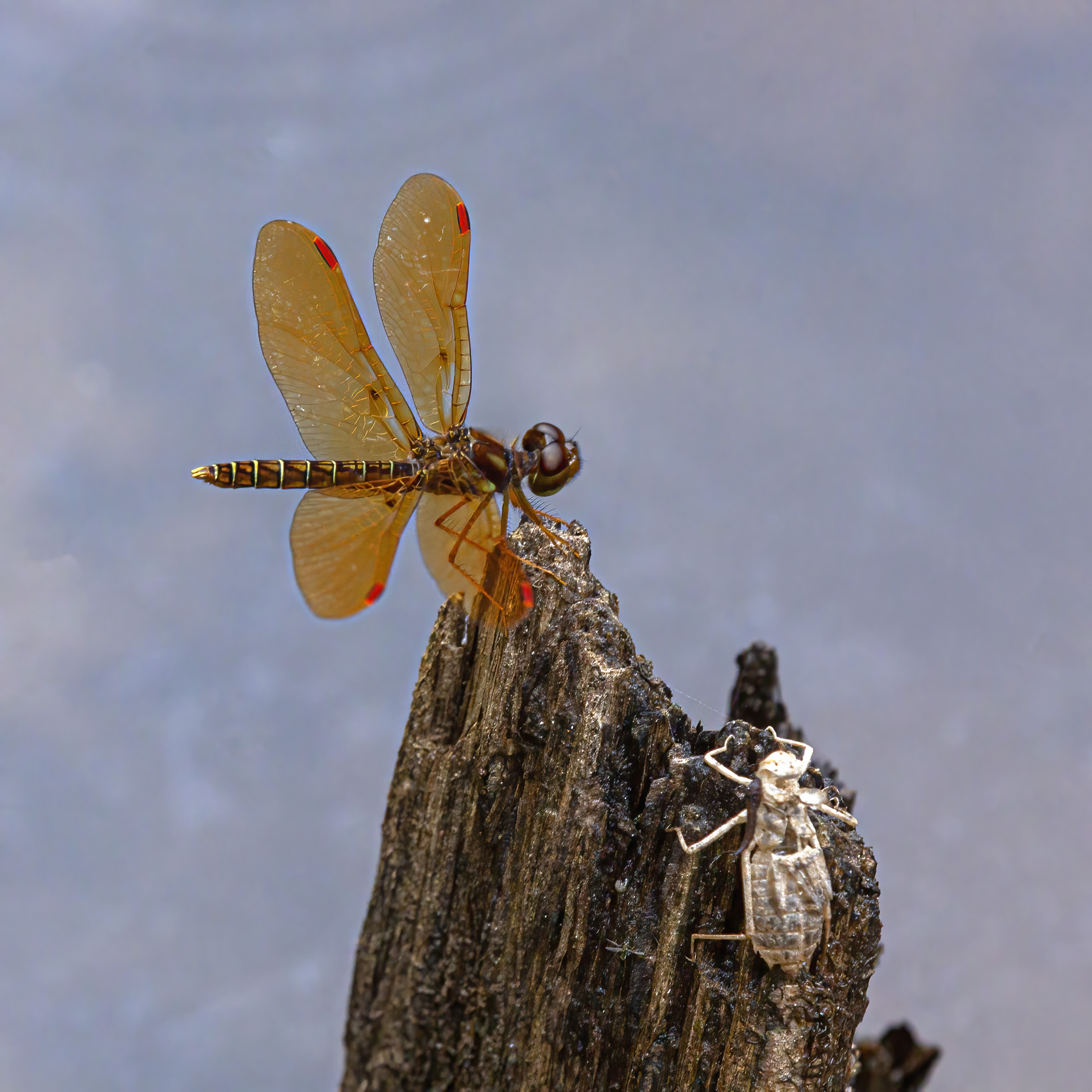
If you wander along the edge of a pond, you may spot some of the discarded exoskeletons, often referred to as exuviae—they look sort of like desiccated bugs. Earlier this month during a visit to Green Spring Gardens, I was able to capture this image of a Eastern Amberwing dragonfly (Perithemis tenera) perched alongside an exuvia. I am not certain that the exoskeleton is from the same species as the dragonfly, but I suspect that it is.

Although it is hard to see very many details of the exuvia, you can’t help but notice how much smaller it is than the adult dragonfly and how the shape of the body is different. It you look closely, you can see the shape of little wing pads that eventually turn into wings. The only body parts that appear to remain the same are the legs.

Eastern Amberwing

© Michael Q. Powell. All rights reserved.


Read Full Post »

Eastern Amberwings (Perithemis tenera) are very small dragonflies, with an overall length of no more than one inch (25 mm). Males of this species are easy to identify because of their amber-colored wings. Males are quite common and I ofter see them buzzing around the edges of the ponds that I visit. Females have brown patches on their clearer wings and often hunt far from the water, so I do not see them very often.

Despite their small size, Eastern Amberwings are one of the easiest dragonflies to photograph in flight. They often hover low, close to the water surface near the shore, which gives me a fighting chance to focus on them. It requires a steady hand and quick reactions, but the first two images show the kind of results you can get. The second shot is a little quirky, but I like the way that it shows two male Amberwings passing each other, flying in opposite directions.

The final shot is an “artsy” shot of a perched Amberwing. The dragonfly was flying among the lotus flowers last Wednesday at Green Spring Gardens and perched for a moment on a lotus leaf that had not yet unfurled. I tried to compose the image so that the viewer gets a sense of the habitat, which gives the shot a completely different feel from the first two photos in which the subjects are completely separated from their environment.

Eastern Amberwing

Eastern Amberwing

Eastern Amberwing

© Michael Q. Powell. All rights reserved.

Read Full Post »

I generally prefer to photograph dragonflies on natural perches, not on manmade ones. However, whenever I visit Jackson Miles Abbott Wetland Refuge I always check a piece of rebar that sticks out of the water of Mulligan Pond near one of the fishing platforms, because I have found that dragonflies love this photogenic perch.

Last Wednesday, I spotted a male Eastern Amberwing dragonfly (Perithemis tenera) perched on the rebar. It flew away as I approached, but I waited patiently and it eventually returned. I tried a number of different approaches in framing my shots, taking advantage of the changing background caused by the movement of the brownish waters of the pond.

I love the contrast between the colors, patterns, and textures of the natural object, the dragonfly, and those of the man-made subject, the rebar. The muddy waters of the pond provide a mostly uniform background color that really complements the amber and rust tones of the primary subjects.

Eastern Amberwing

Eastern Amberwing

Eastern Amberwing

© Michael Q. Powell. All rights reserved.


Read Full Post »

Within the bird and insect kingdoms, species tend to be named on the basis of the appearance of the male and not of the female. This can be incredibly confusing, especially for a neophyte who is trying to identify an individual.

I remember be utterly baffled years ago when someone explained to me that the sparrow-looking bird in front of me was a female Red-winged Blackbird. What? How could that be? The “blackbird” was not black at all, and as for the “red wings,” there were none.

Over time I have become more familiar with the birds and the bees and some of the intricacies of sexual differentiation within species. I do not give too much thought that this pretty little female Eastern Amberwing dragonfly (Perithemis tenera) that I spotted last week at Green Spring Gardens has wings that are not completely amber-colored like those of her male counterpart.

Eastern Amberwings are the smallest dragonflies in our area at less than an inch (20-25 mm) in length. It is hard to miss the males as they buzz about low over the waters of ponds, but females tend to be much more elusive and often hunt far from the water. In the case of the one in the photo, she was perched on some vegetation in a bed of flowers a long way from the pond.

According to the Dragonflies of Northern Virginia website, “Amberwings are reported to have the most intricate courtship of any dragonfly. After the male selects several possible egg-laying sites for a mate, he flies off to find a female and leads her back to his potential nursery. To attract her, he sways back and forth, and hovers with his abdomen raised. Mating only occurs if the females approves—making this one of the few dragonflies where females choose the males.”

Eastern Amberwing

© Michael Q. Powell. All rights reserved.

Read Full Post »

Every time that I visit Jackson Miles Abbott Wetland Refuge, I alway check a spot near a fishing platform where there is a piece of rebar sticking out of the water. In the past I have seen dragonflies of various species perching on the rebar and it provides a wonderful photographic opportunity, assuming that the dragonfly does not immediately fly away, which happens about half of the time.

Yesterday a male Eastern Amberwing dragonfly (Perithemis tenera) was perched on the rebar. I love the contrast between the colors, patterns, and textures of the natural object, the dragonfly, and those of the man-made subject, the rebar. The muddy waters of the pond provide a uniform background color that really complements the amber and rust tones of the primary subjects.

One of the coolest things about this image is the long amber shadow that the dragonfly is casting onto the rebar. I am a huge fan of shadows and reflections, which often add a “wow” factor to an image, the proverbial “cherry on top.”

Eastern Amberwing

© Michael Q. Powell. All rights reserved.

Read Full Post »

Male Eastern Amberwing dragonflies (Perithemis tenera) are really easy to identify, because their wings are amber-colored. However, when they first emerge and are in a stage known as “teneral,” their wings are clear and shiny, like those of this Eastern Amberwing that I spotted yesterday at the edge of the pond at Jackson Miles Abbott Wetland Refuge.

For comparison purposes, I have included a shot from earlier this year of a mature male Eastern Amberwing at the same location—it was part of a posting called Eastern Amberwing in May. Now that we have moved into summer it is quite common to see these tiny dragonflies, the smallest dragonflies in our area at about one inch (25 mm) in length, though I had never before seen a teneral male of this species.


Eastern Amberwing

Eastern Amberwing

© Michael Q. Powell. All rights reserved.


Read Full Post »

Many of the early spring dragonflies are now gone, but the summer species are starting to show up in force. On Tuesday, for example, I spotted a large number of Eastern Amberwing dragonflies (Perithemis tenera), including the handsome male in the photo below, buzzing about the pond at Jackson Miles Abbott Wetland Refuge. Eastern Amberwings are quite common during the summer and are the smallest dragonflies in our area at about one inch (25 mm) in length—it is easy to confuse them with wasps when you see them flying.

According to the Dragonflies of Northern Virginia website, “Amberwings are reported to have the most intricate courtship of any dragonfly. After the male selects several possible egg-laying sites for a mate, he flies off to find a female and leads her back to his potential nursery. To attract her, he sways back and forth, and hovers with his abdomen raised. Mating only occurs if the females approves—making this one of the few dragonflies where females choose the males.”

I love the warm tones of this dragonfly and the way the background colors of this image complement them.

Eastern Amberwing

© Michael Q. Powell. All rights reserved.


Read Full Post »

Male dragonflies are often territorial and spend a lot of their time chasing off intruders, like these rival male Eastern Amberwing dragonflies (Perithemis tenera) that I spotted earlier this month at Jackson Miles Abbott Wetland Refuge. Although Eastern Amberwing dragonflies are quite small (one inch (25 mm) or less in length), they tend to hover a bit when they are flying, which makes them a little easier to photograph in flight than most other dragonfly species.

Eastern Amberwing

© Michael Q. Powell. All rights reserved.

Read Full Post »

Do you photograph the same subjects over and over again? I know that I do, hoping that each new opportunity might provide something different—perhaps a new pose, an unusual angle of view, or different lighting conditions.

That is why I was chasing after this male Eastern Amberwing dragonfly (Perithemis tenera) last week at Jackson Miles Abbott Wetland Refuge. Usually I find the males of this common species buzzing around at water’s edge or perched on vegetation overhanging or growing out of the water. This individual, however, was flying over a grassy patch adjacent to the pond, periodically pausing to perch only a few inches above the ground.

I took this shot from almost directly above the little dragonfly—Eastern Amberwings are less than an inch (25 mm) in length—and that angle helped me to capture the entire body in relatively sharp focus. Sharpness, though is only one of the factors that I use in evaluating my photos and often it is not the most important one. In this case, I really like the angled pose of the dragonfly and I the dominant colors in the image. I absolutely love the way that the beautiful warm brown colors of the dragonfly contrast with the cool greens in the background.

Sometimes we grow so comfortable with our familiar surroundings that we take them for granted. I strive to look at the world with optimism and fresh eyes each day, confident that I will discover beauty almost anywhere that I find myself.

Eastern Amberwing

© Michael Q. Powell. All rights reserved.

Read Full Post »

What do you do to cope on a hot sunny day? Most of us stay indoors in an air-conditioned space, possibly with a cold beverage. Dragonflies do not have those options, so many of them assume a pose, often known as the obelisk posture, in an attempt to regulate their temperature by reducing exposure to the direct sunlight.

You may seen dragonflies in a handstand-like pose, looking like gymnasts in training—that is the obelisk posture. The dragonfly lifts its abdomen until its tip points to the sun, thereby minimizing the amount of surface area exposed to solar radiation. At noontime, the vertical position of the dragonfly’s body suggest an obelisk, which in my area immediately brings to mind the Washington Monument. According to Wikipedia, scientists have tested this phenomenon in a laboratory by heating Blue Dasher dragonflies with a lamp, which caused them to raise their abdomens and has been shown to be effective in stopping or slowly the rise in their body temperature.

While visiting Green Spring Gardens last week on a hot humid day, I observed obelisking behavior in a male Blue Dasher (Pachydiplax longipennis) and a male Eastern Amberwing (Perithemis tenera). I have always been intrigued by this pose and would love to try it out to see if it works for thermoregulation in humans too. Alas, I lack both the upper-body strength and the lower body flexibility to make a go of it, so I’ll continue to be merely a spectator of these beautiful little acrobats.

Blue Dasher

Eastern Amberwing

© Michael Q. Powell. All rights reserved.


Read Full Post »

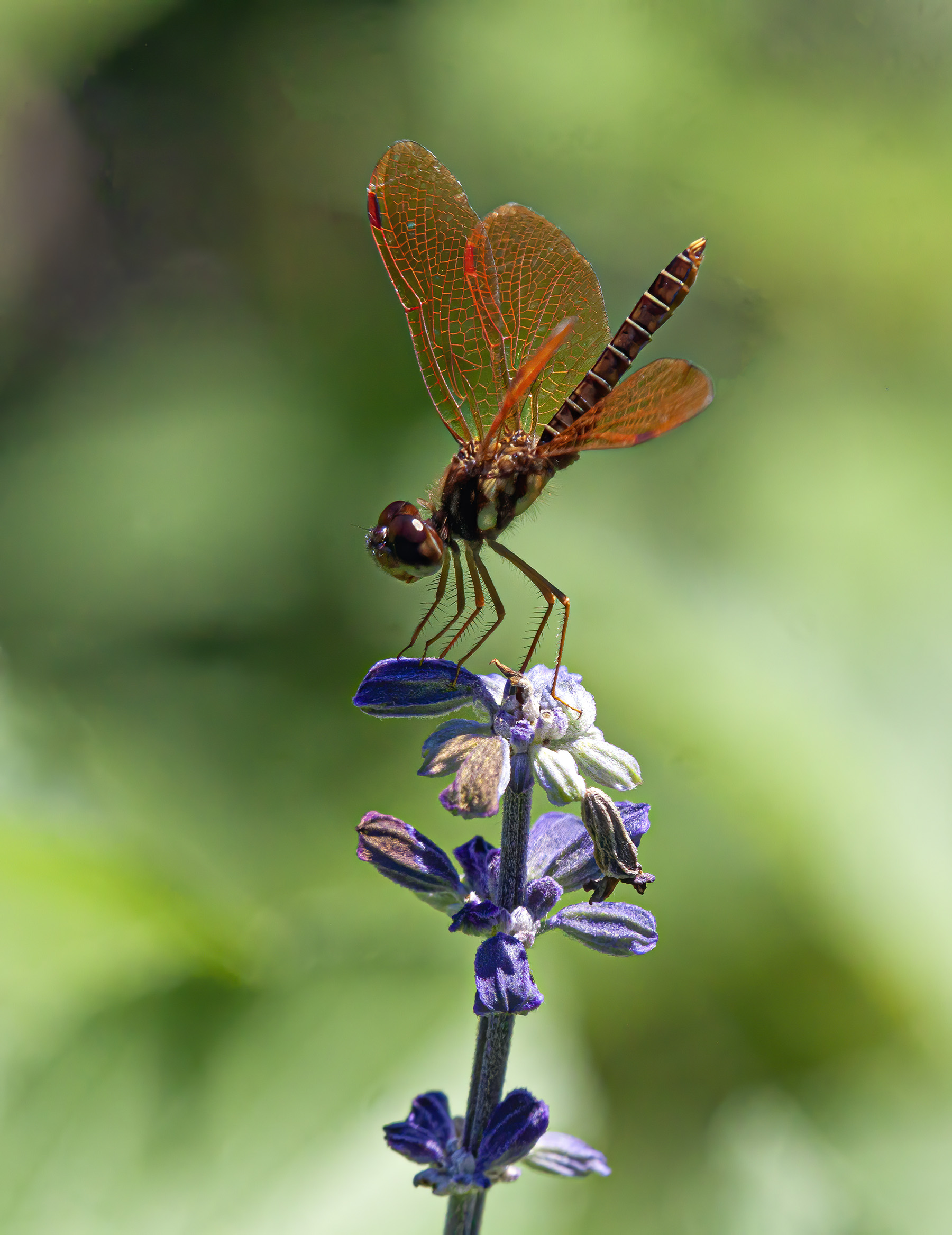
It love it when dragonflies cooperate and choose particularly photogenic perches, as these female Eastern Amberwing dragonflies (Perithemis tenera) did on Tuesday at Green Spring Gardens in Alexandria, Virginia, not far from where I live. The males of this species, whose wings are a solid amber in color, mostly seemed to be hanging out at a pond at the bottom of a hill, while the females were flitting about among the flowers in the gardens at the top—the gender separation reminded me of the awkwardness of junior high dances when I was growing up.

As many of you may recall, dragonflies and damselflies are part of the Odonata order of flying insects. My friend and fellow dragonfly enthusiast Walter Sanford has coined the term “odonart” to refer to artsy-style photos that we manage to capture of our favorite aerial acrobats. I think that both of these images qualify to fit into that self-created category, given the beauty of the dragonflies and their particularly photogenic perches.

Eastern Amberwing

Eastern Amberwing

© Michael Q. Powell. All rights reserved.

Read Full Post »

Every year I enjoy taking photos of dragonflies perching on a piece of rusted rebar that sticks a few inches out of the water of a small pond at Jackson Miles Abbott Wetland Refuge. I have seen dragonflies of several species use this particular perch, but photographically speaking my favorite is probably a male Eastern Amberwing dragonfly (Perithemis tenera) like the one in this photo from last Friday—the orange-rust colors of the dragonfly and its perch are complementary and soften what might otherwise be a jarring juxtaposition of the natural and man-made worlds.

You can’t see it really well, but there is a spider, probably a long-jawed spider, visible onthe lower portion of the rebar. I don’t know for sure if that spider could capture the dragonfly, but it is a potentially dangerous situation for the dragonfly and in the past I have photographed several dragonflies that had fallen prey to spiders.

Eastern Amberwing

© Michael Q. Powell. All rights reserved.


Read Full Post »

Last week I spotted my first Eastern Amberwing dragonflies (Perithemis tenera) of the season at Jackson Miles Abbott Wetland Refuge. These distinctively colored dragonflies are a frequent sight throughout the summer as they buzz about over the waters of ponds. Eastern Amberwings are small, even by dragonfly standards, with a total length of less than an inch (25 mm) and are considered to be a wasp mimic. According to Wikipedia, “The Eastern Amberwing dragonfly is one of the only types of dragonfly that actively mimics a wasp. The yellow and brown stripes on its abdomen encourage predators to stay away. When perched, they will wiggle their abdomen and wings in a wasp-like fashion to deter other animals from eating it.”

My second and third shots are portraits of perched male Eastern Amberwing dragonflies that were carefully composed and sharp, but my favorite image of the day is the dynamic shot of two dragonflies in flight. It may not be obvious what is going on in the photo, so let me explain. After mating, the female in the upper left corner is getting ready to deposit her eggs in the water, while the male in the lower right corner hovers in the air, ready to keep any rivals from interfering with the process.

Eastern Amberwing

Eastern Amberwing

Eastern Amberwing

© Michael Q. Powell. All rights reserved.

Read Full Post »

I guess that the main subject of this image is the tiny male Eastern Amberwing dragonfly (Perithemis tenera), but I must confess that I was equally drawn to the curving shapes of the branches sticking out of the water during my recent trip to Jackson Miles Abbott Wetland Refuge. Normally I try to fill as much of my frame with my primary subject by using a zoom lens or by moving closer, but in this case I actually moved back in order to be able to capture more of the vegetation.

I really like the way that the warm amber color of the aptly named Eastern Amberwing stands out against the muted tones of the rest of the image. The style of this image is different from most of my shots (assuming that I have an identifiable style), but I enjoy mixing it up from time to time by shooting from different angle or distances.

Eastern Amberwing

© Michael Q. Powell. All rights reserved.

Read Full Post »

Eastern Amberwings (Perithemis tenera) are one of the smallest dragonfly species where I live—less than one inch (25 mm) in length. I often see the amber-colored males buzzing around at the ponds that I visit, but it is rare for me to find a female.

According to the wonderful website Dragonflies of Northern Virginia, female Eastern Amberwing dragonflies are often found far from the water in meadows where they share perches with hornet and other wasps. When they are threatened, these dragonflies will rhythmically move their wings up and down while pulsing their abdomens in imitation of a wasp in order. Their goal is to scare off potential predators that believe they are about to be stung.

I spotted this tiny beauty yesterday while I was exploring Occoquan Bay National Wildlife Refuge. I was, in fact, far from the water when I photographed her.  She posed briefly, it seemed, when I raised my camera and seemed to smile a little.

Eastern Amberwing

© Michael Q. Powell. All rights reserved.

Read Full Post »

When the weather gets hot, some dragonflies will raise their abdomens (the “tail”) in what is believed to be an attempt at thermoregulation. I can’t say for sure if it works, but the theory is that in this position, sometimes referred to as the “obelisk,” dragonflies are able to stay cooler by reducing the amount of their bodies subject to direct sunlight.

Earlier this week I spotted this male Eastern Amberwing dragonfly (Perithemis tenera) in a modest obelisk position at Jackson Miles Abbott Wetland Refuge. I characterized the position as “modest,” because sometimes a dragonfly will elevated its abdomen until is almost vertical.Eastern Amberwing

© Michael Q. Powell. All rights reserved.


Read Full Post »

Throughout the month of May I have struggled to identify the dragonflies and damselflies that I have photographed. So many of the species seem so similar that I have had to defer to experts for help. Over the years I have learned that the best way to get help on a Facebook forum is to misidentify a subject—some experts, who might not respond to a request for help, feel compelled to correct you and demonstrate their superior knowledge.

This past Friday at Jackson Miles Abbott Wetland Refuge, it was nice to spot a familiar dragonfly species that was immediately identifiable—there is simply no other dragonfly in our area the looks like an Eastern Amberwing (Perithemis tenera). Even the name is helpful in drawing attention to the key identification feature, the distinctive amber wings.

These dragonflies are among the smallest ones in our area, but they tend to perch on low vegetation overhanging the water (especially males like this one), so they are relatively easy to spot. Although they tend to be a little skittish, if you are patient and persistent you can snag some shots that show the beautiful details of the Eastern Amberwing dragonfly.

Eastern Amberwing

© Michael Q. Powell. All rights reserved.

Read Full Post »

As a nature photographer, I am used to living with compromises. Unlike some other kinds of photographers, I don’t have the luxury of waiting for perfect light or photographing only perfect subjects. I can make a few adjustments or move about a bit to improve my composition, but most of the time I deal with imperfections of one sort or another.

Every once and a while, though, I’ll take a photo that doesn’t require any substantial adjustments or even cropping–it looks just like I imagined it would. That was the case with a recent image I captured of a female Eastern Amberwing dragonfly (Perithemis tenera) at Occoquan Bay National Wildlife Refuge.  I like the way that I captured the subject, I like the curved of the vegetation on which it is perched, and I like the background. It’s a bonus that I didn’t need to crop.

Perfection is elusive in any pursuit—this is about as close as I can come to it in my photography.

Eastern Amberwing

© Michael Q. Powell. All rights reserved

Read Full Post »

There were only a few water lilies in bloom at the small pond at a local garden that I visited this past weekend. Surprisingly, they were all pink in color and not the white ones that I am more used to seeing—perhaps it is late in the season for the white ones. Not surprisingly, there were quite a few dragonflies buzzing about and I decided that I wanted to get a shot of one of them perched on one of the water lilies.

So I waited and hoped and waited some more. My patience was eventually rewarded when a tiny male Eastern Amberwing dragonfly (Perithemis tenera) landed on a partially open water lily bud and perched momentarily.

I really like the image that I managed to capture because of the way it conveys a sense of the mood of the moment, a calm, almost zen-like feeling of tranquility. The colors are subdued and the composition is minimalist—there is a real beauty in simplicity.

Dragonfly and water lily

© Michael Q. Powell. All rights reserved.


Read Full Post »

Do you consider yourself to be artistic? All of my life I have been in awe of people who can draw and paint and create art, but have never considered myself to be artistic. Increasingly, though, my photography has opened up a creative side that I am trying to nurture.

As some of you know, I decided that I want to try my hand at watercolor painting and did a posting not long ago on my first efforts at doing a landscape. I don’t usually shoot landscapes with my camera, so I thought that I would try a more familiar subject for my second project—I decided to try to paint a dragonfly. In retrospect, I probably should have chosen an easier subject, but I am so inexperienced in art that I didn’t realize what I was getting myself into.

For inspiration, I used a recent photo that I took of a female Eastern Amberwing (Perithemis tenera). I have already included it in a blog posting, but am reprising it as the final photo, so you’ll know what my artistic efforts were supposed to look like.

I tried a couple of different approaches to my subject. First I tried sketching the dragonfly. I didn’t have a pencil handy, so I used a Bic ballpoint pen. My observation skills and sense of proportion are definitely lacking, but it was surprisingly fun to try. Without an eraser to correct my errors, I felt a bit like I was walking on a tightrope without a net.

Then I tried to draw with Crayola crayons? Why? I happened to be at Walmart yesterday and picked up a pack of 24 for only 50 cents at a back-to-school sale. My drawing looks a bit like a cartoon to me.

Finally I was ready to try watercolor. I decided that I would do the painting without bothering to sketch it out. Oops. I was using some inexpensive paper and it started to buckle a bit when I tried to cover the entire area with an overly wet wash of light green. I think I then attempted to put on the next layer before the first one was fully dry. I still feel like a second-grader in my watercolor skills, but it still was enjoyable trying to see what worked and what didn’t.

I did my final attempt in a sketchbook that is not intended for watercolor. I sketched out the dragonfly with a mechanical pencil and then colored the sketch with my watercolor paints. Out of all of my attempts, this is the one that I like the most. I felt a bit more confident in using the paints and in some of my strokes.

So what did I learn? Most significantly I learned that it’s worth taking a risk of feeling embarrassed; that it’s ok to try something new and achieve only a limited amount of success;, and that the amount of enjoyment that I can derive from a creative pursuit is not directly tied to any specific outcome.

dragonfly sketch

dragonfly crayon drawing

#worldwatercolormonth

#worldwatercolormonth

Eastern Amberwing

© Michael Q. Powell. All rights reserved.


Read Full Post »

Eastern Amberwings (Perithemis tenera) are the smallest dragonflies in our area. You can often find males buzzing around at the water’s edge, but females are harder to spot because they hang out in vegetation away from the water. I was thrilled therefore to see a beautiful female this past Friday at Occoquan Bay National Wildlife Refuge in some beautiful morning sunlight.

I decided to give a male Eastern Amberwing dragonfly equal billing in this post, because I really like the way that the shadows and the reflections make it look like he has an elongated body and extra sets of wings.

Eastern Amberwing

Eastern Amberwing

© Michael Q. Powell. All rights reserved.

Read Full Post »
Older Posts »