Feeds:
Posts
Comments

Posts Tagged ‘Papilio troilus’

During a recent visit to Occoquan Bay National Wildlife Refuge I noticed that the thistle plants were attracting a lot of butterflies. I managed to photograph what I think was a Spicebush Swallowtail butterfly (Papilio troilus) as it was feverishly feeding on the thistles.

The butterfly had sustained a significant amount of damage to its wings, which made identification of its species a little difficult—it is possible that this is actually a Black Swallowtail or one of the other dark swallowtails in my area.  Whatever the case, I was once again amazed that, despite the damage to its wings, the butterfly seemed to be able to fly and feed without any obvious limitations.

Spicebush Swallowtail

Spicebush Swallowtail

© Michael Q. Powell. All rights reserved.


Read Full Post »

As I have mentioned previously, I have real difficulties in identifying many of the dark swallowtails that I encounter. However, sometimes I get a perfect view of one and the task is vastly simplified.

Last week at Occoquan Bay National Wildlife Refuge, for example, I spotted this Spicebush Swallowtail butterfly (Papilio troilus) feeding on a blooming thistle plant. I could tell it was a Spicebush Swallowtail because its row of inner orange spots was interrupted by a swoosh of blue that looks a bit like the tail of a comet. Additionally, the position of the butterfly made for a beautiful composition of the image that I was able to capture.

Spicebush Swallowtail

© Michael Q. Powell. All rights reserved.

Read Full Post »

There has been a relatively recent resurgence of butterflies in my area. In the past week or so I have seen more butterflies than at any other time this summer. Several of the dark swallowtail butterflies, though, are similar in appearance and are hard to tell apart, especially when wing damage hides some of the features that I rely on for identification.

Last week at Occoquan Bay National Wildlife Refuge, I spotted this beautiful dark swallowtail as it was feeding on a thistle plant. I can’t tell for sure, but I think that it may be a Spicebush Swallowtail butterfly (Papilio troilus). A chunk of the hind wing is missing, but otherwise the butterfly seems to be in good shape. It was moving around a lot on the thistle, but I was patient and eventually was able to capture a decent shot of this beautiful creature.

Pipevine Swallowtail

© Michael Q. Powell. All rights reserved.

Read Full Post »

We have a number of different dark swallowtail butterfly species in our area and sometimes I have trouble telling them apart. Recently I have seen Black Swallowtails fairly frequently and occasionally I will see a Pipevine Swallowtail. I know that there is also a dark morph version of the Eastern Tiger Swallowtail and a Red-spotted Purple butterfly sometimes looks almost like a swallowtail.

Are you confused yet? When I spotted this cool-looking butterfly on Wednesday at Occoquan Bay National Wildlife Refuge, I was not sure what it was. Rather than endlessly speculating while in the field, I follow what I call the “Law of the Wild West”—shoot first and ask questions later—and wait to identify my subjects until after I have loaded my images onto my computer.

I have grown accustomed to using a blog posting by the Louisiana Naturalist to help identify dark swallowtails—it provides side-by-side photos of four different species. On the basis of that posting and some other research, I have concluded that “my” butterfly is probably a Spicebush Swallowtail (Papilio troilus) butterfly, a species that I don’t recall seeing the past few years.

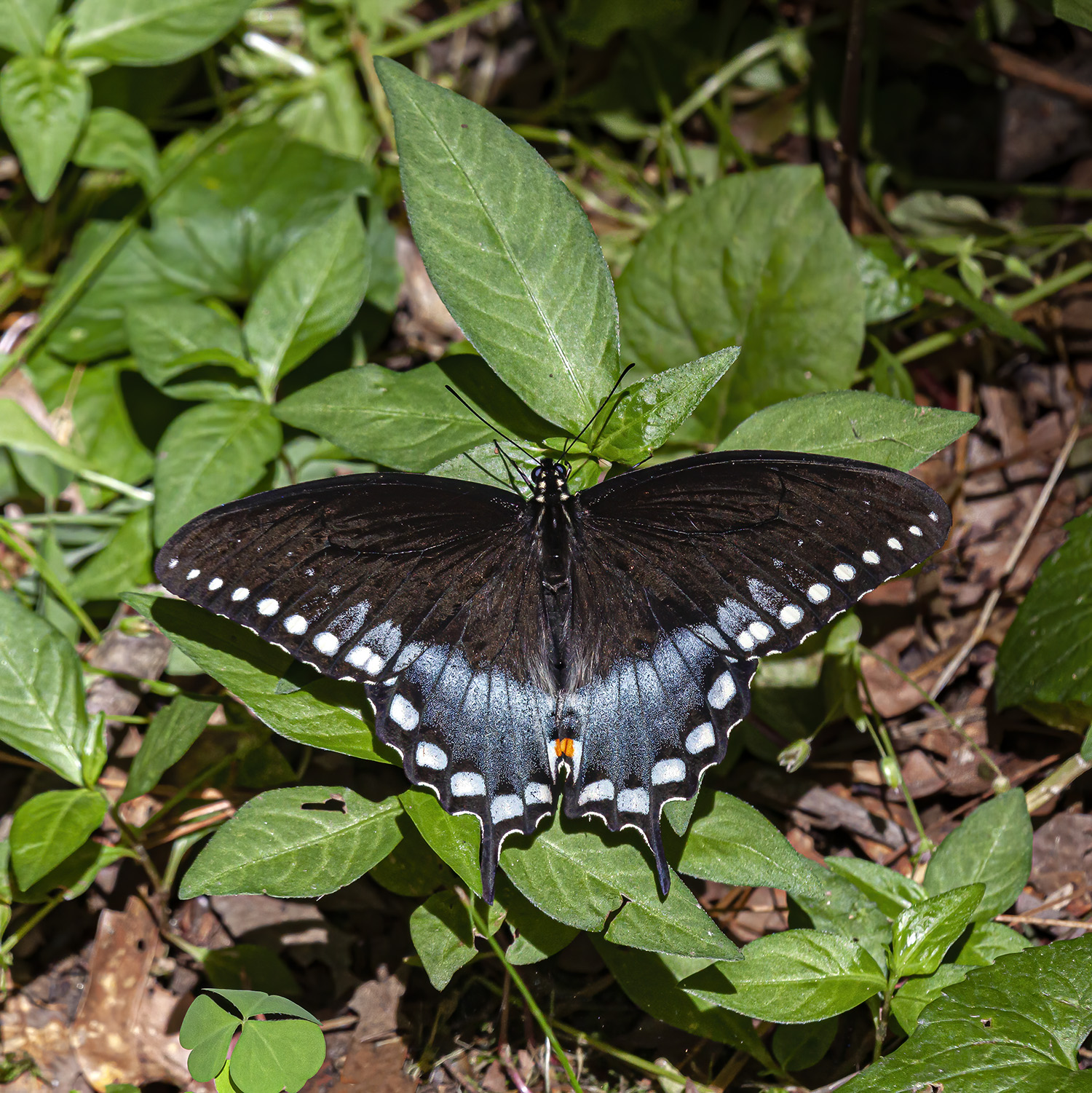
The background of the photo is not particularly interesting, but I was patient enough to wait for the butterfly to open its wings, so you get a good look at the wonderful markings of this Spicebush Swallowtail butterfly.

Spicebush Swallowtail

© Michael Q. Powell. All rights reserved.

Read Full Post »

I was delighted to encounter this group of butterflies last Tuesday at Occoquan Bay National Wildlife Refuge. Several Zebra Swallowtails (Eurytides marcellus) and one prominent Spicebush Swallowtail (Papilio troilus) were poking among the rocks, drinking in salts and other nutrients. If you look carefully at the image, you will see that one of the Zebra Swallowtails (the one to the right of the Spicebush Swallowtail flying—apparently it wanted to join the party.

Did you know that one of the collective nouns for a group of butterflies is “kaleidoscope?” I think the word is a a perfect descriptor for these multi-colored swirling beauties.

kaleidoscope of butterflies

© Michael Q. Powell. All rights reserved.

Read Full Post »

It was definitely exciting to see my first Monarch butterflies of the season last Friday at Green Spring Gardens, but I was equally delighted to see some other beautiful butterflies that day. The one in the first photo is an Eastern Tiger Swallowtail (Papilio glaucus) on a flower that I later learned is a Mexican sunflower. I am pretty sure that the butterfly in the second image is a Spicebush Swallowtail (Papilio troilus), although the angle of this shot keeps me from being absolutely certain. I am not sure what kind of flower it is feeding on, but it sure was pretty.

Although I spend a lot of time in streams, fields, and marshes, I enjoy visiting gardens from time to time. It is stimulating to all of the senses to see all of the bright colors and smell the fragrant flowers. There were plenty of bees too and occasional forays into the flowers by goldfinches and hummingbirds. It was a good day.

Eastern Tiger Swallowtail

Spicebush Swallowtail

© Michael Q. Powell. All rights reserved.


Read Full Post »

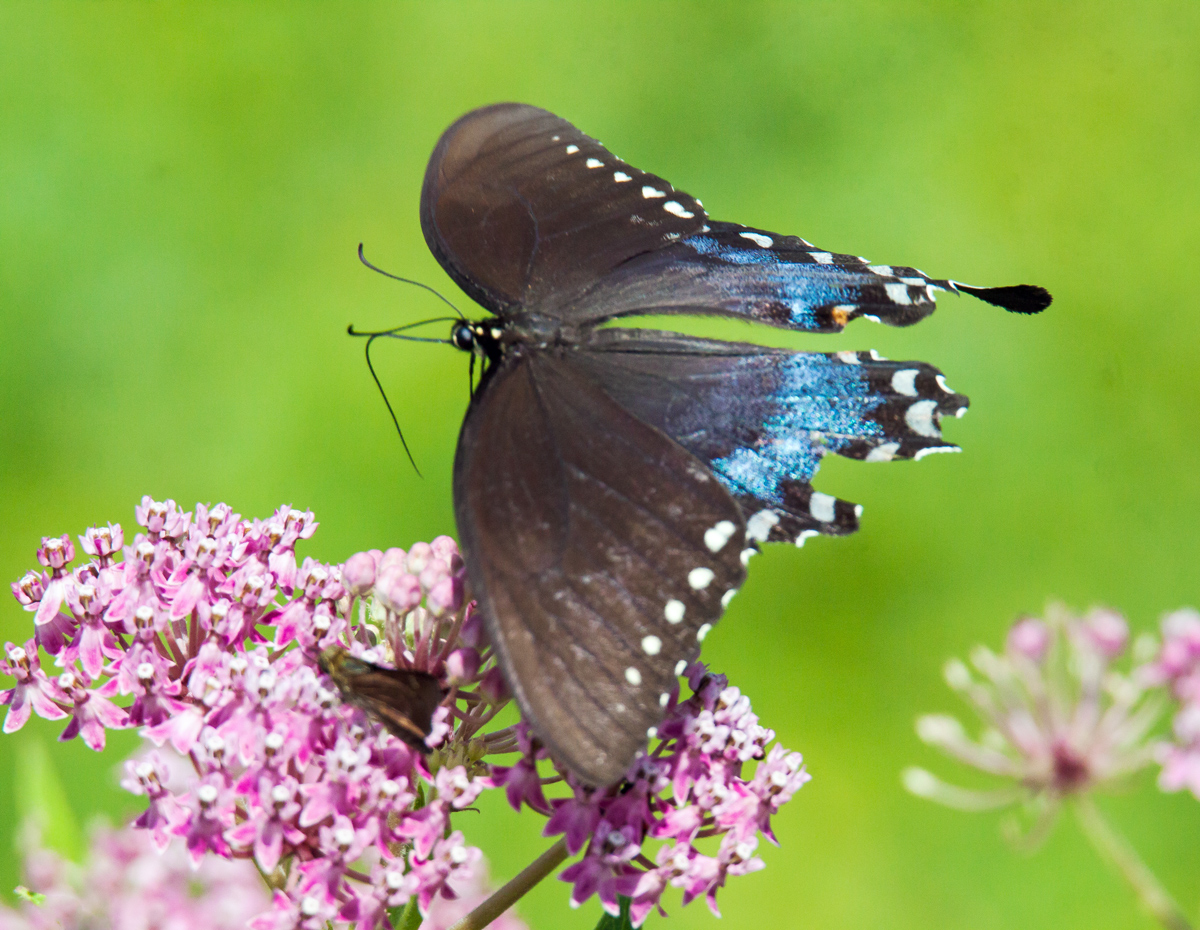
I was delighted on Monday to see that Swamp Milkweed (Asclepias incarnata) is now flowering at Huntley Meadows Park, a local marshland refuge. Butterflies really seem to like all varieties of milkweed and I was thrilled to photograph several different species that were feeding on these fabulous flowers, including a Spicebush Swallowtail(Papilio troilus) in the first image; an Eastern Tiger Swallowtail (Papilio glaucus) in the second image; and in the final image, a Silver-spotted Skipper (Epargyreus clarus), a smaller skipper that I cannot identify, and a bee.

Spicebush Swallowtail

Eastern Tiger Swallowtail

Silver-spotted Skipper

© Michael Q. Powell. All rights reserved.


Read Full Post »

We have a number of different dark swallowtail butterflies in the area in which I live, which can make identification a little tricky. I spotted this beautiful butterfly last Friday at Jackson Miles Abbott Wetland Refuge and believe that it is a Spicebush Swallowtail butterfly (Papilio troilus). The perfect condition of its wings suggest to me that it has emerged quite recently—as we move deeper into summer, I often spot butterflies with tattered wings.

Spicebush Swallowtail

© Michael Q. Powell. All rights reserved.


Read Full Post »

When I spotted a small patch of milkweed while exploring Occoquan Bay National Wildlife Refuge earlier this month, I stopped and waited. I knew that numerous butterflies are attracted to this plant. Before long, several butterflies in fact appeared.

Here are photos of two of them, both swallowtail butterflies. The first one, a Spicebush Swallowtail (Papilio troilus), appears to be in perfect condition. Its wings and “tails” are intact and its colors are vibrant. By contrast the second butterfly, a Zebra Swallowtail (Protographium marcellus), is clearly a veteran. There are chunks missing from its wings and its long beautiful swallowtails are gone.

Do you find one of the butterflies to be more inherently beautiful than the other? Here in the United States, we tend to worship beauty and a standard of supposed perfection. We are daily bombarded with advertising messages that tell us we can look young again, that we can cover up our imperfections. The current focus on selfies and dating apps that allow you to judge others with a swipe encourages a kind of narcissism and attention to superficial appearances that I personally find to be unhealthy.

I remember watching a video several years ago about photographing nature. The photographer encouraged viewers to photograph only perfect specimens of flowers and insects, following the lead of those who say that in order to create beautiful photographs, you need beautiful subjects.

The photos here are my response to that kind of thinking. There is an incredible beauty to be discovered in the ordinary, everyday subjects that surround us, full of imperfections and blemishes. Take a moment today to slow down and truly experience that beauty.

Spicebush Swallowtail

Zebra Swallowtail

© Michael Q. Powell. All rights reserved.

Read Full Post »

I was thrilled to capture some shot of a Spicebush Swallowtail butterfly (Papilio troilus) this past weekend at Green Spring Gardens as it fed on a lantana flower. I am so used to more muted colors when I am shooting in the “wild” that the brightness of these flowers seem almost unnatural.

If you look closely at the butterfly’s legs in the first image, you will see that one of them is blurred. Obviously the butterfly was moving about and my camera’s shutter speed was too slow to stop the motion. In many cases I would be disappointed with that lack of sharpness, but I find that it acceptable here, because it doesn’t really distract the viewer’s eyes.

There are a number of dark-colored swallowtails in our area, but the Spicebush Swallowtail is the only one with a blue swoosh on its wings in the middle of a row of orange spots.

Spicebush Swallowtail

Spicebush Swallowtail

© Michael Q. Powell. All rights reserved.

Read Full Post »

Cardinal flowers (Lobelia cardinalis) are now in bloom at Huntley Meadows Park. In addition to being beautiful, these vivid red flowers attract butterflies, like this Spicebush Swallowtail butterfly (Papilio troilus) that I spotted this past weekend at the park.

Spicebush Swallowtail

© Michael Q. Powell. All rights reserved

Read Full Post »

Butterflies fly so expertly that I often can’t tell that they have severe wing damage until I look closely. That was certainly the case this past weekend when I was observing a dark swallowtail at Huntley Meadows Park.

I didn’t get an absolutely clear look at it, but I think it might be a Spice Bush Swallowtail butterfly (Papilio troilus), judging from its colors and patterns. In the first photo, you can see only minor damage, but when the butterfly changed position, the extent of the damage became much more apparent.

I consider flight to be somewhat of a mystery in any case, but it is even more of a mystery how a butterfly can fly so well when one of its wings is almost completely detached from its body,

Spicebush Swallowtail

Spicebush Swallowtail


© Michael Q. Powell. All rights reserved

Read Full Post »

I used to think that there were only one or two varieties of black-colored swallowtails, but as I learned there were more such species (some deliberating mimicking each other), I’d sometimes get confused and frustrated when trying to distinguish among them.

For example, I encountered this beautiful black swallowtail butterfly feeding on a Cardinal Flower (Lobelia cardinalis) this past weekend at my local marsh. It is definitely an unusual circumstance when I can identify a flower, but not the insect.

So, I asked myself, is this a female Eastern Tiger Swallowtail or a Pipevine Swallowtail or a Spicebush Swallowtail or a Black Swallowtail? How can you tell them apart, given they are all black and all have swallowtails?

While searching on the internet, I came across a wonderful blog posting on a site called Louisiana Naturalist that compared all four of these swallowtail species and pointed out clearly the distinguishing marks. Once I looked at the posting, it was pretty clear that “my” butterfly is a Spicebush Swallowtail (Papilio troilus). Why am I so confident? One of the identifying marks is the blue comet-like marking that interrupts the inner row of orange spots.

It’s interesting to see this butterfly feeding on the Cardinal Flower. The website of the Lady Bird Johnson Wildflower Center at the University of Texas states that the Cardinal Flower depends on hummingbirds for pollination, because most insects find its long tubular flowers difficult to navigate. I suspect that butterflies play a role in pollinating these plants, even if they are not as efficient as bees would be (or maybe even hummingbirds).

Spicebush Swallowtail

© Michael Q. Powell. All rights reserved.

Read Full Post »