Feeds:
Posts
Comments

Posts Tagged ‘Occoquan Regional Park’

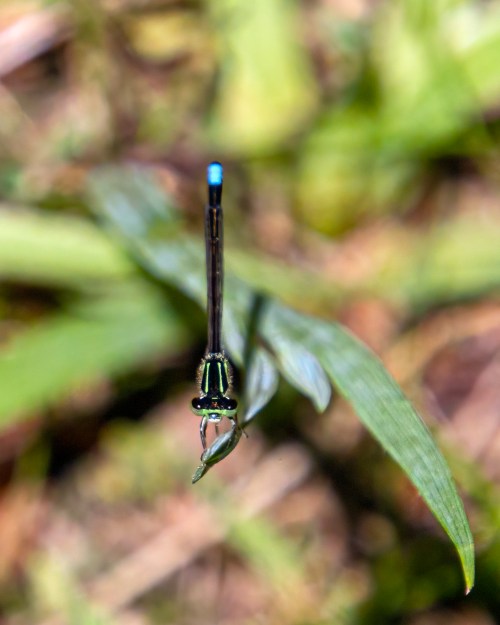
It has taken a little while, but I am starting to see damselflies during my searches for dragonflies. As many of you know, damselflies and dragonflies are “cousins” in the sense that they are both members of the order Odonata. Generally speaking, dragonflies have thicker, shorter bodies and hold their wings out to the sides when resting, while damselflies are slender with wings often folded together. The eyes of dragonflies often touch each other, while those of damselflies tend to be more widely separated.

The first photo below shows a Fragile Forktail damselfly (Ischnura posita), a very common species where I live. The interrupted shoulder stripes look like exclamation marks, which makes them pretty easy to identify.  The second photo shows what I am pretty certain is a female Eastern Forktail damselfly (Ischnura verticalis). Female damselflies of a number of species are similar in appearance, so I am a bit less confident that I have correctly identified this individual.

More damselflies will continue to appear as I shift my attention almost exclusively from birds to insects. As a result of recent rains, the trees in my area are now covered with leaves, which means that I am increasingly having trouble seeing the birds that I can hear singing.

Fragile Forktail

Eastern Forktail

© Michael Q. Powell. All rights reserved.

Read Full Post »

Common Whitetails (Plathemis lydia) can be found almost everywhere and are among the first dragonflies to appear in the spring and the last to survive in the fall. I nonetheless enjoy trying to capture creative images of them, like these two that I spotted this past week.

How do wildlife photographers choose their subjects? Some of them are attracted almost exclusively to rare and/or exotic species and are always looking for something new to photograph. Their mentality is close to those of many birders, who keep “life lists” of all the birds they have seen and are always lookin got add another one to the “list.”

Other photographers, like me, are content to photograph a more limited selection of subjects over and over again, hoping to capture something new and different, finding the extraordinary in the ordinary. The first photo is one such example—I love the prominent specular highlights in the image and the unusual pose of this female Common Whitetail with one of her legs extended.

At other times, I am simply trying to compose an image creatively, as in the second photo below. There is nothing super special about this shot of a male Common Whitetail, but I tried to add some visual interest by including some of the vegetation at the base of its perch and a portion of the lily pads in the distance. It is not a prize-winner by any standards, but I like the overall “feel” of the pleasant little image.

Female Common Whitetail

Male Common Whitetail

© Michael Q. Powell. All rights reserved.


Read Full Post »

What is the most difficult subject that you try to photograph? Quite often my biggest concern is the composition of a photograph, i.e. can I capture a shot that will be visually pleasing. Sometimes that means waiting for a particular expression or wing position or moment of action, but if I am patient enough, I have a pretty good chance of getting some decent shots.

Each year, though, I try try to challenge myself to capture some “impossible shots” of dragonflies in flight. Of course, such shots are not actually impossible, but they are really difficult to pull off. Some really high-end modern mirrorless cameras have focusing systems that are so good that they can lock focus on a moving dragonfly, but I mostly use cameras with technology that is over a decade old. Usually I will try to track a dragonfly through the viewfinder of my camera and focus on it manually. It’s a little easier when the dragonfly is flying a somewhat predictable path over the water and ideally hovering a bit.

This past Monday I had my first experience this season with in-flight photography when I spotted several Common Baskettail dragonflies (Epitheca cynosura) patrolling over the water of a small pond at Occoquan Regional Park. I managed to get a decent number of shots in frame, but most of them were out of focus—clearly I am a little rusty and need more practice to regain the necessary hand-to-eye coordination. The first shot below is cropped quite a bit, but is one of my best shots from my little session.

Common Baskettail dragonflies, which are only about 1.6 inches (41 mm) in length, spend a lot of their time in the air, but on that day I was fortunate when one of them decided to take a break and perched for a few moments low in the nearby vegetation. The second and third shots below provide a good side view of this beautiful little dragonfly, including its distinctive terminal appendages (the tip of its “tail”).

It’s a fun challenge for my patience and skills as a photographer to attempt to capture shots of dragonflies in flight and luck certainly plays a big part in achieving any success whatsoever. I can just about guarantee that I will be featuring a few more in-flight dragonfly photos in the upcoming months as the insects and I become more active outdoors.

Common Baskettail

Common Baskettail

Common Baskettail

© Michael Q. Powell. All rights reserved.


Read Full Post »

Yesterday I decided to visit Occoquan Regional Park in nearby Lorton, Virginia to search for some dragonflies. Some of you know that the place that I visit most frequently is Occoquan Bay National Wildlife Refuge, so you may be a little confused, because they both have “Occoquan” in their names. The Wildlife Refuge is run by the U.S. Fish and Wildlife Service, whereas the Regional Park is run by Fairfax County.

The locations are only a few miles apart, but their habitats are different enough that I tend to see some different dragonfly species at each spot. I was hoping to see some Spiketail dragonflies, but came up empty-handed. As I was nearing the end of my adventure, however, a large dragonfly flew overhead. I did not get a very good look at it, but its size, shape, and flight profile suggested to me that it was from the Darner family.

A short while later, I spotted another large dragonfly (possibly the same one) flying around some vegetation and was thrilled when it landed. At the precise moment that it landed, my vision was partially blocked by some branches, but I had a good idea of where I hoped the dragonfly was perched. I moved a few steps slowly and silent to get an unobstructed view of the dragonfly.

I held my breath when I saw that it was a Swamp Darner (Epiaeschna heros), the largest dragonfly in my area at about 3.5 inches (89 mm) in length. Wow! Judging from its terminal appendages (the tip of the “tail”), I am pretty sure that this is a female. I took the second photo below initially, afraid to move closer for fear of spooking the dragonfly.

I then stepped a little closer and moved up and down as I tried to get a better shot. My options were limited, because the dragonfly was perched about 10 feet up (about 3 meters) and was surrounded by intertwined vines and branches. I think that the first shot below is a marginal improvement on my first shot and encourage you to click on it to get a better look at the Swamp Darners beautiful markings, including its spectacular eyes.

I suspect that this park will be in my regular rotation of places to visit as additional dragonfly species continue to emerge.

Swamp Darner

Swamp Darner

© Michael Q. Powell. All rights reserved.

Read Full Post »

I am always looking for cool perches when I spot dragonflies. Sometimes I will try to communicate telepathically with the dragonflies to prompt them to move to photogenic perches, but, alas, I am rarely successful—I guess that my telepathic powers are weak.

I was delighted on Monday at Occoquan Regional Park when this dark male Slaty Skimmer (Libellula incesta) voluntarily perched on the flowering stalk of a beautiful dark red plant. I have no idea what kind of plant it is, but I really like the color combination of this dragonfly and the the vegetation. The twisting pattern of the flowers on the stalk were a nice bonus and add a bit of additional visual interest to the image.

Slaty Skimmer

© Michael Q. Powell. All rights reserved.

Read Full Post »

Most of the time I see butterflies in the air or perched on vegetation, but some species, like this Red-spotted Purple butterfly (Limenitis arthemis astyanax) are low-fliers and spend a lot of time perching on the ground. I spotted this beauty on Monday during a short visit to Occoquan Regional Park in nearby Lorton, Virginia.

It was hot and humid and it seemed like most of the insects and birds were taking afternoon naps, so I cut my trip short and joined them in their siestas.

Red-spotted Purple

© Michael Q. Powell. All rights reserved.


Read Full Post »

When it comes to color theory, red and green are viewed as complementary colors, i.e. they are on the opposite sides of a color wheel. When used together, complementary colors provide a high contrast and high impact color combination—together, these colors will appear brighter and more prominent.

A week ago I was delighted to post a photo of a perched Carolina Saddlebags (Tramea carolina) dragonfly, a species that is almost always in flight when I am fortunate to spot one. A few days later, I managed to get some even better photos of a perched Carolina Saddlebags during a visit to Occoquan Bay Regional Park.

The lighting was good and the background was far enough away that it became blurry. The complementary colors of the dragonfly and the background really make these images “pop.” The interesting poses of the dragonfly draw in the viewer as well—a breeze was blowing and the dragonfly struggled a bit to maintain its hold on the tip of the vegetation on which it was perched.

It is really cool when the elements of a photograph come together like this and I am able to capture the scene in a way that is both technically and artistically pleasing. It was a good day.

Carolina Saddlebags

Carolina Saddlebags

© Michael Q. Powell. All rights reserved.

Read Full Post »

Sometimes my photos convey the mistaken impression that dragonflies are large and are easy to find and photograph. Using telephoto and macro lenses and a stealthy approach, I try to isolate the dragonflies, so that viewers can focus on the beautiful details of these amazing aerial acrobats.

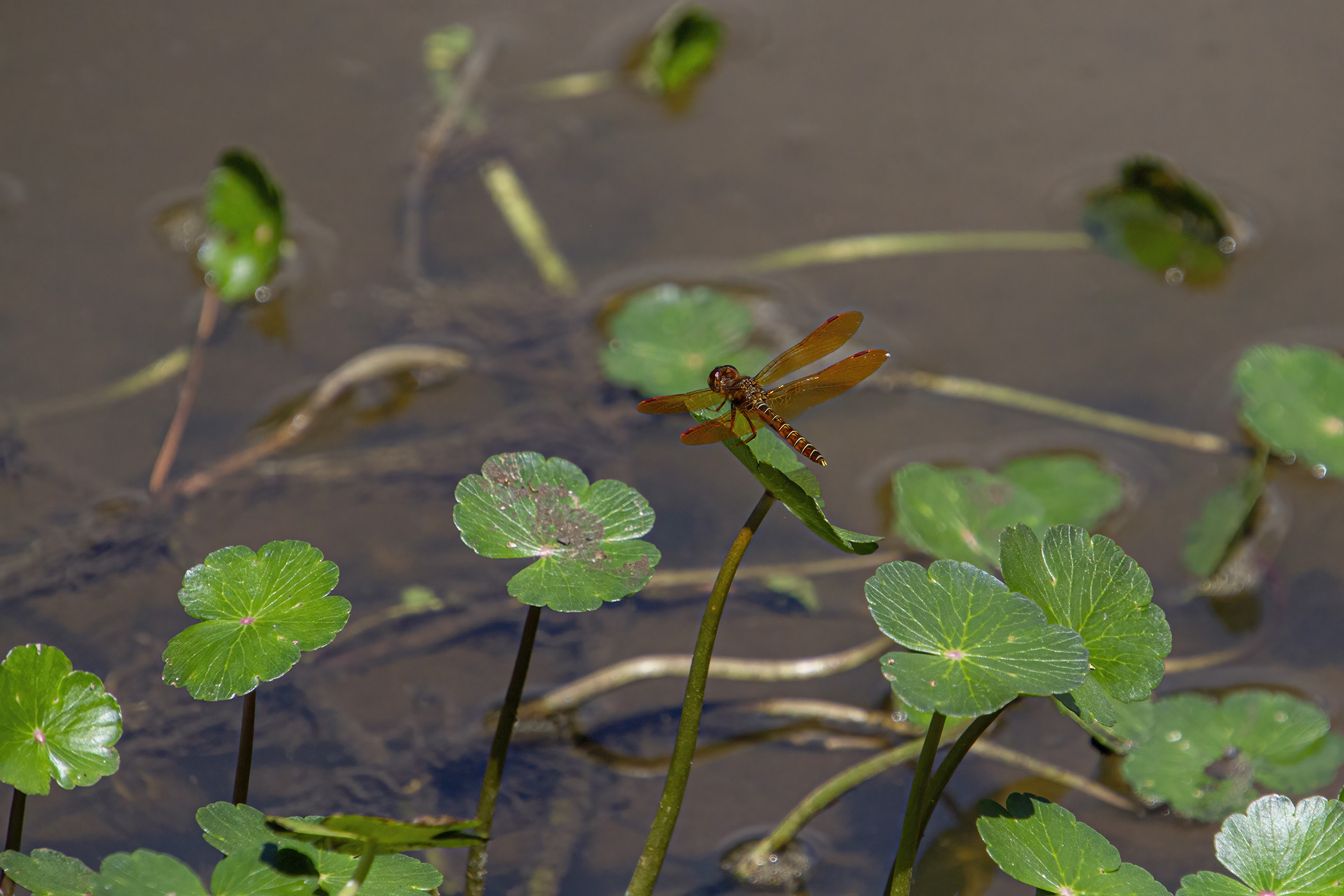
The reality though, is that most dragonflies are quite small—this male Eastern Amberwing dragonfly (Perithemis tenera) is only about one inch (25 mm) in length—and they often fly about amidst vegetation that conceals their movements.

This image gives you a sense of the vastness of the environment and some of the challenges in spotting the dragonflies. Of course, the second challenge is getting close enough to the subject without scaring it away, though in this case I was content to capture a wide-angle shot that shows this dragonfly in its preferred environment.

Eastern Amberwing

© Michael Q. Powell. All rights reserved.


Read Full Post »

Simple photographic compositions are often the most effective ones, like this image of a male Needham’s Skimmer (Libellula needhami) dragonfly that I captured last week at Occoquan Regional Park in Lorton, Virginia. All that is present in the frame is the dragonfly, the stem of the vegetation on which he is perched, and a blurred background—there is nothing extraneous or distracting. The limited color palette and the angled pose help to make the subject “pop.”

Sometimes photography can seem so complicated, but at other times it seems natural and intuitive and I am able to capture the beauty of nature without having to think consciously about what I am doing.

Needham's Skimmer

© Michael Q. Powell. All rights reserved.

Read Full Post »

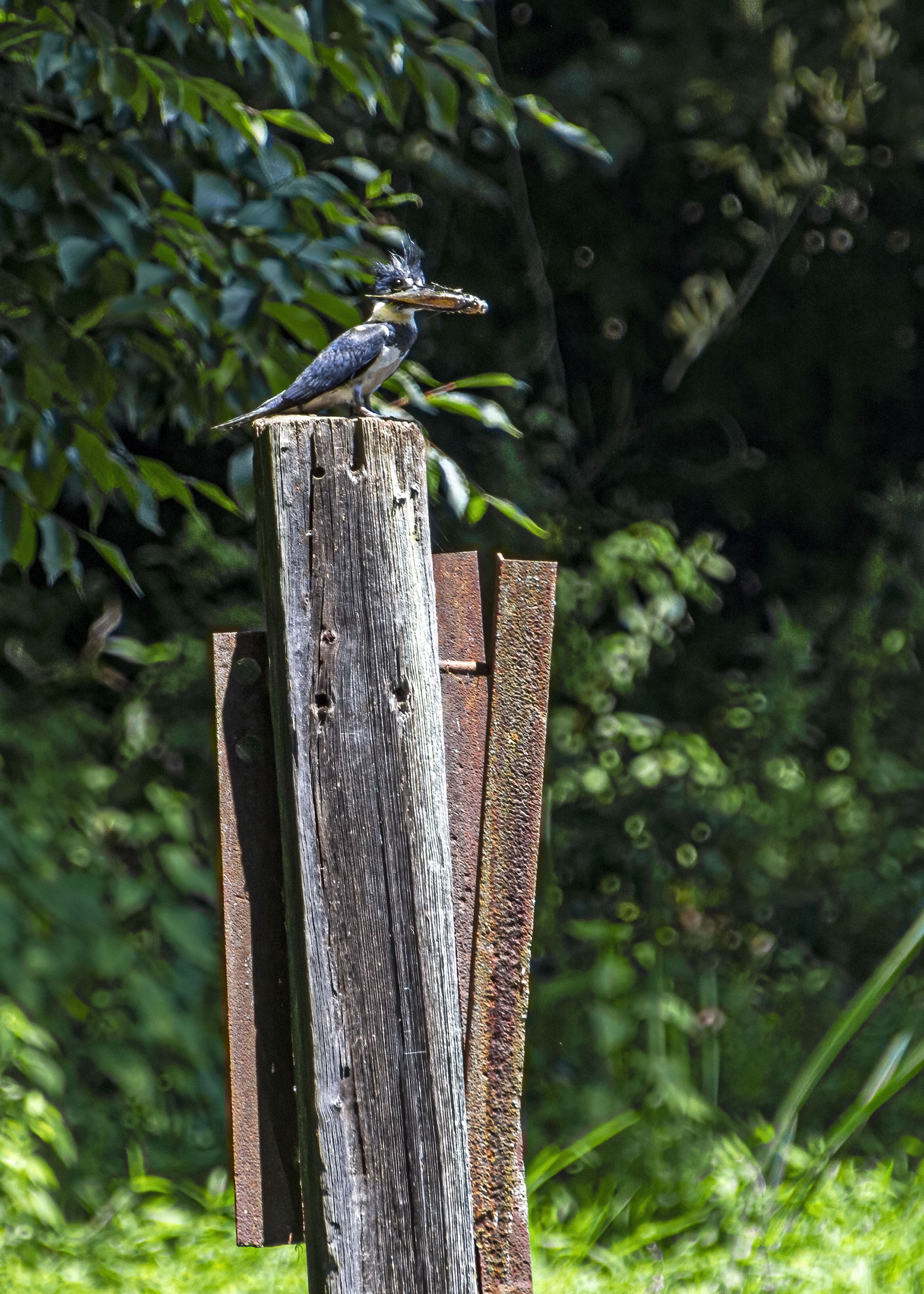
As I was searching the edge of a pond for dragonflies earlier this week I suddenly heard the unmistakable call of a Belted Kingfisher (Megaceryle alcyon). As I lifted my head, the kingfisher flew across my field of view and perched on a wooden post sticking out of the water. Even though the kingfisher was quite far away, I could see that it had a relatively large fish in its bill.

Normally a kingfisher will beat its catch against a branch to subdue it before swallowing it head-first. I was hoping to be able to see if the kingfisher would be successful in swallowing this prey—it looked too big for it to swallow in one gulp, but I have been surprised in the past when herons and cormorant have swallowed large fish.

Alas, the kingfisher flew away before I could see if it would be successful in swallowing its prey.

Belted Kingfisher

© Michael Q. Powell. All rights reserved.


Read Full Post »

I photographed this male Widow Skimmer (Libellula luctuosa) on Tuesday at Occoquan Regional Park. As I was working on the image, I noted that the dragonfly had an infestation of what look to be red water mites on at least two of its wings. You may need to click on the images to zoom in and you should be able to see some small red spherical objects that I am pretty sure are water mites.

According to Wikipedia, these water mites, likely from the genus Arrenurus, “establish an association for the purpose of transportation and nutrients, and attach to the host during the host’s transition from larva to adult.” Although these mites do not kill the dragonfly hosts, studies “show that parasitism by the mites affect the host’s longevity and fecundity by draining its tissue fluids, hampering copulation and interfering with sperm transfer.” Yikes!


Widow Skimmer

Widow Skimmer

© Michael Q. Powell. All rights reserved.


Read Full Post »

There must be something special about this perch. One week after I photographed a Unicorn Clubtail dragonfly (Arigomphus villosipes) on a log at the edge of a small pond at Occoquan Regional Park, I  spotted another Unicorn Clubtail in the exact same spot. Perhaps it was even the same individual, hanging out in the same old places, as this wildlife photographer is wont to do.

The edge of the pond is very mucky, so I couldn’t get any closer to give you a better view of the little “horn” that sticks up between the eyes and gives rise to the name “unicorn.” You’ll have to trust me on that point or check out a 2017 blog post entitled Unicorn in Northern Virginia that includes a better view of the unicorn “horn.”

We are in the midst of a real heat wave, with daily temperatures soaring into the mid-90’s (35 degrees C), so my wildlife forays are shorter than normal. Don’t worry, I am taking it slow, seeking shade whenever possible, and carrying water with me. Forecasters predict that this heat wave will continue for at least another week.  Yikes!

Unicorn Clubtail

© Michael Q. Powell. All rights reserved.


Read Full Post »

When I spotted this Gray Petaltail dragonfly (Tachopteryx thoreyi) on Monday at Occoquan Regional Park, I could see that it was feasting on some kind of insect that it had caught, but I could not get close enough to identify the prey. Dragonflies are fierce predators that feed on a wide variety of insects, sometimes including other dragonflies or damselflies.

When I examine the image carefully I can just make out the wings and legs and possibly an eye of the victim, but that does not help me to identify it. The dragonfly was perched high on the trunk of the tree and when I tried to move closer to get a better shot, the sharp angle made it even harder to see what was going on. I was happy enough to capture this profile view of the Gray Petaltail, which would otherwise have been pretty well camouflaged by the rough bark of the tree.

Gray Petaltail

© Michael Q. Powell. All rights reserved.

Read Full Post »

Many dragonflies have transparent wings that seem to disappear when they are flying, making them look even smaller and hard to detect. Male Widow Skimmer dragonflies (Libellula luctuosa), however, have such large bi-colored patches on their wings that they look almost like butterflies when in flight, an impression heightened by the fluttering way that they fly.

I was thrilled when I spotted this male Widow Skimmer—the females of this species do not have the white wing patches—on Monday at Occoquan Regional Park. The dragonfly flew by me numerous times and I watched and waiting, hoping that it would land.  My patience eventually paid off and I was able to capture this shot that shows off its wings beautifully. This may not be the most artistic image that I have ever captured, but it is a good one to use for the purpose of identification.

One of the coolest things about photography is that it can be both scientific and artistic, allowing me to be as geeky as I want in either domain.

Widow Skimmer

© Michael Q. Powell. All rights reserved.

Read Full Post »

Sable Clubtail dragonflies (Stenogomphurus rogersi) are uncommon in my area. This dragonfly species is generally found only in very small numbers, has a short flight period, and requires very specific habitats, preferably a small, clean forest stream. There is only one location in my area where I have found Sable Clubtails in the past and some years I have not seen a single one.

I was therefore really excited on Monday when I spotted what I thought might be a Sable Clubtail. I was not sure of my identification, though, because this dragonfly was in a different location at the park, not along the stream where I had seen Sable Clubtails in the past.

When I returned home and examined my photos on my computer, I was shocked to see that the dragonfly was a female–I am pretty sure that all of the Sable Clubtails that I have previously seen were males. For the sake of comparison, I have added a photo of a male that was part of a posting I did on 10 June 2024 entitled Sable Clubtail dragonfly (male). If you look closely at the tip of the abdomen (the “tail”) of each dragonfly, you will see different shaped terminal appendages, which are key factors in helping to identify the gender of a dragonfly.

Different dragonfly species have different courting behaviors. In some cases, the males and females are present in the same area, but in other cases, the females remain in a different area until they are actually ready for mating. I looked through my resources and on-line to see if I could find any information about the behavior of Sable Clubtail females, but came up empty-handed.

Where do female Sable Clubtails like to hang out? With a sample size of only one, I certainly can’t come to any conclusions, but I will continue to keep my eyes open and perhaps I will encounter another one.

Sable Clubtail

Sable Clubtail

© Michael Q. Powell. All rights reserved.

Read Full Post »

Do you believe in unicorns? I am always delighted when I manage to spot a Unicorn Clubtail (Arigomphus villosipes), a beautiful dragonfly species in which both sexes have a small hornlike projection between their eyes that gives rise to their common name—you can’t really see the “horn” in these photos, so you’ll have to take my word on it. I spotted the dragonfly in this posting while exploring a small pond in Fairfax County, where I live.

It is fairly easy to identify this species, because of the rusty-edged club at the bottom portion of the dragonfly’s abdomen and its very visible bright tip. Male Unicorn Clubtails tend to fly short patrols and perch quite often on low vegetation.  It is not hard to spot them if I am in the appropriate environment, which is usually a pond or marsh, unlike most other clubtail dragonflies that prefer rivers and streams.

Chasing unicorns and dragons? That is how I enjoy spending my time in the wild.

Unicorn Clubtail

Unicorn Clubtail

© Michael Q. Powell. All rights reserved.

Read Full Post »

On Monday I photographed this female Widow Skimmer dragonfly (Libellula luctuosa) at Occoquan Regional Park, my first sighting of this species in 2024. Why is it called a “Widow Skimmer?” Someone apparently thought the dark patches on the wings of this species looked like the mourning crepe that historically widows wore and even a portion of its Latin name “luctuosa” means “sorrowful.”

The dark wing patches are quite distinctive and may it relatively easy to identify this species. The males of the species, which I did not see at all that day, have patches of white in addition to the same dark wing patches of the female and their bodies are blue in color when they are mature. Click on this link to see some photos of a male Widow Skimmer from a few years ago.

Widow Skimmer

© Michael Q. Powell. All rights reserved.

Read Full Post »

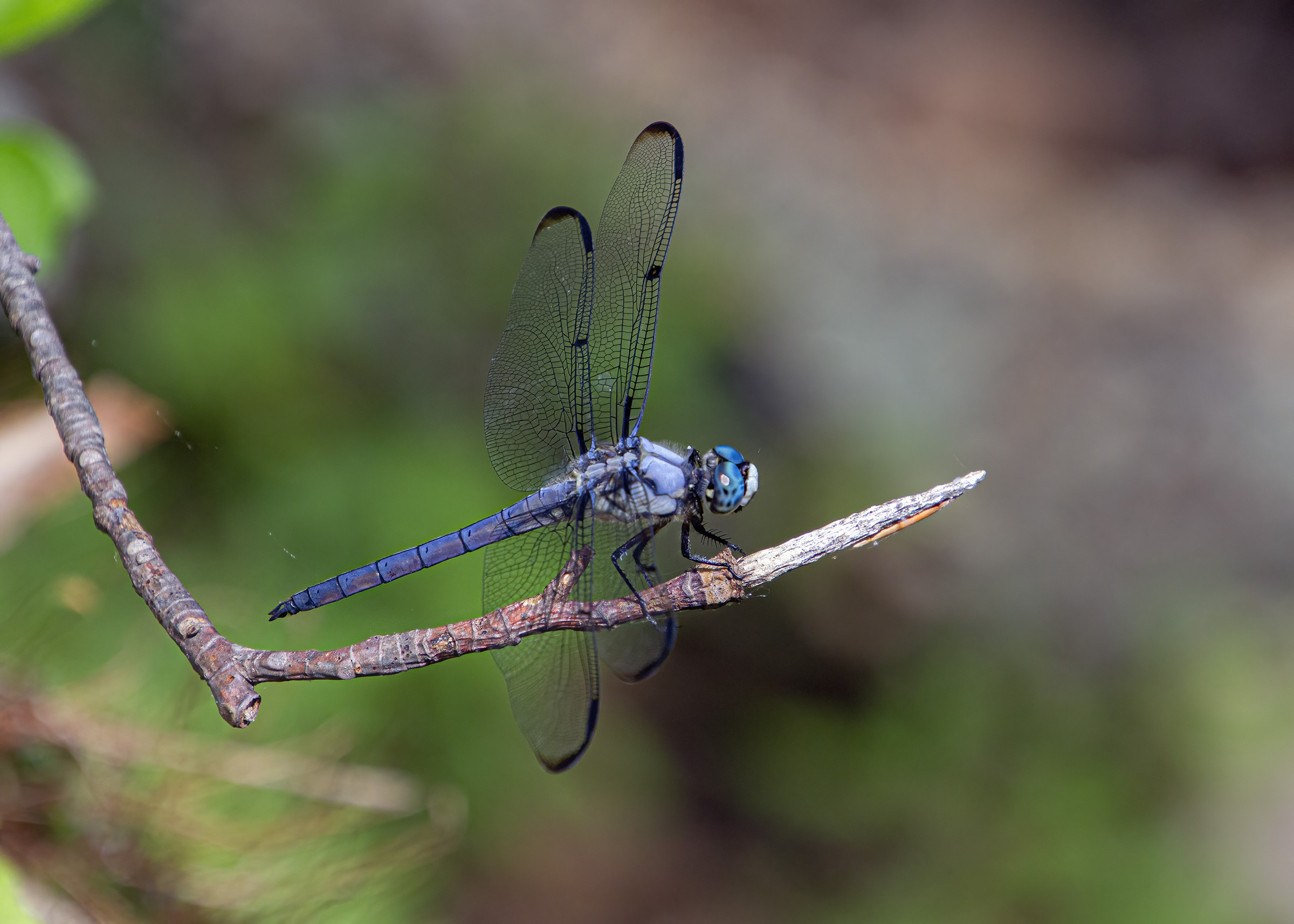
On Monday I played a little game of peekaboo with this Great Blue Skimmer (Libellula vibrans) dragonfly at Occoquan Regional Park. As I approached, the dragonfly hunkered down and was almost hidden from view. I stopped and waited and eventually the Great Blue Skimmer lifted its head, looked right at me, and appeared to smile.

The second shot provides a more traditional view of this species, highlighting its beautiful speckled eyes and white face that help in distinguishing it from other blue dragonflies in our area. Great Blue Skimmers are quite common in my area during the summer, but this was one of first ones that I spotted this year.

Great Blue Skimmer

Great Blue Skimmer

© Michael Q. Powell. All rights reserved.

Read Full Post »

This Gray Petaltail dragonfly (Tachopteryx thoreyi) looked like it was trying to climb a small tree when I spotted it from a distance on Monday at Occoquan Regional Park in Lorton, Virginia. I was happy to be able to capture this shot from the side, because when Gray Petaltails perch flat against a tree, they become virtually invisible—their black and gray coloration causes them to blend in perfectly with the rough bark of a tree.

Gray Petaltail

© Michael Q. Powell. All rights reserved.

Read Full Post »

Dragonfly identification can sometimes be quite difficult—many species, and especially the females of the species, are similar in color and in markings. There are, for example, quite a few blue male dragonflies with females that are yellow and brown, like these Spangled Skimmers (Libellula cyanea) that I spotted last week at Occoquan Regional Park.

Fortunately, however, this dragonfly is quite easy to identify  because of its unique black and white stigmata, the spots on the outer leading edge of each wing. As far as I know, no other dragonfly in our area has bicolor stigmata. The stigmata are not there for decoration, but serve an important role in the flight of dragonflies. I do not really understand the physics of flight, but have read that the stigmata are heavier than the adjoining cells and help to stabilize the vibrations of the wings.

Now that we are into June, I have noticed that most of the summer dragonflies have appeared on the scene. There are a few that I have not yet spotted, but with a little luck I will see (and photograph) them soon.

Spangled Skimmer

Spangled Skimmer

© Michael Q. Powell. All rights reserved.

Read Full Post »

Male dragonflies can be quite aggressive in fighting off potential rivals, but they seem somewhat more tolerant of males from a different species. This past Wednesday I spotted two dragonflies peacefully coexisting and sharing a perch at Occoquan Regional Park.

The dragonfly perched near the top of the branch is a male Spangled Skimmer (Libellula cyanea) and the one perched a bit lower is a male Common Whitetail (Plathemis lydia). I have already seen quite a few Common Whitetails this season, but this Spangled Skimmer was one of the first that I have spotted this yea.

Spangled Skimmer and Common Whitetail

© Michael Q. Powell. All rights reserved.


Read Full Post »

I was delighted this week to spot my first Ebony Jewelwing damselflies (Calopteryx maculata) of the season while I was exploring at Occoquan Regional Park. Members of this species have distinctive dark wings and are generally found in shaded forest streams where the mixed lighting makes it challenging to photograph them.

When things work out, though, I can sometimes get a good shot of one, like this dramatic portrait of a female perched on a sunlit piece of vegetation. Only females have the little white patches (known as pseudostigmas) on their wings that along with their terminal appendages make them easy to identify.

Ebony Jewelwing

© Michael Q. Powell. All rights reserved.

Read Full Post »

I was delighted to spot this cool-looking Brown Spiketail dragonfly (Cordulegaster bilineata) this past Wednesday at Occoquan Regional Park in Lorton, Virginia. I was hoping to get a closer shot, but the dragonfly did not hang around very long before flying away.

Fortunately I was shooting with a relatively long lens—I was at the long end of my Tamron 18-400mm zoom lens—and was able to capture a good deal of detail of the dragonfly, including its stunning two-toned compound eyes. The dragonfly appeared to be barely hanging on to the vegetation when I took this shot, which may partially account for its swift departure.

Brown Spiketail

© Michael Q. Powell. All rights reserved.

Read Full Post »

Over the past week I have spotted Woodland Box Turtles (Terrapene carolina carolina) at two different locations in my local area. The red eyes of both turtles suggest that that they are males, though I have read that eye color is not always 100% accurate in determining the gender of a box turtle. The shell pattern for each box turtle is supposed to be unique, like a fingerprint, and you can definitely see differences in the patterns on the shells of these two turtles.

It is always a treat to spot one of these box turtles, because they are so cool-looking. Unlike many turtles, the box turtle is primarily terrestrial rather than aquatic, and most of the times that I have encountered them, they have been out in the open. According to the Virginia Department of Wildlife Resources (DWR), “The box turtle has a low reproductive rate and is long lived. It requires 10-20 years to reach sexual maturity. Box turtles may sometimes live to over 100 years.”

Virginia has special protections for this species. According to the DWR,  “it is illegal to keep one in your home in Virginia due to the significant number of wild caught animals found in captivity. This species is primarily threatened due to the thousands that are caught for the pet trade from the wild each year; although habitat fragmentation and urbanization also account for a fraction of the population’s drop of 32% over the last 100 years.”

Woodland Box Turtles

Woodland Box Turtle

© Michael Q. Powell. All rights reserved.


Read Full Post »

I spotted this dragonfly during a recent visit to Occoquan Regional Park. I got a glimpse of the markings on its body as it zoomed past me, so I knew that it was a spiketail, but I was not sure about the species. I watched it patrol up and down a small stream and managed to finally get a shot of the dragonfly when it perched momentarily.

It turned out to be a Brown Spiketail (Cordulegaster bilineata), one of several spiketail species that I have seen in the past at this park. During most of my previous encounters with spiketails, they have been perching on vegetation in sunlit areas along a trail.

In this case, the area where the dragonfly was patrolling was mostly in the shade, so it was a real challenge to track and photograph the dragonfly. In case you are curious, I took the photo with my Canon 7D DSLR and my Tamron 18-400mm lens extended to 400mm with settings of ISO 800, F/8.0, and 1/320 sec. The settings were not optimal for getting a shot, but they worked well enough.

Brown Spiketail

© Michael Q. Powell. All rights reserved.

Read Full Post »

A month ago it was easy to spot the early-emerging insects, because very few of them were flying. Now, though, the air is so full of bees, flies, and other aerial creatures that it is a little harder to detect the dragonflies and damselflies that are my primary targets.

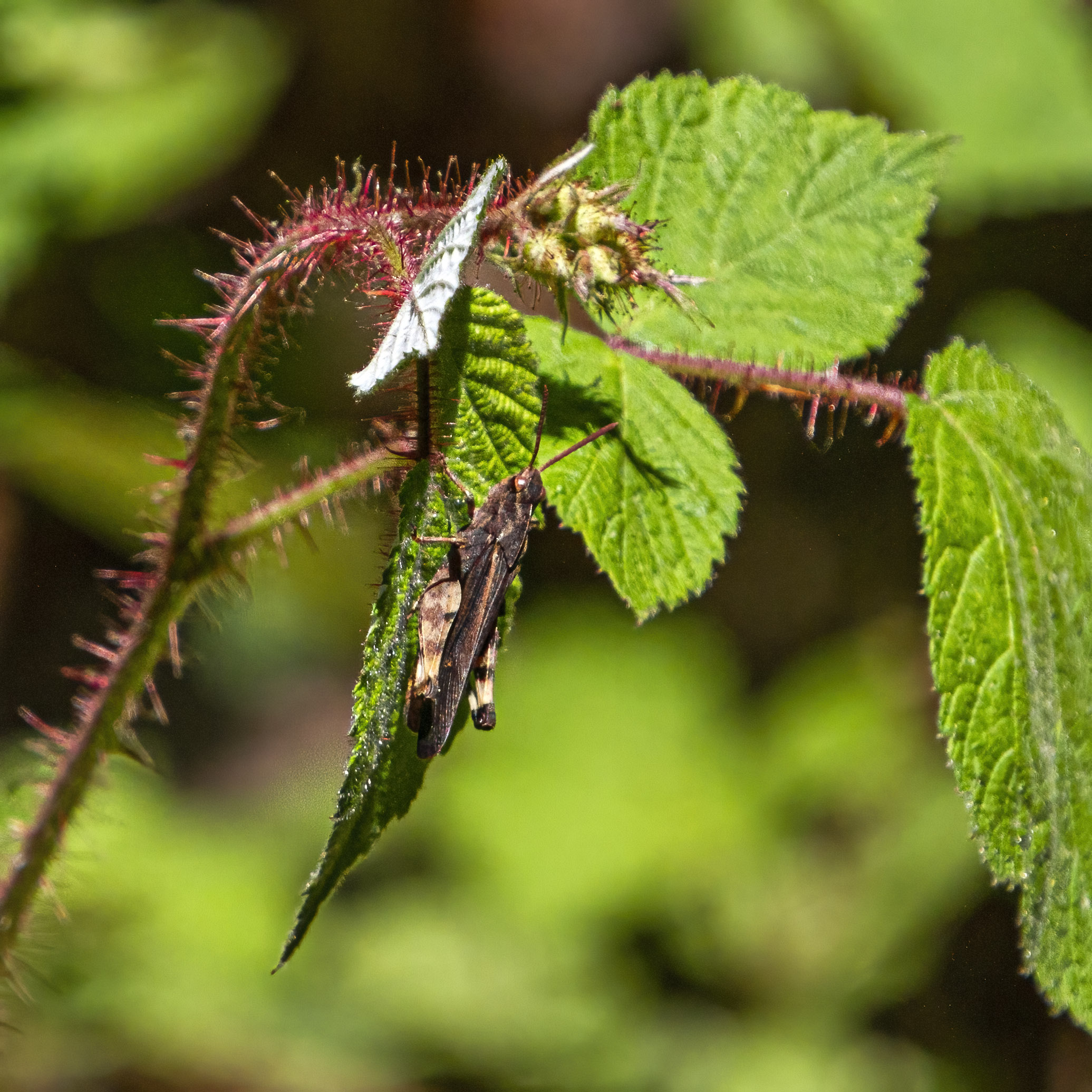
As I walk along grassy paths now, little clouds of grasshoppers burst into the air in front of me. Most of the grasshoppers jump out of sight, but occasionally one will perch on some nearby vegetation and remain immobile, hoping perhaps that I will not see him.  Last week at Occoquan Regional Park I captured a shot of one such grasshopper.

I am definitely not an expert on grasshoppers, so I had to pore over page after page of entries on the internet before I finally concluded that this might be a Green-striped Grasshopper (Chortophaga viridifasciata). Still unsure of the identification, I posted a request for help on the BugGuide website and an expert there confirmed my identification of this grasshopper.

From an aesthetic perspective, I loved the curve of the spiky stem of the plant and my initial instinct was to go for a looser crop of the image, as you can see below in the second photo. However, I realized that viewers could not see the details of the grasshopper, so I made the more zoomed-in version that you can see as the first photo below.

The two images, which are actually just different versions of the same shot, complement each other and serve different functions. The first one focuses more on the grasshopper as the primary subject, while the second one makes the environment a co-star. I like both versions.

Green-striped Grasshopper

Green-striped Grasshopper

© Michael Q. Powell. All rights reserved.

Read Full Post »

Odonata is an order of flying insects that includes dragonflies and damselflies. During the warmer months of the year I spend a lot of time hunting for dragonflies, the larger members of this group of magical creatures, but I also enjoy searching for damselflies, their smaller and more fragile “cousins.”

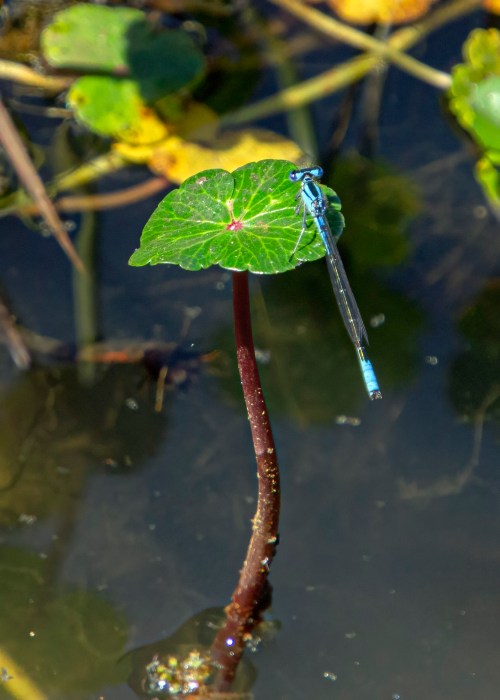
Damselflies, like dragonflies, come in a variety of colors and shapes. Here is a sampling of images of damselflies that I captured this past Thursday during visits to Jackson Miles Abbott Wetland Refuge and Occoquan Regional Park, both of which are located within 15 miles (24 km) of my house.

The first photo shows a Orange Bluet (Enallagma signatum). I am always amused by the name of this species, because it seems incongruous to have an orange-colored member of a genus called American Bluets. Most male bluets are, in fact, blue, but others are orange, scarlet, and burgundy and there is even a “Rainbow Bluet.”

The second image shows a male Azure Bluet (Enallagma aspersum), whose colors are closer to my mental image of a bluet. Most bluets are some combination of blue and black and it can be tricky trying to determine specific species by examining the color patterns on the body and in the eyes.

The third shot is of a male Fragile Forktail (Ischnura posita), one of the first damselflies to emerge each spring. Fragile Forktails are really tiny (about an inch (25 mm) in length, but are relatively easy to identify by their broken shoulder stripe that looks like an exclamation point.

In the final photo I was eye-to-eye with the damselfly so his abdomen is almost completely out of focus. Nonetheless enough details are visible for me to say this is almost certainly a male Eastern Forktail damselfly (Ischnura verticalis).

I like to try to vary my approach to capturing images of most subjects, including damselflies, as you can see in this little collection of photos. Sometimes, as in the first shot, I will try to isolate the subject from its background in order to focus the viewer’s complete attention on the subject. Recently, though, I have developed a preference for including more of the habitat in my shots, as in the second image, in order to give the viewer a sense of the environment in which I took the shot. When possible, I like to attempt to capture some “artsy” shots, like the final image, by using selective focus and choosing carefully my angle of view.

No matter what approach I choose with damselflies, I have to be careful not to fall into the water, where most of these dragonflies were perching. I am not always successful in keeping my feet dry.

Orange Bluet

Azure Bluet

Fragile Forktail

Eastern Forktail

© Michael Q. Powell. All rights reserved.

Read Full Post »

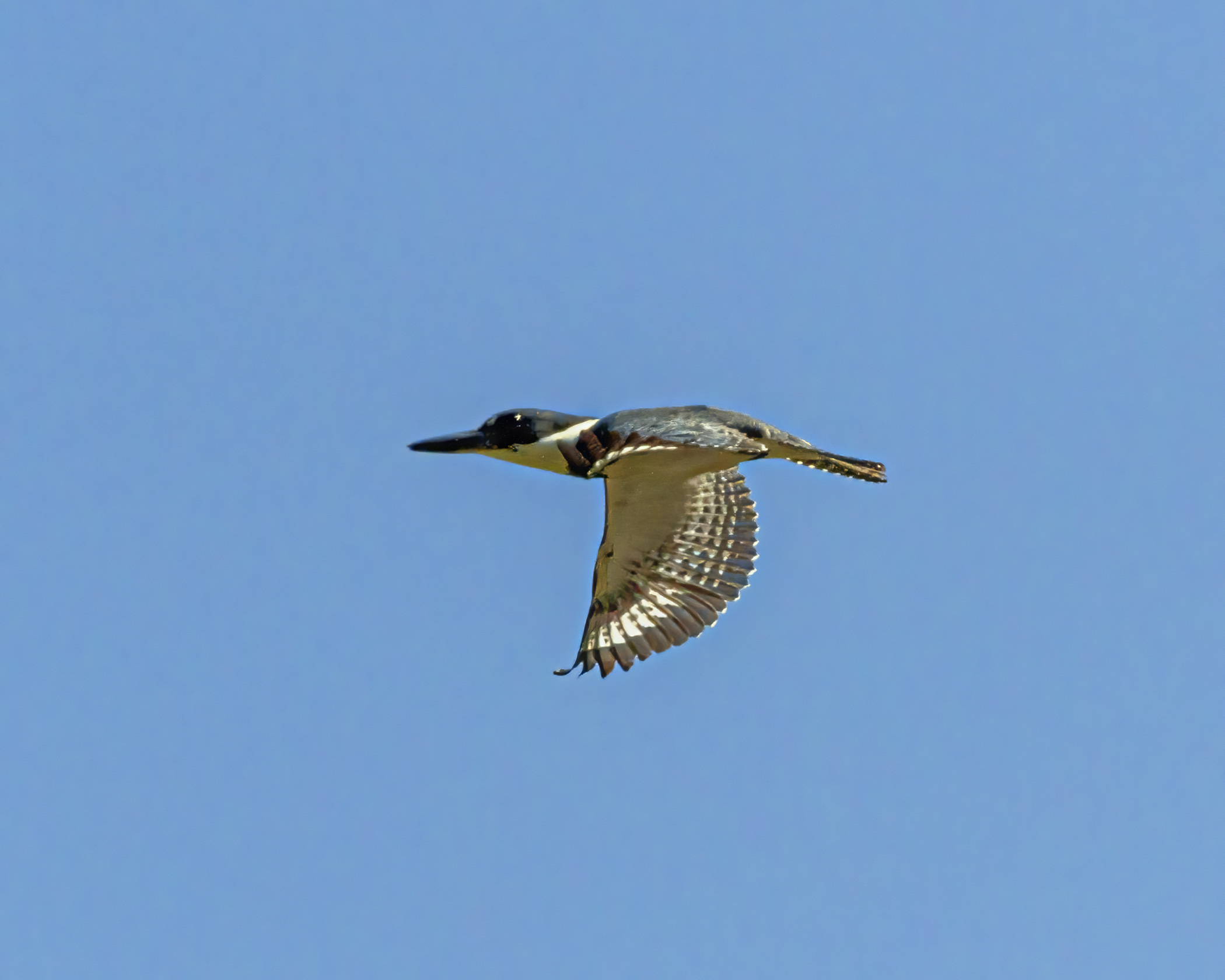
On Monday at Occoquan Regional Park, I was thrilled to capture some shots of this male Belted Kingfisher (Megaceryle alcyon) as he flew by me overhead. Kingfishers are really skittish and quite often I am aware of their presence of these speedy little birds when I hear their rattling call as they fly away from me. This kingfisher, however, flew across my field of view, which allowed me to track it and focus on it as it passed.

How do I know this is a male kingfisher? Normally male birds are more colorful than their female counterparts, but that is not true for Belted Kingfishers—females have a chestnut-colored band across their chests that the males do not have.

Belted Kingfisher

Belted Kingfisher

© Michael Q. Powell. All rights reserved.

Read Full Post »

What is your first reaction when you see a snake? If you are like many people, you turn and run away as fast as you can. My reaction is generally the opposite one—I move closer to the snake, either physically or with a zoom lens, in order to get a more detailed look at it. Most of the snakes in our area are non-poisonous, but I still remain very cautious, because some of them will strike and/or bite.

On Monday I spotted a large black snake in the vegetation at Occoquan Regional Park. As I started to get a little closer, it began to vibrate its entire body and the dried leaves helped to create a rattling kind of sound. Yikes! I decided that I was close enough to get a few shots. Usually the black snakes that I encounter are ratsnakes, but this one turned out to be a Northern Black Racer (Coluber constrictor constrictor). The two species of snakes are somewhat similar in appearance, but the scales of the black racer are smoother and more shiny in appearance.

I decided to check out the website of the Virginia Herpetological Society for more information on the black racer and was surprised to learn that “Coluber constrictor does not constrict, as the scientific name implies, but pins its prey with body loops and swallows it alive.”

The website also noted that “Coluber constrictor has a catholic diet,” which caused me to do a double take. I grew up in a predominantly Roman Catholic neighborhood and tend to associate the word “catholic” with that church, so I immediately wondered how the snake determined the religious preferences of its victims. When a sense of reality returned to me, I remembered that “catholic” with a small initial letter simply means “universal,” so that statement probably just means that the black racer has a wide-ranging diet.

Ever curious, I wondered why this species is called a “racer.” Do they compete in competitions? The herpetological society provided the following information about the snake’s hunting habits:

“Northern Black Racers are active, diurnal predators that use vision to search for prey. Coluber constrictor actively forages with the forepart of the body raised off the ground and the head held horizontally searching for prey. They will seek escape by swiftly moving to thick grass cover or into a burrow entrance…Because they are active snakes that widely search for prey, they have large home ranges. Movements of up to 1.6 km have been recorded.”

My apologies to those readers who are creeped out by photos of snakes. I find then to be as fascinating as the more traditionally “beautiful” creatures that I often feature.

black racer

black racer

© Michael Q. Powell. All rights reserved.

Read Full Post »

On Monday I spotted this cool little butterfly at Occoquan Regional Park in nearby Lorton, Virginia. I was a little surprised to learn that it is a Falcate Orangetip butterfly ( (Anthocharis midea), given that the butterfly has not a single visible spot of orange. Apparently only the males have the orange tips for which the species is named and this one is a female.

When I first spotted this tiny butterfly flying about, I assumed that it was a Cabbage White. However, I quickly noticed the colored pattern on the outside of the wings and realized that my initial impression were wrong—Cabbage Whites are all white except for some black spots. When I looked even closer I noticed the butterfly’s gray eyes and scallop-edged wings, unlike the Cabbage Whites that have green eyes and more even-edged wings.

Falcate Orangetip

© Michael Q. Powell. All rights reserved.

Read Full Post »

A small group of Common Green Darner dragonflies (Anax junius) was active on Monday at Occoquan Regional Park, including a couple that, after mating, was depositing eggs in the floating vegetation. The male (the one with the blue abdomen) holds onto the female while she does the actual work and then they fly off together still attached in the “tandem” position to another patch of vegetation.

Common Green Darners are a migratory species and I suspect that these particular dragonflies were part of that migration. Most people are aware of the migratory pattern of Monarch butterflies, but are unaware of the fact that Common Green Darners follow a similar pattern. The Science News website provides a good overview of that migration.

“At least three generations make up the annual migration of common green darner dragonflies. The first generation emerges in the southern United States, Mexico and the Caribbean starting around February and flies north. There, those insects lay eggs and die, giving rise to a second generation that migrates south until late October. (Some in that second generation don’t fly south until the next year, after overwintering as nymphs.) A third generation, hatched in the south, overwinters there before laying eggs that will start the entire process over again.”

I was quite fortunate that the patches of vegetation where the dragonflies were depositing the eggs were relatively close to the edge of the pond, so I was able to capture the shots of the dragonflies in action. The second shot was one that I snapped as the couple zoomed by—long-time readers of my blog know that I love to try to capture images of dragonflies while they are flying.

The final image shows one a male Common Green Darner that was flying all around the small pond, searching for food or a mate (or maybe both). It is a fun challenge to try to track and photograph a dragonfly in flight and I felt a little rusty after spending the winter photographing birds. I was therefore quite thrilled when this shot turned out so well. Some newer mirrorless cameras have tracking systems that lock focus on moving subjects, but my trusty Canon 7D DSLR has 2009 technology, so it is a little trickier for me to get shots in—it is definitely a “hands-on” process.

Common Green Darner

Common Green Darner

Common Green Darner

Common Green Darner

© Michael Q. Powell. All rights reserved.

Read Full Post »

Older Posts »