Feeds:
Posts
Comments

Posts Tagged ‘Occoquan Bay National Wildlife Refuge’

It was windy yesterday at Occoquan Bay National Wildlife Refuge, but that did not deter some American Goldfinches (Spinus tristis) from foraging for seeds in the spiky seedpods still hanging from the leafless Sweetgum Trees (Liquidambar styraciflua). The goldfinches were amazing daring and acrobatic in their efforts high in the trees to extract the seeds.

It is a testament to the strength of the stems of the seedpods and the light weight of the goldfinches that the birds were able to place all of their weight on hanging seedpods and poke into their perches with their pointed beaks, as you can see in the first image. The final image shows that the finches knew that there were seeds throughout the seedpods and were willing to turn upside down to reach some additional seeds.

American Goldfinch

American Goldfinch

American Goldfinch

© Michael Q. Powell. All rights reserved.

Read Full Post »

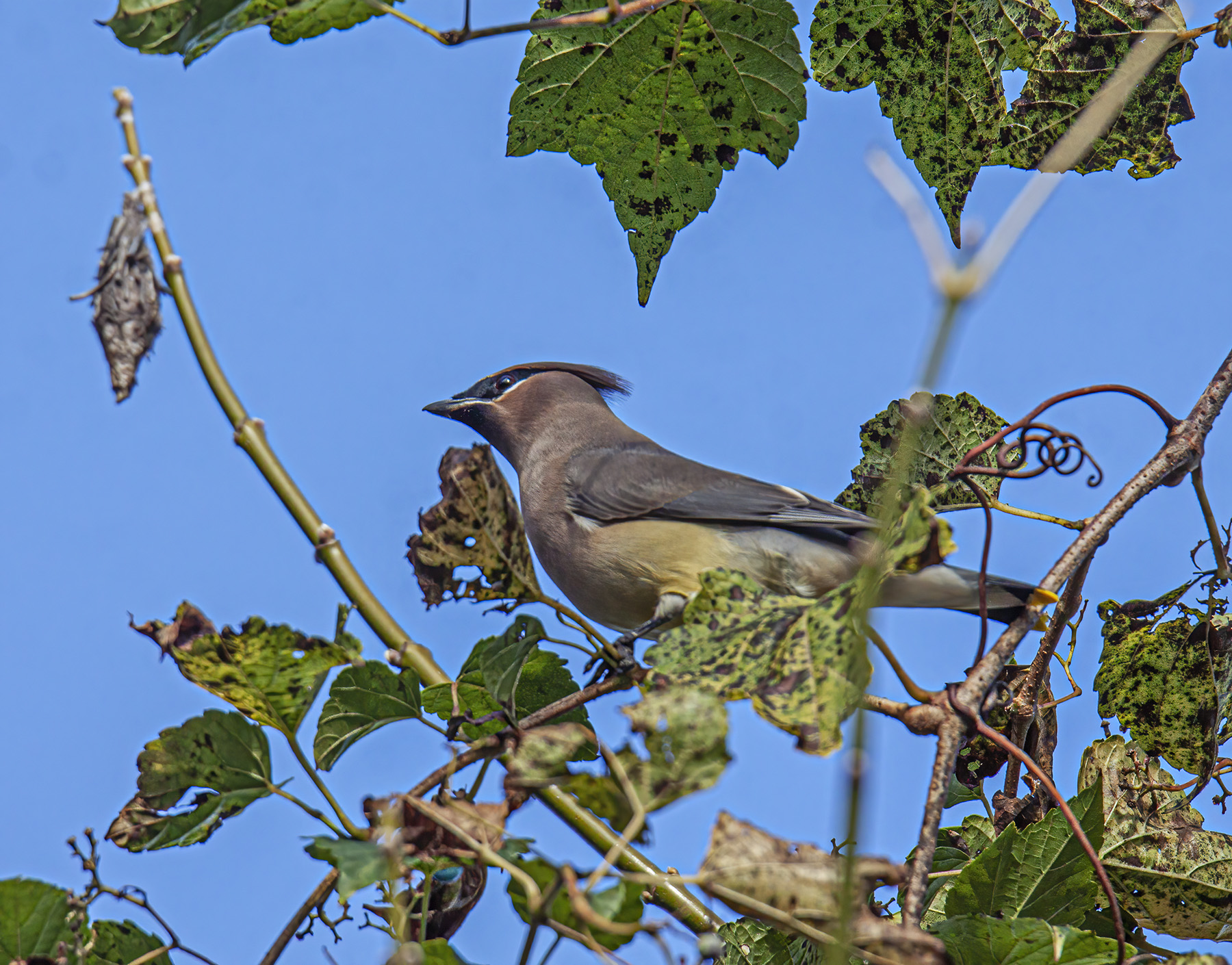
Not long ago I posted some shots of Cedar Waxwings (Bombycilla cedrorum) foraging for berries. In many of those shots, however, the beautiful birds were partially obscured by vegetation. On Monday this past week I managed to get a clearer view of a Cedar Waxwing at Occoquan Bay National Wildlife Refuge and captured this portrait image.

I really like the fact that this image shows the distinctive shape of this bird and its wonderful coloration. From top of its crested head to its yellow-tipped tail, the Cedar Waxwing is one of the most photogenic birds that I am privileged to photograph.

Cedar Waxwing

© Michael Q. Powell. All rights reserved.

Read Full Post »

The sun had just risen over the horizon as I started walking down a trail on Monday morning at Occoquan Bay National Wildlife Refuge. I noticed a dark shadow at the edge of the trail and slowed down. When I got a little closer, I could see that it was a small White-tailed Deer (Odocoileus virginianus). There are probably quite a few deer at the wildlife refuge, but I rarely see one.

The deer sensed my presence, raised its head, and stared right at me with what looked to be mostly curiosity. Our eyes remained fixed on each other for quite some time before the deer crossed the path and disappeared silently in the underbrush.

White-tailed Deer

© Michael Q. Powell. All rights reserved.

Read Full Post »

The remaining leaves on the trees and other vegetation complicate my efforts to get clear shots of the numerous Yellow-rumped Warblers (Setophaga coronata) that I have seen and heard during my recent trips to Occoquan Bay National Wildlife Refuge. On Monday, however, I manage to capture two images of these colorful little birds, the only warblers that stay with us throughout the winter.

It is always a delight to catch sight of the colorful patches of yellow feathers on these birds. The second image shows the yellow rump that is responsible for the name of this species that is affectionately known to birdwatchers as “butterbutts.”

Yellow-rumped Warbler

Yellow-rumped Warbler

© Michael Q. Powell. All rights reserved.

Read Full Post »
I do not see Raccoons (Procyon lotor) very often at Occoquan Bay National Wildlife Refuge, so it was quite a treat when I spotted this one on Monday.  The raccoon was leisurely making its way across the leaf-covered trail and I was happy to capture this image while it was mid-stride.

At a time when most of us are wearing masks that cover our noses and mouths, this is the second wild creature that I have seen recently with a black eye mask—I previously featured masked Cedar Waxwings in a posting entitled Cedar Waxwings in November.

raccoon

© Michael Q. Powell. All rights reserved.

Read Full Post »

I was thrilled on Monday at Occoquan Bay National Wildlife Refuge to see this handsome Hermit Thrush (Catharus guttatus), another one of our winter visitors. The Cornell Lab of Ornithology describes the Hermit Thrush in these words—”An unassuming bird with a lovely, melancholy song, the Hermit Thrush lurks in the understories of far northern forests in summer and is a frequent winter companion across much of the country.” Wikipedia notes that “the hermit thrush’s song has been described as “the finest sound in nature” and is ethereal and flute-like, consisting of a beginning note, then several descending musical phrases in a minor key, repeated at different pitches.”

When I first spotted the bird, I thought it might be an American Robin, because of the shape of its body and bill. The American Robin is also in the greater thrush family, but close examination showed that “my” bird lacked the reddish-orange breast color of the robin and had instead a distinctive pattern similar to that of some sparrows.

Hermit Thrush

© Michael Q. Powell. All rights reserved.


Read Full Post »

The crows were making a racket yesterday morning at Occoquan Bay National Wildlife Refuge and I wondered if they were harassing a raptor. Even though they are a lot smaller than most hawks, eagles, and owls, crows are fearless in their efforts to force the much larger birds to leave their area.

As I walked down the trail scanning the trees, I spotted the bright underside and tail of a large bird that looked to be hiding. Rather than perching upright, the bird seemed to be perching horizontally. I approached as stealthily as I could and eventually managed to get almost directly underneath the the bird, which I believe is a Red-shouldered Hawk (Buteo lineatus). The hawk looked straight down at me with a look of mild disapproval. I managed to capture this image in the seconds before the beautiful bird reluctantly took off.

Red-shouldered Hawk

© Michael Q. Powell. All rights reserved.

Read Full Post »
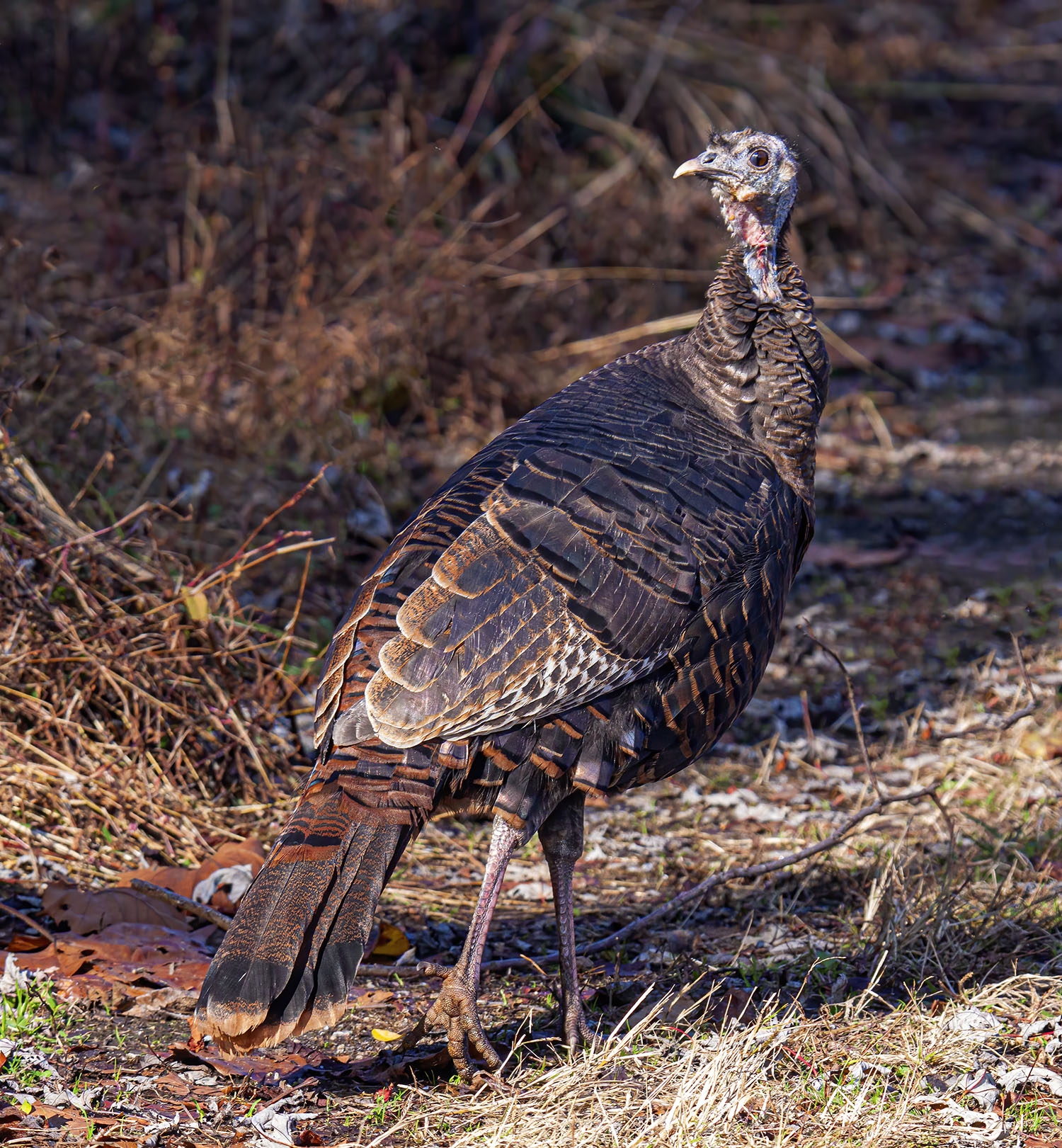
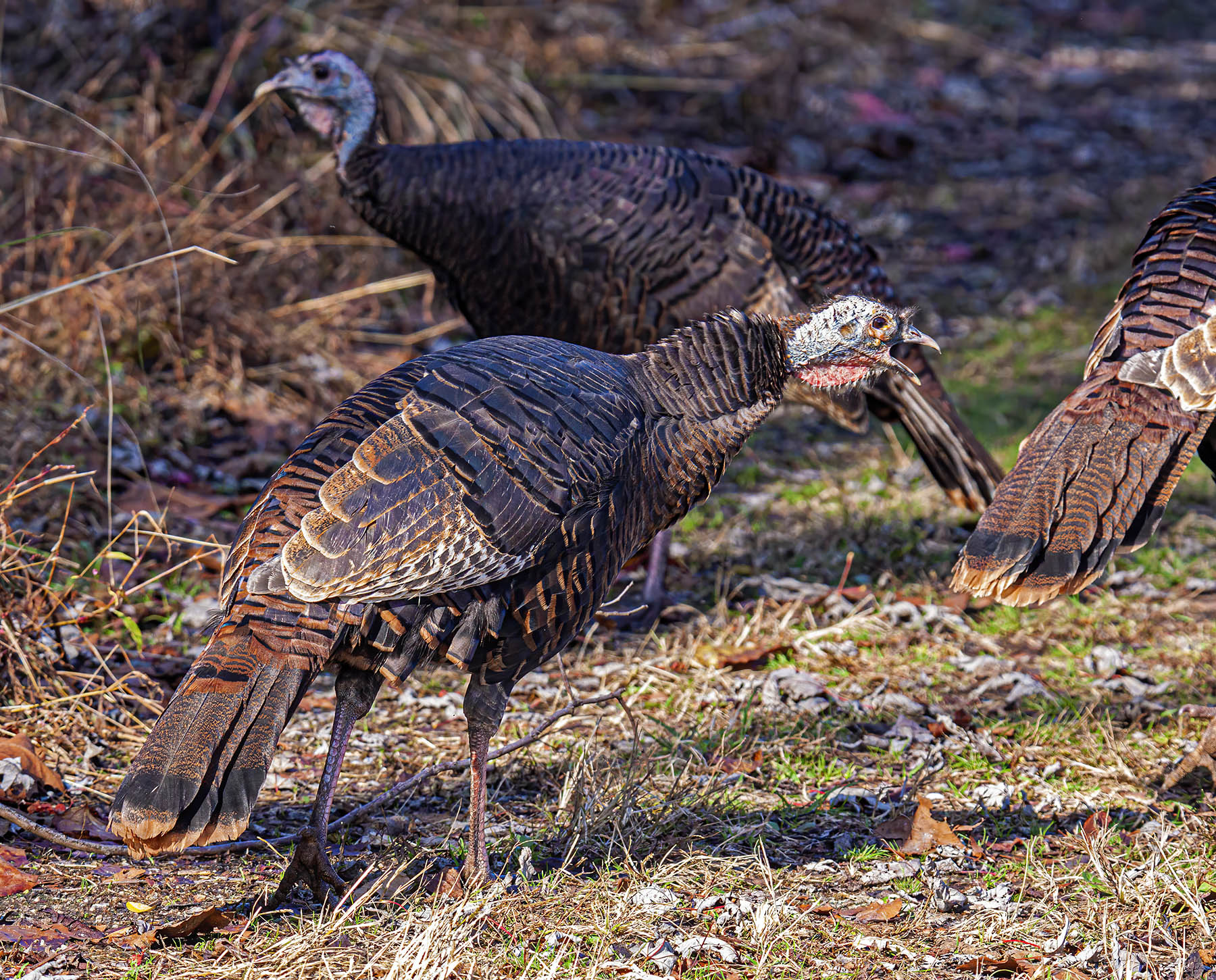
On Friday I spotted a flock of Wild Turkeys (Meleagris gallopavo) at Occoquan Bay National Wildlife Refuge. At least one of them was not very happy—perhaps the turkey knew that Thanksgiving Day is fast approaching.

The turkeys were all clustered together, so it was impossible to isolate one for a cleaner shot. I was happy, though, to be able to capture the beautiful coloration and patterns of the turkeys’ feathers.

wild turkey

© Michael Q. Powell. All rights reserved.

Read Full Post »

Most sparrows are brown in color, but as winter approaches slate-colored  Dark-eyed Juncos (Junco hyemalis) move into our area from locations farther north. This past Friday I spotted a small flock of juncos at Occoquan Bay National Wildlife Refuge poking about on the ground and low in the trees and managed to capture a few clear shots of juncos.

The second shot shows quite clearly the color pattern that I generally associate with juncos—mostly gray with a white belly. On the west coast of the US, however, juncos have a dark brown hood, light brown back, and a white belly.


Dark-eyed Junco

Dark-eyed Junco

© Michael Q. Powell. All rights reserved.

Read Full Post »

The foliage partially blocked my approach to this Bald Eagle (Haliaeetus leucocephalus) this past Tuesday at Occoquan Bay National Wildlife Refuge and I was able to sneak up pretty close to it. In fact, I was standing almost directly below the tree in which the eagle was perched when I captured the second shot. Although my view was partially obstructed, I was thrilled to capture these images of this majestic bird.

Bald Eagle

Bald Eagle

© Michael Q. Powell. All rights reserved.

Read Full Post »
Many birds are pretty, but few are as sleek and stylish as Cedar Waxwings (Bombycilla cedrorum). I love their rakish black masks, slicked-back hair, and yellow-tipped tails.

I spotted a small flock of these wonderful birds on Tuesday at Occoquan Bay National Wildlife Refuge, acrobatically snagging berries high in the trees. In the final photo, a Cedar Waxwing was upside-down as it reached for some colorful porcelain berries, a plant that is considered an invasive species in our area.

Cedar Waxwing

Cedar Waxwing

Cedar Waxwing

© Michael Q. Powell. All rights reserved.

Read Full Post »

Normally when I see a Bald Eagle (Haliaeetus leucocephalus) catch a fish, it is a grab-and-go affair. The eagle reaches out with extended talons, pulls the fish from the surface of the water, and keeps flying.

Yesterday at Occoquan Bay National Wildlife Refuge, the scene was quite different. I spotted an eagle flying low over the water and watched as the eagle went deep into the water feet-first. I was shocked when the eagle was briefly submerged. It made multiple unsuccessful attempts to lift itself out of the water before it ultimately managed to fly away.

What was the problem? I have heard of cases when the eagle snagged a fish that was too heavy to lift. I have also seen videos of eagles swimming to shore with large fish. This eagle was far from shore, so that was not really an option here. I wonder if perhaps the fish was stuck in vegetation and the eagle had somehow gotten its talons entangled. As I look at the final photo, I am not able to tell if the eagle has its prey, but by the time the eagle was airborne, the talons were empty.

Bald Eagle

Bald Eagle

Bald Eagle

© Michael Q. Powell. All rights reserved.

Read Full Post »
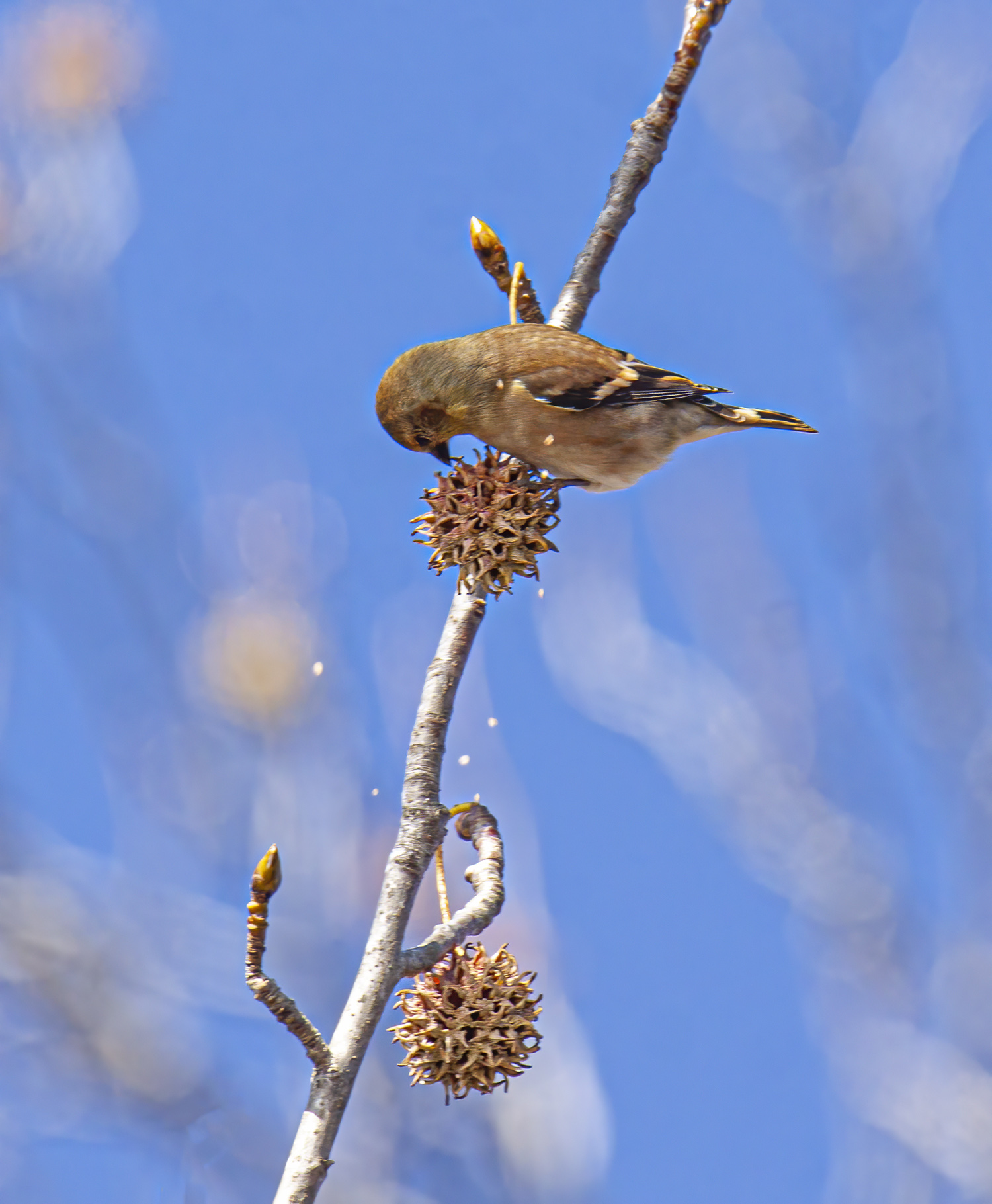
When I caught a glimpse of the body of this bird at Occoquan Bay National Wildlife Refuge last week, I initially thought it was some kind of sparrow. However, even though I was shooting into the light, I could see that its head was read. What could it possibly be?

Some experts in a Facebook birding forum informed me that it is an immature male House Finch (Haemorhous mexicanus). According to Wikipedia, this species was originally only a resident of Mexico and the southestern United States. It was introduced to eastern North America in the 1940s when the birds were sold illegally in New York City as “Hollywood Finches.” To avoid prosecution under the Migratory Bird Treaty Act of 1918, vendors and owners released the birds into the wild and they have since become naturalized in largely unforested land across the eastern U.S.

House Finch

© Michael Q. Powell. All rights reserved.

Read Full Post »

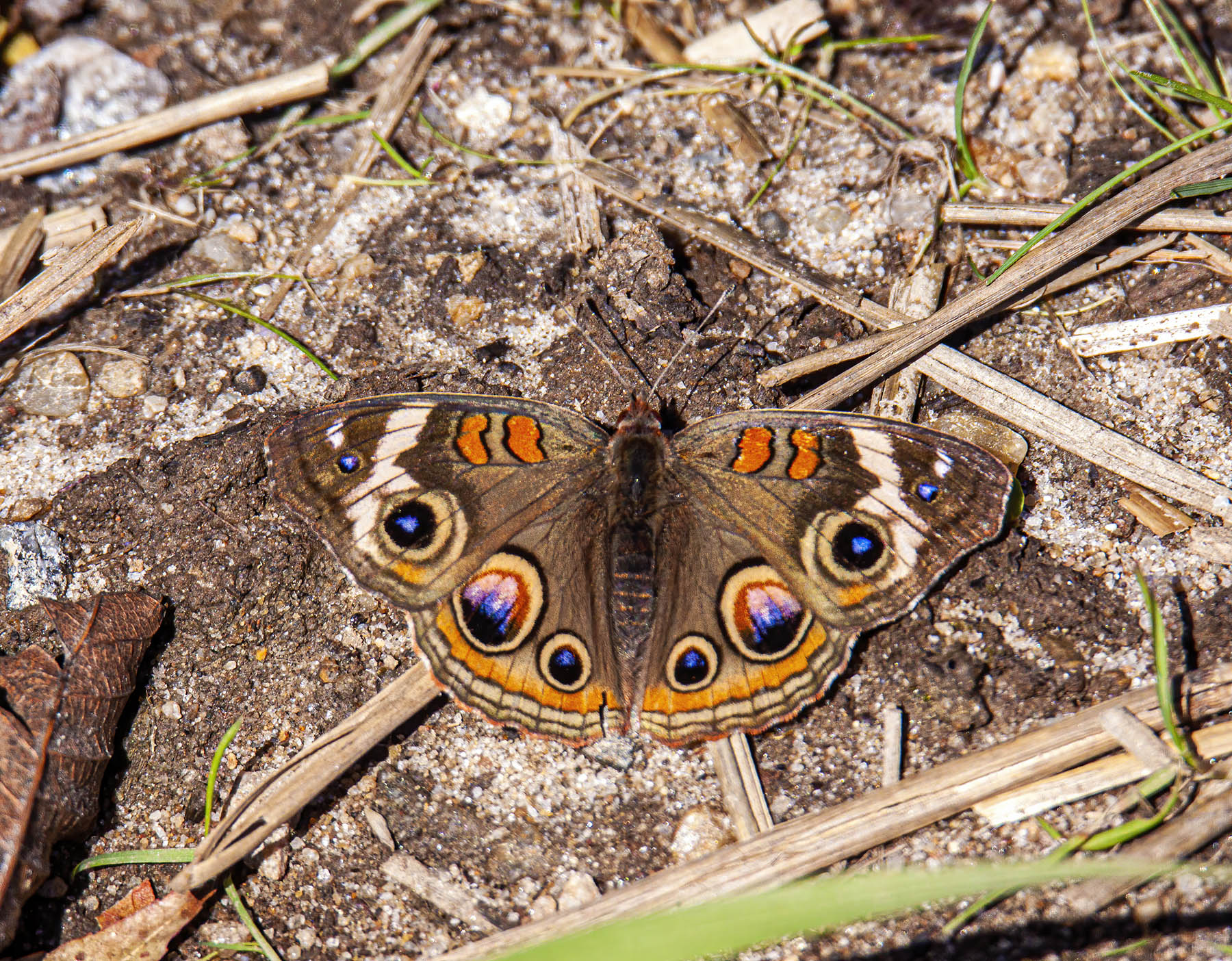
There are still a few butterflies flying around, like this beautiful Common Buckeye (Junonia coenia) that I spotted last week at Occoquan Bay National Wildlife Refuge. Unlike most other butterflies that I have seen late in the season that were faded and tattered, this one seemed to be in perfect condition. As several of my Facebook friends noted, there is nothing “common” about the beauty of this butterfly.

Common Buckeye

© Michael Q. Powell. All rights reserved.

Read Full Post »

This Eastern Bluebird (Sialia sialis) was totally focused on a single remaining berry when I spotted it last Wednesday at Occoquan Bay National Wildlife Refuge. The “prize” seems modest, but this little bird was determined. I believe it was successful in achieving its goal.

Eastern Bluebird

© Michael Q. Powell. All rights reserved.

Read Full Post »

In addition to the large raft of American Coots (Fulica americana) that I spotted in the waters off of Occoquan Bay Wildlife Refuge last week and featured in a posting entitled A raft of coots, I also saw three coots near to the shore swimming around in a little circle like they were lost. I do not know if they had somehow gotten separated from the group, but they struck me as being very vulnerable—as several readers have noted, coots are vulnerable to being picked off by bald eagles.

This close-up shots highlight some of the notable characteristics of this species, including their red eyes and their legs that are placed rather far back on their bodies, making walking a bit of a challenge.

American Coot

© Michael Q. Powell. All rights reserved.

Read Full Post »

It is a bit of a cliché, but I have to admit that bluebirds really do make me feel happy. I was therefore absolutely delighted to spot a small flock of them flitting in and out of the vegetation on Wednesday at Occoquan Bay National Wildlife Refuge. The rusty color on the breasts of these Eastern Bluebirds (Sialia sialis) fit in well with the fall foliage palette.

These three images show different approaches I used in trying to capture images of these beautiful little birds. Sometimes I tried to take shots when the blue birds were almost imbedded in the vegetation; sometimes I tried to get an unobstructed angle with the natural landscape providing a visual backdrop for the bird; and sometimes I tried to isolate the bird and use an uncluttered background such as the sky in the final photo.

I am not sure that any of these three approaches is necessarily better than the others. Instead I personally like the visual variety that comes from using somewhat different approaches when shooting a subject. What do you think?

Eastern Bluebird

Eastern Bluebird

Eastern Bluebird

© Michael Q. Powell. All rights reserved.


Read Full Post »

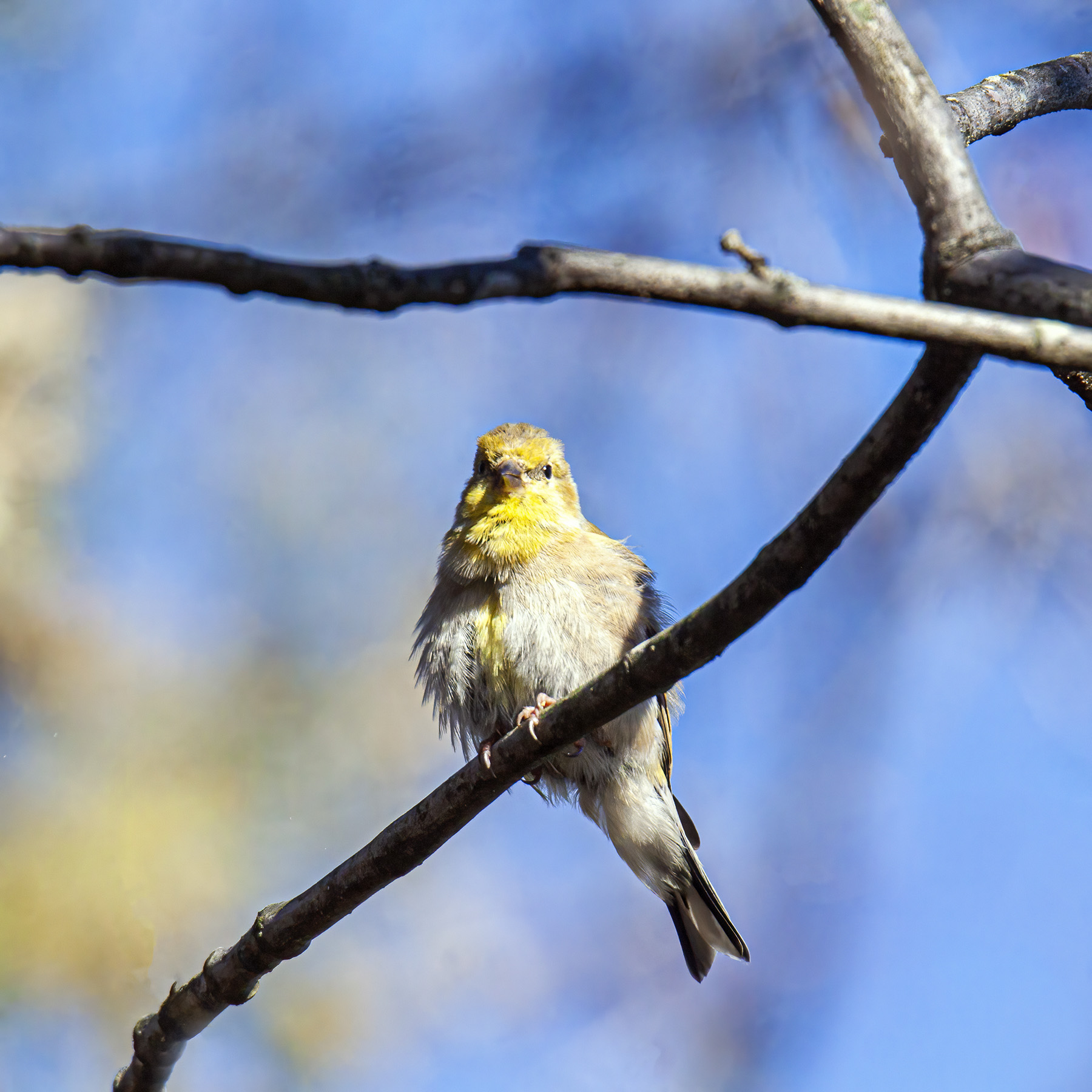
I was happy to spot this somewhat scruffy looking American Goldfinch (Spinus tristis) as I wandered the trails at Occoquan Bay National Wildlife Refuge yesterday seeking a respite from election news coverage. As is often the case, nature served as a soothing balm to calm my anxieties and reestablish my internal balance.


American Goldfinch

American Goldfinch

© Michael Q. Powell. All rights reserved.


Read Full Post »

I was excited to spot this beautiful Palm Warbler (Setophaga palmarum) last Friday at Occoquan Bay National Wildlife Refuge. I had more or less given up on seeing any warblers except for Yellow-rumped Warbler, which will remain with us for a while, so this was a pleasant surprise. The little bird was full of energy and shortly after it leaned forward a little, as you can see in the second image, it flew to a more distant part of the field in which it was foraging.

Palm Warbler

Palm Warbler

© Michael Q. Powell. All rights reserved.

Read Full Post »

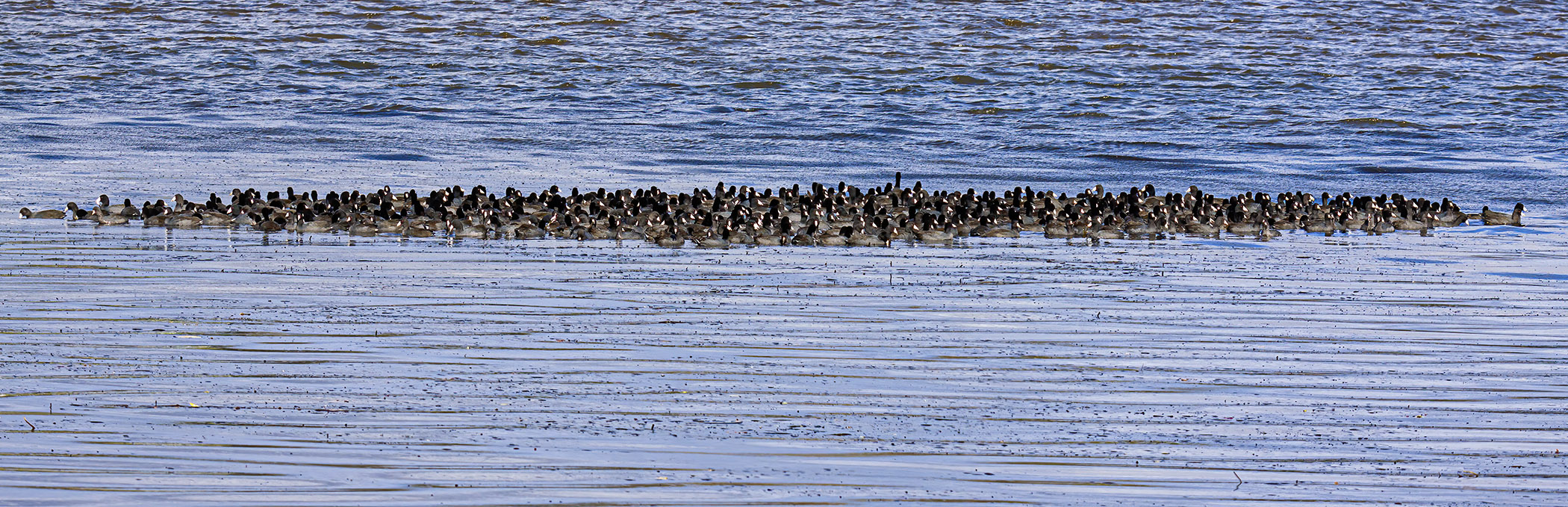
Normally when I see American Coots (Fulica americana) I see only a few of them at a time, but last Friday I spotted a whole raft of them in the waters off of Occoquan Bay National Wildlife Refuge. They seemed to be of mixed ages, not just old coots like me.

I zoomed out with my 150-600mm lens to capture the whole raft and then zoomed in to capture some details. I recommend that you double-click on the images, especially the second one, to see wonderful details, like all of the red eyes. There seem to be a number of different colored beaks in the group, suggesting the possibility that there are some other species mixed in, though it appears to be mostly coots.

American Coots

American Coots

© Michael Q. Powell. All rights reserved.

Read Full Post »

I spotted this bird from a distance on Friday at Occoquan Bay National Wildlife Refuge when it was perched and when it took to the air. The tail struck me as being exceptionally long and the wings seemed relatively short in length, so I decided it was probably not a Red-shouldered Hawk or a Red-tailed Hawk, the two most common hawks where I live. Was it a falcon or one of the smaller hawks?

As I usually do in situations like this, I asked for help in a Facebook group devoted to birding in Virginia. Some experts there identified this as a mature Cooper’s Hawk (Accipiter cooperii). The Cornell Lab of Ornithology described the species with these words, “Among the bird world’s most skillful fliers, Cooper’s Hawks are common woodland hawks that tear through cluttered tree canopies in high speed pursuit of other birds…Finding a Cooper’s Hawk is typically a matter of keeping your eyes peeled – they’re common but stealthy, and smaller than other common hawks like the red-tailed, so your eye might skip over them in flight.”

Cooper’s Hawks are about the size of crows, although males are significantly smaller than their mates. Mating can therefore be a tricky proposition for a male Cooper’s Hawk, given that females Cooper’s Hawks specialize in eating smaller birds.

Cooper's Hawk

Cooper's Hawk

© Michael Q. Powell. All rights reserved.


Read Full Post »
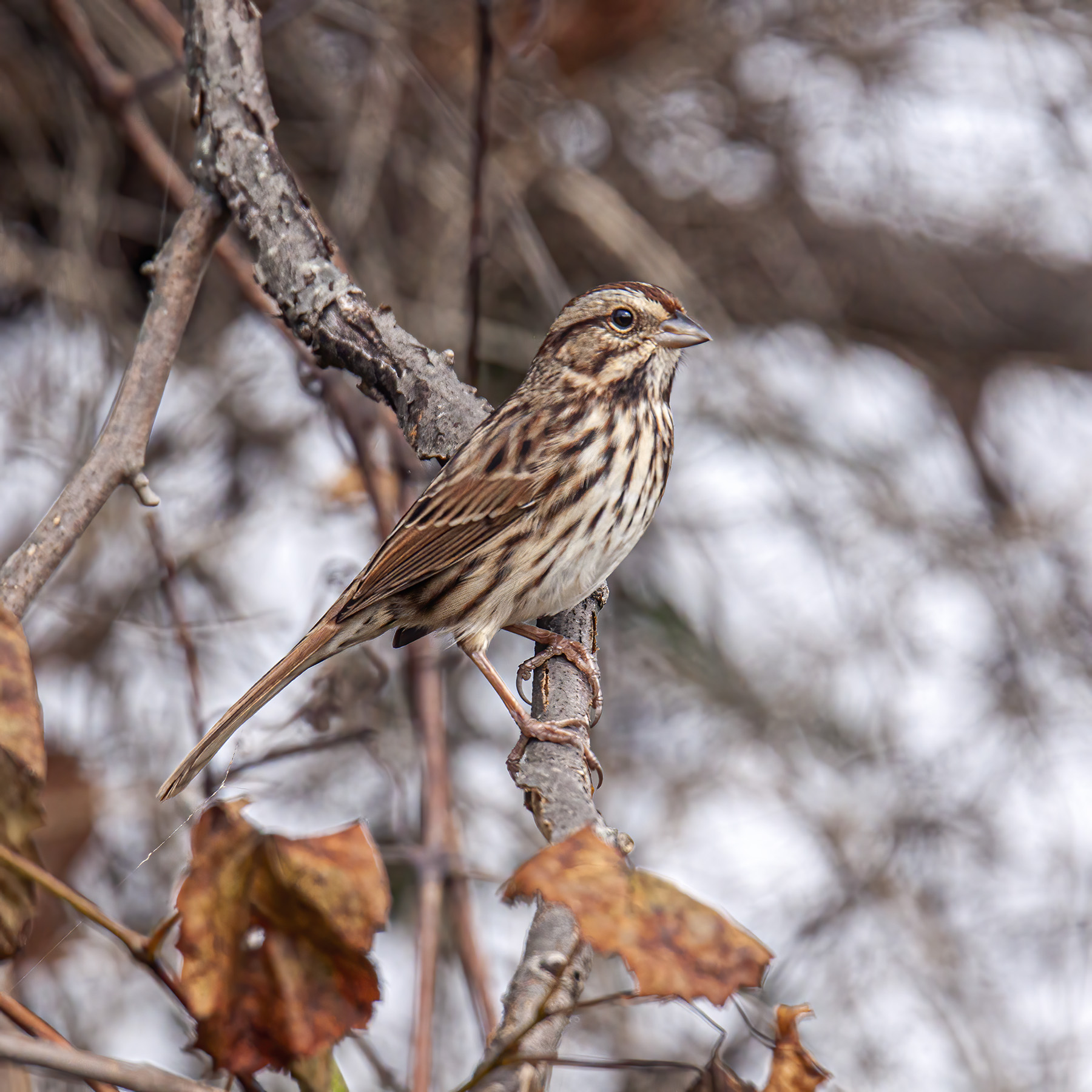
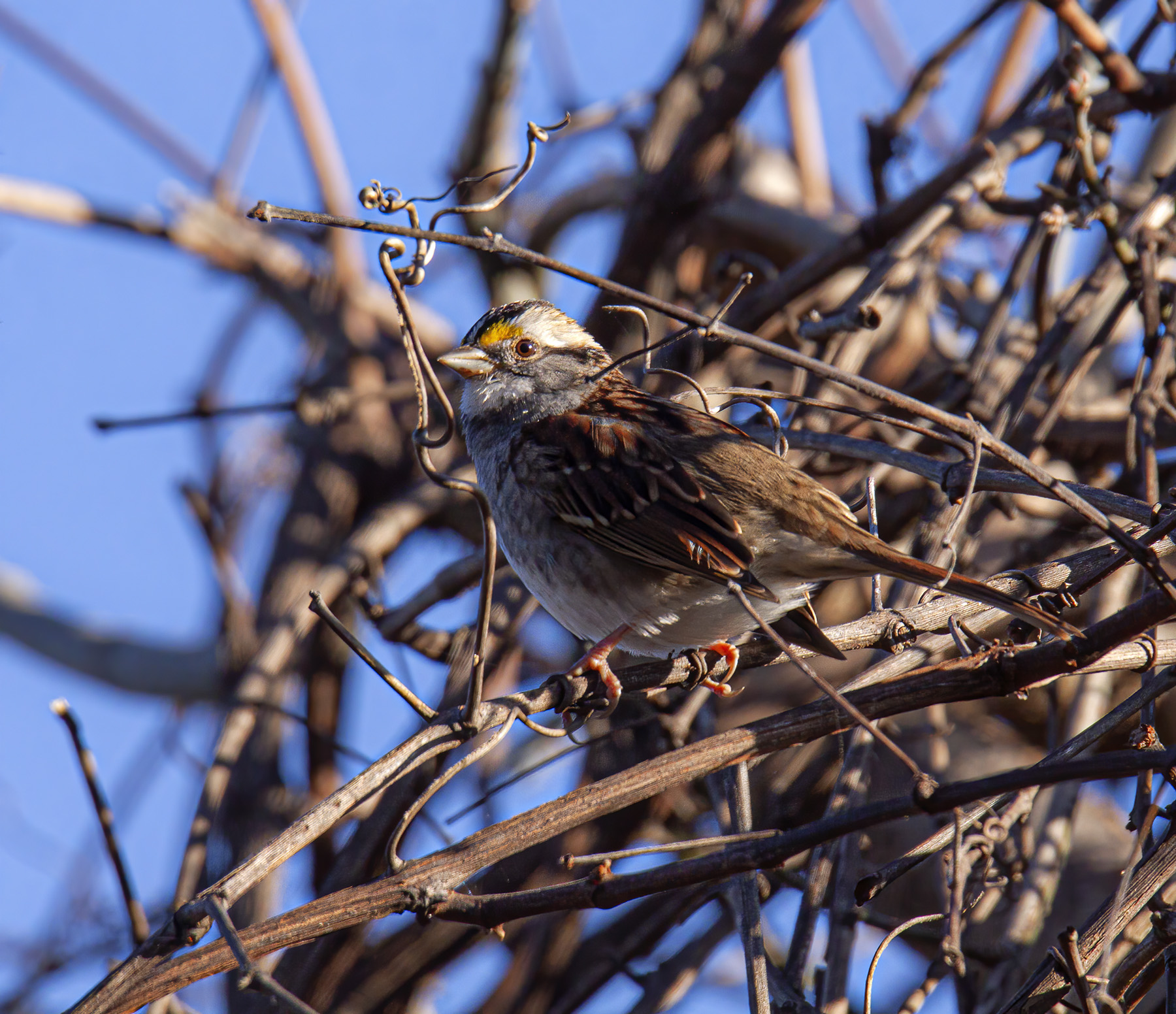
When I first started photographing birds, all sparrow looked the same to me—they were all nondescript little brown birds. Over time I have come to appreciate the subtle variations in color and markings that help to differentiate the species, although identification is still a bit of a hit-or-miss proposition for me.

I spotted this handsome sparrow on Monday as I was exploring at Occoquan Bay National Wildlife Refuge. I believe that it is a Song Sparrow (Melospiza melodia), one of the relatively common sparrow species where I live. I really like the sparrow’s perch and the fact that it includes some of the dried leaves that will soon be falling from the branch. The white skies in the background give this image an almost wintry feel, though it is way too early for me to be even thinking of snow.

Song Sparrow

© Michael Q. Powell. All rights reserved.

Read Full Post »

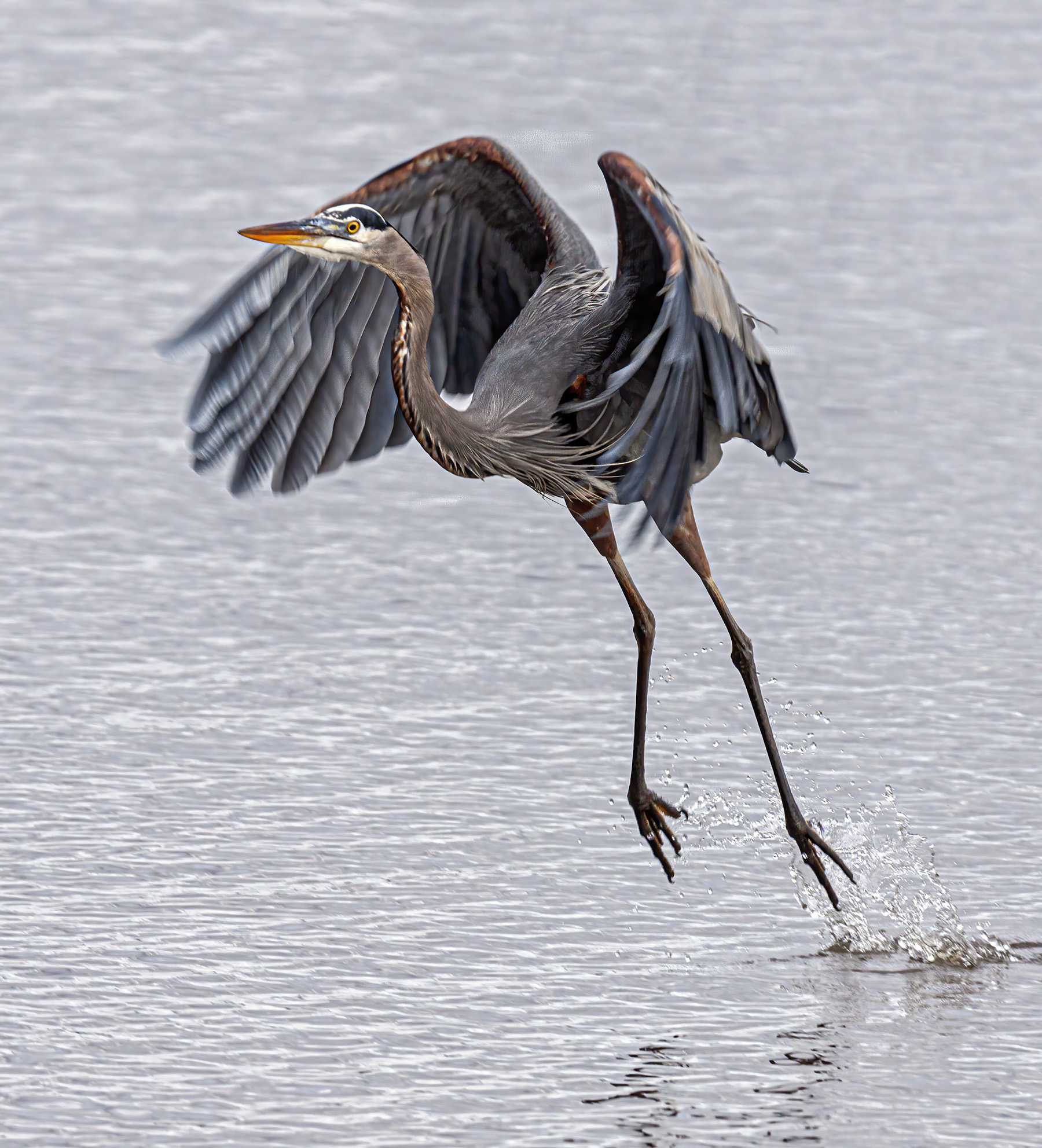
It is hard to appreciate the length of the wings of a Great Blue Heron (Ardea herodias) when it is standing in the water. When it takes off, however, the heron extends its wings fully and the sight is amazing, especially when the heron is flying away from you. This Great Blue Heron that I spotted on Monday at Occoquan Bay National Wildlife Refuge initially was standing on a small sandbar, but took to the air when it detected my presence. It started out heading away from me and gradually turned to my right as it gained altitude.

In case you are curious, the wingspan of a Great Blue Heron is 65.8-79.1 inches (167-201 cm), according to the Cornell Lab of Ornithology website. Wow!

Great Blue Heron

Great Blue Heron


Great Blue Heron

© Michael Q. Powell. All rights reserved.


Read Full Post »

With Halloween on the horizon, I thought I would share an image today of a Rusty Blackbird (Euphagus carolinus) that I spotted on Monday at Occoquan Bay National Wildlife Refuge. The bird’s wide-open pale eyes give it an eerie look that fits in well with other Halloween icons like black cats, witches, and skeletons.

According to the Cornell Lab of Ornithology website, “Rusty Blackbird is one of North America’s most rapidly declining species. The population has plunged an estimated 85-99 percent over the past forty years and scientists are completely puzzled as to what is the cause.” Needless to say, I was thrilled to see this Rusty Blackbird that appeared to part of a small flock high in the trees.

Rusty Blackbird

© Michael Q. Powell. All rights reserved.

Read Full Post »

On Monday at Occoquan Bay National Wildlife Refuge I spotted Yellow-rumped Warblers (Setophaga coronata) multiple times.  However, there is a huge difference between getting a glimpse and getting a shot of one of these hyperactive little birds, particularly when many of the trees still have their leaves.

I captured the first image when one of the warblers was feasting on clusters of poison ivy berries. I definitely was not complaining when he did not offer to share his “treats.” I was surprised to learn several years ago that these berries are a primary food source for a number of small birds during the winter months.

In the second image, I believe the warbler was getting ready to move to a new perch or may have just arrived at this one. In either case, I think it looks pretty cool to see the one wing partially extended.

The composition of the final photo is the simplest—it is just a shot of the perched warbler. However, I really like the way that some of the foliage shows through in the blurry background. You may have noted that the backgrounds are light-colored. On the day when I took these shots, the skies were completely overcast and appeared to be a solid white.


Yellow-rumped Warbler

Yellow-rumped Warbler

Yellow-rumped Warbler

© Michael Q. Powell. All rights reserved.

Read Full Post »

My idea of a perfect bird shot during this autumn season would be to capture a pretty bird perfectly posed against a background of colorful foliage. Alas, things don’t often work out that well in the real world, so I have to make the best of what I am able to find.

In this case, it was a Gray Catbird (Dumetella carolinensis) that I spotted during a recent visit to Occoquan Bay National Wildlife Refuge. The feathers of this catbird are muted in color, as are the colors of the dying leaves that surround it. Nonetheless, I like this rather pleasing portrait of a bird that has a vocal repertoire equal to that of a mockingbird.

Gray Catbird

© Michael Q. Powell. All rights reserved.

Read Full Post »
Flowers are slowing giving up their colors and fewer insects are flying as we move deeper into fall. It lifts my spirits to see the survivors, like this Cabbage White butterfly (Pieris rapae) that I spotted during a trip to Occoquan Bay National Wildlife Refuge at the end of September. The Cabbage White may appear to be completely monochromatic, but if you double-click on the image, you can get a look at its beautiful speckled green eyes.

Cabbage White

© Michael Q. Powell. All rights reserved.

Read Full Post »

Red Admiral butterflies (Vanessa atalanta) are quite common in my area, but for some unknown reason I have not seen very many of them this year. I was therefore quite happy to spot this one during a recent visit to Occoquan Bay National Wildlife Refuge. In this image, the red leaf in the bottom of the frame helps to remind us that we are well into autumn and more and more of the foliage is changing colors or dropping to the ground—after a recent heavy rainstorm, the grown was covered with fallen leaves.

Red Admiral

© Michael Q. Powell. All rights reserved.

Read Full Post »

Although I really like the bright red color of the male Northern Cardinal (Cardinalis cardinalis), there is something even more special about the subtle beauty of a female cardinal, like this one that I spotted last week at Occoquan Bay National Wildlife Refuge. The muted colors of this bird seem particularly appropriate for autumn in this area. The changing foliage here rarely has the brilliant yellows and reds found in other parts of the country, but transitions to paler shades before the leaves all fall to the ground.

Northern Cardinal

© Michael Q. Powell. All rights reserved.

Read Full Post »

As I was walking along one of the trails recently at Occoquan Bay National Wildlife Refuge, my eyes were drawn to the bright orange of a patch of fungus. Orange is one of the colors that I tend to associate with autumn and with holidays like Halloween and Thanksgiving, so I was feeling very seasonal. I do not know my fungi very well, but I think that this might be Chicken of the Woods (Laetiporus sulphureus).

From what I have read, this mushroom can be used as a substitute for chicken and can be sautéed, deep fried, baked, and used in soups. I prefer to enjoy its beauty with my eyes only—the consequences of eating the wrong mushroom can be pretty dire.

The third image gives you an overall view of the mushroom “patch.” However, I had a macro lens on my camera, so I had fun exploring the different elements of the scene. The first image reminds me of Halloween candy corn, a traditional candy that most people either love or hate. In the second image, I was attracted to the circular rows of water droplets that paralleled the rings of colors of the mushroom.

Chicken of the Woods

Chicken of the Woods

Chicken of the Woods

© Michael Q. Powell. All rights reserved.

Read Full Post »

As many of you know, I am always excited to see a Monarch Butterfly (Danaus plexippus). This season started slowly and after a few months I feared that I would not see any of them at all. However, late in the season I began to spot them at multiple locations. Often they were by themselves and only occasionally did I see two of them in the same location.

Imagine my joy when I managed to capture three of them in a single shot on the first of October at Occoquan Bay National Wildlife Refuge, long after I expected them to have migrated out of our area. The butterflies were feverishly feeding on some thistles that were flowering, probably packing in energy for the long migratory journey south.

I suspect that this will be my last sighting of this colorful butterfly species this year. I bid these three monarchs farewell and wish them a safe onward journey.

Monarch butterflies

© Michael Q. Powell. All rights reserved.

Read Full Post »

« Newer Posts - Older Posts »