Feeds:
Posts
Comments

Posts Tagged ‘Occoquan Bay National Wildlife Refuge’

When it comes to aerial skills, Tree Swallows (Tachycineta bicolor) are some of the most agile fliers that I have ever observed. On Monday I watched in awe and amazement as a small group of tree swallows swooped and zoomed over the waters off of Occoquan Bay National Wildlife Refuge. The flight of these tiny birds was graceful and mesmerizing, full of acrobatic twists and turns.

It was a real challenge, though, to take photos of birds that are so small and so fast. I was especially happy when I managed to capture the first image that shows a pair of swallows with their wings fully extended. The second shot shows a swallow gliding low over the water—the shape of the bird reminds me of a stealth aircraft skimming low over the earth to avoid being detected by radar.

I did not realize that Tree Swallows had returned to our area. There are several nesting boxes at this wildlife refuge that Tree Swallows regularly use, so I will have to check them out soon.  Sometimes there is a competition between Tree Swallows and Eastern Bluebirds for the nesting boxes. I am not sure how they decide who will get to use the boxes, but somehow they figure it out. Tree Swallows

tree swallow

© Michael Q. Powell. All rights reserved.


Read Full Post »

I was excited to spot quite a few Bald Eagles (Haliaeetus leucocephalus) on Monday at Occoquan Bay National Wildlife Refuge. It was especially cool because the eagles that I observed were at different stages of development. Bald Eagles are mostly brown in color when they are born and it takes almost five years for them to mature and develop the white feathers on their head that we associate with Bald Eagles.

The eagle on the left in both of the photos is a really young one. I initially thought it might be a fledging that was born this year, but it seems too early for one to have already reached this stage of development. Perhaps this eagle is a year old, judging from its coloration and markings.

I thought that the other eagle was the same one in both photos, but the markings in the first photo show some dark feather on the head and some mottled coloration on the body that seems to me missing on the adult bald eagle in the second photo. I would guess that the “other” eagle in the first photo is about four years old.


Bald Eagles

Bald Eagles

© Michael Q. Powell. All rights reserved.

Read Full Post »

I could not get an angle that let me see what this Eastern Gray Squirrel (Sciurus carolinensis) was eating earlier this month at Occoquan Bay National Wildlife Refuge, but I was very much taken by the cute way that it had curled up its tail as it was eating. Normally I think of a squirrel with its long fluffy tail trailing behind it, so I was surprised to see the tail pulled into the squirrel’s body, making the small animal look even smaller.

In addition to the curious tail position, I like the way that I was able to capture the texture of the branch. The color of the branch was almost a perfect match for the squirrel’s fur and the brownish buds were almost the same color as the fur surrounding the squirrel’s eye.

squirrel

© Michael Q. Powell. All rights reserved.


Read Full Post »

I don’t see Ring-necked Ducks (Aythya collaris) very often, so I was happy to spot this little group of them last week at Occoquan Bay National Wildlife Refuge. Although this looks like a ménage à trois situation with a male duck in the middle of two females, there actually was another male who was out of the frame when I took this photo. Ring-necked Ducks are a migratory species that overwinters with us and I suspect that these ducks will soon be leaving our area for more northern locations.

Ring-necked Duck

© Michael Q. Powell. All rights reserved.

Read Full Post »

Sometimes I feel compelled to throw back my head and sing at the top of my lungs, as this Bald Eagle (Haliaeetus leucocephalus) was doing when I spotted it last week at Occoquan Bay National Wildlife Refuge. It might be somewhat of an exaggeration to call it “singing”—the eagle was calling out to its mate, I believe, in a somewhat unmelodious way, but it was a cool experience nonetheless.

The Cornell Lab of Ornithology had the following description of a bald eagle’s calls, “For such a powerful bird, the Bald Eagle emits surprisingly weak-sounding calls—usually a series of high-pitched whistling or piping notes.” Check out this link to a Cornell Lab webpage that has several sound samples of an eagle’s call. According to a National Public Radio report, Hollywood movies often dub over an eagle’s call with a Red-tailed Hawk’s cry, which is much more majestic, so you may be surprised to hear what a bald eagle actually sounds like.

bald eagle

bald eagle

bald eagle

© Michael Q. Powell. All rights reserved.

Read Full Post »

There was a lot of activity on Tuesday at the large Bald Eagle (Haliaeetus leucocephalus) nest at Occoquan Bay National Wildlife Refuge. I still cannot determine if any eaglets have hatched, but several times I observed an eagle fly into the nest or fly out of it. The nest is so deep that an eagle is often hidden from view when sitting on an egg—the only way to know for sure that an eagle is present is when one of them arrives or departs.

The eagle in the first photo was arriving and had spread its wings to slow down its speed and forward momentum. In the second photo, an eagle that was in nest had popped its head up and was looking towards a nearby tree where its mate was perched. After the eagle had reassured itself that everything was ready, the two eagles executed a changing of the guard ceremony—the eagle in the nest flew away and the perched eagle took its place. I captured the third image just as the eagle was taking off from its perch to take its turn watching over the nest.

Bald Eagle

Bald Eagle

bald eagle


© Michael Q. Powell. All rights reserved.

Read Full Post »

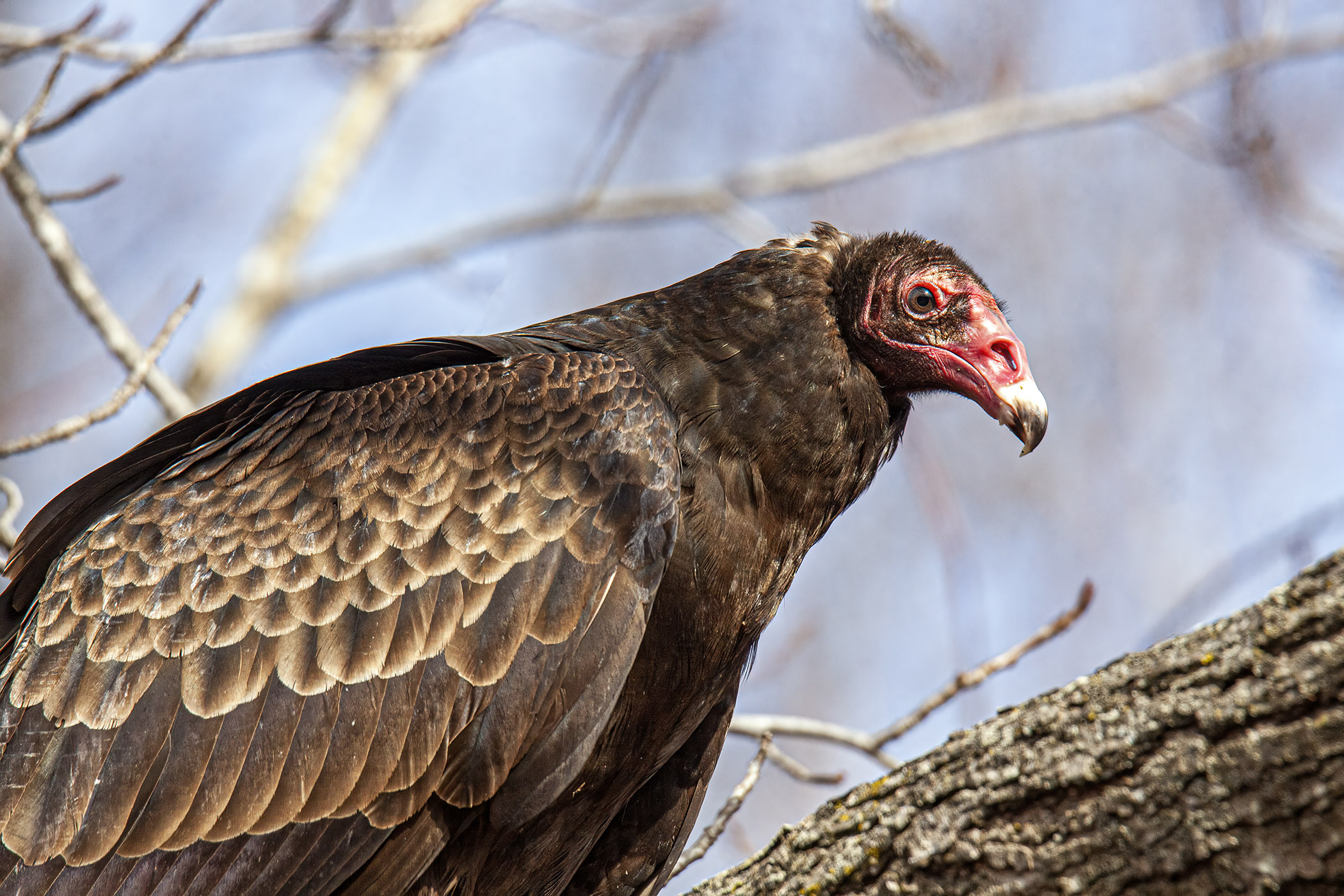
I would not necessarily call this Turkey Vulture (Cathartes aura) handsome, but I am happy with the way that I was able to capture a bit of the bird’s personality in this close-up portrait shot. I spotted this vulture last week as it perched low in a tree just off the edge of a trail that I was following at Occoquan Bay National Wildlife Refuge.

Some people are freaked out by the fact that vultures eat carrion, but most people acknowledge that these scavengers play a valuable role in our ecosystems. I am ok with a turkey vulture’s dietary choices, though I would probably refuse to join a turkey vulture in a meal if one of them made such an offer.

Turkey Vulture

© Michael Q. Powell. All rights reserved.
Read Full Post »

Some of the Ospreys (Pandion haliaetus) that I spotted last week at Occoquan Bay National Wildlife Refuge seemed to be making early claims on the existing nests from last year, while others were simply perched on trees throughout the refuge. Mostly they kept their distance, though, so I had to be content with relatively distant shots of these recently returned raptors.

osprey

Osprey

© Michael Q. Powell. All rights reserved.

Read Full Post »

Quite a few ospreys (Pandion haliaetus) have returned to Occoquan Bay National Wildlife Refuge and I spent a lot of time last Thursday trying to photograph them. Most of my efforts were focused on trying to capture images of them in flight.

Ospreys will fly in circles over the water and occasionally will hover and glide a little as they search for prey, which makes it somewhat easier to focus on them than on many other birds. However, it’s still a pretty formidable challenge to get shots in which the eyes are visible and in focus and in which the wing positions are good.

For the first image, I did not react quickly enough to zoom out when the osprey flew overhead, so I clipped its wings in the photo. I think that it is nonetheless a cool shot that provides a good look at the feather details of the osprey and at its eye and beak.

In the second shot, I captured the osprey at a moment when it had its wings fully extended. I like the way that the osprey’s yellow eye really stands out in the image.

I am sure that I will get lots of chances to photograph ospreys in the upcoming months, but it is always exciting me to them again for the first time each year—another sign that the seasons are changing.

osprey

osprey

© Michael Q. Powell. All rights reserved.

Read Full Post »

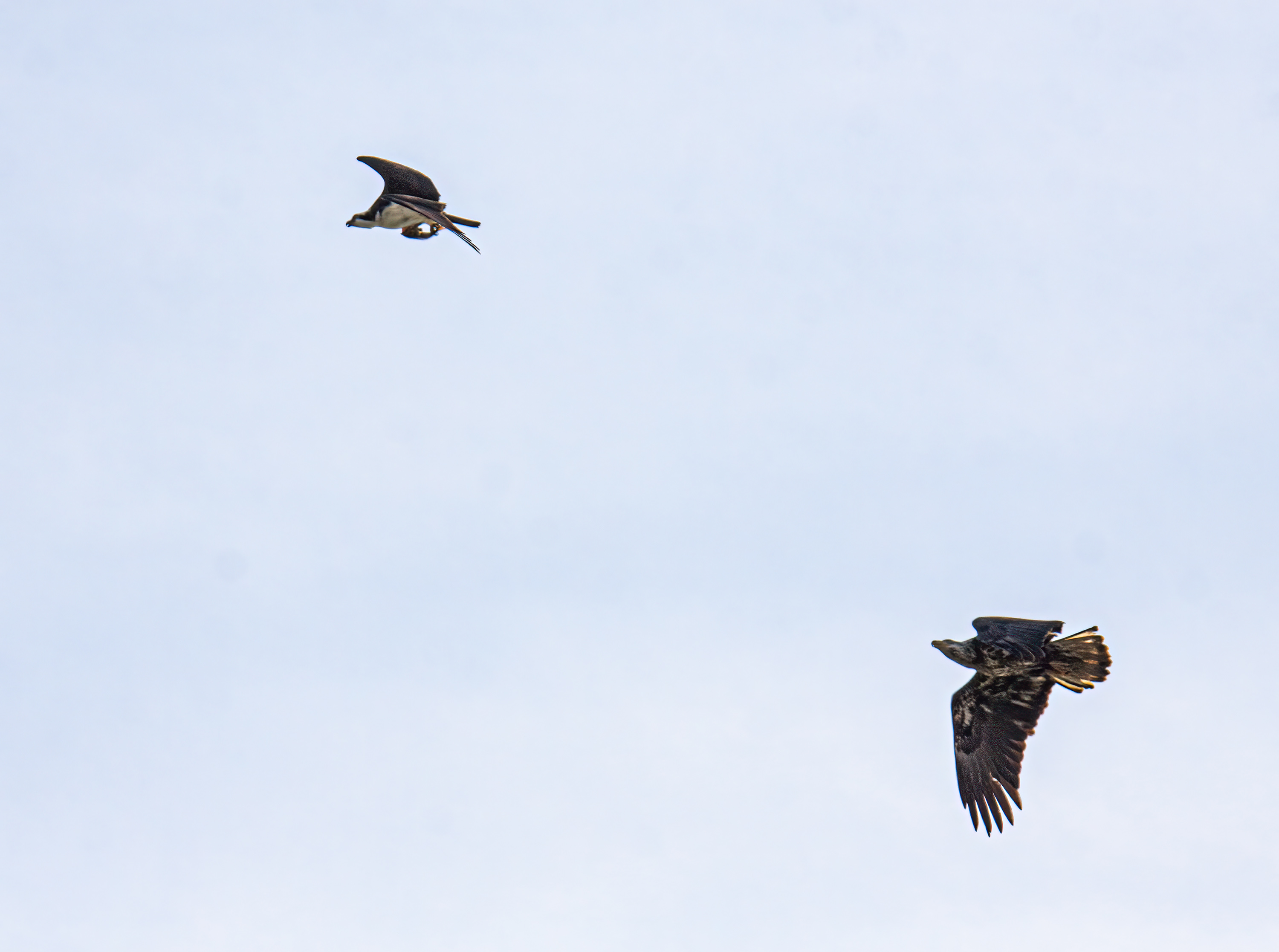
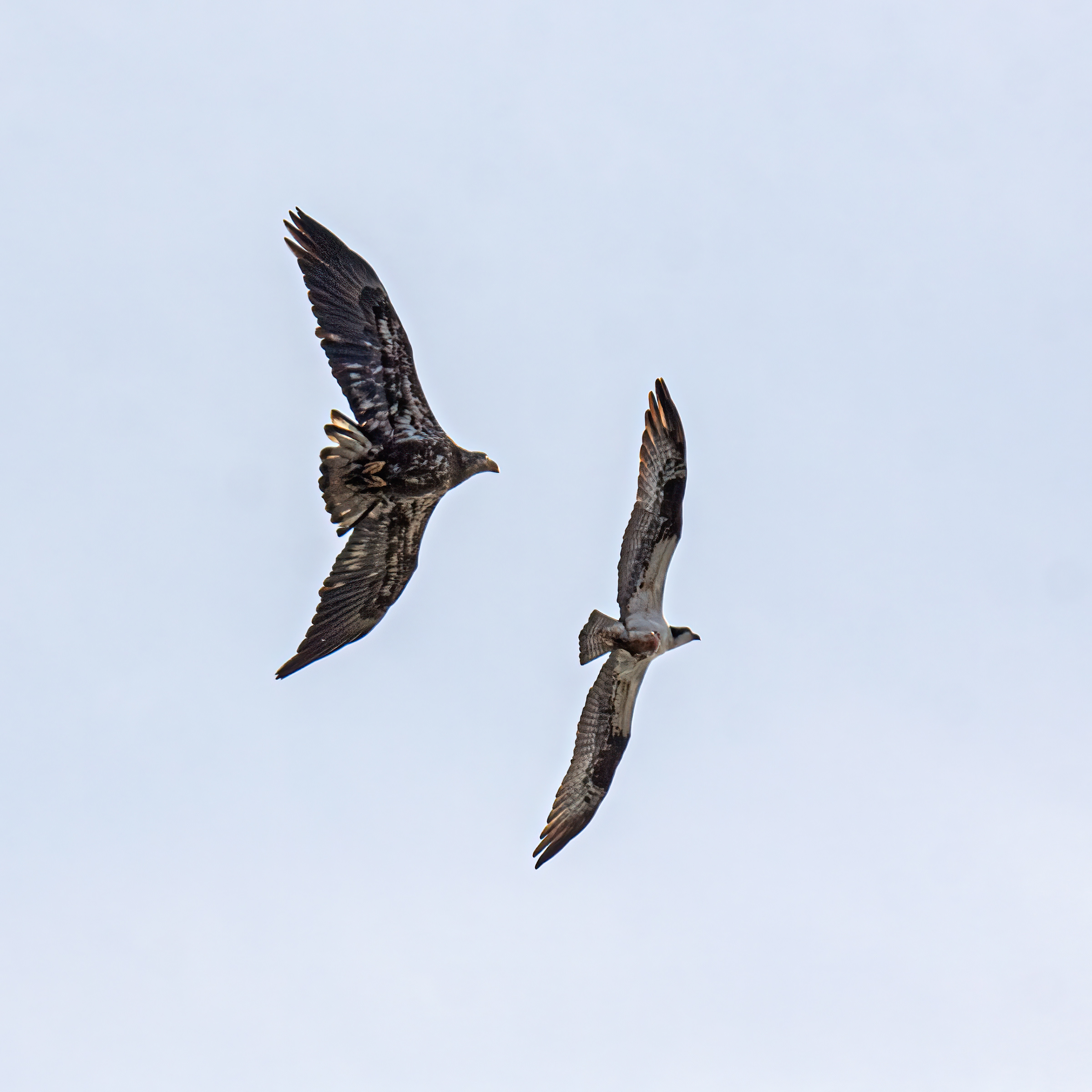
A juvenile Bald Eagle (Haliaeetus leucocephalus) tried to steal a fish from an Osprey (Pandion haliaetus) on Thursday at Occoquan Bay National Wildlife Refuge and chased it across the sky. It was quite an aerial dogfight. In the end, I think that the osprey dropped the fish and both birds ended up “empty-handed.”

Ospreys migrate away from my area for the winter and I was delighted to see that they had returned. I spotted at least a half-dozen or more ospreys and they were both active and vocal. Ospreys have high-pitched, distinctive voices that the Cornell Lab of Ornithology described in these words, ” Their calls can be given as a slow succession of chirps during flight or as an alarm call—or strung together into a series that rises in intensity and then falls away, similar to the sound of a whistling kettle taken rapidly off a stove.” Here is a link to a Cornell Lab webpage where you can listen to recordings of various osprey calls.

These three photos give you a general sense of the chase. In the first shot, you can definitely see the “prize,” the fish that the osprey had caught. In the second shot, the eagle has closed the distance separating it from the osprey. In the third shot, the osprey is doing its best to maneuver away from the eagle, but the eagle was able to match the osprey turn by turn. All of this took place over the water and eventually the two birds flew out of range.

eagle osprey chase

eagle osprey chase

eagle osprey chase

© Michael Q. Powell. All rights reserved.

Read Full Post »

This Bald Eagle (Haliaeetus leucocephalus) definitely had something to say when I spotted it last week at Occoquan Bay National Wildlife Refuge. I think I may have been guilty of eavesdropping, though, because the eagle appeared to be calling out to its mate.

One of the things that I really like about this image is the way that I was able to capture a sense of the rough texture of both the bark on the tree and the feathers on the eagle’s body.

Bald Eagle

© Michael Q. Powell. All rights reserved.


Read Full Post »

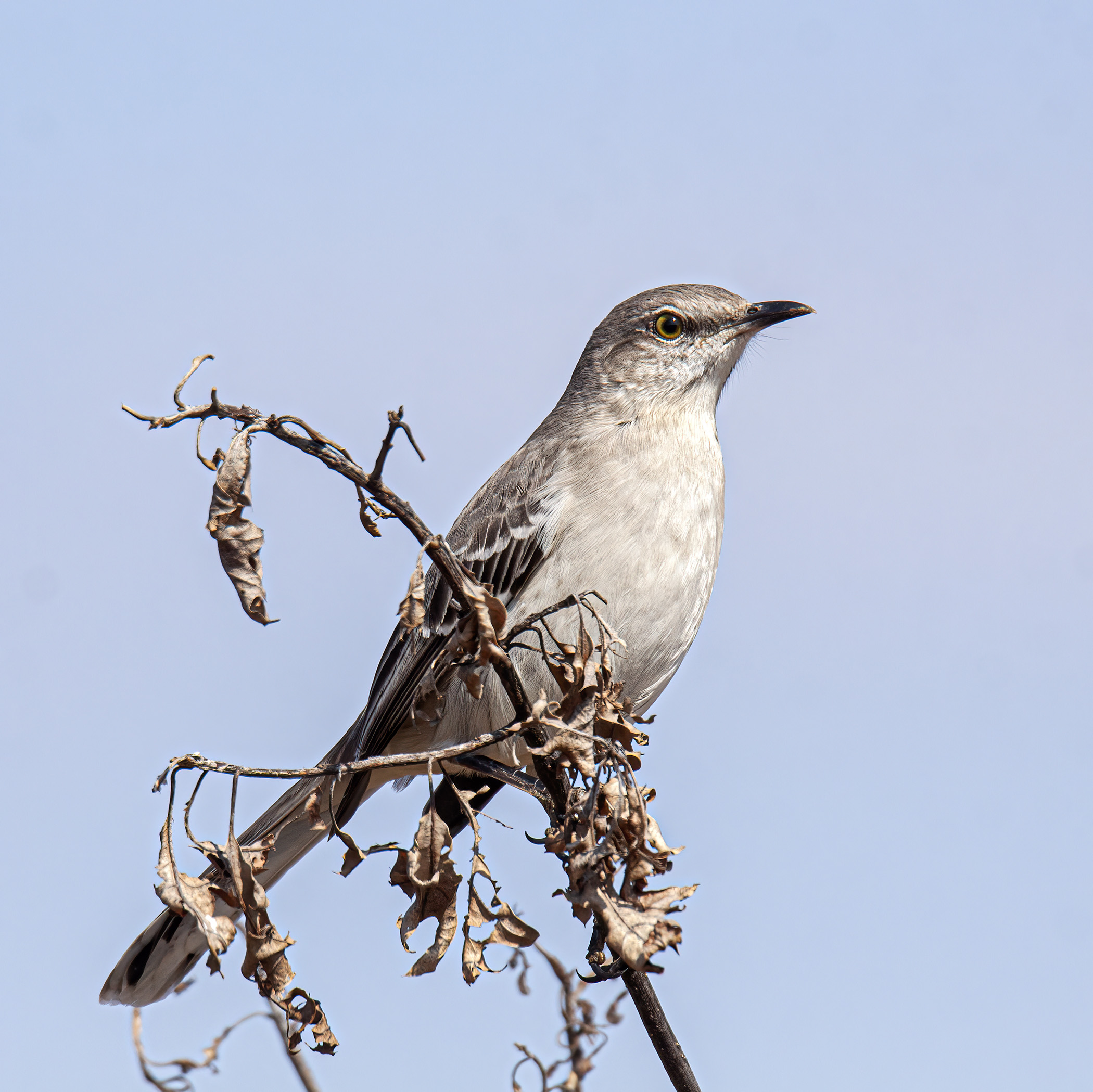
Perched high atop the vegetation, this Northern Mockingbird (Mimus polyglottos) posed for me during a recent portrait session at Occoquan Bay National Wildlife Refuge. The mockingbird could not decide which side was its best side, so I took profile shots with the bird looking in both directions.

I think the bird liked the results and tweeted them on Twitter.

Northern Mockingbird

Northern Mockingbird

© Michael Q. Powell. All rights reserved.
Read Full Post »

I was blessed to see multiple Bald Eagles (Haliaeetus leucocephalus) last Friday during a visit to Occoquan Bay National Wildlife Refuge. I am used to seeing two eagle couples that occupy the nests plus a few other from time to time. On this day, though, there seemed to be a whole lot more eagles than normal.

Seeing eagles is great, of course, but getting photos of them is not always easy. In the first photo, the eagle was flying almost directly over me and it is challenging to hold a long telephoto lens upright and track a moving subject. I am pretty happy with the way that this one turned out. If you click on the photo you can see the wonderful details of the eagle more closely, including what looks to a band on at least one leg and possibly on both of them—to me it looks like the eagle is flying with leg shackles.

In the second image, I captured an eagle as it was preparing to land on its nest. There was a lot of activity at that nest on that day, with both eagles flying in and out of that nest. It seems a bit early, but I wonder if there is a change that the eaglets have already hatched. The only way that I will know for sure that there are eaglets is if they pop their heads up. However, the nest is so deep that it will probably be a while before the eaglets are big and strong enough to be seen.

Bald Eagle

Bald Eagle

© Michael Q. Powell. All rights reserved.

Read Full Post »

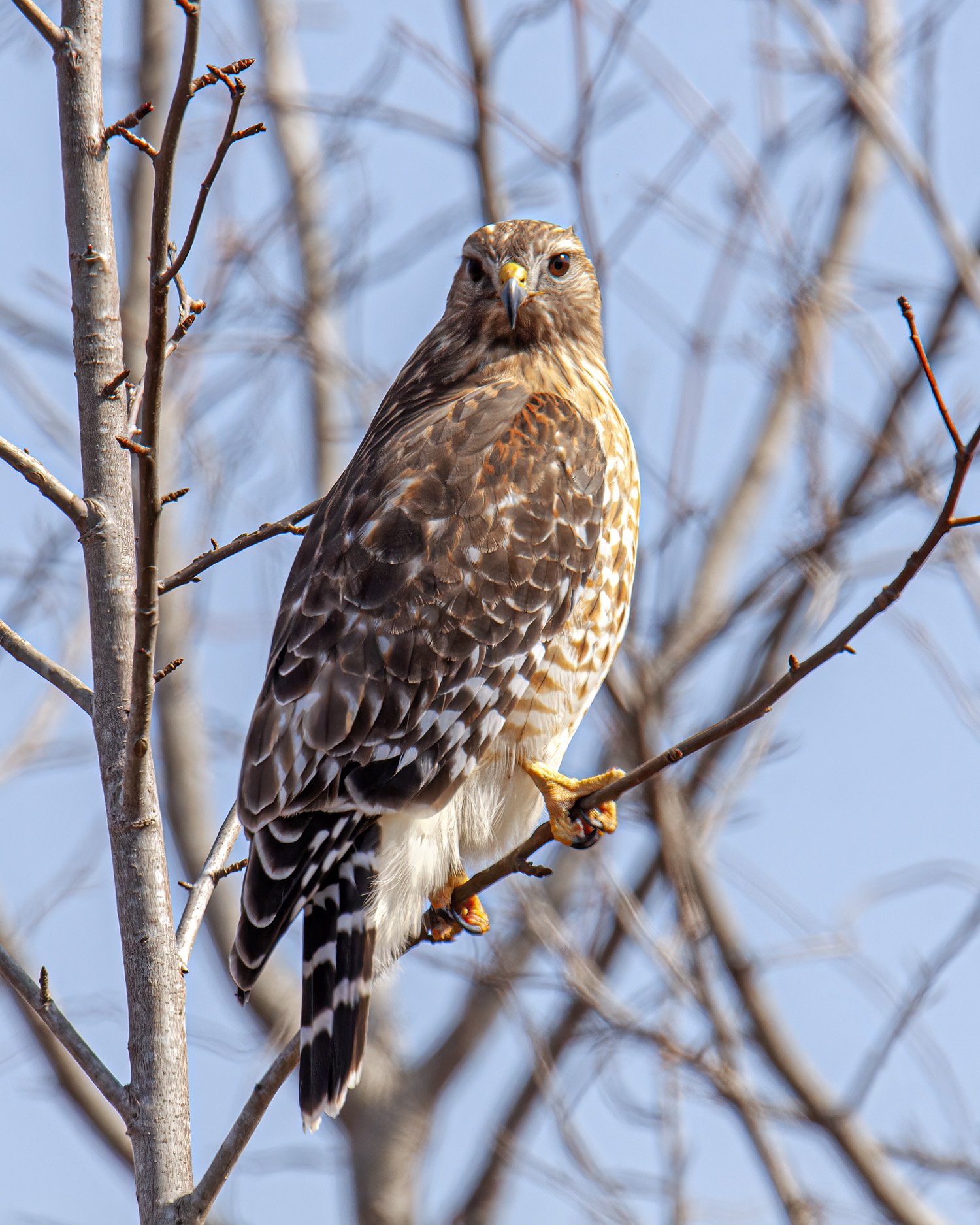
Normally when I see hawks, they are perched high in the trees, but last week I was fortunate to spot perched relatively low in some vegetation in a field at Occoquan Bay National Wildlife Refuge. When you have to shoot upwards at a sharp angle, you don’t miss a lot of details on the bodies of these beautiful birds—in this case I was able to shoot at a much lower angle at which I was almost eye to eye with the hawk.

The hawk, which I am pretty sure is a Red-shouldered Hawk (Buteo lineatus) was quite tolerant of my presence and allowed me to get shots from several different angles before it flew away. The middle image in particular suggests that it was well aware of my presence, but did not view me as a threat. I really like the way that I was able to capture the different colors and patterns in the feathers on the various parts of this hawk’s body.

If you compare the three shots, you can see how a subtle movement of a bird’s head or body position can alter the feel of the image in much the same way that a change in facial expression does with human subjects. The major difference, of course, is that you have a bit more control over your subject when it is a person. I must admit, though, that I sometimes try to telepathically instruct a wild subject, but it rarely seems to work.

Red-shouldered Hawk

Red-shouldered Hawk

Red-shouldered Hawk

© Michael Q. Powell. All rights reserved.

Read Full Post »

When it heard me approaching, this White-tailed Deer (Odocoileus virginianus) moved into the field of dried vegetation. It had only gone a short distance when it stopped and turned to look back at me. Our eyes met and we shared a moment together. Had curiosity overcome any fear that the deer might have been feeling? I felt a real sense of gentleness and peace during our little encounter.

All of the sudden, the deer decided that it was time to leave and trotted off toward the tree line. I was quite ready for the action to resume and was zoomed in a bit too much, so that parts of the deer are cut off in the second and third images. Still, I really like the way that I was able to capture the movement of the deer and especially of its white tail.

White-tailed DeerWhite-tailed Deer

White-tailed Deer

© Michael Q. Powell. All rights reserved.

Read Full Post »

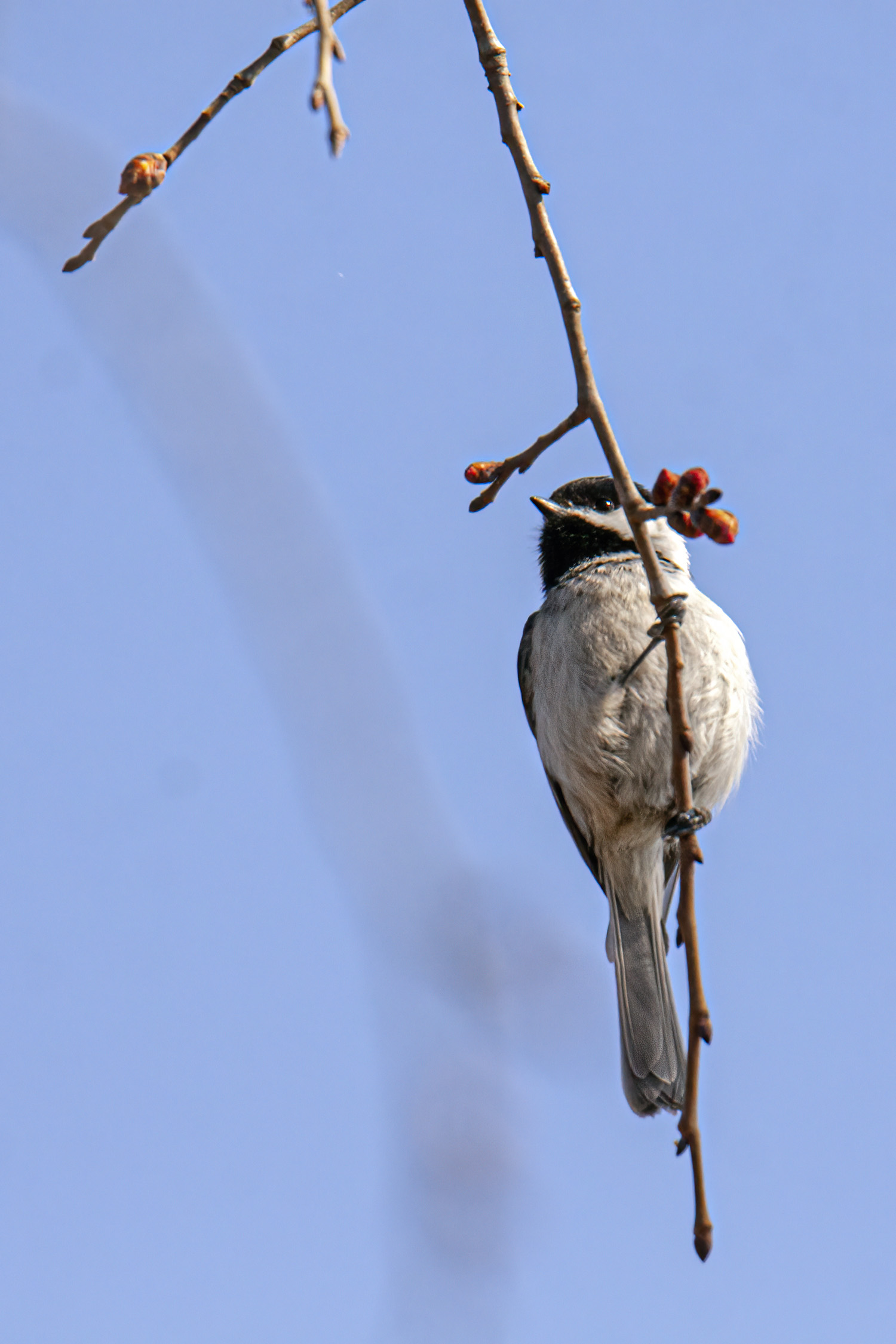
“This bud’s for you.” A Carolina Chickadee (Poecile carolinensis) seemed happy that buds are finally starting to appear on the trees on Monday at Occoquan Bay National Wildlife Refuge.

According to the Cornell Lab of Ornithology, “In winter, the Carolina Chickadee’s diet is about half plant, half animal. The rest of the year about 80–90 percent of their diet is animal (mostly insects and spiders).”

Progress is uneven, but it looks like spring inexorably is on the way.

Carolina Chickadee

Carolina Chickadee

© Michael Q. Powell. All rights reserved.

Read Full Post »

This female Northern Cardinal (Cardinalis cardinalis) was sporting a spiky punk rock hairstyle when I spotted her on Monday at Occoquan Bay National Wildlife Refuge. Female cardinals do not have as many bright red feathers as their male counterparts, but I find them to be equally striking and arguably even more beautiful.

Northern Cardinal

© Michael Q. Powell. All rights reserved.

Read Full Post »

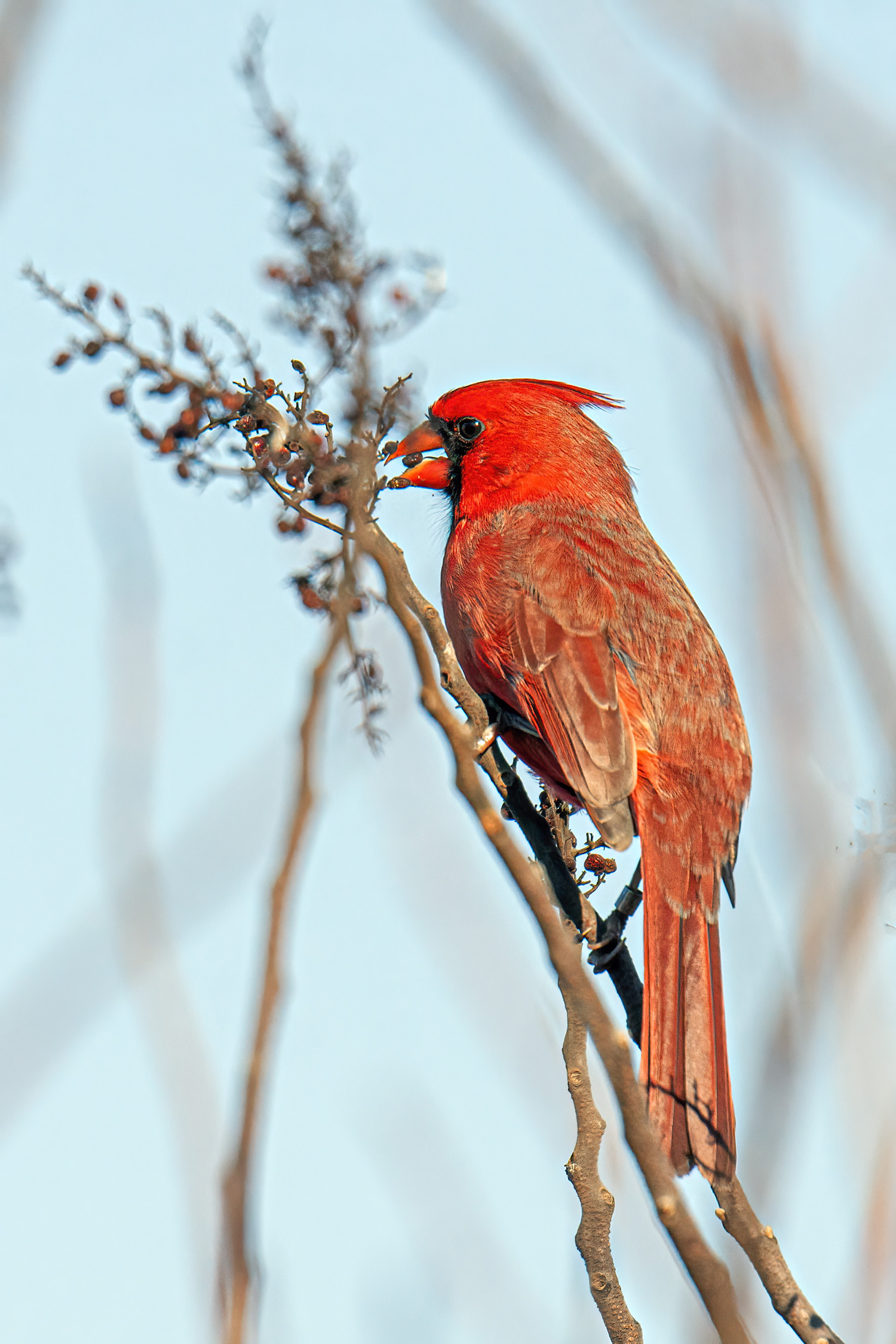
There are signs that spring is on the way, but progress is slow and the bright spring blossoms and flowers have not yet appeared. The grey of winter continue to dominate, so it is especially energizing to spot brilliant colors, like those of this male Northern Cardinal (Cardinalis cardinalis) at Occoquan Bay National Wildlife Refuge.

I am more than ready for the return of spring as February comes to a close. It won’t be long, I am sure, before I see my first crocuses and daffodils—I am keeping my eyes open for them.

Northern Cardinal

© Michael Q. Powell. All rights reserved.

Read Full Post »

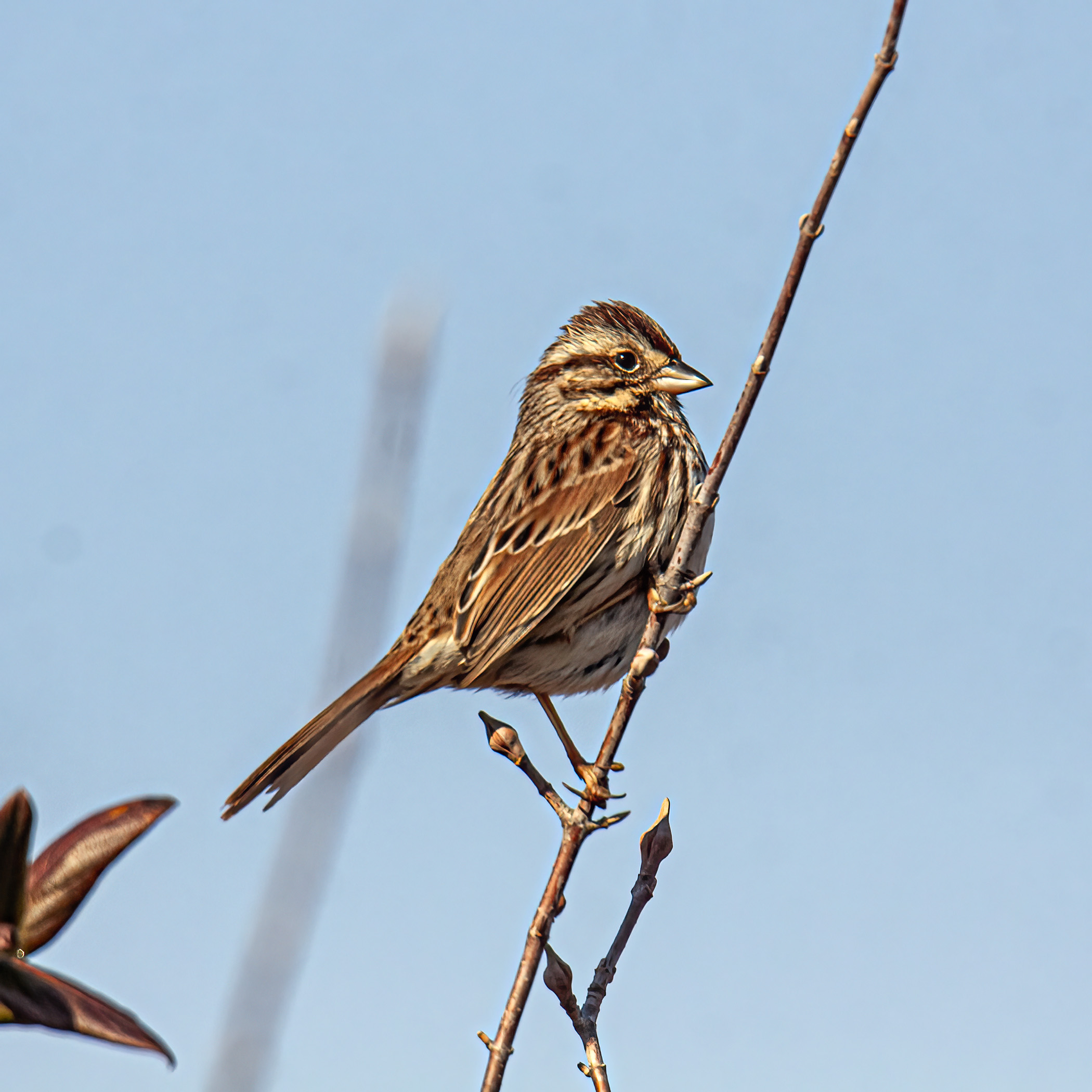
I can’t help but feel feel powerless and impotent as the brave Ukrainian people continue their heroic defense against Putin’s brutal invasion. Like this Song Sparrow (Melospiza melodia) at Occoquan Bay National Wildlife Refuge, many of us feel like we all are doing all we can by hanging on tightly, trying to stay focused and seeking ways to support Ukraine.

As human beings, we cannot afford to remain indifferent. Our leaders are pursuing various options and I call on you all to keep Ukraine in your thoughts and prayers.

Song Sparrow

© Michael Q. Powell. All rights reserved.

Read Full Post »

I never fail to be impressed by the beauty and majesty of Bald Eagles (Haliaeetus leucocephalus), like this one that I spotted a week ago at Occoquan Bay National Wildlife Refuge. This eagle had chosen a high branch as its perch and appeared to be surveying the situation from on high.

As I noted yesterday, I continue to be deeply disturbed and shaken by Russia’s ongoing invasion of Ukraine. I’ll pose to you the same question that I posted last night on Facebook and make the same request—that we pray for the Ukrainian people, who are suffering in so many different way, and that we pray for peace to prevail.

“Would you selflessly be willing to take up arms to defend your country, your freedom, and your way of life against an aggressor that invades your territory and seeks to destroy your nation? I feel nothing but admiration and respect for the brave Ukrainians who continue to fight with courage and determination against overwhelming odds. Please join me in praying for all Ukrainians as their country continues to be attacked by Putin’s forces.”

Bald Eagle

Bald Eagle

© Michael Q. Powell. All rights reserved.


Read Full Post »

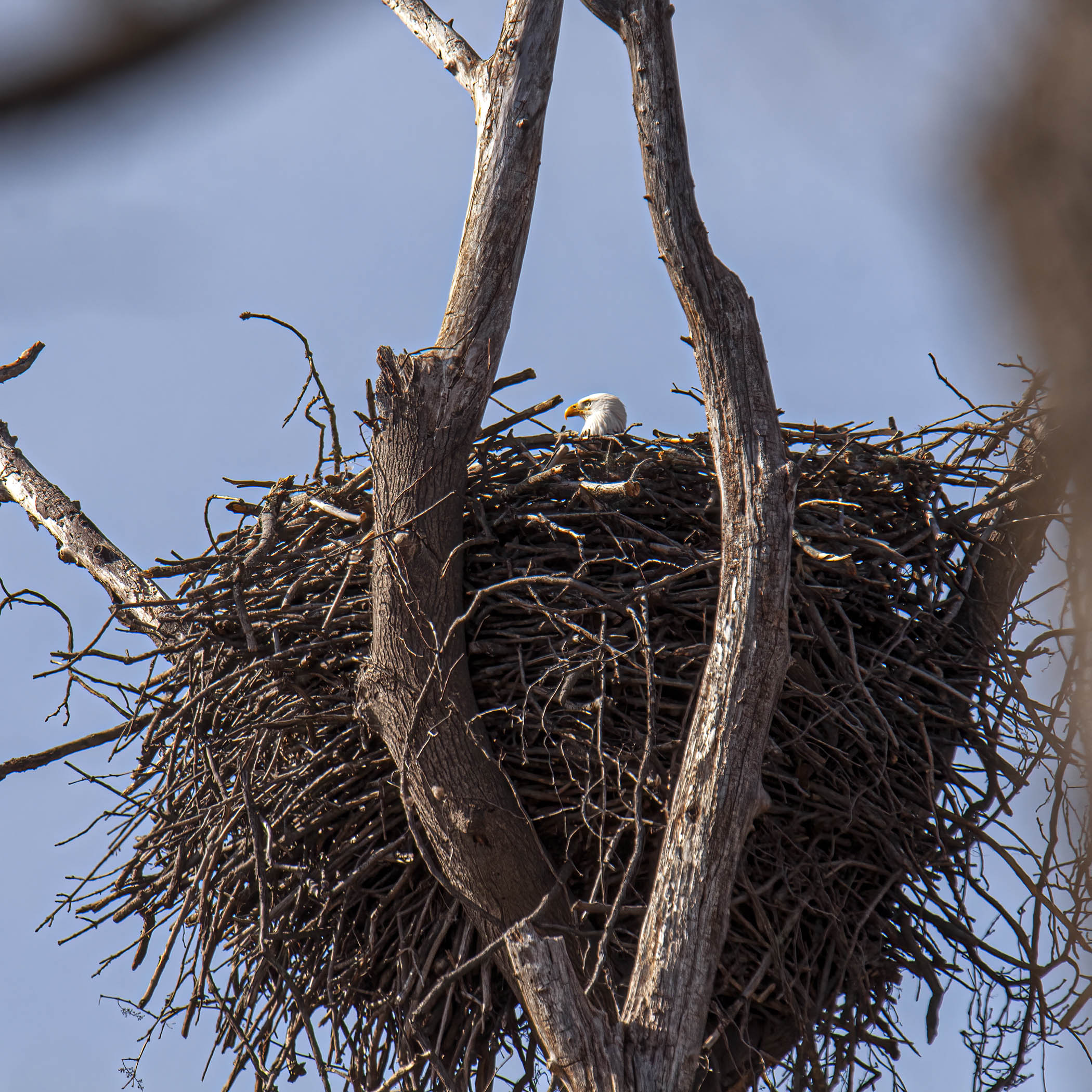
I had already spotted a Bald Eagle (Haliaeetus leucocephalus) sitting on a small nest at Occoquan Bay National Wildlife Refuge (see the final photo in my recent posting Out on a limb). However, until Wednesday  I had been unable to determine if the eagles had started to sit on eggs in the much larger and prominent nesting sight. That nest is so large and deep that a nesting eagle is hidden from view most of the time.

We had unusually warm weather on Wednesday, so I felt compelled to leave my house with my camera and towards my favorite site for wildlife photography. As I walked past my normal viewing site for the nest, I wasn’t surprised that I could not see an eagle in it.  As I continued to walk down the trail, however, I continued to keep my eye on the nest as I continued to walk down the trail. My view was partially blocked by trees, but looking through the trees, I suddenly spotted a small white head sticking out of the nest.

I don’t know if the warmer weather prompted the eagle to sit up higher in the nest than during cold weather, when the eagle would tend to hunker down to keep the eggs warm. Whatever the case, I welcomed this confirmation that the eagles were in the nest. The first image shows that the eagle was quite alert and keeping and eye on things. The second image helps to give you all a sense of the massive size of this nest.

As I write this posting, my heart is breaking as I continue to watch horrific events unfolding in Ukraine. I would simply ask that you pray for the brave Ukrainian people who are fighting and, in many cases, dying to defend themselves and their country.

Bald Eagle

Bald Eagle

© Michael Q. Powell. All rights reserved.

Read Full Post »

I have long been fascinated by the way that Double-crested Cormorants (Phalacrocorax auritus) take off from the water. The cormorants flap their wings and bounce across the surface of the water before they lift off into the air.

Yesterday at Occoquan Bay National Wildlife Refuge I spotted a cormorant and was just beginning to focus on it when without warning it started to take off. I was happy to be able to capture a short series of images of the cormorant in action that show some of the stages of the cormorant’s takeoff.

Double-crested Cormorant

Double-crested Cormorant

Double-crested Cormorant

© Michael Q. Powell. All rights reserved.

Read Full Post »

How do you capture the mood of the moment? I really love the early morning, those moments when the wildlife is just waking up and becoming active and the sun is slowly rising. This winter, though, I have been kind of lazy and a little unmotivated. Consequently I have been generally sleeping through those magical moments or been seated in front of my computer rather than standing outdoors behind my camera.

Recently, though, I visited Occoquan Bay National Wildlife Refuge just after dawn and captured these images, which give you a sense of what I was seeing and feeling on that occasion. In the first image a pair of Bufflehead ducks (Bucephala albeola) were flying past another duck in the foreground. As your eyes make your way across the color-tinged ripples towards the distant horizon, you can just make out successive rows of other water birds.

In the second image, a solitary Great Blue Heron (Ardea herodias) was already at work just off the shore, fishing for breakfast. Though the heron is almost a silhouette, you can just detect the warm sunshine coming from the right that illuminates its chest.

The light is the main subject in the final, almost abstract image. The light reveals the details in the grain of the wood and creates a wonderfully distorted reflection in the ripples of the water. In many ways this image represents photography reduced to its simplest, most elemental form—the interplay of light and shadows.

Bufflehead

Great Blue Heron

reflection

© Michael Q. Powell. All rights reserved.

Read Full Post »

As we near the end of the month of February, we are moving into nesting season for the Bald Eagles (Haliaeetus leucocephalus) that I regularly observe at Occoquan Bay National Wildlife Refuge. Some other wildlife photographers have photographed one of the eagle pairs mating, but when I visited the refuge last Wednesday, there was no such activity. The best images that I was able to capture were of a solitary bald eagle perched on the outermost tip of a branch overlooking the trail on which I was walking—as the first photo shows, the eagle was quite aware of my presence.

Later that same day, I spotted a bald eagle that appears to be sitting on one of the two nests that monitor. One of the nests is so large and high up in the trees that it is almost impossible to tell when an eagle is sitting on the nest. The other nest, which is the one shown in the final photo, is much smaller and a sitting eagle is quite visible. There are barriers blocking the road to keep eagles from being disturbed, because a trail runs right under the nesting tree, so I am able to capture images only from a distance.

I will be checking in on the nests as time passes and with a little luck will be able to share some images of any eaglets that I manage to spot.

Bald Eagle

Bald Eagle

Bald Eagle

© Michael Q. Powell. All rights reserved.


Read Full Post »

On Wednesday at Occoquan Bay National Wildlife Refuge, it was fun photographing this colorful Northern Flicker (Colaptes auratus) feasting in a field of sumac. The muted tones of the sumac really help the female flicker to stand out in this image, particularly because she turned to the side and revealed the patch of bright red on the nape of her neck.

In case you are curious, I can tell that she is a female, because she lacks the black “mustache” stripe that is present with males. If you want to see a male Northern Flicker for the sake of comparison, check out my post from December 2020 entitled “Flicker in December.”

Northern Flicker

© Michael Q. Powell. All rights reserved.

Read Full Post »

I watched a Great Blue Heron (Ardea herodias) snag a small fish on Wednesday at Occoquan Bay National Wildlife Refuge. Herons like to swallow their catches head-first, so the heron tossed the fish in the air several times to reposition it.

In the final photo, the heron had finally flicked the fish into the proper position and was preparing to swallow it. I am pretty sure that he was successful in doing so, although the photo suggests that his aim was somewhat less than perfect. I have tossed popcorn, M&M’s, and other tasty treats into the air and tried to catch them in my mouth and can testify to the fact that it is not as easy as it looks.

Great Blue Heron

Great Blue Heron

Great Blue Heron

© Michael Q. Powell. All rights reserved.


Read Full Post »

Northern Mockingbirds (Mimus polyglottos) have been quite active and visible during my recent visits to Occoquan Bay National Wildlife Refuge. Like many other species, the mockingbirds have discovered the sumac patches that are scattered throughout the refuge, as you can see in the second photo.  I like the way that you can see the sumac berries and you also get a sense of the cluster of branches and stalks that conspire to keep me from getting clear looks at the birds feasting on the sumac.

From a photography perspective, though, I much more favor the first photo. I managed to isolate the mockingbird from the cluttered background and I really like the angular lines of the branches that are visible. One of my Facebook friends commented that it looked like the mockingbird was perched in the crow’s nest of a sailing ship—an image that tickles my imagination.

Northern Mockingbird

Northern Mockingbird

© Michael Q. Powell. All rights reserved.


Read Full Post »

They are hard to spot, because they are  often hidden in the underbrush, so I am happy whenever I manage to get an unobstructed look at a Carolina Wren (Thryothorus ludovicianus). I was particularly delighted when I was able to photograph one in warm early morning sunlight during a recent trip to Occoquan Bay National Wildlife Refuge, as you can see in the first photo. The light really helped to emphasize the warm shades of brown feathers on the wren’s body.

In the second image, the light was dimmer and cooler and the wren was in partial shade. As a result, the colors and details do not “pop” as much as in the first image, but I do like the dynamic pose of the bird as it was singing.

Carolina Wren

Carolina Wren

© Michael Q. Powell. All rights reserved.

Read Full Post »

Through the distant trees, I spotted a shadowy shape in the early morning hours last week at Occoquan Bay National Wildlife Refuge. Was it a large bird or simply a malformed tree? It is a little embarrassing to admit it, but I often find myself taking photos of odd-shaped branches or leaf formations, thinking they might be birds.

In this case, though, it turned out to be a bird. When I zoomed in to get a closer look, I initially thought it might be a hawk, but the more I stared at the hazy form, the more I realized that it was almost certainly an immature Bald Eagle (Haliaeetus leucocephalus).

It takes almost five years for an adult Bald Eagle to develop its signature look, with its yellow beak, light-colored eyes, and white head and tail. In the interim the eagle’s plumage is flecked with white, rather than being a solid dark color, and the beak and eyes are darker than they will eventually become. Experts can tell the age of an immature eagle on the basis of its plumage pattern—I am definitely not an expert and would guess from what I have read on-line that this eagle is probably about a year old or so.

Although I was a long way away from the eagle, it seemed to sense by presence and took off shortly after I spotted it. As the eagle flew away, I was able to capture an image with a view of the mottled pattern of the feathers on the underside of its wings and its dark tail feathers

Bald Eagle

Bald Eagle

© Michael Q. Powell. All rights reserved.

Read Full Post »

The early morning sun was beginning to warm the Great Blue Heron (Ardea herodias) that I spotted in a tree last Friday at Occoquan Bay National Wildlife Refuge, a perch where I suspected the heron had spent the previous night. I quickly got a few shots and quietly moved on—I think the heron dozed off again after I had passed by.

When I took these shots, I was close enough to the heron that I was able to zoom in with my telephoto lens and capture some wonderful details in the feathers. The sunlight was warm and beautiful during that early portion of the day, part of the so-called “golden hour,” when subjects take on a golden glow. I have gotten a little lazy about rising at dawn, but this day was a pointed reminder of the potential benefits of doing so.

Great Blue Heron

Great Blue Heron

© Michael Q. Powell. All rights reserved.

Read Full Post »

As winter progresses, the sumac plants are slowly being picked clean by the birds at Occoquan Bay National Wildlife Refuge, but there are still plenty of berries that attract several species, including one of my favorites, Eastern Bluebirds (Sialia sialis).  Each time that I visit the refuge, I make sure to check out the patches of sumac at several different locations and last Tuesday I was delighted to spot some colorful bluebirds at one of them.

I love to watch the bluebirds zooming in and out of the stalks of sumac. Much of the time they have their heads down, mostly blocked from view, but occasionally I will get a clear shot of one when it lifts its head. I especially like the pose in the first photo, in which the bluebird has its head cocked to the side, giving us a wonderful view of its profile. In the second image, I like the way that you can see the blurry second bird in the background, which, based on its coloration, could be the mate of the male in the foreground.

Best wishes to you all for a Happy Valentine’s Day, however you choose to celebrate (or not to celebrate) this day—may your day be filled with love and with joy.


Eastern Bluebird

Eastern Bluebird

© Michael Q. Powell. All rights reserved.


Read Full Post »

« Newer Posts - Older Posts »