Feeds:
Posts
Comments

Posts Tagged ‘Megaceryle alcyon’

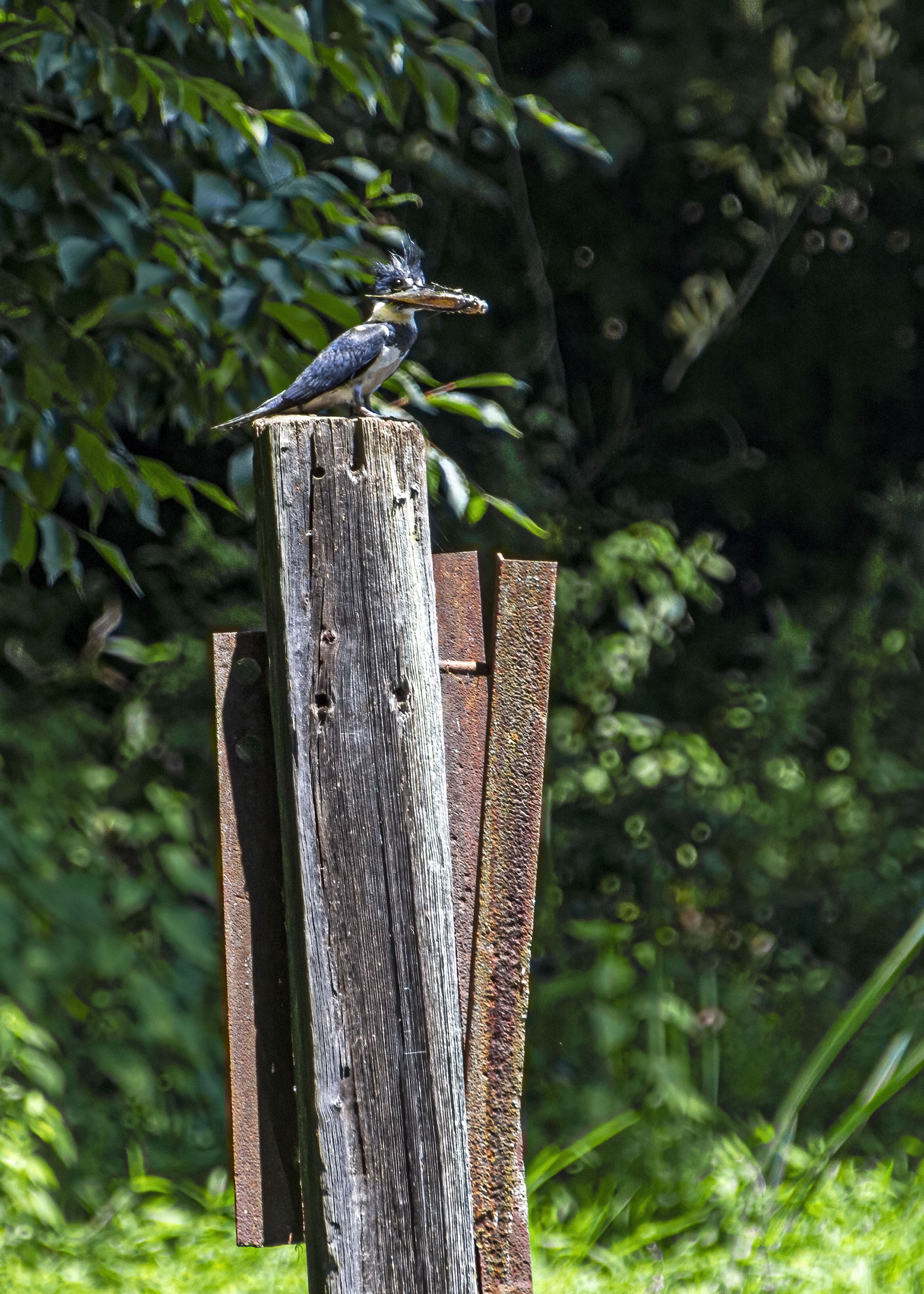
As I was searching the edge of a pond for dragonflies earlier this week I suddenly heard the unmistakable call of a Belted Kingfisher (Megaceryle alcyon). As I lifted my head, the kingfisher flew across my field of view and perched on a wooden post sticking out of the water. Even though the kingfisher was quite far away, I could see that it had a relatively large fish in its bill.

Normally a kingfisher will beat its catch against a branch to subdue it before swallowing it head-first. I was hoping to be able to see if the kingfisher would be successful in swallowing this prey—it looked too big for it to swallow in one gulp, but I have been surprised in the past when herons and cormorant have swallowed large fish.

Alas, the kingfisher flew away before I could see if it would be successful in swallowing its prey.

Belted Kingfisher

© Michael Q. Powell. All rights reserved.


Read Full Post »

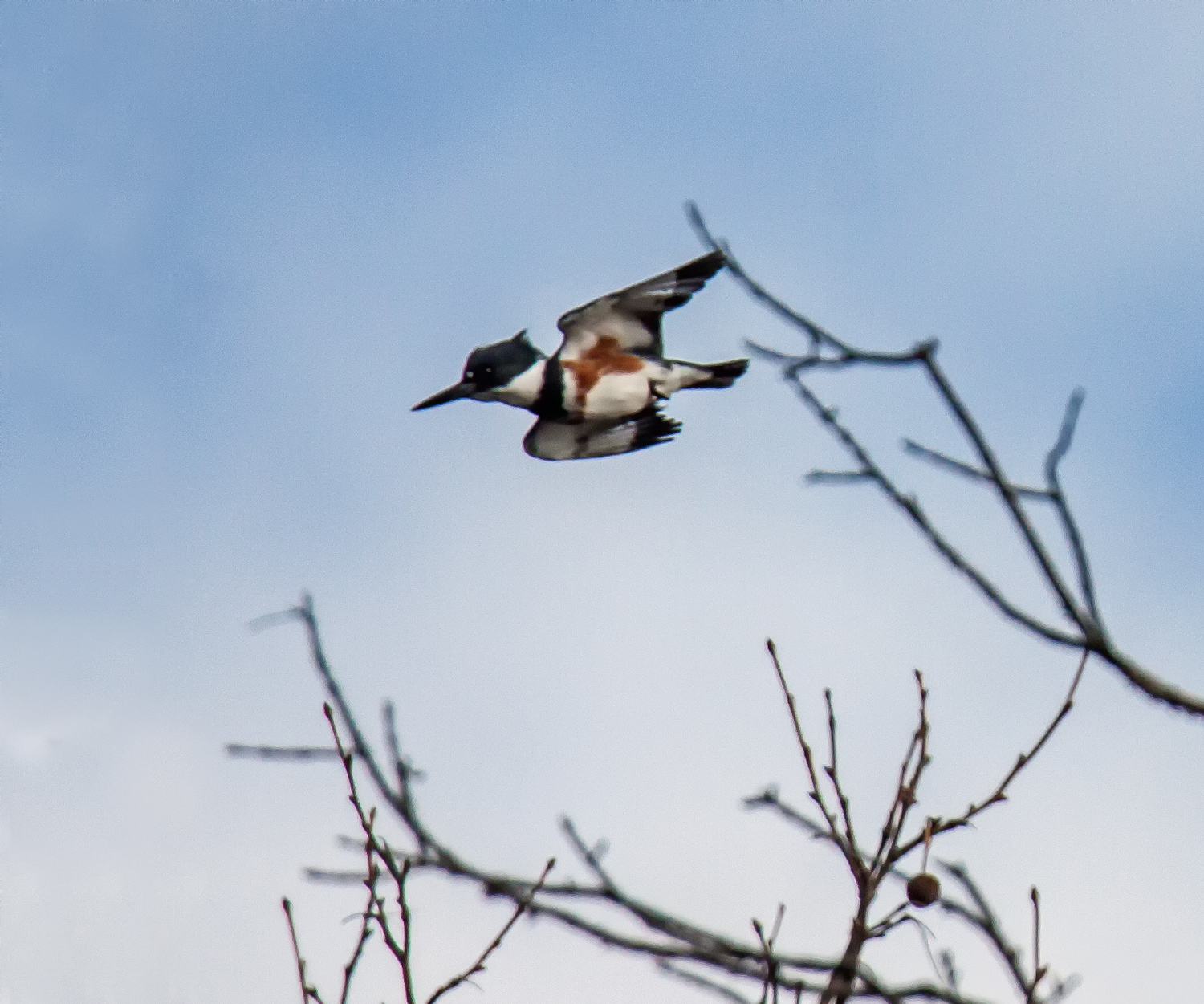
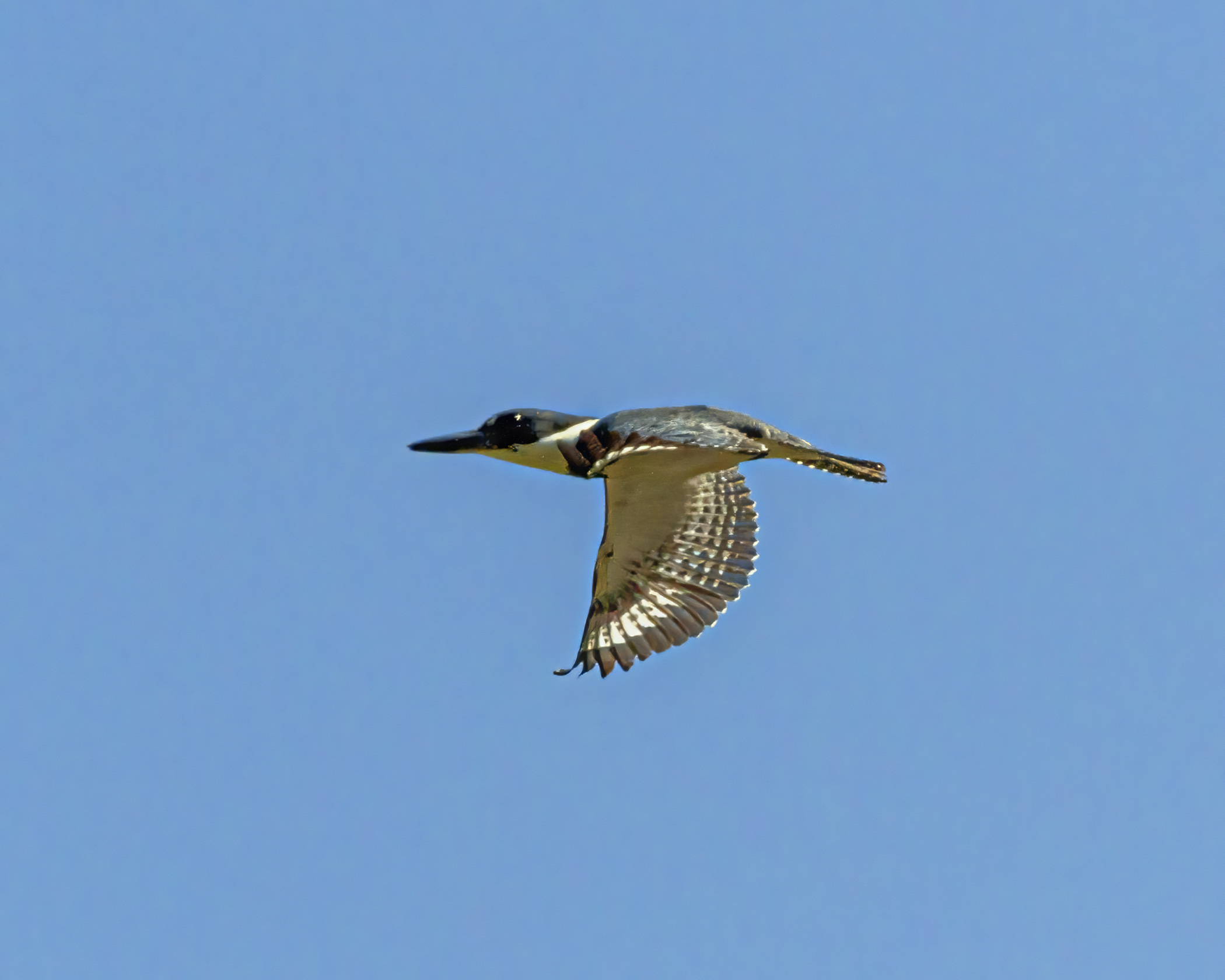
On Monday at Occoquan Regional Park, I was thrilled to capture some shots of this male Belted Kingfisher (Megaceryle alcyon) as he flew by me overhead. Kingfishers are really skittish and quite often I am aware of their presence of these speedy little birds when I hear their rattling call as they fly away from me. This kingfisher, however, flew across my field of view, which allowed me to track it and focus on it as it passed.

How do I know this is a male kingfisher? Normally male birds are more colorful than their female counterparts, but that is not true for Belted Kingfishers—females have a chestnut-colored band across their chests that the males do not have.

Belted Kingfisher

Belted Kingfisher

© Michael Q. Powell. All rights reserved.

Read Full Post »

Belted Kingfishers (Megaceryle alcyon) are one of my nemesis birds. They are small and fast and incredibly skittish. I see (or hear) them quite often, but I am rarely able to get a decent shot of one.

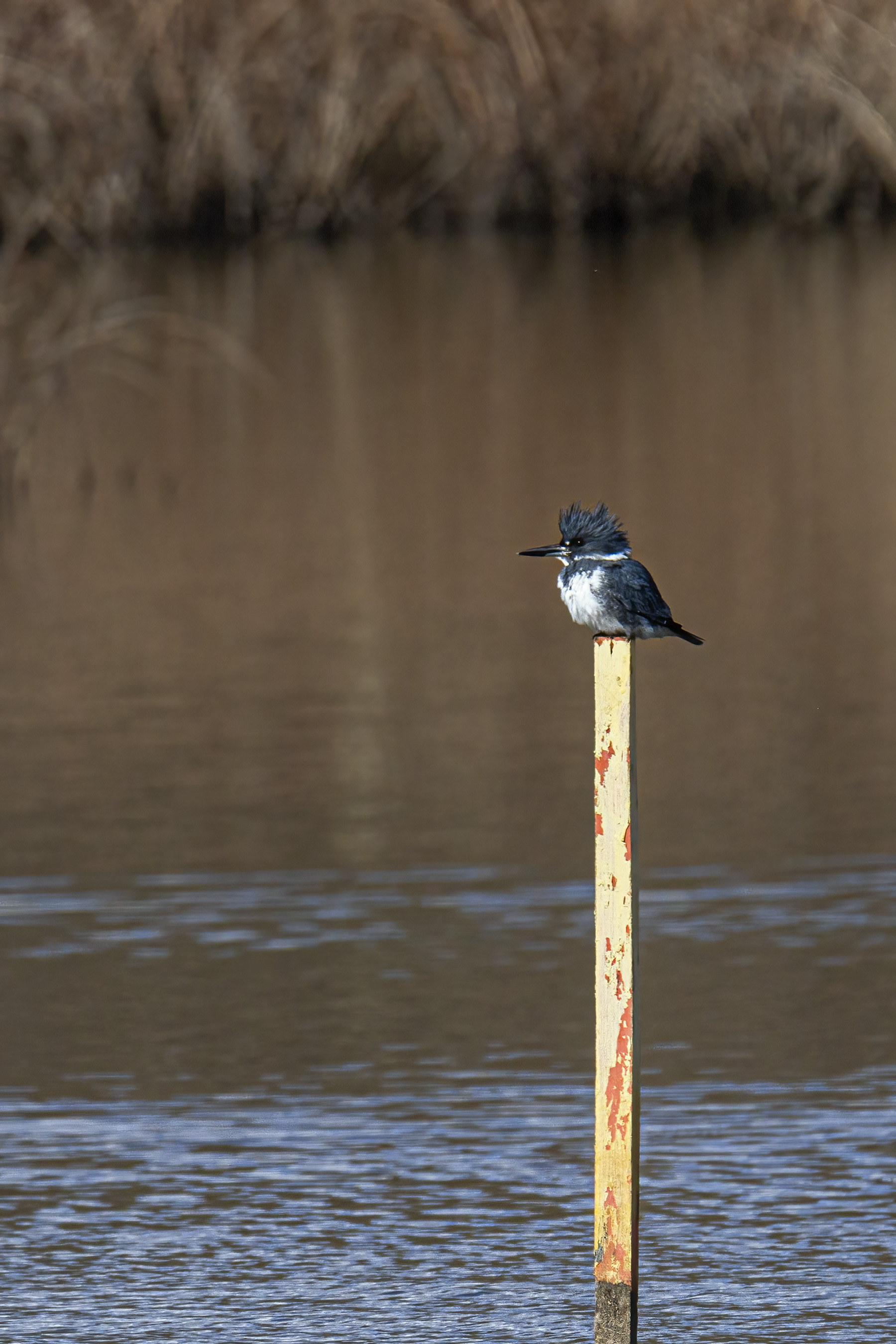
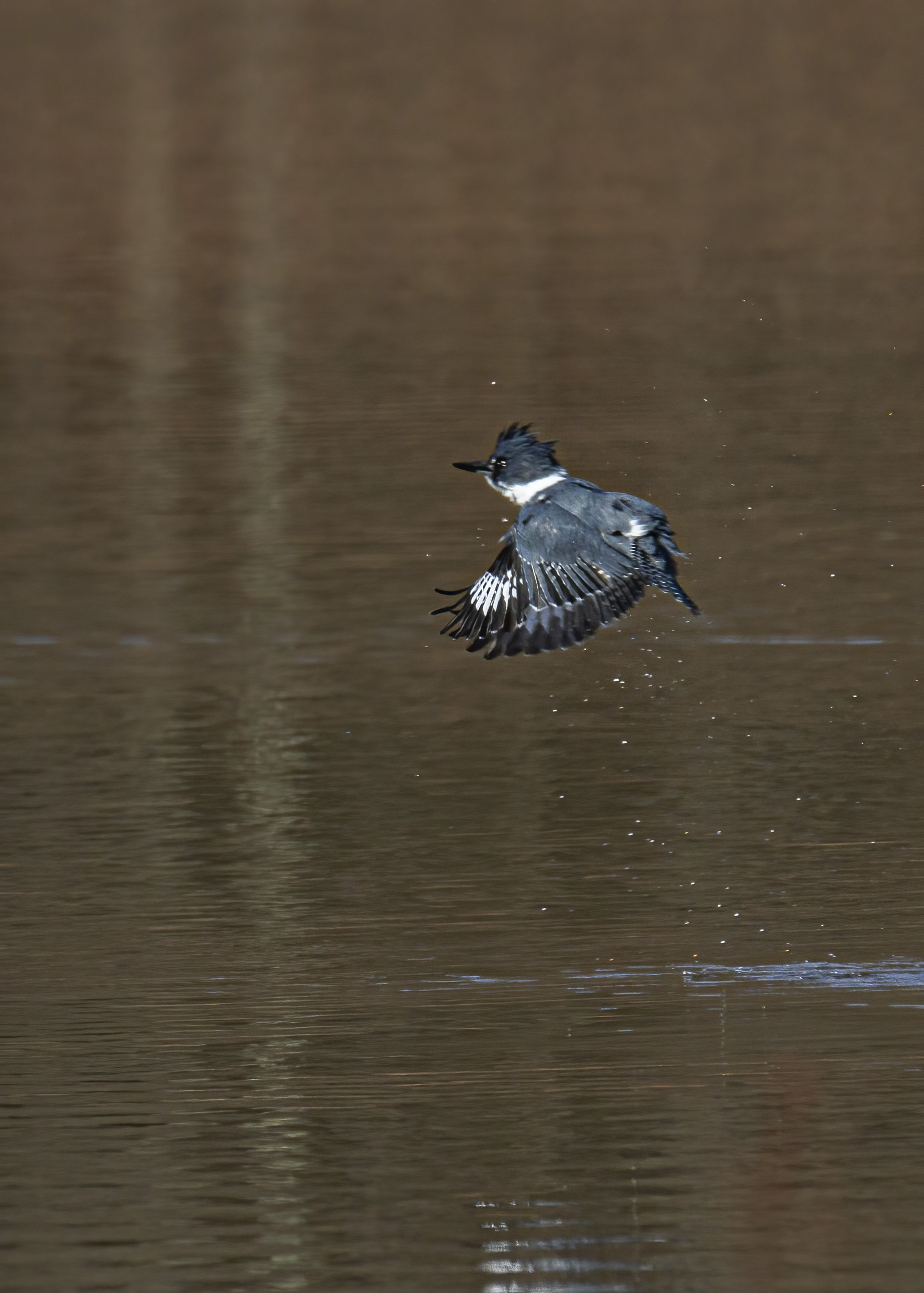
I spent a good amount of time last Friday at Huntley Meadows Park observing a male Belted Kingfisher trying to catch a fish. He was perched on some kind of board sticking out of the water and repeatedly dove into the water and returned to the same post. Eventually he caught a fish, but, alas, flew away with it before I could get a shot of him with his catch.

Unlike an eagle that grabs a fish with its talons without submerging itself, a kingfisher dives headfirst into the water, creating a big splash. According to the Cornell Lab of Ornithology, “When it spots a fish or crayfish near the surface, it takes flight, dives with closed eyes, and grabs the prey in its bill with a pincer motion. Returning with its prize, it pounds the prey against the perch before swallowing it head first.”

I was perched on am observation platform some distance away, but had a clear line of sight to the kingfisher. Over time I was able to capture some relatively sharp shots of the kingfisher in action. The first shot is my favorite—the kingfisher was rising up out of the water, surrounded by water droplets, after what appeared to have been an unsuccessful attempt.

The second photo shows the kingfisher on its perch. I am not sure why this board was sticking out of the water, but noted several similar boards nearby. The subsequent images show the kingfisher in various stages of action. I was fortunate that the kingfisher made several attempts, sometimes diving to the left and sometimes to the right, so I had multiple chances to get shots. Actions shots are a tough, but fun challenge. The kingfisher would take off without warning and after it dove into the water, I was never sure exactly when and where he would reemerge.

Belted Kingfisher

Belted Kingfisher

Belted Kingfisher

Belted Kingfisher

Belted Kingfisher

Belted Kingfisher

© Michael Q. Powell. All rights reserved.


Read Full Post »

When it comes to posting photos, where do you you draw the line? Do you carefully curate your images and post only the ones that make you look good as a photographer? Do you worry about your “image” and reputation? I remember someone telling me once that the true sign of professionals is that they present only their absolute best work to the public.

I am proud to say that I am not a professional by that definition and I post photos that I find interesting, cool, or quirky, irrespective of the supposed quality of the images. I do not really care all that much about my personal image and have never had a goal of attracting a large audience of “followers.” I post images that appeal to me in some way and hope that some viewers will have a similar reaction

My photos (and my blog) are a reflection of the way that I see the world and my simple objective is to use my images and words to share my perspectives with others, i.e. to help them to see the world through my eyes. For me, the natural world is full of endless wonder and unlimited beauty, a place to explore and channel my curiosity and creativity.

I have gone off on a bit of a tangent in this posting, but I woke up this morning in an introspective mood and wanted to share some of what is going on in my head at this moment. The three images below are ones that I have taken over the past two weeks at Occoquan Bay National Wildlife Refuge and are a bit more “artsy” than my usual images, which tend to be more detailed and close-up.

The first image shows a pair of Hooded Merganser ducks (Lophodytes cucullatus) flying away from me over the water. I really like their shadowy reflections and the parallel lines of the water. The second photo shows a Pied-billed Grebe (Podilymbus podiceps). Although I captured the details of the bird pretty well, it is the rippled reflection that really grabbed my attention.

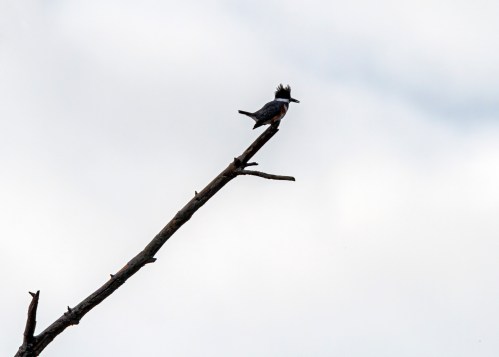
The final photo is a minimalist environmental portrait of a Belted Kingfisher (Megaceryle alcyon). Silhouettes work best when the shape of the subject make it immediately recognizable, which I think is the case here. I like the way that the angular protrusions of the branch match those of the bird. The image is mostly black and white, but I really like the way that you can see a bit of the blue sky peeking through in the upper right corner of the frame.

So what do you think? Would you have thought to capture these images? Would you have been willing to share them with others? Where do you draw the line?

Hooded Mergansers

Pied-billed Grebe

Belted Kingfisher

© Michael Q. Powell. All rights reserved.

Read Full Post »
Belted Kingfishers (Megaceryle alcyon) have a distinctive chattering call and I hear these skittish little birds more often than I see them. Often my first indication of their presence is their call as they fly away from me.

Normally I see a single kingfisher at a time, but Friday at Occoquan Bay National Wildlife Refuge I watched and listened as two kingfishers loudly chased each other around through the trees and over the water. I did not get a really good look at them, because they never flew or perched close to me, but it appeared to me that they were both females. Female Belted Kingfishers have a chestnut-colored strip across their chests that males do not have, one of the few bird species that I know of in which the females are more colorful than the males.

These kingfishers are small and fast, but I managed to capture a few in-flight shots. I particularly like the first image, in which the sunlight helped to illuminate the underside of the kingfisher as she extended her wings fully as she flew through what I believe is a tulip tree. In the second photo there was more of a shadow on the bird, but I like the angle of view that I had as I pointed my camera upwards as the kingfisher zoomed by me.

Belted Kingfisher

Belted Kingfisher

© Michael Q. Powell. All rights reserved.

Read Full Post »

I will often strive to photograph my wildlife subjects from as many different angles as I can in order to take advantage of the lighting or to highlight the details of their bodies. When I spot a subject, though, I initially try to capture whatever shot I can before I work to get a better shot—any of my subjects are skittish and there is always the chance that my initial shot will be my only one.

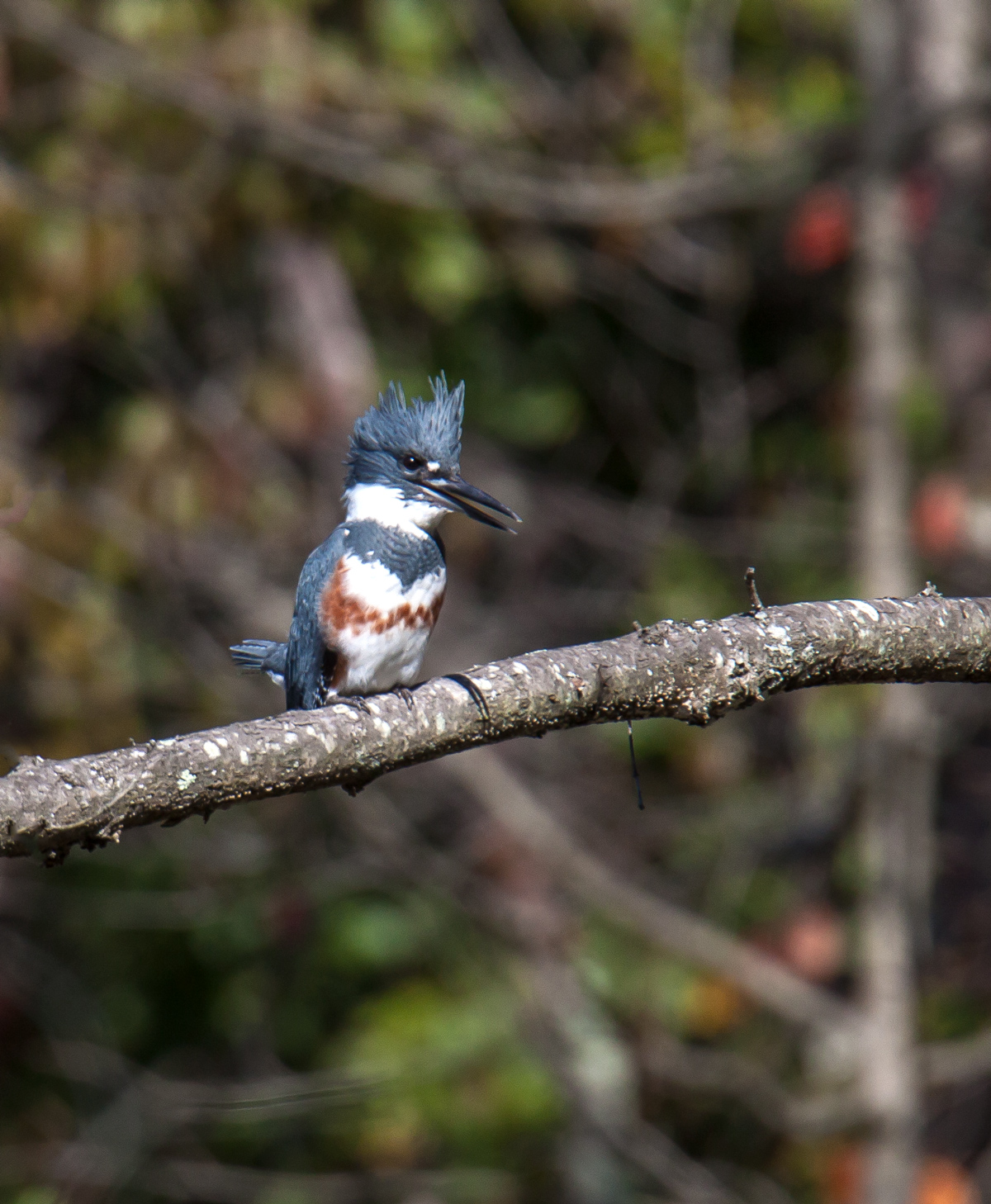
I spotted this perched male Belted Kingfisher (Megaceryle alcyon) last Thursday at Huntley Meadows Park in Alexandria, Virginia and one of my initial shots was the third one below. The perch was sticking out of a pond that was surrounded by a marshy wetland, so there was really no chance for me to get closer to the kingfisher—there was no way to work the angles in my usual way.

So what did I do? In the background I noticed there were some patches of colorful fall foliage, so I decided to see if I could include some of those colors in my images to give them an autumn vibe. By bending, twisting, crouching, and kneeling I was able to vary my shooting angle, while remaining more or less in the same spot, and eventually managed to get some photos that included portions of that autumn foliage. The kingfisher remained in place, but cooperated by changing his head position from time to time.

Belted Kingfisher

Belted Kingfisher

Belted Kingfisher

© Michael Q. Powell. All rights reserved.

Read Full Post »
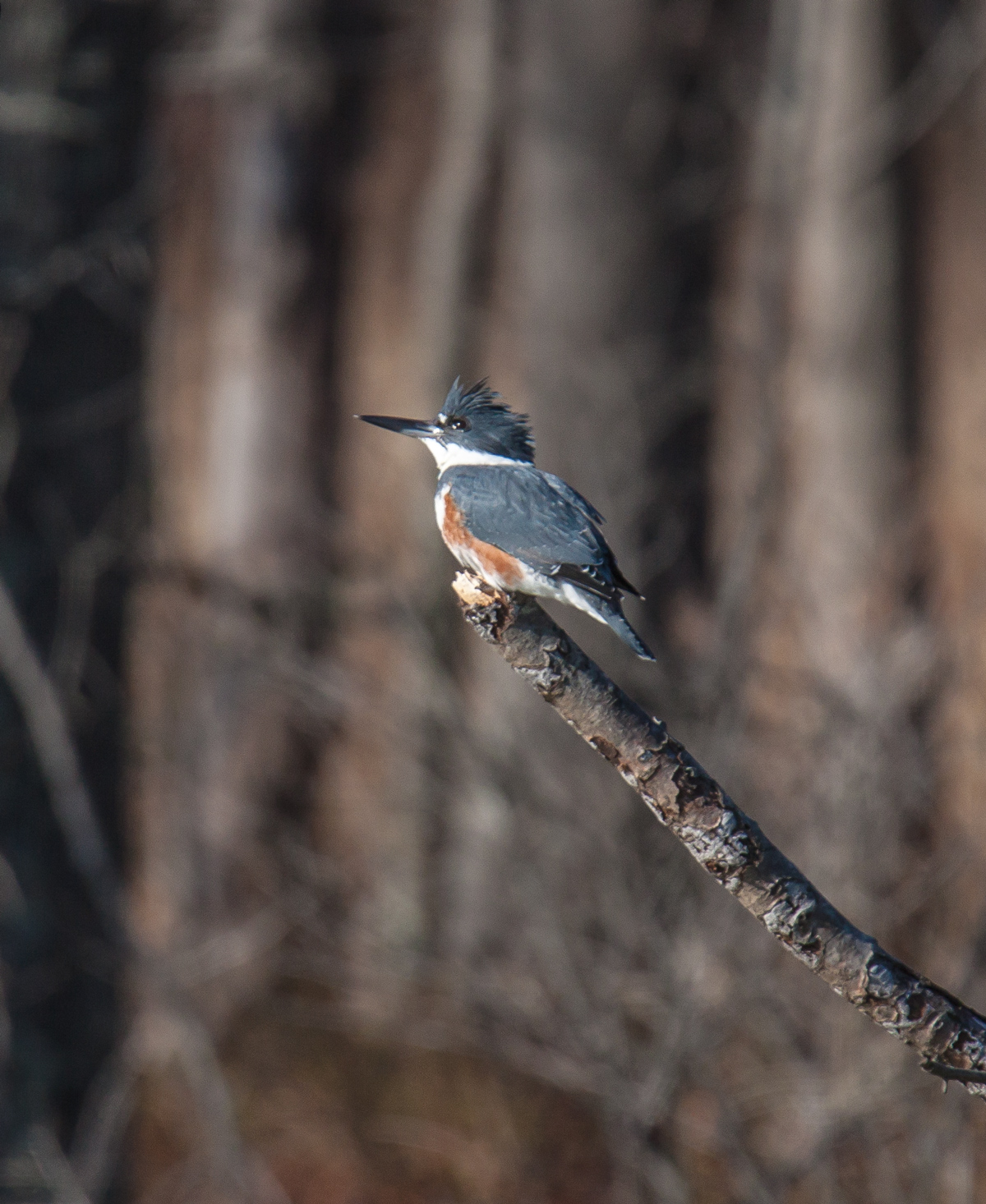
During a visit in late January to Occoquan Bay National Wildlife Refuge, I was thrilled to spot a female Belted Kingfisher (Megaceryle alcyon). The kingfisher was perched relatively in the brush a pretty good distance away and surprisingly did not seem to be aware of my presence. Normally kingfishers are really skittish and often fly away before I am within the range of my camera.

This kingfisher seemed to be a little distracted by a helicopter that was flying overhead and kept glancing upwards, as you can see in the second photo. The chestnut-colored stripe on the breast of the bird helps me to identify it as a female, because males have no such stripe.

Belted Kingfisher

Belted Kingfisher

Belted Kingfisher

© Michael Q. Powell. All rights reserved.

Read Full Post »

The Belted Kingfisher (Megaceryle alcyon) is probably the most skittish bird that I try to photograph. No matter how hard I try to sneak up on one, it always seems to fly away before I can get close. Quite often I hear the kingfisher’s distinctive rattling call and never even see the bird.

The first image is a long-distance shot of one from last week at Occoquan Bay National Wildlife Refuge. The kingfisher is relatively small in the frame, but I love the pattern of the branches in the shot.

The second image shows a female Belted Kingfisher perched on a metal post sticking out of the water on Monday at the same wildlife refuge. Generally I prefer natural vice man-made perches, but in this case I like the little “forest” of metal posts and their beautiful reflections in the water. How do I know that it is a female? Only female Belted Kingfishers have the chestnut-colored stripe on their breasts, one of the few cases in bird world in which the female is more colorful than the male.

Belted Kingfisher

Belted Kingfisher

© Michael Q. Powell. All rights reserved.

Read Full Post »
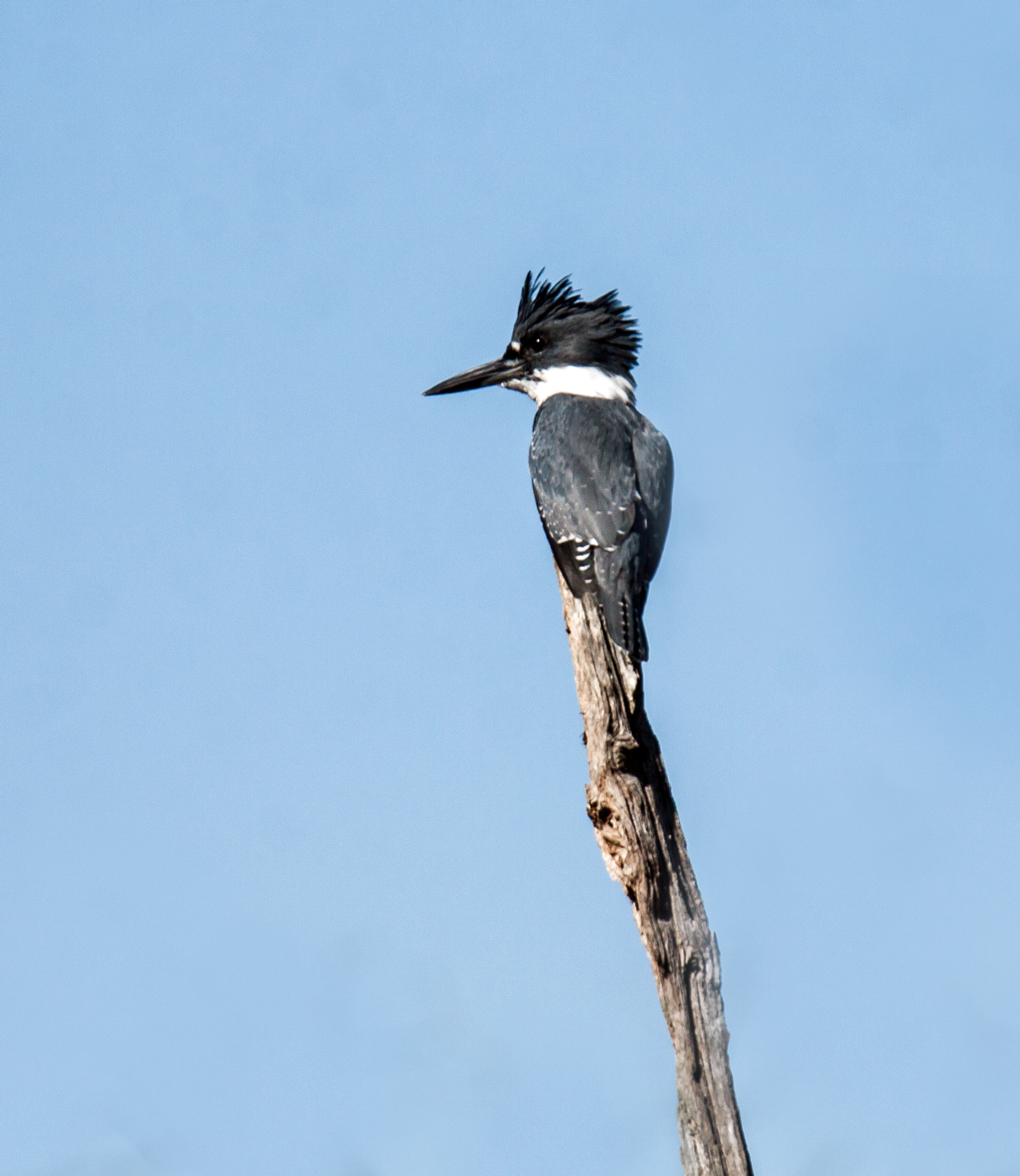
I couldn’t get very close to this Belted Kingfisher (Megaceryle alcyon) at Occoquan Bay National Wildlife Refuge last week, but I was happy to get a few long-distance shots before it flew away. Kingfishers are incredibly skittish and often my first indication of the presence of one is when I see or hear it flying away from me.

Generally I prefer to photograph birds that are perched on natural objects, but in this case I really like the geometric shape of the wooden structure that was sticking out of the water. Considering that I took these shots from a long way off, I was happy to be able to capture some of the grain of the wood and the bolt that held the boards to the post. I think this might have been part of a former duck blind, though it is hard to know for sure where it came from.

I am hoping to see this kingfisher again and perhaps will manage to get some closer shots the next time. Like most wildlife photographers, I am always thinking of my next shots, confident that I can capture better images on future outings.

Belted Kingfisher


Belted Kingfisher

© Michael Q. Powell. All rights reserved.

Read Full Post »

If I am patient and persistent, I can usually end up with pretty good shots of most types of birds that I see. The Belted Kingfisher (Megaceryle alcyon), however, is a notable exception—I only rarely get a clean look at a kingfisher and don’t think that I have ever gotten a close-up shot of one.

Why? Belted Kingfishers are small, fast, and extremely skittish, which makes them remarkably elusive. Most of the time my first indication that a kingfisher is in the area is when I hear its distinctive rattling call as it flies away from me. It sometimes feels like the bird is taunting me. It will often fly only a short distance away, giving me hope that I will be able to creep closer, and then it will fly away again as soon as I start to move.

I have several encounters with a Belted Kingfisher this month and was happy to get this shot recently of a female. You can tell that it is a female because of the chestnut stripe on its breast. Males have only a blue stripe—it is really unusual with bird species to have the female more colorful than the male.

Kingfishers have a very distinctive look with their stocky bodies, large heads and thick, pointed bills. I always enjoy seeing photos of kingfishers from other parts of the world, including the brilliant blue Eurasian Kingfisher, a species that I hope to see in person in the future, when it becomes safe enough to travel internationally again.

Belted Kingfisher

© Michael Q. Powell. All rights reserved.

Read Full Post »

Many of the birds that I try to photograph are skittish, but the Belted Kingfisher (Megaceryle alcyon) may take the prize for being the most skittish. The kingfisher is amazingly energetic and exceptionally alert and will frequently fly away before I am even aware of its presence. As it zooms out of sight, the kingfisher will often make a distinctive rattling call, almost like it is taunting me.

Yesterday at Occoquan Bay National Wildlife Refuge, I spotted the distinctive silhouette of a kingfisher perched on branch overlooking the water. The small bird was a good distance away, but as I peered through my telephoto lens, I could tell that it had caught a fish and was busily subduing the fish—a kingfisher will pound its prey against its perch before swallowing it head first.

I was faced with a dilemma. Should I try to get a distant shot, knowing that I might scare the bird away, or should I try to move closer for a better shot and risk not getting any shots at all? In this case, I chose the safer approach and took this long range shot. The kingfisher did not fly away while I was taking the shot, but when I took  few steps down the trail towards it, the kingfisher immediately took to the air.

I am pretty happy with the image that I was able to capture. If you click on the photo, you will see that I was able to capture some of the detail of this beautiful little bird and even some details of the hapless fish.

Belted Kingfisher

© Michael Q. Powell. All rights reserved.


Read Full Post »
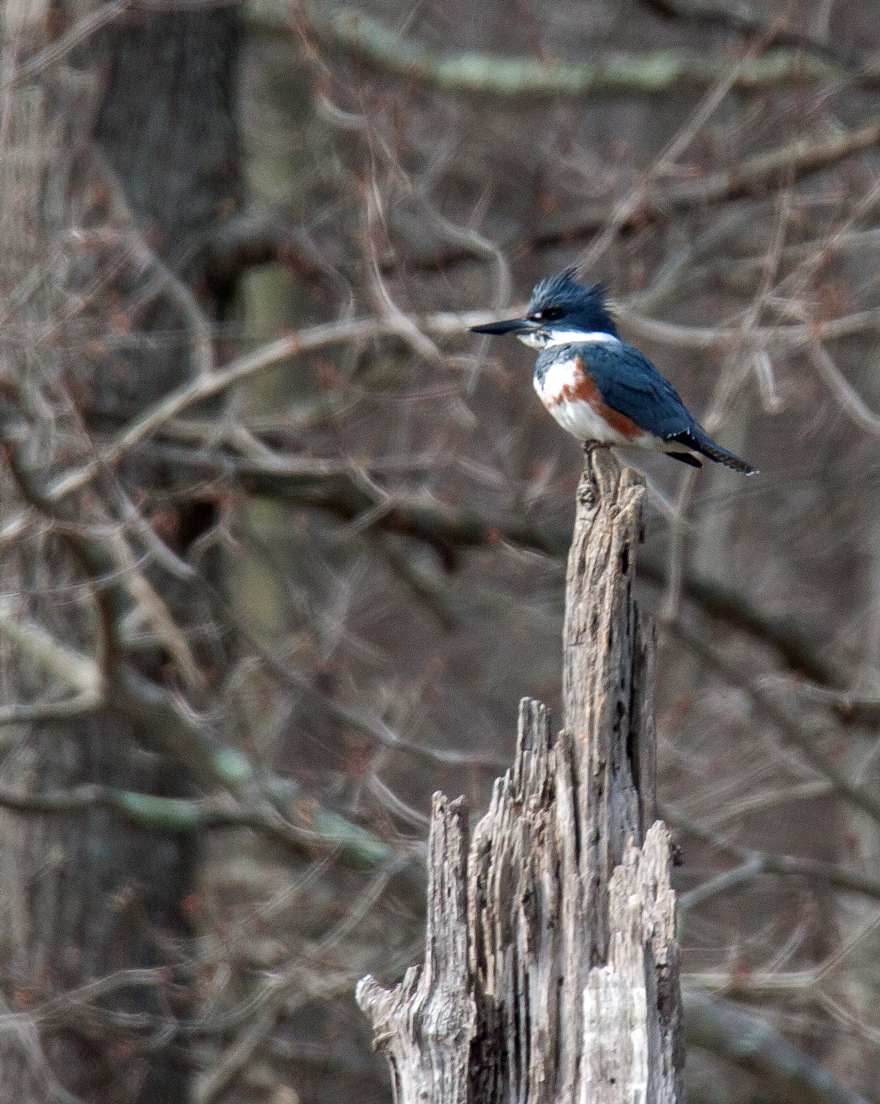
In the distance I heard the unmistakeable call of a Belted Kingfisher (Megaceryle alcyon) during a recent at Occoquan Bay National Wildlife Refuge. My eyes tried to follow my ears and I was finally able to locate the elusive bird, almost hidden against a backdrop of tangled trees. Was it worth taking a shot?

All photographers are taught to avoid cluttered backgrounds, because they make it difficult for viewers to focus on the primary subject—that is the conventional wisdom and it often makes sense, except when it doesn’t. The more I take photos, the more I realize that the “rules” are merely loose guidelines that need to be challenged regularly. When in doubt, I believe it is best to take the shot even when the lighting is bad, the shutter speed is too slow, or the background is too busy.

In this case, the small branches form an almost irregular pattern that more or less fades away for me, leaving me with the skeleton structure of the darker branches and the bird itself. The colors of the bird contrast so much with those of the branches that it stands out even though it is only a small part of the photo.

Does the image “work?” It is definitely not the “normal” kind of shot that I take, but I really like the way that it turned out. Sometimes it can be good to ignore the limitations of the rules and just go for it.

belted kingfisher

© Michael Q. Powell. All rights reserved.


Read Full Post »
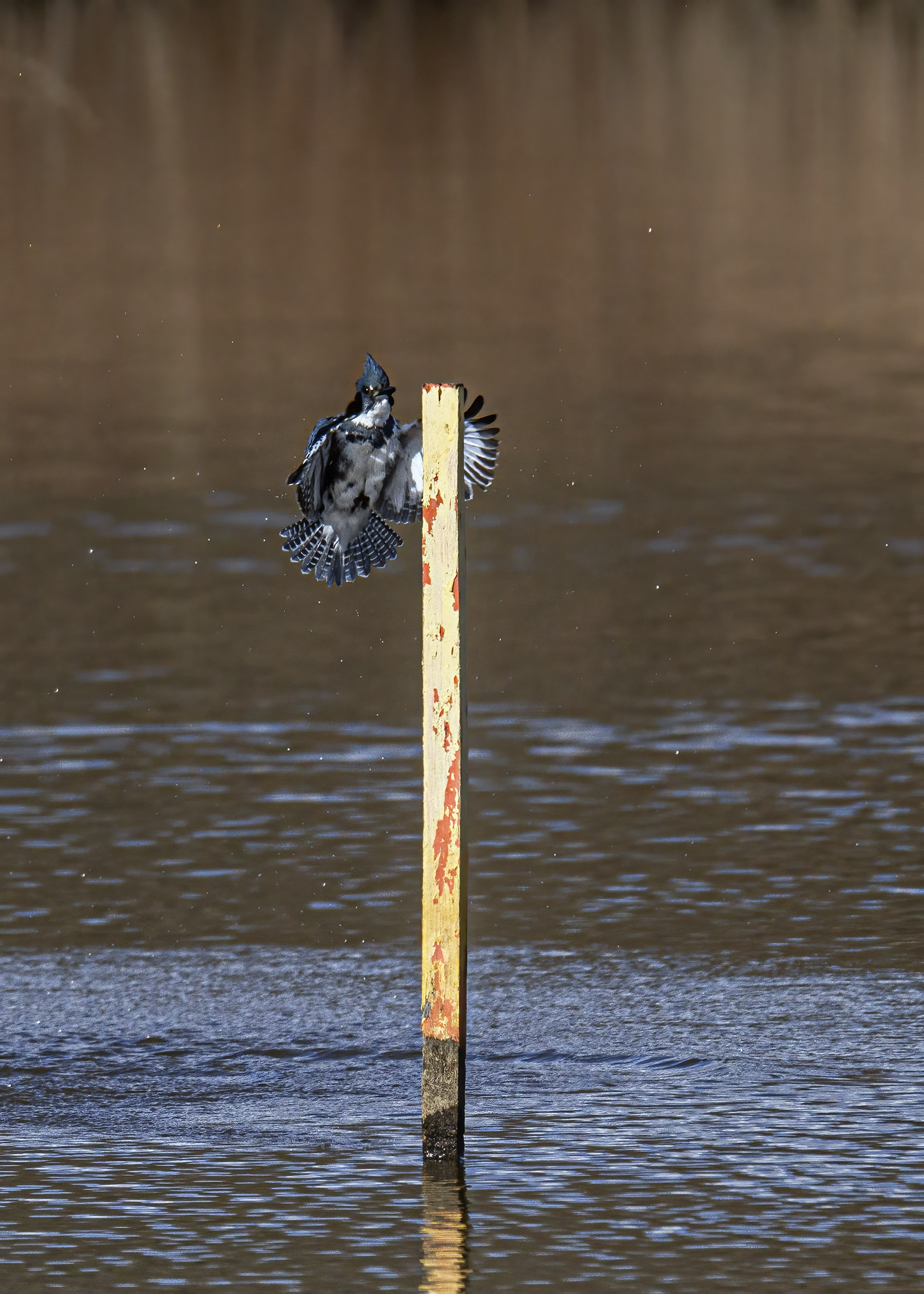
The female Belted Kingfisher (Megaceryle alcyon) that I spotted last Friday at Huntley Meadows Park was too quick and too far away for me to photograph in flight when she took off several times to try to catch a fish. I did manage, though, to capture a short sequence of shots when she was returning to her perch after an unsuccessful attempt. Unlike many birds that would have approached the perch horizontally, the kingfisher came up out of the water vertically, appearing almost to levitate as she rose to her perch.

Normally I lead a blog post with my favorite or my best image, but this time I decided to leave the shots in the correct time sequence. The middle image in which the kingfisher was fully spread her wings is my clear favorite of the three, though I like the way that each shot shows the different body and wing positions as she stuck her landing–I would give her a perfect score of 10.


Belted Kingfisher

Belted Kingfisher

Belted Kingfisher

© Michael Q. Powell. All rights reserved.

Read Full Post »

As I was exploring in Huntley Meadows Park last Friday, I heard the unmistakeable rattling call of a kingfisher. After a bit of searching, I located this female Belted Kingfisher (Megaceryle alcyon) on a perch high above an osprey nesting platform jutting out of the water. I watched and waited and eventually kingfisher flew down from the perch in an attempt to catch a fish.

The kingfisher was successful and returned to the perch with a sizable fish. The first challenge for the kingfisher was to subdue the fish and it beat the fish repeatedly against the perch. At the same time it adjusted the fish in order to swallow the fish headfirst, in the same way that a great blue heron does. In the second image, you can see that the kingfisher has maneuvered the fish into almost the proper position.

I am a bit more used to watching ospreys and eagles consume fish, which they accomplish by tearing away pieces of the fish with their sharp beaks while holding down the fish with their equally sharp talons. Kingfishers have differently-shaped bills and talons, so they have to swallow their fish in a single gulp.

The kingfisher has little margin for error as it makes its forceful movements while balancing itself on a narrow perch high above the water. The final photo shows that mistakes can happen—the fish slipped out of the kingfisher’s bill when she lifted her head upwards to swallow it.

I am able to happily report that the kingfisher was able to fly down to the water, retrieve the fish, and eventually consume it. As always, I encourage you to double-click on the images to get a closer look at the wonderful details of the photos.

Belted Kingfisher

Belted Kingfisher

Belted Kingfisher

© Michael Q. Powell. All rights reserved.

Read Full Post »

During the hot, humid days of mid-summer, I often hear the sounds of birds, but rarely see them. Although I may be out in the blazing sun, most of the birds seem to use common sense and take shelter in the shade of the trees.

Last week as I was exploring Jackson Miles Abbott Wetland Refuge, I heard the unmistakable call of a kingfisher and caught a glimpse of it skimming across the water of a small pond. I was a bit surprised when it chose briefly to perch in a small tree overhanging the water. I was a long way away, but had a clear line of sight and captured this image of the female Belted Kingfisher (Megaceryle alcyon). I can tell that it is a female because I can see a reddish-colored band across its chest that the male lacks.

Many of you know that I photograph birds more frequently during the winter months, when insects disappear and the lack of foliage makes it easier to spot the birds. Throughout the year, however, I try to be ready in case a bird decides to be cooperative and poses for me.

Belted Kingfisher

© Michael Q. Powell. All rights reserved.

Read Full Post »

It often feels like Belted Kingfishers (Megaceryle alcyon) are taunting me. They boldly advertise their presence with a distinctive rattling call, but keep their distance or fly away quickly before I can spot them. I dream of spotting one at close range and getting some shots before it is aware of my presence.

Well, my dream did not not come true this past Monday, but I did manage to get some shots of a female Belted Kingfisher in flight while exploring Occoquan Bay National Wildlife Refuge. I took the shots at pretty long range as the kingfisher was moving from perch to perch in the distant trees.

Belted Kingfisher

Belted Kingfisher

Belted Kingfisher

© Michael Q. Powell. All rights reserved.


Read Full Post »

Every monarch needs a crown and this female Belted Kingfisher (Megaceryle alcyon) seemed to be wearing a leafy one yesterday at Occoquan Bay National Wildlife Refuge.

Maybe I should be calling her a Belted Queenfisher. 🙂

Belted Kingfisher

© Michael Q. Powell. All rights reserved.


Read Full Post »

Belted Kingfishers (Megaceryle alcyon) are normally very skittish and it seems like they always choose to perch in distant trees. This past weekend, however, a female Belted Kingfisher flew to some trees that were a lot closer than usual and I was able to capture these shot. The images don’t exactly fill they frame, but they do show a lot of the cool details that make the kingfisher so special. In case you are curious, it is really easy to identify the gender of Belted Kingfishers—only the females have the rust-colored stripes on the chest, one of the few cases in which a female of a bird species is more colorful than the male.

Belted Kingfisher

Belted Kingfisher

Belted Kingfisher

© Michael Q. Powell. All rights reserved.

Read Full Post »

A Belted Kingfisher (Megaceryle alcyon) and a Red-headed Woodpecker (Melanerpes erythrocephalus) seemed to be eyeing each other with intense curiosity this past Friday at Huntley Meadows Park when they both chose to occupy the same tree at the same time.

Redheads have a mysterious attraction, it seems, in the bird world as well as in the human world.

Belted Kingfisher and Red-headed Woodpecker

© Michael Q. Powell. All rights reserved.

Read Full Post »

I spent a considerable amount of time one morning earlier this month at Huntley Meadows Park trying to get some shots of this skittish female Belted Kingfisher (Megaceryle alcyon). It was almost impossible to get really close, so I had to rely on my long telephoto zoom lens.

Belted Kingfisher

Belted Kingfisher

Belted Kingfisher

© Michael Q. Powell. All rights reserved

Read Full Post »

With stealth and patience I can get relatively close to some birds, but Belted Kingfishers (Megaceryle alcyon) remain elusive, skittish, and difficult to capture. I was fortunate to get some long distance shots of a handsome male kingfisher (males have no chestnut-colored stripe on their chests) last weekend in the trees overlooking Lake Cook in Alexandria, Virginia.

Belted Kingfisher

Belted Kingfisher

© Michael Q. Powell. All rights reserved.

Read Full Post »

I spent a fair amount of time yesterday at Huntley Meadows Park watching a female Belted Kingfisher (Megaceryle alcyon), one of my favorite birds. She was perched on a broken-off tree a pretty good distance away and there was no way that I could get any closer, since there was water between the boardwalk on which I was standing and that tree.

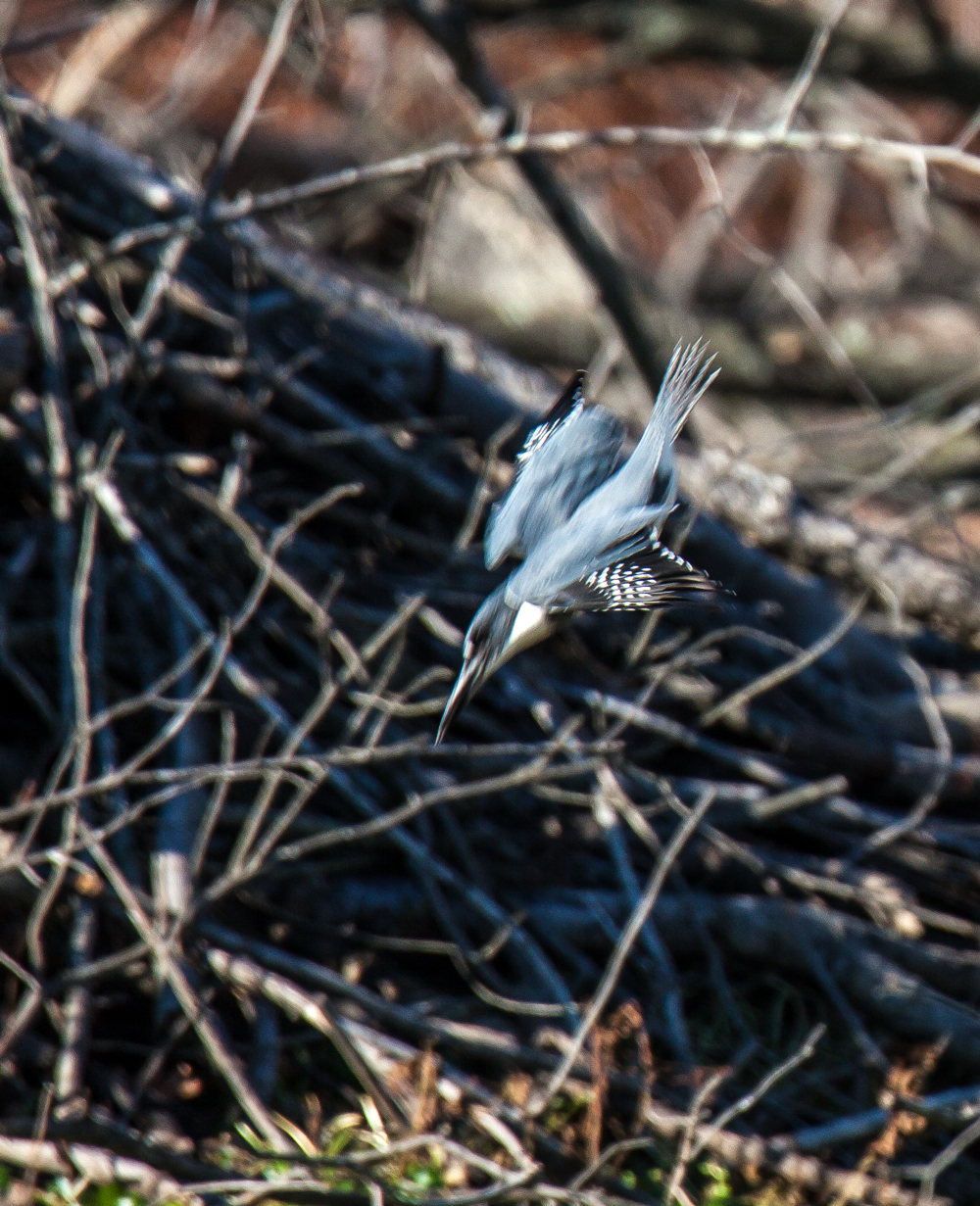
The kingfisher remained perched for quite some time, so I had plenty of time to steady myself and adjust settings until I was relatively content with some of my shots. What I really wanted to do, though, was to capture the kingfisher. I knew that eventually the kingfisher would dive into the water and I waited. Kingfishers don’t give any real warning when they are ready to dive, so I tried to remain alert and ready, even though I knew the chances of me capturing this fast-moving bird in flight were slim.

The kingfisher dove several times and I did manage to capture a few ok images of her flight toward the water. My favorite shot, however, is the final one here in which she is flying out of the water with what looks to be a small fish.

It was a nice catch for both of us.

Belted Kingfisher

Belted Kingfisher

Belted Kingfisher

Belted Kingfisher

© Michael Q. Powell. All rights reserved.

Read Full Post »

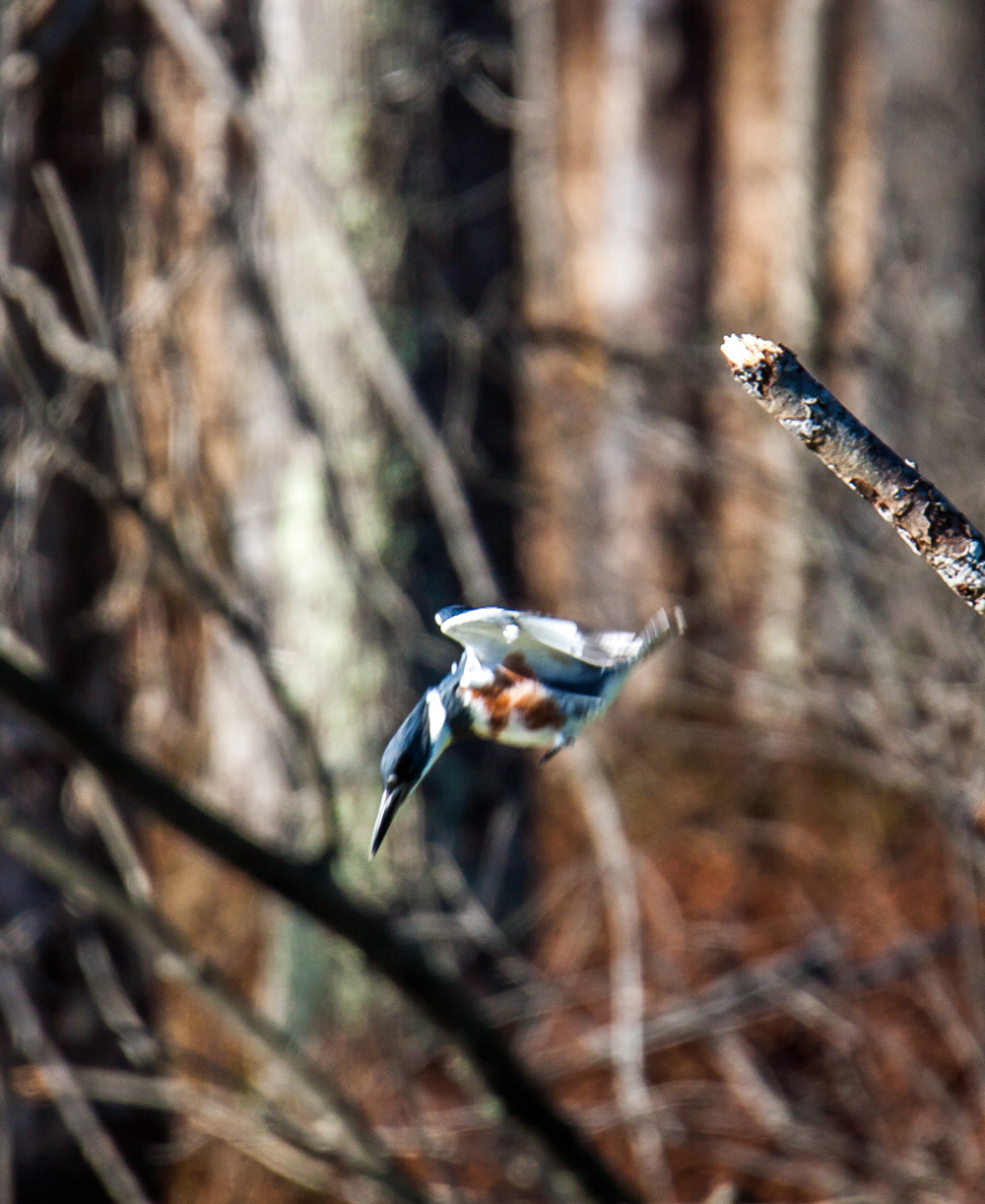
On a cloudy, misty afternoon yesterday at Huntley Meadows Park, this female Belted Kingfisher ( Megaceryle alcyon) couldn’t make up her mind where to perch, flying from one rotted tree to another in the marshland. I was thrilled to get this shot when she took off from one of her perches.

Belted Kingfisher

© Michael Q. Powell. All rights reserved.

Read Full Post »

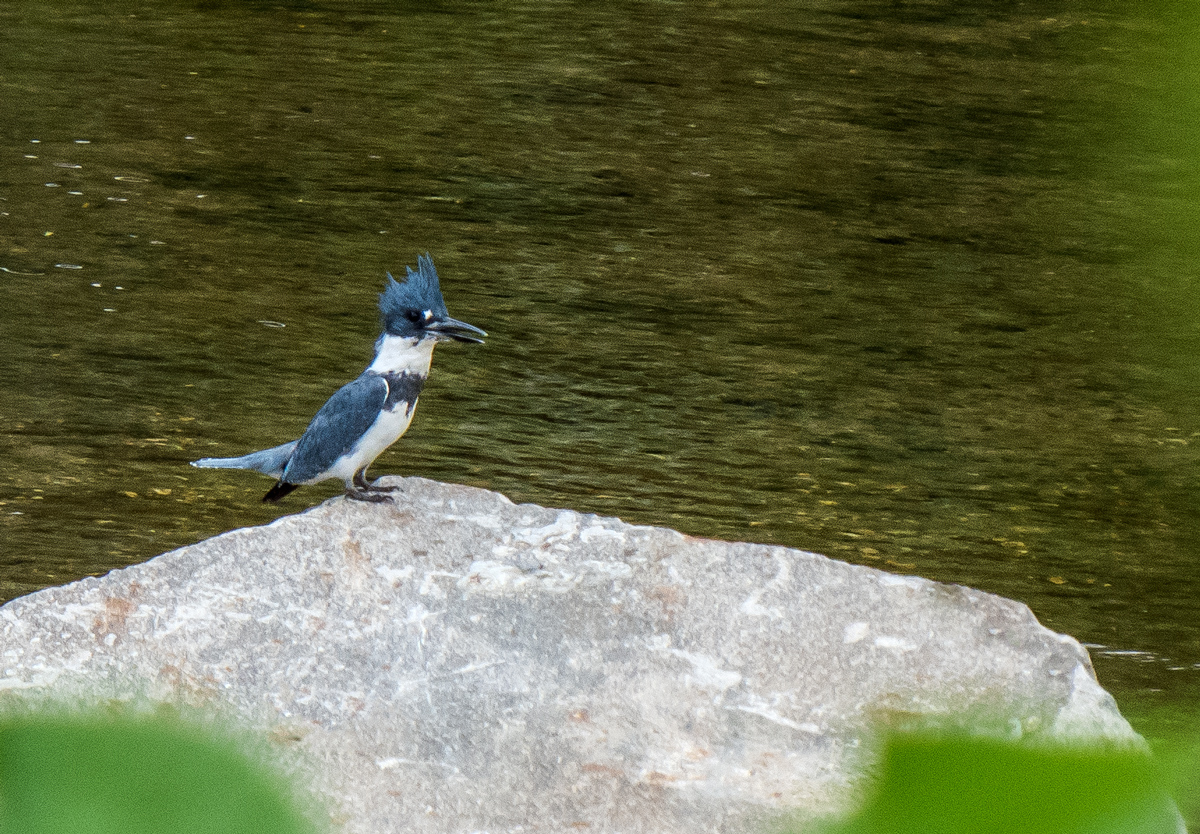
Yesterday I was on a biking/walking trail that follows Cameron Run, a tributary stream of the Potomac River, when I heard the unmistakable  rattling call of a Belted Kingfisher (Megaceryle alcyon). As I moved through the vegetation to investigate, I spotted a kingfisher perched on a rock jutting out of the water. I had my Canon SX50 zoomed out to its maximum length, but it wasn’t enough—I needed to get closer.

As I made my way slowly down a steep slope, my footing gave way and I unceremoniously slid for a short distance on my back side. No surprisingly I spooked the kingfisher. What was surprising was that the kingfisher did not fly up into the trees, but instead he flew to a more distant smaller rock that was barely bigger than he was. (You can tell that it is a male because, unlike the female, he does not have chestnut stripe across his chest.)

The kingfisher soon took to the air and was joined by another one. They proceeded to fly back and forth over a portion of the stream, calling out loudly the entire time. They didn’t actually buzz me, but they did fly in my general direction a couple of times before veering off. What was going on?

I got a somewhat blurry shot of the second kingfisher, a female, that confirmed my suspicion that this was a couple. According to the Cornell Lab of Ornithology website, “During breeding season the Belted Kingfisher pair defends a territory against other kingfishers. A territory along a stream includes just the streambed and the vegetation along it, and averages 0.6 mile long. The nest burrow is usually in a dirt bank near water. The tunnel slopes upward from the entrance, perhaps to keep water from entering the nest. Tunnel length ranges from 1 to 8 feet.”

This behavior suggests to me that there could be baby kingfishers in the area. I certainly didn’t see any babies and suspect that a nest would probably be on the opposite side of the stream from where I took these photos, an area that is more remote and inacessible.

Belted Kingfisher

Belted Kingfisher

© Michael Q. Powell. All rights reserved

Read Full Post »

I keep trying without much success to get a close shot of a Belted Kingfisher, but they are very skittish and always seem to be perched on the opposite bank of the stream or pond from where I am standing.

This past weekend I was happy to get a clear (albeit distant) look at this beautiful female Belted Kingfisher (Megaceryle alcyon) at my favorite marshland park. The kingfisher seemed to be taking a break from fishing and spent most of her time looking to the left and to the right rather than down at the water.

I’ve spotted a kingfisher before on this perch, but can’t get any closer from this side of the pond. Occasionally I will trek to the other side of the pond and hope that eventually I will be able to sneak closer to this elusive bird from that direction.

Belted Kingfisher

Belted Kingfisher

© Michael Q. Powell. All rights reserved.

Read Full Post »

Recently, while exploring the streams in the remote back areas of Huntley Meadows Park, I have heard the unmistakable call of a Belted Kingfisher (Megaceryle alcyon) several times. Yesterday, on a warm spring-like day, I finally got a clear view of this beautiful female.

As I have mentioned before in some earlier postings, Belted Kingfishers are unusual in the bird world—the females are more colorful than the males. Females have a blue and a chestnut band across their white breasts and the males have only a blue band.

Belted Kingfisher

© Michael Q. Powell. All rights reserved.

Read Full Post »

Where do birds spend their nights? I was surprised one recent early morning to see a Belted Kingfisher (Megaceryle alcyon) perched on a fallen tree not very far above water level. Why was the kingfisher there?

I am pretty sure the kingfisher wasn’t hunting—there wasn’t enough elevation for a dive. I wonder if it had spent the night there. Maybe the kingfisher has a fear of heights, which would be a terrible occupational hazard. Perhaps the kingfisher simply wanted to check out the scenery from a different perspective.

Whatever the reason for the unusual perch, it was nice to get a clear look at a Belted Kingfisher, even if it was from a long way off.

Belted Kingfisher

© Michael Q. Powell. All rights reserved.

Read Full Post »
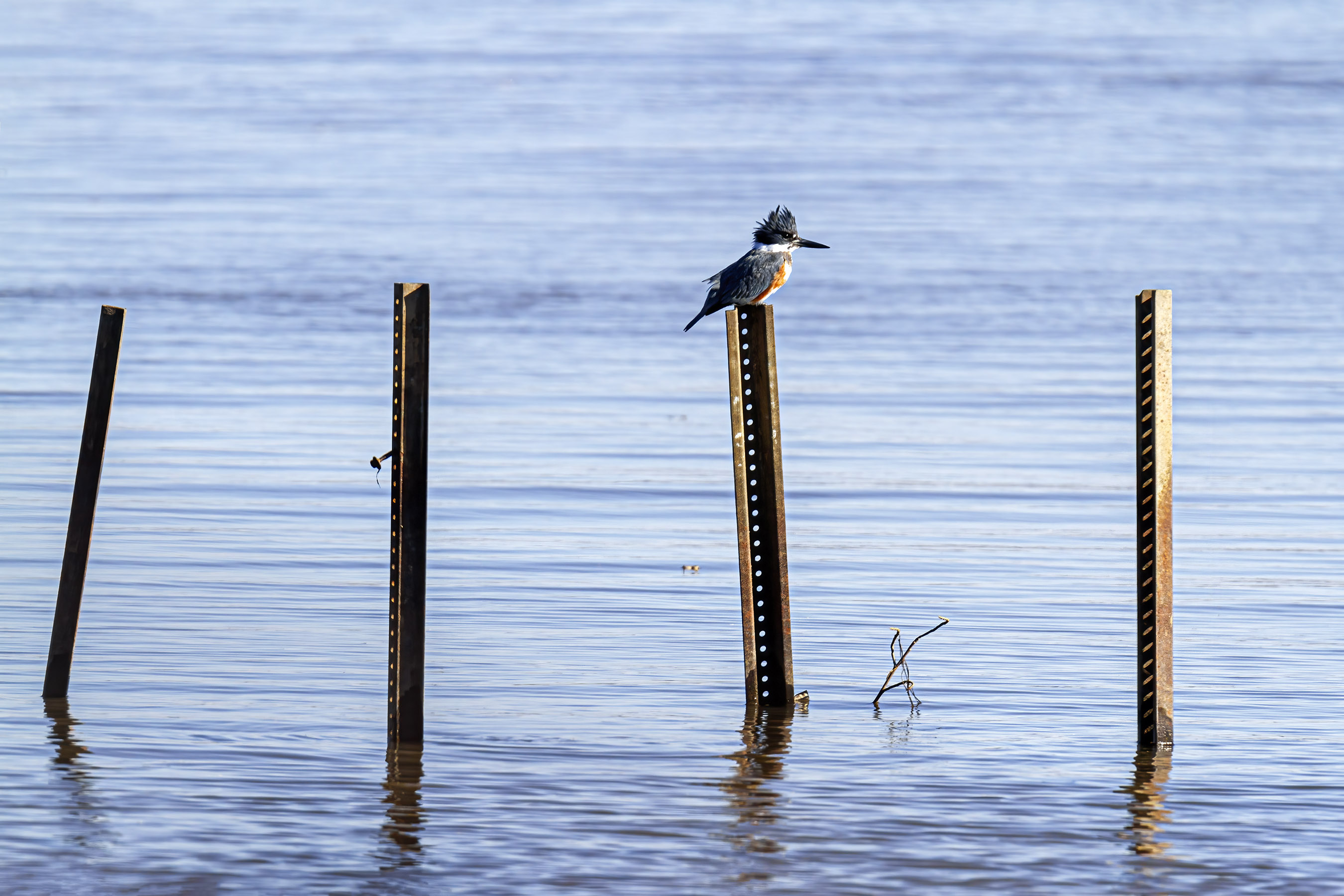
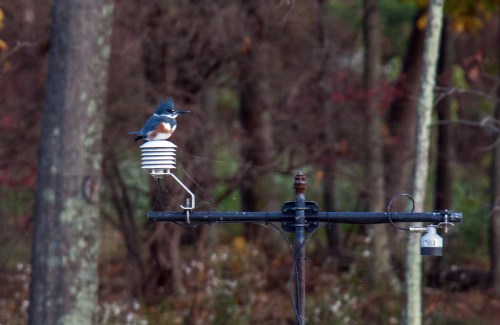
How do birds choose the perches they use? Several times last month I saw a female Belted Kingfisher (Megaceryle alcyon) perched in the early morning on this monitoring equipment sticking out of the water. Somehow I had the impression that the kingfisher was spending the nights on that perch.

Perhaps it’s more comfortable (or maybe safer) than the surrounding trees. Whatever the case, it makes for an interesting juxtaposition of natural and man-made elements in the image.

Belted Kingfisher

© Michael Q. Powell. All rights reserved.

Read Full Post »

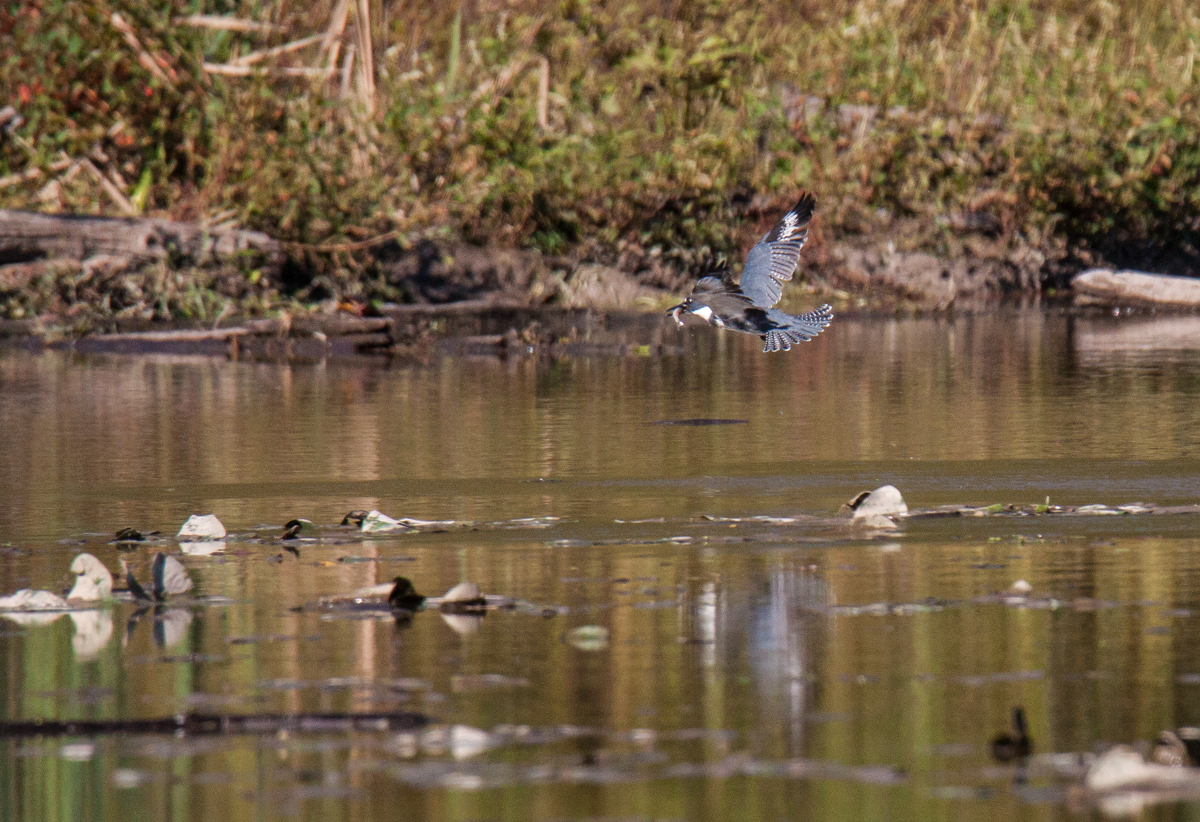
When I spotted a male Belted Kingfisher (Megaceryle alcyon) yesterday, I was really happy, because I have not seen a male in several years. He was pretty far away and I having a hard time getting a sharp shot, so I decided to switch to manual focus.

Just after I had switched, the kingfisher made a long shallow dive off of the rotten tree on which he was perched. Instinctively I tried to track the fast-moving bird as I frantically tried to focus. Not surprisingly, most of my shots were out of focus, but one came out pretty well. It shows the kingfisher just above the surface of the water with what appears to be a fish in his mouth. (You may want to click on the image to get a better look at the kingfisher.)

Belted Kingfisher

A bit later in the day, I took this shot of the male Belted Kingfisher on the same perch that he had been on earlier. He seemed to be in a good mood and almost looked like he was singing. Unlike the female, which has both a chestnut and a blue stripe or her chest, the male Belted Kingfisher has only the blue stripe.

Belted Kingfisher

The kingfisher was happy and I was overjoyed with my shots. It was a wonderful day.

© Michael Q. Powell. All rights reserved.

Read Full Post »

I love the distinctive look and bright colors of the Belted Kingfisher (Megaceryle alcyon) and was thrilled to spot this female on Monday at Huntley Meadows Park.

She was initially perched on a rotten tree trunk in a meadow, which is actually a dried-up pond—the water levels at the marsh are perilously low at the moment.  Before I could get a close shot, I managed to spook her and she flew to the higher perch that you see in the first image of this posting. The second image shows her in her initial position.

I like the way that the dark leaves provide a backdrop that draws our attention to the kingfisher in the first shot, but also like the softer quality of the second shot, with the grass and the out-of-focus treeline.

Unlike in most bird species, the female Belted Kingfisher is more colorful than the male—she has a rust-colored stripe that is absent in the male.

Belted Kingfisher

Belted Kingfisher

© Michael Q. Powell. All rights reserved.

Read Full Post »

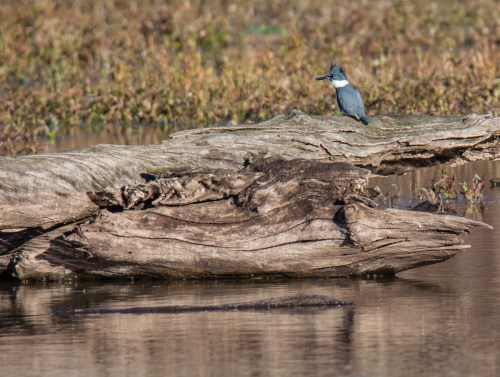
Instinctively I try to get as close to a subject as possible, often ignoring the “big picture.” One recently early morning, however, there was a substantial amount of water between me and the Belted Kingfisher (Megaceryle alcyon) that I spotted on a fallen tree and there was no way I was getting closer.

I concentrated on focusing, thinking I would probably have to crop a lot, and on composition. Almost despite myself, I ended up with an image that I really like, an image in which the kingfisher is only one element of an early morning landscape.

There is definitely a benefit sometimes in not getting closer to the subject.

Belted Kingfisher

Michael Q. Powell. All rights reserved.

Read Full Post »

Older Posts »