Feeds:
Posts
Comments

Posts Tagged ‘Lophodytes cucullatus’

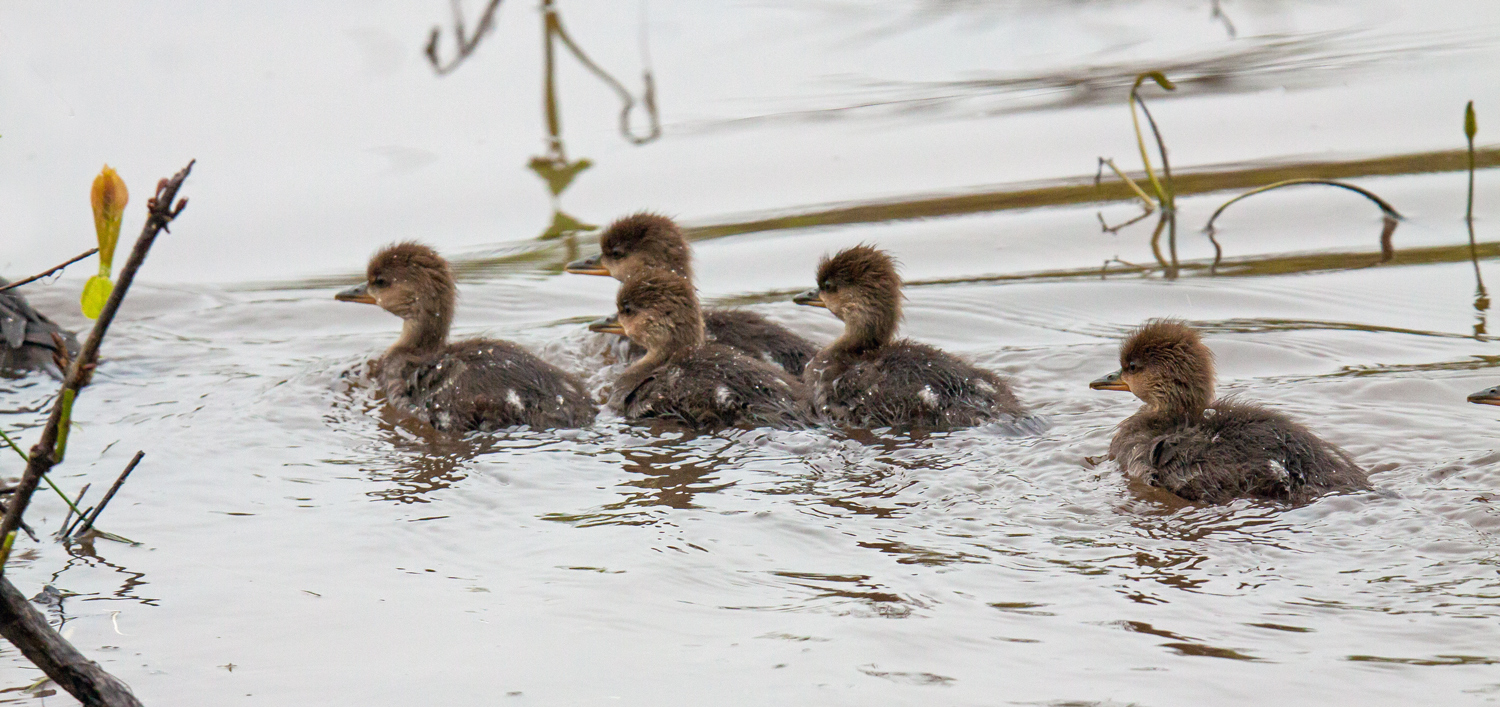
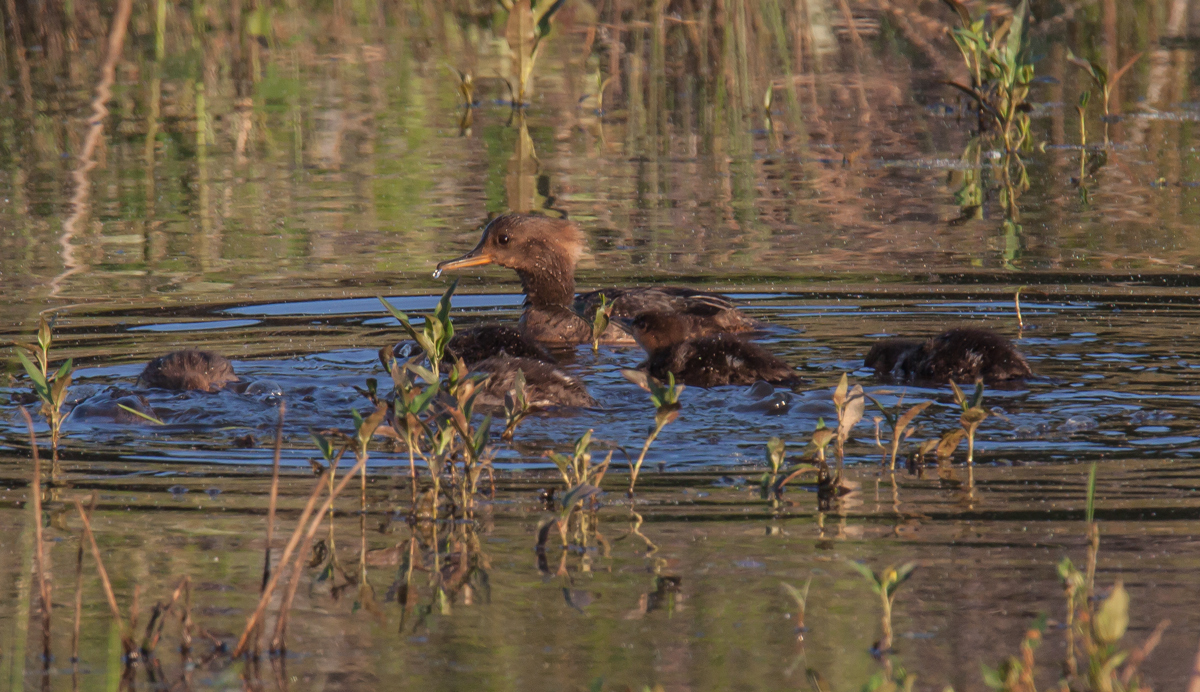
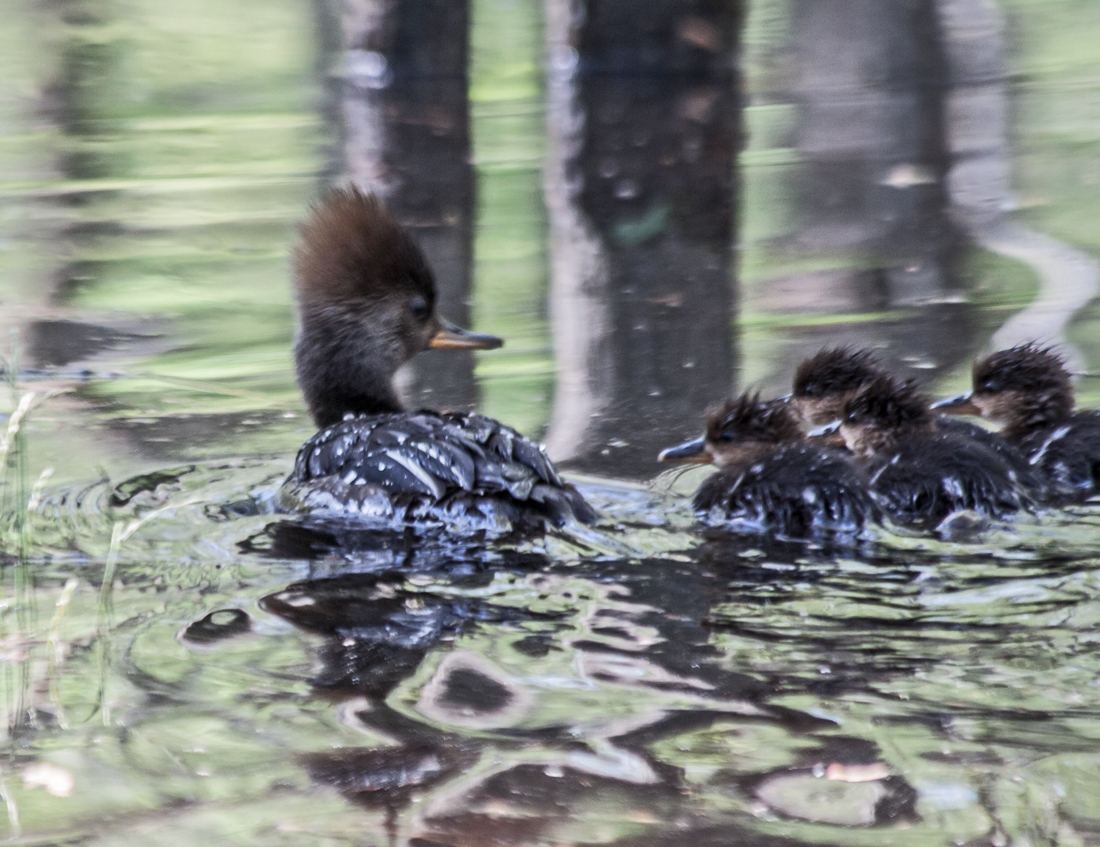
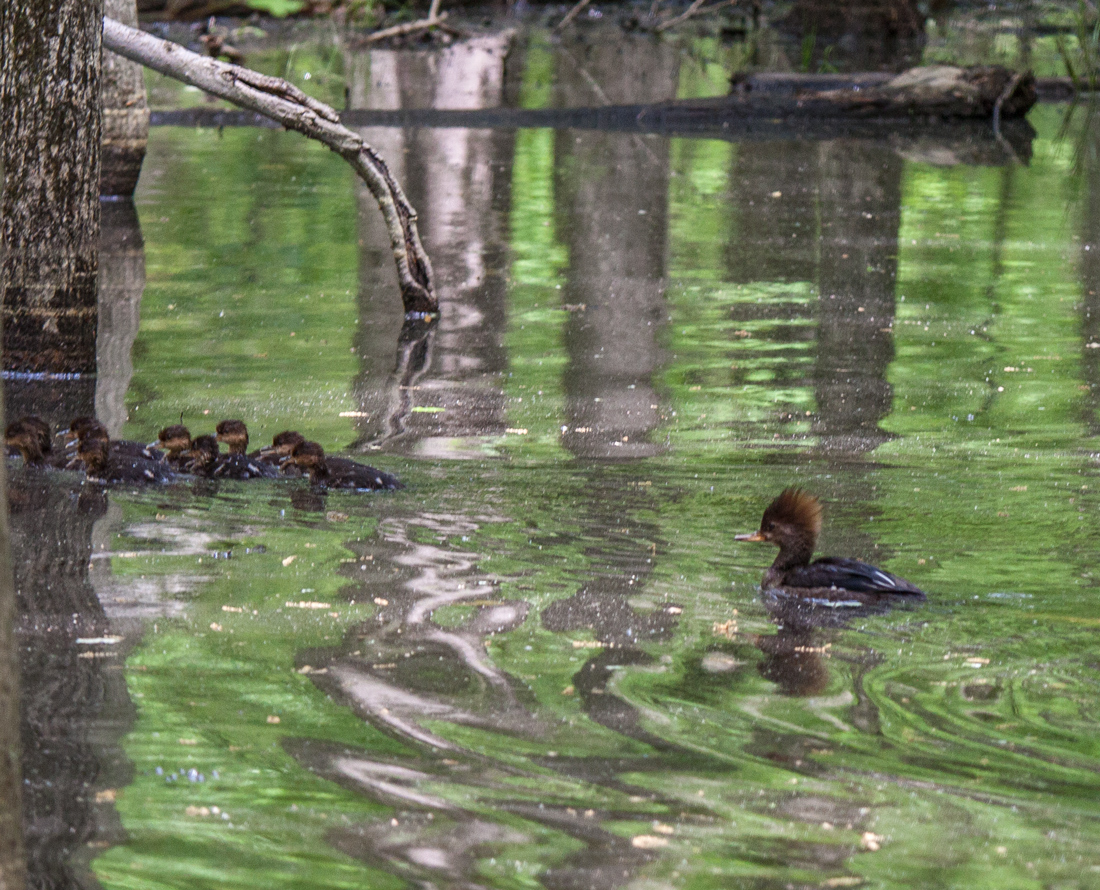
Like so many others at Huntley Meadows Park, I have fallen in love with this Hooded Merganser family (Lophodytes cucullatus), with its hyper-vigilant Mom and nine growing babies. Occasionally I will see them all huddled together on a fallen log, but only rarely do I a clear look at them. The ducklings are be full of energy, ready to wander in multiple directions, and the Mom seems to be more than fully occupied watching out for predators and keeping the group together.

Hooded Merganser family

hooded merganser ducklings

Hooded Merganser ducklings

© Michael Q. Powell. All rights reserved.

Read Full Post »

I love the distinctive look of the male Hooded Merganser duck (Lophodytes cucullatus) and it was a real treat to watch this one last weekend as he foraged in the vegetation at Huntley Meadows Park. Normally these small ducks are so skittish they fly away as soon as they sense my presence.

Hooded Merganser

© Michael Q. Powell. All rights reserved.


Read Full Post »

I spotted this Hooded Merganser couple (Lophodytes cucullatus) last Friday at Huntley Meadows Park enjoying a few quiet moments together.

The male duck has a wide-eyed goofy look on his face that makes me think of a teenager who has fallen in love. He worked up the courage to ask the cute girl on a date and she actually said yes. She’s playing it cool, but he can hardly contain his excitement.

It’s springtime and love is in the air.

Hooded Merganser

© Michael Q. Powell. All rights reserved.

Read Full Post »

Do dabbling ducks double date? It sure looked like that was the case earlier this week when I spotted a Mallard (Anas platyrhynchos) couple and a Hooded Merganser (Lophodytes cucullatus) couple swimming away from a larger group of mostly mallards for a few quiet moments together. I grew up in a family with eight siblings, so I can really understand their pursuit of peace and privacy. 

It’s almost springtime and many of the birds are searching for mates. Usually it’s the males that put on elaborate displayes, but I think the female “Hoodie” here was the one that went all out to impress her date with an elaborate hairstyle.

duck dating

© Michael Q. Powell. All rights reserved.

Read Full Post »

Shortly after sunrise at Huntley Meadows Park on Tuesday, a mother Hooded Merganser duck (Lophodytes cucullatus) checked on her seven babies and got them ready to start the day. I don’t know if the little family spent the night on the log, but it was probably a good idea to get moving before the numerous snapping turtles woke up. Most of the babies seem to be paying attention to the Mama in the first shot, though the one on the end seems to be daydreaming or is distracted.

Hooded Merganser

A short while later the family dropped into the water and started to swim away. This second shot is my favorite one from an artistic perspective. I just love the interplay of the light and the shadows.

Hooded Merganser

As the Merganser family continued to swim, it got tougher and tougher to track them amid all of the vegetation growing in the pond. Only occasionally would I get an unobstructed glimpse of them. I managed to get most of the family in this shot. One of the ducklings was a bit ahead of the group, perhaps the adventurous one on the end of the log in the first shot.

Hooded Merganser

When they reached a spot that Mama Merganser considered to be safe, all of the babies began to stick their heads under the water. I don’t know if they were bathing or playing or if this was a lesson in fishing. Whatever the case, the mother duck remained vigilant.

Hooded Merganser

It’s at moments like this that I regret that the father Merganser does not stay around to help in raising the ducklings. It would sure ease the burden on the Mama and would enhance the chances for survival for the cute little babies.

© Michael Q. Powell. All rights reserved.


Read Full Post »

Unlike some other species of birds, Hooded Merganser ducks (Lophodytes cucullatus) don’t seems to sit on their eggs continuously. They will often lay them in nesting boxes and periodically check on them, perhaps adding more eggs to the nest.

Hooded Merganser

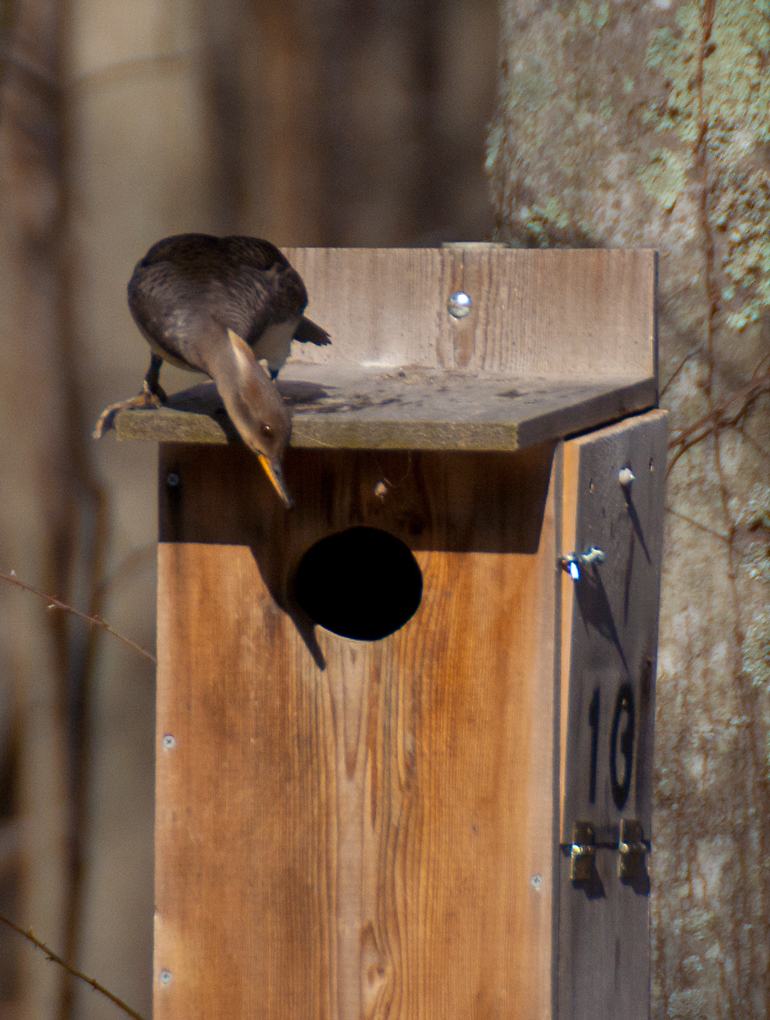
I took this first shot earlier today at Huntley Meadows Park as a female Hooded Merganser was getting ready to eventually enter a nesting box. When I first spotted the female duck, she was standing on top of the nesting box. During previous springs I learned that this was a sign that she had eggs in the nesting box and that eventually she would fly into it. So I waited and waited, hoping to catch the moment.

It may look like she is actually preparing to enter the box, but in fact she had just stepped off of the roof and was gliding to the ground. Unfortunately, she dropped behind a virtual wall of vegetation and I could not see her when she lifted off from the ground and flew straight into the box and I missed that shot.

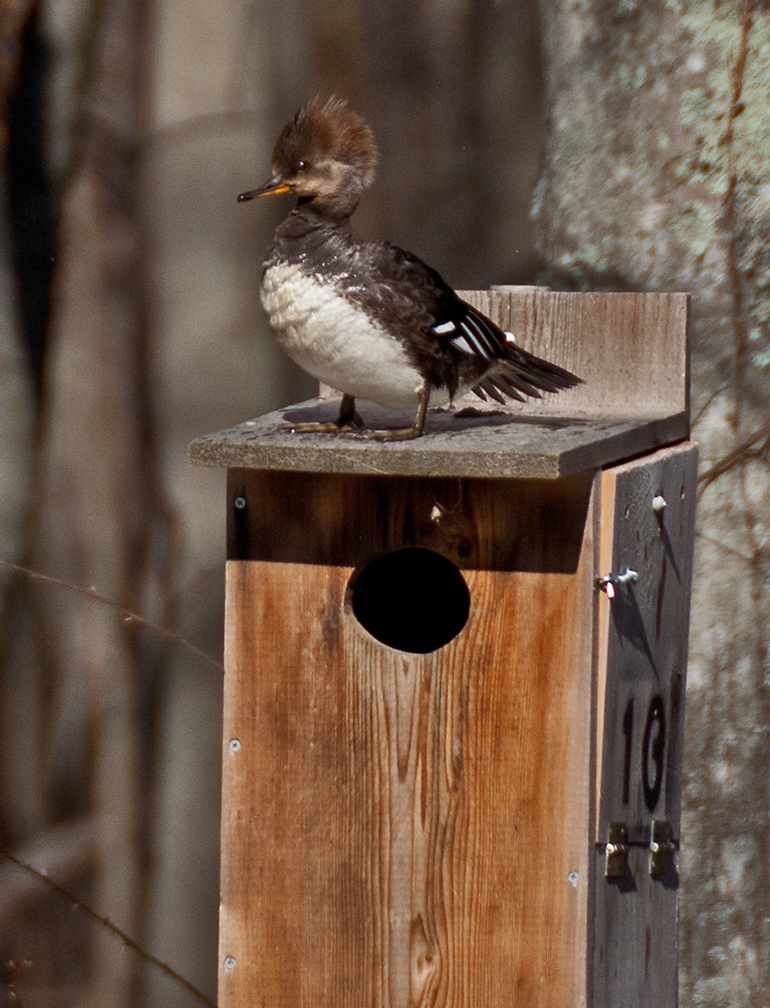
Here are a few shots of the female Hooded Merganser as she paced back and forth on the roof of the nesting box, peering to the right and to the left to makes sure that all was safe before she entered the box.

Hooded Merganser

Hooded Merganser

Hooded Merganser

As I was doing some research on Hooded Merganser ducks, I came across a blog from Lee Rentz Photography that includes a video from inside a nesting box of a Hooded Merganser. Be sure to check it out.

© Michael Q. Powell. All rights reserved.


Read Full Post »

Love is in the air and this female Hooded Merganser duck (Lophodytes cucullatus) chose to chase after her male suitors rather than wait for them to come to her.

She’s looks to be a feminist duck of the 21st century, determined to upend the traditional gender roles of the past. Who says you have to wait for the guy to make the first move?

Hooded Merganserchase1_blog

© Michael Q. Powell. All rights reserved.

Read Full Post »

What’s going on here? Normally, it’s the male Hooded Merganser duck (Lophodytes cucullatus) that engages in courting behavior to attract a female, but in this case it looks like the situation was reversed. The female seems to be trying to get the attention of the male, who is playing hard to get and ignoring her antics.

Hooded Merganser

I took these shots this past Friday at my local marshland park. After a week of several snowstorms and frigid temperatures, there was not much open water for the water birds. I managed to find an area where a small number of them, mostly mallards and Canada Geese, were congregated and moved forward toward them, painfully aware that the crusty snow was crunching under my feet. I was thrilled when I saw that a pair of Hooded Mergansera mixed in with the other, bigger birds.

As a few snow flurries started falling, I was able to get some individual shots of the Hooded Mergansers, as well as the opening shot of them swimming together.

Hooded Merganser

Hooded Merganser

The first photo seems to be calling out for a clever caption and I welcome any creative ideas from readers. I used the title of a Toby Keith song as the title of the posting, imaging the female duck was trying to impress the male, who had ignored her in the past. (Check out this video from Vevo if you are not familiar with the song.)

What scenario do you imagine when you see the initial photo?

© Michael Q. Powell. All rights reserved.

Read Full Post »

As I look at this image from last week of a couple of Hooded Mergansers (Lophodytes cucullatus) swimming together, they somehow remind me of a young adolescent couple out for a date on Valentine’s Day. There is an awkwardness in their body language, but the gawky male seems to have a smile on his face, content that he has found someone with whom to share these special moments.

Hooded Merganser

© Michael Q. Powell. All rights reserved.

Read Full Post »

Oh say can you see by the dawn’s early light? Peering through a break in the bushes, I could just barely make out the unmistakeable shape of a male Hooded Merganser (Lophodytes cucullatus) as he slowly paddled away from the shore of a small pond at my local marshland park.

Hooded Merganser

© Michael Q. Powell. All rights reserved.

Read Full Post »

On Christmas Day I managed to fit in a short walk at Huntley Meadows Park, my local marshland park, and captured these images of a pair of Hooded Mergansers (Lophodytes cucullatus) as they took off from the water and started to gain altitude.

Hooded Merganser takeoff

Hooded Merganser takeoff

Hooded Merganser takeoff

Hooded Merganser takeoff

© Michael Q. Powell. All rights reserved.

Read Full Post »

I don’t know if they are going to stay for the winter or are just passing through, but yesterday, the first day of December, there were a dozen or so Hooded Merganser ducks (Lophodytes cucullatus) cavorting in the water at Huntley Meadows Park, my local marshland park.

I was first alerted to their presence when I heard the unmistakable frog-like croak of one of the males. The Cornell Lab of Ornithology states that these ducks are usually silent except during courtship, when the courting male “makes a deep, rolling sound like the call of a pickerel frog, earning it the nickname of “frog-duck” in Georgia.” Check out this link to hear the call of the courting male Hooded Merganser. It seems a bit early for courting to be taking place, but the males were bouncing around as I have seen them do in the spring.

The Hooded Mergansers stayed pretty far out in the water and this is the best shot I could get of one of the males paddling by. The comic-like appearance of these ducks always makes me smile and I love their shiny golden eyes.

Hooded Merganser

© Michael Q. Powell. All rights reserved.


Read Full Post »

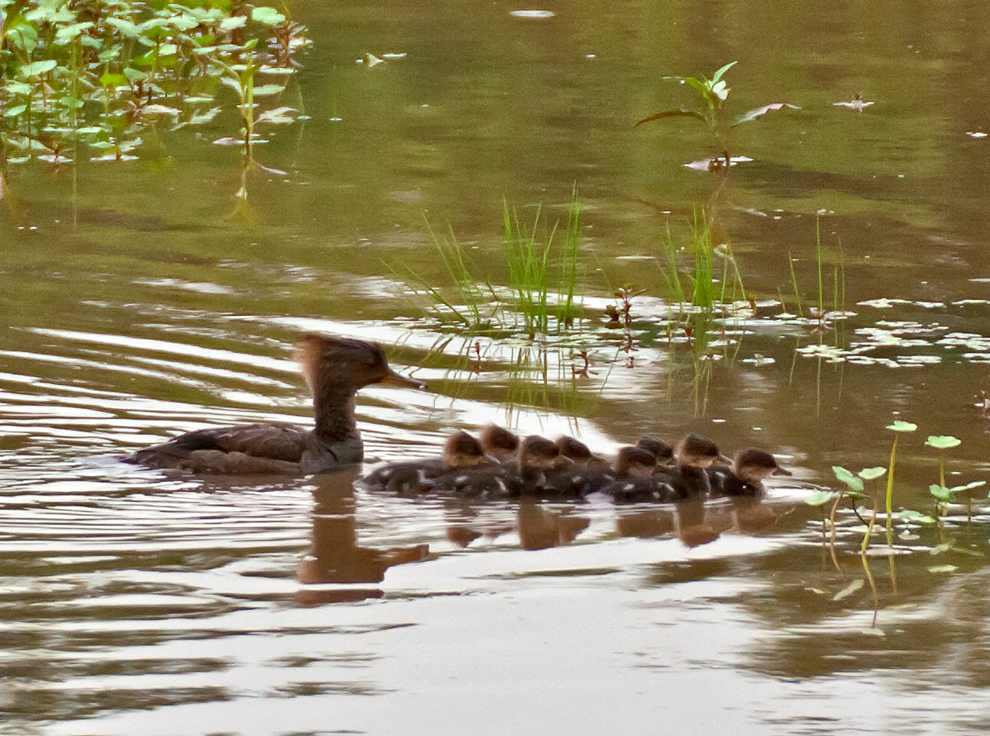
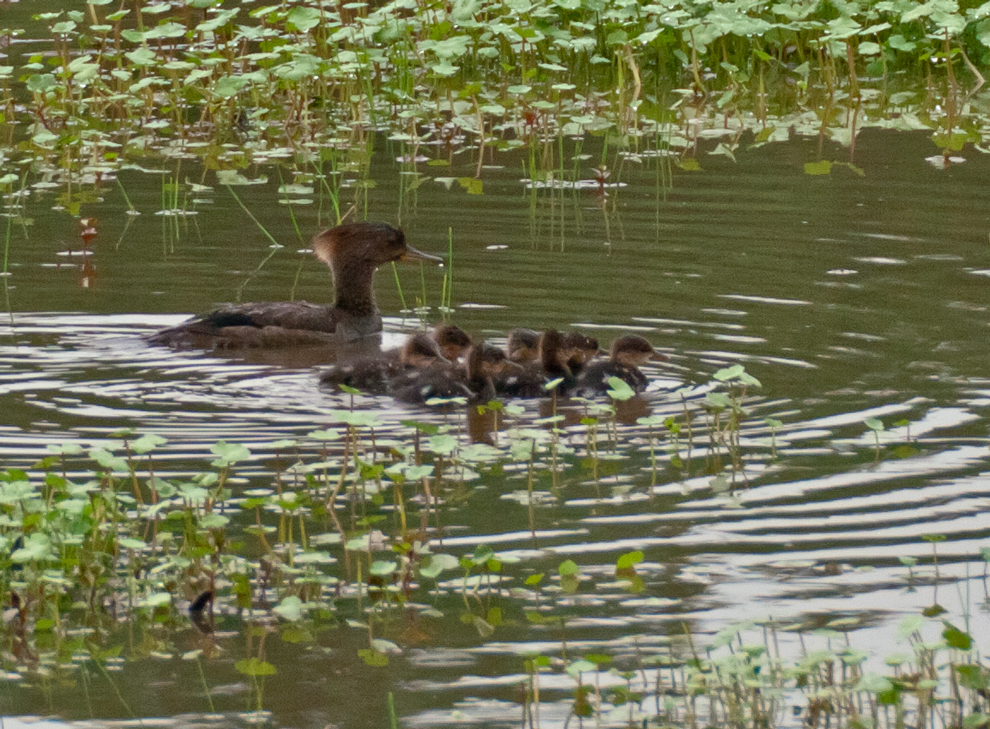
Several weeks after I first spotted a family of Hooded Merganser ducks (Lophodytes cucullatus) at my local marsh, I continue run into this single mother and her adorable ducklings. (Click here to see the original posting.)

The ducks seem to hang out a lot in one flooded, shady area of the marsh that is relatively shallow and doesn’t seem to have the snapping turtles that plagued similar families last year. The light is limited and the ducks start moving as soon as they sense my presence, so getting photos has been a challenge. Here’s a selection of some of my favorite shots to date of this cute little family.

mama_swamp4_blog

Mama duck gives a reminder to the ducklings to stay together and follow her.

mama_swamp3_blog

Trying to move out, but some of the ducklings want to look back toward me.

Mama duck takes up a rear position to ensure there are no stragglers.

Mama duck takes up a rear position to ensure there are no stragglers.

Grainy close-up shot that shows some of the personality of the ducklings.

Grainy close-up shot that shows some of the personality of the ducklings.

© Michael Q. Powell. All rights reserved.

Read Full Post »

Female Hooded Merganser ducks (Lophodytes cucullatus) raise their ducklings as single Moms, which must be pretty tough when you have so many offspring to look after. According to the Cornell Lab of Ornithology, the male Hooded Merganser duck abandons his mate once she begins incubating eggs and it’s not known if they reunite the following season.

Last year, when the level of water at my local marsh was pretty low and there seemed to be lots of snapping turtles, most of the ducklings did not survive. After a lot of construction at the marsh, water levels are higher and I am hoping that things will be a little easier on the duck families.

I don’t know how old these ducklings are, but they appear to be tiny—even adult Hooded Mergansers are pretty small. A family of Hooded Mergansers was spotted earlier this week and I suspect that this is the same one, so they may be a week or so old.

I was not able to get very close to the ducks and the conscientious Mama duck started swimming away as soon as she sensed my presence early yesterday morning. You can see details in the first two shots, which are cropped a fair amount, but I included a final shot, which shows more of the setting, because I love the beautiful ripples in the water.

mama_duck1_blogmama_duck2_blogmama_duck3_blog

© Michael Q. Powell. All rights reserved

Read Full Post »

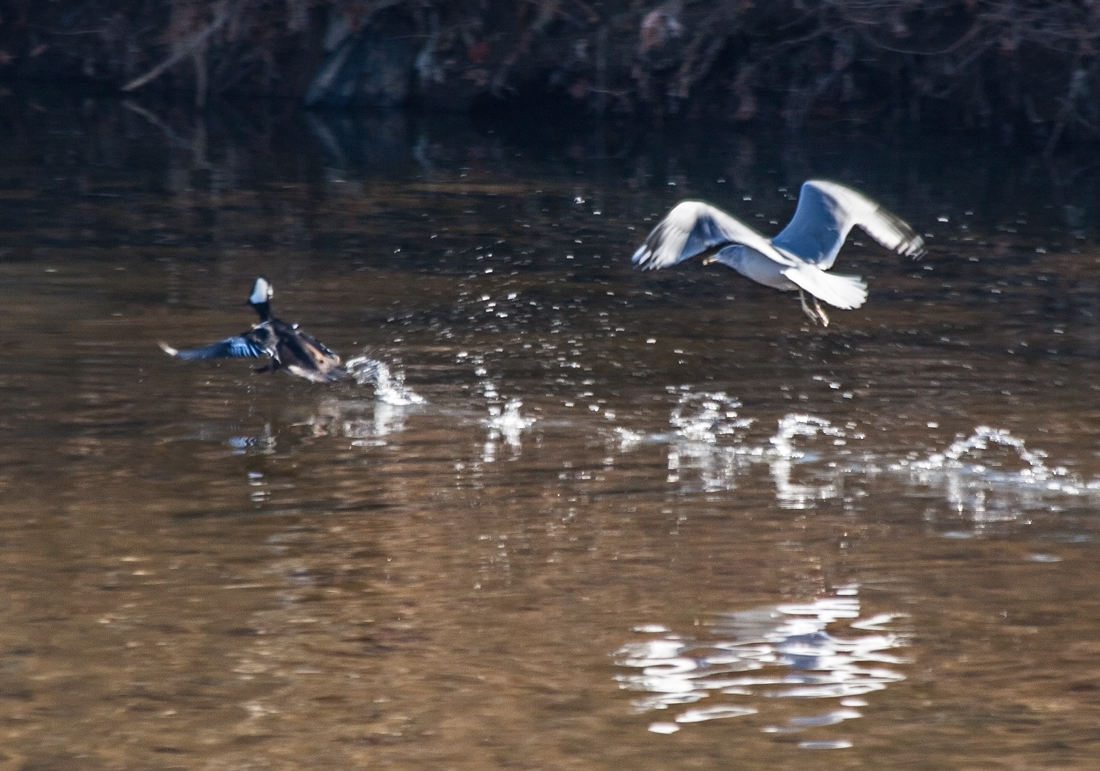
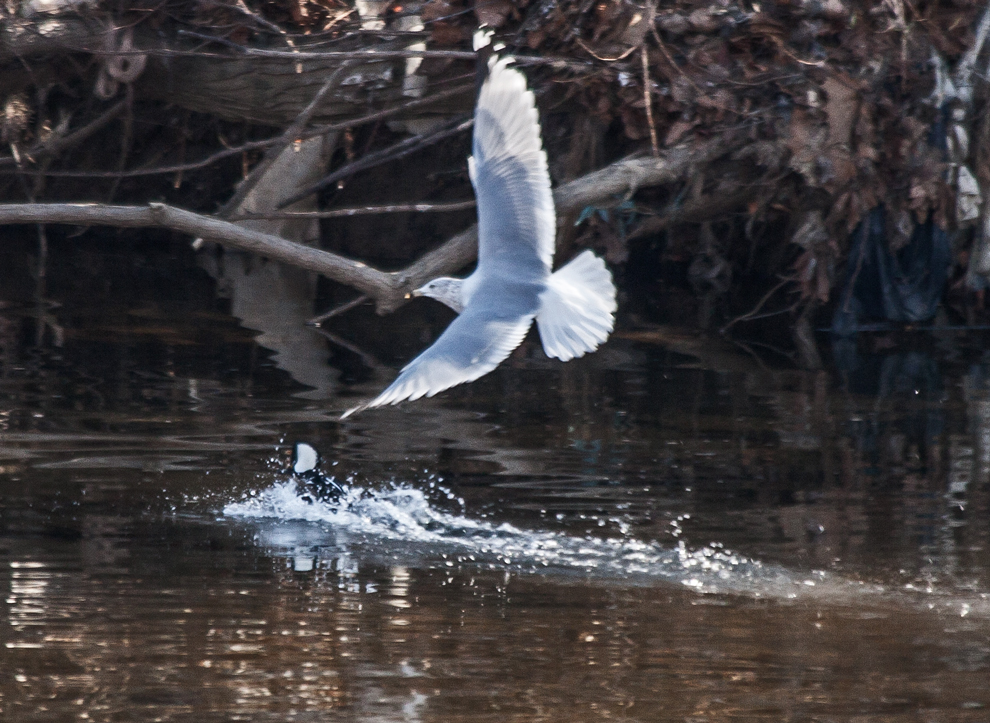
Do seagulls hunt ducks? That’s a crazy question, but that was the first thing that came to mind when a Ring-billed Gull (Larus delawarensis) started aggressively chasing a Hooded Merganser duck (Lophodytes cucullatus) with what appeared to be hostile intent.

I was walking along Cameron Run, a tributary of the Potomac River, when the scene started to unfold in front of me. The gull flew toward the dusk with its legs extended, like it was trying to snatch the duck out of the water. The duck immediately started bounding across the water (as you can see in the third photos) in an effort to escape the gull, but did not take to the air. When the duck got close to the bank of the stream, the gull turned away and left the duck in peace.

Was this merely a cranky gull or maybe a bully? Was it a territoriality thing? All I know is that it provided me a fascinating moment as I treated to a brief interaction between these two very different species of birds.

gull_chasing_duck3_bloggull_chasing_duck1_bloggull_chasing_duck2_bloggull_chasing_duck4_blog

© Michael Q. Powell. All rights reserved.

Read Full Post »

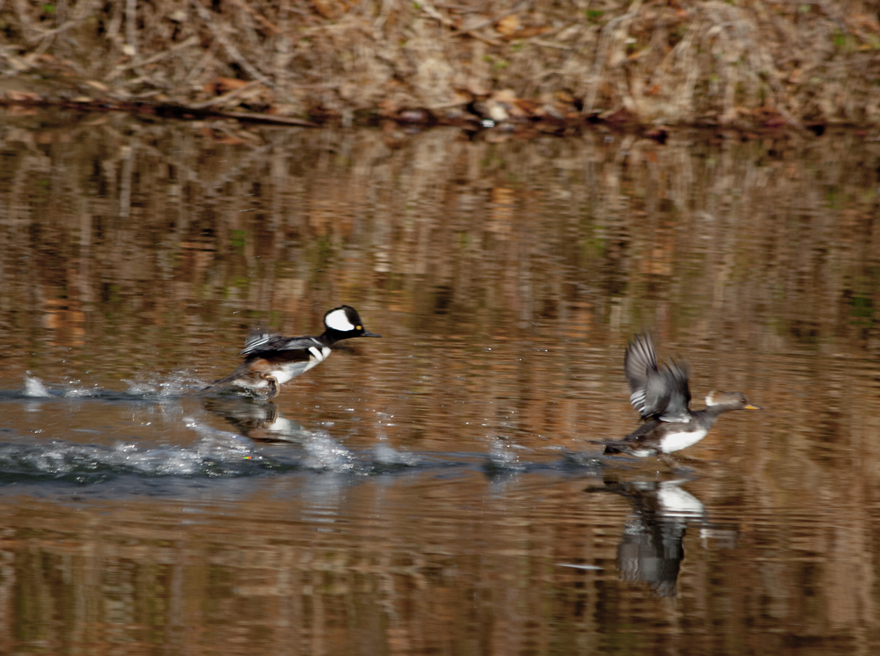
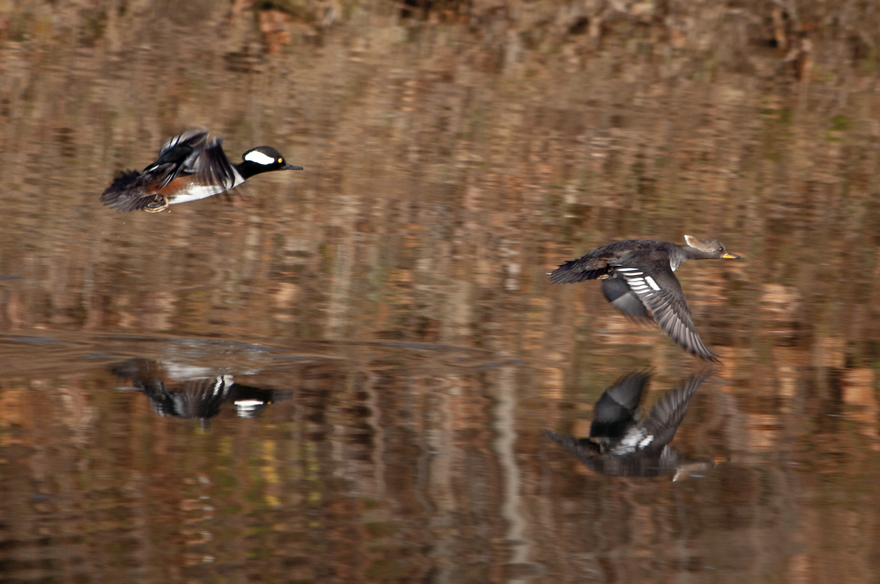
It’s been months since I have seen any Hooded Merganser ducks (Lophodytes cucullatus), so I was thrilled when I spotted several pairs in the distance this past weekend, swimming around as shown in the second photo.

Unfortunately, they sensed my presence before I could get much closer and took to the air. Given the distance and the small size and speed of these ducks, I was surprised that I got a reasonably good shot of one of the males in flight. Hooded Mergansers always look a little cartoonish, but that effect is magnified when they are straining forward in flight. If you click on the first photo, you can get a better look at some of the details of the wings and some of the beautiful colors of this little duck.

The second photo was taken before the first and it gives you a general idea of the differences between the male and female of this colorful species of duck.

merganser_flying_blogmergansers_swimming_blog

© Michael Q. Powell. All rights reserved.

Read Full Post »

Although I tend to use either my macro or my shorter telephoto zoom lens most at this time of the year, yesterday I decided to walk around with my longest zoom (135-400mm) and was happy about that decision when I encountered this juvenile Hooded Merganser duck (Lophodytes cucullatus).

When I first saw it, the duck was sitting on a semi-submerged log  in the beaver pond of my local marshland pond, basking in the sun. I expected for the duck to be part of a group, but it appeared to be alone.

Merganser1_blog

I guess that I got a little too close, because the juvenile duck then slipped quietly off the log into the brown, muddy water of the pond and swam away a short distance. I like the concentric ripples in this shot of the duck slowly paddling away.

Merganser2_blog

I backed off and continued to observe the young duck, which decided to take advantage of being in the water to do a little grooming. After submerging itself, the duck rose up out of the water to dry off. The duck flapped its wings and I clicked my shutter and got this shot.

Merganser3_blog

There is a kind of playful feel to this shot that I really like. Somehow the duck reminds me of a friendly little dragon in this shot, with its feathers looking almost like scales and its wings and tail in an unusual position. I almost expected it to breathe a tiny burst of fire.

Maybe I should name the little duck “Puff.”

© Michael Q. Powell. All rights reserved

Read Full Post »

Walking along the boardwalk at my local marsh yesterday morning, scanning the surface of the water, I noticed some movement and suddenly a female Hooded Merganser (Lophodytes cucullatus) with eight little ducklings swam into view. They were pretty far away in the shallow water, amidst the plants that have sprung up, but I managed to get a few shots of the family. The female Hooded Merganser ducks cares for the young alone, unlike the Canada Geese families that I see at the marsh, in which both parents are present.

I was heartened to see this group of ducklings, because I had heard from others at the marsh of dwindling number of ducklings earlier in the season. I have no idea how many of these little ones will survive—they seem so small and vulnerable (not to mention cute) and the snapping turtles are huge in comparison.

mergansers2_blog

mergansers1_blog

Michael Q. Powell. All rights reserved

Read Full Post »

All alone, this Hooded Merganser duckling sought refuge on a floating log, separated from his family. I don’t know for sure what happened to the rest of the ducklings and the mother, but I had heard some reports of dwindling numbers of ducklings.

The duckling seemed to feel safe on the log and appeared to relax a little, but kept looking forlornly out into the distance. Eventually he was joined by a turtle on the log. For a brief moment, perhaps, he felt a little less alone. Deep inside, though, he felt a desire to grow stronger, so he stretched out his wings, fervently believing that someday he would be able to fly.

Alone_blog

Where are the others?

alone2_blog

Feeling a little more comfortable

alone3_blog

Someday I’ll be able to fly

Michael Q. Powell. All rights reserved

Read Full Post »

The last month or so I have been keeping an eye on a couple of female Hooded Merganser ducks that are using a nesting box at my local marshland park. One of my fellow photographers has already posted a photo of one of them, surrounded by a dozen or so cute little ducklings, so I may have missed one of the moments that I was hoping to catch.

A little earlier this month, though, I had a special moment with one of them, when I arrived at the park early in the morning, just after the sun had risen. The small female duck was more out in the open than usual, though she was still pretty far away. Initially she seemed to be taking a bath, as she stuck her head under water and would shake a little. Eventually she climbed out of the water onto a log and began to groom herself.

The light at that moment from the back and the side made the spiky reddish-blond hair on her head glow and also created a nice reflection in the water. She seemed unhurried and unafraid as she basked in the beautiful early morning light.

For at least a moment, the two of us were freed from the cares of our everyday lives.

merganser_morning_blogmerganser2_blog

Michael Q. Powell. All rights reserved

Read Full Post »

This past weekend I was fortunate enough to see a female Hooded Merganser duck (Lophodytes cucullatus) again enter a nesting box at my local marshland park. If you want to see some photos of my first such incident, check out my previous posting.

It is proving to be quite a challenge to capture this fascinating encounter in photographs, even with my camera trained on the nesting box. I think I get my best shots when the female chooses to land on the box prior to entering it. At that moment, the subject is relatively stationary and I can refocus my camera on the duck itself, and not on the box. When she flies into and out of the box, my camera and lens have trouble maintaining focus and stopping the action, even at exposures of 1/1000 and greater.

She paused a moment when exiting and I was able to get a shot with her head sticking out of the nesting box. I also got a photo of her flying out of the box, which is pretty blurry, but I thought the shadow was pretty cool.

The last two shots are aspirational shots for me—they give you an idea of what I am trying to shoot, even if I have not yet been able to do so successfully.

box2a_blogbox2b_blogbox2d_blogbox2c_blog

Michael Q. Powell. All rights reserved

Read Full Post »

This male Hooded Merganser duck (Lophodytes cucullatus) flew away when his mate entered the nesting box (as shown in my posting yesterday), but I was able to get these shots when he was swimming around beforehand.

I am also including a shot from earlier this month when a male was displaying for a female. He would periodically throw back his head back and make the strangest sound, almost like a frog. The sound is so unusual that you may enjoy checking it out at the Cornell Lab of Ornithology site, where you should click on the button that says “Male display.”

male1_blogmale2_blog

Merganser_singing1_blog

Michael Q. Powell. All rights reserved

Read Full Post »

I have often wondered if birds actually used the nesting boxes scattered throughout my local marshland park and yesterday I got a definitive response when I saw two female Hooded Merganser ducks separately go into one of the boxes.

As I was looking across the beaver pond, one of my favorite spots for taking photos, a Hooded Merganser (Lophodytes cucullatus) couple flew by and landed in the water. They were out of the reach of my lens at that moment, but a fellow photographer alerted me to the fact that the couple had been using a nesting box that was somewhat closer to where I was standing.

I set up my tripod and trained my 135-400 telephoto lens on the nesting box and waited.  Eventually the couple swam behind a cattail patch and came into view near the box. Without warning, the female lifted off and flew straight into the box. It happened so fast that I was not able to get off a shot. A short while later, the male took off.

I continued to wait, confident that the female would eventually have to emerge through the hole in the nesting box. As I was watching and waiting, a bird landed on the roof of the nesting box, as you can see in the second photo. I did not immediately realize that it was another female Hooded Merganser, but I had the presence of mind to take some shots.

She seemed uncertain about whether or not she should go into the box and tried to peer into it, as you see in the first photo. Satisfying herself that everything was ok, she flew into the box, which by now was getting a little crowded. My photos of the entry were completely blurry.

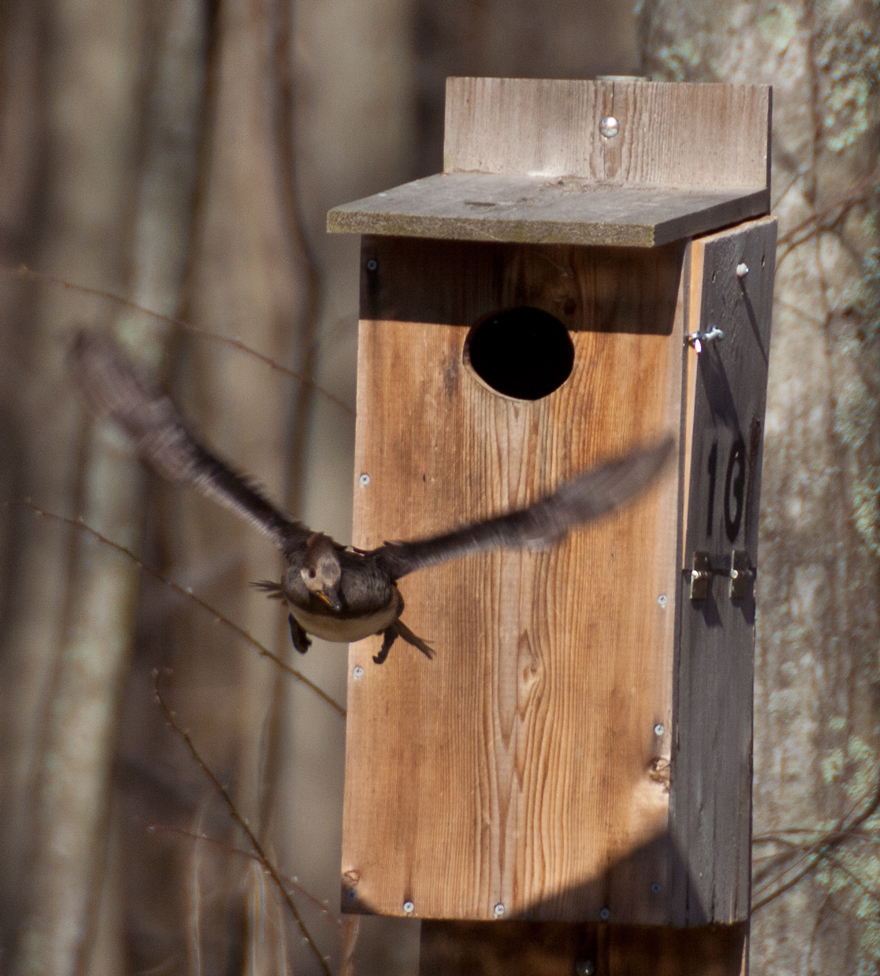
I waited some more and eventually one of the females flew out and I managed to get the third shot. I was hoping that she would linger with her head sticking out of the box before she started flying, but that didn’t happen. I waited for about 45 minutes longer for the second female to exit the box and finally my patience gave out.

The incubation period for the eggs that the female presumably is laying in the box is about a month, so I will keep returning to this location, and with a little luck will be able to see some ducklings.

merganser2_blogmerganser1_blogmerganser3_blog

Michael Q. Powell. All rights reserved

Read Full Post »

I was outdoors a lot this past weekend enjoying the beautiful weather and managed to catch a glimpse of a pair of Hooded Merganser ducks (Lophodytes cucullatus). As is usually the case, they headed in the opposite direction as soon as they perceived my presence.

I was able to get a couple of clear shots of the male (the female kept ducking under the water). I especially like the duck’s reflection in the water, which looked almost turquoise. and the ripples on the surface of the water.

merganser1_blogMerganser2_blog

© Michael Q. Powell. All rights reserved

Read Full Post »

I stumbled upon a pair of Hooded Merganser ducks (Lophodytes cucullatus) at Lake Cook, a tiny urban lake, shortly after I photographed a Belted Kingfisher this past weekend. As soon I spotted them, they also became aware of my presence and immediately took evasive action. In most cases in the past, that has meant that they started swimming away. This time they seemed to have decided that more decisive action was needed and they immediately took off.

Fortunately my camera was already in my hands and the settings were about the right ones for the situation. When I started photographing birds, one of the more experienced birders whom I met recommended keeping the camera set for burst mode and that’s where I keep it most of the time now. Occasionally that means I shoot off a few extra exposures unintentionally when my trigger finger is a little heavy, but sometimes it lets me get an exposure I might not have gotten otherwise. Now, let me be clear that my almost ancient Canon Rebel XT is not a professional DSLR, so burst mode means about three frames a second, which worked out this time.

I fired off a half-dozen frames as the two ducks, a male and a female, took off from the water and I am pretty pleased with the results. It looks like the ducks get a running start on the water before they take to the air. The photo of the male duck that I featured at the start is the second one in the chronological sequence, but I thought it was the most interesting in showing the little water “explosions” as the ducks skipped across the surface. The rest are pretty much self-explanatory. I especially like the way that the heads flatten out into more aerodynamic shapes as the ducks start flying and the reflections are pretty nice. A couple of the shots are cropped to show only the male duck, because his position happened to bemore interesting than that of the female in the image (no discrimination intended).

Takeoff2_blogTakeoff1_blogtakeoff3_blog Takeoff4_blog

© Michael Q. Powell. All rights reserved

Read Full Post »

As I was out shooting today, I was happy to encounter Hooded Merganser ducks (Lophodytes cucullatus) a couple of times, They are the coolest-looking ducks in my opinion (although Wood Ducks are in the running too). It’s a real challenge to get good shots of them, because they are small, fast, and skittish. I would love to find myself in a position like Phil Lanoue, a fellow blogger and incredible photographer, who recently photographed a Hooded Merganser duck coming in for a landing next to him (check out his blog posting).

I’m still going through my photos, but this one jumped out at me. It shows two duck couples swimming in formation. What is unusual is that one of the pairs appears to me a male Mallard and a female Merganser. Oh, I know that some of you are thinking that such a relationship could never work, but true love always finds a way.

I can only imagine what their children will look like.

Mixed couple

Mixed couple (click for higher resolution view)

© Michael Q. Powell. All rights reserved

Read Full Post »

This duck tale has a happy ending, as two Hooded Merganser duck couples paddle gently down the stream, but a potential crisis had been averted only moments before.

It began like this. Five Mallard ducks (Anas platyrhynchos), three males and two females, were swimming upstream. Two of the males were in the lead, while the other male seemed to be carrying on a conversation with one of the females. Their course had them in the partial shade, not far from one of the banks.

At the same time, four Hooded Merganser ducks (Lophodytes cucullatus), two males and two females, were headed downstream in perfect formation on a collision course with the Mallard ducks.

What would happen when the groups met? Would there be a confrontation? Would they exchange information about the attractions of the places they had just passed through? Who has the right-of-way in situations like this?

The signals were a bit ambiguous at the first encounter, as one of the male Mallards tried to have a conversation with one of the male Hooded Mergansers, who had turned away. All eyes were turned on the two representatives. Would they be able to negotiate an agreement? If a fight broke out, it was clear that the Mallards had an advantage in both size and numbers.
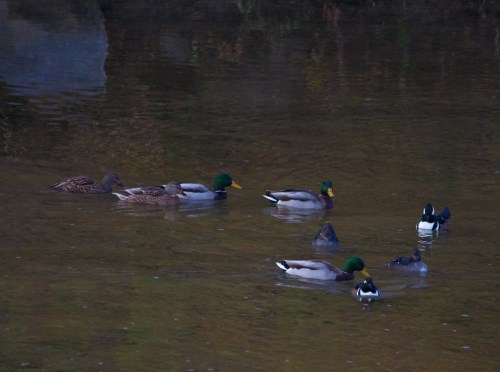
Who know what was said, but it appears that an agreement was reached and a possible confrontation was avoided. The ducks peacefully passed each other and continued on their separate ways.

The first photo showed the Hooded Merganser ducks after the encounter with the Mallards, so sequentially it should go here. Did you notice that the duck formation had changed and that the males were now in the lead? Was this a protective, chivalrous gesture on their part?

Of course, I may have completely misread this situation. Perhaps the male duck ego is less fragile than the human one and the two male ducks were simply asking each other for directions when they met in the middle of the stream.

© Michael Q. Powell. All rights reserved.

Read Full Post »

« Newer Posts