Feeds:
Posts
Comments

Posts Tagged ‘Ladona deplanata’

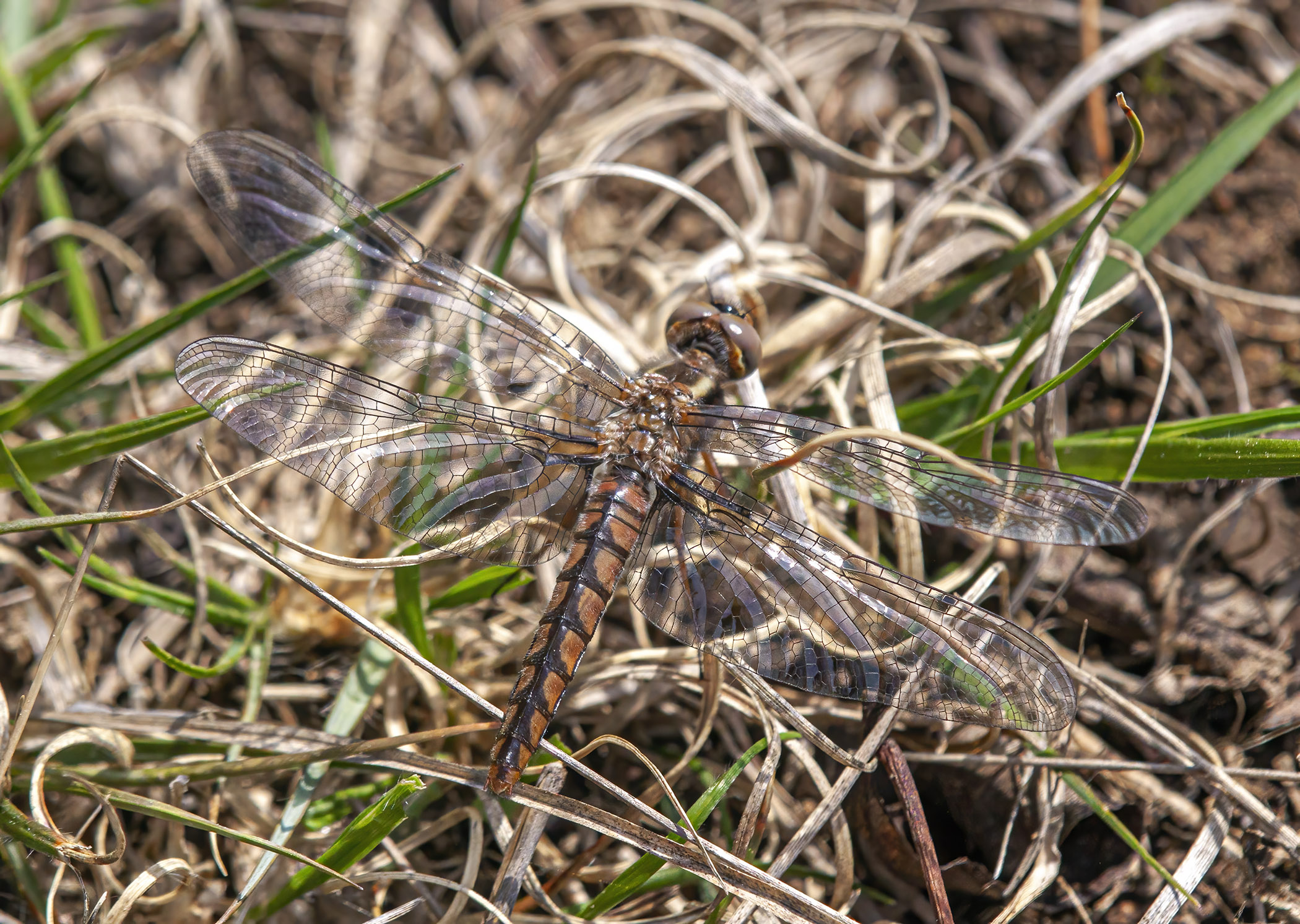
Blue Corporals (Ladona deplanata) are an early-season dragonfly—they appear in April and are usually gone by the beginning of June. I was therefore happy to spot some Blue Corporals in mid-May during a visit to Occoquan Bay National Wildlife Refuge. Blue Corporals perches frequently on low flat surfaces, often on the ground, so they are sometimes hard to see when the ground is cluttered, as it often is at this time of the year.

The dragonfly’s “corporal” stripes on his thorax are really visible in the first photos, so I could immediately identify his species. A short time later I was surprised when I saw a Blue Corporal land on a rusty bit of metal sticking out of the water at the edge of a small pond—I haven’t seen Blue Corporals flying over the water very often. I think this might have been a fence post or some kind of marker, because it appeared to be attached to some concrete.

I was absolutely delighted to be able to captures the texture of the rusty metal and the orange-blue complementary colors make this image particularly eye-catching.

Blue Corporal

Blue Corporal

© Michael Q. Powell. All rights reserved.


Read Full Post »

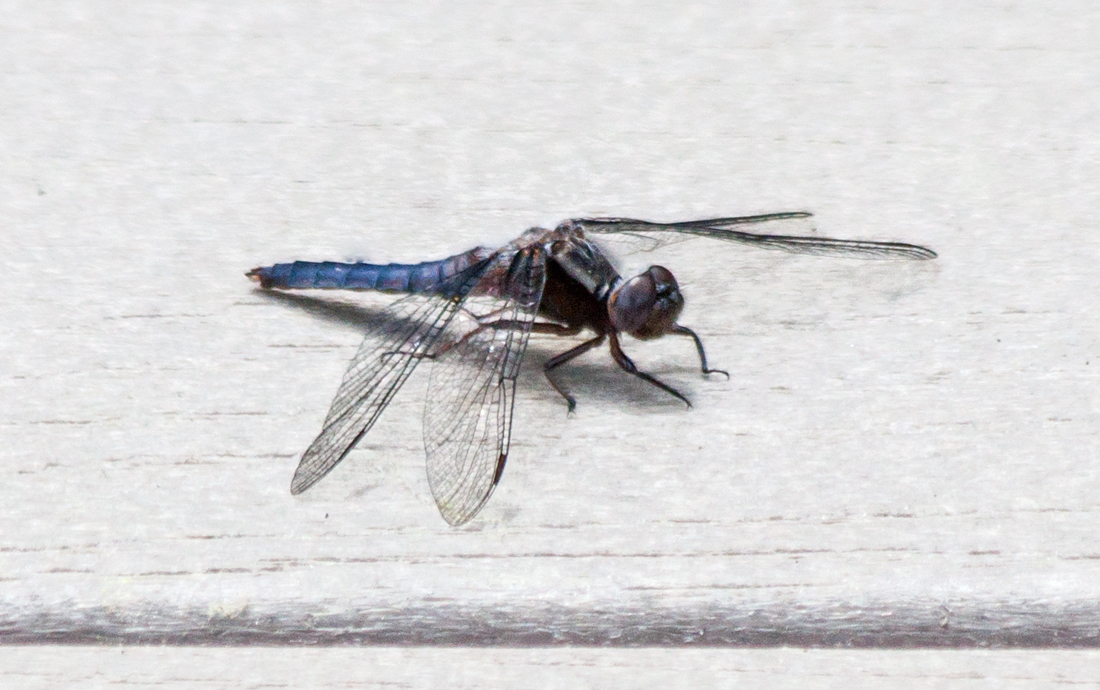
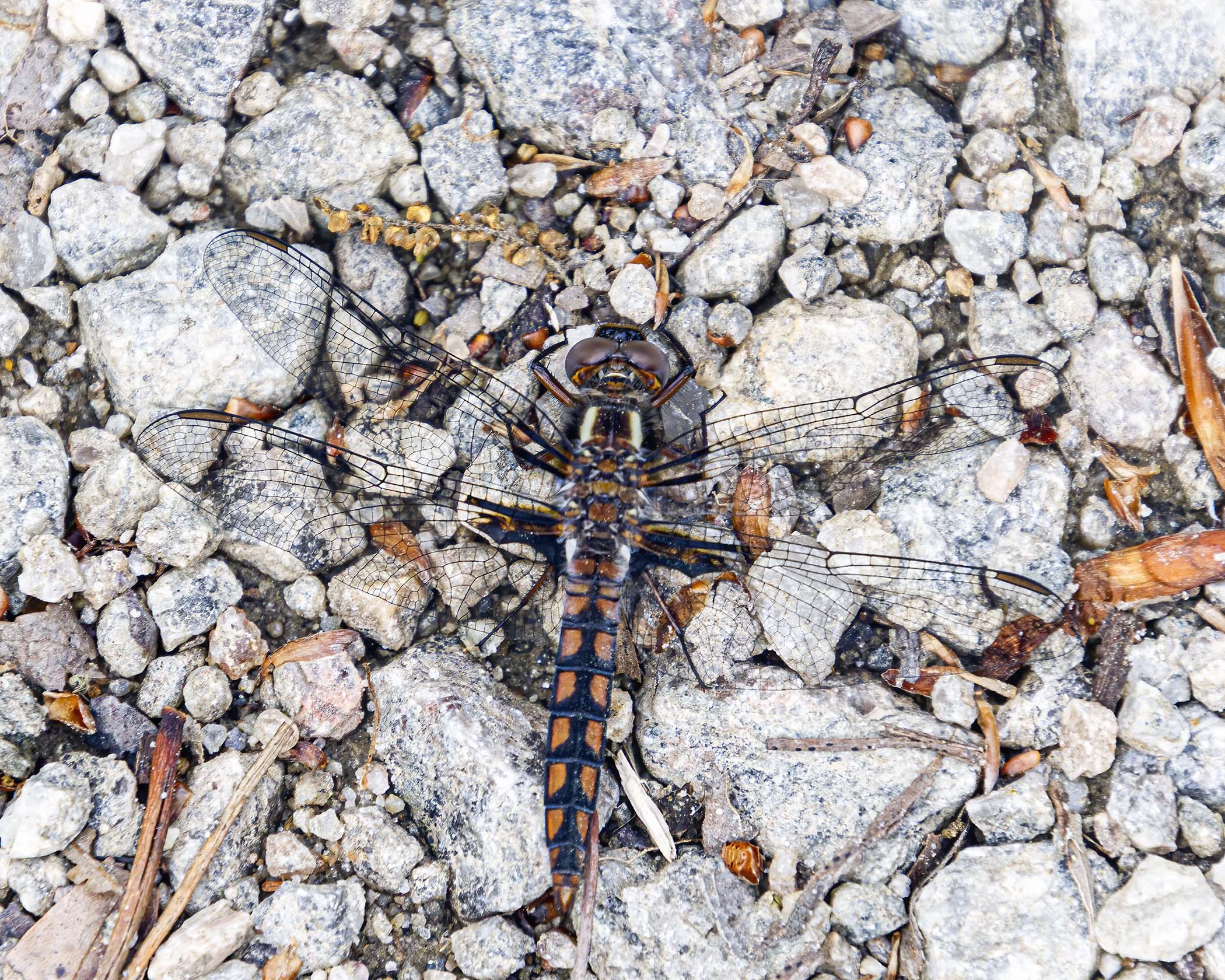
I am finally starting to see some male Blue Corporal dragonflies (Ladona deplanata) that are blue in color. In mid-April I started seeing Blue Corporals, but the males that I spotted at that time were all immature, like the one in the second photo below, and shared the coloration of females of the species.

The dragonfly in the first photo is a mature male. I spotted it during a recent hike along a creek in Prince William County. When you compare its feature to those of the immature male, you can see that the adult coloration is definitely bluer and the “shoulder” stripes on its thorax are a bit faded.

I really like the head-on angle that I used to photograph the Blue Corporal in the first photo. Technically only a small portion of the dragonfly is in sharp focus when you shoot from this angle, the eye-to-eye direct contact works well and draws in the viewer. As you can probably tell, I took this from a low angle, which helped to draw attention to the dragonfly’s interesting pose and to separate the subject from the somewhat cluttered background.

Blue Corporal

Blue Corporal

© Michael Q. Powell. All rights reserved.
 

Read Full Post »

I am a little late in finding my first dragonflies of 2025, but on Wednesday (15 April) I finally spotted some Blue Corporals (Ladona deplanata) at Occoquan Bay National Wildlife Refuge. As an added bonus, the first image also shows a metallic-green Six-spotted Tiger Beetle (Cicindela sexguttata) that was crawling past the dragonfly.

Blue Corporals, one of the first dragonflies to emerge in the spring, are relatively easy to identify because they have two stripes of their shoulders—two stripes is the traditional marking for the rank of corporal in the armed forces. When they first emerge, males and females have similar colorations, but the males turn blue as they mature. Judging from the shape of their terminal appendages, I believe that the dragonflies in the first two images are females and the one in the final photo is an immature male.

Blue Corporal

Blue Corporal

Blue Corporal

© Michael Q. Powell. All rights reserved.

Read Full Post »

One of the earliest dragonflies to appear in the spring in my area is the Blue Corporal (Ladona deplanata). Blue Corporals are relatively easy to identify because they have two stripes of their shoulders—two stripes is the traditional marking for the rank of corporal in the armed forces. When they first emerge, males and females have similar colorations, but the males turn blue as they mature.

The dragonfly in the first photo is an immature male Blue Corporal and was the first member of this species that I photographed on 10 April at Occoquan Bay National Wildlife Refuge. The shiny wings and pale markings suggest that this dragonfly was newly emerged. I believe that the dragonfly in the second photo is a female Blue Corporal, judging from her terminal appendages.

I usually try to get close-up shots of dragonflies, but when I can’t get near them, I am content to capture more “artsy” shots, like the final image below that shows a male Blue Corporal perched on some vegetation poking out of the shallow water of a pond.

Blue Corporal

Blue Corporal

Blue Corporal

© Michael Q. Powell. All rights reserved.


Read Full Post »

As I was reviewing my photos of the past couple of weeks, I was a little surprised at the number of shots that I have taken of Blue Corporal (Ladona deplanata) dragonflies in wildly varying environments. Blue Corporals are an early-season species and won’t be around for too much longer, so I am happy to have had the opportunity to observe so many of them. Most of the time, Blue Corporals like to perch flat and, judging from the photos, it doesn’t seem to matter if there are rocks, vegetation, or even lily pads.

From the perspective of a naturalist, I like the way that the different photos give you a feel for the environments in which I found these dragonflies. As a photographer, I was also struck by the way that the colors and textures of the background interact with the subjects. Most of the backgrounds in these shots are somewhat cluttered, but I did my best to use framing and focusing techniques to keep the background from being too distracting.

If I had to make a choice, I would say that the first photo is my favorite of the Blue Corporal images. I love the juxtaposition of the dragonfly with the varied textures, shapes, and colors of the rocks. I also really like the way the background grows progressively more blurry towards the top of the image. Do you have a favorite?

Blue Corporal

Blue Corporal

Blue Corporal

Blue Corporal

© Michael Q. Powell. All rights reserved.

Read Full Post »

On Monday I was thrilled to photograph my first dragonfly of the year at Occoquan Bay National Wildlife Refuge, the location that I visit most frequently with my camera. The first prize goes to an immature male Blue Corporal dragonfly (Ladona deplanata)—males turn blue as they mature, but initially they have the same coloration as the females. Blue Corporals of both genders have two light-colored stripes on the front of their thoraxes, the traditional rank military insignia for corporals.

Later in the day I spotted a female Blue Corporal perched on some dry leaves, as shown in the second photo. Can you spot the differences between the dragonflies in the first and second photos? The male abdomen tends to be a bit thinner than the abdomen of the female. However, the biggest difference is in the terminal appendages, i.e. the specific parts at the very tip of their abdomens (their “tails”).

The following day I returned to the refuge and spotted another Blue Corporal perched in some vegetation—I think it is another immature male. Most of the time Blue Corporals like to perch on the ground, but this one looked like it had only recently emerged and may have been waiting for its wings to harden.

When dragonflies undergo their metamorphosis from water-dwelling nymphs to aerial acrobats, their wings are initially very clear and fragile and the creatures are very vulnerable, so I was careful not to disturb the dragonfly when I took a few photos. If you are interested to learn more, check out a 2016 blog posting  Metamorphosis of a dragonfly in which I documented the entire transformation process of a Common Sandragon dragonfly in a series of 15 photos. At the end of that series you will be able to see why I characterized the wings of a newly-emerged dragonfly as “fragile.”

Blue Corporal

Blue Corporal

Blue Corporal

© Michael Q. Powell. All rights reserved.

Read Full Post »

I was happy to spot several Blue Corporal dragonflies (Ladona deplanata) on Wednesday at Occoquan Bay National Wildlife Refuge, my first dragonflies of the year at that location. Blue Corporals almost always perch low to the ground, which makes them a challenge to photograph, as you can see in these photos.

In our area, Blue Corporals are found most often in the coastal plain region, unlike the Uhler’s Sundragon that I featured in an earlier posting (First dragonfly of 2022) that is found at rocky forest streams. Most of the early spring dragonflies are found in specific and limited habitats, while many of the summer species can thrive in a variety of habitats.

You may have noticed that none of these Blue Corporals are blue. Adult males are bluish in color and both the male and the female have two white stripes on their thoraxes in an area that you might think of as their shoulders. In the military of the United States, the rank insignia for corporals is two stripes, which accounts for that portion of the common name for the species.

When males first emerge, however, they share the same tan coloration as the females and as they mature they turn blue. (Here’s a link to a 2018 posting called A Bluer Corporal that shows a mature male.) The dragonfly in the final photo looks to be an immature and the one in the middle photo is a female—the angle of the first photo makes it hard for me to determine its gender.

It is still really early in the dragonfly season, so I am excited every single time that I spot one. Actually my enthusiasm for dragonflies barely wanes as we get deeper into the season and the early dragonflies give way to new species.

Blue Corporal

Blue Corporal

Blue Corporal

© Michael Q. Powell. All rights reserved.

Read Full Post »

I was thrilled yesterday at Occoquan Bay National Wildlife Refuge to spot my first Blue Corporal dragonfly (Ladona deplanata) of the season. This little dragonfly—about 1.4 inches (36 mm) in length—is one of the earliest dragonflies to reappear each spring in my area and was one of my target species for the day.

If you look carefully at the upper part of the thorax (the “shoulders”) you can see the two light-colored stripes, the traditional military insignia for a corporal, that are responsible for the name of this species. Blue Corporals most often perch flat on the ground, which can make them really hard to spot when they land. In this case, the ground was so cluttered with dried reeds that I could barely detect the dragonfly’s wings. (You can see the wings more easily if you click on the image to enlarge it.)

Blue Corporal

© Michael Q. Powell. All rights reserved.

Read Full Post »

One of the earliest dragonflies to emerge in the spring in our area is the Blue Corporal (Ladona deplanata). Adult males are bluish in color and both the male and the female have two white stripes on their thoraxes in an area that you might think of as their shoulders. In the military of the United States, the rank insignia for corporals is two stripes, which accounts for that portion of the common name for the species.

The dragonfly in the first photo is a female Blue Corporal. She will remain that tan color for her entire life. If you look closely at the very tip of her abdomen (the “tail”) and compare it with the same area of the dragonfly in the second image, you can probably see some physiological differences. This is often the best way to tell the gender of a dragonfly.

The dragonfly in the second photo is a newly emerged male Blue Corporal, a stage known as teneral. During this stage, the wings are very clear and shiny and are very fragile. As the male matures, he will gradually turn bluish in color. His corporal stripes may turn light blue and eventually fade away.

You probably noted that the male Blue Corporal is perched flat on the ground—this is the most frequent perching position for this species. I was a little surprised that the female in the first photo was perching vertically a few inches above the ground, but I am not complaining, because it gave me a better chance to get a photo of her wings.

It is still a bit early in the season for dragonflies, so I was really happy to spot these two on Wednesday at Occoquan Bay National Wildlife Refuge. The refuge is still open and there were a number of other cars in the parking lot when I arrived. All of the other visitors, though, seemed to be either birding or walking in other areas of the refuge, leaving me the chance to muck about at the edge of a small pond all by myself, safely distanced from human contact.

Blue Corporal

Blue Corporal

© Michael Q. Powell. All rights reserved.


Read Full Post »

On the last day of April I spotted a Blue Corporal dragonfly (Ladona deplanata) that was newly emerged and was not yet blue. This past Friday I went back to the same location at Occoquan Bay National Wildlife Refuge and found a young male Blue Corporal that had already gained his blue coloration.

Additionally, he was now perching on some vegetation rather than on the ground, which allowed me to get a more artistic shot—I really like the arc of the vegetation and how it helped make for an interesting composition.

Blue Corporal

© Michael Q. Powell. All rights reserved.


Read Full Post »

It’s taken a while, but I have finally spotted my first locally-born dragonfly of the season. Previously I had seen some Common Green Darner dragonflies, which were probably migrants from the south, but on Monday, the last day of April, I spotted this newly-emerged Blue Corporal dragonfly (Ladona deplanata) at Occoquan Bay National Wildlife Refuge.

I did not get a really good angle for this shot, so I can’t be absolutely certain of the dragonfly’s gender, but I think that it may be a male. One of the tricky things about identifying the gender of dragonflies is that immature males often look similar in coloration to females. If this is a male its abdomen will eventually turn blue in color, which helps explain the first part of the species name. As for the “corporal,” I have been told that this is a reference to the two whitish lines on the dragonfly’s thorax that resemble the two stripes that corporals wear as their rank insignia in the US Army.

The weather is warming up and I expect to be seeing a whole lot more dragonflies in the upcoming weeks and months. Unlike this Blue Corporal, some of them will perch above the ground rather than on in, which should permit me to get some more photogenic shots. Our weather this spring has been a bit crazy and the emergence of dragonflies seems to have been delayed, but with this spotting I can confidently state that the dragonfly season has started for me.

Blue Corporal dragonfly

© Michael Q. Powell. All rights reserved.

Read Full Post »

Some of the common species of dragonflies are around throughout much of the summer. Other dragonflies, sometimes referred to as “spring ephemeral” dragonflies,  are around for only brief periods of time in the early spring, like this male Blue Corporal dragonfly (Ladona deplanata) that I spotted last week on the boardwalk at my local marsh.

I had never seen this species before, but fortunately my fellow blogger and local dragonfly expert, Walter Sanford, was able to assist me with the identification. Check out his blog to see some awesome shots of dragonflies and other nature subjects.

I would love to be able to photograph this species the next time in a more natural environment, but I am pretty excited any time I have the chance to get a recognizable photo of a new species.

dragonfly2_may_blogdragonfly_may_blog

© Michael Q. Powell. All rights reserved

Read Full Post »