Feeds:
Posts
Comments

Posts Tagged ‘Jackson Miles Abbott Wetland Refuge’

I often wonder about the origins of the names of some species, but it’s pretty obvious why this particular bird is called a Yellow-rumped Warbler (Setophaga coronata). It is pretty hard to miss that posterior patch of bright yellow feathers, which leads some birders to affectionately call the bird a “butter butt.”

As I was tracking the bird through the vegetation, it came out into the open briefly, but turned away from me, and giving me a view of its underside. I find it fascinating to view a bird from multiple angles, but I must confess that I would have had trouble identifying the bird if this had been the only view that I had been able to capture.

Some of you may have noticed that I have been doing most of my photo treks these past few months in Occoquan Bay National Wildlife  Refuge. In this case, however, I spotted the warbler at Jackson Miles Abbott Wetland Refuge last Friday, because I was checking to see if any dragonflies had emerged yet. There were none to be seen, but I am going out today, a week later, to search again for them. The weather is supposed to soar today to 80 degrees (27 degrees C), which is much more hospitable to dragonflies than the near-freezing levels that we had earlier in the week.

Yellow-rumped Warbler

Yellow-rumped Warbler

© Michael Q. Powell. All rights reserved.

Read Full Post »

The red leaves surrounding this Common Yellowthroat (Geothlypis trichas) that I spotted in a distant tree recently at Jackson Miles Abbot Wetland Refuge serve as a reminder that the autumn has begun. Leaves are starting to fall from many of the trees and some of them are starting to change colors, though the colors never seen so bright and vibrant as the trees in my native New England.

Initially I was not going to post this photo, because I was not able to get a detailed shot of the bird, but the more I look at the image, the more I like the environmental surroundings of the beautiful little bird.

Common Yellowthroat

© Michael Q. Powell. All rights reserved.

Read Full Post »

Different dragonfly species rest in varying positions. Some of them hang vertically, but most of them perch at somewhat of an acute angle. Last week when I spotted this male Swift Setwing dragonfly (Dythemis velox), I was struck by the degree to which its rigid position reminded me of the diagrams of a right angle in my geometry textbook when I was a schoolboy—the dragonfly and the plant stem seemed to form an almost perfect 90 degree angle. One unusual thing about Swift Setwing dragonfly is the way that it holds its wings forward when perched and not straight out as most dragonflies do. Perhaps it helps to counterbalance the effects of gravity and helps it hold its abdomen so high for so long.

Swift Setwing

© Michael Q. Powell. All rights reserved.

Read Full Post »

“Beautiful Spider”—I know that some people would consider that an oxymoron, a contradiction in terms. I, however, am fascinated with spiders and photographed this Black and Yellow Garden Spider (Argiope aurantia) at Jackson Miles Abbott Wetland Refuge as carefully as if I were doing a beauty shot in a photo studio. The spider had constructed her web on some vegetation overhanging a small pond, which is why  I was able to get such an uncluttered gray background.

Argiope aurantia

Earlier this month I captured an image of a spider of the same species while exploring Occoquan Bay National Wildlife Refuge—this seems to be the prime season for these spiders, which I have seen at multiple locations. This image shows well the amazing reach of the spider’s amazingly long legs and, as was the case in the first image, shows the ziz-zag portion of the web that is associated with this species.

Argiope aurantia

© Michael Q. Powell. All rights reserved

Read Full Post »

The bright blue color of a juvenile skink’s tail is so startling and whimsical that I never fail to smile whenever I see one. When I first spotted this Common Five-lined Skink (Plestiodon fasciatus), it was basking in the sun on top of a concrete fishing platform at Jackson Miles Abbott Wetland Refuge. As I approach, it scurried under the platform and I stopped and waited. Eventually the skink poked its head out and cautiously crawled forward and I was able to capture this image.

Generally I prefer a more natural backdrop for my shots of insects and amphibians, but in this case I really like the varied colors and textures of the man-made materials. I also like the angular lines that contrast nicely with the curves of the skink’s body. Finally the neutral colors of the image help to draw the viewer’s eyes to the beautiful blue tail.

juvenile skink

© Michael Q. Powell. All rights reserved

Read Full Post »

Several years ago, when I first started getting serious about photography, I probably would have called the insect in the photo a bee. My choices back then were simple—a black and yellow insect was either a bee or a yellowjacket. Now that I know a whole lot more about insects, I can readily identify the insect as a hoverfly (also referred to as flower fly) from the Syrphidae family.

When I spotted the hoverfly yesterday, I was struck by the way that its colors matched almost perfect those of the black-eyed Susans (Rudbeckia hirta) that were growing in abundance at Jackson Miles Abbott Wetland Refuge.

hover fly

© Michael Q. Powell. All rights reserved

Read Full Post »

Sanddragon on the rocks? No, it’s not a tropical summertime drink—it is simply a description of a dragonfly that I saw earlier this month in a somewhat unusual location.

Common Sanddragon dragonflies (Progomphus obscurus) have been one of my favorite dragonfly species from the moment I first encountered them at Huntley Meadows Park a few years ago as I was exploring a remote area of the park. I almost literally stumbled upon them and didn’t really know what species they were at the time. I sent photos off to my local dragonfly expert Walter Sanford and he was able to identify them for me.

Since that time I have learned a lot more about the species, including the fact that they emerge on the sandy banks of streams. (Many other dragonfly nymphs attach themselves to vegetation growing out of the water and leave their discarded exoskeletons attached to the vegetation when they emerge.) Last year I even had the awesome experience of watching the emergence of a Common Sanddragon and documented it in series of images in a blog posting called Metamorphosis of a Dragonfly.

This year I have had an unusually hard time finding Common Sanddragons, because the creeks where I normally find them have had unusually high water levels, leaving all of the sandy areas underwater. Earlier this month while I was exploring Jackson Miles Abbott Wetland Refuge, which is rapidly becoming one of my favorite locations for finding dragonflies, I decided to check out the creek that runs through the refuge. It is actually part of the same creek where I was used to finding sanddragons, but is further downstream.

I noticed that part of a sandbar was exposed, but I didn’t think that it would be suitable for sanddragons, because it was covered with small rocks. I decided to investigate it anyways and my persistence was rewarded when a male Common Sanddragon flew in and perched on one of the rocks.

Sanddragon on the rocks? It was definitely a refreshing experience for me on a hot summer day. Any ideas on the appropriate ingredients for a cocktail with that name?

Common Sanddragon

© Michael Q. Powell. All rights reserved

Read Full Post »

What are Carolina Saddlebags? Luggage for horseback or motorcycle riding? No, Carolina Saddlebags (Tramea carolina) are a species of bright red dragonflies with reddish-brown blotches of color on their hindwings. Why aren’t they Carolina Blue in color? Obviously the folks who named the dragonfly were not fans of the University of North Carolina (UNC) basketball team. (According to Wikipedia, the use of the light blue color at UNC dates back to 1795.)

I first became aware of the Carolina Saddlebags yesterday at Jackson Miles Abbott Wetland Refuge when a flash of red caught my eye. A dragonfly was patrolling over a section of the water and the adjacent grassy area. I tracked it visually and eventually realized it was a saddlebags dragonfly—those blotches of color stand out even when the dragonflies are flying. Most of the saddlebags dragonflies that we encounter in our area are Black Saddlebags (Tramea lacerata), but I was pretty confident that my eyes were seeing the red of the relatively rarer Carolina Saddlebags. I tried to capture some in-flight shots, including the first one below, but eventually lost sight of the dragonfly.

Carolina Saddlebag dragonflies, according to the information on the Dragonflies of Northern Virginia website, are powerful fliers and are one of only a few species that routinely migrate hundreds of miles. Additionally, according to that same website, they rarely perch.  As I continued to walk around the small pond of the wildlife refuge, imagine my surprise when I came upon one that was perching.

I didn’t dare approach too closely initially and may well have been holding my breath when I took some preliminary shots. My caution proved to be justified, because the dragonfly flew away when I tried to move forward, even though I was approaching as slowly and as stealthily as I could. Either the dragonfly was skittish or its short rest break was over.

Carolina Saddlebags was not a species that I had seen before at this location and it was not really on my radar. Fortunately I was able to react quickly enough and was lucky enough to get some shots, including the in-flight one as the dragonfly was zooming past me. As I learned in the Boy Scouts, it is always good to be prepared.

Carolina Saddlebags

Carolina Saddlebags

Carolina Saddlebags

© Michael Q. Powell. All rights reserved

Read Full Post »

I haven’t seen many hummingbirds this year, so I am always excited to spot one of their insect counterparts in action. Hummingbird Clearwing Moths (Hemaris thysbe) act a lot like hummingbirds, with the notable difference of gathering nectar with their long proboscises rather than with needle-like bills.

I photographed this moth yesterday  at Jackson Miles Abbott Wetland Refuge at Fort Belvoir, Virginia. As you can probably imagine, I had to take a lot of shots to get one in which the moth was in focus and had its wings in a relatively good position. These moths are really fast, keep moving in and out of the flowers, and are pretty small—about a wingspan of about an inch and a half  (4 cm).

Hummingbird Clearwing Moth

© Michael Q. Powell. All rights reserved

Read Full Post »

Yesterday as I was exploring at Jackson Miles Abbott Wetland Refuge I came across one of my favorite insects, a Hummingbird Clearwing Moth (Hemaris thysbe). These spectacular insects act like a cross between a bee and a hummingbird, although they look more like a flying crayfish. They move really quickly, so I was thrilled to capture this image that gives a clear view of the moth’s transparent wings.

Hummingbird Clearwing Moth

© Michael Q. Powell. All rights reserved


Read Full Post »

Eastern Amberwing dragonflies (Perithemis tenera)  are tiny, less than an inch (20-25mm) in length, but they are distinctive and stunningly beautiful. According to information on the wonderful Dragonflies of Northern Virginia website, Eastern Amberwings are the smallest dragonflies in our area and the second smallest in the United States—only Elfin Skimmers are smaller.

I spotted this perching male this past weekend at Jackson Miles Abbott Wetland Refuge in the vegetation surrounding a small pond. I was happy to be close enough that I was able to capture so many of the details of the dragonfly, including its captivating eyes and segmented body.

Eastern Amberwing

© Michael Q. Powell. All rights reserved.

Read Full Post »

Dragonflies seem to love to perch on this piece of rusted rebar that sticks out of the water at Jackson Miles Abbott Wetland Refuge. I really like the juxtaposition of the man-made and natural elements in this shot of a male Eastern Amberwing dragonfly (Perithemis tenera) that I spotted on Monday.

You can’t see it really well in the first shot, but there is a spider on the rebar in addition to the dragonfly.  I got a better shot of the spider later in the day. I don’t know for sure that it could capture the dragonfly, but it’s a potentially dangerous situation for the dragonfly (and I have photographed several dragonflies that had fallen prey to spiders in the past).

Eastern Amberwing


spider

© Michael Q. Powell. All rights reserved.

Read Full Post »

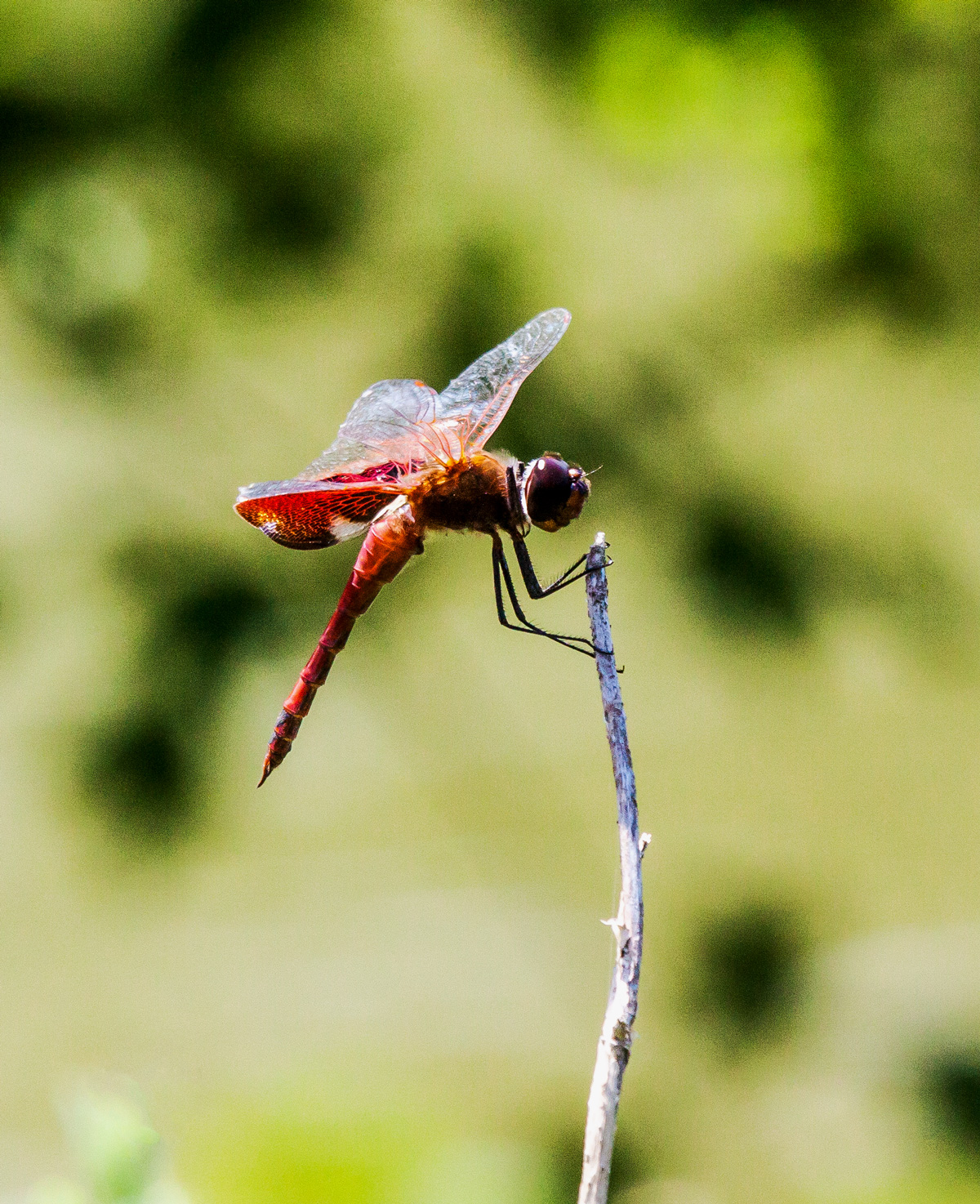
Yesterday morning at Jackson Miles Abbott Wetland Refuge at Fort Belvoir, Virginia I spotted my first Swift Setwing dragonfly (Dythemis velox) of the season. Last year. I believe, was the first time one was spotted in Fairfax County, where I live, and it looks like they are here to stay.

I spotted this dragonfly from pretty far away and recognized the shape and perching style. I took a few shots and moved a little closer and took a few more shots. I was hoping to get even closer, but the dragonfly apparently sensed my presence and flew away. As it turned out, that was the only Swift Setwing that I saw all day. I am pretty confident, though, that I will have some more opportunities to photograph this beautiful little dragonfly in the upcoming weeks and, hopefully, months.

Swift Setwing

© Michael Q. Powell. All rights reserved.

Read Full Post »

It’s a fun challenge to try to capture an image of a dragonfly in flight and I spent a lot of quality time this morning with a Prince Baskettail (Epitheca princeps) at Jackson Miles Abbott Wetland Refuge. Generally he flew patrols in the center of the pond, out of range of my lens (a 180mm macro), but occasionally he would fly tantalizingly close and give me a split second to react.

Most of the time I was unable to track him and focus quickly enough, but eventually I did manage get a few relatively sharp photos. This one is my favorite.

Prince Baskettail

© Michael Q. Powell. All rights reserved.

Read Full Post »

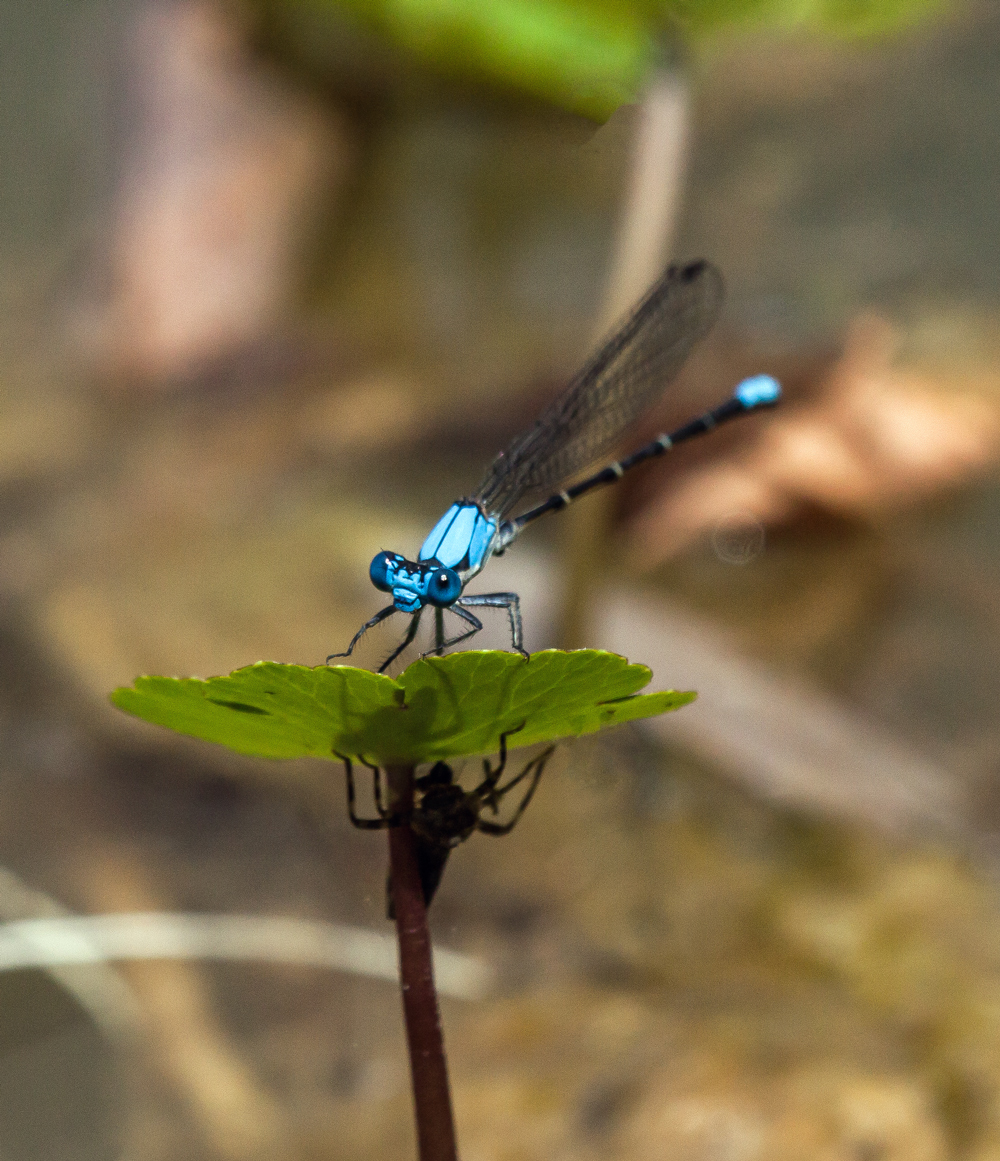
Whenever I walk along the edge of a pond, I always like to look for damselflies, which love to perch on the vegetation growing out of the water. Footing can be a bit problematic and more than once I have slid down a slippery bank into the water. Normally, though, I just lean out as far as I dare to get some shots.

Last weekend as I was exploring Jackson Miles Abbott Wetland Refuge, I spotted this beautiful little damselfly that was looking in my direction. I knew that depth of field would be a problem from that position, but did my best to focus on the damselfly’s beautiful eyes. When I returned home and began to review my shots, I was a little shocked to see what looked to be the discarded exoskeleton (exuvia) of another damselfly (or possibly a dragonfly) on the underside of the leaf on which “my” damselfly had perched. How did I not notice that when I was shooting?

I really like the way that the head of the exoskeleton is facing that of the damselfly and the shadow in between the two of them. Is it the shadow of the one looking down or the one looking up? Common sense says that it is the former, but the slight degree of ambiguity adds interest to the photo for me.


damselfly

© Michael Q. Powell. All rights reserved.

Read Full Post »

As I was exploring Jackson Miles Abbott Wetland Refuge last weekend, I spotted some Eastern Amberwing dragonflies (Perithemis tenera) flying low above the surface of the pond. One of them, a female, kept returning to a particular spot and would dip down and touch the water to deposit eggs. A male would periodically make an appearance and I couldn’t tell for sure if he was guarding the female or was trying to put the moves on her.

This is my favorite shot of the encounter. The dragonfly on the left is a male Eastern Amberwing and the one coming in from the right is a female. I thought about cropping the image in closer, but decided to keep it like this in order to retain the ripples and the reflection, elements that I really like.


Eastern Amberwing

© Michael Q. Powell. All rights reserved

Read Full Post »

What’s a Widow Skimmer? The name may bring to mind a gigolo chasing after rich old ladies, but it is actually a strikingly beautiful dragonfly. I spotted this handsome male Widow Skimmer (Libellula luctuosa) on Monday at Jackson Miles Abbott Wetland Refuge in at Fort Belvoir, Virginia.

When I took this shot, I was facing toward the sun. As a result, the body of the dragonfly is almost a silhouette. What was more important to me was the detail of the wings and I am happy I was able to capture some of the detail that was revealed as the light streamed through the almost transparent wings.

widow skimmer

© Michael Q. Powell. All rights reserved

Read Full Post »

It has rained almost continuously for several days since my return from a brief overseas trip to Vienna, Austria. After a week spent mostly in the city, I was itching to get out into the wild again. The rain finally let up in middle of this morning, so I went out exploring with my camera at Jackson Miles Abbott Wetland Refuge.

The wetland was really wet and it was cool and cloudy, so not much was stirring, except this little butterfly. I think I disturbed its sleep, for it was motionless with its wings spread wide until I was almost on top of it. Suddenly it took to the air and flew away. I am not sure what type of butterfly this is, but I was so happy to be in my “natural” environment again, that I am content to simply marvel in its delicate beauty.

UPDATE: In a Facebook insect identification group, my pretty little butterfly has been identified as a Crocus Geometer moth (sp. Xanthotype) or possibly a False Crocus Geometer moth.

butterfly

© Michael Q. Powell. All rights reserved

Read Full Post »

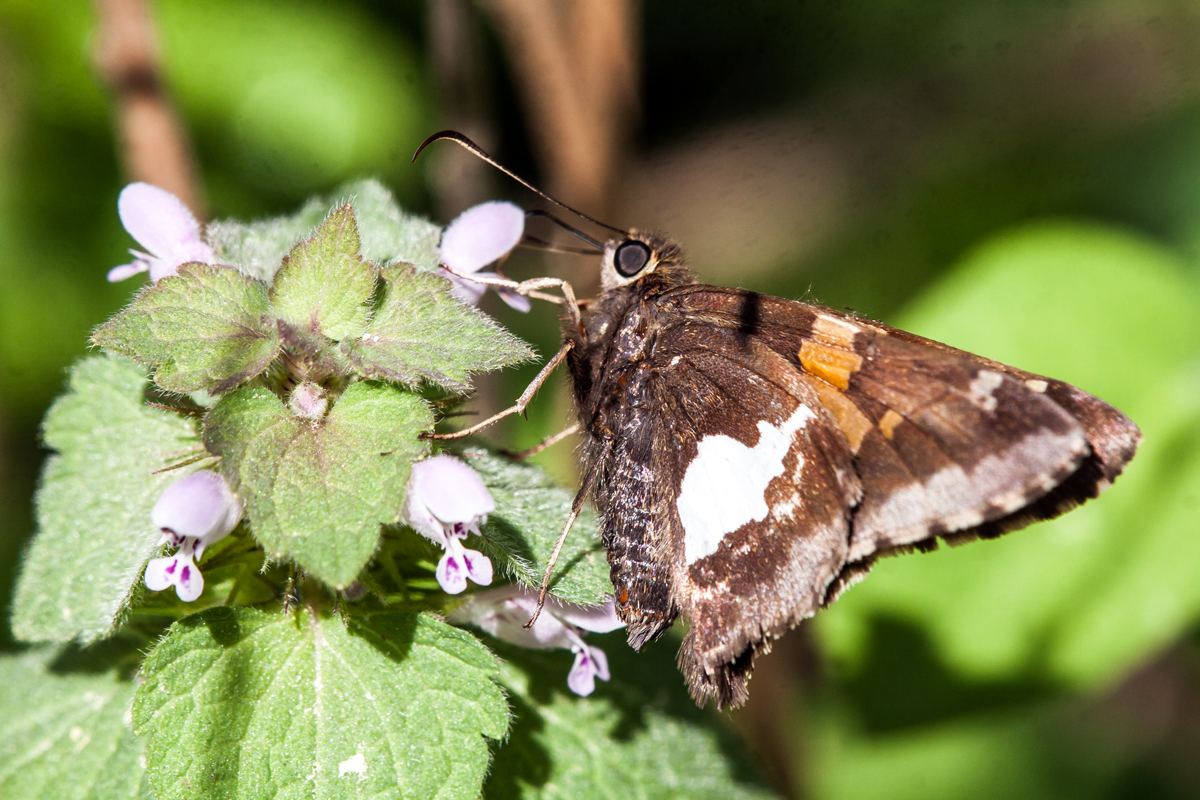
Out of the more than 3500 different species of skipper butterflies worldwide, according to Wikipedia, there is really only one that I can reliably identify—the Silver-spotted Skipper (Epargyreus clarus). I spotted this beautiful little butterfly this past weekend at Jackson Miles Abbott Wetland Refuge. The skipper was so intent on feeding that it let me get pretty close to it. As a result, this image is one of the rare cases when I didn’t feel a need or desire to crop at all. I am not very good at plant identification, but I really like the tiny flowers of the plant in this image.

Silver-spotted Skipper

© Michael Q. Powell. All rights reserved

Read Full Post »

During the summer it seems like dragonflies are everywhere, perching prominently in plain sight, but this early in the season there are a whole lot fewer of them and the ones that are around are hard to find. Fellow dragonfly enthusiast and blogger Walter Sanford recently did a posting about some Ashy Clubtail dragonflies (Phanogomphus lividus) that he had spotted at Jackson Miles Abbott Wetlands Refuge.

I had never seen this species before, so I set off this past Friday to see if I could find one of my own. Walter had alerted me to look for the Ashy Clubtails perched in the grass and in the low vegetation that surrounds the small pond at the wildlife refuge. I circled the pond several times in vain before I suddenly caught sight of some dragonfly wings shining in the sunlight. I was able to track the dragonfly during its short flight and saw where it landed in the grass.

Almost certain that I had found an Ashy, I approached the dragonfly slowly and cautiously, fearful of scaring it away before I could get a shot. I was face-to-face with dragonfly, which is not the greatest position for capturing its details, and was able to confirm that it was an Ashy Clubtail. Its pale coloration and very clear wings indicate that it is newly emerged, what is often called a “teneral,” and it looks to be a female. Having gotten a few shots, I tried to get a better angle and spooked the dragonfly.

Ashy Clubtail

Buoyed by my success, I was motivated to search even harder and eventually spotted two more teneral female Ashy Clubtails. One was in some chest-high thorny bushes and I had to push up against them to get as parallel as possible with its body for a detailed shot. I was able to photograph the third Ashy from almost directly overhead and the final photo gives you the best overall view of this beautiful dragonfly.

These Ashy Clubtails ares not as brightly colored as some of the dragonflies that will appear later in the summer, but they were definitely a welcome sight for me.

Ashy Clubtail

Ashy Clubtail

© Michael Q. Powell. All rights reserved

Read Full Post »

It’s springtime and love is in the air. So many creatures seem to be searching for mates and some of them have obviously found one, like this pair of Pearl Crescent butterflies (Phyciodes tharos) that I spotted in flagrante delicto at Jackson Miles Abbott Wetland Refuge in Northern Virginia this past Friday.

I am no expert in butterfly anatomy and have no idea how this works, but there is a real beauty in the position, which appropriately looks  to me like a double heart. What can I say, I am a romantic at heart.

Pearl Crescent

© Michael Q. Powell. All rights reserved

Read Full Post »

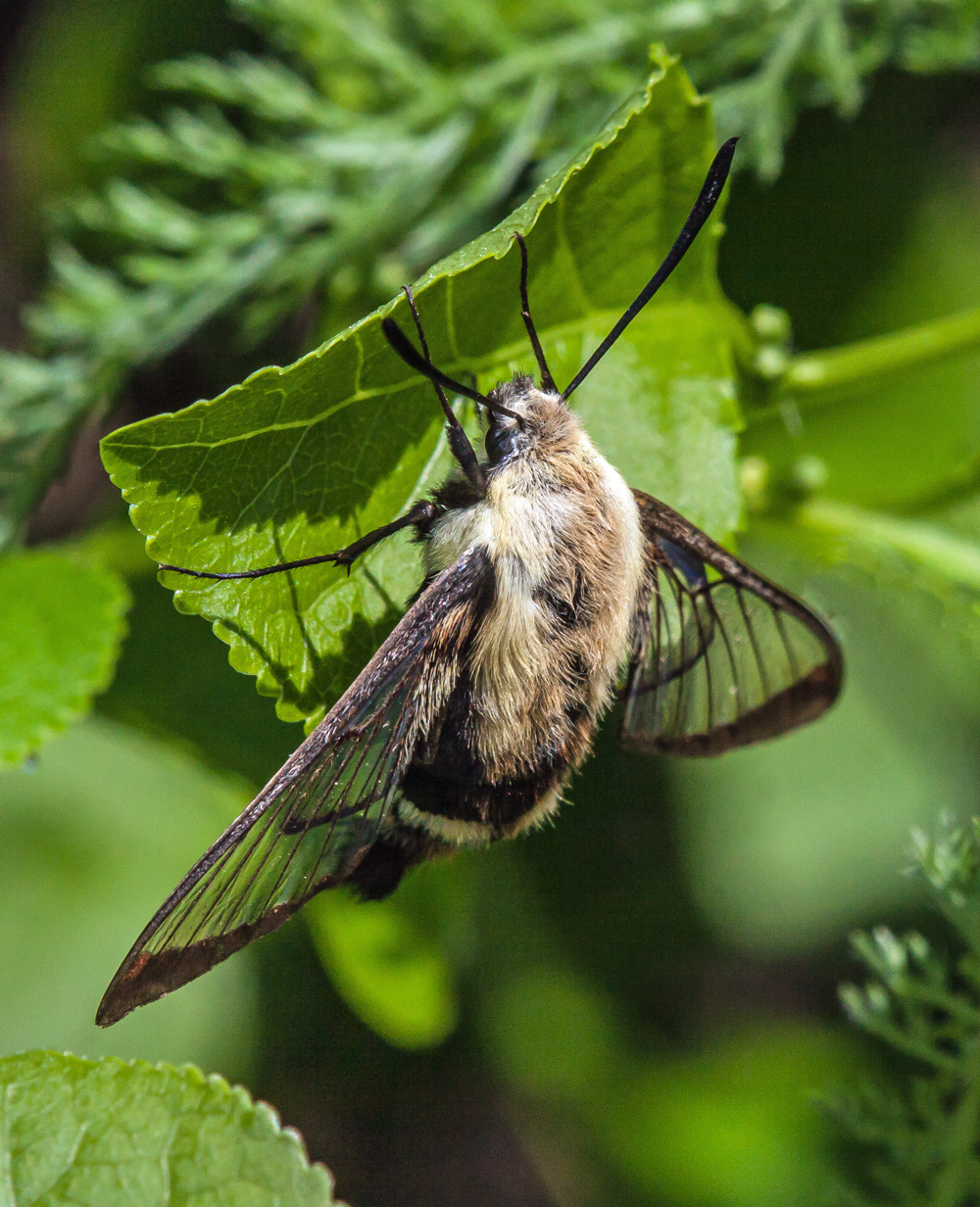
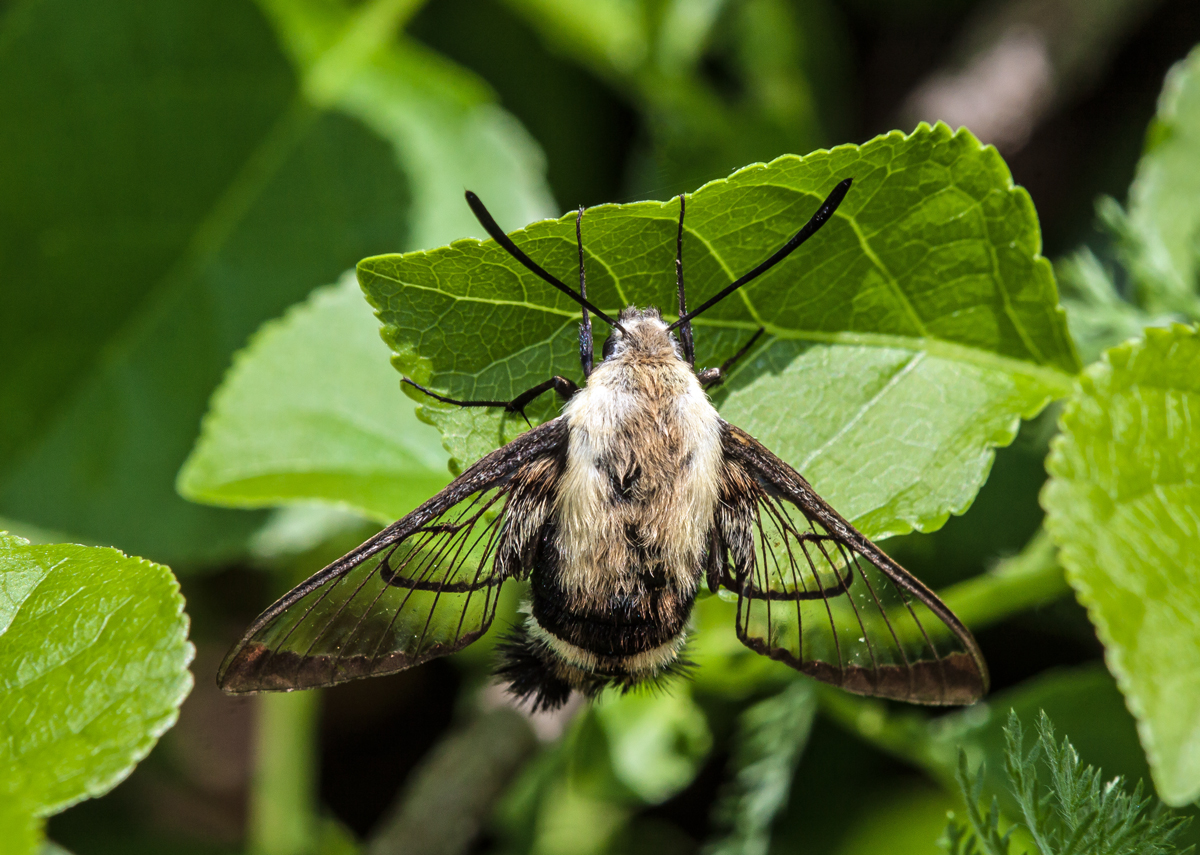
As I was searching for dragonflies yesterday at Jackson Miles Abbott Wetland Refuge, I noticed an unusually large bumblebee and started to give chase. When it landed and I moved in close, it became clear that it was not a bumblebee after all—it was a clearwing moth.

I have seen clearwing moths in the past of the the variety commonly known as Hummingbird Clearwing Moths (Hemaris thysbe), but they have generally been hovering like a hummingbird rather than perching like this one and their wings were outlined in red, not black. It took only a few minutes of internet research to discover that this is a Snowberry Clearwing Moth (Hemaris diffinis).

Snowberry Clearwing moth

Snowberry Clearwing moth

© Michael Q. Powell. All rights reserved

Read Full Post »

This delicate little butterfly was facing away from me, but I love the way that you can see the beautiful markings on the inside of its wings. I believe it is an Eastern Tailed-Blue butterfly (Cupido comyntas), a kind of hairstreak butterfly with an average wingspan of only about one inch (25mm).

I chased after a number of these butterflies earlier this week when I was exploring Jackson Miles Abbott Wetland Refuge at Fort Belvoir, Virginia. They don’t fly very fast, but their flight path is unpredictable and close to the ground and they usually don’t perch for long in one spot.

I suspect that if someone had been observing me from a distance, they would have been hard-pressed to figure out what I was trying to photograph and might have concluded that I was merely another crazy wildlife photographer. We are a peculiar breed, aren’t we?

Eastern-tailed Blue

© Michael Q. Powell. All rights reserved


Read Full Post »

Now that the dragonfly season has started in my area, I am devoting more and more of my available photography time to searching for these beautiful little creatures. Some dragonflies can be found almost anywhere, but many of them require a very specific kind of habitat and may be present for only limited periods of time.

Yesterday afternoon I visited Jackson Miles Abbott Wetland Refuge, which features a small pond surrounded by a pathway. Last year I found several different dragonfly species there, so I knew that I might have a chance of seeing some dragonflies. I looked in the brush and in the vegetation and came up empty-handed until I looked at the water and spotted several dragonflies flying low above the water.

I recognized the dragonflies as Common Baskettail dragonflies (Epitheca cynosura) and knew that I faced a challenge—this species seems to fly continuously and rarely have I seen one perch. I realized that if I wanted to get some shots of the dragonflies I would have to capture the images while they were flying.

I had my Tamron 180mm macro lens on my camera and started to track the flying dragonflies. I have tried a number of focusing techniques in the past and have had the most success when I focus the lens manually (although I hesitate to use the word “success,” given the high rate of failure in getting an in-focus shot). This was my favorite shot of a Common Baskettail flying above the water. There is a bit of motion blur in the wings and I had to crop the image quite a bit, but I managed to keep most of the dragonfly in focus.

Common Baskettail

I walked multiple circuits around the pond, still searching for more dragonflies. I tend to like to keep moving, rather than sticking in one spot. As I reached one end of the pond, I suddenly realized that a dragonfly was hovering in mid-air right in front of me. The dragonfly was moving slowly above a grassy patch adjacent to the pond, but did not seem interested in heading for the water.

I could hardly believe my good fortune and tried to compose myself and focus on the dragonfly. I managed to get some detailed shots that show, for example, how the Common Baskettail folds up its legs when flying. I took the first shot below while on my knees, so that I was almost level with the dragonfly. For the second shot, I was shooting down on the dragonfly and it looks almost like it was taken by a drone, hovering above the hovering dragonfly.

Common Baskettail

Common Baskettail

© Michael Q. Powell. All rights reserved

Read Full Post »

« Newer Posts