Feeds:
Posts
Comments

Posts Tagged ‘Jackson Miles Abbott Wetland Refuge’

I spotted this beautiful female Red-winged Blackbird (Agelaius phoeniceus) poking about in the marshland vegetation last Thursday at Jackson Miles Abbott Wetland Refuge. As is the case with many birds, the name of the species matches the coloration and/or features of the male, but not those of the female, e.g. this Red-winged Blackbird is not black nor does it have red wings.

I had my first encounter with a female Red-winged Blackbird in June 2012, a few months before I started this blog. I remember well my initial difficulties in trying to identify the bird and my shock in learning that it was a blackbird—I assumed it was a sparrow of some sort. In September 2012, I posted some photos of that bird in a blog entry entitled “Intense bird.” I encourage you to click on that link and make your own judgment about the degree to which my photography “style” has remained consistent over the years.

In 2012 I was just starting to get serious about photography and my dear friend and photography mentor Cindy Dyer had lent me a Nikon D300 and a Tamron 180mm macro lens that day. I fell in love with that lens and quickly purchased one for my Canon, the brand that I mostly use. The Tamron 180mm macro lens remains one of my favorite lenses.

It was quite enjoyable to watch this blackbird last week exploring the vegetation protruding from the water. She would perch on some rather small stems, appearing to flare her tail to maintain her balance, as you can see in these photos, occasionally calling out to a male blackbird that I could hear, but did not see.

Red-winged Blackbird

Red-winged Blackbird

© Michael Q. Powell. All rights reserved.

Read Full Post »

Odonata is an order of flying insects that includes dragonflies and damselflies. During the warmer months of the year I spend a lot of time hunting for dragonflies, the larger members of this group of magical creatures, but I also enjoy searching for damselflies, their smaller and more fragile “cousins.”

Damselflies, like dragonflies, come in a variety of colors and shapes. Here is a sampling of images of damselflies that I captured this past Thursday during visits to Jackson Miles Abbott Wetland Refuge and Occoquan Regional Park, both of which are located within 15 miles (24 km) of my house.

The first photo shows a Orange Bluet (Enallagma signatum). I am always amused by the name of this species, because it seems incongruous to have an orange-colored member of a genus called American Bluets. Most male bluets are, in fact, blue, but others are orange, scarlet, and burgundy and there is even a “Rainbow Bluet.”

The second image shows a male Azure Bluet (Enallagma aspersum), whose colors are closer to my mental image of a bluet. Most bluets are some combination of blue and black and it can be tricky trying to determine specific species by examining the color patterns on the body and in the eyes.

The third shot is of a male Fragile Forktail (Ischnura posita), one of the first damselflies to emerge each spring. Fragile Forktails are really tiny (about an inch (25 mm) in length, but are relatively easy to identify by their broken shoulder stripe that looks like an exclamation point.

In the final photo I was eye-to-eye with the damselfly so his abdomen is almost completely out of focus. Nonetheless enough details are visible for me to say this is almost certainly a male Eastern Forktail damselfly (Ischnura verticalis).

I like to try to vary my approach to capturing images of most subjects, including damselflies, as you can see in this little collection of photos. Sometimes, as in the first shot, I will try to isolate the subject from its background in order to focus the viewer’s complete attention on the subject. Recently, though, I have developed a preference for including more of the habitat in my shots, as in the second image, in order to give the viewer a sense of the environment in which I took the shot. When possible, I like to attempt to capture some “artsy” shots, like the final image, by using selective focus and choosing carefully my angle of view.

No matter what approach I choose with damselflies, I have to be careful not to fall into the water, where most of these dragonflies were perching. I am not always successful in keeping my feet dry.

Orange Bluet

Azure Bluet

Fragile Forktail

Eastern Forktail

© Michael Q. Powell. All rights reserved.

Read Full Post »

I almost fell into the pond on Wednesday at Jackson Miles Abbott Wetland Refuge when I leaned over the edge of a steep bank after detecting some movement. Fortunately I did not lose my balance and managed to get a shot of this male Fragile Forktail (Ischnura posita), my first damselfly of this season.

Fragile Forktails are almost always the first damselflies in my area to emerge and are surprisingly easy to identify—they have broken shoulder stripes that look like exclamation points. Although they are easy to identify, you have to find them first and their diminutive size (0.83 to 1.14 inches (21 to 29mm) in length) makes them quite difficult to spot.

Damselflies and dragonflies belong to the Odonata order of flying insects. Damselflies generally are more slender, have eyes placed apart, and perch with their wings folded together along their bodies when at rest. Dragonflies tend to be bulkier, have large compound eyes that touch each other, and usually perch with their wings extended when at rest.

Fragile Forktail

© Michael Q. Powell. All rights reserved.


Read Full Post »

I love the way these turtles were lined up on an upward-slanting log as they basked in the autumn sunlight last Tuesday at Jackson Miles Abbott Wetland Refuge. One smaller turtle looked like it was trying to merge into the traffic on the log, but the other turtles, like drivers in the Washington D.C. area where I live, were not letting him in.

The reflections in the water were a nice bonus and few floating leaves add little pops of autumn color.

turtles

© Michael Q. Powell. All rights reserved

Read Full Post »

I was thrilled to spot this handsome Russet-tipped Clubtail dragonfly (Stylurus plagiatus) last Wednesday at Jackson Miles Abbott Wetland Refuge. I love the way that the dragonfly was clinging to the leaf, looking almost like it was peeping over the edge.

Russet-tipped Clubtails are a late season species and are seen most often in August and September in my area. Unlike many of the dragonflies that I see regularly that prefer pole-like perches or perch flat on the ground, Russet-tipped Clubtails like to hang from the leaves of vegetation at an angle or almost vertically—members of the genus Stylurus are sometimes called “Hanging Clubtails.”

Russet-tipped Clubtail

© Michael Q. Powell. All rights reserved.

Read Full Post »

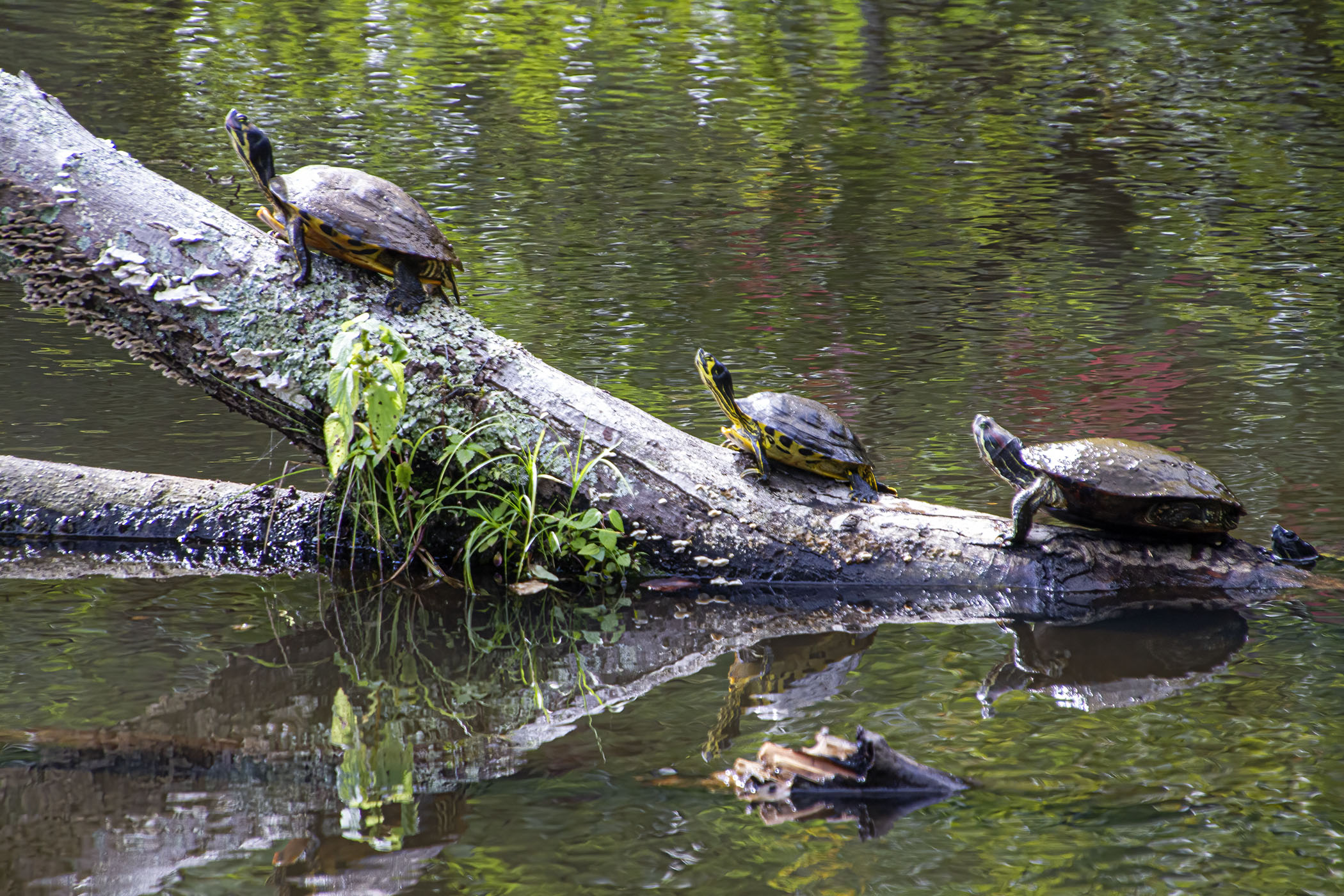
The weather is cooling off, but whenever there is the slightest amount of sunshine, I can count on seeing turtles basking in the warmth of the sun. This past Wednesday, I spotted these three turtles on a partially submerged tree branch in the small pond at Jackson Miles Abbott Wetland Refuge. I am pretty sure that the turtle on the right is a Red-eared Slider (Trachemys scripta elegans) and the other two may be Yellow-bellied Sliders (Trachemys scripta scripta).

I am always a fan of reflections and I love the way that we can see reflections of the turtles on the rippled surface of the water. It was an added bonus to have some patches of red, a sign of the changing season.

turtles

© Michael Q. Powell. All rights reserved.

Read Full Post »

For the last few weeks I have been searching diligently for the late-season dragonfly species that appear on the scene in late August and early September. So far I have come up mostly empty-handed, but I was thrilled to spot this cool-looking Russet-tipped Clubtail dragonfly (Stylurus plagiatus) on 6 September at Jackson Miles Abbott Wetland Refuge. In my area, Russet-tipped Clubtails  are seen most often in August and September, but they are somewhat uncommon.

As some of you know, I dabble a bit with YouTube. At about this time last year I did a little video about Russet-tipped Clubtails that you might enjoy watching. It was one of my first videos and lasts about a minute and a half.  Click on this link to view the video in YouTube. I am also embedding a YouTube link at the end of this posting. Depending on how you are reading this blog, you may be able to watch the video from within the blog.

A year ago, I had aspirations of shooting more video footage during my photography outings. I have made only minor progress in that area, but it is still something that interests me a lot. I have learned the basics of making and editing videos, but am struggling to figure out what stories I want to tell and how a video can help me tell those stories.

Russet-tipped Clubtail

© Michael Q. Powell. All rights reserved.


Read Full Post »

In many of my blog postings, I concentrate on a single species of dragonflies, but today I want to celebrate the diversity of species that I have been seeing during the month of September. Despite my warnings in some earlier postings about the decreasing numbers of dragonflies, I continue to see a variety of species—Northern Virginia, where I live, is blessed to have an abundance of different dragonflies and damselflies.

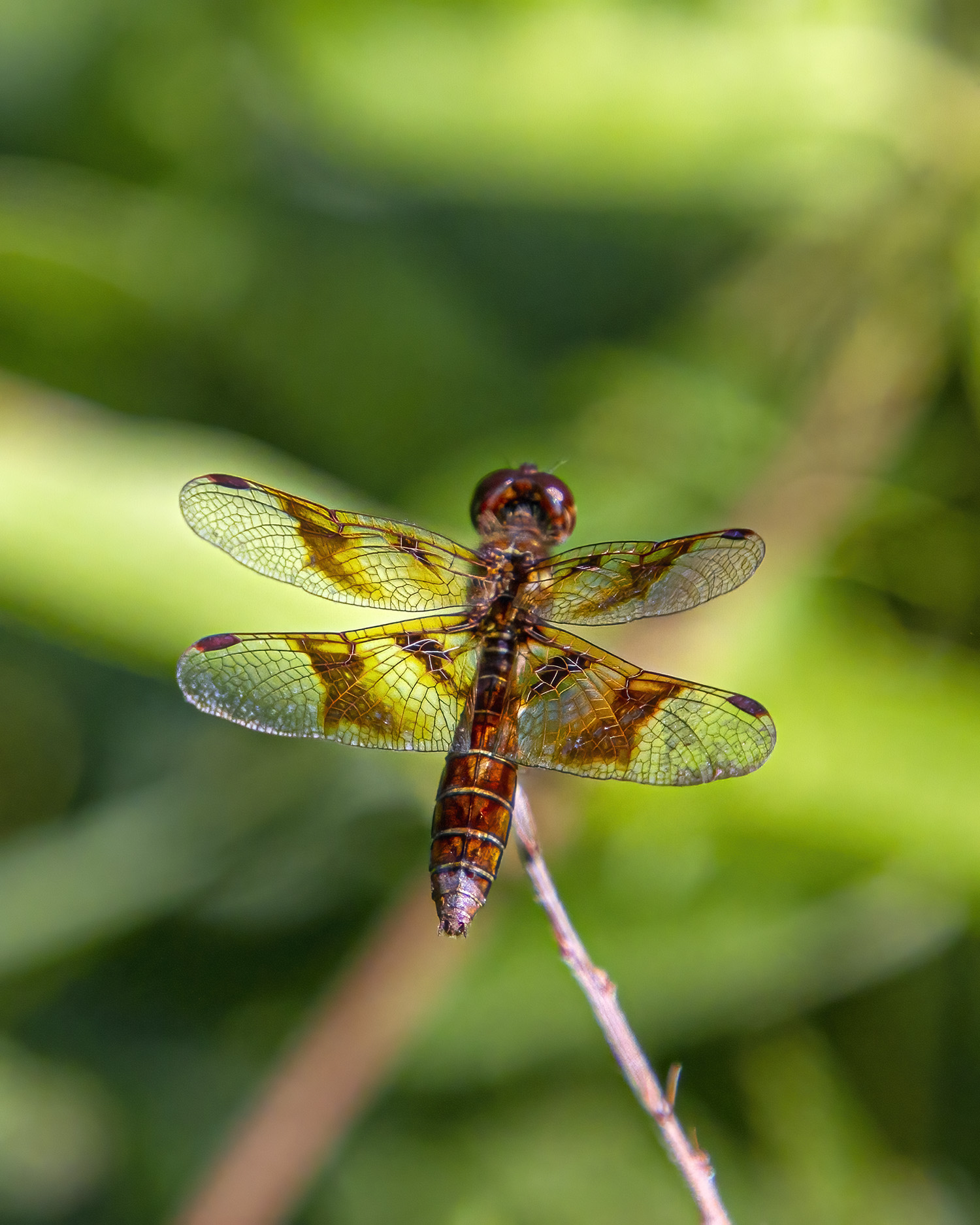
The first photo shows a female Eastern Amberwing (Perithemis tenera), the smallest dragonfly in our area.  Males of this species hang out at ponds, but the females, which do not have amber wings like the males, are usually found in vegetation some distance from the water.

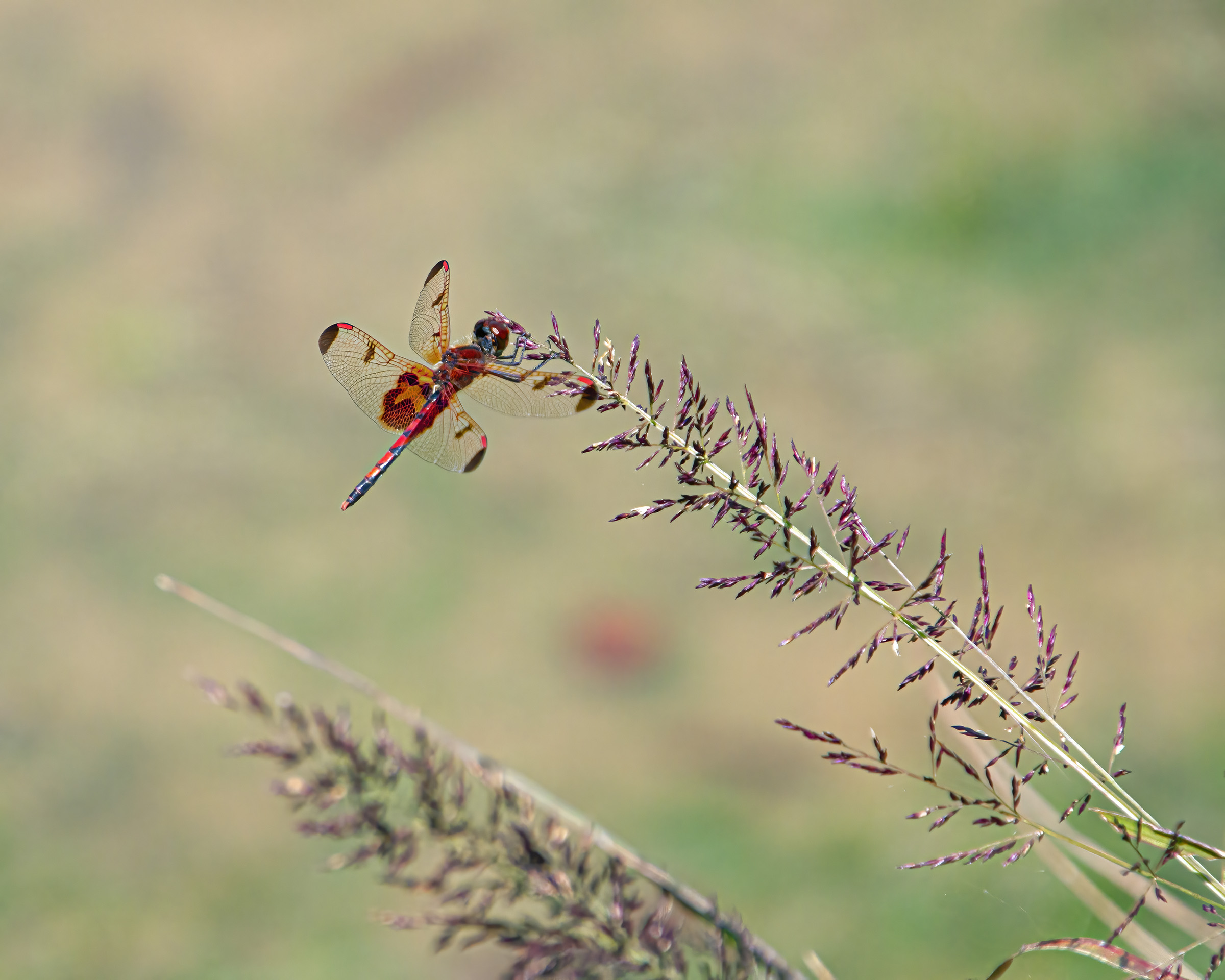
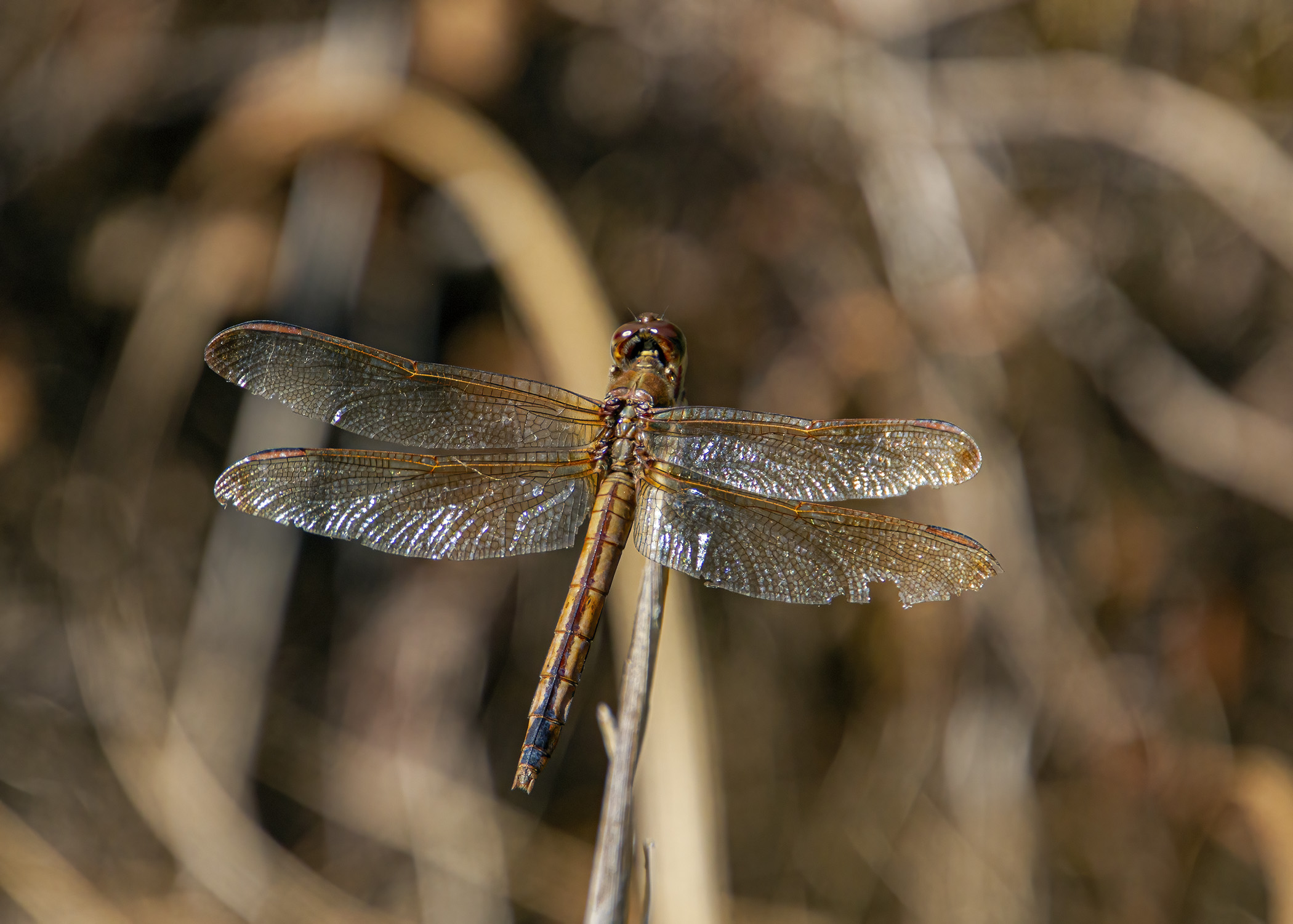
The second image shows a male Calico Pennant (Celithemis elisa), a beautifully colored dragonfly with distinctive patterns on its wings. The third image shows a mature female Needham’s Skimmer (Libellula needhami). Her wings show some damage and her color has fades, but she is still beautiful and the golden strands on the front edges of her wings were sparkling in the sunlight when I captured this image.

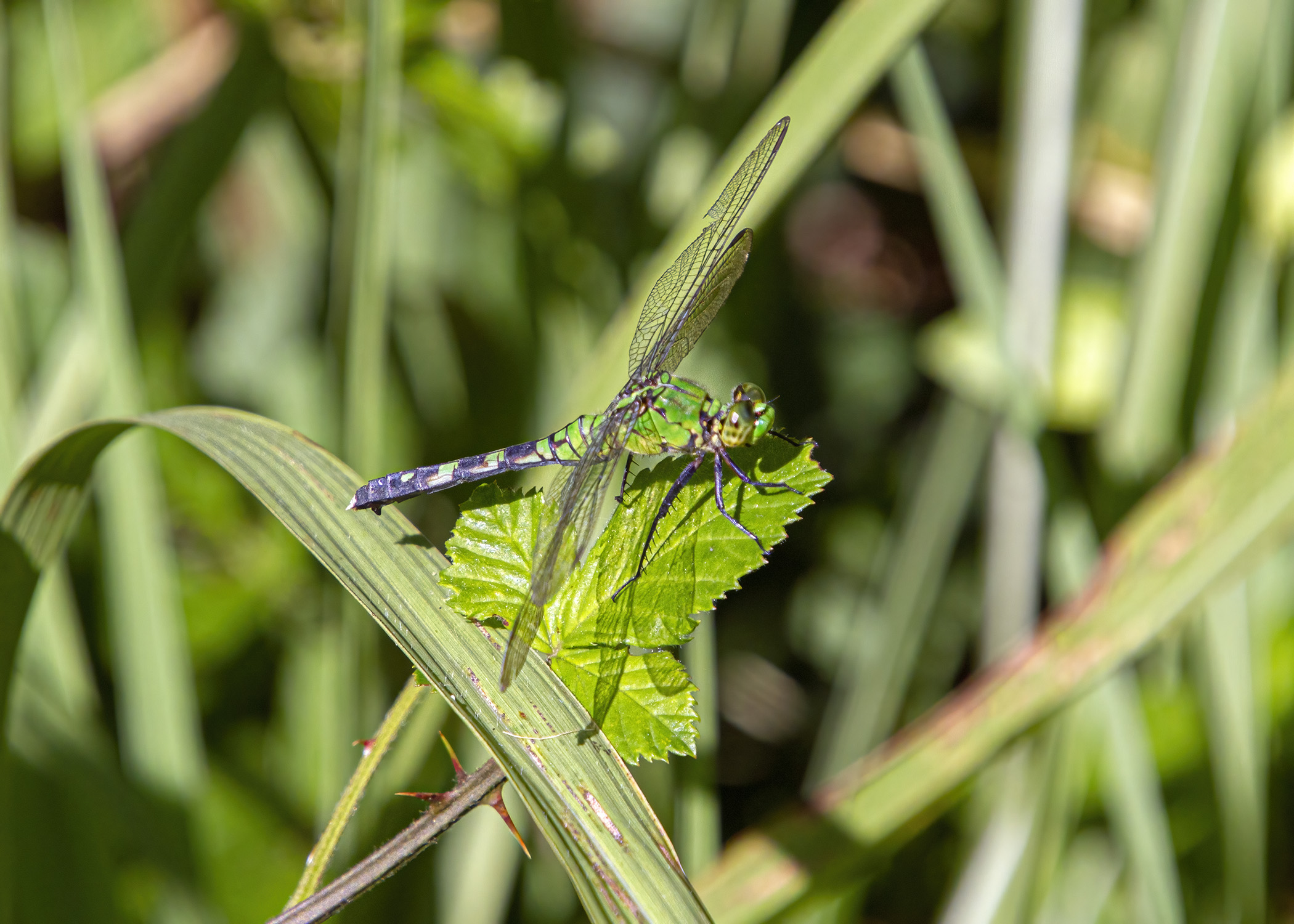
The fourth image shows a female Eastern Pondhawk (Erythemis simplicicollis), one of the most common dragonfly species in my area. I love the brilliant emerald color of the females (and immature males) of this species and the black markings on the abdomen.

The dragonfly in the last photo was the toughest one for me to identify. It had flown up into a tree and I was looking into the sun when I captured the image. However, I am pretty sure that it is a female Great Blue Skimmer (Libellula vibrans).

All of these dragonflies belong to the Skimmer family, the largest dragonfly family that includes the species most likely to be seen by a casual dragonfly watcher. The other families, which are generally harder to find, include Clubtails, Cruisers, Darners, Emeralds, Petaltails, and Spiketails. If I remember correctly, I have managed this season to photograph at least one dragonfly in all seven of these dragonfly families.

Eastern Amberwing

Calico Pennant

Needham's Skimmer

Eastern Pondhawk

Great Blue Skimmer

© Michael Q. Powell. All rights reserved.


Read Full Post »

For those of us in the northern hemisphere who use the astronomical calendar, tomorrow (23 September) marks the beginning of the autumn season. In so many of the photos that I have taken during the past few weeks, I have noted signs of the changing seasons.

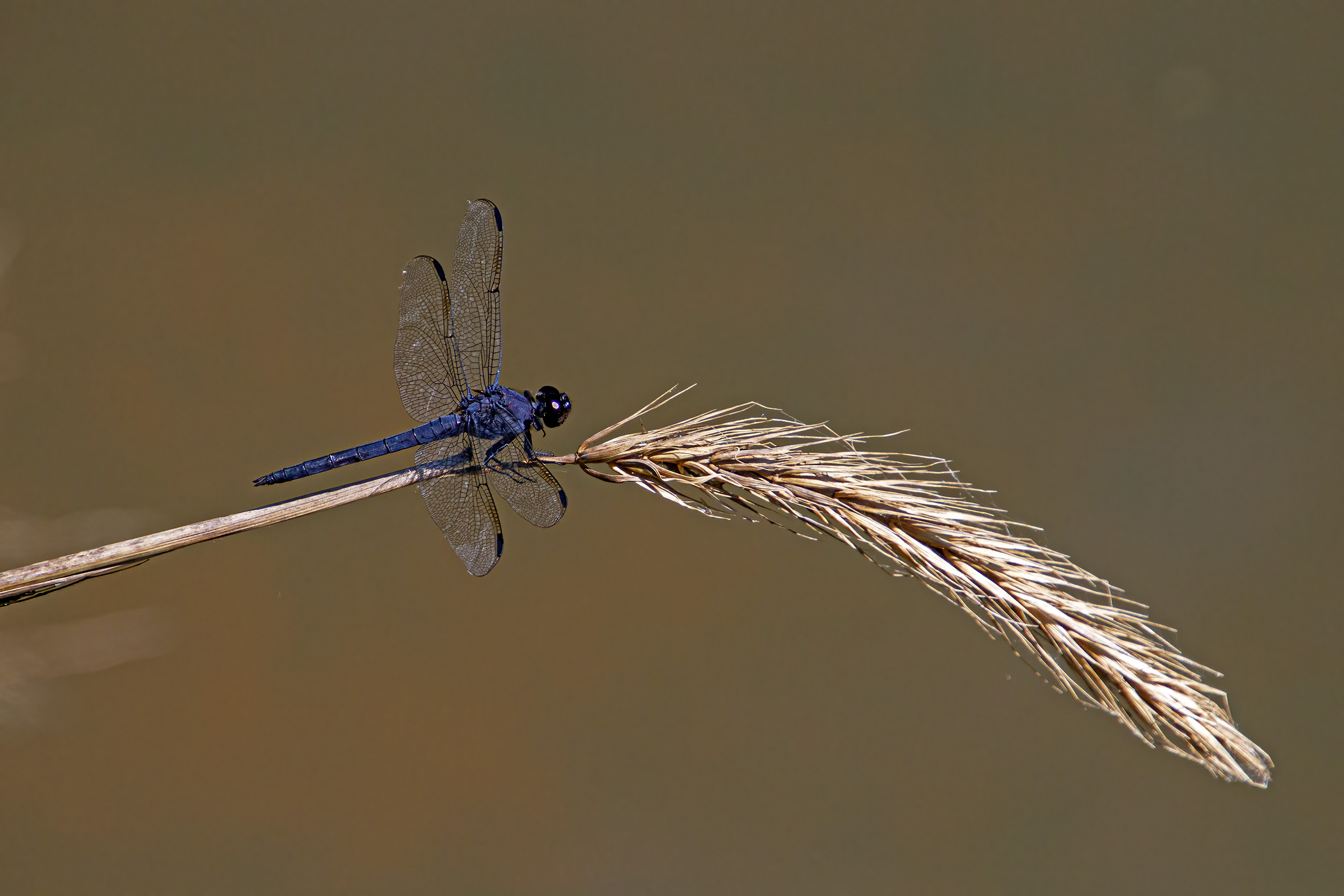
The warm orange tones in this shot of a female Needham’s Skimmer dragonfly (Libellula needhami) remind me of pumpkins and autumn leaves. The fading flowers in the photo of a male Common Whitetail dragonfly (Plathemis lydia) remind us that the growing season is coming to an end. The dryness of the stalk on which the Slaty Skimmer (Libellula incesta) dragonfly perch brings to mind the droughts and extreme weather that many have experience during this summer.

Embrace the new season and the opportunities is provides, whether it be autumn in the northern hemisphere or spring for those in the southern hemisphere.

Needham's Skimmer

Common Whitetail

Slaty Skimmer

© Michael Q. Powell. All rights reserved.
 

Read Full Post »

At this time of the year we experience the change in seasons in many different ways. We feel the gradual cooling of the weather. We see the changing colors of the leaves on the trees. We hear (and see) the unmistakable sound of flocks of migrating Canada Geese (Branta canadensis).

Although we seem to have a resident population of Canada Geese in our area year-round, during the spring and summer large flocks of geese fly through our area and it is quite common to hear the loud honking of the geese as they fly overhead. Sometimes they fly in military precision in a v-formation, but more often than not they are in a looser formation, as was the case with these Canada Geese that I photographed last week while I was looking for dragonflies at Jackson Miles Abbott Wetland Refuge in Northern Virginia.

Canada Geese

© Michael Q. Powell. All rights reserved.

Read Full Post »

Wings are tattered. Flowers have faded. Summer is ending. (Blue Dasher dragonfly (Pachydiplax longipennis) photographed on 6 September at Jackson Miles Abbott Wetland Refuge.)

Blue Dasher

© Michael Q. Powell. All rights reserved.
Read Full Post »

I don’t often see dragonflies perch on flowers, so I was delighted when this female Blue Dasher (Pachydiplax longipennis) decided to rest for a moment on an aster plant in bloom last week at Jackson Miles Abbott Wetland Refuge.

I decided not to crop this photo to show the dragonfly better, because I really like the sweep of bright color on the left side of the image and the more muted out-of-focus colors on the right side. I am growing to love this type of environmental portrait, which goes against my normal approach of trying to fill as much of the frame as possible with my primary subject.

Blue Dasher

© Michael Q. Powell. All rights reserved.
Read Full Post »

Do you prefer to live your life widely or deeply? That is a curious question, but it is one that affects the way that many of us approach our photography and our lives in general. Let me reframe the question. Are you always seeking to visit new places to see new things, i.e. living “widely”, or would you rather spend your time in familiar locations with familiar subjects, going back to the same places repeatedly, i.e. living “deeply?”

As you may have guessed, I tend to put myself in the second category. I like to observe the seasonal changes at a few local areas, watching for new species to arrive and to depart (or disappear), observing the changes in the flora and the fauna, and discovering favorite spots for my photography. I am not really consumed by a need or desire to add to my “life list” of birds or insects that I have seen, though I do enjoy visiting other locations.

All of these thoughts were percolating in my brain on Wednesday when I visited Jackson Miles Abbott Wetland Refuge to see which dragonflies were still present. I was particularly delighted to spot several Swift Setwing dragonflies (Dythemis velox). In June 2016 at this same refuge, I first photographed a Swift Setwing—a primarily southern species that had never before have been spotted in Fairfax County, the county where I live—and each year since I have eagerly returned to learn more about the species. For more details on my initial sighting, check out my 2016  blog posting Swift Setwing dragonfly.

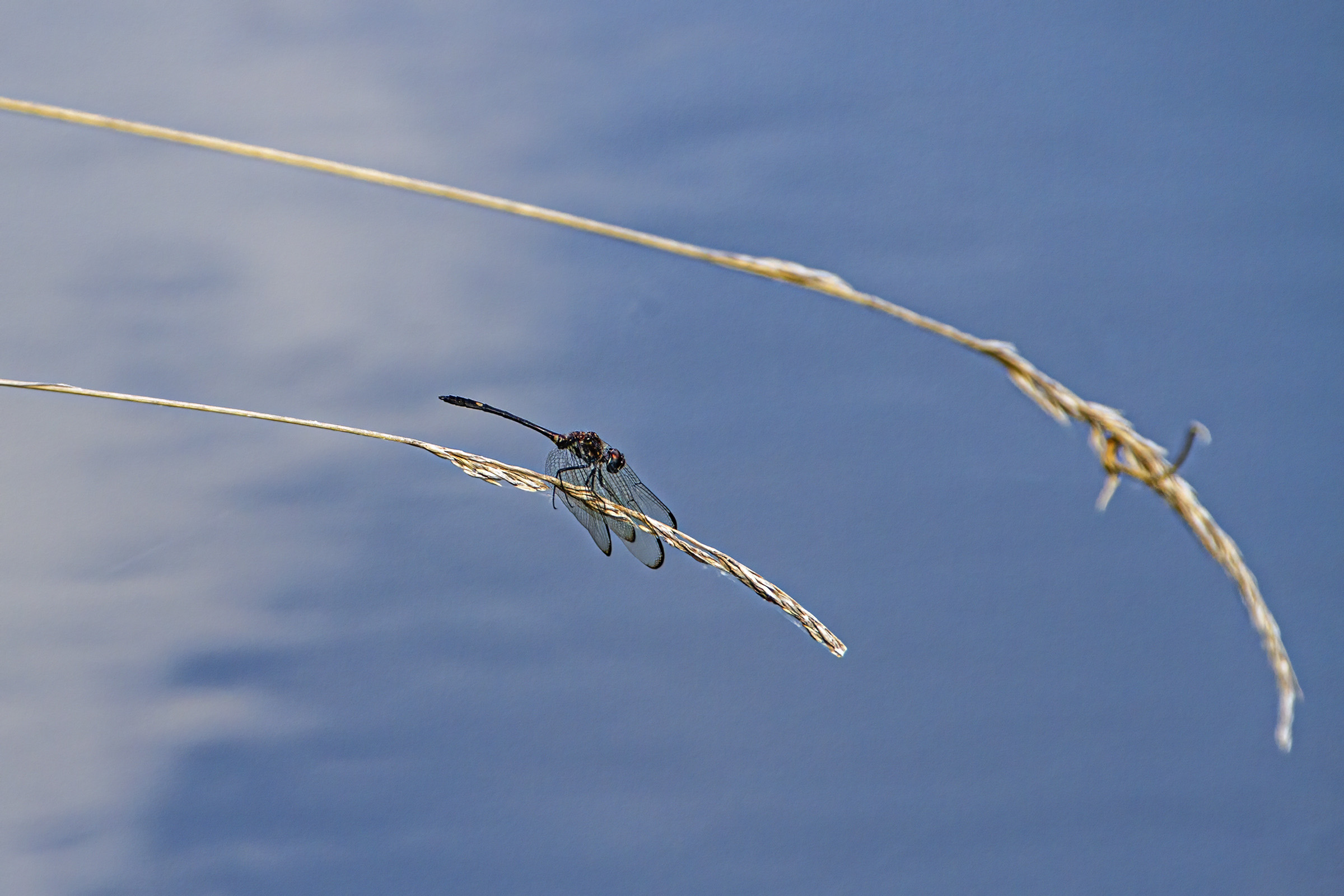
It is always tough to frame shots of Swift Setwings, because they like to perch on vegetation that overhangs the water and they face the water. The sun was shining brightly and I was happy to capture a couple of images in which the dragonfly appears to be perching among the clouds. I did try to get down low, but I think the background is a reflection of the sky in the water of the pond and not the sky itself.

For the second image, I was far away from the dragonfly. I couldn’t get a clear shot of the Swift Setwing, so I chose to use some vegetation blocking my view as a framing element in the foreground. I like the way that the image turned out.

Swift Setwing

Swift Setwing

© Michael Q. Powell. All rights reserved.
Read Full Post »

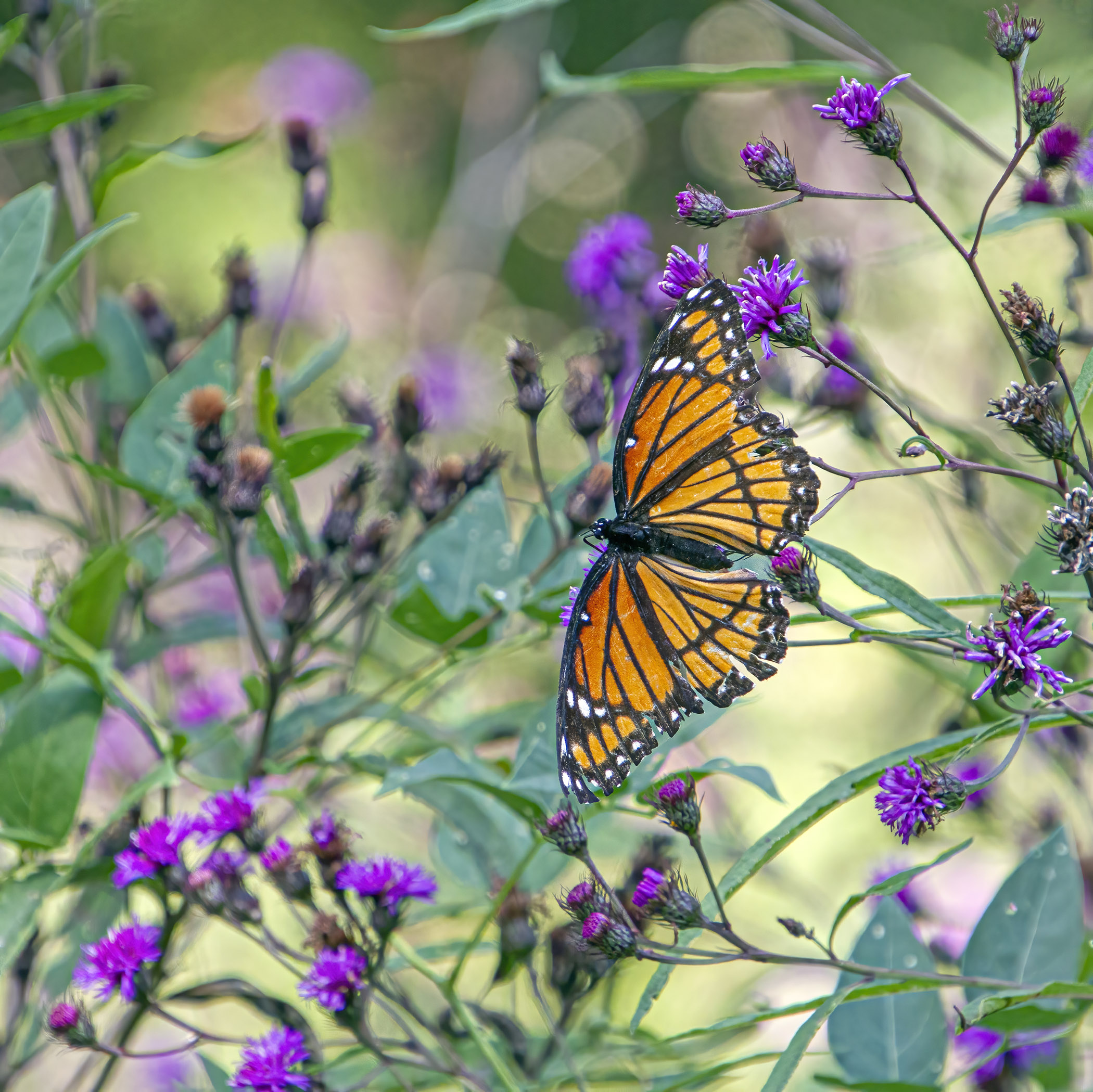
On Wednesday I spotted this beautiful Viceroy butterfly (Limenitis archippus) during a short visit to Jackson Miles Abbott Wetland Refuge. At one end of the refuge, there is a patch of wildflowers and I always make sure to check it out for birds, butterflies, and other insects. I am no expert on wildflowers, but I think the purple plant in the photo may be a variety of ironweed.

As you can probably tell, the Viceroy is considered to be a mimic of the somewhat larger Monarch butterfly. They are pretty easy to tell apart, however, because the Viceroy has a black line across the hind wings that is not found on the wings of Monarchs.

Viceroy

Viceroy

© Michael Q. Powell. All rights reserved.
Read Full Post »

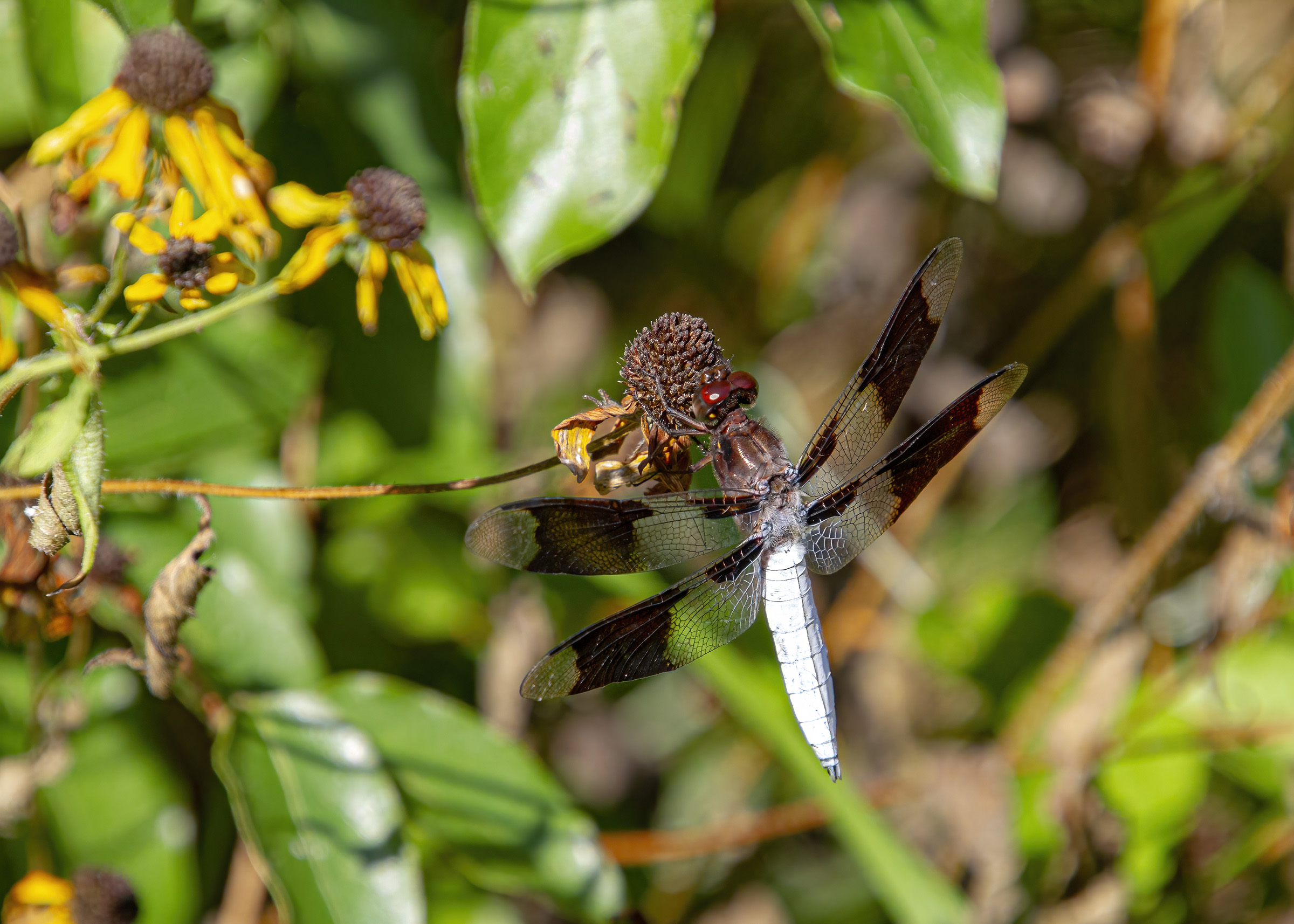
From a distance, many dragonflies are hard to identify. However, the wing markings on a male Twelve-spotted Skimmer dragonfly (Libellula pulchella) are so distinctive that I could identify this dragonfly immediately when I spotted it yesterday in the marshland at Jackson Miles Abbott Wetland Refuge.

If you take the time to count all of the spots on the wings of the dragonfly, you come up with a number much higher than 12. Why then is it called a Twelve-spotted Skimmer? Someone decided that it was best to count only the dark spots, because only the males generally have the white spots. It is a rare case when gender equality seems to have factored into the name of a species—normally species’ names are based on the characteristics of the male.

Twelve-spotted Skimmer

© Michael Q. Powell. All rights reserved.
Read Full Post »

The vegetation seemed so thick in the marshland at Jackson Miles Abbott Wetland Refuge that I was surprised that a Great Egret (Ardea alba) was able to spot and catch a fish there last Monday. I have not seen many egrets this year, so I was shocked to see five of them that day.

Great Egrets leave our area and head to warmer locations when the weather begins to turn cooler, while their “cousins,” the Great Blue Herons, stay with us throughout the entire year.

Great Egret

Great Egret

© Michael Q. Powell. All rights reserved.
 

Read Full Post »

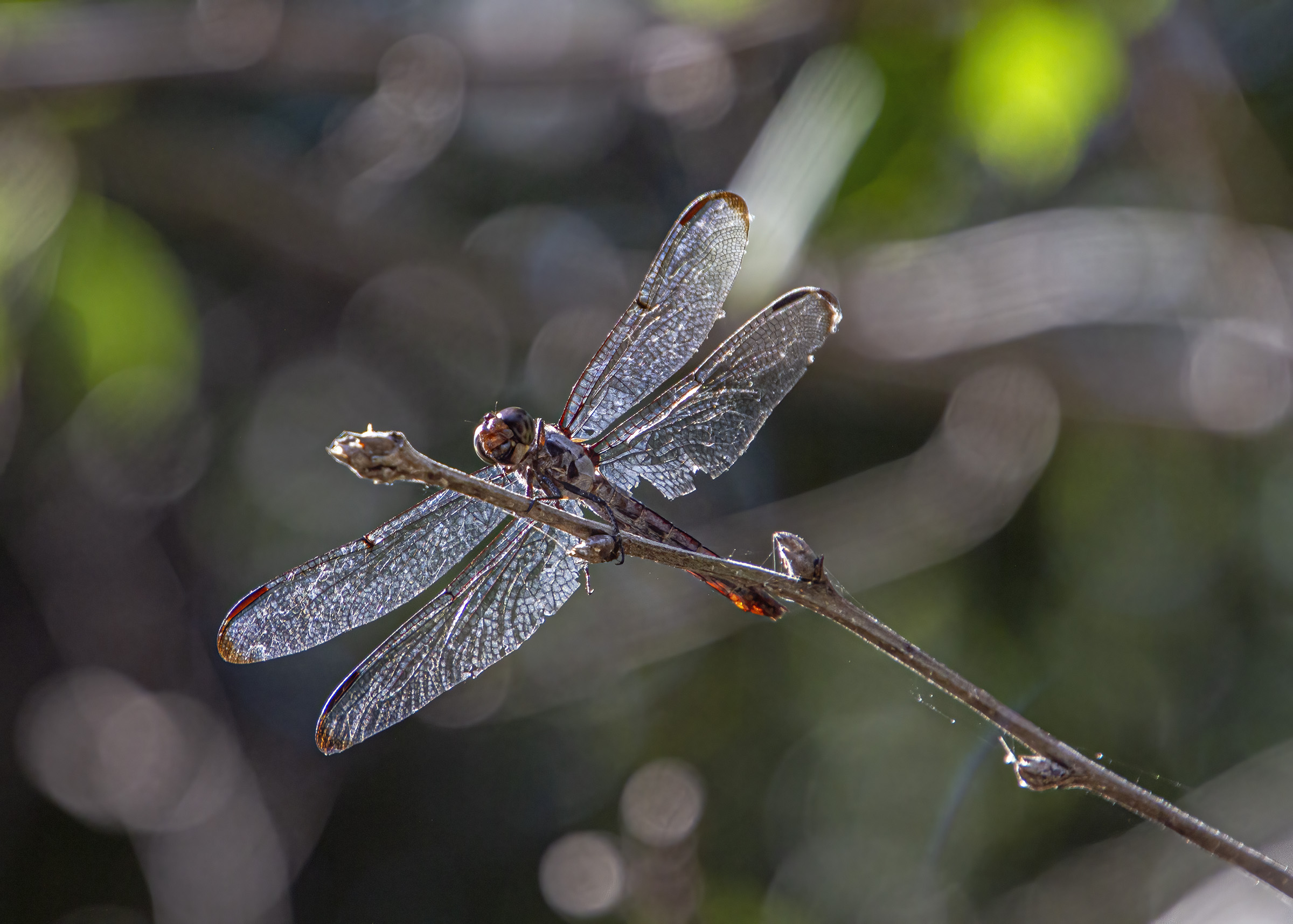
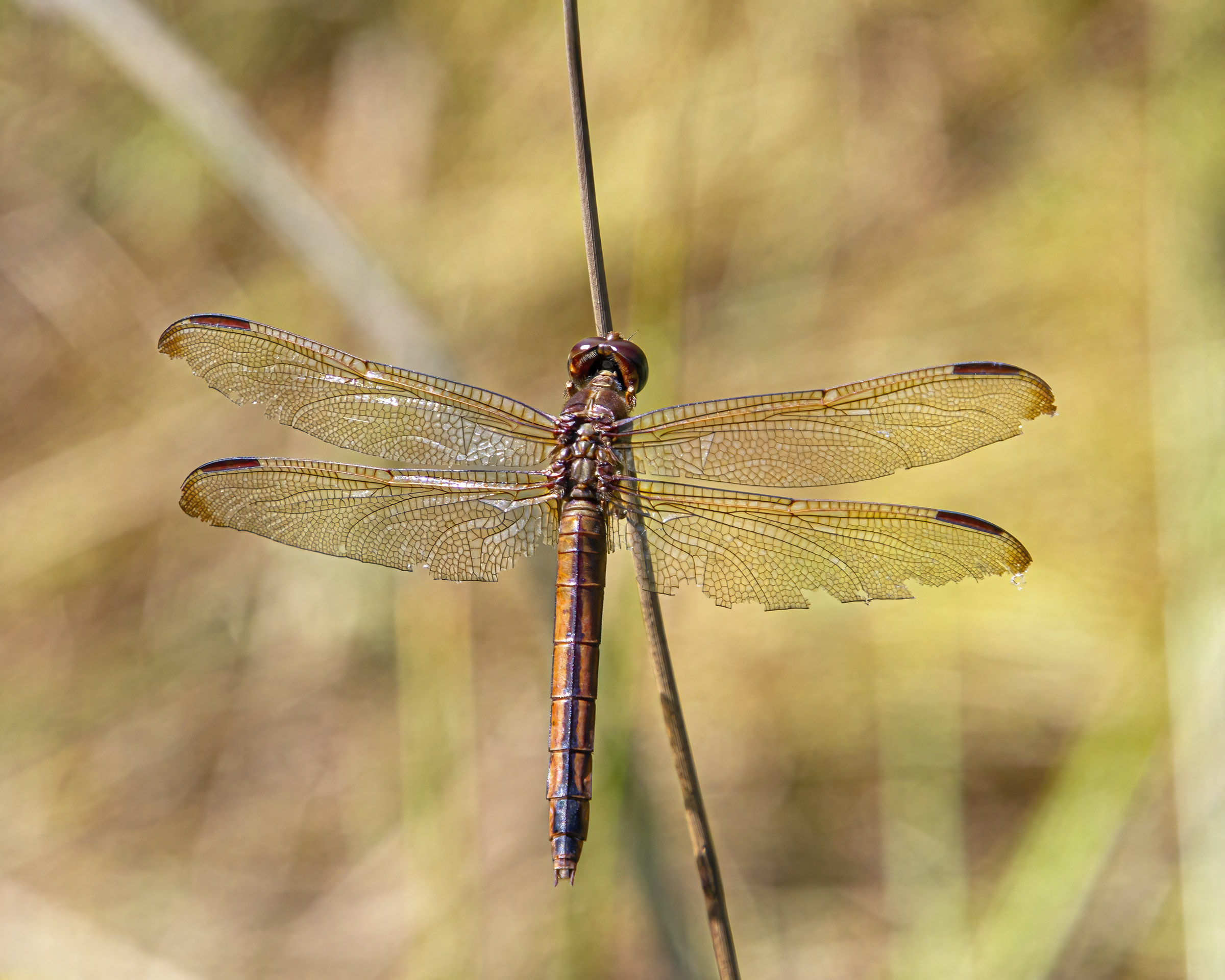
As we flip the pages of our monthly calendars from August to September, it is not unusual for me to encounter dragonflies with tattered wings. For many of these dragonflies, it has been a long, tough summer and they will only be with us for a few more weeks or perhaps a month or two. Despite the damage to their wings, the dragonflies appear to be fully capable of flight—somehow they are able to compensate for their infirmities.

I spotted this Great Blue Skimmer dragonfly (Libellula vibrans) this past Monday at Jackson Miles Abbott Wetland Refuge. It is a little tough to tell in this image, but several of the wings showed wear-and-tear. The shredded appearance of the vegetation is a perfect complement to this late season dragonfly—they both speak to me of the inexorable passage of time and the inevitable changes in our appearance and capabilities brought on the aging process.

Great Blue Skimmer

© Michael Q. Powell. All rights reserved.
Read Full Post »

When I first started taking nature photos more than ten years ago, I probably would have assumed that this yellow and black insect was a bee. With the benefit of accumulate experience, I can identify it as some kind of Hover Fly. Hover flies, also called flower flies or syrphid flies, are quite common—according to Wikipedia there are about 6000 species of hover flies worldwide, so I don’t feel bad that I cannot identify the species of this one.

I spotted the hover fly during a recent visit to Jackson Miles Abbott Wetland Refuge as it was feeding on a Black-eyed Susan flower (Rudbeckia hirta). Both the insect and the flower are made up of varying shades of yellow and brown and they seem to complement each other pretty well. I also like the way that the lines on the petals of the flower mirror the marking on the insect’s body.

hover fly

© Michael Q. Powell. All rights reserved.


Read Full Post »

Female Eastern Pondhawk dragonflies (Erythemis simplicicollis) are quite easy to spot when they are out in the open—they are bright emerald green in color and have distinctive black stripes on their abdomens. When they land in a grassy area, however, they virtually disappear from sight, thanks to their almost perfect camouflage.

During a recent visit to Jackson Miles Abbott Wetland Refuge, I spotted this Eastern Pondhawk while it was flying and watch it land on this fallen branch. If I had not seen the dragonfly land and it had remained still on its perch, I doubt that I would have detected its presence.

Eastern Pondhawk

© Michael Q. Powell. All rights reserved.

Read Full Post »

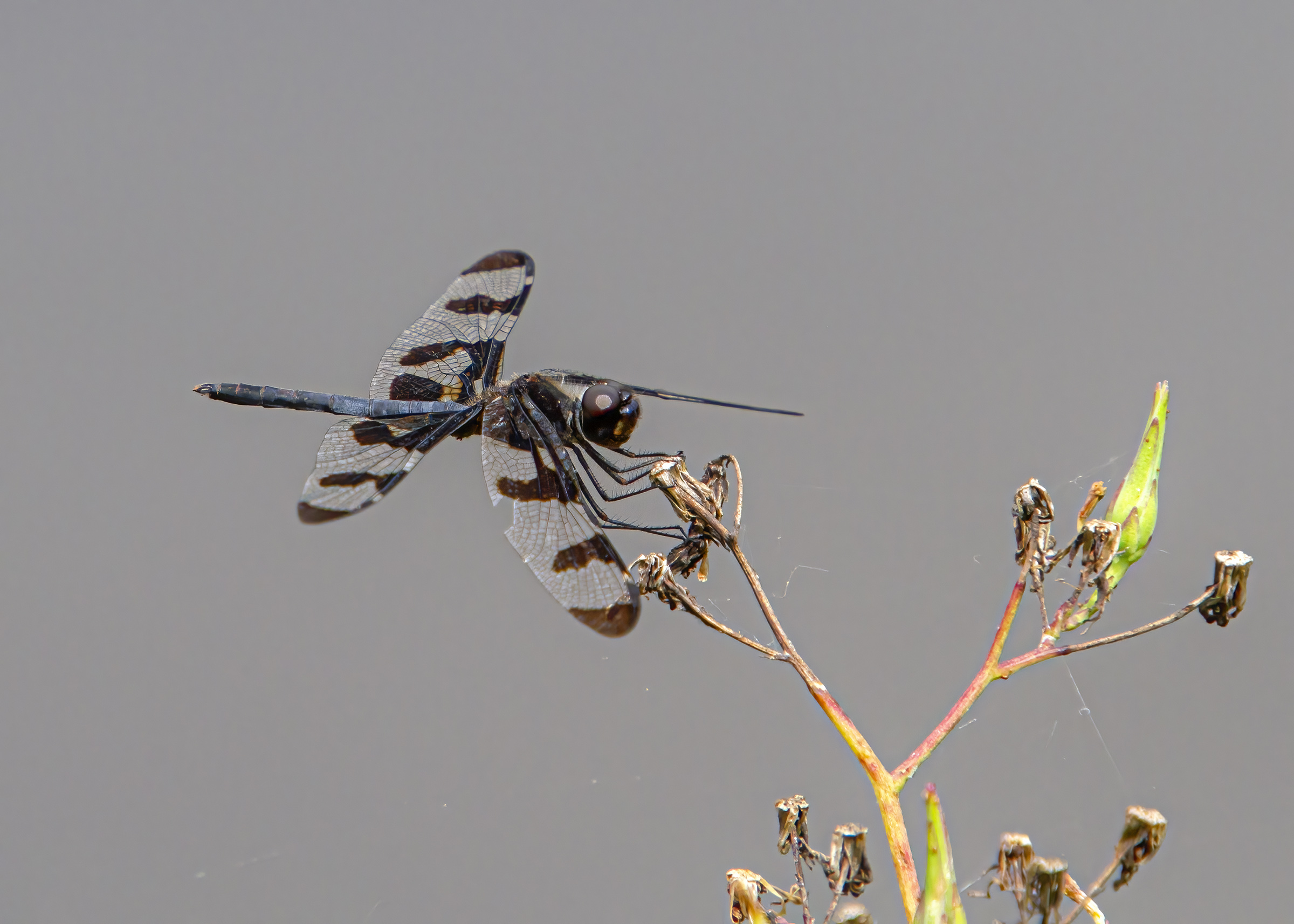
I was intrigued by the varying wing positions of this Banded Pennant dragonfly (Celithemis fasciata) that I spotted last week at Jackson Miles Abbott Wetland Refuge. There was a bit of a breeze and this little dragonfly was doing its best to hold on to the vegetation by adjusting its wings.

Although each wing can function independently from the others, it appeared that the dragonfly mostly moved them in pairs. I was particularly struck in the first photo by the way that the front wings of the Banded Pennant were tilted forward, while its back wings were held flat horizontally.

Banded Pennant

Banded Pennant

Banded Pennant

© Michael Q. Powell. All rights reserved.


Read Full Post »

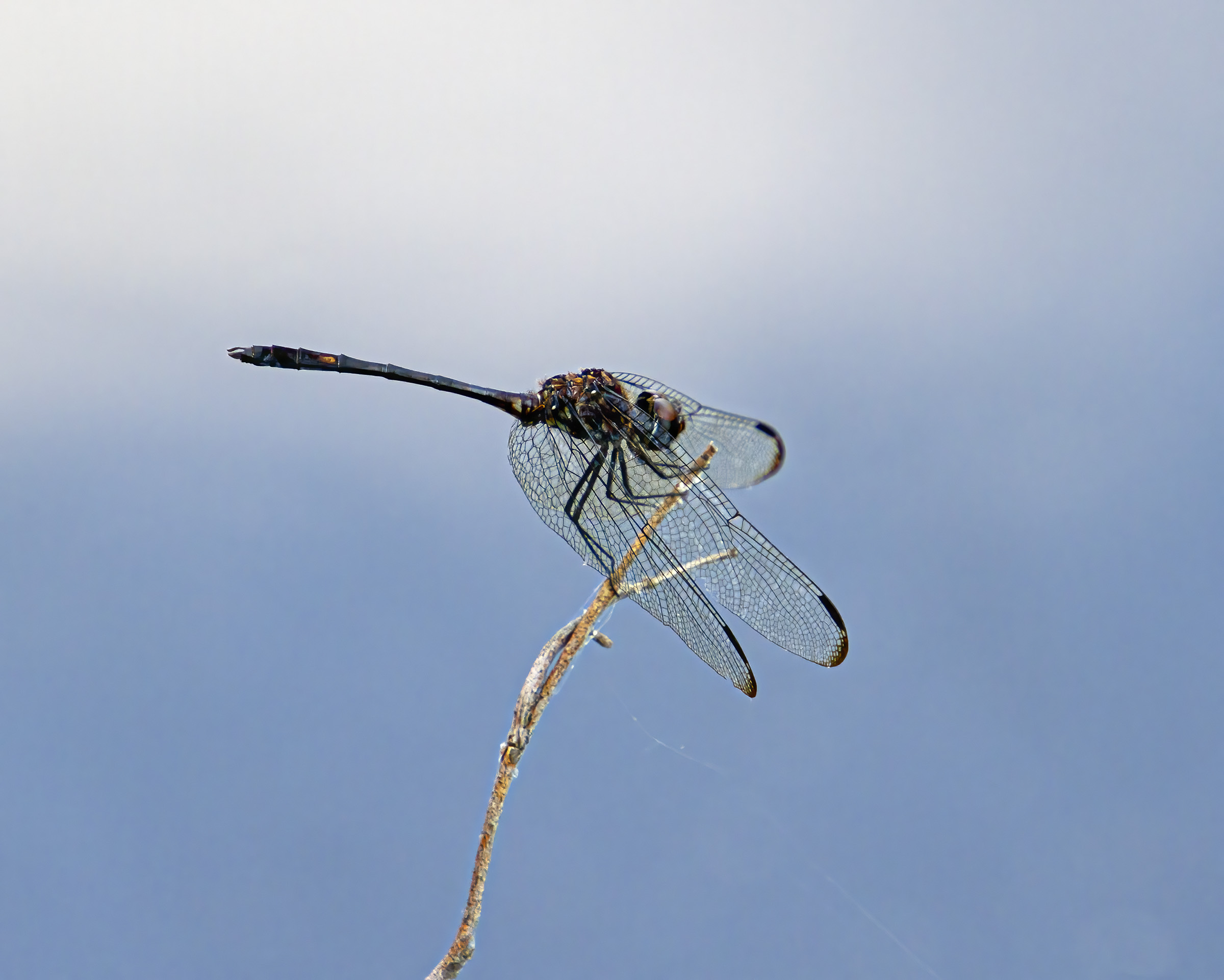
I was happy to see that at least a few Swift Setwing dragonflies (Dythemis velox) were still around this past Friday at Jackson Miles Abbott Wetland Refuge. We are gradually moving to a time of the summer when some dragonfly species decrease in numbers or disappear. Fortunately, a few fall species will appear soon to take their places.

Swift Setwing

© Michael Q. Powell. All rights reserved.

Read Full Post »

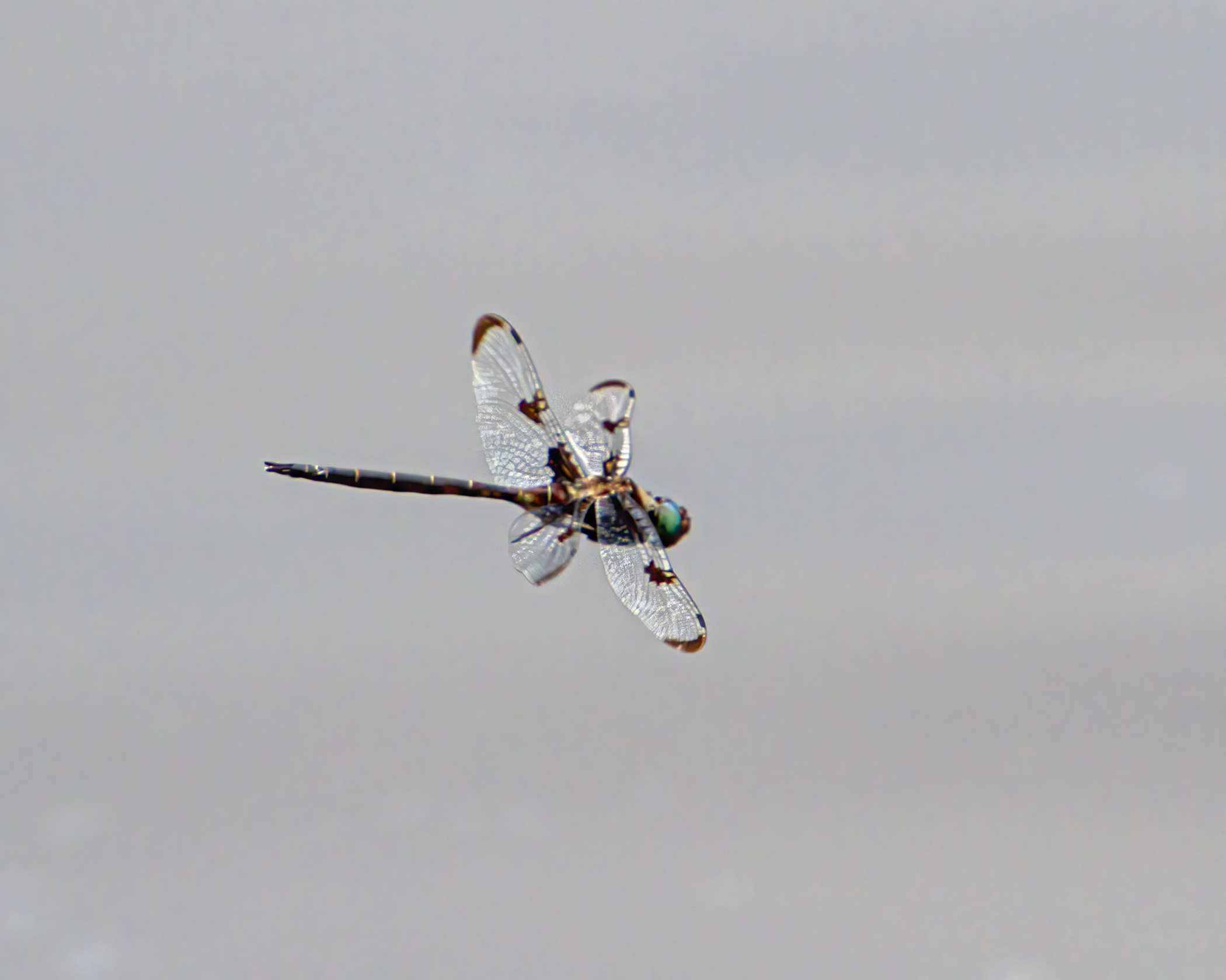
Yesterday I had the chance to test my skill and my patience as I tried to capture images of dragonflies in flight at Jackson Miles Abbott Wetland Refuge. I believe they are a Royal River Cruiser (Macromia taeniolata), a Prince Baskettail (Epitheca cynosura), and a Russet-tipped Clubtail (Stylurus plagiatus), members of three different families of dragonflies.

The Royal River Cruiser is the most uncommon of these three species—I have only seen one a few times and this is the first time that I have gotten a decent shot of one. Cruisers are large dragonflies with large eyes and long legs that generally fly up and down streams or rivers or along lake shores. I did not expect to see one at the small pond at this refuge, but there is an adjacent wetland and a small stream, so maybe the dragonfly made a detour in its patrol over those areas. This dragonfly followed the shore of the pond and flew fast in a single direction.

The Prince Baskettail is the most common of the three dragonflies and I have featured in-flight shots of this species multiple times. The Prince Baskettail appears to have a portion of the shoreline as its territory and it flies back and forth, giving me multiple opportunities to get a shot. This dragonfly has amazing stamina and rarely seems to rest—in ten years of observing dragonflies, I have seen a perched Prince Baskettail only a couple of times.

The Russet-tipped Clubtail is a dragonfly that appears in the late summer and I usually spot one when it is hanging from the vegetation. This one was the first sighting for me of the species this season. Although the dragonfly never came close to the shore, the distinctive color of its “tail” made it easy for me to identify it, even when it was flying.

In case any of you are curious, I captured all of these images with my Canon 7D DSLR and my Tamron 18-400mm zoom lens. Sometimes I focus manually when trying to photographing dragonflies in flight, but I believe I used my camera’s autofocus for these shots with a group of nine focus points in the center selected.

Royal River Cruiser

Prince Baskettail

Russet-tipped Clubtail

© Michael Q. Powell. All rights reserved.
 

Read Full Post »

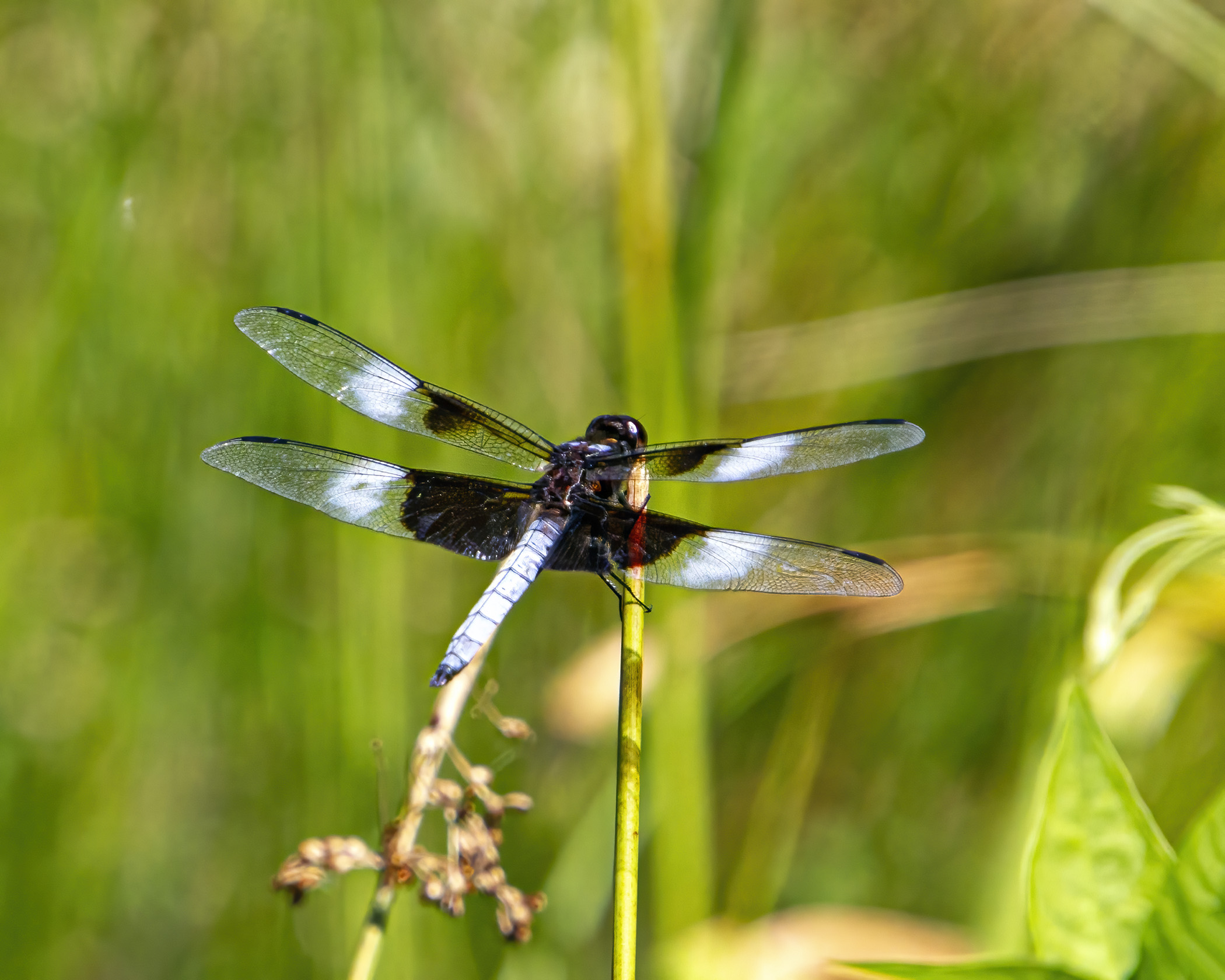
Here’s a shot of a handsome male Widow Skimmer dragonfly (Libellula luctuosa) that I spotted this past Monday at Jackson Miles Abbott Wetland Refuge. The Widow Skimmer is one of only a few dragonfly species that I have encountered that has both white and brown markings on its wings. (the male Twelve-spotted Skimmer dragonfly is the only other one that immediately comes to mind and you can see what one looks like in my 31 May 2021 posting entitled Twelve-spotted Skimmer.

Backgrounds are always tricky when photographing insects perched in highly vegetated areas. I think the stalks of vegetation are blurred enough in the first image that they do not draw attention away from the main subject. I think, in fact, the the green and tan lines add some visual interest to the image that would be lacking if the entire background were a solid color. The background in the second image is a bit busier, but you get a much better view of the dragonfly’s wing patterns—wildlife photography is often a matter of compromise in which “perfection” is often unachievable.

Widow Skimmer

Widow Skimmer

© Michael Q. Powell. All rights reserved.
 

Read Full Post »

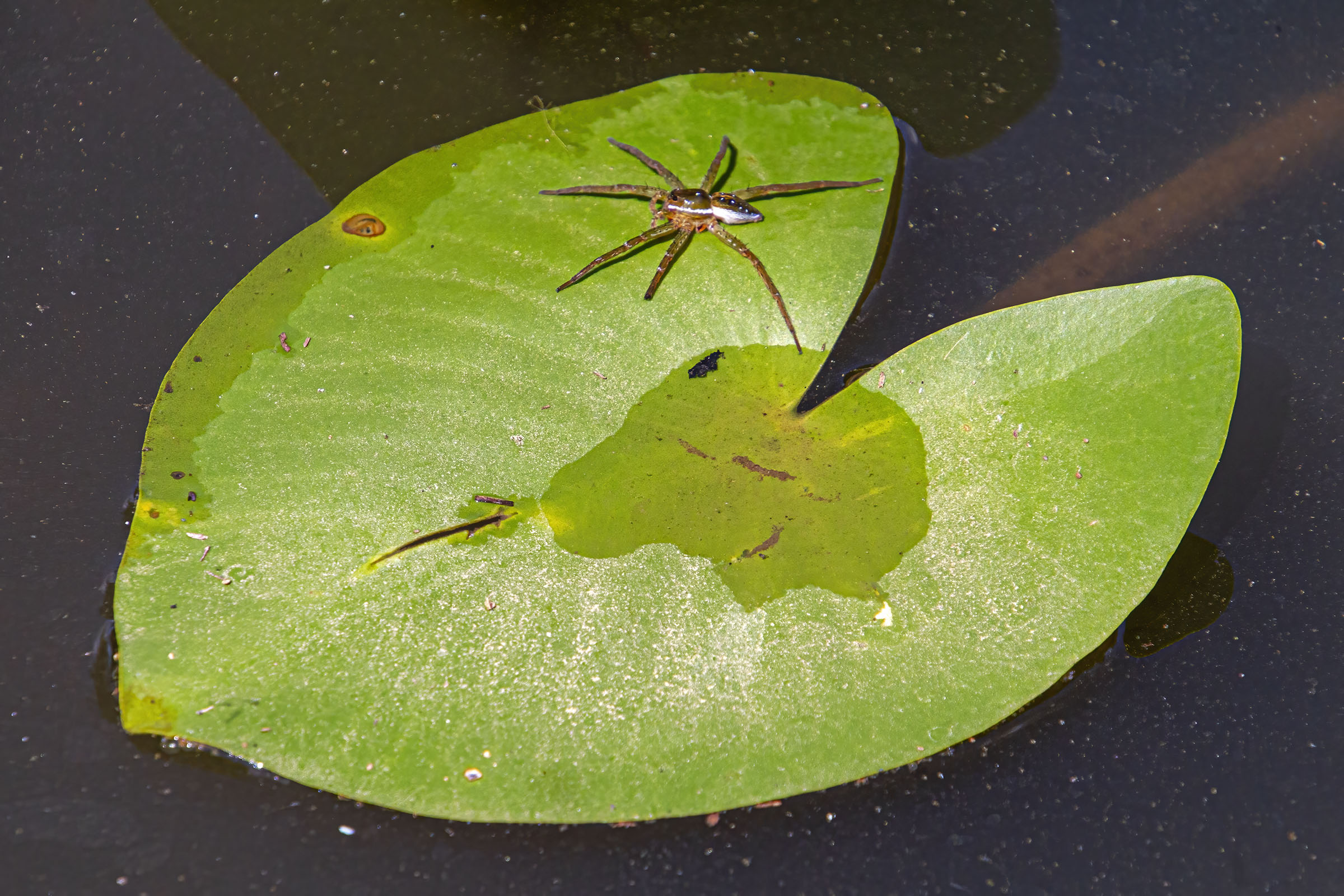
I usually scan the surfaces of lily pads whenever I see them, hoping to spot frogs perched on them. I did not see any frogs last week during a visit to Jackson Miles Abbott Wetland Refuge, but I did spot a cool-looking Six-spotted Fishing Spider (Dolomedes triton).

Normally I see these fishing spiders in shallow water at the edge of ponds with some of their legs on the surface of the water to sense the vibrations of potential prey. When they do, they capture the prey by walking across the water, prompting some people to refer to them as “Jesus spiders.”

Six-spotted Fishing Spider

© Michael Q. Powell. All rights reserved.
Read Full Post »

On Monday I spent several hours at Jackson Miles Abbott Wetland Refuge, focusing my attention primarily on trying to capture shots of Prince Baskettail dragonflies (Epitheca cynosura) in flight. There appeared to be several of them patrolling over the waters of the small pond and I managed to find some good vantage points that gave me unobstructed views of them as they passed by.

One of the locations where I spotted a Prince Baskettail included some lily pads and I decided to try to include them in the shots to give a sense of the environment. The downside of this approach, though, was that it made it even harder to keep my camera’s focus on the dragonfly—the camera kept trying to focus on the background. I was persistent, however, and managed to get a few good shots, as you can see in the first three images below.

I took the final image at a different spot where there were no lily pads. This shot is undoubtedly the sharpest one of today’s photos. Although you can’t see much of the environment in the image, the ripples in the water do add some visual interest.

I couldn’t help but notice that the dragonfly in the final photo had its legs in a lower position than normally—generally a Prince Baskettail flies with its legs held tightly against its thorax to present the most aerodynamic profile. I know that some dragonfly species catch prey on the fly with their legs extended like a basket and wonder if that was what this dragonfly was attempting to do.

Prince Baskettail

Prince Baskettail

Prince Baskettail

Prince Baskettail

© Michael Q. Powell. All rights reserved.


Read Full Post »

Eastern Amberwing (Perithemis tenera) dragonflies are the smallest dragonflies in my area at less than an inch (25 mm) in length, but are quite common. I often spot the distinctive amber wings of the males as they fly low over the waters of many ponds. Females of this species, however, do not have amber wings—they have brown patches on their wings—and I rarely see them.

According to the Dragonflies of Northern Virginia website, female Eastern Amberwings are often found far from water, in meadows among summer wildflowers. “They’re probably hunting even smaller visitors to these summer blooms like midges, flower flies and tiny bees. They also share their colorful perches with hornets and other wasps. Perhaps, this is how their mimicry behavior evolved, and may explain why females appear to practice it more than males.”

On Monday I was thrilled to spot this female while I was exploring a pond at Jackson Miles Abbott Wetland Refuge. I am not sure if she had ventured down to the pond to mate, but whatever the case I was happy to capture some shots of her as she buzzed about the vegetation surrounding the pond. I love her two-toned eyes and the beautiful markings on her body.

Eastern Amberwing

Eastern Amberwing

Eastern Amberwing

© Michael Q. Powell. All rights reserved.

Read Full Post »

When the weather is nice, many turtles emerge from the waters of the ponds to bask in the sunlight. Often I will see turtles jammed so close together on logs that it looks like a mall parking lot just before Christmas.

During a recent visit to Jackson Miles Abbott Wetland Refuge, I spotted an Eastern Painted Turtle (Chrysemys picta picta) that had found a solitary perch that was just big enough for a single turtle. The only problem was that the tree was sticking out from the water at a sharp angle. I could not tell, but suspect that the turtle had dug the claws in its front feet into the bark to keep from sliding into the water.

I love the serene look on the face of this turtle—it seemed to be in a meditative state, a picture of peaceful contentment.

Painted Turtle

© Michael Q. Powell. All rights reserved.

Read Full Post »

July is finally coming to an end, a month of endless hot, hazy, and humid days. It has been tough to get myself motivated to go out with my camera and I have been forced to keep my outings relatively short. Weather-wise autumn is my favorite time of the year, but we have a lot more summer weather to endure before the cooling temperatures of autumn arrive.

During a recent visit to Jackson Miles Abbott Wetland Refuge I was delighted to spot this Pearl Crescent butterfly (Phyciodes tharos). It was feeding in a patch of what looked to be Black-eyed Susan flowers (Rudbeckia hirta), although I must confess that I am not very good at identifying flowers, so my identification may not be accurate.

Initially the little butterfly perched with its wings only partially open, but I waited patiently and eventually it fully extended its wings and I was able to capture this image. It is a relatively simple composition, but I really like the way that it gives you a sense of the environment while also showing you the beautiful markings of the Pearl Crescent butterfly.

pearl crescent

© Michael Q. Powell. All rights reserved.


Read Full Post »

I was excited to spot several Swift Setwing dragonflies (Dythemis velox) last Saturday along the edges of the pond at Jackson Miles Abbott Wetland Refuge. This species gets its name from the way that the way the Swift Setwings perch with their wings forward and abdomens up, like the “ready, set, go” position of a runner at a track meet.

The Swift Setwing is primarily a southern species that may never before have been spotted in Fairfax County, Virginia, the county where I live, until June 2016, when I spotted one at the same wetland refuge. (See my 25 June 2016 blog posting for details on my first sighting of the species.) Every year since then, I have excitedly looked forward to seeing these little dragonflies—it is pretty clear by now that there is an established breeding population at this pond. This is the only location where I have seen Swift Setwings, though I heard from a friend that they may have also been found at another local spot.

I am driving up to Massachusetts and Maine on Tuesday to handle some family issues and suspect that I will not be posting a blog until my return late on Saturday. After then I hope to return to my normal schedule of doing a blog posting almost every day.

Swift Setwing

Swift Setwing

Swift Setwing

© Michael Q. Powell. All rights reserved.


Read Full Post »

During the summer, most of my dragonfly photos tend to be variations of the stereotypical “dragonfly on a stick.” I am always on the lookout, though, for more interesting or photogenic perching places and behaviors.

The first shot shows a male Eastern Amberwing dragonfly (Perithemis tenera) perched on the end of a piece of rebar that sticks out of the water near a small fishing dock at Jackson Miles Abbott Wetland Refuge. Generally I try to avoid having manmade objects in my nature photos, but in this case I really like the juxtaposition of the natural and manmade elements in this shot. The warm tones of the amber wings contrast nicely with the cooler rust color of the rebar and the lines on the rebar are mirrored by those on the dragonfly’s body. Almost every year I return to this spot to capture a similar image, though each encounter is unique in its own way.

The second image shows another male Eastern Amberwing perched on a large rock jutting out from the water. I couldn’t get close to the dragonfly so I took the opposite approach and zoomed out to capture the dragonfly’s reflection (as well as the amber shadow it was casting on the rock). I really like the contrast between the diminutive size of the dragonfly and the large jagged rock—it seems almost like a visual metaphor for life’s challenges.

These two shots are examples of how I try, when possible, to visualize a shot before I take it. Frequently, though, I am forced to react instantaneously to a given situation, with a primary goal of keeping my subject within the frame and hopefully in focus. It’s a weird mental juggling act to simultaneously attempt to think creatively, instinctively, instinctively, and analytically—that’s wildlife photography in a nutshell.

Eastern Amberwing

Eastern Amberwing

© Michael Q. Powell. All rights reserved.


Read Full Post »

It seems like large butterflies have been more scarce than normal this summer. I was therefore thrilled to spot this Great Spangled Fritillary butterfly (Speyeria cybele) yesterday during a brief visit to Jackson Miles Abbott Wetland Refuge. Most of the time the butterfly had its head buried in the flower, but for a brief moment the butterfly raised its head, spread its wings, and let me capture this pretty little portrait image.

Great Spangled Fritillary

© Michael Q. Powell. All rights reserved.


Read Full Post »

« Newer Posts - Older Posts »