Feeds:
Posts
Comments

Posts Tagged ‘Huntley Meadows Park’

This colorful male Wood Duck (Aix sponsa) was standing tall yesterday as he kept watch over a nesting box at Huntley Meadows Park. I kept watch for a while myself, hoping to photograph a female entering or exiting the box, but came up empty-handed.

It’s breeding time and all of the animals and birds seem to be looking for mates and preparing for the arrival of babies. At least some of the Hooded Mergansers and Wood Ducks use the nesting boxes at various locations throughout the park. Tree Swallows also use nesting boxes, although those boxes are much smaller than the ones used by the ducks.

I don’t know if this male Wood Duck is guarding eggs that have already been laid in the box or is merely helping to reserve the box for use by his partner. In the past I have spent extended periods of time waiting for the arrival and departure of female ducks at nesting boxes. I find it amazing that the females are able to arrest their forward momentum and enter the box through a hole that is a tight fit.

Wood Duck

© Michael Q. Powell. All rights reserved.

Read Full Post »

I was a little surprised when an unusually shaped mound of dirt slowly began to move in the shallow waters of a muddy pond at Huntley Meadows Park. When it raised its massive head, I realized it was an Eastern Snapping Turtle (Chelydra serpentina serpentina) newly arisen from the bottom of the pond.

The extra weight of the mud on its back didn’t seem to affect the turtle’s swimming ability—it must be nice to be so big and strong.

Snapping Turtle

© Michael Q. Powell. All rights reserved.

Read Full Post »

I usually think of seeing toads on dry land, but when it’s breeding time, they head to shallow pools of water. These Eastern American Toads (Anaxyrus americanus americanus) were swimming around this past Friday at Huntley Meadows Park in Northern Virginia.

Some of the toads were graceful swimmers, effortlessly skimming across the water. Others, however, seemed to have problems coordinating the actions of their limbs and floundered and splashed around a lot. The toads seemed to use a variety of strokes, though almost all of them used a variant of the frog kick with their rear legs.

How did the frogs get the naming rights for the kick? It could just as easily have been the “toad kick.” Perhaps marketing is a bit more difficult when you have as many warts as the average toad.

Eastern American Toad

Eastern American Toad

Eastern American Toad

Eastern American Toad

© Michael Q. Powell. All rights reserved.

Read Full Post »

The marsh at Huntley Meadows Park is alive with the sound of frogs and toads—it’s the start of the breeding season.

Yesterday, I captured this shot of an Eastern American Toad (Anaxyrus americanus americanus) as he was calling out to females. It’s amazing how long the toad is able to hold that long, high-pitched trill, as much as 20 to 30 seconds according to the Virginia Herpetological Society.

His expanded pouch (officially called a dewlap) reminds me of my childhood days, when I would attempt to blow large bubbles with the ever present bright pink bubble gum. One of my favorite gums was called Bazooka and the individually wrapped pieces of gum included a comic strip starring Bazooka Joe. (For more information about Bazooka, check out this Wikipedia article.)

I’ve decided I want to call this little guy Bazooka Joe and my unofficial name for the Eastern American Toad is the Bubble Gum Toad. As a side note, fellow photographer and blogger Walter Sanford has given nicknames to several of my lenses and he calls my Tamron 150-600mm lens Bazooka Joe. This, of course, is more a reference to the anti-tank rocket launcher than to the bubble gum—the size and length of the lens brings to mind a bazooka. (If you are not familiar with this weapon, check out this Wikipedia article.)

In case you are curious, I captured this image of Bazooka Joe with Bazooka Joe.

Eastern American Toad

© Michael Q. Powell. All rights reserved.

Read Full Post »

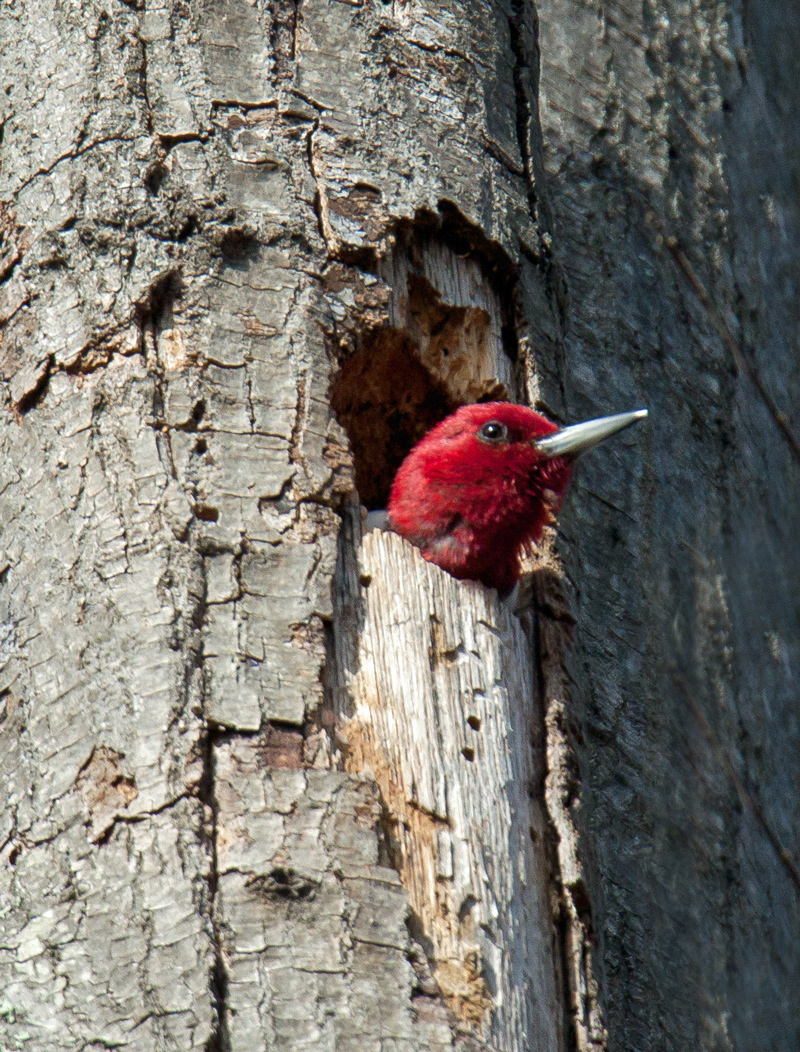
Woodpeckers are amazingly energetic, but I guess they too sometimes need to take a break. On Monday I saw a Red-headed Woodpecker (Melanerpes erythrocephalus) hard at work on a cavity at Huntley Meadows Park. Eventually the woodpecker climbed inside the cavity and, after looking around a bit, appeared to close its eyes to take a little nap.

Red-headed Woodpecker

Red-headed Woodpecker

Red-headed Woodpecker

© Michael Q. Powell. All rights reserved.

Read Full Post »

With our recent warm weather, turtles have risen from the mud at Huntley Meadows Park.  Sunning turtles are now vying for space on logs that are more crowded than a mall parking lot on Black Friday.

On Monday, a Spotted Turtle (Clemys guttata) tried a different approach. He slowly clawed his way up out of the water onto some vegetation amid the cattails and assumed an almost vertical perch.

Who needs a log?

Spotted Turtle

© Michael Q. Powell. All rights reserved.

Read Full Post »

I love the serene beauty of the early morning. The light is soft, often tinged with pastel shades of pink and orange, and colors are especially saturated. The water is frequently still and mirror-like, providing for the possibility of perfect reflections.

On Monday I spotted this male Northern Shoveler (Anas clypeata) as he slowly made his way across one of the ponds at Huntley Meadows Park. The special characteristics of the post-dawn period made this striking bird even more spectacular than normal.

This photo is a visual response to those who occasionally ask me why I enjoy getting up so early in the morning—words are not necessary.

Northern Shoveler

© Michael Q. Powell. All rights reserved.

Read Full Post »

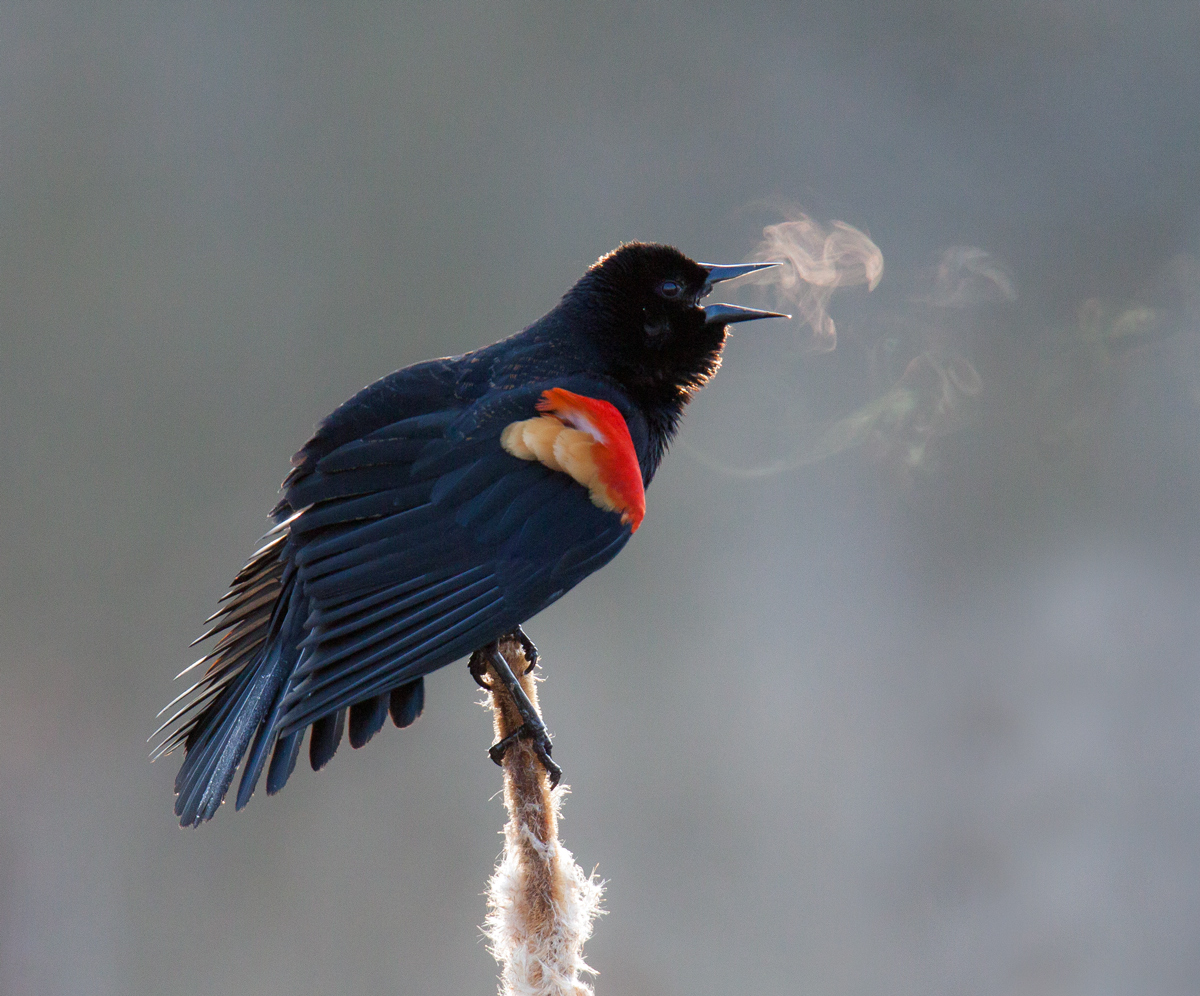
It was so cold yesterday morning at Huntley Meadows Park that the breath of a Red-winged Blackbird (Agelaius phoeniceus) was visible as he sang out from atop a cattail.

Spring is definitely in the air and potentially record high temperatures are forecast for later in the week. However, it was right about at the freezing level when I arrived at the local marshland park where I spent so much of my free time wandering with my camera in hand.

I’ve photographed Red-winged Blackbirds lots of times, but I rarely pass up an opportunity to shoot them again—I just never know when I may capture an unusual moment. The sun had risen and light was starting to reach the cattails. I turned toward the light when I heard a blackbird call out.

As I zoomed in on the bird, I was amazed to see that the blackbird’s breath was visible as he forcibly exhaled when singing. In the still morning air the visible breath swirled about and the bird looked like a smoker getting his early morning nicotine fix.

I was fascinated by the differing patterns of the condensation as the blackbird moved his head or body position and was thrilled to be able to capture several different views of the blackbird’s visible song.

As I went to bed last night, I noticed that the counter for my blog was right at a hundred thousand views. Thanks to so many of you for helping me to reach this milestone and for encouraging me and supporting me as I journey on into photography.

Red-winged Blackbird

Red-winged Blackbird

Red-winged Blackbird

© Michael Q. Powell. All rights reserved.
 

Read Full Post »

Recently I posted a photo of a Bald Eagle (Haliaeetus leucocephalus) arriving at a perch with talons extended. Here’s what the same eagle looked like when it eventually left the perch. I love sense of power that the eagle is able to convey when it extends its mighty wings. (The second photo, taken a split-second before the first one, shows the eagle as it was preparing to take off,)

Note that the eagle has a band around his left leg. I wonder how many of the eagles I see at Huntley Meadows Park are banded. I can recall only one other time when I could see a band, but must admit that most of my eagle shots do not have enough detail to be able to tell if a band is present.

Bald Eagle

eagle2_5Mar_blog

© Michael Q. Powell. All rights reserved.

Read Full Post »

A Bald Eagle (Haliaeetus leucocephalus) was preparing to land in a tree yesterday morning at Huntley Meadows Park and had its talons fully extended. With perfect form, the eagle was able to stick and hold the landing.

The judges all gave the eagle a perfect score of 10 for the routine.

Bald Eagle

© Michael Q. Powell. All rights reserved.

Read Full Post »

Yesterday morning I had a portrait session with a male Northern Cardinal (Cardinalis cardinalis) who wanted to update his presence on social media. Nowadays, he said, it takes more to attract a mate than merely putting on displays and singing loudly and he wanted to set himself apart from his rivals.

We tried a number of different poses in an effort to give him an artsy, mysterious look that would simultaneously suggest vulnerability and passion. We even tried a full-body portrait, because he knows that some of the lady cardinals are interested in more than just his handsome face.

Northern Cardinal

Northern Cardinal

Northern Cardinal

Northern Cardinal

© Michael Q. Powell. All rights reserved.


Read Full Post »

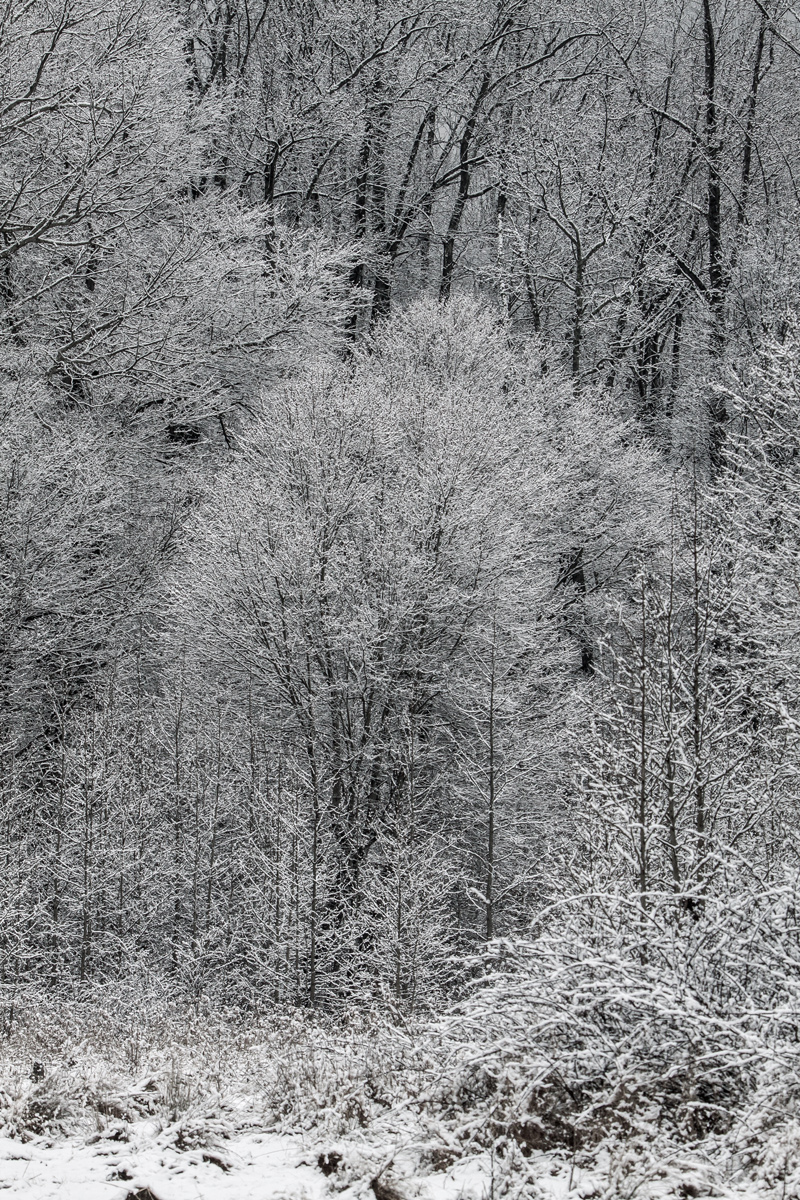
Coated in a layer of snow, the landscape yesterday morning at Huntley Meadows Park was devoid of color, transformed into a study of black and white.

snowscape

Partially hidden behind a branch, this Bald Eagle (Haliaeetus leucocephalus) was almost invisible in a distant snow-covered tree.

Bald Eagle

This was almost a perfect snowfall—the accumulation of an inch or two (2-5 cm) was just enough to create a beautiful snowscape without inhibiting travel on the roads.

© Michael Q. Powell. All rights reserved.

Read Full Post »

My heartbeat definitely accelerates when a Bald Eagle (Haliaeetus leucocephalus) flaps its wings and heads straight in my direction, as one did again this past Monday morning. I don’t know why the eagle chose to fly toward me, since I am pretty sure that it was aware of my presence and could have flown away. Perhaps the eagle was simply curious and wanted to check me out.

Eventually the eagle did pull up and fly past me, without getting as close as it might seem from the images. Some readers have asked me if I was near an eagle nest when I posted similar photos in the past. I have seen eagles multiple times in the same general location and suspect there might be a nest nearby, but so far have not located one.

Bald Eagle

Bald Eagle

Bald Eagle

© Michael Q. Powell. All rights reserved.


Read Full Post »

Do dabbling ducks double date? It sure looked like that was the case earlier this week when I spotted a Mallard (Anas platyrhynchos) couple and a Hooded Merganser (Lophodytes cucullatus) couple swimming away from a larger group of mostly mallards for a few quiet moments together. I grew up in a family with eight siblings, so I can really understand their pursuit of peace and privacy. 

It’s almost springtime and many of the birds are searching for mates. Usually it’s the males that put on elaborate displayes, but I think the female “Hoodie” here was the one that went all out to impress her date with an elaborate hairstyle.

duck dating

© Michael Q. Powell. All rights reserved.
Read Full Post »

For a few magical moments Monday morning the sun was shining through the trees at Huntley Meadows Park with a gorgeous golden light. At first I was a little disappointed that there were no birds or animals for me to photograph, but gradually I was drawn deeper and deeper into the simple abstract beauty of the trees themselves.

The varied colors, shapes, and textures of this intimate landscape enveloped me and filled me with a kind of reverent awe and inner sense of peace. I would have liked to freeze that moment and experience it in slow motion, but all too quickly the golden light faded and reality returned.

golden1_29Feb_blog

© Michael Q. Powell. All rights reserved.

Read Full Post »

There were a lot of Canada Geese (Branta canadensis) coming and going at Huntley Meadows Park early yesterday morning. This one was descending rapidly and coming in so fast that it looked like the goose was going to land right on me.

Canada Goose

© Michael Q. Powell. All rights reserved.

Read Full Post »

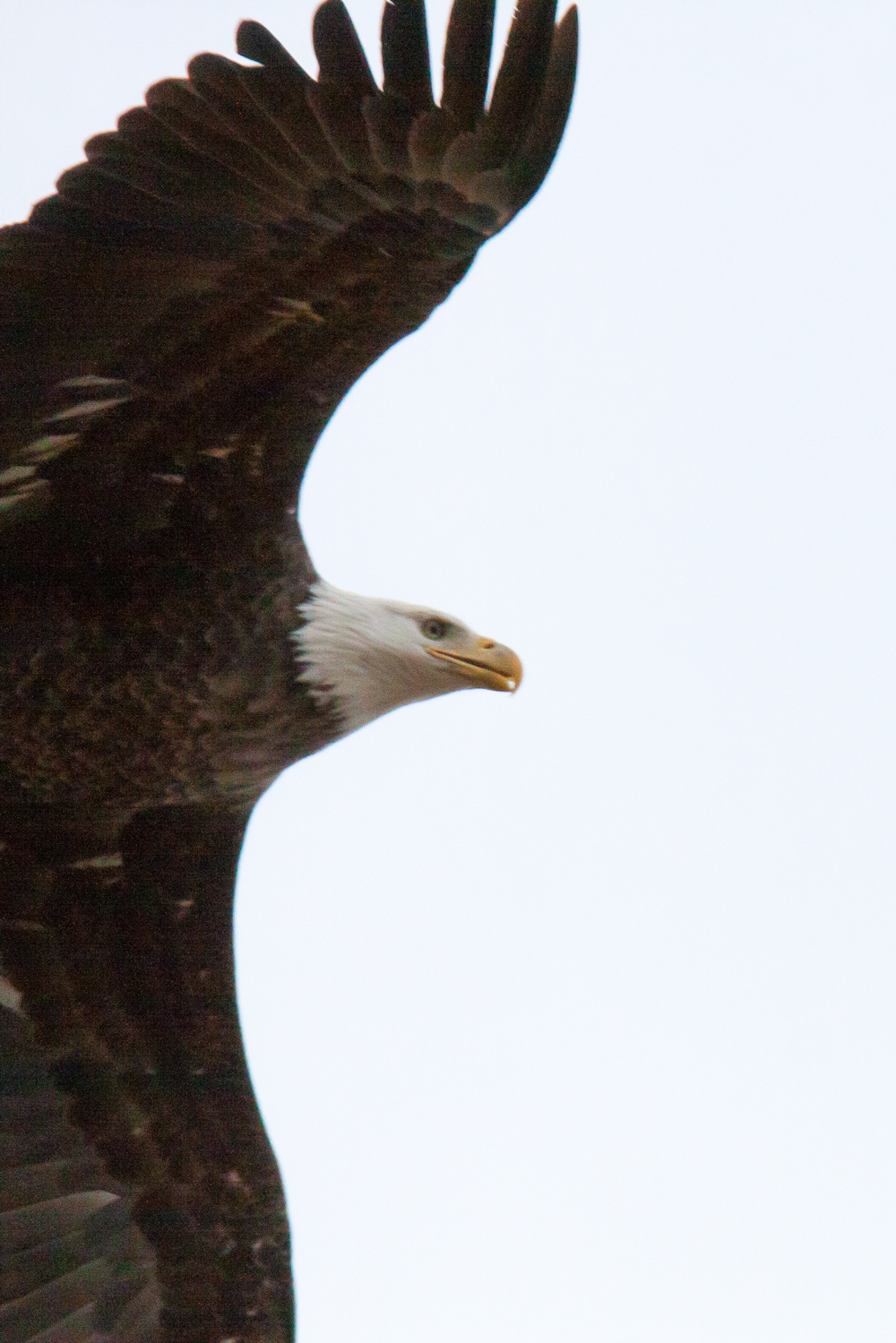
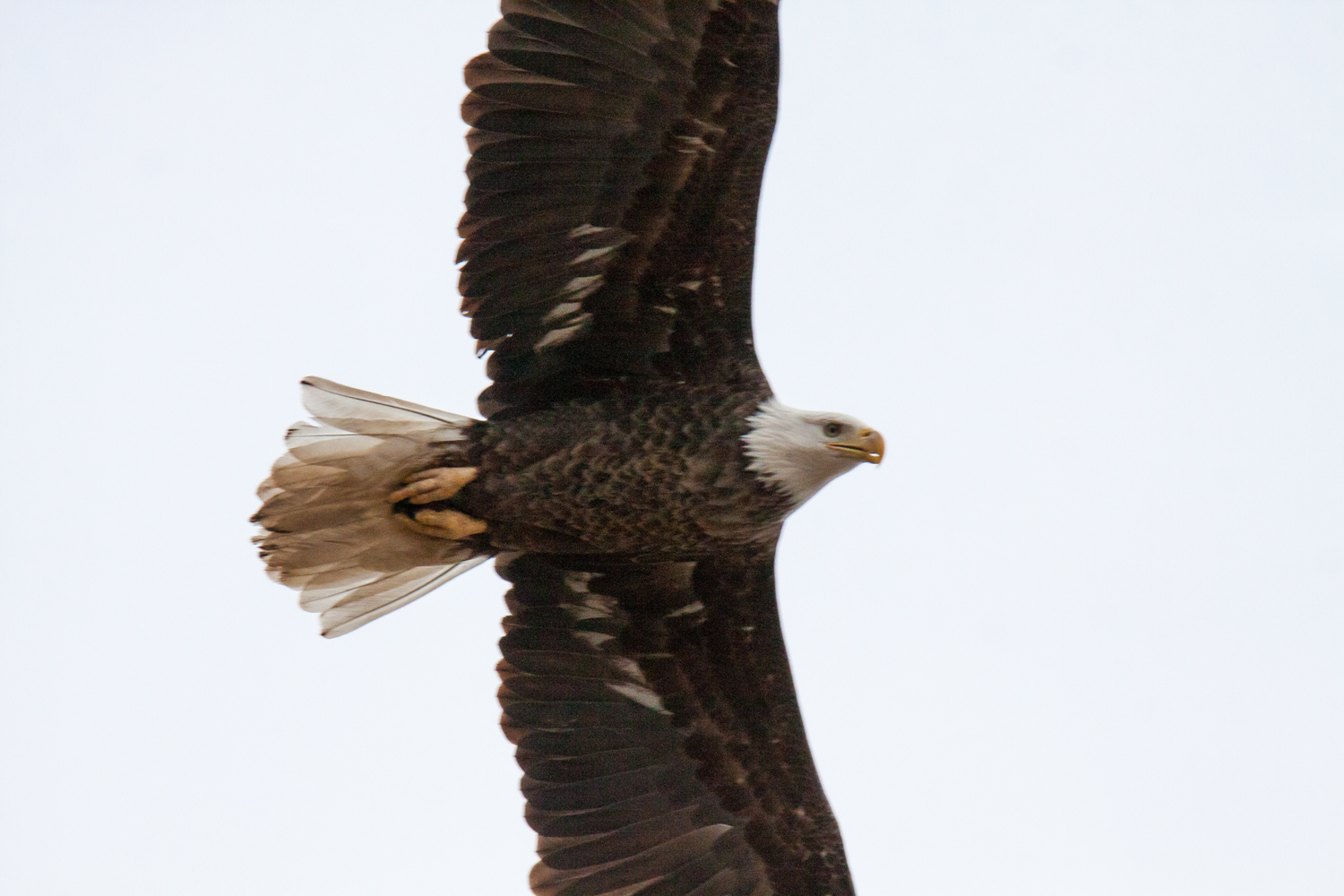
I didn’t see where this Bald Eagle (Haliaeetus leucocephalus) came from early yesterday morning at Huntley Meadows Park, but suddenly it was overhead at a relatively low altitude. I zoomed back a bit on my telephoto lens, but the eagle still more than filled the frame. At that close range, tracking was difficult and I had trouble keeping the eagle in the viewfinder (I think adrenaline might have been a factor too).

Incredibly, the first shot is an uncropped image. It was shot handheld at 483mm on my crop sensor Canon 50D camera with my trusty Tamron 150-600mm lens. The lighting was not that great, so I was shooting at ISO 1600, which resulted in a somewhat grainy image.

The second shot is one in which I got a bit ahead of the eagle in tracking it and chopped off its body. I liked the eagle’s expression so I cropped off the wide expanse of white sky to the right, turning the image from landscape mode to portrait mode, but otherwise left the framing untouched.

If someone had told me before yesterday that I could fill the frame of an image with a bald eagle in flight, I almost certainly would have laughed at them. Reality continues to amaze me.


Bald Eagle

Bald Eagle

© Michael Q. Powell. All rights reserved.

Read Full Post »

Recently, while exploring the streams in the remote back areas of Huntley Meadows Park, I have heard the unmistakable call of a Belted Kingfisher (Megaceryle alcyon) several times. Yesterday, on a warm spring-like day, I finally got a clear view of this beautiful female.

As I have mentioned before in some earlier postings, Belted Kingfishers are unusual in the bird world—the females are more colorful than the males. Females have a blue and a chestnut band across their white breasts and the males have only a blue band.

Belted Kingfisher

© Michael Q. Powell. All rights reserved.

Read Full Post »

As I was walking through the woods on Friday at Huntley Meadows Park, I noticed something white among the leaves on the ground. At first I thought it was just a mushroom, but upon closer examination it turned out to be the upper portion of the skull of what I am pretty sure is a raccoon (Procyon lotor). There were no other bones in the area, nor was the lower jaw anywhere to be seen.

I don’t know much about animal anatomy, but I was fascinated by the shapes and contours of the skull, a kind of natural and organic sculpture. It was intriguing as well to examine the sizes and shapes of all of the different teeth.

Raccoon skull

Raccoon skull

raccoon skull

© Michael Q. Powell. All rights reserved.

Read Full Post »

As I was wandering about Huntley Meadows Park this morning, I came upon the remains of an Eastern Snapping Turtle (Chelydra serpentina) that quite obviously did not survive the winter. It looks to have been in place for quite some time not far from the water’s edge of a stream in a remote area of the park.

I don’t know if a predator consumed its flesh, but it looks like a lot of the bones were scattered around the skull of the turtle, as you can see in the first photo. I move the shell to nearby location to get shots of the the top and underside and also took a close-up shot of the skull.

Snapping Turtle

Snapping Turtle remains in situ

Snapping Turtle

Detailed view of the top of the shell

Snapping Turtle

Detailed view of the underside of the shell

Snapping Turtle

Detailed view of the skull

© Michael Q. Powell. All rights reserved.

Read Full Post »

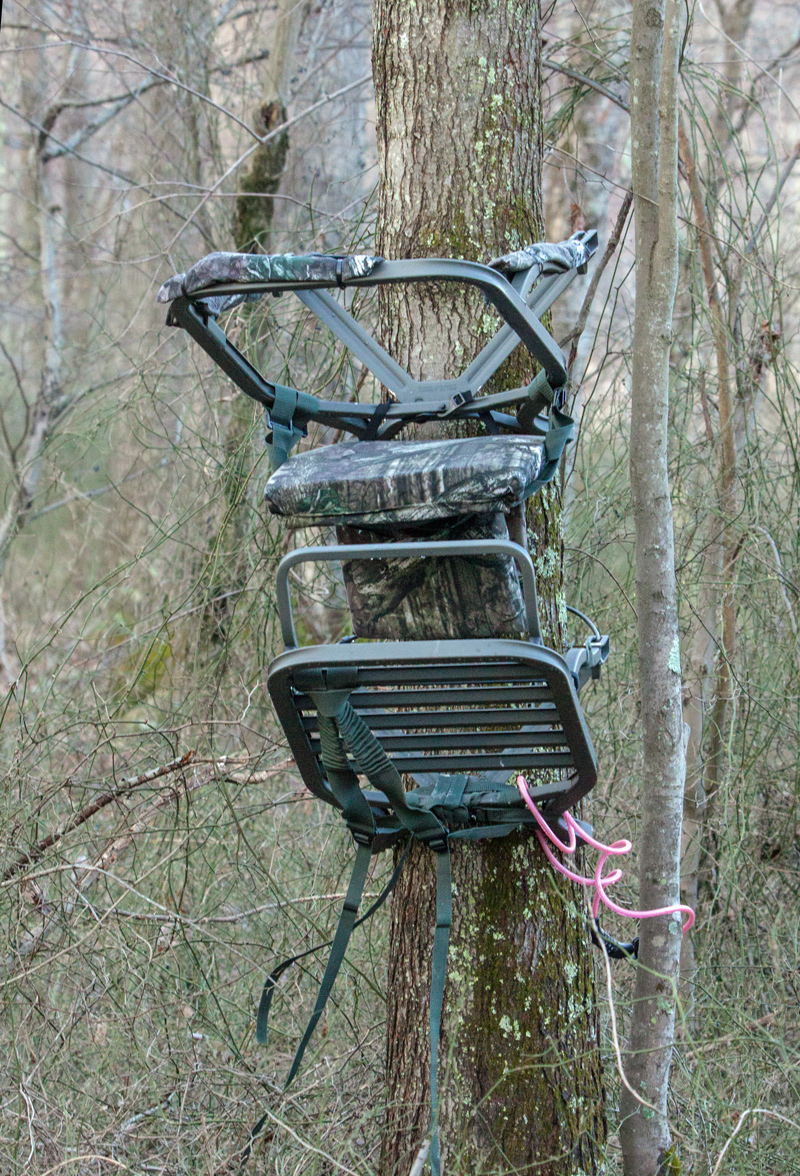
Last Saturday, the final day of the 5+ month deer hunting season at Huntley Meadows Park, I was startled to see the unmistakable shape of deer antlers on the ground a short distance away from where I was standing. As I moved closer, I saw that it was only some kind of decoy used by the hunters.

deer decoy

Looking up, I realized I was at the base of an unoccupied tree stand. I felt a little safer knowing that there were no archers in the stand at that moment.

tree stand

I understand the problems caused in our area by an overpopulation of White-tailed Deer and the reason for the extended hunting season. Still, I am somewhat amused by the lengths to which the county goes to avoid using words like “hunting” or “killing.” Instead, they refer to the “archery program” and “deer management.” Deer management? I have visions of a deer CEO.

deer3_20Feb_blog

On Monday the 22nd, I returned to the park and was surprised to see that least some of the tree stands were still present. I am sure that someone will eventually come to retrieve the stands, but I am going remain alert, just in case one of the stands happens to be occupied despite the stated end of the deer hunting season.

deer stand

© Michael Q. Powell. All rights reserved.

Read Full Post »

Some days it seems like the birds are conspiring against me. They are so skittish that they fly away long before I am within range or they hide behind a wall of branches, where I can hear them but cannot see them clearly.

In moments like that, a male Red-winged Blackbird (Agelaius phoeniceus) often comes to rescue me from my despair. These birds are so bold and defiant that they refuse to hide. Instead, they find the most prominent perch and sing out as loudly as possible, showing off for rivals and potential mates.

This past Monday was one of those days when I was having trouble finding subjects to photograph. Suddenly a blackbird appeared and flew to the highest branch of a nearby small tree. Undeterred by my presence, he looked in my direction and seemed to smile. After a moment, he burst forth in singing while continuing to look at me, as though he were saying, “This one’s for you.”

Red-winged Blackbird

bb2_22feb_blog

© Michael Q. Powell. All rights reserved.
Read Full Post »

We visit our local parks and wildlife refuges for a short while and return home, forgetting sometimes that many of the creatures we observed live and die within the confines of these small (or not so small) areas. As I wander through Huntley Meadows Park, I see signs of this entire circle of life. Lives have ended and, as we move into spring, new lives are beginning.

Whenever I come across skeletal remains, a clump of feathers, or other evidence of the death of a bird or an animal, I cannot help but wonder how the creature met its demise. Was it a predator, old age, sickness, or starvation? Life can be harsh in the wild, especially in the winter.

As far as I can tell, the animal in the first photo is a raccoon (Procyon lotor). Several months ago a fellow photographer mentioned that he had seen the dead body of a raccoon inside a hollow in the trunk of a fallen tree. I thought that predators would have dismembered the body by now, but instead it seems to be slowly decomposing in its sheltered position.

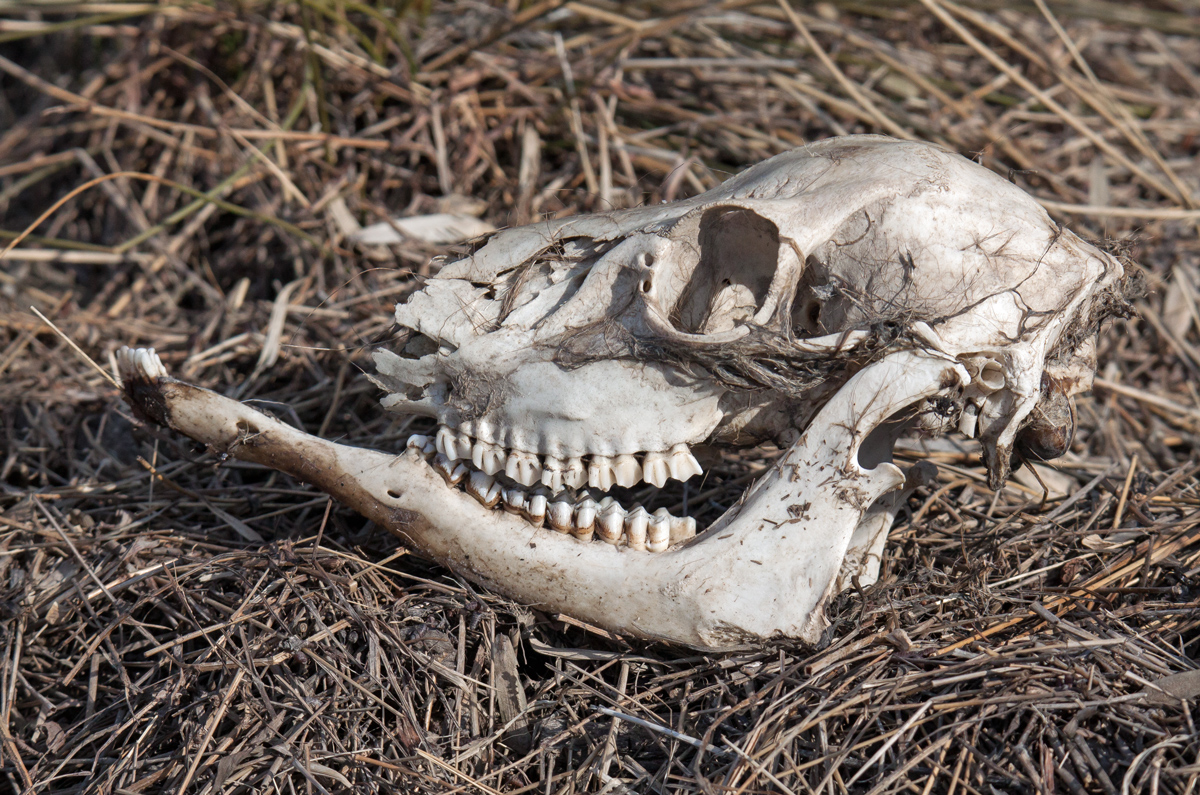
The skull is the second photo is that of a White-tailed Deer (Odocoileus virginianus). Other body parts of the deer were scattered about in the same area where I spotted the skull. There are concerns that the deer population is too high for the park to support, so there is a chance this deer died from starvation.

I know that these photos, especially the first one, are pretty graphic and apologize in advance to those who may have found them to be excessively disturbing.

raccoon

White-tailed Deer

© Michael Q. Powell. All rights reserved.

Read Full Post »

How do you generate volume when you sing? I remember being told to breathe from the diaphragm, but this male Red-winged Blackbird (Agelaius phoeniceus) seemed to think that spreading his wings helped him to be heard yesterday morning at Huntley Meadows Park.

Red-winged Blackbird

© Michael Q. Powell. All rights reserved.

Read Full Post »

I don’t know if this male Northern Cardinal (Cardinalis cardinalis) qualifies as an “angry bird,” but he sure did not seem happy to see me this morning at Huntley Meadows Park.

Maybe he was cold and hungry or got off on the wrong side of the bed this morning. In any case, I couldn’t coax a smile out of him.

Northern Cardinal

Northern Cardinal

© Michael Q. Powell. All rights reserved.

Read Full Post »

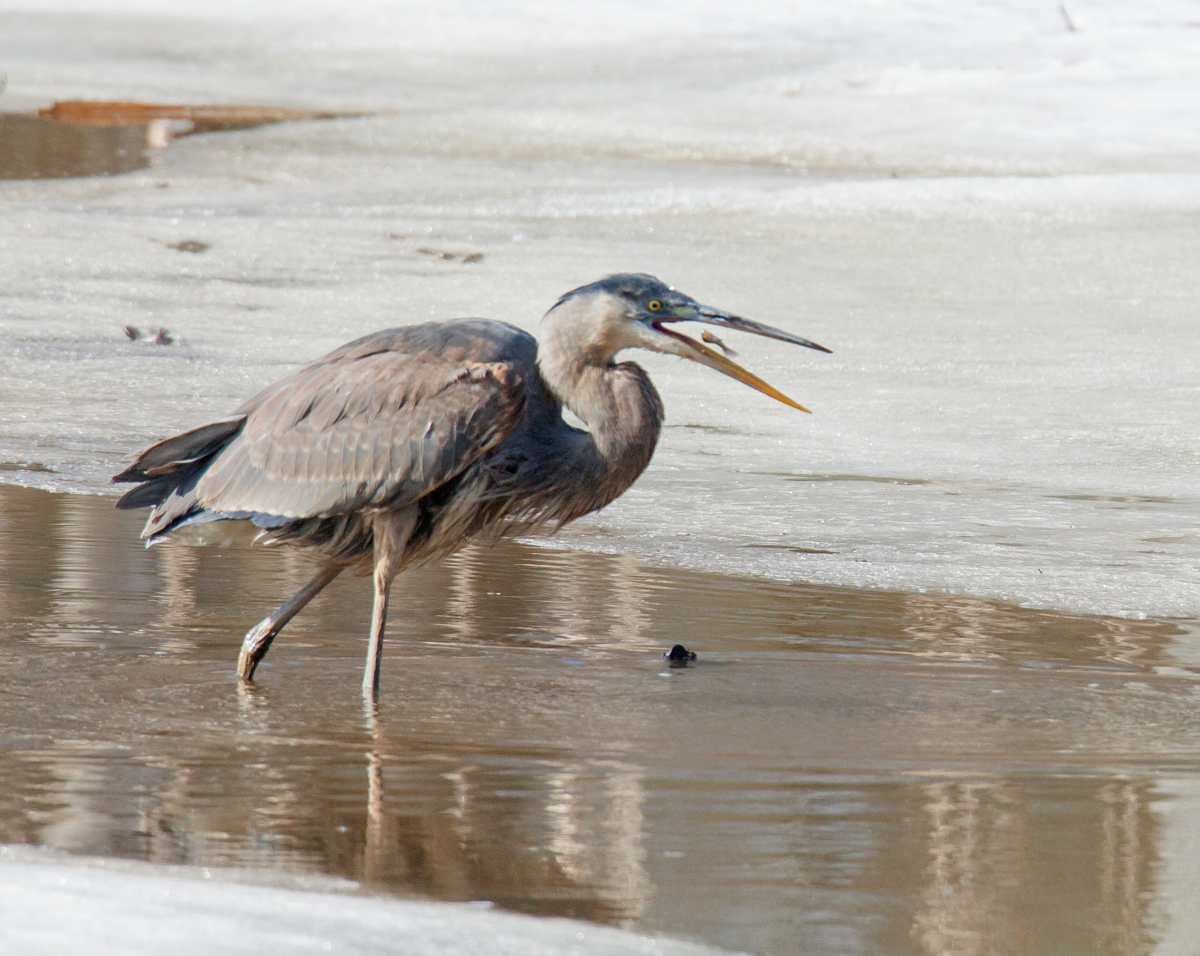
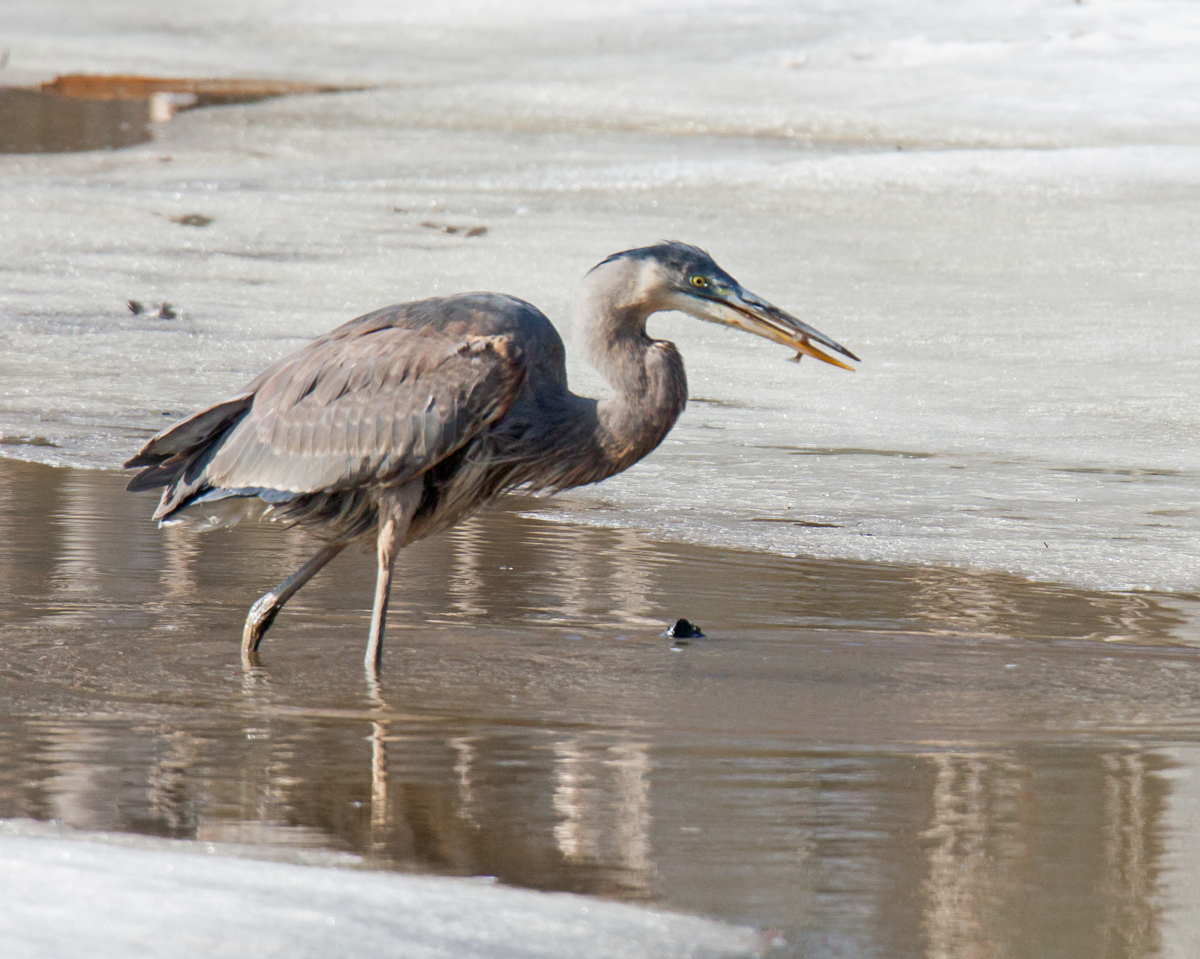
Sometimes a Great Blue Heron’s catch is big enough for a main course, but sometimes it’s only an appetizer. The good news is that appetizers are really easy for a Great Blue Heron (Ardea herodias) to swallow.

I included the second photo, which sequentially was taken before the first one, because I like the expression on the heron’s face. The heron seems to be both amused and embarrassed at the small size of the fish.

It’s obvious, though, that the heron does not have a catch-and-release policy if the fish is not of a certain minimum size.

Great Blue Heron

Great Blue Heron

© Michael Q. Powell. All rights reserved.

Read Full Post »

I love to wander through remote areas of Huntley Meadows Park, often following meandering streams. Each time is different, as the level of the water, the varying light, and the changing vegetation alter my perceptions of the landscape.

The park is a freshwater wetland of over 1500 acres with meadows, ponds, streams, and woods that provide a habitat for the wide range of insects, birds, and animals that I often feature on this blog. I am always conscious of the beauty of my surroundings, but generally have either a telephoto zoom or a macro lens on my camera, so photographing the landscape is not something that I do very often.

I was drawn to the twists and turns of this section of one of my favorite streams after a significant rainfall earlier this month. It was relatively early in the morning and there were still shadows in some areas. I captured some images of the scene with the “short” end of my 150-600mm lens and this is my favorite of the group. I definitely need to work more on visualizing landscape shots, but am happy with this initial effort.

Barnyard Run

© Michael Q. Powell. All rights reserved.


Read Full Post »

Like a tightrope walker, this American Robin (Turdus migratorius) inched its way along a narrow vine at Huntley Meadows Park, its eyes focused on the prize that awaited it at the other end. Periodically the robin used its wings for balance and moved forward until it reached a steady position almost within reach of the berries.

With a quick thrust forward of its head, the robin was able to snatch one of the low-hanging fruits. When I left it, the robin seemed to be enjoying its prize with a smile on its face.

American Robin

American Robin

American Robin

American Robin

© Michael Q. Powell. All rights reserved.

Read Full Post »

Although the temperature was 20 degrees (minus 7 degrees C) and the wind was blowing yesterday afternoon, I got fooled into thinking the bright sunshine would warm me up a bit. Most of the creatures at the marsh were absent from view, probably trying to keep warm in sheltered locations.

I was excited, therefore, when I head the unmistakable sound of a Pileated Woodpecker (Dryocopus pileatus) at work nearby as I was walking along a path. No other woodpeckers in our area can match the volume of a Pileated Woodpecker when it is burying its bill into a tree.

I managed to locate the woodpecker and was a little disappointed that it was high in a tree in a location where it was obscured by lots of branches. Eventually the woodpecker climbed higher in the tree and I was able to get a few relatively unobstructed shots, although I had to take them at a pretty sharp angle.

My favorite shot is the one in which the woodpecker looks like it is stalking a prey at the top of the tree. Its eyes are fixed on the target and it seems to be trying to sneak up on it. In reality, I have no idea what the woodpecker was doing, but it made for an unusual pose.

pil1_13Feb_blog

Pileated Woodpecker

Pileated Woodpecker

© Michael Q. Powell. All rights reserved.

Read Full Post »

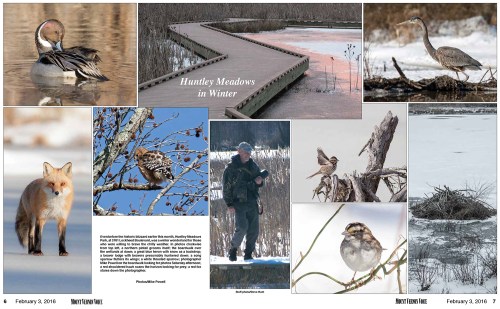
My good friend and photography mentor, Cindy Dyer, is spreading the news about the two-page photo spread of some of my recent photos that ran in a local community newspaper. What she doesn’t note is that she is a source of constant support, encouragement, and inspiration for my photography as well as for my blog. Thanks, Cindy.

cindydyer's avatarCindy Dyer's Blog

Congratulations to my dear friend Michael Powell for getting his photos published in a spread in the local Mt. Vernon Voice newspaper. He was out shooting at Huntley Meadows one cold morning and the co-editor of the publication happened to be there. He asked him if he would like his work to be featured in the newspaper. He had a two page spread available to fill and Michael had to get him photos pronto. Nice showcase for your work, grasshopper! You can see more of Michael’s work on his blog at https://michaelqpowell.wordpress.com/.

Michael Mt Vernon Voice

View original post

Read Full Post »

As the early morning sunlight hit the cattails yesterday at Huntley Meadows Park, this male Red-winged Blackbird (Agelaius phoeniceus) seemed to be contemplating the start of the new day.

Red-winged Blackbird

© Michael Q. Powell. All rights reserved.
Read Full Post »

« Newer Posts - Older Posts »