Feeds:
Posts
Comments

Posts Tagged ‘heron’

Late this afternoon, I was at a nearby suburban pond and noticed a Great Blue Heron (Ardea herodias) on the opposite bank. He was in a shaded area, where the water was calm and the reflections were beautiful. I was a bit too far away for a close-up shot, but couldn’t get any closer because of the bushes and underbrush that kept me from the water’s edge. Nevertheless, I was able to get some images that I like, including this one. I decided not to crop too closely to the heron in order to retain some of the bushes and their reflections that add a lot to the photo.

Heron in the shade (click for higher resolution)

© Michael Q. Powell. All rights reserved.

Read Full Post »

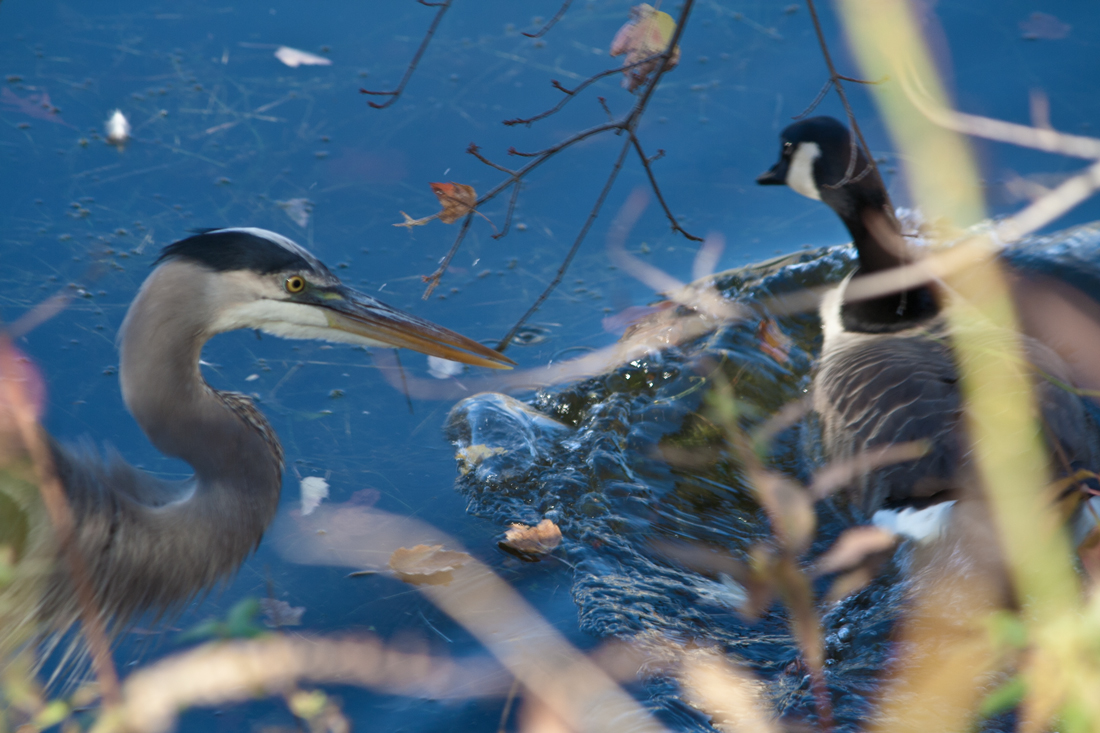
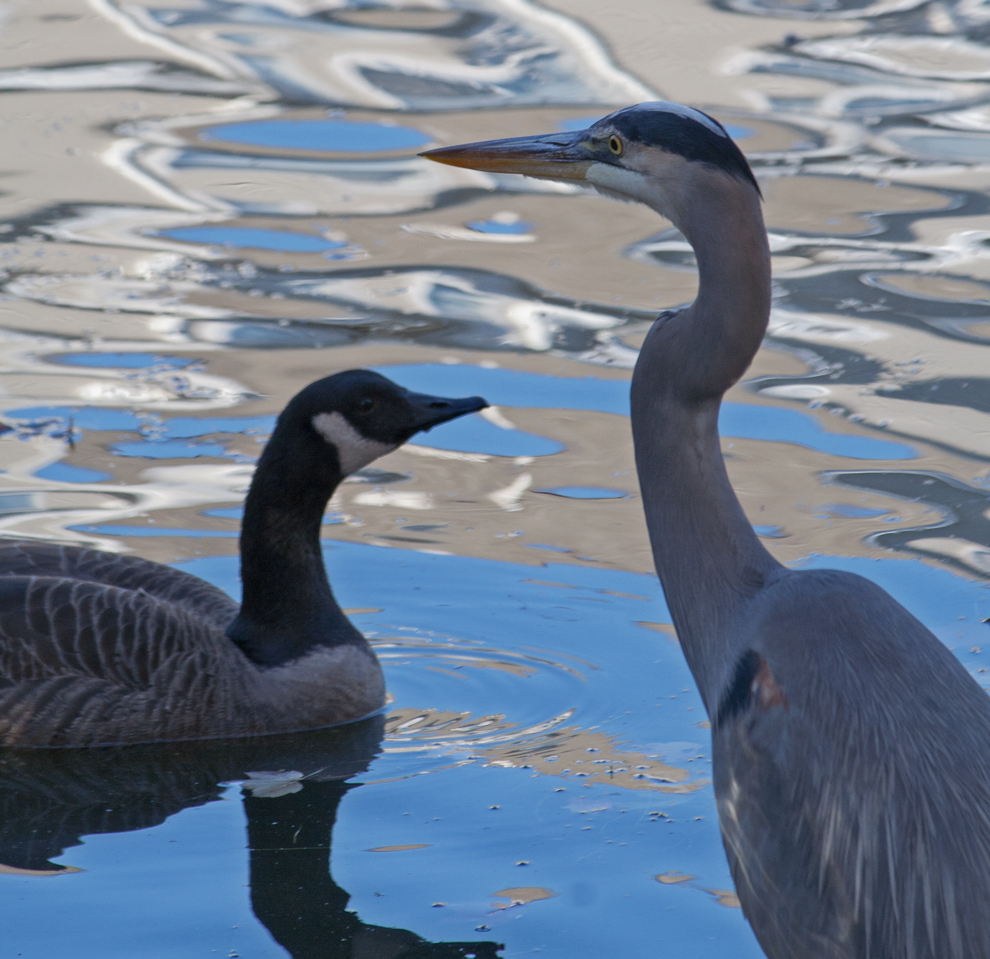
It is always interesting for me to see two species interact—you never quite know what will happen. Last Sunday, I was in the bushes in a local suburban pond area, pretty close to a Great Blue Heron (Ardea herodias). He seemed to be willing to tolerate my presence, though there were a lot of bushes that kept me from getting a clear shot. I photographed several encounters between the heron and Canada Geese (Branta canadensis) that live semi-permanently at the pond.

I took the first photo just after the heron made a threatening gesture with his beak at a goose that must have invade his personal space. The goose appears to have gotten the message and looks to be exiting the area. At the time of the shot, the sun was bright and was reflecting off the water, somehow turning it almost turquoise in color. The branches of the bush get in the way a little, but don’t detract too much from the charm of the photo. The whole effect is to make the image look almost as much like an illustration as a photograph.

“I need my personal space.”

The second photo is much less action oriented and is a study in contrasts. The goose seems to be looking at the heron with wonderment and curiosity, while the heron seems to be cool and disinterested. The background reminds me a little of a psychedelic image from the 1960’s.

“How did you grow to be so tall?”

© Michael Q. Powell. All rights reserved.

Read Full Post »

Yesterday afternoon, I took some photos of a Great Blue Heron (Ardea herodias) in the little pond in my suburban neighborhood. He seemed amazing mellow and content to relax in the shade. Consequently, he was pretty tolerant of my presence and that of the nearby Canada Geese. Here’s a sneak preview of the shoot, an image that captures the heron with the reflections of the remaining fall foliage.

Fall reflection of a Great Blue Heron

© Michael Q. Powell. All rights reserved.

Read Full Post »

The water level in the area of the marsh where I photographed herons and egrets earlier this summer is so low that it is now just a big puddle. Therefore, I was surprised early one morning this past weekend to see a Great Blue Heron (Ardea herodias) wading in the water. The light was not very bright, but the surface of the water had a really beautiful reflection of the orange of the fall foliage. The heron was a pretty good distance away and I was on a boardwalk, so my options were limited for framing my shots. Here are a couple of my favorite shots of the heron, surrounded by the reflection of the fall colors.

Great Blue Heron in the fall at Huntley Meadows Park

Fall reflection of a Great Blue Heron

© Michael Q. Powell. All rights reserved.

Read Full Post »

It was early in the morning and I was walking almost directly east along a stream. The sun had already risen and was in my eyes, but I spotted a Great Blue Heron in the water. I was able to get a shot that I knew would turn out as a silhouette, but the heron was standing in such a way that I was pretty confident that his silhouette would be immediately recognizable. The glare caused the color to wash out almost entirely and there are all kinds of artifacts from the light, but I like the overall effect.

Great Blue Heron Silhouette

© Michael Q. Powell. All rights reserved.

Read Full Post »

This is another shot of the Great Blue Heron (Ardea herodias) who was so cooperative today in permitting me to get close to him. In this shot, his eyes are fixed intently on the water, which unfortunately was covered with some combination of algae and duckweed. There was virtually no way for him to spot any potential prey below the surface of the water. His body seems coiled, ready to strike at a moment’s notice. He remained in this position for quite some time, but eventually he relaxed and gave up the hunt. Later, he moved to the other small pond and was equally unsuccessful there.

Focused blue heron (click for a higher resolution view)

© Michael Q. Powell. All rights reserved.

Read Full Post »

I was lucky today. Normally when I have tried to photograph Great Blue Herons (Ardea herodias), I have had to do so at the maximum range of my telephoto zoom lens and even then would have to crop the image significantly. The result has been that my photos have not been as sharp or detailed as I would have liked.

Today was different. I was walking around the little ponds at Green Spring Gardens, a county-run historical park where I had previously taken photos of a green heron, when I startled a Great Blue Heron who had been perched in a tree. He flew off high into a tree across the pond and remained there as I followed him and tried to take some photos. I have not yet looked at those photos, but suspect that they are a little distorted, given that I was shooting almost straight up.

It started to drizzle a bit. When all of the other visitors left, the heron flew down from the tree and landed no more than 30 feet from me. He wandered along the water’s edge, periodically entering the water and staring intently at its surface, probably searching for something to eat. I cautiously approached him and he let me get with fifteen feet or so of him and I even circled around him trying to get a decent angle and background for a shot. How close was I? At times I could not use the full range of my 55-250mm lens if I wanted to capture his whole body.

Here is one of my initial favorite shots. I shot it with the lens extended to 194mm with settings of f9.0, 1/200 sec, ISO 400, and an exposure compensation of -.67. Other than a little sharpening and a little cropping, this is the way the image came out of the camera.

Indeed, I was lucky today to encounter an unusually cooperative Great Blue Heron.

Cooperative Great Blue Heron

© Michael Q. Powell. All rights reserved.

Read Full Post »

Great Blue Herons (Ardea herodias) look graceful when they are flying or when they are wading, but they sure look awkward and gawky when on dry land. This heron seemed to be taking a break in the shade on a sunny, fall day. I took this photograph yesterday at Cameron Run, a tributary stream of the Potomac River, where I often see both egrets and heron. I do not know if they will remain here through the winter, but I hope that they do.

Great Blue Heron in the underbrush

© Michael Q. Powell. All rights reserved.

Read Full Post »

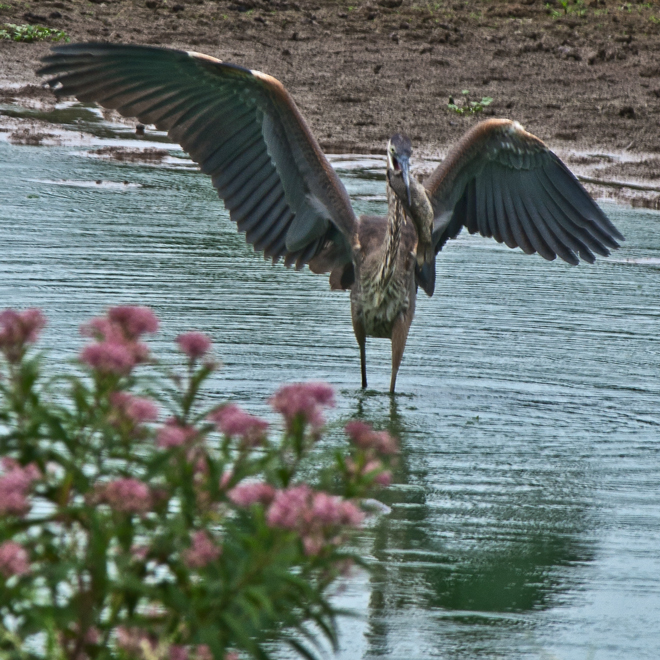
Rain was gently falling as I observed a Great Blue Heron at Huntley Meadows Park, a marshland in Alexandria, VA. I was surprised to see how the open water area had shrunk to just a small pool over the past couple of months, presumably because of the lack of rain.

Nonetheless, there was a heron in the middle of that pool, seemingly intent on catching a fish. I was not at all convinced that there were any fish in such a small body of water, but the heron soon proved me wrong. He extended his neck and made a strike into the water and came up with a fish. As he brought the fish out of the water, he opened his wings widely (as the second photo shows), perhaps to counterbalance the weight of the fish. The heron’s wingspan was definitely impressive. He kept his wings partially extended as he moved the fish around in his mouth (as you can see in the first photo) and then swallowed the fish whole.

My photos are not technically great, but they did capture the moment pretty well.  I am thankful that I once again had the privilege to watch such a beautiful creature in action.

Great Blue Heron positions fish prior to swallowing it

Great Blue Heron opens his wings as he pulls a fish out of the water

© Michael Q. Powell. All rights reserved.

Read Full Post »

This past weekend I managed to get this shot of a green heron wading in a shallow stream. At that moment I don’t think he was yet aware of my presence.  I had an unobstructed view and the light was cooperative enough to make a nice reflection in the water. If you click on the image you can see some additional details of the green heron.

Wading green heron

© Michael Q. Powell. All rights reserved.

Read Full Post »

This is a shot of a green heron in the third different location where I have seen a green heron within the past month or so, all within a five mile radius of where I live in suburban Northern Virginia, outside of Washington DC. I came upon this little guy while I was walking down a stream bed and he flew into a tree when he became aware of my presence. Luckily he was still very visible in the foliage and, in fact, the green leaves serve as a nice backdrop to highlight the beauty of this green heron.

Green Heron in a tree

© Michael Q. Powell. All rights reserved.

Read Full Post »

After I got home from work today I rushed to a nearby garden to get in a few shots before the light disappeared totally. I was happy to spot a green heron (I’ve photographed them before at the pond area of this garden) and managed to take a photo of him that I really like. The green heron is standing the edge of a rocky cliff and appears to be keeping watch.  (In reality it’s more like a rock wall).

Green Heron Sentinel

I decided to add one other photo of the green heron that I managed to take before he flew across the little pond to the rock wall. It is a little more of an unposed shot than the first one, which almost looks staged, and captures him in his more natural environment.

Candid shot of a green heron

© Michael Q. Powell. All rights reserved.

Read Full Post »

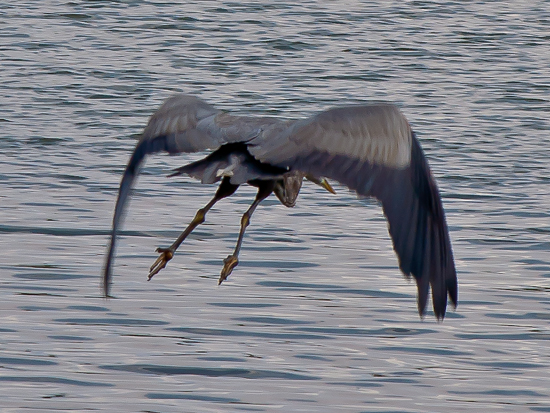
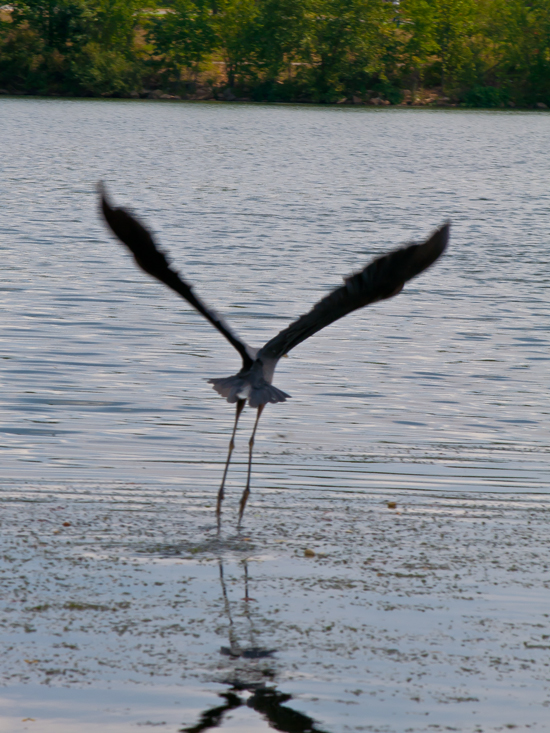
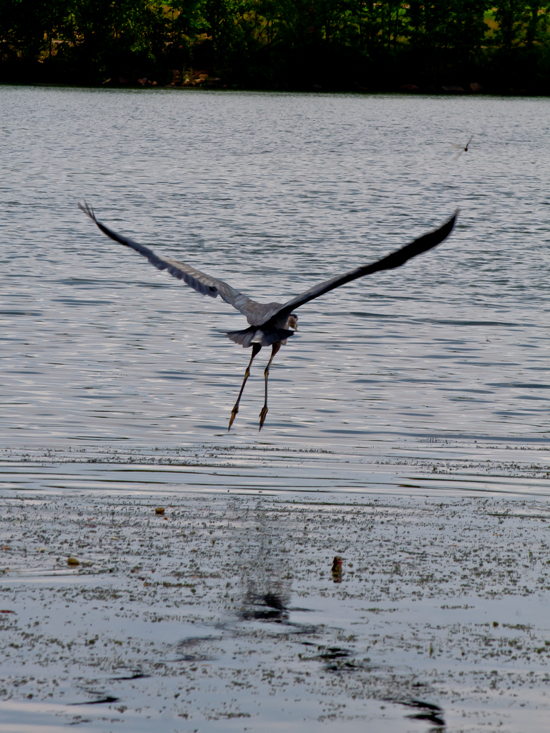
I haven never really paid attention to how birds take off. This past weekend I was photographing a Great Blue heron wading in the water of a nearby pond.  Without any prior indications, he suddenly took to the air. I happened to be in a good position to get a few shots of the different positions his wings assumed as he lifted off from the water. As you can see, I was almost directly behind the heron.

The first photo is my favorite because of the way in which the wings frame the extended legs and the barely visible head. Out of the three photos I have posted here, this was the second one shot.

The photo below shows the heron just as he was taking off from the water. The wings are blurry and are almost like a silhouette. It seems like he had to flap them really hard to lift out of the water. I like the fact that I was able to capture part of his reflection in the water.

Lifting off from the water

This final shot shows his wings in what I consider to be a normal flying position. I haven’t observed herons enough to know if they eventually pull in their legs tighter when they fly higher, but I assume that to be the case. In this photo I managed to get more of a complete reflection in the water than in the previous one.

Spreading his wings

I learned a few things when shooting these photos. First, and perhaps most importantly, I learned how important it is to be ready at all times, because a static situation can become very dynamic very quickly. Secondly, I now understand better why serious wildlife photographers have really big (and expensive) telephoto lens—it’s tough to get in close enough. Finally, I appreciate much more the abilities of those who are able to capture moving subjects like this heron with perfect focus and sharpness. My photos are not very sharp and clear, but I still found them interesting enough to want to share them.

© Michael Q. Powell. All rights reserved.

Read Full Post »

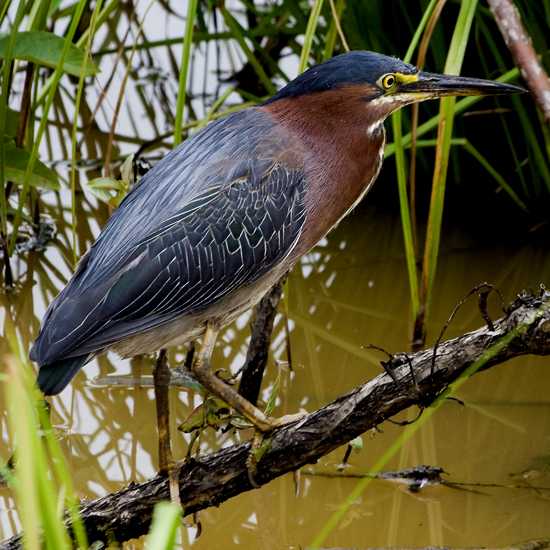
This past weekend seems to have been my heron weekend. I posted some photos of a great blue heron that I saw on Saturday. However, I realize that hadn’t yet gone through all of my photos from Friday, which included this shot of a green heron perched on the dead limb of a tree.

The tree was overlooking a muddy pond and I couldn’t tell if the green heron was just resting or whether he was preparing to hunt for prey. The situation afforded me an unobstructed view of the green heron and I quickly started taking some shots, suspecting (as turned out to be the case) that my luck would not hold for long. The green heron soon jumped from his perch and moved farther away into some undergrowth when he focused his attention on the water.

I was totally fascinated and watched him from a distance for quite a while. Several times he “alerted” by extending his neck and leaning toward the water, but I didn’t managed to see him catch anything.

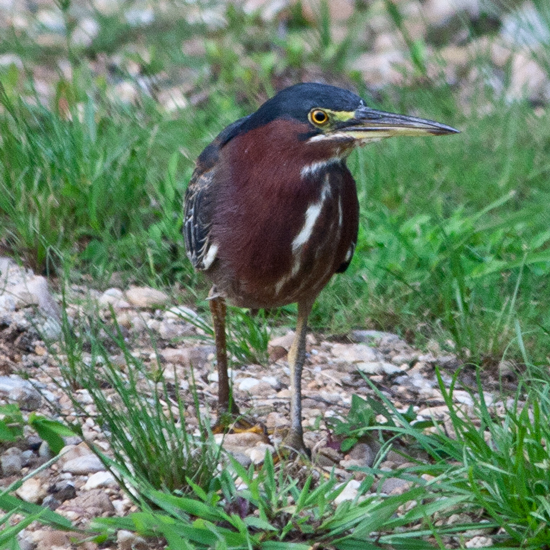
This image captures some of  of the green heron’s gorgeous colors. I especially like the chestnut color around his neck and the intensity of the yellow of his eyes.

© Michael Q. Powell. All rights reserved.

Read Full Post »

Here is a close-up of a Great Blue Heron (Ardea herodias) who has just speared a fish of an unknown type. I was able to watch the whole process from the shoreline of the pond and took some shots.

I note that the photo here is not a super crisp, clear image. It is a crop of a shot that I had to tweak because of some problems getting the exposure right (reflected light off the water and shadows were both problem), but I like the fact that you can see both the heron’s and the fish’s faces.

In a posting on 24 July I showed a green heron swallowing a frog whole. I was not able to see how this blue heron consumed the fish because he carried it into a shaded area along the shoreline.

© Michael Q. Powell. All rights reserved.

Read Full Post »

Here is another shot of a Great Blue Heron (Ardea herodias) that I photographed 11 August 2012 in Alexandria, Virginia.

At first I couldn’t figure out why he had his mouth open in so many of my pictures. As I went over the photos, however, it looks like he may have had a stick or bone stuck in his mouth. Is that possible? Earlier in the day I watched as he speared and ate a fish and it’s possible he picked up some debris when he caught the fish (my photos of him spearing the fish turned out really dark but I’ll see if I can salvage any to post).

Eventually he did close his mouth.

Click on the image for greater details.

© Michael Q. Powell. All rights reserved.

Read Full Post »

Great Blue Heron (Ardea herodias) photographed 11 August 2012 in Alexandria, Virginia.

Click on photo for greater details.

© Michael Q. Powell. All rights reserved.

Read Full Post »

It may sound like a new summer beverage sensation, but the title is meant to be literal.

I captured this shot of a green heron  just as the rain was beginning to fall this afternoon. I was at the same pond at a local garden where I had previously seen a juvenile green heron (and that was right after the rain). Maybe green herons like to come out to play in the rain—I’ll have to remember that in the future.

There really wasn’t enough light for a high quality image, but I think that I managed to capture the unique look and style of the green heron.

(I also got some photos of a juvenile green heron this afternoon but I’ll save them for another posting.)

© Michael Q. Powell. All rights reserved.

Read Full Post »

Yesterday’s blog entry featured the adventures of a young green heron catching and swallowing a frog. After the snack was consumed, though, the heron moved from the boardwalk into the marshy area. There he perched on a branch and seemed to pose for me, maybe figuring that his exploits were worthy of a magazine feature.

The resulting photograph is one of my favorite shots of the whole day, because I think it captures well the rugged beauty of this young bird. The background is a little distracting but I like the reflections in the water and the angle of the ranch.

I decided to include two additional action shots from yesterday. The photos seem to show that I probably was incorrect when I stated that the heron had speared the frog when he initially caught it. It looks like the heron was merely holding the frog with his beak as he adjusted its position. Now that I think about it, the process of swallowing the frog would have been complicated if the frog had been speared.

© Michael Q. Powell. All rights reserved.

Read Full Post »

Stereotypes of a heron’s  appearance

This past weekend I visited a pond at a local garden and encountered this interesting bird. He looked a little like a heron but had a totally different body type—he was shorter and squatter than the herons I was used to seeing. I have photographed blue herons and white herons and have a mental picture of what a heron looks like. They are tall and slender and posses a fashion model’s elegance. Could this really be a heron?

Surveying the situation

Playing and posing like a child

I was alone with the bird for quite some time for the gardens were deserted after a thunderstorm. The beautiful bird, later identified as a juvenile green heron, seemed to be unusually willing to remain as I attempted to photograph him. At times he even seemed to be posing for me. Like a child he was enjoying himself, running around and playing in the water. He definitely was not intent on adult-type tasks such as catching food.
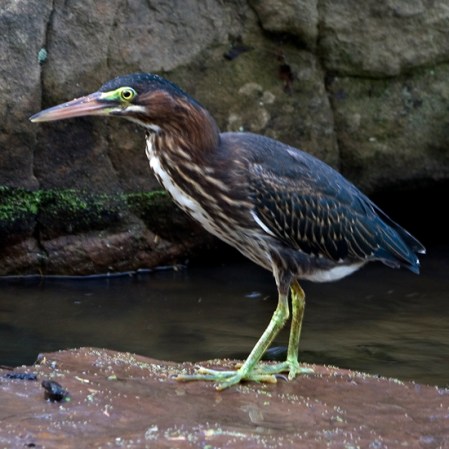
Full body shot. Don’t I have great legs?

Is this enough of a smile for you?

It’s a green heron

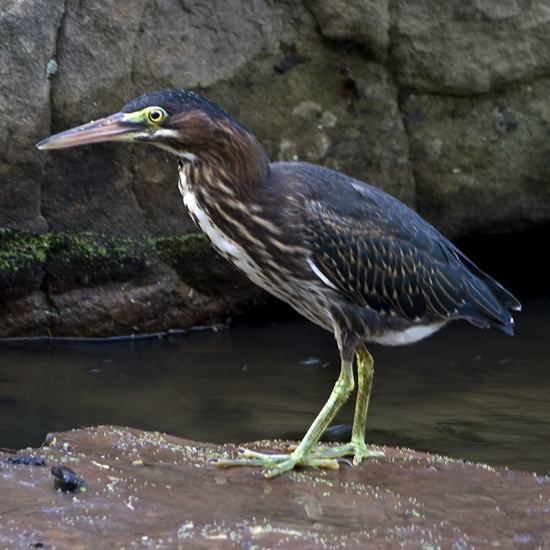
I am pretty confident that this bird is a green heron (Butorides virescens). Wikipedia helped me determine that he is a juvenile because of the brown-and-white streaked feathers on his breast and the greenish-yellow webbed feet. (The adult green heron has a darker bill and a more pronounced  chestnut-colored neck and breast.) NatureWorks has some summary information if you want to quickly learn about green herons.

This grass feels really good on my bare feet.

A tool-using bird

My favorite website for information on the green heron, however, belongs to the Cornell Lab of Ornithology, which includes range maps and audio files. It also noted the following truly amazing fact about green herons, “The Green Heron is one of the few tool-using birds. It commonly drops bait onto the surface of the water and grabs the small fish that are attracted. It uses a variety of baits and lures, including crusts of bread, insects, earthworms, twigs, or feathers.”

Ready for my close-up

Maybe the green heron should have its own reality television show, “Fishing With a Green Heron-Choosing the Right Bait. You Don’t Even Need a Hook”

© Michael Q. Powell. All rights reserved.

Read Full Post »

« Newer Posts