Feeds:
Posts
Comments

Posts Tagged ‘Haliaeetus leucocephalus’

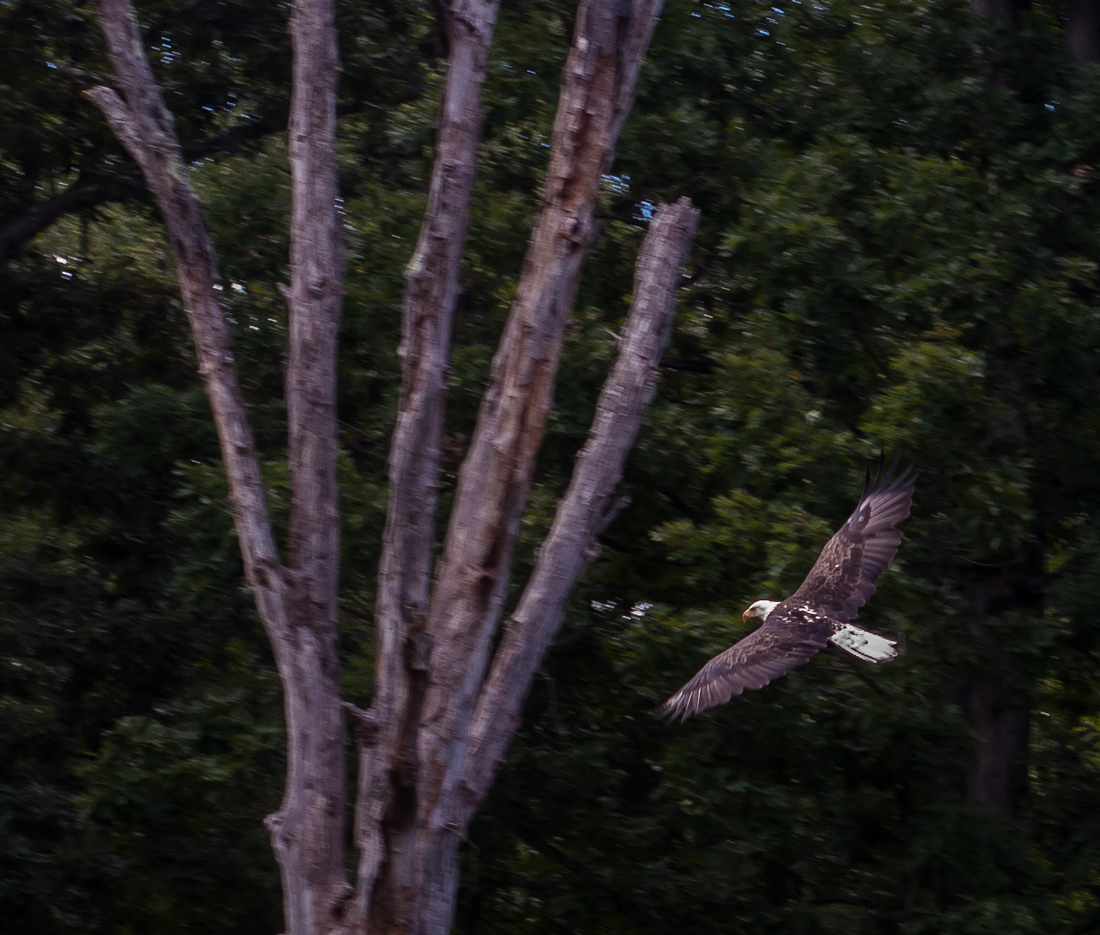
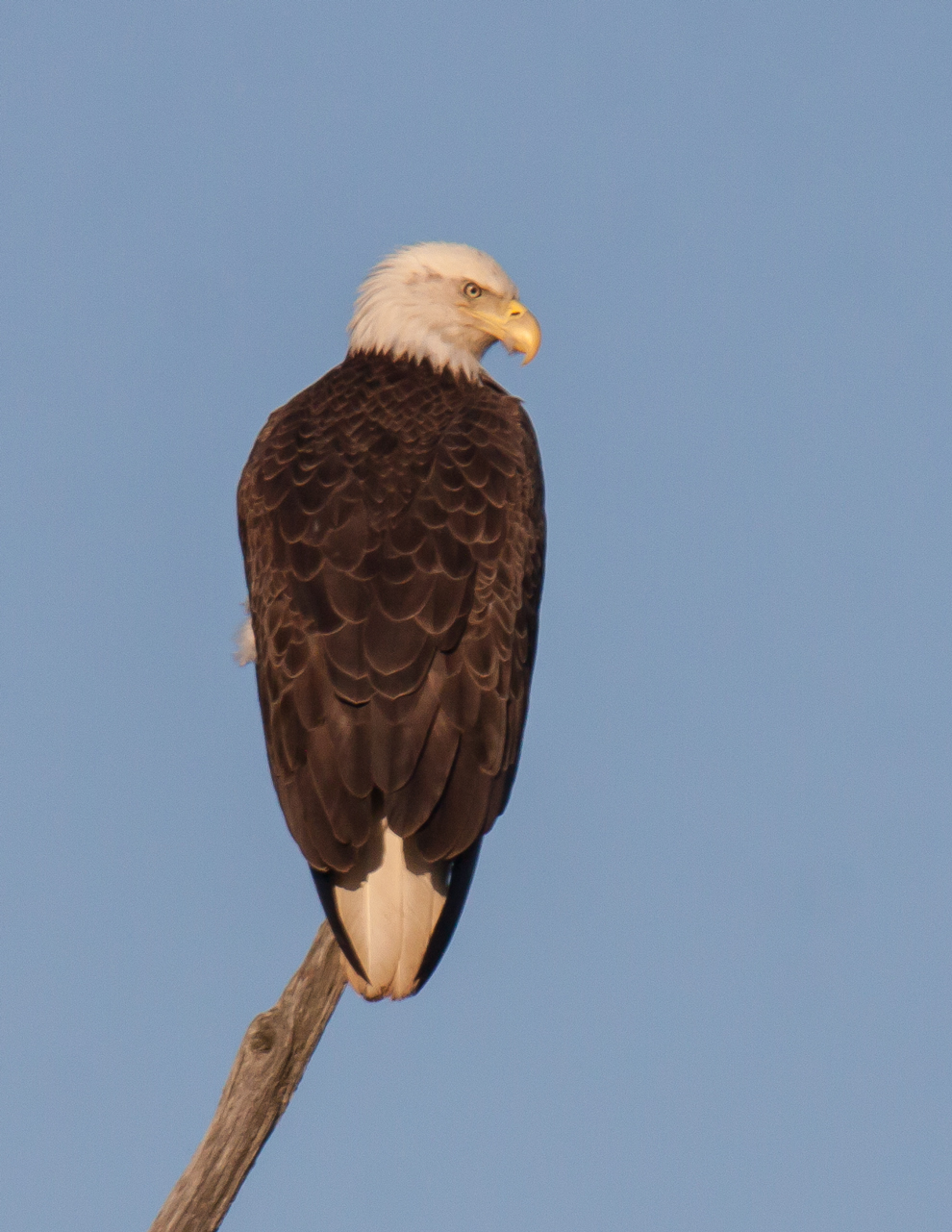
This past Monday was a wonderful day for eagles. In addition to the young eagle whose photos I posted earlier, I also managed to capture these images of a mature Bald Eagle (Haliaeetus leucocephalus) perched on a dead tree in the marsh.

Bald Eagle

Bald Eagle

© Michael Q. Powell. All rights reserved.


Read Full Post »

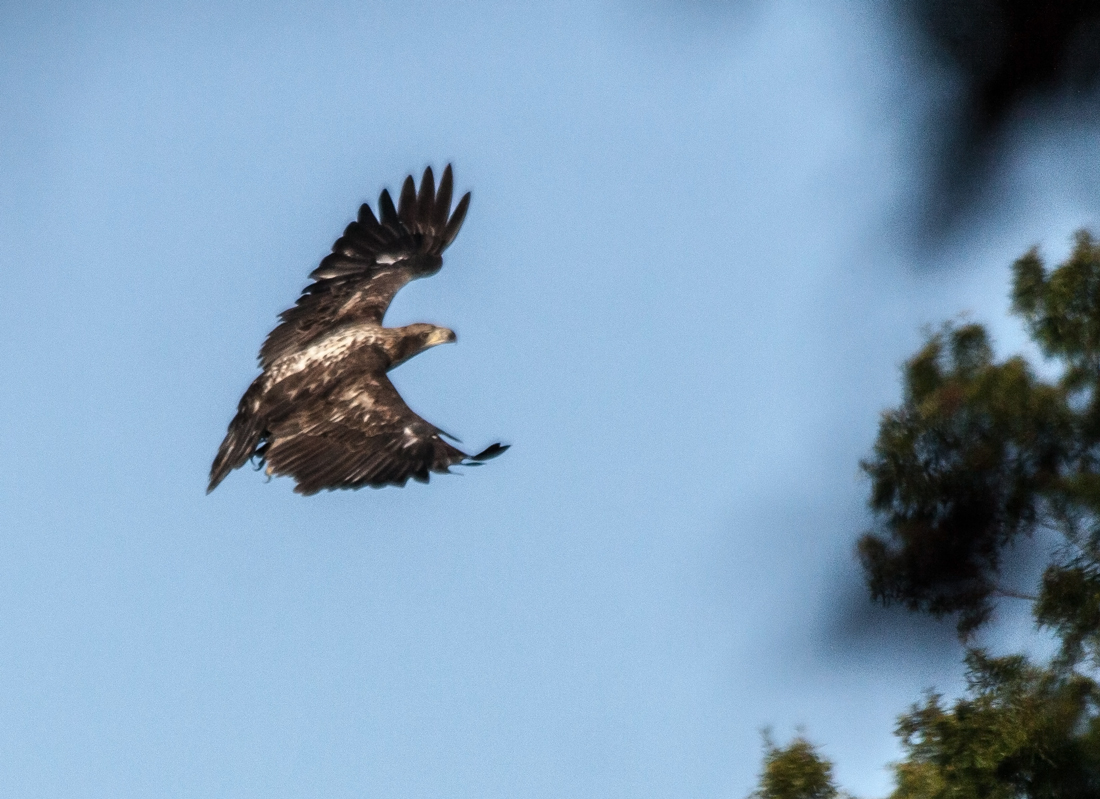
I was late in reacting when the Bald Eagle (Haliaeetus leucocephalus) took off from its perch and I was pretty sure that I had not gotten any decent shots of its departure. Consequently, I skimmed quickly through the shots during my initial review and none of them jumped out at me.

After I had done this morning’s posting, I had a few minutes before I had to depart for work and decided to review the images again. I was surprised to find this shot of the young eagle in flight, shortly after he had pushed off from the tree. It’s reasonably sharp and the wings are in a decent position, so I decided to post the photo as a complement to the first image that showed the eagle completing a difficult landing.

Bald Eagle

© Michael Q. Powell. All rights reserved.

Read Full Post »

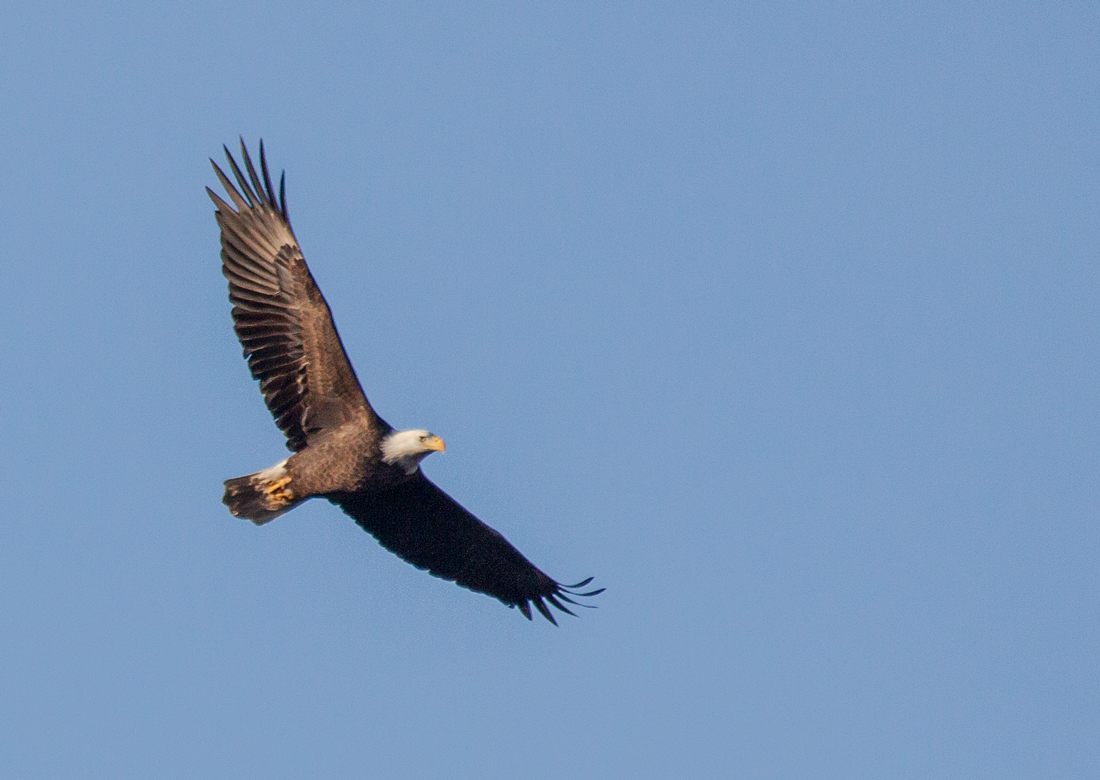
No matter what else happened yesterday, I knew it was already an amazing day when I captured this shot of a Bald Eagle (Haliaeetus leucocephalus) early in the morning at Huntley Meadows Park.

bald eagle


© Michael Q. Powell. All rights reserved.

Read Full Post »

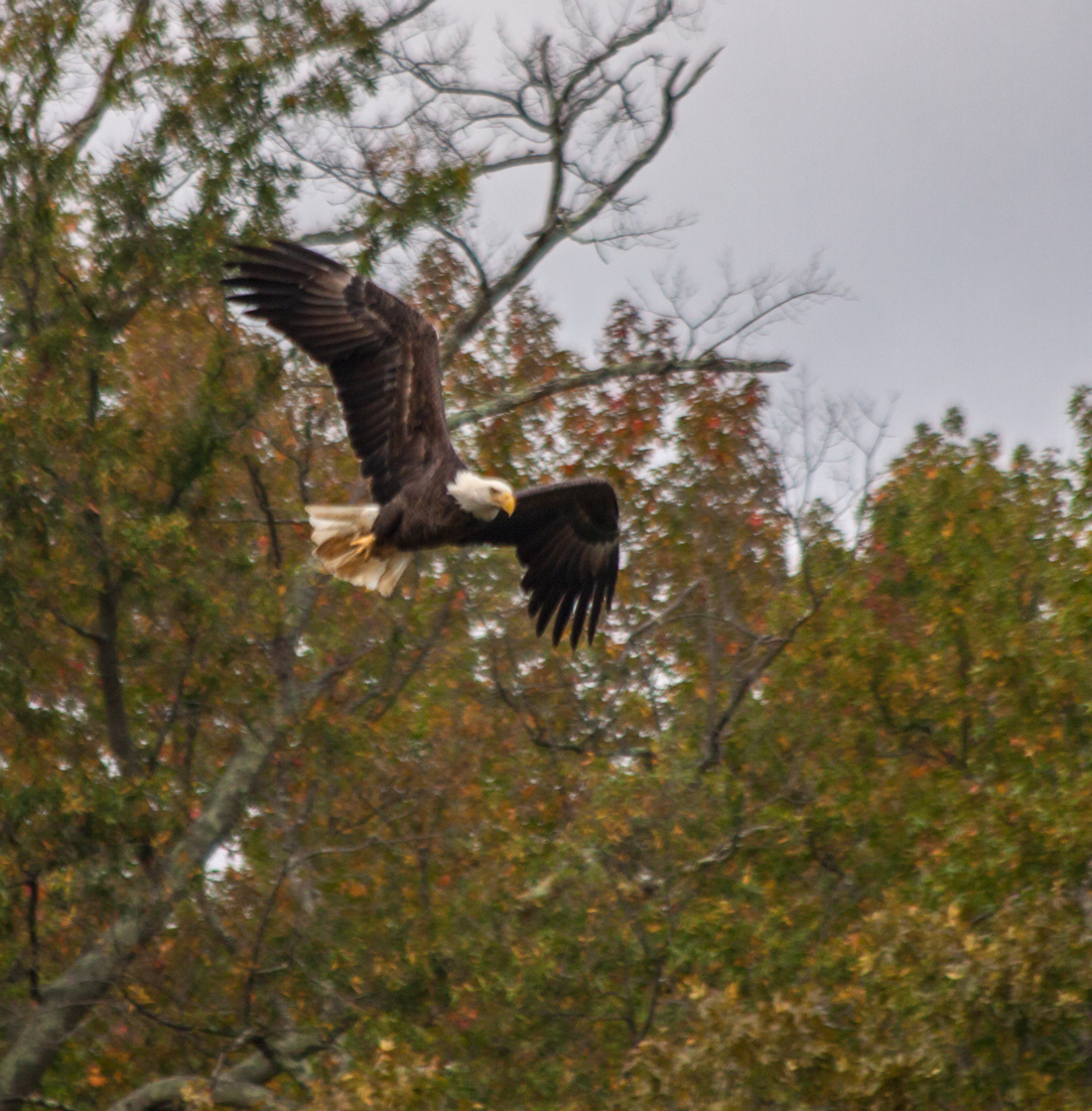
After record-breaking warm weather this past Sunday, the ice on the ponds at my local marshland park melted and I suspected that there might be a Bald Eagle there on Monday. On a gloomy, overcast day, I spotted one in the trees and captured some shots as the eagle took off and flew away.

Bald Eagles (Haliaeetus leucocephalus) frequently hang out in a remote area of Huntley Meadows Park, and I think that that there may be a nest in that general area. When the ponds started to freeze over, not surprisingly the eagles seem to have disappeared from view.

I initially caught sight of the eagle in flight and watched it land on a distant tree. I had an unobstructed view of the eagle, because I was looking over a small body of water. My telephoto lens is too heavy to hold for long periods of time when it is pointing upwards, but I was fortunate that I was looking through the viewfinder when the eagle took off from the tree.

I have been working on tracking birds in flight and managed to keep the eagle pretty much in focus as it flew over the trees. When the lens is extended to 600mm, it’s quite a challenge to keep a moving subject in the viewfinder. Normally I also like to keep my ISO as low as possible to avoid grainy images, because my Canon 50D is a little dated and doesn’t handle higher ISO levels as well as newer cameras. Taking into account the limited light on the overcast day, I was shooting at ISO 1000, which let me stop the action at 1/1000 of a second.

I actually enjoy shooting on days when the weather is marginal, because it keeps many others away. When the weather is sunny and warmer, the park tends to be crawling with people, which tends to decrease my chances of getting shots like these.

Bald EagleBald EagleBald EagleBald Eagle

© Michael Q. Powell. All rights reserved.

Read Full Post »

I tend to take the majority of my wildlife photographs within a few miles of my home in Northern Virginia, but yesterday I boldly decided to cross the Potomac River and venture into Maryland in search of Bald Eagles. One of my fellow photographers has repeatedly posted beautiful photos of eagles at Fort Washington Park and I wanted to see if I too could find them.

Fort Washington is a historic park, now run by the National Park Service, that was built to defend the river approach to Washington D.C. almost two hundred years ago. The park is a bigger than I expected and I wandered up and down walking paths, wondering where I might find the eagles. I spent a lot of time near the water, but eventually decided to climb to the higher ground, where the artillery positions were located.

As I was about to enter the fort, I glanced over at a tree in the distance and saw the shape of a large bird—it was a Bald Eagle (Haliaeetus leucocephalus). As luck would have it, it started to rain as I started to take some photos, but I managed to get a few relatively clear shots. I had to climb down one hill and up another to get closer to the tree and the eagle flew off before I could get any closer shots.

I don’t know if that tree is a favorite perching spot for the eagles, which I saw soaring at a distance a bit later in the day, but I’m confident that I will return to this location, hopefully when the weather is a bit more hospitable, to search again for a bald eagle.

Bald Eagle

Bald Eagle

© Michael Q. Powell. All rights reserved.

Read Full Post »

I recently experienced a sharp increase in the number of views of my blog and went from 628 to 4723 views in a single week.  One of my posts has had an amazing 3235 views to date. What happened? Have I learned a secret to boosting my viewer statistics?

As you might have guessed from the photos that I have reprised below, the post in question is my 4 November posting Rescue of an Injured Bald Eagle. Within my WordPress world, the post was reasonably successful and sixty viewers “liked” it, but that’s not enough to account for the boost.

The most important key to getting more viewers, I think, is finding viewers from outside of WordPress. I sometimes cross-post on Facebook account and in a few Facebook groups to which I belong and will get some additional views, but generally only a few.

I’ve looked back at all that transpired and here is the “formula” that led to my “success.” First, take photos of an event that is newsworthy, has broad appeal, and preferably has police involvement. The police departments, it seems, are always looking for good news stories, and I sent copies of my photos to the officer who made the rescue. The Fairfax County Police Department posted my photos (with attribution) on their blog on 5 November and included a link to my blog posting. This got the ball rolling, it seems.

The next step is to enlist the aid of the mass media in publicizing your blog and keep them updated. I suspect that news outlets troll the police sites for stories and suddenly I started receiving requests from reporters to use the photos in the on-line versions of their television or radio stations—I don’t think the photos appeared in print. I gave approval each time that I was asked, but requested attribution by name and, if possible, a link back to my blog.

The local Fox station and the local NBC station were the most cooperative and did articles that used my photos, excerpts from the text of my blog, and included links to my blog. The Fox article brought in more than 750 viewers and the NBC article brought in over 100 viewers. WTOP, a local news radio station, was similarly cooperative. I made sure to keep these reporters in the loop when I first received information that the eagle was euthanized and all they did updates on the story.

What about the others? Several news outlets, most notably The Washington Post, used my photos with attribution, though they did not request permission or link back to my blog in any way. It was really cool to see the Post use one of my photos in articles on 5 November and 6 November, but it had no effect on my blog statistics. The local ABC station WJLA also gave attribution when they used my photo in an article. I ran across a couple of instances in which my photos were used and they were attributed to “a park visitor” or to the police department.

I came across the photos, with attribution, in several local community news sites and in a couple of other Fox site as well. The euthanization decision was carried by the Associated Press, but, alas, they did not use a photo.

I think I understand better now how I had such an increase in viewers, but I realize that the experience is not easily replicable and the results were short-lived. After the temporary spike in views, I have returned to more normal levels. I enjoyed the brief moment in the spotlight and learned a lot about how stories enter into the news cycle, but I am content to return to my smaller world of walking the trails, in search of new photographic adventure.

 

Bald Eagle rescue

Bald Eagle rescue

© Michael Q. Powell. All rights reserved.


Read Full Post »

We all like to believe in happy endings, but unlike fairy tales, real life does not always turn out that way. I was saddened this afternoon to learn that the female Bald Eagle (Haliaeetus leucocephalus) that was rescued on Monday at Huntley Meadows Park had to be euthanized.

The dislocation of her elbow was chronic and so severe that eventual release was not a possibility.  The doctors at The Wildlife Center of Virginia determined that humane euthanasia was the best treatment.

I was happy that the work of the Fairfax County Animal Control Services officer that I chronicled in an earlier posting were featured today in the on-line editions of local media, including the Washington Post, WJLA (ABC television), WTOP radio, and Inside NOVA. The sad ending in no way diminishes my respect and thanks to Officer Kathy Prucnal for her extraordinary efforts to rescue the injured eagle.

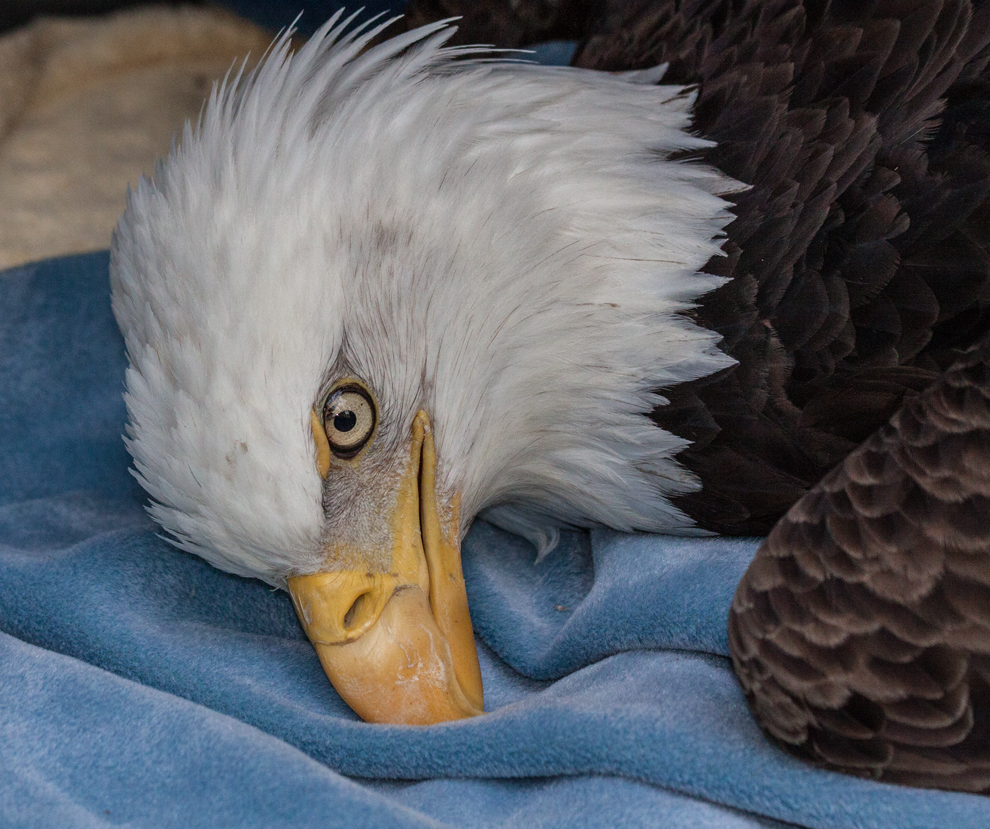
This photo that I took during the rescue is how I want to remember the female Bald Eagle, appearing strong and alert.

RIP, beautiful eagle.

Bald Eagle

© Michael Q. Powell. All rights reserved.

Read Full Post »
I received an update from the Animal Control Officer who rescued the Bald Eagle (Haliaeetus leucocephalus) featured in yesterday’s posting and the prognosis looks positive.

The eagle had a low heart rate, according to the attending veterinarian, likely from pesticide poisoning, and they treated it with atropine. The eagle, an 8 pound (3.6 kg) female, also had a dislocated joint in one wing, which is treatable as well. It is likely they will be able to release her after some rehabilitation at a specialized facility in southern VA, which I assume is The Wildlife Center of Virginia in Waynesboro, Virginia.

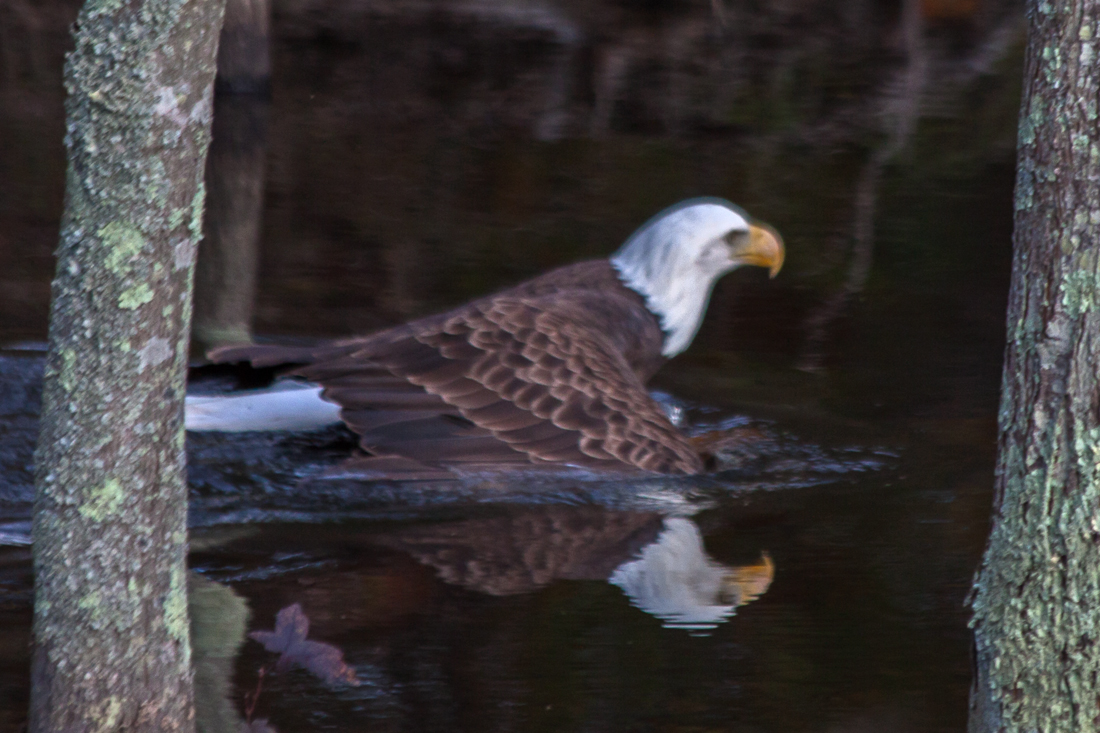
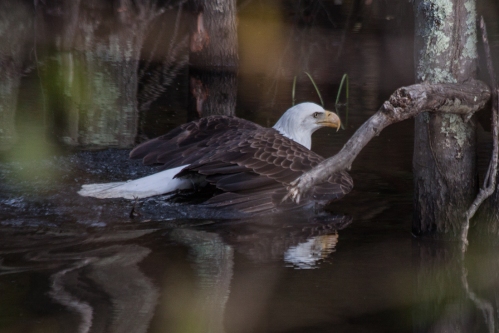
I took the first photo when the eagle was trying to swim away while being rescued. The image is not quite as sharp as the photos from yesterday, but I just love the reflection of the eagle in the water as it struggles to swim. This was in a wooded area of Huntley Meadows Park, my favorite venue for photography, that is now flooded as part of a wetland restoration project. The second photo shows the eagle as it was when I first came upon it, perched on a pile of brush, unable to fly away.

Bald Eagle

Bald Eagle

© Michael Q. Powell. All rights reserved.

Read Full Post »

Would you be willing to chase an injured adult Bald Eagle (Haliaeetus leucocephalus) with nothing more than a blanket in your hands? Yesterday, I was privileged to observe a very brave officer of the Fairfax County Animal Control Services capture an injured eagle at my local marshland park.

The eagle was perched on a brush pile in a flooded forest area of the marsh. From time to time it would hop to a new position, but did not seem able to fly away. Several parkgoers had alerted the park authorities of the situation and I came upon the situation shortly before the animal control officer arrived.

When the officer began to chase it, the eagle hopped away and then tried to swim away, stopping for a moment to look in my direction from behind a tree. Eventually, when an unidentified parkgoer helped to block a potential exit route for the eagle, the officer was able to capture the eagle.

As the officer was carrying the eagle, wrapped up in a blanket, to a small vehicle, I circled around on the path as fast as I could, hoping to get a closer look at the eagle. The officer was accommodating and briefly unwrapped the blanket and I got an amazing close-up look at this majestic bird. She was also willing to pose for me and I took a photo that I sent to her to help her remember her amazing actions.

I managed to get a final look at the eagle after it had been transferred to the animal control vehicle. The officer unwrapped the eagle so that the man who had assisted in the rescue could get a look at it. The eagle seemed to have settled down a bit and appeared to be resting comfortably. It was impossible to determine the cause and the extent of the eagle’s injuries, but the officer assured me that the county has excellent rehabilitation facilities for injured raptors. If I am able to get progress reports on the eagle’s recovery, I’ll be sure to keep you all informed.

Bald Eagle

Bald EagleBald Eagle rescueBald Eagle rescueBald Eagle rescue

© Michael Q. Powell. All rights reserved.

Read Full Post »

This morning I spotted a Bald Eagle (Haliaeetus leucocephalus) in a tree a my local marshland park, not far from where I had previously seen one. Once again, the eagle reacted more quickly than I did and took off before I was completely ready. This time, however, I was able to more quickly track the flying eagle and got a better shot than last time. I’m still not fully satisfied with the sharpness of this image, but I continue to believe that any day that I see an eagle is a great day.

Bald Eagle at Huntely Meadows Park

© Michael Q. Powell. All rights reserved.


Read Full Post »

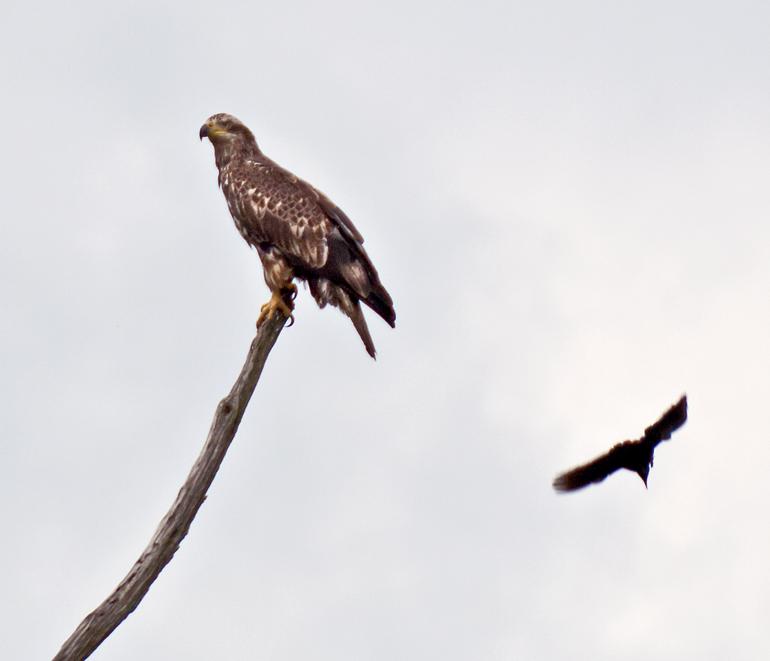
Can you react faster than an eagle can? Yesterday, I was getting ready to step out of the brush that surrounds one of the ponds at my local marsh, when I spotted a large dark shape in a dead tree that overlooks the water. I suspected that it might be a Bald Eagle (Haliaeetus leucocephalus), since I had seen eagles perched on this tree a couple of times in the past.

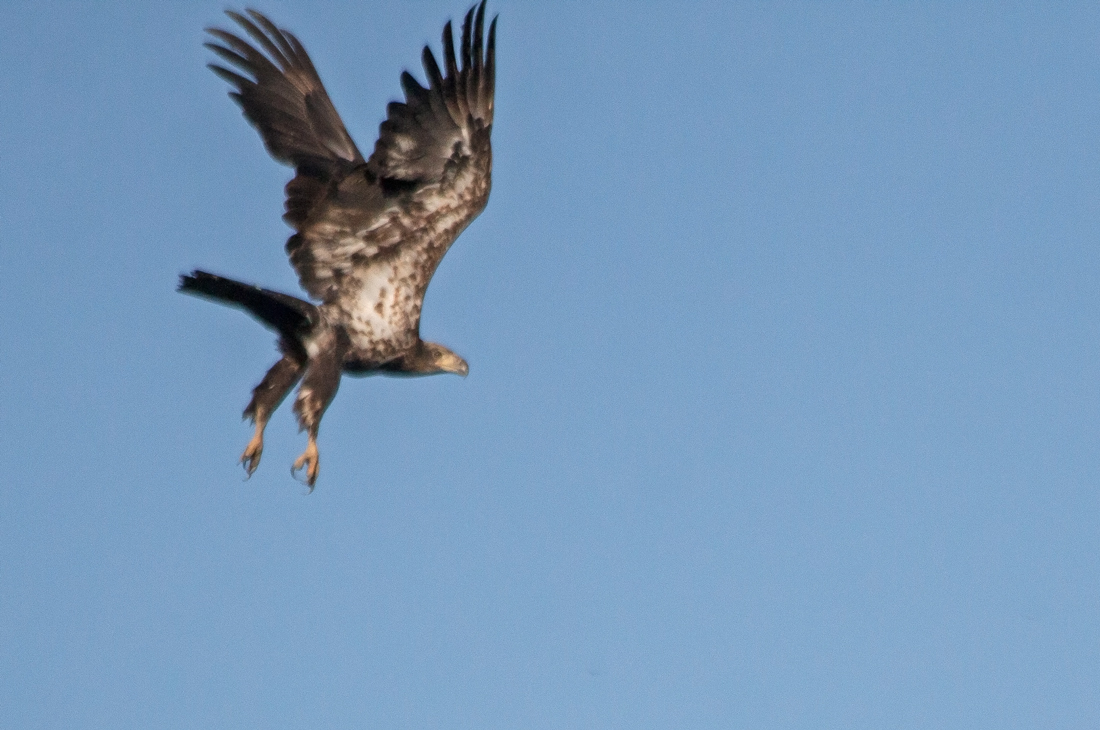
As I stepped forward and was starting to bring my camera to my eye, a juvenile Bald Eagle took off. The eagle flew upwards so quickly that I had trouble finding it and keeping it in my viewfinder, as you can see in my first shot. I got a few more shots as I tracked the eagle’s flight, but in most of them, the eagle’s head is obscured by its outstretched wings. Just before the eagle flew behind the trees in the distance, I got a reasonably clear shot, the second image below.

What did I learn? If an eagle spots me at the same time that I spot him, his reaction times are going to be quicker than mine. Someone I’m going to have to figure out a way to be more stealthy and more ready the next time I find myself in a situation like this. That will be my challenge this autumn as I start to take more shots of birds as the insect population gradually decreases.

eagle1_blog_sepeagle2_blog_sep© Michael Q. Powell. All rights reserved.

Read Full Post »

How often do you find yourself taking a shot of a subject with the wrong lens? If you are an opportunistic wildlife shooter like I am, it happens pretty regularly.

At this time of the year, most of the time I have a macro lens on my camera and I focus a lot on insects. Earlier this week, I was attempting to photograph a dragonfly with a 100mm macro lens when I heard the squawking on an approaching bird. Thinking perhaps that it was a hawk, I raised my camera and clicked off a series of shots as the bird flew by on the other side of a small pond.

Imagine my surprise when I looked at my images and realized that the bird was actually a Bald Eagle (Haliaeetus leucocephalus). There is something really special about Bald Eagles and I am thrilled every single time I see one.

Even with a crop sensor camera, a 100mm lens is not the right lens for shooting birds in flight at a distance, especially against a background of trees. I am posting a couple of shots simply to show that it is sometimes possible to get recognizable images of cool subjects even when the conditions and equipment are not optimal.

The images are also a reminder to myself to keep shooting and not wait for the perfect conditions to come together. If I wear out the camera, I can always get another one.

eagle1_blogeagle2_blog

© Michael Q. Powell. All rights reserved

Read Full Post »

Some subjects are so awe-inspiring that I get excited just seeing them, even if they are too far away for a good photo—like this Bald Eagle (Haliaeetus leucocephalus) that I saw Monday at my local marsh. The eagle seemed to sense my presence and took off before I could get closer, but I managed to capture an image of its final preparations for takeoff from the branch.

eagle_takeoff1_blogWhen I am walking through the woods at this time of the year, I have to keep my eyes in constant motion. Leaves are still sparse enough on the trees that I am still able to spot some birds in the trees.  However, insects are starting to appear too, so I have to scan the leaves and branches on the ground for these little creatures.

On early Monday morning, as I looked through a break in the trees, I caught sight of a large bird in the distance, sitting on the end of a branch. I immediately stopped, having learned from experience that even a single step forward would be likely to spook the bird. The light was not great, but the shape suggested to me that it was probably a bald eagle.

The eagle looked around for a few seconds and then took off. At that moment, I was absolutely certain that it was a bald eagle. I was not so certain that I had captured any useable images, but I was content just to have experienced the sight of that majestic bird in flight.

eagle_takeoff2_blog

© Michael Q. Powell. All rights reserved

Read Full Post »

Early yesterday morning, I was so focused on a Great Blue Heron that I spotted high in a tree that I didn’t even notice that there was a Bald Eagle in an adjacent tree until it took off almost right in front of me. Nearby, a female Belted Kingfisher loudly announced her presence with her unmistakable rattling call.

The sky was covered with heavy clouds and the forecast called for thunderstorms, which meant that lighting conditions were less than optimal for taking photos in a wooded area. Still, it felt great to be outdoors on the trails after a week of constrained activity thanks to our recent snowstorm.

I hadn’t seen a live Great Blue Heron (Ardea herodias) at my local marsh in quite some time, so I was excited when I caught sight of the heron, perched on broken-off tree at the edge of one of the marshy fields. The heron was almost a silhouette against the sky, but its shape is very easy to recognize when you see it in profile.

heron_early_blog

As I was creeping forward to get a clearer shot, I was startled when a large bird flew right across my field of view—I knew almost immediately that it was a Bald Eagle (Haliaeetus leucocephalus), although it too was mostly a shadowy silhouette as I viewed it through the branches of the trees. I was able to react quickly enough to get off a few shots before the eagle flew out of sight.

eagle_early_blog

A short distance away, a female Belted Kingfisher (Megaceryle alcyon) was perched on the trunk of a rotted tree, intently staring down at the shallow water of the marsh, looking for prey. That water prevented me from getting closer to her, but I did manage to capture her distinctive pose through the branches.

kingfisher_early_blog

I am an early bird by habit and it was great to be outdoors in the “wilds” of my suburban marsh to see what other early birds I could find.

© Michael Q. Powell. All rights reserved

Read Full Post »

My heartbeat accelerates every time I see a Bald Eagle (Haliaeetus leucocephalus), a combination of patriotism and awe at the power and beauty of this majestic bird.

Normally the eagles are soaring high in the sky, making it almost impossible for me to get a decent shot. Last Saturday, though, one of them seem to be hunting and circled around me a couple of times at a somewhat lower altitude, which allowed me to get some shots of the eagle in different flight positions.

I took these shots from the same spot at my marshland park where I recently saw an otter, a fox, and a raccoon. If only the park would let me pitch a tent in there.

eagle3_blog

© Michael Q. Powell. All rights reserved

Read Full Post »

On a day devoted in the United States to the brave men and women who are serving and have served in out armed forces, it seemed appropriate that I was able to get some shots of a Bald Eagle (Haliaeetus leucocephalus), our national bird.

For a short time early yesterday morning, this eagle circled over me at my local marsh park and then flew off to a distant tree, where its white head was still visible, but was out of range of my camera.

I’m still working on my techniques for photographing birds in flight and this eagle reminded me of the importance of light in trying to get a decent shot. As the bird circled and changed its wing positions, various parts of the body would come in an out of the light and in about half of my shots, the eagle’s head is in the shadows. When the eagle’s head was in the light, however, the brilliant white color often caused the details to blow out.

The final reminder of this experience is a familiar one for anyone who has attempted to photograph birds—I need a longer telephoto lens.

eagle3_11Nov_blogeagle2_11Nov_blogeagle_11Nov_blog

© Michael Q. Powell. All rights reserved.

Read Full Post »

Whenever I see large birds soaring in the sky, I will try to get photos of them. Often the birds turn out to be vultures, but this weekend I managed to get this shot of a Bald Eagle (Haliaeetus leucocephalus). Any day when I can get a shot of an eagle is a successful day of photography.

The bald eagle was far away and my zoom lens maxed out at 300mm, but the resulting image is still recognizable, especially if you  look at it in higher resolution. As I get more experienced with birds, I am starting to look at features like the position of the wings, which, in this case, immediately make this bird recognizable as a bald eagle. I am very much in awe of experienced birders who can identify a bird quickly and accurately from the shape of its bill, the markings on its wings, or even its call. I am pretty confident that I will never reach those levels of expertise.

There are lots of signs of the changing season—for me, it’s the switchover from a macro lens to a telephoto as the default lens on my camera when walking around in a natural environment and birds start to replace insects as my primary subjects.

eagle1_blog

© Michael Q. Powell. All rights reserved

Read Full Post »

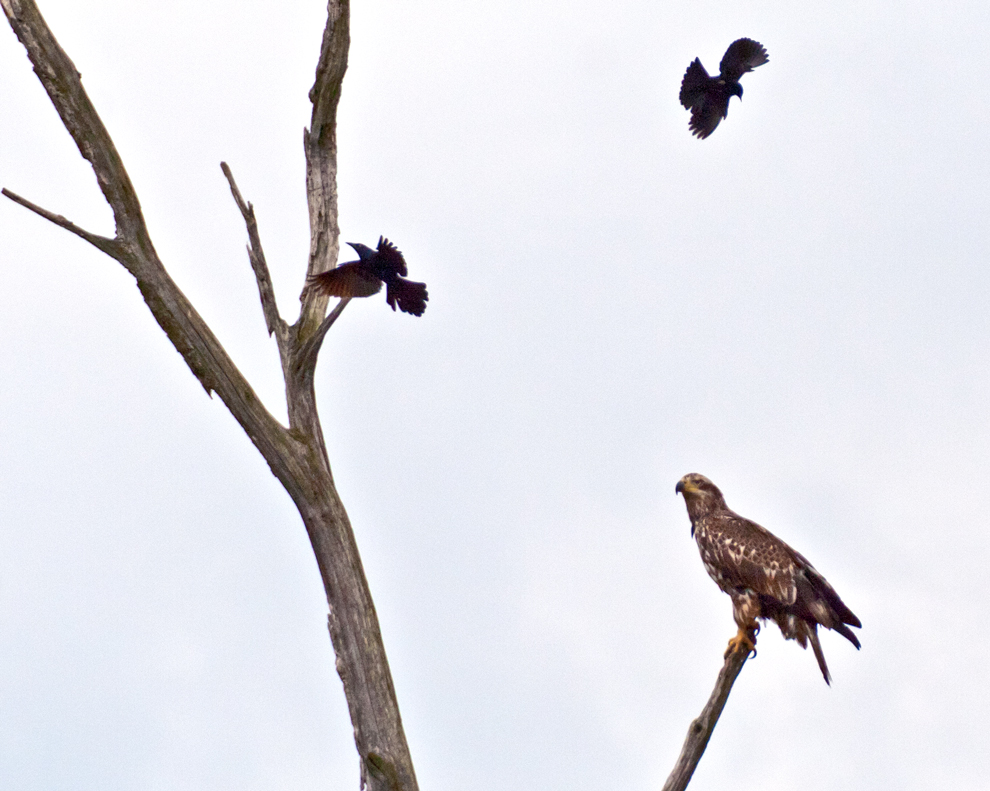
After doing an initial posting earlier this week on an encounter between a young Bald Eagle (Haliaeetus leucocephalus) and group of Red-winged Blackbirds (Agelaius phoeniceus), I reviewed my photos and came up with a few more to share.

These shots show various moments in the assault of the blackbirds, which seemed determined to harass the much larger eagle. I naturally paid the most attention to the juvenile eagle and tried to capture his attitude of alertness and wariness. After a few minutes of the off-an-on attacks, the eagle finally took off, seemingly in pursuit of the blackbirds.

It was amazing to watch this action and I am glad I managed to get some photos to document the encounter.

eagle3_blog

Buzzing the eagle (click on photo for higher resolution view)

eagle7_blog

Circling around for the next attack

eagle6_blog

Ever vigilant

eagle5_blog

Alert for the next attack

eagle4_blog

Relaxed but wary

Michael Q. Powell. All rights reserved

Read Full Post »

I was checking out a location this morning where I had previously seen an eagle, when suddenly a juvenile Bald Eagle (Haliaeetus leucocephalus) landed on the tree at which I was staring. He seemed a little flustered and I soon found out why—he was being harassed by a group of Red-winged Blackbirds (Agelaius phoeniceus). They may have been crows, but one of my shots seems to show a flash of red on one of the black birds.

I have a few more shots that I am working on, but thought I’d give you an idea of the scene that I witnessed. I am pretty sure that this is a juvenile Bald Eagle, but would welcome a correction if I am wrong. In any case, it was pretty exciting for me.

eagle1_blogeagle2_blog

Michael Q. Powell. All rights reserved

Read Full Post »

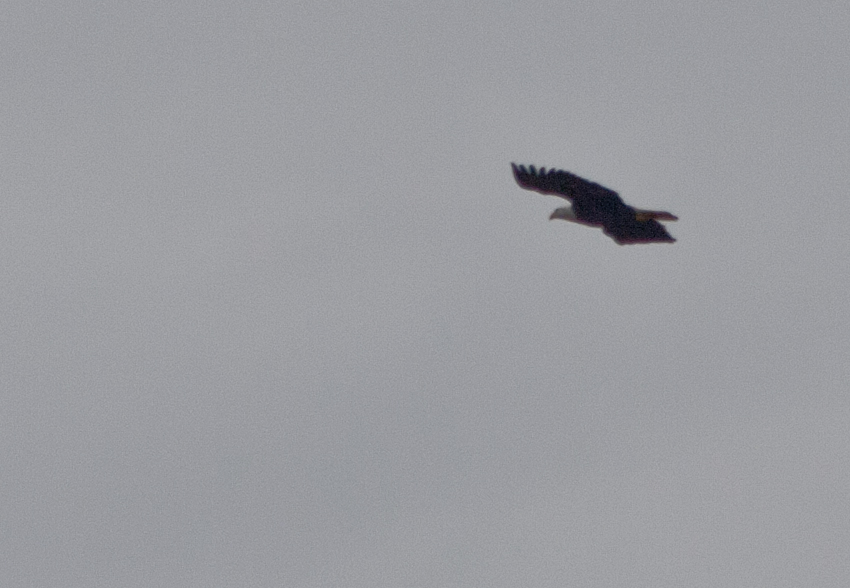
Yesterday I was observing ducks, geese, and gulls in one of the ponds at my local marshland, when suddenly they all took to the air. It seemed to me that something had spooked them and I quickly scanned the ground area and the water and found nothing. When I turned my eyes to the sky, however, I discovered a relatively large bird flying  across my field of vision in the distance

The day was dark and gray and rain clouds covered the sky, so the lighting was not very good. The poor lighting and the fact that the bird was so far away made it tough for me to lock on the focus of the camera, so I was able to snap off only a couple of shots before the bird disappeared completely in the distance.

The flight of the bird did not look like that of the vultures that I have photographed, so I thought that perhaps I had photographed a hawk, though it was hard to know for sure from the image on the little LCD screen of my camera. When I viewed the images on my computer, I was thrilled to discover that I had finally photographed a Bald Eagle (Haliaeetus leucocephalus). Maybe it’s because of the symbolism attached with the bald eagle—all I know is that I felt really happy with my discovery.

These two images are not really that clear and I hope to get better ones in the future. In many ways, I am continuing what I recognize as a pattern in my shooting. The first time I capture a new subject, I am so excited that I will share the image, irrespective of its quality. The second time, the quality of the image normally increases dramatically.

eagle2_blogeagle1_blog

© Michael Q. Powell. All rights reserved

Read Full Post »

« Newer Posts