Feeds:
Posts
Comments

Posts Tagged ‘Great Blue Skimmer’

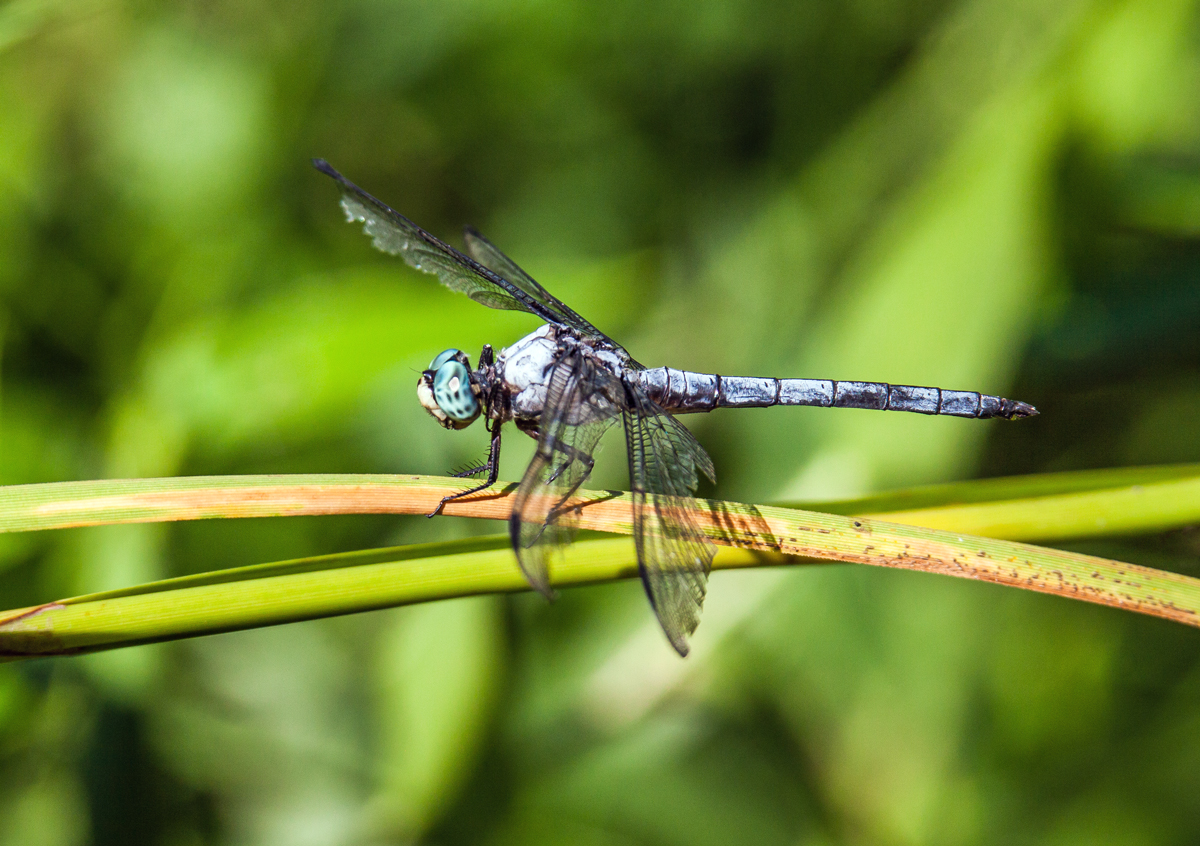
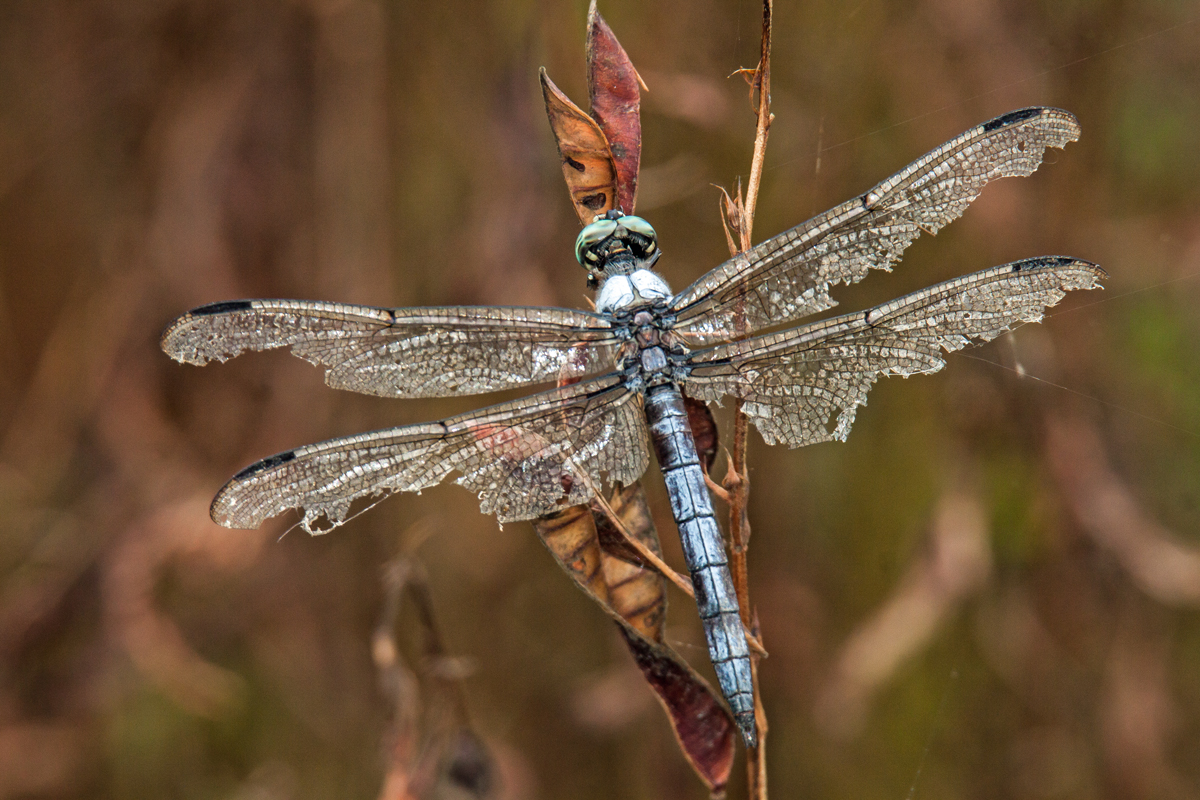
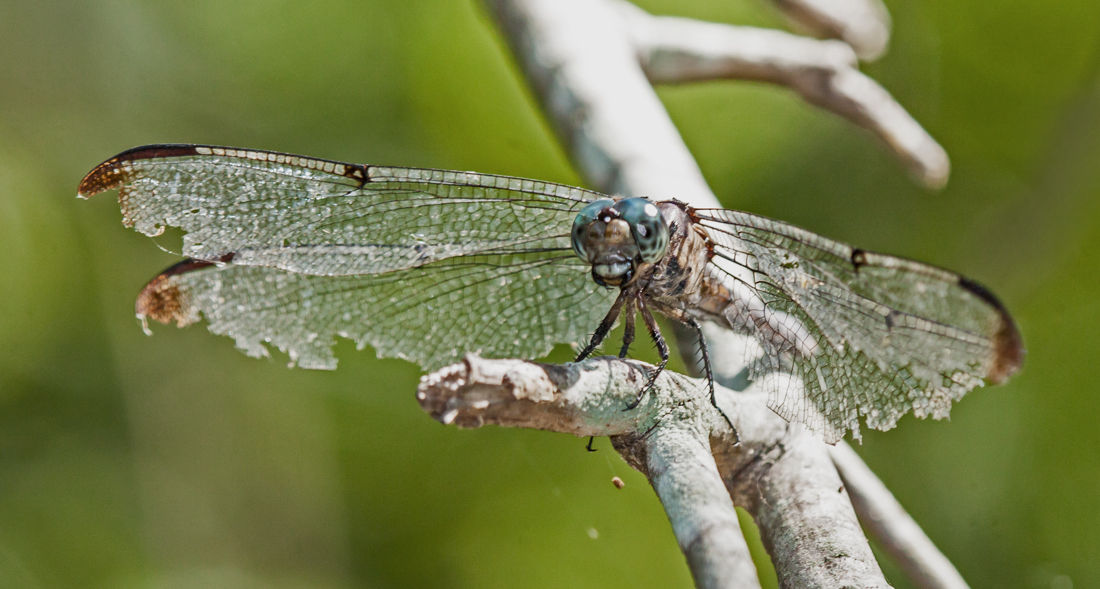
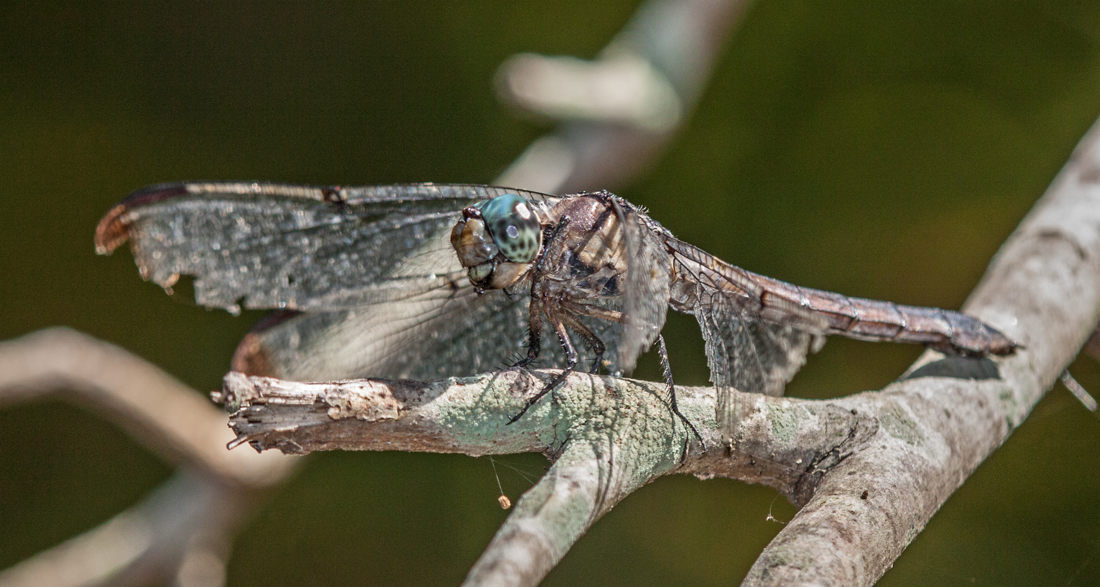
Most folks can readily identify a Great Blue Heron, but would you recognize a Great Blue Skimmer if you encountered one? This dragonfly’s wing pattern is fairly distinctive, but I usually look for its beautiful blue eyes and bright white face. I spotted these male Great Blue Skimmers (Libellula vibrans) on Monday at Huntley Meadows Park in Alexandria, Virginia.

Great Blue Skimmer

Great Blue Skimmer

Great Blue Skimmer

Great Blue Skimmer

© Michael Q. Powell. All rights reserved

Read Full Post »

Many of the dragonflies that I see this late in the summer have wings that are torn and tattered, yet they seem to still fly perfectly well. The dragonflies clearly are survivors—survivors of encounters with predators and thorny vegetation or even of overly energetic mating sessions.

Last Friday I spotted this Great Blue Skimmer (Libellula vibrans) as it perched on some bent stalks of grass. He is not a perfect specimen, but I can’t help but be drawn in by his beautiful speckled blue eyes.

Yes, he still deserves to be called “great.”

Great Blue Skimmer

© Michael Q. Powell. All rights reserved.

Read Full Post »

Females are a real mystery to me, especially when it comes to dragonflies. At this time of the year I see a lot of different dragonflies and I have featured a number of the colorful males over the past few weeks. They are relatively easy to identify when they are mature—immature males, however, often have the same coloration as females.

The challenge with females, particularly a number of the members of the Skimmer family, is that they all look pretty much the same.  This past Friday I photographed this beautiful female dragonfly and I love the two-toned coloration of her eyes. After consulting with my local dragonfly expert Walter Sanford, I have concluded that she is probably a Great Blue Skimmer (Libellula vibrans), though she doesn’t have a spot of blue on her

Great Blue Skimmer

© Michael Q. Powell. All rights reserved.

Read Full Post »

I love the speckled blue eyes of the male Great Blue Skimmer dragonfly (Libellula vibrans), like this spectacular specimen I spotted Monday at Huntley Meadows Park in Alexandria, Virginia.

Great Blue Skimmer

Great Blue Skimmer

© Michael Q. Powell. All rights reserved.

Read Full Post »

How was your summer? Did you take a vacation and relax or at least take some time off from work?

There are no vacations for dragonflies. It looks like this has been a long, hard summer for the male Great Blue Skimmer (Libellula vibrans) that I spotted earlier this month, judging from the almost shredded condition of his wings. Yet somehow, he is still able to fly and continues to survive

Autumn is almost upon us and the number of dragonflies that I observe is dropping. Before long, only a few hardy species will remain. For now, I take joy in seeing the tattered survivors, whose beauty is undiminished in my eyes.

Great Blue Skimmer

© Michael Q. Powell. All rights reserved.

Read Full Post »

One of the dangers of shooting with a macro lens is that I am often so focused on shooting close-up that I forget to step back and look at the bigger picture.

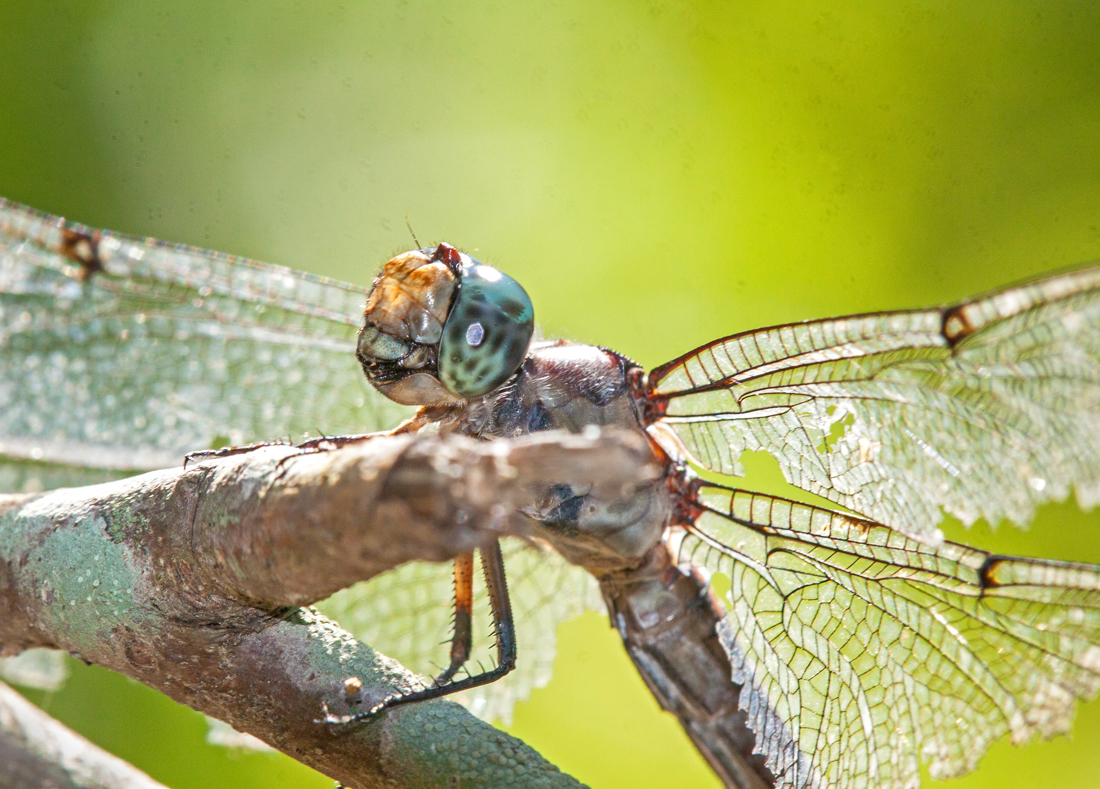
A couple of days ago, I posted a photo of a dragonfly basking in the sun and felt pretty content that I had been able to capture a detailed shot of its eyes and face. I had instantly gravitated to several close-up images to the point that I temporarily forgot that my initial shots had been from a greater distance. As a result, I made my preliminary identification on the basis of the facial shot alone.

After I posted the image on Facebook, one of my fellow photographers, Walter Sanford, who is much more of an expert on dragonflies than I am, asked me if I had any shots of the dragonfly’s entire body, probably with a desire to check my identification. When I reviewed my more distant shots of the dragonfly, I was immediately struck by how tattered the wings were of this female Great Blue Skimmer (Libellula vibrans). Sure, I’ve seen lots of dragonflies with minor damage to the wings, but these are seriously tattered.

When I posted these follow-up images on Facebook, Walter replied, “Definitely an old female Great Blue Skimmer dragonfly, as indicated by its tattered wings, coloration, and flanges beneath the eighth abdominal segment. The flanges are used to scoop and hold a few drops of water when laying eggs (oviposition), hence the family name “skimmer.” ”

Be sure to check out Walter’s blog for his wonderful shots of dragonflies and his more  scientific descriptions of his subjects. My background was more in the liberal arts area rather than in science, and my writing in my blog tends to be a reflection of that background.
tattered_blog tattered2_blog


© Michael Q. Powell. All rights reserved.

Read Full Post »
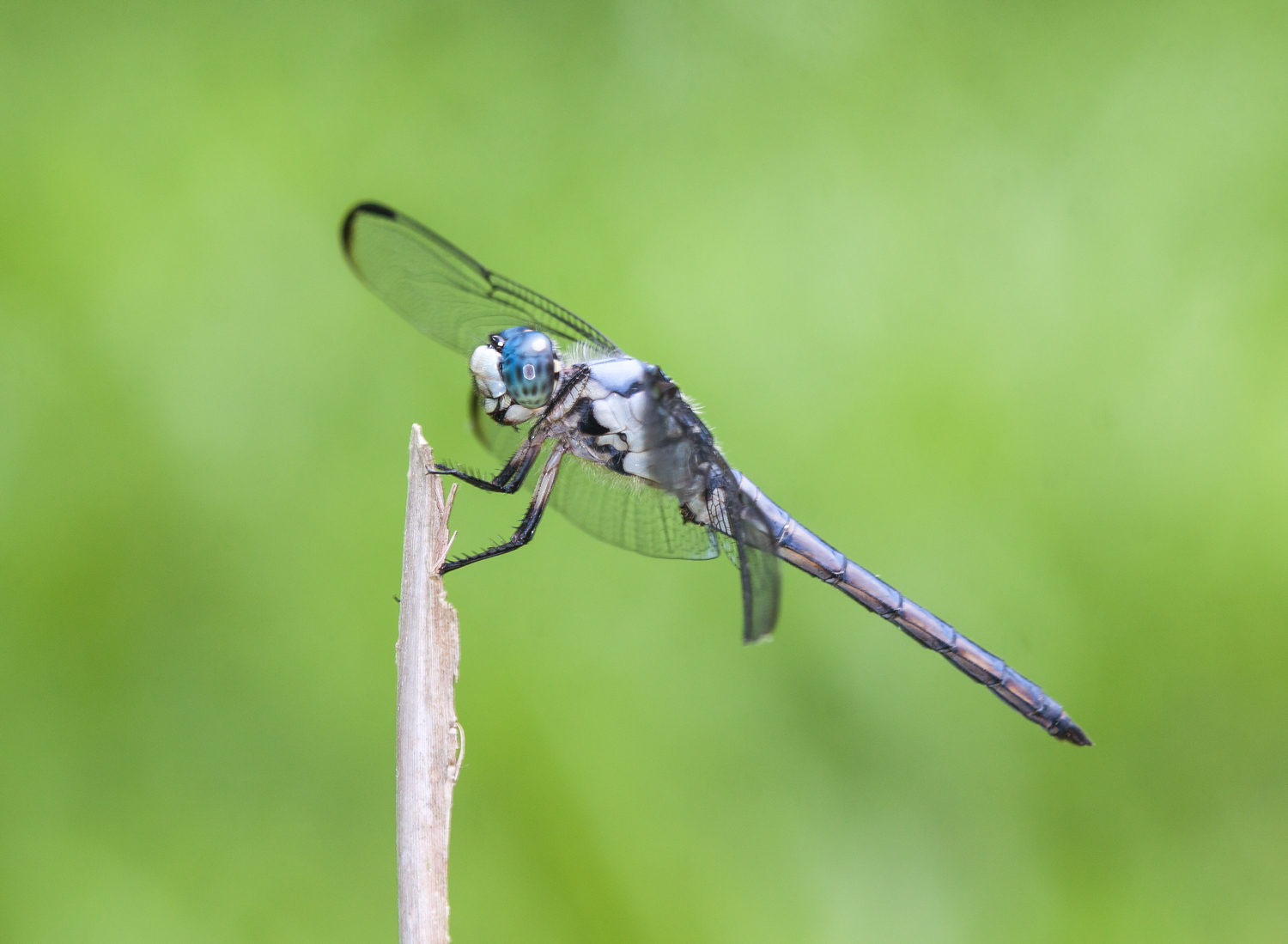
I was suffering in the heat and humidity on Friday, but this dragonfly, which I think is a female Great Blue Skimmer (Libellula vibrans), seemed to enjoy basking in the sunlight and let me get really close for this shot.

dragon_superclose_blog

© Michael Q. Powell. All rights reserved.

Read Full Post »

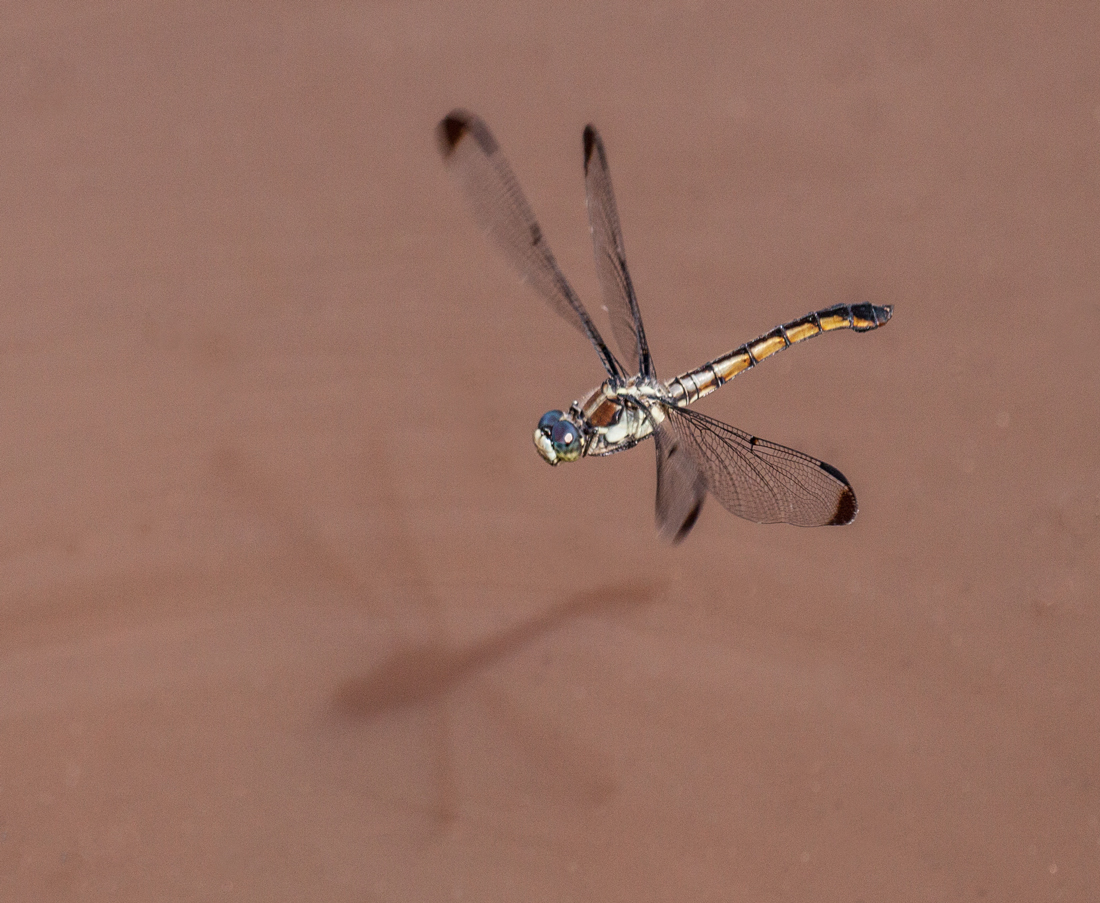
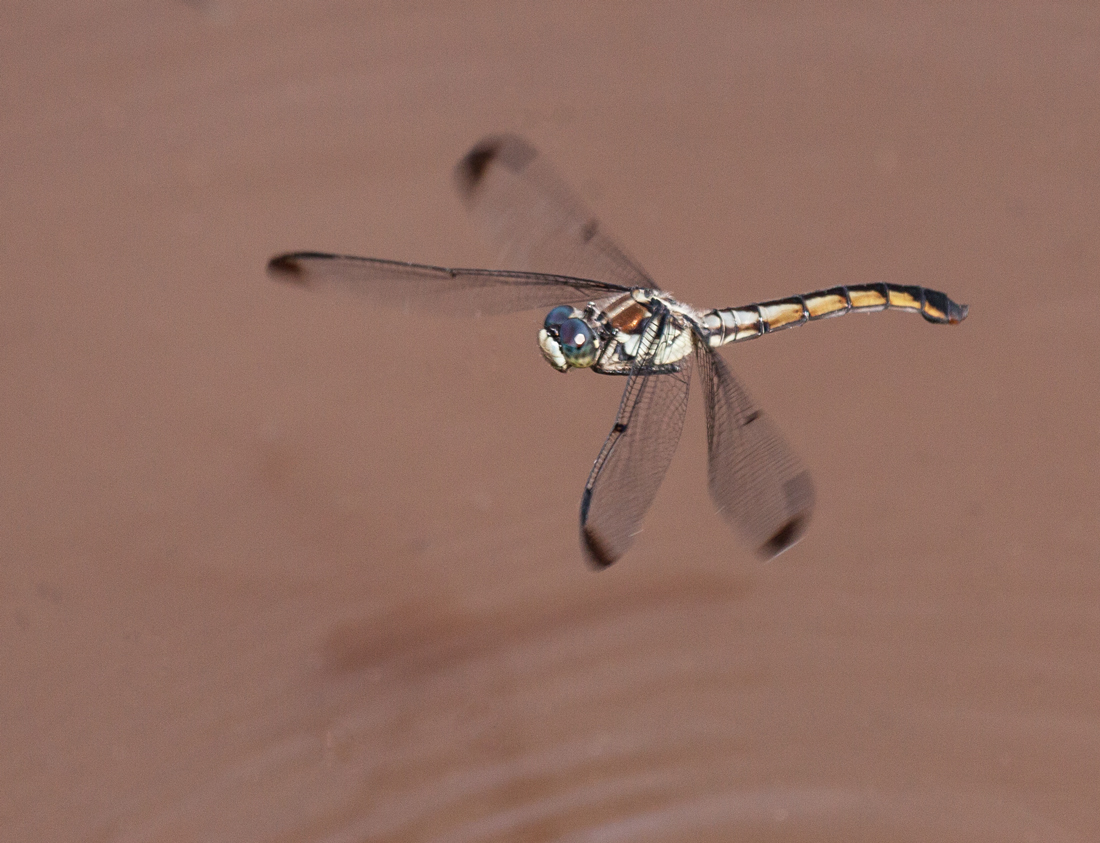
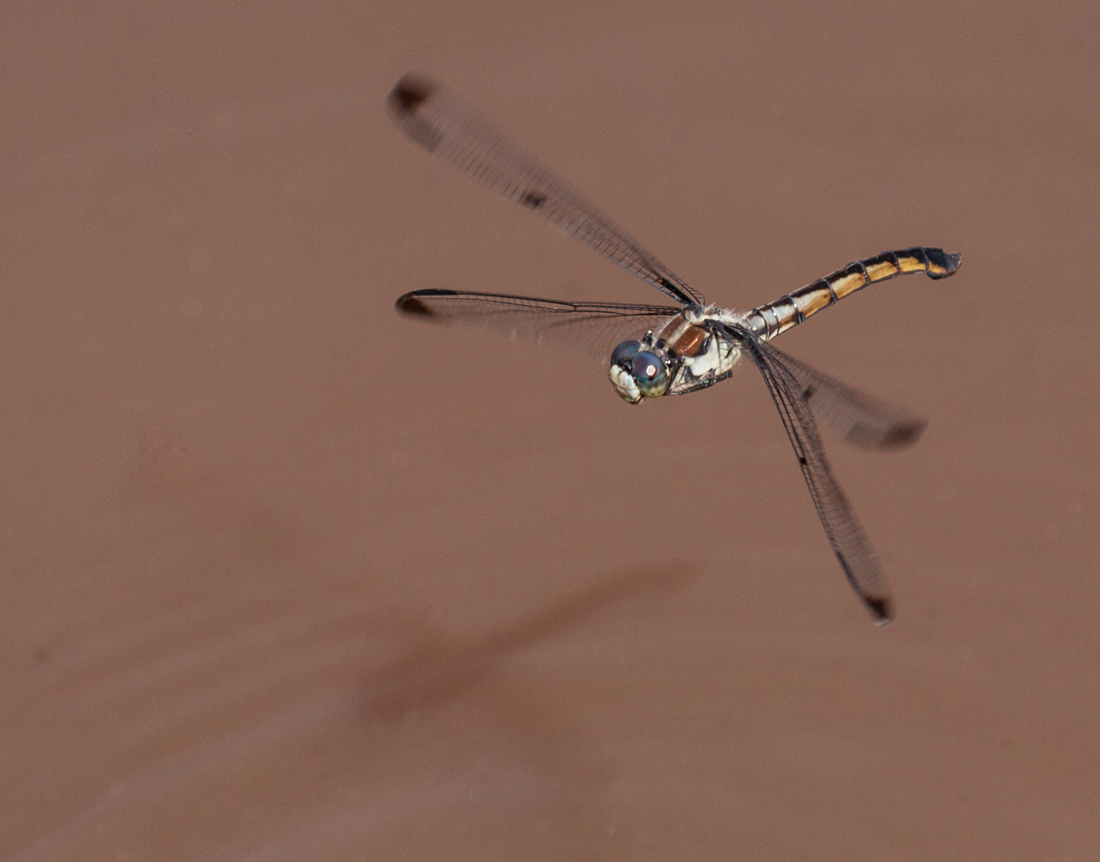
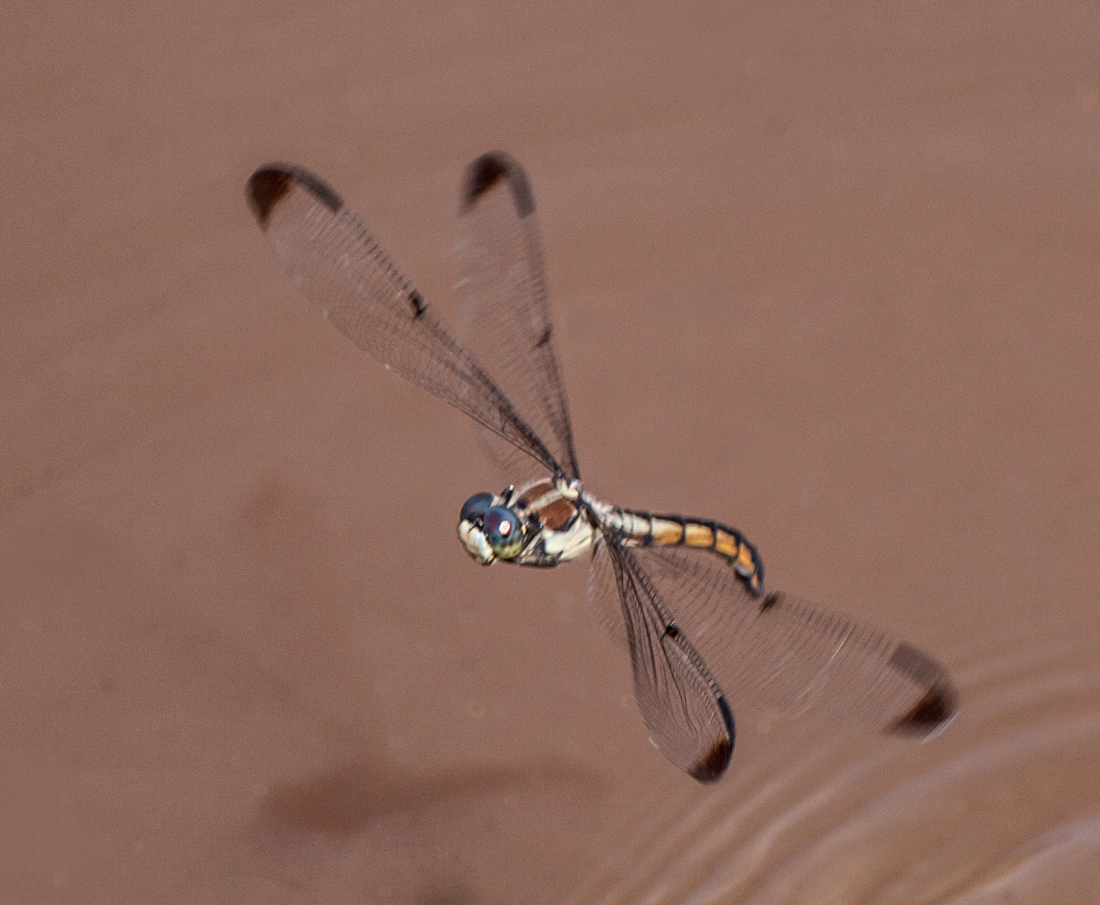
It’s tough to photograph a dragonfly in flight, but when it chooses to hover, there is a slightly better chance of getting a shot. That was the case recently when I encountered this female Great Blue Skimmer dragonfly (Libellula vibrans) that was in the process of depositing her eggs in the water. As her mate circled overhead, the female dragonfly would hover over the water and then periodically dip the tip of her tail in the water before returning to the hovering position. I was able to get several images of the hovering dragonfly, but got only a single image of her depositing the eggs.

flying1_skim_blogflying2_skim_blogflying3_skim_blogflying4_skim_blog

© Michael Q. Powell. All rights reserved.

Read Full Post »

As summer fades, I have been seeing fewer and fewer dragonflies, so I decided to attempt some in-flight shots and managed to capture these images of a female Great Blue Skimmer dragonfly (Libellula vibrans).

Photographing dragonflies in flight is one of my toughest photographic challenges, but I have learned a few tricks about capturing these kinds of shots. One way is to find a favorite perch of a dragonfly and try to photograph the dragonfly arriving and departing from that perch, given that dragonflies often return to the same perches. That was not the approach that I used this time.

The approach I used is to capture the dragonfly while it is hovering and is therefore in the same spot for a few seconds. I  watched as two blue skimmers mated quickly and I knew that I had a target of opportunity, because the female would soon deposit the eggs in the water. She hovered in the air and then dipped her tail end down to the water to deposit some eggs and returned to the hover position and repeated the process. It was during this process that I got these shots.

I am always struck by the beautiful blue eyes of the Great Blue Skimmer, particularly in the female. The male is all blue, so his eyes don’t provide the same visual contrast as the drabber colored body of the female.

The dwindling dragonfly population is yet another sign of the changing of the seasons—it won’t be long before I begin to focus my camera lens more frequently on birds than on insects, but I am not giving up on my insects quite yet.

skimmer_air2_blogskimmer_air_blog

© Michael Q. Powell. All rights reserved.

Read Full Post »

« Newer Posts