Feeds:
Posts
Comments

Posts Tagged ‘Great Blue Heron’

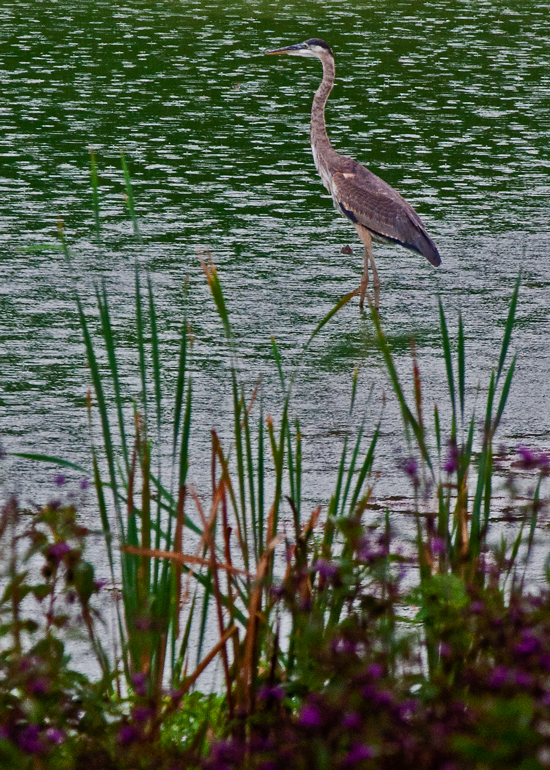
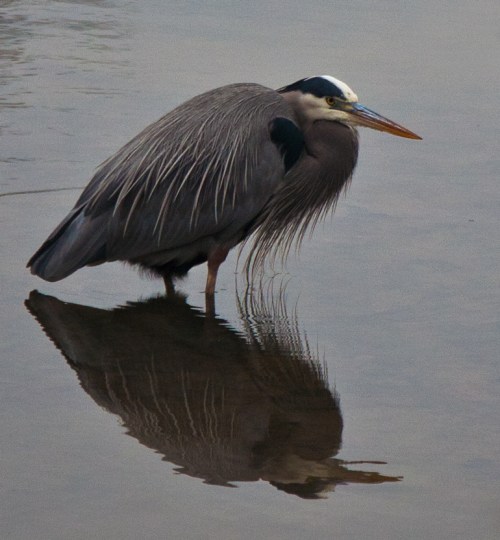
Late this afternoon, I was at a nearby suburban pond and noticed a Great Blue Heron (Ardea herodias) on the opposite bank. He was in a shaded area, where the water was calm and the reflections were beautiful. I was a bit too far away for a close-up shot, but couldn’t get any closer because of the bushes and underbrush that kept me from the water’s edge. Nevertheless, I was able to get some images that I like, including this one. I decided not to crop too closely to the heron in order to retain some of the bushes and their reflections that add a lot to the photo.

Heron in the shade (click for higher resolution)

© Michael Q. Powell. All rights reserved.

Read Full Post »

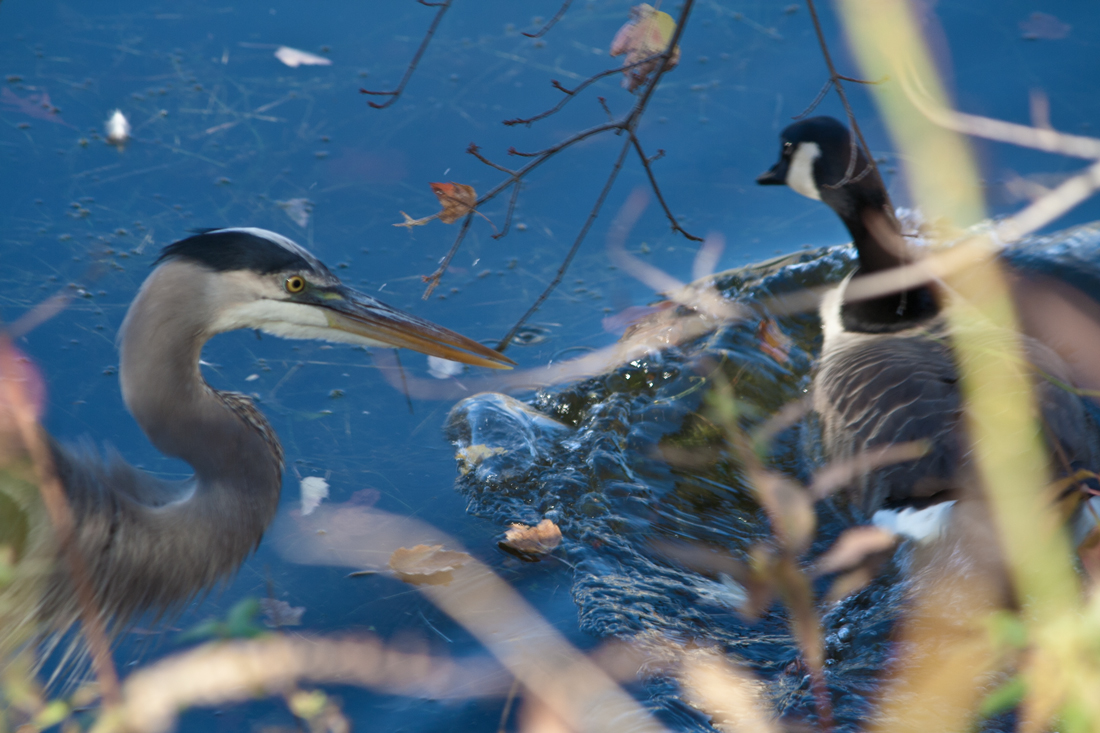
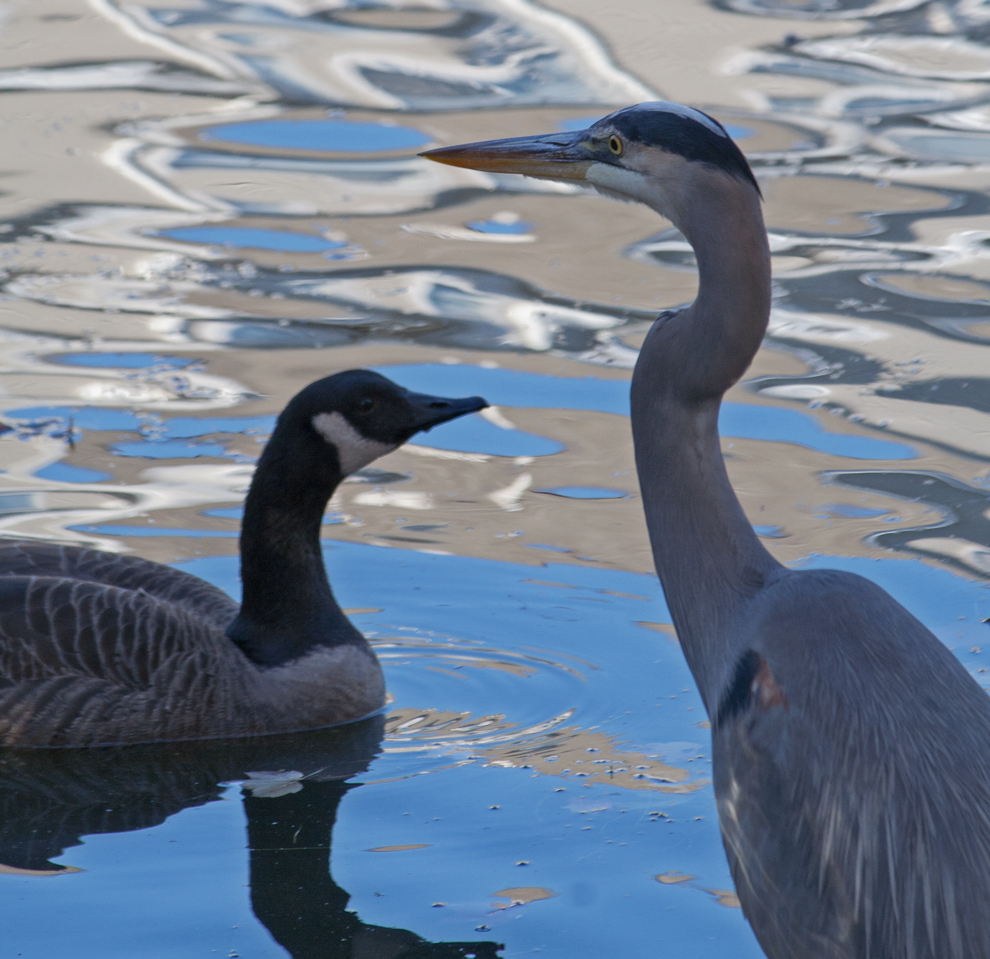
It is always interesting for me to see two species interact—you never quite know what will happen. Last Sunday, I was in the bushes in a local suburban pond area, pretty close to a Great Blue Heron (Ardea herodias). He seemed to be willing to tolerate my presence, though there were a lot of bushes that kept me from getting a clear shot. I photographed several encounters between the heron and Canada Geese (Branta canadensis) that live semi-permanently at the pond.

I took the first photo just after the heron made a threatening gesture with his beak at a goose that must have invade his personal space. The goose appears to have gotten the message and looks to be exiting the area. At the time of the shot, the sun was bright and was reflecting off the water, somehow turning it almost turquoise in color. The branches of the bush get in the way a little, but don’t detract too much from the charm of the photo. The whole effect is to make the image look almost as much like an illustration as a photograph.

“I need my personal space.”

The second photo is much less action oriented and is a study in contrasts. The goose seems to be looking at the heron with wonderment and curiosity, while the heron seems to be cool and disinterested. The background reminds me a little of a psychedelic image from the 1960’s.

“How did you grow to be so tall?”

© Michael Q. Powell. All rights reserved.

Read Full Post »

Yesterday afternoon, I took some photos of a Great Blue Heron (Ardea herodias) in the little pond in my suburban neighborhood. He seemed amazing mellow and content to relax in the shade. Consequently, he was pretty tolerant of my presence and that of the nearby Canada Geese. Here’s a sneak preview of the shoot, an image that captures the heron with the reflections of the remaining fall foliage.

Fall reflection of a Great Blue Heron

© Michael Q. Powell. All rights reserved.

Read Full Post »

The water level in the area of the marsh where I photographed herons and egrets earlier this summer is so low that it is now just a big puddle. Therefore, I was surprised early one morning this past weekend to see a Great Blue Heron (Ardea herodias) wading in the water. The light was not very bright, but the surface of the water had a really beautiful reflection of the orange of the fall foliage. The heron was a pretty good distance away and I was on a boardwalk, so my options were limited for framing my shots. Here are a couple of my favorite shots of the heron, surrounded by the reflection of the fall colors.

Great Blue Heron in the fall at Huntley Meadows Park

Fall reflection of a Great Blue Heron

© Michael Q. Powell. All rights reserved.

Read Full Post »

It was early in the morning and I was walking almost directly east along a stream. The sun had already risen and was in my eyes, but I spotted a Great Blue Heron in the water. I was able to get a shot that I knew would turn out as a silhouette, but the heron was standing in such a way that I was pretty confident that his silhouette would be immediately recognizable. The glare caused the color to wash out almost entirely and there are all kinds of artifacts from the light, but I like the overall effect.

Great Blue Heron Silhouette

© Michael Q. Powell. All rights reserved.

Read Full Post »

This is another shot of the Great Blue Heron (Ardea herodias) who was so cooperative today in permitting me to get close to him. In this shot, his eyes are fixed intently on the water, which unfortunately was covered with some combination of algae and duckweed. There was virtually no way for him to spot any potential prey below the surface of the water. His body seems coiled, ready to strike at a moment’s notice. He remained in this position for quite some time, but eventually he relaxed and gave up the hunt. Later, he moved to the other small pond and was equally unsuccessful there.

Focused blue heron (click for a higher resolution view)

© Michael Q. Powell. All rights reserved.

Read Full Post »

I was lucky today. Normally when I have tried to photograph Great Blue Herons (Ardea herodias), I have had to do so at the maximum range of my telephoto zoom lens and even then would have to crop the image significantly. The result has been that my photos have not been as sharp or detailed as I would have liked.

Today was different. I was walking around the little ponds at Green Spring Gardens, a county-run historical park where I had previously taken photos of a green heron, when I startled a Great Blue Heron who had been perched in a tree. He flew off high into a tree across the pond and remained there as I followed him and tried to take some photos. I have not yet looked at those photos, but suspect that they are a little distorted, given that I was shooting almost straight up.

It started to drizzle a bit. When all of the other visitors left, the heron flew down from the tree and landed no more than 30 feet from me. He wandered along the water’s edge, periodically entering the water and staring intently at its surface, probably searching for something to eat. I cautiously approached him and he let me get with fifteen feet or so of him and I even circled around him trying to get a decent angle and background for a shot. How close was I? At times I could not use the full range of my 55-250mm lens if I wanted to capture his whole body.

Here is one of my initial favorite shots. I shot it with the lens extended to 194mm with settings of f9.0, 1/200 sec, ISO 400, and an exposure compensation of -.67. Other than a little sharpening and a little cropping, this is the way the image came out of the camera.

Indeed, I was lucky today to encounter an unusually cooperative Great Blue Heron.

Cooperative Great Blue Heron

© Michael Q. Powell. All rights reserved.

Read Full Post »
Great Blue Herons (Ardea herodias) look graceful when they are flying or when they are wading, but they sure look awkward and gawky when on dry land. This heron seemed to be taking a break in the shade on a sunny, fall day. I took this photograph yesterday at Cameron Run, a tributary stream of the Potomac River, where I often see both egrets and heron. I do not know if they will remain here through the winter, but I hope that they do.

Great Blue Heron in the underbrush

© Michael Q. Powell. All rights reserved.

Read Full Post »

This shot has some great elements—a Great White Egret and a Great Blue Heron,  practicing together in the trees for their audition for “Dancing With the Stars.” They look to be almost perfectly synchronized, though the heron may need to work on his neck position. From a technical perspective, alas, the shot is far from great, but it was interesting enough that I decided to share it.

I frequently see egrets roosting in the trees along Cameron Run, a stream in Alexandria, Virginia that feeds into the Potomac River, but this is the first time that I had seen a blue heron fly into the trees. I was shooting from a running path that parallels one side of the stream.  Shooting across a considerable amount of growth as well as the stream itself, I find it difficult to get a close-up shot. In this photo, I had startled the heron and he took off into the trees, startling the egret, who was already perched there.

Dancing in the trees

I continue to have difficulties getting good shost of the egret, because there is often glare and it is hard to keep the highlights from blowing out. Here is a shot of an egret in partial shade that has some detail, but I can’t seem to keep the detail without imparting a grayish tinge to what is a really white bird. I will definitely keep trying, though, because I find the egrets and herons to be fascinating to watch in their almost geeky gawkiness.

Egret in a tree along Cameron Run

© Michael Q. Powell. All rights reserved.

Read Full Post »

The water level in the marsh at Huntley Meadow Gardens here in Alexandria, VA has been getting lower and lower as the summer has progressed. I suspect that the situation had made it more difficult for some of the inhabitants to find food and may have increased competition for the available food.

Previously I posted photos of a Great Blue Heron catching a fish in the remaining water of the pond of the marsh. Last week I had the chance to watch a series of confrontations between a Great Blue Heron and a snapping turtle. It seemed to start when the  heron grabbed a fish out of the water just as the turtle was approaching him. I had the impression that the turtle might have been pursuing that same fish. The snapping turtle made a series of aggressive runs at the heron, getting really close to the heron’s legs. I have seen pictures on-line of a snapping turtle pulling down a Great Blue Heron, so I waited with fear and anticipation to see what would happen. The heron left the water this time without any bodily injury. (I have some photos of this initial confrontation that I might post later, but their quality is not as good as those of the second round of confrontations.)

The heron eventually went back into the water and it wasn’t long before the snapping turtle came at him again. (I could almost hear the music of the movie “Jaws” in my head as the turtle made a run at the heron.) Like a matador side-stepping a charging bull, the heron awkwardly avoided the turtle who was approaching him faster than I’ve ever seen a turtle move. The heron then turned his back on the turtle and started walking away, perhaps feeling the hot breath of the turtle who continued to pursue him. Finally, the heron took to the air, deciding that he had had enough of the persistent turtle.

I managed to capture the highlights of the confrontation with my camera. I continue to marvel at the wonders of nature as I observe new creatures and see familiar ones act and interact in new ways.

Snapping turtle approaches Great Blue Heron

Great Blue Heron steps to the side as snapping turtle gets aggressive

Great Blue Heron walks away with snapping turtle in pursuit

Great Blue Heron decides to leave his problems behind

© Michael Q. Powell. All rights reserved.

Read Full Post »
I love to shoot in the rain. This past weekend the weather was threatening, but I went to Huntley Meadows Park anyway and was happy to see both a Great Blue heron and a green heron. It was already sprinkling a little when I started to take some photos of this little green heron and I had my umbrella out. I like the effect of the raindrops on the surface of the water. The light was interesting too and the heron cast a reddish, blurry reflection in the water.

Green heron in the rain

The weather started to worsen as I headed toward the location where I previously had seen a Great Blue heron. That area has a two-tiered observation area and I knew the lower level is partially sheltered from the rain. I arrived just in time as the rain started to come down really hard. The first photo of the Great Blue heron shows him standing in the water as the rain pours down. It didn’t seem to bother him at all. The quality of the photo is not that great (the light was bad and I upped the ISO), but I like the effect. The second photo shows the same area as the downpour is ending and the water appears as a very vivid green and looks almost tropical.

Great Blue heron in the driving rain

Great Blue heron as the rain tapers off

The rain may not be the time to take perfect photos, but I personally like the look that it gives to some of the photos that I shoot.

© Michael Q. Powell. All rights reserved.

Read Full Post »
Rain was gently falling as I observed a Great Blue Heron at Huntley Meadows Park, a marshland in Alexandria, VA. I was surprised to see how the open water area had shrunk to just a small pool over the past couple of months, presumably because of the lack of rain.

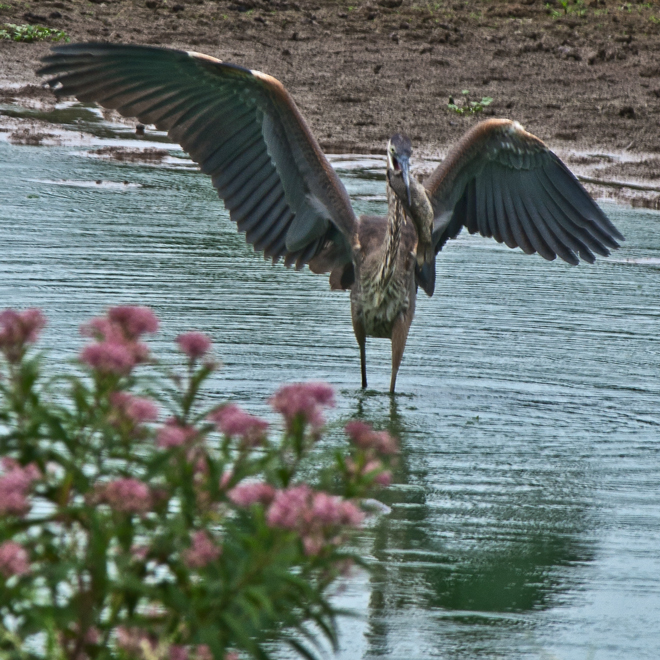
Nonetheless, there was a heron in the middle of that pool, seemingly intent on catching a fish. I was not at all convinced that there were any fish in such a small body of water, but the heron soon proved me wrong. He extended his neck and made a strike into the water and came up with a fish. As he brought the fish out of the water, he opened his wings widely (as the second photo shows), perhaps to counterbalance the weight of the fish. The heron’s wingspan was definitely impressive. He kept his wings partially extended as he moved the fish around in his mouth (as you can see in the first photo) and then swallowed the fish whole.

My photos are not technically great, but they did capture the moment pretty well.  I am thankful that I once again had the privilege to watch such a beautiful creature in action.

Great Blue Heron positions fish prior to swallowing it

Great Blue Heron opens his wings as he pulls a fish out of the water

© Michael Q. Powell. All rights reserved.

Read Full Post »

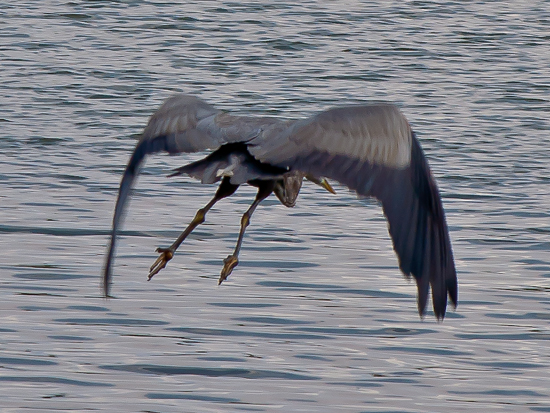
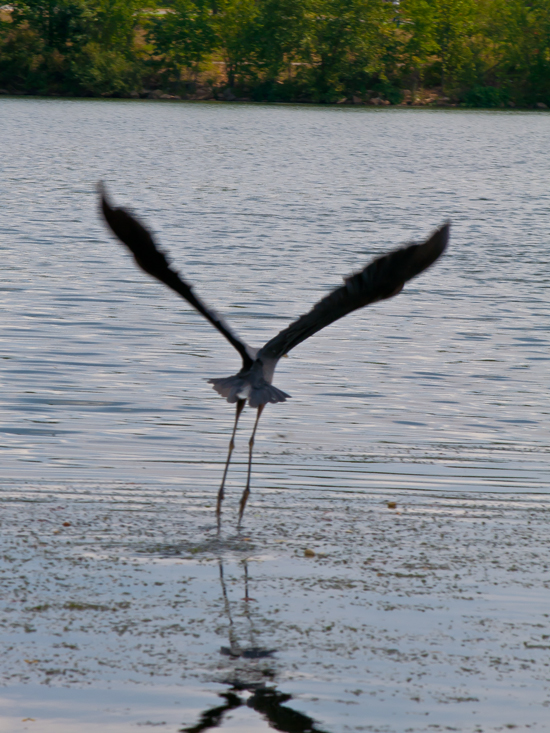
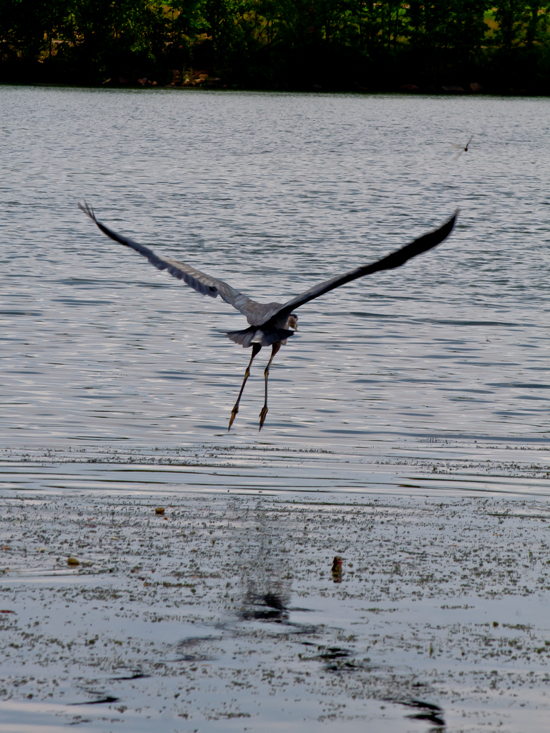
I haven never really paid attention to how birds take off. This past weekend I was photographing a Great Blue heron wading in the water of a nearby pond.  Without any prior indications, he suddenly took to the air. I happened to be in a good position to get a few shots of the different positions his wings assumed as he lifted off from the water. As you can see, I was almost directly behind the heron.

The first photo is my favorite because of the way in which the wings frame the extended legs and the barely visible head. Out of the three photos I have posted here, this was the second one shot.

The photo below shows the heron just as he was taking off from the water. The wings are blurry and are almost like a silhouette. It seems like he had to flap them really hard to lift out of the water. I like the fact that I was able to capture part of his reflection in the water.

Lifting off from the water

This final shot shows his wings in what I consider to be a normal flying position. I haven’t observed herons enough to know if they eventually pull in their legs tighter when they fly higher, but I assume that to be the case. In this photo I managed to get more of a complete reflection in the water than in the previous one.

Spreading his wings

I learned a few things when shooting these photos. First, and perhaps most importantly, I learned how important it is to be ready at all times, because a static situation can become very dynamic very quickly. Secondly, I now understand better why serious wildlife photographers have really big (and expensive) telephoto lens—it’s tough to get in close enough. Finally, I appreciate much more the abilities of those who are able to capture moving subjects like this heron with perfect focus and sharpness. My photos are not very sharp and clear, but I still found them interesting enough to want to share them.

© Michael Q. Powell. All rights reserved.

Read Full Post »

Here is a close-up of a Great Blue Heron (Ardea herodias) who has just speared a fish of an unknown type. I was able to watch the whole process from the shoreline of the pond and took some shots.

I note that the photo here is not a super crisp, clear image. It is a crop of a shot that I had to tweak because of some problems getting the exposure right (reflected light off the water and shadows were both problem), but I like the fact that you can see both the heron’s and the fish’s faces.

In a posting on 24 July I showed a green heron swallowing a frog whole. I was not able to see how this blue heron consumed the fish because he carried it into a shaded area along the shoreline.

© Michael Q. Powell. All rights reserved.

Read Full Post »

Here is another shot of a Great Blue Heron (Ardea herodias) that I photographed 11 August 2012 in Alexandria, Virginia.

At first I couldn’t figure out why he had his mouth open in so many of my pictures. As I went over the photos, however, it looks like he may have had a stick or bone stuck in his mouth. Is that possible? Earlier in the day I watched as he speared and ate a fish and it’s possible he picked up some debris when he caught the fish (my photos of him spearing the fish turned out really dark but I’ll see if I can salvage any to post).

Eventually he did close his mouth.

Click on the image for greater details.

© Michael Q. Powell. All rights reserved.

Read Full Post »

Great Blue Heron (Ardea herodias) photographed 11 August 2012 in Alexandria, Virginia.

Click on photo for greater details.

© Michael Q. Powell. All rights reserved.

Read Full Post »

« Newer Posts