Feeds:
Posts
Comments

Posts Tagged ‘Great Blue Heron’

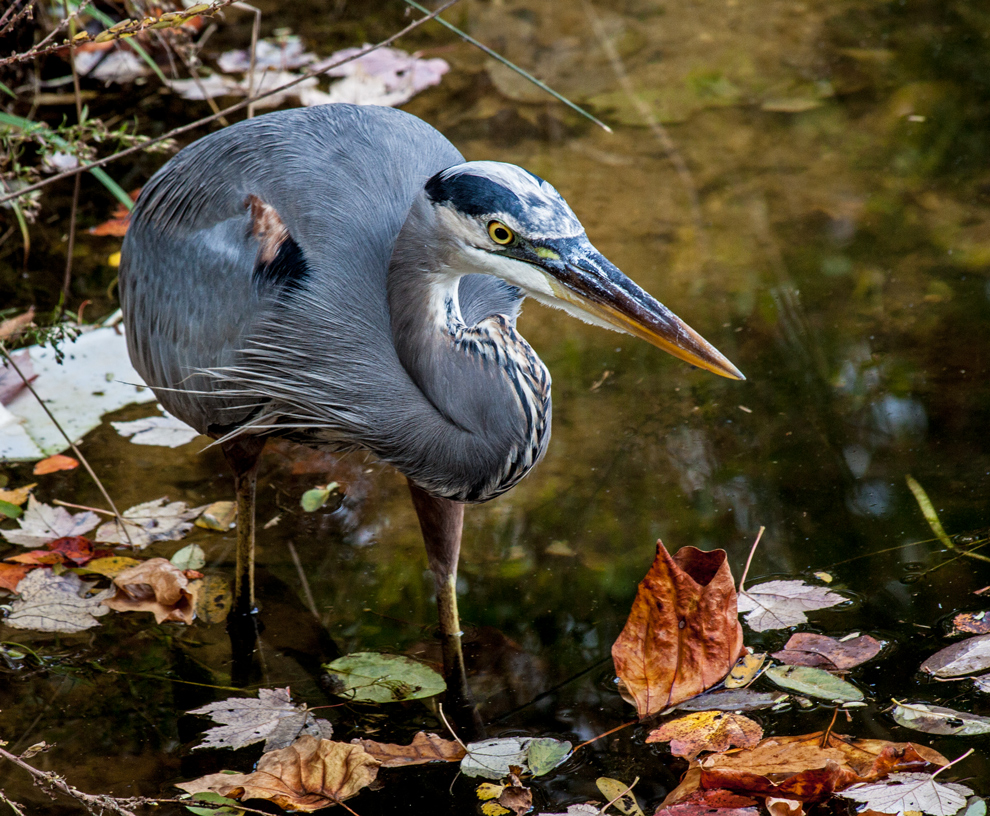
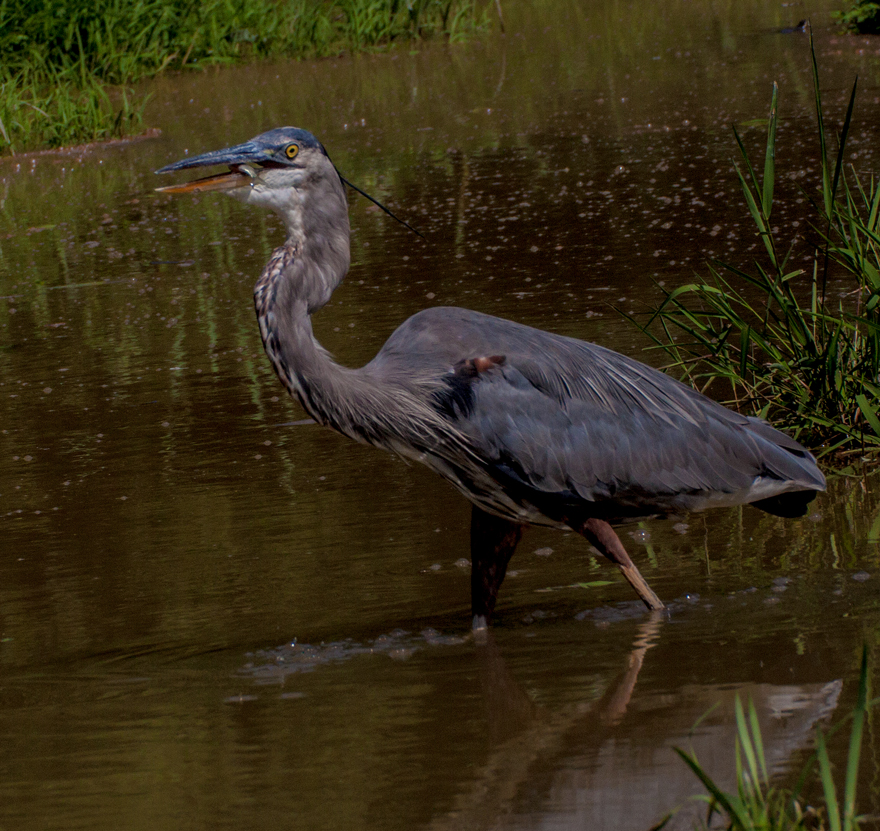
Saturday, I went out with fellow photographer Cindy Dyer to take photographs of the fall foliage and we stopped at a little suburban pond, where I managed to get this close-up shot of a Great Blue Heron (Ardea herodias) crouching at the edge of the water. If you want to see some awesome shots of the fall colors in Northern Virginia, check out Cindy’s blog—she was quicker than I was in posting her shots.

I was able to get this downward-looking angle for the image because I was on a small bridge that is part of a walking path around the pond. The heron was focused on trying to catch prey, though he didn’t seem to be having too much success. Judging from its relatively small size and inexperience fishing, I suspect that this might be a juvenile heron.

I took a number of other shots of the heron that I will probably post, including an encounter with what I think is a juvenile cormorant. Stay tuned.

heron_crouching_blog

© Michael Q. Powell. All rights reserved.

Read Full Post »

If you are a heron, how do you get  a fish down your throat and into your stomach after you have caught it? Some animals and birds of prey might tear off a bite-size piece of the fish using claws or talons. Herons don’t have that option. They have to somehow maneuver their catch within their bills until they are in a position to swallow it whole, all the time at risk of dropping their catch back into the water and losing it.

I enjoy watching Great Blue Herons (Ardea herodias) fish. They seem to be extremely focused, but patient as they wait for the optimal moment for a strike. This past weekend, I observed this heron in the waters of the Potomac River, just south of the city of Alexandria, Virginia. I watched and waited with my camera focused and ready until the heron struck and pulled a modest fish out of the water.

The heron made several adjustments to the fish’s position by making small movements with his head until it was in the ready position shown in the second photo. He them gave a little flip of his head, launching the fish into the air, and opened his mouth wider, as you can see in the first image. In a split-second the fish was gone and the heron was swallowing.

Every time I see a heron fishing, I am hoping that I will see him pull a really big fish out of the water, as I have seen in photos on other blogs.  So far I have seen the herons catch only small fish and an occasional crayfish or frog, but I hope to be ready when a heron catches a “big one,” so that I won’t have to be the one who tells stories of “the one that got away.”

heron_fish2_blog

heron_fish1_blog© Michael Q. Powell. All rights reserved.

Read Full Post »

The bright fall colors of the trees at the pond’s edge were reflected beautifully in the water and I waited until the Great Blue Heron (Ardea herodias) moved into those reflections to capture this shot.

The effects of the light on the water remind me a little of some of the paintings of Monet, one of my favorite artists. Normally when I am photographing birds, I do my best to fill the frame with them, but in this case the context was actually more important to me than the apparent subject.

heron_fall_light_blog

© Michael Q. Powell. All rights reserved.

Read Full Post »

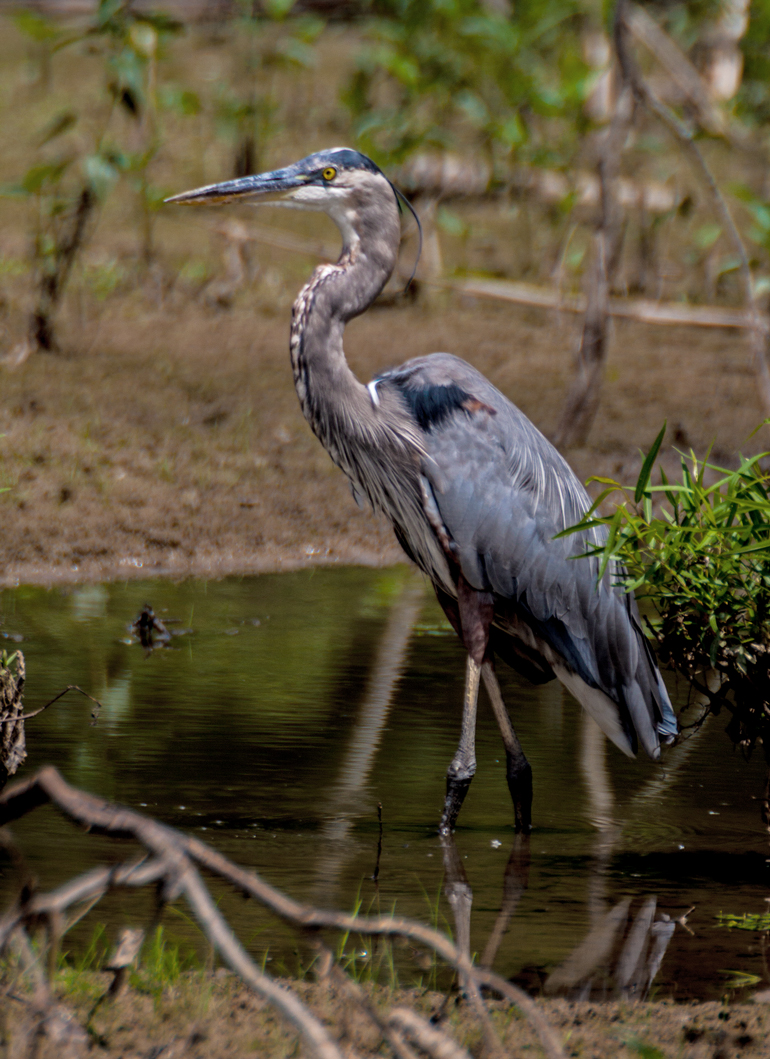
A blue heron with attitude? The pose, facial expression, and hair style of this Great Blue Heron (Ardea herodias) at Huntley Meadows Park, my local marsh, remind me of a punk rocker. Do you think he has tattoos and body piercings too?

heron_punkrocker_blog

© Michael Q. Powell. All rights reserved

Read Full Post »

This Great Blue Heron, which I think was a juvenile, was clearly not experienced at hunting for food. Unlike his more patient elders, he seemed unable to stay in one spot for more than a few minutes and his success rate when he made a strike was not very high. He was persistent, however, and I kept hoping that he would pull a frog or some other tasty morsel out of the waters of the beaver pond.

I readied myself as he prepared for another strike and fired away as he triumphantly pulled his catch out of the water. The photo confirmed my initial impression—the big catch was just a leaf that had been floating on the surface of the water.

With more practice, this heron’s fishing skills are sure to improve or it is going to be a long, cold autumn and winter for him.

heron_leaf_blog

© Michael Q. Powell. All rights reserved

Read Full Post »

Yesterday I went shooting on Theodore Roosevelt Island, a small nature preserve in the Potomac River, just opposite Washington D.C.  that is accessible by a small bridge from the Virginia side and got this shot of a Great Blue Heron (Ardea herodias). The heron took off when I got a little too close to it.

One of the interesting problems of shooting in an urban environment is that it is hard to control the background. The long shape behind the heron is a one-man crew scull. If I hadn’t cropped the image, you would have been able to see the brightly clothed rower.

heron_potomac1_blog

© Michael Q. Powell. All rights reserved

Read Full Post »

The Great Blue Heron stealthily moved into position and leaned forward, preparing to strike. Would he pull a great big fish out of the water? The second photo provides the answer.

The catch was relatively modest, a tiny fish, dwarfed by the size of the heron’s bill. The heron obviously did not believe in the “catch and release” policy used by most fisherman for such small fish. Turning his head back a little, the heron had no trouble swallowing the little fish. He even seemed to smile a little as he did so, content that he had been successful in his fishing.

Having consumed his appetizer, the heron got back to fishing, hoping to catch a more substantial dinner.

fishing1_blog

fishing2_blogfishing3_blog

© Michael Q. Powell. All rights reserved.

Read Full Post »

Coming in for a landing, this Great Blue Heron (Ardea herodias) stretched out his wings to their full extent and the sight was mighty impressive. The wings stretched out so wide, in fact, that I couldn’t fit them entirely into the frame. As he reached the ground, the heron gradually pulled in his wings and I was able to get a couple of additional shots of the impressive wingspan.

wingspan1_blog

wingspan2_blog wingspan3_blog

© Michael Q. Powell. All rights reserved

Read Full Post »

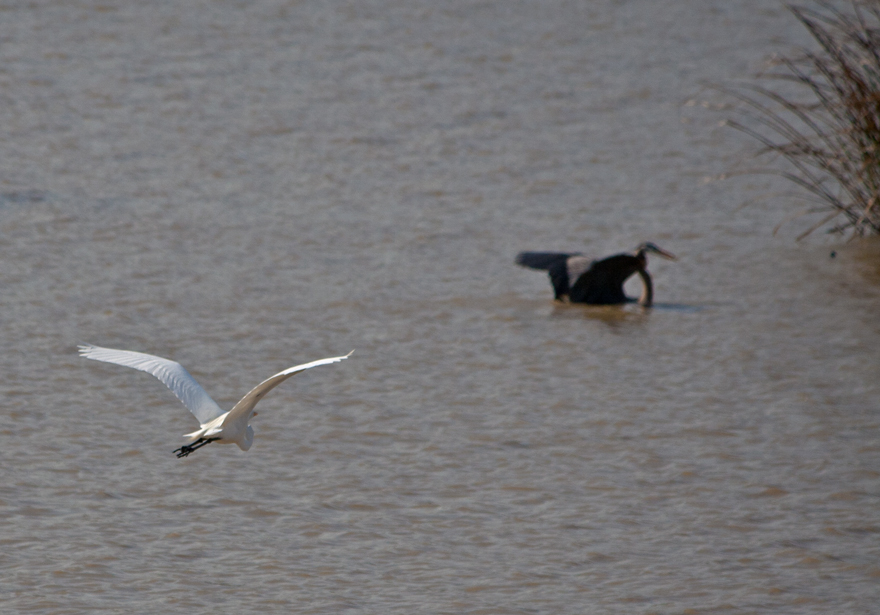
Without fill-in light, a backlit subject is often in the shadows and becomes a silhouette, which is what happened in these shots of a Great Blue Heron taking off from a watery area of my local marshland park. The same sunlight in front of me also created beautiful reflections of the heron in the water, and I really like the combination of the silhouettes and reflections in these images.

This heron was getting ready to give chase to another blue heron and was squawking loudly as it took off. I watched the two herons for quite a while and this one went out of his ways several times to harass the other one and force it to search for prey in the vegetation away from the pool of water. As you can see in the second and third photos, a Great Egret was a spectator to the action, lifting up its head to observe what was going on. When things calmed down, the egret returned to its fishing until the next round of activity from the herons.

heron_silhouette1_blog heron_silhouette2_blogheron_silhouette3_blog

© Michael Q. Powell. All rights reserved

Read Full Post »

Do Great Blue Herons (Ardea herodias) have a sense of humor? What would prompt one to burst out in laughter?

Maybe one of the many turtles surrounding the heron’s feet decided to tickle them. (Click on the photo to get a better look at the turtles).

Perhaps he is preparing for an audition for the reality television show America’s Got Talent. What’s his talent? Judging from his appearance, I’d say this heron might have a future as a stand-up comic. I might have captured hims as he was trying out new material on the turtles, which are notoriously tough as judges—you have to be really funny to be able to penetrate those thick shells.

laughing_heron_blog

© Michael Q. Powell. All rights reserved

Read Full Post »

When it started to rain yesterday, I pulled out my umbrella and kept shooting for a while, permitting me to get this close-up shot of a Great Blue Heron (Ardea herodias).

The heron was stoically enduring the rainfall, as drops of water began to bead up on its shoulders. The wind started to kick up a little too, ruffling some of the feathers on the heron’s chest. I was afraid that my white and green umbrella would spook the heron, but I was able to get pretty close to the heron to get this shot at the far end of my 55-250mm zoom lens. If you click on the photo, you can see these (and other) details in a higher resolution image.

There are many flowers blooming in my local marshland park right now and I really like the little splashes of yellow in the background of this image.

heron_closeup1_blog

© Michael Q. Powell. All rights reserved

Read Full Post »

Have you ever seen a Great Blue Heron (Ardea herodias) attempt to do a vertical takeoff from the water? Most of the time, blue herons gain altitude with a few thrusts of their powerful wings as they move forward into the air.

This heron, however, looked like he was initially trying to levitate straight up into the air, like a Harrier jet, a jet that is capable of taking off vertically. It looked like the heron could not perform a normal takeoff because his feet were tangled in the weeds at the bottom of the little pond.  Before he could take off, he had to untangle his feet and his initial upward wing movements were intended to accomplish that task. Only then was he cleared for takeoff.

You’ll probably noted that I posted the images in reverse chronological order, so if you want to follow the takeoff process, you should start at the bottom. The first two images are more impressive as photographs, because I was able to capture the heron in the air, with the wings in interesting positions, despite the fact that I was using “only” a 180mm lens. (Some of the bird photographers that I encounter have 500mm or longer lenses.) The last two images are interesting and a little whimsical, because of the heron’s actions and the angle at which we are viewing the heron. Did you notice how skinny his face and neck look when shot from a head-on position?

flying2_blog

Click on the image for a higher-resolution view.

flying1_blog

flying4_blog

Before you can take off, you have to untangle your feet.

Before you can take off, you have to untangle your feet.

© Michael Q. Powell. All rights reserved

Read Full Post »

I had zoomed all the way in on this Great Blue Heron (Ardea herodias), when suddenly he took a big stride, a stride that almost took him out of the frame.

Something must have caught his attention, because he started moving quickly after having been still for quite some time. Normally when a blue heron moves, he is striking, reaching down to pull (or spear) some hapless prey out of the water. His lateral movement caught me a little by surprise.

One of the challenges of taking photos of wildlife is to be ready for the unexpected. I’m learning that the more I study subjects like this blue heron, the more I can anticipate some of their action. It’s a whole lot easier to be ready for the expected than for the unexpected.

stride_blog

© Michael Q. Powell. All rights reserved

Read Full Post »

I have always thought that Great Blue Herons (Ardea herodias) look a bit awkward on the ground, tall and gangly, but they are exceptionally beautiful in the air.

As I approached this blue heron yesterday at my local marshland park, it decided to take off. I often try to capture photos of birds in flight, though generally I’ve had only limited success.

I was pretty happy with this shot, taken shortly after the heron had taken to the air. The shaded woods make a decent backdrop and I like the blooming mallow flowers in the foreground. The focusing is a little soft, but I was able to capture some of the magnificent details of the visible wing.

heron_flying_blog

© Michael Q. Powell. All rights reserved

Read Full Post »

I enjoy watching Great Blue Herons (Ardea herodias) fishing—they seem so patient and so focused—and observed one recently in the beaver pond at my local marsh.

I was a little surprised to see the heron at that location, because the water level in the pond has dropped as the weather has gotten hotter and some areas are even exposed. As the heron plunged his bill into the shallow water, I expected him to pull out a frog or perhaps a small fish. I was too far away to tell for sure what he had caught, but I kept shooting. When I looked at the images, it looks like he may have caught a crayfish, but I am not really sure. Do herons even eat crayfish? I took the photos in the middle of the day, so the colors are washed out a bit, but some more knowledgeable reader may still be able to tell me for sure if it is a crayfish in the heron’s mouth. (You can get a higher resolution view if you click on the image.)

GBH2_blog

The second photo was taken before the heron began fishing and gives you an idea of how shallow the water is in the beaver pond. In post processing, I made a number of tweaks to the image to try to increase the contrast and saturation of the colors and may have gone over the top a little. What do you think?

GBH1_blog

© Michael Q. Powell. All rights reserved

Read Full Post »

Generally when I encounter Great Blue Herons (Ardea herodias), they are very focused. They seem willing to stand in one place for a long period of time, staring intently at the water, waiting for the optimal moment to strike.

In contrast, this heron seemed to be almost daydreaming as he gazed off into the distance. Had something caught his attention there? Was he merely taking a break? Was he thinking about something else, or imagining he was somewhere else?

I’ll never know the answer to those question, but I can be happy that he was willing to stay in one place long enough for me to get this shot.

pensive_heron_blog

Michael Q. Powell. All rights reserved

Read Full Post »

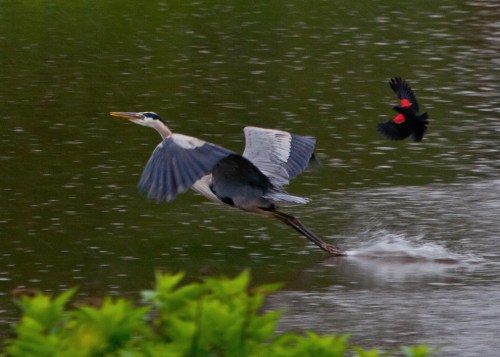
Yesterday, I was observing a Great Blue Heron (Ardea herodias) as he flew to a new location. As soon as the heron landed, a male Red-winged Blackbird (Agelaius phoeniceus) started buzzing him, obviously feeling possessive of the territory. I captured this photo as the heron took off in search of a more peaceful fishing spot.

I love watching the interaction between different species, whether it be birds, reptiles, animals, or insects. Sometimes there is a kind of peaceful coexistence and sometimes, as was the case here, there is confrontation. Previously, I observed a group of blackbirds harassing a juvenile eagle, but this time the blackbird seemed to be alone.

One of my favorite bloggers, Sue of Back Yard Biology, did a wonderful posting recently on the Red-winged Blackbird’s sense of territoriality that is worth checking out. She called it “Angy Bird” and the post includes some cool photos that illustrate her main point.

I tend to think of blackbirds as aggressive and herons as peaceful and prone to avoid confrontation. Another one of my favorite bloggers, Phil Lanoue, who posts gorgeous shots of birds and alligators in his local marsh, has shown me, however, that Great Blue Herons will harass other birds and sometimes steal their catches, including this posting that he called “Stolen Treasure.”

Initially I was focused on catching this heron in the air, but I am glad that I kept my eyes and camera trained on the bird after he landed, for it turned out that the most exciting action was just starting.
chase1_blackbird

Michael Q. Powell. All rights reserved

Read Full Post »
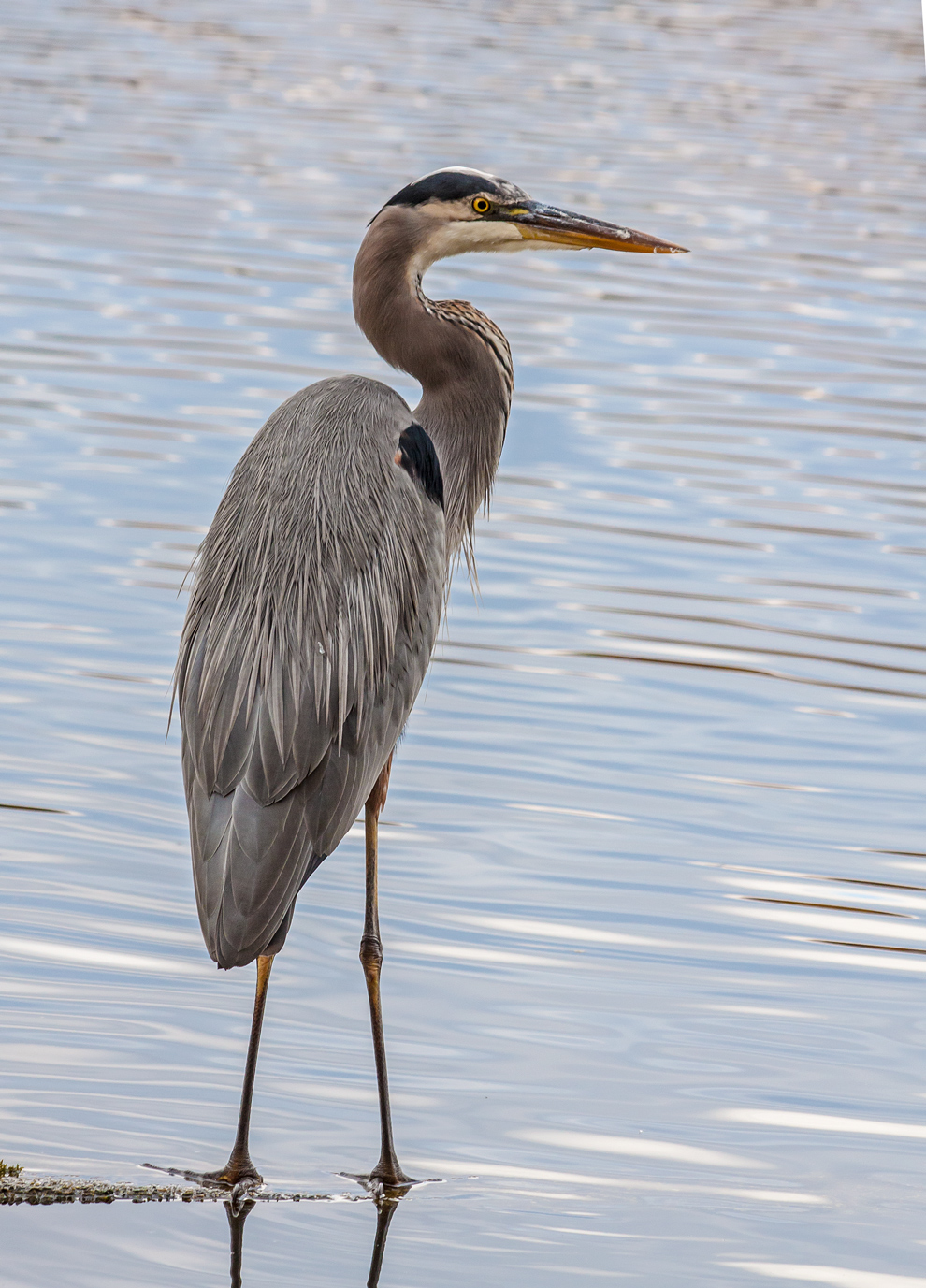
A Great Blue Heron (Ardea herodias) seems to be a regular visitor to the beaver pond at my local marsh (and may have taken up residence nearby), but usually fishes in an area in which it is tough to get a clear shot.

One recent morning, however, I was happy to see him in a closer area and was able to get these shots. The first one has a less cluttered background, which helps to highlight the heron’s head.  Sometimes, though, I like the second one better, in which the heron is tucked into the midst of the growth and is partially camouflaged.

Do you have a preference for one of the two images?

heron1_blogheron2_blog

Michael Q. Powell. All rights reserved

Read Full Post »
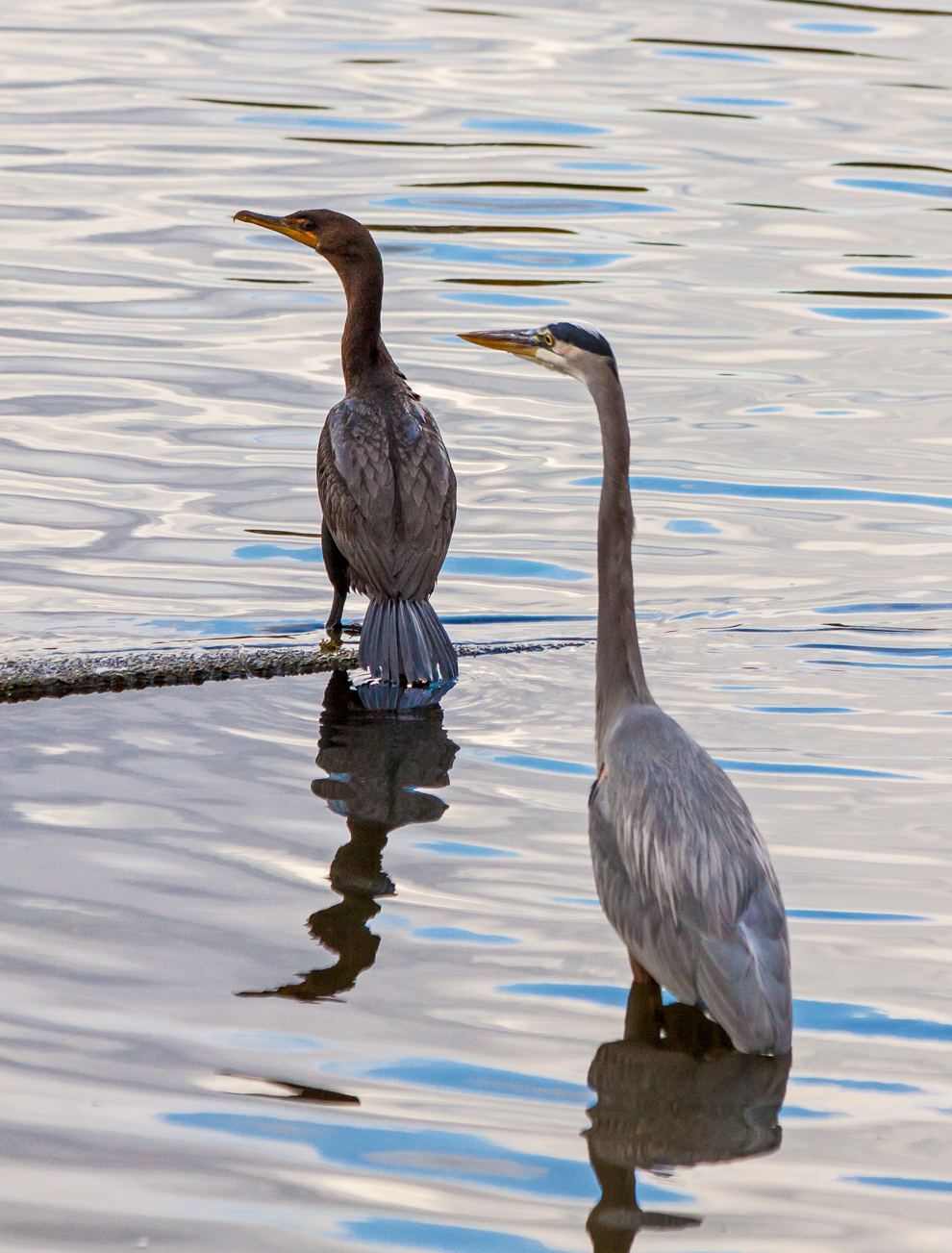
As I was getting ready to leave the marsh on Monday, I noticed this Great Blue Heron (Ardea herodias) on the other side of the beaver pond.

He did not appear to be fishing, but was perched on a fallen tree, seemingly seeking shelter from the falling rain. He was hunched over a little, like he was trying to retain body heat.

It’s not often that I see a blue heron completely out of the water (assuming I don’t count all of the times when they were flying away from me), so I was happy to get this shot.

blueheron_standing_blog

Michael Q. Powell. All rights reserved

Read Full Post »
The Great Blue Heron was too far away for me to capture many details, but the light early yesterday morning was especially beautiful, so I decided to pull back and try to capture the landscape, something that I don’t do very often.

I love the rich bands of color that I managed to capture in this shot and the gorgeous reflections in the water at my local marshland park. The red color, I believe, is from buds that were stripped from the trees by winds and rain this past week.

heron_blog

Michael Q. Powell. All rights reserved

Read Full Post »

Although it is exciting to be able to capture a photo of a Great Blue Heron (Ardea herodias) flying or catching a fish, I find them to be beautiful even when they are standing still.

I came upon this heron early one morning a week ago or so and was struck by the serenity of the moment. The heron seemed pensive and the beautiful morning light helped to provide some wonderful reflections in the still water of the beaver pond.

The second shot was taken a little later that same morning, after the heron had groomed himself. In this photo, I am amazed at how tall the heron looks with his neck fully extended.

It was rare for me to be able to get unobstructed shots of a heron from relatively close range, and I was pretty happy to be able to get shots like this.

standing_heron1_blogstanding_heron4_blog

Michael Q. Powell. All rights reserved

Read Full Post »

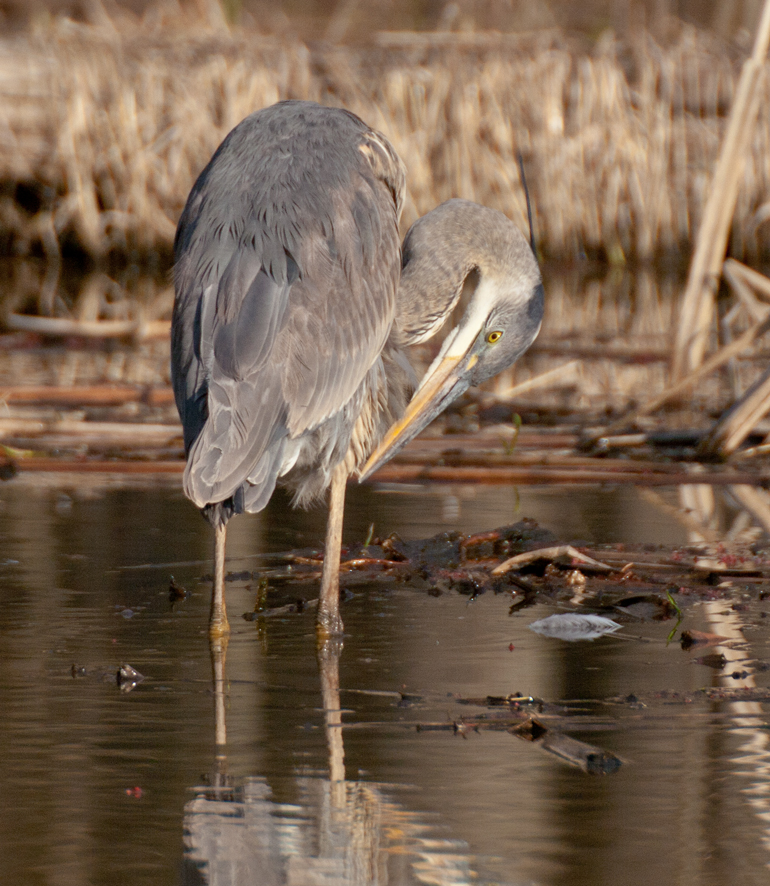
I arrived at the marsh early in the morning, just as this Great Blue Heron (Ardea herodias) was getting up. He seemed to be going through his pre-breakfast routine, grooming and preening and getting ready for the day ahead. It was fascinating to watch him contort his long neck as he sought to arrange his feathers just so. The water was calm enough that he could have used it as a mirror, if he had wanted to do so.

I am not sure if he was trying to make himself look bigger and fluffier, was airing himself out,  or just wanted some additional air for insulation, but at one point he shook himself vigorously. I was fortunate enough to get the first photo as he was in the process of ruffling the feathers.

Eventually, my feathered friend decided that he was presentable and stood motionless, as though posing for me. I’ll post some of those images later.

standing_heron3_blog

standing_heron2_blog

Michael Q. Powell. All rights reserved

Read Full Post »

A Great Blue Heron this weekend was poised, waiting to strike, and I waited with my camera and my tripod, hoping to capture the moment of triumphal success.

I had visions of the heron pulling some big fish out of the water, like I see in Phil Lanoue‘s incredible photos, and watching as he struggled to swallow it whole.

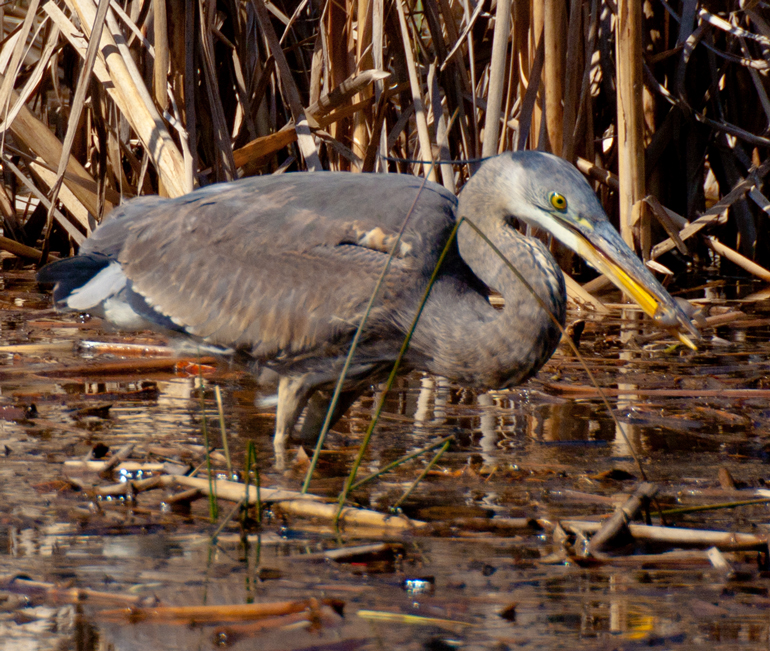
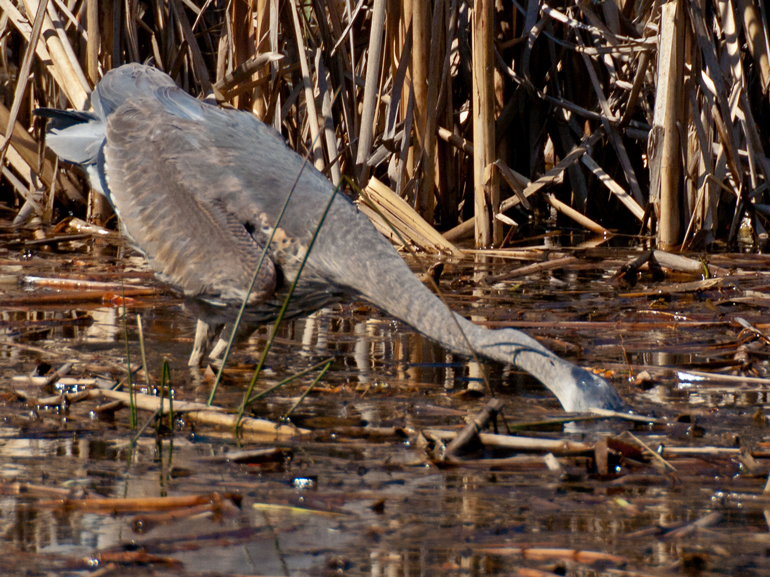
The reality, as you can see, was much more modest. After all, the Great Blue Heron (Ardea herodias) was fishing in the beaver pond at my local marsh and the pickings were pretty slim. Initially, I though he had caught a frog, but the photo suggests it was a small fish, though it is hard to tell for sure because of the catch’s small size.

The second photo shows his pre-strike position. The heron stood motionless in this position for what seemed like an eternity. I am amazed that he could see anything in the shallow, reed-covered water.

When he struck, he didn’t even have to put his head very deeply into the water or use a lot of force to catch the fish. The final shot shows the heron swallowing his catch. It did not take any special maneuvering to get the little fish down his throat.

I saw a heron hanging around the same beaver pond the following day. I hope he is not spending all of his time in this one location or I may end up photographing a really skinny heron in the future.

heron1_blogheron2_blogheron3_blogheron4_blog

Michael Q. Powell. All rights reserved

Read Full Post »
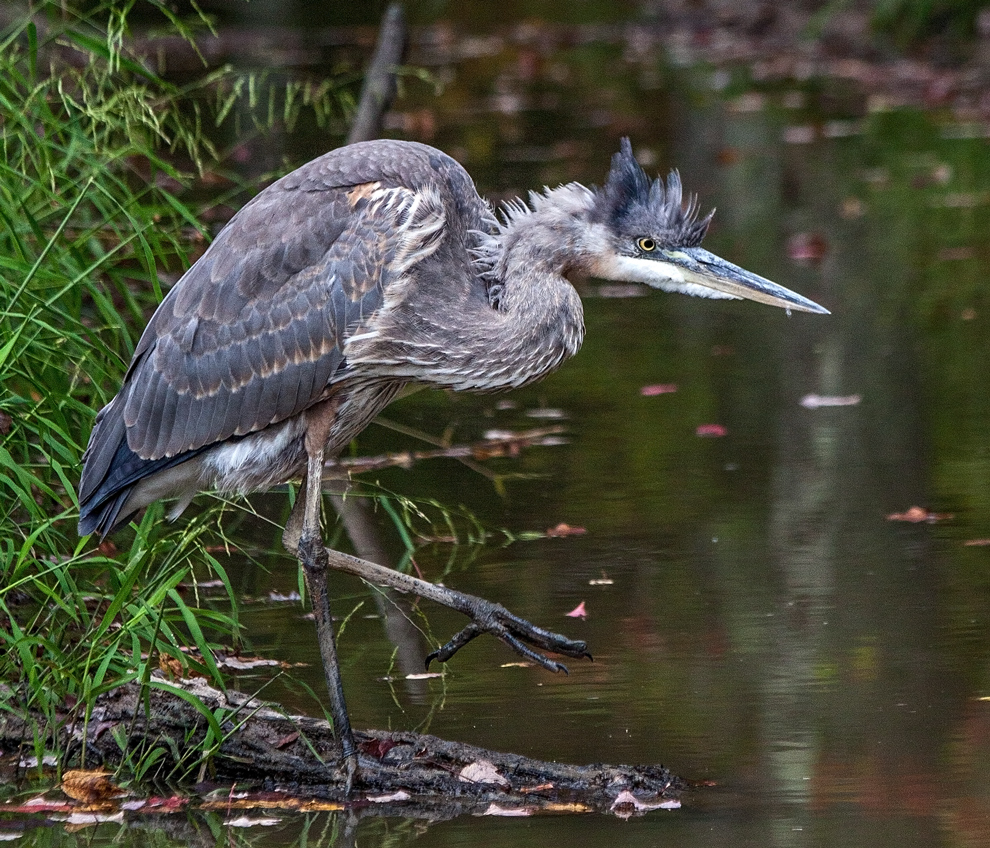
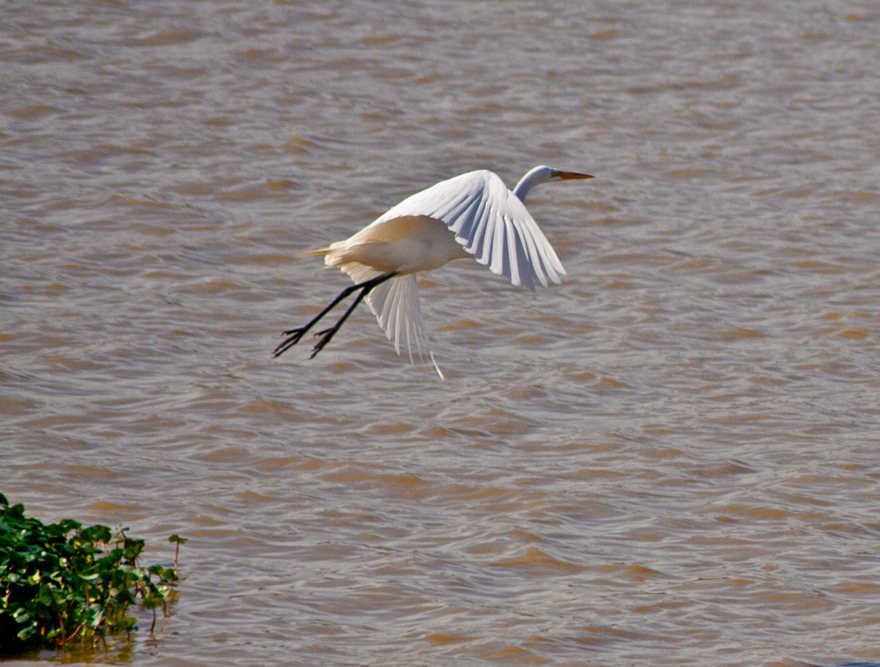
What was the mission that prompted this Great Egret to launch himself into the air?  His mission, it seems, was to continue to harass a Great Blue Heron that he had previous forced out of a prime fishing spot. As you can see from the second photo onward, the egret headed straight for the heron and only at the last minute did he veer off. (I may post some photos later of the initial encounter, but I especially like these in-flight photos.)

I took this series of photos a couple of weeks ago, when I was in Augusta, Georgia, at the Phinizy Swamp Nature Park.

takeoff_blogattack_blogattack2_blogattack3_blogattack4_blog

Michael Q. Powell. All rights reserved

Read Full Post »

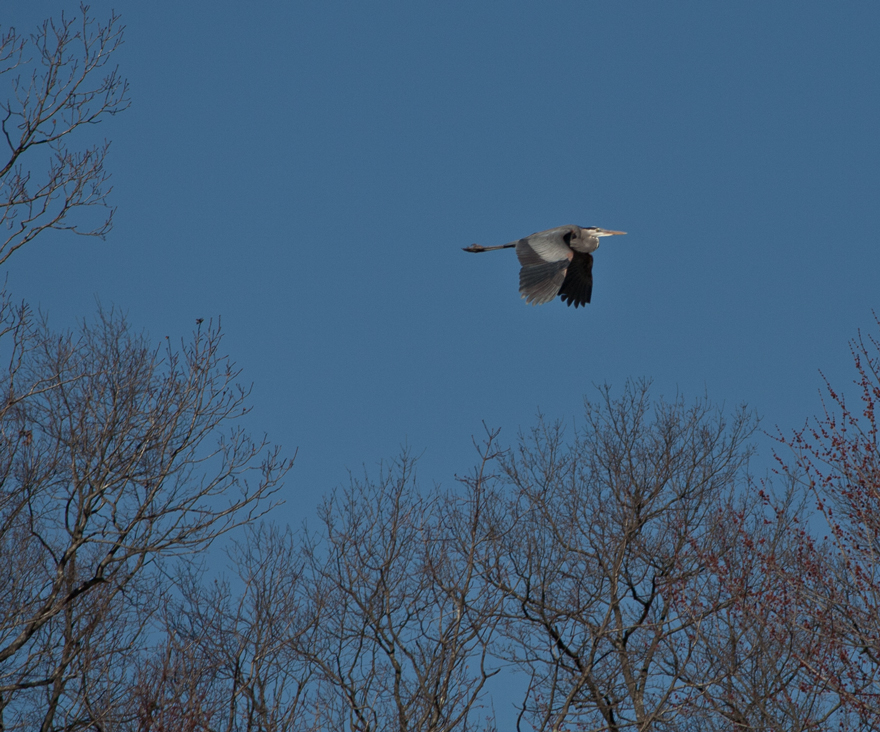
I was staring intently at some ducks in a secluded area of the marsh, when suddenly my eyes caught sight of movement in one of the trees overlooking the pond. The next think I knew a Great Blue Heron (Ardea herodias), who had apparently been perched on the tree,  was flying through the air.

This is the best of the shots that I was able to take. Most of the times that I have attempted a similar shot in the past, the white in the face has been totally blown out. I still need to work on getting a better exposure, but feel like I am making progress. Now if I can just find a cooperative heron.

heron_blog

© Michael Q. Powell. All rights reserved

Read Full Post »

How do Great Blue Herons manage to stay warm when it’s bitterly cold outside?

Yesterday morning was cold and windy and the beaver pond was iced over again. As I scanned the area, looking for activity, I noticed this Great Blue Heron (Ardea herodias) perched on the limbs of a fallen tree in a back area surrounded with undergrowth. He was hunched over with his wings wrapped tightly around himself and he seemed to be doing his best to maintain his body heat.

When I moved a little, he lifted his head slightly from his chest to look in my direction. Eventually he decided I was not a threat and he placed his bill back on his chest, between the feathers, and resumed his rest. Perhaps he was sleeping, though it seemed to me that the perch was a bit precarious for serious sleeping.

A few hours later, after it had warmed a bit, I saw a heron flying in the distance. Perhaps it was this blue heron, who had decided that it was time to begin his day’s activities, which I am sure included finding some unfrozen water where he might be able to locate something to eat.

GBH1_blog

© Michael Q. Powell. All rights reserved

Read Full Post »
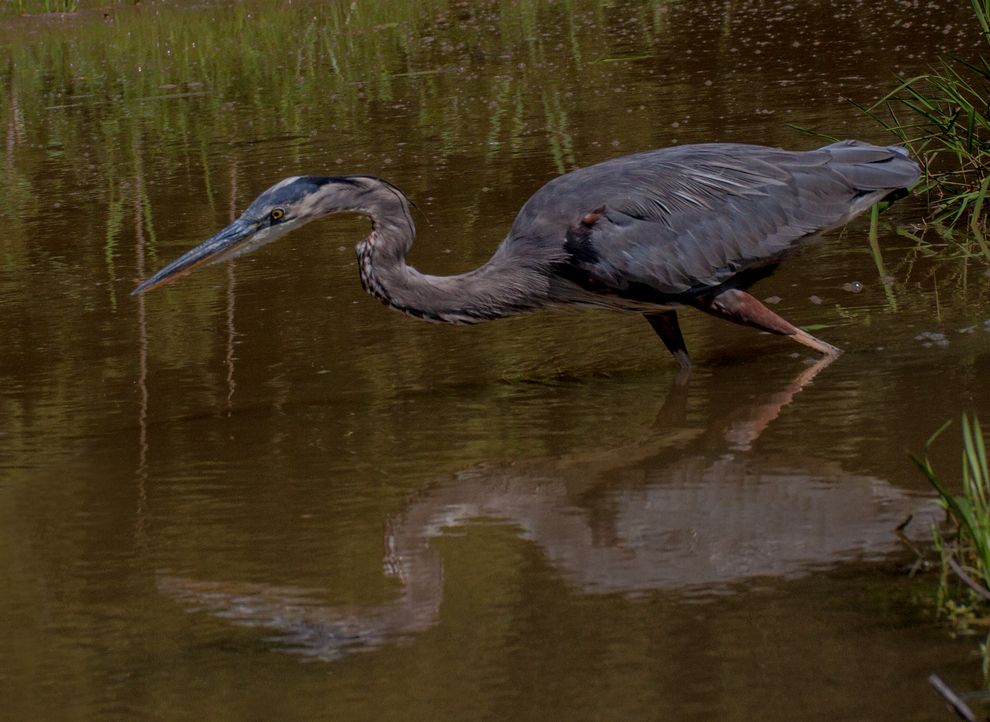
If you think that you are having a bad hair day today, check out the windblown hair of this Great Blue Heron.

It was cold and really windy today and it seemed like the small birds had sought shelter somewhere, because there were relatively few around. The bigger birds could handle the wind better and I saw lots of crows and geese and a number of vultures.

I also saw one Great Blue Heron, who was pretty far away from me. I watched him for quite some time as he stared down at the waters at the far edge of the beaver pond and I wondered if it would be possible for him to find anything to eat.

When I looked at some of my photos of the heron, I was struck by his hair. It looks like he is suffering from male pattern baldness and has grown his hair long in a vain attempt to hide that reality. Perhaps he has an artistically arranged comb over most of the time, but the wind caused his hair to go in all directions.

Do you think that they have a Hair Club for herons?

badhair_blog

© Michael Q. Powell. All rights reserved

Read Full Post »
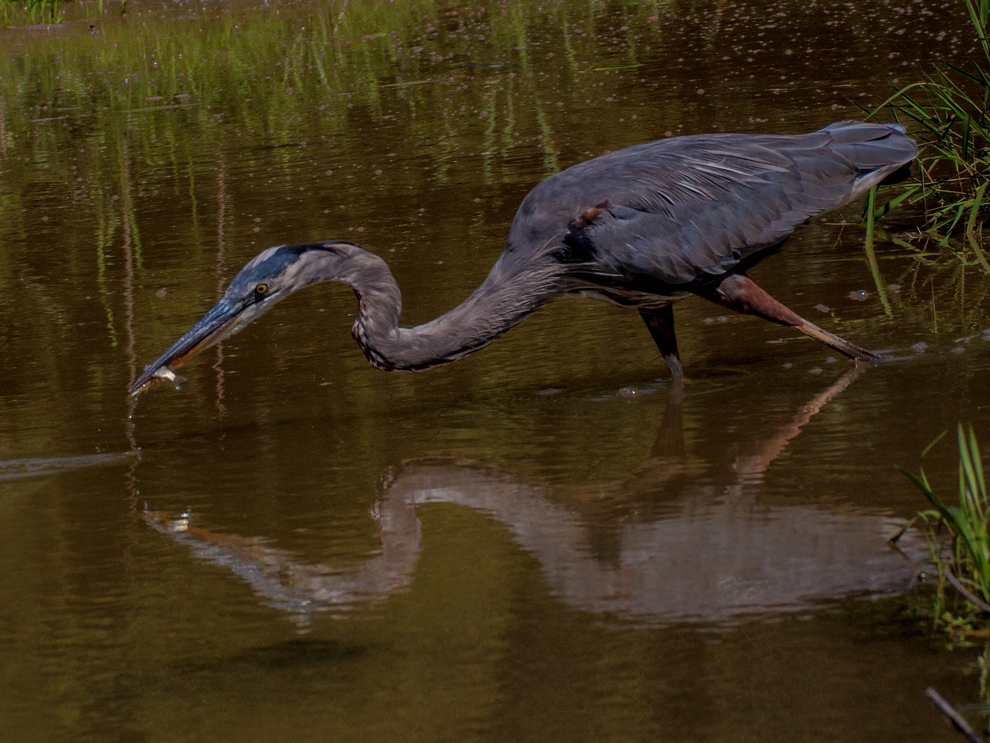
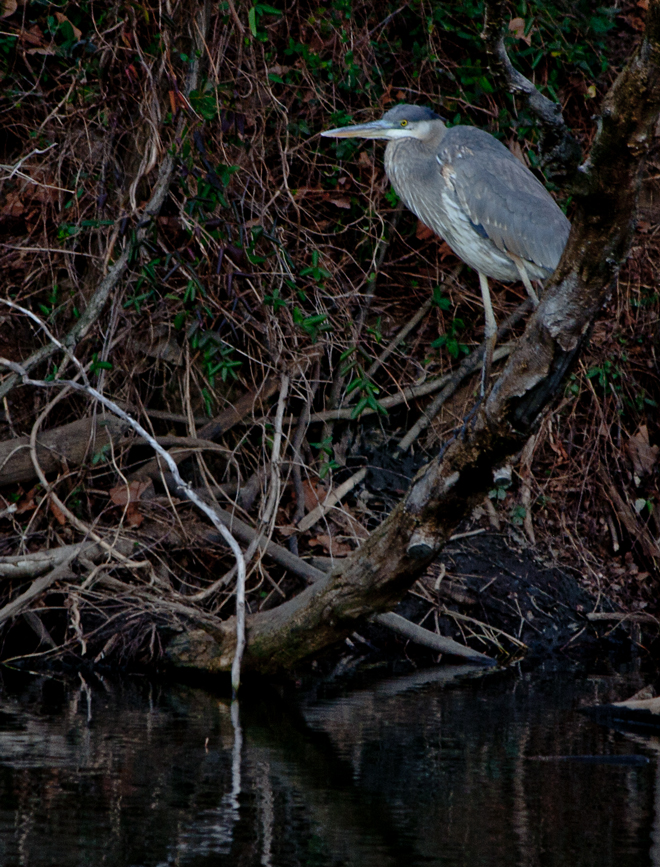
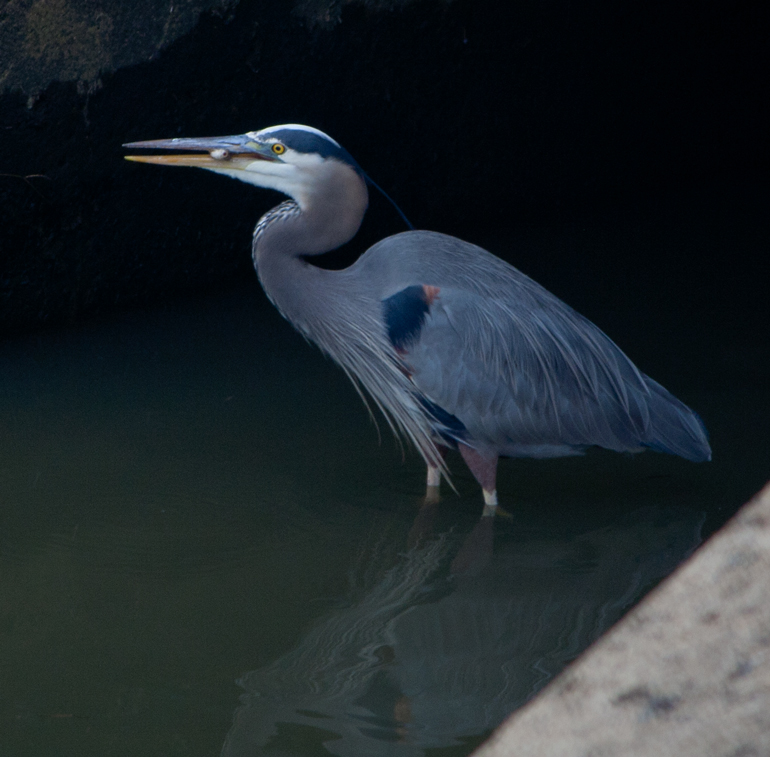
Yesterday I returned to the little lake near where I live in hopes of seeing the Belted Kingfisher again. As I was scanning the trees near the water’s edge, I caught sight of a Great Blue Heron.

Most of the time when I see Great Blue Herons, they are in the water. This one, however, seemed quite content to just stand in the shade of a tree on a slanted bank, surrounded by all kinds of roots and vines.

As I was inching my way down the slope of the opposite bank, he caught sight of me and took off immediately. Acting on instinct, I raised my camera to try to capture him in flight and lost my footing.  Sliding down the bank. I dug in my heels and managed to stop just before I reached the water.

Needless to say, I did not get any good shots of the heron’s departing flight.

GBH1_blog

© Michael Q. Powell. All rights reserved

Read Full Post »
A few days ago I featured a Black-crowned Night Heron in a posting called Heron of a different color. One of the most unusual things about that heron was the location where I found him—a man-made canal at the edge of the runways at Reagan National Airport, across the Potomac River from Washington D.C.

That day there was another heron, a Great Blue Heron, fishing just opposite the night heron. I thought that herons preferred clear water, to help them see their prey better, but this water did not look to be very clear.

The first photo shows part of the canal, with a concrete wall in the lower right and the peeling paint of a bridge support in the upper left. I captured the image as the heron was moving around a freshly-caught little fish in his beak prior to swallowing it.

Urban_GBH2_blog

In the second shot, the heron had just dipped his beak into the water. I like the concentric ripples in the water and the drops of water visibly dripping off of the heron’s beak. This may have been an unsuccessful strike or he may have decided to rinse out his mouth (to get rid of the fish taste?).

urban_GBH3_blog

In this final photo, the heron is crossing the canal. As you can see, the water is fairly deep. I particularly like the heron’s reflection and how the details of the long feathers in the front are visible.

Urban_GBH4_blog

Six months ago, I didn’t realize that there were Great Blue Herons in the area in which I live, but now I seem to find them with some regularity. As long I continue to see them, there’s a pretty good chance you’ll be seeing them again in this blog.

© Michael Q. Powell. All rights reserved

Read Full Post »

Earlier this week I posted a photograph of a Great Blue Heron (Ardea herodias) that I encountered while walking along the Potomac River here in Virginia. As I looked over the images from that day I came across another one that I really like.  The heron’s posture and his feathers make this image stand out for me, especially the way the feathers merge with his reflection in the water.

It’s probably clear to many readers that Great Blue Herons are among my favorite birds and that I never tire of finding opportunities to photograph them.

Great Blue Heron on Potomac River, Take 2

Great Blue Heron on Potomac River, Take 2

© Michael Q. Powell. All rights reserved

Read Full Post »

The weather was overcast today, but I decided to take a long walk along the Potomac River. There is a bike/walking path that parallels the river and I set out for Washington D.C. from Old Town Alexandria, Virginia.

I stumbled upon a Great Blue Heron (Ardea herodias) late in the afternoon, in one of the inlets just off the bike path that was raised above the water at that point. I have taken multiple photos of Great Blue Herons in the past, but I think that this image is my best to date. The pose is interesting and there are a lot of details. In addition the reflection is nice and the background is simple.

For me, this is about as close to a “great” shot as I can get at the moment, but this year I am hoping to raise my personal bar even higher.

Great Blue Heron in the Potomac River

Great Blue Heron in the Potomac River

© Michael Q. Powell. All rights reserved

Read Full Post »
« Newer Posts - Older Posts »