Feeds:
Posts
Comments

Posts Tagged ‘Fort Belvoir VA’

During the summer, most of my dragonfly photos tend to be variations of the stereotypical “dragonfly on a stick.” I am always on the lookout, though, for more interesting or photogenic perching places and behaviors.

The first shot shows a male Eastern Amberwing dragonfly (Perithemis tenera) perched on the end of a piece of rebar that sticks out of the water near a small fishing dock at Jackson Miles Abbott Wetland Refuge. Generally I try to avoid having manmade objects in my nature photos, but in this case I really like the juxtaposition of the natural and manmade elements in this shot. The warm tones of the amber wings contrast nicely with the cooler rust color of the rebar and the lines on the rebar are mirrored by those on the dragonfly’s body. Almost every year I return to this spot to capture a similar image, though each encounter is unique in its own way.

The second image shows another male Eastern Amberwing perched on a large rock jutting out from the water. I couldn’t get close to the dragonfly so I took the opposite approach and zoomed out to capture the dragonfly’s reflection (as well as the amber shadow it was casting on the rock). I really like the contrast between the diminutive size of the dragonfly and the large jagged rock—it seems almost like a visual metaphor for life’s challenges.

These two shots are examples of how I try, when possible, to visualize a shot before I take it. Frequently, though, I am forced to react instantaneously to a given situation, with a primary goal of keeping my subject within the frame and hopefully in focus. It’s a weird mental juggling act to simultaneously attempt to think creatively, instinctively, instinctively, and analytically—that’s wildlife photography in a nutshell.

Eastern Amberwing

Eastern Amberwing

© Michael Q. Powell. All rights reserved.
 

Read Full Post »

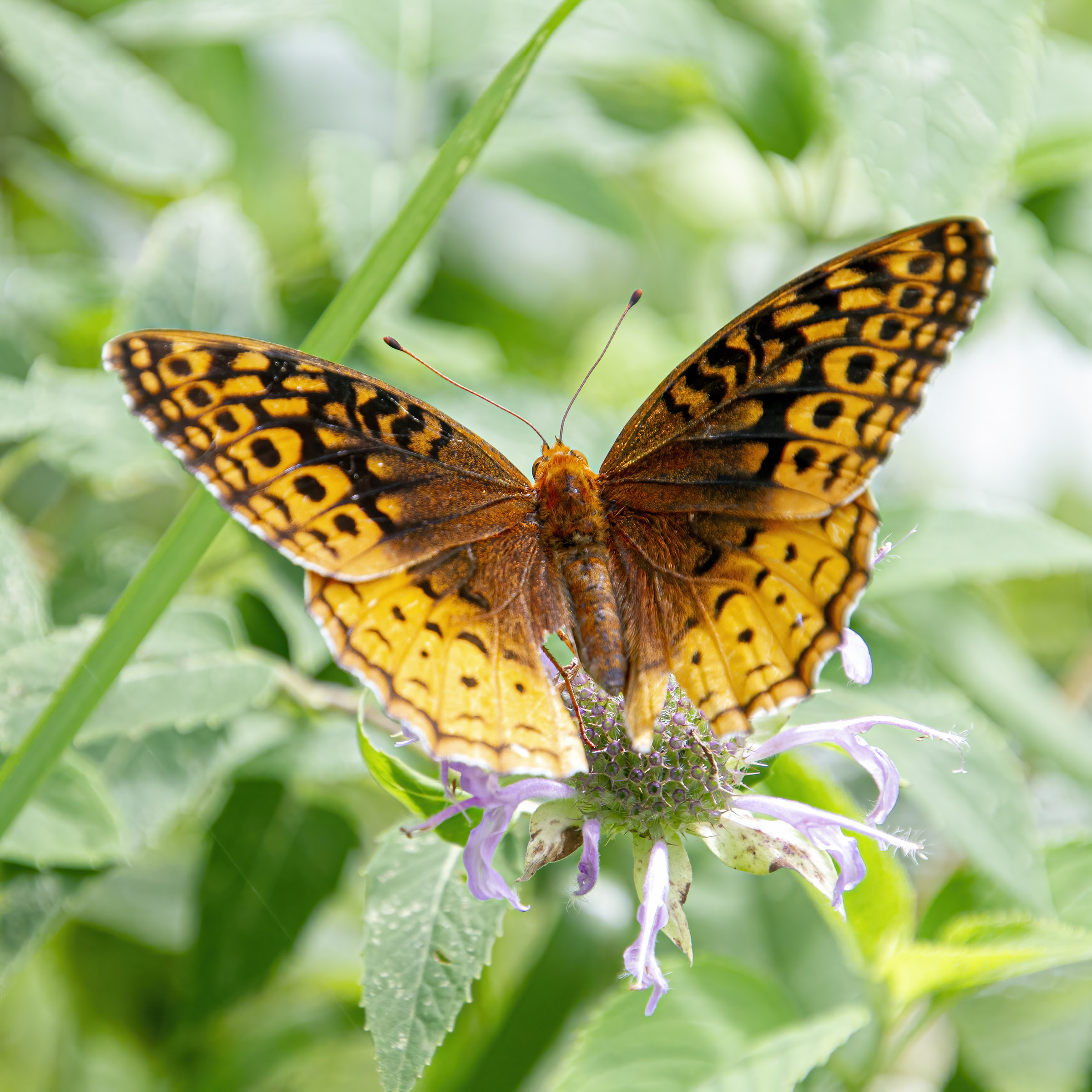
It seems like large butterflies have been more scarce than normal this summer. I was therefore thrilled to spot this Great Spangled Fritillary butterfly (Speyeria cybele) yesterday during a brief visit to Jackson Miles Abbott Wetland Refuge. Most of the time the butterfly had its head buried in the flower, but for a brief moment the butterfly raised its head, spread its wings, and let me capture this pretty little portrait image.

Great Spangled Fritillary

© Michael Q. Powell. All rights reserved.


Read Full Post »

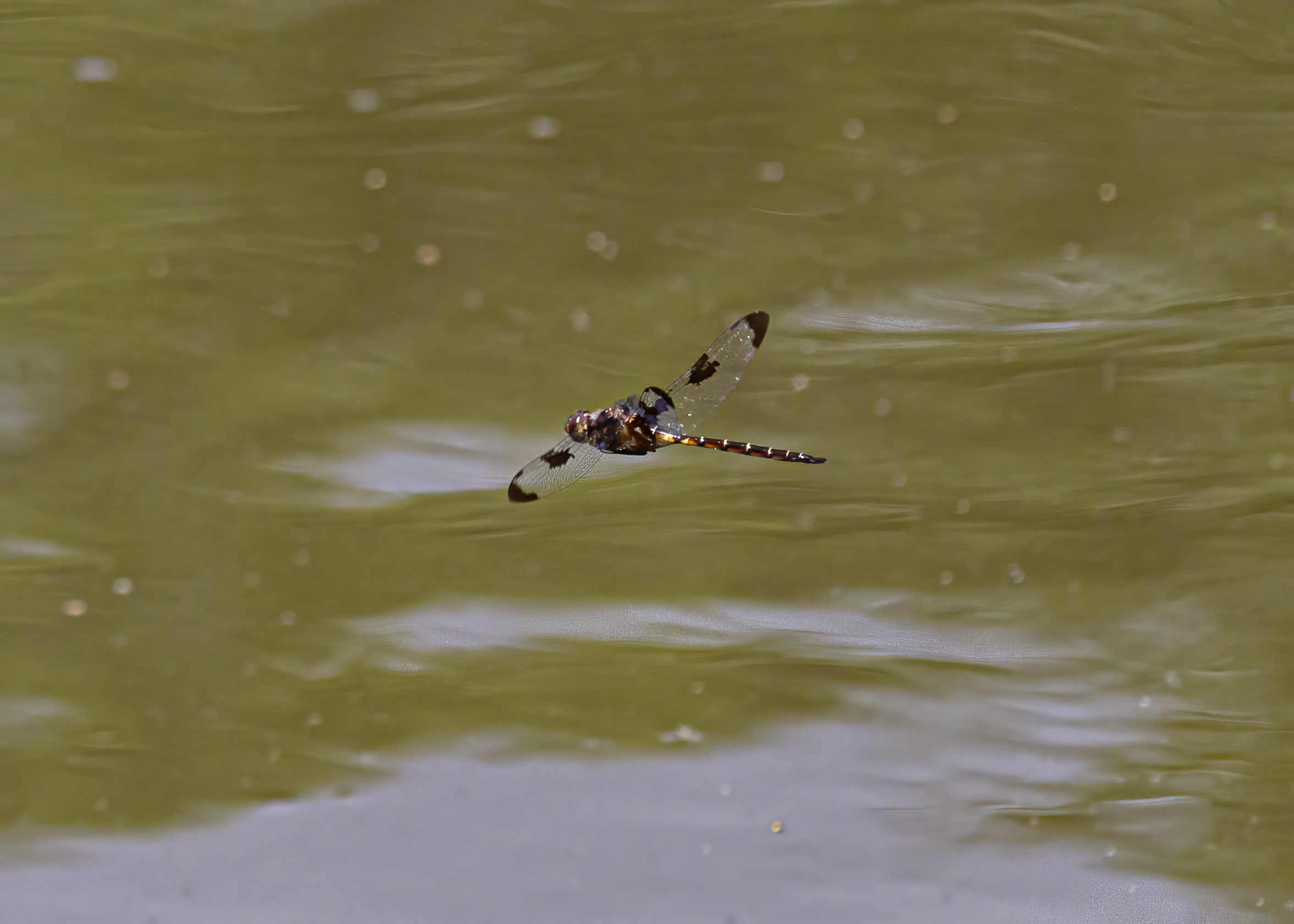
There is only one local location where I have found Banded Pennant dragonflies (Celithemis fasciata) in the past and in some years I have not seen a single one there. I was hopeful that I would see some on Thursday when I returned to Jackson Miles Abbott Wetland Refuge and my hopes were rewarded. Not only did I spot several Banded Pennants, but they were cooperative in choosing some photogenic perching locations for me.

Like other pennant dragonflies, Banded Pennants like to perch on the very tips of vegetation, which causes them to flap around a bit in the slightest breeze, like a pennant. I love the patterned wings of Banded Pennants, which cause them to stand out from several other small blue dragonflies that I saw that day. As you can see from the photos, the Banded Pennants mostly perched on plants overhanging the water or on vegetation growing out of the water.

At the last minute I decided to add the final photo, despite the fact that the dragonfly occupies only a small part of the frame. I really like the reflections of the plants in the water and did not want to zoom in and lose them. I also like the way that the image shows a Banded Pennant zooming low over the water in between the plants. If you look closely you can see the way that the dragonfly has tucked in its legs in order to be a bit more aerodynamic when flying.

Banded Pennant

Banded Pennant

Banded Pennant

Banded Pennant

© Michael Q. Powell. All rights reserved.


Read Full Post »

Yesterday I visited Jackson Miles Abbott Wetland Refuge and spent a lot of my time there trying to get shots of dragonflies in flight. The dragonflies were not very cooperative and kept their distance most of the time, but eventually I managed to get a few decent shots. What was especially cool was that I captured images of dragonflies from three different families—Skimmer, Darner, and Emerald.

The first photo shows a Banded Pennant (Celithemis fasciata), a Skimmer, as he was flying toward me. Banded Pennants are pretty small at about 1.3 inches (33 mm) in length, so I was pretty thrilled to capture this shot as he was flying toward me. This was actually the first time that I had seen a Banded Skimmer this season.

The second photo shows a Cyrano Darner (Nasiaeschna pentacantha). Despite the fact that I took the shot from a long distance away, you can still see the prominent “nose” that is supposedly reminiscent of the long nose of literary character Cyrano de Bergerac.

The last two photos show Prince Baskettails (Epitheca cynosura) that are members of the Emerald family. Prince Baskettails, which are about 2.9 inches (74 mm) are quite easy to identify, because they are the only large dragonfly in our area with patterned wings. I had more opportunities with this species that with the others, because several Prince Baskettails were flying repetitive patrols only various parts of the pond and passed by me multiple times. Although it is a little easier to focus on a dragonfly in flight when the background is clear, I think it is even cooler when I manage to include reflections in the water in a photo, as was the case with the reflections of the branches in the final photo.

Banded Pennant

Cyrano Darner

Prince Baskettail

Prince Baskettail

© Michael Q. Powell. All rights reserved.


Read Full Post »

On Monday I was thrilled to spot this Prince Baskettail dragonfly (Epitheca cynosura) flying patrols over the small pond at Jackson Miles Abbott Wetland Refuge. Previously I had spotted Common Baskettails doing the same thing at this location—see my recent posting Common Baskettails in flight—but they seem to have been supplanted by the Prince Baskettails. How do you tell them apart? Although they are both part of the Emerald family, only Prince Baskettails have patterned wings, as you can see in these photos.

I really like the description of this species on the Dragonflies of Northern Virginia website:

“This sleek, elegant dragonfly could in fact be called King Baskettail, as it is the largest member of the Emerald family. There are seven families of dragonflies in the US–Emeralds are known for their glowing green eyes (hence the family name), and their endless, acrobatic flight. Like other members of this family, Prince Baskettails rarely land and can spend many hours in ceaseless flight. Look for this powerful flier making long, repeated, low patrols over open water habitats such as lakes, ponds, canals, and sluggish river sections.”

As a result of the repeated patrols, I was able to track the dragonfly as it flew by me and capture these images. The dragonfly did not get really close to the bank on which I was standing, so my autofocus would not detect my subject and I had to resort to focusing manually. I am pretty happy with the results and I encourage you to click on the images to see the beautiful markings on the body of this Prince Baskettail dragonfly.

Prince Baskettail

Prince Baskettail

Prince Baskettail

© Michael Q. Powell. All rights reserved.

Read Full Post »

Although Blue Dashers (Pachydiplax longipennis) are among the most common dragonflies in my area during the summer, they are very special to me. I remember visiting a photography show by my dear friend Cindy Dyer in 2012, I believe, and marveling at the photos that she had taken of Blue Dasher dragonflies. I decided that I wanted to be able to take photos like hers of these beautiful creatures.

I went out on numerous occasions and she taught me a lot about both the creative and technical sides of photography. She also served as a muse to me, encouraging me and gently pushing me along my path. She had a well-established blog and decided that I needed one too, so on 7 July 2012, she sat me down I created my blog. My first blog posting on the same day was entitled Blue Dasher dragonfly and it featured a male Blue Dasher dragonfly in the obelisk position, similar to the pose of the dragonfly in the final photo in today’s post. That’s one of the main reasons why Blue Dashers are so special to me.

I spotted these Blue Dashers, all of which are males, on Monday during a brief visit to Jackson Miles Abbott Wetland Refuge. Each of the three photos represents a different approach I used in attempting to capture the”feel” of my encounters with these dragonflies. The first image shows the details of colors and patterns of the body quite well. The second image gives you a sense of their environment. The final photo focuses on the obelisk pose that is believed to be a form of thermoregulation—by raising its abdomen the dragonfly reduces its exposure to the direct sunlight on hot days.

Some days I will post only a single photo, but most often I enjoy posting a small set of photos that complement each other and provide different perspectives on the living creatures that I love to photograph. Beauty is everywhere.


Blue Dasher

Blue Dasher

Blue Dasher

© Michael Q. Powell. All rights reserved.

Read Full Post »

During a recent visit to Jackson Miles Abbott Wetland Refuge I was delighted to spot a female Eastern Amberwing dragonfly (Perithemis tenera) as she was depositing her eggs in the vegetation in a small pond. Initially she would hover for a moment, as you can see in the first image, and then dip the tip of her abdomen straight downwards to release some eggs, as shown in the second image. The dragonfly repeated this process multiple times at this spot before moving on to other spots.

I have observed this process multiple times, but have rarely been able to photograph it. Eastern Amberwings are the smallest dragonflies in my area and are only about an inch (25 mm) in length, so they are a challenge to photograph. Fortunately when the female is ovipositing, she hovers a bit, which gives me time to focus on her. Sharp-eyed viewers may have noticed that the wings of this dragonfly have patterns, but are not amber in color—only male Eastern Amberwings have amber wings.

Eastern Amberwing

Eastern Amberwing

© Michael Q. Powell. All rights reserved.


Read Full Post »

Whenever I see a dragonfly in flight when I am traipsing about with my camera, I can’t help but stop and try to get a photograph of the dragonfly in the air. My success rate in not high, but sometimes I am able to capture a good image as the dragonfly zooms by me.

In mid-June I spotted a Common Baskettail dragonfly (Epitheca cynosura) as it flew back and forth over the pond at Jackson Miles Wetland Refuge. During one of its passes I managed to freeze its motion in this shot. I like the way that you can see all four wings and also the distinctive markings on its body. The bluish-green eyes really “pop” and if you look really closely, you can see the that the dragonfly folds its legs under its thorax (the torso part of its body) while it is flying.

I returned yesterday from my five-day trip up to Massachusetts and Maine to deal with a family emergency. Hopefully I will be able to get out this week and capture some new images. It’s hard to believe that it is already July.

Common Baskettail

© Michael Q. Powell. All rights reserved.

Read Full Post »

There were lots of Slaty Skimmers (Libellula incesta) flying about on Tuesday at the small pond at Jackson Miles Abbott Wetland Refuge, but none of them were cooperative in perching within range. They seemed to content to buzz around over the lily pads and land occasionally in vegetation overhanging the water—I was willing to lean a little to get closer to the dragonflies, but did not want to risk falling into the water.

Slaty Skimmers are one of our most common summer dragonfly species and they find themselves at home in almost any habitat. The mature males are really easy to identify because of their dark bodies and eyes. Immature males and females are a lot harder to distinguish from a number of other species in the skimmer family, like the Great Blue Skimmer and the Bar-winged Skimmer.

Slaty Skimmer

Slaty Skimmer

© Michael Q. Powell. All rights reserved.


Read Full Post »

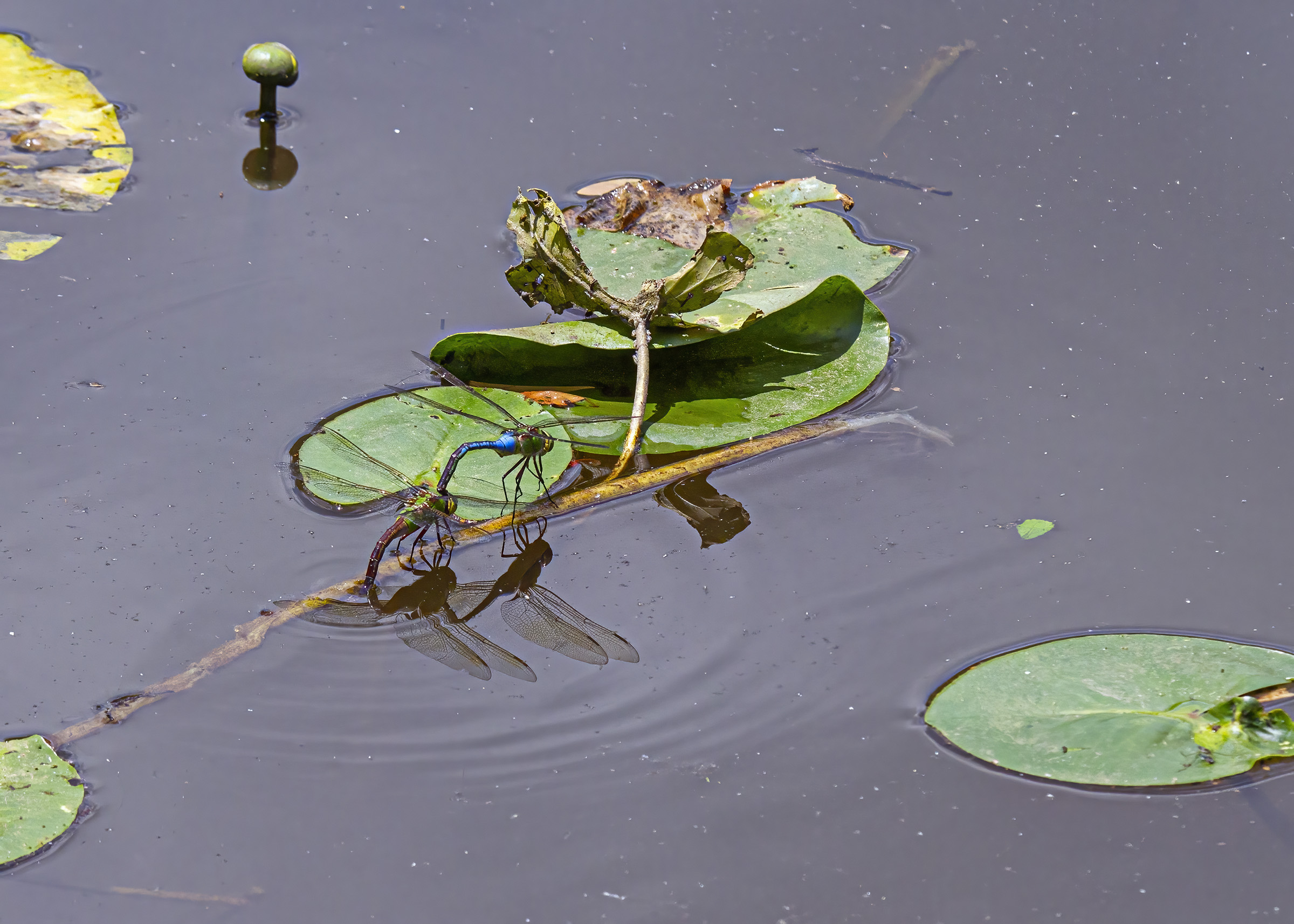
I spotted a female Common Green Darner dragonfly (Anax junius) as she was ovipositing while her male partner held onto her last Saturday at the edge of the small pond at Jackson Miles Abbott Wetland Refuge. Common Green Darners are large dragonflies—about 3 inches (76 mm) in length—so it was relatively easy to track the pair as they moved about placing eggs in various patches of vegetation in the water.

After mating takes place, the males of some species of dragonflies disappear.  In other species, the male stays nearby, guarding the female and fending off other males that might remove the initial suitor’s sperm and replace it with their own.  Some species, like this Common Green Darner, remain attached to the female in a position known as “tandem.” while egg-laying takes place.  The female Common Green Darner submerges her abdomen and lays her eggs in or on the aquatic vegetation, as you can see in these images. If you look really closely at the first image, you can see what I believe is the dragonfly’s curved ovipositor that she uses to make a little slit into the vegetation in which to place the eggs.

According to an article on Animal Diversity Web, there are two different lifecycles for Common Green Darners, one for the dragonflies that have migrated northward and one for the resident population. “Migratory adults mate and oviposit in June. Unlike resident populations, nymphal development for migrant offspring takes only 3 to 5 months, and they do not overwinter. They emerge as tenerals typically around late-August and September. They often begin their migration as tenerals, feeding along the way and developing into adults.” The timing of the activity that I observed suggests that these could be migrant Common Green Darners.

“For residents in the north, the adults mate and oviposit in late July to August. The resulting offspring hatch and develop to mid-instars and then overwinter when temperatures drop. Total nymphal development time can take 11 to 12 months for residents, as the nymphs finish development when temperatures warm in the spring and then emerge as adults in the following June and July.”

I highly recommend the article that I referenced, which has lots more fascinating information about this colorful dragonfly species.

Common Green Darner

Common Green Darner

Common Green Darner

Common Green Darner

© Michael Q. Powell. All rights reserved


Read Full Post »

Many damselflies have distinctive shoulder stripes, but the thoraxes of Blue-fronted Dancers (Argia apicalis) are almost completely blue and have only hairline black stripes. Last Saturday I was delighted to spot some Blue-fronted Dancers at the small pond at Jackson Miles Abbott Wetland Refuge, my first sighting of this species this season. Although the blue thorax made them easy to identify, what really struck me were their brilliant blue eyes, a feature that I had never noticed before. Wow!

I was able to photograph these damselflies on various locations as I repeatedly circled the pond. Periodically I would glance out at the water, where several families of Canada Geese were swimming around with their almost grown goslings. In the final photo, you can see one of the feathers from the geese, a quirky and almost whimsical addition to my photo of the Blue-fronted Dancer—I really like that image.

Blue-fronted Dancer

Blue-fronted Dancer

Blue-fronted Dancer

© Michael Q. Powell. All rights reserved

Read Full Post »

I was delighted to spot several handsome Lancet Clubtail dragonflies (Phanogomphus exilis) during a recent visit to Jackson Miles Abbott Wetland Refuge, my first sightings of this species this season. As you can see from these two photos, Lancet Clubtails like to perch flat on the ground and I spotted both of these near the edge of the pond.

I love the bright blue eyes of Lancet Clubtails and the yellow flange near the tip of the abdomen, a feature that helps to distinguish Lancet Clubtails from the visually-similar Ashy Clubtails. Some members of the Clubtail family have large and obvious “clubtails,” but the one on the male Lancet Clubtails is relatively small—you have to look at the proper angle to see it well. I like the way that the shadow in the first photo makes it easy to see the enlarged area near the end of abdomen that constitutes the “clubtail.”

Lancet Clubtail

Lancet Clubtail

© Michael Q. Powell. All rights reserved.

Read Full Post »

Several Common Baskettail dragonflies (Epitheca cynosura) were patrolling over the pond at Jackson Miles Abbott Wetland Refuge last Thursday and I spent a lot of time trying to capture images of one of them as they zoomed by me. I made attempts with both my 180mm macro lens and my 18-400mm zoom lens, sometimes using focusing manually and sometimes using auto focus. Needless to say, there is also a lot of luck involved in getting a somewhat sharp photo of a dragonfly in flight

I spent a lot of time trying to track the dragonflies. They didn’t exactly fly in a pattern, but they seemed to have a territory that they were patrolling, so they came by me at irregular intervals. In the first two shots below, I was able to get a bit of the habitat in the photo, but most of the time I was focusing solely on the dragonfly and there is nothing in the background but the somewhat muddy water of the pond.

I was happy that I was able to get some shots from a number of different angles. In some of the shots, the dragonfly was flying by me, but in other cases I manage to capture images in which the dragonfly was flying towards me or away from me. The angle was often dependent on the speed with which I was able to acquire my target in the viewfinder of my camera and successfully track it as I tried to focus on it—hand-t0-eye coordination is critical.

I used to think that it was impossible to get shots like these. It has gotten a little easier over time as I have gained experience, but it still is pretty hard. No matter how skilled I get, patience and persistence are still the most critical factors in this type of photography.

Common Baskettail

Common Baskettail

Common Baskettail

Common Baskettail

© Michael Q. Powell. All rights reserved.

Read Full Post »

Some of you may have noticed that the banner photo for this blog shows a beautiful purple damselfly, one of my favorite insects. The intense purple is really striking and is not a color that I seen very often when I am looking for wildlife to photograph. The official species name for the damselfly is Variable Dancer (Argia fumipennis), though I prefer to use the colorful and descriptive name of its most common subspecies, the Violet Dancer (Argia fumipennis violacea).

Last Thursday I was delighted to spot numerous Violet Dancers in the vegetation along the edge of a small pond at Jackson Miles Abbott Wetland Refuge.  I even managed to photograph one on the trail surrounding the pond, as you can see in the first photo in which the damselfly is perched on a small stone. For the other two shots, I was much farther away from the damselfly. These damselflies like to perch on vegetation that overhangs the water, so I shot from a distance to avoid slipping into the pond, which has happened on occasion in the past.

Violet Dancer

Violet Dancer

Violet Dancer

© Michael Q. Powell. All rights reserved.
Read Full Post »

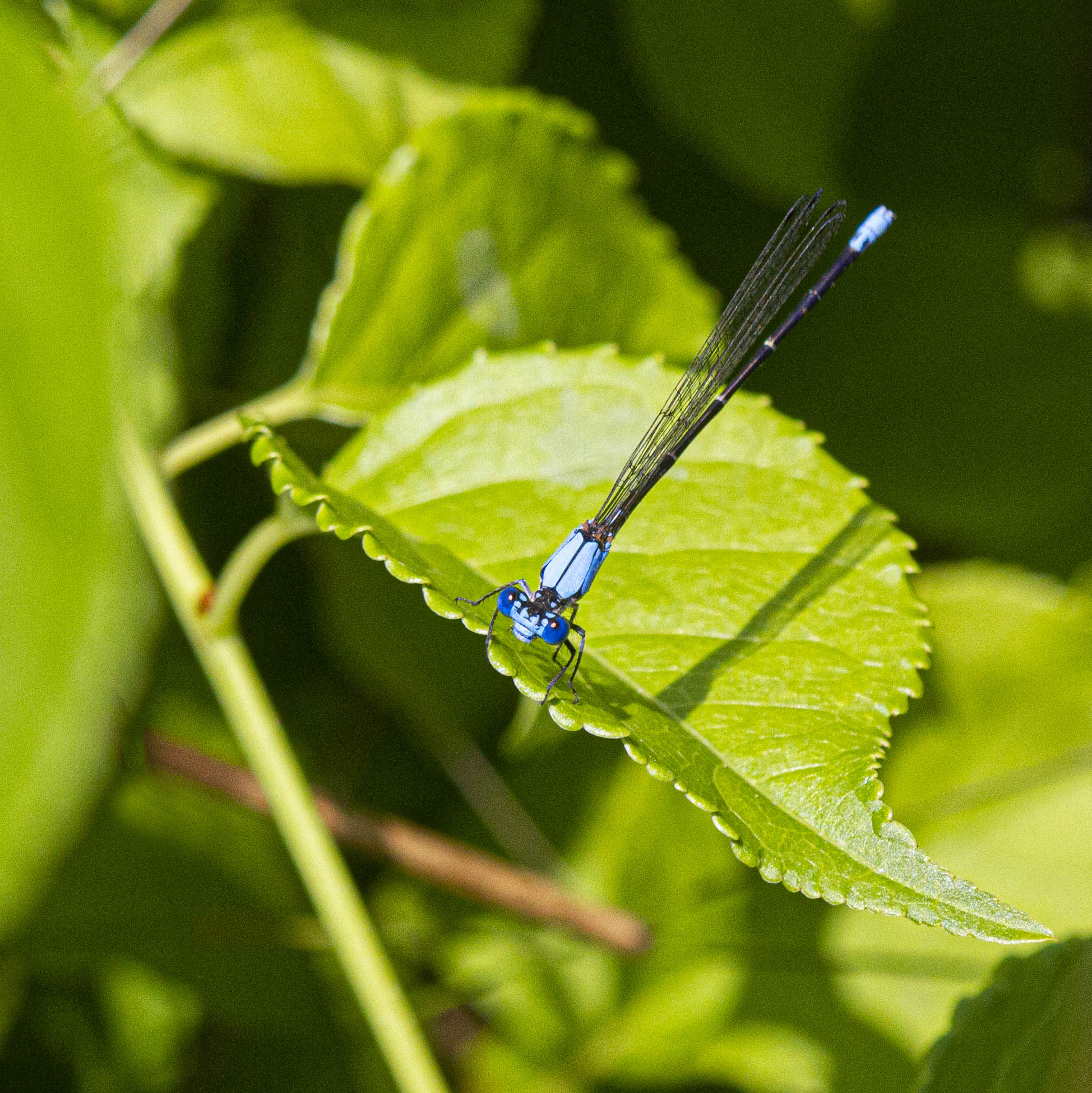
This little damselfly is called an Orange Bluet (Enallagma signatum). Yes, the name is confusing and seems to be a bit of an oxymoron. Most bluets have various patterns of blue and black on their bodies, but surprisingly there are also bluets that are patterned predominantly in red, orange, yellow, green or black. The male Orange Bluet adopted a seemingly confrontational pose and stared right at me as I prepared to photograph him last Thursday at Jackson Miles Abbott Wetland Refuge—maybe he felt the need to defend his territory.

I would have liked to have captured an eye-to-eye shot, but was afraid of scaring away the damselfly if I bent down closer to it, so took the shot from a downward angle. Although a substantial part of the Orange Bluet’s body is out of focus in this image, I think the shot worked out ok, owing largely to the fact that the damselfly’s eyes were in focus. The curve of the stalk on which it was perched was a nice bonus and added some visual interest to the shot.

Orange Bluet

© Michael Q. Powell. All rights reserved.

Read Full Post »

Last Thursday I was delighted to spot some Slender Bluet (Enallagma traviatum) damselflies at the small pond at Jackson Miles Abbott Wetland Refuge, my first sighting of this species this year. Although this species is quite small—about 1.2 inches (31 mm) in length—I managed to get a shot of a Slender Bluet in flight, as well as several shots of Slender Bluets perched in the vegetation at the edge of the pond.

Many of the summer species of dragonflies and damselflies have now reappeared and I will be focusing a lot of my attention in the upcoming months on highlighting the beauty of these amazing aerial acrobats.

Slender Bluet

Slender Bluet

Slender Bluet

© Michael Q. Powell. All rights reserved.

Read Full Post »

As I was reviewing my photos of the past couple of weeks, I was a little surprised at the number of shots that I have taken of Blue Corporal (Ladona deplanata) dragonflies in wildly varying environments. Blue Corporals are an early-season species and won’t be around for too much longer, so I am happy to have had the opportunity to observe so many of them. Most of the time, Blue Corporals like to perch flat and, judging from the photos, it doesn’t seem to matter if there are rocks, vegetation, or even lily pads.

From the perspective of a naturalist, I like the way that the different photos give you a feel for the environments in which I found these dragonflies. As a photographer, I was also struck by the way that the colors and textures of the background interact with the subjects. Most of the backgrounds in these shots are somewhat cluttered, but I did my best to use framing and focusing techniques to keep the background from being too distracting.

If I had to make a choice, I would say that the first photo is my favorite of the Blue Corporal images. I love the juxtaposition of the dragonfly with the varied textures, shapes, and colors of the rocks. I also really like the way the background grows progressively more blurry towards the top of the image. Do you have a favorite?

Blue Corporal

Blue Corporal

Blue Corporal

Blue Corporal

© Michael Q. Powell. All rights reserved.

Read Full Post »

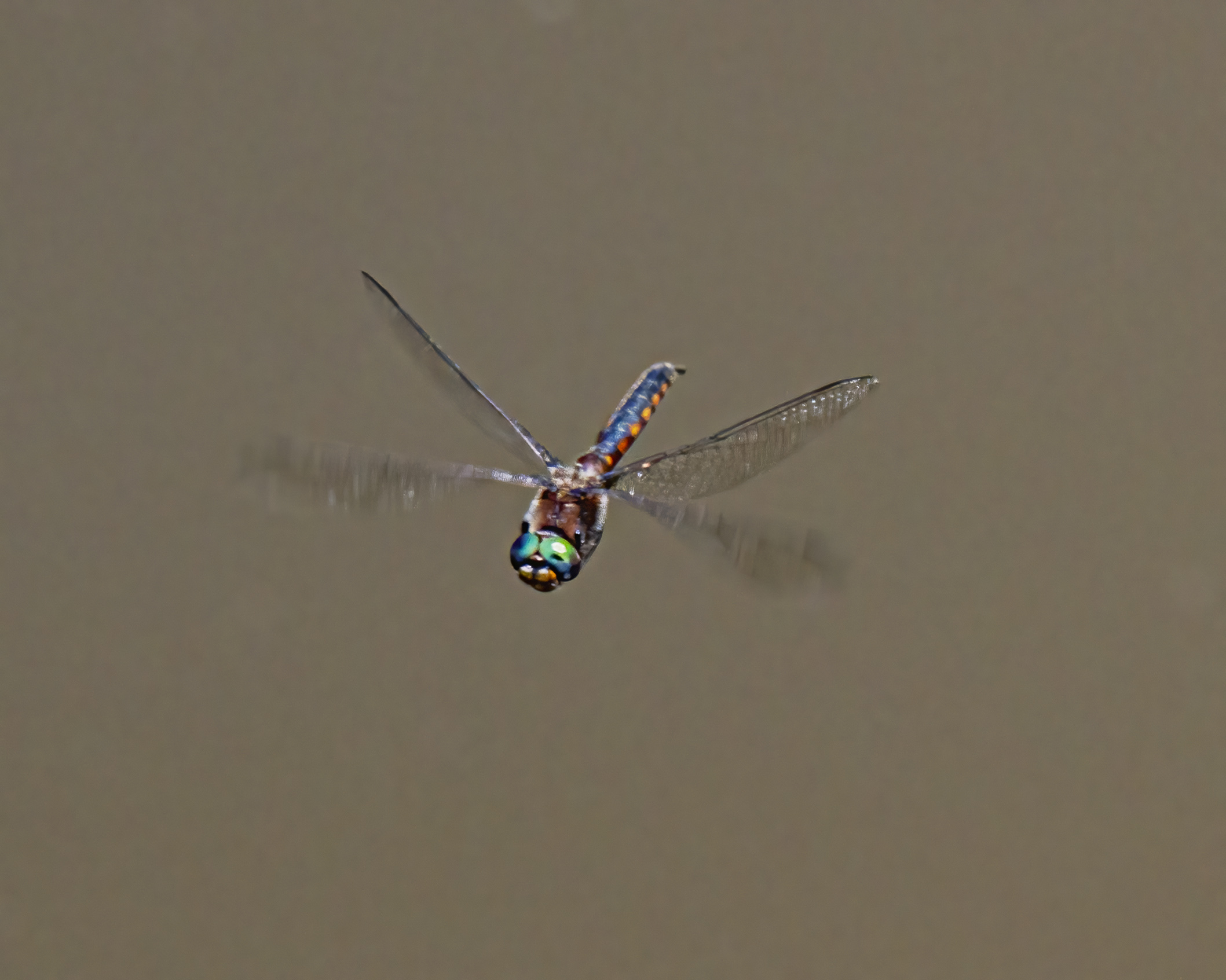
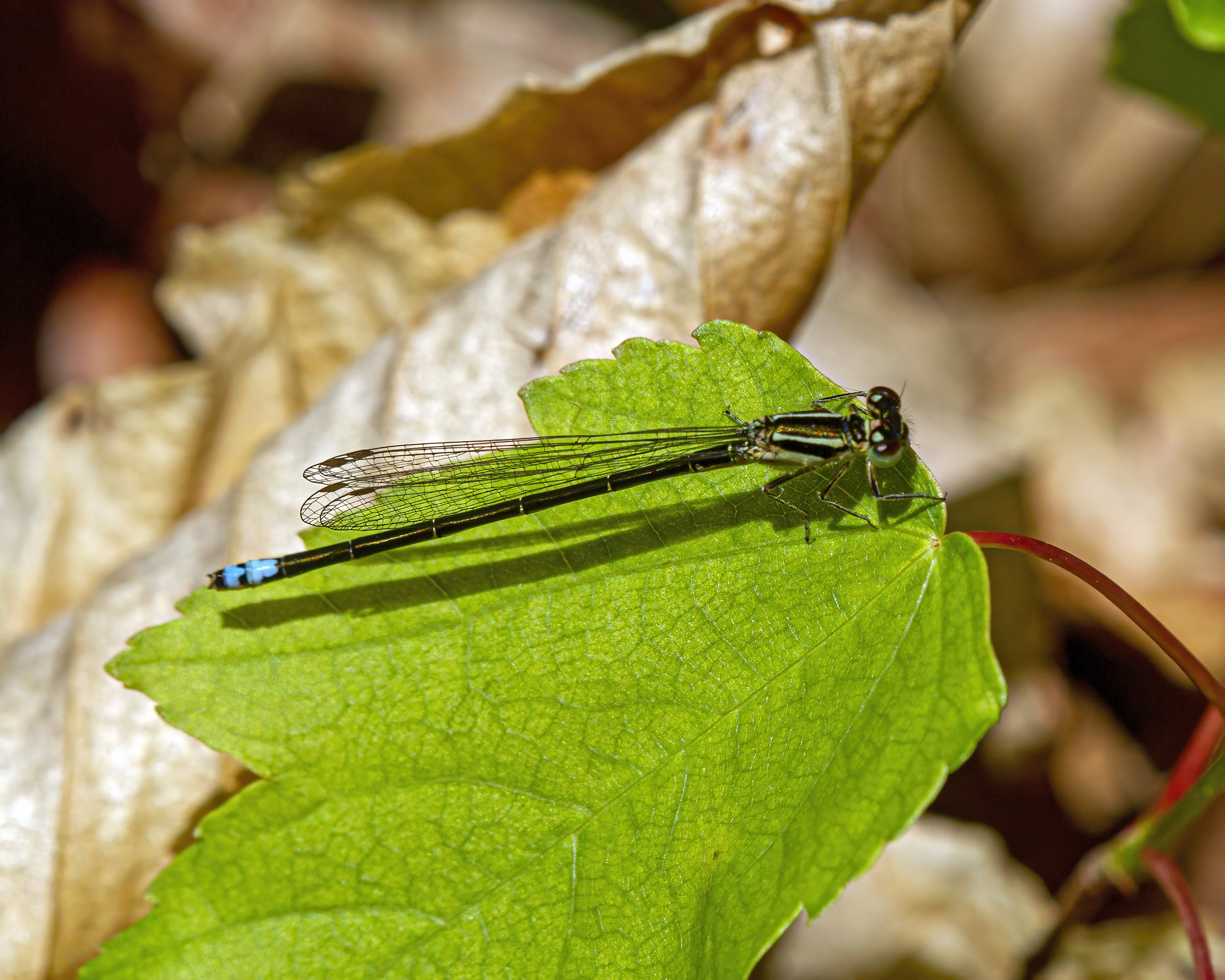
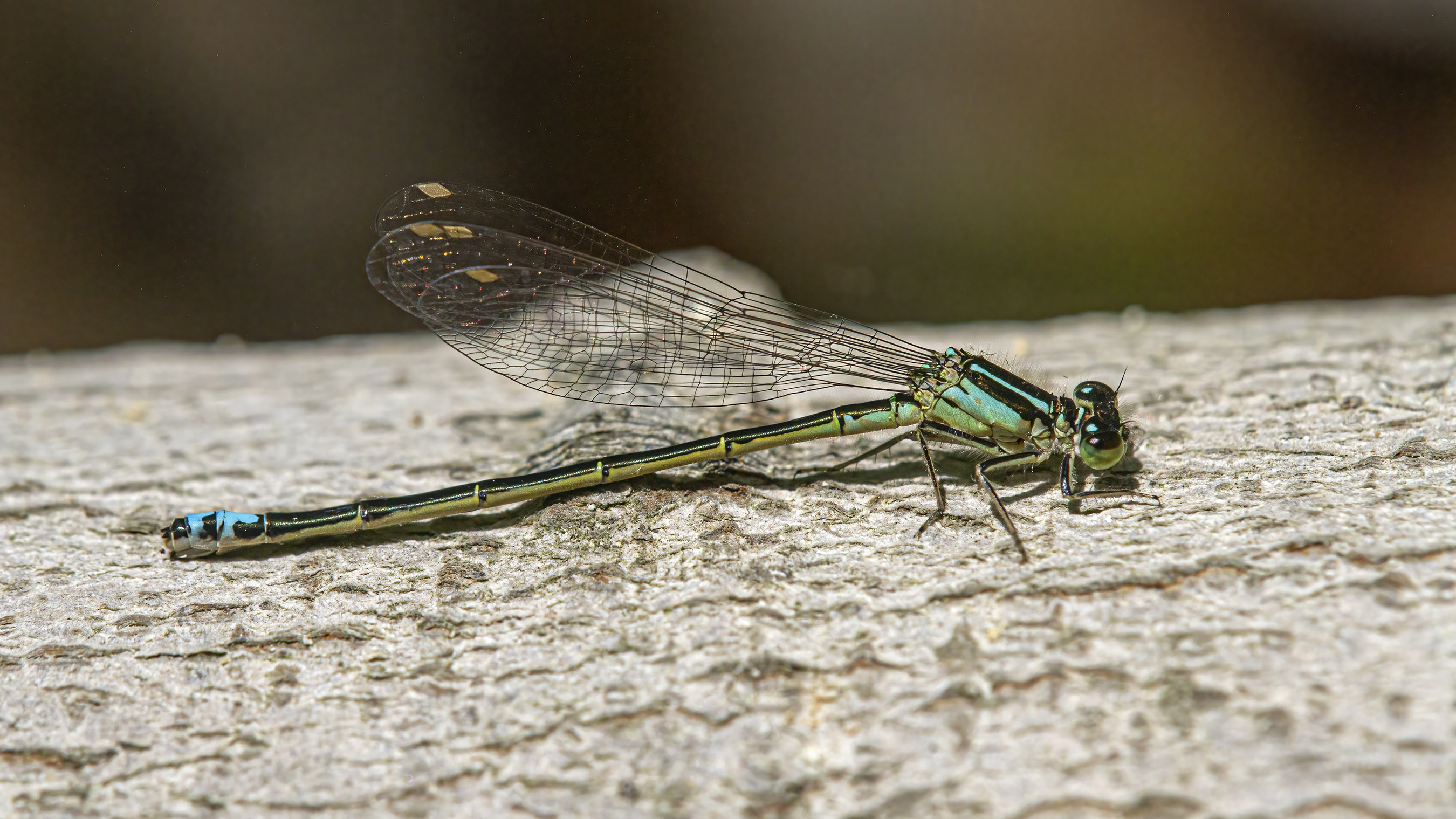
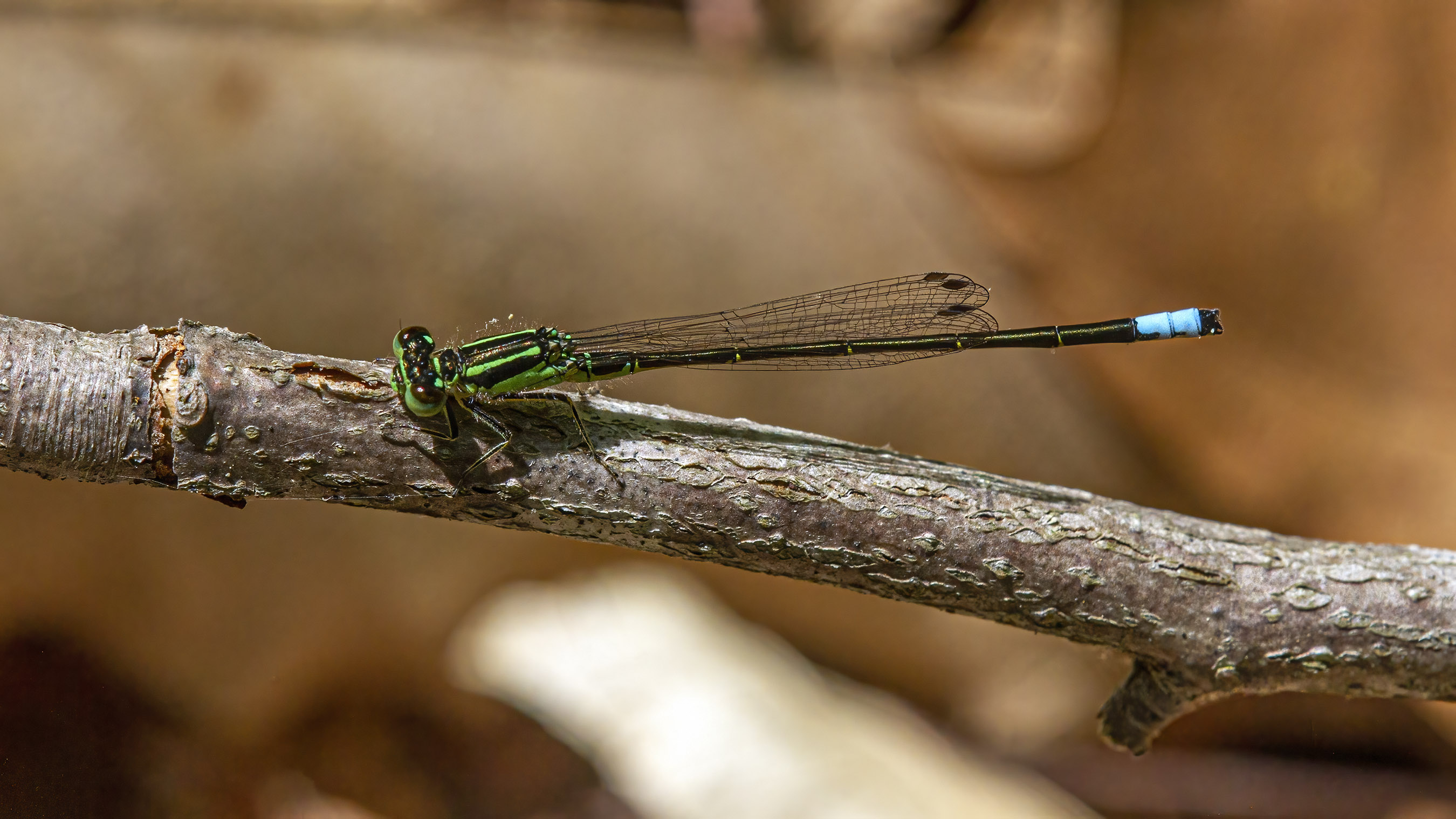
Yesterday I went exploring in Accotink Bay Wildlife Refuge, a nature preserve on the grounds of Fort Belvoir, a nearby US Army installation. I did not see many dragonflies, but was happy to spot some Eastern Forktail (Ischnura verticalis) damselflies. These damselflies are quite small—about an inch (25 mm) in length—and have distinctive blue markings near the tips of their abdomens.

Many damselflies have combinations of black and blue on their bodies, so identification can often be difficult. Usually I start by looking at the body and deciding if it is primarily black, as was the case here, primarily blue, or somewhere in the middle. After that, I examine the shape of the markings at the tip of the abdomens and compare them with the pictures in my damselfly identification guide.

Somehow, though, I always have more problems with damselfly identification that I do with dragonfly identification. Fortunately I am part of several Facebook groups that have experts who can weigh in when I need help in identifying a particular damselfly.

Eastern Forktail

Eastern Forktail

Eastern Forktail

© Michael Q. Powell. All rights reserved.

Read Full Post »

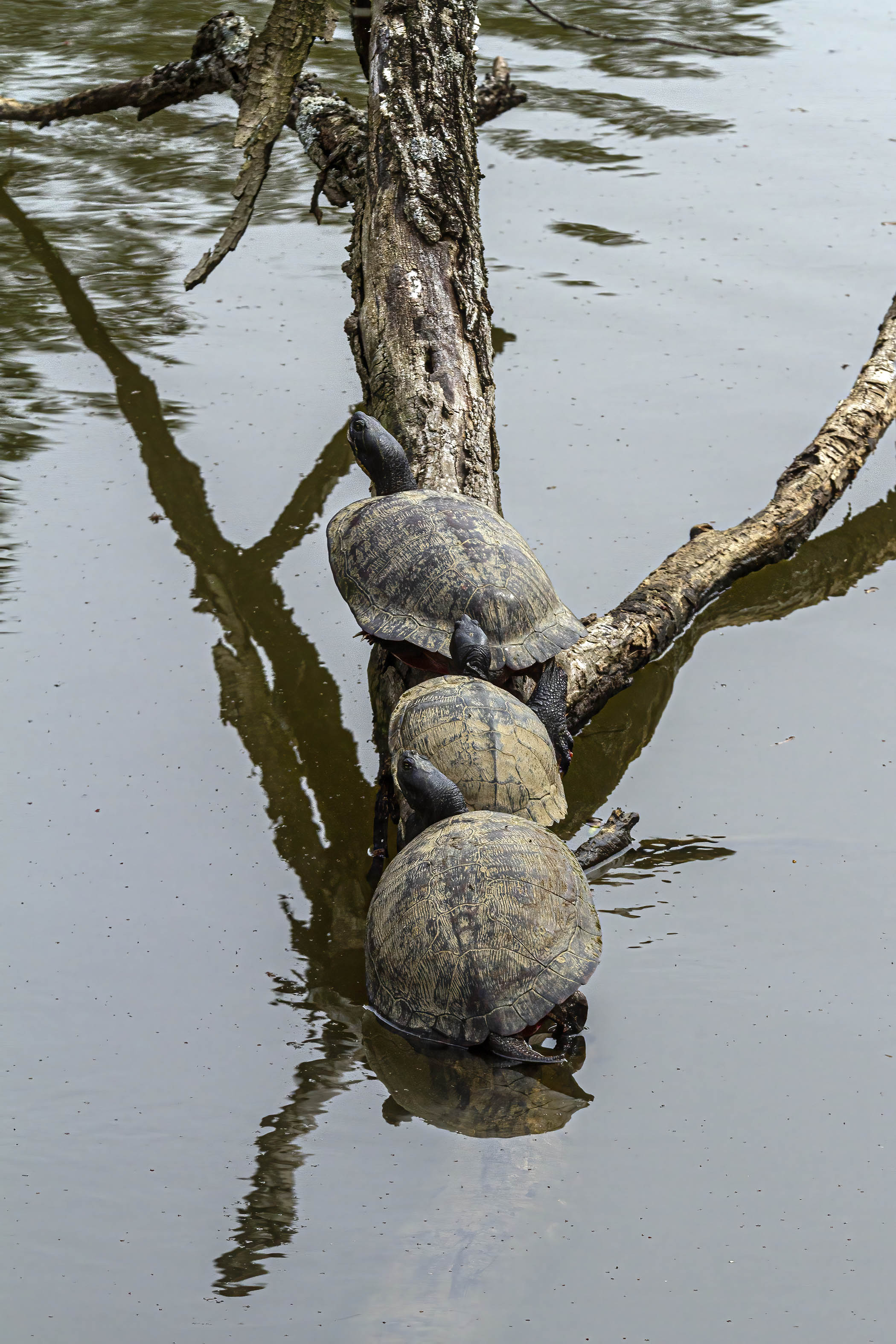
It is not unusual to see turtles in a row on a log, basking in the sunlight. Normally, though, the log is horizontal. In the case of the turtles that I spotted last week at Jackson Miles Abbott Wetland Refuge, the large fallen branch on which they were perched was sticking out of the water at an angle. The turtles, especially the one in the front, had to climb upwards on the branch and secure themselves firmly to keep from sliding back into the water.

I really like the way that this image turned out. I managed to capture the texture of the bark and of the turtles’ shells and the reflections were a nice bonus. The limited color palette allows the viewer to focus on the shapes and textures without being distracted by bright colors. It is a simple, almost abstract image, characteristics shared by many of my favorite photos.

turtles

© Michael Q. Powell. All rights reserved.

Read Full Post »

Most of the turtles that I see are either Painted Turtles or Red-eared Sliders, so I am delighted when I spot a member of another turtle species. Last Wednesday I was thrilled to spot several Spotted Turtles (Clemmys guttata), a relatively uncommon turtle species in my area. Spotted turtles tend to be found in marshy areas rather than in ponds, and it was indeed in a small wetland area at Jackson Miles Abbott Wetland Refuge that I photographed this turtle.

Species names can sometimes feel confusing or inappropriate, but the name of “Spotted Turtle” is perfect for these turtles that, as you can see in the photos below, have small yellow spots on their bodies and shells. For the first time this season I was walking around with my 180mm macro lens attached to my camera, hoping to photograph some butterflies, dragonflies, or other insects, but I came up empty-handed in that regard. I was happy, though, to be able to get a few shots of these little Spotted Turtles, perched on a log as they basked in the warmth of a sunny March day.

Spotted Turtle

spotted turtle

© Michael Q. Powell. All rights reserved.

Read Full Post »

I have been playing around with video again and made a little YouTube video about some of my challenges in trying to photograph dragonflies in flight. I tried to combine some video footage captured when I was out in the field (the second shot below is a still extracted from the video) with some of my still images that you may have already seen in past blog postings. I did a voiceover with the still photos that provides some information about my camera settings and techniques as well as commentary about the location where I was shooting. The first image is the thumbnail for the video, which I included to give you an indication in the Reader about the content.

I embedded the video link at the end of this posting that you can click directly if you are viewing directly from my blog. After I posted a video this way in the past, I learned that those folks who receive the blog in their e-mail are not able to see the embedded video. If that is the case for you, here is a link that you can click that will take you to the YouTube video. The video is about eight minutes long, but I think you will find it enjoyable and informative.

I shared the video directly with one of my subscribers, Jet Eliot, who commented, “I absolutely loved your video, Mike. Your enthusiasm and expertise for dragonflies comes through beautifully. I like how upbeat you are about photographing dragonflies, and encouraging. Your voice is rich, vocabulary lovely, and diction is smooth. A complete joy to watch–I’m still smiling.” Be sure to check out her wonderful blog Jet Eliot–Travel and Wildlife Adventures for her weekly essays, photos, and anecdotes on lively, interesting places and creatures that she has befriended all over the world.

YouTube_thumbnail

In the Field

© Michael Q. Powell. All rights reserved.

Read Full Post »

As I was looking over my photos from my visit last Wednesday to Jackson Miles Abbott Wetland Refuge, I was struck by the variety of perching styles of the dragonflies that I had photographed. The dragonfly on the left in the first photo, a Slaty Skimmer (Libellula incesta), was using the style that I see most often—he was perched horizontally with his wings extended outwards. The dragonfly on the right, a male Swift Setwing (Dythemis velox) had his abdomen raised to about a 45 degree angle and had pulled his wings forward.

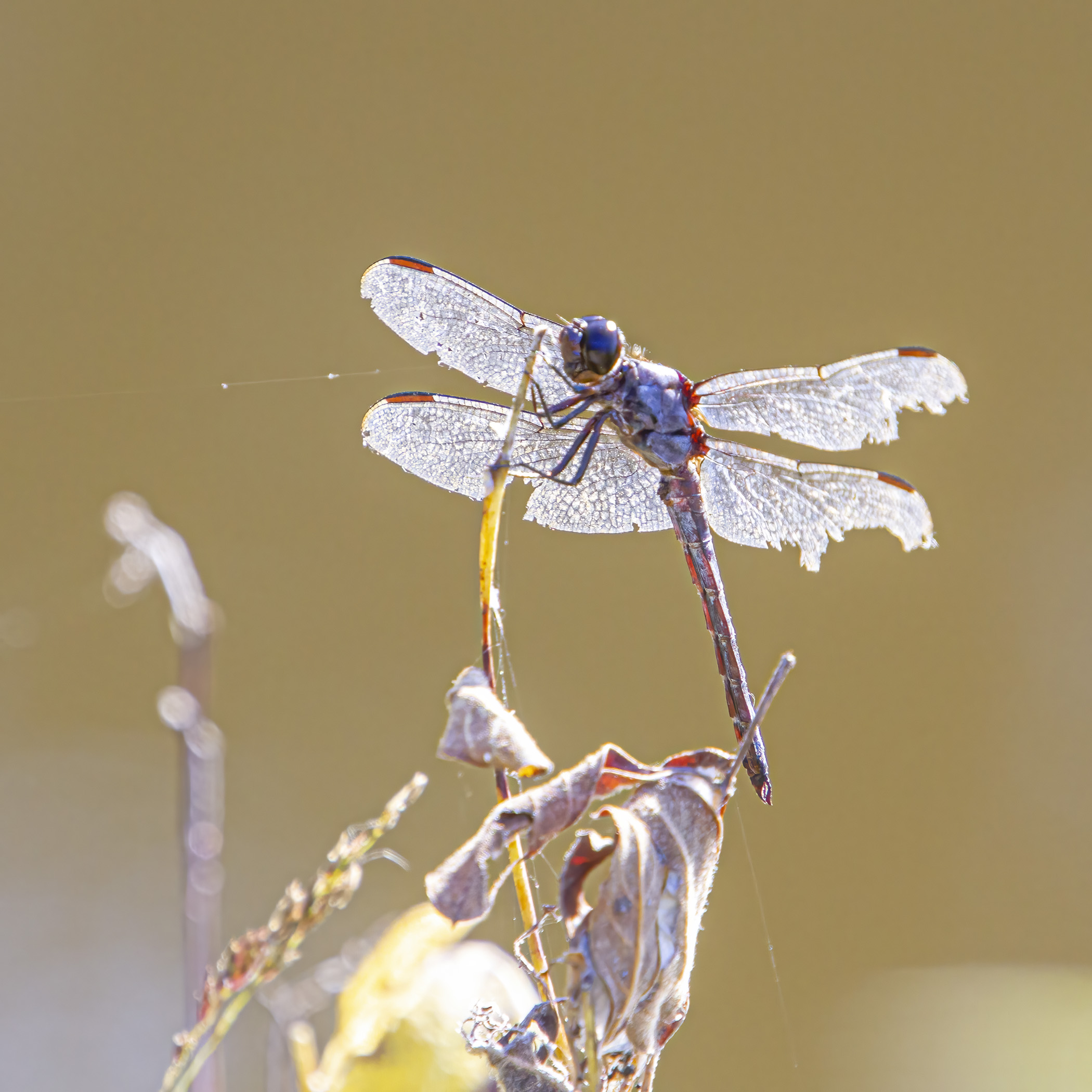
In the second image, the dragonfly was perched at a slight angle as it held onto the vegetation. The coloration of this dragonfly is so faded that it is hard for me to identify its species, though I think it might be an old Great Blue Skimmer (Libellula vibrans).

In the final photo, the dragonfly is in an almost vertical position as it clings to the stalk of the vegetation. The shadows make it tough to identify this dragonfly, but I am not worried about that—I like the “artsy” feel of the photo.

This little posting barely scratches the surface of the topic of dragonfly perching behavior, but I hope it raises your awareness of the diversity in the world of dragonflies, not just in their appearances, but also in their behavior.


dragonfly perches

dragonfly perches

dragonfly perches

© Michael Q. Powell. All rights reserved.


Read Full Post »

I was a little surprised on Wednesday to see a Prince Baskettail dragonfly (Epitheca princeps) flying over the pond at Jackson Miles Abbott Wetland Refuge—I thought they were all gone by now. There were not too many other dragonflies around, so I concentrated on trying to capture in-flight shots of this elusive dragonfly that I never saw perch.

Photographing dragonflies while they are flying is a huge challenge for both my skill and my patience. I had a general idea of the area in which this dragonfly was flying as he flew repeatedly over a patch of lily pads. However, his specific flight path varied a lot and he often changed directions without warning.

Most of my photos were blurry or did not contain my subject, but I eventually managed to get a few decent shots of the Prince Baskettail. The first one is the sharpest, but it does not give you much of a sense of the environment in which the dragonfly was flying. The second shot has a bit of blur, but I really like the background pattern of the water of the pond. The dragonfly was flying away from me when I took the final photo, but I like the way that the image shows the pond vegetation and the tiny perched Eastern Amberwing dragonfly in the foreground was a nice bonus.

Prince Baskettail

Prince Baskettail

Prince Baskettail

© Michael Q. Powell. All rights reserved.


Read Full Post »

This looks like such a tranquil scene, with two dragonflies of different species sharing a prime perch on a branch overhanging the pond at Jackson Miles Abbott Wetland Refuge, a moment of peaceful coexistence. However, I had been watching these two dragonflies for an extended period of time and knew that the moment of sharing was the exception rather than the rule.

The male Slaty Skimmer dragonfly (Libellula incesta) on the left and the male Swift Setwing (Dythemis velox) had been repeatedly challenging each other for sole possession of the perch. Whenever one of them would perch on the end of the branch, the other dragonfly would fly straight at the one that was perched, attempting either to dislodge the interloper or at least convince him to fly away.  They went back and forth like this for quite a while, alternating possession, though I think the Slaty Skimmer, the larger of the two, held onto the branch for a longer period of time than the Swift Setwing.

I tried to capture them “buzzing” each other, but timing was really tricky and it was almost impossible to keep them both in focus. The second image below is my best effort in showing their interaction. I was low to the ground when I took the shot and really like the perspective with the sky in the background. If you look closely at the lower left corner of the second photo, you may notice that a long-jawed spider was also sharing the perch with the two dragonflies.

coexistence

coexistence


© Michael Q. Powell. All rights reserved.

Read Full Post »

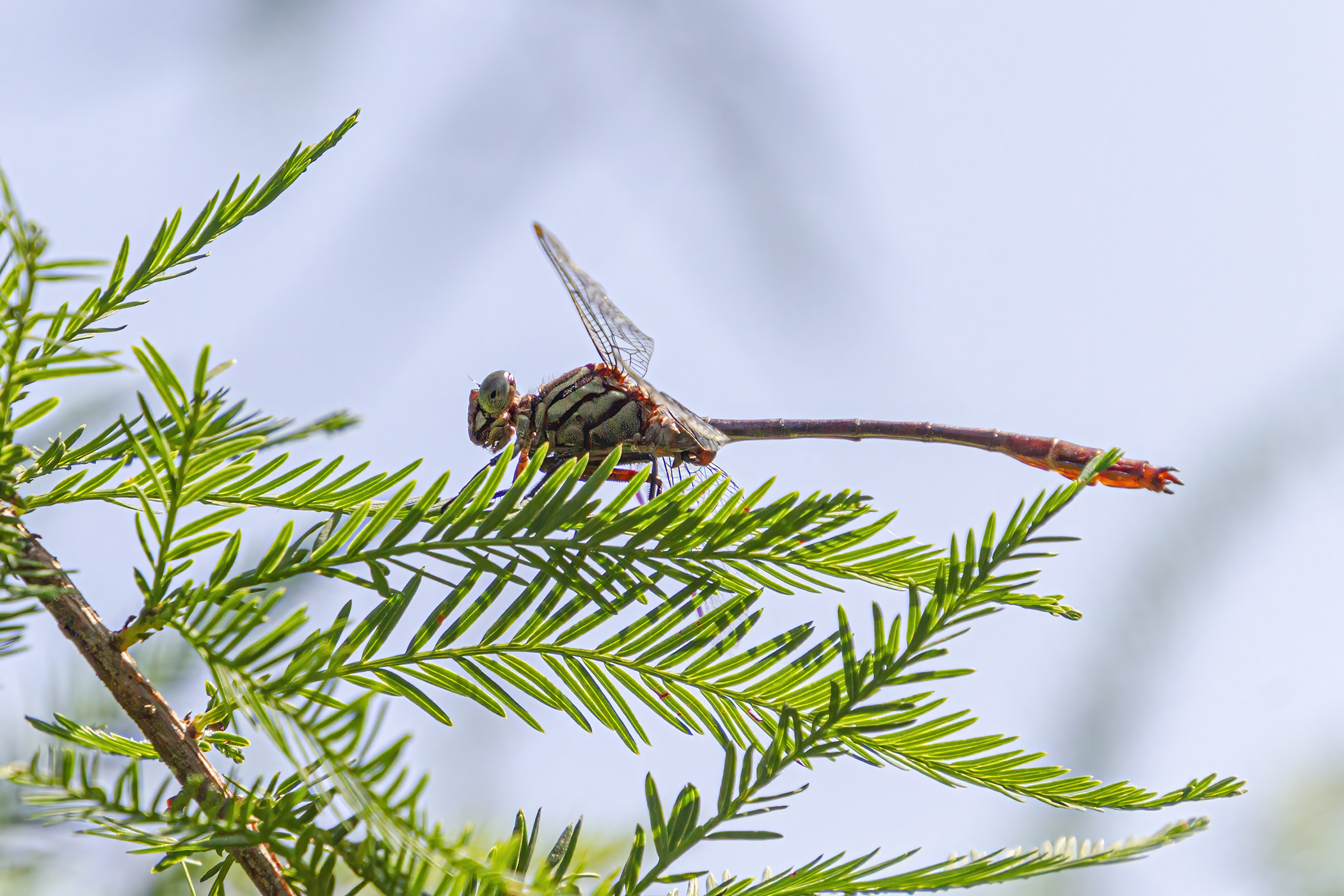
Here are some shots of Russet-tipped Clubtail dragonflies (Stylurus plagiatus) that I photographed at Jackson Miles Abbot Wetland Refuge last Saturday. The first image shows a male perched in an evergreen tree. Sharp-eyed views may recognize this tree, which is the same one on which yesterday’s Common Green Darner was perched.

The second image shows a female Russet-tipped Clubtail in some vegetation. If you compare the tip of her abdomen (the “tail”) with that of the first dragonfly, you can readily see they they are different. That is one of the reasons why the terminal appendages of a dragonfly are a key identification feature in determining the gender of an individual. You can’t help but notice that her left hind wind is almost completely shredded. I suspect that she can still fly, albeit with some difficulty.

The final shot shows a male in flight over the pond at the refuge. This is the first time that I have gotten an identifiable shot of this species in the air. I actually did not realize that it was a Russet-tipped Clubtail when I took a burst of shots of then flying dragonfly. I had simply reacted instinctively when I spotted the dragonfly—if it’s flying, I’m trying. It was a pleasant surprise when I opened the images on my computer and realized what I had captured.

There are a few species that emerge in September, so this year’s dragonfly season is far from over. Tomorrow marks the start of a new month, a month that I hope will be full of new opportunities for me and for all of you.

Russet-tipped Clubtail

Russet-tipped Clubtail

Russet-tipped Clubtail

© Michael Q. Powell. All rights reserved.

Read Full Post »

I was thrilled on Saturday when one of my fellow dragonfly enthusiasts spotted this colorful male Common Green Darner dragonfly (Anax junius) at Jackson Miles Abbott Wetland Refuge and pointed it out to me. Common Green Darners are relatively common, but most of the time when I see them they are patrolling overhead, so it was quite a treat to find one perched.

Common Green Darners are one of the few dragonfly species that migrate. According to Kevin Munroe, creator of the wonderful Dragonflies of Northern Virginia website, “Common Greens seen in our area in early spring are in fact migrants from points south. They emerge in the Southeast and fly north, arriving here late March thru May. After their long flight, they mate, lay eggs and die. Their young emerge in July and August. Congregating in large swarms, this second generation begins flying south in September. They lay eggs that fall, after arriving in their southern destinations, and die. When their young hatch in March, they fly back to Northern Virginia and it starts again—a two generation migration.” Wow!

This dragonfly was hanging on the same evergreen tree where I recently photographed a Russet-tipped Clubtail—see my blog posting entitled “Russet-tipped Clubtail dragonfly.” I guess that I will be checking that tree from now on to see if lightning will strike again. When I am hunting for dragonflies, I tend to return first to places where I have seen them previously and then widen my search. Sometime it pays off, though, as is the case for all wildlife photography, there are certainly no guarantees of success.

Common Green Darner

© Michael Q. Powell. All rights reserved.
Read Full Post »

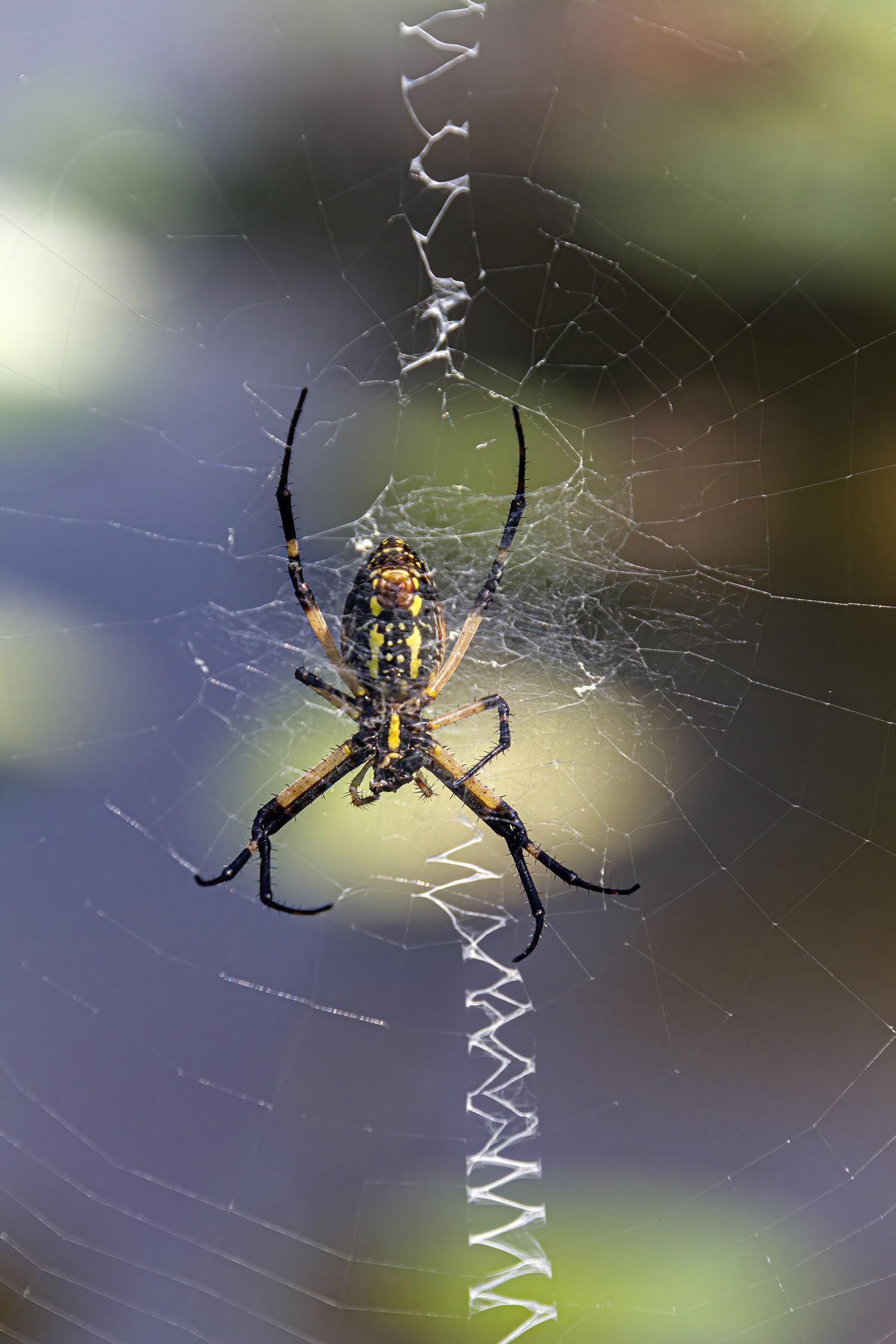
During my recent visits to Jackson Miles Abbott Wetland Refuge, I have noticed the reappearance of Black and Yellow Garden Orbweaver Spiders (Argiope aurantia). During the late summer and early fall, these relatively large spiders can be seen in the vegetation surrounding the pond and in the adjacent fields.

One of the coolest things about this spider is the distinctive zig-zag pattern, known technically as a stabilimentum that the spider uses for the central part of its web. According to Wikipedia, the purpose of the zig-zags is disputed. “It is possible that it acts as camouflage for the spider lurking in the web’s center, but it may also attract insect prey, or even warn birds of the presence of the otherwise difficult-to-see web.”

Argiope aurantia

© Michael Q. Powell. All rights reserved.

Read Full Post »

Goldenrod was in full bloom on Wednesday at Jackson Miles Abbott Wetland Refuge, attracting all kinds of insects, including a little Skipper butterfly and a colorfully-patterned Ailanthus Webworm moth (Atteva aurea). I believe that the butterfly is a Sachem Skipper (Atalopedes campestris), although it is hard to be confident when identifying skipper butterflies—there are quite a number of similar looking species.

I love the intricate orange, black, and white pattern on the body of the Ailanthus Webworm moth, a type of ermine moth. This moth looks quite a bit like a beetle when it is at rest with its wings tucked in, but reportedly it looks like a wasp when in flight. I encourage you to click on the image to get a better look at the wonderful details of the two insects.

When I composed this image, I was conscious of the fact that my primary subject, which was initially the skipper, filled only a small part of the frame. However, I really liked the brilliant yellow of the goldenrod and framed the shot to focus viewers’ attention as much on the sweeping curve and color of the goldenrod as on the insects. The goldenrod became the co-star of the photo and therefore has equal billing in the title of this blog posting.

goldenrod and insects

© Michael Q. Powell. All rights reserved.
 

Read Full Post »

I was delighted on Wednesday to spot this male Swift Setwing dragonfly (Dythemis velox) during a short visit to Jackson Miles Abbott Wetland Refuge. These little dragonflies perch in a distinctive pose with their wings pulled forward, which looked to some scientist like the “ready-set-go” position of a sprinter and is reportedly the reason for the name of the species.

This species is really special to me, because this primarily southern species had never before have been documented in Fairfax County, Virginia, the county where I live, until I spotted one six years ago at this same location. By now there seems to be an established breeding population, and I look forward to seeing them each summer.

As August draws to a close, I am acutely aware that each sighting of a dragonfly could be the last one of the season for that species, so I really savor each encounter. There is beauty all around us, but somehow I have a particular affinity for dragonflies and damselflies—I am endlessly fascinated by these colorful little aerial acrobats.


Swift Setwing

© Michael Q. Powell. All rights reserved.

Read Full Post »

Seasons are starting to change for those of us in the Northern Hemisphere as summer gradually releases its hold on us. Already the children in my area have returned to school and the weather is cooling off a bit.

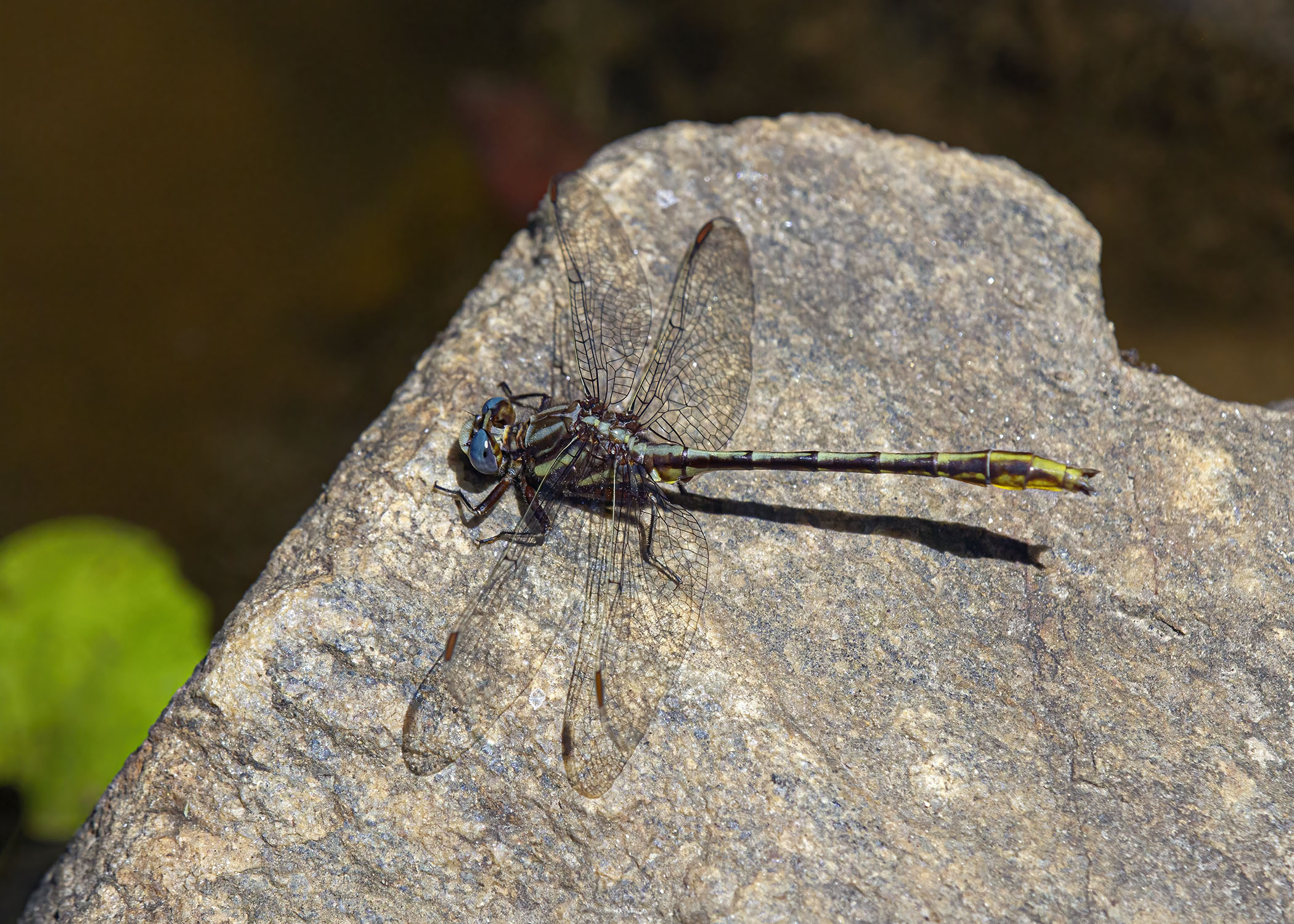
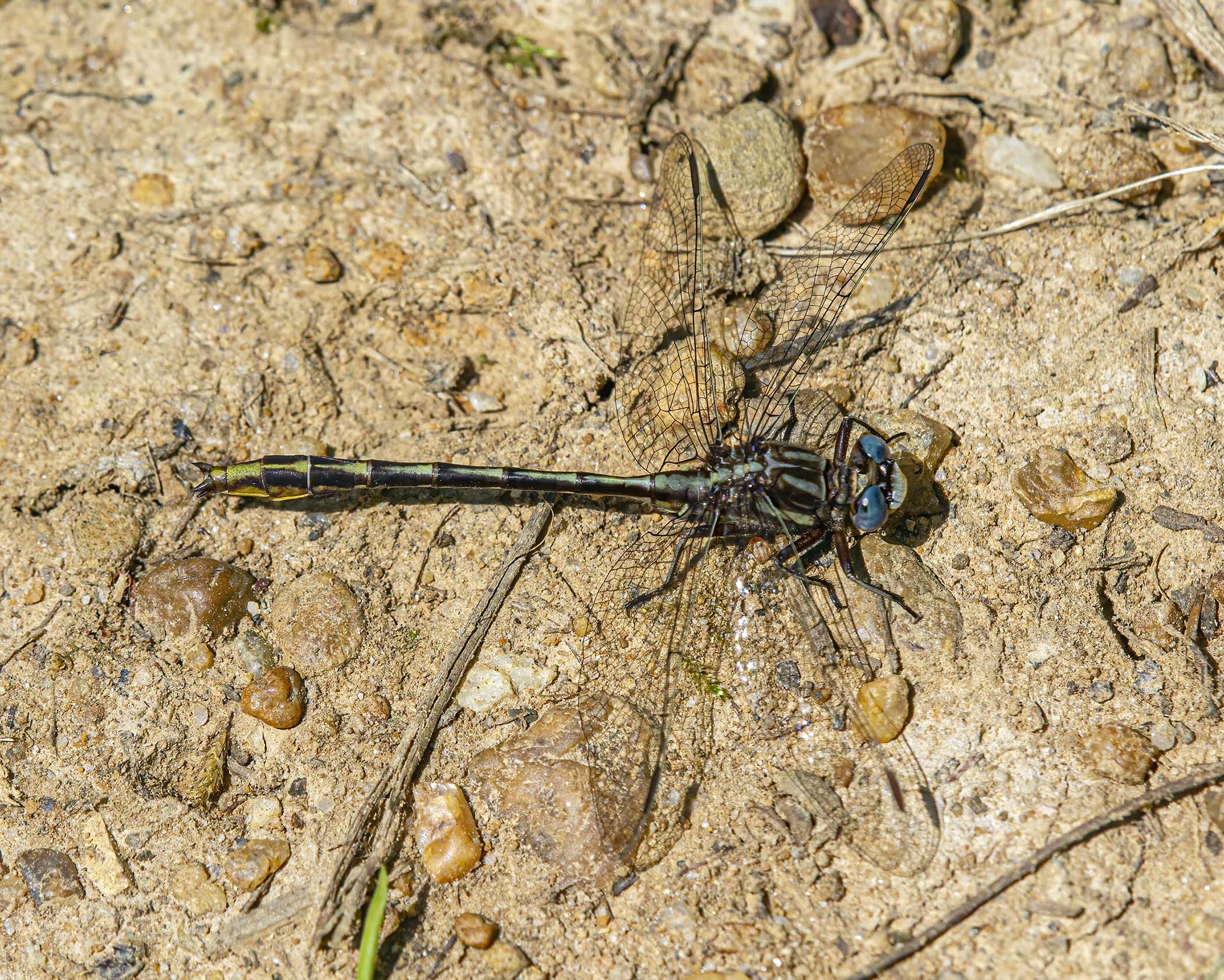
Some of the summer dragonfly species are starting to disappear or decrease in numbers. Fortunately, some new species appear late in the season to take their places, like this handsome male Russet-tipped Clubtail dragonfly (Stylurus plagiatus) that I spotted yesterday at Jackson Miles Abbott Wetland Refuge.

Russet-tipped Clubtails are a late season species and are seen most often in August and September. Unlike many of the dragonflies that I see regularly that seem to prefer pole-like perches or perch flat on the ground, Russet-tipped Clubtails like to hang from the leaves of vegetation at an angle or almost vertically—members of the genus Stylurus are sometimes called “Hanging Clubtails.”

I am not quite ready to welcome “autumn,” but there are signs everywhere that the seasons are inexorably changing. Autumn is probably my favorite season of the year, but I am still holding on to the summer.

Russet-tipped Clubtail

UPDATE: As a kind of experiment I decided to do a little video version of this posting that I put on my YouTube channel. What do you think?

© Michael Q. Powell. All rights reserved.
Read Full Post »

Normally I try to do a posting to my blog every day, but for the next three weeks my posting schedule will be much more erratic. I am in the final stages of packing my car for a trip to visit my son and his family outside of Seattle, Washington. There are multiple decision points along the way and I have not yet decided on my final route, but no matter how I go, it is likely to be about 3,000 miles (4828 km) each way.

I have some camping gear with me, including a water jug that holds six gallon (23 liter), so I may well be spending some time disconnected from the virtual world. I’ll try to take some photos along the way and will share them when I am able.

I am leaving you with a shot of a pretty little butterfly, which I think is a Pearl Crescent (Phyciodes tharos) perched on some Butterfly Weed (Asclepias tuberosa). I love the different shades of orange in the image.

In case some of you do not know it, my KIA Soul, in which I am driving out West, is orange in color. It is a coppery orange and not a pumpkin orange and it definitely stands out in a parking lot. My license plate holder has SOUL on it and my license plate itself is “BLESS MY.”

I am attaching a couple of photos of my car from January 2016, after a big snow storm. So many of us throughout the Northern Hemisphere are suffering from oppressive heat and I thought that the sight of snow might cool us off a little. I’ll close with a joke that I say on-line today that is a perfect fit for my quirky sense of humor—”Just be thankful that it is not snowing. Imagine shoveling snow in this heat!”

KIA Soul

KIA Soul

© Michael Q. Powell. All rights reserved.
 

Read Full Post »

« Newer Posts - Older Posts »