Feeds:
Posts
Comments

Posts Tagged ‘female Red-winged Blackbird’

I was delighted to see some Red-winged Blackbirds (Agelaius phoeniceus) last week at Occoquan Bay National Wildlife Refuge. In the first photo, a male  Red-winged Blackbird seemed to be showing off for me as he balanced himself on a single leg, glanced in my direction, and seemed to smile. Eventually he climbed to the tip of the small branch and appeared to be complaining about something that he observed.

A short distance away I captured the final image of a female Red-winged Blackbird. As you can she, she is not black nor does she have any red on her wings, so it feels a little strange to call her a Red-winged Blackbird. Although I was not able to get very close to her, I really like the overall composition of the image and the moment of action that I was able to capture as she called out.

Red-winged Blackbird

Red-winged Blackbird

Red-winged Blackbird

© Michael Q. Powell. All rights reserved.


Read Full Post »

I spotted this beautiful female Red-winged Blackbird (Agelaius phoeniceus) poking about in the marshland vegetation last Thursday at Jackson Miles Abbott Wetland Refuge. As is the case with many birds, the name of the species matches the coloration and/or features of the male, but not those of the female, e.g. this Red-winged Blackbird is not black nor does it have red wings.

I had my first encounter with a female Red-winged Blackbird in June 2012, a few months before I started this blog. I remember well my initial difficulties in trying to identify the bird and my shock in learning that it was a blackbird—I assumed it was a sparrow of some sort. In September 2012, I posted some photos of that bird in a blog entry entitled “Intense bird.” I encourage you to click on that link and make your own judgment about the degree to which my photography “style” has remained consistent over the years.

In 2012 I was just starting to get serious about photography and my dear friend and photography mentor Cindy Dyer had lent me a Nikon D300 and a Tamron 180mm macro lens that day. I fell in love with that lens and quickly purchased one for my Canon, the brand that I mostly use. The Tamron 180mm macro lens remains one of my favorite lenses.

It was quite enjoyable to watch this blackbird last week exploring the vegetation protruding from the water. She would perch on some rather small stems, appearing to flare her tail to maintain her balance, as you can see in these photos, occasionally calling out to a male blackbird that I could hear, but did not see.

Red-winged Blackbird

Red-winged Blackbird

© Michael Q. Powell. All rights reserved.

Read Full Post »

A female Red-winged Blackbird (Agelaius phoeniceus) lifted her head as I approached her last week at Occoquan Bay National Wildlife Refuge, but then went back to work extracting seeds from the spiky sweetgum balls. The seedpods were so numerous that they reminded me of a well-decorated Christmas tree festooned with hanging ornaments.

Red-winged Blackbird

© Michael Q. Powell. All rights reserved.

Read Full Post »

Birds have to work really hard to find food during the cold season. This female Red-wing Blackbird (Agelaius phoeniceus) decided that it was worth her effort to try to extract some seeds from the spiky seed pods of a sweetgum tree earlier this month at Occoquan Bay National Wildlife Refuge.

Some of you may be wondering how this can possibly be a Red-winged Blackbird. After all, this bird is not at all black and her wings are not red. When I first started getting serious about my photography more than 11 years ago, I would often go out shooting with my mentor Cindy Dyer, who loved to photograph flowers and sometimes insects. She rarely photographed birds and I had no experience identifying them.

During one such outing I photographed a bird on a rebar trellis at one a botanical garden. I assumed that it was one of the many types of sparrows that I lumped together as “little brown birds.” When I posted the shots in a Facebook birding forum, I was shocked to learn that it was a female Red-winged Blackbird. (Check out my 27 September 2012 blog posting called “Intense bird” for more details on that adventure, including my first ever shots of a female Red-winged Blackbird. I also remember that 2012 encounter well because I was shooting with a Nikon D300 that Cindy had lent me along with a Tamron 180mm macro lens. I did not switch from Canon to Nikon, but immediately orders the Canon version of the lens, which continues to be one of my favorite lenses.)

I am a lot more knowledgeable about birds now and have reconciled myself to the reality that many species derive their names from the males, who tend to be more colorful in appearance. As most of you know, I love to photograph insects, particularly dragonflies, but they have now completely (or maybe almost completely) disappeared from the scene, so I will be focusing my camera and my attention mostly on birds in the upcoming cold months.

Red-winged Blackbird

© Michael Q. Powell. All rights reserved.

Read Full Post »

This female Red-winged Blackbird (Agelaius phoeniceus) was backlit on Monday at Occoquan Bay National Wildlife Refuge, so I had to overexpose the image, which made the cloudy sky turn almost pure white. I really like the effect, which is reminiscent of a high-key portrait taken in a studio setting. One of my Facebook friends commented that the shot looked to him “like an old time copper image.”

My initial thought was to crop the image in a landscape format, as in the second image below, because I liked the graceful curve of the main branch. Upon further reflection, I decided that maybe there was literally too much white space in the image and opted for the square format in the first shot below, which gives a bit more attention to the main subject. What do you think? Do you have a preference for one version over the other?

red-winged blackbird

red-winged blackbird


© Michael Q. Powell. All rights reserved.


Read Full Post »

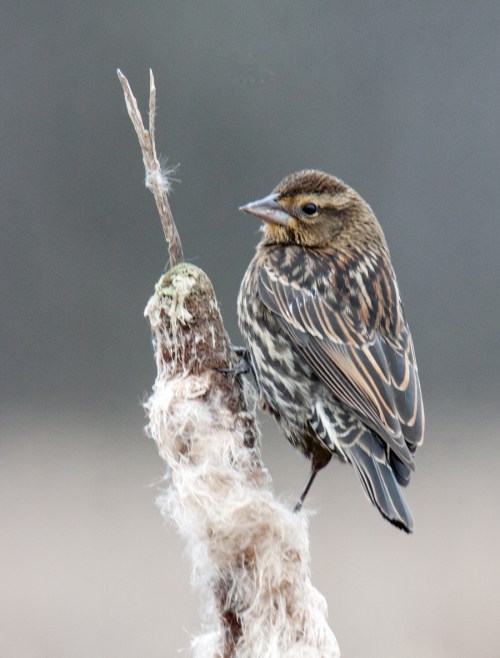
The composition of these images couldn’t get much simpler, but I think that they help to highlight the beauty of this female Red-winged Blackbird (Agelaius phoeniceus) that I spotted last week at Huntley Meadows Park. Normally female blackbirds forage down low inside the vegetation, so it was a real treat to find one perched out in the open.

Female Red-winged Blackbirds are special to me because they were one of my first subjects when I started to photograph birds. I remember well my surprise when I learned that this bird was a red-winged blackbird, given that it clearly was not black nor did it have red wings. I’ve learned a lot about bird identification since that time and birds have become one of my favorite subjects.

Red-winged Blackbird

Red-winged Blackbird

© Michael Q. Powell. All rights reserved.


Read Full Post »

A female Red-winged Blackbird (Agelaius phoeniceus) paused for a moment to pose as she foraged for food in the cattails of Huntley Meadows Park earlier this month.

Red-winged Blackbird

© Michael Q. Powell. All rights reserved.

Read Full Post »


How do you celebrate the end of the year? Do you like to go out with a bang, with a big celebration and literal or figurative fireworks, or are you more pensive and reflective? I know that I am in the latter group.

My life this past year, both personally and as a photographer, has had some high points, but mostly it has been a year in which I have tried to find beauty and meaning in ordinary things. I have visited my favorite park over and over again, photographing some of the same species repeatedly. Patience and persistence have been my hallmarks and I have been rewarded with some wonderful photographic opportunities.

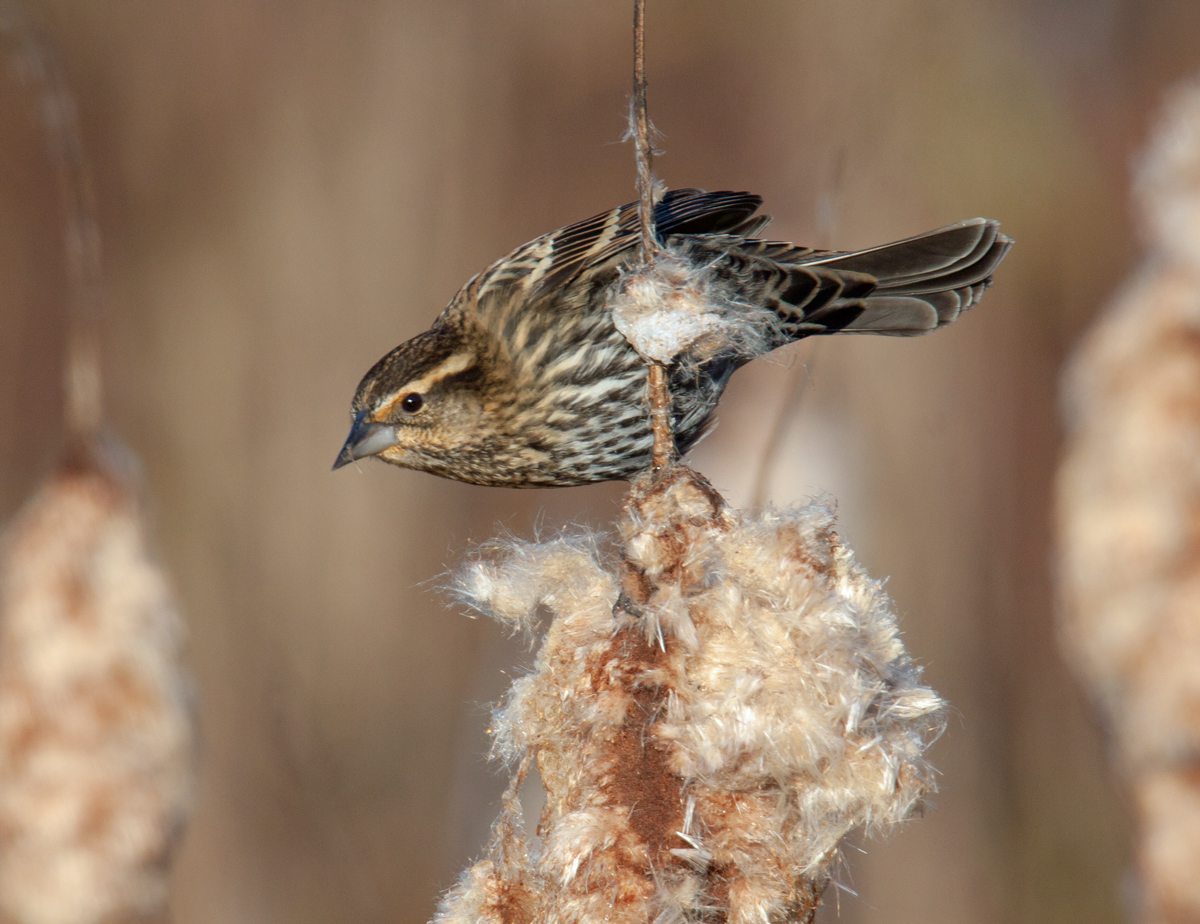
Somehow it seems appropriate that I end this year with a couple of images of this beautiful female Red-winged Blackbird (Agelaius phoeniceus) that I spotted in the cattails on Monday at Huntley Meadows Park. Red-winged Blackbirds are with us most of the year. They seem to come and go, but they are often there. The females are usually buried deep in the underbrush and are not seen as often as the more flashy and loud males. As you can see from these photos, however, the females are at least as beautiful as the males.

The blackbird’s body positions serve as a visual metaphors for my approach as I look forward to 2016—hanging on and occasionally looking back, but primarily looking forward with optimism to the future.

Best wishes to all for a wonderful 2016.

Red-winged Blackbird

Red-winged Blackbird

© Michael Q. Powell. All rights reserved.

Read Full Post »

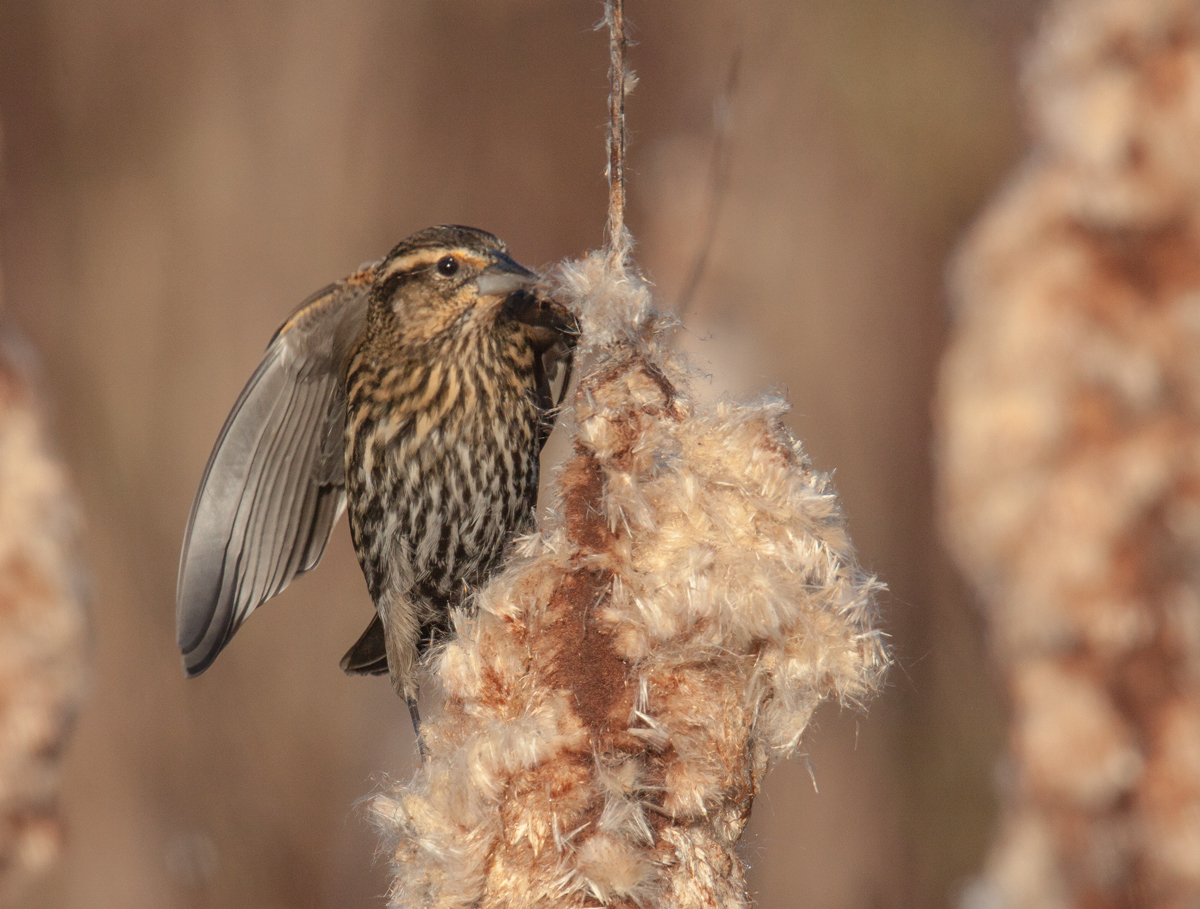
A small flock of Red-winged Blackbirds (Agelaius phoeniceus) was active in the cattails at Huntley Meadows Park on Monday morning. I was happy to be able to capture some action shots of one of the females, which, as you can readily see, are not black and don’t have red wings.

It was a real treat for me to be able to get some shots of the female blackbirds at the top of the cattails. Most of the time, the females peck about at the base of the cattails and only the male blackbirds are visible at the tops. For whatever reason, the majority of the members of this small flock appeared to be females.

I didn’t think that this female blackbird was aware of my presence as she diligently searched for insects, but the stare that I captured in the final photo seemed to be conveying a message that she did not want me there. I backed off and left a short time later.

Red-winged Blackbird

Red-winged Blackbird

Red-winged Blackbird

Red-winged Blackbird

Red-winged Blackbird

© Michael Q. Powell. All rights reserved.

Read Full Post »

I can understand how an adept female Red-winged Blackbird (Agelaius phoeniceus) can catch one dragonfly, but how in the world did this one manage to catch two at once?

I can’t tell for certain, but the dragonflies in the bird’s mouth look to be female Common Whitetails (Plathemis lydia) or possibly immature males, which look like the females. The wings seem to be very transparent, so it’s possible too that these may be newly emerged dragonflies—when they first transition from the water nymph stage into dragonflies, they are very vulnerable.

Red-winged Blackbird

© Michael Q. Powell. All rights reserved.

Read Full Post »

Early yesterday morning I thought that this female Red-winged Blackbird (Agelaius phoeniceus) was gathering nesting materials, which seemed a little strange this late in the season. When I looked at the images on my computer, however, I was surprised to see that she had instead captured an immature male Eastern Pondhawk dragonfly (Erythemis simplicicollis), a species that itself has a reputation as a ruthless predator.

As the old adage suggests, sometimes the predator becomes the prey.

Eastern Pondhawk

Eastern Pondhawk

Michael Q. Powell. All rights reserved.

.

Read Full Post »

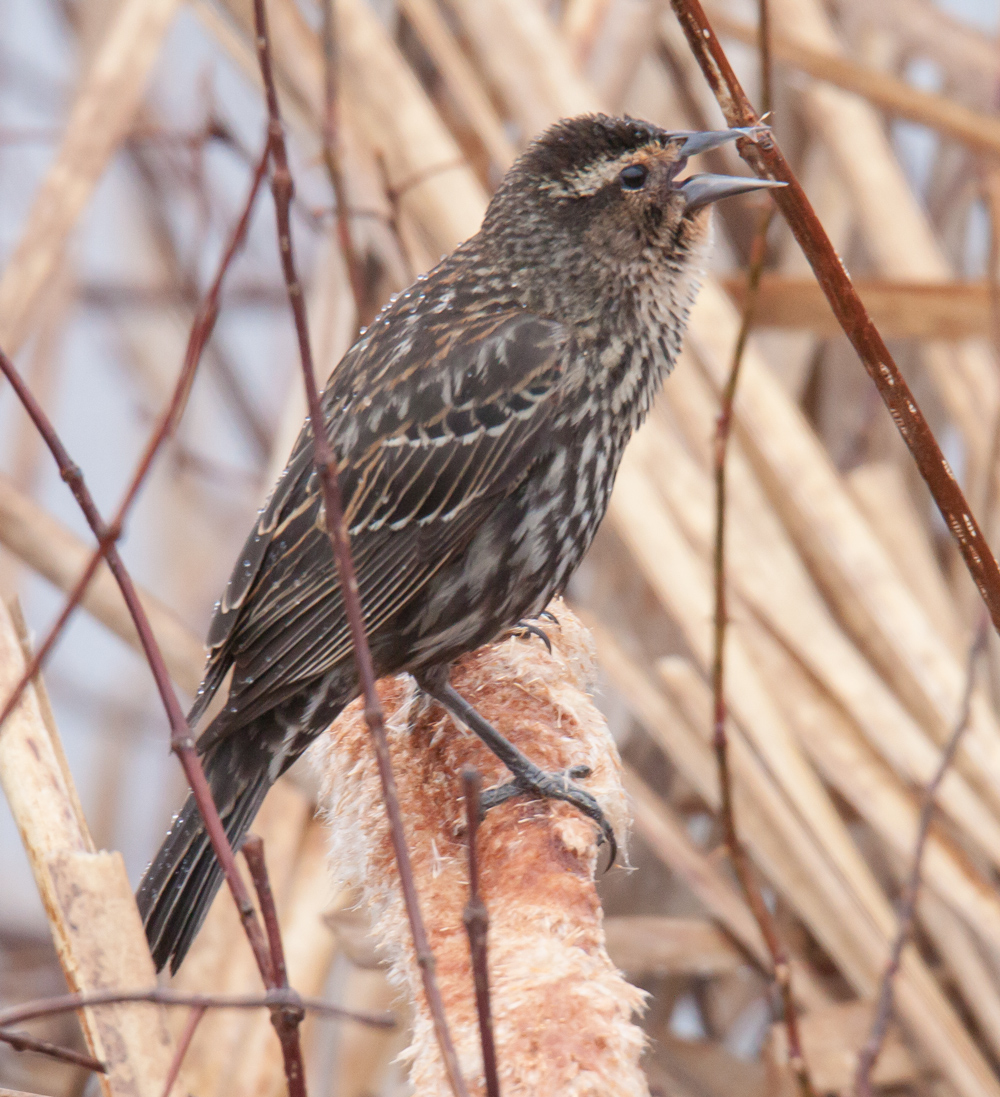
My life was much simpler before I started to photograph birds. I naively assumed that all Red-winged Blackbirds were black and had red wings. There is no way in the world that I would have even guessed that the bird in this photograph is a female Red-winged Blackbird, but I know now that’s what it is.

With experience comes wisdom, perhaps, but I generally feel more confused than wise when it comes to identifying birds. There are so many variables to consider, including the geographic location, the time of the year, the age of the bird, and, of course, its gender. Sure, there are lots of resources available over which to pore, but I’m often left with a certain degree of uncertainty about a bird’s identification. Apparently I am not alone, because I have overheard heated discussions among experience birds trying to identify a distant bird that they can barely see in their spotting scopes.

Female Red-winged Blackbirds (Agelaius phoeniceus) are amazingly beautiful and I would love to feature them more often in this blog, but I find them to be unusually difficult to photograph. Unlike their male counterparts, who are visible and vocal to the point of being a bit obnoxious, the females tend to spend their time pecking about industriously in the undergrowth, rarely coming out into the open.

I was pleased to be able to get this mostly unobstructed shot of this female blackbird recently as she was singing in the rain. If you look closely, you can see a series of raindrops beading up on her back. Other birds may have been seeking shelter from the rain, but she kept working.

As the foliage reappears on the trees and bushes, it’s going to get tougher and tougher for me to spot birds. I’ll still be trying to photograph them for a while longer until I switch to macro mode and focus more on insects and flowers, which have their own identification challenges.
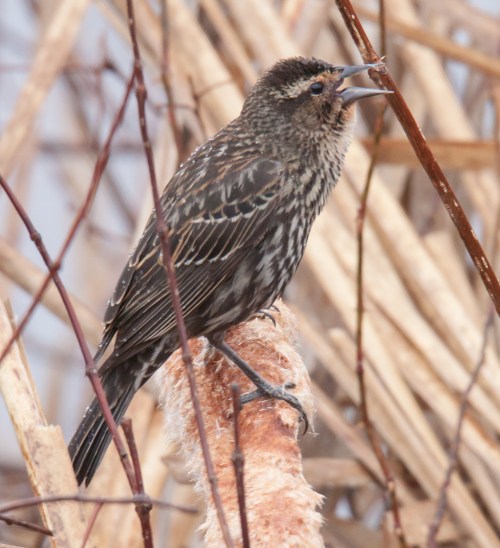
Red-winged Blackbird

© Michael Q. Powell. All rights reserved.

Read Full Post »

Have you ever seen a bird that looked like it was wearing a costume? When I caught sight of  this female Red-winged Blackbird (Agelaius phoeniceus) in the cattails last week, it looked to me like she had donned a large head scarf and an additional coat of feathers as protection from the cold.

blackbird_feathers_blog

© Michael Q. Powell. All rights reserved

Read Full Post »