Feeds:
Posts
Comments

Posts Tagged ‘female Eastern Amberwing’

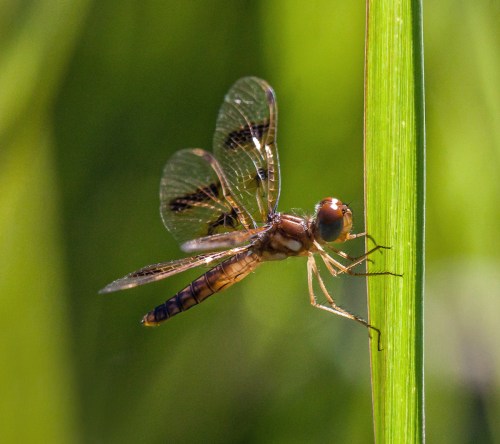
Eastern Amberwings (Perithemis tenera) are one of the smallest dragonfly species where I live—less than one inch (25 mm) in length. I often see the amber-colored males buzzing around at the ponds that I visit, but it is pretty rare for me to spot a female.

Yesterday I visited Jackson Miles Abbott Wetland Refuge and was a bit surprised to see a female Eastern Amberwing dragonfly in the vegetation near the edge of a small pond. Unlike the males, females of these species have patterned wings that are partially clear. I maneuvered around to composed a shot and managed to capture this image of the dragonfly.

According to the website Dragonflies of Northern Virginia, one of my favorite dragonfly websites, female Eastern Amberwing dragonflies are often found far from the water in meadows where they share perches with hornet and other wasps. When they are threatened, these dragonflies will rhythmically move their wings up and down while pulsing their abdomens in imitation of a wasp to scare off potential predators that believe they are about to be stung.

I don’t know if this female was checking out the males at the pond, searching for a suitable partner, or perhaps had just mated and was recovering from the experience. Whatever the case, I was delighted to spot this elusive little dragonfly.

Eastern Amberwing

© Michael Q. Powell. All rights reserved.


Read Full Post »

Eastern Amberwing (Perithemis tenera) dragonflies are the smallest dragonflies in my area at less than an inch (25 mm) in length, but are quite common. I often spot the distinctive amber wings of the males as they fly low over the waters of many ponds. Females of this species, however, do not have amber wings—they have brown patches on their wings—and I rarely see them.

According to the Dragonflies of Northern Virginia website, female Eastern Amberwings are often found far from water, in meadows among summer wildflowers. “They’re probably hunting even smaller visitors to these summer blooms like midges, flower flies and tiny bees. They also share their colorful perches with hornets and other wasps. Perhaps, this is how their mimicry behavior evolved, and may explain why females appear to practice it more than males.”

On Monday I was thrilled to spot this female while I was exploring a pond at Jackson Miles Abbott Wetland Refuge. I am not sure if she had ventured down to the pond to mate, but whatever the case I was happy to capture some shots of her as she buzzed about the vegetation surrounding the pond. I love her two-toned eyes and the beautiful markings on her body.

Eastern Amberwing

Eastern Amberwing

Eastern Amberwing

© Michael Q. Powell. All rights reserved.

Read Full Post »

During a recent visit to Jackson Miles Abbott Wetland Refuge I was delighted to spot a female Eastern Amberwing dragonfly (Perithemis tenera) as she was depositing her eggs in the vegetation in a small pond. Initially she would hover for a moment, as you can see in the first image, and then dip the tip of her abdomen straight downwards to release some eggs, as shown in the second image. The dragonfly repeated this process multiple times at this spot before moving on to other spots.

I have observed this process multiple times, but have rarely been able to photograph it. Eastern Amberwings are the smallest dragonflies in my area and are only about an inch (25 mm) in length, so they are a challenge to photograph. Fortunately when the female is ovipositing, she hovers a bit, which gives me time to focus on her. Sharp-eyed viewers may have noticed that the wings of this dragonfly have patterns, but are not amber in color—only male Eastern Amberwings have amber wings.

Eastern Amberwing

Eastern Amberwing

© Michael Q. Powell. All rights reserved.


Read Full Post »

Within the bird and insect kingdoms, species tend to be named on the basis of the appearance of the male and not of the female. This can be incredibly confusing, especially for a neophyte who is trying to identify an individual.

I remember be utterly baffled years ago when someone explained to me that the sparrow-looking bird in front of me was a female Red-winged Blackbird. What? How could that be? The “blackbird” was not black at all, and as for the “red wings,” there were none.

Over time I have become more familiar with the birds and the bees and some of the intricacies of sexual differentiation within species. I do not give too much thought that this pretty little female Eastern Amberwing dragonfly (Perithemis tenera) that I spotted last week at Green Spring Gardens has wings that are not completely amber-colored like those of her male counterpart.

Eastern Amberwings are the smallest dragonflies in our area at less than an inch (20-25 mm) in length. It is hard to miss the males as they buzz about low over the waters of ponds, but females tend to be much more elusive and often hunt far from the water. In the case of the one in the photo, she was perched on some vegetation in a bed of flowers a long way from the pond.

According to the Dragonflies of Northern Virginia website, “Amberwings are reported to have the most intricate courtship of any dragonfly. After the male selects several possible egg-laying sites for a mate, he flies off to find a female and leads her back to his potential nursery. To attract her, he sways back and forth, and hovers with his abdomen raised. Mating only occurs if the females approves—making this one of the few dragonflies where females choose the males.”

Eastern Amberwing

© Michael Q. Powell. All rights reserved.

Read Full Post »

It love it when dragonflies cooperate and choose particularly photogenic perches, as these female Eastern Amberwing dragonflies (Perithemis tenera) did on Tuesday at Green Spring Gardens in Alexandria, Virginia, not far from where I live. The males of this species, whose wings are a solid amber in color, mostly seemed to be hanging out at a pond at the bottom of a hill, while the females were flitting about among the flowers in the gardens at the top—the gender separation reminded me of the awkwardness of junior high dances when I was growing up.

As many of you may recall, dragonflies and damselflies are part of the Odonata order of flying insects. My friend and fellow dragonfly enthusiast Walter Sanford has coined the term “odonart” to refer to artsy-style photos that we manage to capture of our favorite aerial acrobats. I think that both of these images qualify to fit into that self-created category, given the beauty of the dragonflies and their particularly photogenic perches.

Eastern Amberwing

Eastern Amberwing

© Michael Q. Powell. All rights reserved.

Read Full Post »

Eastern Amberwings (Perithemis tenera) are one of the smallest dragonfly species where I live—less than one inch (25 mm) in length. I often see the amber-colored males buzzing around at the ponds that I visit, but it is rare for me to find a female.

According to the wonderful website Dragonflies of Northern Virginia, female Eastern Amberwing dragonflies are often found far from the water in meadows where they share perches with hornet and other wasps. When they are threatened, these dragonflies will rhythmically move their wings up and down while pulsing their abdomens in imitation of a wasp in order. Their goal is to scare off potential predators that believe they are about to be stung.

I spotted this tiny beauty yesterday while I was exploring Occoquan Bay National Wildlife Refuge. I was, in fact, far from the water when I photographed her.  She posed briefly, it seemed, when I raised my camera and seemed to smile a little.

Eastern Amberwing

© Michael Q. Powell. All rights reserved.

Read Full Post »

As a nature photographer, I am used to living with compromises. Unlike some other kinds of photographers, I don’t have the luxury of waiting for perfect light or photographing only perfect subjects. I can make a few adjustments or move about a bit to improve my composition, but most of the time I deal with imperfections of one sort or another.

Every once and a while, though, I’ll take a photo that doesn’t require any substantial adjustments or even cropping–it looks just like I imagined it would. That was the case with a recent image I captured of a female Eastern Amberwing dragonfly (Perithemis tenera) at Occoquan Bay National Wildlife Refuge.  I like the way that I captured the subject, I like the curved of the vegetation on which it is perched, and I like the background. It’s a bonus that I didn’t need to crop.

Perfection is elusive in any pursuit—this is about as close as I can come to it in my photography.

Eastern Amberwing

© Michael Q. Powell. All rights reserved

Read Full Post »

Do you consider yourself to be artistic? All of my life I have been in awe of people who can draw and paint and create art, but have never considered myself to be artistic. Increasingly, though, my photography has opened up a creative side that I am trying to nurture.

As some of you know, I decided that I want to try my hand at watercolor painting and did a posting not long ago on my first efforts at doing a landscape. I don’t usually shoot landscapes with my camera, so I thought that I would try a more familiar subject for my second project—I decided to try to paint a dragonfly. In retrospect, I probably should have chosen an easier subject, but I am so inexperienced in art that I didn’t realize what I was getting myself into.

For inspiration, I used a recent photo that I took of a female Eastern Amberwing (Perithemis tenera). I have already included it in a blog posting, but am reprising it as the final photo, so you’ll know what my artistic efforts were supposed to look like.

I tried a couple of different approaches to my subject. First I tried sketching the dragonfly. I didn’t have a pencil handy, so I used a Bic ballpoint pen. My observation skills and sense of proportion are definitely lacking, but it was surprisingly fun to try. Without an eraser to correct my errors, I felt a bit like I was walking on a tightrope without a net.

Then I tried to draw with Crayola crayons? Why? I happened to be at Walmart yesterday and picked up a pack of 24 for only 50 cents at a back-to-school sale. My drawing looks a bit like a cartoon to me.

Finally I was ready to try watercolor. I decided that I would do the painting without bothering to sketch it out. Oops. I was using some inexpensive paper and it started to buckle a bit when I tried to cover the entire area with an overly wet wash of light green. I think I then attempted to put on the next layer before the first one was fully dry. I still feel like a second-grader in my watercolor skills, but it still was enjoyable trying to see what worked and what didn’t.

I did my final attempt in a sketchbook that is not intended for watercolor. I sketched out the dragonfly with a mechanical pencil and then colored the sketch with my watercolor paints. Out of all of my attempts, this is the one that I like the most. I felt a bit more confident in using the paints and in some of my strokes.

So what did I learn? Most significantly I learned that it’s worth taking a risk of feeling embarrassed; that it’s ok to try something new and achieve only a limited amount of success;, and that the amount of enjoyment that I can derive from a creative pursuit is not directly tied to any specific outcome.

dragonfly sketch

dragonfly crayon drawing

#worldwatercolormonth

#worldwatercolormonth

Eastern Amberwing

© Michael Q. Powell. All rights reserved.


Read Full Post »

Eastern Amberwings (Perithemis tenera) are the smallest dragonflies in our area. You can often find males buzzing around at the water’s edge, but females are harder to spot because they hang out in vegetation away from the water. I was thrilled therefore to see a beautiful female this past Friday at Occoquan Bay National Wildlife Refuge in some beautiful morning sunlight.

I decided to give a male Eastern Amberwing dragonfly equal billing in this post, because I really like the way that the shadows and the reflections make it look like he has an elongated body and extra sets of wings.

Eastern Amberwing

Eastern Amberwing

© Michael Q. Powell. All rights reserved.

Read Full Post »