Feeds:
Posts
Comments

Posts Tagged ‘Erythemis simplicicollis’

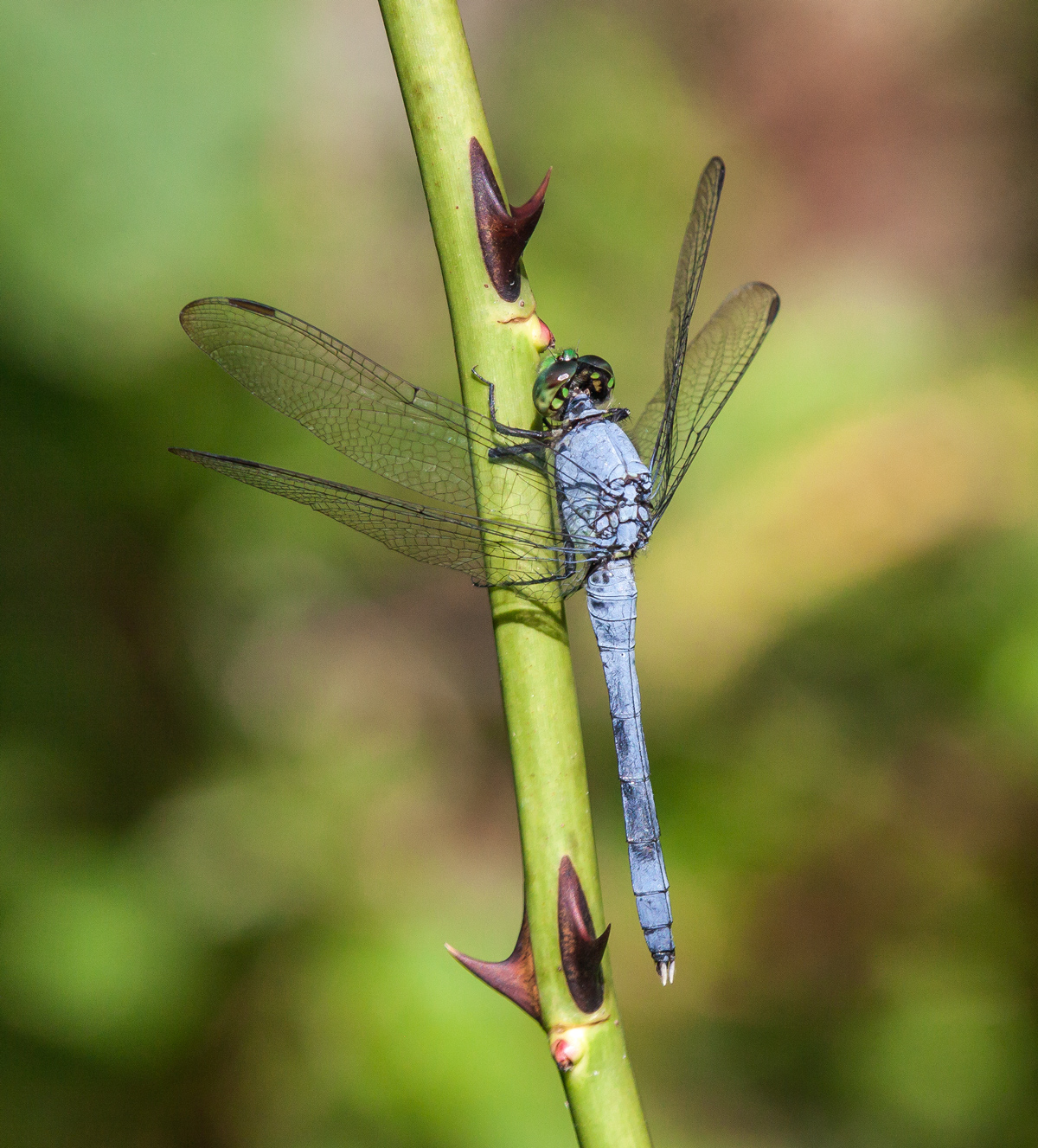
I don’t know about you, but if I were an insect with large, fragile wings, I think that I would avoid perching on vegetation with large thorns. This male Eastern Pondhawk dragonfly (Erythemis simplicicollis), however, is obviously bolder and more skilled than I am. With precision flying skills matching the parking abilities of an inner city driver, he has managed to squeeze into a space that seems barely large enough to accommodate him.

Pointless perching—that seems to be the point.

Eastern Pondhawk

© Michael Q. Powell. All rights reserved


Read Full Post »

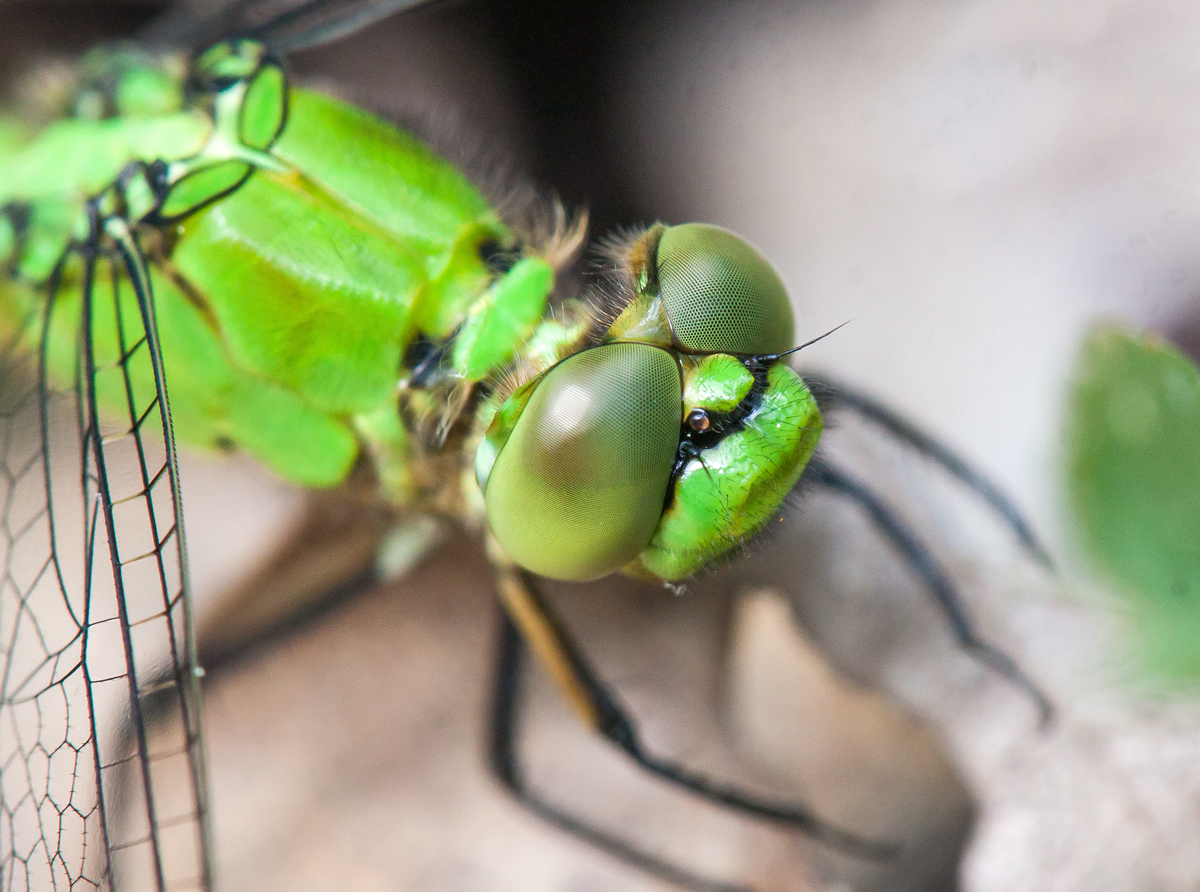
There is something really special about green eyes, especially when you see them up close, really close. Every dragonfly season I try to find at least one cooperative dragonfly that sees eye-to-eye with me and lets me get a shot like this. I photographed this female Eastern Pondhawk (Erythemis simplicicollis) earlier this month at Huntley Meadows Park in Alexandria, Virginia.

Eastern Pondhawk

© Michael Q. Powell. All rights reserved.

Read Full Post »

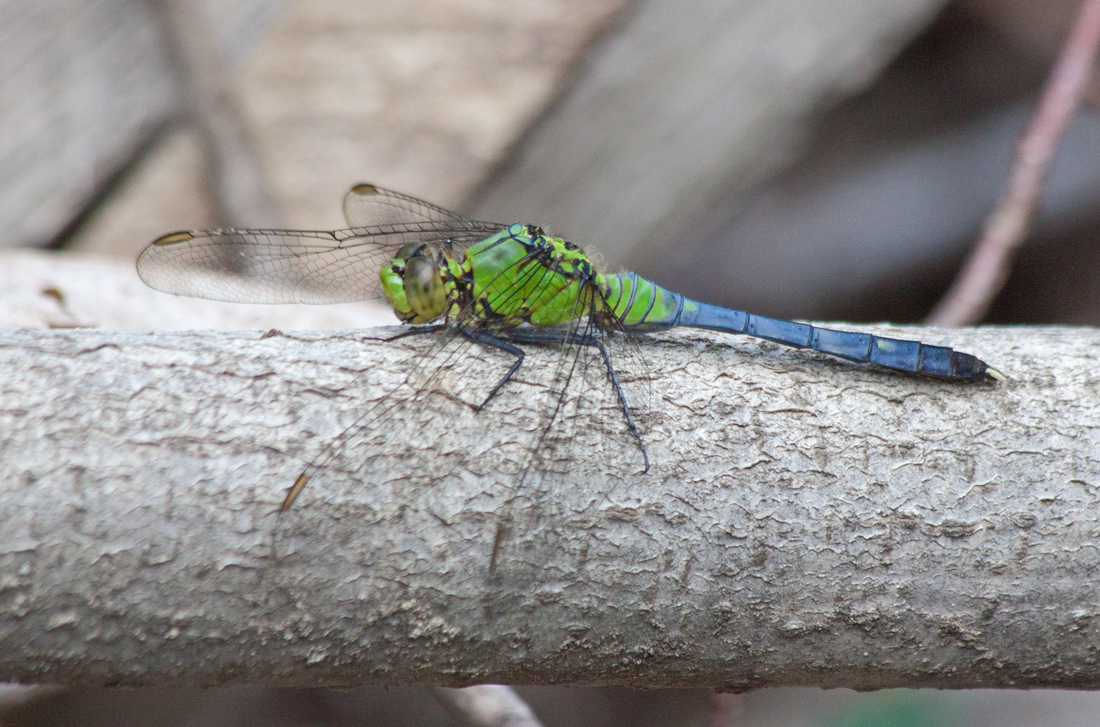
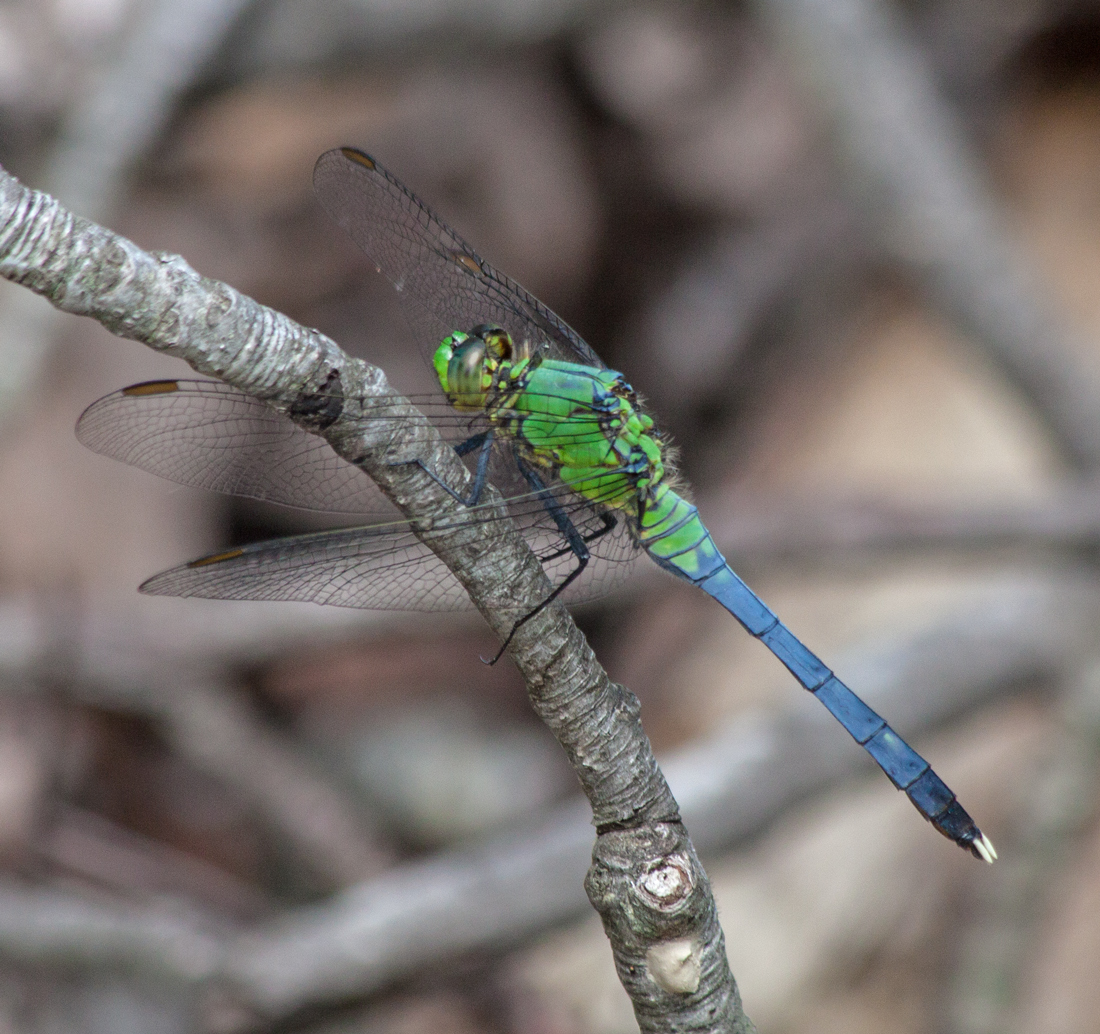
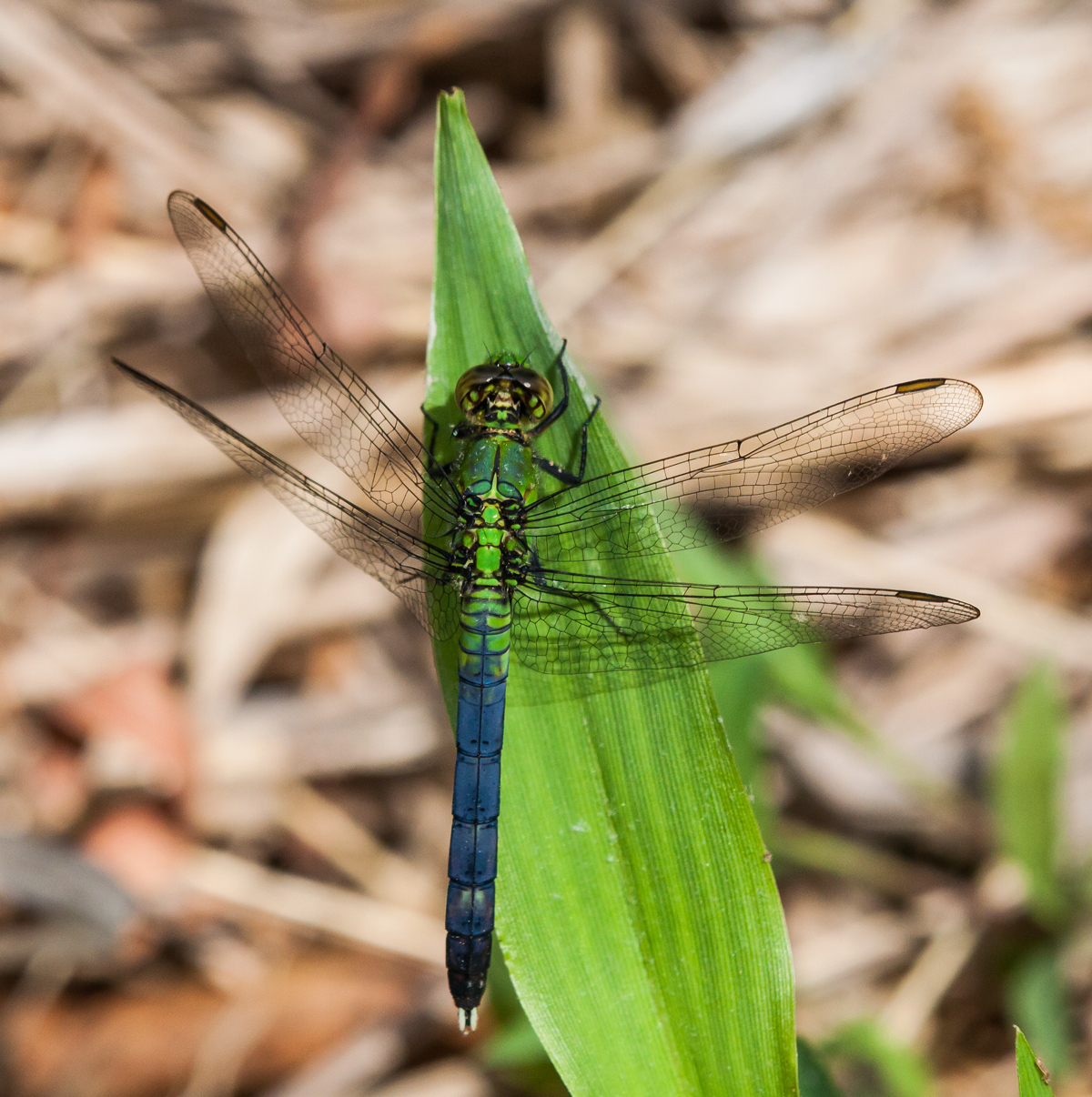
Male Eastern Pondhawk dragonflies (Erythemis simplicicollis) start out with the same bright green coloration and bold black and white stripes as the female that I featured in a posting earlier this week. Over time the males turn a fairly nondescript blue and are outshone by their female counterparts.

On Monday, I was fortunate to capture this image of a male Eastern Pondhawk in a transitional  stage, with beautiful two-toned shades of green and blue. I was thrilled when it perched on a green plant, which helps to draw the viewer’s eye to the dragonfly in a background of dried-up fallen leaves.

Eastern Pondhawk

© Michael Q. Powell. All rights reserved

Read Full Post »

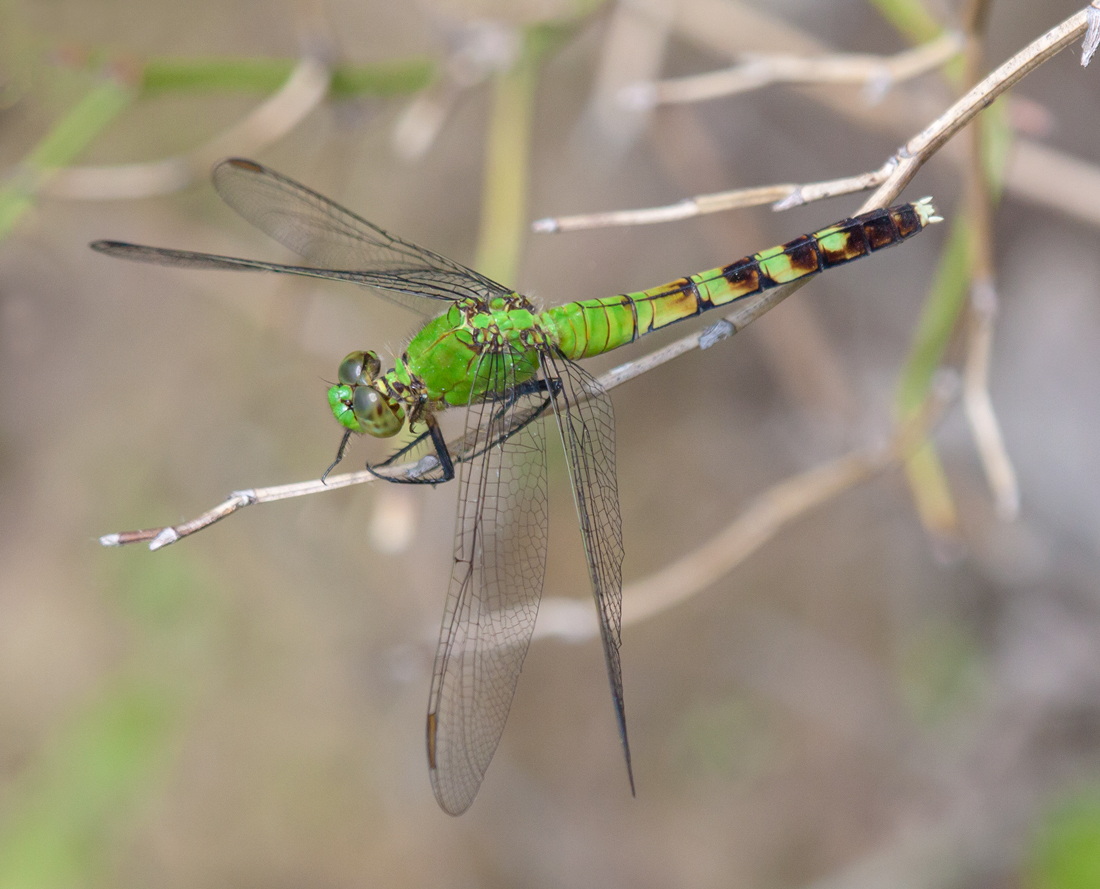
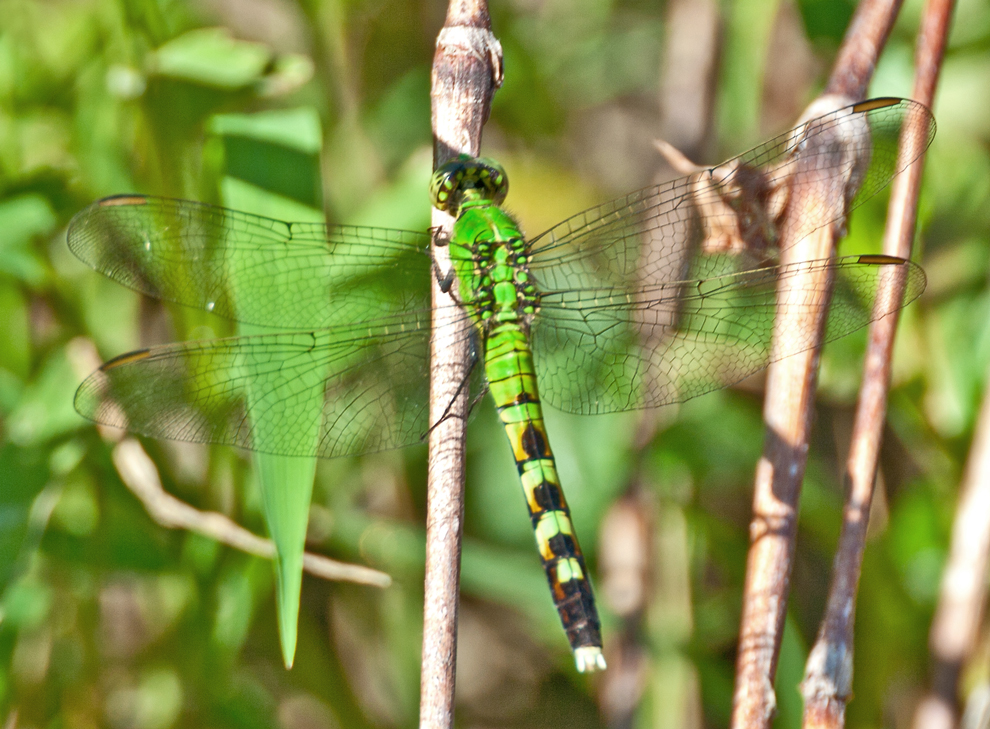
I celebrated May Day yesterday by searching for dragonflies at Huntley Meadows Park and was rewarded by spotting my first Eastern Pondhawk dragonflies (Erythemis simplicicollis) of the season. This bright green female pondhawk was almost hidden in the fresh vegetation, but she really showed her colors when she perched on the brittle fallen leaves on the forest floor. The muted tones of gray and brown created a wonderful (albeit cluttered) backdrop that really let her beautiful colors and patterns stand out.

Eastern Pondhawk

© Michael Q. Powell. All rights reserved

Read Full Post »

The coloration of this female Eastern Pondhawk dragonfly (Erythemis simplicicollis) helped it to blend in almost perfectly with the lush green vegetation this past Friday at Huntley Meadows Park. This species of dragonfly is not only beautiful, but it is also deadly. I was reminded of this latter fact when I realized why the dragonfly had stopped and perched—it was consuming a small moth that it had just caught.

Eastern Pondhawk

© Michael Q. Powell. All rights reserved.

Read Full Post »

Early yesterday morning I thought that this female Red-winged Blackbird (Agelaius phoeniceus) was gathering nesting materials, which seemed a little strange this late in the season. When I looked at the images on my computer, however, I was surprised to see that she had instead captured an immature male Eastern Pondhawk dragonfly (Erythemis simplicicollis), a species that itself has a reputation as a ruthless predator.

As the old adage suggests, sometimes the predator becomes the prey.

Eastern Pondhawk

Eastern Pondhawk

Michael Q. Powell. All rights reserved.

.

Read Full Post »

I wouldn’t have thought that a moth would taste very good, even for a dragonfly, but this young male Eastern Pondhawk (Erythemis simplicicollis) would probably disagree.

I knew that dragonflies are fierce predators and ate other insects, but somehow I didn’t imagine that their diet included moths, which I would think would be dry and not have much nutritional value.

Of course, I have been known to consume chicken wings, which require a lot of work in order to get a very small amount of meat, so who am I to criticize a dragonfly’s diet. I might offer him one suggestion—the moth would probably taste better if he coated it with a spicy sauce.

Eastern PondhawkEastern Pondhawk

© Michael Q. Powell. All rights reserved.


Read Full Post »

Yesterday the fields at Huntley Meadows Park were abuzz with beautiful emerald-and-black dragonflies. As I walked through the grass, the Eastern Pondhawks (Erythemis simplicicollis) would fly up to about knee level and then settle back down on the ground or perch on some low hanging plants.

Eastern Pondhawk

The dragonflies were a bit skittish and it was a bit of a challenge to get clear shots of them. Occasionally one of them would fly to a slightly higher perch and permit me to get a shot like the first one that separates the subject from the background. Long-time readers of this blog know that I will usually try to move it as close as I can and I was happy to get this close-up shot of an Eastern Pondhawk that lets you see some of the facets of its amazing compound eyes.

Eastern Pondhawk

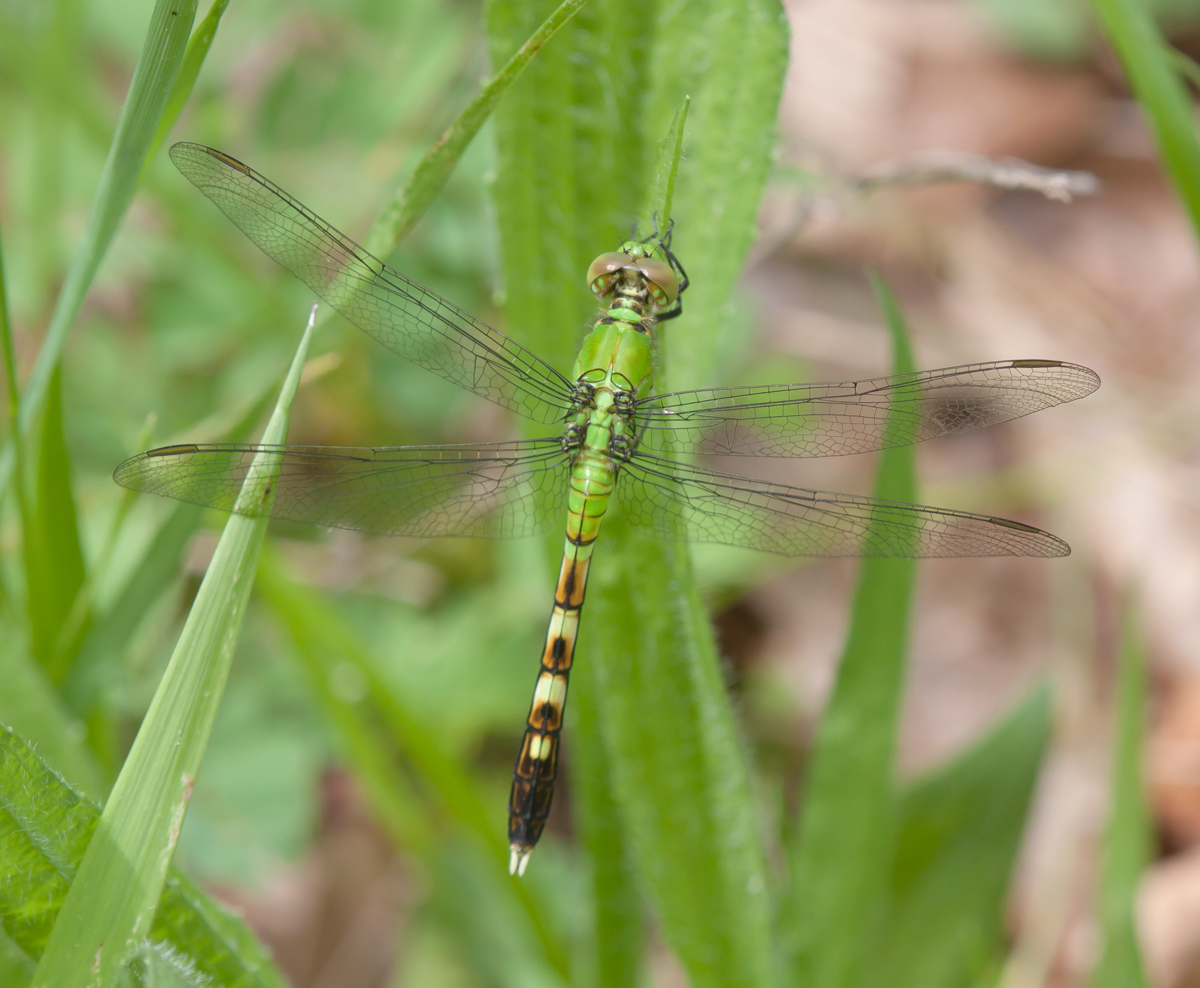
All of the Eastern Pondhawks had the same beautiful green coloration. Eventually the male Eastern Pondhawks will turn blue, but this early in the season the juvenile male have the same coloration as the females. How do you tell them apart? My fellow photographer and blogger Walter Sanford is an expert on this subject, but in this case even I can tell the difference by looking at the terminal appendages.

In the shot below, you can tell it is a male because the white cerci at the end of the abdomen are long and close together.

Eastern Pondhawk

Juvenile Male Eastern Pondhawk

By contrast, the white cerci of the female are shorter and more widely spaced, as in the photo below.

Eastern Pondhawk

Female Eastern Pondhawk

That just about exhausts my knowledge of dragonfly anatomy. My focus is mostly on capturing their beauty, but it is amazing how much I learn along the way about these fascinating little creatures.

© Michael Q. Powell. All rights reserved.

Read Full Post »

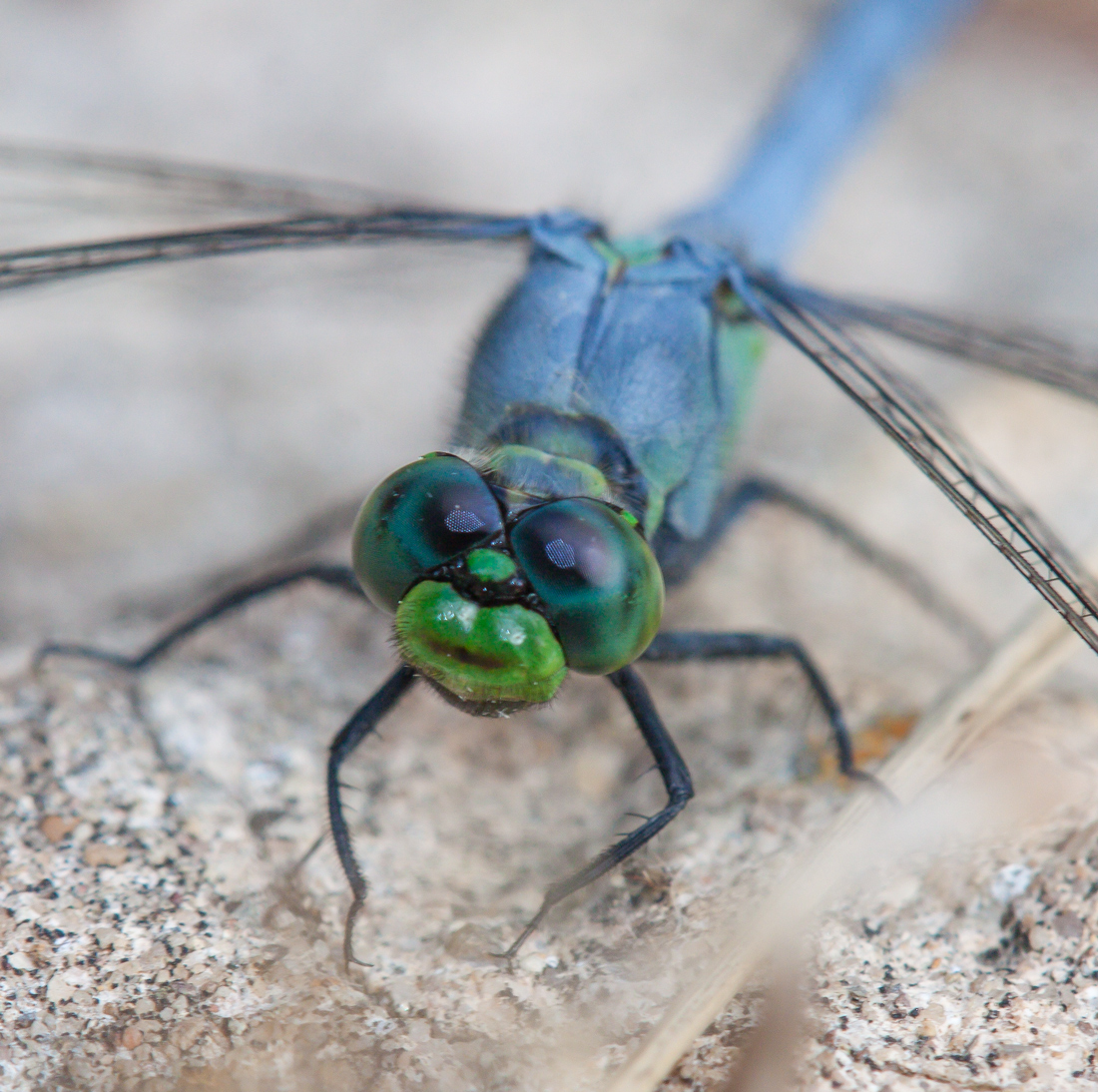
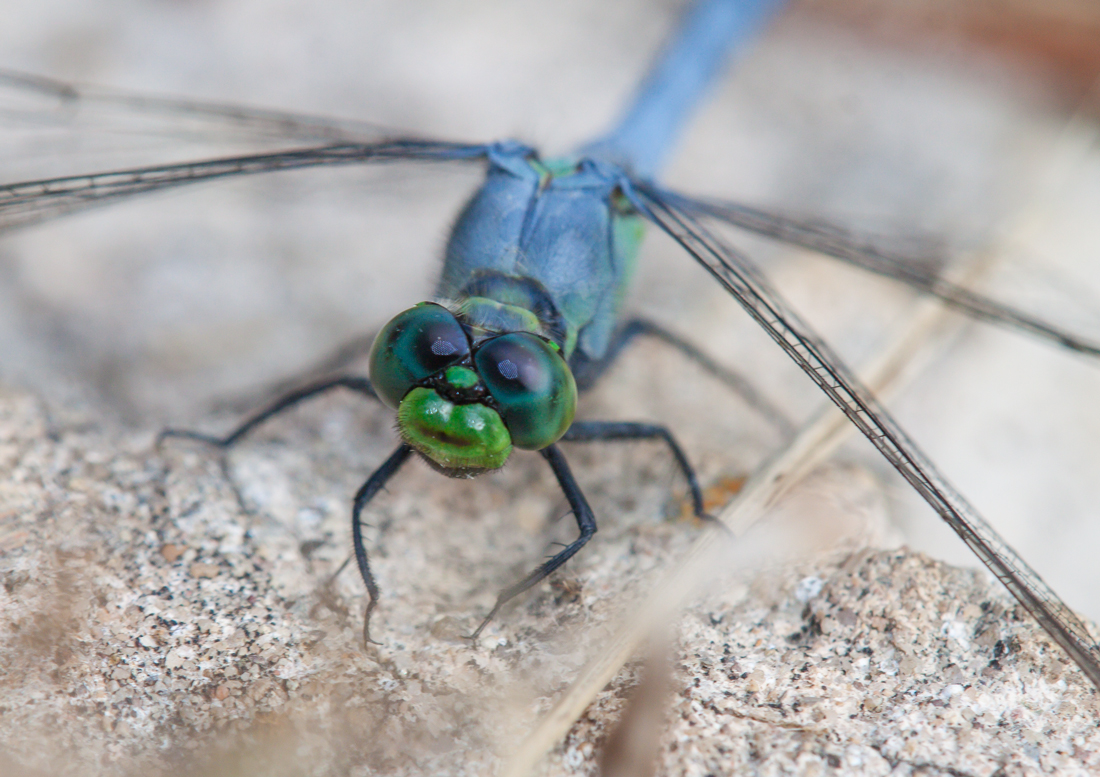
One of the main reasons why I love having a macro lens is that it that it lets me capture photos like this extreme close-up image of a male Eastern Pondhawk dragonfly (Erythemis simplicicollis) that I took yesterday at Green Spring Gardens, a historical, county-run garden in Alexandria, Virginia.

I have always been fascinated by the multi-faceted compound eyes of dragonflies and the blue-green eyes of the Eastern Pondhawk are particularly stunning. When I first caught sight of this dragonfly, he was sunning himself on a rock near the edge of a small pond. I kept low to the ground and approached him slowly. He didn’t fly away and seemed more curious about my presence than afraid.

For these shots, I rested the lens hood of the camera on the edge of the rock ledge to get this low, eye-to-eye perspective. This technique served to steady my camera, so I was able to capture a good deal of detail of the dragonfly’s face. In the initial photo, for example,which is a cropped version of the second image, you can see that the dragonfly has stubble on his chin. The third shot is a cropped version of the last photo, again to show greater detail and to draw the attention of viewers more directly to the eyes.

Do you think the shots are more effective when cropped or do you prefer the larger perspective images?

Eastern Pondhawk

Eastern Pondhawk

Eastern Pondhawk


pondhawk1_closeupb

© Michael Q. Powell. All rights reserved.


Read Full Post »

Dragonflies are so beautiful that I sometimes forget that they are also fierce predators. Last weekend at my local marsh, I captured this image of a female Eastern Pondhawk dragonfly (Erythemis simplicicollis) feeding on another dragonfly, which looks like it might be a female Blue Dasher (Pachydiplax longipennis).

The dragonfly is perched on the end of one of the slats of a railing that along the edge of an inclined section of the boardwalk. I cropped the image to focus viewers’ attention on the dragonfly, but I also like the second version of the same photo, which is close to the original view when I took the shot. Somehow those three slats remind me of a row of tombstones, a memorial to the predator’s prey.

Eastern Pondhawk

Eastern Pondhawk

© Michael Q. Powell. All rights reserved.

Read Full Post »

In the shade of the flowering lotus plants, these two Eastern Pondhawk dragonflies (Erythemis simplicicollis) found a few moments for some summer lovin’. Summer lovin’, it happened so fast.

Eastern Pondhawks mating

© Michael Q. Powell. All rights reserved.

Read Full Post »

Yesterday I wrote of a male Eastern Pondhawk dragonfly (Erythemis simplicicollis) transitioning to adulthood, but I realized this morning that not all viewers know what an adult male pondhawk looks like.

This first shot shows an adult male Eastern Pondhawk perched above a big mass of algae, duckweed, and other “stuff” at a small pond at a local garden. Originally I was frustrated when the dragonfly flew into this mess and did not perch above the cleaner water of the pond. I wasn’t sure if I could get a clear shot with all of the clutter, but was pleasantly surprised with the result. I actually like the bubbles in the foreground and the texture and visual interest that it adds to the shot.

pondhawk1_blog

I took the second shot in a totally different environment, at the edge of a field. It shows the bright green coloration of the Eastern Pondhawk female (and young males). My local dragonfly expert, Walter Sanford, keeps reminding me that one of the keys to differentiating the genders is the terminal appendages and I think this one is a female.

pondhawk2_blogWhen you take the blue from the top photo and the green from the bottom one, you get the color combination of yesterday’s posting. As for me, I find the colors to be exceptionally beautifully individually as well as in combination.

© Michael Q. Powell. All rights reserved.

Read Full Post »

I have always been intrigued by the fact that many male dragonflies start out looking like females and over time acquire their male coloration. It’s a bit of an oversimplification, but male Eastern Pondhawk dragonflies (Erythemis simplicicollis) are blue and females are green. Males of this species initially are green and gradually turn blue. Last weekend I managed to get some shots of a dragonfly who is in midst of this transitional period.

I really like his current two-toned look, but before long he’ll be almost completely blue, (though he will retain the green face.

drag_bg1_blogdrag_bg2_blog

© Michael Q. Powell. All rights reserved.

Read Full Post »

As a follow-up to last week’s preview, here is the complete story of my recent encounter with a Bold Jumping Spider (Phidippus audax) and a female Eastern Pondhawk dragonfly (Erythemis simplicicollis). The photos are a bit graphic, particularly for those of us who like dragonflies, but they illustrate the reality of nature that even super predators like dragonflies can easily become prey.

dragon1A_spider_blogAs I was walking at my local marshland park, I spotted a bright green dragonfly perched on the boardwalk and suspected immediately that it was a female Eastern Pondhawk. I moved in slowly to get a shot and was a bit surprised when the dragonfly did not take off when I got close. This is the initial view I had of the dragonfly.

dragon3_spider_blogI looked closely at the dragonfly and noticed that it was lying on its side and appeared to be dead. Wondering what might have caused its demise, I picked up the dragonfly’s body to do some amateur forensic analysis. (I obviously watched to many televisions shows about crime scene investigations.) As I lifted the body toward my eyes, I was shocked to find that a fuzzy black spider was still attached to it. Apparently the spider had been hiding in the gap between the boards as it feasted on the dragonfly.

Somewhat in shock, I dropped the dragonfly back onto the boardwalk and the fall caused the spider to be separated from its prey. Undeterred, it quickly set off to recapture the dragonfly.

dragon4_spider_blogThe spider grabbed the dragonfly in a headlock and began to drag it back toward the gap between the synthetic boards of the boardwalk. It seemed totally oblivious to my presence.dragon6_spider_blog

When it reached the gap, the spider paused for a few seconds, as though considering possibility of dragging the body through the gap.

dragon7_spider_blog

The spider decided to give it a try and did its best to pull the body in, starting with the head.

dragon9_spider_blog

Despite the spider’s best efforts, however, the dragonfly’s body was simply too big.

dragon12_spider_blog

As I left the scene, the spider had again settled down out of sight below the surface of the boardwalk, happily enjoying its meal and presumably hoping that it would not be disturbed again.

dragon10_spider_blog

© Michael Q. Powell. All rights reserved.


Read Full Post »
How does a jumping spider, a spider that does not build a web, manage to capture a dragonfly? I don’t know how this Bold Jumping Spider (Phidippus audax) snagged an Eastern Pondhawk dragonfly (Erythemis simplicicollis), but I came upon the two of them after the capture had been completed and managed to snap a series of photographs of the action.

I am still working on the images and plan to do a longer posting, but wanted to give you a sneak preview.

dragon8_spider_blogdragon11_spider_blog

© Michael Q. Powell. All rights reserved.

Read Full Post »

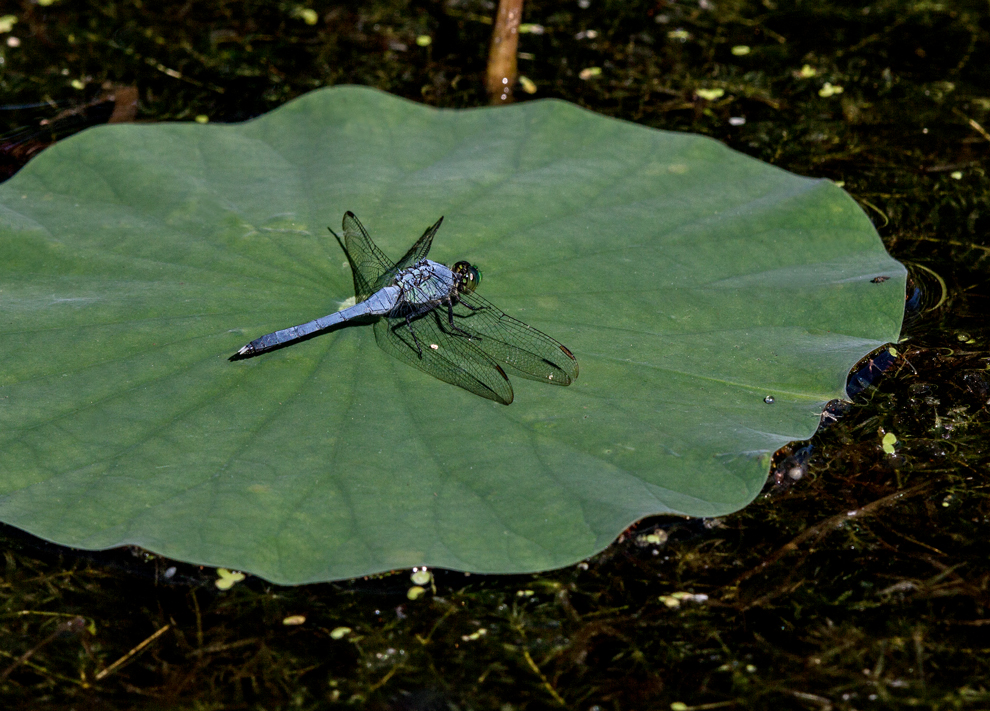
In most of my dragonfly shots the dragonfly is perched on an upright object, so, for variety, I decided to post this shot of a male Eastern Pondhawk dragonfly (Erythemis simplicicollis) in a different position—posing on a lily pad.

The dragonfly made multiple touch-and-go landings on this lily pad, sometimes landing near the edge, as in the first image, and sometimes in the middle, as in the second image. I couldn’t tell if he was using the lily pad as a platform for hunting insects or was merely resting. (It seems to me that it would be more advantageous for hunting to be higher up, unless you are hunting aquatic insects, which didn’t seem to be the case here.)

pad2_blogpad1_blog

© Michael Q. Powell. All rights reserved

Read Full Post »

All of the photos that I have posted this year of the Eastern Pondhawk dragonfly (Erythemis simplicicollis) have been of females, which are a beautiful emerald green, but I think that you will agree that the male in this photo is equally stunning. I love the mixture of blue and green on its body and was particularly happy to capture this one perched on a colorful flower.

This is a shot from couple of weeks ago, when I was able to borrow my friend’s Nikon D7000 and Tamron 180mm macro lens for a little while while we were shooting at Kenilworth Aquatic Gardens in the District of Columbia. Every time that I look over the images that I shot, I am impressed by the results that I was able to achieve with a “foreign” camera—normally I shoot with a Canon.

Pondhawk lorez

© Michael Q. Powell. All rights reserved

Read Full Post »

It was bound to happen. No more than I few days ago I lamented that I had never seen a dragonfly eating, in responding to a wonderful posting by Sue of Backyard Biology about dragonflies as super predators—you should check out her posting, unless you are squeamish about things like headless dragonflies.

Sure enough, this past weekend I was able to get some photos of a female Eastern Pondhawk dragonfly (Erythemis simplicicollis) with a bee that she had captured. Initially, I was just trying to get a photo of the beautiful emerald-colored dragonfly on the plant in the second photo. I didn’t even realize that she was cuddling a bee in her front legs, almost like a little baby.

Eventually she flew down from the plant to the edge of the boardwalk to enjoy her meal and I got the first shot. I had to lean over the edge of the boardwalk to get the photo and just barely avoided falling into the bushes below.

My usual experience is that I am so excited about photographing a subject the first time that I not very concerned about the quality of the images. I will keep my eyes open and hope to capture some more images of dragonflies feeding.

dragonfly_bee1_blogdragon_bee2_blog

© Michael Q. Powell. All rights reserved

Read Full Post »

I chased around this beautiful female Eastern Pondhawk dragonfly (Erythemis simplicicollis), hoping in vain that she would land on something more natural-looking than the composite boards of the marsh boardwalk. Several times she took off and circled around a bit, but returned each time to the boardwalk.

Shooting from a high angle, I was able to capture some of the details of the dragonfly that I do not usually see, like the little hooks at the end of the hairy legs. I really like her pose as she seemed to lean toward me, without seeming threatening in any way.

As always, I was struck by the strikingly beautiful emerald color of the females of this species. It’s even more impressive in real life.

green_blog

Michael Q. Powell. All rights reserved

Read Full Post »

Normally, I try to have an uncluttered background for my dragonfly shots, but the brilliant green body of this female Eastern Pondhawk (Erythemis simplicicollis) really helps it to stand out (and this was the first pondhawk that I saw this spring).

Most of the dragonflies that I observe at my local marsh are either Blue Dashers or Common Whitetails, so I was really excited when a flash of emerald green caught my eye—the color is distinctive enough that I knew immediately what it was. Without paying too much attention to my surroundings, I moved forward to try to get a better angle on the dragonfly.  The next thing I knew, I was ankle-deep in marsh mud, but did manage to get some shots.

I haven’t yet seen any male Eastern Pondhawks, which are mostly blue, but I am keeping my eyes open and hope that it is only a matter of time until I photograph one this spring.

pondhawk1_blog

pondhawk2_blog

Michael Q. Powell. All rights reserved

Read Full Post »

A flash of emerald green whizzed past my eyes as I was walking in a meadow near my hotel in Massachusetts. What could it be? I waited a few minutes and recognized the familiar flight patterns of a dragonfly.

Most of the dragonflies that I see are drab by comparison with this one that is almost tropical in the brightness of its color. I am pretty sure this is a female Eastern Pondhawk (Erythemis simplicicollis). For more details about this dragonfly check out BugGuide.

Female Eastern Pondhawk

I stayed for a while longer in the meadow to see what else might appear and was pleased when a pretty bluish-green dragonfly flew into view. At first I thought it was a Blue Dasher but after examining him more closely I realized he was a different type.  I think he is a male Eastern Pondhawk (Erythemis simplicicollis).

Male Eastern Pondhawk

© Michael Q. Powell. All rights reserved.

Read Full Post »
« Newer Posts